Article

Development of Unity3D-Based Intelligent Warehouse Visualization Platform with Enhanced A-Star Path Planning Algorithm

College of Mechanical and Electrical Engineering, Shihezi University, Shihezi 832000, China
*
Author to whom correspondence should be addressed.
Appl. Sci. 2025, 15(22), 12202; https://doi.org/10.3390/app152212202
Submission received: 26 September 2025 / Revised: 30 October 2025 / Accepted: 14 November 2025 / Published: 17 November 2025

Abstract

In the context of rapidly growing logistics demand, traditional warehouse management methods are inadequate in meeting contemporary efficiency and accuracy requirements. The present study proposes the development of an intelligent warehouse visualization platform, the objective of which is to address issues such as high labor dependency, opaque inventory, and operational inefficiencies. The construction of a virtual warehouse environment was undertaken using Unity3D, with the aim of simulating real-world zones. These comprised storage areas, automatic guided vehicle (AGV) pathways, and operational spaces. The platform incorporates radio frequency identification devices (RFID) for item tracking and a role-based access system, enabling real-time monitoring and management of inbound, inventory, and outbound processes. In order to optimize AGV path planning, the proposed algorithm incorporates a dynamic weighted heuristic, a five-neighborhood search, a bidirectional search, and Bézier curve-based smoothing. The efficacy of these enhancements has been demonstrated through a reduction in searched nodes, computation time, and path length, while simultaneously enhancing smoothness. As demonstrated by simulations conducted in Unity3D, the optimized algorithm exhibits a reduction in search nodes of 59.19%, in time of 45.41%, and in path length of 18%, in comparison with the conventional A-star algorithm. The platform offers a safe, efficient, and scalable solution for enterprise training and operational simulation, contributing valuable insights for intelligent warehouse upgrading.

1. Introduction

The digital transformation of global supply chains is advancing at an unprecedented pace. The modernization of smart warehousing, the core hub of logistics systems, has become crucial for enhancing corporate competitiveness. Driven by emerging sectors like e-commerce and smart manufacturing, market demand now exhibits characteristics of high frequency, small batches, and tight timelines, which pose significant challenges to traditional warehousing models. Take X Company, a cotton picker manufacturer, as an example. Its warehousing operations suffer from high labor dependency, opaque inventory visibility, and unstandardized workflows, resulting in low operational efficiency, rising error rates, and high operating costs. Consequently, building an intelligent, visualized warehouse management system has become an urgent necessity to enhance the company’s operational capabilities.
To address these challenges, intelligent warehousing systems integrating IoT technology, automated equipment, and data-driven management have emerged [1]. By deploying hardware such as automated guided vehicles (AGVs), radio frequency identification (RFID) devices, and smart shelving, and establishing an integrated information management platform, these systems enable real-time monitoring, intelligent scheduling, and optimized decision-making across the entire warehousing process. Particularly noteworthy is the increasingly vital role of virtual simulation technology in the planning, validation, and training phases of smart warehousing. It constructs a “digital twin” of the physical system within a virtual space before operational deployment, enabling system layout verification, process simulation, and personnel training at minimal cost. This approach not only reduces reliance on physical equipment but also provides enterprises with a safe, efficient environment for training and operational simulation.
Automated Guided Vehicles (AGVs) serve as the primary tools for executing material handling tasks in warehousing operations and have been widely adopted in modern production systems. They optimize product transportation processes, reduce manual handling costs, and enhance production efficiency and accuracy [2]. Path planning serves as the core functionality enabling AGVs to execute material handling tasks. It assists AGVs in determining travel routes, establishing task execution sequences, and achieving precise obstacle avoidance. The quality of its algorithms directly determines the transportation efficiency, safety, and cost-effectiveness of the entire logistics system [3]. Although the importance of AGV path planning is widely recognized, traditional path planning algorithms still face significant challenges when applied in practical scenarios such as the structured warehousing environments of companies like X. The widely used global path planning algorithm, Dijkstra’s algorithm [4], guarantees optimal paths but suffers from low search efficiency. While the A-star algorithm [5] ensures finding the shortest path, it often struggles to balance computational efficiency with path quality. Its fixed search strategy generates significant redundant computations in complex shelf layouts, prolonging response times. The Jump Point Search (JPS) algorithm [6], an efficient variant of the A-star algorithm, significantly accelerates search speeds on regular grid maps by pruning symmetric paths to skip intermediate nodes. However, its performance heavily depends on the map’s structural regularity. Furthermore, local path planning algorithms like the Artificial Potential Field (APF) method [7] are prone to getting stuck in local optima, while bio-inspired algorithms such as the Ant Colony Optimization (ACO) [8] and Particle Swarm Optimization (PSO) [9], which excel in dynamic environments, often struggle to meet the stringent real-time requirements of warehouse scheduling due to their computational complexity and challenging parameter tuning. More critically, most existing algorithmic research is validated in simplified two-dimensional simulation environments, creating a gap with the three-dimensional, structured physical environments of real intelligent warehouses. This discrepancy leads to a disconnect between algorithmic simulation performance and real-world application outcomes. Consequently, despite progress in system construction and algorithm optimization, significant gaps remain in three areas: deep integration between virtual simulation platforms and path planning algorithms; balancing AGV path smoothness with efficiency; and system applicability in actual enterprise environments. A path planning solution capable of seamless integration within highly realistic virtual environments and effectively addressing the aforementioned challenges has become the key to propelling intelligent warehousing from proof-of-concept to practical implementation.
Based on this, this paper proposes establishing a visual intelligent warehousing platform using the Unity3D virtual engine as a tool, leveraging databases for efficient data transmission. The aim is to integrate intelligent warehousing, virtual technology, and path planning to achieve efficient warehouse management and operations. The core research work of this paper unfolds across the following three levels:
(1)
At the system architecture level, leverage software such as Unity3D (Version 2022.3.4f1c1) and 3ds Max (Version 2020) is used to develop a virtual factory simulation platform for intelligent warehousing. This ensures stable platform operation and functional rationality, enabling effective interaction between employees, the platform, and goods.
(2)
Optimizing the AGV path planning algorithm, this study addresses inherent limitations of the traditional A-star algorithm by proposing a comprehensive enhanced A-star algorithm. This approach integrates dynamically weighted heuristics, direction-adaptive five-neighborhood search, efficient list management using hashing and binary heaps, bidirectional search strategies, and path smoothing via Bézier curves. It aims to simultaneously optimize search efficiency, path length, and operational smoothness.
(3)
Construct a virtual simulation environment within the Unity3D engine to conduct multi-scenario, multi-metric experimental validation of the enhanced A-star algorithm. A comparative analysis with the traditional A-star algorithm evaluates its performance enhancement in real-world warehouse operations, delivering forward-looking yet practical solutions for enterprise intelligent upgrades.
The article is structured as follows. Section 1 outlines the research background, motivation, and core objectives. Section 2 provides a systematic literature review of related work and analyzes existing challenges. Section 3 introduces the overall platform design, including the platform architecture, functional module design, and database design. Section 4 details the construction of the intelligent warehousing platform, demonstrating the implementation process and key technical details. Section 5 addresses AGV path planning and simulation validation, detailing the optimization process of the A-star algorithm. The optimized algorithm is integrated into the virtual platform constructed in Section 4, where comparative experiments are conducted across multiple scenarios and metrics. Finally, Section 6 concludes by summarizing the research work and main contributions, identifying current limitations, and outlining future research directions.

2. Related Work

By integrating virtual technology with the construction of smart warehousing facilities, visualization of warehouse and logistics management can be achieved. Virtual drills and operations facilitate personnel training and learning, among other requirements, enabling the establishment of a new management model. This section provides a systematic literature review of the key technologies applied in this paper to clarify current trends in the field and analyze the existing challenges faced by Company X.

2.1. Key Technologies

(1)
Intelligent warehouse system and virtual simulation platform
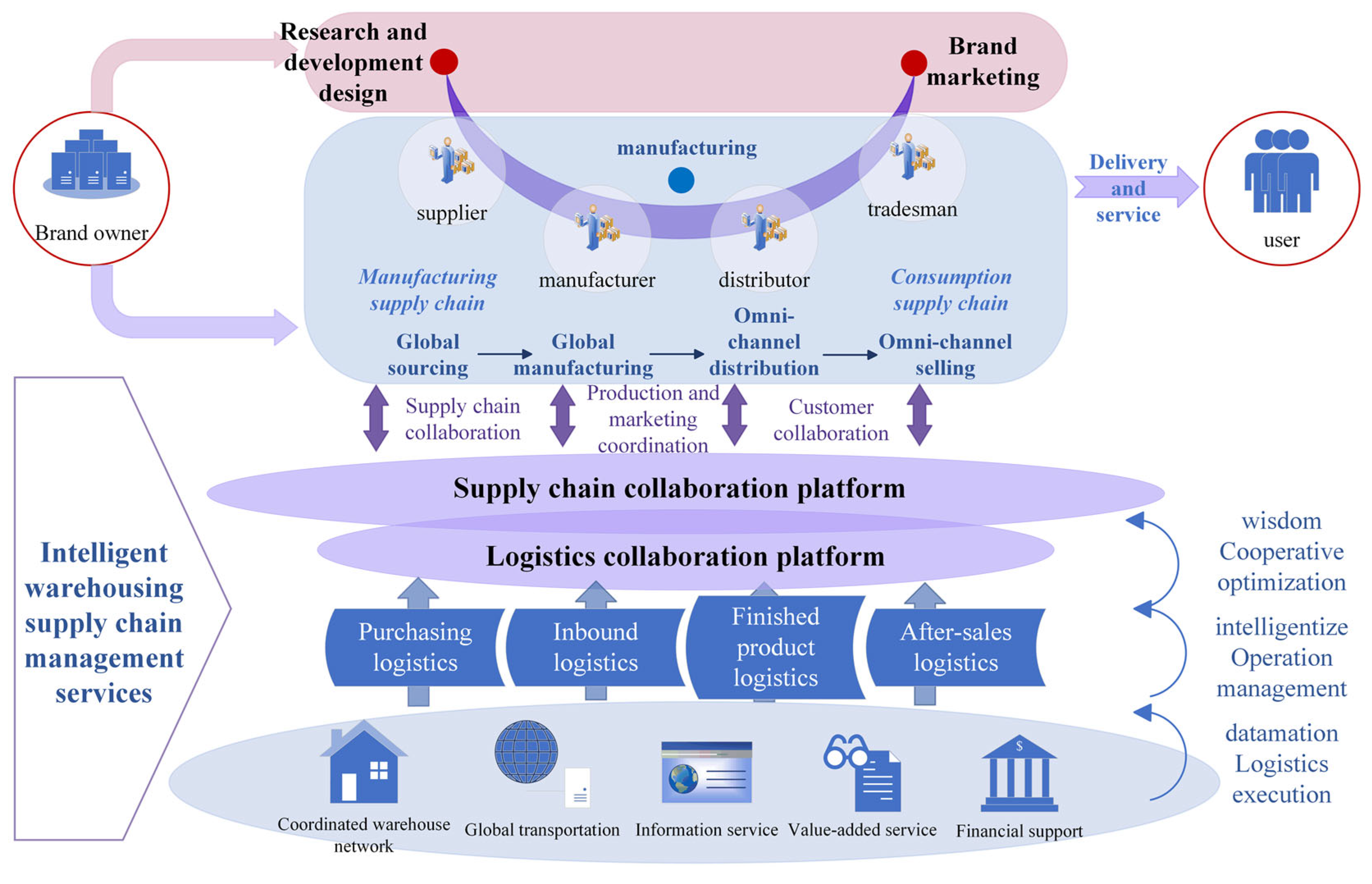
Smart warehousing refers to the concept of utilizing advanced technological means and intelligent systems to optimize warehouse management and operations. It is a comprehensive industry with extensive applications across sectors such as pharmaceuticals, automotive manufacturing, machinery manufacturing, tobacco, and apparel manufacturing. The smart warehousing industry chain is illustrated in Figure 1.
The evolution of intelligent warehousing systems represents a progression from mechanization and automation toward informatization and intelligence. Early research primarily focused on the integration of automated hardware and the implementation of control logic. For instance, Feng and Song [10] built an automated warehousing experimental platform centered around Mitsubishi and Siemens PLCs, integrating machinery, electricity, pneumatics, and communications. While demonstrating strong teaching and demonstration capabilities, their system remained closed-loop, lacking upper-level information management and visual interaction capabilities. Chen and Shi [11] approached the challenge from a system integration perspective, developing a management platform for intelligent production logistics systems. They emphasized the pivotal role of data in optimizing inventory management and logistics distribution. However, their research leaned more toward information flow design, with limited depth in simulating three-dimensional physical spaces. With the maturation of virtual reality and game engine technologies, constructing highly realistic virtual simulation platforms has become a research hotspot. Yan [12] utilized multimedia technology to build a logistics management experimental environment, providing students with online enterprise-level logistics operation experiences, demonstrating the immense potential of virtual simulation in teaching and training. However, such platforms are typically disconnected from underlying physical equipment, making it difficult to achieve closed-loop control integrating virtual and physical systems. Liu et al. [13] designed a wireless intelligent warehouse management system based on ZigBee technology, effectively addressing the real-time challenges of goods information collection and transmission. However, its functionality remains primarily confined to the information management layer, lacking deep integration with AGV path planning and three-dimensional dynamic simulation.
In recent years, with the widespread adoption of the “digital twin” concept, research on intelligent warehousing systems has entered a new phase of deep integration between virtual and physical domains. Digital twins aim to achieve full lifecycle monitoring, prediction, and optimization by creating virtual models that synchronize in real time with physical entities and enable bidirectional interaction [14]. This concept demonstrates immense potential in the field of warehousing. For instance, Marah et al. [15] proposed the MADTwin framework, employing a multi-agent system paradigm to construct digital twins for multi-robot systems in smart warehouses, offering novel approaches to handling the complexity of warehousing systems. Wu et al. [16], adopting a design-oriented perspective, introduced a modular smart warehouse design framework based on digital twins, emphasizing end-to-end integration spanning physical space, virtual space, and design processes.
However, despite progress in architectural design and multi-agent coordination, these studies often treat path planning as an embedded, pre-solved subproblem without deeply optimizing the efficiency and quality of the core path planning algorithm for AGVs. A promising avenue for future research lies in deeply embedding a high-performance path planning algorithm into the framework—one that not only reflects the system’s state but also optimizes the physical entity’s operation through intelligent decision-making.
(2)
Unity3D-based logistics simulation technology
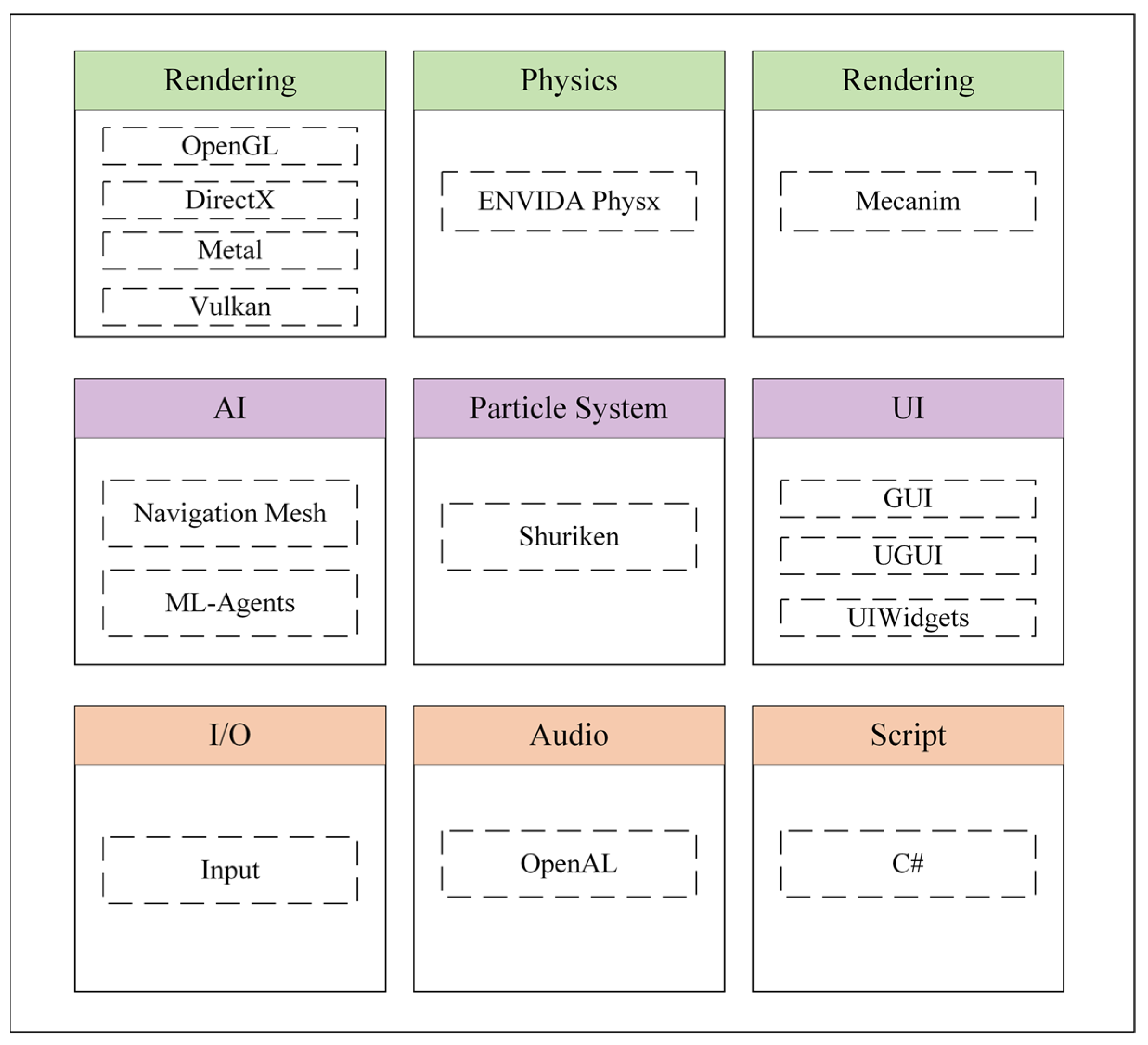
In the selection of technology for building the aforementioned intelligent warehousing virtual simulation platform, Unity3D—a powerful cross-platform game engine—has emerged as a popular tool in the logistics simulation field due to its robust 3D rendering capabilities, efficient physics engine, and rich plugin ecosystem. Its engine architecture is illustrated in Figure 2.
Currently, researchers are leveraging Unity3D to develop more realistic, interactive, and integrated simulation systems. Hu et al. [17] developed a real-time interactive simulation system for container yards based on Unity3D. By precisely mapping satellite positioning coordinates to 3D virtual scene coordinates through coordinate transformation technology, they dynamically demonstrated the operational processes of yard logistics systems, proving Unity3D’s reliability in modeling large-scale logistics scenarios and achieving precise positioning. Furthermore, the work by Nguyen et al. [18] highlights Unity3D’s potential for achieving high real-time performance and virtual-physical integration. They innovatively employed EtherCAT real-time communication technology to enable online control of an AGV robotic arm system within the Unity platform. This established an experimental platform for intelligent warehouse management that bridges virtual reality with physical models, providing a valuable practical case study for real-time data interaction in intelligent warehousing systems.
(3)
Research progress in path planning algorithms
In intelligent warehousing systems, the performance of path planning algorithms directly impacts the operational efficiency of AGVs. As mentioned in the introduction, Dijkstra, A-Star, JPS, APF, and various bio-inspired algorithms have been extensively researched and applied in the field of path planning [4,5,6,7,8,9], but the current focus of research extends beyond merely improving the performance of individual algorithms.
To enhance search efficiency and tackle complex environments, researchers have explored various approaches. At the traditional algorithmic level, JPS significantly reduces the number of nodes in the open list by identifying and “skipping” symmetric points along the path, demonstrating remarkable effectiveness in obstacle-free open areas [6]. However, JPS’s advantages diminish in densely obstructed environments. APF has been extensively explored due to its computational simplicity. The idea of applying APF to path planning originated from Khatib [19], in which robots are guided through virtual forces, though they are prone to getting stuck in local minima. Subsequent studies, such as Weerakoon et al. [20], extended APF to provide safe navigation; Kim et al. [21] combined it with visual perception to propose dynamic obstacle detection and avoidance methods; Li et al. [22] improved the dynamic window method to enhance mobile robot obstacle avoidance; Guo et al. [23] combined the heuristic A-star algorithm with the DWA algorithm for real-time obstacle avoidance. On the other hand, there are nature-inspired algorithms, such as ant colony optimization, particle swarm optimization, genetic algorithms, and fuzzy logic. By simulating collective intelligence or biomimetic principles found in nature, these algorithms demonstrate powerful global search capabilities in complex, unstructured environments and can handle uncertainty [24]. For instance, Li et al. [25] employed genetic algorithms for path planning of mobile robots in both dynamic and static environments, developing operators for five specific problems; Minh et al. [26] successfully implemented trajectory planning for mobile robots in dynamic obstacle environments using a fuzzy logic system; Murugaiah et al. [27] integrated particle swarm optimization and fuzzy logic to enhance the motion control of nanorobots and optimize path planning under uncertain conditions.
Looking at the evolution of path planning algorithms, we observe a shift from single-dimensional global or local planning toward comprehensive performance optimization that balances efficiency, optimality, smoothness, and dynamic feasibility. Within this trend, for typical scenarios like intelligent warehousing—characterized by high structure, known environmental priors, and stringent path optimality requirements—algorithm selection and evaluation must place particular emphasis on foundational performance. Intelligent warehouses are typically laid out based on regular grids or networks, making graph search algorithms particularly well-suited for such environments. Among these, Dijkstra’s algorithm, as a classic shortest path algorithm, is often used as a benchmark reference due to its ability to guarantee finding the globally optimal path. Meanwhile, the A-star algorithm, by introducing heuristic concepts into Dijkstra’s approach, significantly enhances search efficiency while maintaining path optimality, making it the practical preferred choice for global path planning in structured warehouse environments [4,5]. However, as discussed in the previous section, the traditional A-star algorithm still has room for optimization in both search efficiency and path quality. Furthermore, most existing studies validate algorithms in simplified simulation environments, focusing primarily on single-aspect optimization. There remains a lack of a systematic, composite optimization framework tailored to warehouse operational needs that can simultaneously address multiple objectives such as search efficiency, path length, and operational smoothness.
Based on this, developing a systematic algorithmic composite optimization framework capable of addressing multiple performance objectives and integrating it within a virtual simulation environment for verification has become crucial for further enhancing the performance of intelligent warehousing systems.

2.2. Problem Analysis

Company X is a major manufacturer of cotton harvesters. To rapidly promote standardized factories, it implemented a unified design for its facilities, establishing a linear logistics flow from left to right: receiving area, AGV staging zone, shelving area, finished goods zone, and shipping area. This configuration minimizes movement waste during warehousing and production transfers. Despite adopting new storage equipment, significant manual operations persist, with low levels of automation and mechanization. Current facilities include seven AGVs, two forklifts, four rows of shelving, two stacker cranes, and 388 storage locations. Daily warehouse tasks encompass inspection, receiving, storage, inventory counting, sorting, packaging, order preparation, and shipping. To thoroughly understand Company X’s current warehouse status and identify key issues, a field survey was conducted in September 2023 through on-site inspections and interviews. The findings are summarized in Table 1.
Through interview research, the following conclusions were drawn regarding the current state of traditional warehousing at Company X:
(1) numerous shelving units with lengthy racks hinder efficient order picking; (2) severe inventory backlogs persist; (3) inventory management remains disorganized. Traditional warehousing practices result in significant human resource wastage and low operational efficiency. However, the adoption of intelligent warehousing solutions offers promising resolutions to these challenges. Consequently, X Company faces an urgent need to transform its warehousing operations. This paper investigates the development of an intelligent warehousing system platform integrating RFID technology with virtual reality, focusing on path planning methodologies.

3. Platform Design

The objective is to establish an interactive virtual practice platform to assist enterprises in production practice training and address issues prevalent in traditional warehousing facilities. The primary design goals are accessibility, usability, and interactivity.

3.1. Overall Platform Architecture

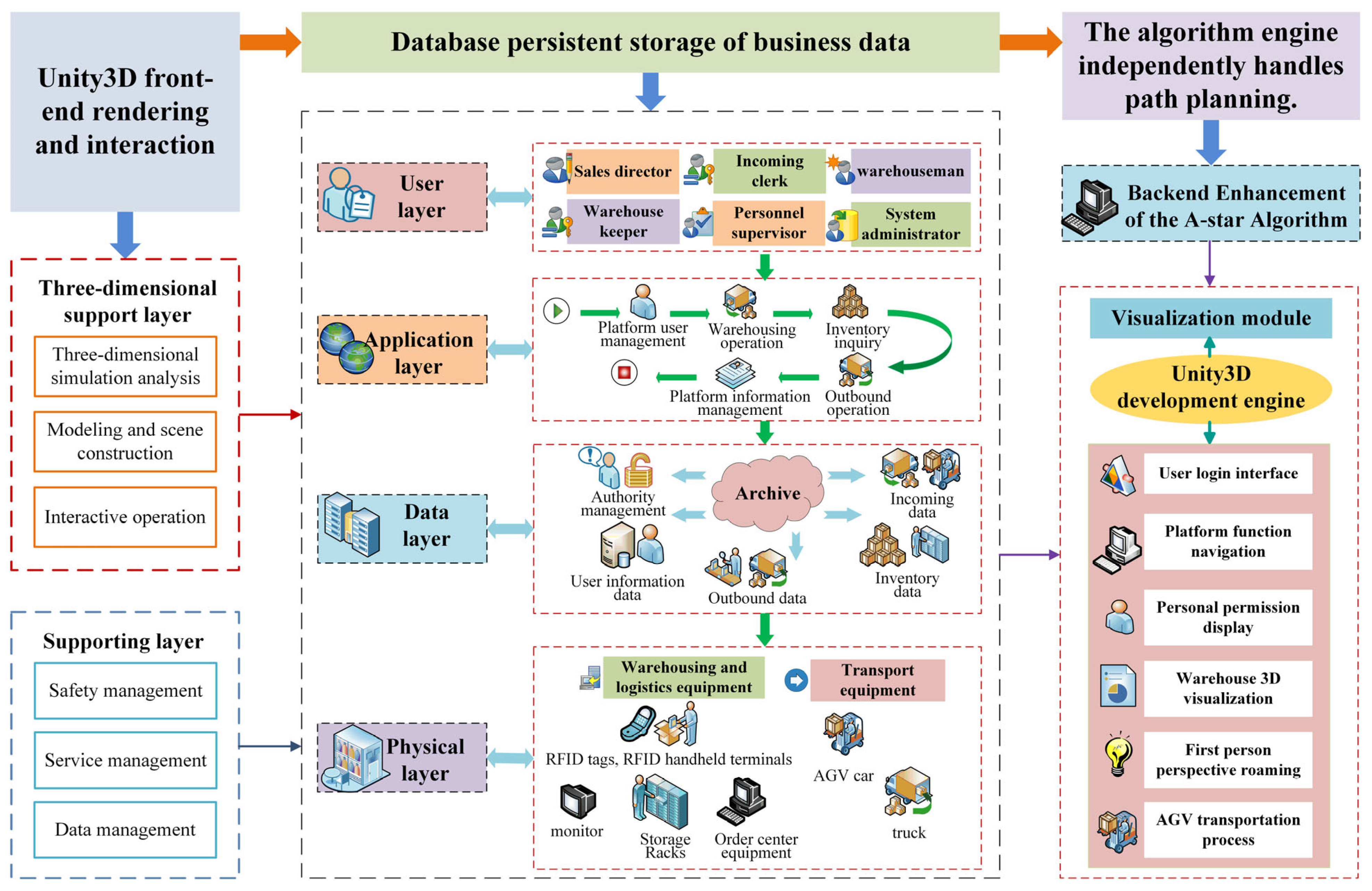
Intelligent storage platform architecture design, using two layers of support layer and four layers of functional service layer structure. The support layer is responsible for the operation and maintenance of the entire platform. The service operation of the platform is ensured. The 3D support layer is responsible for 3D simulation, modeling, and scene construction, human-computer interaction, etc. The uppermost layer of the functional service layer is the user layer, which mainly introduces the division of functions of the platform. The second layer is the application layer, which mainly includes platform user management, warehousing operation, inventory query, platform information management, etc. The third layer is the data layer, which is also a very critical layer. It includes the data of all users and goods of the entire platform to achieve permission management, input and exit information query, product shelf information management, and user and product information increase and deletion. At the bottom is the physical layer of the entire platform, which realizes the information conversion between the platform and the entity through warehousing logistics equipment and transportation equipment. The overall architecture design of the intelligent warehousing platform is shown in Figure 3.

3.2. Warehouse Management Module Architecture Design

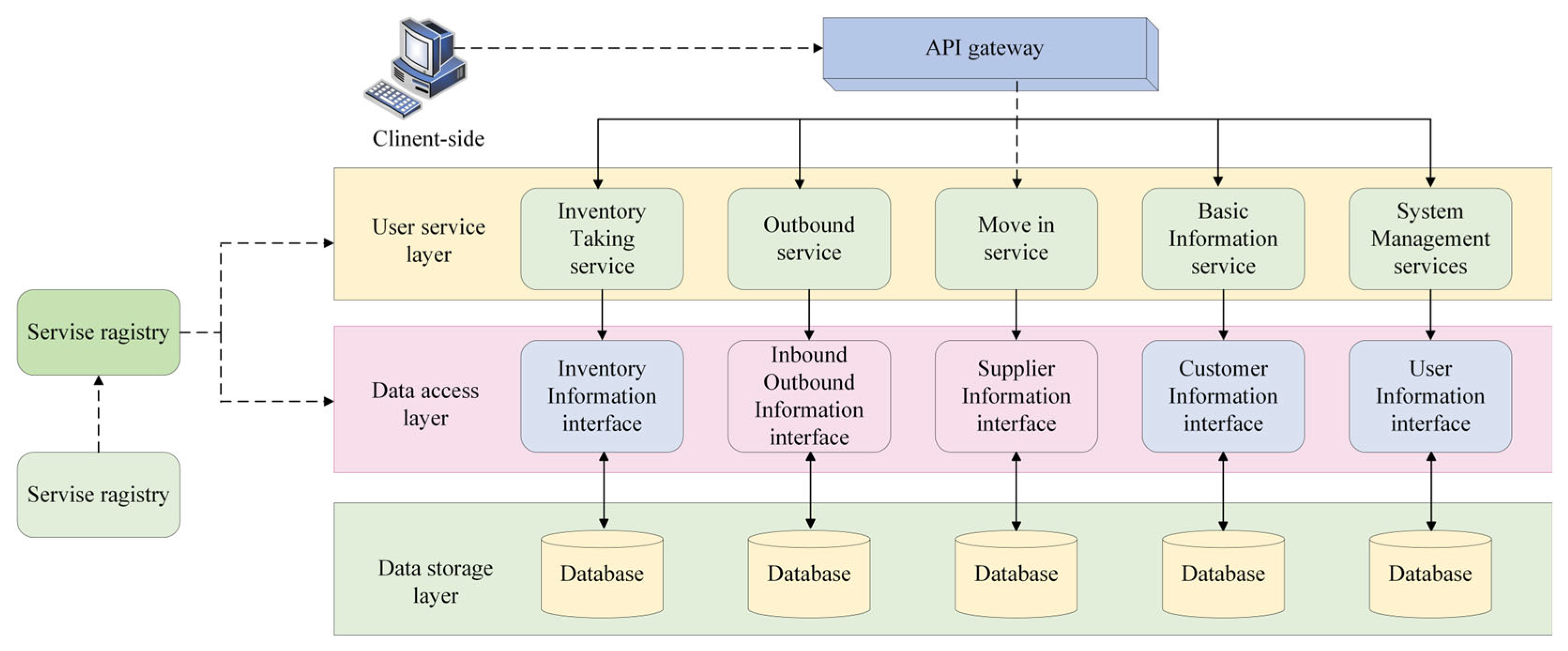
The warehouse management system uses a C/S architecture mode for designing, and users can access the warehouse management system directly through the server. The application service layer, which basically realizes the management service needed in the warehouse management process and provides the user access interface that the manager can call, makes up the main layers of the architecture of the warehouse management system. The data access layer, on the other hand, provides a variety of data access interfaces; any data add, delete, modify, and check operations must be realized through this layer. Finally, the data storage layer, or database, primarily realizes the persistent storage of data.
The warehouse platform was developed using the Unity3D virtual engine. The powerful graphics rendering engine function makes the virtual scene construction of an intelligent warehouse factory more realistic; It also provides rich plugins and resource libraries and rich tools and functions, such as a physics engine, animation system, virtual reality support, etc., effectively improving the scalability, high availability, and development efficiency of the platform.
The microservice architecture of the warehouse management module is illustrated in Figure 4. Based on user commands, it exchanges data with the backend and renders pages for users. The application service layer primarily provides key services for the warehouse management system by invoking data processing logic services from the data access layer. The data access layer primarily enhances fundamental logic services related to database operations such as insert, delete, update, and check. This database is partitioned into distinct sub-functional databases based on service functionality. Each sub-functional database focuses on managing data specific to its current sub-function, thereby reducing coupling between data components.

3.3. Platform Function Design

The core functionality of this system relies on the electronic tags of RFID devices, which store management information for target objects. Warehouse managers can utilize this management module to quickly and conveniently query and access basic information about target objects. The system’s database operates on real-time updated data, enabling implementation within existing traditional logistics models to enhance the scientific rigor of enterprise logistics management.
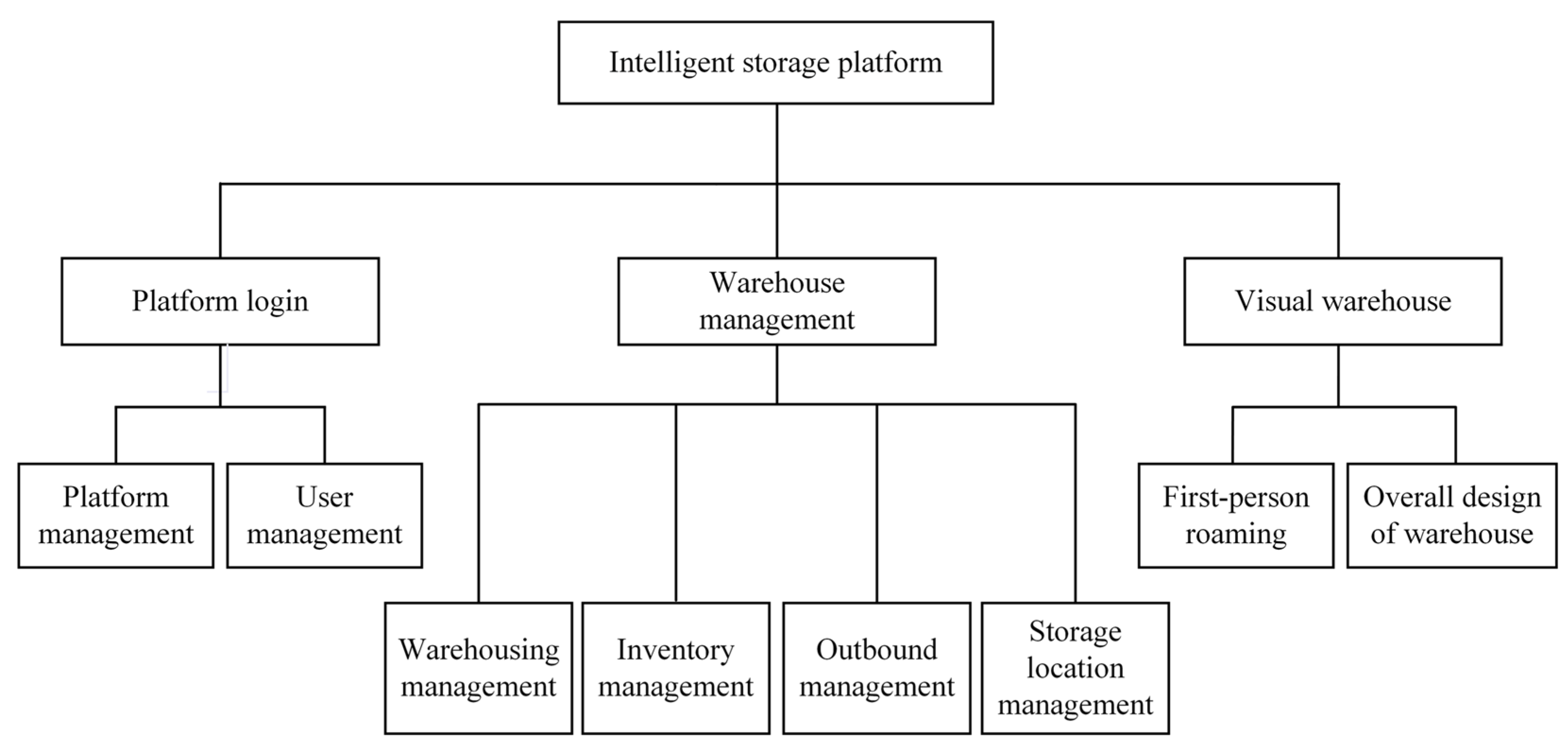
The function of the platform is divided into login and registration function, storage management, inventory management, storage management, visual warehouse, each module can be divided into several sub-modules. (1) Login and registration function design: according to the RBAC role rights management model, different function rights are assigned to different users. (2) Warehousing management module design: obtain the basic information of goods through RFID identification bar codes, and import data such as goods number, warehousing quantity, warehousing date and storage location into the warehousing management module. (3) Inventory management module design: include the query of goods information, storage location management and the query of warehouse records. (4) Out-bound management module design: realize the functions of adding outbound records and querying outbound records. (5) Platform roaming module design: build an intelligent warehouse model to realize the function of roaming from the first-person perspective. The functional structure diagram of the intelligent storage platform is shown in Figure 5.

3.4. Database Design

In order to realize the function of warehouse management, the JET (Jet Engine) database engine is used to store data and provide the corresponding data access interface. For security and permission management, we protect the security of the system by designing the login interface and window for identity verification and permission control. The design of the table in the database mainly includes two parts: the user permission table and the warehouse table. The key fields in Table 2, Table 3, Table 4 and Table 5 are as follows:

4. Realization of Intelligent Storage Platform

4.1. Warehouse Factory Model Construction

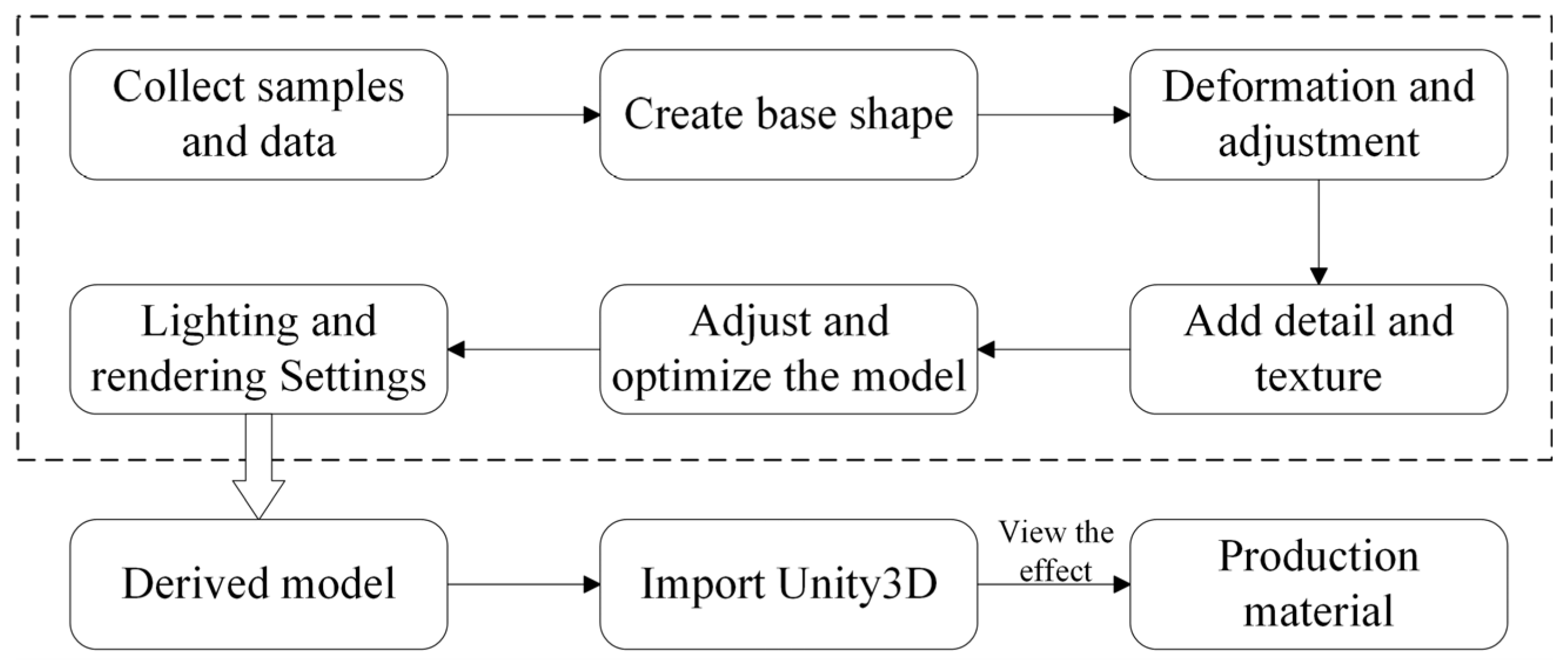
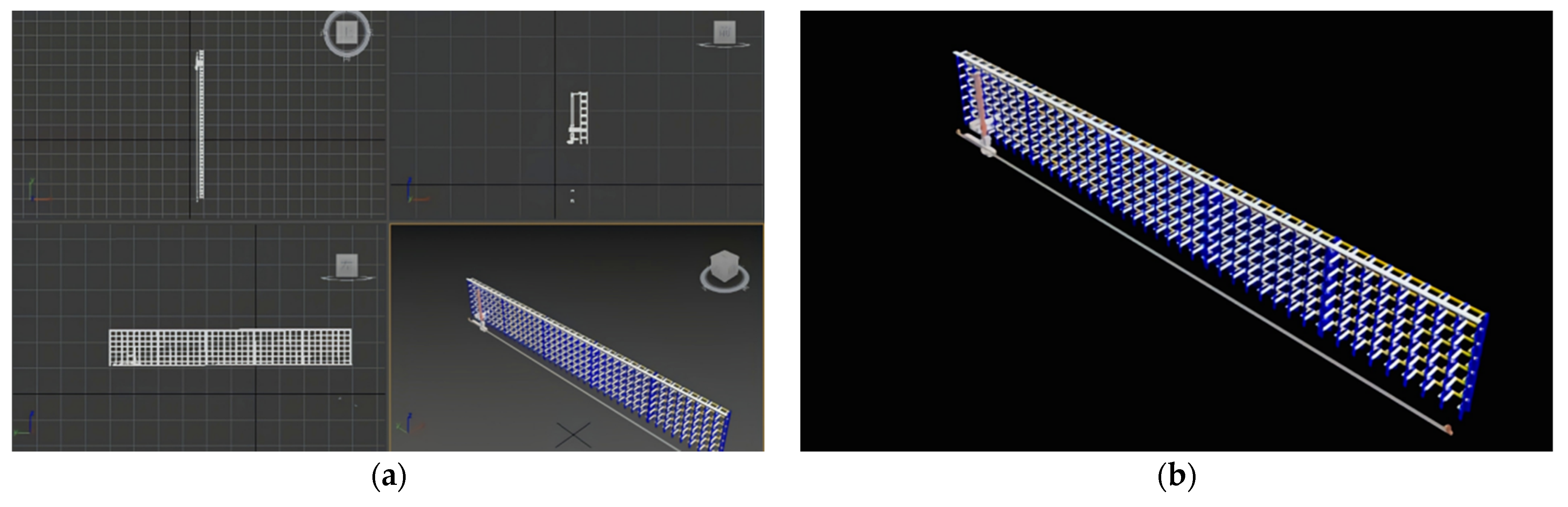
The modeling in the intelligent warehousing platform includes the modeling of scenes and logistics equipment, as well as the production and adjustment of materials. Modeling with 3ds Max software involves collecting samples, creating shapes, deformations, and adjustments, adding details and textures, adjusting the model, lighting and rendering settings, and more. The modeling process is shown in Figure 6.
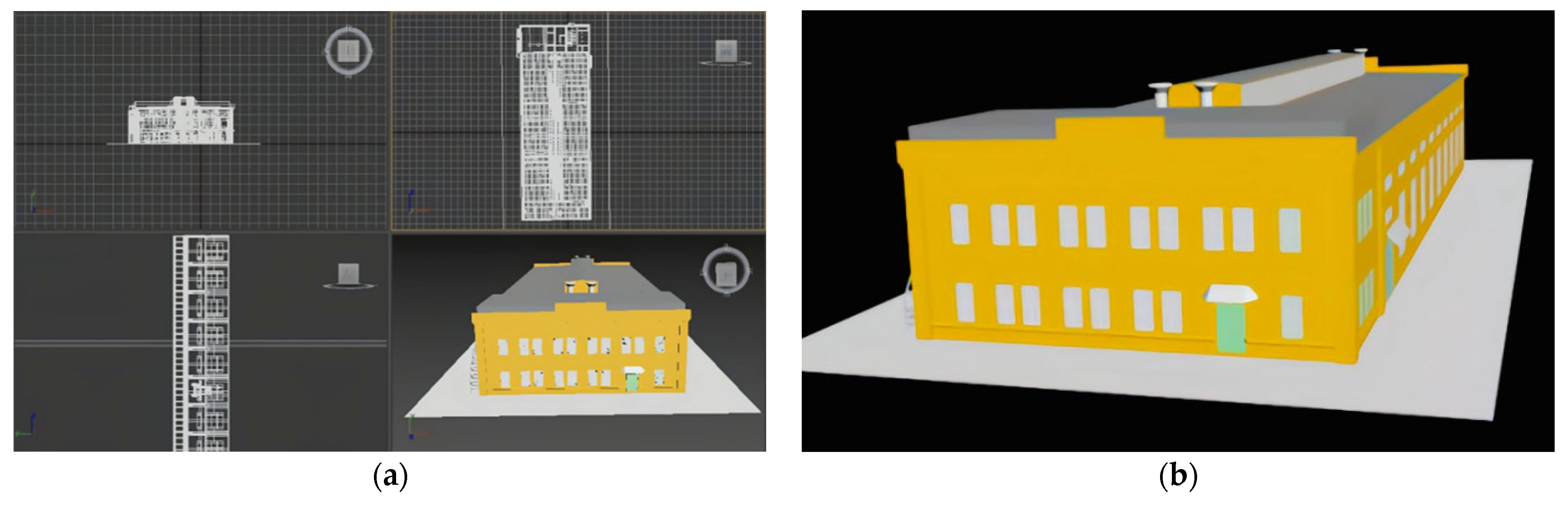
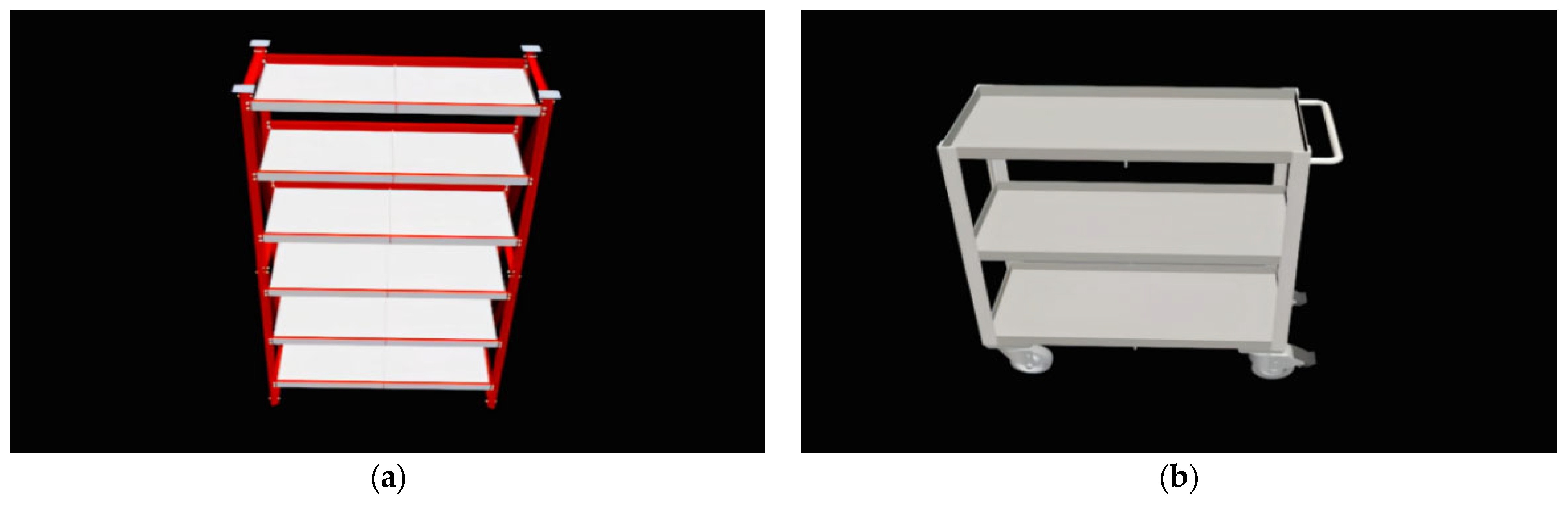
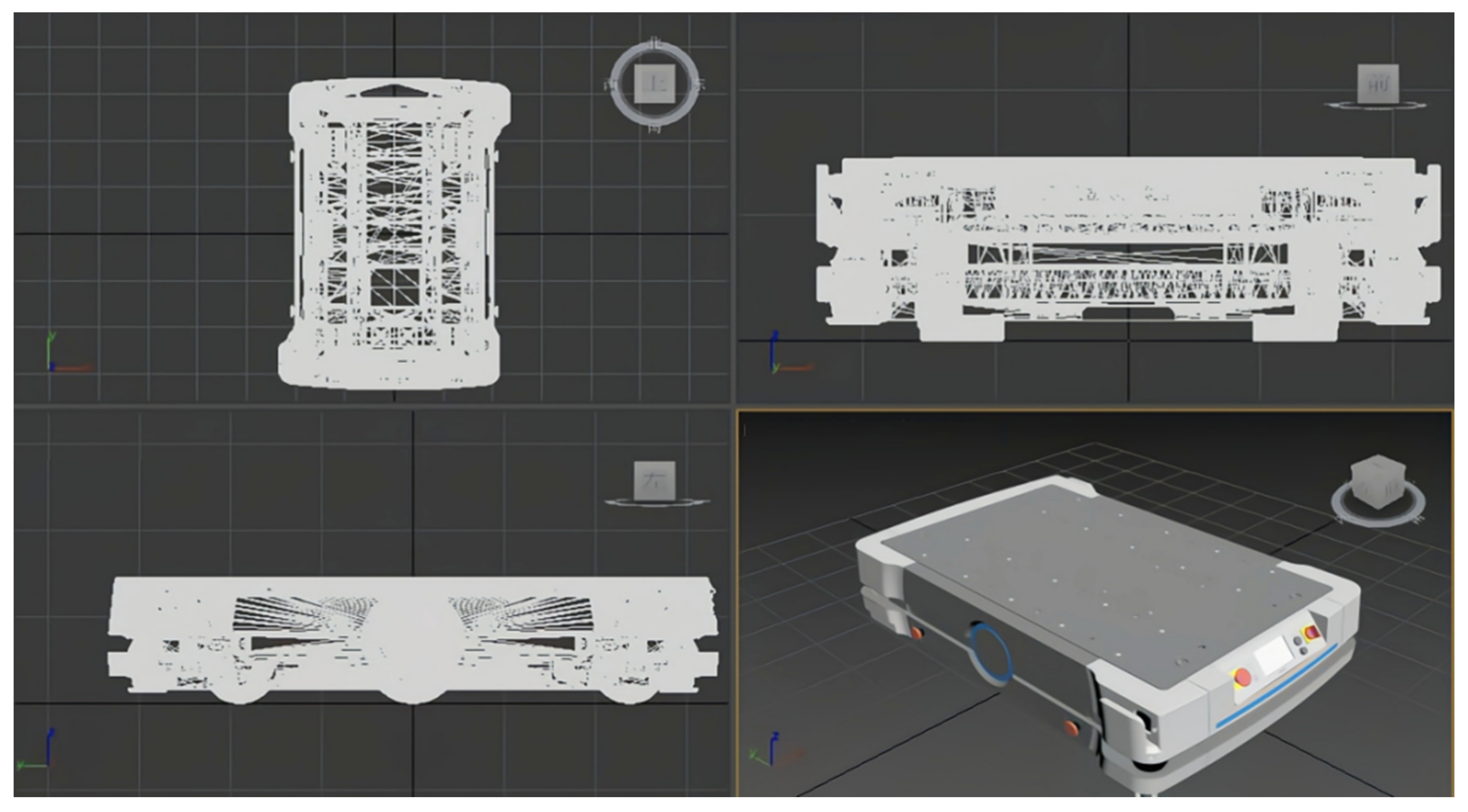
To obtain precise model data, an in-depth field investigation of Company X’s warehouse workshop was conducted to study its daily operational processes. The actual warehouse dimensional parameters were obtained as shown in Table 6. A factory sketch was created using SolidWorks (https://www.solidworks.com/, accessed on 13 November 2025), followed by the modeling of the factory. Basic modeling tools in 3ds Max, such as boxes, cylinders, and spheres, were employed to establish the foundational model. Building upon this base, detailed modeling was performed using 3ds Max editing tools like extrusion, beveling, and chamfering to enhance the warehouse factory’s details and features. During modeling, topological optimization was applied to the model to facilitate better texture mapping, thereby improving the representation of surface textures and colors within the factory scene. Finally, render the scene with lighting to achieve accurate highlights, shadows, and depth effects. After completing the warehouse factory model, export it as an fbx format; import the fbx format into Unity3D for subsequent modeling work. Renderings of the warehouse, three-dimensional shelving, and logistics equipment created using 3ds Max are shown in Appendix A.1.
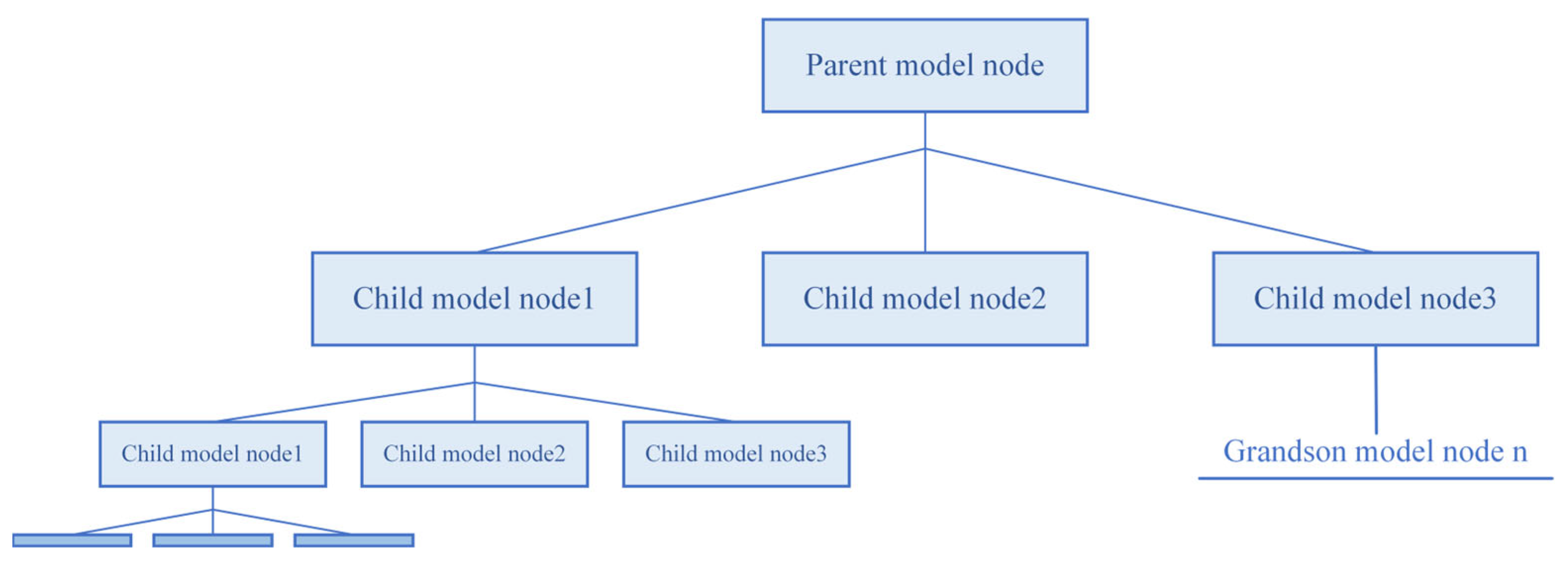
It should be mentioned that the different model resources created by 3ds Max need to be “ungrouped” when exporting. After ungrouping, the 3D model will become a tree-structured model. In this case, the 3D model consists of sub-models in the tree model, which may contain sub-models. The disassembly tree view of the 3D model is shown in Figure 7.
Unity3D is used as the development engine of the virtual simulation system to build the virtual scene of the smart warehouse factory. It should be noted that Unity3D is used as the front-end development engine, which is responsible for scene rendering, first-person roaming, AGV motion simulation, and collision detection (through the BoxCollider component). The path-planning algorithm acts as the back-end engine and is implemented in a C# script, where the core computational part of the improved A-star algorithm is performed in a separate class. The database is used to store all the persistent data of the platform, including user information, goods information, and path records.
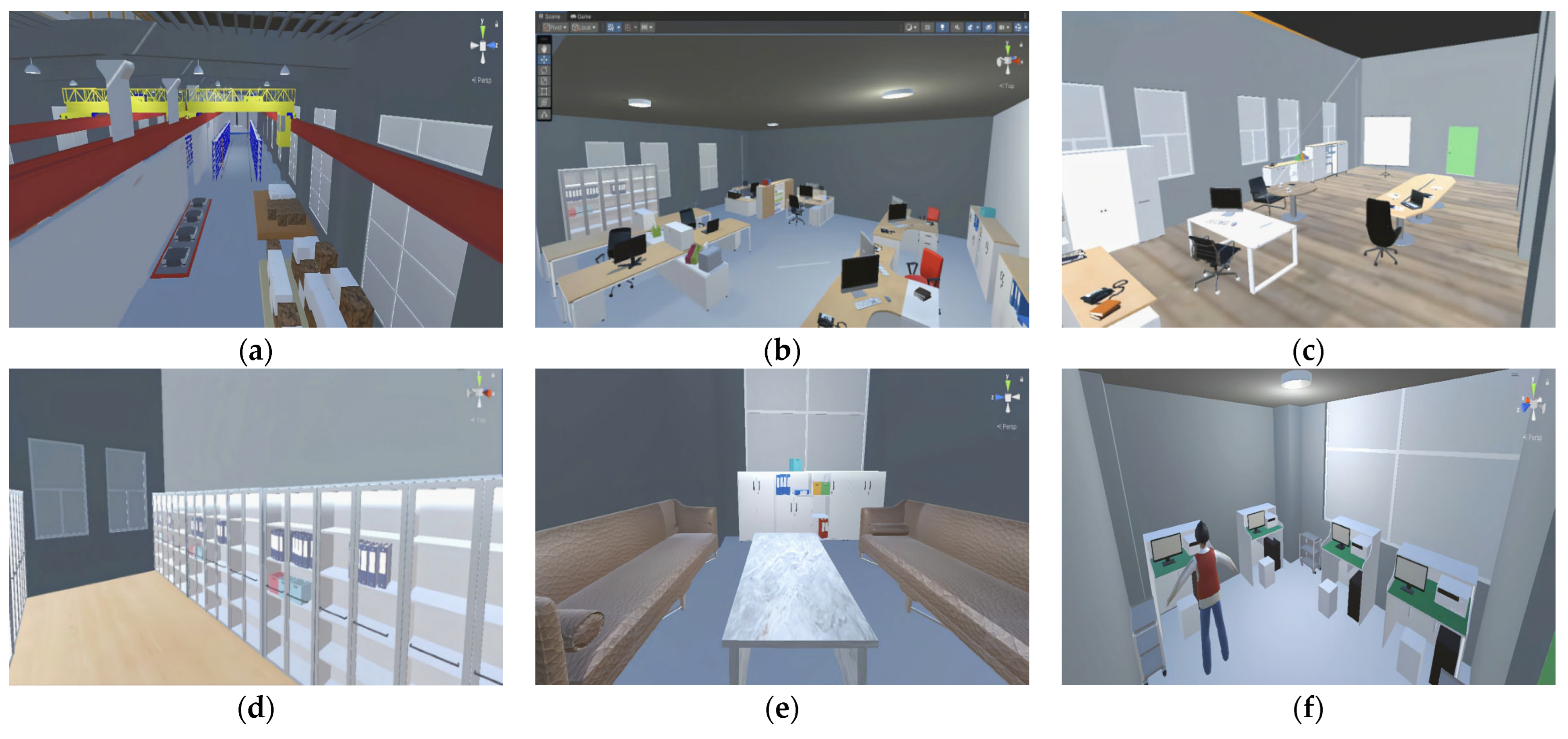
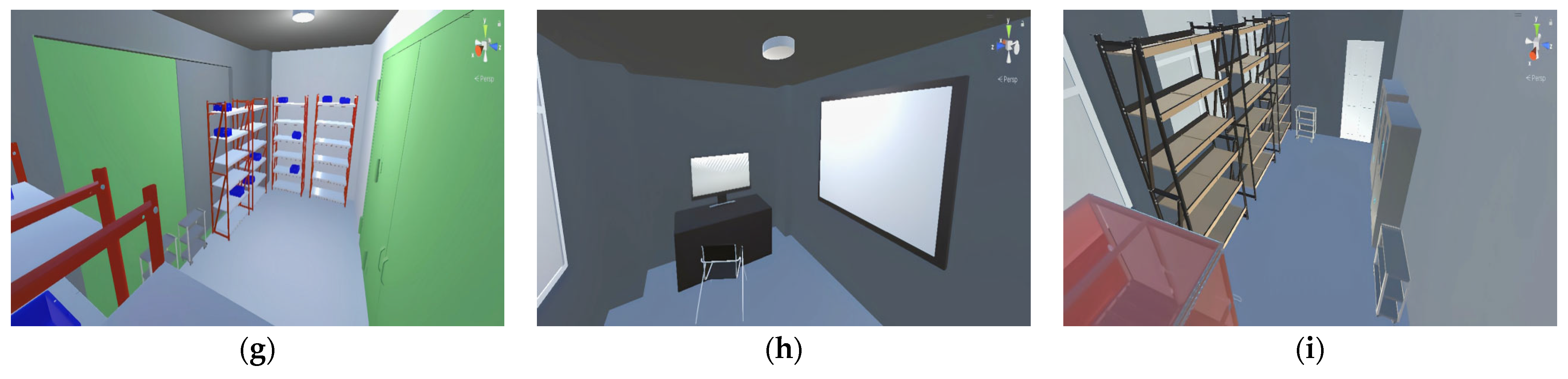
There are many different panels in Unity3D, such as Hierarchy, Inspector, Project, and Scene. They provide a variety of functions for editing, managing, and debugging game projects. Create a new project from Unity Hub and import the warehouse factory model in fbx format into the Scene, and add 3D Objects, such as squares, spheres, and so on, to the Hierarchy panel. The toolbar in the top-left corner of the Scene allows direct adjustment of the created model’s position, size, and orientation. Alternatively, these operations can be performed through the Position, Rotation, and Scale properties in the Transform section of the Inspector panel. The intelligent warehouse factory includes a transportation area, an office area, a maintenance and other equipment area, and the scene diagrams of each area built based on Unity3D are shown in Appendix A.2.

4.2. Realization of Each Functional Module

4.2.1. Login and Navigation Functionality Design

The pseudo-code is shown in Appendix B.1. In order to visualize the interaction process of the system design based on Unity3D, the Unity3D platform setting interface is shown in Appendix A.3.
Utilizing Unity3D’s built-in UI components enables developers to design functionalities such as platform account password login and button triggers. After visualizing the platform login interface, use C# Script to edit user login prompts. If the user leaves the account or password field blank, the system displays “Account or password cannot be empty!” If the user enters an incorrect account or password, the system displays “Account or password not found. Login failed.” Upon entering the correct account and password, the system displays “Login successful.” The pseudocode is shown in Appendix B.1. In order to visualize the interaction process of the system design based on Unity3D, the Unity3D platform setting interface is shown in Appendix A.3.
The intelligent warehouse virtual factory platform is divided into two components: intelligent warehouse management and visual warehouse. Within Unity3D, create two buttons on the Canvas: one named “Smart Warehouse Management” and the other named “Visual Warehouse”. These buttons enable navigation functionality, facilitating interface transitions for entering a first-person roaming view. This allows users to tour and study the virtual model of the smart warehouse factory. The platform’s user interface mockup is presented in Appendix A.4.

4.2.2. Visual Roaming Function Design

Warehouse factory scene roaming serves as the initial point of user interaction with virtual environments, delivering an immersive experience that showcases intricate details within smart warehouses. This visualization of intelligent storage facilities adds depth to the entire platform, significantly enhancing user engagement.
(1)
First-person roaming perspective
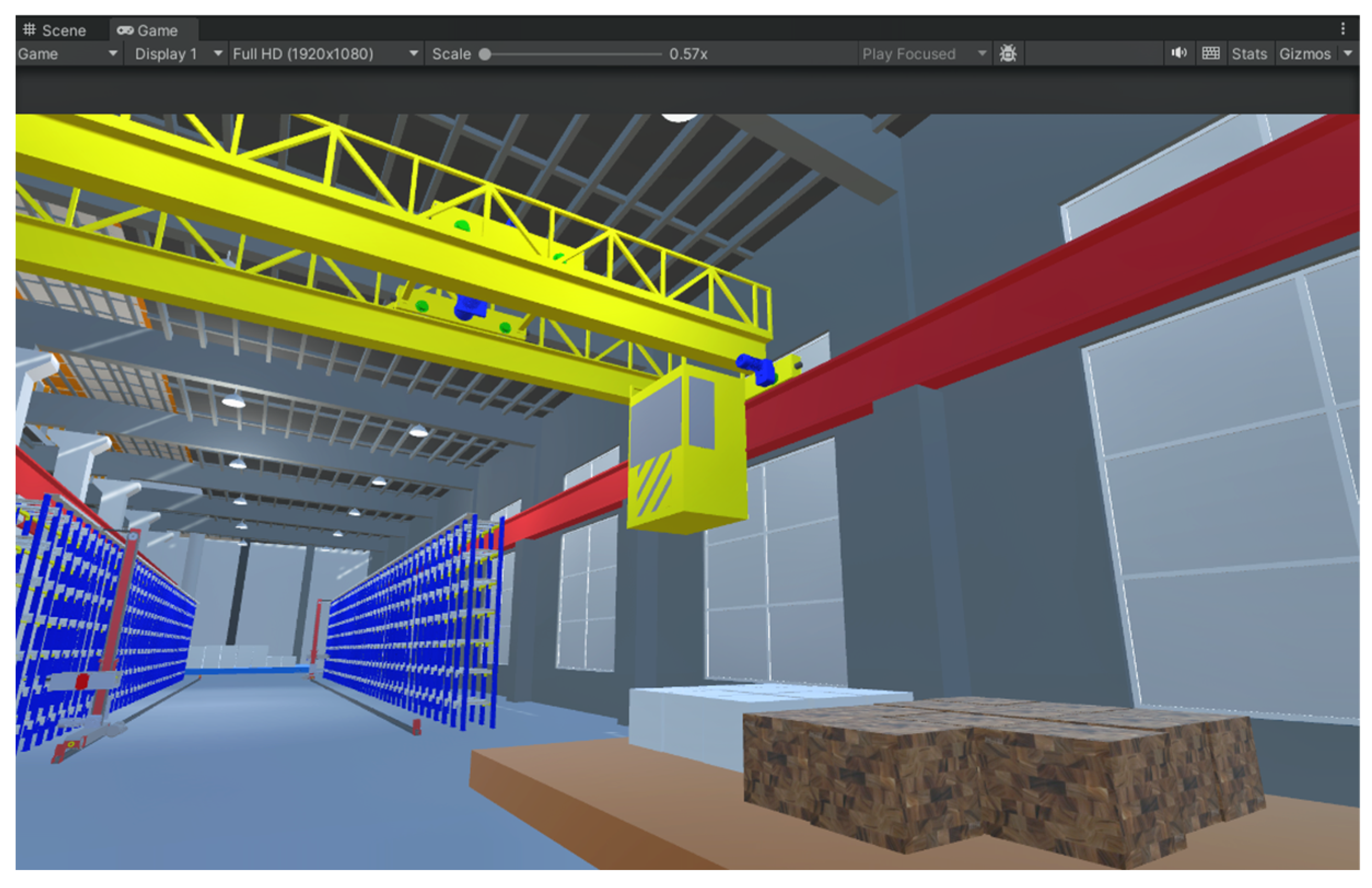
First, create a Player object in the Hierarchy view to serve as the first-person perspective character. Create a script named Camera Controller to manage the camera, defining two float variables to add mouse sensitivity for controlling mouse speed. Use the transform.Rotate() method to rotate the Player. Then create a Player Controller script to manage player behavior. First, define the Player’s movement and jump speeds. Use the Input.GetAxis() method to obtain the values from the buttons. Multiply both button values by the movement speed. Store the movement direction, then use the Move() method in the Character Controller to move the player. Return to Unity and assign values to the variables defined earlier to implement the first-person perspective movement functionality. The pseudocode is shown in Appendix B.2. After running the first-person roaming view, the result is shown in Figure 8.
(2)
AGV cart drive simulation
Create a camera and adjust it to the optimal viewing position for observing the AGV driving simulation. Then, create a C# script named “AGV move” in the Scripts folder. Write code to control the movement behavior of the AGV cart, enabling directional control using the WASD keys. Pseudocode is provided in Appendix B.3.
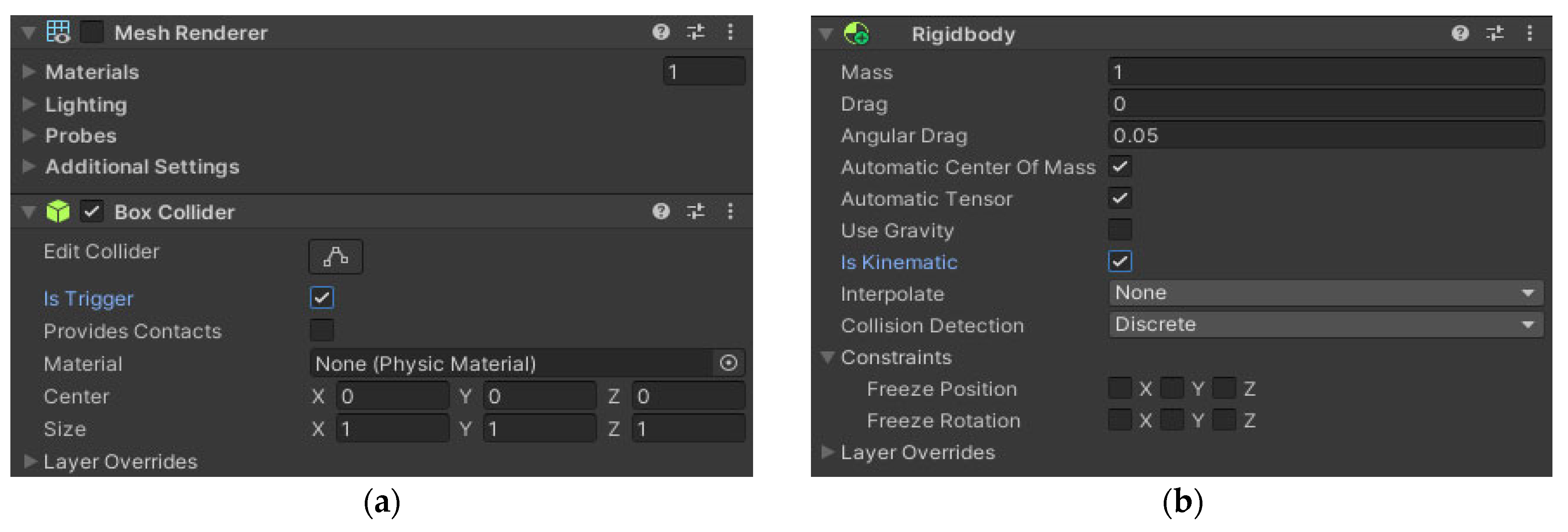
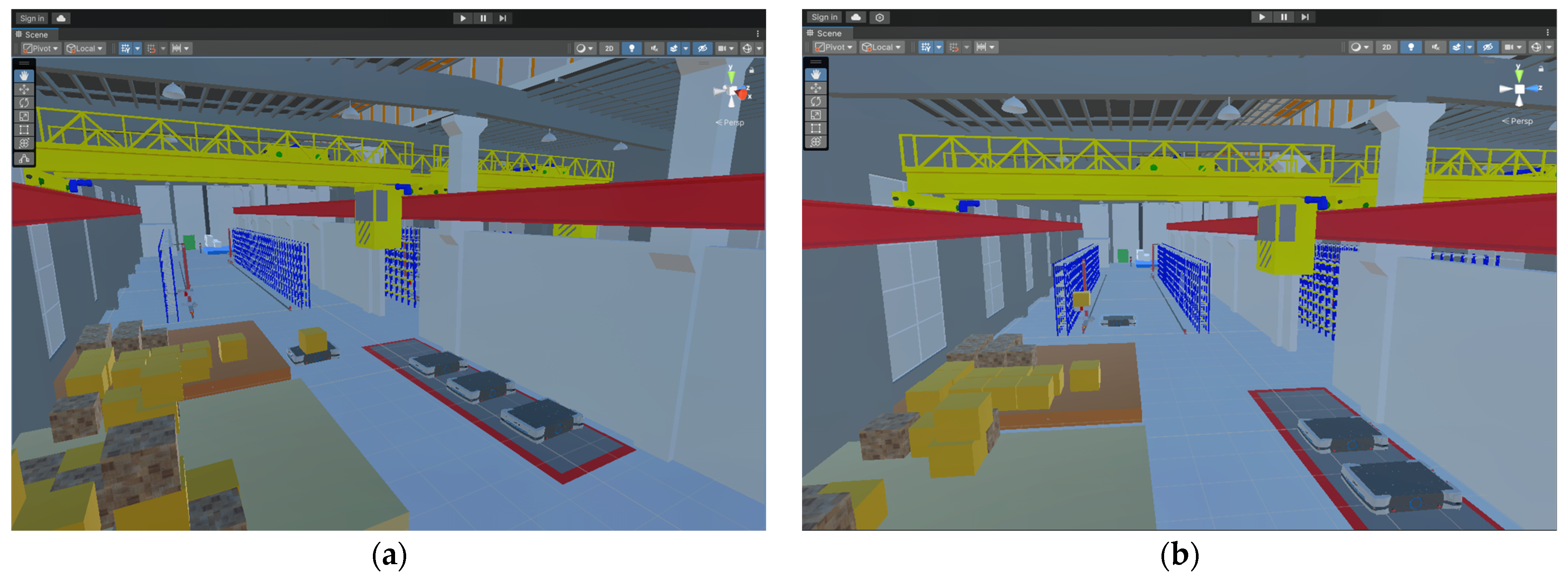
Add a Cube in front of the AGV for collision detection. Uncheck the Mesh Renderer to hide the detection cube. Select the Is Trigger option under the Box Collider component to enable physics detection without triggering physics effects. Add a Rigidbody component to the AGV, disable the Use Gravity option in the Gravity System, and select the Is Kinematic option. This enables the AGV to possess physical properties without participating in collisions. For detailed component settings during system interactions, refer to Figure A8 in Appendix A.3. The simulation-driven effect of the AGV goods transportation process is shown in Figure 9.

4.2.3. Design of Intelligent Warehouse Management Functions

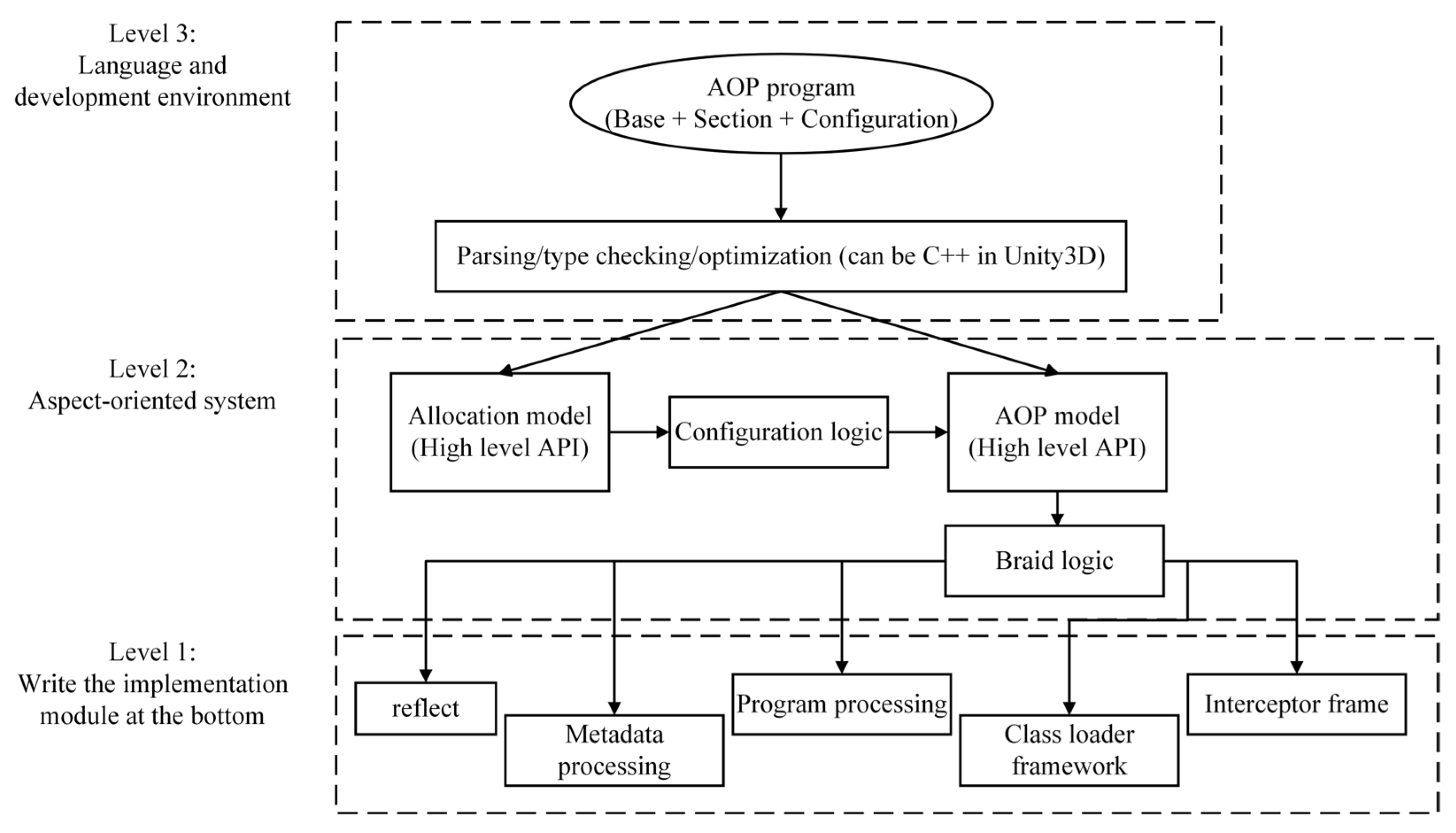
To enhance the efficiency of intelligent warehouse management and standardize code development, this section’s intelligent warehouse management module design fully integrates RFID (Radio Frequency Identification) technology and AOP (Aspect-Oriented Programming) technology. This integration achieves intelligent, efficient, and secure warehouse management. The AOP functionality is implemented using the Unity.Interception component within Unity. By deploying interceptors to intercept method calls, various functionalities are achieved, such as performance monitoring and exception handling. The AOP principle diagram is shown in Figure 10.
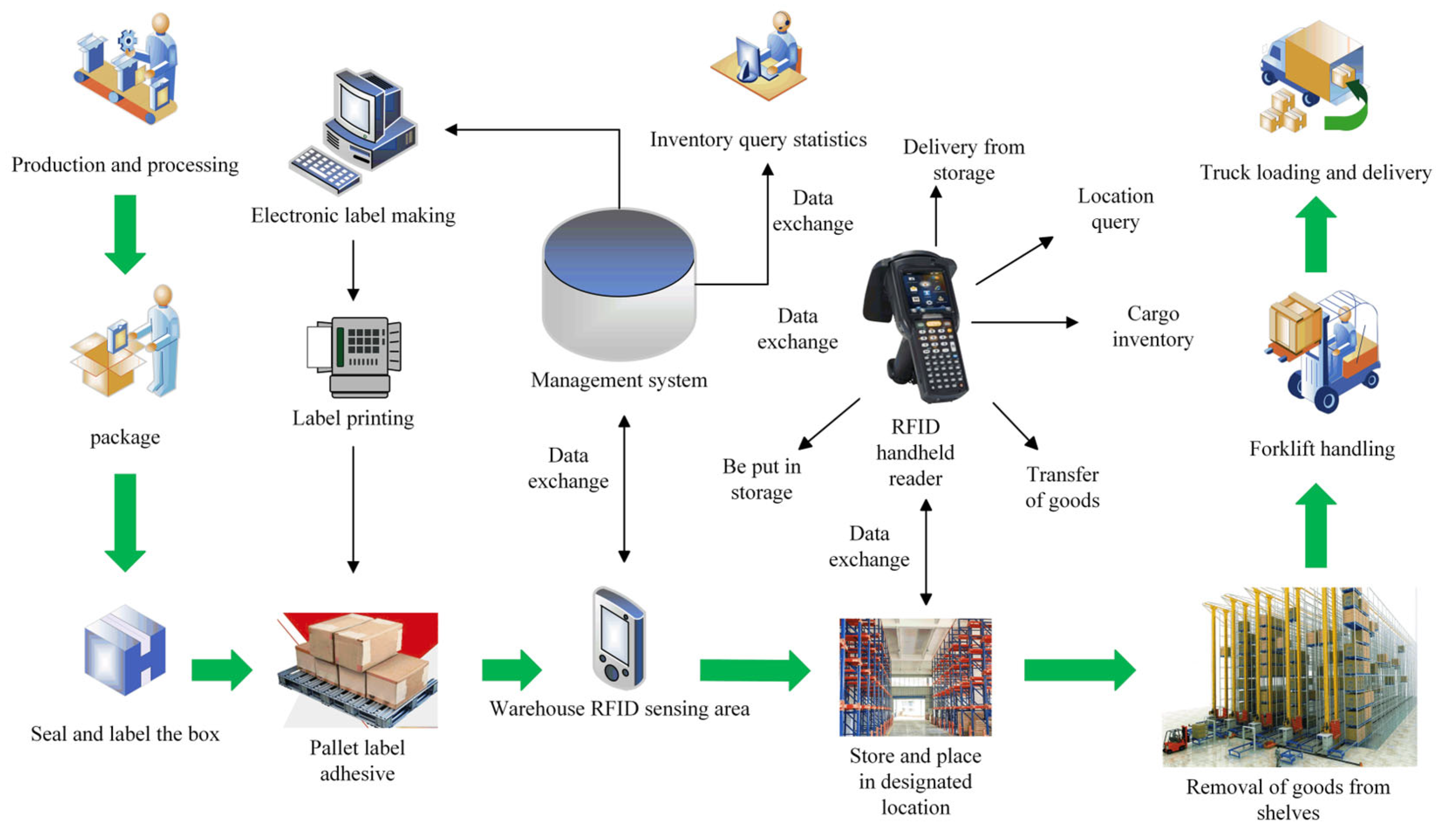
RFID tags have a unique identification code, which can prevent goods from being stolen or replaced. In the process of warehouse management, RFID technology can be used to carry out anti-counterfeiting and anti-theft monitoring of goods to protect the safety of goods. The role of RFID in warehouse management is illustrated in Figure 11.
The implementation of each functional module in intelligent warehouse management primarily relies on warehouse staff assigning unique identifiers to goods. Subsequently, the system automatically generates digital information corresponding to storage locations. First, the warehouse manager compiles statistics on available storage locations within the database. Based on the unique identifier codes, the warehouse automatically generates corresponding numbering rules to initialize storage locations, reserving some slots to accommodate inventory expansion. The generated storage location labels are uniquely linked to the physical attributes of corresponding goods. Receiving personnel then assign actual storage location details to each designated spot. The Location Manager verifies whether goods have been successfully received. If errors occur, it adjusts location information to ensure effective alignment between storage locations and physical goods. Pseudocode is provided in Appendix B.4.
Inventory management operations utilize RFID devices to read item tag codes and RFID tags, uploading the information to the corresponding server. After analyzing and categorizing the data, the server uploads it to the database for comparison. If discrepancies are detected between the reliability of stored database information and the data read by the RFID devices, the platform will send an alert to the inventory management module. Pseudocode is provided in Appendix B.5.
The most critical aspect of outbound management operations is simultaneously recording goods and transferring outbound information during the removal process, cross-referencing and verifying against inbound data, and then saving the records. Within the outbound management module, when an outbound request is initiated, the system automatically prompts whether to add items if the corresponding quantity is insufficient. When the quantity of goods to be shipped is adequate, simply submit the relevant outbound goods information, await approval, and proceed with the outbound operation. Pseudocode is provided in Appendix B.6.

4.3. Platform Operation and Debugging

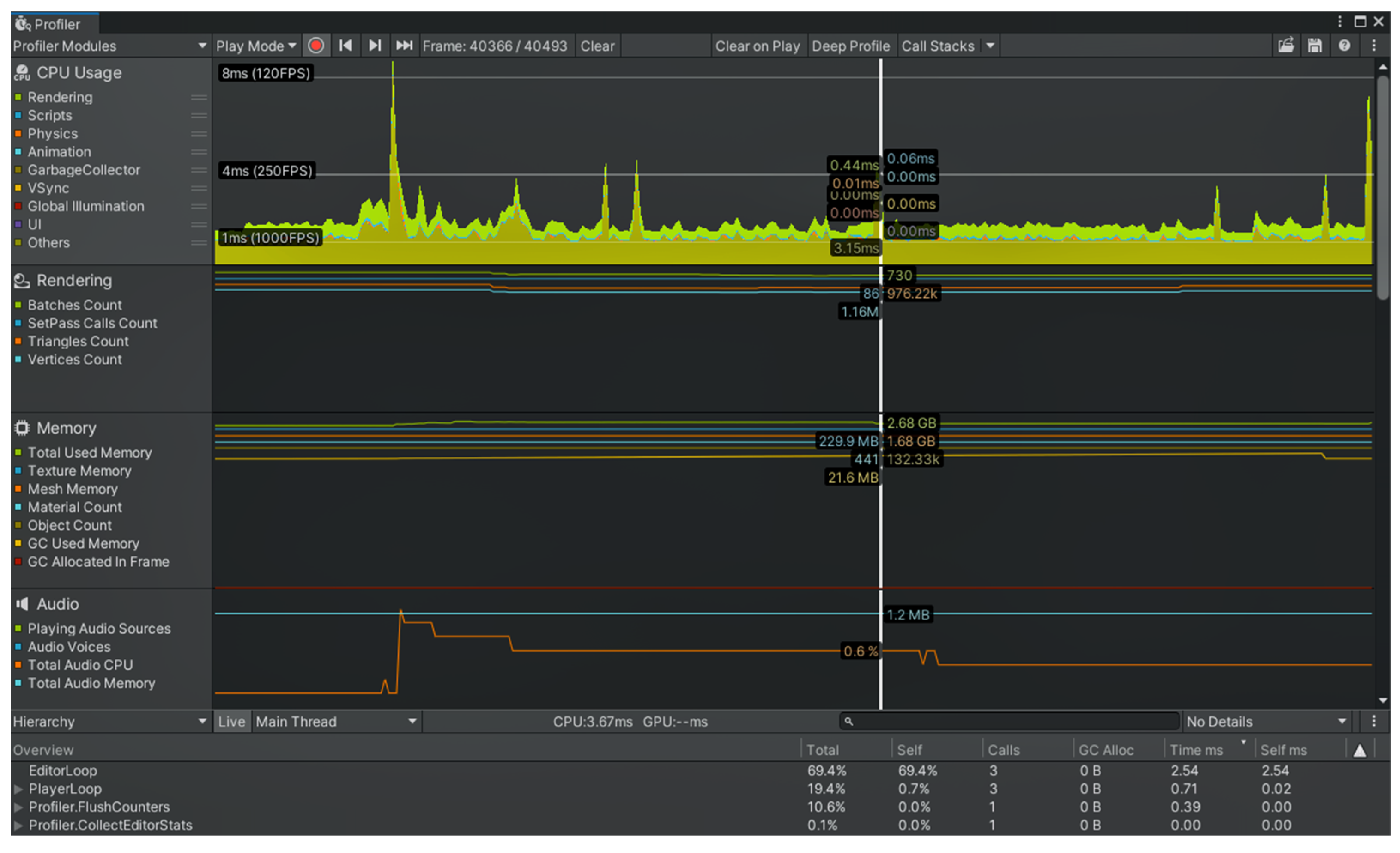
To ensure the platform’s stability and reliability, this paper utilizes Unity3D’s built-in Profiler performance analysis tool to examine data on various performance resource consumption during platform runtime and test whether all functions operate normally. We found through comprehensive performance analysis that response speed peaks occur around 25 ms, with an average response speed of approximately 15 ms. Peak occurrences are infrequent, indicating that the platform performs well and can guarantee a positive user experience. The performance resource consumption details are shown in Figure 12.
The results of the platform functionality testing are shown in Table 7.

5. Platform Path Planning Simulation Verification

This section introduces the fundamental principles of the traditional A-star algorithm and Dijkstra’s algorithm, analyzes the shortcomings of the A-star algorithm and their underlying causes, and proposes five optimization methods for the A-star algorithm. The development of the new algorithm utilizes intelligent warehouse AGVs as the implementation vehicle and Python (v3.9.23) and Unity3D as the development platforms. Building upon the traditional A-star algorithm, it sequentially optimizes the heuristic function, search neighborhood, data storage list, bidirectional search, and path smoothing processing.

5.1. Algorithm Selection

(1)
Dijkstra’s algorithm
The idea of Dijkstra’s algorithm is to set a set S to record the vertex of the obtained shortest path and put the source point into S initially. Every time the set S merges a new vertex Vi, the current shortest path length value of the vertex from the source point V0 to the set VS should be modified. The Dijkstra algorithm solves the single-source shortest path problem in weighted graphs. The steps are as follows:
(a) Initialization: Set S is initialized to {0}, initial value of dist[] dist[i] = Edge[0][i], initial value of path[] path[i] = −1, i = 1, 2, …, n − 1.
(b) Select Vj from the set of vertices VS, satisfy dist[j] = Min{dist[i]|ViVS}, Vj is the end point of the shortest path from V0, let S = S ∪ {j}.
(c) Modify the shortest path length reachable from V0 to a vertex Vk in the set VS: if dist[j] + Edge[j][k] < dist[k], update dist[k] = dist[j] + Edge[j][k], and modify path[k] = j (modify the precursor node of the shortest path of vertex Vk).
(d) The (b)~(c) operation is repeated n − 1 times until all vertices are contained in S.
(2)
A-star algorithm
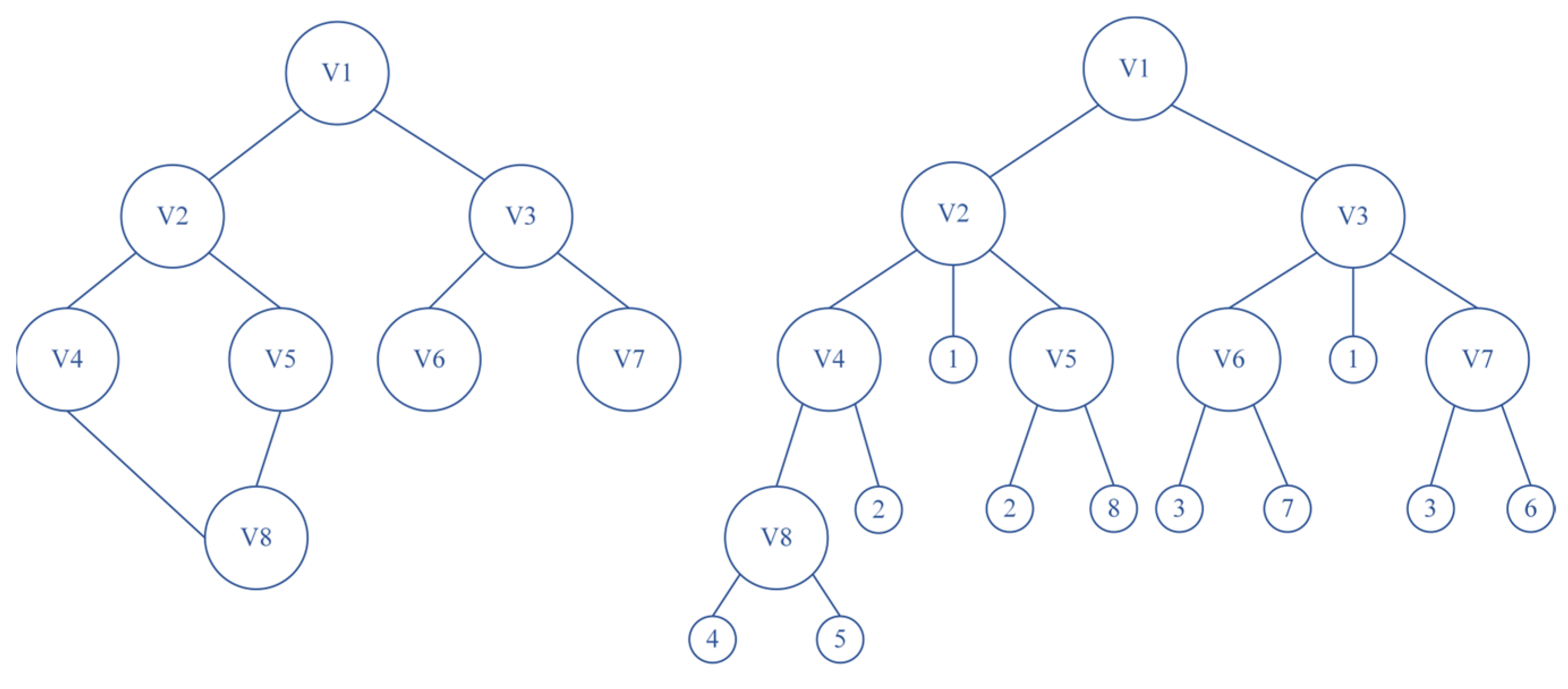
The A-star algorithm is a graph search algorithm used for path planning, employing a search method based on breadth-first search. In this algorithm, node visits resemble tree traversal. Only after completing the search of all nodes in one layer can the nodes in the next layer be searched. This may lead to blind searching and result in lower search efficiency. However, if a feasible path exists, it must be found and is guaranteed to be the optimal path. The generation process of BFS is illustrated in Figure 13.
The core principle of the A-star algorithm can be summarized as follows: by comprehensively considering actual costs and expected costs and utilizing a heuristic function to guide the search, it aims to find the optimal path or a solution that approximates the optimal path. The cost function of the A-star algorithm can be expressed as Formula (1).
f ( n ) = g ( n ) + h ( n )
where f(n) represents the total path cost from the starting point to the end point, g(n) is the movement cost function indicating the actual cost from the start to the current node, and h(n) is the heuristic function estimating the cost from the current node to the end. The selection of h(n) size directly affects the efficiency of path search and the optimality of the path [28]. The second phase is analytical expansion, which ensures the algorithm achieves continuous coordinates to the target state. The steps of the A-star algorithm are as follows:
(a) Initialize the open list (openlist) and the closed list (closelist). Add the starting point S to the open list.
(b) Starting from the origin, search all surrounding nodes and compute the f(n) values for all adjacent nodes. Add the node with the smallest f(n) value to the closed list (closelist). Add all reachable surrounding nodes to the open list (openlist) as points to be examined.
(c) Determine whether the current minimum node k is the endpoint. If yes, output the optimal path; if no, continue.
(d) Search for the f(n) value of the adjacent node i of the minimum node k. If i already exists in the closed list (closelist), ignore it. If i is in the open list (openlist) and g(i) > g(k) + d(k, i), update g(i) > g(k) + d(k, i), and make k the parent node of i. If i is not in the open list (openlist), add it to the open list (openlist).
(e) Repeat steps (b) to (d), starting from the end point, tracing the parent node path of each node back to the starting point, and finally output the nodes in the closed list (closelist) in order, which is the optimal path found.
When Dijkstra’s algorithm incorporates a heuristic function, it transforms into the A-star algorithm. Therefore, only the pseudocode for the A-star algorithm is presented, as shown in Appendix B.7.
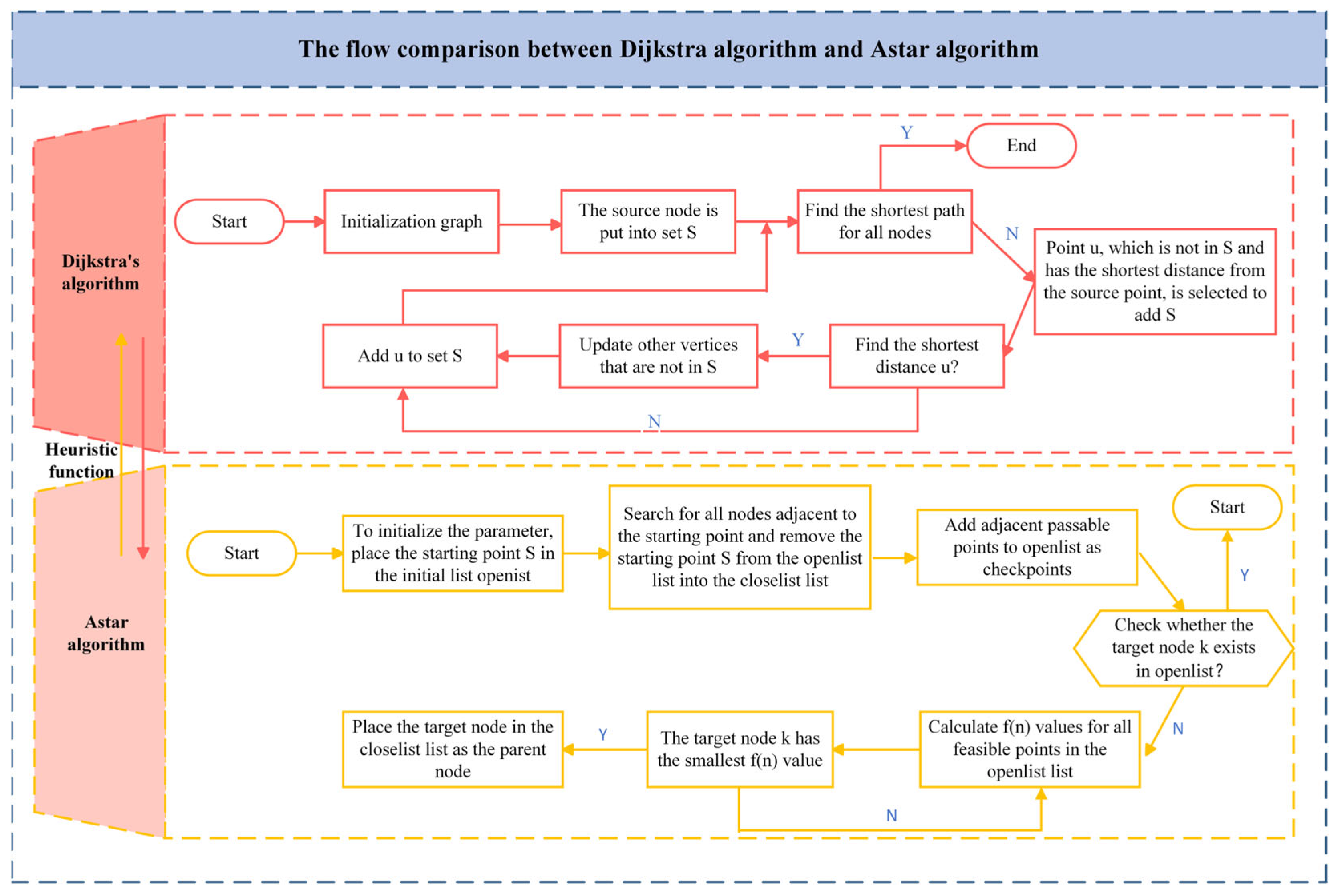
The basic flowcharts of Dijkstra’s algorithm and the A-star algorithm are compared, as shown in Figure 14.
(3)
Comparison of algorithm advantages and disadvantages
Compared to the Dijkstra algorithm, the A-star algorithm is directional in its search, whereas Dijkstra performs a blind search. When handling large-scale graphs, Dijkstra’s lack of heuristic guidance may result in prolonged runtime. Therefore, the A-star algorithm incorporates a heuristic function, which assists it in more intelligently selecting the next vertex, thereby finding the shortest path more efficiently. The A-star algorithm guides the search process through a heuristic evaluation function, making it more efficient at finding the shortest path. However, if the evaluation function is poorly designed, the search may not always locate the shortest path. The advantages and disadvantages of both algorithms are compared in Table 8.
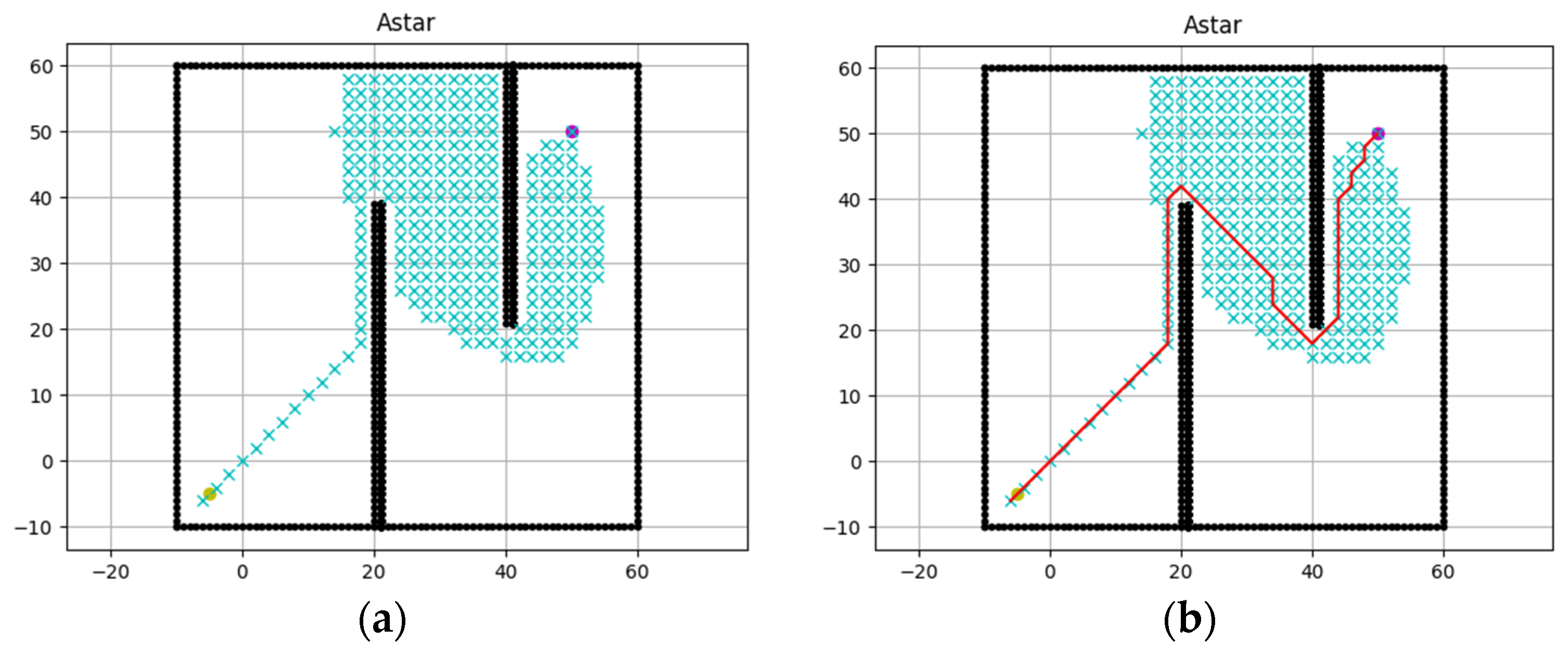
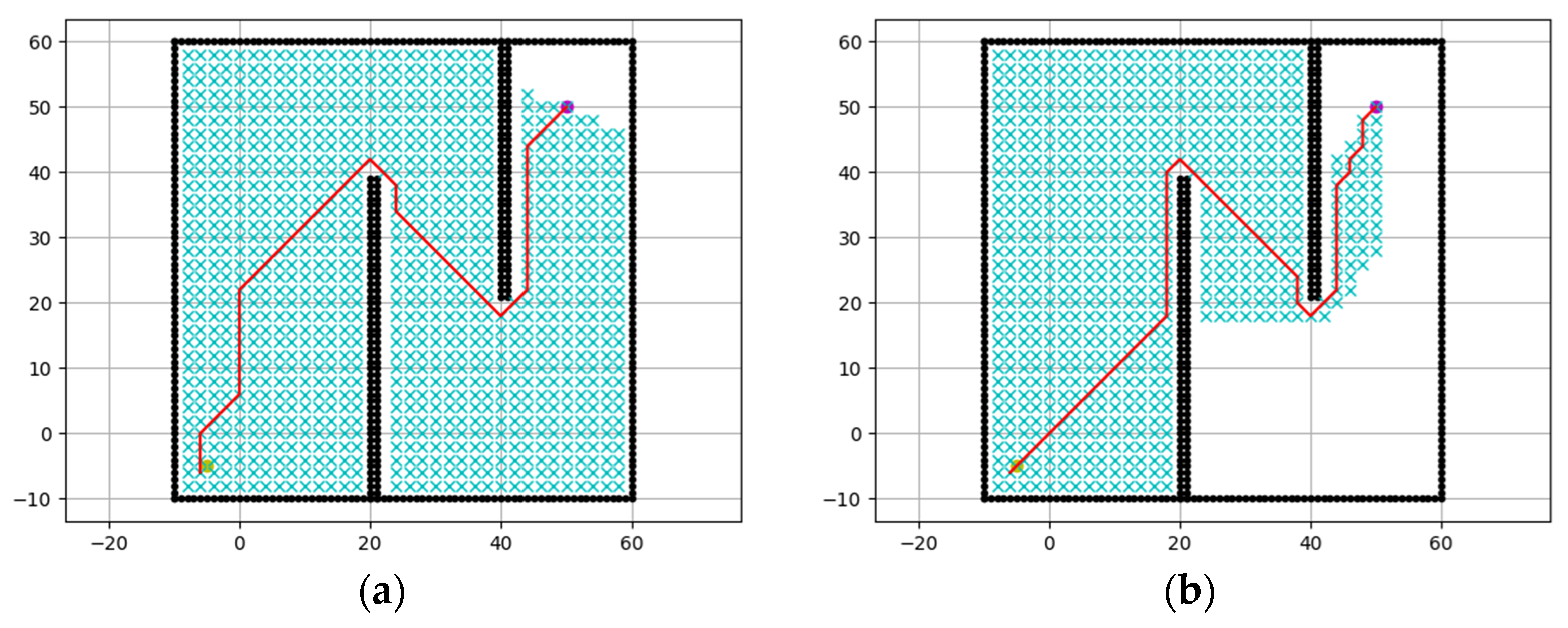
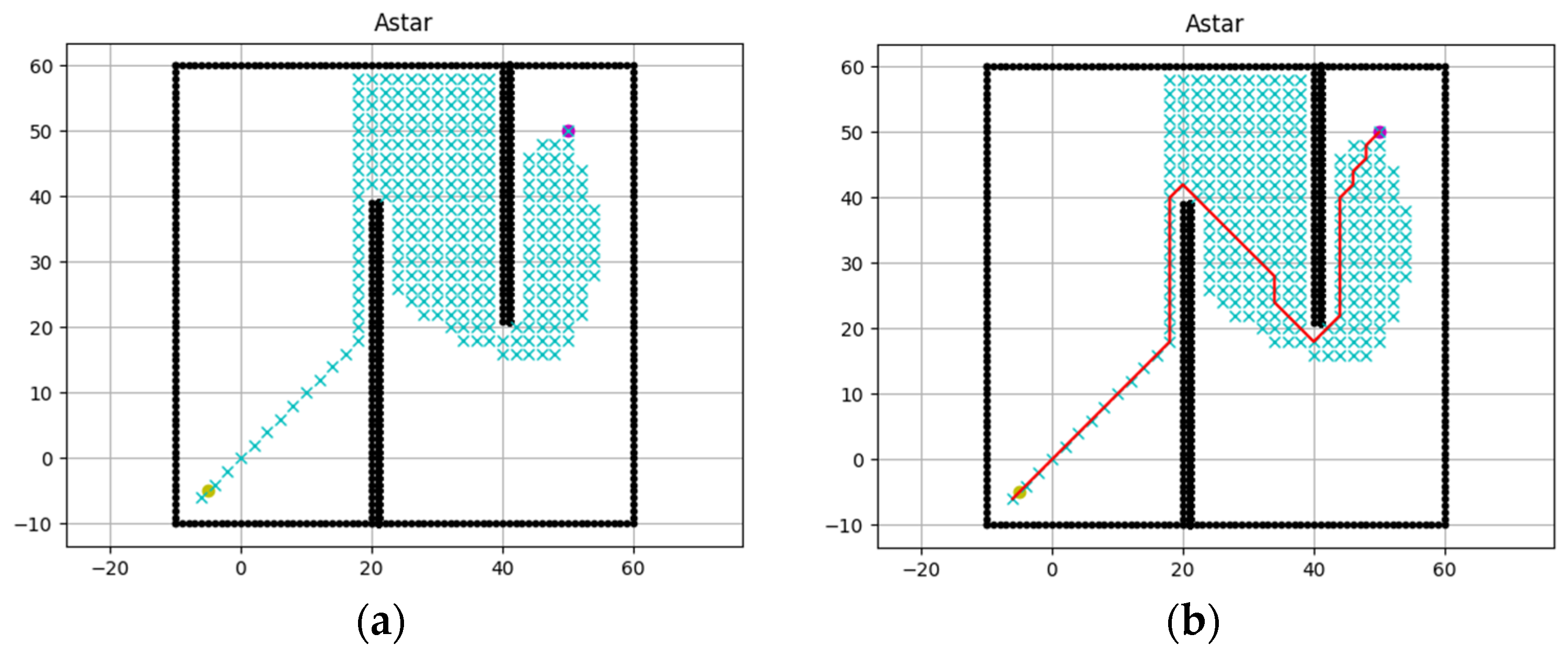
To better validate the differences between the A-star algorithm and Dijkstra’s algorithm, a comparative verification of both algorithms was conducted using Python within the same grid environment. The grid map, measured in nodes, has dimensions of 34 × 34, comprising 1156 nodes. Black indicates obstacles, with two rows added at x-coordinates 20 and 40, containing 50 and 40 nodes, respectively. The yellow circle denotes the path’s starting point, the pink circle marks the target destination, and the red lines represent paths found under different conditions. Therefore, after comprehensively considering factors such as the ground conditions, environmental characteristics, and overall layout of the intelligent warehouse factory, the A-star algorithm was selected as the foundational path planning algorithm for AGVs due to its advantages of broad applicability, short search time, and high search efficiency. The simulation diagrams for the Dijkstra algorithm and the A-star algorithm are shown in Figure 15.

5.2. Algorithm Improvement and Optimization

5.2.1. Heuristic Function

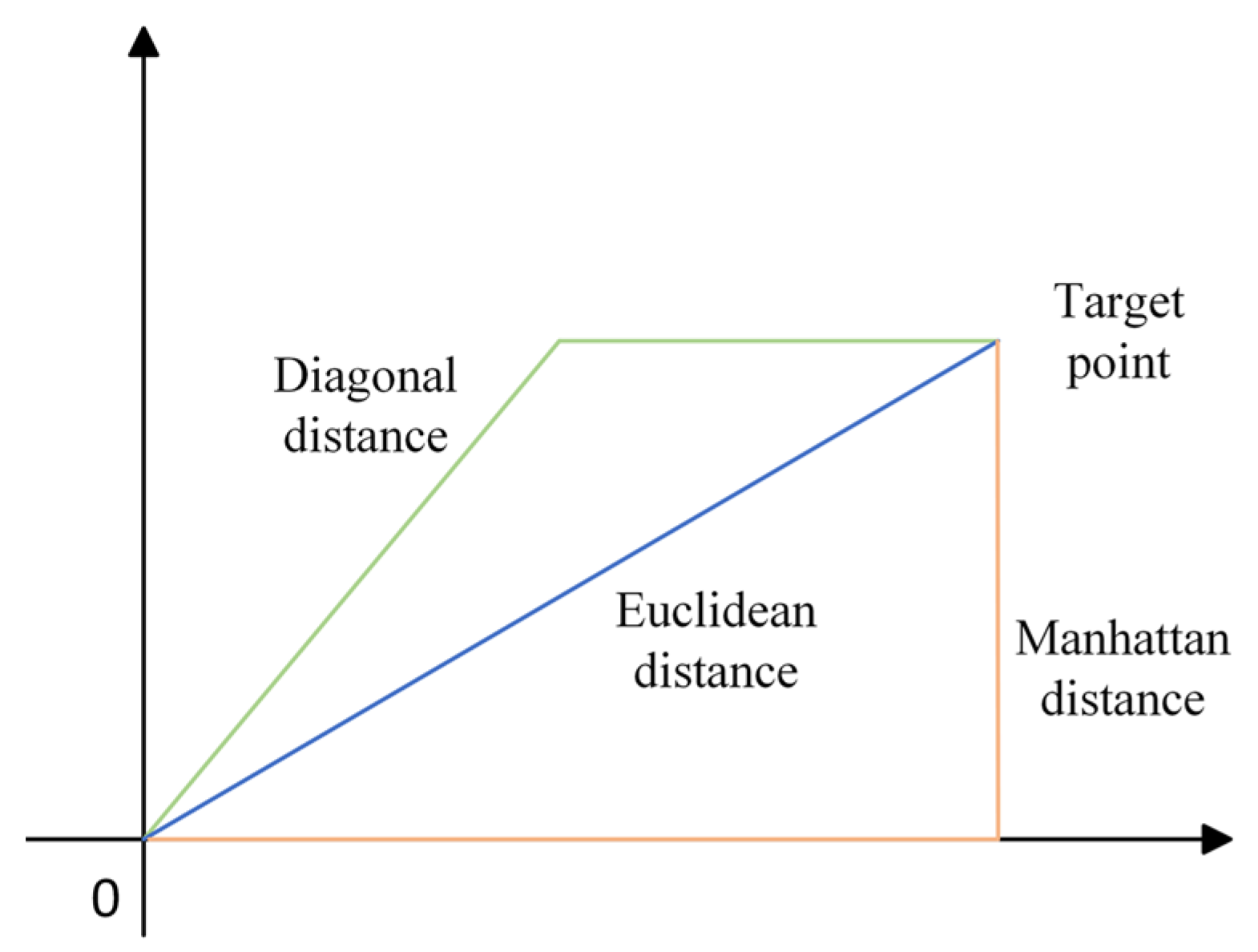
The selection of the heuristic function h(n) has an important effect on the search efficiency and the quality of the A-star algorithm. Selecting an appropriate heuristic function provides the algorithm with accurate estimates while also enhancing computational efficiency. Currently, common heuristic functions for two-dimensional maps include Manhattan distance, Euclidean distance, and Chebyshev distance, whose concepts are illustrated in Formulas (2)–(4). The three distance description methods are depicted in Figure 16.
(1)
Manhattan distance heuristic function
h ( n ) = x a x b + y a y b
(2)
Euclidean distance heuristic function
h ( n ) = ( x a x b ) 2 + ( y a y b ) 2
(3)
Chebyshev distance heuristic function
h ( n ) = max ( x a x b , y a y b )
h(n) represents the heuristic function, while (xa, ya) denotes the coordinates of the target node and (xb, yb) refers to any given node. The Manhattan distance is primarily utilized for four-way search, but may traverse excessive nodes during eight-way searches. When employing Euclidean distance, estimated function values become highly similar as paths approach the target node, potentially leading to ambiguous node selection. When using Chebyshev distance, which relies solely on the maximum horizontal or vertical coordinate difference, paths invariably begin along straight lines followed by diagonals. Should the search path encounter obstacles, the shortest path will not be obtained.
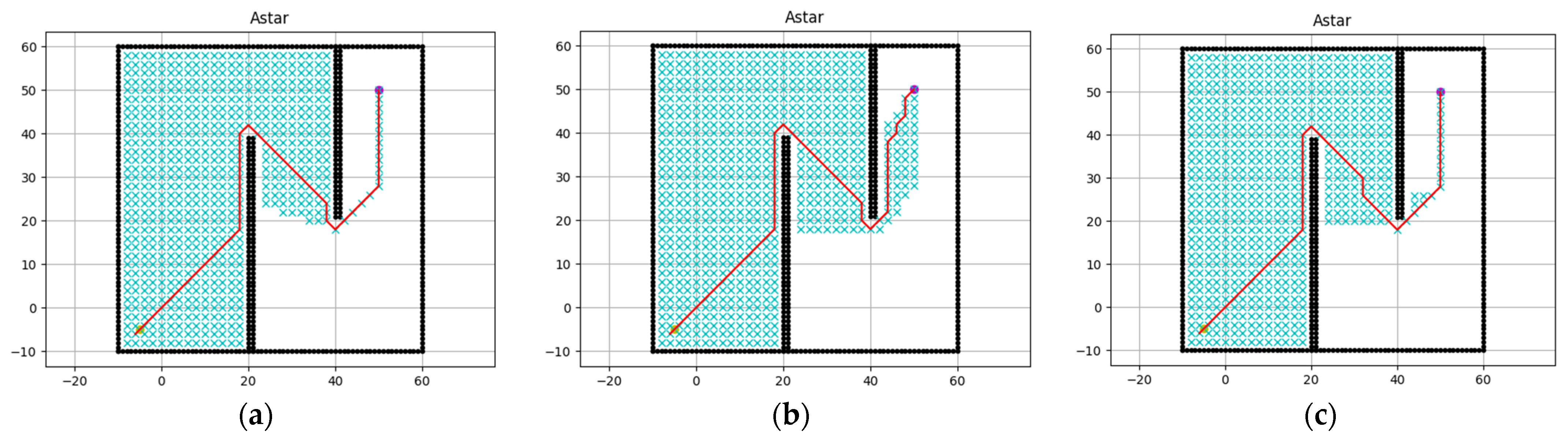
By simulating the three distances, analyzing and comparing the three aspects of the number of search nodes, path length, and search time, and at the same time, combining the movement of AGVs in the intelligent warehouse factory in this paper, because AGVs are magnetic navigation type, the movement of guidance is realized by sticking the magnetic tape on the ground in the warehouse factory, the magnetic tape is arranged in the form of a grid, and the direction of the movement of the AGVs is restricted, therefore, the Manhattan distance is chosen to be the heuristic function of the A-star heuristic function of the algorithm to obtain Formula (5), and the three distance simulation diagrams are shown in Figure 17.
f ( n ) = g ( n ) + x a x b + y a y b
After selecting a suitable heuristic function, the weight coefficients of the heuristic function are improved to obtain better search results. In the traditional A-star algorithm, adjustments are made to the heuristic function in front of the heuristic function h(n) to add a weight coefficient w, thus changing the weight of the heuristic function, to obtain the Formula (6).
f ( n ) = g ( n ) + w x a x b + y a y b
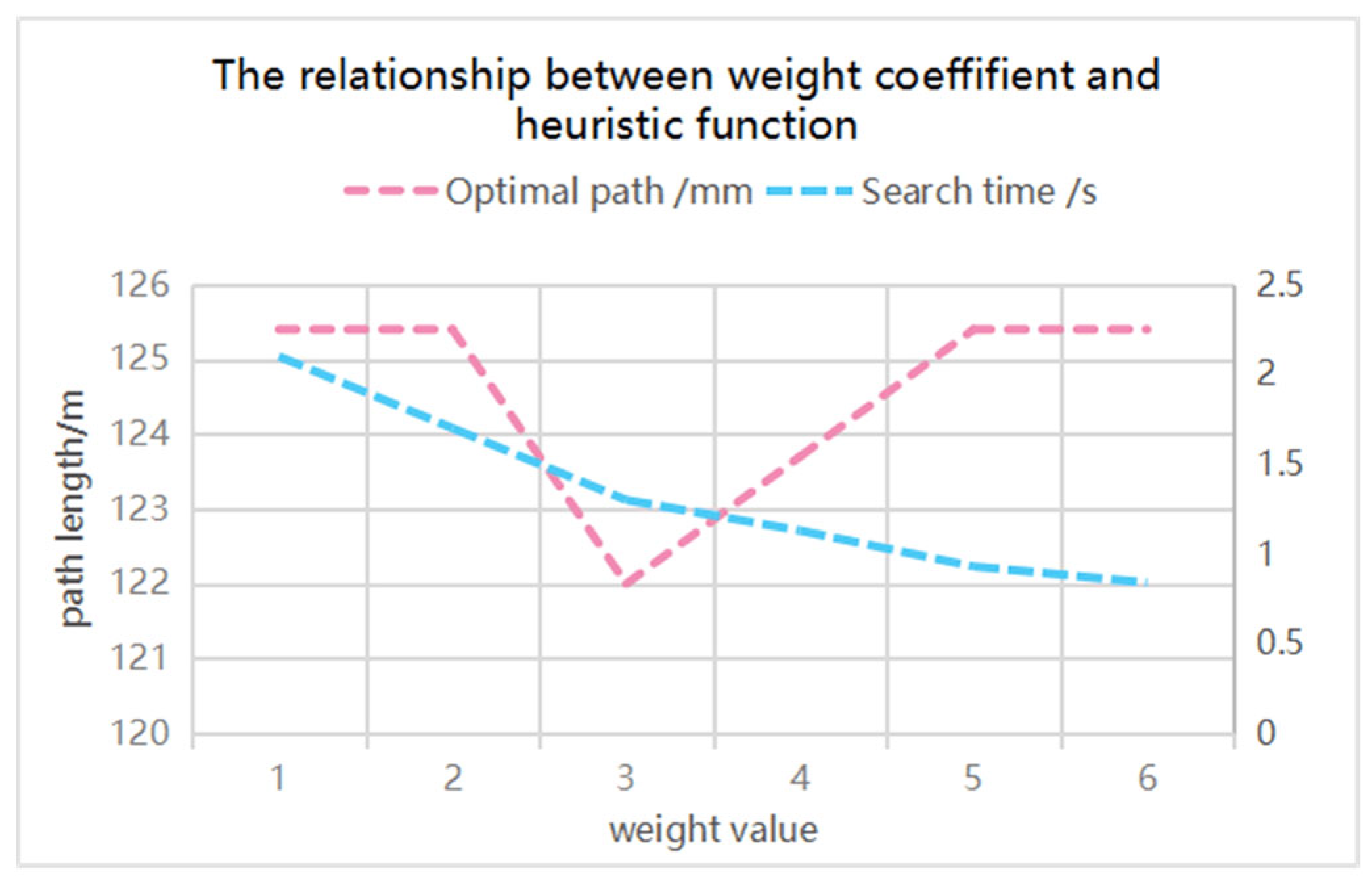
When the weight coefficient w is set to a large value, the A-star algorithm accelerates its search process but cannot guarantee that the found path is the optimal solution. Conversely, if w is set to a small value, the number of nodes involved in the A-star search increases, slowing down the search speed but ensuring the optimal path is found. Therefore, to determine the most suitable weight allocation, the A-star algorithm is optimized using a dynamic weighting method, adjusting the values of h(n) and w according to the map. The relationship between the weight coefficient and the heuristic function is illustrated in Figure 18. The right vertical axis represents search time, the left vertical axis represents the optimal path, the lower horizontal axis represents the weight coefficient values, and the upper horizontal axis represents the heuristic function values.
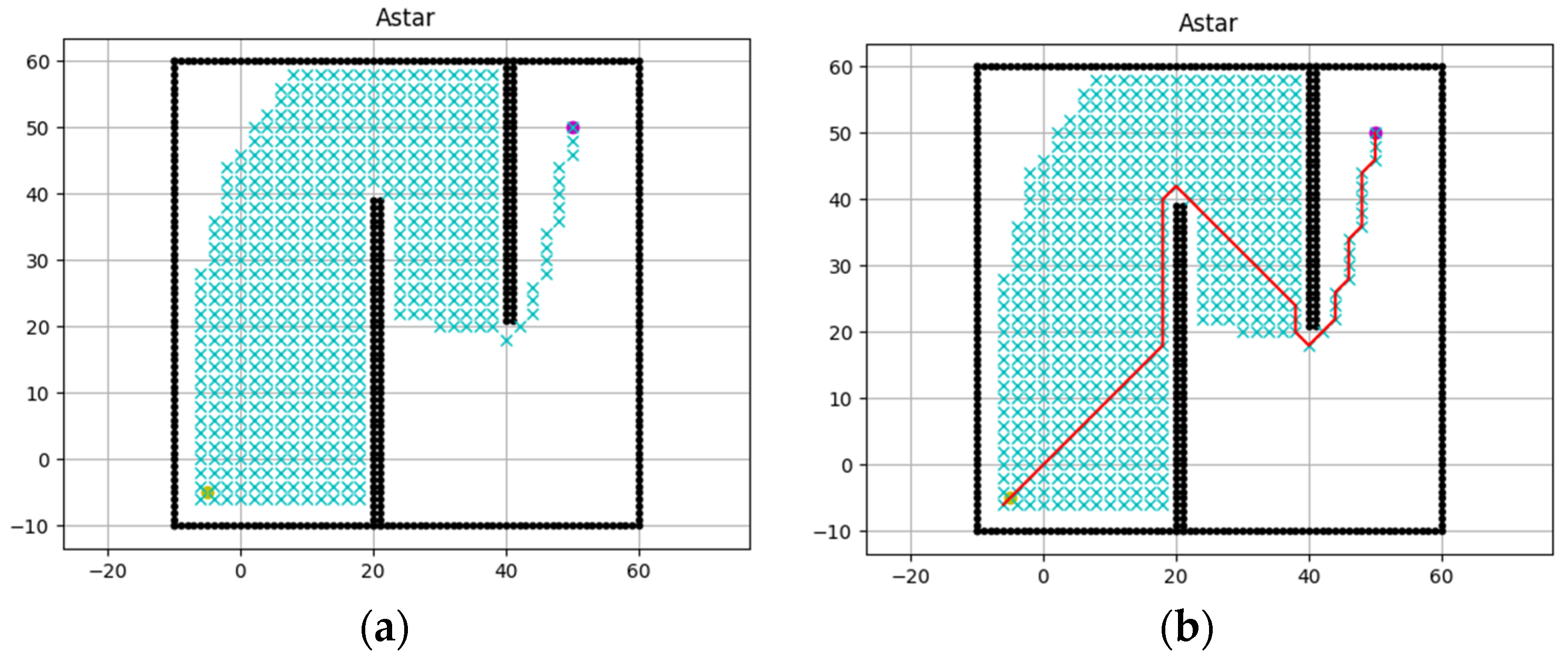
Adaptive coefficients are used to weight the weight coefficients, and in the pre-search phase of the algorithm, in order to quickly find the direction, the weight coefficient of h is made to account for an increase in the proportion of the weight coefficients, and the initial value of the weight coefficients is set to be 2. At this time, the simulation diagram of the A-star algorithm is shown in Figure 19. Using the original heuristic function h(n) as the basis for judgment, it is defined as d. Based on the specific search conditions in the map described in this paper, the value of w is calculated. Where w0 = 2, the Golden section method [29] is employed to calculate the upper and lower bounds of w as 3.236 and 0.746, respectively. The golden ratio (φ ≈ 0.618) has been proven in optimization theory to exhibit optimal convergence properties in unimodal search spaces. The specific calculation formula is shown in Formula (7).
w = w 0 + g max g e n × ( w 0 × 0.618 ) , i f   d > 12 w 0 g max g e n × ( w 0 × 0.618 ) , i f   d 12
where g is the current number of iterations and max gen is the maximum number of iterations. It is found in multiple experiments that in the pre-algorithm d > 12, with the increase in iterations, the weight of w increases from w = 2 to w = 3.236 as iterations progress. At this point, the algorithm enhances heuristic guidance to accelerate the localization of the search direction. As the target approaches d ≤ 12, the weight of w decreases from w = 2 to w = 0.746 with increasing iterations. This diminishes heuristic influence near the endpoint to ensure path optimality. The simulation diagram of the improved A-star algorithm is shown in Figure 20.

5.2.2. Search Neighborhood Optimization

In path planning, the setting of search direction is one of the key factors affecting the algorithm’s search efficiency and path quality. Common search methods include four-direction and eight-direction. Four directions allow nodes to move up, down, left and right in four orthogonal directions, and the path turns are all at right angles, which is simple to compute, but the path length may be non-optimal; eight directions add four diagonal moves on top of this, for a total of eight search directions, which makes the paths more flexible and shorter in length, but it will increase the number of nodes to be searched significantly, which leads to a higher computational complexity.
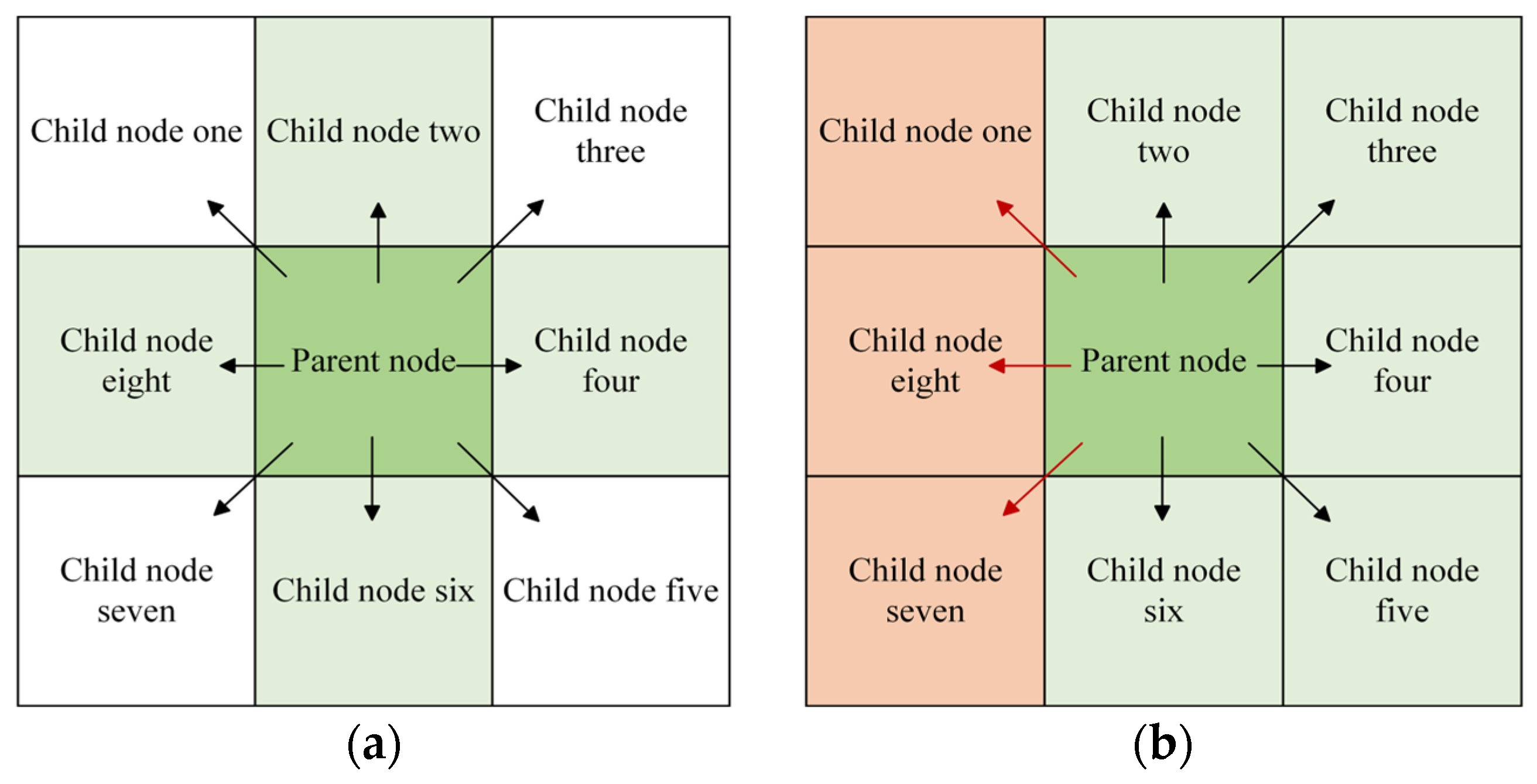
The traditional A-star algorithm seeks the optimal path in the search field by taking the parent node as the center and expanding the child nodes along the surrounding eight search directions, but this also becomes the bottleneck of its efficiency. In this paper, a parametric method is chosen to classify the search direction according to the current angle of the target point, and five-neighborhood search is proposed to improve the A-star algorithm, which dynamically discards three directions according to the map settings. The optimized search neighborhood can reduce the search nodes and improve the efficiency, but it still retains the ability to move diagonally. The specific basis for judging is the angle of the line connecting the start point and the target point with the due north direction, and the child node selection is shown in Figure 21. The discard rule is shown in Table 9.
According to Table 9, the search direction rule most suitable for the map in this section is as follows: when the included Angle β is [337.5°, 360°) ⋃ [0°, 22.5°), 000T, 045T, 090T, 270T, and 315T shall be retained; 135T, 180T, and 225T shall be discarded. The improved search field and path are shown in Figure 22.

5.2.3. Data Storage List Structure Optimization

For the improved A-star algorithm in Section 5.2.2, although the search range of child nodes is reduced, with the gradual progress of the algorithm, a large amount of search node data is required, which will increase the time complexity and calculation time. In order to solve this problem, a custom priority queue is established based on a heap implementation in Python, and the hash table combined with a binary heap is used to enable the A-star algorithm to find the smallest node more quickly and improve the search efficiency.
(1)
Hash table
A Hash table is a data structure that is directly accessed based on Key values. The mathematical expression of the hash function is given in Formula (8).
N u m = f ( k e y )
where f(key) is the hash function and Num is the key value. Let the coordinates of a node be (temp_x, temp_y). Then the corresponding hash function is given in Formula (9).
f ( k e y ) = ( t e m p _ x + t e m p _ y ) % M
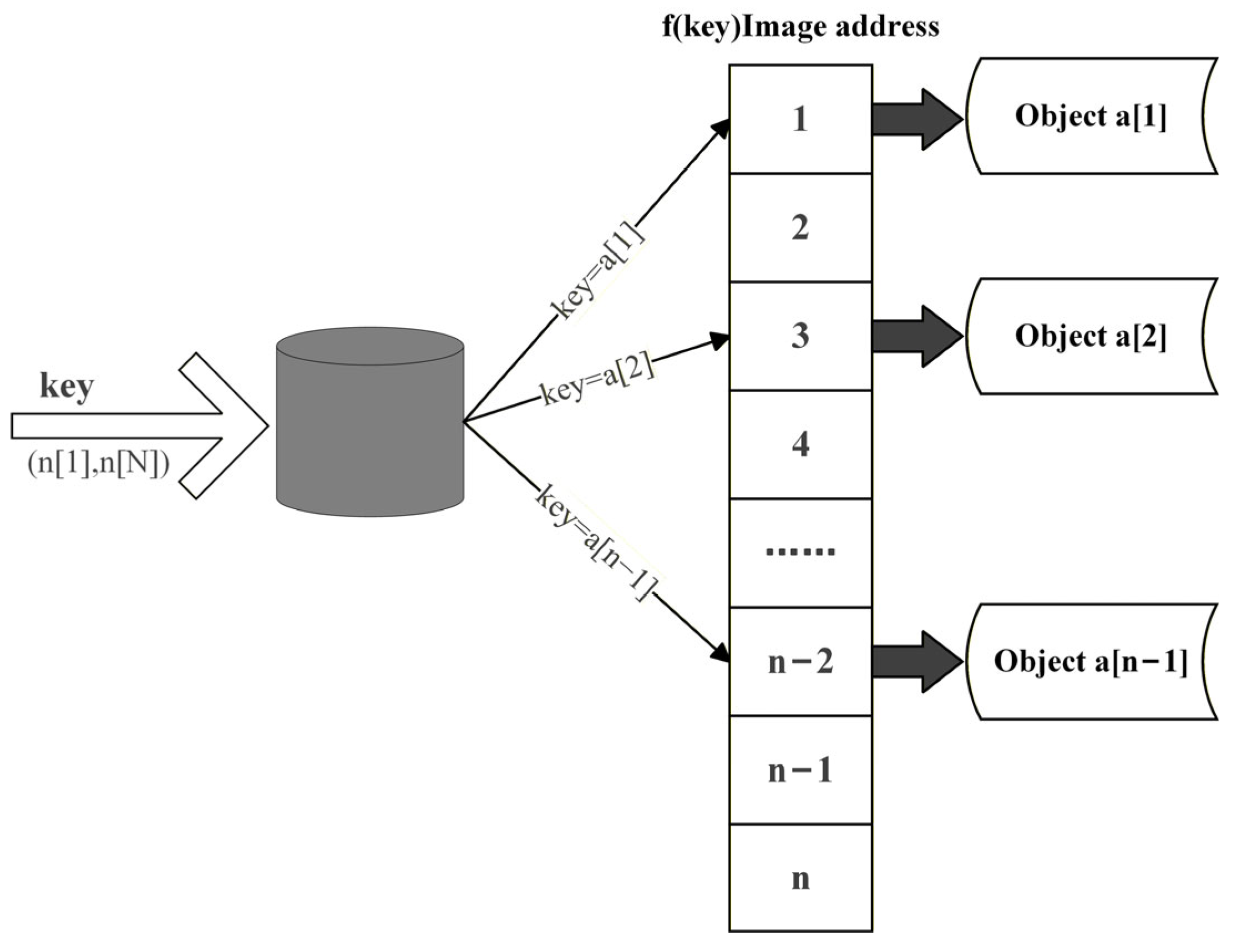
where M is some prime number with the same length as the hash table. When a hash table is used in the A-star algorithm, the node state is used as the key, and the data information (e.g., path, cost) associated with that node is used as the value. The hash function accesses the record by mapping the node state (key code value) to a location in the table to speed up the search efficiency. As shown in Figure 23, the hash table finds the image f(key) of a given value key according to the correspondence relation f. If there is a record in the structure that is equal to the node state and must be in the storage location of f(key), then the correspondence relation f is the hash function. But different keys may obtain the same hash position, that is, key1 ≠ key2, f(key1) = f(key2). This phenomenon is called collision. In order to solve this problem and make improvements to the hash function, see Formula (10).
f ( k e y ) = ( t e m p _ x + t e m p _ y + p ) % M
where p represents the offset, introducing the offset hash function can effectively solve the problem of performance waste caused by hash conflict. Then, according to the obtained hash value, determine whether the corresponding node is in the openlist list to avoid unnecessary calculation costs.
(2)
binary heap
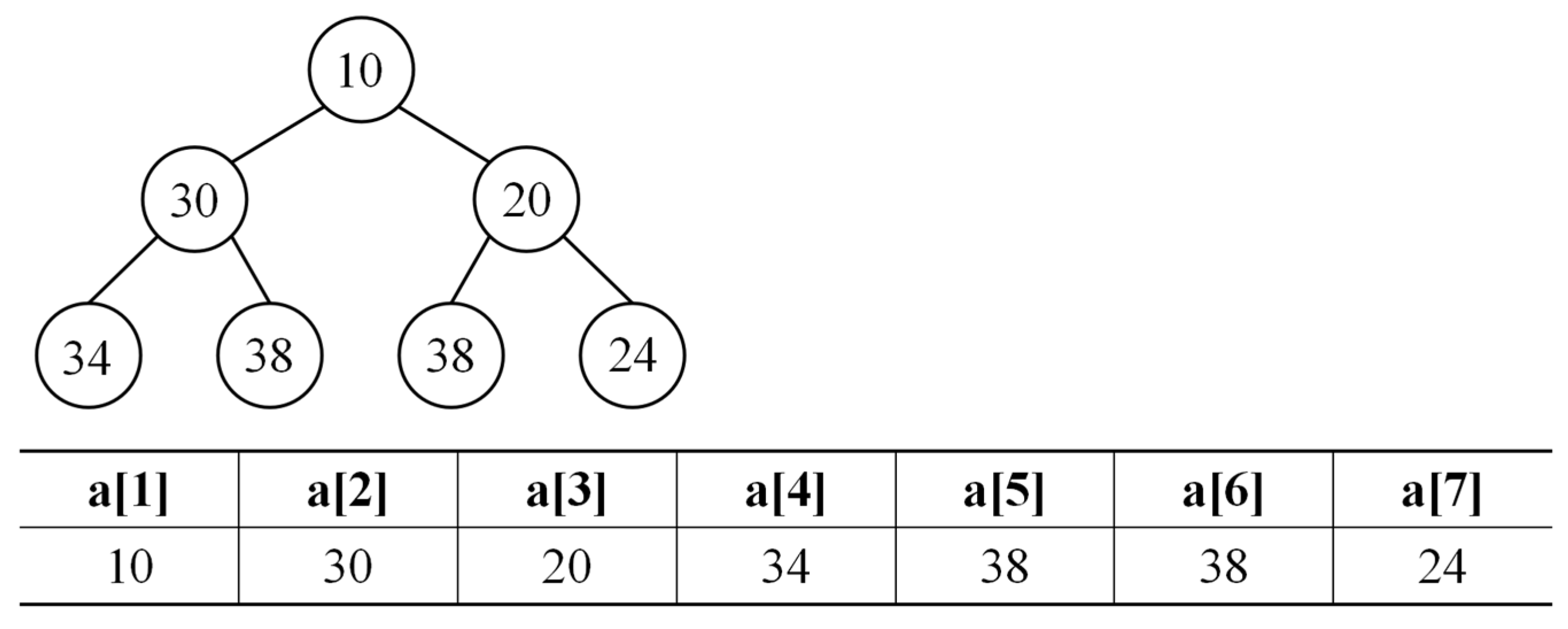
A binary heap is a collection of nodes, with the largest or smallest node positioned at the top. Each node has two child nodes that are greater than (less than) or equal to the value of that node. In this section, the A-star algorithm is optimized using the least binary heap to change the storage of nodes in the openlist list. As shown in Figure 24, the nodes are the f-values of the A-star algorithm, in this binary heap, the node with the smallest key value value 10 is located at the top of the heap and all its children have higher key values than this node, followed by 20 as its child node and the third smallest node value of 24 is located at a distance of two steps from the top. Although 24 is less than 30, which is also present in this layer but one step away from being on top, it still satisfies our condition where each child’s value must be greater than or equal to its parent’s; thus, other nodes’ positions do not affect this property. When adding a new node (position n), it is placed at the end of the array and then compared with its parent’s value (position (n − 1)/2). If the new node’s value is smaller, it will be swapped until no parent node has a larger value or until the new node reaches position 1 (top of the heap). The topmost node will then be deleted from the heap and replaced by a new one; subsequently, the f-value of child nodes will be compared until relationship satisfaction. Compared to the previous algorithm’s time complexity of O(n), the above procedure compresses the time complexity down to O(lgn).
To optimize the execution efficiency and space complexity of the A-star algorithm, a hash table is employed to store previously visited nodes and their associated information, enabling lookups to avoid redundant computations. A binary heap is used to place unexplored nodes into a priority queue, sorted by their f-values. This ensures that the node with the smallest f-value is removed at each iteration, thereby accelerating the discovery of the optimal path.

5.2.4. Bidirectional A-Star Pathfinding Algorithm

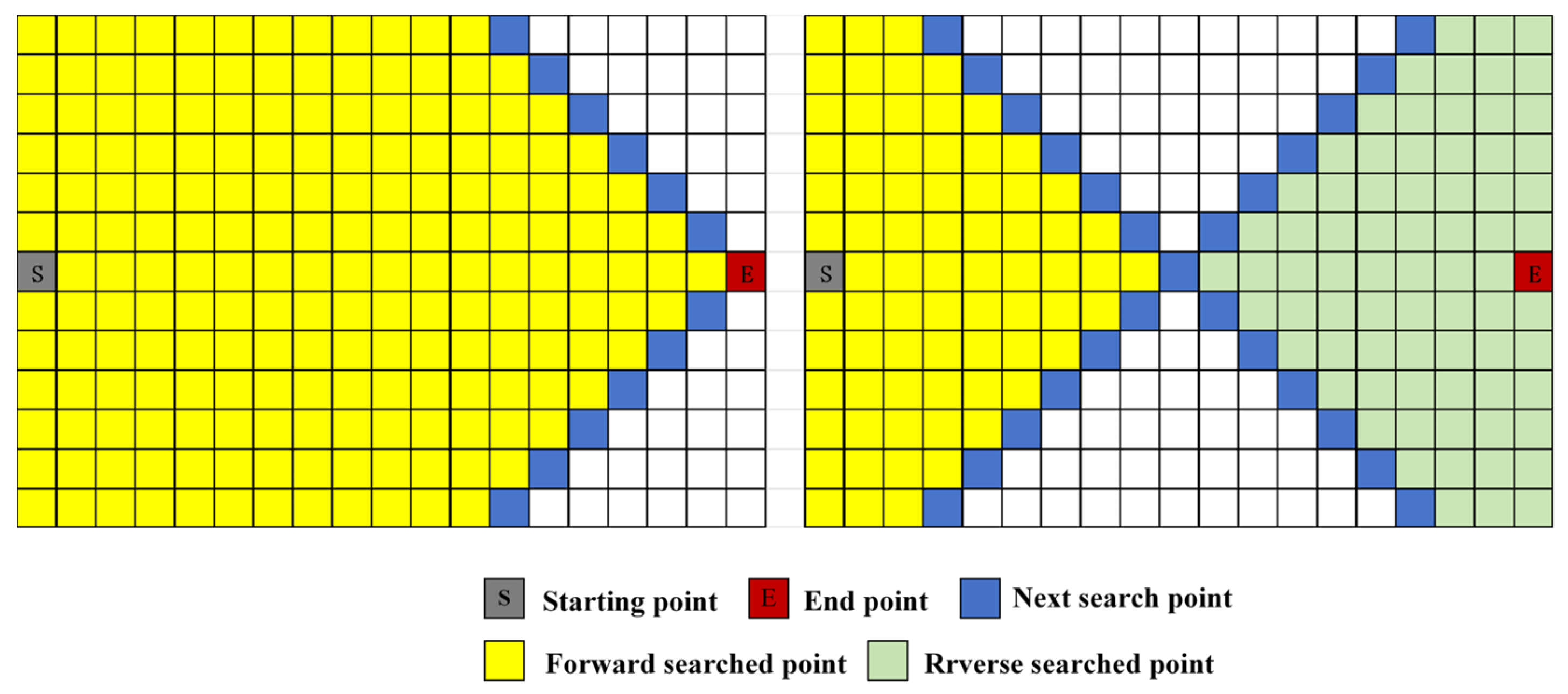
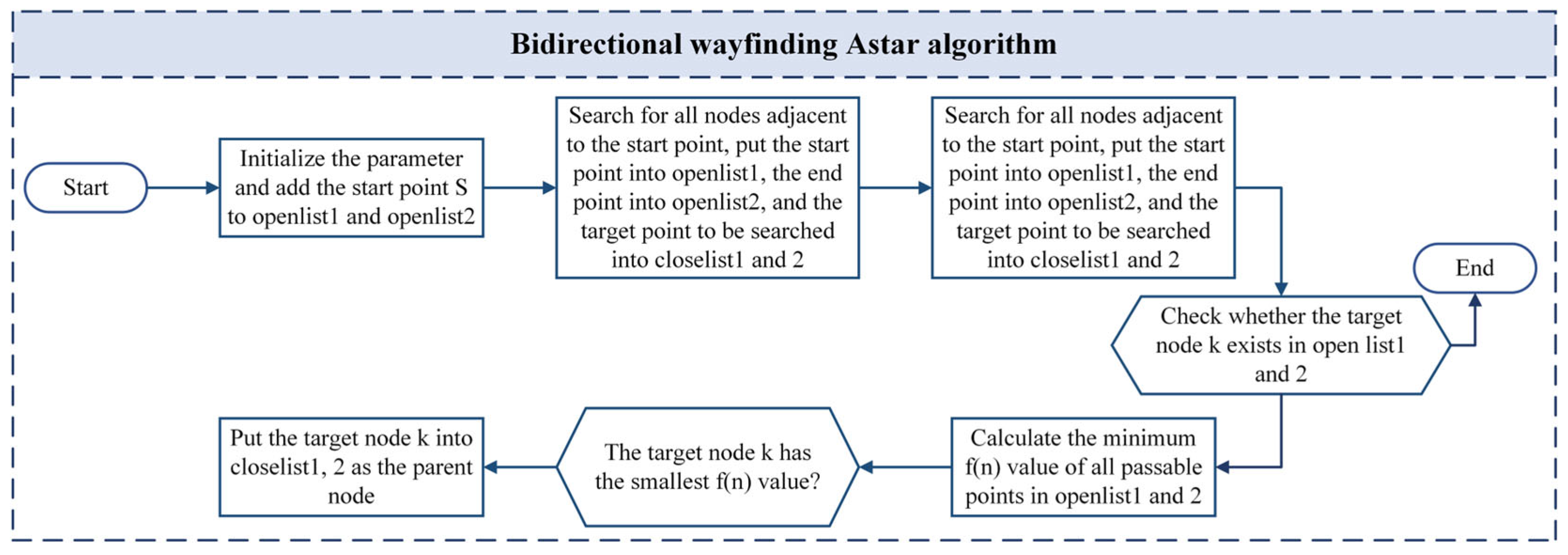
Since all the neighboring child nodes are added to the open list in the traditional A-star algorithm, resulting in a large number of useless nodes during pathfinding, the bidirectional pathfinding method is used to improve the efficiency of the search by performing the search from the start and end nodes at the same time. Simultaneous search is performed from the start node and the end node, and the search process ends when the positive and negative search nodes are adjacent to each other during the search process. Positive and negative incomplete paths are stitched together to form a complete collision-free path. The schematic diagram of search optimization is shown in Figure 25. The left figure shows a single search, and the right figure shows a two-way search.
The bidirectional pathfinding algorithm has more search directions but less search space. In terms of search efficiency, it can effectively avoid falling into the local optimal solution so as to better improve efficiency. The flowchart of the bidirectional pathfinding A-star algorithm is shown in Figure 26.
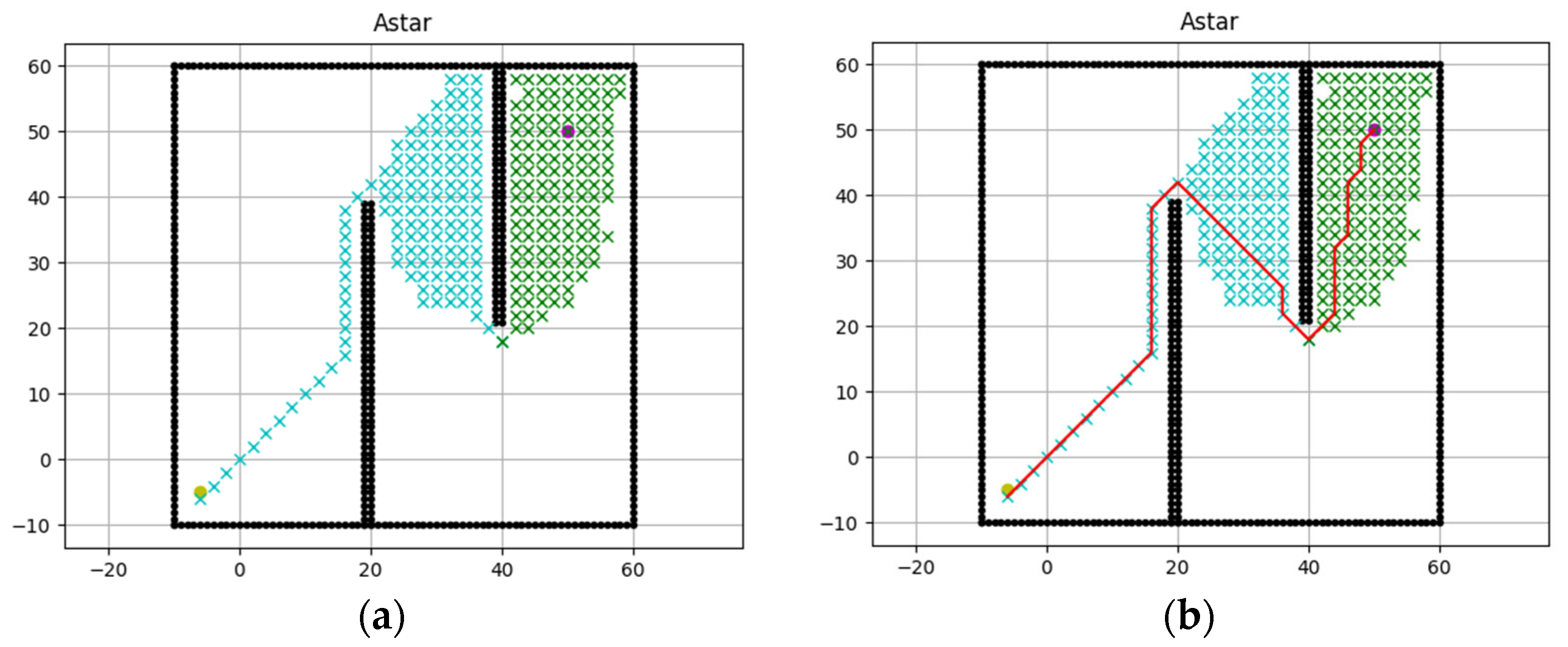
Through comparative analysis of simulation results, the bidirectional A-star pathfinding algorithm demonstrates significant improvements in both search time and search space. In the diagram, the starting point is marked with a yellow circle, the target node with a pink circle, nodes involved in forward search are shown in cyan, and nodes involved in backward search are shown in green. Figure 27 illustrates the simulation diagram of the bidirectional A-star algorithm’s search path.

5.2.5. Bézier Curve

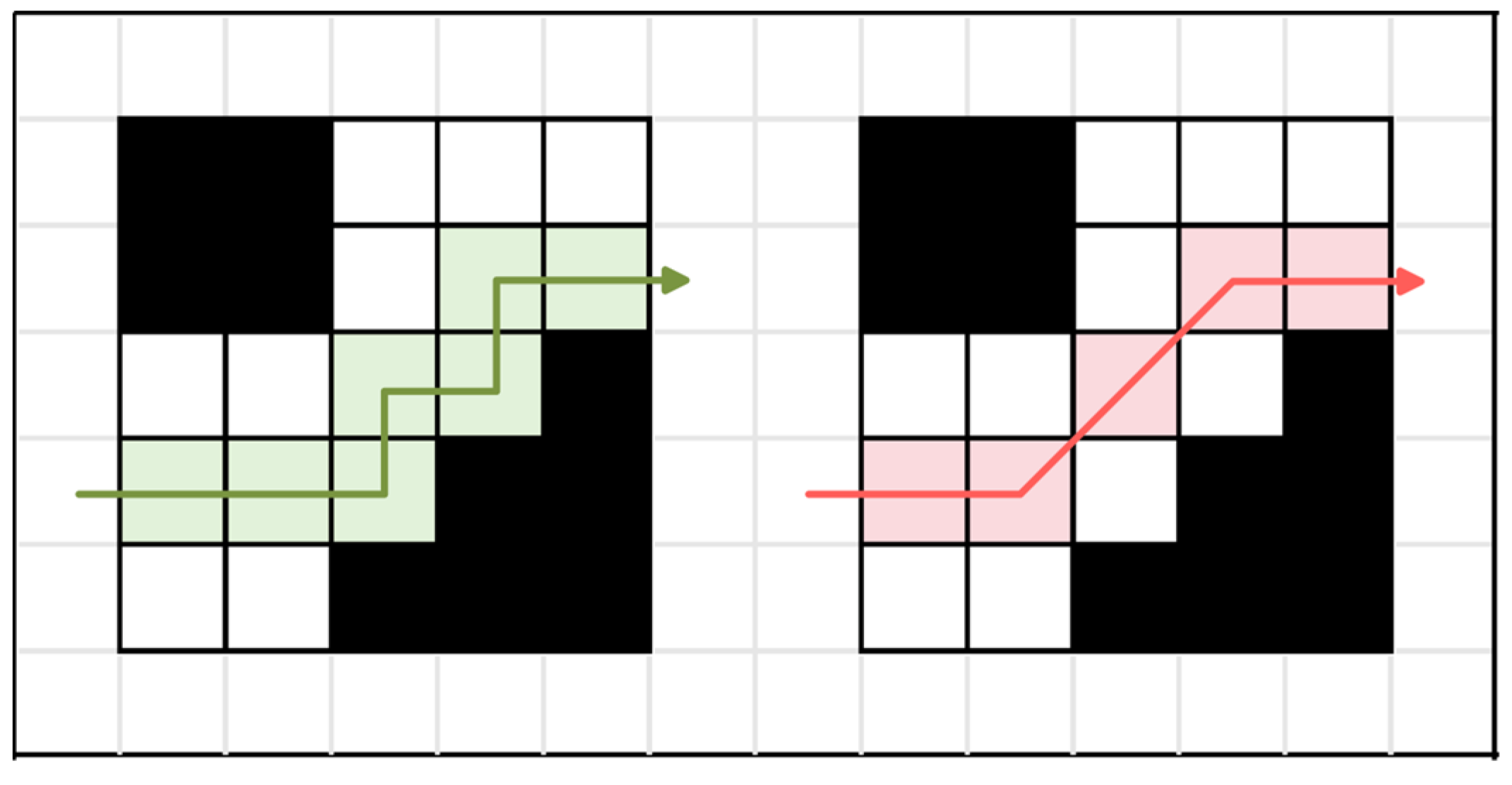
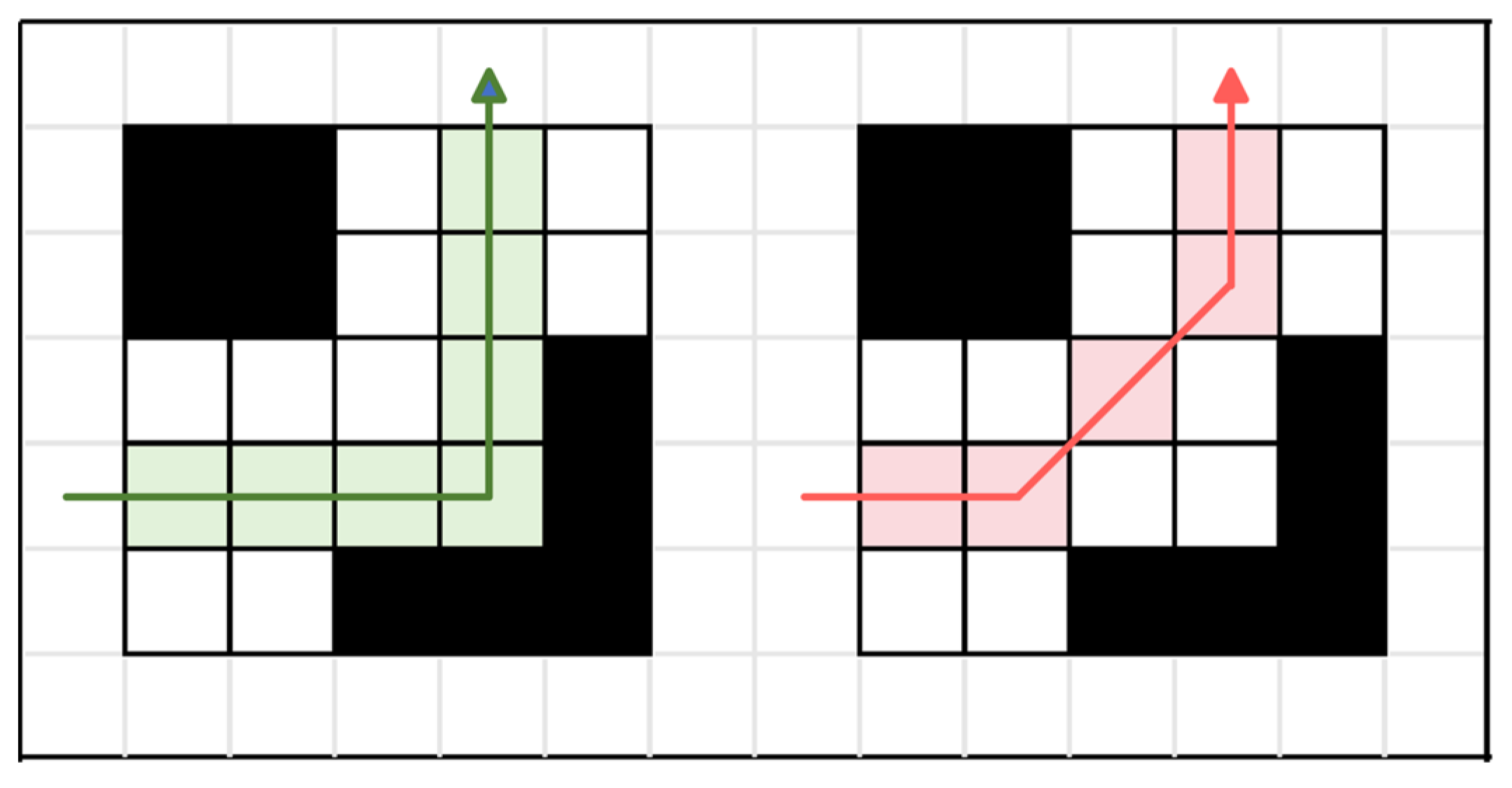
Since the A-star algorithm sacrifices the cost of turning to find the shortest path length, the planned paths still have many turning points and are not smooth, and Bézier curves are used to smooth the paths. In the process of AGV traveling, if the corner is a right angle, the turning movement of the AGV carriage is divided into three steps of deceleration, steering, and movement, which greatly reduces the speed of the mobile robot. The idea of smooth right-angle turns is to decompose a 90° turn into multiple small-angle turns to improve the smoothness of the planned path. There are two cases: a single turn and a continuous turn. When there are no obstacles inside the corner, removing the inflection point and using its two neighboring nodes as corner turning points breaks a single right-angle turn into two 45° corners, as shown in Figure 28. When there are consecutive right-angle turns, the inflection points are removed and the neighboring nodes are directly connected to convert multiple right-angle turns into a small number of sharp 45° corner turns, as shown in Figure 29. The smoothing optimization of right-angle turns improves the smoothness of the path, which not only improves the robustness of the algorithm but also improves the efficiency of AGV driving.
The Bézier curve is composed of a starting point, a control point, and an end point. The shape of the Bézier curve is determined by the position, number, relative position, and weight of the control point. As the order increases, the flexibility and complexity of the Bézier curve increase, and the difficulty of computation and control increases accordingly. The choice of order of the Bézier curve depends on the specific design requirements and complexity. The first, second, third, and higher-order expressions for the Bézier curve are shown in Formulas (11)–(14).
First-order Bézier curve expression:
B ( t ) = P 0 + ( P 1 P 0 ) t = ( 1 t ) P 0 + t P 1 , t [ 0 , 1 ]
Second-order Bézier curve expression:
B ( t ) = ( 1 t ) 2 P 0 + 2 t ( 1 t ) P 1 + t 2 P 2 , t [ 0 , 1 ]
Third-order Bézier curve expression:
B ( t ) = P 0 ( 1 t ) 3 + 3 P 1 t ( 1 t ) 2 + 3 P 2 t 2 ( 1 t ) + P 3 t 3 , t [ 0 , 1 ]
Higher-order Bézier curve expression:
B ( t ) = i = 0 n ( n i ) P i ( 1 t ) n i t i = ( n 0 ) P 0 ( 1 t ) n t 0 + ( n 1 ) P 1 ( 1 t ) n 1 t 1 + + ( n n 1 ) P n ( 1 t ) 1 t n 1
where B(t) represents the coordinates of points on the Bézier curve when the parameter is t, usually points in two-dimensional or three-dimensional space [30], where the parameter t generally takes a value range of [0, 1], representing the position of the curve; n represents the order of the curve minus one, that is, the Bézier curve consists of n + 1 control points; Pi represents the coordinates of the i-th control point, usually in the form of (x,y) or (x,y,z).
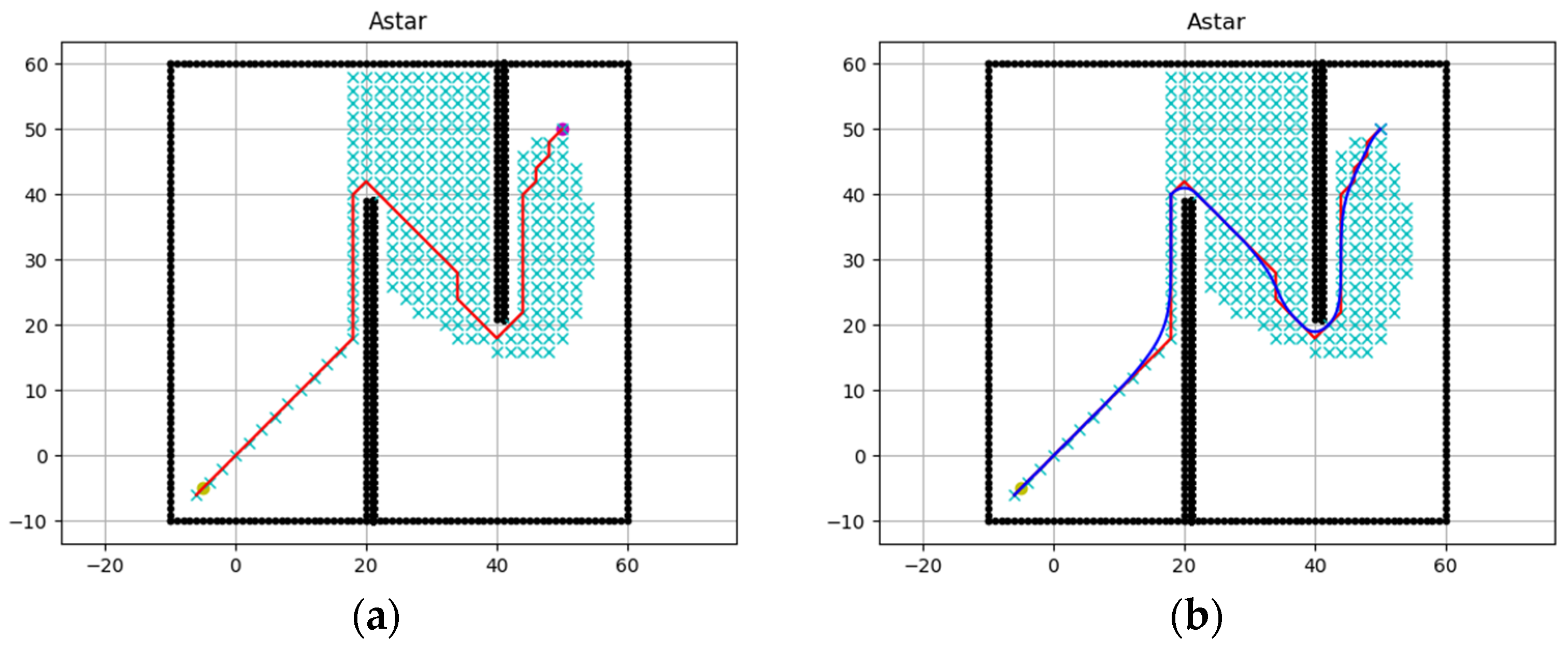
A method combining a Bézier curve with an improved A-star algorithm is employed. First, the optimized path is generated using the enhanced A-star algorithm. Subsequently, Bézier curves are applied for smoothing operations. The values from the pathx and pathy lists obtained at the end of the A-star algorithm run serve as control points, generating a smooth curve through the points. To observe the effect of path smoothing using a Bézier curve, the path processed with a Bézier curve is represented by a blue line on the original map. The smoothed path is shown in Figure 30.

5.2.6. Comparison of Optimization Results

Based on the optimization method mentioned earlier, the optimized A-star algorithm initializes the start node and goal node, creating an open set and a closed set to store nodes to be visited and visited nodes, respectively. In the main loop, the node with the smallest overall evaluation value is selected from the open set as the current node. This node is removed from the open set and added to the closed set. The current node is checked against the goal node: if it is the goal, the path search ends and path backtracking occurs; otherwise, the next step proceeds by traversing the current node’s adjacent nodes. If an adjacent node is an obstacle or already in the closed set, it is ignored. If the adjacent node is not in the open list, add it to the open list, calculate its g-value, h-value, and f-value, and set the current node as its parent node. If the adjacent node already exists in the open list, calculate the actual cost from the current node to reach the adjacent node. If this cost is lower than the existing cost, update its parent node to the current node and update its g-value and f-value. Repeat the above steps until the open list is empty or the goal node is found. If the goal node is found, trace back through the parent node chain starting from the goal node until reaching the start node, obtaining the optimal path.
During the running process, increase the value of counter A_star.count when accessing the nodes in order to assess the situation of the number of nodes searched by the improved algorithm. Use the time() function of the time module to obtain the current timestamp, obtain the timestamps at the beginning and the end of the algorithm, respectively, and then calculate the difference between the two to get the algorithm’s running time. Make modifications to the A-star algorithm to make it return the path length when the target node is found and update the path length by recursive calls. Calculating the space complexity requires installing the memory_profiler module, using the @profile decorator to mark the optimization method, running the script in a terminal, and using the mprof command to generate a memory usage report. The pseudo-code is shown in Appendix B.8, and a comparison of the results of the algorithmic optimization methods is shown in Table 10.
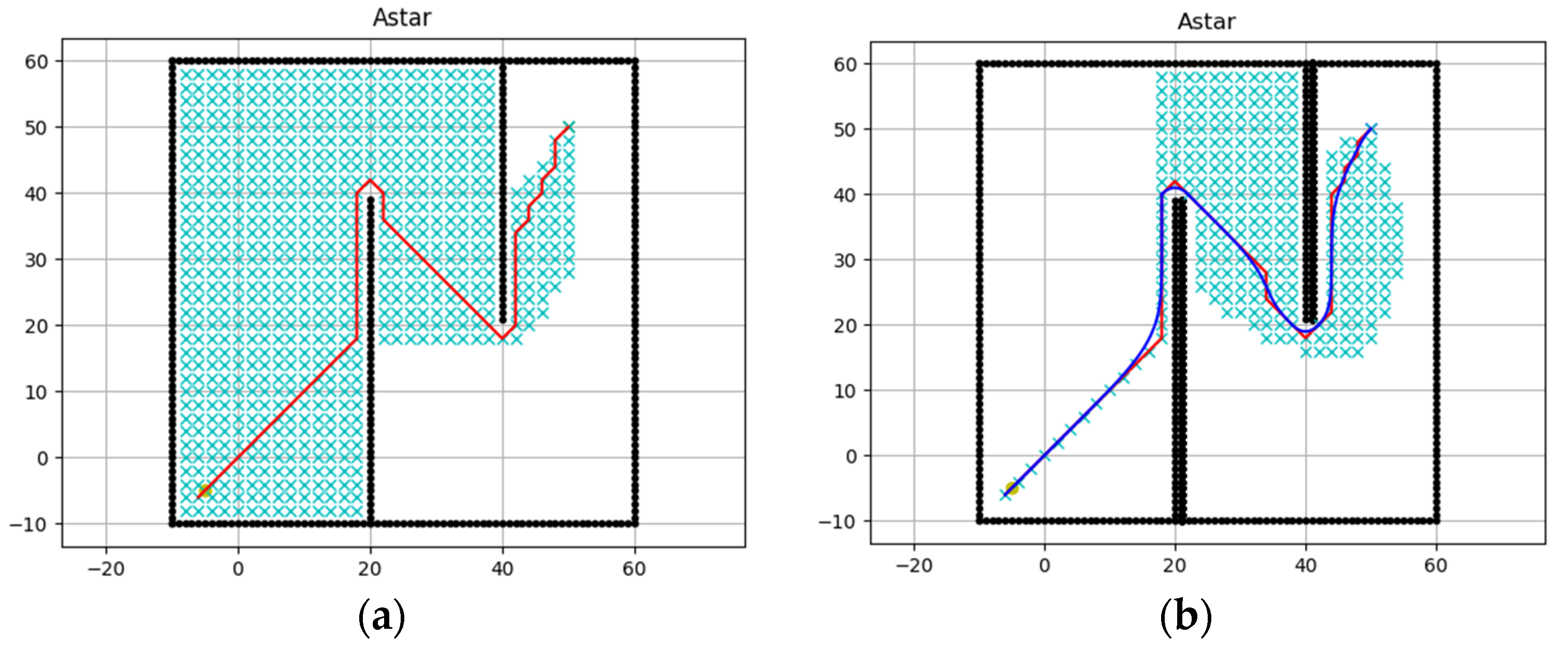
From the optimization results, it can be seen that the improved A-star algorithm reduces the number of search nodes by 59.19%, the time used by 45.41%, and the path length is optimized by 18% compared with the standard A-star algorithm, and the overall efficiency has been improved to some extent. The simulation comparison graph of the A-star algorithm path planning before and after optimization is shown in Figure 31.

5.3. Experimental Verification and Result Analysis

(1)
Simulation environment establishment
This section integrates path planning with Unity3D. Building upon the established intelligent warehousing platform, it validates the application of path planning algorithms within smart warehousing factories. Unity3D handles visualization and collision detection, while path computation is performed by an enhanced A-star algorithm in the backend. Specifically, when a user sets the start and destination points, Unity3D transmits this information to the improved A-star algorithm script. This script calculates the path in the background and returns the path points to Unity3D, which then controls the AGV’s movement.
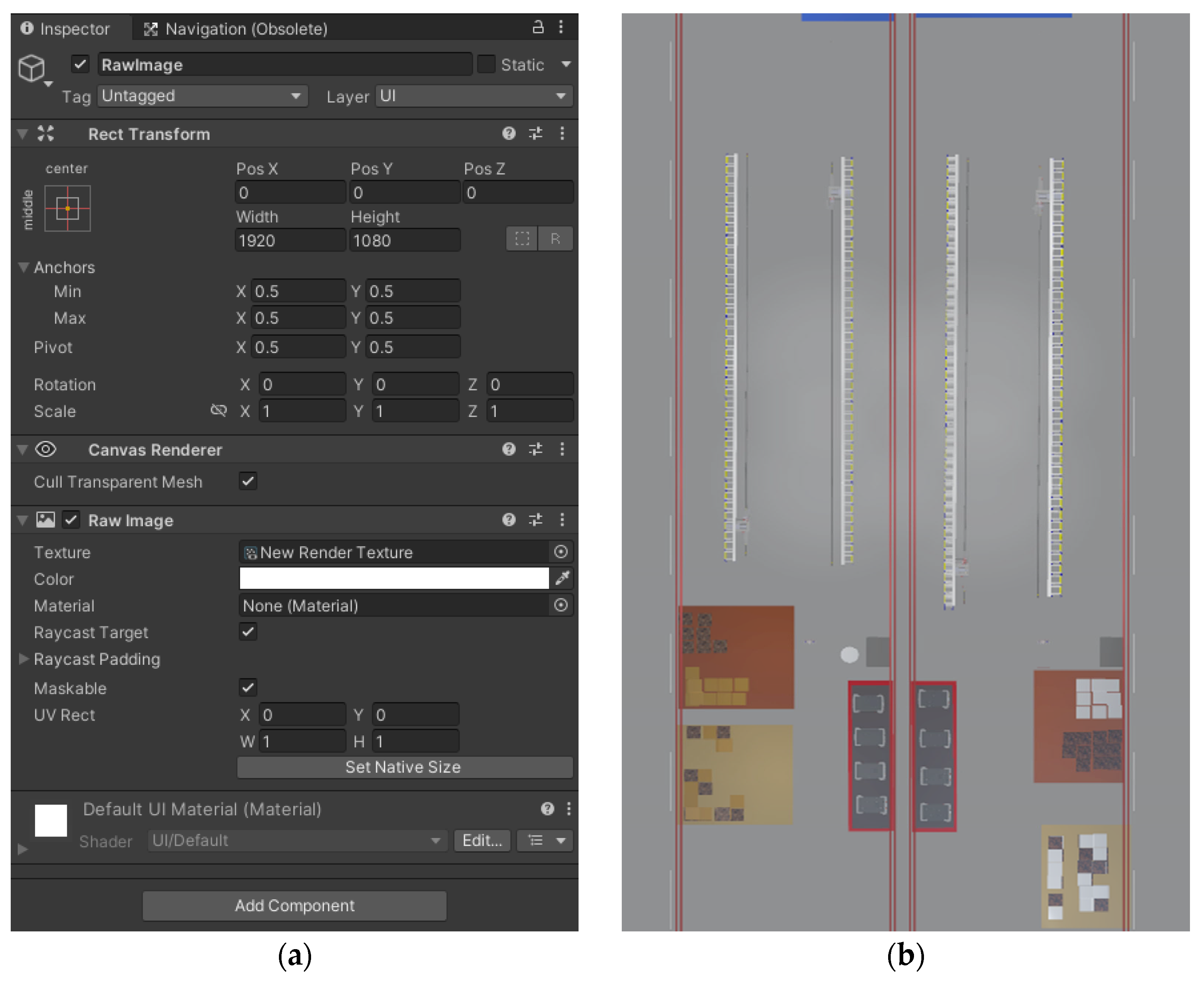
Specifically, create a canvas Canvas, and then create a sub-object Rawimage as a 2D base map under the UI module; set up a Camera camera viewpoint for top-down, and place the real-time-rendered content of the camera in the 2D base map to obtain a planar map of the warehouse factory. The map settings and effects are shown in Figure A10 in Appendix A.5.
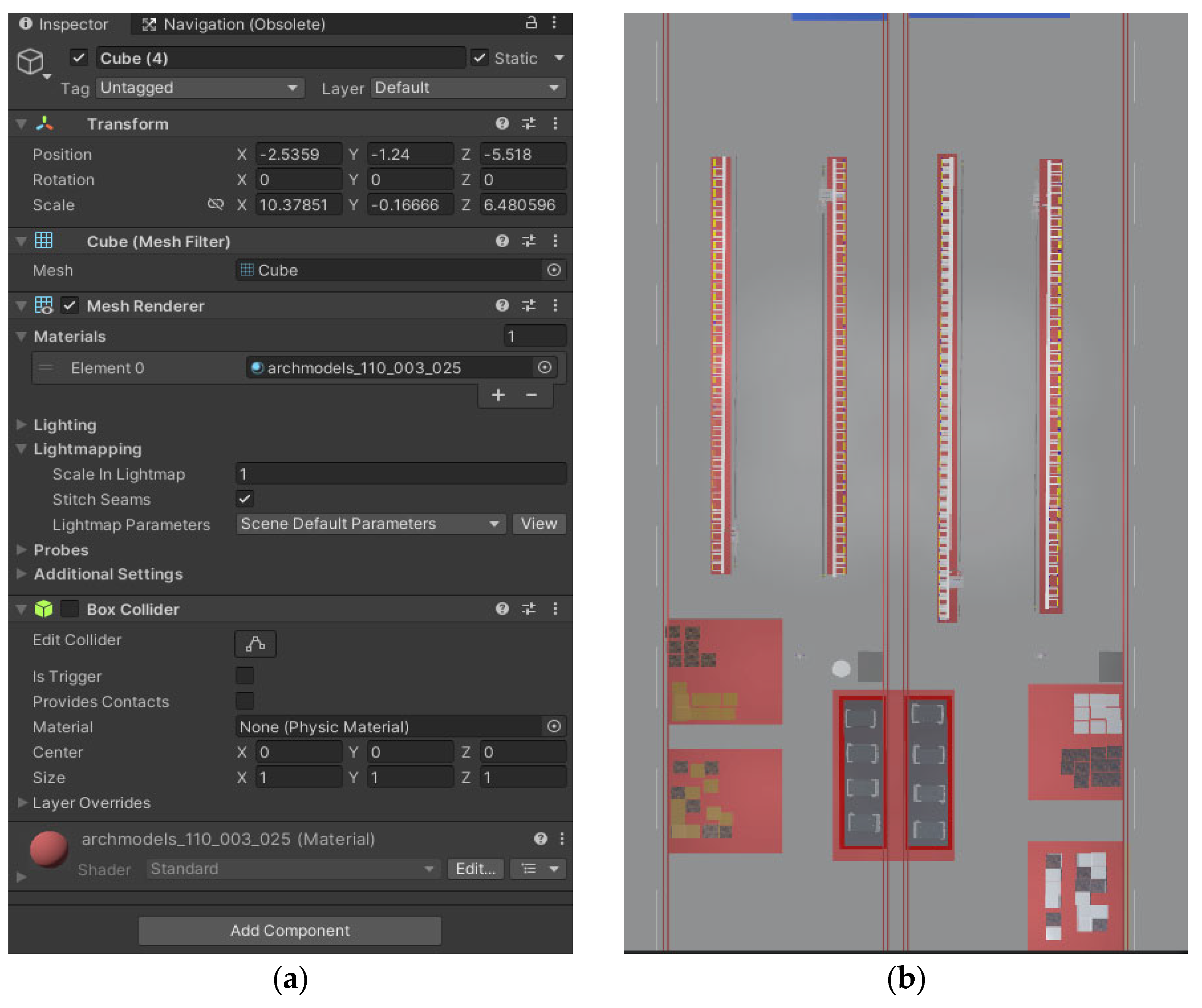
Add obstacle properties to the incoming temporary storage area, sorting area, outgoing temporary storage area, wall, and shelves in the smart warehouse factory. Establish cube1~cube5 in the impassable area as the obstacle area. Check Static and add the component Box Collider to it. Set all obstacle areas as red for impassable and green for passable. The obstacles set up within Unity3D are shown in Figure A11 in Appendix A.5.
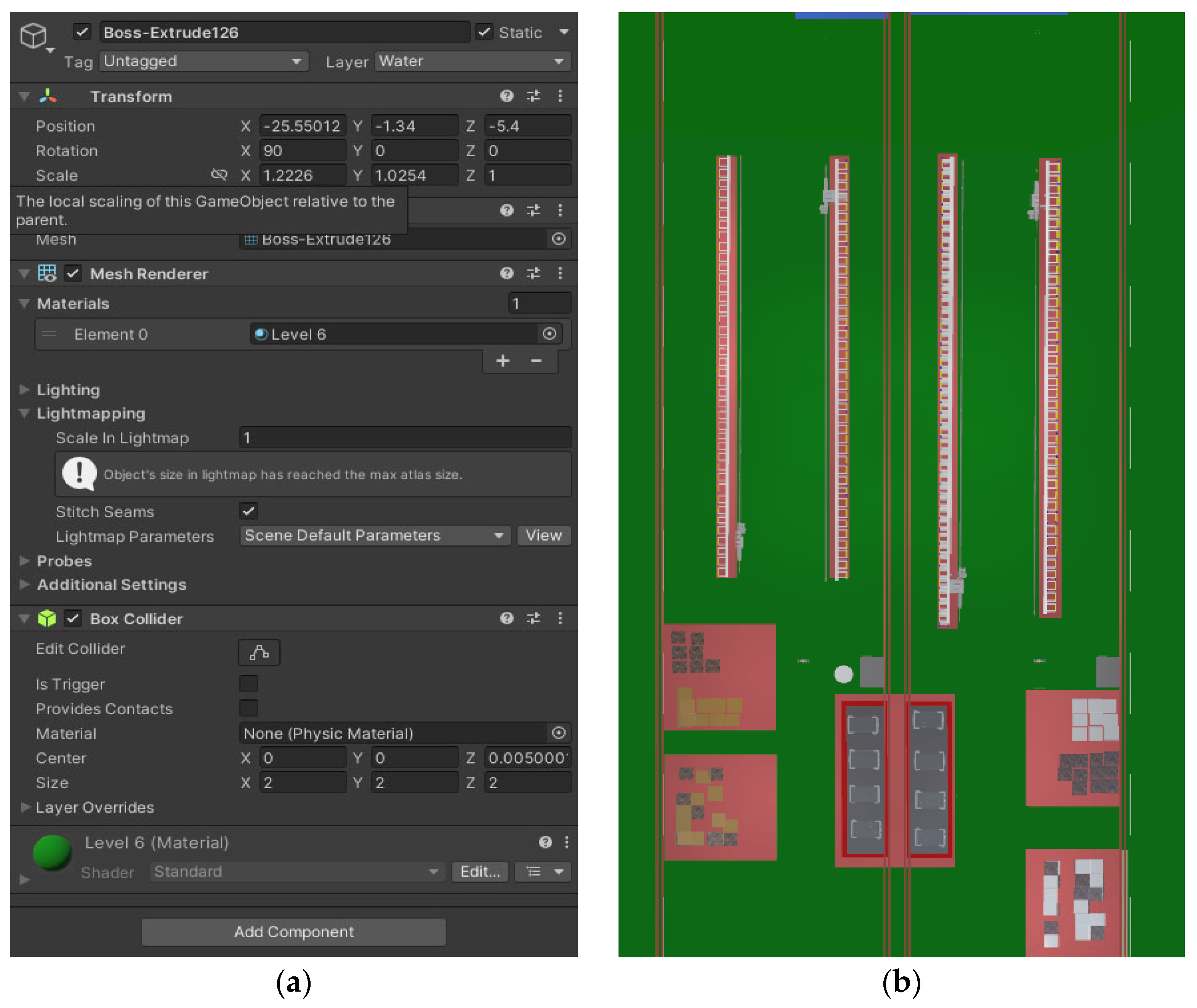
Add the Layer level Water as the plane of AGV vehicle movement in the map model Plane of the intelligent warehouse factory, adjust the Y-axis position in the Transform component in the Inspector panel, and make sure that the Water layer level is the passable area. The parameter settings of the Water layer level are shown in Figure A12 of Appendix A.5.
C#Script script is used to divide the floor plane of the intelligent storage virtual factory into grids with exactly the same area. The grid setting code is provided in Appendix B.9.
(2)
AGV car drive simulation
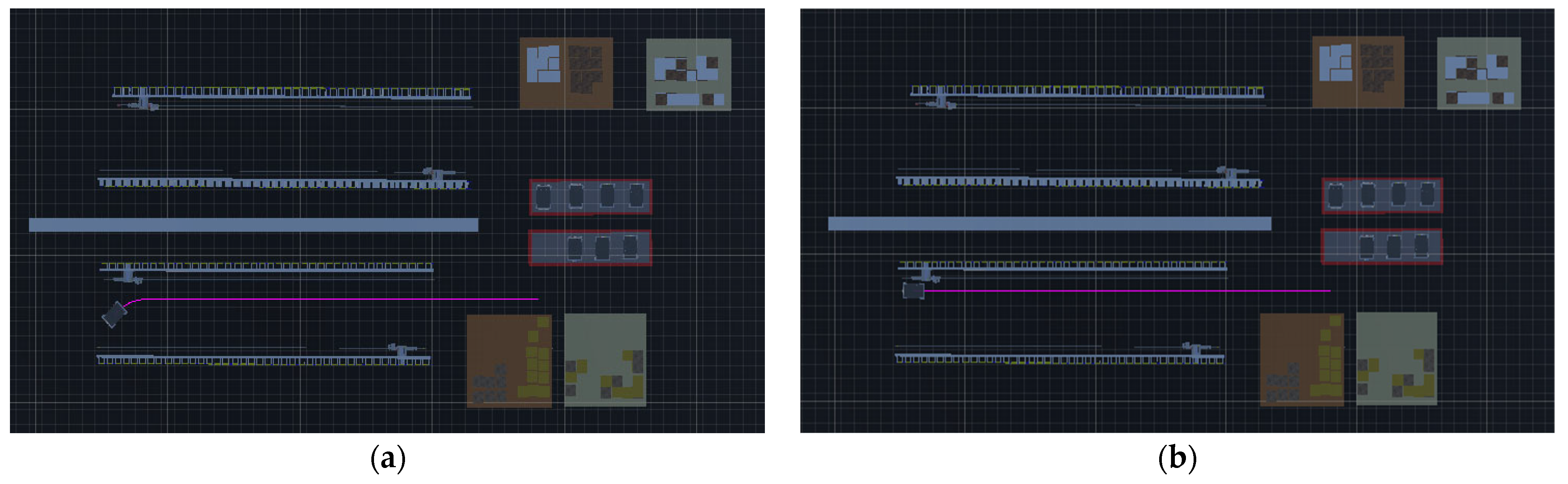
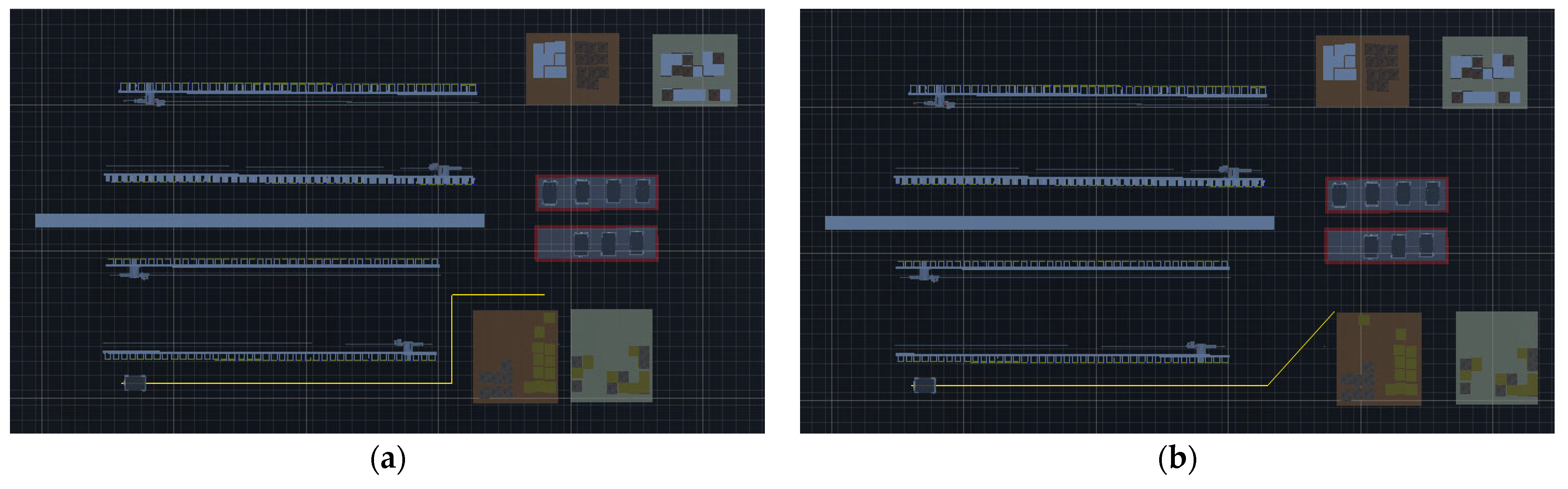
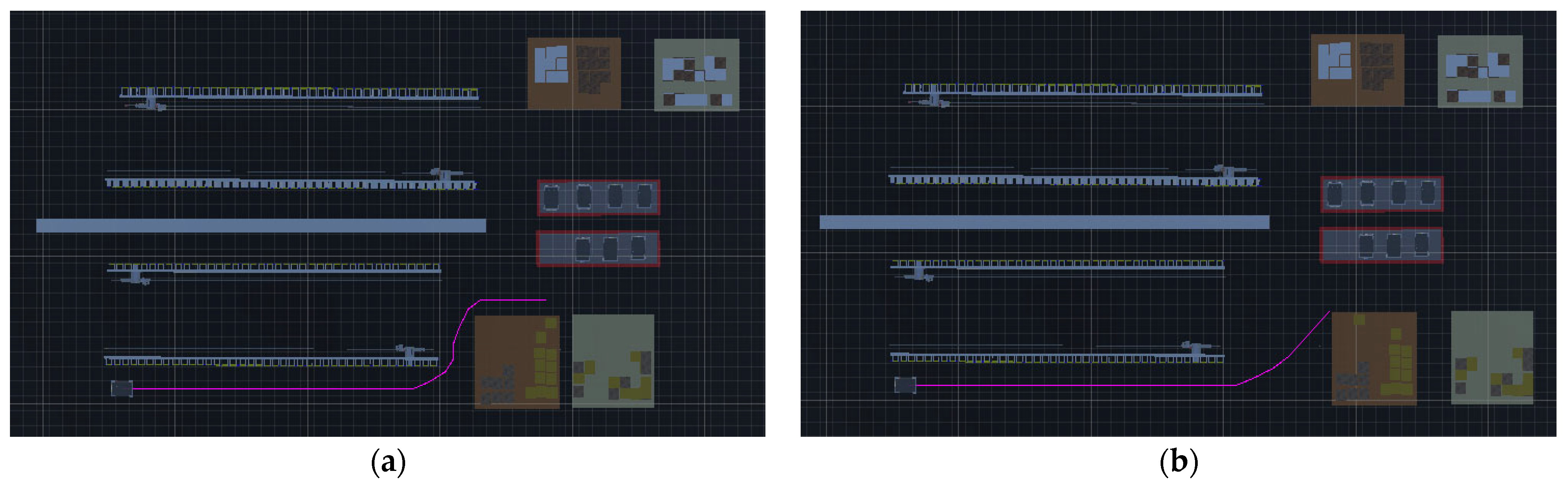
Intelligent warehouse AGV car path planning drive simulation has the following steps: (1) simulation warehouse environment construction; (2) AGV car drive simulation script writing; (3) determine the initial position as the location of the first AGV car in the AGV staging area; (4) determine the target point from right to left: shelf 1, shelf 2, shelf 3, and shelf 4; (5) the AGV 3D scene path is visualized and moved to the target point. The code defines the switching of the movement mode, the starting point of path planning, the target point, the obstacle layer, the movement type, etc. Create a two-dimensional grid of nodes, calculate the world coordinates of the nodes, check for obstacles, create points and add them to the network, start wayfinding, and calculate the optimal path for the A-star algorithm. Realize the dynamic route finding of the AGV car.
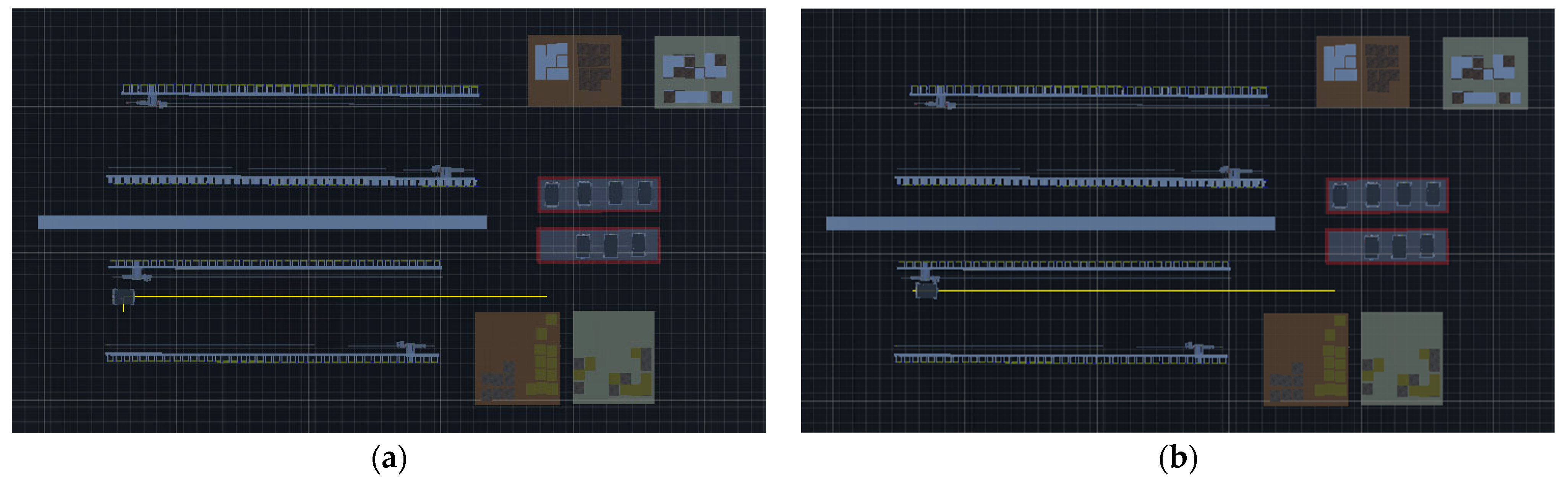
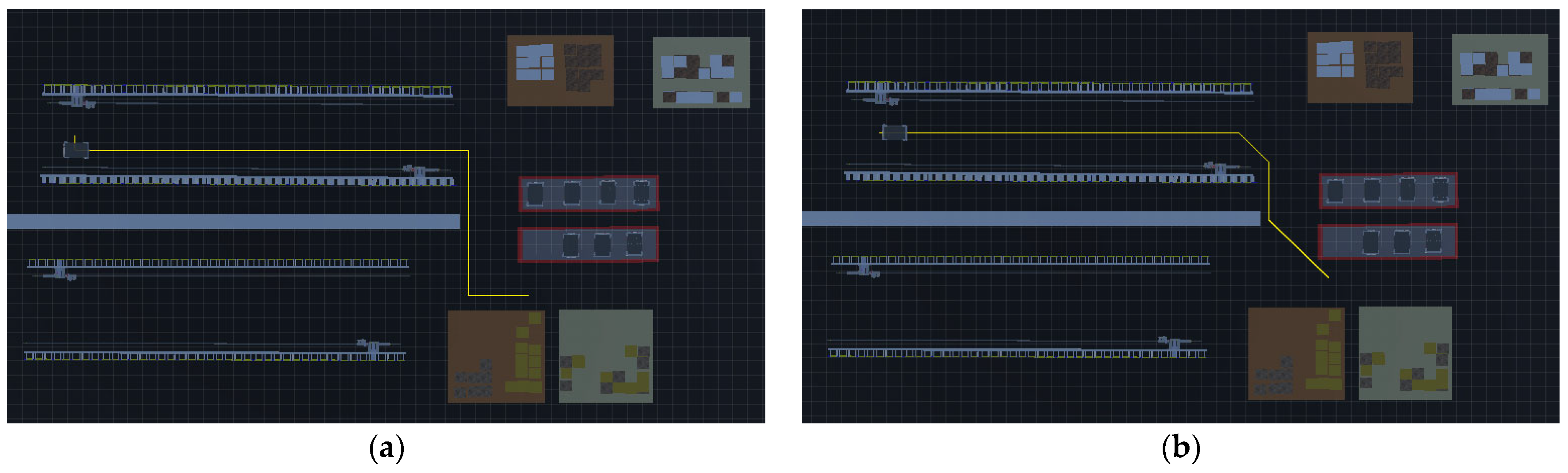
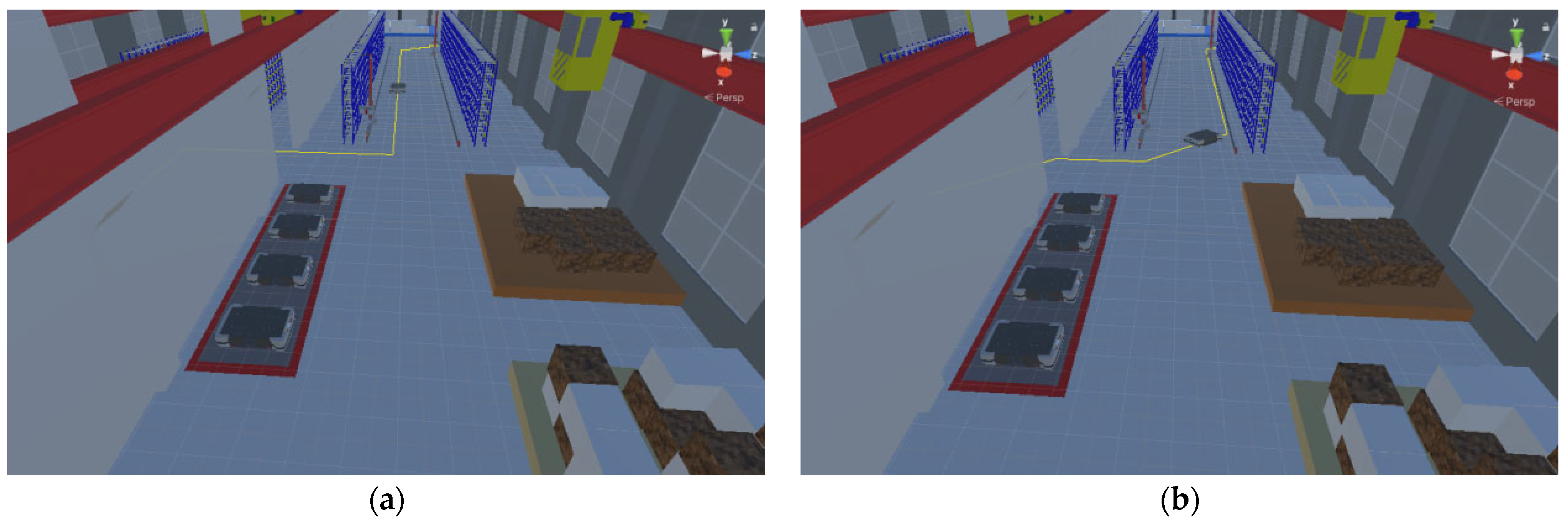
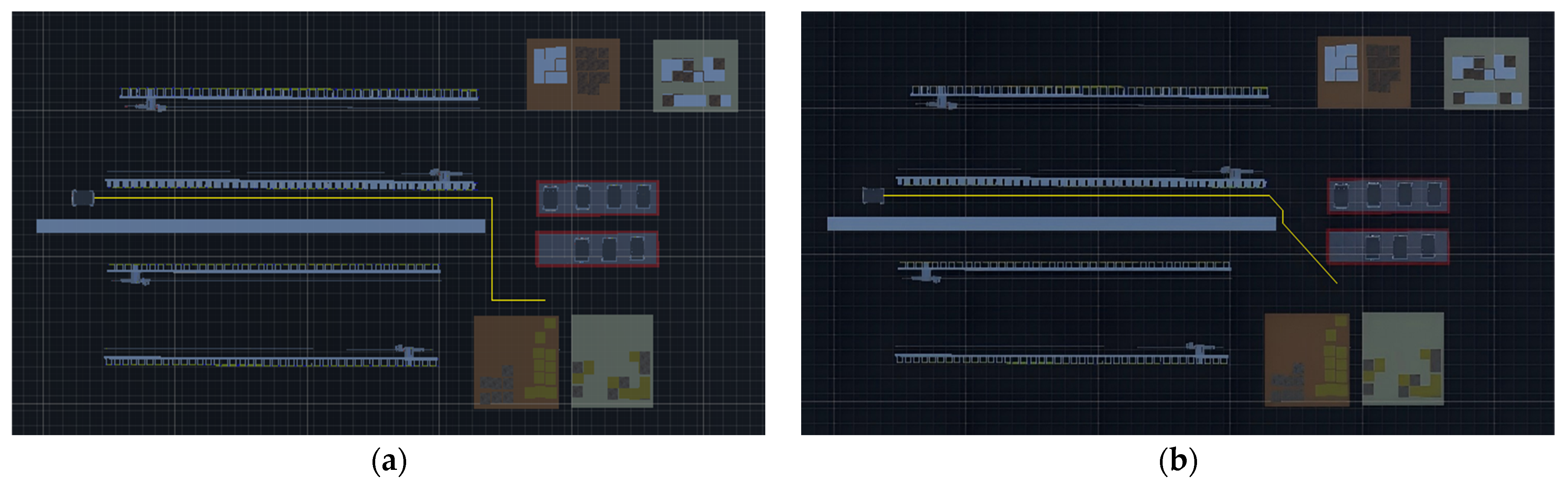
Create an empty Game Object named A_star in the Hierarchy panel to serve as the code container for the AGV pathfinding simulation. Attach the A-star algorithm script to the A_star object. Additionally, create empty objects named StartPoint and EndPoint. Adjust their positions arbitrarily. Designate Shelf 1, Shelf 2, Shelf 3, and Shelf 4 as target endpoints. The selection of these four points covers typical scenarios: short-distance high-turn (Shelf 1), medium-distance multi-obstacle (Shelf 2), straight paths (Shelf 3), and long-distance mixed paths (Shelf 4). Observe the simulation results when the AGV operates using four-direction search and eight-direction search as movement modes. Comparing the impact of different movement modes on algorithm performance enables effective evaluation of the algorithm’s adaptability across varying scenarios and complexities. During eight-direction search, the optimized A-star algorithm dynamically selects and retains five search directions based on the directional angle between the starting point and target point, following the search neighborhood optimization strategy. Taking the simulation results with Shelf 1 as the target point as an example, the path planning outcomes are shown in Figure 32 and Figure 33. Experimental results for other scenarios are referenced in Appendix A.6.
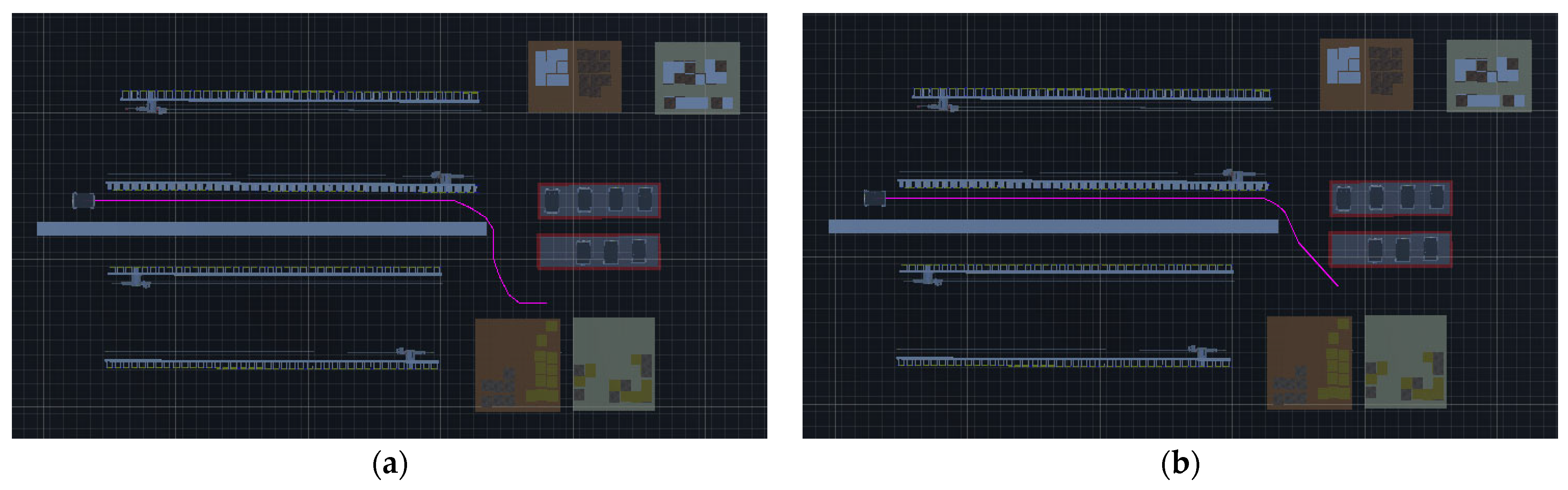
Using the Bézier curves smooth path, define whether the smooth path is IsSmooth and the bezierSmoothPower degree in the code. The simulated effect of the smoothed path is shown in Figure 34 and Figure 35.
(3)
Simulation result analysis
The enhanced A-star algorithm was run eight times on the same simulation environment map. Results from four-direction and eight-direction movement modes were compared across metrics including required time, grid count, path length, and path turning points. The four-direction mode is suitable for right-angle turning scenarios with simpler computation, while the eight-direction mode more closely approximates the actual diagonal movement capabilities of AGVs. Test results indicate that the enhanced A-star algorithm achieved an 11.38% reduction in computation time, an 11.04% decrease in grid count, and a 9.48% reduction in path length when using the eight-direction search compared to the four-direction search. By simulating AGV path planning within a virtual factory model, the feasibility and implementability of the A-star algorithm within the virtual simulation platform were validated. The computational results of the enhanced A-star algorithm are presented in Table 11.
To comprehensively evaluate the performance gains of the optimized A-star algorithm, this paper designed multi-level comparative experiments. The core logic lies in demonstrating that, even when constrained to the more restrictive four-directional search mode, the optimized algorithm outperforms the traditional A-star algorithm under identical conditions, fully validating the effectiveness of the optimization strategy proposed herein.
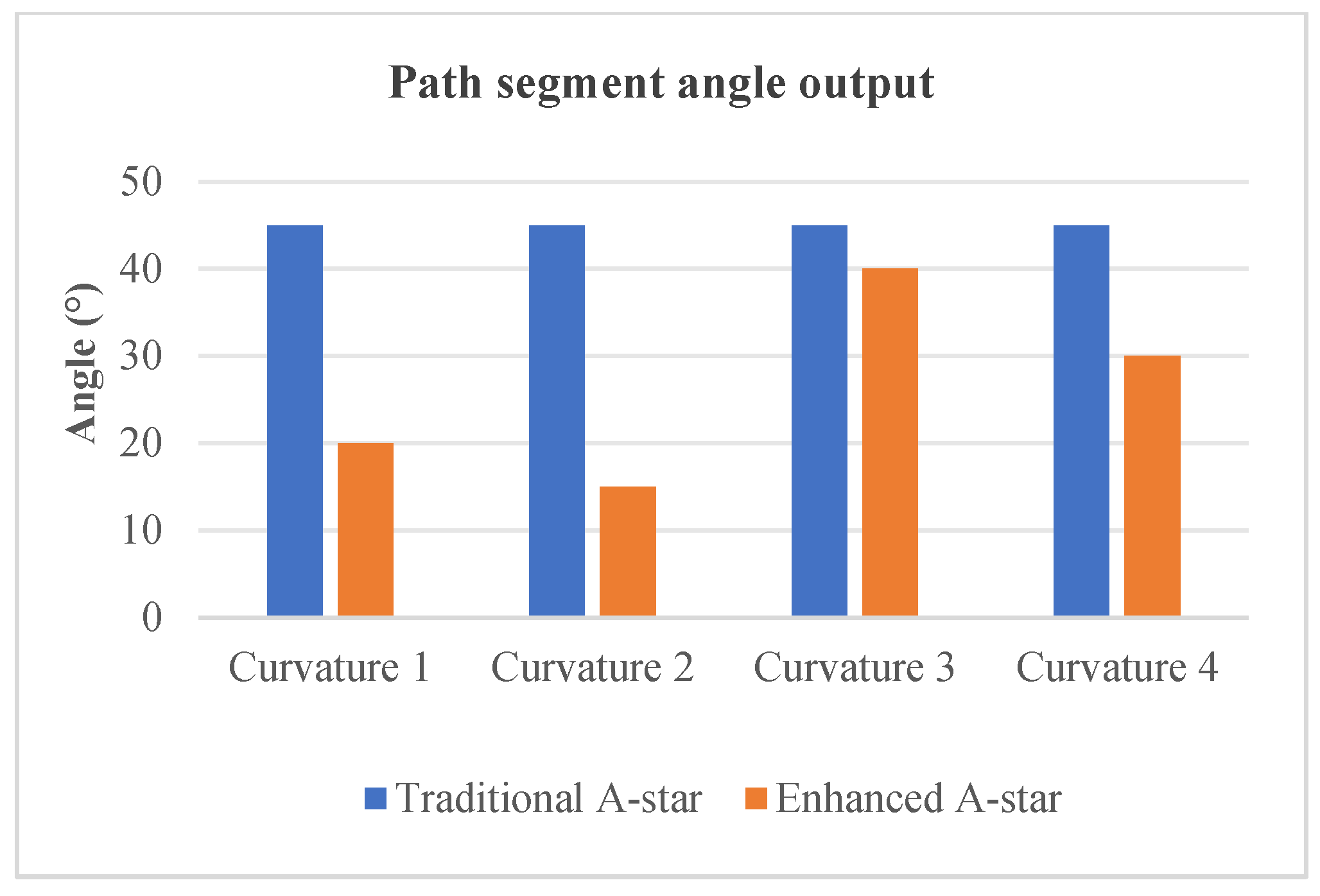
Comparing the traditional A-star algorithm with the enhanced A-star algorithm during four-directional search, the results are presented in Table 12. The optimization outcomes are also visualized using bar charts, as shown in Figure 36, Figure 37, Figure 38 and Figure 39. To quantitatively evaluate the optimization effect, statistical analysis was conducted on the experimental results for four sets of target points. Compared to the traditional A-star algorithm, the enhanced A-star algorithm achieves an average reduction of 9.4% in path length, 68.3% in the number of searched nodes, and 18.2% in search time during four-directional searches. The figures clearly demonstrate that the enhanced A-star algorithm outperforms the traditional A-star algorithm in path length, number of searched nodes, search time, and number of turning points, proving its effectiveness and superiority.

6. Conclusions

This paper presents an overall design scheme for an intelligent warehouse virtual factory simulation platform. Utilizing 3ds Max and Unity3D, it completes warehouse factory modeling, AGV simulation driving, and platform interface development. The intelligent warehouse virtual factory simulation platform built on Unity3D provides enterprises with a new, economical, and safe operational and training model. Employees can access the platform via a server to acquire relevant knowledge, practice inbound/outbound operations for goods, using the intelligent warehouse management module, and learn AGV vehicle cargo transportation processes and basic equipment operation through the visual warehouse module. This virtual factory simulation platform resolves enterprises’ challenges with new employees and users accessing physical facilities for equipment operation, while mitigating personnel safety risks inherent in traditional warehousing models.
Path planning for AGV transportation is a key method to enhance the transportation efficiency of virtual simulation platforms. This paper adopts the A-star algorithm as the foundational path planning algorithm. Due to issues such as prolonged search times and excessive path turning points in traditional A-star algorithms, this study optimizes the conventional A-star algorithm through improvements in heuristic functions, search neighborhoods, data storage list structures, bidirectional pathfinding, and Bézier curve smoothing. To address issues of inefficient search and redundant search nodes, the algorithm’s efficiency in locating target points is enhanced by selecting heuristic functions suitable for the map and setting weight coefficients. The A-star algorithm’s neighborhood search is optimized using a five-neighborhood search method. To address slow search speeds, we propose optimizing the openlist data structure using hash tables and binary heaps, alongside implementing a bidirectional A-star algorithm. This involves adding a second set of openlist and closelist data structures, swapping the starting and target nodes, and dynamically defining bidirectional target nodes to accelerate search performance. Finally, to mitigate excessive turning points in the improved algorithm, we employ Bézier curves to smooth the path. Ultimately, the enhanced A-star algorithm reduces the number of search nodes by 59.19%, the time used by 45.41%, and the path length is optimized by 18% compared to the traditional A-star algorithm, all of which improve the overall efficiency.
A virtual factory simulation environment for intelligent warehousing was constructed using the Unity3D development engine, and simulations were conducted to validate the enhanced A-star algorithm before and after optimization. Comparative analysis of four sets of simulated experimental results revealed that in a four-directional search scenario, the enhanced A-star algorithm achieved average improvements of 9.4%, 68.3%, and 18.2% over the traditional A-star algorithm in path length, number of searched nodes, and search time, respectively. Furthermore, comparing the enhanced A-star algorithm’s performance across four-directional and eight-directional search scenarios revealed that in the eight-directional scenario, the algorithm reduced required time by 11.38%, decreased grid cell count by 11.04%, and shortened path length by 9.48%. This demonstrates the superiority and practicality of the enhanced A-star algorithm within intelligent warehousing environments.
The development of a virtual factory simulation platform based on Unity3D stems from the immense potential of Unity3D. Consequently, future work will focus on designing and developing more complex equipment operations to enrich interactive capabilities. Simultaneously, real-world production data will be integrated into simulations that model changes in production parameters following virtual equipment operation. Continuous optimization of platform functionality and models will reduce computational overhead and lower hardware requirements to accommodate a broader user base.
Furthermore, while the current experiments validate the algorithm’s performance within X Company’s specific layout, its behavior in hyperscale or highly dynamic warehouse configurations warrants further investigation. During actual operation in intelligent warehouse factories, AGV transport paths are subject to interference from multiple factors, including load weight and dynamic/static obstacles. Consequently, future work will focus on testing in more complex, large-scale scenarios—including multi-AGV systems with dynamic obstacle avoidance and integrated task scheduling—to comprehensively evaluate scalability and robustness.

Author Contributions

Y.L.: data curation, methodology, software, writing-original draft. T.X.: data curation, software. J.Z.: validation, visualization. Z.H.: validation, writing-review and editing. H.T.: methodology, writing-review and editing. Y.W.: methodology, conceptualization. X.Z.: supervision, validation. T.T.: supervision, visualization. Z.W.: supervision, writing-review and editing. Y.Z.: supervision, resources, project administration, funding acquisition, writing-review and editing. All authors have read and agreed to the published version of the manuscript.

Funding

This research was funded by Science and Technology Program Projects of the Xinjiang Production and Construction Corps, China, under Grant No. 2024AB062.

Institutional Review Board Statement

Not applicable.

Informed Consent Statement

Not applicable.

Data Availability Statement

The original contributions presented in this study are included in the article. Further inquiries can be directed to the corresponding author.

Conflicts of Interest

The authors declare no conflicts of interest.

Appendix A

Appendix A.1

Figure A1. Shelf model effect in 3ds Max: (a) shelf model visualizations; (b) shelf model rendering.
Applsci 15 12202 g0a1
Figure A2. Warehouse factory model rendering in 3ds Max: (a) exterior model of warehouse factory; (b) warehouse exterior rendering.
Applsci 15 12202 g0a2
Figure A3. Renderings of small shelving units and handcart: (a) small shelving unit rendering; (b) handcart rendering.
Applsci 15 12202 g0a3
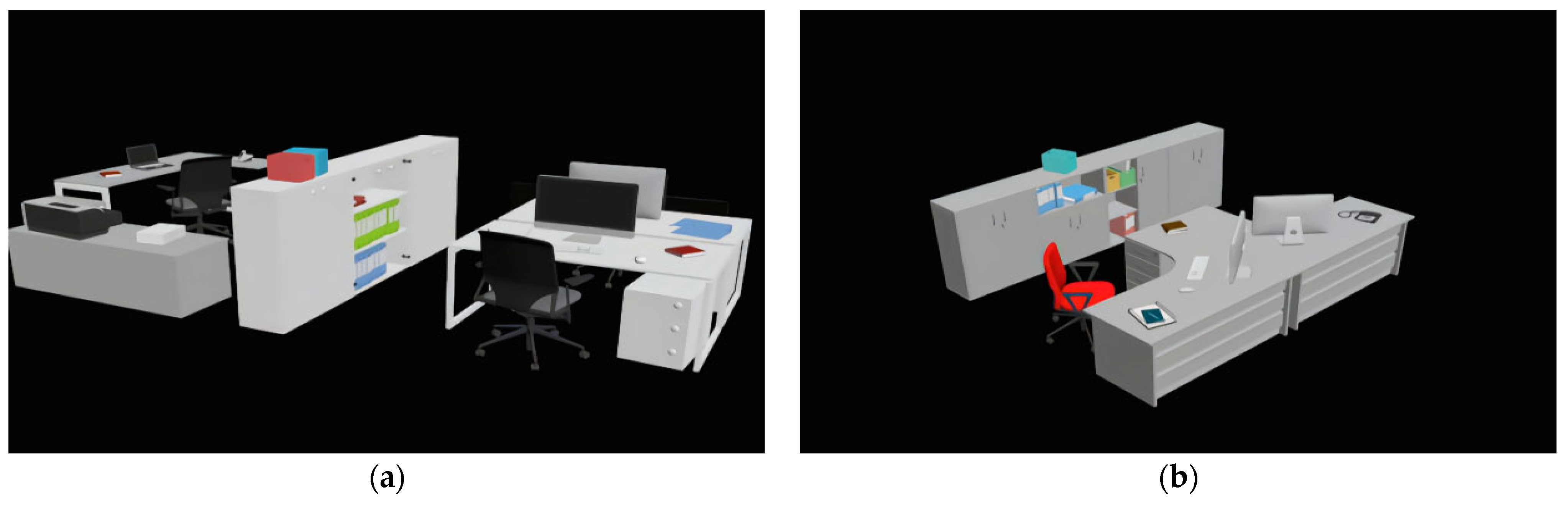
Figure A4. Order center equipment rendering: (a) rendering of the warehouse office area; (b) rendering of the outbound office area.
Applsci 15 12202 g0a4
Figure A5. AGV rendering visualization.
Applsci 15 12202 g0a5

Appendix A.2

Figure A6. Regional scenario diagrams: (a) transportation area scenario; (b) order service center scenario diagram; (c) conference room scenario diagram; (d) documentation room scenario diagram; (e) reception room scene diagram; (f) maintenance area scene diagram; (g) small parts storage room scenario diagram; (h) monitoring room scene diagram; (i) tool room scene diagram.
Applsci 15 12202 g0a6aApplsci 15 12202 g0a6b

Appendix A.3

Figure A7. Platform login settings: (a) platform account settings; (b) platform password settings.
Applsci 15 12202 g0a7
Figure A8. Simulate object component settings: (a) detection body component settings; (b) AGV component configuration.
Applsci 15 12202 g0a8

Appendix A.4

Figure A9. Platform user interface renderings: (a) login interface; (b) functional navigation interface.
Applsci 15 12202 g0a9

Appendix A.5

Figure A10. Map setup and effect display: (a) map settings; (b) two-dimensional map effect shown.
Applsci 15 12202 g0a10
Figure A11. Smart warehousing virtual factory obstacle setting: (a) obstacle setting; (b) impassable area.
Applsci 15 12202 g0a11
Figure A12. Intelligent warehousing virtual factory ground environment setup: (a) hierarchical parameter settings; (b) accessible areas.
Applsci 15 12202 g0a12

Appendix A.6

Figure A13. Shelf 2 for the target point A-star experimental results: (a) four-directional search visualization; (b) eight-directional search visualization.
Applsci 15 12202 g0a13
Figure A14. Shelf 2 for the target point smoothing processing experimental results: (a) four-directional search visualization; (b) eight-directional search visualization.
Applsci 15 12202 g0a14
Figure A15. Shelf 3 for the target point A-star experimental results: (a) four-directional search visualization; (b) eight-directional search visualization.
Applsci 15 12202 g0a15
Figure A16. Shelf 3 for the target point smoothing processing experimental results: (a) four-directional search visualization; (b) eight-directional search visualization.
Applsci 15 12202 g0a16
Figure A17. Shelf 4 for the target point A-star experimental results: (a) four-directional search visualization; (b) eight-directional search visualization.
Applsci 15 12202 g0a17
Figure A18. Shelf 4 for the target point smoothing processing experimental results: (a) four-directional search visualization; (b) eight-directional search visualization.
Applsci 15 12202 g0a18

Appendix B

Appendix B.1

public class dengLuZhuCe: MonoBehaviour
{
  public Input Field input_Name;//user name
  public Input Field input_Pw;//password
  public void Btn_Login()
 {if (input_Name.text == ““ || input_Pw.text == ““)
  {print(“The account or password cannot be empty!”);}
 else if (input_Name.text == “123,456” && input_Pw.text == “456,789”)
  {print(“login successfully”);
  UnityEngine.SceneManagement.SceneManager.LoadScene(1);}
 else
 {print(“Account or password not found, login failed!”); }
}

Appendix B.2

private void Update()
{
  isGround = Physics.CheckSphere(groundCheck.position, checkRadius, groundLayer);
  if(isGround && velocity.y < 0)
   {velocity.y = −2f;}
   horizontalMove = Input.GetAxis(“Horizontal”) * moveSpeed;
   verticalMove = Input.GetAxis(“Vertical”) * moveSpeed;
   dir = transform.forward*verticalMove + transform.right * horizontalMove;
   cc.Move(dir * Time.deltaTime);
   velocity.y -= gravity * Time.deltaTime;
  if(Input.GetButtonDown(‘Jump’) && isGround)
   {velocity.y = jumpSpeed;}
}

Appendix B.3

csharp
if (Input.GetKey(KeyCode.W))
 {transform.Translate(Vector3.forward * speed * Time.deltaTime);}
else if (Input.GetKey(KeyCode.S))
 {transform.Translate(Vector3.back * speed * Time.deltaTime);}
else if (Input.GetKey(KeyCode.A))
 {transform.Translate(Vector3.left * speed * Time.deltaTime);}
else if (Input.GetKey(KeyCode.D))
 {transform.Translate(Vector3.right * speed * Time.deltaTime);}

Appendix B.4

void Start()
{
 FileInfo fileInfo = new FileInfo(filepath);
 using (ExcelPackage excelPackage = newExcelPackage(fileInfo))
  {ExcelWorksheet worksheet = excelPackage.Workbook.Worksheets[1];
  for (int i = 2; i <= worksheet.Dimension.End.Row; i++)
   {var obj = Instantiate(Resources.Load<GameObject>(“infos”),content.transform) as GameObject;
   obj.name = i.ToString();
   for (int j = 1; j <= worksheet.Dimension.End.Column; j++)
    {obj.transform.GetChild(j − 1).GetComponent<InputField>().text = worksheet.GetValue(i,j).ToString();
    obj.transform.GetChild(j − 1).name = j.ToString();
    obj.transform.GetChild(j − 1).gameObject.AddComponent< Modify >();}}}
}

Appendix B.5

void Start()
{
 FileInfo fileInfo = new FileInfo(filepath);
 using (ExcelPackage excelPackage = new ExcelPackage(fileInfo))
  {ExcelWorksheet worksheet = excelPackage.Workbook.Worksheets[1];
  for (int i = 2; i <= worksheet.Dimension.End.Row; i++)
   {var obj = Instantiate(Resources.Load<GameObject>(“infos”),content.transform)as GameObject;
   obj.name = i.ToString();
   for (int j = 1; j <= worksheet.Dimension.End.Column; j++)
    {obj.transform.GetChild(j − 1).GetComponent<InputField>().text = worksheet.GetValue(i,j).ToString();
    obj.transform.GetChild(j − 1).name = j.ToString();
    obj.transform.GetChild(j − 1).gameObject.AddComponent< In-memory modification>();}}}
}

Appendix B.6

void Start()
{
 FileInfo fileInfo = new FileInfo(filepath);
 using (ExcelPackage excelPackage = new ExcelPackage(fileInfo))
  {ExcelWorksheet worksheet = excelPackage.Workbook.Worksheets[1];
  for (int i = 2; i <= worksheet.Dimension.End.Row; i++)
   {var obj = Instantiate(Resources.Load<GameObject>(“infos”),content.transform)as GameObject;
   obj.name = i.ToString();
   for (int j = 1; j <= worksheet.Dimension.End.Column; j++)
    {obj.transform.GetChild(j − 1).GetComponent<InputField>().text = worksheet.GetValue(i,j).ToString();
    obj.transform.GetChild(j − 1).name = j.ToString();
    obj.transform.GetChild(j − 1).gameObject.AddComponent< ModifyOutbound>();}}}
}

Appendix B.7

A-star algorithm
nstart = self.Node(self.calc_xyindex(sx, self.minx),
        self.calc_xyindex(sy, self.miny), 0.0, −1)
ngoal = self.Node(self.calc_xyindex(gx, self.minx),
        self.calc_xyindex(gy, self.miny), 0.0, −1)
open_set, closed_set = dict(), dict()
open_set[self.calc_grid_index(nstart)] = nstart
while True:
  if len(open_set) == 0:
   print(“Open_set is empty…”)
   break
  c_id = min(open_set, key = lambda o: open_set[o].cost + self.calc_heuristic(ngoal, open_set[o]))
  current = open_set[c_id]
  if show_animation:
   plt.plot(self.calc_grid_position(current.x, self.minx),
      self.calc_grid_position(current.y, self.miny),”xc”)
   plt.gcf().canvas.mpl_connect(‘key_release_event’,
            lambda event: [exit(0) if event.key == ‘escape’ else None])
   if len(closed_set.keys()) % 10 == 0:
    plt.pause(0.001)
  if current.x == ngoal.x and current.y == ngoal.y:
   print(“Find goal!”)
   ngoal.parent_index = current.parent_index
   ngoal.cost = current.cost
   break

Appendix B.8

Optimized A-star algorithm
c_id = min(open_set, key=lambda o: open_set[o].cost + self.calc_heuristic(ngoal, open_set[o])) # Select the least costly node from the open set (f = g + h)
current = open_set[c_id]
if show_animation: # If animation needs to be displayed
  plt.plot(self.calc_grid_position(current.x, self.minx),
      self.calc_grid_position(current.y, self.miny), “xc”)
  plt.gcf().canvas.mpl_connect(‘key_release_event’,
             lambda event: exit(0) if event.key == ‘escape’ else None)
  if len(closed_set.keys()) % 10 == 0:
    plt.pause(0.001)
if current.x == ngoal.x and current.y == ngoal.y:
  print(“Find goal!”)
  ngoal.parent_index = current.parent_index
  print(“ngoal_parent_index:”, ngoal.parent_index)
  ngoal.cost = current.cost
  print(“ngoal_cost:”, ngoal.cost)
  break
del open_set[c_id] # Move current node from open set to closed set
closed_set[c_id] = current
for move_x, move_y, move_cost in self.motion:
    node = self.Node(current.x + move_x, current.y + move_y, current.cost + move_cost, c_id)
  n_id = self.calc_grid_index(node)
  if not self.verify_node(node):
    continue
  if n_id in closed_set:
    continue
  if n_id not in open_set:
    open_set[n_id] = node
  else:
    if open_set[n_id].cost > node.cost: open_set[n_id] = node
pathx, pathy = self.calc_final_path(ngoal, closed_set)
return pathx, pathy

Appendix B.9

private void CreateGrid()
{
 grid = new Node[gridSize.x, gridSize.y];
 for (int x = 0; x < gridSize.x; x++)
  {for (int y = 0; y < gridSize.y; y++)
   {Vector3 worldPosition = new Vector3(x * nodeSize, 0, y * nodeSize);
   bool walkable = !Physics.CheckSphere(worldPosition, nodeSize / 2f, obstacleMask);//Check for obstructions
   grid[x, y] = new Node(walkable, worldPosition, x, y);}}
}

References

  1. Zotou, D.; Papadam, S.; Kargakos, A.; Kostavelis, I.; Bliantidou, M.; Giakoumis, D.; Ioannidis, D.; Tzovaras, D. iWMS: A Warehouse Management System for a Goods-to-Person Warehouse Automation. In Supply Chains; Springer: Cham, Switzerland, 2025; pp. 148–160. [Google Scholar]
  2. Song, X.; Gao, H.; Ding, T.; Gu, Y.; Liu, J.; Tian, K. A Review of the Motion Planning and Control Methods for Automated Vehicles. Sensors 2023, 23, 6140. [Google Scholar] [CrossRef] [PubMed]
  3. Zhang, Z.W.; Wu, L.H.; Zhang, W.Q.; Peng, T.; Zheng, J. Energy-efficient path planning for a single-load automated guided vehicle in a manufacturing workshop. Comput. Ind. Eng. 2021, 158, 107397. [Google Scholar] [CrossRef]
  4. Gbadamosi, O.A.; Aremu, D.R. Design of a Modified Dijkstra’s Algorithm for finding alternate routes for shortest-path problems with huge costs. In Proceedings of the 2020 International Conference in Mathematics, Computer Engineering and Computer Science (ICMCECS), Ayobo, Nigeria, 18–21 March 2020; pp. 1–6. [Google Scholar]
  5. Xu, X.; Zeng, J.; Zhao, Y.; Lü, X. Research on global path planning algorithm for mobile robots based on improved A*. Expert Syst. Appl. 2024, 243, 122922. [Google Scholar] [CrossRef]
  6. Fan, B.; Guo, L. An Improved JPS Algorithm for Global Path Planning of the Seabed Mining Vehicle. Arab. J. Sci. Eng. 2024, 49, 3963–3977. [Google Scholar] [CrossRef]
  7. Wu, Z.; Dai, J.; Jiang, B.; Karimi, H.R. Robot path planning based on artificial potential field with deterministic annealing. ISA Trans. 2023, 138, 74–87. [Google Scholar] [CrossRef]
  8. Li, P.; Wei, L.; Wu, D. An Intelligently Enhanced Ant Colony Optimization Algorithm for Global Path Planning of Mobile Robots in Engineering Applications. Sensors 2025, 25, 1326. [Google Scholar] [CrossRef]
  9. Zheng, L.; Yu, W.; Li, G.; Qin, G.; Luo, Y. Particle Swarm Algorithm Path-Planning Method for Mobile Robots Based on Artificial Potential Fields. Sensors 2023, 23, 6082. [Google Scholar] [CrossRef]
  10. Feng, D.N.; Song, R.J. Automatic Storage Experiment Platform Based on a Dual-Control System. Res. Explor. Lab. 2016, 35, 70–73+262. (In Chinese) [Google Scholar]
  11. Chen, J.M.; Shi, Y.Q. Research on models and platforms for intelligent production logistics systems. Manuf. Autom. 2015, 37, 47–50. (In Chinese) [Google Scholar]
  12. Yan, X.J. Construction of an intelligent warehousing and logistics experimental platform. Wirel. Internet Sci. Technol. 2019, 16, 59–60. (In Chinese) [Google Scholar]
  13. Liu, J.N.; Li, B.L.; Liu, W.Q.; Xie, X.Y. ZigBee-Based Intelligent Warehouse Management System. Intell. Comput. Appl. 2021, 11, 88–91+95. (In Chinese) [Google Scholar]
  14. Wu, J.J.; Yang, Y.H.; Cheng, X.; Zuo, H.F.; Cheng, Z. The Development of Digital Twin Technology Review. In Proceedings of the 2020 Chinese Automation Congress (CAC 2020), Shanghai, China, 6–8 November 2020; pp. 4901–4906. [Google Scholar]
  15. Marah, H.; Challenger, M. MADTwin: A framework for multi-agent digital twin development: Smart warehouse case study. Ann. Math. Artif. Intell. 2024, 92, 975–1005. [Google Scholar] [CrossRef]
  16. Wu, Z.Y.; Zhou, R.; Goh, M.; Wang, Y.; Xu, Z.T.; Song, W.Y. A digital twin-based modularized design approach for smart warehouses. Int. J. Comput. Integr. Manuf. 2025, 38, 1404–1425. [Google Scholar] [CrossRef]
  17. Hu, R.R.; Zhou, X.M.; Yu, Y.P. Application Research on Real-Time Interactive Simulation System of Container Yard Based on Unity3D. Open J. Model. Simul. 2022, 10, 292–302. [Google Scholar] [CrossRef]
  18. Nguyen, H.; Nguyen Thanh, P.; Ngo Ha Quang, T. Using EtherCAT technology to launch online automated guided vehicle manipulation with unity-based platform for smart warehouse management. IET Control. Theory Appl. 2024, 18, 229–243. [Google Scholar] [CrossRef]
  19. Khatib, O. Real-time obstacle avoidance for manipulators and mobile robots. In Proceedings of the1985 IEEE International Conference on Robotics and Automation, St. Louis, MO, USA, 25–28 March 1985; pp. 500–505. [Google Scholar]
  20. Weerakoon, T.; Ishii, K.; Nassiraei, A.A.F. Dead-lock free mobile robot navigation using modified artificial potential field. In Proceedings of the 2014 Joint 7th International Conference on Soft Computing and Intelligent Systems (SCIS) and 15th International Symposium on Advanced Intelligent Systems (ISIS), Kitakyushu, Japan, 3–6 December 2014; pp. 259–264. [Google Scholar]
  21. Kim, J.; Do, Y. Moving Obstacle Avoidance of a Mobile Robot Using a Single Camera. Procedia Eng. 2012, 41, 911–916. [Google Scholar] [CrossRef]
  22. Li, X.; Liu, F.; Liu, J.; Liang, S. Obstacle avoidance for mobile robot based on improved dynamic window approach. Turk. J. Electr. Eng. Comput. Sci. 2017, 25, 666–676. [Google Scholar] [CrossRef]
  23. Guo, S.Y.; Pan, X.J.; Liu, Z.Y. AGV Path Planning Algorithm Based on Fusion of Improved A* and DWA. In Proceedings of the 2024 43RD Chinese Control Conference (CCC), Kunming, China, 28–31 July 2024; pp. 1782–1787. [Google Scholar]
  24. Zhang, Z.; Jiang, J.; Ling, K.V.; Zhang, W.A. Real-Time Path Planning for Autonomous UAVs: An Event-Triggered Multimodal Adaptive Pigeon-Inspired Optimization Approach. IEEE Trans. Aerosp. Electron. Syst. 2025, 61, 10972–10981. [Google Scholar] [CrossRef]
  25. Li, J.F.; Hu, Y.R.; Yang, S.X. A Novel Knowledge-Based Genetic Algorithm for Robot Path Planning in Complex Environments. IEEE Trans. Evol. Comput. 2025, 29, 375–389. [Google Scholar] [CrossRef]
  26. Minh, H.N.; An, H.T.; Cam, G.T.T.; Ha, L.D.T.; Do Quoc, H. Fuzzy Logic and Quadtree-Based Control for Mobile Robots in Dynamic Environments. In Proceedings of the Intelligent Robotics and Applications (ICIRA 2024), PT V, Xi’an, China, 31 July–2 August 2024; pp. 429–445. [Google Scholar]
  27. Murugaiah, P.; Samiappan, D.; Nagu, B. Optimizing Motion in Nanoscale Robotics: A Hybrid WQPSO-Fuzzy Logic Approach for Dynamic Path Planning. Stud. Inform. Control. 2025, 34, 65–76. [Google Scholar] [CrossRef]
  28. Guo, T.; Sun, Y.; Liu, Y.; Liu, L.; Lu, J. An Automated Guided Vehicle Path Planning Algorithm Based on Improved A* and Dynamic Window Approach Fusion. Appl. Sci. 2023, 13, 10326. [Google Scholar] [CrossRef]
  29. Chen, X.D.; Wang, F.W. AGV Path Planning Based on an Improved A* Algorithm. Comput. Syst. Appl. 2023, 32, 180–185. (In Chinese) [Google Scholar] [CrossRef]
  30. Liu, Y.F.; Wang, L.X. AGV Path Planning: An Improved A* Algorithm Based on Bezier Curve Smoothing. In Proceedings of the 39th Youth Academic Annual Conference of Chinese-Association-of-Automation (YAC), Dalian, China, 7–9 June 2024; pp. 243–247. [Google Scholar]
Figure 1. Intelligent storage supply chain industry.
Applsci 15 12202 g001
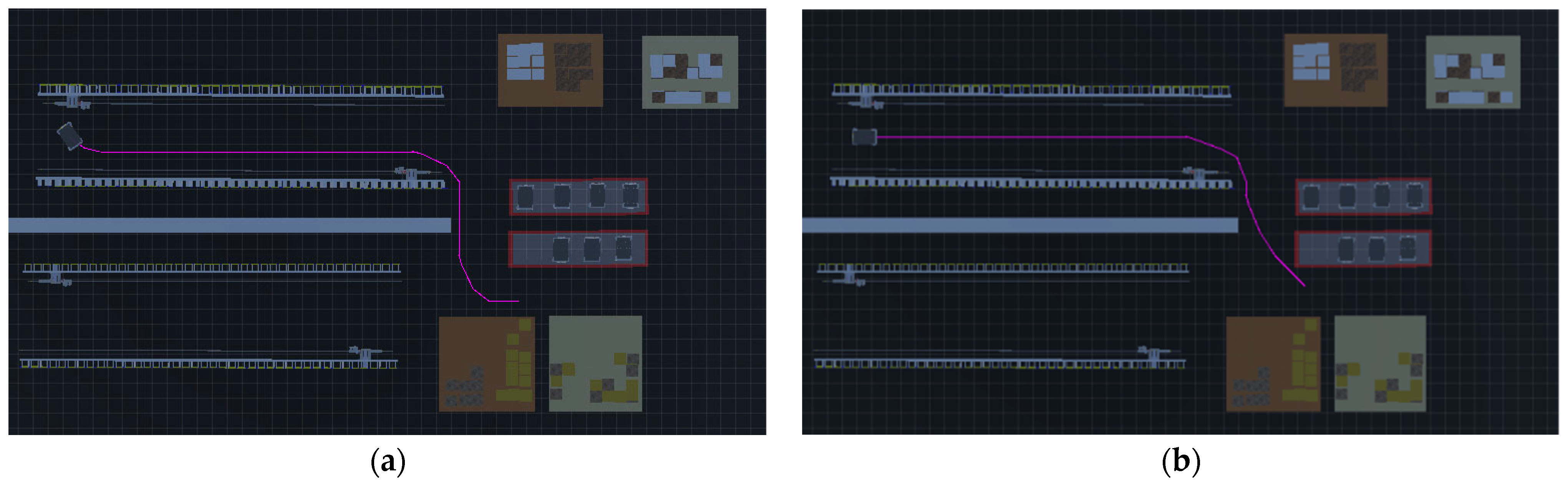
Figure 2. Unity3D architecture.
Applsci 15 12202 g002
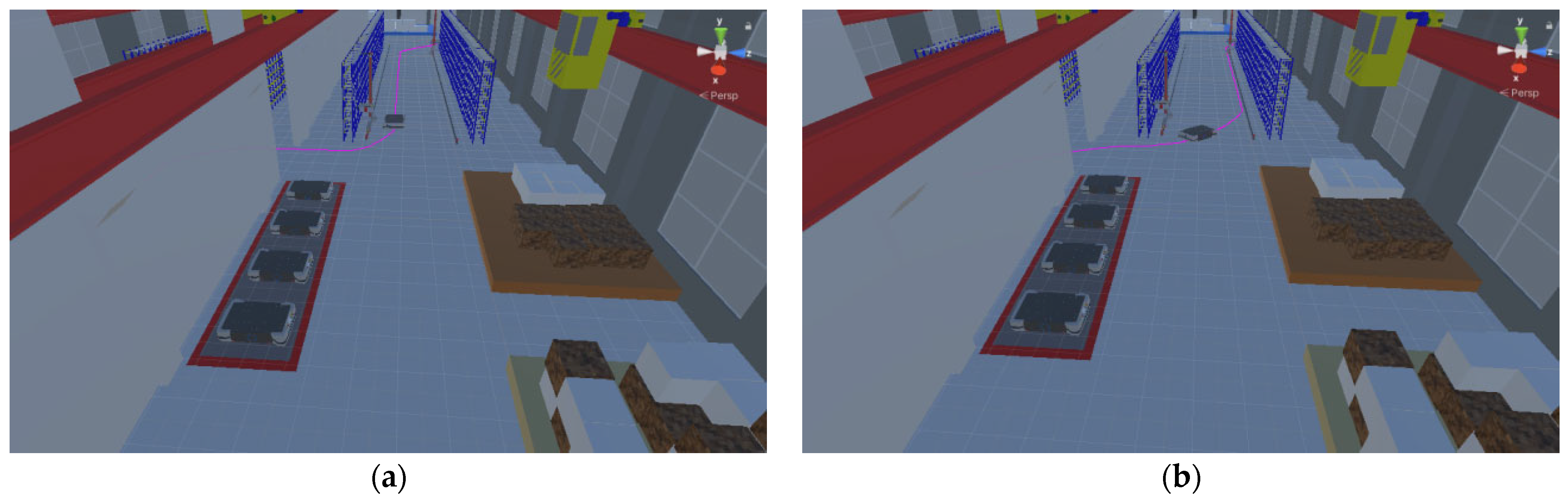
Figure 3. Intelligent storage platform architecture overall frame diagram. The arrows in the diagram illustrate the primary directions of data flow and functional dependencies between the architectural components.
Applsci 15 12202 g003
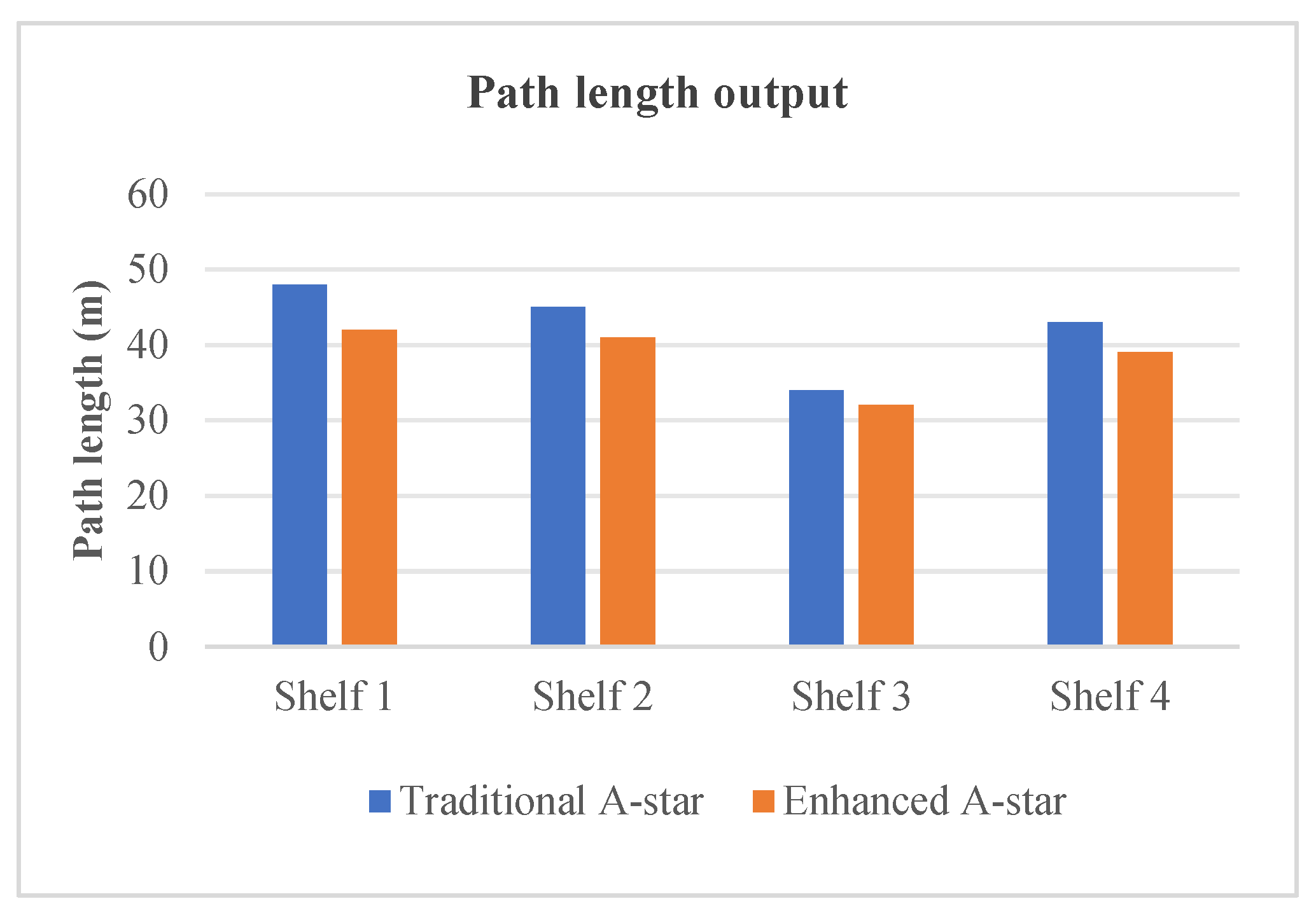
Figure 4. Warehouse management system microservices architecture diagram.
Applsci 15 12202 g004
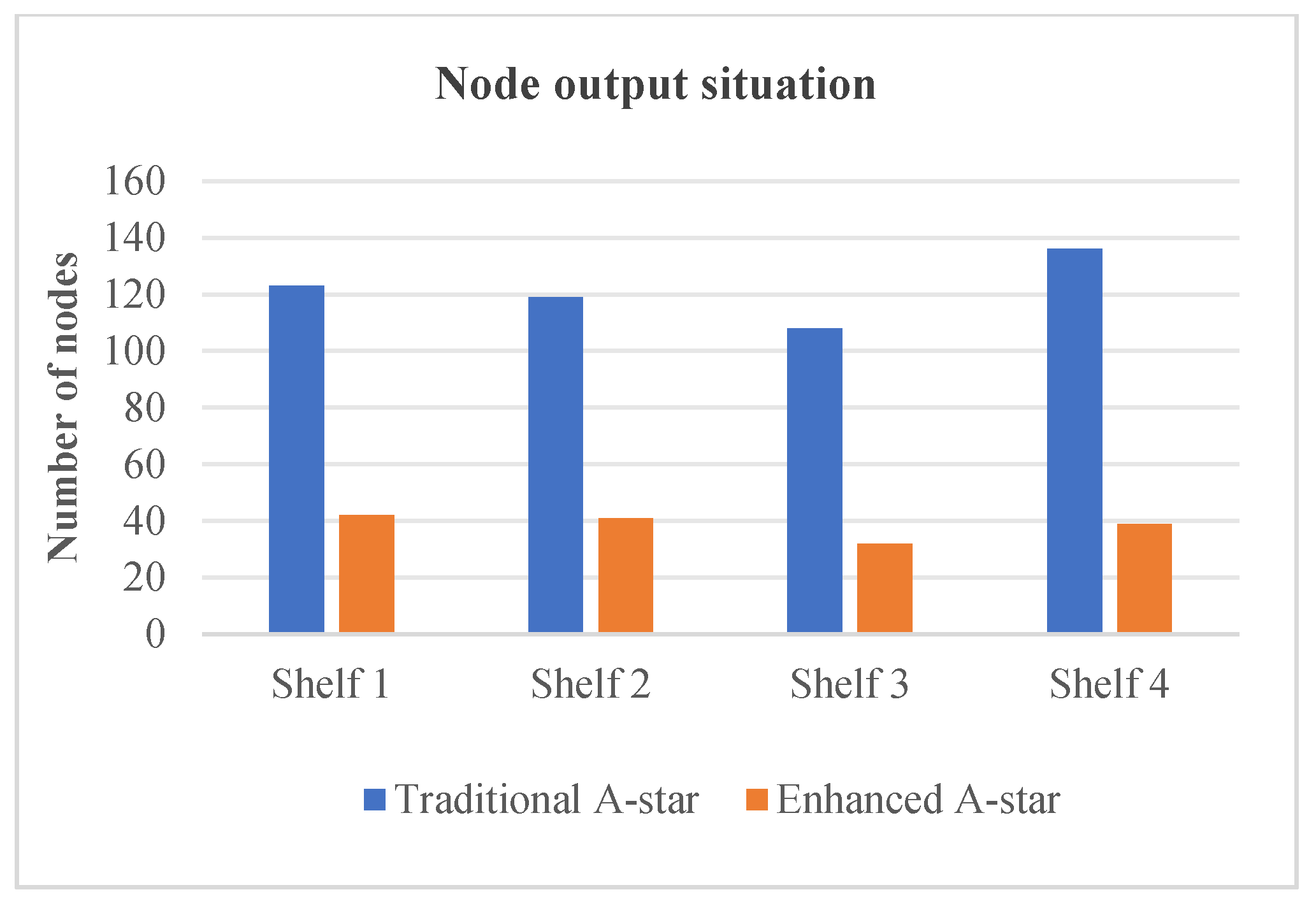
Figure 5. Functional architecture diagram of the intelligent warehouse platform.
Applsci 15 12202 g005
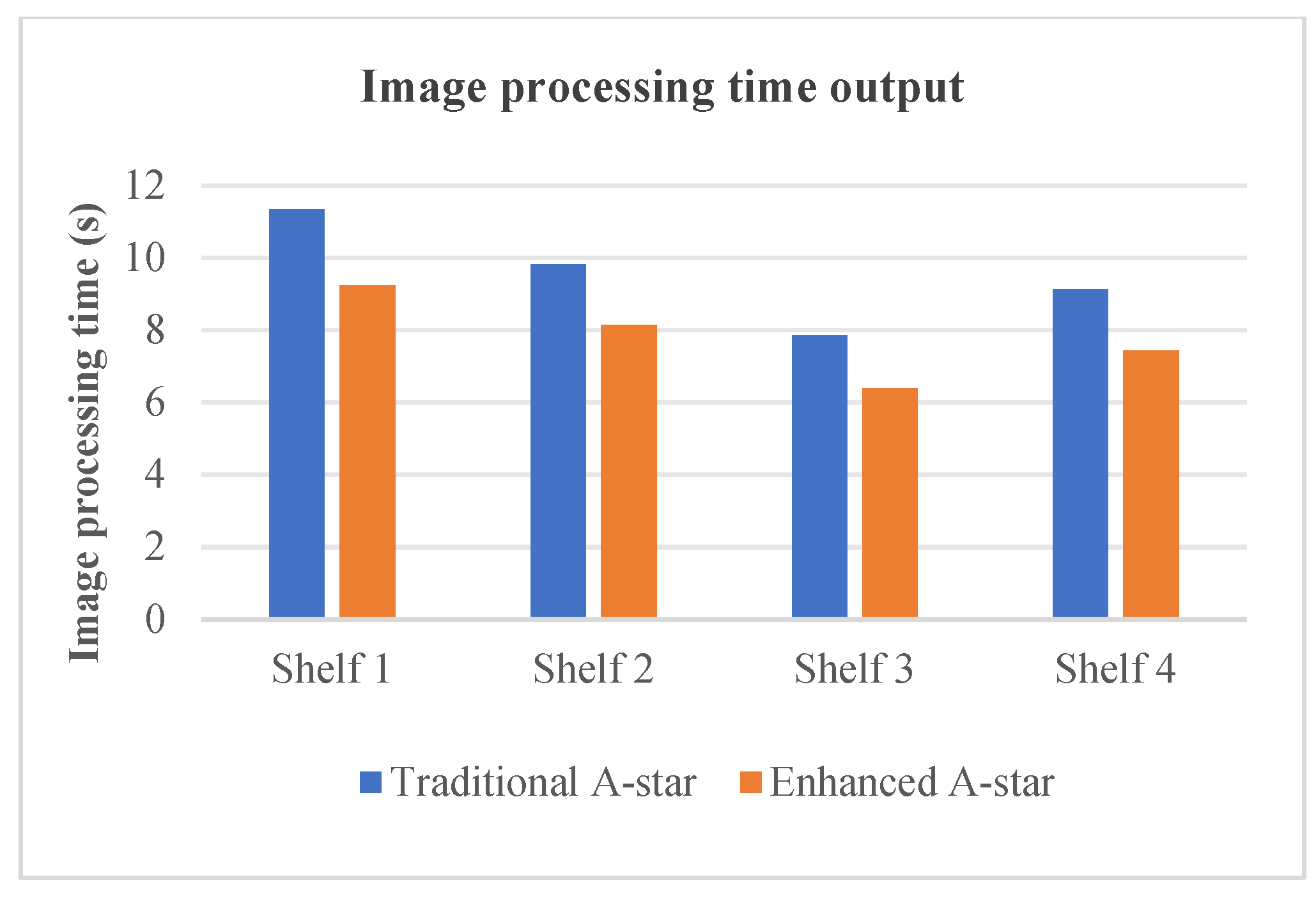
Figure 6. The modeling process is shown in the figure. The arrows indicate the overall modeling sequence for the smart warehousing platform, while the dashed boxes represent modeling steps performed in 3ds Max.
Applsci 15 12202 g006
Figure 7. 3D model disassembly tree view.
Applsci 15 12202 g007
Figure 8. First-person roaming perspective.
Applsci 15 12202 g008
Figure 9. AGV simulation drive rendering: (a) pick up goods; (b) put down the goods.
Applsci 15 12202 g009
Figure 10. AOP schematic diagram.
Applsci 15 12202 g010
Figure 11. Application of RFID technology in warehouse management.
Applsci 15 12202 g011
Figure 12. Platform performance consumption graph.
Applsci 15 12202 g012
Figure 13. The process of BFS.
Applsci 15 12202 g013
Figure 14. Comparison of a basic flowchart for Dijkstra’s algorithm and the A-star algorithm.
Applsci 15 12202 g014
Figure 15. Simulation Roadmap for Two Algorithms: (a) Dijkstra algorithm simulation roadmap; (b) A-star algorithm simulation roadmap.
Applsci 15 12202 g015
Figure 16. Graphical representation of three distance description methods in two dimensions.
Applsci 15 12202 g016
Figure 17. Simulation of three heuristic functions in A-star algorithm: (a) Manhattan distance; (b) Euclidean distance; (c) Chebyshev distance.
Applsci 15 12202 g017
Figure 18. The relationship between the weight coefficient and the heuristic function.
Applsci 15 12202 g018
Figure 19. Simulation of A-star algorithm for w = 2: (a) node search; (b) path planning.
Applsci 15 12202 g019
Figure 20. Simulation of dynamic weighted improved A-star algorithm: (a) node search; (b) path planning.
Applsci 15 12202 g020
Figure 21. Child node selection: (a) eight direction search; (b) five-neighborhood search.
Applsci 15 12202 g021
Figure 22. Simulation diagram of the improved search neighborhood A-star algorithm: (a) node search; (b) path planning.
Applsci 15 12202 g022
Figure 23. Hash table retrieval principle.
Applsci 15 12202 g023
Figure 24. Least binary heap and data storage.
Applsci 15 12202 g024
Figure 25. Search optimization schematic.
Applsci 15 12202 g025
Figure 26. Bidirectional A-star algorithm flowchart.
Applsci 15 12202 g026
Figure 27. Simulation of bidirectional A-star algorithm search path: (a) node search; (b) path planning.
Applsci 15 12202 g027
Figure 28. Single right-angle turn smoothing. The arrows in the green map indicate the direction of a single right-angle turn before smoothing. The arrows in the red map indicate the direction of a turn where the right-angle turn is broken down into two 45° turns after smoothing.
Applsci 15 12202 g028
Figure 29. Continuous right-angle turn smoothing. Arrows in the green map indicate the direction of consecutive right-angle turns before smoothing. Arrows in the red map indicate the direction of turns after smoothing, where right-angle turns are broken down into a few 45°.
Applsci 15 12202 g029
Figure 30. Comparison of Bézier Curve smoothing effects: (a) pathmap before smoothing; (b) smoothed path diagram.
Applsci 15 12202 g030
Figure 31. Comparison of A-star algorithm before and after improvement: (a) standard A-star algorithm; (b) optimize the A-star algorithm.
Applsci 15 12202 g031
Figure 32. A-star algorithm path planning effect in virtual simulation platform: (a) four-directional search; (b) eight-directional search.
Applsci 15 12202 g032
Figure 33. 3D effect of A-star algorithm path planning in the virtual simulation platform: (a) four-directional search; (b) eight-directional search.
Applsci 15 12202 g033
Figure 34. Visualization of the Bézier curve path smoothing effect in a virtual simulation platform: (a) the four-direction search path is smooth; (b) the eight-direction search path is smooth.
Applsci 15 12202 g034
Figure 35. Three-dimensional visualization of Bézier curve path smoothing effect in a virtual simulation platform: (a) the four-direction search path is smooth; (b) the eight-direction search path is smooth.
Applsci 15 12202 g035
Figure 36. Comparison of enhanced A-star algorithm and traditional A-star algorithm path length output results.
Applsci 15 12202 g036
Figure 37. Comparison of the output of the enhanced A-star algorithm with the traditional A-star algorithm for searching the number of nodes.
Applsci 15 12202 g037
Figure 38. Comparison of image processing time, output results of enhanced A-star algorithm, and traditional A-star Algorithm.
Applsci 15 12202 g038
Figure 39. Comparison of enhanced A-star algorithm and traditional A-star algorithm path segment angle outputs.
Applsci 15 12202 g039
Table 1. X Company warehouse factory questionnaire.
TimeSurvey ObjectFocus of Investigation
September 2023Warehouse managers 2
Office staff 1
Understand the current situation of A Company’s warehousing, outstanding problems, operation mode, management mode, etc.
September 2023Forklift operator 1Understand the working status of A Company’s warehouse management and the completion of work tracking.
September 2023Sales staff 3
Financial personnel 1
Understand the sales data and cost data of Company A, and provide accurate data sources for formulating reasonable plans.
Table 2. Basic user information table.
Field NameDescription of the Data ItemData TypeField SizeAllow NullMajor Key
Employee numberThe unique identification of the user’s record and the user’s login accountFigureLong integernoyes
Employee nameUser nameShort text30nono
Employee genderUser genderShort text30nono
SectionUser’s departmentShort text30nono
PositionThe role that the user holds in the departmentShort text30nono
TypeIdentify the types of actions that
employees perform in the system
FigureLong integernono
CipherPassword for logging into the platformShort text30nono
Table 3. Storage management information table.
Field NameDescription of the Data ItemData TypeField SizeAllow NullMajor Key
Incoming serial
number
The unique identification number
assigned to goods when they enter the warehouse
Automatic numbering noyes
Item numberAn identifier that numbers an itemShort text30nono
Warehousing date and timeThe time the goods are storedDate/time nono
Quantity in storageQuantity of goods taken into storageFigureLong integernono
Employee numberAn identifier that numbers an
employee
FigureLong integernono
Table 4. Inventory management information sheet.
Field NameDescription of the Data ItemData TypeField SizeAllow NullMajor Key
Item numberA unique number corresponding to the itemShort text30noyes
Goods nameName of goodsShort text30nono
Item typeModel number of goodsShort text30nono
Type of goodsType of goodsShort text30nono
Goods noteItem information of special interestLong text yesno
Table 5. Outbound management information table.
Field NameDescription of the Data ItemData TypeField SizeAllow NullMajor Key
Outbound serial numberThe unique identification number
assigned to the goods when they are sent to the warehouse
Automatic numbering noyes
Item numberAn identifier that numbers an itemShort text30nono
Date and time of
delivery
The time when the goods are out of storageDate/time nono
Outbound quantityQuantity of goods out of stockFigureLong integernono
Employee numberAn identifier that numbers an
employee
FigureLong integernono
Table 6. Warehouse dimension parameters.
Warehouse StructureDimension Parameters/m
Warehouse dimensions70 × 25
Shelf dimensions25 × 4
Dimensions of the temporary storage area6 × 4
Sorting area dimensions6 × 4
Dimensions of the AGV docking area6 × 1.5
Table 7. Platform functionality test results table.
NumberExpected RealizationInstructionsExpected EffectActual Effect
1Access to the function navigation screenUsers click the “Login” button
with their account number and password
Entering the function
navigation interface, the Smart Warehouse Management and
Visualization Warehouse
modules are loaded properly
Achieve the
desired results
2Intelligent warehouse managementManage goods in and out of the warehouse according to user
permissions
Operation of goods in and out of the warehouse, goods status linkageAchieve the
desired results
3Storage location
management
According to the warehouse
status index, to realize the goods
warehouse storage details
Operational management of goods storage locationsAchieve the
desired results
4Visual warehouseViewing angle and travel
distance controlled by WASD
keys and mouse
Models are loaded properly, and the internal structure of the warehouse is visualizedAchieve the
desired results
5AGV transportation simulationPlace the goods on the cart and mark the target pointAGVs carry goods and
navigate autonomously to find the target point.
Achieve the
desired results
Table 8. Comparison of advantages and disadvantages of path planning algorithms.
AlgorithmAdvantageDisadvantage
DijkstraThe algorithmic approach is straightforward and easy to understand.Node search is complex and inefficient
A-starIt has better completeness and optimalitySeriously affected by the choice of heuristic function
Table 9. Search the direction rule table.
Included Angle βKeep Five Search DirectionsDiscard Three Search Directions
[337.5°, 360°) ⋃ [0°, 22.5°)000T, 045T, 090T, 270T, 315T135T, 180T, 225T
[22.5°, 67.5°)000T, 045T, 090T, 135T, 315T180T, 225T, 270T
[67.5°, 112.5°)000T, 045T, 090T, 135T, 180T225T, 270T, 350T
[112.5°, 157.5°)045T, 090T, 135T, 180T, 225T270T, 315T, 000T
[157.5°, 202.5°)090T, 135T, 180T, 225T, 270T000T, 045T, 315T
[202.5°, 247.5°)135T, 180T, 225T, 270T, 315T000T, 045T, 090T
[247.5°, 292.5°)180T, 225T, 270T, 315T, 000T045T, 090T, 135T
[292.5°, 337.5°)225T, 270T, 315T, 000T, 045T090T, 135T, 180T
Table 10. Comparison of optimization method results.
AlgorithmSearch NodeSearch for a NodeOptimal Path/mSpace Complexity
A-star algorithm7452.07132low
Enhanced A-star algorithm3041.13108.24lower
Table 11. Comparison of experimental results for enhanced A-star Algorithm.
ObjectiveDirectionTime (m/s)Number of GridsPath Length (m)Path Turning Point
Shelf 1Four-directional search9.2442422
Shelf 1Eight-directional search7.313535.43
Shelf 2Four-directional search8.1441413
Shelf 2Eight-directional search7.4335384
Shelf 3Four-directional search6.3832320
Shelf 3Eight-directional search6.1732320
Shelf 4Four-directional search7.4339392
Shelf 4Eight-directional search6.7335343
Table 12. Comparison of experimental results between traditional A-star algorithm and enhanced A-star algorithm under four-direction search.
AlgorithmObjectivePath Length (m)Number of NodesTime (m/s)Path Segment Angle (°)Obstacle Avoidance Rate (%)
Traditional A-starShelf 14812311.3345100%
Shelf 2451199.8245100%
Shelf 3341087.8645100%
Shelf 4431369.1245100%
Mean ± standard deviation42.5 ± 5.9121.5 ± 10.79.53 ± 1.37
Enhanced A-starShelf 142429.2420100%
Shelf 241418.1415100%
Shelf 332326.3840100%
Shelf 439397.4330100%
Mean ± standard deviation38.5 ± 4.438.5 ± 4.47.80 ± 1.15
Disclaimer/Publisher’s Note: The statements, opinions and data contained in all publications are solely those of the individual author(s) and contributor(s) and not of MDPI and/or the editor(s). MDPI and/or the editor(s) disclaim responsibility for any injury to people or property resulting from any ideas, methods, instructions or products referred to in the content.