


Featured Application
This work contributes to better planning and designing of next-generation passive optical networks utilizing the wavelength division multiplexing technique by supporting decisions for involving traffic protection schemes that consider both financial sustainability and the need for reliable service delivery.
Abstract
Wavelength Division Multiplexing-based Passive Optical Networks (WDM-PONs) are among the most advanced optical networks without active elements, using a wide range of wavelengths to increase network reliability, scalability, and capacity. This ensures the provision of high quality, fast, and available services for end users. In this aim, traffic protection considerations have markedly enhanced their role. Traffic protection schemes can be divided into Point-To-MultiPoint (P2MP) and ring architectures. Traffic protection scenarios of access WDM-PONs in the P2MP architecture include Type B, dual-parented Type B, and Type C, while the ring architecture includes protected access and metropolitan-access WDM-PONs. Any potential traffic protection scheme can be represented by a corresponding reliability block diagram for the purpose of cost–benefit analysis. An important aspect of the WDM-PON design is presented by the Capital (CAPEXs) and Operational (OPEXs) Expenditures, which play a key role in network optimization. Managing them efficiently allows us to achieve an economically sustainable and efficient infrastructure of future passive optical networks involving traffic protection schemes. In this work, we focused on simulation model development for calculating the CAPEX and OPEX costs and the subsequent cost–benefit analysis of possible WDM-PON traffic protection schemes.
1. Introduction
Recent studies have addressed the problem of total cost and expenditure on optical access networks with traffic protection schemes from different perspectives. In [1], a protection scheme for the Ultra Dense Wavelength Division Multiplexing-based Passive Optical Network (UDWDM-PON) applied in the 5G fronthaul/backhaul is proposed, demonstrating that the four-nines reliability can be achieved with only a modest CAPEX increase. This work highlights the same trade-off between protection and cost considered in our study, but its scope is restricted to UDWDM-PON fronthaul scenarios.
In [2], a low-cost WDM-PON design for data centers is presented, reducing hardware requirements through transceiver sharing and passive multiplexing. This study is limited to architectural simplification without economic evaluation.
Optimization approaches have also been explored. In [3], a mixed-integer linear programming model for fronthaul networks compares fiber, PON, and hybrid Passive Optical Network-Free Space Optics (PON-FSO) scenarios, jointly evaluating CAPEX, OPEX, and energy consumption. Similarly, the Mixed-Integer Linear Programming (MILP) optimization to plan a hybrid fiber/mmWave fronthaul is employed in [4], reducing Total Cost of Ownership (TCO) by dynamically assigning transport resources according to the traffic.
Hybrid and physical protection methods have also been proposed in some research works. In [5], an experimental self-healing WDM-PON with additional fiber and FSO backup links is demonstrated, successfully rerouting traffic after fiber cuts while maintaining acceptable Bit Error Ratio (BER) limits. In [6], a WDM-PON + FSO system enhanced with the Low-Density Parity-Check (LDPC) coding is introduced for Cloud Radio Access Network (C-RAN) fronthaul, showing that hybrid fiber/FSO links can maintain a reliable high-speed transmission under adverse conditions. These works focus on resilience at the physical and coding layers, whereas our study concentrates on the economic dimension of protection, explicitly calculating the CAPEX/OPEX trade-offs associated with conventional protection schemes.
Other contributions address architectural strategies for improving resilience. In [7], a high-capacity optical metro-access design with centralized Optical Line Terminal (OLT) and robust switching is proposed to recover quickly from fiber failures. The work [8] demonstrates that high detection accuracy can coexist with transparency, providing robust and trustworthy industrial operations for resource-constrained networks. For 5G xHaul access networks, a dedicated path protection mechanism is introduced in [9] with flexible switching selection, demonstrating significant CAPEX savings using MILP optimization.
Beyond the WDM-PON, there are also relevant studies on the Time Division Multiplexing-based Passive Optical Network (TDM-PON), the Time- and Wavelength-Division Multiplexing-based Passive Optical Network (TWDM-PON), and generic PON cost modeling. In [10], a Fiber to The Home (FTTH) infrastructure in the open fiber passive optical network is analyzed, introducing an economic model to quantify the maximum attenuation allowed by Service Level Agreement (SLA) acts. This work links network dimensioning to OPEX related to trouble-ticket management.
Earlier work in [11] applied Markov and Monte Carlo models to investigate cost-efficient protection mechanisms in PON networks, focusing on availability improvements versus additional CAPEX and OPEX. This approach is methodologically close to the use of RBDs and economic modeling, but it lacks the integration of detailed component pricing and the explicit comparison of multiple protection architectures.
For the multi-stage TDM/TWDM-PON design, an Integer Linear Programming (ILP)-based methodology is presented in [12], aiming to minimize both CAPEX and OPEX in optical access networks. Such optimization frameworks resemble the MILP-based planning used in recent fronthaul studies.
Finally, the work [13] compares the yearly evolution of CAPEX and OPEX for PON networks with ring-based topologies, showing that although initial deployment costs are high, operating expenses decrease as network utilization grows. This work highlights temporal cost trends in optical access networks.
In summary, the literature demonstrates a variety of approaches:
- Economic cost analyses and availability in WDM-PONs [1,2];
- Optimization-based planning of fronthaul and access networks [3,4,9,12];
- Hybrid and physical-layer protection techniques [5,6,7];
- SLA-driven and temporal cost modeling in generic passive optical networks [10,11,13].
Compared to these works, the novelty of our contribution is represented by the integration of CAPEX and OPEX modeling with the RBD-based network reliability evaluation and by offering a decision-support simulation tool to compare conventional traffic protection schemes for both P2MP and ring WDM-PON architectures. While optimization and hybrid protection approaches explore new directions, our work provides a practical baseline for network operators to evaluate various traffic protection schemes from an economic perspective, bridging the gap between theoretical availability improvements and their real financial implications. Moreover, our work, that is arising directly from the analytical framework introduced in [14], also presents the WDM-PON Network Cost Evaluator tool for the cost–benefit analysis of presumptive WDM-PON traffic protection schemes. This novel simulation model extends the original PON Network Availability Evaluator tool with additional modules for CAPEX and OPEX calculations, thus transforming a purely reliability-oriented framework into a comprehensive program capable of combined performance, network reliability, and cost–benefit analysis of WDM-PON traffic protection schemes.
In this contribution, the importance and features of potential traffic protection schemes for deployment in presumptive WDM-PON architectures are introduced and connected with the appropriate cost–benefit analysis. For this aim, necessary assumptions and relations of WDM-PON traffic protection schemes are mentioned. The next sections are organized as follows: the use of Artificial Intelligence (AI) in this paper is declared in Section 2. Section 3 presents a basic classification of WDM-PON architectures. Presumptive traffic protection schemes for P2MP and ring architectures involved in the cost–benefit analysis together with corresponding reliability diagrams are also presented. Subsequently, appropriate formulas and parameters considered for calculating capital and operational expenditures are introduced in Section 4. For analyzing total network costs of various potential traffic protection schemes, a new simulation tool called the WDM-PON Network Cost Evaluator is created (Section 5). In Section 6, considered WDM-PON traffic protection schemes are evaluated and compared based on their CAPEX, OPEX, and TCO costs. The acquired simulation results are analyzed and discussed in Section 7. At the end of this article in Section 8, conclusions of achieved findings together with future challenges and research directions of our work are presented.
2. Materials and Methods
First, we present presumptive architectures of advanced WDM-PON networks and their potential traffic protection schemes in Section 3. Mainly, a key focus is oriented towards presumptive scenarios that are introduced in detail. Subsequently, reliability block diagram representations utilized for the cost–benefit analysis have been developed for each possible traffic protection scheme in WDN-PON architectures. The functionality and reliability of RBDs were proved and verified in previously published works [14,15].
Second, the novelty of this paper is represented by integrating CAPEX/OPEX with RBDs of traffic protection schemes for advanced WDM-PONs. For this integration, formulas introduced in Section 4 for each traffic protection scheme are necessary together with references parameters introduced in Section 5 for OPEX/CAPEX evaluations. This integration is realized by a newly created simulation tool, WDM-PON Network Cost Evaluator, that has been designed and developed for the calculation and evaluation of capital and operational expenditures for these future developed networks.
This article, including all analytical procedures, figures, and programming environments, was developed in Microsoft Excel, and the complete source code was entirely written and created by authors. Generative Artificial Intelligence (GenAI) tools were employed only to assist in language-related tasks—specifically, in translation and stylistic refinement of the manuscript to improve clarity, consistency, and readability.
In addition, GenAI was used in the preliminary research phase to support the review and comparison of the relevant scientific literature and publicly available sources. However, the selection, interpretation, and synthesis of these materials were performed solely by authors.
3. Presumptive WDM-PON Architectures
Future WDM-PONs provide scalability by supporting multiple wavelengths in a single optical fiber, thus providing transparency in data throughput and power budget without passive optical losses. Optical components involved in several architecture types must be cost-effective and flexible from the viewpoint of connected users [16]. For utilization of the wavelength division multiplexing, DWDM applications based on the standard ITU-T G.694.1 [17] are considered.
3.1. The P2MP Architecture of the WDM-PON Access Network
In this architecture with the Remote Node (RN), the Feeder Fiber (FF), and Distribution Fibers (DF) (Figure 1), each Optical Network Unit (ONU) component is assigned to a separate wavelength channel in both transmission directions. This creates a point-to-point link between the OLT and the specific ONU terminal, where each ONU is able to operate at the data rate determined by its wavelength channel. The channels can have different data rates, allowing for the service variability [16].
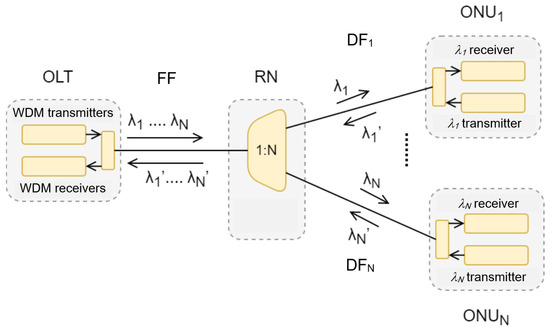
Figure 1.
The graphical presentation of the P2MP WDM-PON architecture.
3.2. The Ring Architecture of the WDM-PON Access Network
The ONUs are interconnected in a ring topology with a bidirectional connection to the central OLT. This architecture (Figure 2) allows a re-modulation of optical signals for more efficient transmission and supports a flexible wavelength allocation, thereby increasing the network capacity and scalability [18,19].
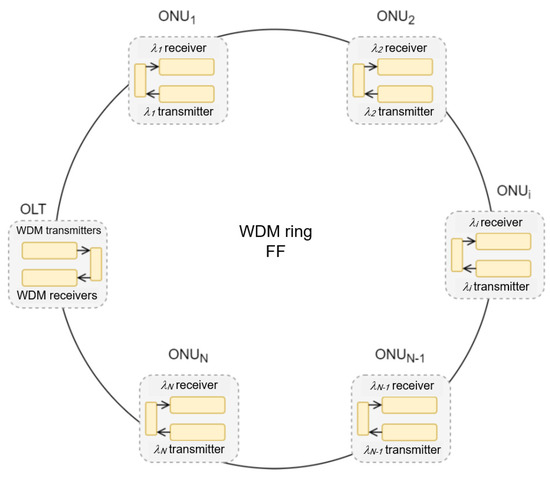
Figure 2.
The graphical presentation of the ring WDM-PON architecture.
3.3. The Combined Architecture of the WDM-PON Metropolitan-Access Network
This extended metropolitan-access architecture (Figure 3) uses a Wavelength Division Multiplexing (WDM) ring based on the FF with Arrayed Waveguide Grating (AWG) elements and then interconnects to a Time Division Multiplex (TDM) access branch using passive Optical Splitter (OS) components, DF, and Drop Distribution Fibers (DDF). Potential Erbium-Doped Fiber Amplifiers (EDFA) can utilize both L- and C-wavelength bands. The modularity of this architecture allows the connection of a large number of users. Acceptable attenuation values are maintained because optical power parameters are adjusted according to the fiber length and power characteristics of the lasers [20].
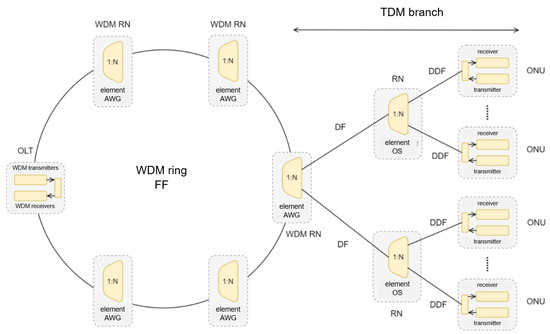
Figure 3.
The graphical presentation of the combined WDM-PON architecture.
3.4. Traffic Protection Schemes in WDM-PONs
At present, WDM-PONs are undergoing a substantial phase of expansion. Despite the considerable capital expenditures associated with their deployment, it is imperative to enhance network resilience to an adequately high level. Depending on the deployment context, several architectural approaches are regarded as promising for future WDM-PON implementations—either as greenfield deployments evolving from existing TDM-PON infrastructures or as brownfield deployments migrated from transient Hybrid Passive Optical Networks (HPONs). The implementation of traffic protection schemes (Table 1) represents an increasingly critical aspect in the advancement towards modern WDM-PON networks.

Table 1.
Review of potential traffic protection schemes for WDM-PON architectures.
3.5. Considered Presumptive Scenarios for Traffic Protection in P2MP WDM-PON Architectures
The P2MP protection schemes are implemented through the duplication of network components, including optical fibers, the OLT, the RN, and ONUs. This approach is in accordance with the ITU-T standard [21], originally defined for TDM-PONs. The WDM-PON technology presents a broadband solution aimed at ensuring system availability at a sufficiently high level, which remains a fundamental prerequisite for the provision of high-speed continuous data services. The P2MP protection schemes should incorporate one or more aggregation layers between the OLT and end-user locations [22]. This way, excessive demands for optical fiber underground laying can be mitigated.
Following presumptive scenarios of P2MP protection schemes can be considered suitable for practical deployment by network operators based on the work [15]:
- Type B protected P2MP access network is characterized by the protection of the Feeder Fiber (FF). Since the FF is shared by all connected subscribers, its failure results in the interruption of service delivery that affects a large number of users. Due to its simplicity and low implementation costs, this protection is particularly attractive to operators with small- to medium-scale traffic loads [23].
- Dual-parented Type B protected P2MP access network extends previous protection by duplicating both the OLT equipment and the FF. In WDM-PONs compared to TDM-PONs, a significantly larger number of subscribers are connected to a single OLT through the FF. Consequently, failures of either the OLT or the FF affect overall network reliability and disrupt service provisioning for a large number of users. Therefore, their protection has a critical importance [23].
- Type C protected P2MP access networks represent a dedicated path protection mechanism achieved by duplicating all network components (FF, RN, DF, and ONU) except the OLT. Additional components (EDFA) may be included in this protection scheme for a network reach extension when it is applied in rural areas. Because this protection provides a high level of network availability, it also requires substantial capital expenditures [23].
3.6. Considered Presumptive Scenarios for Traffic Protection in Ring WDM-PON Architectures
The ring protection schemes in WDM-PONs are considered a cost-effective approach for ensuring protection provisioning. With the growing demand from advanced users for exceptionally reliable connectivity, it is anticipated that network operators will be required to provide uninterrupted access to telecommunication services. Therefore, securing network reliability through the implementation of appropriate protection schemes represents a fundamental requirement. Optical fibers organized in a ring architecture require increased attention to ensure failure-free signal transmission compared to other network topologies. Moreover, the ring architecture enables cost reductions by sharing the same transmission channels across working and protecting optical fibers. This scenario can also be applied in TDM-PONs or HPONs [15,24].
Based on practical considerations, the following presumptive scenarios of the ring protection scheme can be considered suitable for deployment by network operators:
- A protected ring access network is designed to provide traffic protection in case of fiber failure and to suppress Rayleigh backscattering noise. This scheme allows improvements in the network scalability and increases the available channel capacity per ONU. It employs two optical paths—a working path and a protection path. In the event of a fiber failure, optical modules are capable of protecting and restoring communication channels using appropriate optical switches to ensure immediate traffic protection [15].
- A protected ring metro-access network combines multiple network topologies and employs duplicated feeder fibers arranged in a ring infrastructure. Two synchronous optical switches are used to select either working or protecting optical fibers. This protection scheme does not extend to the distribution part of the passive optical network. It is capable of handling extremely high data traffic loads of up to 1 Tbit/s, supporting a large number of users, and covering wide geographical areas. Because any physical-layer failure causes significant losses of end-user data, an effective monitoring and traffic protection system must be implemented. This protection scheme provides high network availability and maintains lower costs compared to other protection schemes considered for ring topologies [25].
3.7. Reliability Representations for WDM-PON Traffic Protection Schemes
The cost–benefit analysis is conducted using Reliability Block Diagram (RBD) representations, which offer several notable advantages, including accuracy, flexibility, simplicity, and a clear visual structure [14,15]. RBD models enable the determination of the overall network availability for a given protection scheme. In the RBD representation, each network component is modeled as a single block connected to adjacent blocks, thereby reflecting its functional relationship within the traffic protection scheme. The interconnections within a specific protection scheme distinguish between unprotected components (connected in series) and protected components (connected in parallel).
For improved clarity, RBD block representations have been developed for the potential traffic protection schemes in WDM-PON architectures (Table 1, illustrated in Figure 4), which are incorporated into the cost–benefit analysis. Specifically, RBDs Figure 4a–d represent WDM-PON protection scenarios considered for P2MP network architectures, whereas RBDs Figure 4e–h correspond to WDM-PON protection scenarios related to ring network architectures.
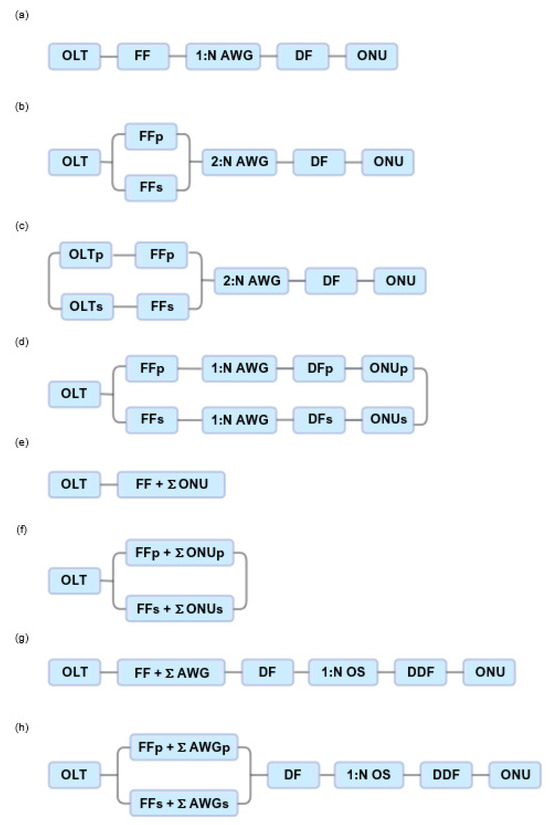
Figure 4.
Reliability Block Diagram representations of traffic protection schemes for P2MP WDM-PON architectures—(a) unprotected P2MP access network, (b) Type B protected P2MP access network, (c) dual-parented Type B protected P2MP access network, (d) Type C protected P2MP access network—and for specific ring WDM-PON architectures, (e) unprotected ring access network, (f) protected ring access network, (g) unprotected ring metro-access network, and (h) protected ring metro-access network [14].
4. Cost–Benefit Analysis Considerations for WDM-PON Traffic Protection Schemes
The deployment and operation of WDM-PONs depend on the complexity of their architecture. As the RBDs show, some protection schemes use redundant elements such as the OLT and ONUs, thus avoiding the need for 1:1 or 1 + 1 fiber protection. Although these techniques provide stable traffic restoration between the OLT and ONUs, they significantly increase the initial network investment.
The duplication of the OLT represents a significantly higher cost compared to 1:1 or 1 + 1 fiber protection, which requires a trade-off between the initial cost and the recovery time upon failure. Minimizing the system complexity is therefore key for efficient fault detection and network recovery.
The cost–benefit analysis includes data on different traffic protection architectures, which is a key factor in evaluating cost-effectiveness. The financial cost in WDM-PON architectures can be divided into the Capital Expenditures (CAPEXs) and Operational Expenditures (OPEXs) [26].
4.1. Capital Expenditures Considerations
The CAPEX amount represents the investment in deploying the considered WDM-PON architecture. It includes the purchase of network equipment (OLT, ONU, AWG, and OS), the optical transmission medium (DF, FF, and DDF), and the work associated with the installation of optical infrastructures, including excavation and fiber deployment [26,27].
The total capital expenditures Capex can be expressed using Equation (1):
where CE represents the purchase of network equipment, CM denotes the cost related to the optical transmission medium, and CL corresponds to the cost of labor associated with the installation of optical infrastructures, including activities such as excavation, fiber deployment, and related works. Moreover, this equation can also be derived by applying individual RBDs, as described in [14] and illustrated in Figure 4.
For the unprotected P2MP access network represented by the RBD (Figure 4a), the total capital cost is expressed using Equation (2):
In the case of the Type B protected P2MP access network represented by the RBD (Figure 4b), the total cost reflects the additional feeder fiber redundancy and is determined using Equation (3):
A more robust approach, the dual-parented Type B protected P2MP access network shown in the RBD (Figure 4c), incorporates the full OLT duplication together with the FF protection, which results in using Equation (4) for the total capital cost:
For the Type C protected P2MP access network represented by the RBD (Figure 4d), the capital cost is calculated using Equation (5):
For the unprotected ring access network represented by the RBD (Figure 4e), the total capital cost is expressed using Equation (6):
For the protected ring access network represented by the RBD (Figure 4f), the total cost is given using Equation (7):
For metropolitan environments that integrate additional switching and distribution elements, the unprotected ring metro-access network is represented by the RBD (Figure 4g) and the total capital cost is determined using Equation (8):
Finally, for the protected ring metro-access network shown in the RBD (Figure 4h), the total capital cost can be expressed using Equation (9):
4.2. Operational Expenditures Considerations
The OPEX amount represents the non-capital expenditure for a network operating from its deployment to its replacement with innovative technology [26]. It includes the following:
- Equipment repairs and replacements, including fiber optic repairs and technician labor [26].
- Penalties for service outages, defined in the Service Level Agreement (SLA) between network operators and customers [16].
- An electricity consumption of active network elements (OLT and ONU), calculated as the product of the unit electricity price and the total electricity consumption of the passive optical network during its lifetime [16,26].
The total operational expenditure, Opex, can be expressed as shown in Equation (10):
where OR represents the repair cost, OP denotes the cost of penalties for service failures, and OC corresponds to the cost incurred by electricity consumption. All the costs mentioned above are introduced for a time period of one year and therefore they have to be multiplied by the number of years Y of the network operation at last [16,26]. For the OR calculation, the network unavailability time and the specific parameters present in Table 3 [14] were used.
5. The WDM-PON Cost Evaluator
Based on the methodological framework of the previously developed simulation program PON Network Availability Evaluator [14], a new simulation tool named WDM-PON Network Cost Evaluator has been designed and developed. This tool focuses on the calculation and evaluation of capital expenditures (CAPEXs) and operational expenditures (OPEXs) for various traffic protection schemes in WDM-PONs, supporting both P2MP and ring architectures. Its purpose is to provide a flexible and transparent way of assessing the cost efficiency of different deployment scenarios in advanced passive optical access networks utilizing a wavelength division multiplexing technique.
The WDM-PON Network Cost Evaluator tool incorporates appropriate formulas prepared for each considered presumptive scenario of the traffic protection in advanced WDM-PON architectures. For CAPEX considerations, the formulas are introduced in Section 4.1 in Equations (1)–(9). For OPEX considerations, the formula is used as expressed in Section 4.2 in Equation (10).
The WDM-PON Network Cost Evaluator tool utilizes data from Table 2 and Table 3 together with the reference values given in [14], which can be easily modified to incorporate cost parameters from other sources or specific network operators. This approach enables a cost–benefit analysis of various realistic WDM-PON deployment scenarios and provides a consistent framework for evaluating their economic aspects.
Table 2.
Reference cost parameters for the OPEX evaluation in WDM-PON traffic protection schemes [27,28].
Table 3.
Reference cost parameters for components, equipment, and deployment works for the CAPEX evaluation in WDM-PON traffic protection schemes [28].
The Simulation Interface of the WDM-PON Network Cost Evaluator Tool
The WDM-PON Network Cost Evaluator tool is implemented in Microsoft Excel using ActiveX control elements and Visual Basic for Applications (VBA). The simulation interface can be divided into two functional sections. On the left side, the user selects the network topology (P2MP or ring) and subsequently the available protection types for the selected topology. For the P2MP selection, the user can adjust the number of subscribers and the lengths of distribution and feeder fibers. For the RING selection, the number of ONU elements in the protected access network and the number of AWG elements in the protected metro-access network can be specified. After entering these input parameters and pressing the CALCULATE button, the program computes the resulting total CAPEX and OPEX values, and the corresponding costs per subscriber. On the right side, comparative graphs are included for easier presentation of various WDM-PON protection type costs.
Figure 5 shows the simulation interface for CAPEX and OPEX calculations in WDM-PONs with P2MP topologies. In this example, the P2MP topology with the Type B protected access network is selected. For this specific selection, the concrete formula (Equation (3)) is used. The interface then lists the main network parameters, such as the number of subscribers, the number of ONUs, the number of AWG elements, and lengths of distribution and feeder fibers. After computing, the simulation tool displays the total, CAPEX, and OPEX per subscriber values in euros for the selected option. Simultaneously, comparisons of CAPEX and OPEX costs for different WDM-PON traffic protection schemes with P2MP topologies are graphically displayed on the right side of the simulation interface.
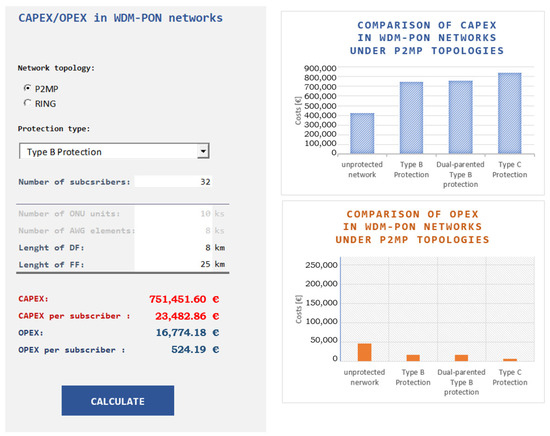
Figure 5.
The simulation interface for CAPEX and OPEX calculations in the Type B protected P2MP access network.
Figure 6 shows the simulation interface for CAPEX and OPEX calculations in WDM-PON networks with ring topologies. In this example, the protected ring access network is selected. For this specific selection, the concrete formula (Equation (7)) is used. The interface then lists the main network parameters, such as the number of ONUs, the number of AWG elements, and the lengths of distribution and feeder fibers. After computing, the simulation tool displays the total, CAPEX, and OPEX per subscriber values in euros for the selected option. Simultaneously, comparisons of CAPEX and OPEX costs for different WDM-PON traffic protection schemes with ring topologies are graphically displayed on the right side of the simulation interface.
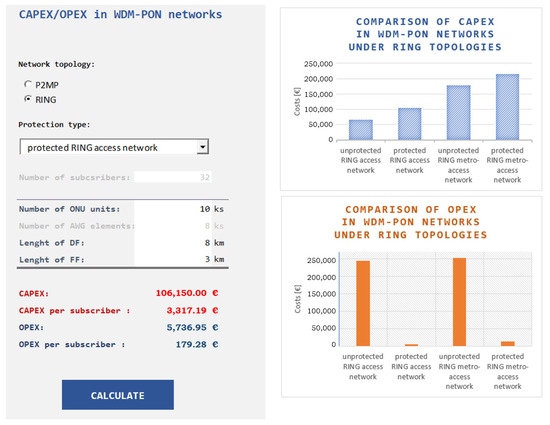
Figure 6.
The simulation interface for CAPEX and OPEX calculations in the protected ring access network.
6. Evaluation of WDM-PON Traffic Protection Schemes
Using the WDM-PON Network Cost Evaluator tool, we can evaluate the capital and operational expenditures of WDM-PONs depending on the selected types of potential traffic protection schemes in considered point-to-multipoint and ring architectures. All potential scenarios of unprotected and protected traffic protection schemes are processed and acquired simulation results are analyzed. Relevant input parameters of considered WDM-PON architectures are summarized in Table 4.
Table 4.
Input parameters for the potential WDM-PON traffic protection scenarios.
6.1. Cost–Benefit Comparison of Protection Scenarios in P2MP WDM-PON Architectures
As can be observed in Table 5, and subsequently in Figure 7, the introduction of traffic protection mechanisms into the passive optical network significantly increases the capital cost of network implementation. On the other hand, it also considerably enhances network availability and reliability, which in turn leads to a substantial reduction in the operational cost associated with the presumptive WDM-PON architecture.
Table 5.
Comparative OPEX, CAPEX, and TCO evaluation results for different WDM-PON access network architectures.
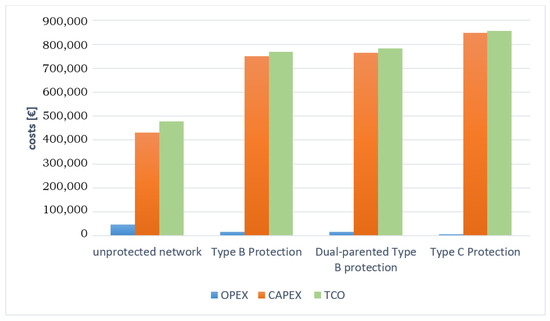
Figure 7.
Comparison of CAPEX, OPEX, and TCO costs for P2MP WDM-PON traffic protection scenarios.
In contrast, the introduction of traffic protection mechanisms (Type B, dual-parented Type B, and Type C) leads to a substantial CAPEX increase, reflecting the higher implementation complexity and the need for additional optical infrastructure. Nevertheless, the OPEX values for these traffic protection schemes decrease, owing to improved network reliability and reduced maintenance requirements. Among the evaluated protection types, Type C protection exhibits the highest CAPEX and TCO, but also ensures the highest degree of fault tolerance and service availability.
Overall, the simulation results confirm that, although traffic protection mechanisms impose higher capital expenditures, they provide long-term economic benefits by reducing operational expenditures, thereby improving the cost-effectiveness and robustness of WDM-PONs over their entire lifecycle.
Figure 8 shows the dependence of CAPEX per subscriber on the number of users in P2MP WDM-PONs for different traffic protection types, where the total CAPEX costs are divided by the number of users. The simulation results clearly indicate that, with an increasing number of subscribers, CAPEX per subscriber decreases across all considered protection types.
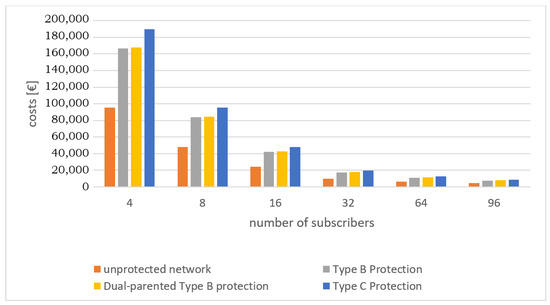
Figure 8.
Total cost comparison for various numbers of subscribers in P2MP WDM-PON traffic protection scenarios.
For a small number of subscribers (e.g., 4 or 8), the costs per subscriber are relatively high, and the differences between unprotected and protected P2MP access network architectures (Type B, dual-parented Type B, and Type C) are the most marked. As the number of subscribers grows (16, 32, 64, and 96), these differences become less significant, and the CAPEX costs per subscriber converge, making even the more complex traffic protection schemes more economically viable.
This trend demonstrates that in the PON planning phase, network designers must consider not only the selected traffic protection scheme but also the expected future subscriber base, since the scalability has a decisive impact on the cost-effectiveness of both unprotected and protected P2MP WDM-PON architectures.
6.2. Cost–Benefit Comparison of Protection Scenarios in Ring WDM-PON Architectures
Figure 9 presents a comparison of capital expenditures, operational expenditures, and total cost of ownership for ring WDM-PON access and metropolitan-access networks, both with and without traffic protection schemes. As illustrated, the implementation of traffic protection scenarios in these network architectures results in an increase in CAPEX, reflecting the additional investment required for equipment redundancy. However, OPEX decreases significantly in the protected configurations due to improved network reliability and reduced maintenance needs. In contrast, the unprotected ring WDM-PON networks exhibit lower initial investment but higher long-term operational expenditures.
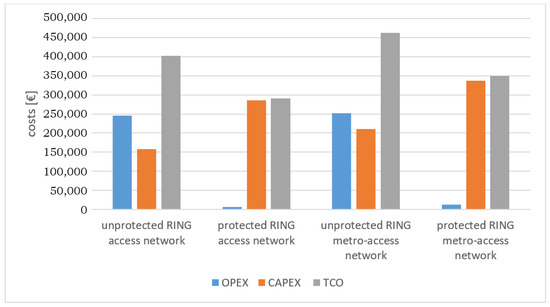
Figure 9.
Comparison of CAPEX, OPEX, and TCO costs for ring WDM-PON traffic protection scenarios.
Based on the obtained results, it can be deduced that the protected architectures in access and metropolitan-access networks achieve lower total expenditures throughout their lifecycle, confirming the economic benefit of applying traffic protection mechanisms.
7. Discussion
The simulation results show that there is a clear balance between investment costs (CAPEX) and operational costs (OPEX) when traffic protection schemes are applied in WDM-PON architectures. Unprotected WDM-PONs without any traffic protection considerations are cheaper to build at the beginning, but they lead to much higher operational costs during their lifecycle because of lower network availability and more frequent service penalties. On the other hand, protected WDM-PONs in both P2MP and ring architectures require higher initial investments but provide much lower OPEX and total cost of ownership (TCO).
These findings are consistent with previous research studies that emphasized the importance of investing in network traffic protection schemes. The novelty of our work lies in combining detailed component cost parameters with network reliability analysis. This approach enables network operators to compare various traffic protection scenarios under real conditions of advanced passive optical networks, utilizing the wavelength division multiplexing technique more effectively and precisely.
Another important outcome is the effect of scalability. As the number of users increases, the cost per subscriber decreases in all considered traffic protection schemes, according to the cost–benefit analysis conducted. This indicates that more complex solutions, although initially more expensive, can become cost-effective as the network serves more subscribers.
Future research will focus on hybrid traffic protection approaches, where physical redundancy is complemented by software-defined mechanisms and/or intelligent network management. It would also be beneficial to extend the simulation tool with electricity consumption and dynamic traffic demand modeling, which are crucial in converged F5G metropolitan-access networks.
8. Conclusions
In this paper, our focus is oriented towards a topical developing area of advanced WDM-PONs where their presumptive architectures together with potential traffic protection schemes are analyzed in detail. First, the novelty of this contribution is represented by reliability block diagram representations utilized for the cost–benefit analysis for each possible traffic protection scheme in WDN-PON architectures. The functionality and reliability of RBDs were proved and verified in previously published works [14,25]. Furthermore, the uniqueness of this contribution is represented by integrating CAPEX/OPEX considerations with RBDs of traffic protection schemes for advanced WDM-PON architectures. For this integration, new formulas for each traffic protection scheme are introduced. The integration is realized by a newly created simulation tool, WDM-PON Network Cost Evaluator, that has been designed and developed for the calculation and evaluation of capital and operational expenditures for future developed WDM-PON traffic protection schemes. Due to the highlighted novelties, there are no other studies or research in this direction possible and available for a near comparison.
This paper focuses on the cost–benefit analysis of different traffic protection schemes in WDM-PON architectures in terms of both capital (CAPEX) and operational (OPEX) expenditures. For this purpose, a new simulation tool called the WDM-PON Network Cost Evaluator was designed and developed. The tool is implemented in the VBA environment and allows the calculation of network costs for various deployment scenarios using traffic protection schemes, including both point-to-multipoint and ring options. By using real network component pricing, the WDM-PON Network Cost Evaluator tool provides significant simulation results that can be directly applied by network operators at planning optical access network deployments.
Findings of the realized cost–benefit analysis show that involving traffic protection schemes into the advanced WDM-PON deployment always increases the initial investment costs (CAPEX), but at the same time it reduces operational costs (OPEX) because of fewer repairs, penalties, and service failures. This effect leads to a lower total cost of ownership (TCO) over the network lifetime. Within P2MP network architectures, Type B and dual-parented Type B protection schemes represent good compromises between cost and performance, while the Type C protection scheme offers the highest level of protection but also requires the highest investment. Among ring topologies, both protected access and metro-access schemes proved to be more economically efficient in the long term, as they combine acceptable CAPEXs with exceptionally low OPEXs.
The analytical conclusions also confirm that scalability plays a key role. With a higher number of connected users, the cost per subscriber decreases in all cases, which makes even more complex traffic protection scenarios economically reasonable. This finding shows that the selection of the WDM-PON traffic protection scheme should not be based only on the initial investments’ costs, but also on the expected network growth and long-term operations.
Overall, the presented framework and the developed WDM-PON Network Cost Evaluator tool provide network operators with a clear and practical method to compare different traffic protection schemes. Our work contributes to better planning and designing of next-generation passive optical networks utilizing the wavelength division multiplexing technique by supporting decisions for involving traffic protection schemes that consider both financial sustainability and the need for reliable delivery service.
Research Directions and Future Challenges
This paper presents a cost–benefit analysis as an important aspect for designing advanced WDM-PONs with traffic protection schemes involved. The paper’s novelty brings some known limitations that can determine future research directions.
First, a focus on the future-developed WDM-PONs does not allow verification on a real data set, comparative validation using field data, an industrial case study, or a comparison with previously published cost models and/or with empirical measurements realized on current TDM-based passive optical networks. There are no known papers suitable for a near comparison in terms of the cost–benefit analysis in WDM-based passive optical networks. By contrast, a fundamental and elementary base is introduced for another possible analysis of future-constructed WDM-PONs utilizing traffic protection schemes.
Second, the WDM-PON Network Cost Evaluator tool can be considered as a prototype that can be easily modularized for another subsequent research purposes, for example, a sensitivity analysis or an adjustment for inflation. The proposed evaluator differs from tools like Markov-model-based frameworks with reason. A Markov cost model allows for capturing the dynamic dependability behavior of passive optical networks. For the purpose of CAPEX/OPEX analysis based on the RBD-based reliability evaluation of proposed WDM-PON traffic protection schemes, the created tool is satisfactory and applicable with simplicity and modularity.
Our analytical models of WDM-PON traffic protection schemes depend on numerous cost and reliability parameters (Table 2 and Table 3) in the actual state. Of course, cost values and repair rates can vary significantly across vendors and regions. Also, changing energy costs, SLA penalties, or the lifetime Y exercise, influences the variation in results. All these premises can be fully incorporated into a created evaluation tool and can be utilized for subsequent analyses. For the purpose of possible comparison to different tools and related results of the WDM-PON cost–benefit analysis, considered values of input parameters (Table 4) are determined as an example in this paper.
Results of the cost–benefit analysis and comparisons of protection scenarios in various WDM-PON traffic protection scenarios can be very useful and important in future F5G and 6G network planning. Network operators who want to apply the network slicing concept in the future F5G architectures will utilize WDM-PONs in access and aggregation segments of the Underlay Plane (UP). Consequently, future extensions of the WDM-PON Network Cost Evaluator tool can be verified and validated by experiments on real-deployed WDM-PONs. Within this context, various AI and ML techniques can be suitably integrated and applied.
Author Contributions
Conceptualization, F.F. and R.R.; methodology, R.R.; software, F.F.; validation, F.F. and R.R.; formal analysis, F.F.; investigation, F.F.; resources, F.F. and R.R.; data curation, F.F.; writing—original draft preparation, F.F.; writing—review and editing, R.R.; visualization, F.F.; supervision, R.R.; project administration, R.R.; funding acquisition, R.R. All authors have read and agreed to the published version of the manuscript.
Funding
This work is a part of research activities conducted at the Slovak University of Technology Bratislava, Faculty of Electrical Engineering and Information Technology, Institute of Multimedia Information and Telecommunications Technologies, within the scope of the project VEGA No. 1/0322/24 “Advanced algorithms for multichannel optical networks in the F5G architecture for implementing access wireless technologies in the NG-PON converged infrastructure”.
Institutional Review Board Statement
Not applicable.
Informed Consent Statement
Not applicable.
Data Availability Statement
The original contributions presented in this study are included in the article. Further inquiries can be directed to the corresponding author.
Acknowledgments
During the preparation of this manuscript, the authors did not use GenAI tool for the purposes of generating text, data, or graphics, or study design, data collection, analysis, or interpretation of data. GenAI tools were employed only in translation and stylistic refinement of the manuscript and in the preliminary research phase to support the review of sources. The authors have reviewed and edited the output and take full responsibility for the content of this publication.
Conflicts of Interest
The authors declare no conflicts of interest. The funders had no role in the design of the study, in the collection, analyses, or interpretation of data, in the writing of the manuscript, or in the decision to publish the results.
Abbreviations
| AI | Artificial Intelligence |
| AWG | Arrayed Waveguide Grating |
| BER | Bit Error Rate |
| CAPEX | Capital Expenditures |
| C-RAN | Cloud Radio Access Network |
| DF | Distribution Fiber |
| DDF | Drop Distribution Fiber |
| EDFA | Erbium-Doped Fiber Amplifier |
| F5G | Fifth Generation Fixed Network |
| FF | Feeder Fiber |
| FSO | Free Space Optics |
| FTTH | Fiber To The Home |
| GenAI | Generative Artificial Intelligence |
| HPON | Hybrid Passive Optical Network |
| ILP | Integer Linear Programming |
| ITU-T | International Telecommunication Union-Telecommunication Standardization Sector |
| LDPC | Low-Density Parity-Check |
| MILP | Mixed-Integer Linear Programming |
| ML | Machine Learning |
| NG-PON | Next-Generation Passive Optical Network |
| OPEX | Operational Expenditures |
| OLT | Optical Line Terminal |
| ONU | Optical Network Unit |
| ONT | Optical Network Terminal |
| OS | Optical Splitter |
| P2MP | Point-to-MultiPoint |
| PON | Passive Optical Network |
| PON-FSO | Passive Optical Network-Free Space Optics |
| RBD | Reliability Block Diagram |
| RN | Remote Node |
| SLA | Service Level Agreement |
| SMF | Single-Mode Fiber |
| TCO | Total Cost of Ownership |
| TDM | Time Division Multiplexing |
| TDM-PON | Time Division Multiplexing Passive Optical Network |
| TWDM-PON | Time- and Wavelength-Division Multiplexing Passive Optical Network |
| UDWDM-PON | Ultra Dense Wavelength Division Multiplexing Passive Optical Network |
| UP | Underlay Plane |
| VBA | Visual Basic for Applications |
| WDM | Wavelength Division Multiplexing |
| WDM-PON | Wavelength Division Multiplexing Passive Optical Network |
References
- Jaffer, S.S.; Hussain, A.; Qureshi, M.A.; Khan, Y.; Mirza, J.; Qureshi, K.K.; Ali, M.M. Reliable and Cost-Efficient Protection Scheme for 5G Fronthaul/Backhaul Network. Heliyon 2023, 9, e14215. [Google Scholar] [CrossRef] [PubMed]
- Guo, Y.; Gan, C.; Fang, Y.; Zhu, Y. Low-Cost WDM-PON Supporting Flexible Point-to-point Communication Between Any Two ONUs for Data Centers. Opt. Fiber Technol. 2023, 75, 103153. [Google Scholar] [CrossRef]
- Fayad, A. Optimization of 5G and Beyond Networks for Cost-and Energy-Efficiency. Ph.D. Thesis, Budapest University of Technology and Economics (Hungary), Budapest, Hungary, 2024. [Google Scholar] [CrossRef]
- Mohammed, A.; Alrabeiah, M.; Alouini, M.-S.; Al-Naffouri, T.Y. Traffic-Aware Cost Optimization for Hybrid Fiber/mmWave 5G Fronthaul. IEEE Access 2024, 12, 56123–56135. [Google Scholar] [CrossRef]
- Wu, T.-H.; Liao, C.-Y.; Yeh, C.-H.; Chen, Y.-W.; Kao, Y.-H.; Lin, S.-Y.; Lin, Y.-H.; Liaw, S.-K. A Self-Healing WDM Access Network with Protected Fiber and FSO Link Paths Effective Against Fiber Breaks. Photonics 2025, 12, 323. [Google Scholar] [CrossRef]
- AlQahtani, D.; El-Nahal, F. WDM-PON Free Space Optical (FSO) System Utilizing LDPC Decoding for Enhanced Cellular C-RAN Fronthaul Networks. Photonics 2025, 12, 391. [Google Scholar] [CrossRef]
- Ullah, R.; Ullah, S.; Almadhor, A.; Alwageed, H.S.; Al-Atawi, A.A.; Ren, J.; Chen, S. A High-Capacity Optical Metro Access Network: Efficiently Recovering Fiber Failures with Robust Switching and Centralized Optical Line Terminal. Sensors 2024, 24, 1074. [Google Scholar] [CrossRef] [PubMed]
- Ahmad, J.; Latif, S.; Khan, I.U.; Alshehri, M.S.; Khan, M.S.; Alasbali, N.; Jiang, W. An Interpretable Deep Learning Framework for Intrusion Detection in Industrial Internet of Things. Internet Things 2025, 33, 101681. [Google Scholar] [CrossRef]
- Klinkowski, M. Dedicated Path Protection with Flexible Switching Selection in Passive Optical 5G Xhaul Access Networks. Photonics 2024, 11, 908. [Google Scholar] [CrossRef]
- Mazzei, C.; Crescitelli, M.; Fioramanti, D.; Quagliarini, A.; Reale, A.; Brunetti, F. Technical-Economic Analysis to Identify the Acceptable Maximum Attenuation on PON FTTH Lines for Wholesale Network Operators. Sci. Rep. 2023, 13, 12372. [Google Scholar] [CrossRef] [PubMed]
- Fernandez, A.; Stol, N. CAPEX and OPEX Simulation Study of Cost-Efficient Protection Mechanisms in Passive Optical Networks. Opt. Switch. Netw. 2015, 17, 14–24. [Google Scholar] [CrossRef]
- Akhtar, M.S.; Biswas, P.; Adhya, A. An ILP-based CapEx and OpEx efficient multi-stage TDM/TWDM PON design methodology. Opt. Fiber Technol. 2018, 46, 205–214. [Google Scholar] [CrossRef]
- Haddaji, N.; Bayati, A.; Nguyen, K.K.; Cheriet, M. BackHauling-as-a-Service (BHaaS) for 5G Optical Sliced Networks: An Optimized TCO Approach. J. Light. Technol. 2018, 36, 4006–4017. [Google Scholar] [CrossRef]
- Róka, R. Performance Analysis of Wavelength Division Multiplexing-Based Passive Optical Network Protection Schemes by Means of the Network Availability Evaluator. Appl. Sci. 2022, 12, 7911. [Google Scholar] [CrossRef]
- Róka, R. Performance Analysis of TDM-PON Protection Schemes by Means of the PON Network Availability Evaluator. In Proceedings of the Seventh International Congress on Information and Communication Technology ICICT, London, UK, 26 July 2022; pp. 21–24. [Google Scholar] [CrossRef]
- Chen, J.; Wosinska, L.; Mas, M.C.; Jaeger, M. Cost vs. Reliability Performance Study of Fiber Access Network Architectures. IEEE Commun. Mag. 2010, 48, 56–65. [Google Scholar] [CrossRef]
- ITU-T. Recommendation G.694.1: Spectral Grids for WDM Applications: DWDM Frequency Grid; International Telecommunication Union: Geneva, Switzerland, 2012. [Google Scholar]
- Ramantas, K.; Vlachos, K.; Ellinas, G.; Hadjiantonis, A. Efficient Resource Management via Dynamic Bandwidth Sharing in a WDM-PON ring-based architecture. In Proceedings of the 14th International Conference on Transparent Optical Networks (ICTON), Coventry, UK, 2–5 July 2012; pp. 1–4. [Google Scholar] [CrossRef]
- Yeh, C.; Chow, C.; Huang, S.; Sung, J.; Liu, Y.; Pan, C. Ring-based WDM Access Network Providing both Rayleigh Backscattering Noise Mitigation and Fiber-Fault Protection. J. Light. Technol. 2012, 30, 3211–3218. [Google Scholar] [CrossRef][Green Version]
- Róka, R. Hybrid PON Networks-Features, Architectures and Configuration; LAP Lambert Academic Publishing: Saarbrücken, Germany, 2015; ISBN 978-3-659-43686-4. [Google Scholar][Green Version]
- ITU-T. Series G-Supplement 51: Passive Optical Network Protection Considerations; International Telecommunication Union: Geneva, Switzerland, 2016. [Google Scholar][Green Version]
- Fan, P.; Chen, H.; Chen, M.; Xie, S. Self-Protected Scheme for Wavelength Reusable WDM Passive Optical Networks. In Proceedings of the National Fiber Optic Engineers Conference, Los Angeles, CA, USA, 6–10 March 2011; pp. 1–3. [Google Scholar] [CrossRef]
- Larsen, C.P.; Gavler, A.; Wang, K. Comparison of Active and Passive Optical Access Networks. In Proceedings of the 9th Conference on Telecommunication, Media and Internet, Ghent, Belgium, 7–9 June 2010; pp. 1–5. [Google Scholar] [CrossRef]
- Machuca, C.M.; Wosinska, L.; Chen, J. Assessment Methodology of Protection Schemes for Next Generation Optical Access Networks. Opt. Fiber Technol. 2015, 26, 82–93. [Google Scholar] [CrossRef]
- Esmail, M.; Fathallah, H. Optical Coding for Next-Generation Survivable Long-Reach Passive Optical Networks. J. Opt. Commun. Netw. 2012, 4, 1062–1074. [Google Scholar] [CrossRef]
- Imtiaz, W.; Iqbal, J.; Qamar, A.; Ali, H.; Idrus, S. Impact of Fiber Duplication on Protection Architectures Feasibility for Passive Optical Networks. In Optical Fiber and Wireless Communications; InTech: Rijeka, Croatia, 2017. [Google Scholar] [CrossRef]
- Davim, J.P.; Ziaie, S.; Pinto, A.P. CAPEX Model for PON Technology Using Single and Cascaded Splitter Schemes. In Proceedings of the IEEE International Conference on Computer as a Tool EUROCON, Lisbon, Portugal, 27–29 April 2011; pp. 192–196. [Google Scholar] [CrossRef]
- FS EUROPE. © 2009–2025 Neufahrn, Germany. Available online: https://www.fs.com/de-en (accessed on 18 October 2025).
Disclaimer/Publisher’s Note: The statements, opinions and data contained in all publications are solely those of the individual author(s) and contributor(s) and not of MDPI and/or the editor(s). MDPI and/or the editor(s) disclaim responsibility for any injury to people or property resulting from any ideas, methods, instructions or products referred to in the content. |
© 2025 by the authors. Licensee MDPI, Basel, Switzerland. This article is an open access article distributed under the terms and conditions of the Creative Commons Attribution (CC BY) license (https://creativecommons.org/licenses/by/4.0/).