Summarizing Recent Developments on Autism Spectrum Disorder Detection and Classification Through Machine Learning and Deep Learning Techniques

 , , , ,
  ,
,  and
and 
Abstract
1. Introduction
2. Research Methods
2.1. Objectives and Research Questions
- (i)
- What are the key contributions of AI and its subfields, such as ML and DL, in detecting or classifying ASD?
- (ii)
- Which datasets are available for ASD detection or classification, and what are their representative characteristics?
- (iii)
- What significant advancements and studies have been conducted in the domain of ML and DL for ASD detection or classification?
- (iv)
- What are the limitations and gaps in the current research on ASD detection or classification using AI and its subfields such as ML and DL, and how can these be addressed in future studies?
2.2. Search and Data Extraction
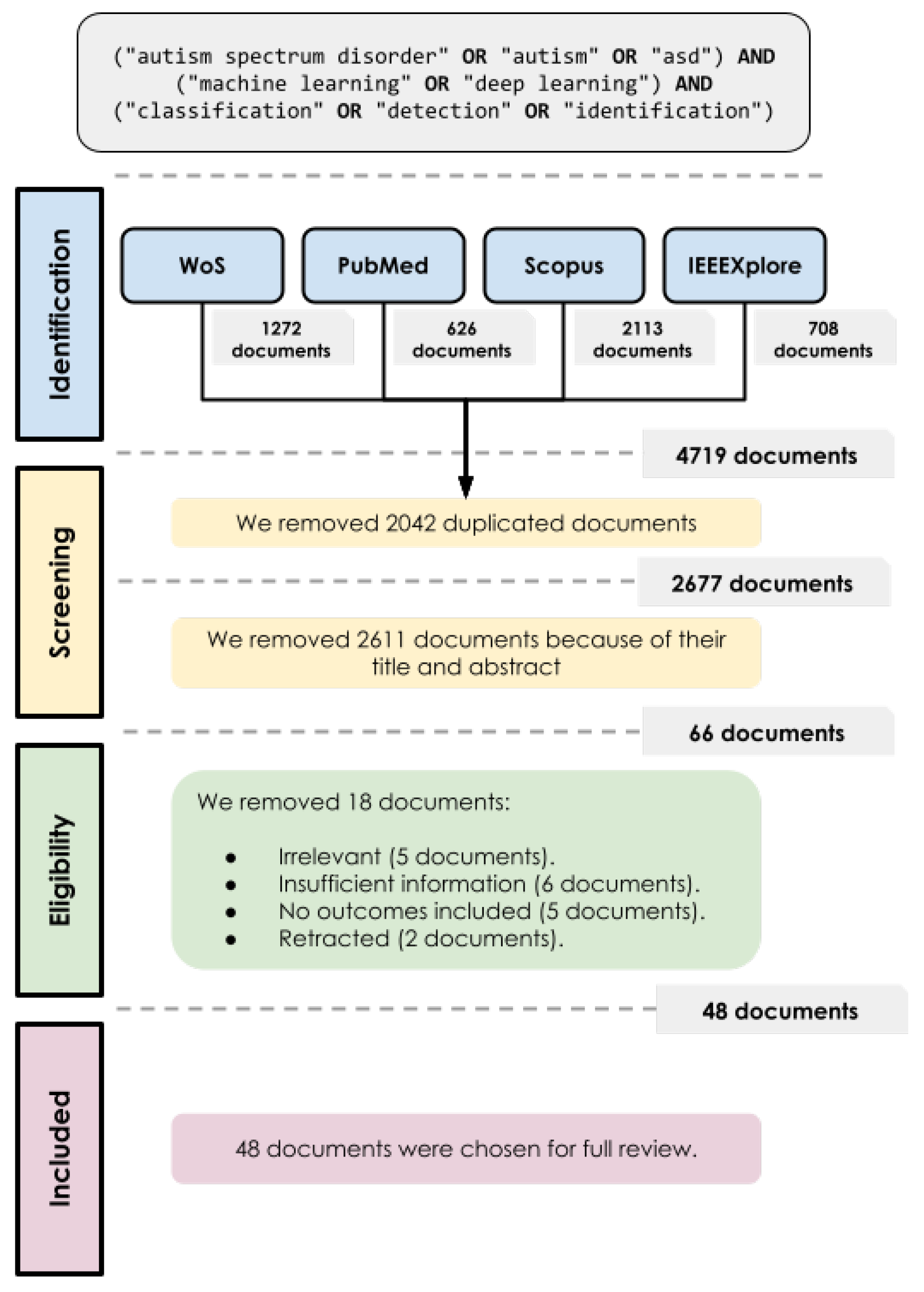
- ("autism spectrum disorder" OR "autism" OR "asd") AND
- ("machine learning" OR "deep learning") AND
- ("classification" OR "detection" OR "identification")
- (i)
- Documents written in English.
- (ii)
- Documents published between 1 January 2016 and 31 May 2024.
- (iii)
- Documents related to AI, ML- and DL-based detection or classification of ASD and aligned with our research questions and objectives.
Search Results
3. Contributions of Artificial Intelligence to ASD Detection
4. Related Work in the ML and DL Domain
4.1. Questionnaire-Based Diagnosis of ASD
4.2. Facial Image-Based Diagnosis of ASD
4.3. MRI-Based Diagnosis of ASD
4.4. Eye Tracking-Based Diagnosis of ASD
4.5. EEG-Based Diagnosis of ASD
4.6. Genetics-Based Diagnosis of ASD
5. Popular Datasets for ASD Detection or Classification
- MRI datasets. The ABIDE I and ABIDE II datasets are open-access and publicly available, consisting of resting state fMRI (r-fMRI) data samples or regional and total brain characteristics of the brain connectome. The ABIDE I dataset, launched in 2012, consists of a total of 1112 samples collected from over 17 various global sites, including 539 ASD and 573 typical control participants that are aged from 7 to 64 years. The ABIDE II launched in 2016, with contributions from 19 locations, provided a total of 1114 samples with enhanced phenotypical data, including 521 ASD people and 593 additional longitudinal samples from 38 people, who were participants aged 5 to 64 years. The major limitation of the ABIDE I dataset for ASD is the imbalanced distribution of gender (male and female). For instance, over 85% of participants are male, reporting a 4:1 male-to-female diagnosis ratio. This gender inequality makes it difficult for AI models to detect ASD accurately in females since girls may determine distinct brain patterns and behaviors. As a result, models instructed on commonly male data may not behave well in real clinical settings where gender differences are more balanced [135]. Additionally, the dataset is taken from specific high-income countries, resulting in biases for similar human races or regions lacking diversity. Further, the data samples taken belong to humans of specific age groups, which reflects a need first to increase the data samples as they are quite low and require targeting a larger age group to improve the effectiveness of these datasets. Lastly, the quality of data samples can differ based on the imaging technology used by the institute from which it is taken and collectively can affect the preprocessing, impacting the model’s performance upon training [38,136].
- Questionnaire datasets. The Autism Screening on Adults dataset, ASD children traits dataset, and Autism Screening data for toddlers datasets are all publicly available on Kaggle. All these datasets consist of ASD Questionnaire-based responses filled out by parents or caregivers of autistic individuals using the ASD Test application. The autism screening on the adult dataset consists of 21 attributes and a total of 704 participants in the age group of 17–64 years. The ASD children traits dataset consists of 19 attributes and 1054 instances where the age range of the participants is from 12 to 36 months. The Autism Screening data for toddlers dataset comprises 1985 instances and 28 attributes. The age range of participants consists of 1 to 18 years. These datasets have a few limitations; first, the datasets have been developed by compiling user responses. It is analyzed that few outliers exist within these datasets caused by typing errors or user mistakes while entering data, causing a lack of data integrity. The datasets are limited to detailed information as they consist of a few questions but do not include any attributes regarding medical ASD tests carried out by experts like MRI or EEG signals, which lowers the impact of ASD classification. Moreover, all these datasets consist of class imbalance in terms of data samples as these datasets consist of fewer samples of ASD patients and more instances of non-ASD individuals, making it less effective for ASD detection [137,138]
- The eye tracking dataset. The eye tracking dataset is an open-source resource publicly available in the Figshare repository. It was created to assist researchers in further research on ASD by sharing detailed records of gaze behavior in children. The dataset comprises 59 participants and is limited to children aged 3 to 12 years, including ASD and TD participants, collected from educational institutions in Hauts-de-France. The gender distribution of participants was 64% male and 36% female. Eye movements, such as fixations and saccades, pupil diameter, and point-of-gaze coordinates, have been recorded for each participant utilizing a screen-based SMI RED-M eye tracker at a sampling rate of 60 Hz. At the same time, this dataset provides valuable opportunities for ASD researchers to explore more research on ASD detection using it. However, limitations exist, such as small sample size, limited diversity, gender imbalance, and potential measurement errors [139,140].
- NDAR dataset. The National Database for Autism Research (NDAR) is a scalable and adaptable data informatics platform that facilitates research on ASD. Data from all layers of biological and behavioral structures, such as synthetics, genes, brain tissue, personality, and relationships with the environment and society, are supported. Different sorts of data are also supported by NDAR, including text, pictures, time series, and numerical values, as NDAR consists of multi-dimensional data types like behavioral data, genetic data, and neuroimaging data that may be in raw format. It adds more complexity to data analysis; therefore, extensive data preprocessing techniques are required to develop benchmark datasets requiring higher computational resources like GPU. Moreover, the datasets are limited to fewer samples and need more diversity, adding biases towards specific human races and age groups [141,142].
- SFARI dataset. The SFARI Autism Inpatient Collection dataset was released in 2013 and consists of behavioral and genetics-based samples belonging to ASD individuals with 527 instances. Some limitations are found in the SFARI dataset. First, the number of instances of this dataset is significantly low and requires more data samples. The genetic dataset is based on the socioeconomic and demographic factors of participants from specific countries with different diagnosis criteria for individuals with ASD, limiting overall diversity and generalizability. Moreover, the behavioral dataset consists of missing values as data is collected via parents and caregivers so human error can reduce data integrity [143,144,145].
- EEG datasets. The P300 speller KAU dataset is an open-source dataset by King AbdulAziz University KSA, and the dataset consists of two categories: one is the global dataset for autism disorder, and the global P300 speller dataset consists of EEG samples of individuals with ASD and people without neurological disorders. Ten boys, ages 9 to 16, who are not diagnosed with any neurological impairments make up the control group; eight boys, ages 10 to 16, represent the ASD group. The BCIAUT_P30 dataset was launched in 2020 and is freely available on Kaggle; comprising of EEG recordings developed for the Brain-Computer Interface (BCI) system based on the P300, it contains 105 individual recordings of data from 15 people diagnosed with ASD, collected throughout seven sessions. The main limitation of EEG datasets is the lack of data diversity and demographic imbalances [146] since they contain very few EEG recording samples, only from the male gender. Moreover, the EEG samples belong to a particular age group, causing bias based only on inclination to that age group. Lastly, the EEG samples are pretty challenging to extract. They are prone to making noise during recording due to interactions with other electromagnetic waves, adding distortion, which requires advanced preprocessing techniques to remove and enhance data quality [147,148,149]. Overall, these problems can reduce a model’s performance and generalization to real-world settings.
- Genetics datasets. The Autism WGS is a collection of genomic data where 32 ASD-affected families underwent whole-genome sequencing (WGS), revealing potentially dangerous genetic abnormalities in 31% of the families and 19% of the probands. These included new and recognized susceptible genes, such as CAPRIN1, VIP, SCN2A, and numerous others connected to disorders, including fragile X syndrome and epilepsy with de novo and hereditary mutations. Due to the rarity of certain phenotypic expressions, the dataset lacks comprehensive representation, limiting insights into specific factors contributing to ASD. Furthermore, the absence of fully developed tools for analyzing structural variants related to ASD hinders the dataset from achieving its full potential in research applications [150,151].
- Facial images dataset. The Autistic Children Facial Dataset is an open-source dataset publicly available on Kaggle, consisting of 2936 facial images of normal and ASD-diagnosed children. The facial images are taken from various human races around the world. The limitations of this dataset are that the images come from various sources, so the image quality differs a lot in size, and it consists of bad image quality and noise. The major limitation is that facial images are not the best medium to detect or classify ASD based on facial images; it can be interpreted that children labeled having ASD have very normal facial features, and the children labeled normal look like having ASD. It is not easy to achieve high accuracy by training CNN-based models due to quite a similarity among facial features. In addition, the number of samples is limited as well and requires to be increased for more effective and efficient results [56]. Lastly, this dataset lacks demographic diversity and presents racial facial feature disparity and gender imbalance, which decreases generalizability and model performance. To overcome these issues, some researchers suggest building and training race-specific models to eliminate bias from other race factors on the reliability and accuracy of the models and recommending balanced demographic representation within datasets to reduce the misclassification caused by facial anthropometric disparities or differences in facial structures in ASD detection using facial images [79].
6. Discussion
- Data quality. AI models’ accuracy and prediction ability are greatly influenced by the data quality used to train them. Ensuring good data quality through thoughtful gathering, preprocessing, cleaning, feature extraction, and validation is crucial for ASD research because identifying nuanced patterns and behaviors is crucial [56,124].
- Data availability. Large datasets are necessary for AI systems, especially DL models, to learn efficiently and generalize correctly. However, limited and diverse data are a common problem in ASD research, which might make AI models underperform [156].
- Interpretability. Understanding the fundamental mechanisms of DL algorithms can be difficult due to their proficiency in mapping complex, nonlinear functions. The interpretability of results is essential in the healthcare sector, as understanding the factors that impact consequences is as vital as generating accurate predictions. Interpretability enhances confidence and assists the prompt integration of these technologies into clinical procedures, improving decision-making and allowing medical practitioners to make educated choices based on algorithmic insights [156].
- Algorithm complexity. Comprehensive AI techniques typically demand a lot of computing power, necessitating the use of suitable hardware and expertise in model building and training. This complexity may be a challenge in clinical and research environments for ASD, where resources are often limited [159].
7. Conclusions
Supplementary Materials
Author Contributions
Funding
Institutional Review Board Statement
Informed Consent Statement
Data Availability Statement
Conflicts of Interest
References
- Mayo Clinic. Autism Spectrum Disorder. 2018. Available online: https://www.mayoclinic.org/diseases-conditions/autism-spectrum-disorder/symptoms-causes/syc-20352928 (accessed on 13 March 2025).
- Eslami, T.; Almuqhim, F.; Raiker, J.S.; Saeed, F. Machine learning methods for diagnosing autism spectrum disorder and attention-deficit/hyperactivity disorder using functional and structural MRI: A survey. Front. Neuroinform. 2021, 14, 575999. [Google Scholar] [CrossRef] [PubMed]
- National Institute of Mental Health. Autism Spectrum Disorder. 2024. Available online: https://www.nimh.nih.gov/health/topics/autism-spectrum-disorders-asd (accessed on 13 March 2025).
- Christensen, D.L.; Baio, J.; Braun, K.V.N. Prevalence and Characteristics of Autism Spectrum Disorder Among Children Aged 8 Years—Autism and Developmental Disabilities Monitoring Network, 11 Sites, United States, 2012. MMWR Surveill. Summ. 2018, 65, 1–3. Available online: https://www.cdc.gov/mmwr/volumes/65/ss/ss6513a1.htm?s_cid=ss6513a1_w (accessed on 13 March 2025). [CrossRef] [PubMed]
- World Health Organization. Autism. 2023. Available online: https://www.who.int/news-room/fact-sheets/detail/autism-spectrum-disorders (accessed on 13 March 2025).
- Talantseva, O.I.; Romanova, R.S.; Shurdova, E.M.; Dolgorukova, T.A.; Sologub, P.S.; Titova, O.S.; Kleeva, D.F.; Grigorenko, E.L. The global prevalence of autism spectrum disorder: A three-level meta-analysis. Front. Psychiatry 2023, 14, 1071181. [Google Scholar] [CrossRef] [PubMed]
- Salari, N.; Rasoulpoor, S.; Rasoulpoor, S.; Shohaimi, S.; Jafarpour, S.; Abdoli, N.; Khaledi-Paveh, B.; Mohammadi, M. The global prevalence of autism spectrum disorder: A comprehensive systematic review and meta-analysis. Ital. J. Pediatr. 2022, 48, 112. [Google Scholar] [CrossRef] [PubMed]
- Connnect N Care ABA Client. Breaking Boundaries: Autism Prevalence by Country Revealed. 2024. Available online: https://www.connectncareaba.com/autism-prevalence-by-country (accessed on 13 March 2025).
- Maenner, M.J. Prevalence and characteristics of autism spectrum disorder among children aged 8 years—Autism and Developmental Disabilities Monitoring Network, 11 sites, United States, 2020. MMWR Surveill. Summ. 2023, 72, 1–14. [Google Scholar] [CrossRef] [PubMed]
- Antonio, U.H.S. Data of Interest: Autism Rates by Country-Hoffman Program for Chemical Intolerance. 2023. Available online: https://tiltresearch.org/2023/06/15/data-of-interest-autism-rates-by-country/ (accessed on 19 August 2024).
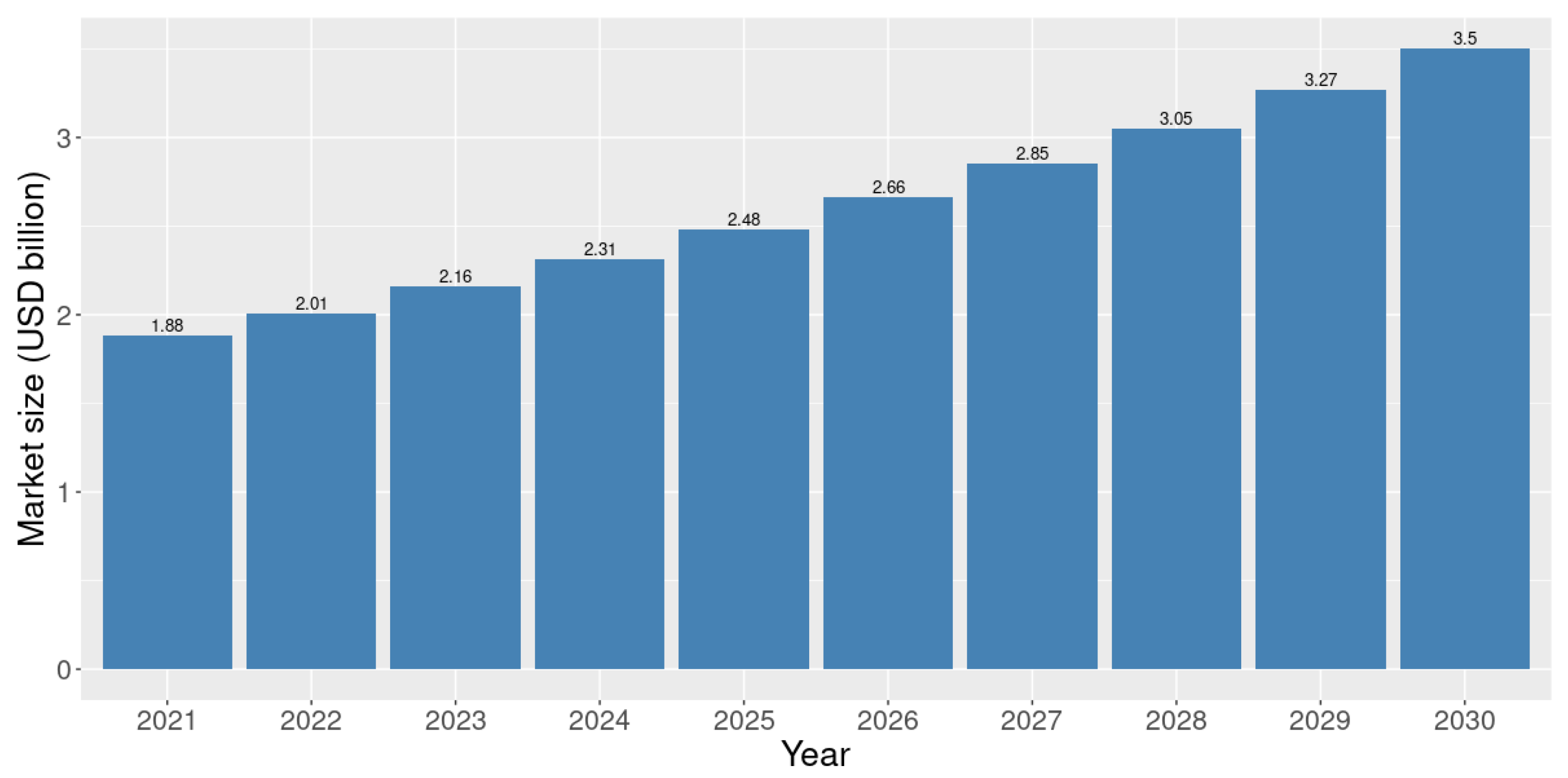
- BioSpace. Autism Spectrum Disorder Treatment Market Size, Growth, Report 2022–2030. 2022. Available online: https://www.biospace.com/article/autism-spectrum-disorder-treatment-market-size-growth-report-2022-2030 (accessed on 13 March 2025).
- Khodatars, M.; Shoeibi, A.; Sadeghi, D.; Ghaasemi, N.; Jafari, M.; Moridian, P.; Khadem, A.; Alizadehsani, R.; Zare, A.; Kong, Y.; et al. Deep learning for neuroimaging-based diagnosis and rehabilitation of autism spectrum disorder: A review. Comput. Biol. Med. 2021, 139, 104949. [Google Scholar] [CrossRef] [PubMed]
- De Giacomo, A.; Fombonne, E. Parental recognition of developmental abnormalities in autism. Eur. Child Adolesc. Psychiatry 1998, 7, 131–136. [Google Scholar] [CrossRef] [PubMed]
- Schopler, E.; Reichler, R.J.; DeVellis, R.F.; Daly, K. Toward objective classification of childhood autism: Childhood Autism Rating Scale (CARS). J. Autism Dev. Disord. 1980, 10, 91–103. [Google Scholar] [CrossRef] [PubMed]
- Skuse, D.; Warrington, R.; Bishop, D.; Chowdhury, U.; Lau, J.; Mandy, W.; Place, M. The developmental, dimensional and diagnostic interview (3di): A novel computerized assessment for autism spectrum disorders. J. Am. Acad. Child Adolesc. Psychiatry 2004, 43, 548–558. [Google Scholar] [CrossRef] [PubMed]
- Kohli, M.; Kar, A.K.; Sinha, S. The role of intelligent technologies in early detection of autism spectrum disorder (asd): A scoping review. IEEE Access 2022, 10, 104887–104913. [Google Scholar] [CrossRef]
- Gillberg, C.; Gillberg, C.; Råstam, M.; Wentz, E. The Asperger Syndrome (and high-functioning autism) Diagnostic Interview (ASDI): A preliminary study of a new structured clinical interview. Autism 2001, 5, 57–66. [Google Scholar] [CrossRef] [PubMed]
- Lecavalier, L. An evaluation of the Gilliam autism rating scale. J. Autism Dev. Disord. 2005, 35, 795–805. [Google Scholar] [CrossRef] [PubMed]
- De Belen, R.A.J.; Bednarz, T.; Sowmya, A.; Del Favero, D. Computer vision in autism spectrum disorder research: A systematic review of published studies from 2009 to 2019. Transl. Psychiatry 2020, 10, 333. [Google Scholar] [CrossRef] [PubMed]
- Noorbakhsh-Sabet, N.; Zand, R.; Zhang, Y.; Abedi, V. Artificial intelligence transforms the future of health care. Am. J. Med. 2019, 132, 795–801. [Google Scholar] [CrossRef] [PubMed]
- Niu, K.; Guo, J.; Pan, Y.; Gao, X.; Peng, X.; Li, N.; Li, H. Multichannel deep attention neural networks for the classification of autism spectrum disorder using neuroimaging and personal characteristic data. Complexity 2020, 2020, 1357853. [Google Scholar] [CrossRef]
- Hossain, M.D.; Kabir, M.A.; Anwar, A.; Islam, M.Z. Detecting autism spectrum disorder using machine learning techniques: An experimental analysis on toddler, child, adolescent and adult datasets. Health Inf. Sci. Syst. 2021, 9, 17. [Google Scholar] [CrossRef] [PubMed]
- Thabtah, F. An accessible and efficient autism screening method for behavioural data and predictive analyses. Health Inform. J. 2019, 25, 1739–1755. [Google Scholar] [CrossRef] [PubMed]
- Sapiro, G.; Hashemi, J.; Dawson, G. Computer vision and behavioral phenotyping: An autism case study. Curr. Opin. Biomed. Eng. 2019, 9, 14–20. [Google Scholar] [CrossRef] [PubMed]
- Hyde, K.K.; Novack, M.N.; LaHaye, N.; Parlett-Pelleriti, C.; Anden, R.; Dixon, D.R.; Linstead, E. Applications of supervised machine learning in autism spectrum disorder research: A review. Rev. J. Autism Dev. Disord. 2019, 6, 128–146. [Google Scholar] [CrossRef]
- Lamani, M.R.; Pernabas, J.B. A Thorough Review of Deep Learning in Autism Spectrum Disorder Detection: From Data to Diagnosis. Recent Adv. Comput. Sci. Commun. 2024, 17, 73–91. [Google Scholar] [CrossRef]
- Sarker, I.H. Machine Learning: Algorithms, Real-World Applications and Research Directions. Sn Comput. Sci. 2021, 2. [Google Scholar] [CrossRef] [PubMed]
- Tufail, S.; Riggs, H.; Tariq, M.; Sarwat, A.I. Advancements and challenges in machine learning: A comprehensive review of models, libraries, applications, and algorithms. Electronics 2023, 12, 1789. [Google Scholar] [CrossRef]
- Rahman, M.M.; Usman, O.L.; Muniyandi, R.C.; Sahran, S.; Mohamed, S.; Razak, R.A. A review of machine learning methods of feature selection and classification for autism spectrum disorder. Brain Sci. 2020, 10, 949. [Google Scholar] [CrossRef] [PubMed]
- Feng, M.; Xu, J. Detection of ASD children through deep-learning application of fMRI. Children 2023, 10, 1654. [Google Scholar] [CrossRef] [PubMed]
- Bezemer, M.; Blijd-Hoogewys, E.; Meek-Heekelaar, M. The Predictive Value of the AQ and the SRS-A in the Diagnosis of ASD in Adults in Clinical Practice. J. Autism Dev. Disord. 2021, 51, 2402–2415. [Google Scholar] [CrossRef] [PubMed]
- Amit, G.; Bilu, Y.; Sudry, T.; Tsadok, M.A.; Zimmerman, D.R.; Baruch, R.; Kasir, N.; Akiva, P.; Sadaka, Y. Early Prediction of Autistic Spectrum Disorder Using Developmental Surveillance Data. JAMA Netw. Open 2024, 7, e2351052. [Google Scholar] [CrossRef] [PubMed]
- Islam, M.M.; Karray, F.; Alhajj, R.; Zeng, J. A Review on Deep Learning Techniques for the Diagnosis of Novel Coronavirus (COVID-19). IEEE Access 2021, 9, 30551–30572. [Google Scholar] [CrossRef] [PubMed]
- de Barros, F.R.D.; da Silva, C.N.F.; de Castro Michelassi, G.; Brentani, H.; Nunes, F.L.; Machado-Lima, A. Computer aided diagnosis of neurodevelopmental disorders and genetic syndromes based on facial images—A systematic literature review. Heliyon 2023, 9, e20517. [Google Scholar] [CrossRef] [PubMed]
- Liu, X.; Hasan, M.R.; Gedeon, T.; Hossain, M.Z. MADE-for-ASD: A multi-atlas deep ensemble network for diagnosing Autism Spectrum Disorder. Comput. Biol. Med. 2024, 182, 109083. [Google Scholar] [CrossRef] [PubMed]
- Fan, Y.; Xiong, H.; Sun, G. DeepASDPred: A CNN-LSTM-based deep learning method for Autism spectrum disorders risk RNA identification. BMC Bioinform. 2023, 24, 261. [Google Scholar] [CrossRef] [PubMed]
- Simeoli, R.; Rega, A.; Cerasuolo, M.; Nappo, R.; Marocco, D. Using machine learning for motion analysis to early detect autism spectrum disorder: A systematic review. Rev. J. Autism Dev. Disord. 2024, 1–20. [Google Scholar] [CrossRef]
- Huda, S.; Khan, D.M.; Masroor, K.; Warda; Rashid, A.; Shabbir, M. Advancements in automated diagnosis of autism spectrum disorder through deep learning and resting-state functional mri biomarkers: A systematic review. Cogn. Neurodyn. 2024, 18, 3585–3601. [Google Scholar] [CrossRef] [PubMed]
- Dcouto, S.S.; Pradeepkandhasamy, J. Multimodal Deep Learning in Early Autism Detection—Recent Advances and Challenges. Eng. Proc. 2024, 59, 205. [Google Scholar] [CrossRef]
- Song, D.Y.; Kim, S.Y.; Bong, G.; Kim, J.M.; Yoo, H.J. The use of artificial intelligence in screening and diagnosis of autism spectrum disorder: A literature review. J. Korean Acad. Child Adolesc. Psychiatry 2019, 30, 145. [Google Scholar] [CrossRef] [PubMed]
- Minissi, M.E.; Chicchi Giglioli, I.A.; Mantovani, F.; Alcaniz Raya, M. Assessment of the autism spectrum disorder based on machine learning and social visual attention: A systematic review. J. Autism Dev. Disord. 2022, 52, 2187–2202. [Google Scholar] [CrossRef] [PubMed]
- Jeyarani, R.A.; Senthilkumar, R. Eye tracking biomarkers for autism spectrum disorder detection using machine learning and deep learning techniques. Res. Autism Spectr. Disord. 2023, 108, 102228. [Google Scholar] [CrossRef]
- Joudar, S.S.; Albahri, A.S.; Hamid, R.A. Triage and priority-based healthcare diagnosis using artificial intelligence for autism spectrum disorder and gene contribution: A systematic review. Comput. Biol. Med. 2022, 146, 105553. [Google Scholar] [CrossRef] [PubMed]
- Parlett-Pelleriti, C.M.; Stevens, E.; Dixon, D.; Linstead, E.J. Applications of unsupervised machine learning in autism spectrum disorder research: A review. Rev. J. Autism Dev. Disord. 2023, 10, 406–421. [Google Scholar] [CrossRef]
- Uddin, M.Z.; Shahriar, M.A.; Mahamood, M.N.; Alnajjar, F.; Pramanik, M.I.; Ahad, M.A.R. Deep learning with image-based autism spectrum disorder analysis: A systematic review. Eng. Appl. Artif. Intell. 2024, 127, 107185. [Google Scholar] [CrossRef]
- Page, M.J.; McKenzie, J.E.; Bossuyt, P.M.; Boutron, I.; Hoffmann, T.C.; Mulrow, C.D.; Shamseer, L.; Tetzlaff, J.M.; Akl, E.A.; Brennan, S.E.; et al. The PRISMA 2020 statement: An updated guideline for reporting systematic reviews. BMJ 2021, 372, n71. [Google Scholar] [CrossRef] [PubMed]
- Frank, R.A.; Bossuyt, P.M.; McInnes, M.D. Systematic reviews and meta-analyses of diagnostic test accuracy: The PRISMA-DTA statement. Radiology 2018, 289. [Google Scholar] [CrossRef] [PubMed]
- PRISMA. PRISMA 2020 Statement Paper. 2020. Available online: https://www.prisma-statement.org/prisma-2020-statement (accessed on 1 June 2025).
- Helmy, E.; Elnakib, A.; ElNakieb, Y.; Khudri, M.; Abdelrahim, M.; Yousaf, J.; Ghazal, M.; Contractor, S.; Barnes, G.N.; El-Baz, A. Role of artificial intelligence for autism diagnosis using DTI and fMRI: A survey. Biomedicines 2023, 11, 1858. [Google Scholar] [CrossRef] [PubMed]
- Abraham, A.; Milham, M.P.; Di Martino, A.; Craddock, R.C.; Samaras, D.; Thirion, B.; Varoquaux, G. Deriving reproducible biomarkers from multi-site resting-state data: An Autism-based example. NeuroImage 2017, 147, 736–745. [Google Scholar] [CrossRef] [PubMed]
- Saad, M.; Islam, S.M.R. Brain connectivity network analysis and classifications from diffusion tensor imaging. In Proceedings of the 2019 International Conference on Robotics, Electrical and Signal Processing Techniques (ICREST), Dhaka, Bangladesh, 10–12 January 2019; pp. 422–427. [Google Scholar] [CrossRef]
- Li, J.; Kong, X.; Sun, L.; Chen, X.; Ouyang, G.; Li, X.; Chen, S. Identification of autism spectrum disorder based on electroencephalography: A systematic review. Comput. Biol. Med. 2024, 108075. [Google Scholar] [CrossRef] [PubMed]
- Rogala, J.; Żygierewicz, J.; Malinowska, U.; Cygan, H.; Stawicka, E.; Kobus, A.; Vanrumste, B. Enhancing autism spectrum disorder classification in children through the integration of traditional statistics and classical machine learning techniques in EEG analysis. Sci. Rep. 2023, 13, 21748. [Google Scholar] [CrossRef] [PubMed]
- Lim, J.Z.; Mountstephens, J.; Teo, J. Eye-tracking feature extraction for biometric machine learning. Front. Neurorobot. 2022, 15, 796895. [Google Scholar] [CrossRef] [PubMed]
- Meng, F.; Li, F.; Wu, S.; Yang, T.; Xiao, Z.; Zhang, Y.; Liu, Z.; Lu, J.; Luo, X. Machine learning-based early diagnosis of autism according to eye movements of real and artificial faces scanning. Front. Neurosci. 2023, 17, 1170951. [Google Scholar] [CrossRef] [PubMed]
- Alam, M.S.; Rashid, M.M.; Roy, R.; Faizabadi, A.R.; Gupta, K.D.; Ahsan, M.M. Empirical study of autism spectrum disorder diagnosis using facial images by improved transfer learning approach. Bioengineering 2022, 9, 710. [Google Scholar] [CrossRef] [PubMed]
- Awaji, B.; Senan, E.M.; Olayah, F.; Alshari, E.A.; Alsulami, M.; Abosaq, H.A.; Alqahtani, J.; Janrao, P. Hybrid techniques of facial feature image analysis for early detection of autism spectrum disorder based on combined CNN features. Diagnostics 2023, 13, 2948. [Google Scholar] [CrossRef] [PubMed]
- Chaplot, N.; Pandey, D.; Kumar, Y.; Sisodia, P.S. A comprehensive analysis of artificial intelligence techniques for the prediction and prognosis of genetic disorders using various gene disorders. Arch. Comput. Methods Eng. 2023, 30, 3301–3323. [Google Scholar] [CrossRef]
- Nahas, L.D.; Datta, A.; Alsamman, A.M.; Adly, M.H.; Al-Dewik, N.; Sekaran, K.; Sasikumar, K.; Verma, K.; Doss, G.P.C.; Zayed, H. Genomic insights and advanced machine learning: Characterizing autism spectrum disorder biomarkers and genetic interactions. Metab. Brain Dis. 2024, 39, 29–42. [Google Scholar] [CrossRef] [PubMed]
- Uddin, M.; Wang, Y.; Woodbury-Smith, M. Artificial intelligence for precision medicine in neurodevelopmental disorders. NPJ Digit. Med. 2019, 2, 112. [Google Scholar] [CrossRef] [PubMed]
- Hyman, S.L.; Levy, S.E.; Myers, S.M.; Kuo, D.Z.; Apkon, S.; Davidson, L.F.; Ellerbeck, K.A.; Foster, J.E.; Noritz, G.H.; Leppert, M.O.; et al. Identification, evaluation, and management of children with autism spectrum disorder. Pediatrics 2020, 145, e20193447. [Google Scholar] [CrossRef] [PubMed]
- Frazier, T.W.; Klingemier, E.W.; Beukemann, M.; Speer, L.; Markowitz, L.; Parikh, S.; Wexberg, S.; Giuliano, K.; Schulte, E.; Delahunty, C.; et al. Development of an objective autism risk index using remote eye tracking. J. Am. Acad. Child Adolesc. Psychiatry 2016, 55, 301–309. [Google Scholar] [CrossRef] [PubMed]
- Shahamiri, S.R.; Thabtah, F. Autism AI: A new autism screening system based on artificial intelligence. Cogn. Comput. 2020, 12, 766–777. [Google Scholar] [CrossRef]
- Erkan, U.; Thanh, D.N. Autism spectrum disorder detection with machine learning methods. Curr. Psychiatry Res. Rev. 2019, 15, 297–308. [Google Scholar] [CrossRef]
- Akter, T.; Satu, M.S.; Khan, M.I.; Ali, M.H.; Uddin, S.; Lio, P.; Quinn, J.M.; Moni, M.A. Machine learning-based models for early stage detection of autism spectrum disorders. IEEE Access 2019, 7, 166509–166527. [Google Scholar] [CrossRef]
- Raj, S.; Masood, S. Analysis and detection of autism spectrum disorder using machine learning techniques. Procedia Comput. Sci. 2020, 167, 994–1004. [Google Scholar] [CrossRef]
- Vakadkar, K.; Purkayastha, D.; Krishnan, D. Detection of autism spectrum disorder in children using machine learning techniques. SN Comput. Sci. 2021, 2, 386. [Google Scholar] [CrossRef] [PubMed]
- Bala, M.; Ali, M.H.; Satu, M.S.; Hasan, K.F.; Moni, M.A. Efficient machine learning models for early stage detection of autism spectrum disorder. Algorithms 2022, 15, 166. [Google Scholar] [CrossRef]
- Kumar, C.J.; Das, P.R. The diagnosis of ASD using multiple machine learning techniques. Int. J. Dev. Disabil. 2022, 68, 973–983. [Google Scholar] [CrossRef] [PubMed]
- Farooq, M.S.; Tehseen, R.; Sabir, M.; Atal, Z. Detection of autism spectrum disorder (ASD) in children and adults using machine learning. Sci. Rep. 2023, 13, 9605. [Google Scholar] [CrossRef] [PubMed]
- Khudhur, D.D.; Khudhur, S.D. The classification of autism spectrum disorder by machine learning methods on multiple datasets for four age groups. Meas. Sens. 2023, 27, 100774. [Google Scholar] [CrossRef]
- Mukherjee, P.; Godse, M.; Chakraborty, B. Detection of Autism Spectrum Disorder (ASD) Symptoms using LSTM Model. WSEAS Trans. Biol. Biomed. 2024, 21, 40–54. [Google Scholar] [CrossRef]
- Rasul, R.A.; Saha, P.; Bala, D.; Karim, S.R.U.; Abdullah, M.I.; Saha, B. An evaluation of machine learning approaches for early diagnosis of autism spectrum disorder. Healthc. Anal. 2024, 5, 100293. [Google Scholar] [CrossRef]
- Priya, K.L.; Jyothirmai, I.; Akshaya, G.; Chowdary, C.S. Identification of Autism in Children Using Static Facial Features and Deep Neural Networks. Turk. J. Comput. Math. Educ. (TURCOMAT) 2023, 14, 704–715. [Google Scholar]
- Golden Steps ABA. Facial Features & Physical Characteristics of Autism. 2025. Available online: https://www.goldenstepsaba.com/resources/facial-features-autism (accessed on 19 August 2024).
- Therapy, G.C. Autism Facial Features|Golden Care Therapy. 2022. Available online: https://goldencaretherapy.com/autism-facial-features/, (accessed on 19 August 2024).
- Farhat, T.; Akram, S.; AlSagri, H.S.; Ali, Z.; Ahmad, A.; Jaffar, A. Facial Image-Based Autism Detection: A Comparative Study of Deep Neural Network Classifiers. Comput. Mater. Contin. 2024, 78, 105–126. [Google Scholar] [CrossRef]
- Liu, W.; Li, M.; Yi, L. Identifying children with autism spectrum disorder based on their face processing abnormality: A machine learning framework. Autism Res. 2016, 9, 888–898. [Google Scholar] [CrossRef] [PubMed]
- Lu, A.; Perkowski, M. Deep learning approach for screening autism spectrum disorder in children with facial images and analysis of ethnoracial factors in model development and application. Brain Sci. 2021, 11, 1446. [Google Scholar] [CrossRef] [PubMed]
- Mujeeb Rahman, K.; Subashini, M.M. Identification of autism in children using static facial features and deep neural networks. Brain Sci. 2022, 12, 94. [Google Scholar] [CrossRef] [PubMed]
- Gaddala, L.K.; Kodepogu, K.R.; Surekha, Y.; Tejaswi, M.; Ameesha, K.; Kollapalli, L.S.; Kotha, S.K.; Manjeti, V.B. Autism Spectrum Disorder Detection Using Facial Images and Deep Convolutional Neural Networks. Rev. D’Intelligence Artif. 2023, 37, 801–806. [Google Scholar] [CrossRef]
- Alkahtani, H.; Aldhyani, T.H.; Alzahrani, M.Y. Deep learning algorithms to identify autism spectrum disorder in children-based facial landmarks. Appl. Sci. 2023, 13, 4855. [Google Scholar] [CrossRef]
- Li, Y.; Huang, W.C.; Song, P.H. A face image classification method of autistic children based on the two-phase transfer learning. Front. Psychol. 2023, 14, 1226470. [Google Scholar] [CrossRef] [PubMed]
- Reddy, P. Diagnosis of Autism in Children Using Deep Learning Techniques by Analyzing Facial Features. Eng. Proc. 2024, 59, 198. [Google Scholar] [CrossRef]
- Peng, X.; Li, Y.; Murphey, Y.L.; Luo, J. Domain adaptation by stacked local constraint auto-encoder learning. IEEE Access 2019, 7, 108248–108260. [Google Scholar] [CrossRef]
- Maji, S.; Malik, J. Fast and Accurate Digit Classification; Tech. Rep. UCB/EECS-2009-159; EECS Department, University of California: Berkeley, CA, USA, 2009; Available online: https://www2.eecs.berkeley.edu/Pubs/TechRpts/2009/EECS-2009-159.pdf (accessed on 8 March 2025).
- He, K.; Zhang, X.; Ren, S.; Sun, J. Deep residual learning for image recognition. In Proceedings of the IEEE Conference on Computer Vision and Pattern Recognition, Las Vegas, NV, USA, 27–30 June 2016; pp. 770–778. [Google Scholar] [CrossRef]
- Wightman, R.; Touvron, H.; Jégou, H. Resnet strikes back: An improved training procedure in timm. arXiv 2021. [Google Scholar] [CrossRef]
- Simonyan, K.; Zisserman, A. Very deep convolutional networks for large-scale image recognition. arXiv 2014, arXiv:1409.1556. [Google Scholar] [CrossRef]
- Cherney, K. MRI vs. X-Ray: Pros, Cons, Costs & More. Available online: https://www.healthline.com/health/mri-vs-xray#vs-ct-scans (accessed on 19 August 2024).
- Dichter, G.S. Functional magnetic resonance imaging of autism spectrum disorders. Dialogues Clin. Neurosci. 2012, 14, 319–351. [Google Scholar] [CrossRef] [PubMed]
- Stigler, K.A.; McDonald, B.C.; Anand, A.; Saykin, A.J.; McDougle, C.J. Structural and functional magnetic resonance imaging of autism spectrum disorders. Brain Res. 2011, 1380, 146–161. [Google Scholar] [CrossRef] [PubMed]
- Mengi, M.; Malhotra, D. SSMDA: Semi-supervised multi-source domain adaptive autism prediction model using neuroimaging. Biomed. Signal Process. Control 2024, 95, 106337. [Google Scholar] [CrossRef]
- Liang, D.; Liang, S.; Xiaa, S.; Zhang, X.; Yind, Q. Diagnosis Classification of Autism in Ages 7-15 Years Based on Deep Learning. In Volume 385: Artificial Intelligence and Human-Computer Interaction; IOP: Bristol, UK, 2024. [Google Scholar] [CrossRef]
- Heinsfeld, A.S.; Franco, A.R.; Craddock, R.C.; Buchweitz, A.; Meneguzzi, F. Identification of autism spectrum disorder using deep learning and the ABIDE dataset. NeuroImage Clin. 2018, 17, 16–23. [Google Scholar] [CrossRef] [PubMed]
- Li, X.; Dvornek, N.C.; Zhuang, J.; Ventola, P.; Duncan, J.S. Brain biomarker interpretation in ASD using deep learning and fMRI. In Proceedings of the Medical Image Computing and Computer Assisted Intervention–MICCAI 2018: 21st International Conference, Granada, Spain, 16–20 September 2018; pp. 206–214. [Google Scholar] [CrossRef]
- Mostafa, S.; Tang, L.; Wu, F.X. Diagnosis of autism spectrum disorder based on eigenvalues of brain networks. IEEE Access 2019, 7, 128474–128486. [Google Scholar] [CrossRef]
- Eslami, T.; Saeed, F. Auto-ASD-network: A technique based on deep learning and support vector machines for diagnosing autism spectrum disorder using fMRI data. In Proceedings of the 10th ACM International Conference on Bioinformatics, Computational Biology and Health Informatics, Niagara Falls, NY, USA, 7–10 September 2019; pp. 646–651. [Google Scholar] [CrossRef]
- Sharif, H.; Khan, R.A. A novel machine learning based framework for detection of autism spectrum disorder (ASD). Appl. Artif. Intell. 2022, 36, 2004655. [Google Scholar] [CrossRef]
- Othmani, A.; Bizet, T.; Pellerin, T.; Hamdi, B.; Bock, M.A.; Dev, S. Significant cc400 functional brain parcellations based lenet5 convolutional neural network for autism spectrum disorder detection. In Proceedings of the International Conference on Recent Trends in Image Processing and Pattern Recognition, Kingsville, TX, USA, 1–2 December 2022; pp. 34–45. [Google Scholar] [CrossRef]
- Zhang, J.; Feng, F.; Han, T.; Gong, X.; Duan, F. Detection of autism spectrum disorder using fMRI functional connectivity with feature selection and deep learning. Cogn. Comput. 2023, 15, 1106–1117. [Google Scholar] [CrossRef]
- Park, K.W.; Cho, S.B. A residual graph convolutional network with spatio-temporal features for autism classification from fMRI brain images. Appl. Soft Comput. 2023, 142, 110363. [Google Scholar] [CrossRef]
- Bahathiq, R.A.; Banjar, H.; Jarraya, S.K.; Bamaga, A.K.; Almoallim, R. Efficient diagnosis of autism spectrum disorder using optimized machine learning models based on structural MRI. Appl. Sci. 2024, 14, 473. [Google Scholar] [CrossRef]
- Li, G.; Ji, Z.; Sun, Q. Deep Multi-Instance Conv-Transformer Frameworks for Landmark-Based Brain MRI Classification. Electronics 2024, 13, 980. [Google Scholar] [CrossRef]
- Wang, C.; Xiao, Z.; Xu, Y.; Zhang, Q.; Chen, J. A novel approach for ASD recognition based on graph attention networks. Front. Comput. Neurosci. 2024, 18, 1388083. [Google Scholar] [CrossRef] [PubMed]
- Wang, W.; Xiao, L.; Qu, G.; Calhoun, V.D.; Wang, Y.P.; Sun, X. Multiview hyperedge-aware hypergraph embedding learning for multisite, multiatlas fMRI based functional connectivity network analysis. Med. Image Anal. 2024, 94, 103144. [Google Scholar] [CrossRef] [PubMed]
- Falck-Ytter, T.; Bölte, S.; Gredebäck, G. Eye tracking in early autism research. J. Neurodev. Disord. 2013, 5, 1–13. [Google Scholar] [CrossRef] [PubMed]
- Zhou, W.; Yang, M.; Tang, J.; Wang, J.; Hu, B. Gaze Patterns in Children With Autism Spectrum Disorder to Emotional Faces: Scanpath and Similarity. IEEE Trans. Neural Syst. Rehabil. Eng. 2024, 32, 865–874. [Google Scholar] [CrossRef] [PubMed]
- Alsaidi, M.; Obeid, N.; Al-Madi, N.; Hiary, H.; Aljarah, I. A Convolutional Deep Neural Network Approach to Predict Autism Spectrum Disorder Based on Eye-Tracking Scan Paths. Information 2024, 15, 133. [Google Scholar] [CrossRef]
- Fabiano, D.; Canavan, S.; Agazzi, H.; Hinduja, S.; Goldgof, D. Gaze-based classification of autism spectrum disorder. Pattern Recognit. Lett. 2020, 135, 204–212. [Google Scholar] [CrossRef]
- Cilia, F.; Carette, R.; Elbattah, M.; Dequen, G.; Guérin, J.L.; Bosche, J.; Vandromme, L.; Le Driant, B. Computer-aided screening of autism spectrum disorder: Eye-tracking study using data visualization and deep learning. JMIR Hum. Factors 2021, 8, e27706. [Google Scholar] [CrossRef] [PubMed]
- Ahmed, I.A.; Senan, E.M.; Rassem, T.H.; Ali, M.A.; Shatnawi, H.S.A.; Alwazer, S.M.; Alshahrani, M. Eye tracking-based diagnosis and early detection of autism spectrum disorder using machine learning and deep learning techniques. Electronics 2022, 11, 530. [Google Scholar] [CrossRef]
- Kanhirakadavath, M.R.; Chandran, M.S.M. Investigation of eye-tracking scan path as a biomarker for autism screening using machine learning algorithms. Diagnostics 2022, 12, 518. [Google Scholar] [CrossRef] [PubMed]
- Ahmed, Z.A.; Albalawi, E.; Aldhyani, T.H.; Jadhav, M.E.; Janrao, P.; Obeidat, M.R.M. Applying eye tracking with deep learning techniques for early-stage detection of autism spectrum disorders. Data 2023, 8, 168. [Google Scholar] [CrossRef]
- Thanarajan, T.; Alotaibi, Y.; Rajendran, S.; Nagappan, K. Eye-Tracking Based Autism Spectrum Disorder Diagnosis Using Chaotic Butterfly Optimization with Deep Learning Model. Comput. Mater. Contin. 2023, 76, 1995–2013. [Google Scholar] [CrossRef]
- Milovanovic, M.; Grujicic, R. Electroencephalography in assessment of autism spectrum disorders: A review. Front. Psychiatry 2021, 12, 686021. [Google Scholar] [CrossRef] [PubMed]
- Melinda, M.; Arnia, F.; Yafi, A.; Andryani, N.A.C.; Enriko, I.K.A. Design and Implementation of Mobile Application for CNN-Based EEG Identification of Autism Spectrum Disorder. Int. J. Adv. Sci. Eng. Inf. Technol. 2024, 14, 57. [Google Scholar] [CrossRef]
- Xu, Y.; Yu, Z.; Li, Y.; Liu, Y.; Li, Y.; Wang, Y. Autism spectrum disorder diagnosis with EEG signals using time series maps of brain functional connectivity and a combined CNN–LSTM model. Comput. Methods Prog. Biomed. 2024, 250, 108196. [Google Scholar] [CrossRef] [PubMed]
- Billeci, L.; Sicca, F.; Maharatna, K.; Apicella, F.; Narzisi, A.; Campatelli, G.; Calderoni, S.; Pioggia, G.; Muratori, F. On the application of quantitative EEG for characterizing autistic brain: A systematic review. Front. Hum. Neurosci. 2013, 7, 442. [Google Scholar] [CrossRef] [PubMed]
- Radhakrishnan, M.; Ramamurthy, K.; Choudhury, K.K.; Won, D.; Manoharan, T.A. Performance analysis of deep learning models for detection of autism spectrum disorder from EEG signals. Trait. Du Signal 2021, 38, 853–863. [Google Scholar] [CrossRef]
- Alhassan, S.; Soudani, A.; Almusallam, M. Energy-efficient EEG-based scheme for autism spectrum disorder detection using wearable sensors. Sensors 2023, 23, 2228. [Google Scholar] [CrossRef] [PubMed]
- Menaka, R.; Karthik, R.; Saranya, S.; Niranjan, M.; Kabilan, S. An improved AlexNet model and cepstral coefficient-based classification of autism using EEG. Clin. EEG Neurosci. 2024, 55, 43–51. [Google Scholar] [CrossRef] [PubMed]
- Al-Qazzaz, N.K.; Aldoori, A.A.; Buniya, A.; Ali, S.H.B.M.; Ahmad, S.A. Transfer Learning and Hybrid Deep Convolutional Neural Networks Models for Autism Spectrum Disorder Classification from EEG Signals. IEEE Access 2024, 12, 64510–64530. [Google Scholar] [CrossRef]
- Ullah, M.Z.; Yu, D. Grid-tuned ensemble models for 2D spectrogram-based autism classification. Biomed. Signal Process. Control 2024, 93, 106151. [Google Scholar] [CrossRef]
- Vorstman, J.A.; Parr, J.R.; Moreno-De-Luca, D.; Anney, R.J.; Nurnberger Jr, J.I.; Hallmayer, J.F. Autism genetics: Opportunities and challenges for clinical translation. Nat. Rev. Genet. 2017, 18, 362–376. [Google Scholar] [CrossRef] [PubMed]
- Geschwind, D.H. Genetics of autism spectrum disorders. Trends Cogn. Sci. 2011, 15, 409–416. [Google Scholar] [CrossRef] [PubMed]
- Rylaarsdam, L.; Guemez-Gamboa, A. Genetic causes and modifiers of autism spectrum disorder. Front. Cell. Neurosci. 2019, 13, 385. [Google Scholar] [CrossRef] [PubMed]
- Saleem, S.; Habib, S.H. Implications of Genetic Factors and Modifiers in Autism Spectrum Disorders: A Systematic Review. Rev. J. Autism Dev. Disord. 2024, 11, 172–183. [Google Scholar] [CrossRef]
- Abdullah, A.A.; Rijal, S.; Dash, S.R. Evaluation on machine learning algorithms for classification of autism spectrum disorder (ASD). J. Phys. Conf. Ser. 2019, 1372, 012052. [Google Scholar] [CrossRef]
- Gök, M. A novel machine learning model to predict autism spectrum disorders risk gene. Neural Comput. Appl. 2019, 31, 6711–6717. [Google Scholar] [CrossRef]
- Wang, M.; Doenyas, C.; Wan, J.; Zeng, S.; Cai, C.; Zhou, J.; Liu, Y.; Yin, Z.; Zhou, W. Virulence factor-related gut microbiota genes and immunoglobulin A levels as novel markers for machine learning-based classification of autism spectrum disorder. Comput. Struct. Biotechnol. J. 2021, 19, 545–554. [Google Scholar] [CrossRef] [PubMed]
- Lin, Y.; Yerukala Sathipati, S.; Ho, S.Y. Predicting the risk genes of autism spectrum disorders. Front. Genet. 2021, 12, 665469. [Google Scholar] [CrossRef] [PubMed]
- Alsuliman, M.; Al-Baity, H.H. Efficient diagnosis of autism with optimized machine learning models: An experimental analysis on genetic and personal characteristic datasets. Appl. Sci. 2022, 12, 3812. [Google Scholar] [CrossRef]
- Suratanee, A.; Plaimas, K. Gene association classification for autism spectrum disorder: Leveraging gene embedding and differential gene expression profiles to identify disease-related genes. Appl. Sci. 2023, 13, 8980. [Google Scholar] [CrossRef]
- Di Martino, A.; Yan, C.G.; Li, Q.; Denio, E.; Castellanos, F.X.; Alaerts, K.; Anderson, J.S.; Assaf, M.; Bookheimer, S.Y.; Dapretto, M.; et al. The autism brain imaging data exchange: Towards a large-scale evaluation of the intrinsic brain architecture in autism. Mol. Psychiatry 2014, 19, 659–667. [Google Scholar] [CrossRef] [PubMed]
- Liu, M.; Li, B.; Hu, D. Autism spectrum disorder studies using fMRI data and machine learning: A review. Front. Neurosci. 2021, 15, 697870. [Google Scholar] [CrossRef] [PubMed]
- Priyadarshini, I. Autism screening in toddlers and adults using deep learning and fair AI techniques. Future Internet 2023, 15, 292. [Google Scholar] [CrossRef]
- Francese, R.; Yang, X. Supporting autism spectrum disorder screening and intervention with machine learning and wearables: A systematic literature review. Complex Intell. Syst. 2022, 8, 3659–3674. [Google Scholar] [CrossRef]
- Cilia, F.; Carette, R.; Elbattah, M.; Guérin, J.L.; Dequen, G. Eye-tracking dataset to support the research on autism spectrum disorder. In Proceedings of the 1st Workshop on Scarce Data in Artificial Intelligence for Healthcare—SDAIH; SciTePress: Setúbal, Portugal, 2022. [Google Scholar] [CrossRef]
- Guillon, Q.; Hadjikhani, N.; Baduel, S.; Rogé, B. Visual social attention in autism spectrum disorder: Insights from eye tracking studies. Neurosci. Biobehav. Rev. 2014, 42, 279–297. [Google Scholar] [CrossRef] [PubMed]
- Torgerson, C.M.; Quinn, C.; Dinov, I.; Liu, Z.; Petrosyan, P.; Pelphrey, K.; Haselgrove, C.; Kennedy, D.N.; Toga, A.W.; Van Horn, J.D. Interacting with the National Database for Autism Research (NDAR) via the LONI Pipeline workflow environment. Brain Imaging Behav. 2015, 9, 89–103. [Google Scholar] [CrossRef] [PubMed][Green Version]
- Hall, D.; Huerta, M.F.; McAuliffe, M.J.; Farber, G.K. Sharing heterogeneous data: The national database for autism research. Neuroinformatics 2012, 10, 331–339. [Google Scholar] [CrossRef] [PubMed]
- Weiner, D.J.; Ling, E.; Erdin, S.; Tai, D.J.; Yadav, R.; Grove, J.; Fu, J.M.; Nadig, A.; Carey, C.E.; Baya, N.; et al. Statistical and functional convergence of common and rare genetic influences on autism at chromosome 16p. Nat. Genet. 2022, 54, 1630–1639. [Google Scholar] [CrossRef] [PubMed]
- Berto, S.; Treacher, A.H.; Caglayan, E.; Luo, D.; Haney, J.R.; Gandal, M.J.; Geschwind, D.H.; Montillo, A.A.; Konopka, G. Association between resting-state functional brain connectivity and gene expression is altered in autism spectrum disorder. Nat. Commun. 2022, 13, 3328. [Google Scholar] [CrossRef] [PubMed]
- Siegel, M.; Smith, K.A.; Mazefsky, C.; Gabriels, R.L.; Erickson, C.; Kaplan, D.; Morrow, E.M.; Wink, L.; Santangelo, S.L. The autism inpatient collection: Methods and preliminary sample description. Mol. Autism 2015, 6, 61. [Google Scholar] [CrossRef] [PubMed]
- Roy, Y.; Banville, H.; Albuquerque, I.; Gramfort, A.; Falk, T.H.; Faubert, J. Deep learning-based electroencephalography analysis: A systematic review. J. Neural Eng. 2019, 16, 051001. [Google Scholar] [CrossRef] [PubMed]
- Ramirez-Quintana, J.A.; Madrid-Herrera, L.; Chacon-Murguia, M.I.; Corral-Martínez, L.F. Brain-Computer Interface System Based on P300 Processing with Convolutional Neural Network, Novel Speller, and Low Number of Electrodes. Cogn. Comput. 2020, 13, 108–124. [Google Scholar] [CrossRef]
- Simões, M.; Borra, D.; Santamaría-Vázquez, E.; Bittencourt-Villalpando, M.; Krzemiński, D.; Miladinović, A.; Schmid, T.; Zhao, H.; Amaral, C.P.; Direito, B.; et al. BCIAUT-P300: A Multi-Session and Multi-Subject Benchmark Dataset on Autism for P300-Based Brain-Computer-Interfaces. Front. Neurosci. 2020, 14, 568104. [Google Scholar] [CrossRef] [PubMed]
- Peketi, S.; Dhok, S.B. Machine Learning Enabled P300 Classifier for Autism Spectrum Disorder Using Adaptive Signal Decomposition. Brain Sci. 2023, 13, 315. [Google Scholar] [CrossRef] [PubMed]
- Zhang, Y.; Liu, X.; Guo, R.; Xu, W.; Guo, Q.; Hao, C.; Ni, X.; Li, W. Biological implications of genetic variations in autism spectrum disorders from genomics studies. Biosci. Rep. 2021, 41, BSR20210593. [Google Scholar] [CrossRef] [PubMed]
- Trost, B.; Thiruvahindrapuram, B.; Chan, A.J.S.; Engchuan, W.; Higginbotham, E.J.; Howe, J.L.; Loureiro, L.; Reuter, M.S.; Roshandel, D.; Whitney, J.; et al. Genomic architecture of autism spectrum disorder from comprehensive whole-genome sequence annotation. medRxiv 2022. [Google Scholar] [CrossRef]
- Baio, J. Prevalence of autism spectrum disorder among children aged 8 years—Autism and developmental disabilities monitoring network, 11 sites, United States, 2014. MMWR. Surveill. Summ. 2018, 67, 1–23. [Google Scholar] [CrossRef] [PubMed]
- Wang, J.; Perez, L. The effectiveness of data augmentation in image classification using deep learning. Convolutional Neural Netw. Vis. Recognit. 2017, 11, 1–8. [Google Scholar] [CrossRef]
- Frid-Adar, M.; Diamant, I.; Klang, E.; Amitai, M.; Goldberger, J.; Greenspan, H. GAN-based synthetic medical image augmentation for increased CNN performance in liver lesion classification. Neurocomputing 2018, 321, 321–331. [Google Scholar] [CrossRef]
- Bougeard, C.; Picarel-Blanchot, F.; Schmid, R.; Campbell, R.; Buitelaar, J. Prevalence of autism spectrum disorder and co-morbidities in children and adolescents: A systematic literature review. Front. Psychiatry 2021, 12, 744709. [Google Scholar] [CrossRef] [PubMed]
- Valliani, A.A.A.; Ranti, D.; Oermann, E.K. Deep learning and neurology: A systematic review. Neurol. Ther. 2019, 8, 351–365. [Google Scholar] [CrossRef] [PubMed]
- MacIntyre, M.R.; Cockerill, R.G.; Mirza, O.F.; Appel, J.M. Ethical considerations for the use of artificial intelligence in medical decision-making capacity assessments. Psychiatry Res. 2023, 328, 115466. [Google Scholar] [CrossRef] [PubMed]
- Rehan, H. AI-Driven Cloud Security: The Future of Safeguarding Sensitive Data in the Digital Age. J. Artif. Intell. Gen. Sci. (JAIGS) 2024, 1, 132–151. [Google Scholar] [CrossRef]
- Hu, X.; Chu, L.; Pei, J.; Liu, W.; Bian, J. Model complexity of deep learning: A survey. Knowl. Inf. Syst. 2021, 63, 2585–2619. [Google Scholar] [CrossRef]



| Citation | Dataset | Technique | Reported Metrics | Limitations |
|---|---|---|---|---|
| [64] | Autism Screening Adult, Autistic Spectrum Disorder Screening Data for Children, Autistic (public), Spectrum Disorder Screening Data for Adolescence Data Set | kNN, SVM, and RF | Accuracy: 100.00% Sensitivity: 100.00% F-Score: 100.00% AUC: 100.00% | Limited feature exploration, generalizability concerns, and demographic constraints. |
| [65] | ASD Dataset of toddler, child, adolescent, adult and ASDTest App: Public | Adaboost, FDA, C5.0, Glmboost, LDA, MDA, PDA, SVM and CART | Accuracy: 98.36% AUROC: 100.00% | Model generalization, and feature interpretation. |
| [66] | ASD dataset for Children, Adult and Adolescent, Attributes based dataset | LR, SVM, NB, kNN, ANN, CNN | Accuracy: 99.53% Sensitivity: 99.30% Specificity: 100.00% | Small dataset, feature interpretation, class imbalance, and preprocessing limitations. |
| [22] | ASD Dataset, Autism detection in adults dataset (public) | ANN, SVM, Multi-Layer Perceptron (MLP), CNN, RF, and LR | Accuracy: 100.00% Recall: 100.00% | Age and race bias, lack of dataset validation, and restricted generalization. |
| [67] | Autism Screening dataset for toddlers (public) | SVM, RF, NB, LR, and kNN | Accuracy: 97.15% F1-Score: 98.00% | Generalizability concerns. |
| [68] | ASD dataset toddlers, children, youths, and adults | NB, Baggage Classifier, Random Tree, SVM, kNN, Classification and Regression Tree (CART), DT, k-Star (kS) | Accuracy: 99.61% Kappa Stat.: 99.21% F1-Score: 99.60% AUROC: 99.60% | Data source bias, limited dataset diversity, lack of model comprehensibility, and Restricted clinical applicability. |
| [69] | Autistic Spectrum Disorder Screening Data for adults | ANN, SVM, DT, RF, LR | Accuracy: 99.40% | Restricted model variety, underutilized ML models, and potential for model expansion. |
| [70] | Autism Screening dataset for toddlers, Autism screening on adults dataset, Autism screening dataset, ASD dataset (public) | FL with SVM and LR | Accuracy: 99.00% Precision: 97.00% Recall: 58.00% F1-Score: 73.00% | Insufficient data instances, risk of misclassification, diagnostic complexity, and limited real world validation. |
| [71] | ASD datasets for children, adult, teenagers, and adolescent, Questionnaire based datasets: Public | DT, kNN, LR, NB, RF, SVM | Accuracy: 100.00% Precision: 100.00% Recall: 100.00% F1-Score: 100.00% | Class imbalance, no sampling techniques, and lack of feature extraction. |
| [72] | Self-collected ASD dataset based on sentiments: Private | LSTM | Accuracy: 97.00% Precision: 97.00% Recall: 97.00% F1-Score: 97.00% | Unspecified dataset size, missing feature interpretation, and real time detection. |
| [73] | ASD Children and Adult dataset, questionnaire-based instances: Public | NB, kNN, LR, SVM, DT, ANN, RF, BIRCH, XG Boost | Accuracy: 94.28% Precision: 89.90% Recall: 92.00% F1-score: 91.19% Specificity: 95.05% Kappa: 86.95% AUC: 98.91% | Small size of data, lack of augmentation, and diversity constraints. |
| Citation | Dataset | Technique | Reported Metrics | Limitations |
|---|---|---|---|---|
| [78] | Self-collected dataset of Chinese children with ASD (private) | k-means and SVM | Accuracy: 88.51% Sensitivity: 93.10% Specificity: 86.21% AUC: 89.93% | Limited data sample, algorithmic limitations, no proper data augmentation and lack of comparative analysis. |
| [79] | East Asia ASD Children Facial Image Dataset, ASD Facial Images Kaggle Dataset | VGG16 | Accuracy: 95.00% F1-Score: 95.00% | Small data size, no data augmentation, and unjustified accuracy. |
| [80] | Autistic children dataset, facial images of autism vs normal children: Public | Pre-trained MobileNet, Xception, EfficientNetB0, EfficientNetB1, EfficientNetB2, and DNN | Sensitivity: 88.46% Specificity: 91.66% NPV: 88.00% PPV: 92.00% AUC: 96.63% | Inappropriate train/test split, unjustified accuracy, and missing data preprocessing. |
| [82] | Autistic children dataset, Facial Images of ASD and Non-ASD Children | MobileNetV2, Hybrid VGG19, LR, Linear SVC, RF, DT, Gradient Boosting, MLP, and KNN | Accuracy: 92.00% Precision: 90.40% Recall: 92.00% F1-Score: 92.00% | No data augmentation, missing feature interpretation, and improper train/test split. |
| [83] | Autism Image data, Facial Images of ASD and Non-ASD Children: Public | MobileNetV2, MobileNetV3, Hybrid Integrated Classifier | Accuracy: 90.50% Sensitivity: 92.30% Specificity: 88.60% G_Mean: 90.40% AUC: 96.40% | No data augmentation, and lack of dataset comparison |
| [81] | Autistic children dataset, 2D facial images of ASD and Non-ASD Children | VGG16, VGG19 | Accuracy: 84.00% | Small data size, no data augmentation, and unjustified accuracy. |
| [84] | Autistic children dataset, 2D facial images of ASD and Non-ASD Children | VGG16, VGG19 and, EfficientnetB0 | Accuracy: 88.30% AUC: 95.44% | Missing confusion matrix, and class-wise accuracy unclear. |
| Citation | Dataset | Technique | Reported Metrics | Limitations |
|---|---|---|---|---|
| [96] | ABIDE dataset, fMRI images | DNN | Accuracy: 87.40% | Lack of practical context, small sample size, and limited generalizability. |
| [95] | ABIDE dataset, rs-fMRI images: Public | Transfer learning autoencoder | Accuracy: 70.00% Sensitivity: 74.00% Specificity: 63.00% | Limited sample size, limited accuracy, lack of augmentation, and insufficient preprocessing. |
| [98] | ABIDE dataset, MRI images: Public | DL with SVM, MLP, ATM and Auto ASD encoder method | Accuracy: 80.00% | Low sample size, missing data states, absent hyperparameter tuning, and incomplete implementation details. |
| [97] | ABIDE-1 Dataset, rs-fMRI Images of ASD and non-ASD patients: Public | kNN, SVM, LR, ANN, LDA | Accuracy: 77.70% AUC: 83.10% | Small data samples, lack of augmentation, feature insufficiency, and accuracy constraints. |
| [99] | ABIDE 1, s-MRI Images (public) | VGG16, SVM, kNN, MLP, Linear Discriminant Analysis | Accuracy: 65.00% | Data dependency, integration challenges, and dataset diversity. |
| [100] | ABIDE, rs-fMRI Images of ASD and non-ASD patients: Public | LeNet-5, VGG16, ResNet-50 | Accuracy: 95.00% | No data augmentation comparison, missing evaluation metrics, and limited performance analysis. |
| [102] | ABIDE dataset, 4D rs-fMRI Images of ASD and non-ASD patients: Private | Graph DNN | Accuracy: 97.66% Precision: 98.00% Recall: 98.00% F1-Score: 98.00% | Limited data size, no data augmentation, and insufficient validation data. |
| [101] | ABIDE-1 dataset, fMRI images: Private | Autoencoder | Accuracy: 70.90% Sensitivity: 70.70% Specificity: 75.50% | Limited dataset size, missing data augmentation, lack of model comparison, and incomplete preprocessing. |
| [103] | ABIDE I, ABIDE II, KAU dataset, rs-fMRI Images of ASD and non-ASD individuals: Public | SVM, NB, DT, ANN, XG Boost, CatBoost, MLP | Accuracy: 62.70% Sensitivity: 61.70% Specificity: 60.14% | Limited data, lack of augmentation, and accuracy constraints. |
| [104] | ABIDE dataset and Alzheimer’s Disease dataset, MRI Images of ASD, and non-ASD, Images of AD and Non-AD individuals: Public | Multi-instance Conv-Transformer (LD-MILCT) | Accuracy: 70.00% Sensitivity: 50.00%, Specificity: 69.00%, F1-Score: 33.00% | Small dataset size, and limited task generalization. |
| [105] | ABIDE dataset, rs-fMRI Images of ASD and non-ASD patients | GNN | Accuracy: 74.00% Sensitivity: 69.00% Specificity: 74.00% | Limited dataset size, limited data preprocessing, and low accuracy. |
| [106] | ABIDE dataset, rs-fMRI Images of ASD and non-ASD patients | Multiview hyperedge-aware hypergraph, convolutional network (HGCN), GNN | Accuracy: 78.54% Sensitivity: 74.40% Precision: 82.00% F1-Score: 77.00% AUC: 87.00% | Imbalance dataset, overlooked demographic variables, and ignored temporal dynamics. |
| Citation | Dataset | Technique | Reported Metrics | Limitations |
|---|---|---|---|---|
| [110] | Eye Tracking Subject-Experiment (ETS-E) dataset, Public | RF, C4.5 DT, PART, and feedforward neural network (FFNN) | Accuracy: 93.45% | Limited data, restricted generalizability, and handcrafted features. |
| [111] | Self-collected data from 59 children: Private | CNN | Accuracy: 71.00% AUC: 90.00% | Limited sample size, unsatisfactory accuracy, and lack of model comparison. |
| Early Screening ASD dataset, Eye-Tracking Scan Path (ETSP) images | Boosted DT (BDT), Deep SVM, and Decision Jungle (DJ), DNN | Sensitivity: 93.00% Specificity: 91.00% PPV: 94.00% NPV: 90.00% AUC: 97.00% | Lack of feature interpretation, missing accuracy metric, and incomplete performance evaluation. | |
| [112] | Eye-Tracking Scanpaths in ASD dataset, ASD eye-tracking scanpaths images of ASD and developing patients | ANN, FFNN, GoogleNet, ResNet-18, Hybrid GoogleNet + SVM, Hybrid ResNet-18 + SVM | Accuracy: 97.60% Precision: 96.50% Sensitivity: 97.00% Specificity: 97.00% AUC: 97.57% | Missing feature interpretation, lack of dataset comparison, and incomplete research findings. |
| [114] | Eye tracking dataset | LSTM, CNN-LSTM, BiLSTM, GRU | Accuracy: 98.33% Sensitivity: 97.25% Specificity: 98.94% F1-Score: 98.70% AUC: 98.00% | Demographic imbalance. |
| [115] | Visualization of Eye-Tracking Scanpaths image dataset | U-net, InceptionV3, LSTM | Accuracy: 99.29% Precision: 98.78% Sensitivity: 99.29% Specificity: 99.29% | Class imbalance, no proper preprocessing. |
| [109] | Eye-Tracking Scanpath Image Dataset | CNN | Accuracy: 95.59% Sensitivity: 77.60% Specificity: 79.91% F1-Score: 78.73% | Limited data Sample, no data augmentation. |
| Citation | Dataset | Technique | Reported Metrics | Limitations |
|---|---|---|---|---|
| [120] | Self collected EEG Signal Data from 10 children: Private | AlexNet, DenseNet, SqueezeNet, ShuffleNet, VGGNet, InceptionNet, and ResNet | Accuracy: 81.00% Precision: 92.00% Recall: 91.00% Specificity: 100.00% F1-Score: 91.00% | Limited dataset size, lack of oversampling, missing dataset comparison, and incomplete model validation. |
| [53] | EEG Recording collected from Institute in Warsaw | LR and Statistical Methods | Accuracy: 83.00% Sensitivity: 83.00% Specificity: 83.00% AUC: 83.00% | Class imbalance, small size of data. |
| [121] | EEG signal dataset | SVM, LR and DT | Accuracy: 96.67% Sensitivity: 100.00% Specificity: 95.00% PPV: 93.33% NPV: 100.00% F1-Score: 96.55% | Limited dataset. |
| [123] | EEG Signal Dataset | AlexNet, SqueezeNet, MobileNetV2, SVM, kNN, DT | Accuracy: 85.50% Precision: 85.50% Specificity: 95.20% Recall: 85.40% F1-Score: 97.73% | Limited dataset size. |
| [122] | Self Collected EEG Recording | AlexNet, VGG16, ResNet50 | Accuracy: 90.12% | Sample homogeneity. |
| [124] | KAU and TUOS dataset, EEG recordings and spectrogram images of ASD and Non-ASD individuals: Public | CNN based weighted ensemble model | Accuracy: 96.22% | Missing feature interpretation, and lack of real time relevance. |
| Citation | Dataset | Technique | Reported Metrics | Limitations |
|---|---|---|---|---|
| [130] | lncRNA gene dataset | NB, BN, kNN, LR, RF, linear and polynomial SVM | Accuracy: 78.31% Sensitivity: 90.02% Specificity: 66.50% F1-Score: 80.60% MCC: 58.30% | Customization. |
| [131] | ASD gut metagenomic dataset (SRP182132) | RF | AUC: 97.00% | Lacking a comparative evaluation with other ML classifiers. |
| [132] | Gene Expression Dataset | RF, LMT, SMO, LR, SVM, IBCGA | Accuracy: 81.83% Sensitivity: 84.00% Specificity: 79.00% AUC: 84.00% | Limited dataset samples. |
| [133] | Self-collected data from ASD Tests application and GE dataset | NB, kNN, DT, SVM, FPA and GWO | Accuracy: 99.69% Precision: 99.65% Recall: 99.67% F1-Score: 100.00% AUC: 99.66% | Feature interpretation, small sample size, practical applicability, and data augmentation. |
| [134] | A whole-genome transcriptomic dataset GSE6575, GSE28521 | XGBoost, NB, NN, and RF | Accuracy: 82.49% AUC: 75.32% | Limited diversity. |
| Dataset | Data Type | Description |
|---|---|---|
| Autism screening data for children https://archive.ics.uci.edu/dataset/419/autistic+spectrum+disorder+screening+data+for+children (accessed on 13 March 2025) | ASD questionnaires | This dataset, released in 2017, includes 292 instances with 20 features. The data was taken from children aged 4 to 11 years, including 141 ASD and 151 TD (with a gender distribution of 208 males and 84 females). It focuses on screening children for ASD and contains ten behavioral features (Q-Chat-10) and other individual characteristics to identify ASD traits. |
| Autism Screening on Adults https://www.kaggle.com/datasets/andrewmvd/autism-screening-on-adults (accessed on 13 March 2025) | ASD questionnaires | Released in 2020, it consists of 704 participants, including 189 ASD and 515 TD, aged 17 to 58, resulting in a gender distribution of 367 males and 337 females. The dataset contains responses to surveys based on questions indicating ASD. |
| Autism screening data for toddlers https://www.kaggle.com/datasets/fabdelja/autism-screening-for-toddlers (accessed on 13 March 2025) | ASD questionnaires | Released in 2018, it includes 1054 records with 18 attributes with 728 ASD and 326 TD participants (735 males and 319 females), focusing on screening autism in toddlers. It contains ten behavioral features (Q-Chat-10) and other individual characteristics to identify ASD traits. |
| ASD children traits https://www.kaggle.com/datasets/uppulurimadhuri/dataset (accessed on 13 March 2025) | ASD questionnaires | Released in 2022, it includes assessments of Autism Spectrum Quotient (AQ1–AQ10), Social Responsiveness Scale, aged 1 to 18, 1074 ASD and 911 TD participants, obtaining gender distribution 1447 male and 538 female and family history of ASD, aiding in predictive analysis of ASD tendencies. The Autism Spectrum Quotient helps identify potential ASD traits in individuals aged 16 or older. |
| Autistic Children Facial Dataset https://www.kaggle.com/datasets/imrankhan77/autistic-children-facial-data-set?select=consolidated (accessed on 13 March 2025) | Facial images | Last updated in 2022, the dataset consists of 2940 subjects (1470 ASD and 1470 TD), aged 2 to 14, resulting in a gender distribution (3:1) in terms of male and female ratio. |
| ABIDE I https://fcon_1000.projects.nitrc.org/indi/abide/abide_I.html (accessed on 13 March 2025) | MRI | Released in 2012, it includes 539 ASD and 573 TC, aged 7 to 64, resulting in 1112 resting-state fMRI and structural MRI datasets from 17 worldwide locations. |
| ABIDE II https://fcon_1000.projects.nitrc.org/indi/abide/abide_II.html (accessed on 13 March 2025) | MRI | Released in 2016, ABIDE II aggregates 1114 MRI datasets from 19 sites, including 521 ASD and 593 controls, aged 5 to 64 year, with enhanced phenotypic data and some longitudinal samples. |
| Eye-tracking Scanpaths Dataset https://figshare.com/articles/dataset/Eye-Tracking_Dataset_to_Support_the_Research_on_Autism_Spectrum_Disorder/20113592 (accessed on 13 March 2025) | Scanpath Images | The dataset consists of 547 subjects, including 29 ASD and 30 TD participants, aged 2 to 12, obtaining a gender distribution of 38 male and 21 female participants. |
| P300 speller KAU https://malhaddad.kau.edu.sa/Pages-BCI-Datasets-En.aspx (accessed on 13 March 2025) | EEG | Published in 2019, it comprises EEGs representing subjects with 15 ASD disorders and normal subjects. The disorder group includes eight boys aged 10 to 16, while the normal group consists of ten boys aged 9 to 16 without neurological disorders. |
| BCIAUT_P30 https://www.kaggle.com/datasets/disbeat/bciaut-p300 (accessed on 13 March 2025) | EEG | Published in 2020, it comprises EEG recordings of P300-based Brain-Computer Interface for training individuals with ASD. It includes recordings from 15 ASD participants across seven sessions, totaling 105 sessions. |
| SFARI Autism Inpatient Collection https://www.sfari.org/resource/autism-brainnet/ (accessed on 13 March 2025) | ASD questionnaires and genetics | Initiated in 2013, it aims to gather phenotypic and genetic data from children diagnosed with ASD. It includes surveys on social communication, behaviors, and other domains from 527 individuals. |
| Autism WGS https://www.omicsdi.org/dataset/ega/EGAS00001000850 (accessed on 13 March 2025) | Genetics | Published in 2014, the Detection of Clinically Relevant Genetic Variants in Autism Spectrum Disorder by Whole-Genome Sequencing explores genetic variants in 32 ASD-affected families. |
| National Database for Autism Research (NDAR) https://catalog.data.gov/dataset/national-database-for-autism-research-ndar (accessed on 13 March 2025) | MRI, Genetics | Last updated in 2023, the dataset is a scalable platform for sharing ASD-related data, supporting various data types, including biological, behavioral, genetic, and medical imaging data. |
Disclaimer/Publisher’s Note: The statements, opinions and data contained in all publications are solely those of the individual author(s) and contributor(s) and not of MDPI and/or the editor(s). MDPI and/or the editor(s) disclaim responsibility for any injury to people or property resulting from any ideas, methods, instructions or products referred to in the content. |
© 2025 by the authors. Licensee MDPI, Basel, Switzerland. This article is an open access article distributed under the terms and conditions of the Creative Commons Attribution (CC BY) license (https://creativecommons.org/licenses/by/4.0/).
Share and Cite
Ahmed, M.; Hussain, S.; Ali, F.; Gárate-Escamilla, A.K.; Amaya, I.; Ochoa-Ruiz, G.; Ortiz-Bayliss, J.C. Summarizing Recent Developments on Autism Spectrum Disorder Detection and Classification Through Machine Learning and Deep Learning Techniques. Appl. Sci. 2025, 15, 8056. https://doi.org/10.3390/app15148056
Ahmed M, Hussain S, Ali F, Gárate-Escamilla AK, Amaya I, Ochoa-Ruiz G, Ortiz-Bayliss JC. Summarizing Recent Developments on Autism Spectrum Disorder Detection and Classification Through Machine Learning and Deep Learning Techniques. Applied Sciences. 2025; 15(14):8056. https://doi.org/10.3390/app15148056
Chicago/Turabian StyleAhmed, Masroor, Sadam Hussain, Farman Ali, Anna Karen Gárate-Escamilla, Ivan Amaya, Gilberto Ochoa-Ruiz, and José Carlos Ortiz-Bayliss. 2025. "Summarizing Recent Developments on Autism Spectrum Disorder Detection and Classification Through Machine Learning and Deep Learning Techniques" Applied Sciences 15, no. 14: 8056. https://doi.org/10.3390/app15148056
APA StyleAhmed, M., Hussain, S., Ali, F., Gárate-Escamilla, A. K., Amaya, I., Ochoa-Ruiz, G., & Ortiz-Bayliss, J. C. (2025). Summarizing Recent Developments on Autism Spectrum Disorder Detection and Classification Through Machine Learning and Deep Learning Techniques. Applied Sciences, 15(14), 8056. https://doi.org/10.3390/app15148056