Emerging Drivers of Adoption of Generative AI Technology in Education: A Review


Abstract
Featured Application
Abstract
1. Introduction
Research Question and Review Objective
2. Research Approach
2.1. Database and Search Strategy
2.2. Inclusion and Exclusion Criteria
- −
- Empirical, peer-reviewed studies published in English (journal articles and conference proceedings),
- −
- Application of theoretical models (e.g., TAM, UTAUT) to examine GenAI adoption or acceptance in education,
- −
- Clearly formulated hypotheses and empirically tested relationships between constructs.
- −
- Purely theoretical, conceptual, or review papers,
- −
- Meta-analyses or studies without primary data analysis,
- −
- Studies using surveys alone, even when employing validated instruments, without deeper model-driven examination of interrelationships between constructs,
- −
- Non-peer-reviewed works, such as book chapters.
2.3. Screening and Selection Process
3. Results and Discussion
- −
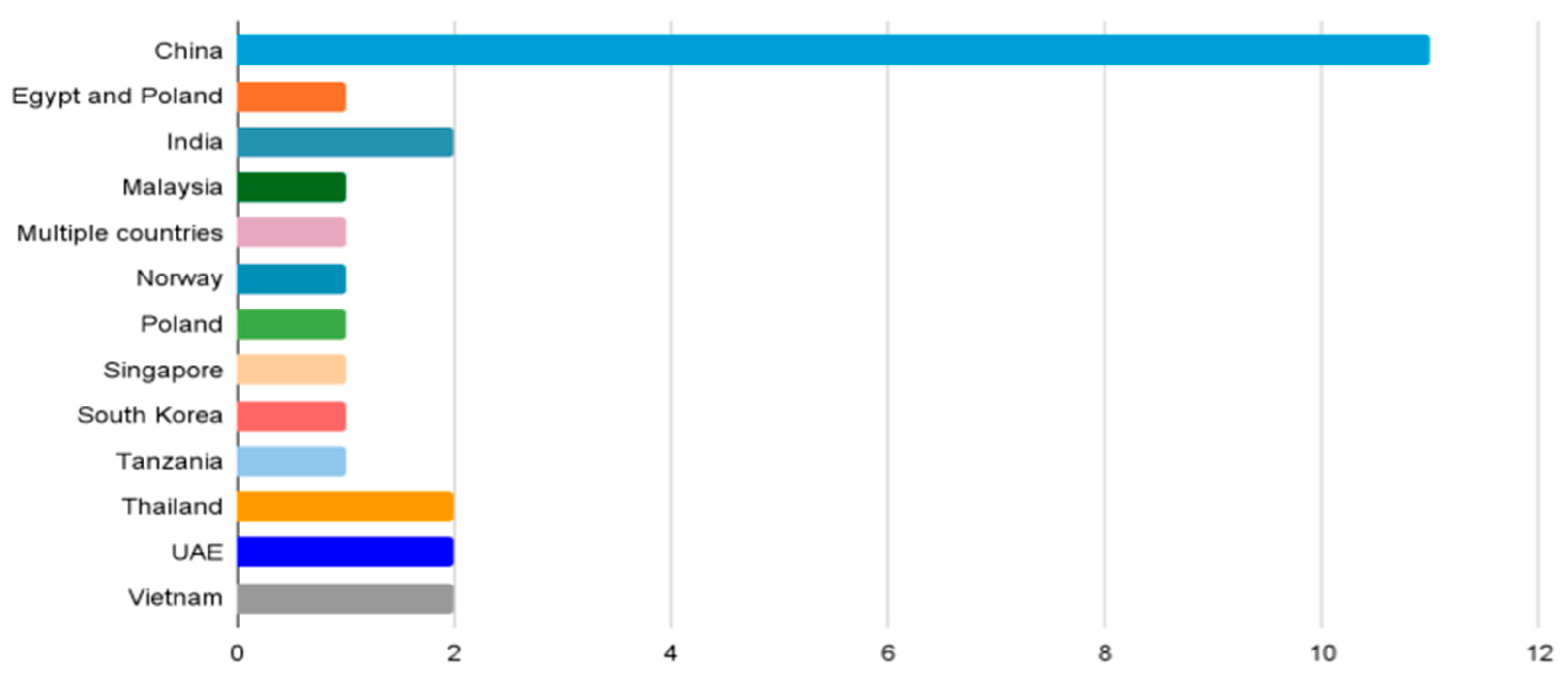
- Regional and Cultural Dimensions of GenAI Adoption in Education, which examines the geographic distribution of the selected studies and explores how regional and cultural contexts shape the conceptualization and adoption of GenAI technologies;
- −
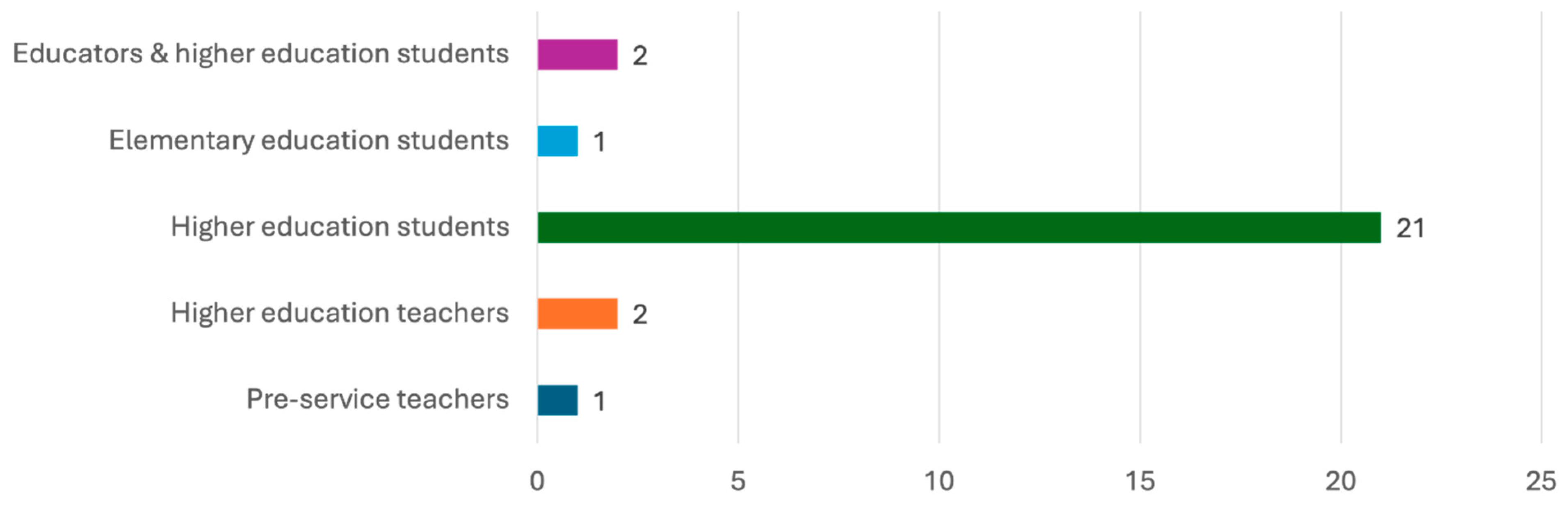
- Participant Demographics and Sampling Approaches, which provides an overview of participant types and sample sizes, highlighting the diversity of educational levels, roles, and research designs;
- −
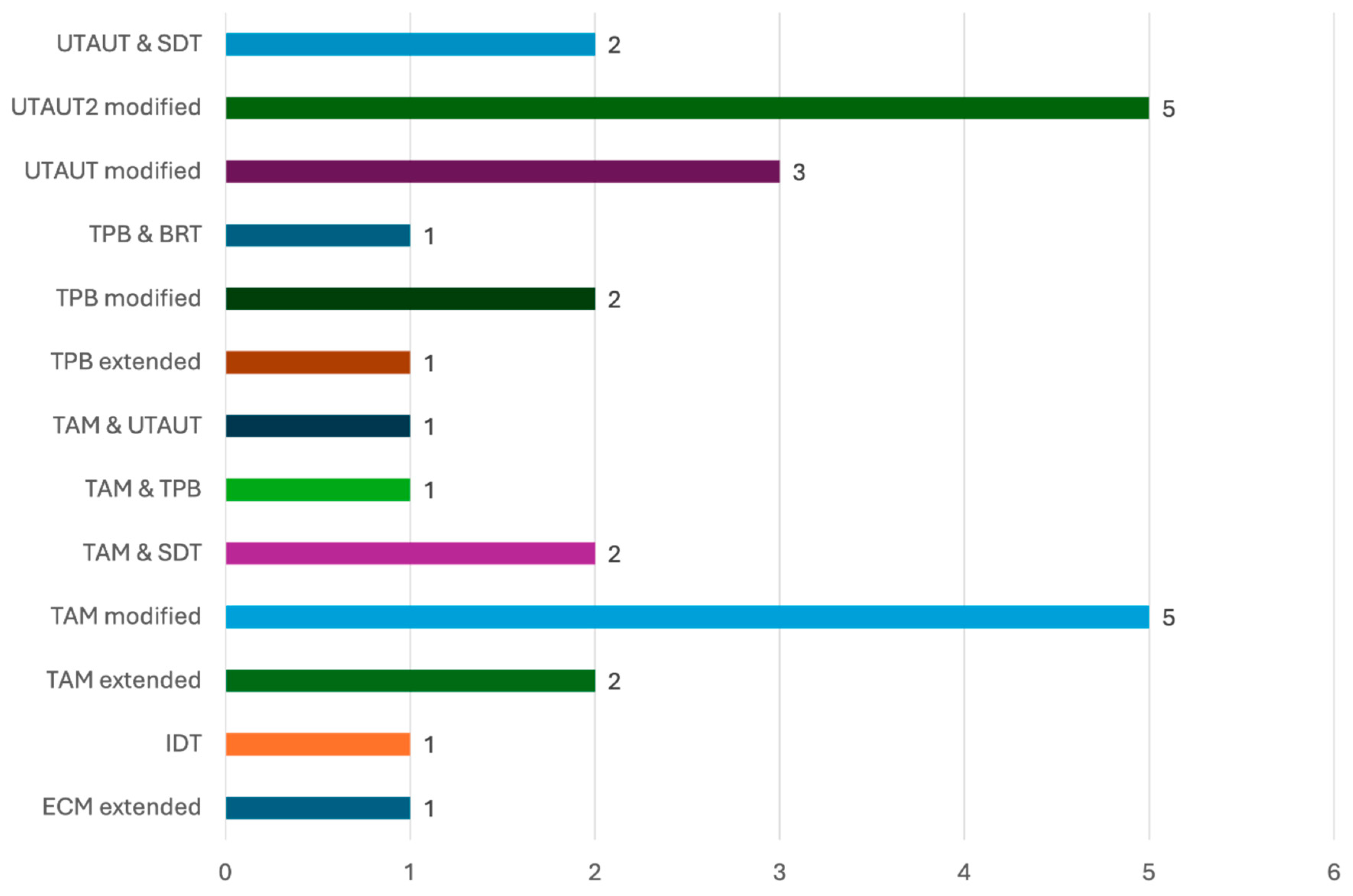
- Adoption Models and Theoretical Frameworks Used in GenAI Research, which analyzes the conceptual foundations and theoretical models employed across the studies; and
- −
- What Influences GenAI Adoption in Education? A Closer Look, which explores the key predictors of adoption across individual, institutional, and socio-technical domains.
3.1. Regional and Cultural Dimensions of GenAI Adoption in Education
3.2. Participant Demographics and Sampling Approaches
3.3. Adoption Models and Theoretical Frameworks Used in GenAI Research
- −
- −
- −
- −
- −
- −
- Integration of TAM and UTAUT, a rich theoretical approach to explaining behavioral intentions and technology use, was analyzed in one study [35].
- −
- −
- Combination of TPB and Behavioral Reasoning Theory (BRT), a theory that explores the cognitive processes and reasoning that bridge the gap between intentions and actual behavior, was examined in one study [30].
- −
- −
- −
- −
- Extended Models: These models expand the original framework by adding new constructs or pathways while maintaining the core structure to address gaps or new challenges specific to the context.
- −
- Modified Models: These models fundamentally alter or redefine the original framework by removing constructs, changing relationships, or integrating elements from other models to better fit the research focus.
3.4. What Influences GenAI Adoption in Education? A Closer Look
- −
- Performance Expectancy (Perceived Usefulness): Users adopt GenAI when they perceive it as beneficial for achieving educational goals. Grassini et al. [31], Jang [42], and Zheng et al. [45] consistently highlight its role in shaping Behavioral Intention (BI). Additionally, Duong et al. [28] and Liu et al. [44] emphasize that Performance Expectancy influences not only BI but also actual use, making it essential for both initial adoption and sustained engagement.
- −
- Trust: Trust plays a central role in GenAI adoption by fostering user confidence and mitigating concerns about privacy, ethics, and transparency. Shahzad et al. [40] reveal that trust plays a crucial role in GenAI awareness, acceptance, and adoption. Similarly, Ma [29] and Yap et al. [46] highlight that perceived trust directly influences BI to use GenAI, highlighting its central role in fostering adoption
- −
- Effort Expectancy (Perceived Ease of Use): While simplicity enhances adoption in some contexts, its influence is often secondary to functionality. Du and Lv [48] and Lu et al. [49] show that Effort Expectancy indirectly boosts perceptions of usefulness, whereas Grassini et al. [31] and Wang et al. [50] suggest that ease of use has limited impact in educational settings where performance and trust are prioritized.
- −
- Facilitating Conditions: External resources and institutional support are critical for bridging the gap between BI and actual use. Zheng et al. [45] and Du and Lv [48] highlight the importance of accessible infrastructure, while Grassini et al. [31] report that Facilitating Conditions may be less impactful in resource-rich environments, emphasizing their context-dependent nature.
- −
- Social Influence: Social norms and external encouragement can shape adoption decisions. Changalima et al. [34], Jang [42], and Zheng et al. [45] find that Social Influence significantly impacts BI, particularly in environments where peer or societal expectations drive behavior. Wang and Reynolds [65] find SI to significantly influence both BI and usage intentions. However, studies like Sudan et al. [43] and Strzelecki et al. [32] report minimal effects, suggesting that intrinsic motivators often outweigh external pressures.
- −
- Perceived Behavioral Control: Confidence in one’s ability to use GenAI effectively is an important determinant of BI. Lu et al. [49], Ivanov et al. [51], and Al-Qaysi et al. [30] underscore its role in empowering users, while Al-Emran et al. [36] observe that its significance may diminish when external enablers, such as of facilitating conditions or social pressures, are strong.
- −
- Perceived Compatibility: Compatibility between GenAI and users’ needs, workflows, and values significantly foster adoption. Raman et al. [39] demonstrate that seamless integration into educational practices enhances BI, while Yap et al. [46] validate its role in making GenAI intuitive and relevant for users.
- −
- Habit: Habit strongly predicts both BI and continued use. Zheng et al. [45], Grassini et al. [31], and Strzelecki et al. [32] emphasize that routine engagement with GenAI fosters sustained adoption. Sudan et al. [43] further highlight the role of prior usage experiences in enhancing the chance of continued engagement and long-term use.
- −
- −
- Anxiety: Concerns about job displacement, ethical implications, or technological complexity can act as barriers to adoption. Shen et al. [47], Li et al. [62], and Wang et al. [50] show that anxiety negatively impacts BI by reducing perceptions of usefulness and ease of use. Addressing these fears is essential for fostering acceptance.
- −
- Playfulness (Hedonic Motivation): Enjoyment and intrinsic satisfaction derived from GenAI usage strongly influence BI. Zheng et al. [45] and Yap et al. [46] highlight that enjoyment and playfulness foster user engagement and enhance the likelihood of continued use, while Strzelecki et al. [32] emphasize the enjoyment and pleasure of GenAI use as strong predictors of BI.
4. The Three-Tier Framework for GenAI Adoption in Education
- Core Predictors (consistently significant across studies):These factors consistently exert a strong influence on the adoption of GenAI technologies, serving as essential drivers rooted in individual perceptions and socio-technical dynamics. They are the most widely recognized and stable determinants of how individuals perceive and engage with AI technologies:
- ⚬
- Performance Expectancy (Perceived Usefulness)
- ⚬
- Trust
- Moderate Predictors (context-dependent):These predictors vary in their influence depending on specific educational or technological contexts, emphasizing the importance of task and environmental factors in shaping GenAI adoption. While significant, their impact is less consistent and often contingent on situational factors:
- ⚬
- Effort Expectancy (Perceived Ease of Use)
- ⚬
- Facilitating Conditions
- ⚬
- Social Influence
- ⚬
- Perceived Behavioral Control
- ⚬
- Perceived Compatibility
- Emerging Predictors (increasing relevance):Reflecting evolving individual and socio-technical dimensions, these factors are gaining prominence as GenAI technologies mature and expand their applications in education. Although less established than core and moderate predictors, they are increasingly supported by empirical research and are expected to grow in relevance:
- ⚬
- Habit
- ⚬
- AI Literacy
- ⚬
- Anxiety
- ⚬
- Playfulness (Hedonic Motivation)
- -
- User Aspects: Personal traits or characteristics that influence technology acceptance.
- -
- Task and Technological Aspects: Features of the technology and the specific tasks it supports.
- -
- Social and Environmental Aspects: Broader contextual and social influences on adoption behavior.
5. Conclusions
5.1. Limitations of the Review
5.2. Potential Extension of the Framework
5.3. Directions for Future Research
- −
- Refining the Three-Tier Framework and longitudinal studies: Future research should refine and expand the Three-Tier Framework by incorporating emerging predictors and examining their stability over time. As GenAI technologies mature, predictors such as trust, performance expectancy, and social influence may evolve in significance. Longitudinal studies are particularly valuable for capturing temporal shifts in adoption dynamics and understanding how sustained exposure to GenAI tools reshapes user attitudes and behaviors.
- −
- Cultural, contextual, and demographic variations in GenAI adoption: The review highlights that GenAI adoption is shaped by regional, cultural, and institutional contexts. Studies across regions such as East Asia, Europe, and Africa suggest differences in the conceptualization of adoption drivers, reflecting variations in educational values, technological infrastructure, and policy environments. Future research should investigate how cultural dimensions—such as collectivism vs. individualism, or institutional centralization—affect perceptions and adoption. In parallel, studies should examine how contextual factors (e.g., educational level) and demographic characteristics (e.g., age, gender, socio-economic status) influence adoption behavior. Special attention should be given to teacher-specific factors, such as AI literacy, pedagogical readiness, and access to professional development, particularly in under-resourced settings.
- −
- Ethical considerations and adoption barriers: Ethical concerns, including data privacy, algorithmic bias, and fairness, remain insufficiently addressed in the existing literature. These issues can significantly influence trust, perceived risk, and ultimately, adoption intentions. Future studies should explore how ethical considerations interact with predictors such as perceived usefulness, trust, and social influence. Additionally, research should identify barriers such as GenAI-related anxiety, fear of obsolescence, and lack of infrastructure to develop interventions that promote equitable and responsible adoption.
- −
- Student engagement and learner-centered adoption: Student-related factors—such as engagement, autonomy, and motivation—are underrepresented in current GenAI adoption studies. As GenAI tools increasingly support personalized and student-centered learning, research should focus on how these technologies influence learner engagement, self-regulation, and educational outcomes. Understanding these dynamics will be essential for maximizing the pedagogical potential of GenAI while mitigating risks such as over-reliance or reduced critical thinking.
- −
- Technological advancements and predictor evolution: Rapid advancements in GenAI technologies, such as multimodal interfaces and adaptive AI systems, may alter the relevance and impact of existing adoption predictors. Research should investigate how these new technological affordances reshape user experiences and expectations, and whether they give rise to new predictors not yet captured by current models. This continuous adaptation is essential to ensure that theoretical frameworks remain relevant in a fast-evolving landscape.
- −
- Interdisciplinary collaboration and model development: The complexity of GenAI adoption necessitates interdisciplinary collaboration across fields such as education, computer science, psychology, and sociology. Future research should draw on diverse disciplinary insights to build more comprehensive models that reflect the cognitive, emotional, social, and technological dimensions of adoption. Such collaboration will help address multifaceted challenges and contribute to the development of holistic and sustainable GenAI integration strategies.
Funding
Institutional Review Board Statement
Informed Consent Statement
Data Availability Statement
Conflicts of Interest
References
- Webster, J.; Watson, R.T. Analyzing the Past to Prepare for the Future: Writing a Literature Review. MIS Q. 2002, 26, xiii–xxiii. Available online: https://www.jstor.org/stable/4132319 (accessed on 9 January 2025).
- Kiuchi, K.; Otsu, K.; Hayashi, Y. Psychological insights into the research and practice of embodied conversational agents, chatbots and social assistive robots: A systematic meta-review. Behav. Inf. Technol. 2023, 43, 3696–3736. [Google Scholar] [CrossRef]
- Ferrara, E. Large Language Models for Wearable Sensor-Based Human Activity Recognition, Health Monitoring, and Behavioral Modeling: A Survey of Early Trends, Datasets, and Challenges. Sensors 2024, 24, 5045. [Google Scholar] [CrossRef] [PubMed]
- Hirata, K.; Matsui, Y.; Yamada, A.; Fujioka, T.; Yanagawa, M.; Nakaura, T.; Ito, R.; Ueda, D.; Fujita, S.; Tatsugami, F.; et al. Generative AI and large language models in nuclear medicine: Current status and future prospects. Ann. Nucl. Med. 2024, 38, 853–864. [Google Scholar] [CrossRef]
- Nerella, S.; Bandyopadhyay, S.; Zhang, J.; Contreras, M.; Siegel, S.; Bumin, A.; Silva, B.; Sena, J.; Shickel, B.; Bihorac, A.; et al. Transformers and large language models in healthcare: A review. Artif. Intell. Med. 2024, 154, 102900. [Google Scholar] [CrossRef]
- Yim, D.; Khuntia, J.; Parameswaran, V.; Meyers, A. Preliminary Evidence of the Use of Generative AI in Health Care Clinical Services: Systematic Narrative Review. JMIR Med. Inform. 2024, 20, e52073. [Google Scholar] [CrossRef] [PubMed]
- Goktas, P.; Grzybowski, A. Assessing the Impact of ChatGPT in Dermatology: A Comprehensive Rapid Review. J. Clin. Med. 2024, 13, 5909. [Google Scholar] [CrossRef] [PubMed]
- Hobensack, M.; von Gerich, H.; Vyas, P.; Withall, J.; Peltonen, L.M.; Block, L.J.; Davies, S.; Chan, R.; Van Bulck, L.; Cho, H.; et al. A rapid review on current and potential uses of large language models in nursing. Int. J. Nurs. Stud. 2024, 154, 104753. [Google Scholar] [CrossRef]
- Ng, C.K.C. Generative Adversarial Network (Generative Artificial Intelligence) in Pediatric Radiology: A Systematic Review. Children 2023, 10, 1372. [Google Scholar] [CrossRef]
- Ogunleye, B.; Zakariyyah, K.I.; Ajao, O.; Olayinka, O.; Sharma, H. A Systematic Review of Generative AI for Teaching and Learning Practice. Educ. Sci. 2024, 14, 636. [Google Scholar] [CrossRef]
- Yusuf, A.; Pervin, N.; Román-González, M.; Noor, N.M. Generative AI in education and research: A systematic mapping review. Rev. Educ. 2024, 12, e3489. [Google Scholar] [CrossRef]
- Sekli, G.M.; Godo, A.; Véliz, J.C. Generative AI Solutions for Faculty and Students: A Review of Literature and Roadmap for Future Research. J. Inf. Technol. Educ. Res. 2024, 23, 14. [Google Scholar] [CrossRef]
- Drobnjak, A.; Botički, I.; Seow, P.; Kahn, K. Learning with Conversational AI and Personas: A Systematic Literature Review. In Proceedings of the the 31st International Conference on Computers in Education, Matsue, Japan, 4–8 December 2023; Asia-Pacific Society for Computers in Education: Taoyuan, Taiwan, 2023. [Google Scholar] [CrossRef]
- Sengul, C.; Neykova, R.; Destefanis, G. Software engineering education in the era of conversational AI: Current trends and future directions. Front. Artif. Intell. 2024, 7, 1436350. [Google Scholar] [CrossRef]
- Ali, O.; Murray, P.A.; Momin, M.; Al-Anzi, F.S. The knowledge and innovation challenges of ChatGPT: A scoping review. Technol. Soc. 2023, 75, 102402. [Google Scholar] [CrossRef]
- Amarathunga, B. ChatGPT in education: Unveiling frontiers and future directions through systematic literature review and bibliometric analysis. Asian Educ. Dev. Stud. 2024, 13, 412–431. [Google Scholar] [CrossRef]
- Hagendorff, T. Mapping the Ethics of Generative AI: A Comprehensive Scoping Review. Minds Mach. 2024, 34, 39. [Google Scholar] [CrossRef]
- Yan, L.; Sha, L.; Zhao, L.; Li, Y.; Martinez-Maldonado, R.; Chen, G.; Li, X.; Jin, Y.; Gašević, D. Practical and ethical challenges of large language models in education: A systematic scoping review. Br. J. Educ. Technol. 2024, 55, 90–112. [Google Scholar] [CrossRef]
- Huang, F.; Wang, Y.; Zhang, H. Modelling Generative AI Acceptance, Perceived Teachers’ Enthusiasm and Self-Efficacy to English as a Foreign Language Learners’ Well-Being in the Digital Era. Eur. J. Educ. 2024, 59, e12770. [Google Scholar] [CrossRef]
- Wang, Q.; Gao, Y.; Wang, X. Exploring Engagement, Self-Efficacy, and Anxiety in Large Language Model EFL Learning: A Latent Profile Analysis of Chinese University Students. Int. J. Hum.–Comput. Interact. 2024, 41, 7815–7824. [Google Scholar] [CrossRef]
- Wu, D.; Zhang, S.; Ma, Z.; Yue, X.-G.; Dong, R.K. Unlocking Potential: Key Factors Shaping Undergraduate Self-Directed Learning in AI-Enhanced Educational Environments. Systems 2024, 12, 332. [Google Scholar] [CrossRef]
- Herani, R.; Angela, J. Navigating ChatGPT: Catalyst or challenge for Indonesian youth in digital entrepreneurship? J. Entrep. Emerg. Econ. 2024, 17, 602–628. [Google Scholar] [CrossRef]
- Smith, C.E.; Shiekh, K.; Cooreman, H.; Rahman, S.; Zhu, Y.; Siam, M.K.; Ivanitskiy, M.; Ahmed, A.M.; Hallinan, M.; Grisak, A.; et al. Early Adoption of Generative Artificial Intelligence in Computing Education: Emergent Student Use Cases and Perspectives in 2023. In Proceedings of the ITiCSE 2024 Conference on Innovation and Technology in Computer Science Education, Milan, Italy, 8–10 July 2024; ACM: New York, NY, USA, 2024; Volume 1, pp. 3–9. [Google Scholar] [CrossRef]
- Petrič, G. Everyone Talks Everything with ChatGPT: Students’ Uses of ChatGPT and Their Impact on Learning Performance. Int. J. Technol. Hum. Interact. 2024, 20, 1–22. [Google Scholar] [CrossRef]
- Chan, C.K.Y.; Zhou, W. An expectancy value theory (EVT) based instrument for measuring student perceptions of generative AI. Smart Learn. Environ. 2023, 10, 64. [Google Scholar] [CrossRef]
- Tangadulrat, P.; Sono, S.; Tangtrakulwanich, B. Using ChatGPT for Clinical Practice and Medical Education: Cross-Sectional Survey of Medical Students’ and Physicians’ Perceptions. JMIR Med. Educ. 2023, 22, e50658. [Google Scholar] [CrossRef] [PubMed]
- Sallam, M.; Salim, N.A.; Barakat, M.; Al-Mahzoum, K.; Al-Tammemi, A.B.; Malaeb, D.; Hallit, R.; Hallit, S. Assessing Health Students’ Attitudes and Usage of ChatGPT in Jordan: Validation Study. JMIR Med. Educ. 2023, 9, e48254. [Google Scholar] [CrossRef]
- Duong, C.D.; Vu, T.N.; Ngo, T.V.N. Applying a modified technology acceptance model to explain higher education students’ usage of ChatGPT: A serial multiple mediation model with knowledge sharing as a moderator. Int. J. Manag. Educ. 2023, 21, 100883. [Google Scholar] [CrossRef]
- Ma, M. Exploring the acceptance of generative artificial intelligence for language learning among EFL postgraduate students: An extended TAM approach. Int. J. Appl. Linguist. 2024, 35, 91–108. [Google Scholar] [CrossRef]
- Al-Qaysi, N.; Al-Emran, M.; Al-Sharafi, M.A.; Iranmanesh, M.; Ahmad, A.; Mahmoud, M.A. Determinants of ChatGPT Use and its Impact on Learning Performance: An Integrated Model of BRT and TPB. Int. J. Hum.–Comput. Interact. 2024, 41, 5462–5474. [Google Scholar] [CrossRef]
- Grassini, S.; Aasen, M.L.; Møgelvang, A. Understanding University Students’ Acceptance of ChatGPT: Insights from the UTAUT2 Model. Appl. Artif. Intell. 2024, 38, 2371168. [Google Scholar] [CrossRef]
- Strzelecki, A.; Cicha, K.; Rizun, M.; Rutecka, P. Acceptance and use of ChatGPT in the academic community. Educ. Inf. Technol. 2024, 29, 22943–22968. [Google Scholar] [CrossRef]
- Strzelecki, A.; ElArabawy, S. Investigation of the moderation effect of gender and study level on the acceptance and use of generative AI by higher education students: Comparative evidence from Poland and Egypt. Br. J. Educ. Technol. 2024, 55, 1209–1230. [Google Scholar] [CrossRef]
- Changalima, I.A.; Amani, D.; Ismail, I.J. Social influence and information quality on Generative AI use among business students. Int. J. Manag. Educ. 2024, 22, 101063. [Google Scholar] [CrossRef]
- Saihi, A.; Ben-Daya, M.; Hariga, M. The moderating role of technology proficiency and academic discipline in AI-chatbot adoption within higher education: Insights from a PLS-SEM analysis. Educ. Inf. Technol. 2024, 30, 5843–5881. [Google Scholar] [CrossRef]
- Al-Emran, M.; Abu-Hijleh, B.; Alsewari, A.A. Exploring the Effect of Generative AI on Social Sustainability Through Integrating AI Attributes, TPB, and T-EESST: A Deep Learning-Based Hybrid SEM-ANN Approach. IEEE Trans. Eng. Manag. 2024, 71, 14512–14524. [Google Scholar] [CrossRef]
- Kanont, K.; Pingmuang, P.; Simasathien, T.; Wisnuwong, S.; Wiwatsiripong, B.; Poonpirome, K.; Songkram, N.; Khlaisang, J. Generative-AI, a Learning Assistant? Factors Influencing Higher-Ed Students’ Technology Acceptance. Electron. J. E-Learn. 2024, 22, 6. [Google Scholar] [CrossRef]
- Ngo, T.T.A.; Tran, T.T.; An, G.K.; Nguyen, P.T. ChatGPT for Educational Purposes: Investigating the Impact of Knowledge Management Factors on Student Satisfaction and Continuous Usage. IEEE Trans. Learn. Technol. 2024, 17, 1367–1378. Available online: https://api.semanticscholar.org/CorpusID:268865544 (accessed on 19 December 2024). [CrossRef]
- Raman, R.; Mandal, S.; Das, P.; Kaur, T.; Sanjanasri, J.P.; Nedungadi, P. Exploring University Students’ Adoption of ChatGPT Using the Diffusion of Innovation Theory and Sentiment Analysis with Gender Dimension. Hum. Behav. Emerg. Technol. 2024, 2024, 3085910. [Google Scholar] [CrossRef]
- Shahzad, M.F.; Xu, S.; Javed, I. ChatGPT awareness, acceptance, and adoption in higher education: The role of trust as a cornerstone. Int. J. Educ. Technol. High. Educ. 2024, 21, 46. [Google Scholar] [CrossRef]
- Soliman, M.; Ali, R.A.; Khalid, J.; Mahmud, I.; Ali, W.B. Modelling continuous intention to use generative artificial intelligence as an educational tool among university students: Findings from PLS-SEM and ANN. J. Comput. Educ. 2024, 1–32. [Google Scholar] [CrossRef]
- Jang, M. AI Literacy and Intention to Use Text-Based GenAI for Learning: The Case of Business Students in Korea. Informatics 2024, 11, 54. [Google Scholar] [CrossRef]
- Sudan, T.; Hans, A.; Taggar, R. Transformative learning with ChatGPT: Analyzing adoption trends and implications for business management students in India. Interact. Technol. Smart Educ. 2024, 21, 735–772. [Google Scholar] [CrossRef]
- Liu, G.L.; Darvin, R.; Ma, C. Exploring AI-mediated informal digital learning of English (AI-IDLE): A mixed-method investigation of Chinese EFL learners’ AI adoption and experiences. Comput. Assist. Lang. Learn. 2024, 1–29. [Google Scholar] [CrossRef]
- Zheng, Y.; Wang, Y.; Liu, K.S.X.; Jiang, M.Y.C. Examining the moderating effect of motivation on technology acceptance of generative AI for English as a foreign language learning. Educ. Inf. Technol. 2024, 29, 23547–23575. [Google Scholar] [CrossRef]
- Yap, K.Y.L.; Ho, J.; Toh, P.S.T. Development of a Metaverse Art Gallery of Image Chronicles (MAGIC) for Healthcare Education: A Digital Health Humanities Approach to Patients’ Medication Experiences. Information 2024, 15, 431. [Google Scholar] [CrossRef]
- Shen, X.; Mo, X.; Xia, T. Exploring the attitude and use of GenAI-image among art and design college students based on TAM and SDT. Interact. Learn. Environ. 2024, 33, 1198–1215. [Google Scholar] [CrossRef]
- Du, L.; Lv, B. Factors influencing students’ acceptance and use generative artificial intelligence in elementary education: An expansion of the UTAUT model. Educ. Inf. Technol. 2024, 29, 24715–24734. [Google Scholar] [CrossRef]
- Lu, H.; He, L.; Yu, H.; Pan, T.; Fu, K. A Study on Teachers’ Willingness to Use Generative AI Technology and Its Influencing Factors: Based on an Integrated Model. Sustainability 2024, 16, 7216. [Google Scholar] [CrossRef]
- Wang, K.; Ruan, Q.; Zhang, X.; Fu, C.; Duan, B. Pre-Service Teachers’ GenAI Anxiety, Technology Self-Efficacy, and TPACK: Their Structural Relations with Behavioral Intention to Design GenAI-Assisted Teaching. Behav. Sci. 2024, 14, 373. [Google Scholar] [CrossRef]
- Ivanov, S.; Soliman, M.; Tuomi, A.; Alkathiri, N.A.; Al-Alawi, A.N. Drivers of generative AI adoption in higher education through the lens of the Theory of Planned Behaviour. Technol. Soc. 2024, 77, 102521. [Google Scholar] [CrossRef]
- Davis, F.D. A Technology Acceptance Model for Empirically Testing New End-User Information Systems: Theory and Results. Ph.D. Thesis, MIT Sloan School of Management, Cambridge, MA, USA, 1986. [Google Scholar]
- Davis, F.D. Perceived Usefulness, Perceived Ease of Use, and User Acceptance of Information Technology. MIS Q. 1989, 13, 319–340. [Google Scholar] [CrossRef]
- Venkatesh, V.; Morris, M.G.; Davis, G.B.; Davis, F.D. User acceptance of information technology: Towards a unified view. MIS Q. 2003, 27, 425–478. Available online: https://www.jstor.org/stable/30036540 (accessed on 9 January 2025). [CrossRef]
- Venkatesh, V.; Thong, J.Y.; Xu, X. Consumer Acceptance and Use of Information Technology: Extending the Unified Theory of Acceptance and Use of Technology. MIS Q. 2012, 36, 157–178. [Google Scholar] [CrossRef]
- Rogers, E. Diffusion of Innovations; The Free Press: New York, NY, USA, 1962. [Google Scholar]
- Rogers, E. Diffusion of Innovations, 4th ed.; The Free Press: New York, NY, USA, 1995. [Google Scholar]
- Bhattacherjee, A. Understanding Information Systems Continuance: An Expectation-Confirmation Model. MIS Q. 2001, 25, 351–370. [Google Scholar] [CrossRef]
- Ajzen, I. From Intentions to Actions: A Theory of Planned Behavior. In Action Control. From Cognition to Behavior; Kuhl, J., Beckmann, J., Eds.; Springer: Berlin/Heidelberg, Germany, 1985. [Google Scholar] [CrossRef]
- Ajzen, I. The Theory of Planned Behavior. Organ. Behav. Hum. Decis. Process. 1991, 50, 179–211. [Google Scholar] [CrossRef]
- Oliver, R.L. A Cognitive Model of the Antecedents and Consequences of Satisfaction Decisions. J. Mark. Res. 1980, 17, 460–469. [Google Scholar] [CrossRef]
- Li, W.; Zhang, X.; Li, J.; Yang, X.; Li, D.; Liu, Y. An explanatory study of factors influencing engagement in AI education at the K-12 Level: An extension of the classic TAM model. Sci. Rep. 2024, 14, 13922. [Google Scholar] [CrossRef]
- Deci, E.L.; Ryan, R.M. Intrinsic Motivation and Self-Determination in Human Behavior; Plenum: New York, NY, USA, 1985. [Google Scholar] [CrossRef]
- Wang, C.; Wang, H.; Li, Y.; Dai, J.; Gu, X.; Yu, T. Factors Influencing University Students’ Behavioral Intention to Use Generative Artificial Intelligence: Integrating the Theory of Planned Behavior and AI Literacy. Int. J. Hum.–Comput. Interact. 2024, 41, 6649–6671. [Google Scholar] [CrossRef]
- Wang, X.; Reynolds, B.L. Beyond the Books: Exploring Factors Shaping Chinese English Learners’ Engagement with Large Language Models for Vocabulary Learning. Educ. Sci. 2024, 14, 496. [Google Scholar] [CrossRef]
- Granić, A. Technology adoption at individual level: Toward an integrated overview. Univers. Access Inf. Soc. 2024, 23, 843–858. [Google Scholar] [CrossRef]
- Granić, A. User Acceptance of Interactive Technologies. In Foundations and Fundamentals in Human-Computer Interaction, Volume I, Handbook of Human-Computer Interaction: Foundations and Advances, 6-Volume Set, 1st ed.; Stephanidis, C., Salvendy, G., Eds.; CRC Press: Boca Raton, FL, USA, 2024; pp. 356–389. [Google Scholar] [CrossRef]
- Granić, A. Educational Technology Adoption: A systematic review. Educ. Inf. Technol. 2022, 27, 9725–9744. [Google Scholar] [CrossRef]
- Davis, F.D.; Granić, A. The Technology Acceptance Model—30 Years of TAM; Springer: Cham, Switzerland, 2024. [Google Scholar] [CrossRef]



| The Three-Tier Framework for GenAI Technology Adoption in Education |
|---|
Performance Expectancy/Perceived Usefulness
|
Trust
|
Effort Expectancy/Perceived Ease of Use
Conversely, several studies suggest that Effort Expectancy has limited significance in driving BI for GenAI technologies. Grassini et al. [31], Jang [42], and Wang et al. [50] observed no significant impact of Effort Expectancy on BI in educational contexts, where users prioritize functionality and performance over ease of use. Similarly, Shen et al. [47] and Sudan et al. [43] reported weak or negligible correlations, suggesting that simplicity plays a minor role when trust or perceived benefits dominate decision-making. These findings suggest that Effort Expectancy’s influence on GenAI adoption is moderate and context-dependent, particularly in settings where users possess baseline digital skills or prioritize performance over usability.
|
Facilitating Conditions
Conversely, other studies suggest that Facilitating Conditions may have a limited role in predicting BI for GenAI technologies. Wang and Reynolds [65] report that while autonomy, competence, and relatedness strongly influence BI and usage, FCs lack significant impact on usage intentions. Grassini et al. [31] and Wang et al. [50] similarly find no statistical association between FCs and BI, emphasizing that users may prioritize intrinsic motivators like performance expectancy and habit. Strzelecki et al. [32] further note that while BI strongly predicts usage, FCs do not directly influence BI. These findings indicate that the role of FCs in GenAI adoption may depend on contextual factors, such as resource availability and the prominence of other adoption drivers. While FCs may be less influential in resource-rich environments, they remain essential in under-resourced settings where external support is critical for bridging the gap between intention and use.
|
Social Influence
Conversely, several studies challenge the influence of Social Influence in predicting GenAI adoption. Grassini et al. [31] report no significant impact of SI on BI, with factors like performance expectancy and habit being more influential. Similarly, Sudan et al. [43] and Strzelecki et al. [32] found minimal or negligible effects of SI, highlighting that intrinsic motivators, such as perceived benefits and personal habits, often outweigh external social pressures. These findings suggest that while Social Influence can play a pivotal role in specific cultural or institutional contexts, its overall impact on GenAI adoption is inconsistent and highly context-dependent.
Conversely, in individualistic cultures or performance-oriented environments, the impact of SI may diminish, as personal autonomy and intrinsic motivators, such as perceived utility and habit, take precedence. While social support or pressure can facilitate or hinder adoption based on cultural and institutional attitudes, its variability across contexts positions Social Influence as a moderate yet necessary predictor of GenAI adoption. |
Perceived Behavioral Control
However, in contexts dominated by external factors like institutional support, social norms, or organizational mandates, the influence of PBC diminishes, as external determinants take precedence. This variability highlights the interplay between PBC and other factors, such as facilitating conditions and social influence. While not universally strong, PBC remains influential in specific contexts where individual control and resource availability are critical. This makes it a moderate but fundamental factor in the framework, addressing diverse user needs and supporting adoption in scenarios where autonomy and self-efficacy drive engagement. |
Perceived Compatibility
The absence of opposing findings suggests that, within the contexts studied, compatibility with existing practices consistently supports adoption. However, this could reflect a limited range of studies in the field, and future research may reveal more complex dynamics or variations depending on specific educational environments. Although Perceived Compatibility has not been challenged significantly in the reviewed studies, its influence remains context-dependent, and further exploration of its role across diverse educational settings is warranted.
|
Habit
|
AI Literacy
|
Anxiety
|
Playfulness/Hedonic Motivation
|
Disclaimer/Publisher’s Note: The statements, opinions and data contained in all publications are solely those of the individual author(s) and contributor(s) and not of MDPI and/or the editor(s). MDPI and/or the editor(s) disclaim responsibility for any injury to people or property resulting from any ideas, methods, instructions or products referred to in the content. |
© 2025 by the author. Licensee MDPI, Basel, Switzerland. This article is an open access article distributed under the terms and conditions of the Creative Commons Attribution (CC BY) license (https://creativecommons.org/licenses/by/4.0/).
Share and Cite
Granić, A. Emerging Drivers of Adoption of Generative AI Technology in Education: A Review. Appl. Sci. 2025, 15, 6968. https://doi.org/10.3390/app15136968
Granić A. Emerging Drivers of Adoption of Generative AI Technology in Education: A Review. Applied Sciences. 2025; 15(13):6968. https://doi.org/10.3390/app15136968
Chicago/Turabian StyleGranić, Andrina. 2025. "Emerging Drivers of Adoption of Generative AI Technology in Education: A Review" Applied Sciences 15, no. 13: 6968. https://doi.org/10.3390/app15136968
APA StyleGranić, A. (2025). Emerging Drivers of Adoption of Generative AI Technology in Education: A Review. Applied Sciences, 15(13), 6968. https://doi.org/10.3390/app15136968