You are currently viewing a new version of our website. To view the old version click .
Applied Sciences
  • Article
  • Open Access

13 March 2024

Securing Internet of Things Applications Using Software-Defined Network-Aided Group Key Management with a Modified One-Way Function Tree

,
,
and
1
Division of Computer Science and Engineering, Karunya Institute of Technology and Sciences, Coimbatore 641114, Tamil Nadu, India
2
Department of Computer Science and Engineering, Manipal Institute of Technology, Manipal Academy of Higher Education, Manipal 576104, Karnataka, India
3
Department of Mechatronics Engineering, Manipal Institute of Technology, Manipal Academy of Higher Education, Manipal 576104, Karnataka, India
*
Authors to whom correspondence should be addressed.
This article belongs to the Special Issue Internet of Things (IoT) Technologies in Cybersecurity: Challenges and Opportunities

Abstract

Group management is practiced to deploy access control and to ease multicast and broadcast communication. However, the devices that constitute the Internet of Things (IoT) are resource-constrained, and the network of IoT is heterogeneous with variable topologies interconnected. Hence, to tackle heterogeneity, SDN-aided centralized group management as a service framework is proposed to provide a global network perspective and administration. Group management as a service includes a group key management function, which can be either centralized or decentralized. Decentralized approaches use complex cryptographic primitives, making centralized techniques the optimal option for the IoT ecosystem. It is also necessary to use a safe, scalable approach that addresses dynamic membership changes with minimal overhead to provide a centralized group key management service. A group key management strategy called a one-way Function Tree (OFT) was put forth to lower communication costs in sizable dynamic groups. The technique, however, is vulnerable to collusion attacks in which an appending and withdrawing device colludes and conspires to obtain unauthorized keys for an unauthorized timeline. Several collusion-deprived improvements to the OFT method are suggested; however, they come at an increased cost for both communication and computation. The Modified One-Way Function Tree (MOFT), a novel technique, is suggested in this proposed work. The collusion resistance of the proposed MOFT system was demonstrated via security analysis. According to performance studies, MOFT lowers communication costs when compared to the original OFT scheme. In comparison to the OFT’s collusion-deprived upgrades, the computation cost is smaller.

1. Introduction

The Internet of Things (IoT) emerged when everyday objects began connecting to the Internet and interacting with each other autonomously without human intervention. IoT devices follow the IEEE 802.15.4 standard [1] to enable network connectivity for resource-constrained devices using short-range, lightweight communication protocols [1]. Due to the limited availability of device resources in addition to the bandwidth problem, the IoT ecosystem prefers multicast communication instead of unicast messages to send updates and patch-ups [2,3]. To send multicast messages securely, a common secret key need to be shared between the devices in the multicast group. To efficiently distribute the keys to all group devices, a vast amount of group key management techniques have been proposed in the literature. Group key management enables the group to operate with integrity and confidentiality [4]. There are three methods for managing group keys. The Key Management Server (KMS), a trustworthy third party, is utilized for key distribution in the centralized key management technique [5,6]. In decentralized key management, both the server and group member devices contribute to key management [7,8,9]. In distributed key management, there is no centralized trust, but every member participates in key management [10,11,12,13]. Among all three methods, centralized key management offers less communication and computation overhead on the member devices with simpler functions. Hence, the proposed work focuses on centralized key management techniques, considering them to be most suitable for resource-constrained IoT devices. Centralized key management relies on a dependable third-party server for key management and key distribution. The proposed group management server uses an SDN controller to obtain centralized control over the heterogeneous network. The controller provides opinions on whether to forward network traffic, while the routers just obey the controller [14]. The advantages of SDN in comparison with traditional networks [15,16,17] are,
  • Easy patching and upgradation
  • Knowledge of the sleep/wake cycle of IoT devices
  • Supports security services by routing traffic through virtualized service functions known as Virtual Service Functions (VSF)
The distribution of a common group key or key materials needed for group key generation occurs during the rekeying procedure. Rekeying ensures the group’s confidentiality by putting forward and backward secrecy into action. When a group member leaves, the departing member should not have any access to any key materials that could be used to access any unapproved group data after the member exit event. This is termed forward secrecy. Similarly, when a new member enters an existing group, the joining member ought not to receive any key materials to obtain any unauthorized group data preceding the member join event. This is termed backward secrecy. A collusion attack is when two or more members join to obtain key material to access the group’s data that are unauthorized for the colluding members. An efficient key management technique should ensure both forward secrecy and backward secrecy, as well as resistance to collusion attacks. Chinese Remainder Theorem (CRT)-based methods [18] offer the lowest communication costs out of all the centralized group key management techniques that have been proposed in the literature. However, because of its limited scalability, the method cannot be applied to dynamic groups.
A group key management strategy called OFT [19] lowers the communication cost for rekeying by a factor of log2n. However, a collusion attack is possible on this approach. There are many proposed collusion-resistant OFT-based methods; however, they come at a higher communication cost. In the proposed MOFT, the binary tree’s neighboring nodes share a second key, which is termed adjacent secret. Additionally, the method employs both a top-down and bottom-up strategy for group key generation, making it collusion-resistant with lower communication costs than the original OFT scheme. The suggested approach’s performance analysis demonstrates that it has less communication overhead and better computation overhead than collusion-resistant OFTs. The existence of forward and backward secrecy in the MOFT approach is verified via security analysis. The existence of collusion resistance in MOFT is verified by a new proposition. Our main contributions are as follows:
A novel technique, MOFT, for centralized group key management.
A new proposition that proves the collusion resistance property of MOFT.
The evaluation of MOFT proves MOFT reduces network traffic, with limited storage cost and optimal computation cost, proving it is scalable.
The remainder of the manuscript is organized as follows: Section 2 depicts the works that are related to SDN-based security for IoT and group key management techniques; Section 3 describes the proposed framework for group management using SDN, provides a brief on the original OFT scheme, and finally, elucidates on the proposed MOFT scheme; Section 4 verifies the security strength of the proposed approach; Section 5 evaluates the proposed approach in terms of computation, storage, and communication cost; finally, Section 6 depicts the IoT tailored version of MOFT; and Section 7 gives the conclusion.

3. Proposed Work

3.1. SDN-Based Group Management Framework

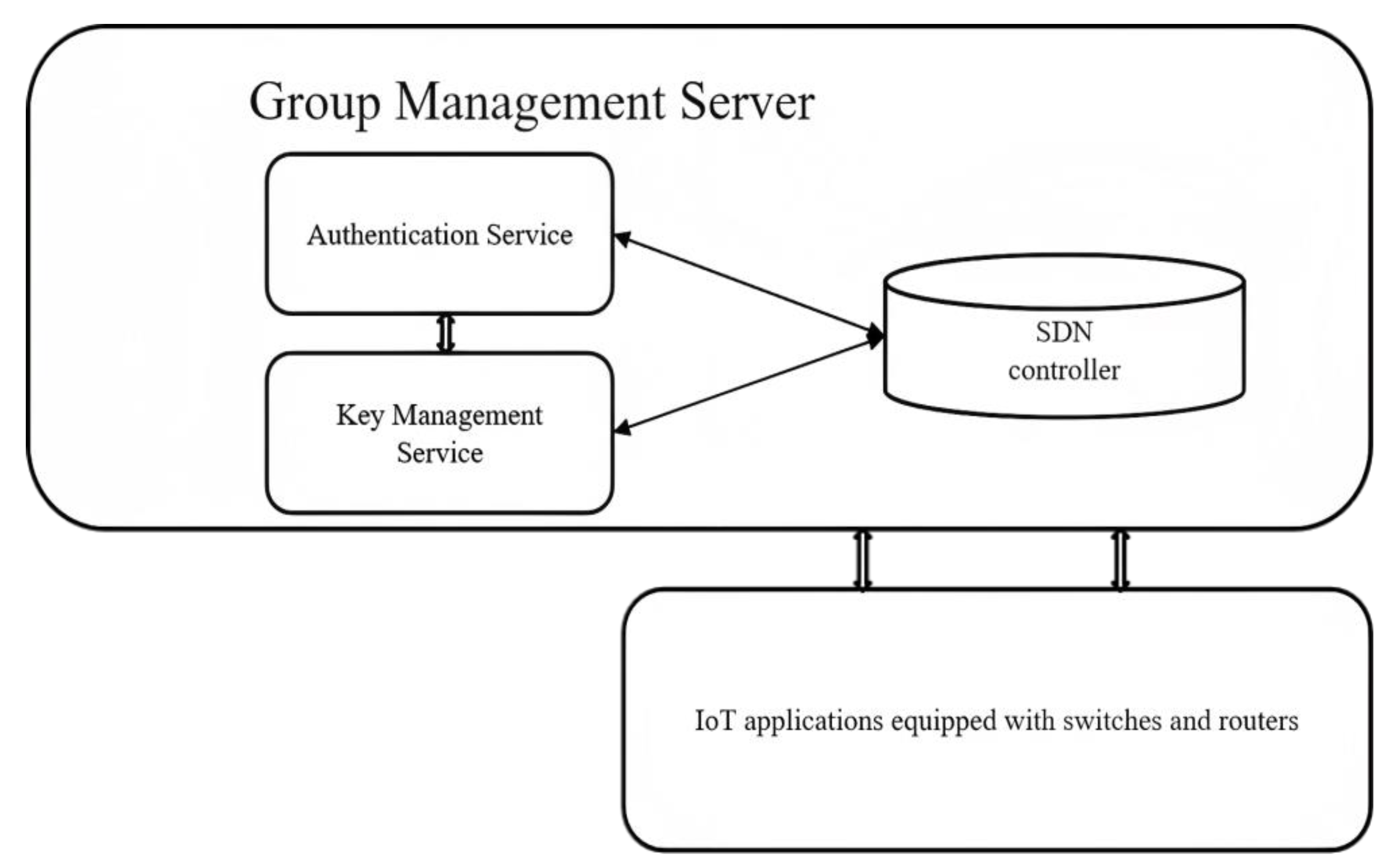
The architecture for group management service is depicted in Figure 1. The devices that communicate frequently and form a communication pattern are united as a group. The Group Management Server (GMS) is built-in with an authentication service function, a key management service function, and an SDN controller. Service functions are virtualized functions that can be provided as a service. The GMS stores the attributes of the group, including the group ID, group member ID, application ID, IP address, MAC address, and location. The key management function stores the key materials of the group. The authentication function authenticates the devices by collaborating with the GMS.
Figure 1. Group management server (GMS).
The authenticated devices will then be allowed to form a group. The key management service function will then distribute the key materials. Using SDN, the communication link is set up in such a way that only group members can communicate. This ensures security against the spread of node-capture attacks and phishing-based attacks by cutting off unnecessary communications.

3.2. Use Case

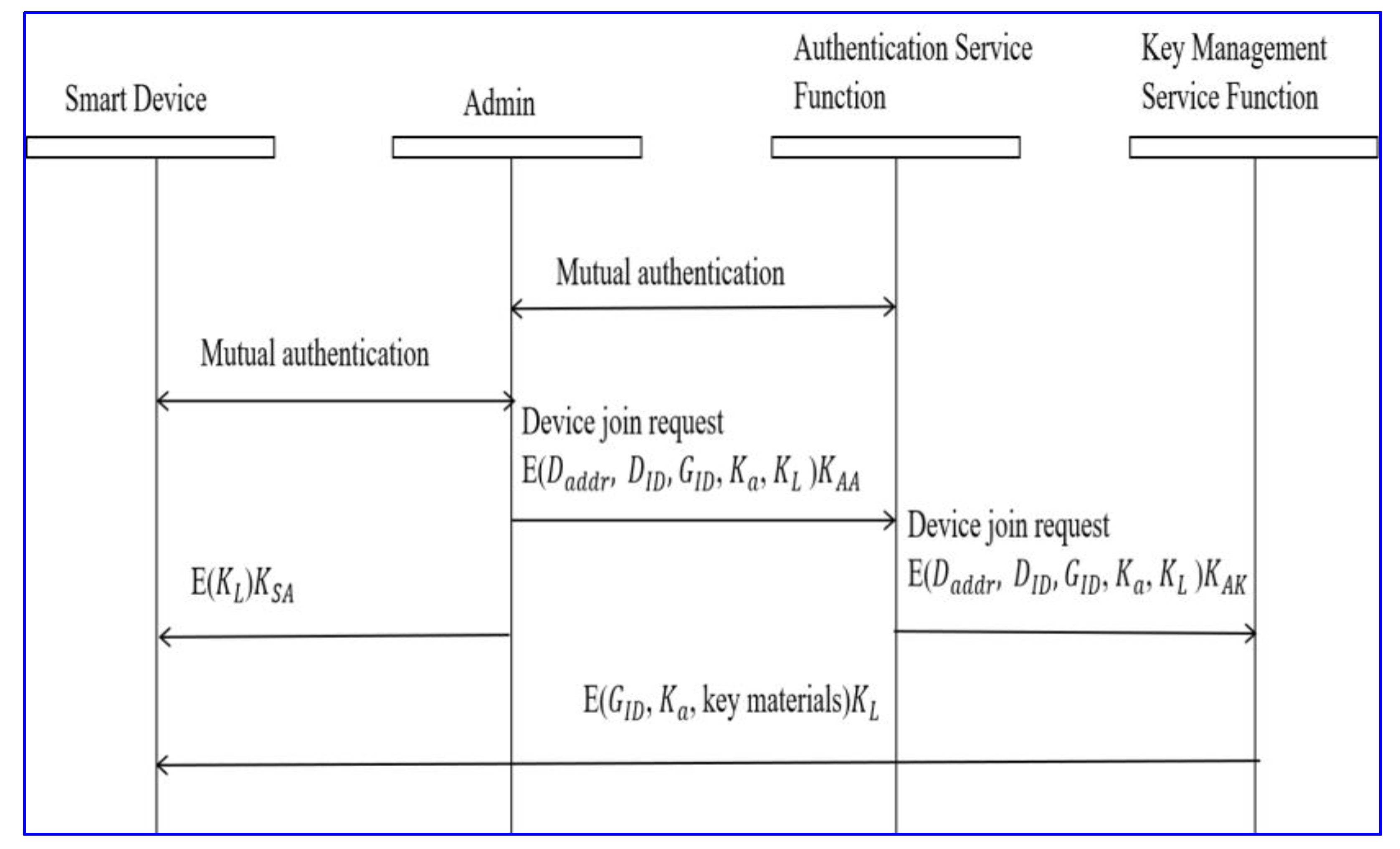
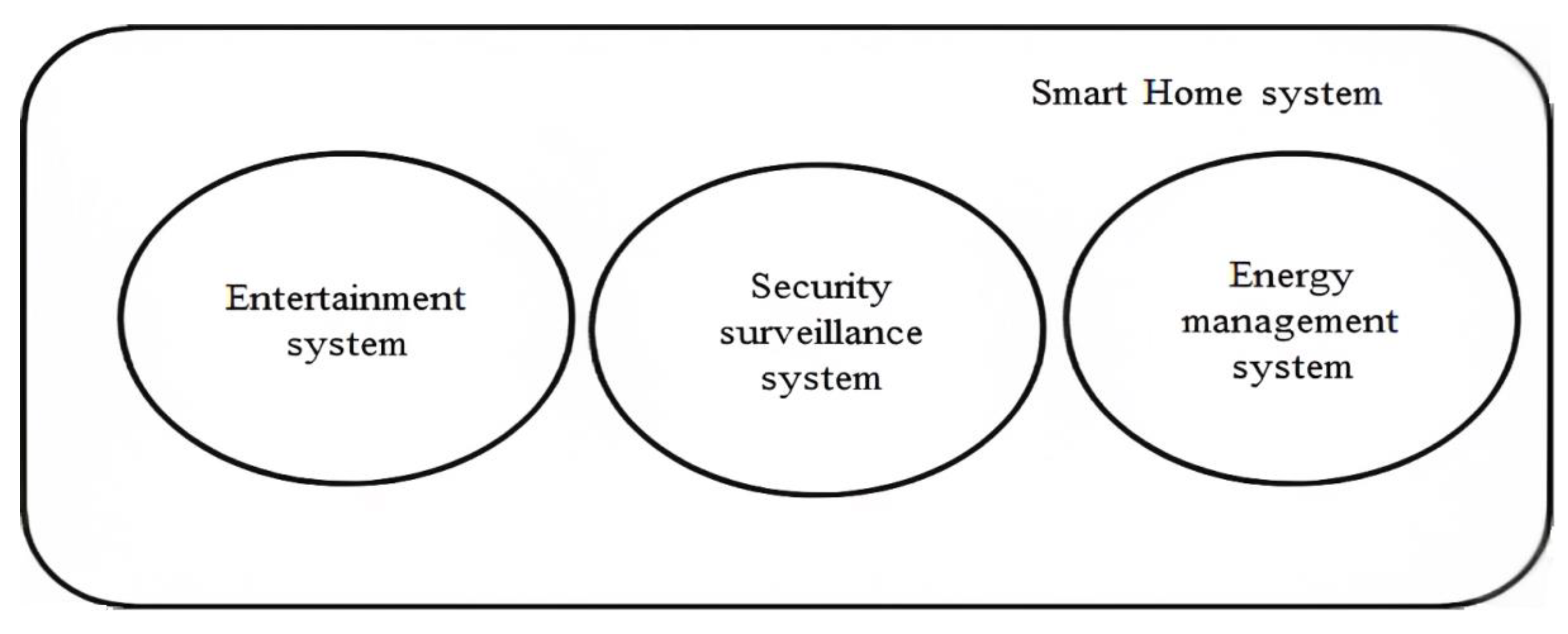
The proposed group management framework is applied to smart home applications, as depicted in Figure 2. The smart home application is built up of embedded devices and sensors that collaborate via LAN or WAN connections to improve the comfort of the house members. The components of a smart home system include an entertainment system consisting of a music system, home theater, TV, etc., a security surveillance system with cameras, alarms, door locks, etc., and an energy management system with a connection to a smart grid to optimize electricity usage [45,46]. The segregation of smart home applications into groups helps prevent the spread of attacks from a vulnerable part of a system to other parts of the system. An authenticated key agreement protocol for groups in home-based sensor networks is proposed in [47], which uses an authentication token for authentication between mobile stations and serving networks. The scheme shows robustness when the mobile stations move between different serving networks. Another group-based authenticated key agreement protocol for machine-to-machine communication is proposed in [48], which selects a leader device first to perform full authentication. The remaining member devices authenticate using the vector provided by the leader device. The proposed work assumes that the smart home application contains an admin device that is trustable with enough resources to communicate with service functions and establish a secure connection. The steps involved in group initialization are depicted in Figure 3. Resource-constrained smart home devices can connect with the admin device via 5G networks or Bluetooth LE that supports device authentication. After mutual authentication, the admin devices send the device IP, MAC address, ID, Group ID, individual key K L , and adjacent shared secret K a to the authentication service function encrypted using the key shared between them. After authentication, the authentication service function forwards the request to the key management service function. The key management service function forwards the adjacent shared secret and key materials needed to obtain the group key to the device encrypted using K L , which was already obtained by the device from the admin. This ensures the message is from a trusted source. The member devices only know the group key of their respective groups. But the admin will have all the group keys as they generate K a , which is consequently used to extract the group key in the proposed group key management approach. The flow rules are set in the switches and routers using an SDN controller so that only devices in the same groups communicate. Thus, if a malicious person compromises the music system, they cannot proceed further to compromise the door lock since the device will be in another group, and using SDN, these devices can be segmented.
Figure 2. Grouping of the smart home system.
Figure 3. Steps in group initialization.

3.3. Existing OFT

Table 1 gives the notations used in the proposed work. The group key G K is commonly shared among all group devices to share data and resources within the group. The node key n k is the individual key possessed by every node. An adjacent secret K a (l,r) is a secret key shared between two adjacent nodes, i.e., the left and right child of a parent node. The intermediate node is the node between the leaf and the root node that contains the group key. The intermediate node secret S I i is the secret calculated and known only to the intermediate node, whereas the blinded secret b l i is distributed to other nodes for group key generation.
Table 1. Notations used.
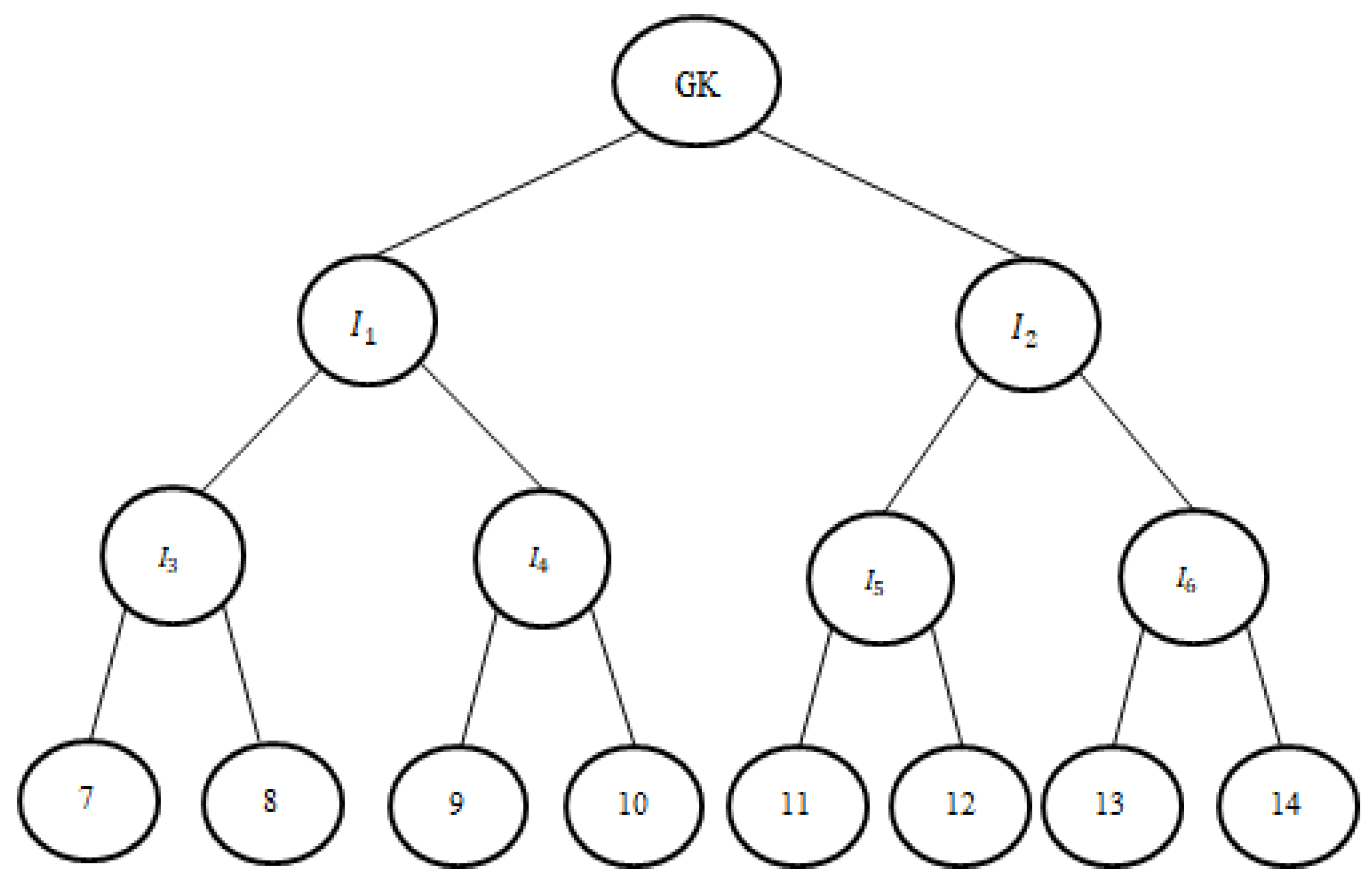
Before looking into the working of MOFT, the working of the earliest OFT scheme is discussed. The OFT scheme uses a binary tree data structure, which is balanced for key management. Each leaf node of the binary tree denotes a group member and is assigned a node key. The group members already possess a shared secret with the KMS with which the node key can be encrypted and distributed to the respective group member. The one-way function on the key is the blinded secret of the leaf node. The mixing function of the left and right child’s blinded node secret gives the intermediate node secret. In this way, the intermediate node secrets are calculated in a bottom-up fashion to compute the group key.
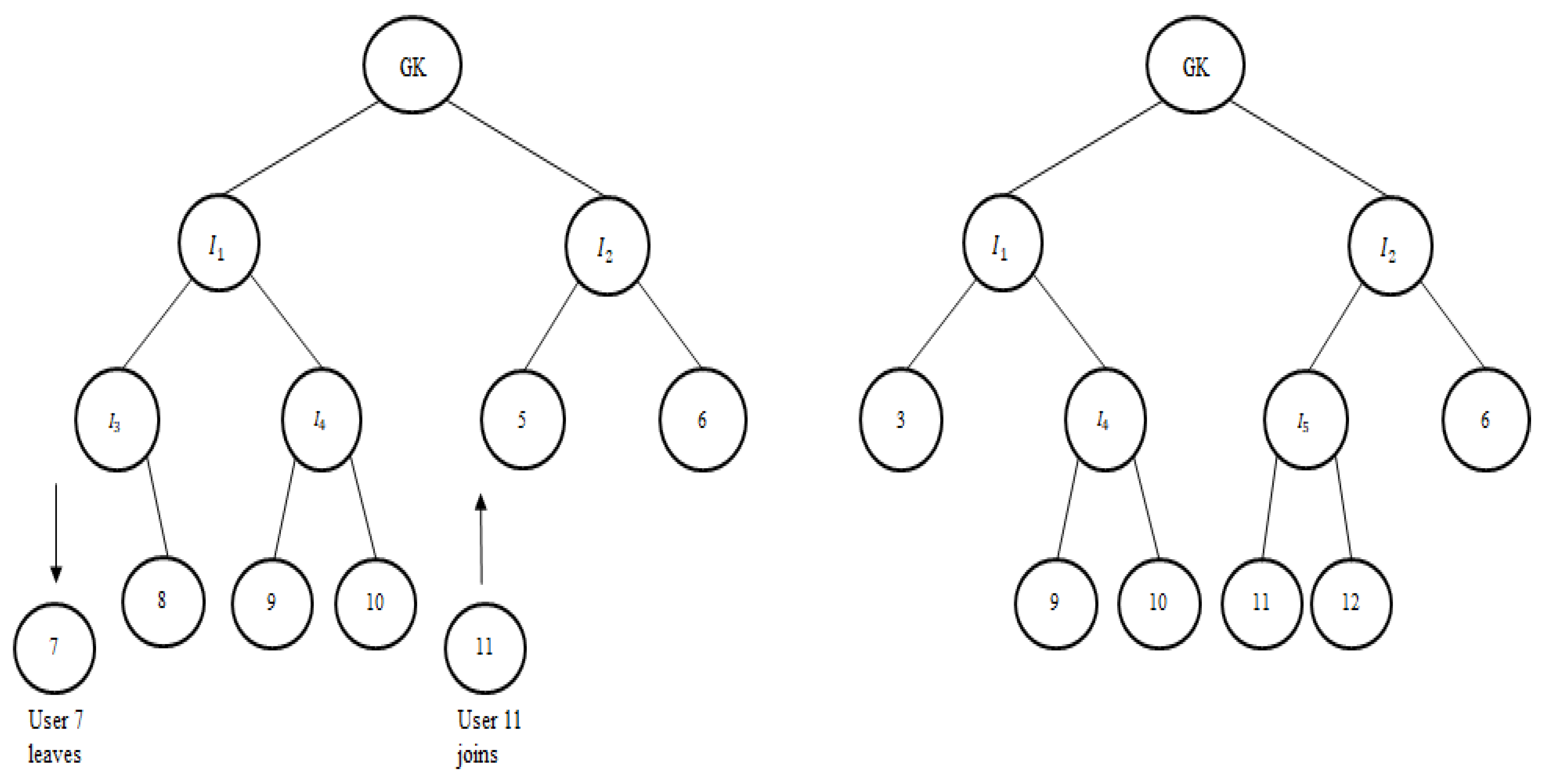
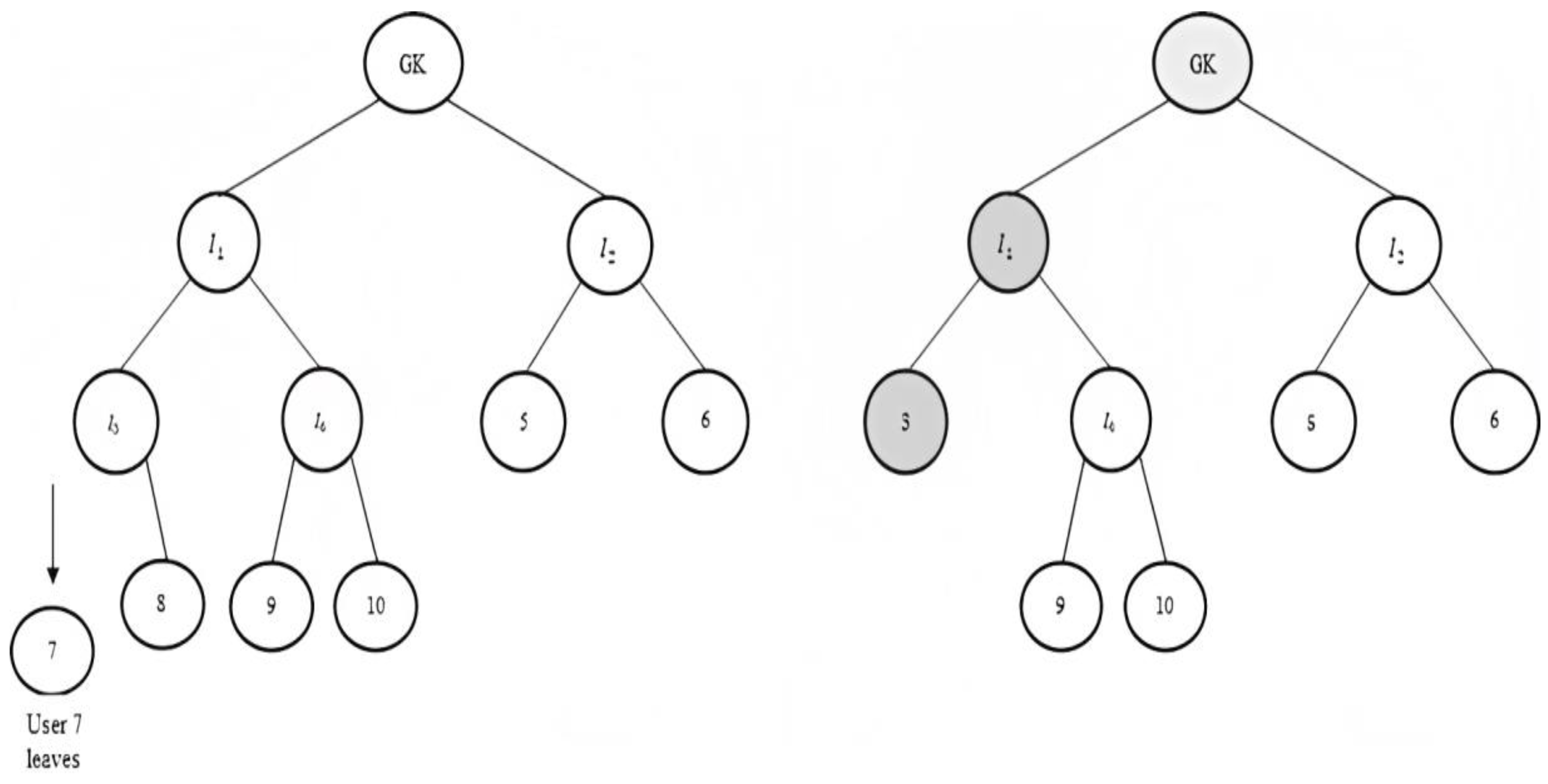
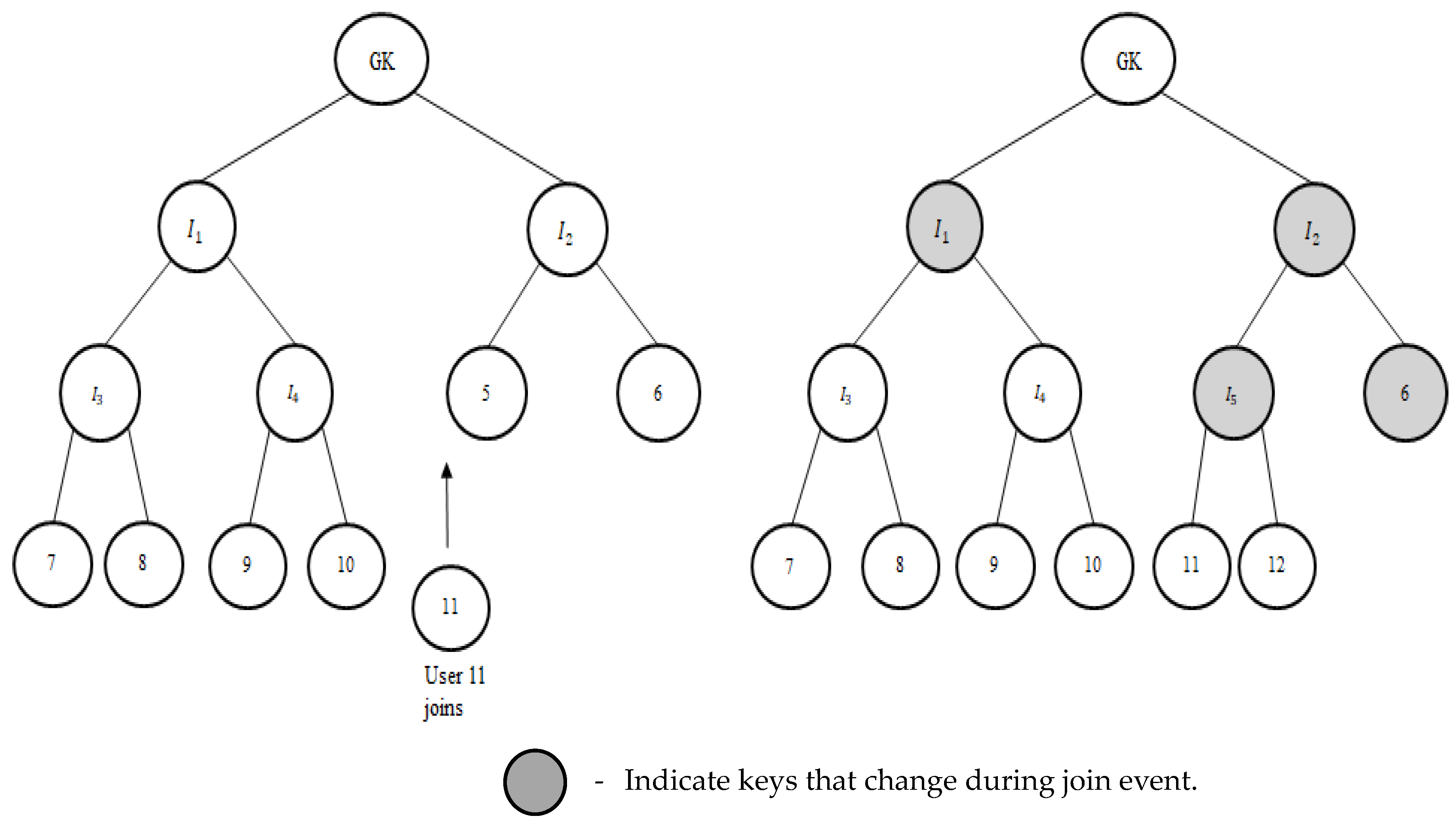
In Figure 4, the numbers represent the nodes of the binary tree, whereas the intermediate nodes are represented using the symbol I . When a user exits or joins, the keys on the trail of the leaving or joining node are changed. As in Figure 5, when user 7 leaves, node 8 takes the position of I 3 as the leaf node. Node 3 is issued a new node key n k 3 . Node 3 then calculates its new blinded node secret b l 3 , thus leading to a new S I 1 intermediate node secret and group key G K . Users 9 and 10 are issued the new b l 3 encrypted using S I 4 . Hence, users 9 and 10 calculate S I 1 = g b l 3 , b l 4 . Users 11 and 12 are issued new b l k 1 encrypted using S I 2 . Now, the group key is calculated as G K = g b l 1 , b l 2 .
Figure 4. Group tree structure.
Figure 5. User leave and join event.
Now, as in Figure 5, if user 11 joins, the user is issued the node secret n k 11 . User 11 will calculate its blinded secret b l 11 . User 12 is issued b l 11 encrypted using its own node secret n k 12 . Users 11 and 12 calculate = g b l 11 , b l 12 . Users 11, 12, and 6 calculate S I 2 = g b l 5 , b l 6 . Then, users 3, 9, and 10 are supplied with the blinded secret of node I 2 so that the group key G K can be calculated. Although the scheme has the advantage of reduced communication costs, it is prone to collusion attacks. Several enhanced OFT-based approaches are proposed [38,39] to attain collusion resistance but with higher communication cost or computation cost.

Collusion Attack in OFT

When two users collude to obtain unauthorized information, it can be termed a collusion attack. For instance, when user 7 leaves at time t1, they know the b l 1 value. Now, new user 11 joins at time t2. User 11 knows the b l 1 value. Now, the left user 7 colludes with malicious user 11 and uses b l 2 , which is known to user 7, and b l 1 , which is known to user 11, to compute the group key G K = g b l 1 , b l 2 for the timeline between t1 and t2. Thus, OFT is prone to collusion attacks. There are works based on OFT that avoid collusion attacks often but with an enhanced cost. Our work attempts to provide a collusion-resistant OFT-based scheme but with a reduced cost.

3.4. MOFT

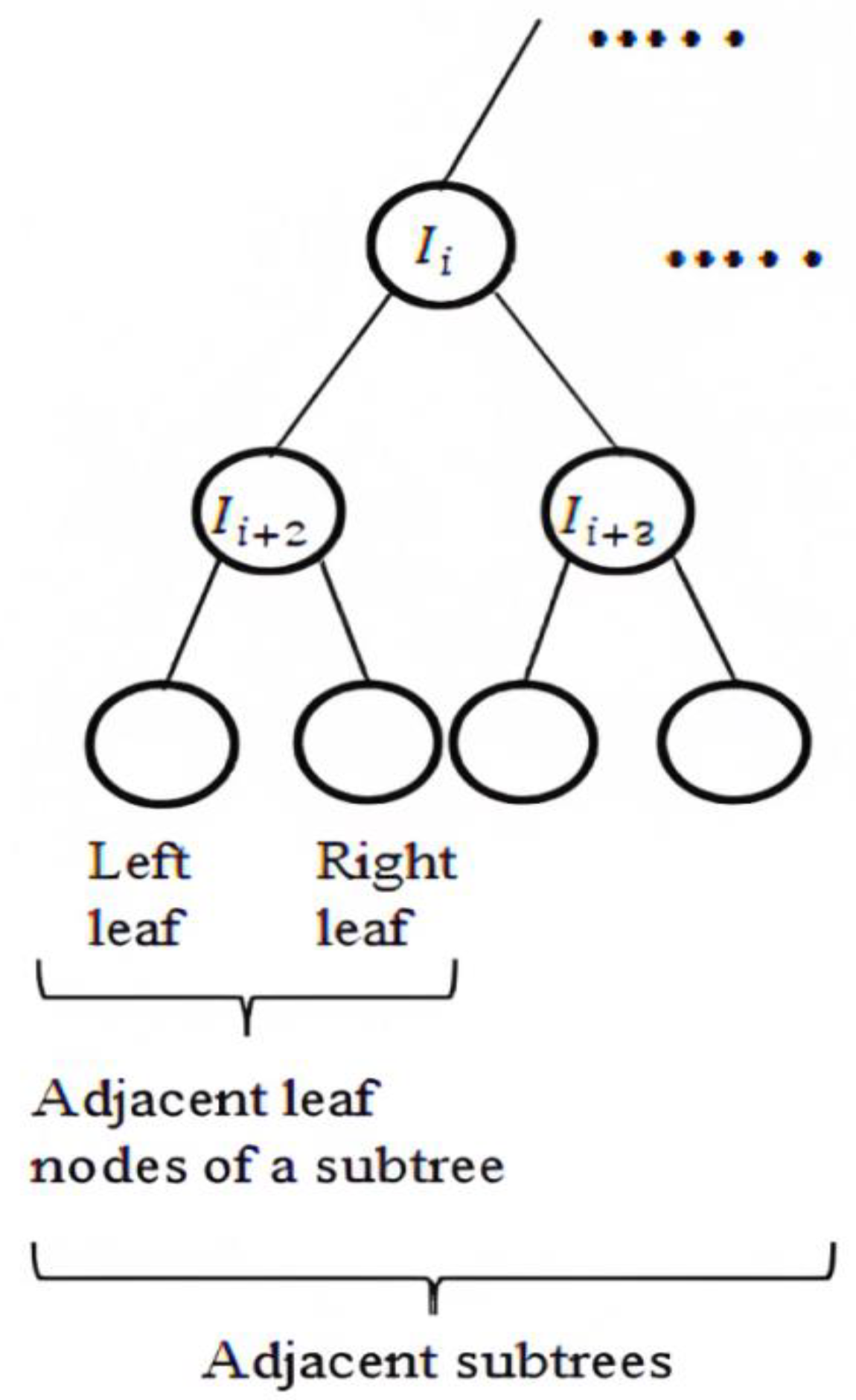
The proposed MOFT scheme uses a binary tree just like OFT maintained by a key management server. The proposed scheme also assumes that the users joining the group have an individual secret key K pre-established with the KMS. In the modified OFT, instead of leaf nodes being issued with the node key, the adjacent leaf nodes are issued with a common adjacent shared secret K a ( l , r ) .
Now, as in Figure 6, the left and right leaf nodes share a common adjacent shared secret K a ( l , r ) . The first intermediate node nearest to the leaf nodes I i + 2 will have the same K a ( l , r ) as node secret, and the blinded node secret of I i + 2 is calculated as f ( K a ( l , r ) ) . The next intermediate node secret I I is calculated as g ( b l i + 2 , b l i + 3 ) . Further node secrets are calculated in a bottom-up style as in OFT to compute the group key G K .
Figure 6. Adjacent subtree structure.

3.4.1. Top-Down Growth

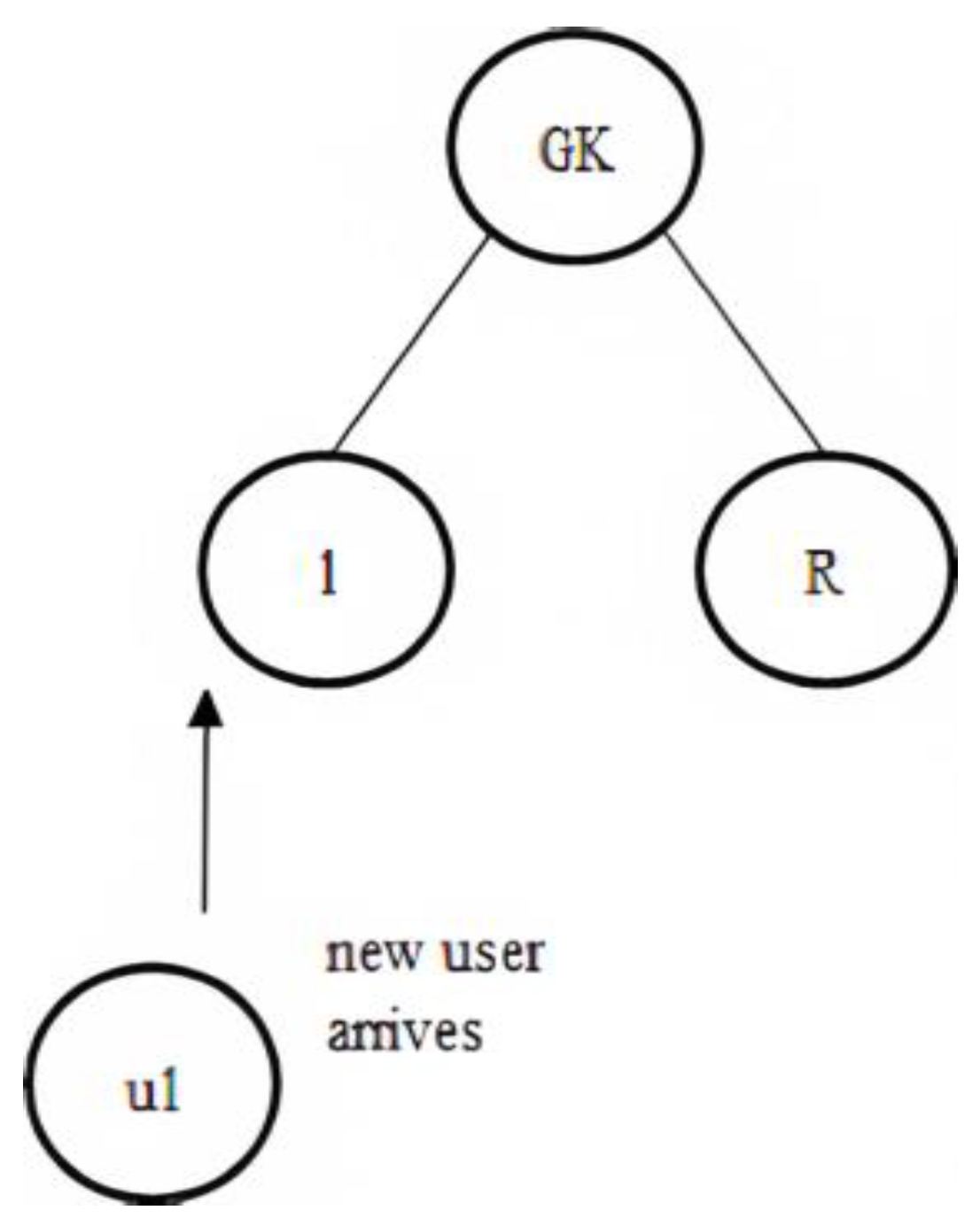
As in Figure 7, when a new user u 1 arrives, the l node performs a mixing function g ( K a l , r , K l ) in which K l is the pre-established secret of user l , and K a l , r is the adjacent shared secret between nodes l and r . This is the new adjacent secret for l and u 1 . The r node’s blinded node secret becomes f K a l , r . Similarly, when a new user arrives on the right side of the tree, g ( K a l , r , K r ) is calculated and issued to the new user as an adjacent secret. In this way, a certain amount of communication cost is cut off.
Figure 7. Top-down growth during new user join.

3.4.2. User Leave and Join Event

When user 7 leaves, as in Figure 8, node 8 becomes leaf node 3. In the modified OFT node, 3 is issued with a new adjacent shared secret value K a 3 . The adjacent secret is blinded using a one-way function to obtain the blinded secret of node 3. Users 9 and 10 are supplied with a new blinded secret of node 3. S I 2 is calculated as ( g ( b l 3 , b l 4 ) . Users 7, 8, 9, and 10 are supplied with the blinded secret of I 2 . The keys that change during the user leave event are highlighted in Figure 8.
Figure 8. User leave event, keys that change during leave event.
When user 11 joins as in Figure 9, node 5’s adjacent shared secret is changed to g ( K a 5,6 , K 5 ) . The changed adjacent secret is issued to user 11 as K a 11,12 encrypted using its individual secret key K 11 . The blinded secret of I 5 is calculated as f ( K a 11,12 ) . User 6’s adjacent secret K a ( 5,6 ) is blinded using a one-way function f x and becomes its blinded secret b l 6 = f ( K a 5,6 ) . User 11 is issued with the blinded secret b l 6 . Users 6, 11, and 12 calculate S I 2 = g ( b l 5 , b l 6 ) . Users 7, 8, 9, and 10 are supplied with SI2, which is encrypted using the node secret of I 1 . As in ROFT [39], another one-way function is performed on each one of the blinded node secrets along the trail of the joining user and supplied to them as a new blinded secret. This makes the MOFT collusion-resistant. The keys that change during the user join event are highlighted in Figure 9. Hence, the new users entering the group do not know any previously used keys, assuring backward secrecy. The modified OFT reduces the communication cost compared to the original OFT.
Figure 9. User join event.

4. Security Analysis

The work one way function tree (OFT) proposes a new generic definition for collusion resistance. Although our scheme follows ROFT to be collusion-resistant, a new proposition is made to prove the collusion resistance of our scheme.
Proposition 1. 
The OFT scheme is collusion-resistant if the leaving users at the time  t 1  and joining users at time  t 2  cannot compute any unknown node secrets if the intersection of their set of known secrets does not contain any adjacent pair node secrets, i.e., the leaving users at time  t 1  known key set  t l e a v e  and the joining users at time  t 2  known key set  t j o i n  should not contain the secrets of adjacent pairs  t l e a v e   t j o i n   s e c r e t s   o f   p a i r { I o i ,   I o i + 1 }  where  o i { s e t   o f   o d d   n u m b e r s } ,  t l e a v e  is the key set known in the time duration between  t 1  and the first key update after the user leaves  t M I N ,  t j o i n    is the key set known in the time interval between the last key update that happened before the user join  t M A X    and  t 2 .
Proof. 
The group key is calculated in a bottom-up fashion using a mixing function g x of adjacent blinded node secrets b l o i , b l o i + 1 . So, to compute any parent intermediate node secret SIi, both the child’s adjacent blinded secrets and adjacent secrets should be known. Hence, if the chain of knowing adjacent secrets and adjacent blinded secrets is broken then the colluding users cannot compute any intermediate key or the group key for an unauthorized time. □
Theorem 1. 
MOFT is collusion-resistant.
Proof of Theorem. 
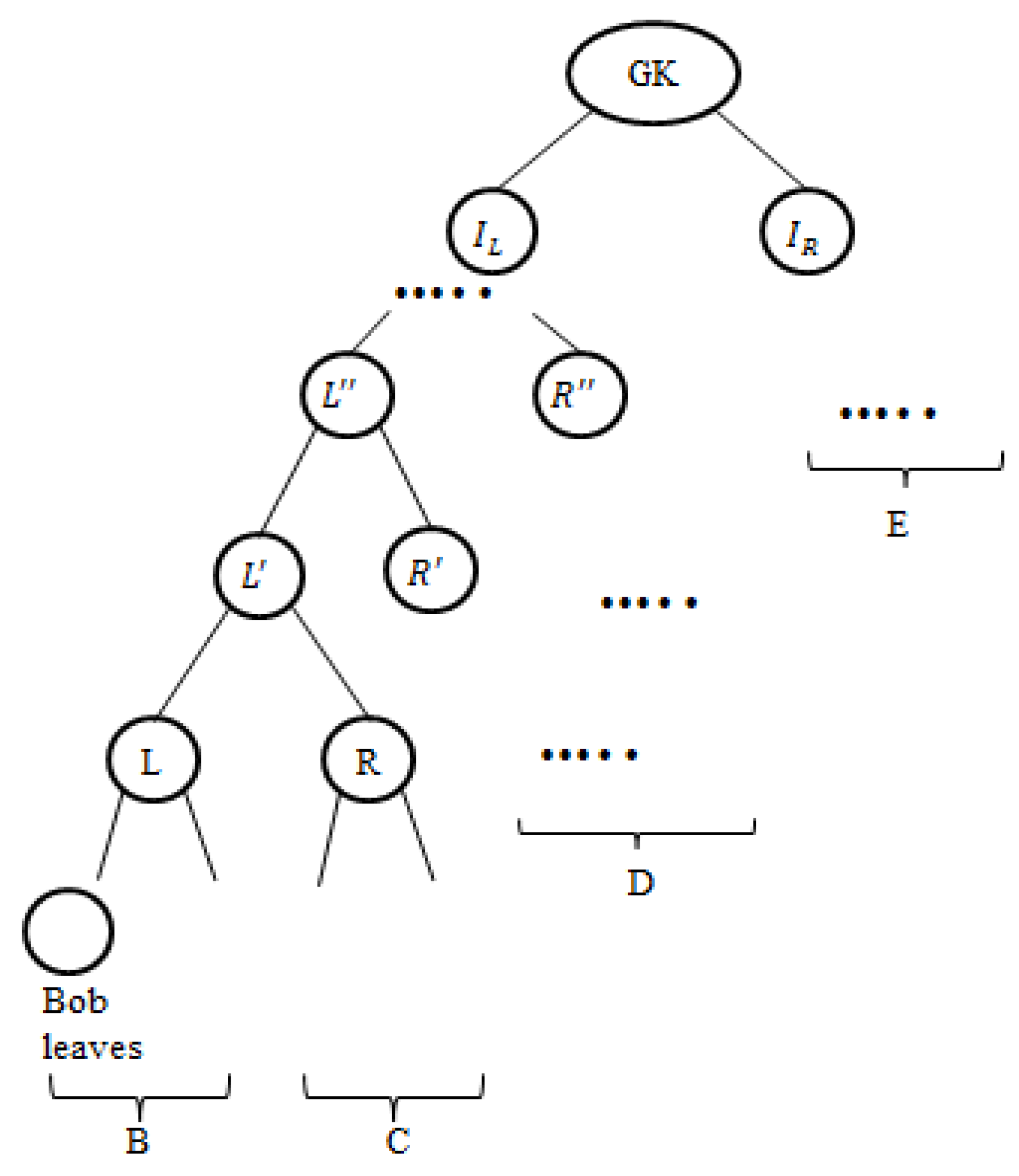
According to Proposition 1, the OFT scheme is collusion-resistant if the leaving users t l e a v e and the joining users t j o i n cannot collude to contain any p a i r { S I o i , S I o i + 1 } . Consider user Bob leaves at the time t l , as in Figure 10 (B–E) subtree sections. The set of keys Bob knows after time t l , t l e a v e =   s e c r e t   k e y   o f   n o d e s { R , R , R , I R } . To perform a collusion attack, Bob has to collude with any of the joining users at the time t j . Consider Alice joining at the time t j at any of the sections B, C, D, or E. The known key set of Alice that existed before time t j , t j o i n = { n u l l } since all the node secrets on the path are hashed using the one-way function before being distributed to Alice. The collusion of Alice and Bob known key sets t l e a v e t j o i n = s e c r e t   k e y   o f   n o d e s { R , R , R , I R } . Hence, according to Proposition 1, the proposed MOFT confirms collusion resistance. □
Figure 10. Collusion attack.

5. Performance Evaluation

The proposed MOFT is evaluated by comparing it with the prevailing OFT-based group key management approaches in terms of computation and communication cost.
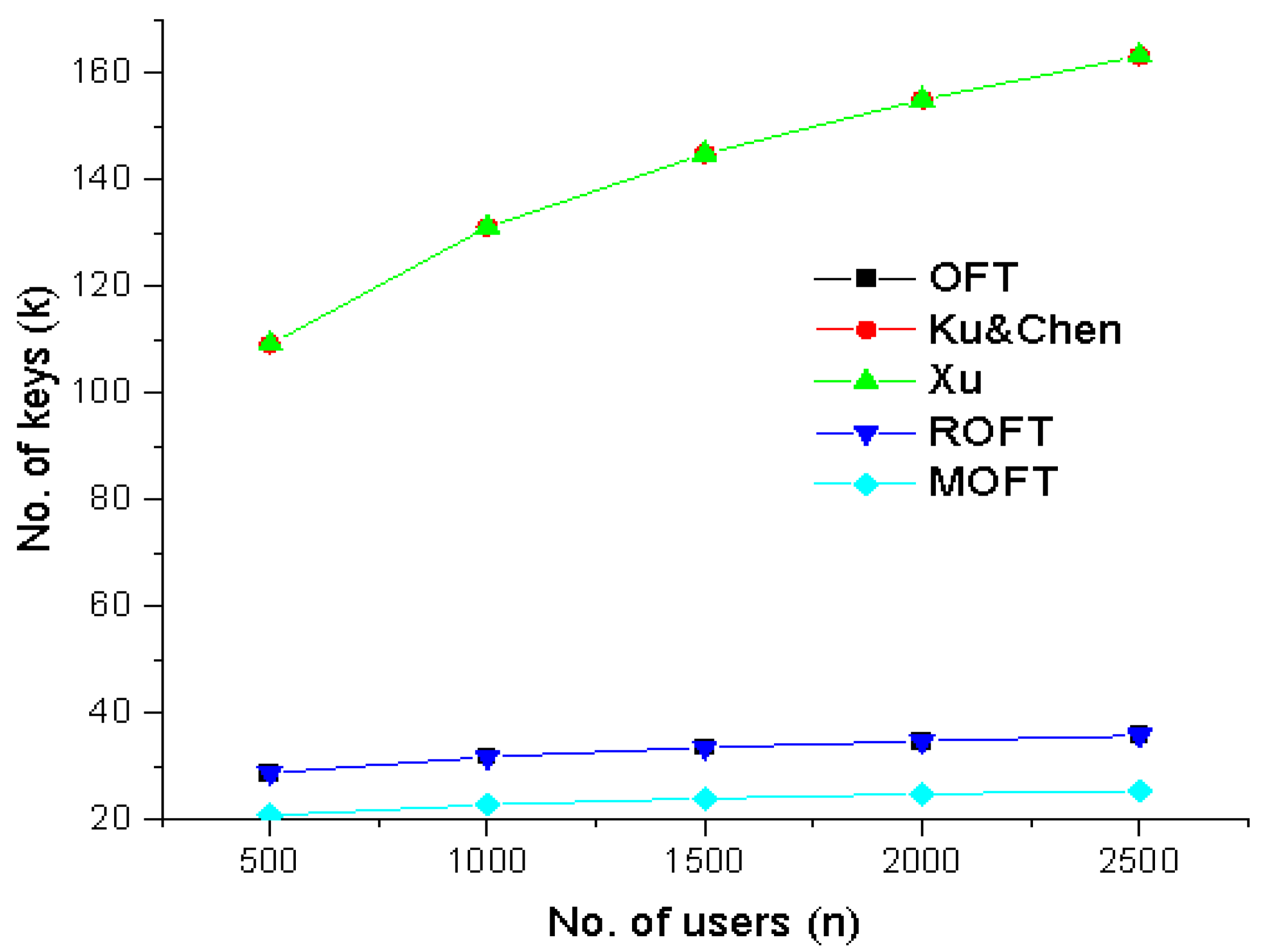
From Table 2 and Table 3, it is evident that the proposed MOFT approach attains the least communication cost, and the cost is even less than the OFT approach itself. The proposed MOFT reduces the communication cost by 39% than the earliest OFT. Although the computation cost is higher than the OFT scheme, it is comparatively less than the existing collusion-resistant OFT schemes. Figure 11 depicts the evaluation of the proposed approach with the existing approaches regarding total communication cost. The schemes OFT and ROFT share the same communication cost. Ku and Chen’s and Xu’s schemes share the same communication cost, whereas the proposed work’s communication cost is less with ( 2 l o g 2 n + 3 ) × L messages, which is lesser than the original OFT. The number of messages transferred is equal to the number of keys needed to be distributed.
Table 2. User join event.
Table 3. User leave event.
Figure 11. Comparison of proposed MOFT communication cost with OFT [19], Ku & Chen [37], Xu [38] and ROFT [39].

5.1. Load on SDN-Centered KMS

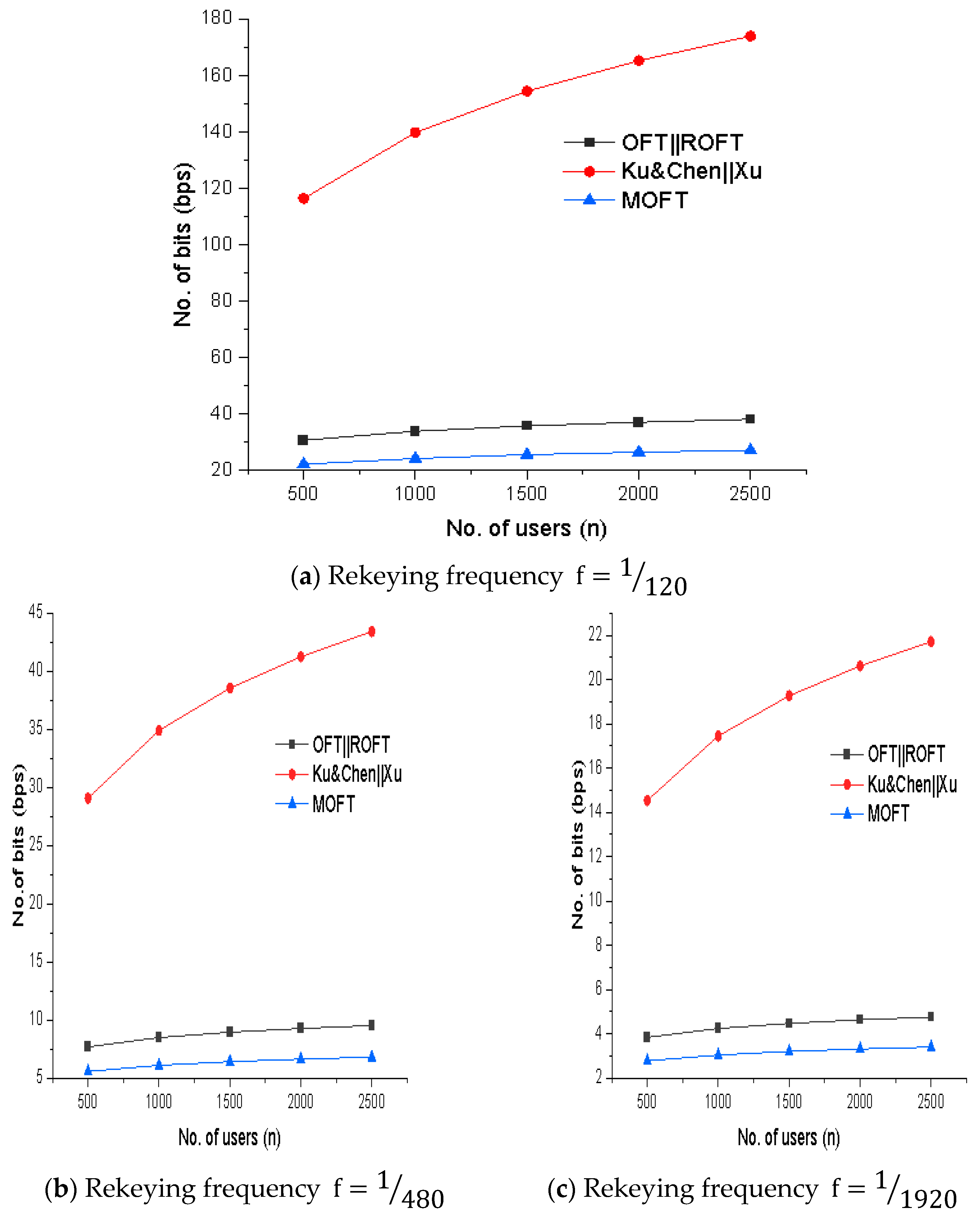
Group rekeying occurs in the event of the user joining or exiting the group. For static applications of IoT like smart home, the devices joining and leaving the smart home network are less frequent. For dynamic applications like retail, healthcare, etc., the rekeying frequency is high. Figure 12a–c depict the communication load on SDN-centered KMS for different rekeying frequencies f = 1 120 , 1 480 , and 1 1920 respectively.
Figure 12. Rekeying frequency comparison of proposed MOFT with OFT [19], Ku & Chen [37], Xu [38] and ROFT [39].

5.2. Storage Cost

The maximum storage cost of the OFT scheme is 2 ( l o g 2 n + 1 ) . The proposed work uses an adjacent secret shared between adjacent nodes instead of the individual node secret; hence, the storage cost of MOFT is 2 l o g 2 n .

6. MOFT Tailored for IoT

Since the adjacent secret for the device is generated by the admin and shared with the centralized server, the admin can generate all the key materials subsequently needed to obtain the group key of all groups in the application. To reduce the overhead on the centralized key management server, the admin device can act as an edge device and take part in the key distribution part. The devices on the left side of the root node can obtain group keys from the centralized server, and the right-side devices can obtain their keys from the admin or vice versa. This will further reduce the overhead on the centralized server. To sum up, even though the group exhibits regular rekeying with membership changes, the suggested MOFT minimizes the communication cost and thus reduces the network traffic to a significant extent. The proposed MOFT also offers lower storage overhead on group member devices. The suggested solution additionally provides collusion resistance using basic cryptographic primitives such as a one-way function and mixing function. The computation overhead is lower than the collusion-deprived enhancements of OFT. All these features make MOFT secure and adaptable to the IoT environment.
The proposed work using the SDN controller, switches, and routers are simulated using the Mininet [49] simulator installed in an oracle VM. The topology is created with 30 hosts, an SDN controller, and 2 switches. The flow rule is set using python script. The hosts are grouped into three groups with each group consisting of ten hosts. The communication link is set only for the hosts of the same group. This restricts the communication between hosts of different groups.

7. Conclusions

Unlike traditional networks, the IoT’s network is heterogeneous, with different lightweight communication protocols for communication with lesser bandwidth. Treating this heterogeneous network as a single network and providing it with essential security solutions is inevitable. Hence, a group management framework with an SDN-centered server as a trusted third party is proposed to tackle heterogeneity and aid in secure key distribution. For key distribution to dynamic groups, a cost-efficient, scalable, and centralized key management technique is undeniable. Although CRT-based schemes are efficient, they lack scalability. LKH and OFT are the earliest, most familiar, and most widely used centralized key management techniques. OFT was proposed as an enhancement to LKH with reduced communication costs, yet it suffers from collusion attacks. The proposed MOFT technique is novel, has minimal communication overhead, and reduces network traffic by 39% compared to OFT. The new proposition defined for security analysis proves that MOFT is collusion-resistant with optimal computation overhead.

Author Contributions

Conceptualization, A.T. and J.W.K.; Methodology, A.T., J.W.K. and J.A.; Validation, J.E.R.; Writing—original draft, A.T.; Writing—review and editing, J.A. and J.E.R.; Visualization, J.E.R.; Supervision, J.W.K. and J.A. All authors have read and agreed to the published version of the manuscript.

Funding

This research received no external funding.

Institutional Review Board Statement

Not applicable.

Data Availability Statement

The data used in this research are available upon request to the authors.

Conflicts of Interest

The authors declare no conflicts of interest.

References

  1. Farash, M.S.; Turkanović, M.; Kumari, S.; Hölbl, M. An efficient user authentication and key agreement scheme for heterogeneous wireless sensor network tailored for the Internet of Things environment. Ad Hoc Netw. 2016, 36, 152–176. [Google Scholar] [CrossRef]
  2. Heo, G.; Chae, K.; Doh, I. Hierarchical Blockchain-based Group and Group Key Management Scheme Exploiting Unmanned Aerial Vehicles for Urban Computing. IEEE Access 2022, 10, 27990–28003. [Google Scholar] [CrossRef]
  3. Nikbakht Bideh, P. LMGROUP: A Lightweight Multicast Group Key Management for IoT Networks. In International Conference on Information Security Practice and Experience; Springer: Cham, Switzerland, 2022; pp. 213–230. [Google Scholar] [CrossRef]
  4. Sakarindr, P.; Ansari, N. Survey of security services on group communications. IET Inf. Secur. 2010, 4, 258–272. [Google Scholar] [CrossRef]
  5. Xu, J.; Li, L.; Lu, S.; Yin, H. A novel batch-based LKH tree balanced algorithm for group key management. Sci. China Inf. Sci. 2017, 60, 108301. [Google Scholar] [CrossRef]
  6. Kung, Y.-H.; Hsiao, H.-C. GroupIt: Lightweight Group Key Management for Dynamic IoT Environments. IEEE Internet Things J. 2018, 5, 5155–5165. [Google Scholar] [CrossRef]
  7. Kim, Y.; Perrig, A.; Tsudik, G. Tree-based group key agreement. ACM Trans. Inf. Syst. Secur. 2004, 7, 60–96. [Google Scholar] [CrossRef]
  8. Zhou, W.; Xu, Y.; Wang, G. Distributed Group Key Management Using Multilinear Forms for Multi-privileged Group Communications. In Proceedings of the 2013 12th IEEE International Conference on Trust, Security and Privacy in Computing and Communications, Melbourne, VIC, Australia, 16–18 July 2013. [Google Scholar] [CrossRef]
  9. Sepulveda, J.; Flórez, D.; Immler, V.; Gogniat, G.; Sigl, G. Efficient security zones implementation through hierarchical group key management at NoC-based MPSoCs. Microprocess. Microsyst. 2017, 50, 164–174. [Google Scholar] [CrossRef]
  10. Ali, S.; Rauf, A.; Islam, N.; Farman, H.; Jan, B.; Khan, M.; Ahmad, A. SGKMP: A scalable group key management protocol. Sustain. Cities Soc. 2018, 39, 37–42. [Google Scholar] [CrossRef]
  11. De Salve, A.; Di Pietro, R.; Mori, P.; Ricci, L. Logical key hierarchy for groups management in Distributed Online Social Network. In Proceedings of the 2016 IEEE Symposium on Computers and Communication (ISCC), Messina, Italy, 27–30 June 2016; pp. 710–717. [Google Scholar] [CrossRef][Green Version]
  12. Inoue, D.; Kuroda, M. FDLKH: Fully decentralized key management scheme on logical key hierarchy. In Applied Cryptography and Network Security; Springer: Berlin/Heidelberg, Germany, 2004; Volume 3089, pp. 339–354. [Google Scholar] [CrossRef]
  13. Wu, Q.; Qin, B.; Zhang, L.; Domingo-Ferrer, J.; Farras, O.; Manjon, J.A. Contributory broadcast encryption with efficient encryption and short ciphertexts. IEEE Trans. Comput. 2016, 65, 466–479. [Google Scholar] [CrossRef]
  14. Der Chou, L.; Tseng, C.-W.; Huang, Y.-K.; Chen, K.-C.; Ou, T.-F.; Yen, C.-K. A Security Service on-demand Architecture in SDN. In Proceedings of the 2016 International Conference on Information and Communication Technology Convergence (ICTC), Jeju, Republic of Korea, 19–21 October 2016; pp. 287–291. [Google Scholar] [CrossRef]
  15. Taurshia, A.; Kathrine, J.W.; Shibin, D. Prognostic Views on Software Defined Networks Based Security for Internet of Things. Commun. Comput. Inf. Sci. 2019, 1116, 100–116. [Google Scholar] [CrossRef]
  16. Joshi, K.D.; Kataoka, K. pSMART: A lightweight, privacy-aware service function chain orchestration in multi-domain NFV/SDN. Comput. Netw. 2020, 178, 107295. [Google Scholar] [CrossRef]
  17. Paolucci, F.; Cugini, F.; Castoldi, P.; Osinski, T. Enhancing 5G SDN/NFV Edge with P4 Data Plane Programmability. IEEE Netw. 2021, 35, 154–160. [Google Scholar] [CrossRef]
  18. Vijayakumar, P.; Bose, S.; Kannan, A. Chinese remainder Theorem based centralised group key management for secure multicast communication. IET Inf. Secur. 2014, 8, 179–187. [Google Scholar] [CrossRef]
  19. Sherman, A.T.; McGrew, D.A. Key establishment in large dynamic groups using one-way function trees. IEEE Trans. Softw. Eng. 2003, 29, 444–458. [Google Scholar] [CrossRef]
  20. Ezekiel, S.; Divakaran, D.M.; Gurusamy, M. Dynamic attack mitigation using SDN. In Proceedings of the 2017 27th International Telecommunication Networks and Applications Conference (ITNAC), Melbourne, VIC, Australia, 22–24 November 2017; pp. 1–6. [Google Scholar] [CrossRef]
  21. Babiceanu, R.F.; Seker, R. Cyber resilience protection for industrial internet of things: A software-defined networking approach. Comput. Ind. 2019, 104, 47–58. [Google Scholar] [CrossRef]
  22. Babiceanu, R.F.; Seker, R. Cybersecurity and resilience modelling for software-defined networks-based manufacturing applications. In Service Orientation in Holonic and Multi-Agent Manufacturing; Springer: Berlin/Heidelberg, Germany, 2017; Volume 694, pp. 167–176. [Google Scholar] [CrossRef]
  23. Piedrahita, A.F.M.; Gaur, V.; Giraldo, J.; Cardenas, A.A.; Rueda, S.J. Leveraging Software-Defined Networking for Incident Response in Industrial Control Systems. IEEE Softw. 2017, 35, 44–50. [Google Scholar] [CrossRef]
  24. Madhawa, S.; Balakrishnan, P.; Arumugam, U. Employing invariants for anomaly detection in software defined networking based industrial internet of things. J. Intell. Fuzzy Syst. 2018, 35, 1267–1279. [Google Scholar] [CrossRef]
  25. Mansour, A.; Azab, M.; Rizk, M.R.M.; Abdelazim, M. Biologically-inspired SDN-based Intrusion Detection and Prevention Mechanism for Heterogeneous IoT Networks. In Proceedings of the 2018 IEEE 9th Annual Information Technology, Electronics and Mobile Communication Conference (IEMCON), Vancouver, BC, Canada, 1–3 November 2018; pp. 1120–1125. [Google Scholar] [CrossRef]
  26. Chung, J.; Jung, E.-S.; Kettimuthu, R.; Rao, N.S.; Foster, I.T.; Clark, R.; Owen, H. Advance reservation access control using software-defined networking and tokens. Future Gener. Comput. Syst. 2018, 79, 225–234. [Google Scholar] [CrossRef]
  27. Sharma, P.K.; Park, J.H.; Jeong, Y.-S.; Park, J.H. SHSec: SDN based Secure Smart Home Network Architecture for Internet of Things. Mob. Networks Appl. 2019, 24, 913–924. [Google Scholar] [CrossRef]
  28. Demetriou, S.; Zhang, N.; Lee, Y.; Wang, X.; Gunter, C.A.; Zhou, X.; Grace, M.C. HanGuard: SDN-Driven Protection of Smart Home WiFi Devices from Malicious Mobile Apps. In Proceedings of the 10th ACM Conference on Security and Privacy in Wireless and Mobile Networks, Boston, MA, USA, 18–20 July 2017; Volume 2017, pp. 122–133. [Google Scholar] [CrossRef]
  29. Caprolu, M.; Raponi, S.; Di Pietro, R. FORTRESS: An efficient and distributed firewall for stateful data plane SDN. Secur. Commun. Netw. 2019, 2019, 6874592. [Google Scholar] [CrossRef]
  30. Ge, M.; Hong, J.B.; Yusuf, S.E.; Kim, D.S. Proactive defense mechanisms for the software-defined Internet of Things with non-patchable vulnerabilities. Future Gener. Comput. Syst. 2018, 78, 568–582. [Google Scholar] [CrossRef]
  31. Zarca, A.M.; Bernabe, J.B.; Skarmeta, A.; Calero, J.M.A. Virtual IoT HoneyNets to mitigate cyberattacks in SDN/NFV-Enabled IoT networks. IEEE J. Sel. Areas Commun. 2020, 38, 1262–1277. [Google Scholar] [CrossRef]
  32. Wang, S.; Gomez, K.; Sithamparanathan, K.; Asghar, M.R.; Russello, G.; Zanna, P. Mitigating ddos attacks in sdn-based iot networks leveraging secure control and data plane algorithm. Appl. Sci. 2021, 11, 929. [Google Scholar] [CrossRef]
  33. Wani, A.; Revathi, S.; Khaliq, R. SDN-based intrusion detection system for IoT using deep learning classifier (IDSIoT-SDL). CAAI Trans. Intell. Technol. 2021, 6, 281–290. [Google Scholar] [CrossRef]
  34. Aslam, M.; Ye, D.; Tariq, A.; Asad, M.; Hanif, M.; Ndzi, D.; Chelloug, S.A.; Elaziz, M.A.; Al-Qaness, M.A.A.; Jilani, S.F. Adaptive Machine Learning Based Distributed Denial-of-Services Attacks Detection and Mitigation System for SDN-Enabled IoT. Sensors 2022, 22, 2697. [Google Scholar] [CrossRef]
  35. Burmester, M.; Desmedt, Y. A secure and efficient conference key distribution system. Lect. Notes Comput. Sci. 1995, 950, 275–286. [Google Scholar] [CrossRef]
  36. Waller, D.; Harder, E.; Agee, R. Key Management for Multicast: Issues and Architectures. 1999. Available online: https://www.rfc-editor.org/rfc/rfc2627 (accessed on 9 March 2023).
  37. Ku, W.C.; Chen, S.M. An improved key management scheme for large dynamic groups using one-way function trees. In Proceedings of the 2003 International Conference on Parallel Processing Workshops, Kaohsiung, Taiwan, 6–9 October 2003; Volume 2003, pp. 391–396. [Google Scholar] [CrossRef]
  38. Xu, X.; Wang, L.; Youssef, A.; Zhu, B. Preventing collusion attacks on the one-way function tree (OFT) scheme. In Applied Cryptography and Network Security; Springer: Berlin/Heidelberg, Germany, 2007; Volume 4521, pp. 177–193. [Google Scholar] [CrossRef]
  39. Sun, Y.; Chen, M.; Bacchus, A.; Lin, X. Towards collusion-attack-resilient group key management using one-way function tree. Comput. Netw. 2016, 104, 16–26. [Google Scholar] [CrossRef]
  40. Festijo, E.; Jung, Y.; Peradilla, M. Software-defined security controller-based group management and end-to-end security management. J. Ambient. Intell. Humaniz. Comput. 2019, 10, 3365–3382. [Google Scholar] [CrossRef]
  41. Mansour, A.; Malik, K.M.; Alkaff, A.; Kanaan, H. ALMS: Asymmetric Lightweight Centralized Group Key Management Protocol for VANETs. IEEE Trans. Intell. Transp. Syst. 2021, 22, 1663–1678. [Google Scholar] [CrossRef]
  42. Tiloca, M.; Dini, G.; Rizki, K.; Raza, S. Group Rekeying Based on Member Join History; Springer: Berlin/Heidelberg, Germany, 2019; Volume 19, pp. 343–381. [Google Scholar] [CrossRef]
  43. Zhang, S.; Han, S.; Zheng, B.; Han, K.; Pang, E. Group Key Management Protocol for File Sharing on Cloud Storage. IEEE Access 2020, 8, 123614–123622. [Google Scholar] [CrossRef]
  44. Tamizhselvan, C. A novel communication-aware adaptive key management approach for ensuring security in IoT networks. Trans. Emerg. Telecommun. Technol. 2022, 2022, e4605. [Google Scholar] [CrossRef]
  45. Komninos, N.; Philippou, E.; Pitsillides, A. Survey in smart grid and smart home security: Issues, challenges and countermeasures. IEEE Commun. Surv. Tutor. 2014, 16, 1933–1954. [Google Scholar] [CrossRef]
  46. Mantas, G.; Lymberopoulos, D.; Komninos, N. Security in Smart Home Environment. In Wireless Technologies for Ambient Assisted Living and Healthcare: Systems and Applications; IGI Global: Hershey, PA, USA, 2010; pp. 170–191. [Google Scholar] [CrossRef]
  47. Chen, Y.-W.; Wang, J.-T.; Chi, K.-H.; Tseng, C.-C. Group-based authentication and key agreement. Wirel. Pers. Commun. 2012, 62, 965–979. [Google Scholar] [CrossRef]
  48. Ouaissa, M.; Rhattoy, A.; Lahmer, M. Group access authentication of machine to machine communications in LTE networks. In Proceedings of the Second International Conference on Internet of things, Data and Cloud Computing, Cambridge, UK, 22–23 March 2017. [Google Scholar] [CrossRef]
  49. Mininet for SDN. Available online: https://github.com/mininet/mininet (accessed on 9 March 2023).
Disclaimer/Publisher’s Note: The statements, opinions and data contained in all publications are solely those of the individual author(s) and contributor(s) and not of MDPI and/or the editor(s). MDPI and/or the editor(s) disclaim responsibility for any injury to people or property resulting from any ideas, methods, instructions or products referred to in the content.

Article Metrics

Citations

Article Access Statistics

Multiple requests from the same IP address are counted as one view.