


Application of Selected Lean Manufacturing Tools to Improve Work Safety in the Construction Industry



Abstract
1. Introduction
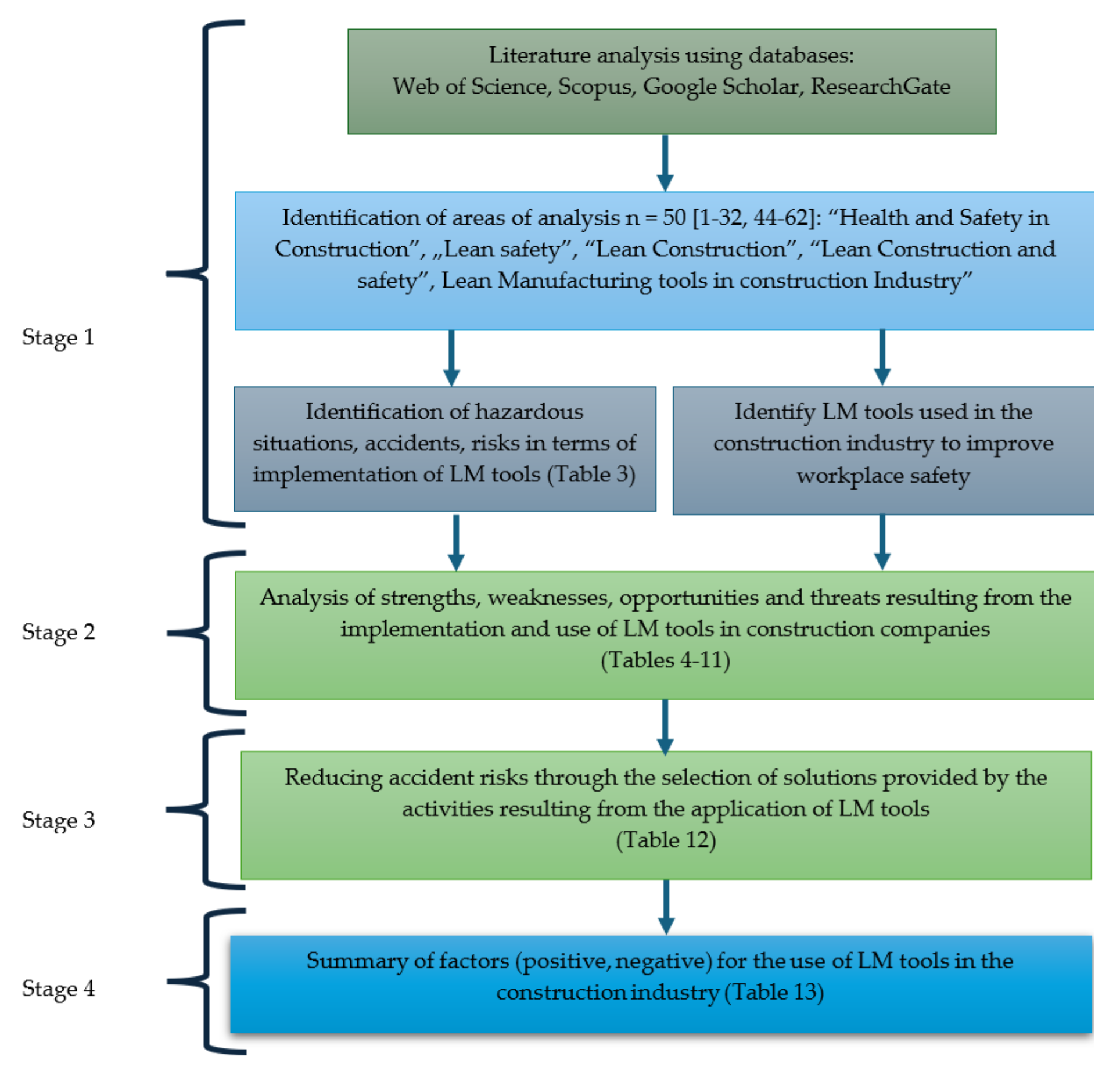
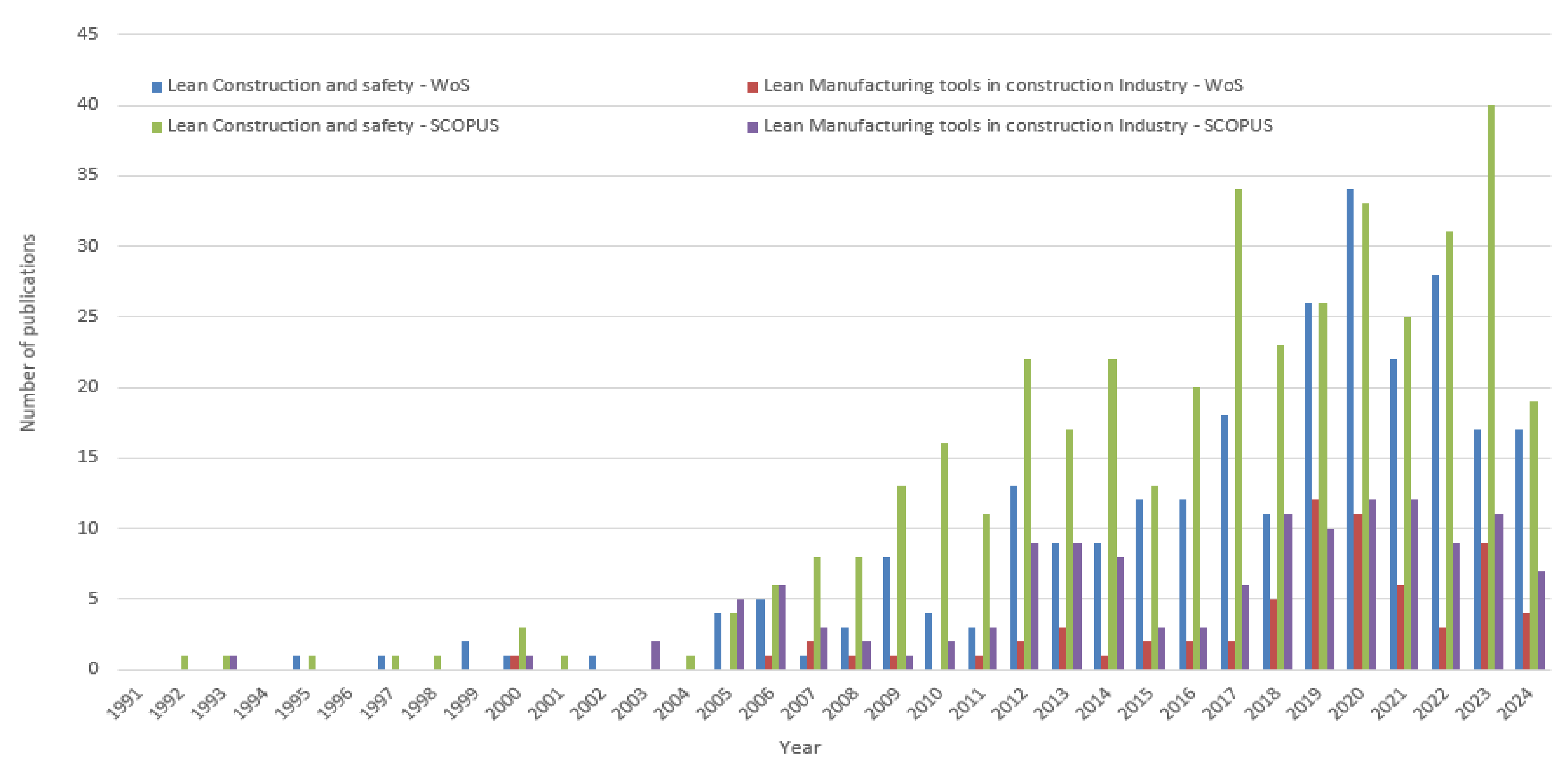
2. Materials and Methods
3. Results
3.1. Dangerous Situations, Hazards on Construction Sites and the Possibility of Using Selected LM Tools to Reduce Them
3.2. Identification of Strengths, Weaknesses, Opportunities, and Threats of Implementing/Using LM Tools in the Construction Industry
3.3. Risk Reduction Activities within the LM Tools Used
3.4. List of Common Factors (Positive/Negative) in the Analysis of Strengths, Weaknesses, Opportunities, and Threats for the Implemented and Used LM Tools
4. Discussion
5. Conclusions
Author Contributions
Funding
Institutional Review Board Statement
Informed Consent Statement
Data Availability Statement
Conflicts of Interest
References
- Soltanmohammadlou, N.; Sadeghi, S.; Hon, C.K.H.; Mokhtarpour-Khanghah, F. Computer vision for behaviour-based safety in construction: A review and future directions. Adv. Eng. Inform. 2020, 43, 100980. [Google Scholar]
- Helander, M.G. Safety hazards and motivation for safe work in the construction industry. Int. J. Ind. Ergon. 1991, 8, 205–223. [Google Scholar] [CrossRef]
- Cheng, C.W.; Lin, C.C.; Leu, S.S. Use of association rules to explore cause–effect relationships in occupational accidents in the Taiwan construction industry. Saf. Sci. 2010, 48, 436–444. [Google Scholar] [CrossRef]
- Nowobilski, T.; Sawicki, M.; Szóstak, M. Analiza rusztowań budowlanych z wykorzystaniem nowych technologii. Builder 2020, 276, 32–34. [Google Scholar] [CrossRef]
- Afzal, M.; Shafiq, M.T.; Jassmi, H.A. Improving construction safety with virtual-design construction technologies—A review. J. Inf. Technol. Constr. 2021, 26, 319–340. [Google Scholar]
- Zhang, M.; Cao, T.; Zhao, X. Applying Sensor-Based Technology to Improve Construction Safety Management. Sensors 2017, 17, 1841. [Google Scholar] [CrossRef] [PubMed]
- Sousa, V.; Almeida, N.M.; Dias, L.A. Risk-based management of occupational safety and health in the construction industry—Part 1: Background knowledge. Saf. Sci. 2014, 66, 75–86. [Google Scholar] [CrossRef]
- Goncalves Filho, A.P.; Waterson, P.; Jun, G.T. Improving accident analysis in construction—Development of a contributing factor classification framework and evaluation of its validity and reliability. Saf. Sci. 2021, 140, 105303. [Google Scholar] [CrossRef]
- Shao, B.; Hu, Z.; Liu, Q.; Chen, S.; He, W. Fatal accident patterns of building construction activities in China. Saf. Sci. 2019, 111, 253–263. [Google Scholar] [CrossRef]
- Ramdan, I.M.; Candra, K.P.; Arlita, D.; Tura, S. Association of demographic characteristics of construction workers and work environments to workplace accident in high building (hotel) construction. Indian J. Public Health Res. Dev. 2019, 10, 1251–1256. [Google Scholar] [CrossRef]
- Cheng, C.W.; Leu, S.S.; Lin, C.C.; Fan, C. Characteristic analysis of occupational accidents at small construction enterprises. Saf. Sci. 2010, 48, 698–707. [Google Scholar] [CrossRef]
- Williams, O.S.; Hamid, R.A.; Misnan, M.S. Accident causal factors on the building construction sites: A review. Int. J. Built Environ. Sustain. 2018, 5, 78–92. [Google Scholar] [CrossRef]
- Kanchana, S.; Sivaprakash, P.; Joseph, S. Studies on labour safety in construction sites. Hindawi Publ. Corp. Sci. World J. 2015, 2015, 590810. [Google Scholar] [CrossRef] [PubMed]
- Oswald, D.; Ahiaga-Dagbui, D.D.; Sherratt, F.; Smith, S.D. An industry structured for unsafety? An exploration of the cost-safety conundrum in construction project delivery. Saf. Sci. 2020, 122, 104535. [Google Scholar] [CrossRef]
- Stala, A.; Dąbrowski, A. Przykład wdrożenia i funkcjonowania systemu monitorowania bezpieczeństwa pracy na placu budowy. Bezp. Pr. 2006, 4, 28–31. [Google Scholar]
- Nowobilski, T.; Hoła, B. The use of unmanned aerial vehicles (drones) in the process of occupational safety management in construction. Prz. Bud. 2023, 9–10, 126–130. [Google Scholar]
- Jeelani, I.; Gheisari, M. Safety challenges of UAV integration in construction: Conceptual analysis and future research roadmap. Saf. Sci. 2021, 144, 105473. [Google Scholar] [CrossRef]
- Choi, H.-W.; Kim, H.-J.; Kim, S.-K.; Na, W.S. An Overview of Drone Applications in the Construction Industry. Drones 2023, 7, 515. [Google Scholar] [CrossRef]
- Cheng, J.C.P.; Wong, P.K.-Y.; Luo, W.M.; Wang, M.; Leung, P.H. Vision-based monitoring of site safety compliance based on worker re-identification and personal protective classification. Autom. Constr. 2022, 139, 104312. [Google Scholar] [CrossRef]
- Martinez, P.; Al-Hussein, M.; Ahmad, R. A scientometric analysis and critical review of computer vision applications for construction. Autom. Constr. 2019, 107, 102947. [Google Scholar] [CrossRef]
- Tay, J.; Shi, P.; He, Y.; Nath, T. Application of Computer Vision in the Construction Industry. Available online: https://ssrn.com/abstract=3487394 (accessed on 28 August 2019).
- Soares Junior, G.G.; Satyro, W.C.; Bonilla, S.H.; Contador, J.C.; Barbosa, A.P.; de Paula Monken, S.F.; Martens, M.L.; Fragomeni, M.A. Construction 4.0: Industry 4.0 enabling technologies applied to improve workplace safety in construction. Res. Soc. Dev. 2021, 10, e280101220280. [Google Scholar] [CrossRef]
- Turner, C.J.; Oyekan, J.; Stergioulas, L.; Griffin, D. Utilizing Industry 4.0 on the Construction Site: Challenges and Opportunities. IEEE Trans. Ind. Inform. 2021, 17, 746–756. [Google Scholar] [CrossRef]
- Zhang, S.; Teizer, J.; Lee, J.K.; Eastman, C.M.; Venugopal, M. Building information modeling (BIM) and safety: Automatic safety checking of construction models and schedules. Autom. Constr. 2013, 29, 183–195. [Google Scholar] [CrossRef]
- Guo, H.; Yu, Y.; Skitmore, M. Visualization technology-based construction safety management: A review. Autom. Constr. 2017, 73, 135–144. [Google Scholar] [CrossRef]
- Nnaji, C.; Gambatese, J.; Lee, H.W.; Zhang, F. Improving construction work zone safety using technology: A systematic review of applicable technologies. J. Traffic Transp. Eng. 2020, 7, 61–78. [Google Scholar] [CrossRef]
- Dobrucali, E.; Demirkesen, S.; Sadikoglu, E.; Zhang, C.; Damci, A. Investigating the impact of emerging technologies on construction safety performance. Eng. Constr. Archit. Manag. 2024, 31, 1322–1347. [Google Scholar] [CrossRef]
- Lee, T.Y.; Ahmad, F.; Sarijari, M.A. Current status and future research trends of construction labor productivity monitoring: A bibliometric review. Buildings 2023, 13, 1479. [Google Scholar] [CrossRef]
- Chi, C.F.; Yang, C.C.; Chen, Z.L. In-depth accident analysis of electrical fatalities in the construction industry. Int. J. Ind. Ergon. 2009, 39, 635–644. [Google Scholar] [CrossRef]
- Winge, S.; Albrechtsen, E. Accident types and barrier failures in the construction industry. Saf. Sci. 2018, 105, 158–166. [Google Scholar] [CrossRef]
- Chi, C.F.; Chang, T.C.; Ting, H.I. Accident patterns and prevention measures for fatal occupational falls in the construction industry. Appl. Ergon. 2005, 36, 391–400. [Google Scholar] [CrossRef]
- Bigelow, P.L.; Greenstein, S.L.; Keefe, T.J.; Gilkey, D.P. Development of an on-site, behavior-based safety audit for the residential construction industry. Work 1998, 11, 11–20. [Google Scholar] [CrossRef] [PubMed]
- Holweg, M. The Genealogy of Lean Production. J. Oper. Manag. 2007, 25, 420–437. [Google Scholar] [CrossRef]
- Pavnaskar, S.J.; Gershenson, J.K.; Jambekar, A.B. Classification scheme for lean manufacturing tools. Int. J. Prod. Res. 2003, 41, 3075–3090. [Google Scholar] [CrossRef]
- Womack, J.P.; Jones, D.T.; Roos, D. The Machine that Changed the World; HarperPerennial: New York, NY, USA, 1991; pp. 11–14. [Google Scholar]
- Kumar, N.; Hasan, S.S.; Srivastava, K.; Akhtar, R.; Yadav, R.K.; Choubey, V.K. Lean manufacturing techniques and its implementation: A review. Mater. Today Proc. 2022, 64, 1188–1192. [Google Scholar] [CrossRef]
- Melton, T. The benefits of Lean Manufacturing: What Lean Thinking has to offer the process industries. Chem. Eng. Res. Des. 2005, 83, 662–673. [Google Scholar] [CrossRef]
- Imai, M. Gemba Kaizen. Zdroworozsądkowe, Niskokosztowe Podejście do Zarządzania; MT Biznes: Warszawa, Poland, 2006. [Google Scholar]
- Dixit, A.; Dave, V.; Pratap Singh, A. Lean Manufacturing: An Approach for Waste Elimination. Int. J. Eng. Res. Technol. Sci. 2015, 4, 532–536. [Google Scholar] [CrossRef]
- Palange, A.; Dhatrak, P. Lean manufacturing a vital tool to enhance productivity in manufacturing. Mater. Today Proc. 2021, 46, 729–736. [Google Scholar] [CrossRef]
- Kunyoria, J.O.; Aila, F.O. Lean Manufacturing Practices: A Structured Literature Review. World J. Innov. Res. 2022, 13, 9–22. [Google Scholar]
- Yuniarti Utami, E.; Rijal, S.; Iwang, B. Application of Lean Manufacturing Principles in Increasing Factory Productivity. West Sci. J. Econ. Entrep. 2023, 1, 264–270. [Google Scholar]
- Adzrie, M.; Elcy, K.; Joselyn, R.M.; Mohd-Lair, N.; Chai, F.O. Implementation Selected Tools of Lean Manufacturing. J. Phys. Conf. Ser. 2020, 1529, 042007. [Google Scholar] [CrossRef]
- Anvari, A.; Zulkifli, N.; Yusuff, R.M. Evaluation of approaches to safety in lean manufacturing and safety management systems and clarification of the relationship between them. World Appl. Sci. J. 2011, 15, 19–26. [Google Scholar]
- Koskela, L. Application of the New Production Philosophy to Construction; Standford University: Standford, CA, USA, 1992. [Google Scholar]
- Garcés, G.; Pena, C. A Review on Lean Construction for Construction Project Management. Rev. Ing. Constr. 2022, 37, 43–60. [Google Scholar] [CrossRef]
- Demirkesen, S. From Lean Manufacturing to Lean Construction: How Principles, Tools, and Techniques Evolved. In Lean Manufacturing; IntechOpen: Rijeka, Croatia, 2021. [Google Scholar] [CrossRef]
- Ahmed, S.; Hossain, M.; Haq, I. Implementation of lean construction in the construction industry in Bangladesh: Awareness, benefits and challenges. Int. J. Build. Pathol. Adapt. 2021, 39, 368–406. [Google Scholar] [CrossRef]
- Amade, B.; Amaeshi, U.F.; Echeme, I.I.; Onwusonye, S.I.J.; Oguzie, J.O.C. Awareness, use and benefits of lean technologies on construction projects in Nigeria. Int. Sci. Res. J. 2021, 2, 310–322. [Google Scholar]
- Misiurek, K.; Misurek, B. Improvement of the safety and quality of a workplace in the area of the construction industry with the use of the 6S system. Int. J. Occup. Saf. Ergon. 2020, 26, 514–520. [Google Scholar] [CrossRef] [PubMed]
- Varshini, D. A Review of Organizational Adaptation of Lean Construction Techniques. J. Hous. Adv. Inter. Des. 2024, 7, 1–8. [Google Scholar] [CrossRef]
- Aravindh, M.D.; Sriram, N.S.; Nakkeeran, G.; Jayakeerti, M.; Velan, C.; Krishnaraj, L. Synergistic effect of alliance contract and lean methodology on project performance measures in the construction industry: SEM analysis. Technol. Forecast. Soc. Chang. 2023, 192, 122545. [Google Scholar] [CrossRef]
- Bajjou, M.S.; Chafi, A.; Ennadi, A.; El Hammoumi, M. The Practical Relationships between Lean Construction Tools and Sustainable Development: A literature review. J. Eng. Sci. Technol. Rev. 2017, 10, 170–177. [Google Scholar] [CrossRef]
- Shaqour, E.N. The impact of adopting lean construction in Egypt: Level of knowledge, application, and benefits. Ain Shams Eng. J. 2022, 13, 101551. [Google Scholar] [CrossRef]
- Li, S.; Fang, Y.; Wu, X. A systematic review of lean construction in Mainland China. J. Clean. Prod. 2020, 257, 120581. [Google Scholar] [CrossRef]
- Abu Aisheh, Y.I.; Tayeh, B.A.; Alaloul, W.S.; Almalki, A. Health and safety improvement in construction projects: A lean construction approach. Int. J. Occup. Saf. Ergon. 2022, 28, 1981–1993. [Google Scholar] [CrossRef] [PubMed]
- Morshidi, Z.; Othman, M.K.F.; Bohari, A.A.M.; Rais, S.L.A. Awareness and Adoption of Lean Construction Tools to Enhance Safety in Construction Projects. Int. J. Serv. Manag. Sustain. 2022, 7, 1–20. [Google Scholar] [CrossRef]
- Musa, M.M.; Saleh, I.M.; Ibrahim, Y.; Dandajeh, M.A. Assessment of Awareness and Barriers to the Application of Lean Construction Techniques in Kano State, Nigeria. J. Constr. Bus. Manag. 2023, 6, 33–42. [Google Scholar] [CrossRef]
- Kulkarni, P.; Dubey, S.; Yadav, P.; Wankhede, S.; Gaikwad, P.; Vishwakarma, S. Study of Lean Technique in Construction. Int. J. Res. Appl. Sci. Eng. Technol. 2023, 11, 7146–7154. [Google Scholar] [CrossRef]
- Gunduz, M.; Fahmi Naser, A. Cost Based Value Stream Mapping as a Sustainable Construction Tool for Underground Pipeline Construction Projects. Sustainability 2017, 9, 2184. [Google Scholar] [CrossRef]
- Jang, J.-W.; Kim, Y.-W. Using the kanban for construction production and safety control. In Proceedings of the IGLC 15, East Lansing, MI, USA, 18–20 July 2007; pp. 519–528. [Google Scholar]
- Aravindh, M.D.; Nakkeeran, G.; Krishnaraj, L. Identification of the Lean Tools Used in the Tamil Nadu Construction Industry. In Recent Advances in Civil Engineering. ICC IDEA 2023; Reddy, K.R., Ravichandran, P.T., Ayothiraman, R., Joseph, A., Eds.; Lecture Notes in Civil Engineering; Springer: Singapore, 2024; Volume 398, pp. 583–584. [Google Scholar]
- Donthu, N.; Kumar, S.; Mukherjee, D.; Pandey, N.; Lim, W.M. How to conduct a bibliometric analysis: An overview and guidelines. J. Bus. Res. 2021, 133, 285–296. [Google Scholar] [CrossRef]
- Ellegaard, O.; Wallin, J.A. The bibliometric analysis of scholarly production: How great is the impact? Scientometrics 2015, 105, 1809–1831. [Google Scholar] [CrossRef]
- Nobanee, H.; Al Hamadi, F.Y.; Abdulaziz, F.A.; Abukarsh, L.S.; Alqahtani, A.F.; AlSubaey, S.K.; Alqahtani, S.M.; Almansoori, H.A. A Bibliometric Analysis of Sustainability and Risk Management. Sustainability 2021, 13, 3277. [Google Scholar] [CrossRef]

| Author/Authors | Applied Solutions | Characteristics of Implemented Solutions |
|---|---|---|
| Stala, A.; Dąbrowski, A. (2006) [15] | Work safety monitoring system | A set of activities aimed at improving safety, allowing for responding to existing problems and solving them. Responsibilities have been divided within the system |
| Nowobilski, T.; Hoła, B. (2023) [16] Jeelani, I.; Gheisari, M. (2021) [17] Choi, H.W.; Kim, H.J.; Kim, S.K.; Na, W.S. (2023) [18] | Unmanned aerial vehicles (drones) | Possibility of using unmanned aerial vehicles (UAV) at various stages of construction in the field of occupational safety management during construction works |
| Cheng, J.C.P; Wong, P.K.Y.; Luo, Wang, M.; Leung, P.H. (2022) [19] Martinez, P.; Al-Hussein, M.; Ahmad, R. (2019) [20] Tay, J.; Shi, P.; He, Y.; Nath, T. (2019) [21] | Visual video processing (machine learning) | Monitoring employee behavior in terms of compliance with occupational safety rules, including the use of personal protective equipment. Monitoring unsafe working conditions |
| Soares Junior, G.G.; Satyro, W.C.; Bonilla, S.H.; Contador, J.C.; Barbosa, A.P.; Monken, S.F. de P.; Martens, M.L.; Fragomeni, M.A. (2021) [22] Turner, C.J.; Oyekan, J.; Stergioulas, L.; Griffin D. (2021) [23] Zhang, S.; Teizer, J.; Lee, J.K.; Eastman, Ch.M.; Venugopal, M. (2013) [24] Guo, H.; Yu, Y.; Skitmore, M. (2017) [25] Nnaji, Ch.; Gambatese, J.; Lee, H.W.; Zhang, F. (2020) [26] Dobrucali, E.; Demirkesen, S.; Sadikoglu, E.; Zhang, Ch.; Damci, A. (2024) [27] Lee, T.Y.; Ahmad, F.; Sarijari, M.A. (2023) [28] | Selected technologies of Industry 4.0 | Industry 4.0 technologies supporting work safety in the construction industry. Technologies include 3D printing and drones, augmented reality and wearable sensors, virtual reality, bionic exoskeleton, building information modeling (BIM), radio frequency identification (RFID), helmets with sensors and smart helmets, Internet of Things (IoT) |
| Chi, Ch.F.; Yang, Ch.Ch.; Chen Z.L. (2009) [29] Winge, S.; Albrechtsen, E. (2018) [30] Chi, Ch.F.; Chang, T.Ch.; Ting, H.I. (2005) [31] Bigelow, P.L.; Greenstein, S.L.; Keefe, T.J. Gilkey, D.P. (1998) [32] | Traditional solutions | Accident analysis, hazard identification, review of preventive measures used, audits of working conditions in the construction industry |
| Author/Authors | LM Methods and Tools | Characteristics of the Solutions Used |
|---|---|---|
| Anvari, A.; Zulkifli, N.; Yusuff, R.M. (2011) [44] Ahmed, S.; Hossain, M.; Haq, I. (2021) [48] Amade, B., Amaeshi, U.F., Echeme, I.I., Onwusonye, S.I.J., Oguzie, J.O.C (2021) [49] Misiurek, K.; Misurek, B. (2019) [50] Varshini, D. (2024) [51] Aravindh, M.; Sriram, N.S.; Nakkeeran, G.; Jayakeerti, M.; Velan, C.; Krishnaraj, L. (2023) [52] Bajjou, M.S.; Chafi, A.; Ennadi, A.; El Hammoumi, M. (2017) [53] Shaqour, E.N. (2022) [54] Li, S.; Fang Y.; Wu, X. (2020) [55] Yazan, I.A.A.; Bassam, A.T.; Wesam, S.A.; Ali A. (2021) [56] Morshidi, Z.; Othman, M.K.F.; Bohari, A.A.M.; Rais, S.L.A. (2022) [57] Musa, M.M.; Saleh, I.M.; Ibrahim, Y.; Dandaje, M.A. (2023) [58] Kulkarni, P.; Yadav, S.; Yadav, P.; Wankhede; S.; Gaikwad, P.; Vish-wakarma, S. (2023) [59] | 5S/6S | A set of activities to organize and maintain an orderly, visual, and safe workplace on construction sites. Applying the 5S/6S principles (removing unnecessary materials, labeling, and storing construction materials and tools in designated places, maintaining general order at the construction site, conducting audits and training) reduces the number of dangerous incidents on the construction site (e.g., trips, falls, slips) and allows to detect damage to materials, tools and construction equipment, the use of which may result in an accident |
| Ahmed, S.; Hossain, M.; Haq, I. (2021) [48] Amade, B., Amaeshi, U.F., Echeme, I.I., Onwusonye, S.I.J., Oguzie, J.O.C (2021) [49] Bajjou, M.S.; Chafi, A.; Ennadi, A.; El Hammoumi, M. (2017) [53] Li, S.; Fang Y.; Wu, X. (2020) [55] Yazan, I.A.A.; Bassam, A.T.; Wesam, S.A.; Ali A. (2021) [56] Morshidi, Z.; Othman, M.K.F.; Bohari, A.A.M.; Rais, S.L.A. (2022) [57] Musa, M.M.; Saleh, I.M.; Ibrahim, Y.; Dandaje, M.A. (2023) [58] Kulkarni, P.; Yadav, S.; Yadav, P.; Wankhede; S.; Gaikwad, P.; Vish-wakarma, S. (2023) [59] | VM (Visual Management) | Using visual markings on the site to provide employees with key information on quality, work safety, and work schedule and to ensure transparency and efficiency of construction work VM solutions used to improve work safety on construction sites: labels, color codes, safety signs and boards, digital billboards, light and sound signaling, marked dangerous areas, and security cameras monitoring the construction site integrated with signaling |
| Ahmed, S.; Hossain, M.; Haq, I. (2021) [48] Shaqour, E.N. (2022) [54] Li, S.; Fang Y.; Wu, X. (2020) [55] | Standardization | Application and compliance with standards to eliminate/limit problems and losses when performing tasks on construction sites |
| Demirkesen, S (2020) [47] Ahmed, S.; Hossain, M.; Haq, I. (2021) [48] Aravindh, M.; Sriram, N.S.; Nakkeeran, G.; Jayakeerti, M.; Velan, C.; Krishnaraj, L. (2023) [52] Bajjou, M.S.; Chafi, A.; Ennadi, A.; El Hammoumi, M. (2017) [53] Shaqour, E.N. (2022) [54] Li, S.; Fang Y.; Wu, X. (2020) [55] Morshidi, Z.; Othman, M.K.F.; Bohari, A.A.M.; Rais, S.L.A. (2022) [56] | Poka-Yoke | Using solutions to protect against quality errors (e.g., control of water addition during mortar production) and to improve work safety, e.g., devices protecting employees from hazards (e.g., excessive heating), devices preventing employees from approaching or crossing risk zones, where there is a possibility of an error leading to an accident, the use of remotely controlled devices |
| Ahmed, S.; Hossain, M.; Haq, I. (2021) [48] Amade, B., Amaeshi, U.F., Echeme, I.I., Onwusonye, S.I.J., Oguzie, J.O.C (2021) [49] Shaqour, E.N. (2022) [54] Musa, M.M.; Saleh, I.M.; Ibrahim, Y.; Dandaje, M.A. (2023) [58] | Kaizen/ Continuous Improvement | Engaging employees in improvement activities, promoting work efficiency and safety on the construction site |
| Demirkesen, S (2020) [47] Ahmed, S.; Hossain, M.; Haq, I. (2021) [48] Amade, B., Amaeshi, U.F., Echeme, I.I., Onwusonye, S.I.J., Oguzie, J.O.C (2021) [49] Aravindh, M.D.; Sriram, N.S.; Nakkee-ran, G.; Jayakeerti, M.; Velan, C.; Krishnaraj, L. (2023) [52] Bajjou, M.S., Chafi, A. Ennadi, A., El Hammoumi, M. (2017) [53] Shaqour, E.N. (2022) [54] Li, S.; Fang Y.; Wu, X. (2020) [55] Musa, M.M.; Saleh, I.M.; Ibrahim, Y.; Dandaje, M.A. (2023) [58] Gunduz, M.; Fahmi Naser, A. (2017) [60] | VSM (Value Stream Mapping) | A tool that allows to graphically present the stages of the construction process to easily understand the flow of materials and information. It allows to record and improve the construction process by assessing its current state and paying attention to the time of activities that create and do not create added value at each stage of work |
| Demirkesen, S (2020) [47] | Gemba Walk | A tool enabling the identification of existing problems, collecting data, and analyzing the causes of problem to introduce improvements in construction work |
| Ahmed, S.; Hossain, M.; Haq, I. (2021) [48] Aravindh, M.D.; Sriram, N.S.; Nakkee-ran, G.; Jayakeerti, M.; Velan, C.; Krishnaraj, L. (2023) [52] Shaqour, E.N. (2022) [54] Li, S.; Fang Y.; Wu, X. (2020) [55] Yazan, I.A.A.; Bassam, A.T.; Wesam, S.A.; Ali A. (2021) [56] Musa, M.M.; Saleh, I.M.; Ibrahim, Y.; Dandaje, M.A. (2023) [58] Kulkarni, P.; Yadav, S.; Yadav, P.; Wankhede; S.; Gaikwad, P.; Vish-wakarma, S. (2023) [59] | JiT (Just in Time) | A tool for inventory management and monitoring, cost control, quality control, and work planning in the construction industry. Timely delivery of materials in the right quantity for a given stage of work reduces the number of accidents at work |
| Ahmed, S.; Hossain, M.; Haq, I. (2021) [48] Jang, J.-W. and Kim, Y.-W. (2007) [61] | Kanban (Pull system) | Kanban—as a tool ensuring reliable workflow by regulating the flow of resources and as a safety control tool in construction |
| Demirkesen, S. (2020) [47] Ahmed, S.; Hossain, M.; Haq, I. (2021) [48] Amade, B., Amaeshi, U.F., Echeme, I.I., Onwusonye, S.I.J., Oguzie, J.O.C (2021) [49] Musa, M.M.; Saleh, I.M.; Ibrahim, Y.; Dandaje, M.A. (2023) [58] Kulkarni, P.; Yadav, S.; Yadav, P.; Wankhede; S.; Gaikwad, P.; Vishwakarma, S. (2023) [59] | Daily Huddle Meetings | Daily, short meetings to discuss ongoing tasks and solve current problems (e.g., related to work safety, including identifying the causes of accidents) that could hinder the progress of construction work |
| Ahmed, S.; Hossain, M.; Haq, I. (2021) [48] Aravindh, M.D; Sriram, N.S.; Nakkee-ran, G.; Jayakeerti, M.; Velan, C.; Krishnaraj, L. (2023) [52] Aravindh, M.D.; Nakkeeran, G.; Krishnaraj, L. (2024) [62] | PDCA (Plan-Do-Check-Act) | Using the PDCA cycle to redesign the process and production methods used in construction to achieve improvement |
| Ahmed, S.; Hossain, M.; Haq, I. (2021) [48] | Ishikawa diagram | Solving problems that arise during the implementation of tasks by identifying the causes of their occurrence |
| Ahmed, S.; Hossain, M.; Haq, I. (2021) [48] Aravindh, M.D.; Nakkeeran, G.; Krishnaraj, L. (2024) [62] | FMEA (Failure Mode and Effects Analysis) | A tool used to improve products, processes, and to analyze risks and hazards in construction projects along with their potential effects |
| Demirkesen, S. (2020) [47] Ahmed, S.; Hossain, M.; Haq, I. (2021) [48] Shaqour, E.N. (2022) [54] Aravindh, M.D.; Nakkeeran, G.; Krishnaraj, L. (2024) [62] | 5Why analysis | Problem-solving tool to identify the root cause and eliminate it to avoid recurrence in construction work |
| Ahmed, S.; Hossain, M.; Haq, I. (2021) [44] Shaqour, E.N. (2022) [54] | Pareto analysis | Data analysis regarding the frequency of causes or problems occurring in construction work/projects |
| Hazards | 5S/6S | VM | Stand. | P-Y | VSM | JiT | DHM | Kaizen | GW | Total |
|---|---|---|---|---|---|---|---|---|---|---|
| (a) | (b) | (c) | (d) | (e) | (f) | (g) | (h) | (i) | (j) | (k) |
| Blocked passages and access to places on the construction site | x | x | x | x | x | x | 6 | |||
| Disorder in the workplace | x | x | x | x | x | x | x | x | 8 | |
| An area at the same level from which workers can fall | x | x | x | x | x | 5 | ||||
| Difference in levels, climbing stairs, working on scaffolding, working below grade | x | x | x | x | 4 | |||||
| Sharp edges (working tools) | x | x | x | x | x | 5 | ||||
| Moving machine elements | x | x | x | x | x | 5 | ||||
| Material ejection (working tools) | x | x | x | x | x | 5 | ||||
| Electrical hazards (electric current) | x | x | x | x | x | x | 6 | |||
| Noise | x | x | x | x | x | x | 6 | |||
| Mechanical vibrations | x | x | x | x | x | x | 6 | |||
| Dust | x | x | x | x | x | 5 | ||||
| Fire breaks out | x | x | x | x | x | x | 6 | |||
| Internal transport | x | x | x | x | x | x | 6 | |||
| Physical load—static | x | x | x | x | 4 | |||||
| Physical load—dynamic | x | x | x | x | x | 5 | ||||
| Emotion burden | x | x | x | x | 3 | |||||
| Objects falling from a height, work tools | x | x | x | x | x | x | 6 | |||
| Greases, oils | x | x | x | x | x | 5 | ||||
| Burned | x | x | x | x | x | 5 | ||||
| Hot materials, surgaces | x | x | x | x | x | 5 | ||||
| Incorrect lighting | x | x | x | 3 | ||||||
| Variable weather conditions | x | x | x | 3 | ||||||
| Frequency of use | 4 | 18 | 13 | 6 | 3 | 3 | 22 | 22 | 22 | - |
| Strengths | Weaknesses | |
|---|---|---|
| Positive Factors | Negative Factors | |
| Internal |
|
|
| Opportunities | Threats | |
| External |
|
|
| Strengths | Weaknesses | |
|---|---|---|
| Positive Factors | Negative Factors | |
| Internal |
|
|
| Opportunities | Threats | |
| External |
|
|
| Strengths | Weaknesses | |
|---|---|---|
| Positive Factors | Negative Factors | |
| Internal |
|
|
| Opportunities | Threats | |
| External |
|
|
| Strengths | Weaknesses | |
|---|---|---|
| Positive Factors | Negative Factors | |
| Internal |
|
|
| Opportunities | Threats | |
| External |
|
|
| Strengths | Weaknesses | |
|---|---|---|
| Positive Factors | Negative Factors | |
| Internal |
|
|
| Opportunities | Threats | |
| External |
|
|
| Strengths | Weaknesses | |
|---|---|---|
| Positive Factors | Negative Factors | |
| Internal |
|
|
| Opportunities | Threats | |
| External |
|
|
| Strengths | Weaknesses | |
|---|---|---|
| Positive Factors | Negative Factors | |
| Internal |
|
|
| Opportunities | Threats | |
| External |
|
|
| Strengths | Weaknesses | |
|---|---|---|
| Positive Factors | Negative Factors | |
| Internal |
|
|
| Opportunities | Threats | |
| External |
|
|
| Hazards | Actions to Reduce Accident Risk (LM Tools) |
|---|---|
| (a) | (b) |
| Blocked passages and access to places on the construction site | Proper organization of work on the construction site (5S/6S); Proper organization of the workplace to improve working conditions (5S/6S); Proper storage of materials (5S/6S); Shaping the occupational health and safety culture and employee awareness (5S/6S, Kaizen, DHM, Gemba Walk); Limiting the occurrence of dangerous situations by identifying activities that do not bring added value in Construction processes (excessive employee traffic, waiting, high level of material inventories)—(VSM); Facilitating work planning thanks to deliveries on time and in the right quantity, creating safer working conditions (more predictable)—(JiT); Suggestions of construction workers regarding solutions affecting safe working conditions (Kaizen); Increased employee involvement in pro-safety activities (Kaizen); Identification of unsafe working conditions and unsafe behavior on the construction site (impact on reducing near-accident events)—(DHM, Gemba Walk); Identification of the causes of accidents (DHM, Gemba Walk); Increased employee involvement in solving problems related to work safety (DHM, Gemba Walk); Improving communication (providing information about tasks to be performed, paying attention to possible hazards) (DHM, Gemba Walk) |
| Disorder in the workplace | Proper organization of work on the construction site (5S/6S); Proper organization of the workplace to improve working conditions (5S/6S); Proper storage of materials—in designated places (5S/6S); Proper marking of places on the construction site for storage, unloading, etc. (VM); Marking of hazardous areas (VM); Shaping the occupational health and safety culture and employee awareness (5S/6S, VM, Kaizen, DHM, Gemba Walk; Maintaining order at workstations (following procedures) (Standardization); Limiting the occurrence of dangerous situations by identifying activities that do not bring added value in construction processes (excessive employee traffic, waiting, high level of material inventories)—(VSM); Improvement of working conditions and health and safety by identifying the source of pollution (dust, smoke, post-production waste)—(VSM); Elimination/reduction of accidents thanks to the delivery of materials exactly on time and in the right quantity, preventing the formation of “congestions” on the construction site (JiT); Suggestions of construction workers regarding solutions affecting safe working conditions (Kaizen); Increased employee involvement in pro-safety activities (Kaizen); Identification of the causes of accidents (DHM, Gemba Walk); Increased employee involvement in solving problems related to work safety (DHM, Gemba Walk); Improving communication (providing information about tasks to be performed, paying attention to possible hazards) (DHM, Gemba Walk); |
| Area at the same level where workers may fall | Proper organization of work on the construction site (5S/6S); Proper organization of the workplace to improve working conditions (5S/6S); Reducing the waste of materials due to their proper storage (identification of non-compliances affecting safe working conditions) (5S/6S); Proper marking of places on the construction site for storage, unloading, etc. (VM); Marking of hazardous areas (VM); Use of marked physical barriers (VM); Marking of safe passage routes for employees (VM); Light and sound signaling (VM); Suggestions of construction workers regarding solutions affecting safe working conditions (Kaizen); Increased employee involvement in pro-safety activities (Kaizen); Shaping the culture of occupational safety and health and safety awareness on the construction site (Kaizen, 5S/6S, VM); Identification of unsafe working conditions and unsafe behavior on the construction site (impact on reducing near-accident events)—(DHM, Gemba Walk); Identification of the causes of accidents (DHM, Gemba Walk); Increased employee involvement in solving problems related to work safety (DHM, Gemba Walk); Improving communication (providing information about tasks to be performed, paying attention to possible hazards) (DHM, Gemba Walk). |
| Differences in levels, moving up stairs, working on scaffolding, working below the level | Proper marking of places on the construction site for storage, unloading, etc. (VM); Safety boards presenting instructions (VM); Marking of hazardous areas (VM); Use of marked physical barriers (VM); Marking of safe passage routes for employees (VM); Light and sound signaling (VM); Suggestions of construction workers regarding solutions affecting safe working conditions (Kaizen); Increased employee involvement in pro-safety activities (Kaizen); Shaping the culture of work safety and health and safety awareness on the construction site (VM, Kaizen, DHM, Gemba Walk); Identification of the causes of accidents (DHM, Gemba Walk); Increased employee involvement in solving problems related to work safety (DHM, Gemba Walk). Improving communication (providing information about tasks to be performed, paying attention to possible hazards) (DHM, Gemba Walk); |
| Sharp edges (work tools) | Safety boards presenting health and safety instructions and equipment (VM); Security control boards (VM); Marking of hazardous areas (VM); Suggestions of construction workers regarding solutions affecting safe working conditions (Kaizen); Increased employee involvement in pro-safety activities (Kaizen); Shaping the culture of occupational safety and health and safety awareness on the construction site (Kaizen, VM, DHM, Gemba Walk); Identification of unsafe working conditions and unsafe behavior on the construction site (impact on reducing near-accident events) (DHM, Gemba Walk); Identification of the causes of accidents (DHM, Gemba Walk); Increased employee involvement in solving problems related to work safety (DHM, Gemba Walk); Improving communication (providing information about tasks to be performed, paying attention to possible hazards) (DHM, Gemba Walk). |
| Moving parts of machines | Safety boards presenting health and safety instructions and equipment (VM); Security control boards (VM); Marking of hazardous areas (VM); Use of marked physical barriers (VM); Suggestions of construction workers regarding solutions affecting safe working conditions (Kaizen); Increased employee involvement in pro-safety activities (Kaizen); Shaping the culture of occupational safety and health and safety awareness on the construction site (Kaizen, VM, DHM, Gemba Walk); Identification of unsafe working conditions and unsafe behavior on the construction site (impact on reducing near-accident events) (DHM, Gemba Walk); Identification of the causes of accidents (DHM, Gemba Walk); Increased employee involvement in solving problems related to work safety (DHM, Gemba Walk); Improving communication (providing information about tasks to be performed, paying attention to possible hazards) (DHM, Gemba Walk). |
| Material ejection (work tools) | Safety boards presenting health and safety instructions and equipment (VM); Security control boards (VM); Marking of hazardous areas (VM); Use of marked physical barriers (VM); Suggestions of construction workers regarding solutions affecting safe working conditions (Kaizen); Increased employee involvement in pro-safety activities (Kaizen); Shaping the culture of occupational safety and health and safety awareness on the construction site (Kaizen, VM, DHM, Gemba Walk); Identification of unsafe working conditions and unsafe behavior on the construction site (impact on reducing near-accident events) (DHM, Gemba Walk); Identification of the causes of accidents (DHM, Gemba Walk); Increased employee involvement in solving problems related to work safety (DHM, Gemba Walk); Improving communication (providing information about tasks to be performed, paying attention to possible hazards) (DHM, Gemba Walk). |
| Electrical hazards (electric current) | Safety boards presenting health and safety instructions and equipment (VM); Security control boards (VM); Marking of hazardous areas (VM); Use of marked physical barriers (VM); Suggestions of construction workers regarding solutions affecting safe working conditions (Kaizen); Increased employee involvement in pro-safety activities (Kaizen); Shaping the culture of occupational safety and health and safety awareness on the construction site (Kaizen, VM, DHM, Gemba Walk); Identification of unsafe working conditions and unsafe behavior on the construction site (impact on reducing near misses) (DHM, Gemba Walk); Identification of the causes of accidents (DHM, Gemba Walk). Increased employee involvement in solving problems related to work safety (DHM, Gemba Walk); Improving communication (providing information about tasks to be performed, paying attention to possible hazards) (DHM, Gemba Walk); Elimination of dangerous events by introducing technical solutions at the workplace (P-Y); Preventing errors made by employees during repetitive activities that carry the risk of distraction leading to an accident at work (P-Y). |
| Noise | Safety boards presenting health and safety instructions and equipment (VM); Security control boards (VM); Marking of hazardous areas (VM); Suggestions of construction workers regarding solutions affecting safe working conditions (Kaizen); Increased employee involvement in pro-safety activities (Kaizen); Shaping the culture of occupational safety and health and safety awareness on the construction site (Kaizen, VM, DHM, Gemba Walk); Identification of unsafe working conditions and unsafe behavior on the construction site (impact on reducing near-accident events) (DHM, Gemba Walk); Identification of the causes of accidents (DHM, Gemba Walk); Increased employee involvement in solving problems related to work safety (DHM, Gemba Walk); Improving communication (providing information about tasks to be performed, paying attention to possible hazards) (DHM, Gemba Walk); Elimination of dangerous events by introducing technical solutions at the workplace (P-Y); Preventing errors made by employees during repetitive activities that carry the risk of distraction leading to an accident at work (P-Y). |
| Mechanical vibrations | Safety boards presenting health and safety instructions and equipment (VM); Security control boards (VM); Marking of hazardous areas (VM); Suggestions of construction workers regarding solutions affecting safe working conditions (Kaizen); Increased employee involvement in pro-safety activities (Kaizen); Shaping the culture of occupational safety and health and safety awareness on the construction site (Kaizen, VM, DHM, Gemba Walk); Identification of unsafe working conditions and unsafe behavior on the construction site (impact on reducing near-accident events) (DHM, Gemba Walk); Identification of the causes of accidents (DHM, Gemba Walk); Increased employee involvement in solving problems related to work safety (DHM, Gemba Walk); Improving communication (providing information about tasks to be performed, paying attention to possible hazards) (DHM, Gemba Walk); Elimination of dangerous events by introducing technical solutions at the workplace (P-Y); Preventing errors made by employees during repetitive activities that carry the risk of distraction leading to an accident at work (P-Y). |
| Dust | Safety boards presenting health and safety instructions and equipment (VM); Security control boards (VM); Marking of hazardous areas (VM); Suggestions of construction workers regarding solutions affecting safe working conditions (Kaizen); Increased employee involvement in pro-safety activities (Kaizen); Shaping the culture of occupational safety and health and safety awareness on the construction site (Kaizen, VM, DHM, Gemba Walk); Identification of unsafe working conditions and unsafe behavior on the construction site (impact on reducing near-accident events) (DHM, Gemba Walk); Identification of the causes of accidents (DHM, Gemba Walk); Increased employee involvement in solving problems related to work safety (DHM, Gemba Walk); Improving communication (providing information about tasks to be performed, paying attention to possible hazards) (DHM, Gemba Walk). |
| Fire/explosion | Proper marking of places on the construction site for storage, unloading, etc. (VM); Safety boards presenting health and safety instructions and equipment (VM); Security control boards (VM); Marking of hazardous areas (VM); Use of marked physical barriers (VM); Light and sound signaling (VM); Standardization of performed tasks aimed at eliminating the occurrence of dangerous events (standardization); Maintaining order at workstations (following procedures) (standardization); Shaping the awareness of construction workers in the field of health and safety (safety standards) (standardization); Elimination of dangerous events by introducing technical solutions at the workplace (P-Y); Preventing errors made by employees during repetitive activities that carry the risk of distraction leading to an accident at work (P-Y); Identification of dangerous situations thanks to the implemented technical solutions (warning signal) (P-Y); Suggestions of construction workers regarding solutions affecting safe working conditions (Kaizen); Increased employee involvement in pro-safety activities (Kaizen); Shaping the culture of occupational safety and health and safety awareness on the construction site (Kaizen, DHM, Gemba Walk); Identification of unsafe working conditions and unsafe behavior on the construction site (impact on reducing near-accident events) (DHM, Gemba Walk); Identification of the causes of accidents (DHM, Gemba Walk); Increased employee involvement in solving problems related to work safety (DHM, Gemba Walk); Improving communication (providing information about tasks to be performed, paying attention to possible hazards) (DHM, Gemba Walk). |
| Internal transport | Proper marking of places on the construction site for storage, unloading, etc. (VM); Security control boards (VM); Marking of hazardous areas (VM); Use of marked physical barriers (VM); Marking of safe passage routes for employees (VM); Light and sound signaling (VM); Improving the communication process between management and construction workers (VM); Limiting the occurrence of dangerous situations by identifying activities that do not bring added value in construction processes (waiting, high level of material inventories) (VSM); Elimination/reduction of accidents thanks to the delivery of materials exactly on time and in the right quantity, preventing the formation of “congestions” on the construction site (JiT); Facilitating work planning thanks to deliveries on time and in the right quantity, creating safer (more predictable) working conditions (JiT); Suggestions of construction workers regarding solutions affecting safe working conditions (Kaizen); Increased employee involvement in pro-safety activities (Kaizen); Shaping the culture of occupational safety and health and safety awareness on the construction site (Kaizen, DHM, Gemba Walk); Identification of unsafe working conditions and unsafe behavior on the construction site (impact on reducing near-accident events) (DHM, Gemba Walk); Identification of the causes of accidents (DHM, Gemba Walk); Increased employee involvement in solving problems related to work safety (DHM, Gemba Walk); Improving communication (providing information about tasks to be performed, paying attention to possible hazards) (DHM, Gemba Walk). |
| Physical load—static | Safety boards presenting health and safety instructions and equipment (VM); Suggestions of construction workers regarding solutions affecting safe working conditions (Kaizen); Increased employee involvement in pro-safety activities (Kaizen); Shaping the culture of occupational safety and health and safety awareness on the construction site (Kaizen, DHM, Gemba Walk); Identification of the causes of accidents (DHM, Gemba Walk); Increased employee involvement in solving problems related to work safety (DHM, Gemba Walk). Improving communication (providing information about tasks to be performed, paying attention to possible hazards) (DHM, Gemba Walk). |
| Physical load—dynamic | Proper marking of places on the construction site for storage, unloading, etc. (VM); Safety boards presenting health and safety instructions and equipment (VM); Safety control boards—lifting standards (VM); Improving the communication process between management and construction workers (VM); Shaping the occupational health and safety culture and employee awareness (VM, Kaizen, DHM, Gemba Walk); Standardization of performed tasks aimed at eliminating the occurrence of dangerous events (standardization); Limiting unnecessary traffic on the construction site, resulting from applicable labor standards and safety standards (standardization); Shaping the awareness of construction workers in the field of health and safety (safety standards) (standardization); Suggestions of construction workers regarding solutions affecting safe working conditions (Kaizen); Increased employee involvement in pro-safety activities (Kaizen); Identification of unsafe working conditions and unsafe behavior on the construction site (impact on reducing near misses) (DHM, Gemba Walk); Identification of the causes of accidents (DHM, Gemba Walk); Increased employee involvement in solving problems related to work safety (DHM, Gemba Walk); Improving communication (providing information about tasks to be performed, paying attention to possible hazards) (DHM, Gemba Walk). |
| Emotional burden | Elimination of dangerous events by introducing technical solutions at the workplace (P-Y); Preventing errors made by employees during repetitive activities that carry the risk of distraction leading to an accident at work (P-Y); Identification of dangerous situations thanks to the implemented technical solutions (warning signal) (P-Y); Suggestions of construction workers regarding solutions affecting safe working conditions (Kaizen); Identification of unsafe working conditions and unsafe behavior on the construction site (impact on reducing near-accident events) (DHM, Gemba Walk); Identification of the causes of accidents (DHM, Gemba Walk); Increased employee involvement in solving problems related to work safety (DHM, Gemba Walk); Improving communication (providing information about tasks to be performed, paying attention to possible threats) (DHM, Gemba Walk); Shaping the culture of occupational safety and health and safety awareness on the construction site (DHM, Gemba Walk, Kaizen). |
| Objects falling from a height, work tools | Proper organization of work on the construction site (5S/6S); Proper organization of the workplace to improve working conditions (5S/6S); Proper marking of places on the construction site for storage, unloading, etc. (VM); Safety boards presenting health and safety instructions and equipment (VM); Security control boards (VM); Marking of hazardous areas (VM); Use of marked physical barriers (VM); Marking of safe passage routes for employees (VM); Light and sound signaling (VM); Improving the communication process between management and construction workers (VM); Preventing errors made by employees during repetitive activities that carry the risk of distraction leading to an accident at work (P-Y); Identification of unsafe working conditions and unsafe behavior on the construction site (impact on reducing near-accident events) (DHM, Gemba Walk); Identification of the causes of accidents (DHM, Gemba Walk); Increased employee involvement in solving problems related to work safety (DHM, Gemba Walk); Improving communication (providing information about tasks to be performed, paying attention to possible hazards) (DHM, Gemba Walk). Shaping the culture of occupational safety and health and safety awareness on the construction site (VM, DHM, Gemba Walk) |
| Greases, oils | Proper marking of places on the construction site for storage, unloading, etc. (VM); Safety boards presenting health and safety instructions and equipment (VM); Security control boards (VM); Marking of hazardous areas (VM); Use of marked physical barriers (VM); Improving the communication process between management and construction workers (VM); Shaping the occupational health and safety culture and employee awareness (VM, Kaizen, DHM, Gemba Walk); Standardization of performed tasks aimed at eliminating the occurrence of dangerous events (standardization); Maintaining order at workstations (following procedures) (standardization); Proposals of construction workers regarding solutions affecting safe working conditions (Kaizen); Increased employee involvement in pro-safety activities (Kaizen); Identification of unsafe working conditions and unsafe behavior on the construction site (impact on reducing near misses) (DHM, Gemba Walk); Identification of the causes of accidents (DHM, Gemba Walk); Increased employee involvement in solving problems related to work safety (DHM, Gemba Walk); Improving communication (providing information about tasks to be performed, paying attention to possible hazards) (DHM, Gemba Walk). |
| Smoke | Proper marking of places on the construction site for storage, unloading, etc. (VM); Safety boards presenting health and safety instructions and equipment (VM); Security control boards (VM); Marking of hazardous areas (VM); Use of marked physical barriers (VM); Marking of safe passage routes for employees (VM); Light and sound signaling (VM); Improving the communication process between management and construction workers (VM); Shaping the occupational health and safety culture and employee awareness (VM, Kaizen, DHM, Gemba Walk); Standardization of performed tasks aimed at eliminating the occurrence of dangerous events (standardization); Maintaining order at workstations (following procedures) (standardization); Shaping the awareness of construction workers in the field of health and safety (safety standards) (standardization); Proposals of construction workers regarding solutions affecting safe working conditions (Kaizen); Increased employee involvement in pro-safety activities (Kaizen); Identification of unsafe working conditions and unsafe behavior on the construction site (impact on reducing near-accident events) (DHM, Gemba Walk); Identification of the causes of accidents (DHM, Gemba Walk); Increased employee involvement in solving problems related to work safety (DHM, Gemba Walk); Improving communication (providing information about tasks to be performed, paying attention to possible hazards) (DHM, Gemba Walk). |
| Hot materials, surfaces | Safety boards presenting health and safety instructions and equipment (VM); Security control boards (VM); Marking of hazardous areas (VM); Use of marked physical barriers (VM); Improving the communication process between management and construction workers (VM); Shaping the occupational health and safety culture and employee awareness (VM); Standardization of performed tasks aimed at eliminating the occurrence of dangerous events (Standardization); Shaping the awareness of construction workers in the field of health and safety (safety standards) (Standardization); Proposals of construction workers regarding solutions affecting safe working conditions (Kaizen); Increased employee involvement in pro-safety activities (Kaizen); Identification of unsafe working conditions and unsafe behavior on the construction site (impact on reducing near misses) (DHM, Gemba Walk); Identification of the causes of accidents (DHM, Gemba Walk); Increased employee involvement in solving problems related to work safety (DHM, Gemba Walk); Improving communication (providing information about tasks to be performed, paying attention to possible hazards) (DHM, Gemba Walk). |
| Incorrect lighting | Suggestions of construction workers regarding solutions affecting safe working conditions (Kaizen); Increased employee involvement in pro-safety activities (Kaizen); Identification of unsafe working conditions and unsafe behavior on the construction site (impact on reducing near-accident events) (DHM, Gemba Walk); Identification of the causes of accidents (DHM, Gemba Walk); Increased employee involvement in solving problems related to work safety (DHM, Gemba Walk). |
| Variable weather conditions | Suggestions of construction workers regarding solutions affecting safe working conditions (Kaizen); Increased employee involvement in pro-safety activities (Kaizen); Identification of unsafe working conditions and unsafe behavior on the construction site (impact on reducing near misses) (DHM, Gemba Walk); Identification of the causes of accidents (DHM, Gemba Walk); Increased employee involvement in solving problems related to work safety (DHM, Gemba Walk); Improving communication (providing information about tasks to be performed, paying attention to possible hazards) (DHM, Gemba Walk) |
| Strengths | Weaknesses | |
|---|---|---|
| Positive Factors | Negative Factors | |
| Internal |
|
|
| Opportunities | Threats | |
| External |
|
|
Disclaimer/Publisher’s Note: The statements, opinions and data contained in all publications are solely those of the individual author(s) and contributor(s) and not of MDPI and/or the editor(s). MDPI and/or the editor(s) disclaim responsibility for any injury to people or property resulting from any ideas, methods, instructions or products referred to in the content. |
© 2024 by the authors. Licensee MDPI, Basel, Switzerland. This article is an open access article distributed under the terms and conditions of the Creative Commons Attribution (CC BY) license (https://creativecommons.org/licenses/by/4.0/).
Share and Cite
Małysa, T.; Furman, J.; Pawlak, S.; Šolc, M. Application of Selected Lean Manufacturing Tools to Improve Work Safety in the Construction Industry. Appl. Sci. 2024, 14, 6312. https://doi.org/10.3390/app14146312
Małysa T, Furman J, Pawlak S, Šolc M. Application of Selected Lean Manufacturing Tools to Improve Work Safety in the Construction Industry. Applied Sciences. 2024; 14(14):6312. https://doi.org/10.3390/app14146312
Chicago/Turabian StyleMałysa, Tomasz, Joanna Furman, Szymon Pawlak, and Marek Šolc. 2024. "Application of Selected Lean Manufacturing Tools to Improve Work Safety in the Construction Industry" Applied Sciences 14, no. 14: 6312. https://doi.org/10.3390/app14146312
APA StyleMałysa, T., Furman, J., Pawlak, S., & Šolc, M. (2024). Application of Selected Lean Manufacturing Tools to Improve Work Safety in the Construction Industry. Applied Sciences, 14(14), 6312. https://doi.org/10.3390/app14146312

