CNN-Based Multi-Factor Authentication System for Mobile Devices Using Faces and Passwords

Abstract
1. Introduction
- (1)
- A mobile-applicable lightweight MFA system;
- (2)
- A multi-modal system that can use both image and text simultaneously, in order to use a text password as a factor;
- (3)
- A system where passwords can be used safely;
- (4)
- A system in which the weights of three or more factors are applied equally.
- (1)
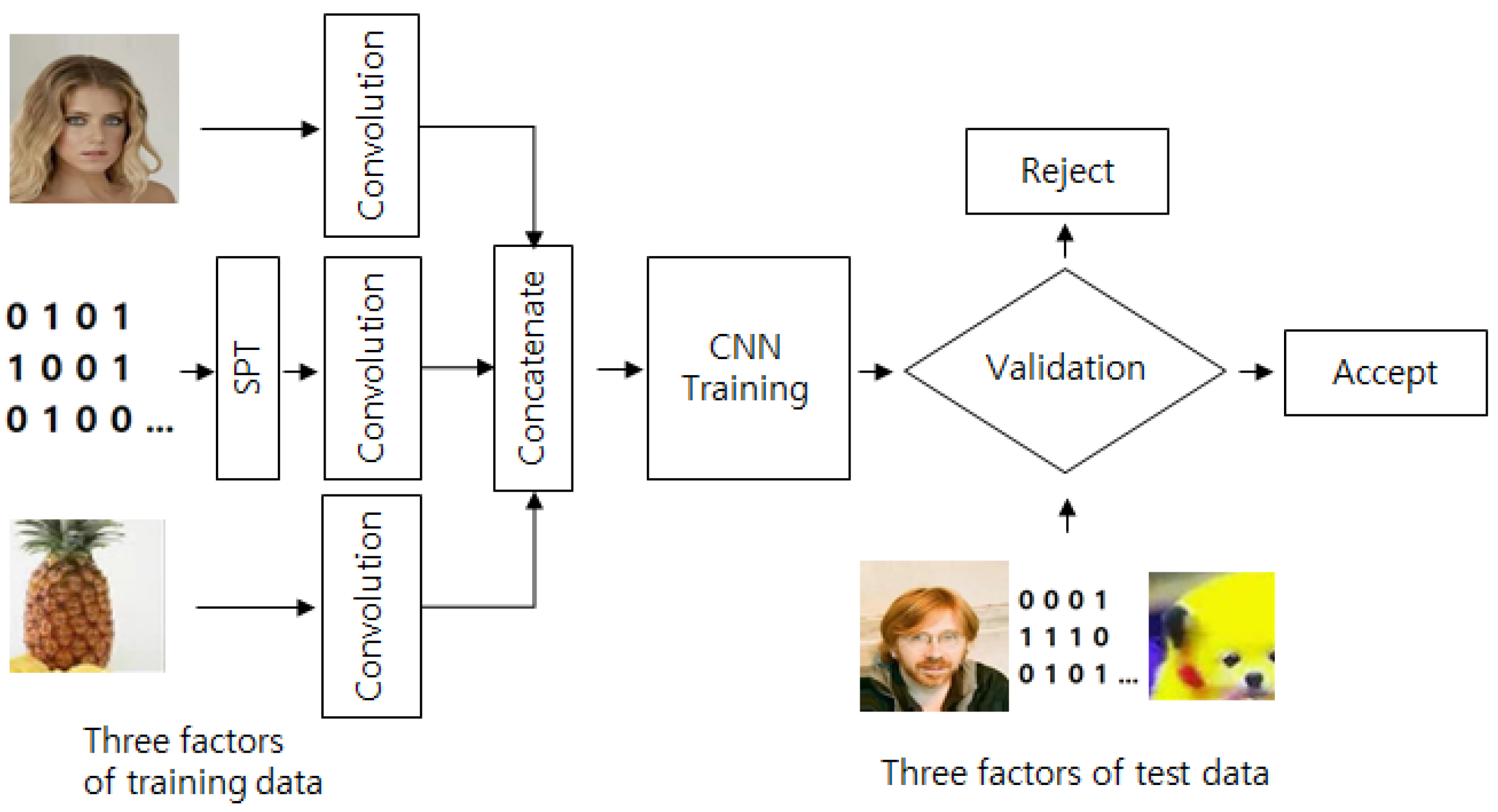
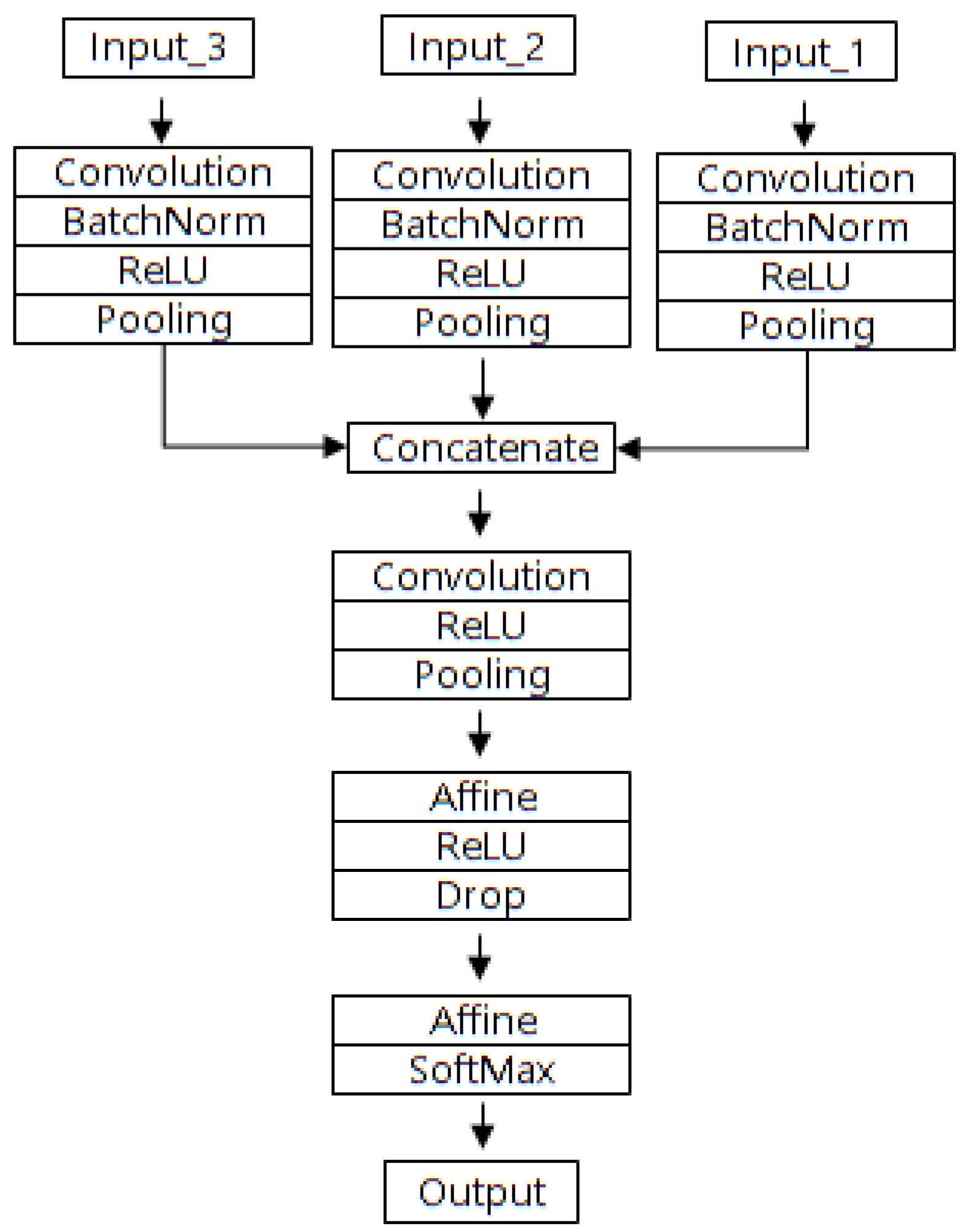
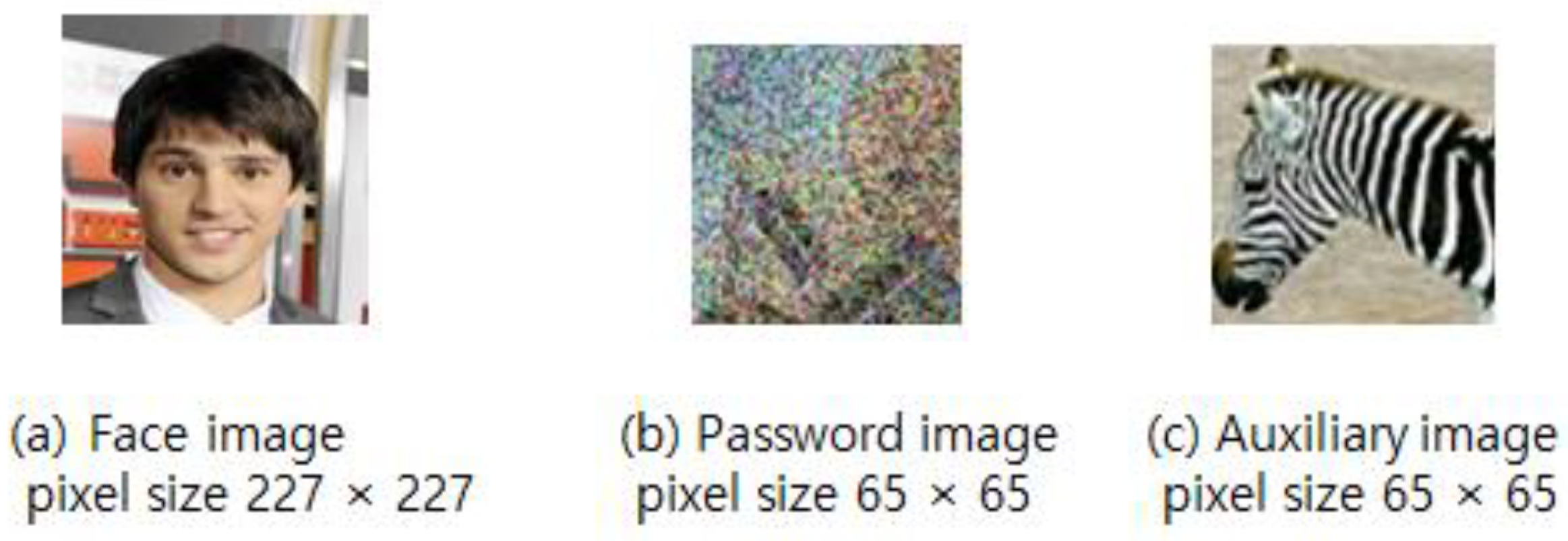
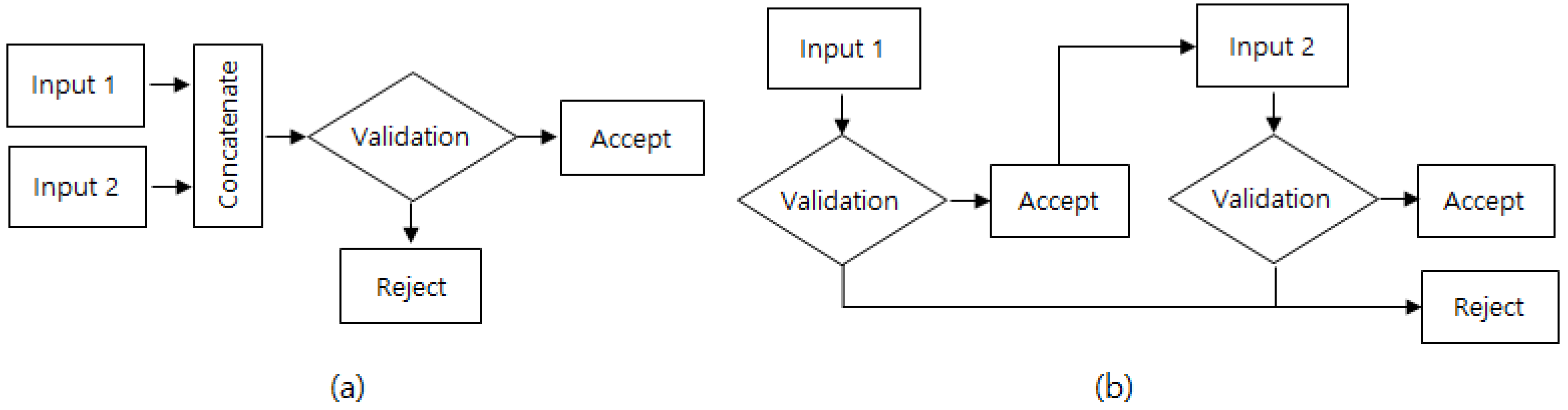
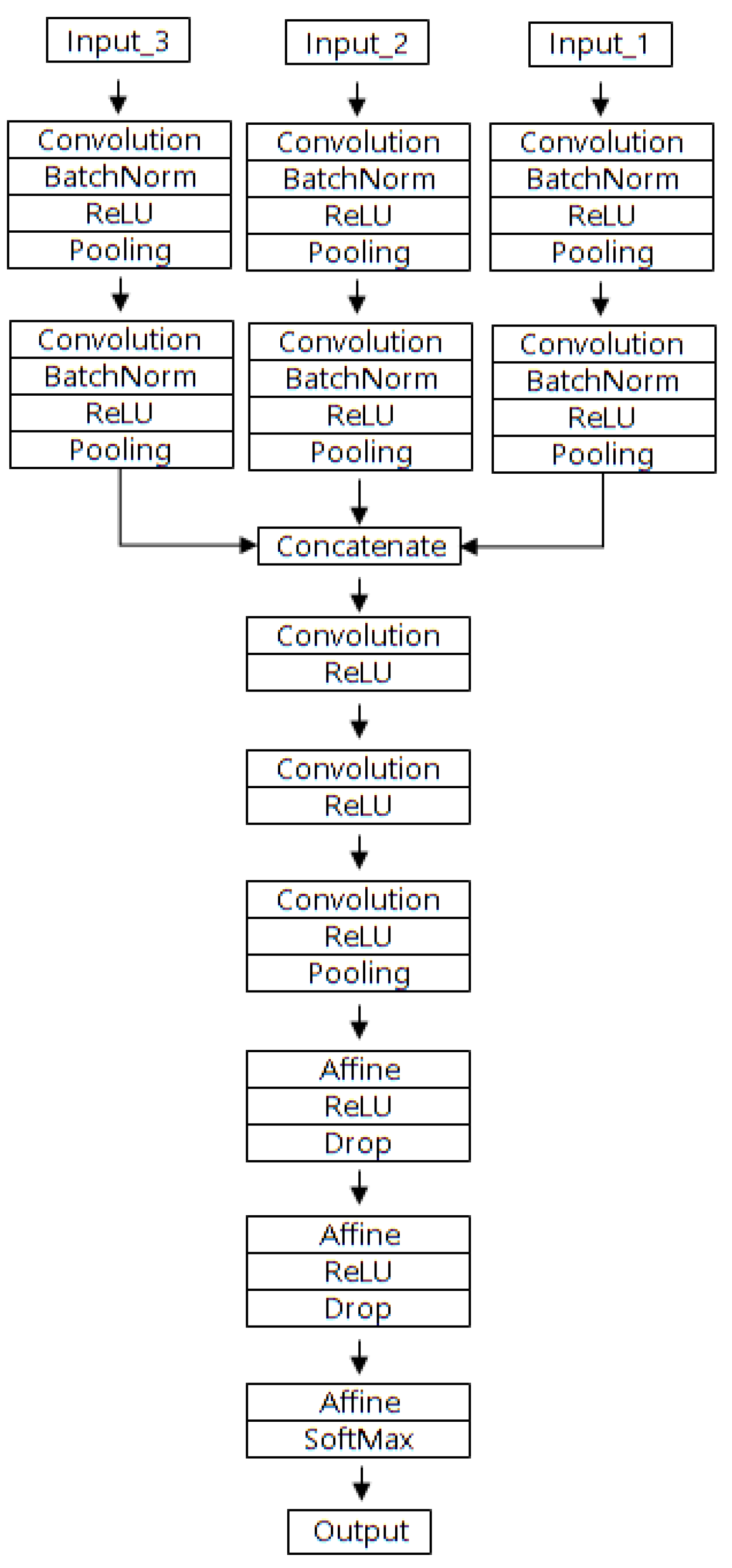
- This study presents a mobile multi-factor CNN (MMCNN) with three inputs, containing only two convolutional layers and two FC layers. With the MMCNN, the proposed CNN-based multi-modal MFA system exhibited an accuracy of 99.6% in the experiment. The three factors used for learning were a face image, an image securely converted from a password, and a specific image designated by the user. These contributions are introduced in Section 3.1, Section 3.2, and Section 4.1.
- (2)
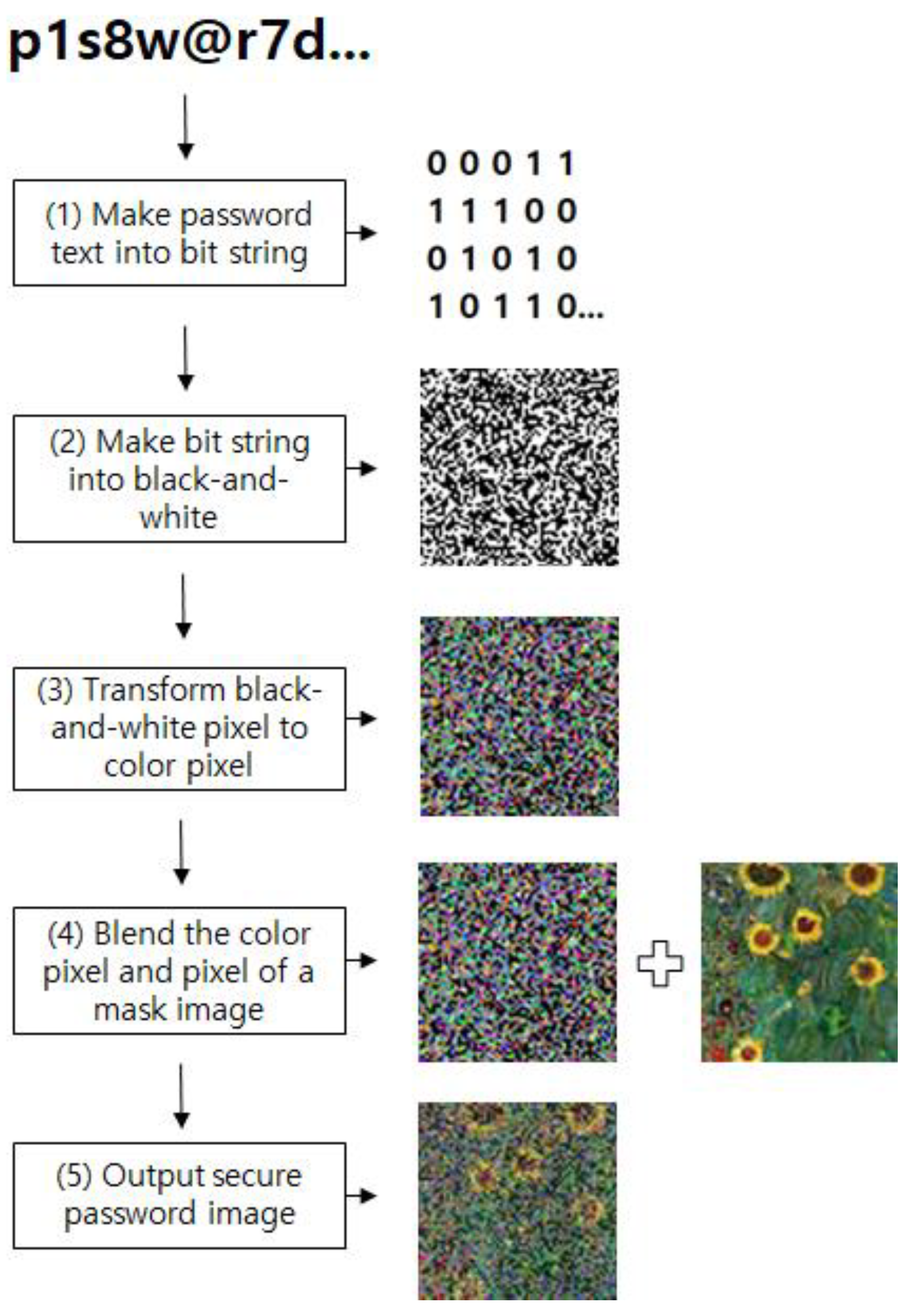
- This study presents an algorithm to create a secure transformed password image, called the Secure Password Transformation (SPT) algorithm. To ensure that a password image is safe even if it is exposed, the pixel location of the password bit among the image pixels is configured differently for each user. This algorithm is introduced in Section 3.3.
- (3)
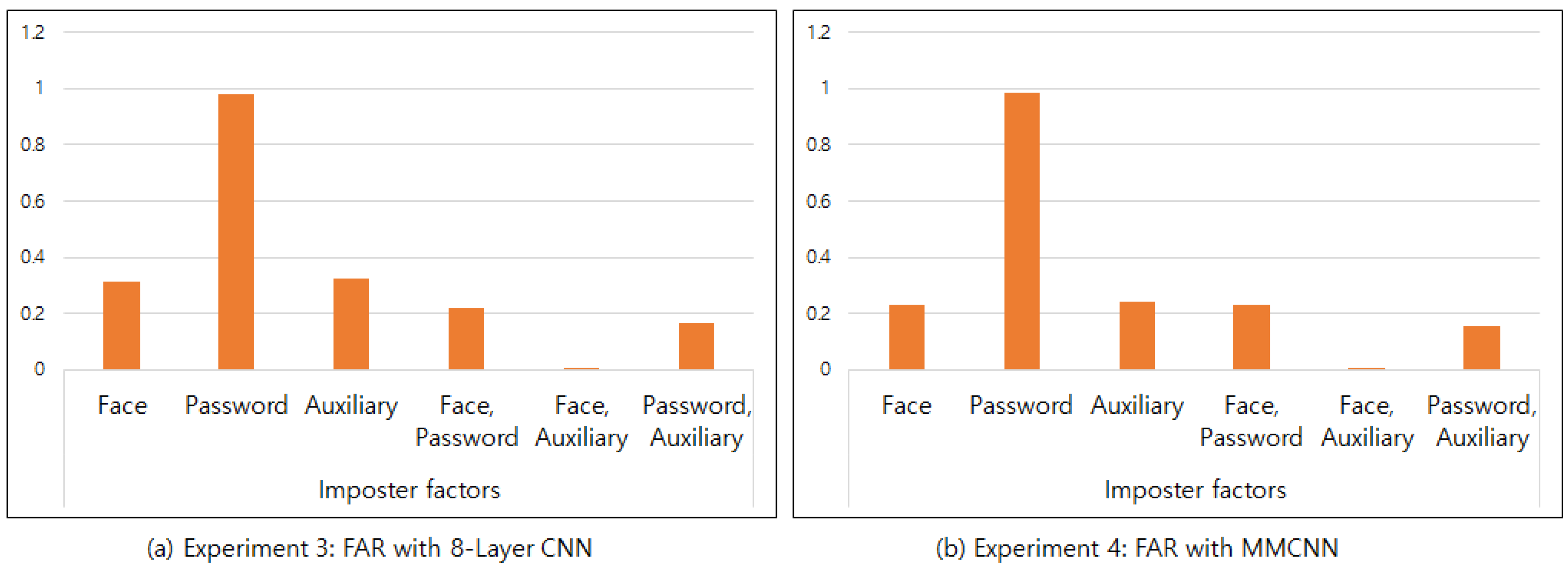
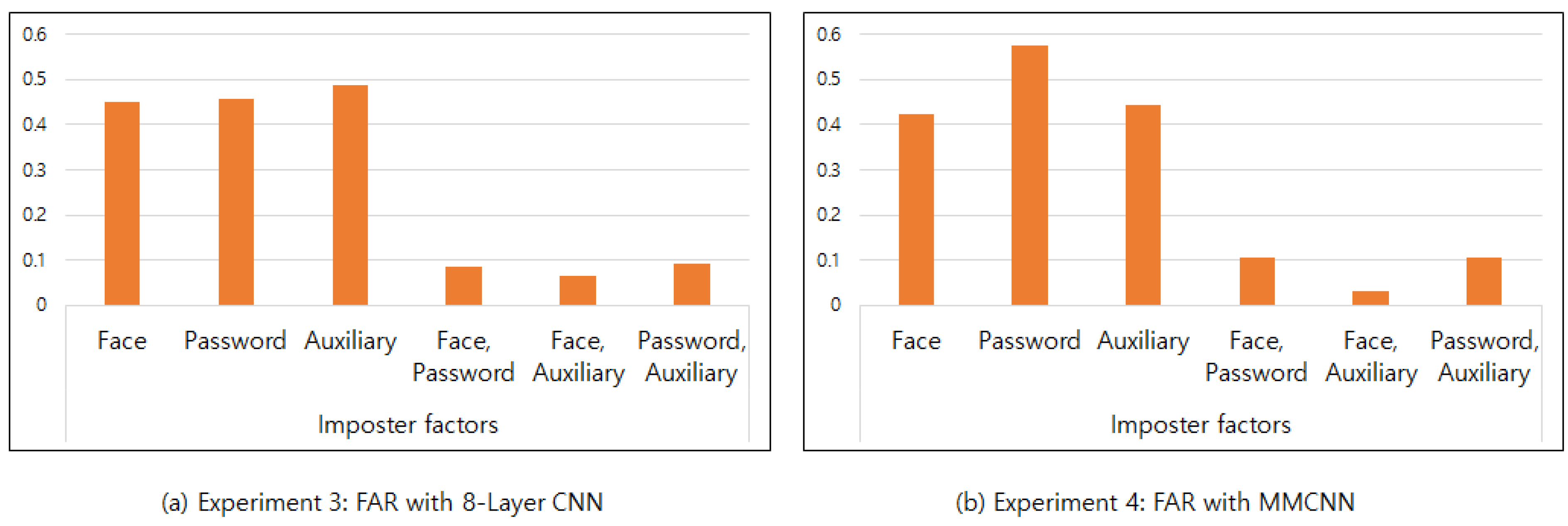
- This study also presents a method for demonstrating that the three considered factors have the same weight regarding the accuracy of authentication, which is confirmed by assuming that one or two factors include fake information. It is found that the weight value of each factor on the authentication system can be determined by judging their FAR values. In this research, the three factors were adjusted to equal weights which were then shown through the FAR values. The experimental results of the system are described in Section 4.2.
2. Related Works
3. Proposed System
3.1. Overall Structure of Proposed MFA System
3.2. Mobile Multi-Factor CNN (MMCNN)
3.3. Secure Password Transformation (SPT) Algorithm
- (1)
- Convert the password text into a bit string: This step converts the password entered as text into a binary bit string. It is written as a bit string of a specified length, taking into account the number of pixels to be used in the image. In this experiment, it was configured as 2080 bits.
- (2)
- Convert the bit string into a black and white image: The password bit string is composed into a grayscale image, where 0 is black and 1 is white. In this experiment, the image size was set to 65 × 65 = 4225 pixels, of which 2080 pixels were created as password bit strings and the remaining 2145 pixels were filled with random bit strings. The location of the 2080 password string pixels was fixed, and security was implemented by specifying a different location for each user.
- (3)
- Transform black-and-white pixels to color pixels: This transforms the grayscale image into a RGB color image. In this experiment, the password string’s 2080 pixels were transformed into color pixels through multiplying by a specified value, while the remaining 2145 pixels were assigned random colors.
- (4)
- Blend the color pixels and pixels of a mask image: The password RGB color image created in (3) and a mask image designated for each user are blended. Pixel blending is achieved through applying the equation below. The mask image was designated separately for each user, in order to further enhance security. In the equation, the α value was set as 0.5, the Image_mask was RGB pixel values of mask image, and Image_RGB_color was RGB pixel values of the password RGB-color image.Image_pw = α × Image_mask + (1 − α) × Image_RGB_color
- (5)
- Output the secure password image: The final secure password image that is created is saved.
| Algorithm 1. The Secure Password Transformation (SPT) algorithm. |
| Input: Password Text pw_text, Mask Image image_mask Output: Secure Password Image secure_pw_image 01: # initialize variables 02: img_width = 65 # width, height 03: img_pixel = 4225 # 65 × 65 = 4225 04: pw_length = 2080 # password length = 2080 bits 05: alpha = 0.5 # alpha value to be used for blending images 06: # (1) Make password text into bit string 07: password_bits = stringtobinary(password_string, pw_length) 08: # (2) Make bit string into black and white 09: # Select password 2080 pixel location among 4225 pixels 10: pw_place = random.choice(img_pixel, size = pw_length, replace = False) 11: # Password bits are stored in the 2080 positions out of 4225 bits. 12: # 0 or 1, random binary bits are stored in the remaining locations. 13: image_bits = random.choice(2, size= img_pixel, replace = True) 14: for i in range(0,img_pixel): #4225 15: for j in range(0,pw_length): #2080 16: if i = =pw_place[j]: 17: image_bits[i] = password_bits[j] 18: pw_array_before[i] = image_bits[i] 19: # Convert 4225 bit array into 65 × 65 gray image. 0-> black 1->white 20: for i in range(0,image_width): #65 21: for j in range(0,image_width): #65 22: pw_array[i][j] = pw_array_before[i*image_width + j] 23: # If necessary, check black and white output using pw_array. 24: img_bw = pw_array * 16581375 #RGB black and white 25: img_black_white = Image.fromarray(img_bw) 26: # (3) Transform black-and-white pixel to color pixel 27: # RGB 0–255 value random choice 28: RGB_image_bits[] =random.choice(256, size = img_pixel, replace = True) 29: # RGB_data generation 30: for i in range(img_width): #65 31: for j in range(img_width): #65 32: for k in range(3): #RGB 33: RGB_data[i][j][k] = RGB_generater(pw_array, RGB_image_bits) 34: img_RGB_Color = Image.fromarray(RGB_data,’RGB’) 35: # (4) Blend the color pixel and pixel of a mask image 36: # blending images with the value of alpha 37: # 0.5 * image_mask + (1 − 0.5) * img_RGB_color 38: secure_pw_image = cv2.addWeighted(img_mask, alpha, img_RGB_color, (1-alpha), 0) 39: # (5) Output secure password image 40: cv2.imwrite(image_path + file_name, secure_pw_image) |
4. Experimental Results and Discussion
4.1. Experimental Data Set and the Results
4.2. Experimental Results: FRR, FAR
4.3. Discussion
5. Conclusions
Funding
Institutional Review Board Statement
Informed Consent Statement
Data Availability Statement
Conflicts of Interest
References
- Rattani, A.; Tistarelli, M. Robust Multi-Modal and Multi-Unit Feature Level Fusion of Face and Iris Biometrics. In Proceedings of the Advances in Biometrics: Third International Conference (ICB 2009), Alghero, Italy, 2–5 June 2009; Proceedings 3. pp. 960–969. [Google Scholar] [CrossRef]
- Van Goethem, T.; Scheepers, W.; Preuveneers, D.; Joosen, W. Accelerometer-Based Device Fingerprinting for Multi-Factor Mobile Authentication. In Proceedings of the Engineering Secure Software and Systems: 8th International Symposium (ESSoS 2016), London, UK, 6–8 April 2016; Proceedings 8. pp. 106–121. [Google Scholar] [CrossRef]
- Shao, Z.; Li, Z.; Wu, P.; Chen, L.; Zhang, X. Multi-factor combination authentication using fuzzy graph domination model. J. Intell. Fuzzy Syst. 2019, 37, 4979–4985. [Google Scholar] [CrossRef]
- Ometov, A.; Petrov, V.; Bezzateev, S.; Andreev, S.; Koucheryavy, Y.; Gerla, M. Challenges of multi-factor authentication for securing advanced IoT applications. IEEE Netw. 2019, 33, 82–88. [Google Scholar] [CrossRef]
- He, Z.; Li, Z.; Yang, F.; Wang, L.; Li, J.; Zhou, C.; Pan, J. Advances in multimodal emotion recognition based on brain-computer interfaces. Brain Sci. 2020, 10, 687. [Google Scholar] [CrossRef]
- Deebak, B.D.; Hwang, S.O. Federated Learning-Based Lightweight Two-Factor Authentication Framework with Privacy Preservation for Mobile Sink in the Social IoMT. Electronics 2023, 12, 1250. [Google Scholar] [CrossRef]
- Ometov, A.; Bezzateev, S.; Mäkitalo, N.; Andreev, S.; Mikkonen, T.; Koucheryavy, Y. Multi-factor authentication: A survey. Cryptography 2018, 2, 1. [Google Scholar] [CrossRef]
- Mujeye, S. A Survey on Multi-Factor Authentication Methods for Mobile Devices. In Proceedings of the 2021 The 4th International Conference on Software Engineering and Information Management, New York, NY, USA, 16–18 January 2021; pp. 199–205. [Google Scholar] [CrossRef]
- Saqib, R.M.; Khan, A.S.; Javed, Y.; Ahmad, S.; Nisar, K.; Abbasi, I.A.; Julaihi, A.A. Analysis and Intellectual Structure of the Multi-Factor Authentication in Information Security. Intell. Autom. Soft Comput. 2022, 32, 1633–1647. [Google Scholar] [CrossRef]
- Otta, S.P.; Panda, S.; Gupta, M.; Hota, C. A Systematic Survey of Multi-Factor Authentication for Cloud Infrastructure. Future Internet 2023, 15, 146. [Google Scholar] [CrossRef]
- Ying, X.; Li, X.; Chuah, M.C. Liveface: A Multi-Task CNN for Fast Face-Authentication. In Proceedings of the 2018 17th IEEE International Conference on Machine Learning and Applications (ICMLA), Orlando, FL, USA, 17–20 December 2018; pp. 955–960. [Google Scholar] [CrossRef]
- Hammad, M.; Liu, Y.; Wang, K. Multimodal biometric authentication systems using convolution neural network based on different level fusion of ECG and fingerprint. IEEE Access 2018, 7, 26527–26542. [Google Scholar] [CrossRef]
- Kwon, B.W.; Sharma, P.K.; Park, J.H. CCTV-Based Multi-Factor Authentication System. J. Inf. Process. Syst. 2019, 15, 904–919. [Google Scholar] [CrossRef]
- Zhou, B.; Xie, Z.; Ye, F. Multi-Modal Face Authentication Using Deep Visual and Acoustic Features. In Proceedings of the ICC 2019-2019 IEEE International Conference on Communications (ICC), Shanghai, China, 20–24 May 2019; pp. 1–6. [Google Scholar] [CrossRef]
- Jena, P.P.; Kattigenahally, K.N.; Nikitha, S.; Sarda, S.; Harshalatha, Y. Multimodal Biometric Authentication: Deep Learning Approach. In Proceedings of the 2021 International Conference on Circuits, Controls and Communications (CCUBE), Bangalore, India, 23–24 December 2021; pp. 1–5. [Google Scholar] [CrossRef]
- Sivakumar, P.; Rathnam, B.R.; Divakar, S.; Teja, M.A.; Prasad, R.R. A Secure and Compact Multimodal Biometric Authentication Scheme using Deep Hashing. In Proceedings of the 2021 IEEE International Conference on Intelligent Systems, Smart and Green Technologies (ICISSGT), Visakhapatnam, India, 13–14 November 2021; pp. 27–31. [Google Scholar] [CrossRef]
- Liu, J.; Zou, X.; Han, J.; Lin, F.; Ren, K. BioDraw: Reliable Multi-Factor User Authentication with one Single Finger Swipe. In Proceedings of the 2020 IEEE/ACM 28th International Symposium on Quality of Service (IWQoS), Hang Zhou, China, 15–17 June 2020; pp. 1–10. [Google Scholar] [CrossRef]
- Zhang, R.; Zeng, Y.; Tong, L.; Shu, J.; Lu, R.; Li, Z.; Yang, K.; Yan, B. EEG Identity Authentication in Multi-Domain Features: A Multi-Scale 3D-CNN Approach. Front. Neurorobot. 2022, 16, 901765. [Google Scholar] [CrossRef]
- Hu, H.; Li, Y.; Zhu, Z.; Zhou, G. CNNAuth: Continuous Authentication via Two-Stream Convolutional Neural Networks. In Proceedings of the 2018 IEEE international conference on networking, architecture and storage (NAS), Chongqing, China, 11–14 October 2018; pp. 1–9. [Google Scholar] [CrossRef]
- Li, Y.; Hu, H.; Zhu, Z.; Zhou, G. SCANet: Sensor-based continuous authentication with two-stream convolutional neural networks. ACM Trans. Sens. Netw. 2020, 16, 1–27. [Google Scholar] [CrossRef]
- Li, Y.; Tao, P.; Deng, S.; Zhou, G. DeFFusion: CNN-based continuous authentication using deep feature fusion. ACM Trans. Sens. Netw. 2021, 18, 1–20. [Google Scholar] [CrossRef]
- Xiong, Y.; Wang, L.; Wang, Q.; Liu, S.; Kou, B. Improved convolutional neural network with feature selection for imbalanced ECG Multi-Factor classification. Measurement 2022, 189, 110471. [Google Scholar] [CrossRef]
- Tu, Z.; Xie, W.; Qin, Q.; Poppe, R.; Veltkamp, R.C.; Li, B.; Yuan, J. Multi-stream CNN: Learning representations based on human-related regions for action recognition. Pattern Recognit. 2018, 79, 32–43. [Google Scholar] [CrossRef]
- Yaguchi, K.; Ikarigawa, K.; Kawasaki, R.; Miyazaki, W.; Morikawa, Y.; Ito, C.; Shuzo, M.; Maeda, E. Human Activity Recognition Using Multi-Input CNN Model with FFT Spectrograms. In Proceedings of the Adjunct Proceedings of the 2020 ACM International Joint Conference on Pervasive and Ubiquitous Computing and Proceedings of the 2020 ACM International Symposium on Wearable Computers, New York, NY, USA, 12–17 September 2020; pp. 364–367. [Google Scholar] [CrossRef]
- Dua, N.; Singh, S.N.; Semwal, V.B. Multi-input CNN-GRU based human activity recognition using wearable sensors. Computing 2021, 103, 1461–1478. [Google Scholar] [CrossRef]
- Oktay, O.; Bai, W.; Lee, M.; Guerrero, R.; Kamnitsas, K.; Caballero, J.; de Marvao, A.; Cook, S.; O’Regan, D.; Rueckert, D. Multi-Input Cardiac Image Super-Resolution Using Convolutional Neural Networks. In Proceedings of the International Conference on Medical Image Computing and Computer-Assisted Intervention, Athens, Greece, 17–21 October 2016; pp. 246–254, Proceedings, Part III 19. [Google Scholar] [CrossRef]
- Abbood, E.A.; Al-Assadi, T.A. GLCMs Based multi-inputs 1D CNN deep learning neural network for COVID-19 texture feature extraction and classification. Karbala Int. J. Mod. Sci. 2022, 8, 28–39. [Google Scholar] [CrossRef]
- Elmoufidi, A.; Skouta, A.; Jai-Andaloussi, S.; Ouchetto, O. CNN with multiple inputs for automatic glaucoma assessment using fundus images. Int. J. Image Graph. 2023, 23, 2350012. [Google Scholar] [CrossRef]
- Gupta, B.B.; Prajapati, V.; Nedjah, N.; Vijayakumar, P.; El-Latif, A.A.A.; Chang, X. Machine learning and smart card based two-factor authentication scheme for preserving anonymity in telecare medical information system (TMIS). Neural. Comput. Applic. 2023, 35, 5055–5080. [Google Scholar] [CrossRef]
- Wang, L.; Wang, X.; Zhao, Z.; Wu, Y.; Xu, J.; Zhang, H.; Yu, J.; Sun, Q.; Bai, Y. Multi factor status prediction by 4d fractal CNN based on remote sensing images. Fractals 2022, 30, 2240101. [Google Scholar] [CrossRef]
- Huang, C.J.; Kuo, P.H. Multiple-input deep convolutional neural network model for short-term photovoltaic power forecasting. IEEE Access 2019, 7, 74822–74834. [Google Scholar] [CrossRef]
- Xing, L.; Qiao, Y. Deepwriter: A Multi-Stream Deep CNN for Text-Independent Writer Identification. In Proceedings of the 2016 15th International Conference on Frontiers in Handwriting Recognition (ICFHR), Shenzhen, China, 23–26 October 2016; pp. 584–589. [Google Scholar] [CrossRef]
- Sun, Y.; Zhu, L.; Wang, G.; Zhao, F. Multi-input convolutional neural network for flower grading. J. Electr. Comput. Eng. 2017, 2017. [Google Scholar] [CrossRef]
- Delgado-Escano, R.; Castro, F.M.; Cózar, J.R.; Marín-Jiménez, M.J.; Guil, N. An end-to-end multi-task and fusion CNN for inertial-based gait recognition. IEEE Access 2018, 7, 1897–1908. [Google Scholar] [CrossRef]
- Naglah, A.; Khalifa, F.; Khaled, R.; Abdel Razek, A.A.K.; Ghazal, M.; Giridharan, G.; El-Baz, A. Novel MRI-Based CAD System for Early Detection of Thyroid Cancer Using Multi-Input CNN. Sensors 2021, 21, 3878. [Google Scholar] [CrossRef]
- Mazumder, A.N.; Ren, H.; Rashid, H.A.; Hosseini, M.; Chandrareddy, V.; Homayoun, H.; Mohsenin, T. Automatic detection of respiratory symptoms using a low-power multi-input CNN processor. IEEE Des. Test 2021, 39, 82–90. [Google Scholar] [CrossRef]
- Chen, P.; Zou, B.; Belkacem, A.N.; Lyu, X.; Zhao, X.; Yi, W.; Huang, Z.; Liang, J.; Chen, C. An improved multi-input deep convolutional neural network for automatic emotion recognition. Front. Neurosci. 2022, 16, 965871. [Google Scholar] [CrossRef]
- Ahamed, F.; Farid, F.; Suleiman, B.; Jan, Z.; Wahsheh, L.A.; Shahrestani, S. An Intelligent Multimodal Biometric Authentication Model for Personalised Healthcare Services. Future Internet 2022, 14, 222. [Google Scholar] [CrossRef]
- Ammour, N.; Bazi, Y.; Alajlan, N. Multimodal Approach for Enhancing Biometric Authentication. J. Imaging 2023, 9, 168. [Google Scholar] [CrossRef]
- Singh, S.P.; Tiwari, S. A Dual Multimodal Biometric Authentication System Based on WOA-ANN and SSA-DBN Techniques. Sci 2023, 5, 10. [Google Scholar] [CrossRef]
- Rajasekar, V.; Saracevic, M.; Hassaballah, M.; Karabasevic, D.; Stanujkic, D.; Zajmovic, M.; Tariq, U.; Jayapaul, P. Efficient Multimodal Biometric Recognition for Secure Authentication Based on Deep Learning Approach. Int. J. ON Artif. Intell. Tools 2023, 32, 2340017. [Google Scholar] [CrossRef]
- Zhou, B.; Lohokare, J.; Gao, R.; Ye, F. EchoPrint: Two-Factor Authentication Using Acoustics and Vision on smart Phonesin. In Proceedings of the 24th Annual International Conference on Mobile Computing and Networking, New Delhi, India, 15 October 2018; pp. 321–336. [Google Scholar] [CrossRef]
- Aleluya, E.R.M.; Vicente, C.T. Faceture ID: Face and hand gesture multi-factor authentication using deep learning. Procedia Comput. Sci. 2018, 135, 147–154. [Google Scholar] [CrossRef]
- Priya, K.D.; Sumalatha, L. Offline Handwritten Signatures Based Multifactor Authentication in Cloud Computing Using Deep CNN Model. I-Manag. J. Cloud Comput. 2019, 6, 13–25. [Google Scholar] [CrossRef]
- Sajjad, M.; Khan, S.; Hussain, T.; Muhammad, K.; Sangaiah, A.K.; Castiglione, A.; Esposito, C.; Baik, S.W. CNN-based anti-spoofing two-tier multi-factor authentication system. Pattern Recognit. Lett. 2019, 126, 123–131. [Google Scholar] [CrossRef]
- Mehdi Cherrat, E.; Alaoui, R.; Bouzahir, H. Convolutional neural networks approach for multimodal biometric identification system using the fusion of fingerprint, finger-vein and face images. PeerJ Comput. Sci. 2020, 6, e248. [Google Scholar] [CrossRef]
- Shalaby, A.; Gad, R.; Hemdan, E.E.; El-Fishawy, N. An efficient multi-factor authentication scheme based CNNs for securing ATMs over cognitive-IoT. PeerJ Comput. Sci. 2021, 7, e381. [Google Scholar] [CrossRef]
- Masuda, N.; Yairi, I.E. Multi-Input CNN-LSTM deep learning model for fear level classification based on EEG and peripheral physiological signals. Front. Psychol. 2023, 14, 1141801. [Google Scholar] [CrossRef]
- Sasikala, T.S. A secure multi-modal biometrics using deep ConvGRU neural networks based hashing. Expert Syst. Appl. 2024, 235, 121096. [Google Scholar] [CrossRef]
- Howard, A.G.; Zhu, M.; Chen, B.; Kalenichenko, D.; Wang, W.; Weyand, T.; Andreetto, M.; Adam, H. Mobilenets: Efficient convolutional neural networks for mobile vision applications. arXiv 2021, arXiv:1704.04861. Available online: https://arxiv.org/abs/1704.04861 (accessed on 10 May 2024).
- Zhang, X.; Zhou, X.; Lin, M.; Sun, J. Shufflenet: An Extremely Efficient Convolutional Neural Network for Mobile devices. In Proceedings of the IEEE Conference on Computer Vision and Pattern Recognition, Salt Lake City, UT, USA, 18–22 June 2018; pp. 6848–6856. Available online: https://arxiv.org/abs/1707.01083 (accessed on 10 May 2024).
- Krizhevsky, A.; Sutskever, I.; Hinton, G.E. Imagenet Classification with Deep Convolutional Neural Networks. Adv. Neural Inf. Process. Syst. 2012, 25, 84–90. Available online: https://proceedings.neurips.cc/paper/2012/hash/c399862d3b9d6b76c8436e924a68c45b-Abstract.html (accessed on 10 May 2024). [CrossRef]
- Piugie, Y.B.W.; Di Manno, J.; Rosenberger, C.; Charrier, C. Keystroke Dynamics Based User Authentication Using Deep Learning Neural Networks. In Proceedings of the 2022 International Conference on Cyberworlds (CW), Kanazawa, Japan, 27–29 September 2022; pp. 220–227. [Google Scholar] [CrossRef]
- Tkachenko, I.; Puech, W.; Destruel, C.; Strauss, O.; Gaudin, J.M.; Guichard, C. Two-level QR code for private message sharing and document authentication. IEEE Trans. Inf. Forensics Secur. 2015, 11, 571–583. [Google Scholar] [CrossRef]
- Christiana, A.O.; Oluwatobi, A.N.; Victory, G.A.; Oluwaseun, O.R. A Secured One Time Password Authentication Technique Using (3, 3) Visual Cryptography Scheme. In Journal of Physics: Conference Series; IOP Publishing: Bristol, UK, 2019; Volume 1299, p. 012059. [Google Scholar] [CrossRef]
- GitHub. Available online: https://github.com/hjinob/CNN-Based-Multi-Factor-Authentication-System-for-Mobile-Devices (accessed on 20 April 2024).





| References | Method | Layers | Accuracy (%) | Mobile Devices | Modality | Secure Data |
|---|---|---|---|---|---|---|
| Proposed MFA System with MMCNN | CNN | 4 | 99.6 | Applicable | Image, Text | Password |
| (2016) Xing and Qiao [32] | CNN | 7 | 99.01 | N/A | Image | N/A |
| (2017) Sun et al. [33] | CNN | 7 | 89.6 | N/A | Image | N/A |
| (2018) Delgado-Escano et al. [34] | CNN | 5 | 96.2 | N/A | Signal | N/A |
| (2021) Naglah et al. [35] | CNN | 4 | 87 | Applicable | Image | N/A |
| (2021) Mazumder et al. [36] | CNN | 9 | 87.3 | Applicable | Sound, vector | N/A |
| (2022) Chen et al. [37] | CNN | 8 | 83.8 | N/A | Signal | N/A |
| (2022) Ahamed et al. [38] | CNN | 17 | 99.8 | N/A | Signal | Signal |
| (2023) Ammour et al. [39] | CNN | 50 | 98.6 | N/A | Signal, Image | N/A |
| (2023) Sing and Tiwari [40] | CNN | 7 | 97.13 | N/A | Signal, Image | N/A |
| (2023) Rajasekar et al. [41] | CNN | 4 | 99.92 | Applicable | Image | N/A |
| (2018) Zhou et al. [42] | CNN, SVM | 6 | 93.75 | Applicable | Sound, Image | Sound |
| (2018) Aleuya and Vicente [43] | CNN, OTP | 7 | 96 | N/A | Image | N/A |
| (2019) Priya and Sumalatha [44] | CNN, HASH | 7 | 99 | N/A | Image | Password |
| (2019) Sajjad et al. [45] | CNN, HASH | 22 | 99.75 | N/A | Image | Image |
| (2020) Mehdi Cherrat et al. [46] | CNN, RF | 5 | 99.49 | N/A | Image | N/A |
| (2021) Shalaby et al. [47] | CNN, OTP | 5 | 99.33 | Applicable | Image | Iris image |
| (2023) Masuda and Yairi [48] | CNN, LSTM | 11 | 98.79 | N/A | Signal | N/A |
| References | Number of Classification | Layers | Accuracy (%) | Mobile Devices | Modality | Secure Data |
|---|---|---|---|---|---|---|
| Proposed MFA System with MMCNN | 100 | 4 | 99.6 | Applicable | Image, Text | Password |
| Proposed MFA System with 8 Layer CNN | 100 | 8 | 99.8 | N/A | Image, Text | Password |
| (2022) Ahamed et al. [38] | 66 | 17 | 99.8 | N/A | Signal | Signal |
| (2023) Ammour et al. [39] | 70 | 50 | 98.6 | N/A | Signal, Image | N/A |
| (2023) Sing and Tiwari [40] | 80 | 7 | 97.13 | N/A | Signal, Image | N/A |
| (2023) Rajasekar et al. [41] | 106 | 4 | 99.92 | Applicable | Image | N/A |
| (2023) Masuda and Yairi [48] | 4 | 11 | 98.79 | N/A | Signal | N/A |
| (2024) Sasikala [49] | 700 | 6 | 99.93 | N/A | Image | Biometrics |
| Layer | Input 1 | Input 2 | Input 3 |
|---|---|---|---|
| Input pixel size | 227 × 227 × 3 | 65 × 65 × 3 | 65 × 65 × 3 |
| First convolutional layer | Filter: 96 Channel: 3 Width, Height: 11 Stride: 4 Zero padding: 0 Output: 55 × 55 × 96 | Filter: 96 Channel: 3 Width, Height: 11 Stride: 1 Zero padding: 0 Output: 55 × 55 × 96 | Filter: 96 Channel: 3 Width, Height: 11 Stride: 1 Zero padding: 0 Output: 55 × 55 × 96 |
| First max pooling | Width, Height: 7 Stride: 3 Output: 17 × 17 × 96 | Width, Height: 7 Stride: 3 Output: 17 × 17 × 96 | Width, Height: 7 Stride: 3 Output: 17 × 17 × 96 |
| Concatenate | 17 × 17 × 96 × 3 | ||
| Second convolutional layer | Filter: 256, Channel: 288 Width, Height: 3 Stride: 1, Zero padding: 1 Output: 17 × 17 × 256 | ||
| Second max pooling | Width, Height: 5, Stride: 2 Output: 7 × 7 × 96 | ||
| First affine layer | Flatten: 12,544, Neuron: 1024, Dropout: 0.5 Output: 1024 | ||
| Second affine layer | Neuron: 100 Output: 100 | ||
| CNNs | Three-Input CNN (8 Layers) MMCNN (4 Layers) |
|---|---|
| Learning rate | 0.001 |
| Training epochs | 300 epochs |
| Number of classes | 100 classes |
| Data set of three factors |
|
| Number of data samples | Total data: 3500 (100 classes × 35) Training data: 3000 Test data: 500 |
| No | Factors | Number of Factors | Accuracy (%) | CNN |
|---|---|---|---|---|
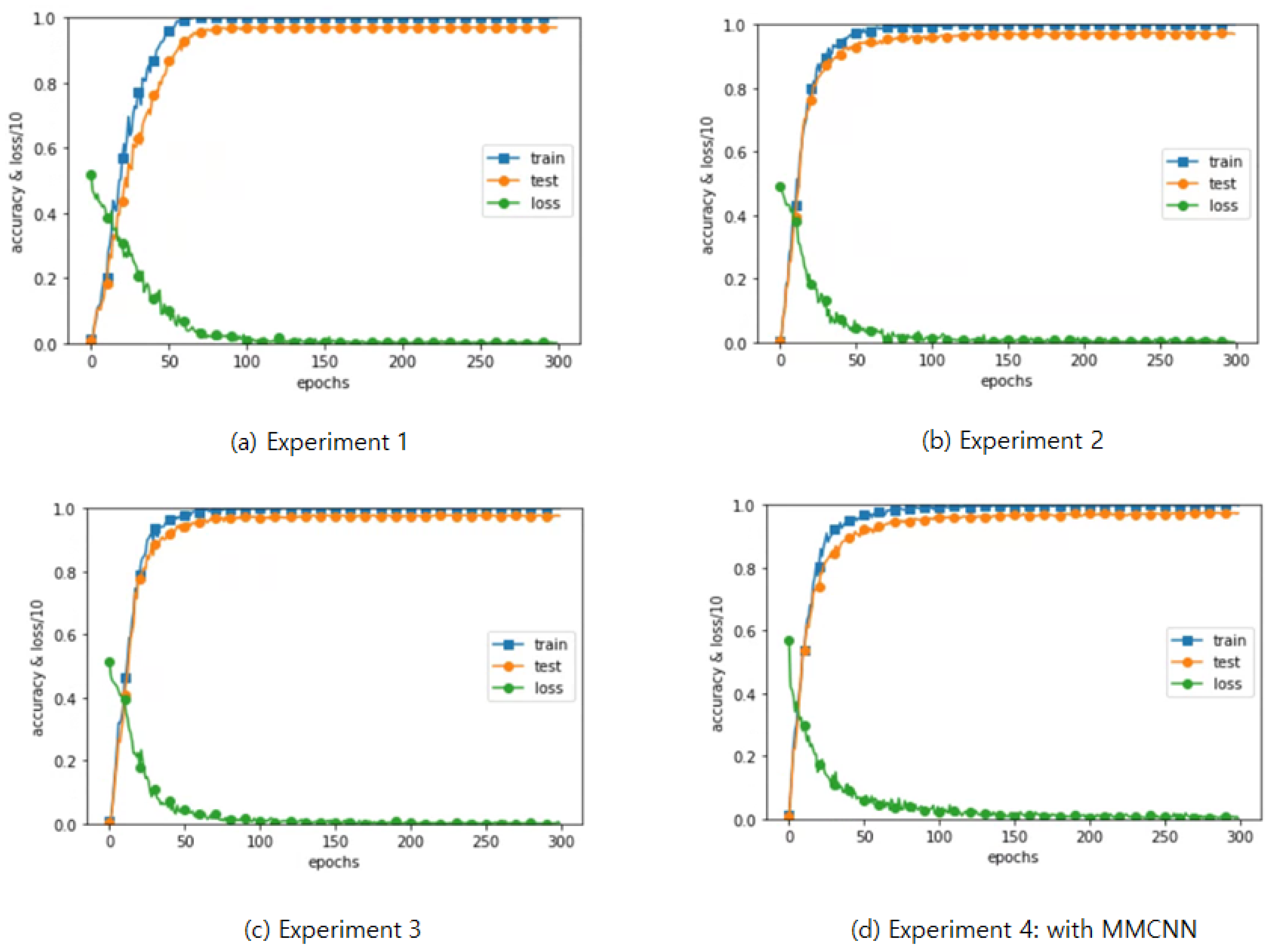
| Experiment 1 | Face, Password images | 2 | 98.8 | CNN (8 layers) |
| Experiment 2 | Face, Auxiliary images | 2 | 98.6 | CNN (8 layers) |
| Experiment 3 | Face, Password, Auxiliary images | 3 | 99.8 | CNN (8 layers) |
| Experiment 4 | Face, Password, Auxiliary images | 3 | 99.6 | MMCNN (4 layers) |
| No | Factors | FRR | Number of Imposter Factors | Imposter Factors | FAR | CNN |
|---|---|---|---|---|---|---|
| Experiment 1 | Face, Password images | 0.012 | 1 | Face | 0.144 | CNN (8 layers) |
| 1 | Password | 0.186 | ||||
| Experiment 2 | Face, Auxiliary images | 0.014 | 1 | Face | 0.252 | CNN (8 layers) |
| 1 | Auxiliary | 0.219 | ||||
| Experiment 3 | Face, Password, Auxiliary images | 0.002 | 1 | Face | 0.45 | CNN (8 layers) |
| 1 | Password | 0.458 | ||||
| 1 | Auxiliary | 0.488 | ||||
| 2 | Face, Password | 0.086 | ||||
| 2 | Face, Auxiliary | 0.064 | ||||
| 2 | Password, Auxiliary | 0.092 | ||||
| Experiment 4 | Face, Password, Auxiliary images | 0.004 | 1 | Face | 0.422 | MMCNN (4 layers) |
| 1 | Password | 0.576 | ||||
| 1 | Auxiliary | 0.442 | ||||
| 2 | Face, Password | 0.104 | ||||
| 2 | Face, Auxiliary | 0.03 | ||||
| 2 | Password, Auxiliary | 0.106 |
Disclaimer/Publisher’s Note: The statements, opinions and data contained in all publications are solely those of the individual author(s) and contributor(s) and not of MDPI and/or the editor(s). MDPI and/or the editor(s) disclaim responsibility for any injury to people or property resulting from any ideas, methods, instructions or products referred to in the content. |
© 2024 by the author. Licensee MDPI, Basel, Switzerland. This article is an open access article distributed under the terms and conditions of the Creative Commons Attribution (CC BY) license (https://creativecommons.org/licenses/by/4.0/).
Share and Cite
Han, J. CNN-Based Multi-Factor Authentication System for Mobile Devices Using Faces and Passwords. Appl. Sci. 2024, 14, 5019. https://doi.org/10.3390/app14125019
Han J. CNN-Based Multi-Factor Authentication System for Mobile Devices Using Faces and Passwords. Applied Sciences. 2024; 14(12):5019. https://doi.org/10.3390/app14125019
Chicago/Turabian StyleHan, Jinho. 2024. "CNN-Based Multi-Factor Authentication System for Mobile Devices Using Faces and Passwords" Applied Sciences 14, no. 12: 5019. https://doi.org/10.3390/app14125019
APA StyleHan, J. (2024). CNN-Based Multi-Factor Authentication System for Mobile Devices Using Faces and Passwords. Applied Sciences, 14(12), 5019. https://doi.org/10.3390/app14125019