Optimization of a Breath Analysis Methodology to Potentially Diagnose Transplanted Kidney Rejection: A Preclinic Study


 ,
,  , ,
, ,  ,
,  ,
,  ,
,  and
and 
Abstract
1. Introduction
2. Materials and Methods
2.1. VOCs GC-MS Analyses
2.2. Linear Regression Test, LOD, and LOQ of the GC-MS Method
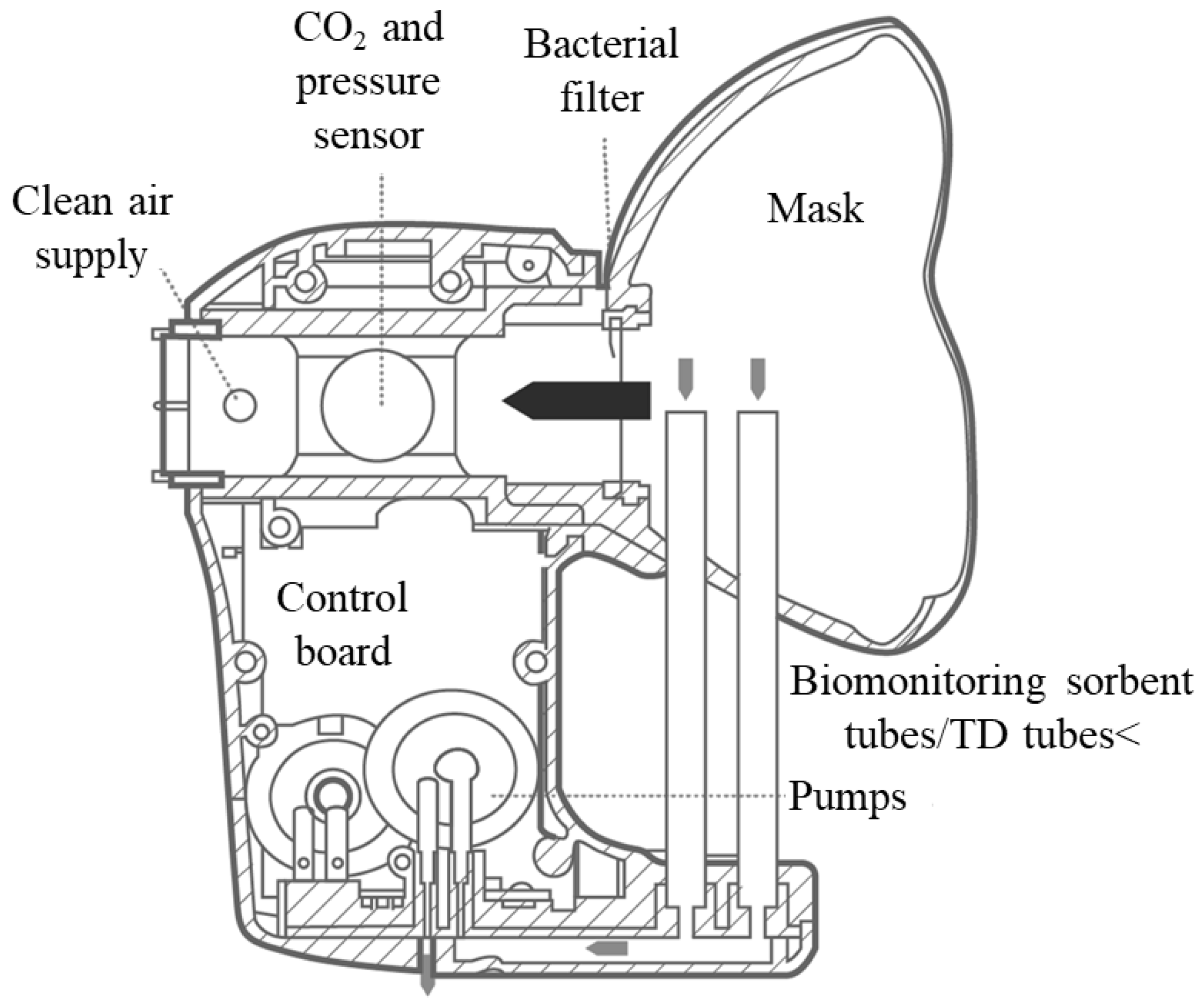
2.3. Exhaled Breath Sampling and Analyses
2.4. Ethical Approval
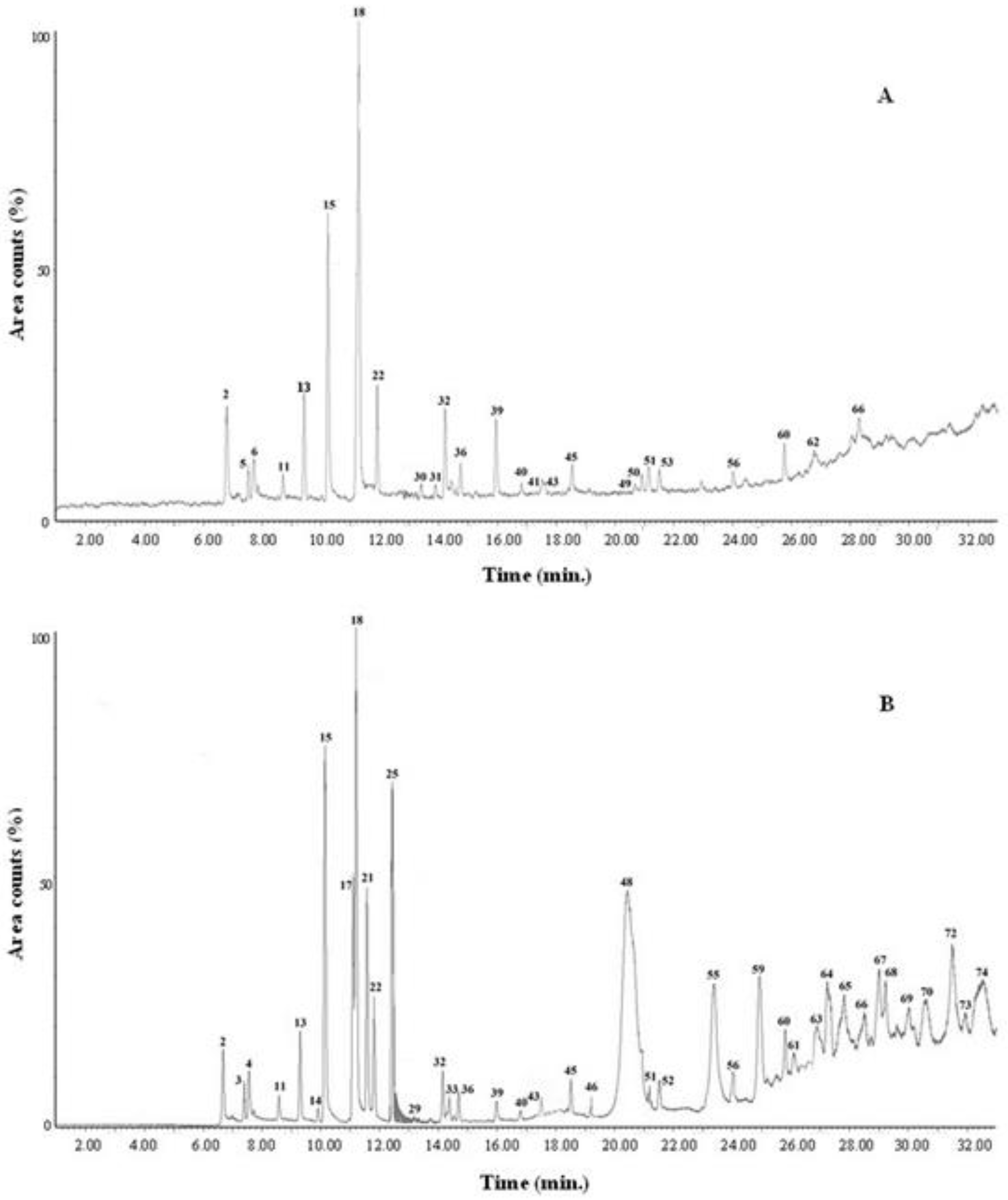
3. Experimental Results
4. Discussion
5. Future Developments
Author Contributions
Funding
Institutional Review Board Statement
Informed Consent Statement
Data Availability Statement
Acknowledgments
Conflicts of Interest
Additional Information
References
- Golshayan, D.; Pascual, M. Burden of end-stage renal disease and evolving challenges in kidney transplantation. Transpl. Int. 2019, 32, 889–891. [Google Scholar] [CrossRef] [PubMed]
- Sobh, M.; Moustafa, F.; Ghoniem, M. Value of renal biopsy in chronic renal failure. Int. Urol. Nephrol. 1988, 20, 77–83. [Google Scholar] [CrossRef] [PubMed]
- Gansevoort, R.T.; Bakker, S.J.L.; de Jong, P.L. Early detection of progressive chronic kidney disease: Is it feasible? J. Am. Soc. Nephrol. 2006, 17, 1218–1220. [Google Scholar] [CrossRef] [PubMed]
- Saalberg, Y.; Wolff, M. VOC breath biomarchers in lung cancer. Anal. Chim. Acta 2016, 459, 5–9. [Google Scholar]
- Capone, S.; Tufariello, M.; Forleo, A.; Longo, V.; Giampetruzzi, L.; Radogna, A.V.; Casino, F.; Siciliano, P. Chromatographic analysis of VOC patterns in exhaled breath from smokers and nonsmokers. Biomed. Chrom. 2018, 32, e4132. [Google Scholar] [CrossRef] [PubMed]
- Bohra, A.; Kapoor, N. Exhaled breath analysis of volatile organic compounds (VOC) in diagnosis of lung cancer a meta-analysis. Mol. Anal. Precis. Oncol. 2020, 31, s1237–s1238. [Google Scholar] [CrossRef]
- Haddadi, S.; Koziel, J.A.; Engelken, T.J. Analytical approaches for detection of breath VOC biomarkers of cattle diseases—A review. Anal. Chim. Acta 2022, 1206, 339565–339580. [Google Scholar] [CrossRef]
- Nakhleh, M.K.; Amal, H.; Jeries, R.; Broza, Y.Y.; Aboud, M.; Gharra, A.; Ivgi, H.; Khatib, S.; Badarneh, S.; Har-Shai, L.; et al. Diagnosis and classification of 17 diseases from 1404 subjects via pattern analysis of exhaled molecules. ACS Nano 2017, 11, 112–125. [Google Scholar] [CrossRef]
- Van Malderen, K.; Hanning, N.; Lambrechts, H.; Haverhals, T.; Van Marcke, S.; De Man, J.; De Winter, B.Y.; Lamote, K.; De Schepper, H.U. Discriminating patients with irritable bowel syndrome from healthy controls with volatile organic compound (VOC) profiling in breath and fecal samples. Gastroenterology 2022, 162, S1076. [Google Scholar] [CrossRef]
- Amann, A.; Miekisch, W.; Schubert, J.; Buszewski, B.; Ligor, T.; Jezierski, T.; Pleil, J.; Risby, T. Analysis of exhaled breath for disease detection. Annu. Rev. Anal. Chem. 2014, 7, 455–482. [Google Scholar] [CrossRef]
- Ghosh, C.; Leon, A.; Koshy, S.; Aloum, O.; Al-Jabawi, Y.; Ismail, N.; Weiss, Z.F.; Koo, S. Breath-based diagnosis of infectious diseases. A review of the current landscape. Clin. Lab. Med. 2021, 41, 185–202. [Google Scholar] [CrossRef] [PubMed]
- Gelin, M.F.; Blokhin, A.P.; Ostrozhenkova, E.; Apolonski, A.; Maiti, K.S. Theory helps experiment to reveal VOCs in human breath. Spectrochim. Acta Part A Mol. Biomol. Spectr. 2021, 258, 119785. [Google Scholar] [CrossRef] [PubMed]
- Agapiou, A.; Amann, A.; Mochalski, P.; Statheropoulos, M.K.; Thomas, C.L.P. Trace detection of endogenous human volatile organic compounds for search, rescue, and emergency applications. Trends Anal. Chem. 2015, 66, 158–175. [Google Scholar] [CrossRef]
- Hansel, A.; Jordan, A.; Holzinger, R.; Prazeller, P.; Vogel, W.; Lindinger, W. Proton-transfer reaction mass-spectrometry—Online trace gas analysis at the ppb level. Int. J. Mass Spectrom. 1995, 149, 609–619. [Google Scholar] [CrossRef]
- Blake, R.S.; Monks, P.S.; Ellis, A.M. Proton-transfer reaction mass spectrometry. Chem. Rev. 2009, 109, 861–896. [Google Scholar] [CrossRef]
- Yuan, B.; Koss, A.R.; Warneke, C.; Coggon, M.; Sekimoto, K.; de Gouw, J.A. Proton-transfer-reaction mass spectrometry: Applications in atmospheric sciences. Chem. Rev. 2017, 117, 13187–13229. [Google Scholar] [CrossRef]
- Nenadis, N.; Heenan, S.; Tsimidou, M.Z.; Van Ruth, S. Applicability of PTR-MS in the quality control of saffron. Food Chem. 2016, 196, 961–967. [Google Scholar] [CrossRef]
- Blake, R.S.; Whyte, C.; Hughes, C.O.; Ellis, A.M.; Monks, P.S. Demonstration of proton-transfer reaction time-of-flight mass spectrometry for real-time analysis of trace volatile organic compounds. Anal. Chem. 2004, 76, 3841–3845. [Google Scholar] [CrossRef]
- Brock, B.; Kamysek, S.; Silz, J.; Trefz, P.; Schubert, J.K.; Miekisch, W. Monitoring of breath VOCs and electrical impedance tomography under pulmonary recruitment in mechanically ventilated patients. J. Breath Res. 2017, 11, 1752–1763. [Google Scholar] [CrossRef]
- Stadler, S.; Stefanuto, P.H.; Brokl, M.; Forbes, S.L.; Focant, J.F. Characterization of volatile organic compounds from human analogue decomposition using thermal desorption coupled to comprehensive two-dimensional gas chromatography-time-of-flight mass spectrometry. Anal. Chem. 2013, 85, 998–1005. [Google Scholar] [CrossRef]
- Trefz, P.; Schubert, J.K.; Miekisch, W. Effects of humidity, CO2 and O2 on real-time quantitation of breath biomarkers by means of PTR-ToF-MS. J. Breath Res. 2018, 12, 2060–2074. [Google Scholar] [CrossRef] [PubMed]
- Smith, D.; Spanel, P. Selected ion flow tube mass spectrometry (SIFT-MS) for on-line trace gas analysis. Mass Spectrom. Rev. 2005, 24, 661–700. [Google Scholar] [CrossRef] [PubMed]
- Boshier, P.R.; Marczin, N.; Hanna, G.B. Repeatability of the measurement of exhaled volatile metabolites using selected ion flow tube mass spectrometry. J. Am. Soc. Mass Spectrom. 2010, 21, 1070–1074. [Google Scholar] [CrossRef] [PubMed]
- Chin, S.T.; Romano, A.; Sophie, L.F.; Doran, S.L.F.; Hanna, G.B. Cross-platform mass spectrometry annotation in breathomics of oesophageal-gastric cancer. Sci. Rep. 2018, 8, 5139–5149. [Google Scholar] [CrossRef] [PubMed]
- Hicks, L.C.; Huang, J.; Kumar, S.; Powles, S.T.; Orchard, T.R.; Hanna, G.B.; Williams, H.R. Analysis of exhaled breath volatile organic compounds in inflammatory bowel disease: A pilot study. J. Crohns Colitis 2015, 9, 731–737. [Google Scholar] [CrossRef]
- Alkhouri, N.; Singh, T.; Alsabbagh, E.; Guirguis, J.; Chami, T.; Hanouneh, I.; Grove, D.; Lopez, R.; Dweik, R. Isoprene in the exhaled breath is a novel biomarker for advanced fibrosis in patients with chronic liver disease: A pilot study. Clin. Translat. Gastroenterol. 2015, 6, e112–e119. [Google Scholar] [CrossRef]
- Van Mastrigt, E.; Reyes-Reyes, A.; Brand, K.; Bhattacharya, N.; Urbach, H.P.; Stubbs, A.P.; de Jongste, J.C.; Pijnenburg, M.W. Exhaled breath profiling using broadband quantum cascade laser-based spectroscopy in healthy children and children with asthma and cystic fibrosis. J. Breath Res. 2016, 10, 026003. [Google Scholar] [CrossRef]
- Tuetuencue, E.; Mizaikoff, B. Cascade laser sensing concepts for advanced breath diagnostics. Anal. Bioanal. Chem. 2019, 411, 1679–1686. [Google Scholar] [CrossRef]
- Handa, H.; Usuba, A.; Maddula, S.; Baumbach, J.I.; Mineshita, M.; Miyazawa, T. Exhaled breath analysis for lung cancer detection using ion mobility spectrometry. PLoS ONE 2014, 9, e114555. [Google Scholar] [CrossRef]
- Hagemann, L.T.; Repp, S.; Mizaikoff, B. Hybrid analytical platform based on field-asymmetric ion mobility spectrometry, infrared sensing, and luminescence-based oxygen sensing for exhaled breath analysis. Sensors 2019, 19, 2653–2671. [Google Scholar] [CrossRef]
- Brodrick, E.; Davies, A.; Neill, P.; Hanna, L.; Williams, E.M. Breath analysis: Translation into clinical practice. J. Breath Res. 2015, 9, 027109–027119. [Google Scholar] [CrossRef] [PubMed]
- Konvalina, G.; Haick, H. Sensors for breath testing: From nanomaterials to comprehensive disease detection. Acc. Chem. Res. 2014, 47, 66–76. [Google Scholar] [CrossRef] [PubMed]
- Hanson, C.W.; Thaler, E.R. Electronic nose prediction of a clinical pneumonia score: Biosensors and microbes. Anesthesiology 2005, 102, 63–68. [Google Scholar] [CrossRef]
- Gupta, A.; Singh, S.T.; Yadava, R.D.S. Mems sensor array-based electronic nose for breath analysis—A simulation study. J. Breath Res. 2019, 13, 016003–016022. [Google Scholar] [CrossRef] [PubMed]
- Van de Goor, R.; van Hooren, M.; Dingemans, A.M.; Kremer, B.; Kross, K. Training and validating a portable electronic nose for lung cancer screening. J. Thorac. Oncol. 2018, 13, 676–681. [Google Scholar] [CrossRef]
- Wilson, A.D. Application of electronic-nose technologies and VOC-biomarkers for the noninvasive early diagnosis of gastrointestinal diseases. Sensors 2018, 18, 2613–2632. [Google Scholar] [CrossRef] [PubMed]
- Monedeiro, F.; Monedeiro-Milanowski, M.; Ratiu, I.A.; Brożek, B.; Ligor, T.; Buszewski, B. Needle trap device-GC-MS for characterization of lung diseases based on breath VOC profiles. Molecules 2021, 26, 1789–1808. [Google Scholar] [CrossRef]
- Gashimova, E.; Temerdashev, A.; Porkhanov, V.; Polyakov, I.; Perunov, D.; Azaryan, A.; Dmitrieva, E. Investigation of different approaches for exhaled breath and tumor tissue analyses to identify lung cancer biomarkers. Helion 2020, 6, e04224. [Google Scholar] [CrossRef]
- Phillips, M.; Cataneo, R.N.; Cruz-Ramos, J.A.; Huston, J.; Ornelas, O.; Pappas, N.; Pathak, S. Prediction of breast cancer risk with volatile biomarkers in breath. Breast Canc. Res. Treat. 2021, 170, 343–350. [Google Scholar] [CrossRef]
- Davies, S.; Spanel, P.; Smith, D. Quantitative analysis of ammonia on the breath of patients in end-stage renal failure. Kidney Int. 1997, 52, 223–238. [Google Scholar] [CrossRef]
- Narasimhan, L.R.; Goodman, W.; Patel, C.K. Correlation of breath ammonia with blood urea nitrogen and creatinine during hemodialysis. Proc. Natl. Acad. Sci. USA 2001, 98, 4617–4621. [Google Scholar] [CrossRef] [PubMed]
- Endre, Z.H.; Pickering, J.W.; Storer, M.K.; Hu, W.P.; Moorhead, K.T.; Allardyce, R.; McGregor, D.O.; Scotter, J.M. Breath ammonia and trimethylamine allow real-time monitoring of haemodialysis efficacy. Physiol. Meas. 2011, 32, 115–130. [Google Scholar] [CrossRef] [PubMed]
- Simenhoff, M.L.; Burke, J.F.; Saukkonen, J.J.; Ordinario, A.T.; Doty, R. Biochemical profile of uremic breath. N. Engl. J. Med. 1977, 297, 132–135. [Google Scholar] [CrossRef] [PubMed]
- Giustarini, D.; Dalle-Donne, I.; Tsikas, D.; Rossi, R. Oxidative stress and human diseases: Origin, link, measurement, mechanisms, and biomarkers. Crit. Rev. Clin. Lab. Sci. 2009, 46, 241–281. [Google Scholar] [CrossRef]
- Alhamdani, M.S.; Al-Kassir, A.H.; Jaleel, N.A.; Hmood, A.M.; Ali, H.M. Elevated levels of alkanals, alkenals and 4-HO-alkenals in plasma of hemodialysis patients. Am. J. Nephrol. 2006, 26, 299–303. [Google Scholar] [CrossRef]
- Hermanns, R.C.; de Zwart, L.L.; Salemink, P.J.; Commandeur, J.N.; Vermeulen, N.P.; Meerman, J.H. Urinary excretion of biomarkers of oxidative kidney damage induced by ferric nitrilotriacetate. Toxicol. Sci. 1988, 43, 241–249. [Google Scholar]
- de Lacy Costello, B.; Amann, A.; Al-Kateb, H.; Flynn, C.; Filipiak, W.; Khalid, T.; Osborne, D.; Ratcliffe, N.M. A review of the volatiles from the healthy human body. J. Breath Res. 2014, 8, 014001–014031. [Google Scholar] [CrossRef]
- De Vietro, N.; Aresta, A.; Rotelli, M.T.; Zambonin, C.; Lippolis, C.; Picciariello, A.; Altomare, D.F. Relationship between cancer tissue derived and exhaled volatile organic compound from colorectal cancer patients. Preliminary results. J. Pharm. Biomed. Anal. 2020, 180, 113055–113065. [Google Scholar] [CrossRef]
- Altomare, D.F.; Picciariello, A.; Rotelli, M.T.; De Fazio, M.; Aresta, A.; Zambonin, C.G.; Vincenti, L.; Trerotoli, P.; De Vietro, N. Chemical signature of colorectal cancer: Case–control study for profiling the breath print. BJS Open Access 2020, 4, 1189–1199. [Google Scholar] [CrossRef]
- De Vietro, N.; Aresta, A.M.; Picciariello, A.; Rotelli, M.T.; Zambonin, C. Determination of VOCs in surgical resected tissues from colorectal cancer patients by solid phase microextraction coupled to gas chromatography–mass spectrometry. Appl. Sci. 2021, 11, 6910–6921. [Google Scholar] [CrossRef]
- Grabowska-Polanowska, B.; Faber, J.; Skowron, M.; Miarka, P.; Pietrzycka, A.; Sliwka, I.; Amann, A. Detection of potential chronic kidney disease markers in breath using gas chromatography with mass-spectral detection coupled with thermal desorption method. J. Chromatogr. A 2013, 1301, 179–189. [Google Scholar] [CrossRef] [PubMed]
- Grabowska-Polanowskaa, B.; Skowrona, M.; Miarka, P.; Pietrzycka, A.; Śliwkaa, I. The application of chromatographic breath analysis in the search of volatile biomarkers of chronic kidney disease and coexisting type 2 diabetes mellitus. J. Chromatogr. B 2017, 1060, 103–110. [Google Scholar] [CrossRef] [PubMed]


| Common Compound Name | Molecular Class | Healthy Subjects | CKD Patients | CAS Number | M.W. (g·mol−1) | Bibliographic Ref. |
|---|---|---|---|---|---|---|
| 2-Butanone | Ketone | * | 78-93-3 | 72.11 | [47,48,49,50] | |
| 3-Heptanone | Ketone | * | 106-35-4 | 114.19 | [47,48,49,50] | |
| 1-Octyne | Alkyne | * | 629-05-0 | 110.20 | [47] | |
| Acetonitrile | Nitrogen compound | * | 75-05-8 | 41.05 | [40,41,42,47] | |
| Benzaldehyde | Aldehyde, benzene compound | * | * | 100-52-7 | 106.12 | [44,45,46,47,48,49,50] |
| Butanoic acid | Acid | * | 107-92-6 | 88.11 | [47,48,49,50] | |
| Butanol | Alcohol | * | 71-36-3 | 74.12 | [47,48,49,50] | |
| Decane | Alkane | * | * | 124-18-5 | 142.29 | [45,47,48,49,50] |
| Dichloromethane | Chlorine compound | * | * | 75-09-2 | 84.93 | [47] |
| Dimethyl sulfoxide | Sulfur compound | * | * | 67-68-5 | 78.13 | [47,51] |
| Dodecane | Alkane | * | * | 112-40-3 | 170.33 | [47,48,49,50] |
| Ethyl ether | Ether | * | 60-29-7 | 74.12 | [47] | |
| Ethylene diamine | Amine | * | 107-15-3 | 60.10 | [40,41,42,47] | |
| Hexanal | Aldehyde | * | * | 66-25-1 | 100.16 | [44,45,46,47,48,49,50] |
| Hexanoic acid | Acid | * | 142-62-1 | 116.16 | [47,48,49,50] | |
| Octanal | Aldehyde | * | * | 124-13-0 | 128.21 | [44,45,46,47,48,49,50] |
| Octanol | Alcohol | * | 111-87-5 | 130.23 | [47,48,49,50] | |
| Propanal | Aldehyde | * | * | 123-38-6 | 58.08 | [44,45,46,47,48,49,50] |
| Propylamine | Amine | * | 107-10-8 | 59.11 | [40,41,42,47] | |
| Toluene | Benzene compound | * | * | 108-88-3 | 92.14 | [48,49,50] |
| CKD Patients (n = 10) Healthy People (n = 20) | ||
|---|---|---|
| Age (years) | 38 (IQR:32–41) | 58.7 (IQR: 49–72) |
| Sex ratio (M:F) | 1:1 | 1:1 |
| Hypertension | 1 | 0 |
| Diabetes | 0 | 0 |
| Hypothyroidism | 0 | 0 |
| Smoker | 0 | 0 |
| Common Compound Name | RT (min.) | m/z |
|---|---|---|
| 2-butanone | 13.8 ± 0.2 | 72, 57, 43 |
| 3-heptanone | 22.9 ± 0.2 | 114, 85, 72 |
| 1-Octine | 18.4 ± 0.2 | 95, 81, 67 |
| Acetonitrile | 11.4 ± 0.3 | - |
| Benzaldehyde | 25.5 ± 0.3 | 106, 77, 51 |
| Butanoic acid | 16.7 ± 0.3 | 88, 73, 60 |
| Butanol | 15.5 ± 0.2 | 56, 43, 41 |
| Decan | 26.2 ± 0.3 | 142, 85, 57 |
| Dichloromethane | 13.2 ± 0.2 | 84, 49 |
| Dimethyl sulfoxide | 25.0 ± 0.2 | 78, 63, 45 |
| Dodecane | 28.3 ± 0.3 | 170, 85, 57 |
| Ethyl ether | 8.4 ± 0.4 | 74, 59, 43 |
| Ethylenediamine | 12.2 ± 0.4 | 60, 59, 43 |
| Hexanal | 19.6 ± 0.2 | 82, 72 |
| Hexanoic acid | 22.4 ± 0.2 | 87, 60 |
| Octanal | 20.8 ± 0.2 | 84, 57 |
| Octanol | 28.0 ± 0.3 | 84, 70 |
| Propanal | 17.9 ± 0.2 | 59, 57 |
| Propylamine | 10.7 ± 0.2 | 59, 41 |
| Toluene | 17.5 ± 0.2 | 91, 65 |
| Common Compound Name | Equation | R2 | Linear Range (ng) | LOD | LOQ | ||
|---|---|---|---|---|---|---|---|
| Tube (ng) | Breath a (pg·mL−1) | Tube (ng) | Breath a (pg·mL−1) | ||||
| 2-Butanone | y = 2·107x − 2 × 10⁸ | 0.9764 | 16–100 | 1.7 | 3.4 | 5.7 | 11.4 |
| 3-Heptanone | y = 4·106x − 1 × 10⁷ | 0.9719 | 16–100 | 2.1 | 4.2 | 6.9 | 13.8 |
| 1-Octine | y = 3·106x − 2 × 10⁷ | 0.9789 | 30–100 | 1.8 | 3.6 | 6.2 | 12.4 |
| Acetonitrile | y = 2·107x − 1 × 10⁸ | 0.9889 | 35–100 | 1.1 | 2.2 | 3.6 | 7.2 |
| Benzaldehyde | y = 2·106x + 3 × 10⁷ | 0.9536 | 18–100 | 2.7 | 5.4 | 8.9 | 17.8 |
| Butanoic acid | y = 6·106x − 2 × 10⁷ | 0.9936 | 45–100 | 1.0 | 2.0 | 3.5 | 7.0 |
| Butanol | y = 3·107x − 3×10⁸ | 0.9952 | 16–100 | 1.0 | 2.0 | 3.2 | 6.4 |
| Decane | y = 1·106x − 1 × 10⁷ | 0.9948 | 28–100 | 1.2 | 2.4 | 3.9 | 7.8 |
| Dichloromethane | y = 7·106x − 2 × 10⁷ | 0.9883 | 20–100 | 1.3 | 2.6 | 4.3 | 8.6 |
| Dimethylsulfoxide | y = 4·106x − 3 × 10⁷ | 0.9780 | 22–100 | 1.7 | 3.4 | 5.8 | 11.6 |
| Dodecane | y = 1·106x − 3 × 10⁶ | 0.9947 | 28–100 | 1.0 | 2.4 | 3.4 | 6.8 |
| Ethyl ether | y = 9·106x − 6 × 10⁶ | 0.9917 | 18–100 | 1.1 | 2.2 | 3.6 | 7.2 |
| Ethylenediamine | y = 3·107x – 3 × 10⁸ | 0.9668 | 40–100 | 2.4 | 4.8 | 8.1 | 16.2 |
| Hexanal | y = 604,904x − 5 × 10⁶ | 0.9961 | 12–100 | 0.7 | 1.4 | 1.4 | 2.8 |
| Hexanoic acid | y = 3·106x − 3 × 10⁷ | 0.9923 | 20–100 | 1.2 | 2.4 | 4.0 | 8.0 |
| Octanal | y = 102,130x − 348,975 | 0.9860 | 23–100 | 1.4 | 2.8 | 4.8 | 9.6 |
| Octanol | y = 921372x − 6 × 10⁶ | 0.9844 | 25–100 | 1.5 | 3.0 | 5.1 | 10.2 |
| Propanal | y = 2·106x − 7 × 10⁶ | 0.9952 | 12–100 | 0.7 | 1.4 | 2.4 | 4.8 |
| Propylamine | y = 1·108x + 2 × 10⁸ | 0.9916 | 23–100 | 1.4 | 2.8 | 4.6 | 9.2 |
| Toluene | y = 5·107x − 3 × 10⁸ | 0.9835 | 27–100 | 1.6 | 3.2 | 5.4 | 10.8 |
| 5 LOD (ng) | 5 LOQ (ng) | 10 LOD (ng) | 10 LOQ (ng) | 20 LOD (ng) | 20 LOQ (ng) | |
|---|---|---|---|---|---|---|
| Compound Common Name | Intraday RSD % (n = 3) | Interday RSD % (n = 21) | Intraday RSD % (n = 3) | Interday RSD % (n = 21) | Intraday RSD % (n = 3) | Interday RSD % (n = 21) |
| 2-butanone | 5 ± 1 | 12 ± 1 | 6 ± 1 | 10 ± 1 | 3 ± 1 | 11 ± 1 |
| 3-heptanone | 6 ± 1 | 10 ± 1 | 4 ± 1 | 11 ± 3 | 5 ± 1 | 10 ± 3 |
| 1-Octine | 7 ± 1 | 12 ± 2 | 6 ± 2 | 11 ± 3 | 8 ± 2 | 11 ± 2 |
| Acetonitrile | 3 ± 1 | 14 ± 2 | 3 ± 1 | 14 ± 2 | 4 ± 1 | 13 ± 3 |
| Benzaldehyde | 7 ± 2 | 13 ± 2 | 8 ± 3 | 12 ± 3 | 5 ± 2 | 13 ± 2 |
| Butanoic acid | 5 ± 1 | 11 ± 1 | 3 ± 1 | 10 ± 2 | 5 ± 1 | 12 ± 2 |
| Butanol | 7 ± 1 | 11 ± 1 | 5 ± 1 | 10 ± 1 | 6 ± 2 | 11 ± 1 |
| Decane | 4 ± 1 | 8 ± 1 | 6 ± 1 | 8 ± 1 | 4 ± 1 | 8 ± 1 |
| Dichloromethane | 4 ± 1 | 9 ± 1 | 6 ± 2 | 8 ± 1 | 3 ± 1 | 8 ± 1 |
| Dimethyl sulfoxide | 7 ± 1 | 12 ± 2 | 8 ± 2 | 12 ± 2 | 6 ± 2 | 10 ± 1 |
| Dodecane | 4 ± 1 | 8 ± 1 | 4 ± 1 | 8 ± 2 | 3 ± 1 | 7 ± 1 |
| Ethyl ether | 6 ± 1 | 10 ± 2 | 5 ± 2 | 9 ± 3 | 6 ± 1 | 9 ± 1 |
| Ethylenediamine | 3 ± 1 | 8 ± 1 | 5 ± 2 | 7 ± 3 | 4 ± 1 | 8 ± 1 |
| Hexanal | 6 ± 1 | 15 ± 2 | 8 ± 3 | 15 ± 3 | 7 ± 2 | 14 ± 3 |
| Octanal | 7 ± 2 | 15 ± 3 | 7 ± 2 | 14 ± 3 | 7 ± 2 | 14 ± 3 |
| Octanol | 7 ± 2 | 9 ± 1 | 7 ± 2 | 8 ± 2 | 7 ± 1 | 9 ± 2 |
| Propanal | 7 ± 1 | 10 ± 1 | 6 ± 2 | 11 ± 3 | 5 ± 1 | 11 ± 2 |
| Propylamine | 6 ± 1 | 13 ± 2 | 6 ± 1 | 12 ± 3 | 5 ± 1 | 12 ± 3 |
| Toluene | 4 ± 1 | 9 ± 1 | 3 ± 1 | 9 ± 2 | 4 ± 1 | 9 ± 1 |
| Peak n° | RT a (min) | Common Compound Name | Match (%) | Probability (%) | Standard identity Confirmation b | Healthy Subjects | CKD Patients |
|---|---|---|---|---|---|---|---|
| 1 | 4.2 | Unidentified | yes | ||||
| 2 | 5.7 | Carbon dioxide | 891 | 90 | yes | yes | |
| 3 | 6.4 | 2,4-Dimethyl pentane | 930 | 91 | yes | yes | |
| 4 | 6.5 | Hexene | 879 | 89 | yes | yes | |
| 5 | 6.6 | Sulfur dioxide | 878 | 87 | yes | yes | |
| 6 | 6.7 | Difluoro methyl-silane | 801 | 52 | yes | yes | |
| 7 | 6.8 | Trimethyl silylanol | 773 | 55 | yes | yes | |
| 8 | 6.9 | Ethane, 1,2-diethoxy | 801 | 61 | yes | yes | |
| 9 | 7.0 | 1-Pentene-4-methyl | 822 | 54 | yes | yes | |
| 10 | 7.2 | 2-propane | 833 | 60 | yes | yes | yes |
| 11 | 7.6 | 1,1,1,1-Trifluoro trimethyl-silylanol | 828 | 56 | yes | yes | |
| 12 | 7.9 | Cyclobutanolo | 903 | 78 | yes | yes | |
| 13 | 8.3 | Trichloro-monofluoro-methane | 822 | 57 | yes | yes | |
| 14 | 8.9 | 1,3-Pentadiene | 954 | 75 | yes | yes | |
| 15 | 9.1 | 2-Propanol-1-methoxy | 930 | 80 | yes | yes | |
| 16 | 9.7 | Unidentified | yes | yes | |||
| 17 | 10.1 | 2-Pentene | 915 | 85 | yes | yes | |
| 18 | 10.2 | 2-Butanol-3-methyl | 907 | 84 | yes | yes | |
| 19 | 10.3 | 2-Methyl pentanal | 839 | 58 | yes | yes | |
| 20 | 10.5 | Cyclopentane | 903 | 88 | yes | yes | |
| 21 | 10.7 | Propylamine | 55 | yes | yes | ||
| 22 | 10.8 | 2,3-Dimethyl pentane | 66 | yes | yes | ||
| 23 | 10.9 | Hexane | 913 | 92 | yes | yes | yes |
| 24 | 11.0 | 4-Methyl-2-pentyne | 877 | yes | yes | ||
| 25 | 11.4 | Acetonitrile | 920 | 90 | yes | yes | |
| 26 | 11.5 | Unidentified | yes | yes | |||
| 27 | 11.6 | Benzene | 938 | 89 | yes | yes | yes |
| 28 | 11.8 | Methoxy-acetonitrile | 888 | 56 | yes | ||
| 29 | 12.2 | Ethylenediamine | 815 | 52 | yes | yes | |
| 30 | 12.4 | Unidentified | yes | yes | |||
| 31 | 12.9 | 1,3,5-Trifluoro benzene | 852 | 57 | yes | yes | |
| 32 | 13.2 | Dichloromethane | 931 | 93 | yes | yes | yes |
| 33 | 13.5 | Hexamethyl disiloxane | 828 | 81 | yes | yes | |
| 34 | 13.6 | Xylitol | 876 | 83 | yes | yes | |
| 35 | 13.7 | Phenol | 913 | 92 | yes | yes | yes |
| 36 | 13.8 | 2-Butanone | 948 | 96 | yes | yes | yes |
| 37 | 14.1 | Heptene | 899 | 88 | yes | yes | yes |
| 38 | 14.3 | 3-Hexanol | 866 | 77 | yes | yes | |
| 39 | 14.9 | Acetic acid | 915 | 67 | yes | yes | |
| 40 | 15.9 | 2-Propanol-1-methoxy | 838 | 52 | yes | yes | |
| 41 | 16.4 | 1,4-Dioxane | 828 | 51 | yes | yes | |
| 42 | 16.6 | 2-Pentanone | 903 | 89 | yes | yes | |
| 43 | 16.7 | Butanoic acid | 933 | 97 | yes | yes | yes |
| 44 | 17.4 | Cyclotrisiloxane hexamethyl | 807 | 58 | yes | yes | |
| 45 | 17.5 | Toluene | 938 | 97 | yes | yes | yes |
| 46 | 18.2 | Unidentified | 907 | 70 | yes | ||
| 47 | 18.4 | 2-Hexanone | 881 | 68 | yes | yes | |
| 48 | 19.6 | Hexanal | yes | yes | |||
| 49 | 19.8 | Methyl isobutyl ketone | 902 | 76 | yes | yes | |
| 50 | 20.00 | Hexanoic acid, methyl ester | 874 | 83 | yes | yes | |
| 51 | 20.1 | Nonane | 934 | 54 | yes | yes | yes |
| 52 | 20.3 | Pentanoic acid, methyl ester | 879 | 79 | yes | yes | |
| 53 | 20.5 | Pentanoic acid | 809 | 54 | yes | yes | yes |
| 54 | 22.2 | Di(isobutyl)acetone | 815 | 58 | yes | yes | |
| 55 | 22.4 | Hexanoic acid | 879 | 79 | yes | yes | yes |
| 56 | 23.0 | 3-Heptanone | 918 | 82 | yes | yes | yes |
| 57 | 23.2 | Heptanoic acid, methyl ester | 988 | 83 | yes | yes | |
| 58 | 23.5 | Eptane, 2,2,4,6,6-pentamethyl | 888 | 55 | yes | yes | |
| 59 | 23.9 | Tetrasiloxane, decamethyl | 848 | 51 | yes | yes | |
| 60 | 24.8 | Limonene | 915 | 92 | yes | yes | |
| 61 | 25.1 | Butanoic acid, dimethyl ester | 855 | 74 | yes | yes | |
| 62 | 25.7 | Benzaldehyde | 933 | 95 | yes | yes | yes |
| 63 | 25.9 | Octanoic acid, methyl ester | 832 | 68 | yes | yes | |
| 64 | 26.2 | Decane | 932 | 55 | yes | yes | yes |
| 65 | 26.8 | Benzoic acid, methyl ester | 815 | 54 | yes | yes | |
| 66 | 27.5 | 1-Decanol-2-esil | 877 | 53 | yes | yes | |
| 67 | 27.8 | Ibruprofen | 984 | 83 | yes | ||
| 68 | 28.3 | Dodecane | 928 | 54 | yes | yes | yes |
| 69 | 29.0 | Unidentified | yes | yes | |||
| 70 | 29.6 | Silane, ethyl-dimethyl-phenyl | 813 | 62 | yes | yes | |
| 71 | 29.8 | 4-Phenyl benzofurane | 822 | 56 | yes | yes | |
| 72 | 30.5 | Tri-tetra-contane | 812 | 56 | yes | yes | |
| 73 | 30.7 | Hexestrol | 828 | 52 | yes | ||
| 74 | 31.5 | Unidentified | yes | yes |
| Common Compound Name | pg·mL−1 in Exhaled Breath | |
|---|---|---|
| Healthy Subjects | CKD Affected Patients | |
| 2-Butanone | 20–70 | 10–30 |
| 3-Heptanone | LOD-12 | 10–40 |
| Acetonitrile | n.d. | 7–20 |
| Benzaldehyde | n.d.-50 | n.d.-LOD |
| Butanoic acid | LOD-60 | LOD-15 |
| Decane | n.d.-50 | 25–40 |
| Dichloromethane | LOD-20 | LOD-15 |
| dodecane | n.d.-60 | 40–70 |
| Ethylenediamine | n.d. | n.d.-LOD |
| Hexanal | n.d.-50 | 35–150 |
| Hexanoic acid | n.d.-60 | 90–120 |
| Propylamine | n.d. | 13–30 |
| Toluene | n.d.-20 | 5–20 |
Disclaimer/Publisher’s Note: The statements, opinions and data contained in all publications are solely those of the individual author(s) and contributor(s) and not of MDPI and/or the editor(s). MDPI and/or the editor(s) disclaim responsibility for any injury to people or property resulting from any ideas, methods, instructions or products referred to in the content. |
© 2023 by the authors. Licensee MDPI, Basel, Switzerland. This article is an open access article distributed under the terms and conditions of the Creative Commons Attribution (CC BY) license (https://creativecommons.org/licenses/by/4.0/).
Share and Cite
De Vietro, N.; Aresta, A.M.; Picciariello, A.; Altomare, D.F.; Lucarelli, G.; Di Gilio, A.; Palmisani, J.; De Gennaro, G.; Zambonin, C. Optimization of a Breath Analysis Methodology to Potentially Diagnose Transplanted Kidney Rejection: A Preclinic Study. Appl. Sci. 2023, 13, 2852. https://doi.org/10.3390/app13052852
De Vietro N, Aresta AM, Picciariello A, Altomare DF, Lucarelli G, Di Gilio A, Palmisani J, De Gennaro G, Zambonin C. Optimization of a Breath Analysis Methodology to Potentially Diagnose Transplanted Kidney Rejection: A Preclinic Study. Applied Sciences. 2023; 13(5):2852. https://doi.org/10.3390/app13052852
Chicago/Turabian StyleDe Vietro, Nicoletta, Antonella Maria Aresta, Arcangelo Picciariello, Donato Francesco Altomare, Giuseppe Lucarelli, Alessia Di Gilio, Jolanda Palmisani, Gianluigi De Gennaro, and Carlo Zambonin. 2023. "Optimization of a Breath Analysis Methodology to Potentially Diagnose Transplanted Kidney Rejection: A Preclinic Study" Applied Sciences 13, no. 5: 2852. https://doi.org/10.3390/app13052852
APA StyleDe Vietro, N., Aresta, A. M., Picciariello, A., Altomare, D. F., Lucarelli, G., Di Gilio, A., Palmisani, J., De Gennaro, G., & Zambonin, C. (2023). Optimization of a Breath Analysis Methodology to Potentially Diagnose Transplanted Kidney Rejection: A Preclinic Study. Applied Sciences, 13(5), 2852. https://doi.org/10.3390/app13052852