


Abstract
Briquetting is considered one of the pre-treatment methods available to produce raw materials of uniform size and moisture content that are easy to process, transport, and store. The quality of briquettes in terms of density and strength depends on the physical and chemical properties of the raw material and the briquetting conditions. However, determining briquette quality is difficult, very costly, and requires long laboratory studies. In this paper, an easy, inexpensive, and fast methodology based on machine learning for the determination of quality parameters of briquette samples is presented. Compressive resistance, one of the most important briquette quality parameters, was estimated by machine learning methods, considering particle size, material moisture, applied pressure value, briquette density, shatter index, and tumbler index. Extra Trees, Random Forest, and Light Gradient Boosting regression models were used. The best estimate is seen in the Extra Trees regression model. The R2 and MAPE values are 0.76 and 0.0799, respectively.
1. Introduction
Biomass is a renewable energy source that has garnered substantial attention in both developing and developed countries as a source of energy. The disadvantages of biomass energy, however, come from the competition between energy crops and food crops for cultivable land, which is one of the fundamental obstacles to its use. A solution to this issue can be found by using agricultural residues for the generation of energy as a means to solve this problem. Thus, the waste problem encountered with the conversion of waste into energy will be reduced [1,2]. A high amount of biomass energy can be generated from agricultural residues in most developing countries, however, exploitation of these sources in an efficient manner for energy generation is uncommon as far as energy generation from agricultural residue is concerned. The agricultural waste that is currently being generated is either burned instantly without any optimization of energy efficiency or control of air pollution. Furthermore, it may release greenhouse gases and damage surface waters due to runoff caused by decomposition on farmland or processing sites [3,4].
The direct use of raw biomass material can cause problems during storage, transportation, and processing, so various forms of biomass can be converted into secondary fuels with better qualities than the original material through a range of techniques. One of these techniques is biomass condensation [5,6].
The densification of biomass involves the compression of the biomass into briquettes that are up to ten times denser than the original biomass material. Biomass bulk and energy density per unit volume increase as a result of this type of processing. A reduction in storage requirements, an improvement in transportation efficiency and a reduction in particulate emissions per unit volume of material can be achieved in this manner. In addition, it provides uniform feed to industrial and domestic equipment, such as rural stoves, gasifiers, and boilers. In general, fuel briquettes have superior energy properties than raw materials, including higher density, higher calorific value (particularly per unit of volume), and lower moisture content [7,8].
The fuel briquettes should burn for the longest amount of time feasible and should not disintegrate or crumble when being transported, stored, or stacked. These desired qualities are dependent on the briquettes’ quality. Briquette quality is significantly influenced by the physical and mechanical characteristics that define briquette durability. Throughout the manufacturing process, elements including pressure, temperature, particle size, binding ratio, and moisture content have a considerable impact on briquette quality [8,9].
The quality of the briquettes obtained are determined with the help of tests carried out in the laboratory according to the physical and mechanical properties of the briquettes [10]. Considering that there are too many variables affecting the quality parameters of the briquettes, the measurement processes to be carried out in laboratory conditions involve an expensive and laborious process, as well as being very time-consuming and labor-intensive. At this time when energy, labor, and time are very important and expensive, non-traditional methods can be used instead of experimental methods to accurately predict these desired properties. In cases where it is difficult to measure in terms of time and cost, estimation with machine learning methods is one of the methods recently used. Many studies in the literature indicate that machine learning methods are efficient in parameter estimation with high accuracy and the least deviation [11].
The use of the artificial neural network (ANN) technique could be a worthwhile idea due to its high accuracy in predicting the quality performance of briquettes in a variety of biomass energy conversion processes due to the high accuracy this technique offers. The ANN has emerged as one of the most efficient, rapid, and accurate problem-solving methods in recent years because of its ability to establish complex relationships between input and output values even when there are no physical relationships involved and no system nonlinearities present. A multi-layer feed-forward neural network has also been identified as a promising alternative to present statistical techniques for data fitting and functional approximations [12,13]. Over the last ten years, the application of ANN in mechanical engineering has been discussed, and its potential uses are beginning to gain more attention.
As a result of the literature studies, it has been determined that the use of ANN in renewable energy studies has become widespread in recent years and the research on these issues has increased rapidly [14,15,16,17,18,19,20,21,22,23,24,25,26,27,28,29,30,31]. However, studies on briquetting/pelletizing and their quality in biomass energy with ANN are quite new and few. The ANN structure combines and deduces the impact of the process element on the output function to simulate linear and non-linear systems. In contrast to complex models that were physically related, it regarded a quick and easy way to anticipate the performance of various processes [20]. Kumar et al. developed an ANN model to predict the performance of millet bran briquettes [11]. With the capacity of the developed multilayer ANN, the effects of moisture content, temperature, and applied pressure on density, durability, and impact strength were estimated. At the end of the study, it was emphasized that the physical parameters were estimated efficiently with high accuracy and the least deviation. Machine learning is mostly used to anticipate the production of renewable energy sources. Making predictions using historical data is one of the operations of artificial intelligence [15]. Yatim et al. created new models based on the final analysis using linear regression and artificial neural network (ANN) to predict biomass waste’s higher heating value. The study found that ANN is one of the most applicable and widely used software in the field of energy from waste conversion [17]. Kartal and Özveren emphasized that in their study, the ANN model provided slightly better performance than the Adaptive Neuro-Fuzzy Inference System (ANFIS). The results show that the developed ANN model is a useful tool to obtain the desired torrefied biomass [18]. In a study by Fracik et al. [32] ANN was used to determine the relationship between individual parameters of the briquette production process. They designed a decision support system in the form of a web application to be opened in a web browser that can be used on all kinds of devices and is modular, with the help of ANN to allow modification and expansion of the application in the future. Zafari et al. [33] reported that the relationships between the variables related to the density of the biomass pellets are very complex and non-linear, which makes it almost impossible to develop a single, general, and accurate mathematical model, and that one of the most suitable methods for solving such problems is intelligent methods. The ANN model was determined to have a higher predictive ability than the statistical model. As a result, they announced that a properly trained neural network can be used to predict the effect of an input variable on pellet density. Mungale et al. [34] presented a model formulation for the briquette-making process by analyzing the Total Briquette Weight after mixing. The entire weight of the briquettes after mixing is taken into account in the model, along with optimization, sensitivity, reliability, and ANN simulation. Genetic algorithms (GA) and artificial neural networks (ANNs) were effectively employed by Shankar et al. [35] to comprehend and improve an extrusion process. It is emphasized that the work carried out shows how the combination of RSM and GA can be successfully used for precise optimization of extrusion process variables within experimental limits.
For a better knowledge of the extrusion palletization process, they combined response surface methodology (RSM) and GA in their investigations. In another study, Mancini et al. [36] studied a methodology based on the classification of pellet spectra using machine learning techniques, which can be used along the entire supply chain for a rapid and cost-effective assessment of pellet quality. They examined the results of many changes proposed to lessen the scattering effect, which is a well-known issue with near-infrared data and trained various machine learning algorithms on real-world data to validate the methodology.
Determining the quality of briquettes, which have gained popularity among other biofuels in recent years due to their low storage costs and excellent combustion efficiency and monitoring them throughout the entire supply chain is a very challenging, costly, and critical issue. This study, aims to determine the compression resistance, which has an important place among briquette quality parameters, by using machine learning techniques for fast and cost-effective determination instead of costly and time-consuming laboratory research.
2. Materials and Methods
2.1. Briquetting Procedure
The study was carried out at the Akdeniz University Vocational School of Technical Sciences, Department of Machinery. All of the trials in this study used groundnuts that had been gathered in 2022 from neighborhood farmers in Mersin’s Anamur area. In order to obtain the desired moisture content values for the groundnut shells collected for briquetting, the shells were sun dried under normal conditions according to EN 14774-1. Dry groundnut shells were briquetted using a prototype PTO-driven mobile hydraulic piston briquetting machine with a briquette pressure range of 0–190 MPa, which included a crusher and grinder (Figure 1). The main steps of briquetting are given in Figure 2.
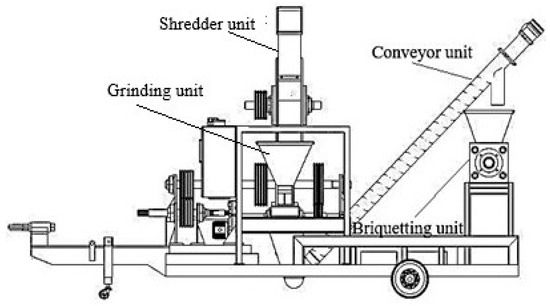
Figure 1.
Prototype mobile hydraulic piston briquetting machine.
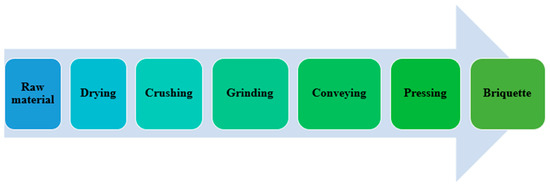
Figure 2.
The main steps of briquetting.
The process of briquetting did not require the use of any binder. The briquetting process was carried out by compressing the raw material with an average moisture content of 6.44% and a particle size of 3.64 mm at an average pressure of 180 MPa and briquettes with a diameter of 55 mm and a length of 45 to 50 mm were produced (Figure 3).
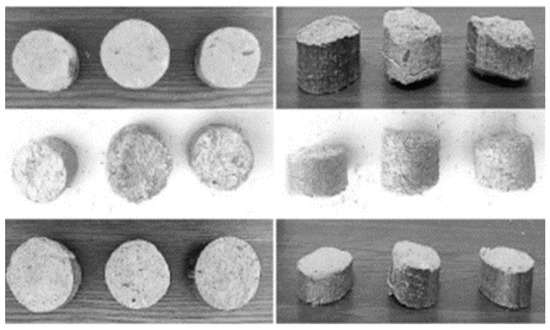
Figure 3.
Sample briquettes made from groundnut shells.
2.2. Experimental Measurements of Briquettes Quality
The moisture content of the briquettes was measured according to the European standard EN 13183-1 and was determined to be 6.44%.
The stereometric method, which is based on measuring the dimensions (such as diameter—55 mm and length—45 of 50 mm) and allowing the briquettes to stay dry, was used to calculate the density. A digital caliper gauge was used to measure the diameter and height of the briquettes in two perpendicular directions (0.01 mm), and a digital balance, accurate to 0.001 g, was used to measure the mass of the briquettes.
where ρ is the density of the briquette (kg m−3), m is the mass of an individual briquette (kg), and d is the diameter of the briquette (m).
Compression tests were carried out according to ASTM E9-89, taking into account some aspects of UNE EN12504-1. A universal testing machine YKM-C205 of 3 kN (minimum load resolution of 0.001 N and data sampling rate of 8 kHz) consisting of two compression plates was used, applying a load at a constant application rate of 5 mm min−1 in accordance with the standards [8]. The compressive resistance of the fuel briquettes was determined as N.
The fuel briquette Tumbler index and Shatter index were evaluated using ASTM D 440-86 and ASAE S269.4 standards, respectively.
In the tumbler resistance test, the fuel briquette samples were weighed for each replicate and placed in the test machine, and then the fuel briquettes were rotated in the drum at 40 min−1 for 3 min. After the tumble was completed, the fuel briquettes were removed from the testing machine and weighed again. Tumbler resistance was determined as the percentage weight lost during the test.
A shatter index is defined as the percentage of weight lost as a result of fractures. During the test, each briquette was dropped on a concrete floor 10 times from a height of one meter. Prior to and following the test, each briquette was weighed. According to the weight loss recorded during the drop test, the shatter index is calculated as a percentage. The particle sizes of the raw material obtained by crushing and grinding the peanut shells were determined by sieve analysis.
2.3. Data Collection
The properties of the briquettes obtained from groundnut shells and the results of some quality tests constitute the dataset. Here, the input parameters include density, moisture content, pressure, particle size, shatter index, and tumbler index. The compressive resistance would be the results of the models. The statistical information of this dataset is given in Table 1.

Table 1.
Statistical information of the data used in this study.
2.4. Machine Learning Models
Machine learning is the modeling of systems that draw conclusions from data using computational mathematical and statistical methods. Various machine learning algorithms were used to model the experimental data collected. The machine learning neural network diagram is given in Figure 4. To estimate the compressive resistance of briquettes, which is an important parameter of their quality, we employed Extra Trees, Random Forest, Light Gradient Boosting, Gradient Boosting, Extreme Gradient Boosting, Decision Tree, Linear Regression, Ridge Regression, AdaBoost, and K-Neighbors machine learning (ML) methods. The dataset obtained from the experimental data was divided into two groups as training (70%) and testing (30%). Random Forest, Extra Trees, and Light Gradient Boosting machine learning algorithms are modeled on the training data in Python programming language. Test data were used to evaluate the model results. The schematic view of the machine learning-based prediction is given in Figure 5.
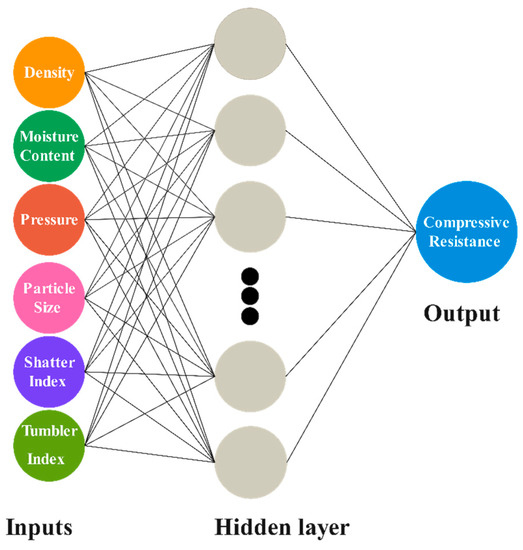
Figure 4.
Machine learning neural network diagram of this study.
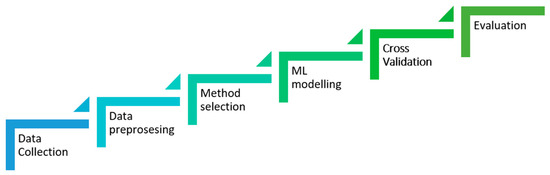
Figure 5.
Schematic view of machine learning-based prediction.
2.4.1. Random Forest
The Random Forest method, an ensemble-based classifier developed by Breiman [37], is frequently used in classification and regression problems. In the Random Forest method, which is an integrated algorithm of the bagging method, the aim is to combine the decision of a set of classifiers through weighted or unweighted voting [38]. The Random Forest method is a machine learning algorithm employed to solve regression and classification tasks, which aggregates the results of several decision trees that are generated randomly.
2.4.2. Extra Trees
The Extra Trees method is a relatively new machine learning technique and was developed as an extension of the random forest algorithm and is less likely to exceed a dataset. The extra tree uses the same principle as the Random Forest and uses a random subset of features to train each base estimator. Each regression tree is trained by Extra Trees using the whole training dataset. On the other hand, Random Forest trains the model using a bootstrap replica. However, it randomly picks the best feature and corresponding value to divide [39].
2.4.3. Light Gradient Boosting
Light Gradient Boosting is an improved decision tree-based gradient learning framework. This model, an incremental learning framework based on decision trees and the empowerment principle, is relatively new. The key distinction between it and the XGBoost model is the use of histogram-based methods to quicken training, use less memory, and employ a leaf-based growth approach with depth limitations [40].
2.5. K-Fold Cross-Validation
Cross-validation is a useful technique for choosing the best model when there are little available data. Cross-validation offers a more reliable estimate of the model’s performance on unknown data, which helps prevent overfitting. Cross-validation is a more data-efficient method than conventional validation procedures since it enables the use of all the available data for both training and validation. The most common of the cross-validation methods is the K-Fold cross-validation method. In the K-Fold cross-validation method used in the study, the data are randomly grouped and divided into “k” subsets. One of them is used for testing and the remaining “k − 1” is used for training. This process is repeated “k” times. The average of the results determines the accuracy of the method [41]. The K-Fold cross-validation diagram is shown in Figure 6.
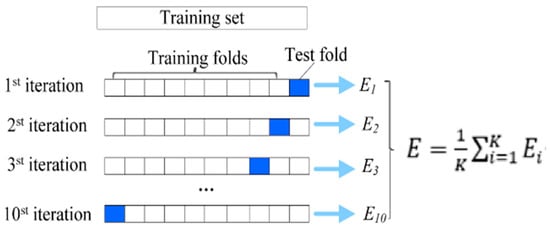
Figure 6.
K-Fold cross-validation diagram [42].
2.6. Model Evaluation
In a machine learning study, the model’s performance is enhanced through optimization of the parameters according to the dataset. Four commonly used statistical methods were used to evaluate the prediction accuracy of the models. These methods are the coefficient of determination (R2), root mean square error (RMSE), mean absolute error (MAE), and mean absolute percentage error (MAPE), defined as Equations (2)–(5) [43]. R2 indicates how well the independent variable x explains the dependent variable y in a regression model. The fact that the R2 value tends toward 1 when the variables are correlated linearly shows that the independent factors account for the majority of the variation in the dependent variable. RMSE is a quadratic metric used to quantify the error magnitude of a machine learning model. It is usually employed to evaluate the discrepancy between the predicted and actual values, i.e., the distance between them. RMSE is calculated as the square root of the average of squared prediction errors, representing the standard deviation of the prediction errors. MAE measures the differences in errors between matched observations that express the same phenomenon. Examples of Y against X include contrasts between predicted and observed data, subsequent time and starting time, and one measuring technique and another measurement technique. MAPE is often used as a loss function in regression problems and model evaluation because of its very intuitive interpretation of relative error.
where Y is the actual value, is the predicted value, is the mean of the actual value, and n is the number of samples.
3. Results and Discussion
The determination of briquette quality and monitoring them throughout the whole supply chain is a highly difficult, expensive, and crucial issue. Briquettes have become more and more popular among other biofuels in recent years due to their low storage costs and excellent combustion efficiency. In this study, machine learning techniques were used to quickly and inexpensively assess compression resistance, which is one of the key briquette quality factors, as opposed to expensive and time-consuming laboratory research. The model evaluation used to verify the data obtained by Extra Trees, Random Forest and Light Gradient Boosting methods with experimental data is given in Table 2. When the MAPE and R2 values are examined, the best result among the three models is obtained from the Extra Trees model. This model achieved the highest R2 value of 0.7595. It is expected that this value will be close to 1.
Table 2.
Model evaluation parameters of machine learning models.
In the validation of the model, the 10-fold cross-validation method was used, and the average value of the results obtained was considered. The K-Fold validation results for all three models are given in Table 3. When the table is examined, it is seen that the standard deviation (std) values of R2 and MAPE are low. This is true for all three models.
Table 3.
K-Fold validation result of machine learning models.
The graph of the measured compressive resistance values of the briquettes produced from peanut shells and the values predicted by the Extra Trees model, which gives the best results, are given in Figure 7. As a result of the estimation made with the test data, the best result was obtained with the value of R2 = 0.754.
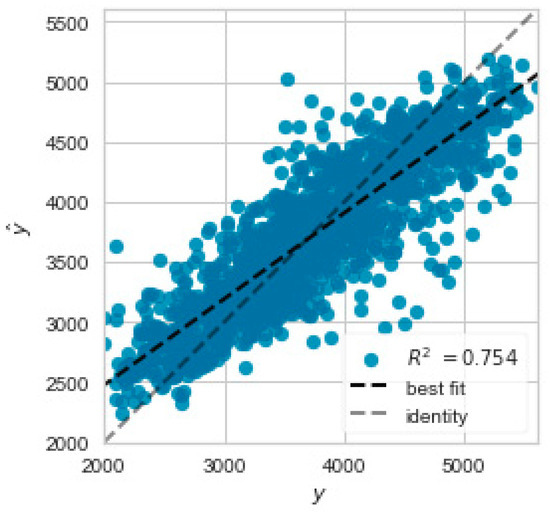
Figure 7.
Prediction errors for Extra Trees model.
In Figure 8, the estimation errors are given for the Random Forest model, and the R2 value calculated on the test data for this model, which is the second-best model for the estimation of compressive resistance, was 0.712. I has been stated in the literature that the Random Forest model gives good results [39,44,45].
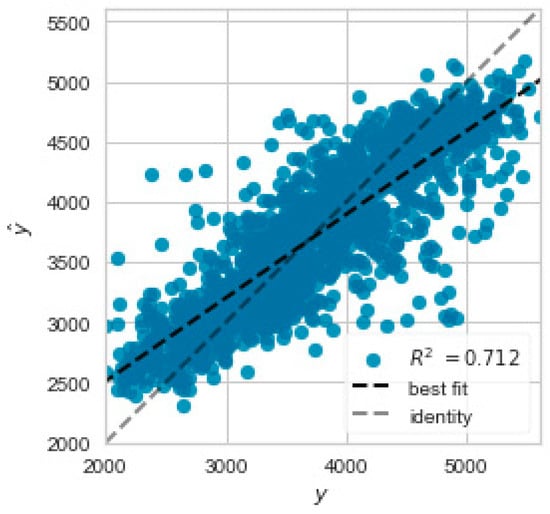
Figure 8.
Prediction errors for Random Forest model.
In this study, it is the Light Gradient Boosting model with an R2 = 0.670 value that gives the third best result and is acceptable for strength estimation. The prediction error values of this model are given in Figure 9. As a result, it can be said that all models demonstrated significant non-linear mapping generalization abilities and are useful for predicting compressive resistance. The optimization of hyperparameters or experimentation with alternative models may be attempted to improve the machine learning model. The variation in briquette parameters is influenced by both the experimental conditions and the choice of raw material.
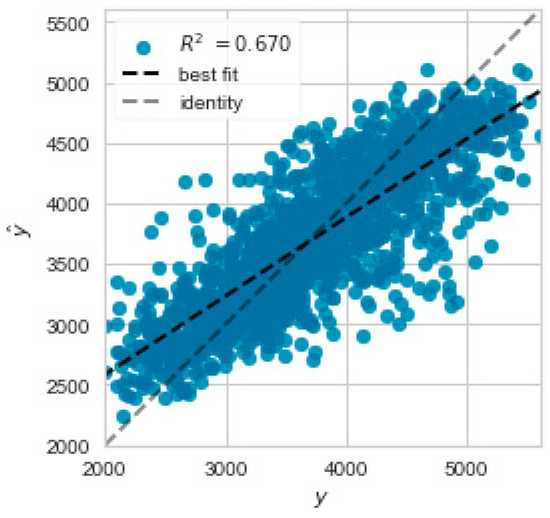
Figure 9.
Prediction errors for Light Gradient Boosting model.
4. Conclusions
To determine the quality parameters of briquettes, measurements with a large number of samples are required. Measurements with a large number of samples are time consuming, costly, and labor-intensive. It also introduces a number of measurement errors. Identifying such features with machine learning inspires larger datasets, attributes, and algorithms for further study, as well as faster and more reliable results for industrial applications such as discrimination, ranking, and prediction processes.
In this study, 10 different machine learning (ML) methods were used to estimate the compressive resistance of briquettes depending on briquette properties such as density, moisture content, pressure, particle size, shatter index, and tumbler index. This study was carried out on the three models that gave the best results from these methods. These models were Extra Trees, Random Forest, and Light Gradient Boosting. The R2 values obtained from the models were 0.7595, 0.7287, and 0.6838, respectively. A 10-fold cross validation was applied to all three models and the average value was taken. The MAPE values of the models were 0.0799, 0.7287, and 0.0922, respectively. As a result of the study, acceptable results emerged from the models obtained. The use of machine learning models has been found to be a preferable method to reduce measurement time and cost. Developing various machine learning models for different raw materials can lead to improvements.
Author Contributions
Conceptualization, A.K. and O.K.; methodology A.K. and O.K.; validation, A.K. and O.K.; formal analysis, A.K. and O.K.; data curation, O.K.; software, A.K.; writing-original draft preparation, A.K., O.K. and B.S.Z.; writing-review and editing, A.K., O.K. and B.S.Z.; visualization, A.K.; super-vision, A.K. and O.K.; project administration, A.K. and O.K. All authors have read and agreed to the published version of the manuscript.
Funding
Funded by National University of Science and Technology Polytechnic Bucharest through PubArt program.
Institutional Review Board Statement
Not applicable.
Informed Consent Statement
Not applicable.
Data Availability Statement
Data available on request from the authors.
Conflicts of Interest
The authors declare no conflict of interest.
References
- Grover, P.D.; Mishra, S.K. Biomass Briquetting: Technology and Practices; FAO Regional Wood Energy Development Programme in Asia: Bangkok, Thailand, 1996. [Google Scholar]
- Gürdil, G.A.K.; Demirel, B. Effect of moisture content, particle size and pressure on some briquetting properties of hazelnut residues. Anadolu J. Agric. Sci. 2020, 35, 330–338. [Google Scholar] [CrossRef]
- Sims, R.; Mabee, W.; Saddler, J.; Taylor, M. An overview of second generation biofuel technologies. Bioresour. Technol. 2010, 101, 1570–1580. [Google Scholar] [PubMed]
- Ajimotokan, H.; Ibitoye, S.; Odusote, J.; Omoniyi, P. Physico-mechanical properties of composite briquettes from corn-cob and rice husk. J. Bioresour. Bioprod. 2019, 4, 159–165. [Google Scholar]
- Ketov, A.; Sliusar, N.; Tsybina, A.; Ketov, I.; Chudinov, S.; Krasnovskikh, M. Plant Biomass Conversion to Vehicle Liquid Fuel as a Path to Sustainability. Resources 2022, 11, 75. [Google Scholar] [CrossRef]
- Kabaş, Ö.; Ünal, İ.; Sözer, S. Quality assessment of bio-briquettes obtained from nut fruit shells. Mitteilungen Klosterneubg. 2022, 72, 222–237. [Google Scholar]
- Orisaleye, J.; Jekayinfa, S.; Dittrich, C.; Obi, O.; Pecenka, R. Effects of Feeding Speed and Temperature on Properties of Briquettes from Poplar Wood Using a Hydraulic Briquetting Press. Resources 2023, 12, 12. [Google Scholar]
- Kabaş, Ö.; Ünal, İ.; Sözer, S.; Selvi, K.; Ungureanu, N. Quality Assessment of Biofuel Briquettes Obtained from Green-house Waste Using a Mobile Prototype Briquetting Machine with PTO Drive. Energies 2022, 15, 8371. [Google Scholar] [CrossRef]
- Aldarabseh, S.M. Experimental investigation of the durability and stability of compressed jojoba cake briquettes. Biomass Convers Biorefinery 2023. [Google Scholar] [CrossRef]
- Pecenka, R.; Clifford, M.; Obi, O.F.; Clifford, M.J. A review of biomass briquette binders and quality parameters. Energies 2022, 15, 2426. [Google Scholar] [CrossRef]
- Kumar, G.; Thampi, B.S.G.; Mondal, P.K. Predicting Performance of Briquette Made from Millet Bran: A Neural Net-work Approach. Adv. J. Grad. Res. 2020, 9, 1–13. [Google Scholar] [CrossRef]
- Benli, H. Determination of thermal performance calculation of two different types solar air collectors with the use of artificial neural networks. Int. J. Heat Mass. Transf. 2013, 60, 1–7. [Google Scholar] [CrossRef]
- Tian, Z.; Qian, C.; Gu, B.; Yang, L.; Liu, F. Electric vehicle air conditioning system performance prediction based on artificial neural network. Appl. Therm. Eng. 2015, 89, 101–114. [Google Scholar] [CrossRef]
- Zhong, H.; Wei, Z.; Man, Y.; Pan, S.; Zhang, J.; Niu, B.; Yu, X.; Ouyang, Y.; Xiong, Q. Prediction of instantaneous yield of bio-oil in fluidized bio-mass pyrolysis using long short-term memory network based on computational fluid dynamics data. J. Clean. Prod. 2023, 391, 136192. [Google Scholar] [CrossRef]
- Yağmur, A.; Kayakuş, M.; Terzioğlu, M. Predicting renewable energy production by machine learning methods: The case of Turkey. Environ. Prog. Sustain. Energy 2023, 42, e14077. [Google Scholar] [CrossRef]
- Musharavati, F.; Khoshnevisan, A.; Alirahmi, S.; Ahmadi, P. Multi-objective optimization of a biomass gasification to generate electricity and desalinated water using Grey Wolf Optimizer and artificial neural network. Chemosphere 2022, 287, 131980. [Google Scholar] [CrossRef]
- Yatim, F.; Boumanchar, I.; Srhir, B.; Chhiti, Y.; Jama, C.; Alaoui, F. Waste-to-energy as a tool of circular economy: Prediction of higher heating value of biomass by artificial neural network (ANN) and multivariate linear. Waste Manag. 2022, 153, 293–303. [Google Scholar] [CrossRef]
- Kartal, F.; Özveren, U. Prediction of torrefied biomass properties from raw biomass. Renew. Energy 2022, 182, 578–591. [Google Scholar] [CrossRef]
- Neto, J.; Ozorio, L.; Abreu, T.; de Dos Santos, B.; Pradelle, F. Modeling of biogas production from food, fruits and vegetables wastes using artificial neural network (ANN). Fuel 2021, 285, 119081. [Google Scholar] [CrossRef]
- Almomani, F. Prediction of biogas production from chemically treated co-digested agricultural waste using artificial neural network. Fuel 2020, 280, 118573. [Google Scholar] [CrossRef]
- Ighalo, J.O.; Adeniyi, A.G.; Marques, G. Application of artificial neural networks in predicting biomass higher heating value: An early appraisal. Energy Sources Part A Recover. Util. Environ. Eff. 2020, 1–8. [Google Scholar] [CrossRef]
- Obafemi, O.; Stephen, A.; Ajayi, O.; Nkosinathi, M. A survey of artificial neural network-based prediction models for thermal properties of biomass. Procedia Manuf. 2019, 33, 184–191. [Google Scholar] [CrossRef]
- George, J.; Arun, P.; Muraleedharan, C. Assessment of producer gas composition in air gasification of biomass using artificial neural network model. Int. J. Hydrogen Energy 2018, 43, 9558–9568. [Google Scholar] [CrossRef]
- Merdun, H.; Sezgin, I.V. Modelling of pyrolysis product yields by artificial neural networks. Int. J. Renew. Energy Res. 2018, 8, 1178–1188. [Google Scholar]
- Francik, S.; Łapczyńska-Kordon, B.; Francik, R.; Wójcik, A. Modeling and Simulation of Biomass Drying Using Artificial Neural Networks. In Renewable Energy Sources: Engineering, Technology, Innovation: ICORES 2017; Springer International Publishing: Cham, Switzerland, 2017; pp. 571–581. [Google Scholar] [CrossRef]
- Kelly Orhorhoro, E.; Sadjere, G.; Okechukwu Ebunilo, P.; Ejuvwedia Sadjere, G. Development of a predictive model for biogas yield using artificial neural networks (ANNs) approach. ResearchgateNet 2017, 4, 71–77. [Google Scholar]
- Beltramo, T.; Ranzan, C.; Hinrichs, J.; Hitzmann, B. Artificial neural network prediction of the biogas flow rate optimised with an ant colony algorithm. Biosyst. Eng. 2016, 143, 68–78. [Google Scholar] [CrossRef]
- Puig-Arnavat, M.; Hernández, J.; Bruno, J.; Coronas, A. Artificial neural network models for biomass gasification in fluidized bed gasifiers. Biomass Biornergy 2013, 49, 279–289. [Google Scholar] [CrossRef]
- Kana, E.; Oloke, J.; Lateef, A.; Adesiyan, M. Modeling and optimization of biogas production on saw dust and other co-substrates using artificial neural network and genetic algorithm. Renew. Energy 2012, 46, 276–281. [Google Scholar] [CrossRef]
- Zhong, Y.; Ding, Y.; Jiang, G.; Lu, K.; Li, C. Comparison of Artificial Neural Networks and kinetic inverse modeling to predict biomass pyrolysis behavior. J. Anal. Appl. Pyrolysis 2023, 169, 105802. [Google Scholar] [CrossRef]
- Liu, S.; Yang, Y.; Yu, L.; Cao, Y.; Liu, X.; Yao, A.; Cao, Y. Self-heating optimization of integrated system of supercritical water gasification of biomass for power generation using artificial neural network combined with. Energy 2023, 272, 127134. [Google Scholar] [CrossRef]
- Francik, S.; Knapczyk, A.A.; Francik, R. Decision support system for the production of Miscanthus and willow briquettes. Energies 2020, 13, 1364. [Google Scholar] [CrossRef]
- Zafari, A.; Kianmehr, M.H.; Abdolahzadeh, R. Modeling the effect of extrusion parameters on density of biomass pel-let using artificial neural network. Int. J. Recycl. Org. Waste Agric. 2013, 2, 9. [Google Scholar] [CrossRef]
- Mungale, N.; Awari, G.; Singh, M.; Sakhale, C. Model formulation and Analysis of Total Weight of Briquettes after mixing for Briquette making operation. Int. J. Eng. Res. Appl. 2016, 6, 25–29. [Google Scholar]
- Shankar, T.J.; Sokhansanj, S.; Bandyopadhyay, S.; Bawa, A.S. A case study on optimization of biomass flow during single-screw extrusion cooking using genetic algorithm (GA) and response surface method (RSM). Food Bioprocess. Technol. 2010, 3, 498–510. [Google Scholar] [CrossRef]
- Mancini, M.; Mircoli, A.; Potena, D.; Diamantini, C.; Duca, D. Prediction of pellet quality through machine learning techniques and near-infrared spectroscopy. Comput. Ind. Eng. 2020, 147, 106566. [Google Scholar] [CrossRef]
- Breiman, L. Random forests. Mach. Learn. 2001, 45, 5–32. [Google Scholar] [CrossRef]
- Ercan, U. Determining Airline Customer Satisfaction with Ensemble Learning Methods. Alanya Acad. Rev. 2022, 6, 2763–2774. [Google Scholar] [CrossRef]
- Ahmad, M.W.; Reynolds, J.; Rezgui, Y. Predictive modelling for solar thermal energy systems: A comparison of support vector regression, random forest, extra trees and regression trees. J. Clean. Prod. 2018, 203, 810–821. [Google Scholar] [CrossRef]
- Fan, J.; Ma, X.; Wu, L.; Zhang, F.; Yu, X.; Zeng, W. Light Gradient Boosting Machine: An efficient soft computing model for estimating daily reference evapotranspiration with local and external meteorological data. Agric. Water Manag. 2019, 225, 105758. [Google Scholar] [CrossRef]
- Ercan, U. Estimating of Households Shopping on The Internet Using Random Forest Method. Kafkas Üniversi-Tesi İktisadi İdari Bilim Fakültesi Derg 2021, 12, 728–752. [Google Scholar] [CrossRef]
- Niu, M.; Li, Y.; Wang, C.; Han, K. A web server for predicting amyloid proteins. Int. J. Mol. Sci. 2018, 19, 2071. [Google Scholar] [CrossRef]
- Ercan, U. Konut Kira Fiyatlarının Makine Öğrenmesi Yöntemleriyle Tahmin Edilmesi: Destek Vektör Regresyonu ve Yapay Sinir Ağları Karşılaştırması. In Ampirik Yöntemlerle İktisadi ve Finans Çözümlemeler; Gazi Kitabevi: Ankara, Türkiye, 2022; pp. 373–390. [Google Scholar]
- Jebli, I.; Belouadha, F.Z.; Kabbaj, M.I.; Tilioua, A. Prediction of solar energy guided by pearson correlation using machine learning. Energy 2021, 224, 120109. [Google Scholar] [CrossRef]
- Saglam, C.; Cetin, N. Prediction of Pistachio (Pistacia vera L.) Mass Based on Shape and Size Attributes by Using Machine Learning Algorithms. Food Anal. Methods 2022, 15, 739–750. [Google Scholar] [CrossRef]
Disclaimer/Publisher’s Note: The statements, opinions and data contained in all publications are solely those of the individual author(s) and contributor(s) and not of MDPI and/or the editor(s). MDPI and/or the editor(s) disclaim responsibility for any injury to people or property resulting from any ideas, methods, instructions or products referred to in the content. |
© 2023 by the authors. Licensee MDPI, Basel, Switzerland. This article is an open access article distributed under the terms and conditions of the Creative Commons Attribution (CC BY) license (https://creativecommons.org/licenses/by/4.0/).