


Abstract
The aim of this study was to determine the effect of the housing system and somatic cell count (SCC) on the composition and fatty acid profile of milk. A total of 419 milk samples were collected from one herd of 210 cows; 90 cows were kept in the tie-stall system, and 120 cows were kept in the free-stall system. The cows received the same fodder. Samples were collected four times, in winter. Udder health was evaluated based on SCC. The tie-stall system, mainly due to individual care, was superior to the free-stall system. Milk from cows kept in the tie-stall system had lower (p < 0.01) SCC by 72 ths mL−1 cells than milk from cows kept in the free-stall system. An increase in SCC was accompanied by decreases in daily milk yield and lactose concentration. Milk from cows housed in the tie-stall barn had higher polyunsaturated fatty acid (PUFA) contents and a lower n-6/n-3 PUFA ratio. Milk with a higher SCC contained more PUFAs and fewer monounsaturated fatty acids (MUFAs). Tie-stall housing contributed to an increase in the proportions of acids beneficial to the health of consumers. A comparison of two housing systems for cows on one farm showed that the free-stall system was associated with a higher SCC and a less favorable milk composition and fatty acid profile.
1. Introduction
Modern consumers have an interest not only in the quality of milk and dairy products, but also in the welfare of dairy cattle. Consumers demand husbandry practices that promote optimal housing and management conditions (animal welfare) and enable animals to express their innate behavior [1]. Animal welfare is determined mainly by housing conditions and herd management practices, which considerably influence the milk yield and quality, the animals’ health and comfort, and the farm’s profits [2]. Polish agriculture is characterized by considerable fragmentation, and dairy cattle are kept mainly in tie-stall systems and milked where they are tethered [3]. Gaworski and Boćkowski [3] calculated the index of technical standards fulfilment (ITSF) to evaluate housing conditions in four barn zones (lying, social, feeding, and milking) and found that the ITSF values were higher in all four zones in the free-stall system than the tie-stall system. An optimal housing system (barn) should facilitate cow handling, cleaning, and management operations to keep animals in good health and to promote their welfare. Both tie-stall and free-stall systems have their strengths and weaknesses in this respect [4]. According to Praks et al. [5], the risk of hoof diseases is higher, whereas the prevalence of mastitis is considerably lower in free-stall than in tie-stall systems. Gordon et al. [6] analyzed the prevalence of diseases in Norwegian dairy cattle farms and found that clinical mastitis was more prevalent in tie-stall than in free-stall systems. A study evaluating housing changes in Swedish dairy herds revealed that the transition from a tie-stall to a free-stall system decreased the prevalence of clinical mastitis and teat injuries [7]. A Romanian study also demonstrated that free-stall housing systems contributed to the health and welfare of dairy cattle [8]. However, the access to animals, handling operations, veterinary treatments, and individual feeding are easier to perform in tie-stall systems [3]. The compared systems also differ in their milking methods. In tie-stall barns, cows are milked directly in stalls, whereas in free-stall systems the milking operations are performed in milking parlors or at automatic milking stations [6]. High-quality milk and dairy products (such as cheese) are positively correlated with cow health, stall cleanliness, and milking hygiene [9]. Mastitis, an intramammary infection (IMI) caused by pathogenic bacteria, generates the greatest losses in dairy cattle production [10]. Mastitis is classified as clinical if symptoms of mammary dysfunction and defective milk are evident, or as subclinical if no clinical signs are visible. Subclinical mastitis is most challenging because it is asymptomatic, and the quality of milk may deteriorate when milk with high somatic cell counts (SCCs) is included in the bulk tank [11]. Intramammary infections increase treatment costs and lead to premature culling and milk production losses [12]. Udder health is commonly monitored based on SCC [13]. Somatic cells are mainly immune system cells that are involved in the innate immune response. These include lymphocytes, macrophages, polymorphonuclear cells, and some types of epithelial cells [14]. An increase in SCC is indicative of an udder infection, and it leads to a decrease in milk yield and undesirable changes in milk composition [14,15]. To improve milk quality, many countries have introduced SCC limits, and milk payments are linked with the physicochemical and microbiological parameters of raw milk. Maximum SCC levels differ across countries. In the European Union, milk is deemed to be fit for human consumption when the SCC is below 400 ths mL−1 cells, but the SCC limit in Brazil is higher, at 600 ths mL−1 cells [16]. Somatic cells are an important source of endogenous milk proteins, including enzymes. Numerous enzymes are released in milk when somatic cells are lysed, including lipases (such as lipoprotein lipase), oxidases (such as catalase and lactoperoxidase), glycosidases (such as lysozyme), and proteases (such as cathepsins, elastase, and collagenase) [17]. Therefore, a high SCC can induce changes in the biochemical properties of milk, including the fatty acid profile, which determines the health benefits of milk and dairy products [18]. Some milk fatty acids, including conjugated linoleic acids (CLAs) and omega-3 polyunsaturated fatty acids (n-3 PUFAs), have anticancer and antidiabetic potential [19]. Diets with a lower n-6/n-3 ratio reduce the risk of many diseases [20].
Previous research has shown that cattle housing systems influence the health status of animals, especially udder health, which affects the quality of produced milk [4,5,8]. In most cases, milk from cows with clinical disease symptoms is not fit for consumption or processing due to changes in its composition and the presence of pharmaceuticals [21]. However, milk from cows with subclinical mastitis is widely consumed and processed in the dairy industry. We hypothesize that milk from such cows shows changes in composition and quality, and this is influenced by the housing system. Therefore, the aim of the present study was to determine the effect of the housing system (i.e., maintenance system, manure removal, milking system, feeding method) and increased SCC on milk composition and the fatty acid profile of milk fat, with special emphasis on the contents of nutritionally essential functional fatty acids.
2. Materials and Methods
2.1. Animals
One herd of 210 Holstein-Friesian (HF) cows was kept in a tie-stall system (90 cows) and a free-stall system (120 cows) (Table 1). The tie-stall and free-stall barns differed with respect to the housing conditions, manure removal method, and milking system. The cows received the same fodder; the differences concerned the technique of feeding concentrates. Feed samples were collected, and the chemical composition of the diets fed to the cows was determined by standard methods [22] (Table 2). The ingredients and chemical composition of the diets are given in Table 3. A total of 419 milk samples were collected in winter, at monthly intervals, four times (twice during morning milking and twice during evening milking). Each time, an attempt was made to collect samples from three cows in a lactation group (1–2, 3+) and from three cows in each lactation stage (until 100 days, 101–200 days, and >200 days after calving). None of the cows showed clear symptoms of clinical mastitis or was treated for mastitis. Approximately 100 mL milk samples were collected in glass containers with 1 mL (20% wt/vol) of 2-bromo-2-nitropro-pane-1,3-diol (bronopol; VWR International AB, Stockholm, Sweden). The milk samples were transported at refrigeration temperature to the laboratory. Two portions of milk were taken from the bulk sample; the first portion was stored at 4 °C and was used to determine the milk’s composition and SCC, and the other portion was stored at −20 °C and was used to analyze the fatty acid profile of the milk fat. The daily milk yield was determined for each cow, and it was converted to energy-corrected milk (ECM). ECM: milk with standardized energy content [23]:

Table 1.
Management characteristics in the examined dairy herd.
Table 2.
Chemical composition and fatty acid profile of feeds used for a dairy herd kept in tie-stall and free-stall systems (mean ± standard error).
Table 3.
Ingredients (kg DM) and chemical composition of diet (mean ± standard error).
Cows’ body energy reserves were estimated based on their body condition scores (BCSs) using a 5-point scale with 0.25-point increments, where 1 denotes a very thin cow and 5 denotes an excessively fat cow [24].
2.2. Analysis of Milk Composition and Fatty Acid Profile
Fresh milk samples were analyzed to determine their chemical composition (i.e., contents of crude protein, casein, fat, lactose, urea, and dry matter) by infrared spectrophotometry using the MilkoScan FT 120 (FossElectric A/S, Hilleroed, Denmark), and to determine their SCC by flow cytometry using the BactoCount IBC (Bentley Instruments Inc., Chaska, MN, USA). In order to evaluate udder health, milk samples were classified by the modified method of Sawa and Piwczyński [25]: ≤200 ths mL−1 somatic cells —healthy udder; 200–400 ths mL−1 somatic cells—risk of mastitis; 400–1000 ths mL−1 somatic cells—subclinical mastitis; >1000 ths mL−1 somatic cells —severe subclinical mastitis. Milk fat was extracted by the method proposed by Röse Gottlieb [22]. The proportions of 41 fatty acids in milk fat were determined by gas chromatography using the CP 3800 system (Varian, Palo Alto, CA, USA) with a split/splitless injector and a flame ionization detector (FID). Samples (1 μL) of fatty acid methyl esters were placed on the CP-Sil 88 Varian Capillary Column (length: 100 m, inner diameter: 0.25 mm). The results were processed using the GALAXIE Chromatography Data System. Fatty acids were identified by comparing their retention times with those of commercially available reference standards purchased from Supelco (Sigma Aldrich, Bellefonte, PA, USA). Analyses of samples and reference standards were performed under identical conditions, i.e., carrier gas—helium; injector temperature—260 °C; detector temperature—260 °C; initial oven temperature—110 °C, raised to 249 °C. Saturated fatty acids (SFAs) and unsaturated fatty acids (UFAs)—including monounsaturated fatty acids (MUFAs) and polyunsaturated fatty acids (PUFAs)—were expressed as relative percentages of total fatty acids, and the following ratios were calculated: UFA/SFA, PUFA/SFA, and n-6/n-3 PUFA.
2.3. Data Analysis
The results were processed using Statistica 13.3 software [26]. In order to obtain the normal distribution of variables, SCC was log-transformed according to the following formula:
where:
x—SCC determined in milk samples.
The least squares method was used to determine whether the milk composition and fatty acid profile were affected by the housing system (tie-stall, free-stall) or SCC class (≤200 ths, 201–400 ths, 401–1000 ths and >1000 ths). The following model was developed:
where Yijk is the value of the analyzed parameter, μ is the population mean, Ai is the effect of the housing system (1, 2), Bj is the effect of the SCC class (1–4), (AB)ij is the housing system × SCC class interaction, and eijk is the random error.
Yijk = μ + Ai + Bj + (AB)ij + eijk
3. Results
All cows housed in the tie-stall and free-stall barns, from which milk was sampled, were similar in terms of age (lactation number) and lactation stage (lactation day) (Table 4). It should be noted that milk from cows kept in the free-stall system contained 72,000 more somatic cells than milk from cows kept in the tie-stall system, and the observed difference was significant (Ln SCC). The housing system influenced the milk’s fat and dry matter contents, which were higher (p < 0.01) in the free-stall system. In turn, milk from cows housed in the tie-stall barn contained less (p < 0.05) urea. The other experimental factor was the SCC in milk, which increased significantly with cows’ age (lactation number) and lactation day. An increase in SCC was accompanied by a significant decrease in daily milk yield. The difference in daily milk yield between the ≤200 SCC and >1000 SCC groups reached 9.1 kg (p < 0.01). The lactose content of milk decreased significantly with increasing SCC. A significant interaction between housing system and SCC class was found for daily milk yield. The decrease in daily milk yield with increasing SCC was slower in the tie-stall system than in the free-stall system (Figure 1). An analysis of the fatty acid profile of milk fat revealed that the housing system affected the concentrations of PUFAs, including n-3 PUFAs, and the n-6/n-3 ratio (Table 5). Milk from cows housed in the tie-stall barn had higher (p < 0.01) contents of PUFAs and n-3 PUFAs, and a lower n-6/n-3 PUFA ratio. The proportion of medium-chain fatty acids (MCFAs) in milk fat increased (p < 0.05), whereas the proportion of long-chain fatty acids (LCFAs) decreased (p < 0.05) with increasing SCC. Fat extracted from milk with a higher SCC contained more (p < 0.05) PUFAs and fewer (p < 0.05) MUFAs.
Table 4.
The effect of the housing system and udder health on milk yield and composition.
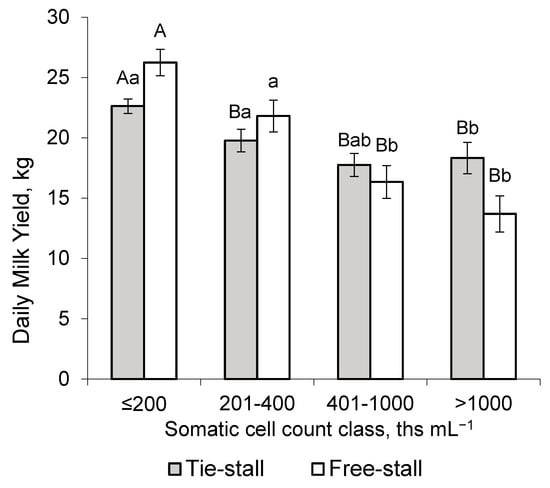
Figure 1.
The effect of the housing system × somatic cell count (SCC) interaction on daily milk yield (means ± SEM): A, B (p ≤ 0.01); a, b (p ≤ 0.05).
Table 5.
The effect of the housing system and udder health on the percentages and ratios of fatty acid groups in milk fat.
An analysis of the major fatty acids in milk fat revealed that their proportions in total fatty acids were affected by the housing system and SCC class (Table 6). Tie-stall housing, compared with free-stall housing, contributed to a significant increase in the proportions of trans-vaccenic acid (TVA), linolenic acid (LNA), conjugated linoleic acid (CLA), and docosahexaenoic acid (DHA). The concentration of arachidonic acid (AA) was higher (p < 0.05) in milk from cows kept in the free-stall system. The proportions of butyric acid (BA) and oleic acid (OA) decreased (p < 0.05), whereas the proportions of linoleic acid (LA), AA, and docosapentaenoic acid (DPA) increased (p < 0.05) with increasing SCC.
Table 6.
The effect of the housing system and udder health on the concentrations of functional fatty acids in milk fat.
4. Discussion
The somatic cell count is an indicator of inflammatory processes in individual cows and, more importantly, of the udder health status of a herd and the quality of raw milk in both the herd and the entire population [14]. In the present study, tie-stall housing and milking directly in stalls resulted in a lower SCC than free-stall housing and the use of milking parlors. Loberg et al. [27] and Keil et al. [28] demonstrated that free-stall barns were characterized by a much lower risk of mastitis. Higher SCCs in free-stall barns may be related to poor organization of the milking process, excessive parlor waiting time, and inadequate pre-milking teat preparation [4]. In the free-stall barn analyzed in this study, wood sawdust was used as bedding and manure was removed once daily, which could negatively affect udder hygiene and increase the SCC. According to Hauge et al. [29], dairy cattle cleanliness is essential to maintaining hygienic milk production. In the current experiment, milk yield decreased and milk composition deteriorated with increasing SCC, which could have been due to impaired synthesis of milk components and increased permeability of the milk–blood barrier [30]. The lactose content of milk decreases during mammary gland infections [31], as a consequence of epithelial cell damage and increased permeability. The osmotic pressure of milk is maintained by an equilibrium between the concentrations of lactose and soluble minerals. Changes in the sodium and potassium contents of milk lead to reductions in lactose synthesis and milk production [32]. In the present study, the milk’s lactose percentage was negatively related to intramammary inflammation and, therefore, could be a potential indicator of udder health. In addition, the daily milk yield decreased with increasing SCC at a slower rate in the tie-stall barn than in the free-stall barn, which could have resulted from the fact that, in the former housing system, cows were handled individually during milking and feeding. Milk samples were collected only from cows that did not exhibit clinical symptoms of mastitis; in the group with the highest SCC, the milk contained 1.2 mln somatic cells per mL on average. Turini et al. [33] also examined cows that did not show clear clinical mastitis symptoms; the group with the highest SCC was characterized by 2.8 mln somatic cells per mL of milk on average, and this state was referred to as severe subclinical mastitis. Subclinical mastitis poses a serious challenge because, in the absence of clinical mastitis symptoms, milk is not discarded and can be used for consumption or processing. However, increased SCC renders milk unsuitable for, e.g., cheese production, due to an unfavorable casein–total protein ratio, as well as reduced lactose and calcium levels [34]. Differences in SCC and milk composition, including endogenous enzyme profiles, can lead to different degrees of lipolysis. It is difficult to establish a clear relationship between enzyme activity and SCC in milk, and their effect on the quality of the end product [17].
In the current experiment, an increase in SCC was accompanied by a decrease in the proportion of LCFAs and an increase in the proportion of MCFAs in milk. This could be explained by the alteration of milk fat globule membranes by leukocyte lipases or plasmin through lipoprotein hydrolysis, which may enhance lipolysis [35]. In a study by Coelho et al. [16], an increase in SCC induced a considerable decrease in OA (C18:1) concentration. A similar relationship was noted in this study. In turn, Foltys and Kirchnerova [36] reported that SCC had no significant effect on the proportions of fatty acids in cows’ milk. However, the maximum SCC value in milk analyzed by the cited authors was 400,000 per mL, which corresponds to SCC groups I and II in the present study. In the current experiment, the percentages of PUFAs, including LA, AA, and DPA, increased with deteriorating udder health. These results partially corroborate the findings of other authors. Bernatowicz et al. [37] found that higher SCC values were accompanied by increased transport of bioactive compounds from blood to milk in cows with mastitis. Lipids present in feed undergo hydrolysis by microbial enzymes, followed by biohydrogenation that converts UFAs (C18:3, C18:2) to SFAs (C18:0) [38]. The fatty acid profile of milk can be altered by feed additives and the type of diet fed to animals [39]. In the evaluated herd, the cows did not receive lipid supplements and were fed similar roughages, including maize silage, grass silage, and meadow hay. In comparison with maize silage, grass silage contributes to a greater increase in the proportions of fatty acids that deliver health benefits to milk consumers [39]. Maize silage is richer in linoleic acid than grass silage, because maize grain, which represents 30–40% of silage, comprises ca. 60% linoleic acid [40]. Apart from the type of forage, i.e., the source of fatty acids, the feeding strategy is also an important consideration [40]. In our study, the method of feeding was the same in both housing systems.
Mixing all feed components thoroughly and feeding them as a ration (PMR) could promote the access of microorganisms to lipids, thus decreasing the proportion of UFAs in total fatty acids in milk.
5. Conclusions
An analysis of milk parameters revealed that the tie-stall system, mainly due to individual care, was superior to the free-stall system. Milk from cows housed in the free-stall barn was characterized by a higher SCC and a less desirable fatty acid profile than milk from cows kept in the tie-stall barn. An increase in SCC was accompanied by significant decreases in daily milk yield and lactose concentration, as well as by an increase in PUFA concentrations and a decrease in MUFA concentrations. High SCC was associated with lower proportions of BA and OA, and higher proportions of LNA, AA, and DPA. A comparison of the two housing systems for cows on one farm showed that the free-stall system was associated with a higher SCC and a less favorable milk composition and fatty acid profile.
Author Contributions
Conceptualization, methodology, software, validation, formal analysis, writing—original draft preparation, writing—review and editing, Z.N.; project administration, investigation, resources, data curation, supervision, funding acquisition, M.M. All authors have read and agreed to the published version of the manuscript.
Funding
This project was financially supported by the Minister of Education and Science under the program entitled “Regional Initiative of Excellence” for the years 2019–2023, Project No. 010/RID/2018/19, amount of funding 12,000,000 PLN.
Institutional Review Board Statement
Not applicable.
Informed Consent Statement
Not applicable.
Data Availability Statement
Not applicable.
Conflicts of Interest
The authors declare no conflict of interest.
References
- Fraser, D. Toward a global perspective on farm animal welfare. Appl. Anim. Behav. Sci. 2008, 113, 330–339. [Google Scholar] [CrossRef]
- Bewley, J.M.; Robertson, L.M.; Eckelkamp, E.A. A 100-year review: Lactating dairy cattle housing management. J. Dairy Sci. 2007, 100, 10418–10431. [Google Scholar] [CrossRef] [PubMed]
- Gaworski, M.; Boćkowski, M. Method for comparing current versus recommended housing conditions in dairy cattle production. Agric. Food Sci. 2018, 27, 17–27. [Google Scholar] [CrossRef]
- Witkowska, D.; Ponieważ, A. The Effect of Housing System on Disease Prevalence and Productive Lifespan of Dairy Herds—A Case Study. Animals 2022, 12, 1610. [Google Scholar] [CrossRef] [PubMed]
- Praks, J.; Poikalainen, V.; Vermäe, I.; Sossidou, E. Livestock production systems: Welfare, environment and product quality. Cattle. In Farm Animal Welfare, Environment & Food Quality Interaction Studies; Sossidou, E., Szücs, E., Eds.; National Agricultural Research Foundation: Giannitsa, Greece, 2007; pp. 201–233. [Google Scholar]
- Gordon, P.F.; Van den Borne, B.H.P.; Reist, M.; Kohler, S.; Doherr, M.G. Questionnaire-based study to assess the association between management practices and mastitis within tie-stall and free-stall dairy housing systems in Switzerland. BMC Vet. Res. 2013, 9, 200. [Google Scholar] [CrossRef] [PubMed]
- Hultgren, J. Foot/leg and udder health in relation to housing changes in Swedish dairy herds. Prev. Vet. Med. 2002, 53, 167–189. [Google Scholar] [CrossRef]
- Popescu, S.; Borda, C.; Diugan, E.A.; Niculae, M.; Razvan, S.; Sandru, C.D. The effect of the housing system on the welfare quality of dairy cows. Ital. J. Anim. Sci. 2014, 13, 2940. [Google Scholar] [CrossRef]
- Velthuis, A.G.J.; Van Asseldonk, M.A.P.M. Process audits versus product quality monitoring of bulk milk. J. Dairy Sci. 2011, 94, 235–249. [Google Scholar] [CrossRef]
- Huijps, K.; Hogeveen, H.; Lam, T.J.G.M.; Oude Lansink, A.G.J.M. Costs and efficacy of management measures to improve udder health on Dutch dairy farms. J. Dairy Sci. 2010, 93, 115–124. [Google Scholar] [CrossRef]
- Leitner, G.; Silanikove, N.; Jacobi, S.; Weisblit, L.; Bernstein, S.; Merin, U. The influence of storage on the farm and in dairy silos on milk quality for cheese production. Int. Dairy J. 2008, 18, 109–113. [Google Scholar] [CrossRef]
- Halasa, T.; Huijps, K.; Østerås, O.; Hogeveen, H. Economic effects of bovine mastitis and mastitis management: A review. Vet. Q. 2007, 29, 18–31. [Google Scholar] [CrossRef]
- Mollenhorst, H.; Van der Tol, P.P.; Hogeveen, H. Somatic cell count assessment at the quarter or cow milking level. J. Dairy Sci. 2010, 93, 3358–3364. [Google Scholar] [CrossRef] [PubMed]
- Schukken, Y.H.; Wilson, D.J.; Welcome, F.; Garrison-Tikofsky, L.; Gonzalez, R.N. Monitoring udder health and milk quality using somatic cell counts. Vet. Res. 2003, 34, 579–596. [Google Scholar] [CrossRef]
- Costa, A.; Bovenhuis, H.; Penasa, M. Changes in Milk Lactose Content as Indicators for Longevity and Udder Health in Holstein Cows. J. Dairy Sci. 2020, 103, 11574–11584. [Google Scholar] [CrossRef] [PubMed]
- Coelho, V.R.P.; Rodrigues, C.E.C.; Corassin, C.H.; Balthazar, C.F.; Cappato, L.P.; Ferreira, M.F.S.; Cruz, A.G.; Oliveira, C.A.F. Milk with different somatic cells counts and the physicochemical, microbiological characteristics and fatty acid profile of pasteurised milk cream: Is there an association? Int. J. Food Sci. 2017, 52, 2631–2636. [Google Scholar] [CrossRef]
- Li, N.; Richoux, R.; Boutinaud, M.; Martin, P.; Gagnaire, R. Role of somatic cells on dairy processes and products: A review. Dairy Sci. Technol. 2014, 94, 517–538. [Google Scholar] [CrossRef]
- Ivanov, G.Y.; Bilgucu, E.; Balabanova, T.G.; Lvanova, I.V. Effect of somatic cell count of cow’s milk on the lipolysis and fatty acid profile of farmer cheese. Int. Food Res. J. 2021, 28, 1171–1178. [Google Scholar] [CrossRef]
- Collomb, M.; Schmid, A.; Sieber, R.; Wechsler, D.; Ryhänen, E.-L. Conjugated linoleic acids in milk fat: Variation and physiological effects. Int. Dairy J. 2006, 16, 1347–1361. [Google Scholar] [CrossRef]
- Simopoulos, A.P. The importance of the omega-6/omega-3 fatty acid ratio in cardiovascular disease and other chronic diseases. Exp. Biol. M. 2008, 233, 674–688. [Google Scholar] [CrossRef]
- Dufour, S.; Fréchette, A.; Barkema, H.W.; Mussell, A.; Scholl, D.T. Invited review: Effect of udder health management practices on herd somatic cell count. J. Dairy Sci. 2011, 94, 563–579. [Google Scholar] [CrossRef]
- AOAC. Official Methods of Analysis, 15th ed.; Association of Official Analytical Chemists: Arlington, TX, USA, 1990. [Google Scholar]
- Sjaunja, L.O.; Baevre, B.L.; Junkkarinen, J.; Pedersen, J.; Setala, J. A Nordic proposal for an energy corrected milk (ECM) formula. In Proceedings of the 27th Session of the ICRPMA, Paris, France, 2–6 July 2009; pp. 156–157. [Google Scholar]
- Wildman, E.E.; Jones, G.M.; Wagner, P.E.; Boman, R.L.; Troutt, H.F.; Lesch, T.N. A dairy cow body condition scoring system and its relationship to selected production characteristics. J. Dairy Sci. 1982, 65, 495–501. [Google Scholar] [CrossRef]
- Sawa, A.; Piwczyński, D. Frequency of the occurrence of cows with low somatic cell levels in milk during full lactation. Med. Wet. 2003, 59, 630–633. [Google Scholar]
- StatSoft Inc. Statistica (Data Analysis Software System), Version 13.3; TIBCO Software Inc.: Palo Alto, CA, USA, 2020.
- Loberg, J.; Telezhenko, E.; Bergsten, C.; Lidfors, L. Behaviour and claw health in tied dairy cows with varying access to exercise in an outdoor paddock. Appl. Anim. Behav. 2004, 89, 1–16. [Google Scholar] [CrossRef]
- Keil, N.M.; Wiederkehr, T.U.; Friedli, K.; Wechsler, B. Effects of frequency and duration of outdoor exercise on the prevalence of hock lesions in tied Swiss dairy cows. Prev. Vet. Med. 2006, 74, 142–153. [Google Scholar] [CrossRef] [PubMed]
- Hauge, S.J.; Kielland, C.; Ringdal, G.; Skjerve, E.; Nafstad, O. Factors associated with cattle cleanliness on Norwegian dairy farms. J. Dairy Sci. 2012, 95, 2485–2496. [Google Scholar] [CrossRef]
- Forsback, L.; Lindmark-Månsson, H.; Andren, A.; Svennersten-Sjaunja, K. Evaluation of quality changes in udder quarter milk from cows with low-to-moderate somatic cell counts. Animal 2010, 4, 617–626. [Google Scholar] [CrossRef]
- Munro, G.L.; Grieve, P.A.; Kitchen, B.J. Effects of mastitis on milk yield, milk composition, processing properties and yield and quality of milk products. Aust. J. Dairy Technol. 1984, 39, 7–16. [Google Scholar]
- Stelwagen, K.; Farr, V.C.; McFadden, H.A. Alteration of the sodium to potassium ratio in milk and the effect on milk secretion in goats. J. Dairy Sci. 1999, 82, 52–59. [Google Scholar] [CrossRef]
- Turini, L.; Conte, G.; Bonelli, F.; Serra, B.; Sgorbini, M.; Mele, M. Multivariate factor analysis of milk fatty acid composition in relation to the somatic cell count of single udder quarters. J. Dairy Sci. 2020, 103, 7392–7406. [Google Scholar] [CrossRef]
- Ogola, H.; Shitandi, A.; Nanua, J. Effect of mastitis on raw milk compositional quality. J. Vet. Sci. 2007, 8, 237–242. [Google Scholar] [CrossRef][Green Version]
- Le Marechal, C.; Thiery, R.; Vautor, E.; Le Loir, Y. Mastitis impact on technological properties of milk andquality of milk products—A review. Dairy Sci. Technol. 2011, 91, 247–282. [Google Scholar] [CrossRef]
- Foltys, V.; Kirchnerova, K. Impact of lactation stage and milk production on milk fat fatty acids ratio. Slovak J. Anim. Sci. 2012, 45, 30–35. [Google Scholar]
- Bernatowicz, E.; Reklewska, B.; Zdziarski, K.; Karaszewska, A. Poziom bioaktywnych składników w mleku krów zależnie od zdrowia gruczołu mlekowego. Zesz. Nauk. Prze. Hod. 2004, 72, 185–193. (In Polish) [Google Scholar]
- Conte, G.; Serra, A.; Cremonesi, P.; Chessa, S.; Castiglioni, B.; Cappucci, A.; Bulleri, E.; Mele, M. Investigating mutual relationship among milk fatty acids by multivariate factor analysis in dairy cows. Livest. Sci. 2016, 188, 124–132. [Google Scholar] [CrossRef]
- Shingfield, K.J.; Bonnet, M.; Scollan, N.D. Recent developments in altering the fatty acid composition of ruminant-derived foods. Animal 2013, 7 (Suppl. S1), 132–162. [Google Scholar] [CrossRef] [PubMed]
- Chilliard, Y.; Ferlay, A.; Doreau, M. Effect of different types of forages, animal fat or marine oils in cow’s diet on milk fat secretion and composition, especially conjugated linoleic acid (CLA) and polyunsaturated fatty acids. Livest. Prod. Sci. 2001, 70, 31–48. [Google Scholar] [CrossRef]
Disclaimer/Publisher’s Note: The statements, opinions and data contained in all publications are solely those of the individual author(s) and contributor(s) and not of MDPI and/or the editor(s). MDPI and/or the editor(s) disclaim responsibility for any injury to people or property resulting from any ideas, methods, instructions or products referred to in the content. |
© 2023 by the authors. Licensee MDPI, Basel, Switzerland. This article is an open access article distributed under the terms and conditions of the Creative Commons Attribution (CC BY) license (https://creativecommons.org/licenses/by/4.0/).