


Due to a minor programming mistake, the authors had to fix the bug and repeat all computational experiments reported in [1]. The bug, however, did not have much influence on the results. In particular, the results changed only slightly, that is, no qualitative change in the results was observed. In the following, the changes applied to the paper are listed.
First, due to fixing the bug, the parameters of the algorithm had to be tuned again. The following two tables are the updated Table 3 and Table 4 of the paper. The values in blue are those that have changed in comparison to the original paper version.

Table 3.
Parameter values determined by irace for the C&W savings heuristic.
Table 4.
Parameter values determined by irace for VNS.
Second, the algorithm was executed with the updated parameter values, and, as a consequence, the results in Table 5, Table 6, Table 7, Table 8, Table 9 and Table 10 and in Figure 8 of the original paper were updated as follows. Note that, in the first three tables, the changes are marked again in a blue color. In contrast, in the last three tables, the changes are not marked, because all results of VNS VNS have changed.
Table 5.
Computational results for small-sized instances with 5 customers.
Table 6.
Computational results for small-sized instances with 10 customers.
Table 7.
Computational results for small-sized instances with 15 customers.
Table 8.
Computational results for large-sized clustered instances.
Table 9.
Computational results for large-sized random instances.
Table 10.
Computational results for large-sized random-clustered instances.
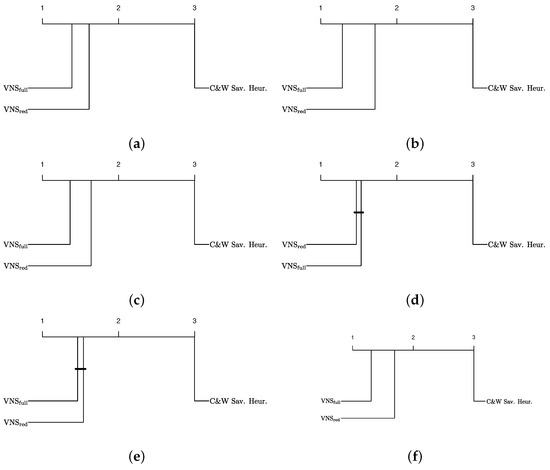
Figure 8.
Critical difference plots concerning the results for large instances. The graphic in (a) considers all large instances, while the other graphics consider subsets of the set of large instances. (a) All large instances; (b) clustered instances; (c) random instances; (d) random-clustered instances; (e) instances R1*; C1* and RC1*; and (f) instances R2*, C2*, and RC2*.
Finally, note that these slight changes in the results led to very minor changes in the text on pages 22 and 23 of the original paper. In particular, on page 22, the original sentence was replaced with the following one: “For two of the remaining three cases, CPLEX was able to provide feasible solutions of the same quality as VNS and VNS, without being able to prove optimality.” Moreover, the following minor changes were made in two sentences of the last paragraph of page 22: “While VNS provides results at least as good as CPLEX for all instances except for C106_C15, VNS only does so in seven out of 12 cases. Considering those instances for which CPLEX was able to obtain a solution, both VNS variants improved the solution quality of CPLEX, on average, by 0.55% (VNS) and 6.86% (VNS). In fact, VNS outperforms VNS both in terms of best-performance (column `dist’) and in terms of average-performance (column `avg’).”
Furthermore, the last paragraph on page 23 was replaced with the following one: “The following observations can be made. For the large clustered instances (Table 8) and large random instances (Table 9), VNS significantly outperforms VNS, both in terms of best-performance and average-performance. This is also shown in Figure 8b,c. However, the opposite is generally the case in the context of random-clustered instances, as shown in Figure 8d. This means that the removal/destroy operators have a rather negative impact on the performance of VNS in these cases. This is most probably due to their elevated computation time requirements. Nevertheless, Figure 8d also shows that this difference is not statistically significant. Moreover, the superiority of VNS over VNS is much more significant in the context of instances with a long scheduling horizon (R2*C2* and RC2*) compared to the instances with a short scheduling horizon (R1*C1* and RC1*); see Figure 8e,f. Finally, when considering all large instances together, VNS significantly outperforms VNS (see also Figure 8a).”.
The authors apologize for any inconvenience caused and state that the scientific conclusions are unaffected. This correction was approved by the Academic Editor. The original publication has also been updated.
Reference
- Akbay, M.A.; Kalayci, C.B.; Blum, C.; Polat, O. Variable Neighborhood Search for the Two-Echelon Electric Vehicle Routing Problem with Time Windows. Appl. Sci. 2022, 12, 1014. [Google Scholar] [CrossRef]
Publisher’s Note: MDPI stays neutral with regard to jurisdictional claims in published maps and institutional affiliations. |
© 2022 by the authors. Licensee MDPI, Basel, Switzerland. This article is an open access article distributed under the terms and conditions of the Creative Commons Attribution (CC BY) license (https://creativecommons.org/licenses/by/4.0/).