1. Introduction
Physiological phenomena, such as respiration, metabolism and immune system defense mechanisms, are important for the proper functioning of living organisms through which reactive oxygen species (ROS) are released. Their increased production could lead to disruption of redox signaling, molecular damage, mutations, cell death, and oxidative damage to macromolecules, such as DNA, proteins, and lipids. This damage could result in many diseases, including age-related disorders, cancer, atherosclerosis, and neurodegenerative diseases [
1]. Moreover, ROS maintains inflammation by inducing the expression of genes that code for proteins involved in the production of inflammatory mediators [
2,
3]. Inflammation is a dynamic physiological process of defense, consisting of a set of vascular, cellular, and humoral reactions to eliminate the aggressor agent, cleanse cellular debris, repair damaged tissue, and restore homeostasis. This acute inflammation is manifested by redness, heat, pain, and swelling of the infected area. However, when it persists, it can lead to multiple general biological and clinical effects as altered general condition, combining asthenia, anorexia, fever, sleep disturbance, and cachexia with muscle wasting [
4]. In addition, inflammation can be associated with changes in the three-dimensional structure of proteins following exposure to heat or chemicals. This leads to an activation of neutrophils and an overproduction of lysosomal constituents, such as bactericidal enzymes and proteases [
5,
6].
One of the most appropriate models for studying anti-inflammatory activities in vivo is that of oedema induction with carrageenan. Carrageenan induces acute and local inflammation characterized by an increase in the level of oxidative stress markers (neutrophil-derived free radicals and nitric oxide), proinflammatory mediators (histamine, prostaglandins etc., and proinflammatory cytokines/chemokines) in the body [
7]. Overproduction of these mediators is strongly implicated in the pathogenesis of several chronic diseases, including diabetes, hypertension, cardiovascular disease, neurodegenerative diseases, alcoholic liver disease, chronic kidney disease, cancer, and aging [
8]. Enzymatic and nonenzymatic antioxidant systems are part of the multiple mechanisms of the human body involved in protection from cellular damage due to reactive oxygen species (ROS) [
9]. However, the innate defense may fail in the face of prolonged oxidative stress.
In addition, conventional therapies recommend the uses of analgesic drugs, non-steroidal anti-inflammatory drugs (NSAIDs), steroidal anti-inflammatory drugs (SAIDs), and opioids. However, the side effects caused by long-term use of antioxidants [butylated hydroxyl anisole (BHA) and butylated hydroxyltoluene (BHT)] and synthetic anti-inflammatory drugs (Aspirin, sodium diclofenac, indomethacin, Paracetamol) motivate the scientific community to search for alternative therapeutic solutions [
10]. Natural antioxidants are particularly important because they are harmless, low cost and abundant in many plant sources [
11]. Thus, medicinal plants are increasingly exploited for this purpose because most of the pharmacological substances and active compounds used to combat the above-mentioned diseases and to produce medicines are of natural origin. They do so through their ability to inhibit the formation of free radicals. Equally, several scientific works have highlighted the anti-inflammatory and antioxidant activities of extracts and pure compounds (phenolics, flavonoids, such as cynaroside) isolated from medicinal plants, such as
Libidibia ferrea, Curcuma longa;
Spirulina plantensis,
Camellia sinensis Elsholtiza bodinieri [
12,
13,
14,
15,
16,
17], and some
Ficus species [
18,
19].
F. umbellata Vahl (Moraceae) is a plant used in Cameroonian pharmacopoeia in the management of certain physiological disorders related to menopause [
20]. Previous studies have revealed that
F. umbellata extracts possess antiestrogenic and estrogenic effects in vitro on estrogen receptor (ER) expressing cells and in vivo on estrogen primary targets organs, respectively [
21]. In addition, methanolic extracts of
F. umbellata showed cytotoxic potential on breast cancer cell lines and an in vivo antitumor activity in ovarian cancer model in Wistar rats [
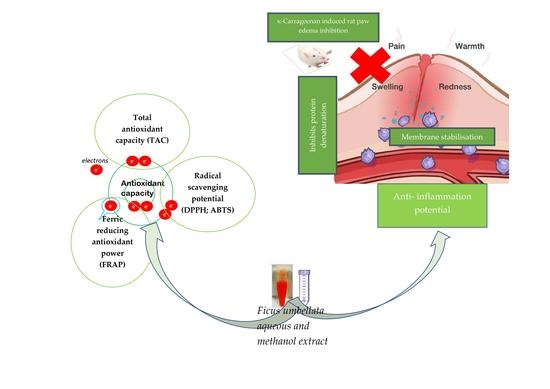
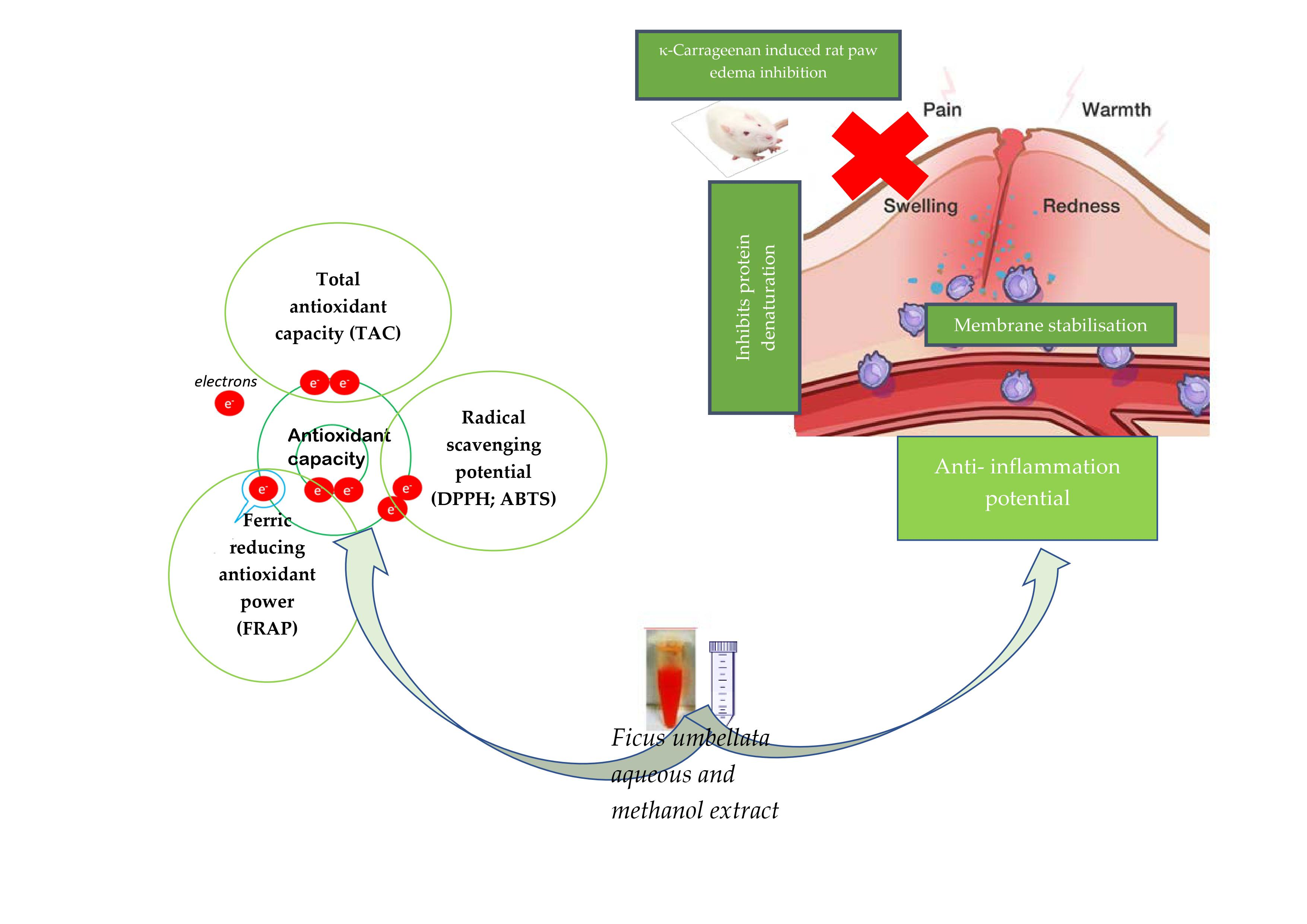
22]. Therefore, the present study was conducted to evaluate the antioxidant and anti-inflammatory activities of
Ficus umbellatta aqueous and methanolic extracts.
4. Discussion
The current article focused on the antiradical, antioxidative and anti-inflammatory activities of
F. umbellata. DPPH (2,2-diphenyl-1-picrylhydrazyl) is a stable free radical whose electrons can delocalize and form free radicals that do not dimerize from one another; leading to its visible discoloration from purple to yellow and absorption at 517 nm. So, DPPH assay is one of the most adequate methods to assess antioxidant activities of various natural substances in vitro because of its fastness, reliability, and reproducibility [
30,
31,
32]. The DPPH reactivity in the presence of
F. umbellata extracts carried out in this study consisted of tracking the inactivation of the DPPH radical by the different extracts over time by recording the absorbance every 15 min for 60 min. The DPPH and ABTS radical scavenging abilities are mainly based on the electron transfer ability of
Ficus umbellata’s antioxidant components. Several works have highlighted the DPPH and ABTS antiradical activities of ethanolic and methanolic aqueous extracts of leaves, fruits, barks, and roots of medicinal plants, such as
Cassia species, Olive tree,
Citrus species,
Camellia sinensis (L.)
O. Kuntz,
Ficus bengalensis L.,
Ficus racemosa L. and
Ficus carica [
18,
19,
33,
34,
35]. Methanolic extract have exhibited stronger scavenging activities than aqueous extract at the tested concentrations. This could be due to its richness in phenol compounds more specifically flavonoids and flavonols, as shown by [
22]. This variability in phenol compound content and antiradical activities in both extracts is due to the polarity of the different compounds toward water and methanol [
36]. In addition, it is well known that phenol compound content is closely related to free radical scavenging activities [
33,
37,
38].
The total antioxidant capacity assay of
Ficus umbellatta extracts revealed that FU
MeOH exhibited higher capacity than FU
aq, confirming that aqueous and alcoholic extracts of some Ficus varieties have been shown to possess high total antioxidant activity [
37,
39,
40]. The high total antioxidant capacity of FU
MeOH is correlated to its high content in secondary metabolites, such as flavonoids, flavonols, and alkaloids [
20]. These are able to donate electrons to transform reactive species into non-reactive and more stable compounds [
41].
Ferrous ions are involved in many physiological processes leading to the production and accumulation of free radicals in the body causing much damage. Therefore, the ferrous reducing antioxidant power of an extract or a pure compound could be of a great importance to alleviate neurodegenerative disorders, metabolic diseases, anemias, cardiovascular diseases, and cancers [
42]. Nowadays, it has been clearly shown that extracts from
Ficus species are also endowed with ferrous reducing antioxidant power [
19,
39]. Murugan et al. [
43] revealed the strong ferrous reducing antioxidant power of extracts from
Osbeckia parvifolia. These results suggest that some bioactive compounds from
F. umbellata extracts as phenol compounds are able to reduce ferrous metal ions, which could be connected to the type of functional groups from their structure. Polyphenolic compounds, such as flavanols and flavonoids, have been recognized as strong ferrous reducing antioxidant power [
35,
38]. Previous studies which aimed at evaluating the antioxidant potential of species from Ficus genus have demonstrated strong antioxidant power comparable to controls with either scavenging activities or reducing potential [
39,
44]. EC
50 values of 9.06 ± 2.21 μg/mL and 369.19 ± 12.04 μg/mL were obtained from
Ficus sur fruits and leaves, respectively [
44]. With the DPPH assay, EC
50 ranging between 210.3 ± 3.22 and 358.3 ± 2.05 µg/mL were obtained from six Ficus species [
45]. This difference in activity with regard to the present study could be due to the difference in the part/organs of the plant been used and the geographical region where the plants were collected; both factors influence the type and relative abundance of secondary metabolites present.
Generally, during biological phenomena in human beings, such as metabolism and respiration, free radicals and reactive oxygen species are yielded. However, their excessive production causes oxidation of macromolecules (proteins, lipids, proteins), and DNA damage, which are strongly involved in the pathogenesis of most chronic diseases, such as atherosclerosis, neurodegenerative diseases, angiocardiopathy, and cancers [
46,
47]. Natural antioxidants can help to fight against these deleterious effects by preventing and avoiding oxidation of biomolecules and regulating the immune system. The increased production of ROS triggers a cascade of reactions leading to the onset of an inflammatory response that can be chronic and lead to pathologies mentioned above, hence it is necessary to assess the anti-inflammatory activities of aqueous and methanolic extracts of
F. umbellata.
The exposure of cells to such chemicals as methyl salicylate, phenyl hydrazine, hypotonic solutions, or heat, provokes hemoglobin oxidation and hemolysis [
48]. On the other hand, free radicals, such as lipid peroxides and superoxides are responsible for cell membrane destabilization. Flavonoids are polyphenolic compounds that are effective scavengers of these free radicals. Thus, we can postulate that these polyphenolic compounds found in
Ficus umbellata extracts could be responsible for the membrane stabilizing effect observed in this study. This protective effect against heat-induced hemolysis of
F. umbellatta extracts noticed in this study suggests their ability to protect the plasma membrane against lysis and then of lysosomal membranes because of their structural similitudes. The mechanism involved for the maintenance of cell life is the inhibition of releasing serum proteins because they can activate neutrophils and extend the inflammatory response for a long time [
49].
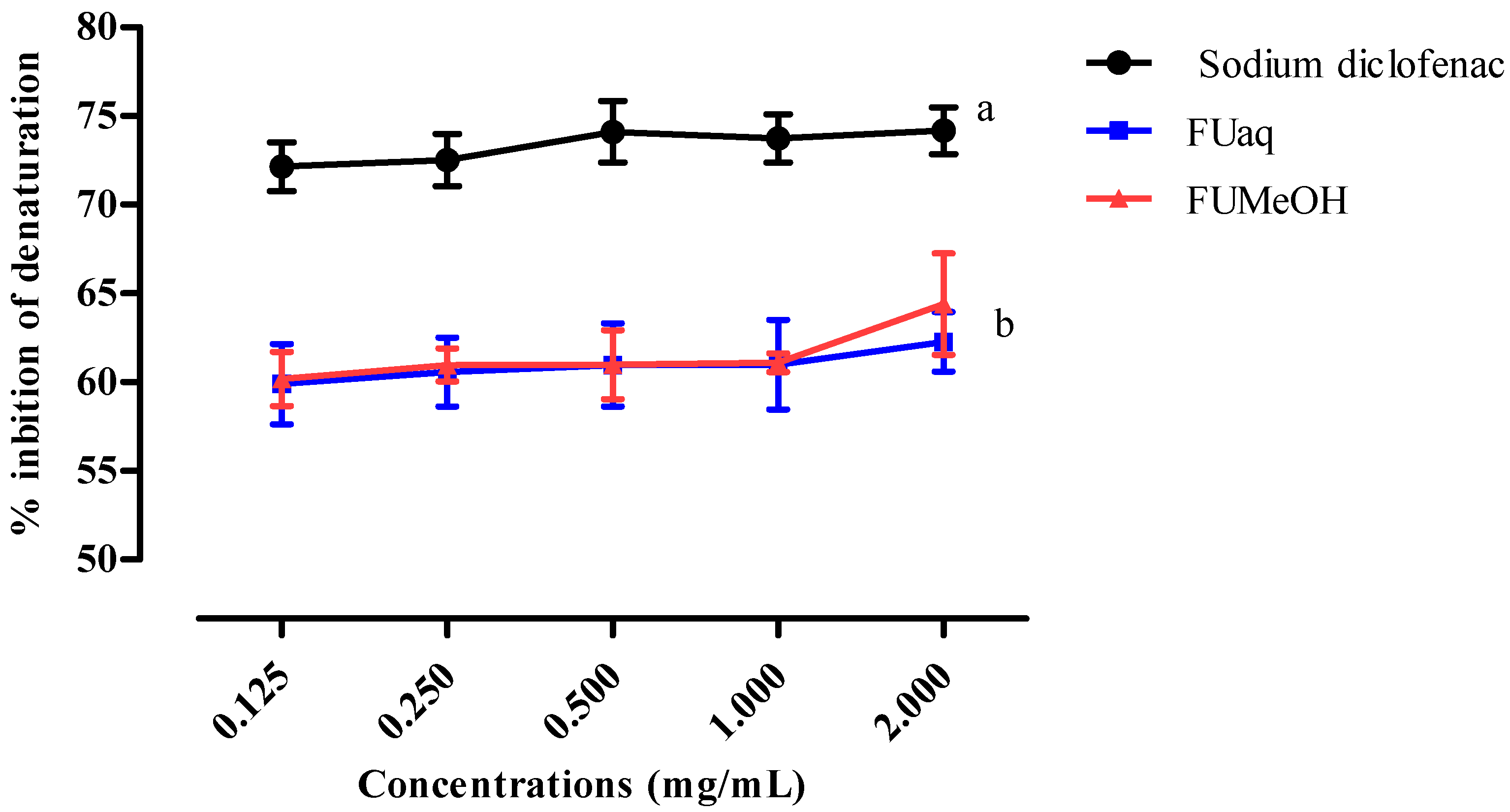
F. umbellatta extracts have shown the antidenaturing activity of egg albumin at concentrations ranging from 0.125 to 2 mg/mL. These results corroborate those of Dharmadeva et al. [
50] who extracted
Ficus racemosa L. from bark at concentrations ranging from 0.01 μg/mL to 0.1 μg/mL. Murugan et al. [
43] have shown that the methanol extracts of
O. parvifolia at 1 mg/mL concentration significantly protected the albumin denaturation and lysis of erythrocyte membrane induced by hypotonic solution, which is comparable to the standard Diclofenac sodium. In fact, protein denaturation occurred very often in an uncontrolled or prolonged activation of inflammation leading to dangerous alterations, such as production of autoantigens associated with type III hypersensitivity reactions and autoimmune diseases, such as rheumatoid arthritis. The denaturation results from the disruption of electrostatic, hydrogen, hydrophobic, and disulfide bonds that maintain the three-dimensional structure of proteins [
51]. The inhibitory activity of
F. umbellatta extracts are probably due to their chemical composition because phenol compounds could interact with two sites present in some proteins, such as ovalbumin of tyrosine-, threonine- and lysine-rich bonds. Therefore,
F. umbellatta extracts could protect protein denaturation by inhibiting the release of autoantigens in living organisms.
Chemical external stimuli, such as carrageenan, leads to a two-phase inflammatory reaction, since carrageenan is a phlogogenic substance. The initial or early phase lasting 90 min after injection of carrageenan is characterized by the release of serotonin, histamine, and bradykinin. After injection of carrageenan, the late phase can last up to 5 h and it is characterized by infiltration of neutrophil and prostaglandin release, mediated by cyclooxygenases. These mediators increase capillary permeability and thus forms an exudate responsible for the oedema that also compresses the nerves and causes the sensation of pain [
52]. In this case, FU200 exhibited the strongest antiedematous activity 5 h after injection of carrageenan. Similar observations were made by Mehta et al., 2013 after administration of ethanolic extracts form aerial parts of
Cassia species in carrageenan induced paw oedema in Wistar albino rats. Different extracts of
Ficus species have also demonstrated high antiedematous activity in rodents [
40]. In addition, Almeida et al. [
12] have reported the in vivo anti-inflammatory activities of several extracts related to
Libidibia ferrea organs’ medicinal plant. Thus, the antiedematous effects of methanolic extracts from
F. umbellata could be helpful to attenuate the delirious effects of an acute inflammation.




 ,
,