1. Introduction
Free-space optical (FSO) communication technology has been widely used in commercial and military fields due to its advantages such as large transmission capacity, rich spectrum resource, good confidentiality, and good directivity [
1,
2,
3]. Moreover, with the use of unmanned aerial vehicles (UAVs) gradually shifting from the military field to the commercial and civil fields, high-speed data transmission is often needed in some special working environments, such as terrain survey and disaster detection. For the above reasons, FSO communication technology is naturally introduced into the field of UAV, so as to establish high-speed optical communication networks in ground-to-ground and air-to-air scenarios.
The FSO communication link between UAVs is fundamental to improve the coverage range and networking flexibility of UAVs. In recent years, UAVs and high-altitude platforms are often used as relays to support wireless long-range links between two terrestrial stations [
4,
5], and the channel modeling of UAV FSO communication has also been fully discussed [
6,
7,
8]. In consideration of turbulence intensity, field angle, spatial position, pointing deviation, and transmitting power, a closed-form statistical channel model, which is a mathematical statistical channel model using a finite number of standard operations of the UAV communication has been proposed, and the above parameters have been optimized to improve the communication quality [
9,
10]. At the same time, a removable lens array has been used to change the beam divergence mechanism of the transmitter to enhance the stability of the link [
7].
However, previous studies were only limited to the communication between hovering UAVs without considering the influence of flying and wind resistance. In hovering states, the UAV FSO communication will only be affected by the jitter and angle deviation [
9,
10,
11]. Taking the star formation UAV group as instance, the central UAV is in the UAV hovering state, and the rest of the UAVs fly on the same level against the central UAV [
12]. During the flight mission, the central UAV sends information to the other UAVs through FSO communications while the tilt of UAV bodies will cause the light beam to be non-orthogonal to the lens at the receiving end. The wind resistance is also one of the main causes of UAV’s jitters. Therefore, an FSO communication link model between in-flight UAVs that includes all the jitter, deviation, receiving error, and wind resistance effects is essential to be established.
The spatial diversity technology can greatly increase the redundancy of the system by receiving the incoherent signals at different locations and improve the stability of the link. A receiver array with multiple isometric receivers, which combines multiple groups of mutually independent fading signals at the receiving end is utilized in this technology, and a strong anti-interference effect on the beam offset and light intensity fluctuation exists [
13]. Equal gain combining (EGC) is a common linear combination algorithm of combining schemes of diversity technology, which can set the weight coefficient of the signals received in each road as 1, and merge them into one road signal to achieve signal gain [
13,
14,
15]. In this way, the sensitivity of the FSO link can be effectively improved.
In this paper, a new FSO communication channel model for the in-flight receiving UAV is established. In consideration of the atmospheric turbulence and the tilt and jitter caused by the UAV flight, the bit error rate (BER) and the outage probability are simulated versus the signal-to-noise ratio (SNR), and the effect of spatial diversity technology on communication quality improvement is studied. Moreover, the improvement of communication quality by spatial diversity technology is analyzed.
2. Theoretical Model of the In-Flight UAV FSO Communication Link
When the UAV at the receiving end is flying horizontally, the arrival angle between the centerline of the beam and the receiving plane is not only related to the pointing deviation caused by the jitter of the receiving end, but also needs to consider the tilt angle of the receiving plane.
In a wireless optical communication link, the received signal at the receiving end can be expressed as [
11]:
where
is the signal emitted at the transmitting end and
is the additive white Gaussian noise (AWGN).
is the channel coefficient that can be given by the following equation:
In Equation (2), is the attenuation and turbulence coefficient of the atmospheric channel; represents the link interrupt coefficient, which indicates whether the spot is detected on the detection plane; and is the geometric and pointing error coefficient, which represents the position deviation between the spot center and the lens center at the receiving end.
As for the attenuation of the optical signal by the influence of atmospheric turbulence, the distribution of
can be described by the Gamma-Gamma model [
16]:
where
is the
n-th order modified Bessel function of the second kind,
is the Gamma function,
and
represent the effective number of the large-scale and small-scale eddies, respectively:
where the Rytov variance is expressed as:
In Equation (3),
k is the wave number,
is the atmospheric refractive index structural parameter, and
L is the propagation distance. In this work, the phase screen method is used to simulate the atmospheric turbulence in the Gamma-Gamma model [
17,
18,
19].
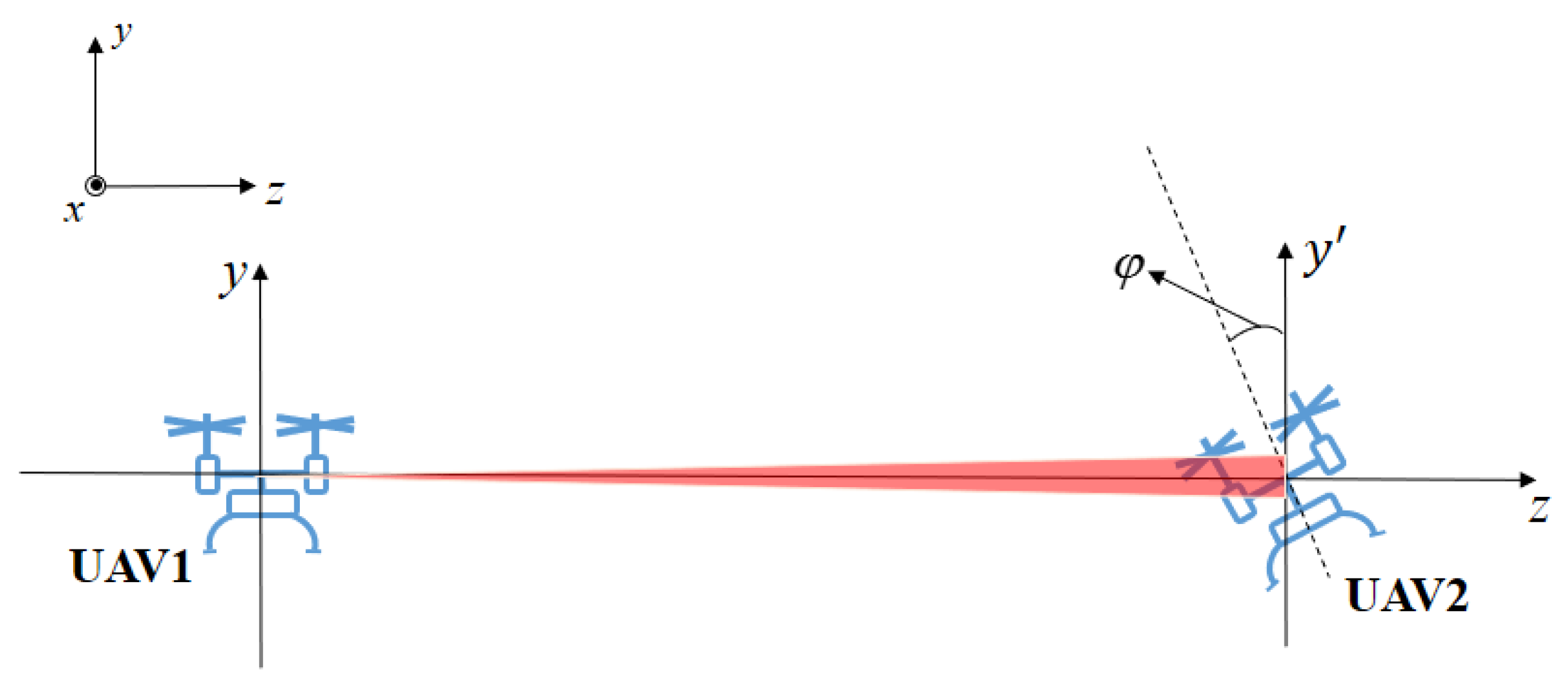
When a multi-rotor UAV is flying in a straight and horizontal flight, a small tilt will exist between the fuselage and the
y axis, as shown in
Figure 1. The size of the tilt angle is related to the speed of the UAV, which affects the link performance through the coefficient
. As shown in
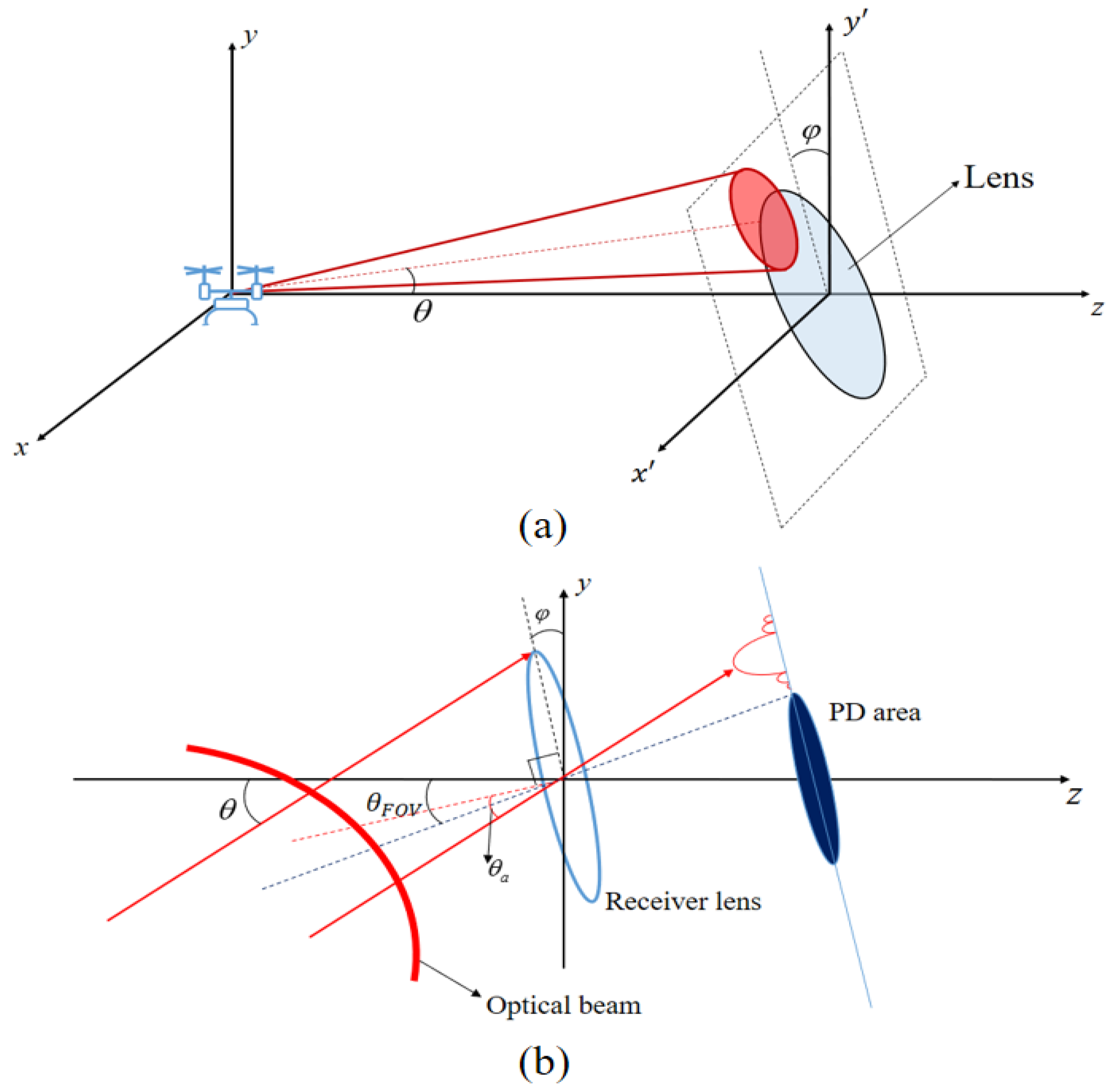
Figure 2a, assuming the UAV at the receiving end is flying horizontally, the included angle between the central axis and the
y axis is denoted as
. Since the plane of the lens at the receiving end is parallel to the central axis of the UAV, the angle between the plane of the lens and the
y axis is also
φ. The angle between the centerline of the beam and the perpendicular direction of the lens plane is defined as the arrival angle
, and the pointing deviation caused by the jitter inherent in the receiving and transmitting end is defined as
.
Here, the UAV is assumed to fly at the same altitude, and it is reasonable to choose a case without loss of generality to describe the relationship between
and
. As shown in
Figure 2b, the direction of the light beam is parallel to the
y-
z plane, and the angle between the beam axis and the
z axis is
. According to the diffraction theory, the communication link will be interrupted when the main lobe of the Airy disk is outside of the detection region of the detector. In the state of horizontal flight,
can be expressed as
. Therefore, the link will be interrupted when
is larger than the receiver’s field angle
. The probability density function (PDF) of
is given by [
10]:
where
and
are the variances of the angle deviation of the transmitter and the receiver respectively.
can be expressed as:
where
and
represent the angle deviations of the transmitting end and the receiving end in the
x direction respectively,
and
represent the angle deviations of the transmitting end and the receiving end in the
y direction, respectively.
According to the above discussion,
has two possible values. The communication will be interrupted when
is greater than
, i.e.,
= 0; the communication interruption will not be induced when
is less than or equal to
, i.e.,
= 1. The value condition of
is given by the following equation:
Therefore, the probability density function (PDF) of
is given by:
where
(
) is the Dirac function.
In the hovering UAV optical communication, the position deviation of the transceiver UAV, and the angle deviation of the transmitter UAV are the main factors that cause the deviation of the center of the spot and the center of the lens. The geometric and pointing error coefficient
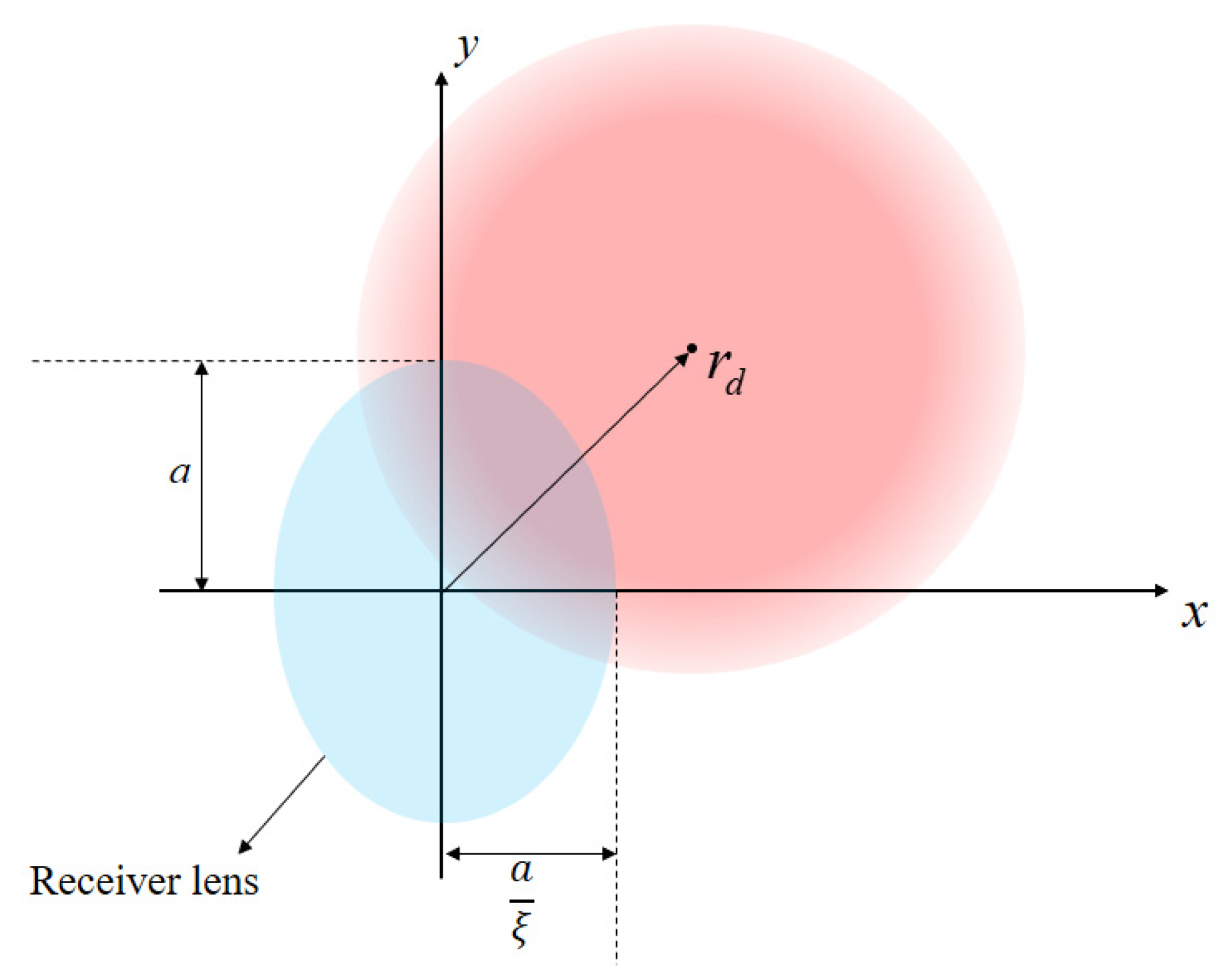
is defined as the proportion of the light intensity of the coincidental part of the spot and the lens to the total light intensity. Here we assume that the transmitting UAV is hovering while the receiving UAV is yawing at the same altitude. In this case, the UAV at the receiving end will be affected by the random lateral wind resistance in the horizontal direction, which will cause the fuselage to wobble around the
y axis, thus causing the lens plane to be no longer orthogonal to the centerline of the beam. As shown in
Figure 3, the projection of the lens on the x-y plane becomes an ellipse instead of a circle. At this point, the intensity of the part where the lens and spot coincide is different from that in the hovering state.
At a certain moment, suppose that the jitter induced by lateral wind resistance causes the lens plane to rotate by an angle
around the
y axis. The ellipse formed by the projection of the lens on the
x-
y plane can be expressed as:
where
. The long axis of the ellipse is
a, and the light intensity of the Gaussian beam section can be written as:
where
r is the radial vector with r distance from the center of the light spot and
is the beam waist at distance
Z. The position deviation between the spot center and the lens
is expressed as:
where
is the position deviation of the receiving end,
is the position deviation of the transmitting end,
Z is the transmission distance, and
is the angle deviation of the transmitting end. Therefore, the geometric and pointing error coefficients can be expressed as:
Equation (12) can be approximated as [
20]:
where
is the ratio of the energy received by the lens to the total energy when
, and the equivalent beam waist can be expressed as:
where
and
is the error function. According to the kinetic characteristic of the UAV,
,
,
, and
all obey Gaussian distributions with zero mean value. They can be expressed as
,
,
, and
respectively, where
and
are the variances of the position deviation of the UAV at the transmitting and receiving end,
is the variance of the pointing angle deviation of the UAV at the transmitting end and
is the variance of the jitter angle of the UAV at the receiving end caused by the horizontal lateral wind resistance. Accordingly,
conditioned on
and
has a Rician distribution, which can be expressed as:
where
is the modified Bessel function of the first kind with order zero. The PDF of
can be written as:
According to Equations (13) and (15), the PDF of
that conditioned on
can be expressed as:
According to Equations (3), (8), and (17), the PDF of
conditioned on
can be expressed as:
Then the PDF of
can be given as:
The outage probability of the UAV-FSO communication can be expressed as:
where
is the threshold of the channel coefficient
. When the instantaneous channel coefficient is lower than
, the link outage can be considered.
Considering the modulation format of quadrature phase shift keying (QPSK), the average BER can be given by the following equation:
where
is the complementary error function,
is the SNR at the transmitter. According to the above discussion, all of
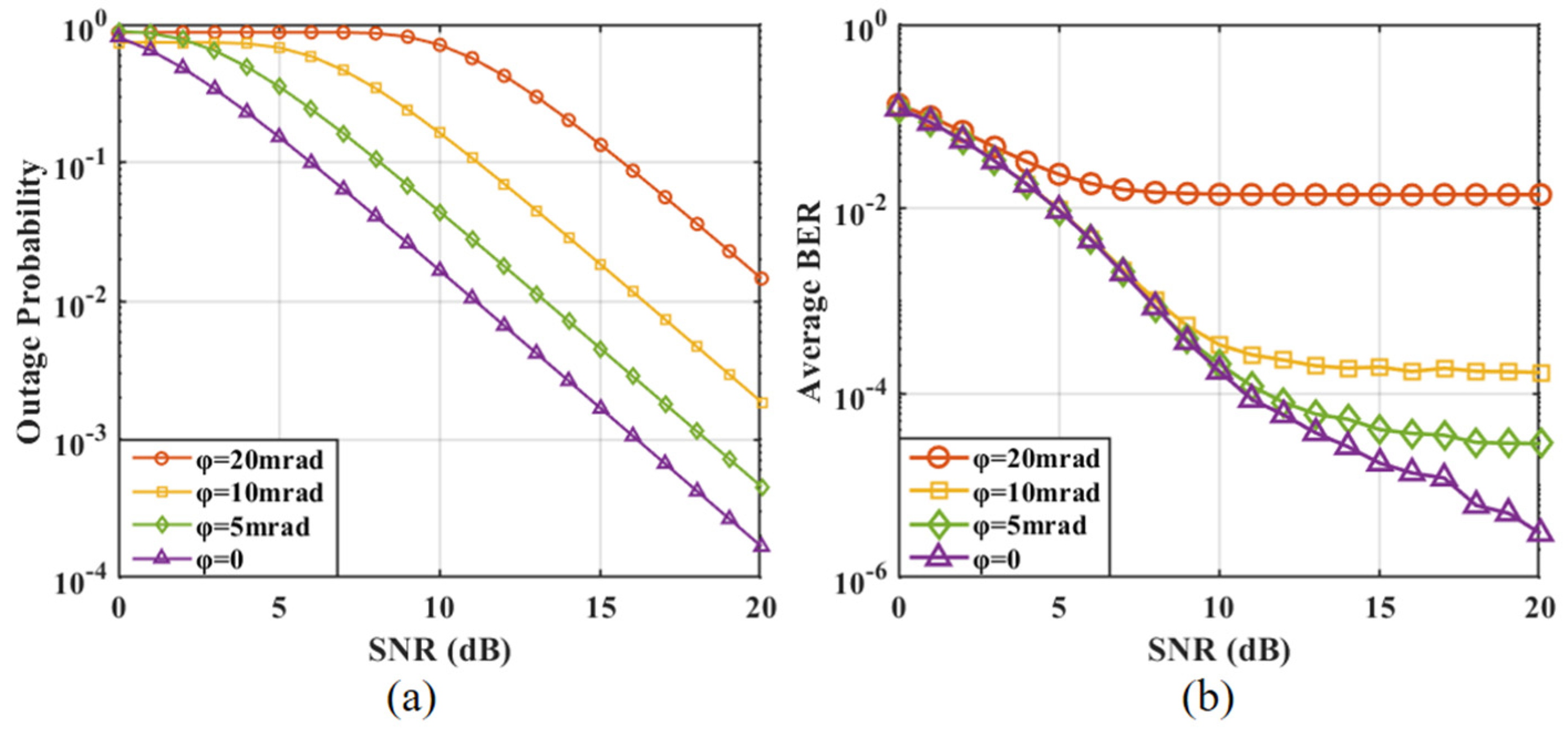
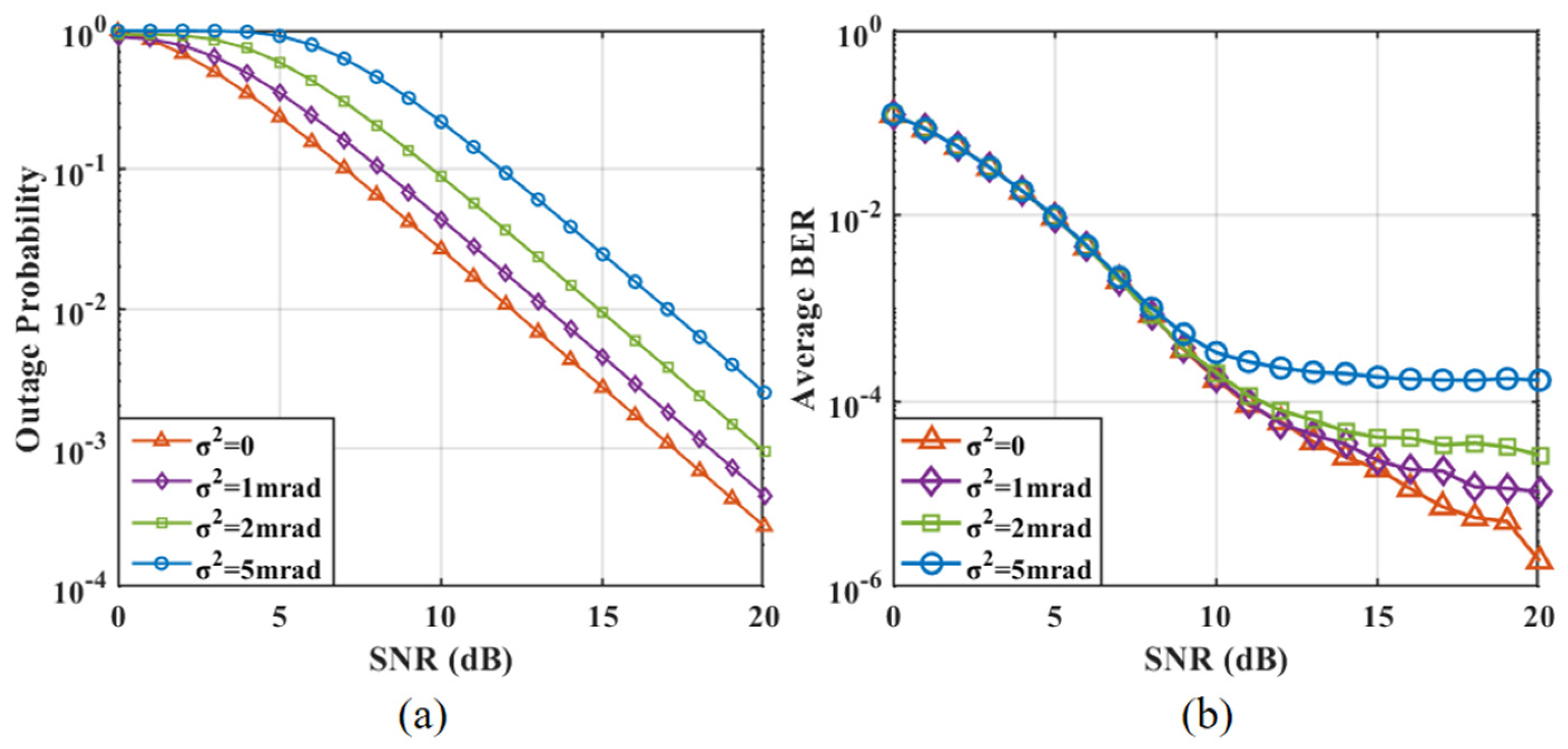
,
, and
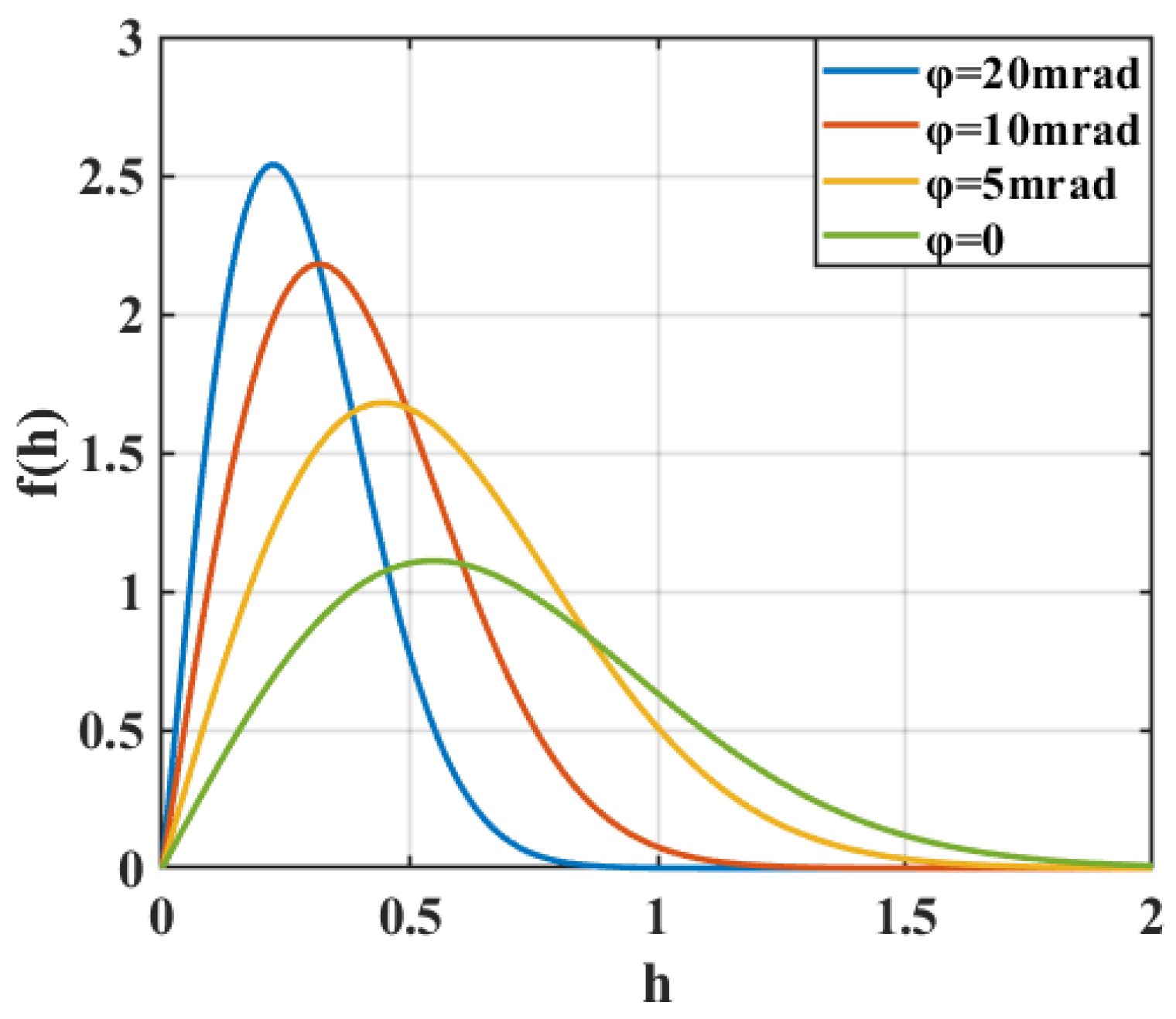
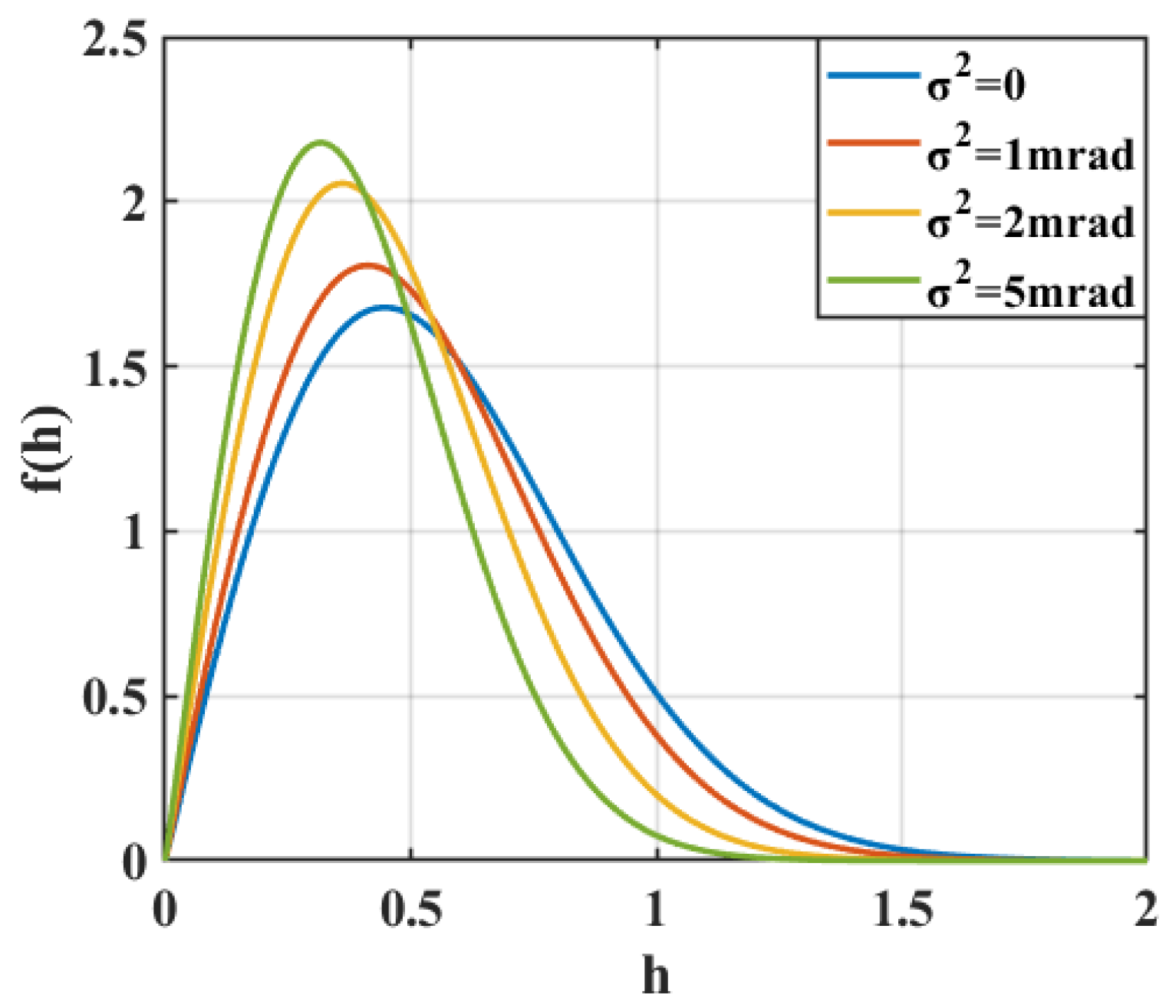
can affect the signal intensity of the receiver, and further affect the SNR of the receiver, and ultimately the BER and the outage probability will be affected. In this paper, the influence of
on the average BER and the outage probability is simulated by numerical Monte Carlo method.
4. In-Flight UAV FSO Communication Improvement Based on Spatial Diversity
The spatial diversity technology can effectively reduce the influence of the phase distortion and light intensity fluctuation, so as to achieve the signal gain [
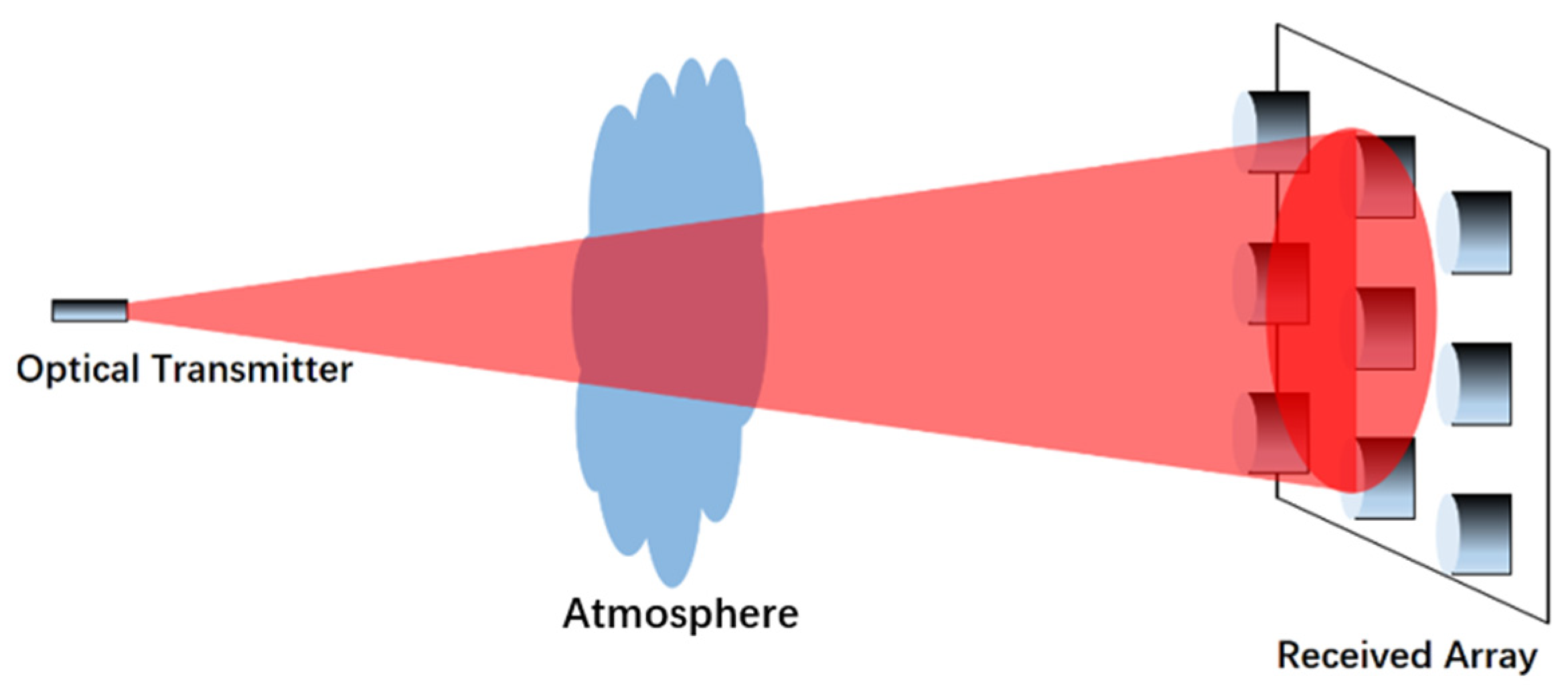
13]. In the UAV FSO link, the spatial diversity with single-in and multiple-out (SIMO) is suitable to be adopted, as shown in
Figure 8, in which each optical antenna in the receiving array independently receives the optical signals. After coupling to the fiber, the signal will be compensated and reconstructed by their corresponding receiver, and the equal gain merge (EGC) algorithm will be used to merge each signal [
21].
The linear combining process for the diversity technology can be expressed as:
where
is the signal of each path, which can be expressed as:
where
denotes the signal, and
is the noise.
represents the weight coefficient of each signal in the process of merging, which can be expressed as:
where the real part
represents the proportion of signals in each path, and the imaginary part
represents the phase alignment of signals in each path to achieve coherent combining effect. Equal-gain combining (EGC) algorithm simplifies all the weighting coefficients to 1 and only performs phase alignment. It can both effectively improve the SNR of the combined signal and avoid the contingency of results.
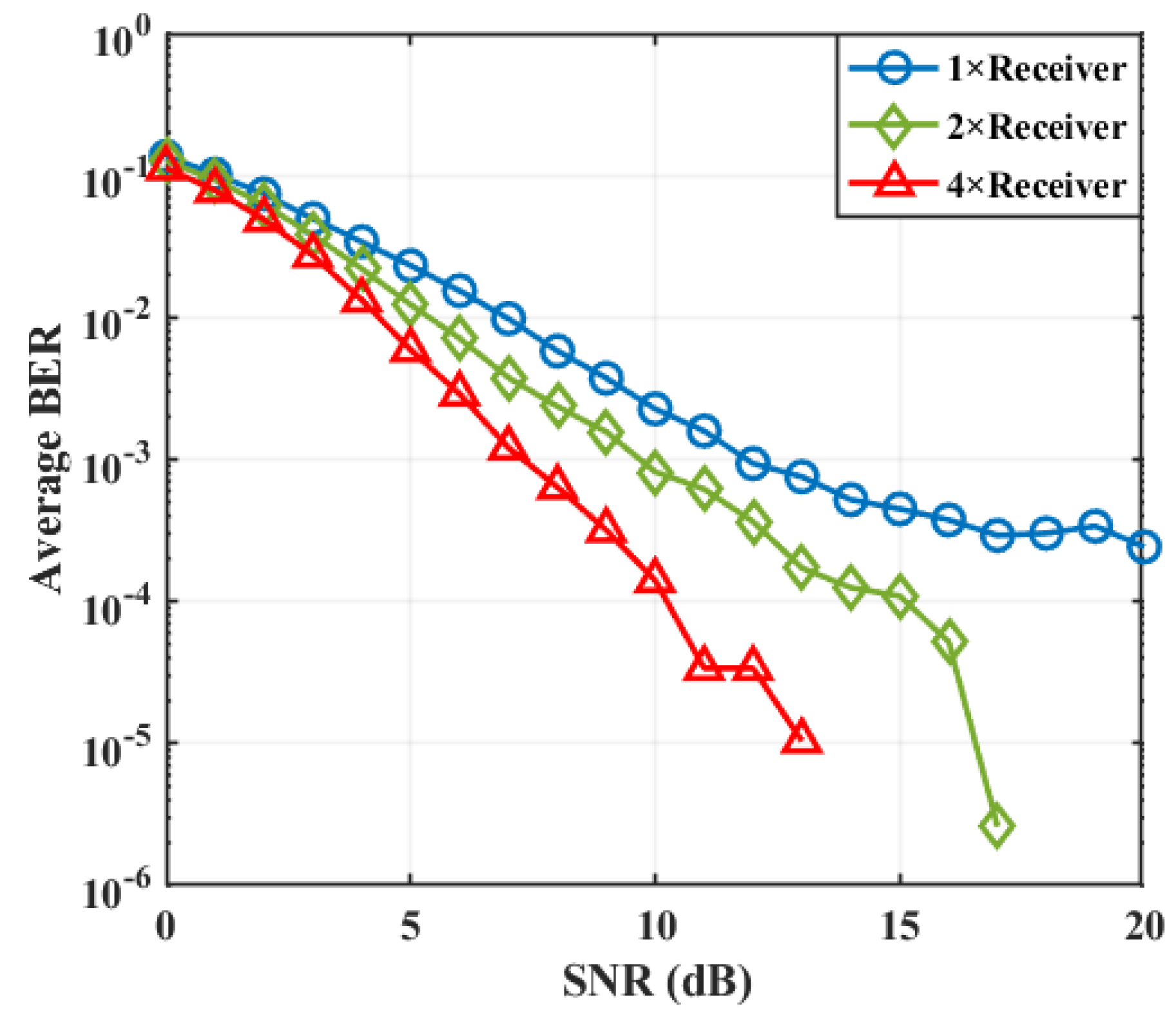
In this simulation, two and four receivers are considered respectively for comparison. The parameters are shown as follows: the field angle
= 40 mrad, the variance of transceiver end position deviation
1 cm, the variances of the angular deviation
1 mrad, the fuselage of the tilt angle
5 mrad, and the random angle deflection variance around the
y axis
= 1 mrad. The number of receivers in the receiving array is 1, 2, and 4, respectively.
Figure 9 shows the BER performance against the SNR, which represents the quality of the FSO communication link.
As shown in
Figure 9, the average BER is significantly reduced compared to that without the diversity receiving technology, and the transmission performance of the UAV FSO system is effectively improved. Without the diversity receiving technology, the average BER of the received signal is still higher than 10
−4 under the SNR higher than 20 dB, and the FSO communication link of the UAV is unstable. When the receiving array composed of two receivers is used, the average BER is less than 10
−4 when the SNR is higher than 15 dB. When the receiving array composed of four receivers is used, the average BER is less than 10
−4 when the SNR is higher than 10 dB. When the SNR is around 13 dB, the average BER drops to 10
−5. Therefore, it can be seen that the application of diversity receiving technology can effectively improve the quality of communication and enhance the stability of the link.