Skip to Content
Administrative SciencesAdministrative Sciences
  • Article
  • Open Access

27 February 2026

Generative Artificial Intelligence in HRM Practice: Patterns, Profiles, and Theoretical Insights


and
1
CISeD–Research Center in Digital Services, School of Technology and Management of Viseu, Polytechnic Institute of Viseu, 3500-100 Viseu, Portugal
2
Industrial Engineering and Management, Faculty of Engineering, Lusófona University, 1749-024 Lisbon, Portugal
*
Author to whom correspondence should be addressed.

Abstract

Although Generative Artificial Intelligence (GenAI) has the potential to transform Human Resource Management (HRM), empirical research on its actual use is still rare. This study aims to investigate how HR professionals use GenAI in HRM, the benefits and challenges they associate with it, and how these patterns vary with organizational context. An exploratory cross-sectional survey of 150 HR professionals in the UK (n = 70) and the US (n = 80) was conducted to investigate usage patterns. Results show that GenAI is mainly applied in job analysis and design, training and development, and recruitment and selection, but concerns persist around operational and technical difficulties, privacy and ethics, output accuracy, and employee resistance. Cluster analysis revealed four user profiles that represent different ways of reconciling efficiency gains and risks. Viewed through the lens of Diffusion of Innovation, Technology–Organization–Environment, and Task–Technology Fit, the results highlight ethical and legal compatibility as a relevant condition for sustained use, point to the potential importance of the organization’s GenAI governance environment, and reveal a boundary condition when tasks involve consequential decisions. This study provides insights into early patterns of GenAI use in HRM and advances theory with propositions that can guide future confirmatory research on responsible and effective use.

1. Introduction

Generative Artificial Intelligence (GenAI) is increasingly acknowledged as a technology that is redefining how organizations operate (Korzynski et al., 2023; Brown et al., 2024). GenAI systems, such as large language models (LLMs), can produce new content (e.g., text, images, code) by learning statistical patterns from massive datasets (Banh & Strobel, 2023; Dwivedi et al., 2023). The relative ease of interaction and flexibility of GenAI distinguish it from previous forms of AI that focused on specific tasks and allow it to be applied in many different organizational activities (e.g., Wamba et al., 2023; Kanbach et al., 2024; Kshetri et al., 2024; Metzger et al., 2025). In Human Resource Management (HRM), GenAI is seen as having the potential to redesign practices and processes for managing people (Budhwar et al., 2023; Chowdhury et al., 2024; Nyberg et al., 2025). In practice, GenAI is beginning to transform several HRM activities: it drafts job descriptions, screens candidates, suggests personalized learning paths, supports performance feedback, and generates onboarding or engagement materials. These possibilities, however, coexist with concerns regarding accuracy, transparency, fairness, and ethics (Andrieux et al., 2024).
Despite growing practical implications, systematic studies on GenAI in HRM are uncommon. Conceptual and review articles have put forth research agendas and identified opportunities and risks (e.g., Budhwar et al., 2023; Chowdhury et al., 2024; Nyberg et al., 2025; Anshima et al., 2026). Practice-based studies by consultancies and professional associations have suggested growing experimentation (e.g., Poitevin & Rizaoglu, 2023; Popera, 2024; UPWS, 2025). Empirical studies, however, are rare and focused on recruitment and selection, where evidence is mixed: some research stresses efficiency gains and better candidate quality (Abdelhay et al., 2025; Koteczki et al., 2025); other work raises issues of fairness and lower validity (Phillips & Robie, 2024; Szandała, 2025). Beyond hiring, there is little evidence. Surprisingly, systematic knowledge of how organizations use GenAI in HRM remains limited, and there is still little empirical evidence on whether usage depends on organizational context (particularly industry and size) or whether formal policies are in place. Moreover, while prior work has discussed potential benefits and challenges of GenAI in HRM (e.g., Budhwar et al., 2023; Andrieux et al., 2024; Chowdhury et al., 2024), it remains less clear which benefits and challenges HR professionals emphasize most in daily practice, and how these perceptions relate to different patterns of use.
The research questions that this study seeks to address are as follows: RQ1—How is GenAI used in HRM? RQ2—To what extent do contextual factors like industry, organizational size, and policy environment relate to usage? RQ3—Which benefits and challenges do HR professionals emphasize most when using GenAI? RQ4—What usage profiles can be identified based on these perceived benefits and challenges?. Our aim is not to claim novel categories of benefits or challenges, but to document their relative prominence in practitioners’ accounts and how they cluster into distinct profiles of GenAI use. To address these questions, we conducted an exploratory cross-sectional survey of 150 HR professionals from the United States and the United Kingdom who had already used GenAI tools in their work. The results are interpreted in the light of well-known adoption models, including the Diffusion of Innovation (DOI), Technology–Organization–Environment (TOE) framework, and Task–Technology Fit (TTF) theory. These perspectives are employed not to explain adoption intentions, but because they provide useful lenses to understand how technologies become embedded in organizational practices and how characteristics of individuals, organizations, and tasks influence patterns of post-adoption use.
It is important to note that this study focuses on GenAI (i.e., artificial intelligence that creates content such as text that HR professionals can adapt) rather than discriminative artificial intelligence, which is mainly used to analyze content or predict outcomes (Berg et al., 2023). Therefore, the present analysis is delimited to GenAI as its open-ended outputs and human-technology interplay may raise partially distinct usage patterns and managerial considerations (Berg et al., 2023; Dutta & Naveen, 2025).
The study makes three main contributions. First, it goes beyond conceptual discussion and the predominant empirical focus on recruitment and selection to provide one of the earliest empirical accounts regarding how GenAI is used in various HRM functions. Second, it advances HRM theory by showing how established technology frameworks, specifically DOI, TOE, and TTF, can be adapted to the GenAI context. The results add ethical and legal compatibility as an additional DOI factor, highlight the role of organizational governance in TOE, and reveal a boundary condition for TTF when tasks involve consequential decisions. Third, the study informs ongoing debates about GenAI’s role in HRM in that it shows that its use is influenced by efficiency advantages, as well as ethical concerns, organizational context, and the demands of specific tasks.

2. Theoretical Background

GenAI is often described as a catalyst for transforming HRM activities (Budhwar et al., 2023; Chowdhury et al., 2024; Nyberg et al., 2025). GenAI is a class of AI models (e.g., LLMs, diffusion models, generative adversarial networks, and others) that learns the statistical patterns in their training data to create new content like images, video, code, and other data (Banh & Strobel, 2023; Dwivedi et al., 2023). When applied to HRM, GenAI comprises any application based on a generative model (usually an LLM like ChatGPT) used by HR professionals or employees to produce useful HRM content.

2.1. Current Evidence and Research Gaps

This section is structured into two complementary streams. First, practice-based evidence is synthesized, mainly reports and surveys by consultancies and professional associations that document how GenAI is being experimented with and implemented in HRM. Second, the academic literature is reviewed, where the conceptual and review contributions are separated from the still limited body of empirical studies.

2.1.1. Practice-Led Insights

Corporate reports and practitioner outlets show a variety of GenAI applications in HRM. Examples include using GenAI tools to draft performance feedback, assist candidates with job applications, create personalized learning content, analyze comments from engagement surveys, and onboard new hires (see Table 1).
Table 1. Applications of GenAI in HRM.
Large consulting firms and professional associations also provide information on current practices (Poitevin & Rizaoglu, 2023; Popera, 2024; UPWS, 2025; Gandhi et al., 2025; Flynn et al., 2025). From their reports, five common insights come to light. First, most surveyed organizations are large and digitally mature; senior executives or HR leaders are over-represented. Second, only 28% of HR leaders make full use of GenAI tools (Popera, 2024). But almost three-quarters of them are pilot-testing or experimenting with them (UPWS, 2025), which indicates that the technology is starting to gain traction. Third, early uses focus on low-risk, high-volume tasks such as candidate-query handling, job-description drafting, and learning-content development. Strategic, high-stakes HRM decisions are still relatively untouched. Fourth, the reports emphasize both benefits and challenges: efficiency gains and faster content generation lead the upside, whereas skill deficits, regulatory issues, and potential bias are significant concerns. Finally, the results suggest two emergent organizational user profiles: “pioneers”, who scale GenAI across various HRM areas; “testers”, who limit use to controlled pilots.
This evidence reveals that GenAI use is still exploratory and uneven, being incorporated in HRM processes mainly for content generation and decision support.

2.1.2. Academic Research

Academic research in this area is still in its infancy and mostly conceptual or oriented to practice. Conceptual contributions discuss possible applications, opportunities and challenges, and propose research agendas (Budhwar et al., 2023; Andrieux et al., 2024; Chowdhury et al., 2024; Garcia & Kwok, 2025; Li & Cheng, 2025; Nyberg et al., 2025; Anshima et al., 2026). Other work proposes an analytical framework to manage the risks associated with the use of GenAI in HRM (Jiang et al., 2025). This framework combines ethical, organizational and technological aspects into a structured governance approach. Practice-based articles show the potential of tools like ChatGPT for various HRM functions and recommend protocols for use (Aguinis et al., 2024; Stergiou, 2025).
These contributions argue that GenAI can support many HRM activities (particularly recruitment, training, analytics, and performance management) by increasing efficiency, personalization, improved fairness, and decision quality, as well as improving communication and fairness. However, they also highlight challenges about algorithmic bias, opacity, data privacy, ethical alignment and loss of human connection.
Empirical research is scarce and mostly focuses on recruitment and selection. Some studies suggest that faster processes, cost savings, and improved candidate quality are possible (Abdelhay et al., 2025; Koteczki et al., 2025). Other works point out risks like inflated scores on personality tests (Phillips & Robie, 2024) or less reliable interview evaluations from GenAI (Szandała, 2025). In a more recent empirical study, Dutta and Naveen (2025) show how GenAI is changing recruitment and selection practices by accelerating screening, enhancing information processing, and creating new types of interaction between recruiters and AI. Beyond hiring, there is little empirical evidence. One study links employee trust in GenAI with higher engagement and performance (Prasad & De, 2024).
In conclusion, this early body of literature provides a useful but fragmented basis for understanding GenAI in HRM. Conceptual and review articles suggest possibilities without explaining how GenAI is currently used in practice. Empirical studies are few in number, domain, and context. There is still a lack of systematic evidence on how use varies across contextual factors (e.g., industries, organizational sizes, formal policies), and how professionals balance perceived benefits with challenges.

2.2. Theoretical Lenses for Understanding GenAI Use in HRM

To interpret how GenAI is used HRM, this study draws on three theoretical perspectives: DOI theory, the TOE framework, and the TTF theory. Despite being developed initially to explain adoption, these frameworks can also offer useful insights into post-adoption use of GenAI in organizations.
DOI theory (Rogers, 2003) explains the diffusion of new technologies within a social system over time. It is based on five perceived attributes that impact the adoption and continued use of an innovation: relative advantage, compatibility, complexity, trialability, and observability. It also distinguishes five adopter categories. Innovators are bold experimenters who seek new technologies and accept uncertainty. Early adopters act as opinion leaders and embrace new technologies soon after innovators. They often influence others with their success stories. The early majority adopts just before the average member and may think it over for some time before deciding. The late majority adopts just after the average member, mainly for economic or social reasons. Laggards tend to be highly suspicious of new technologies and only start using them once well-established or when there is no other option.
According to the TOE framework (Tornatzky & Fleischer, 1990), technology use can be situated within three interacting contexts. The technological context includes internal and external technology aspects like availability, maturity, perceived strengths and weaknesses. Internal factors such as size, resources, structure, culture, and management support are included in the organizational context. The environmental context is the external pressures such as competition, regulations, and professional norms. This framework can offer helpful insights into how usage patterns differ among organizations. Organizations with similar technological capabilities might use a particular technology at different levels of intensity because of differences in governance structures, allocation of resources and industrial pressures.
TTF (Goodhue & Thompson, 1995) focuses on individual factors that affect technology use, postulating that technology use depends on how well it aligns with task requirements. A high degree of fit supports greater use and performance gains, whereas low fit reduces the perceived value of the technology. TTF helps explain why GenAI may be used more in some HRM functions than others.

3. Methodology

3.1. Research Design

Given that GenAI in HRM is a recent and poorly theorized phenomenon (Chowdhury et al., 2024; Korzynski et al., 2023), we undertook an exploratory cross-sectional survey. An exploratory design is suitable “for understanding phenomena still in early stages of theory development” (Edmondson & McManus, 2007, p. 1161). A cross-sectional survey is an effective way to capture a quick snapshot of practice at scale (Spector, 2019), which is a valuable feature for fast-moving technological areas. An exploratory, cross-sectional survey is suitable to address “how” questions about unexplored topics (Naghshineh & Carvalho, 2025). We included closed and open-ended questions in the survey design to measure emerging patterns and gather more context-based insights; this also allowed methodological triangulation (Bryman, 2006). Past studies that used a similar research design in technology adoption and use include Wamba et al. (2024) and Naghshineh and Carvalho (2025).
The unit of analysis is the use of GenAI by HRM professionals (post-adoption use). As such, the survey elicits usage patterns at the individual level and examines them in relation to the organizational context (industry, size) and the organization’s GenAI policy setting as reported by respondents. The focus on practitioners from the UK and US reflects that both countries have high levels of GenAI diffusion (Statista, 2025) and constitute an appropriate context for investigating early use. A pooling sensitivity check indicates that cluster membership and core outcomes are directionally similar across UK and US respondents (Appendix D), but the study is not designed for systematic cross-country comparisons and power for such contrasts is limited.
In line with an exploratory, theory-building stance, this study adopts an empirical profiling logic rather than a variance-based structural equation modeling approach. Given that GenAI use in HRM is still at an early phase and heterogeneous, a priori specification of causal effects may hide important configurations of practice. We therefore derive propositions, rather than hypotheses, because the study is designed to develop plausible theoretical explanations from observed patterns in the data (Timmermans & Tavory, 2024).

3.2. Data Collection

Respondents were recruited through Prolific, an online panel platform recognized for high-quality data (Palan & Schitter, 2018; Peer et al., 2017). Five eligibility filters were applied both within Prolific’s prescreen and again in the survey: participants had to (i) be full-time employees, (ii) occupy a HRM-related role (e.g., HR generalist, talent-acquisition specialist, HR business partner), (iii) have used at least one GenAI tool in their HRM work (either proactive individual use of stand-alone tools and/or use of GenAI embedded in HR software), (iv) reside in the UK or US, and (v) hold a 100% Prolific approval rate. The study lasted 10–12 min and paid an average of £9.68/h (US $12.90), above Prolific’s minimum.
A pilot test with 20 eligible participants assessed wording, clarity, and timing; feedback led to minor revisions of two items and the re-ordering of one block. Of 342 individuals who accepted the task, 164 completed the questionnaire (48%). Fourteen cases failed the in-survey screener items and were removed, leaving 150 usable responses. All participants had to read and accept an informed-consent statement that detailed the study purpose, the voluntary nature of participation, confidentiality measures, data-protection provisions under GDPR, and the right to withdraw at any time. The study received ethics clearance from the relevant Institutional Review Board.
The questionnaire is included in Appendix A. Key variables were measured using single-item measures with ordinal and categorical response formats (e.g., frequency of GenAI use, industry sector, number of employees, country, and the organization’s GenAI policy environment) and multiple-response items (GenAI tools used and the HRM activities in which GenAI is applied). Perceived benefits and challenges as well as a description of how GenAI is incorporated into HRM activities were elicited through open-ended questions. For more detailed information about the measurement and coding of the key variables, see Appendix B.

3.3. Data Analysis

Quantitative analyses were performed in Python (v. 3.12) on Google Colab using the gower, matplotlib, numpy, pandas, scikit, scipy, and statsmodels libraries. Descriptive statistics were computed, and group differences on ordinal variables were examined using Kruskal–Wallis H tests followed, where significant, by Dunn pairwise comparisons with Benjamini–Hochberg false-discovery-rate (FDR) correction. Associations among ordinal variables were evaluated with Spearman’s ρ using FDR-adjusted significance.
For cluster analysis, sixteen binary benefit and challenge indicators were transformed into a Gower-distance matrix and analyzed with agglomerative hierarchical clustering (average linkage). Dendrogram inspection initially supported a three-cluster solution. However, this solution joined different profiles of frequent users. A four-cluster solution added greater theoretical depth by separating frequent users into two subgroups, although internal validation (silhouette) indicated slightly lower cohesion than the three-cluster solution. The five-cluster solution over-fragmented the data and did not add any useful insights. A very small cluster (n = 4) was present across all solutions analyzed. The four-cluster solution was therefore selected as the final model. Robustness checks (see Appendix C) showed moderate agreement between average and complete linkage solutions, whereas single linkage produced markedly different partitions; subsampling analyses indicated good overall stability but also frequent small clusters, suggesting that the existence of small clusters is robust even when the exact membership may vary across subsamples. As such, the smallest cluster should be interpreted as an illustrative archetype, and comparisons involving it are treated as descriptive and interpreted with caution. As a sensitivity check, the main tests between clusters were re-estimated after excluding the smallest cluster (n = 4) to assess whether key inferences were robust (Appendix C). Differences between clusters in categorical variables were tested using Fisher–Freeman–Halton exact tests with Monte Carlo simulation and FDR correction. Kruskal–Wallis H tests were also used to further assess differences across clusters based on usage frequency and organizational size.
Qualitative data of around 13,000 words were analyzed in NVivo 14 via thematic analysis (Braun & Clarke, 2006, 2021). For the open question “Please describe how you incorporate GenAI into your HRM activities”, a deductive, theory-driven approach was applied: excerpts were coded based on 13 HRM functions adapted from Dessler (2024). Two coders worked independently and resolved any differences through discussion. The questions about perceived benefits and challenges were analyzed using an inductive, data-driven approach that followed Braun and Clarke’s (2006, 2021) six-phase procedure. Both coders open-coded 25% of responses to build a joint codebook, which was then iteratively refined across the entire dataset.

4. Results

Participants were mainly female and aged 26–35 years. Most had a bachelor’s degree, reported 3–5 years of experience in HRM, and held mid-level positions. Respondents typically worked in Manufacturing, Health Care, Professional Services, and Finance, with organizations of 50–249 employees being most frequently represented. Sample characteristics are summarized in Table 2.
Table 2. Demographics of the survey sample.

4.1. Frequency of Use and Contextual Factors

After the demographic block, respondents answered three questions about the organizational context of GenAI use. A formal, permissive policy was the most common (48%); informal and no-policy settings were also frequent (23.3% each); explicit prohibitions were rare (2.7%).
The tool landscape was dominated by ChatGPT (80%). Copilot (42.7%), Gemini (36%), and GenAI modules embedded in HRM suites (34.7%) followed next, while NotebookLM (6%) and proprietary models (0.7%) were marginal. Importantly, 71% of respondents used more than one tool (typically ChatGPT combined with Copilot or Gemini), indicating a multi-tool ecosystem anchored around ChatGPT.
Use was generally frequent. Daily (40.7%) and near-daily (27.3%) use were common; weekly (22.7%), fortnightly (6.7%), and monthly (2.7%) use appeared far less often. Overall, respondents reported permissive governance, relied on several tools, and integrated GenAI routinely into their HRM activities.
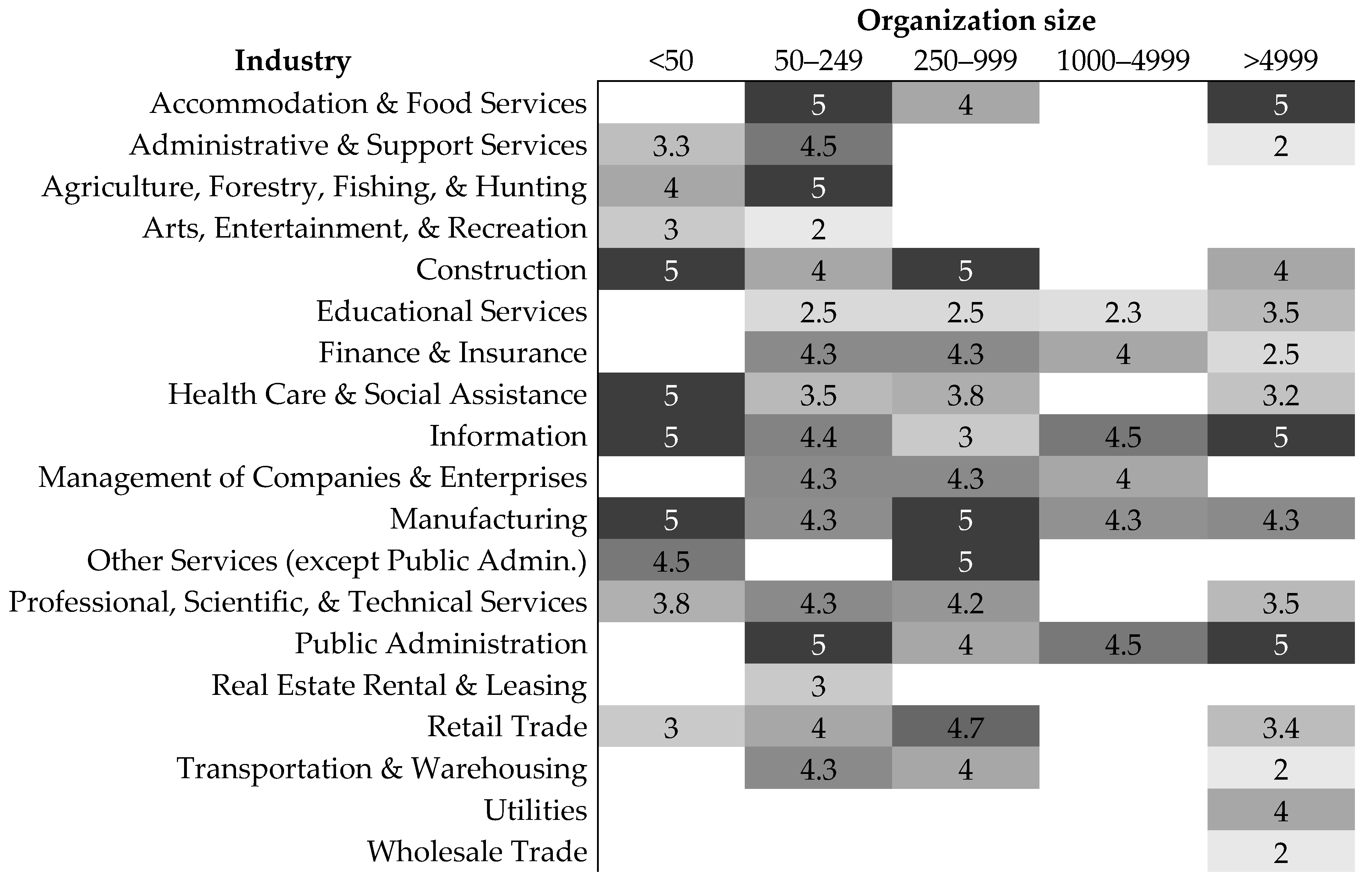
Interestingly, frequency of use differed across industries (Kruskal–Wallis H = 38.44, p = 0.003). Dunn’s tests showed that Manufacturing reported significantly higher use than Educational Services (FDR-adjusted p = 0.031). Organizational size correlated negatively with frequency (Spearman ρ = –0.212, p = 0.009), indicating a slight decline in use as firms grow. Figure 1 summarizes these patterns across industries and organizational sizes.
Figure 1. Average frequency of use by industry and organization size.
Frequency also differed across the five policy categories (Kruskal–Wallis H = 14.50, p = 0.006). Dunn pairwise tests showed a significant difference: organizations with a formal, permissive policy reported higher usage than those with an informal, permissive policy (FDR-adjusted p = 0.014); the remaining comparisons were insignificant. This pattern suggests an association between policy formalization and more consistent and intensive GenAI use in HRM.

4.2. Use Within HRM Functions

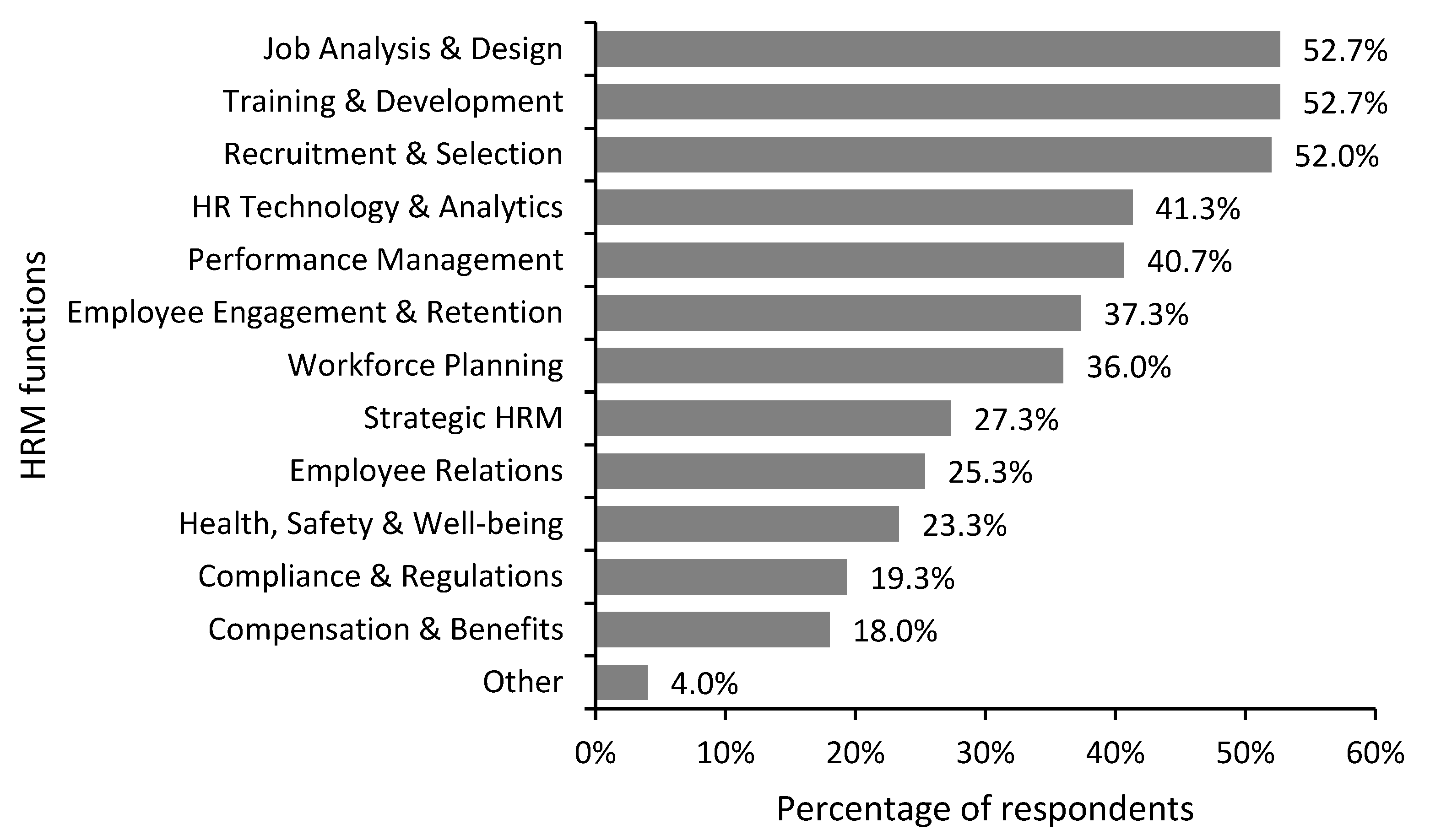
Respondents indicated the HRM functions for which they use GenAI (Figure 2). Three functions dominated: job analysis and design (52.7%), training and development (52.7%), and recruitment and selection (52%). Usage was also substantial in HR technology and analytics (41.3%), performance management (40.7%), and employee engagement and retention (37.3%). The least used functions were workforce planning, strategic HRM, and employee relations. Importantly, organizations using GenAI for analytically intensive functions such as performance management and workforce planning were associated with higher overall frequency of use (rs = 0.29 for both, FDR-adjusted p < 0.001).
Figure 2. Use of GenAI in HRM functions.
Open-ended responses revealed diverse applications across HRM. In job analysis and design, GenAI was used to draft inclusive, standardized job descriptions and to identify key competencies. For training and development, respondents used it to create tailored learning modules, dynamic assessments, and onboarding plans. GenAI assisted, in recruitment and selection, to draft postings, screen résumés, produce candidate summaries, and conduct initial virtual interviews. In performance management, it helped set SMART goals, draft appraisal text, and provide data-based justifications for ratings. For employee engagement and retention, GenAI helped craft personalized communications and suggested tailored retention initiatives. These and other applications across HRM functions are summarized in Table 3.
Table 3. Applications of GenAI in HRM functions.

4.3. Perceived Benefits and Challenges

Respondents described the benefits they experienced from using GenAI in HRM (Table 4). Thematic analysis identified nine benefit themes. The most frequently reported was higher efficiency and automation (76.7%), which reflected time savings, streamlined task execution, cost reductions, productivity gains, and decreased manual workload.
Table 4. Perceived benefits of GenAI in HRM.
Other additional themes emerged. Improved communication and professionalism (34%) concerned GenAI’s role in refining tone, clarity, and consistency of HRM communications. Enhanced decision-making and analytics (33.3%) referred to GenAI’s ability to turn data into actionable insights, which made analyzing workforce trends easier and supported strategic planning. The theme enhanced employee experience and engagement (32.7%) included better onboarding, personalized development paths, and more responsive employee support. Enhanced recruitment and fair selection practices (30.7%) concerned faster screening and scheduling, and a perceived reduction in human bias.
Some respondents mentioned improved accuracy and compliance (20.7%), noting fewer human errors and better adherence to legal or policy requirements through automated document checks. Views of GenAI as enabling creativity, new ideas, and novel problem-solving approaches were represented in GenAI as a catalyst for innovation (16%). Health, safety, and well-being (2%) was rarely mentioned, indicating limited use in wellness-related tasks. The other category (20%) included diverse benefits such as improved performance evaluation, faster policy drafting, and more structured feedback analysis.
Regarding challenges (Table 5), thematic analysis identified seven themes. The most frequent, barriers to effective implementation (39.3%), included complexity, time-consuming interactions, integration difficulties, costs, limited prompt engineering skills, and concerns about overreliance on GenAI. The second most cited theme was privacy, ethics and legal risk (36.7%), where respondents noted challenges about data privacy and security, opacity of model outputs, and regulatory compliance.
Table 5. Perceived challenges of GenAI in HRM.
A third theme referred to output accuracy and professional use (34%), with reports of errors, irrelevance, superficiality, and inconsistent tone. Employee fears and adaptation challenges (33.3%) reflected several concerns: reduced human contact, mistrust, resistance to change, fear of job loss, and lower effort.
Respondents also pointed to functional and cognitive constraints (25.3%), including limited contextual understanding, restricted reasoning capabilities, and dependence on system availability. Bias and fairness (22.7%) captured concerns about biased outputs and potentially unfair outcomes in HRM processes. Lastly, cultural and structural constraints (4.7%) related to poor alignment with organizational values, bureaucracy, and sector-level drag.
Although several of these benefits and challenges have been discussed in previous conceptual work (e.g., Budhwar et al., 2023; Chowdhury et al., 2024), Table 4 and Table 5 provide empirical evidence on their prominence in practitioners’ accounts among those who already use GenAI in HRM. These reported frequencies also serve as inputs for the profiling analysis in Section 4.4, which examines how benefits and challenges combine into distinct user profiles.

4.4. User Profiles

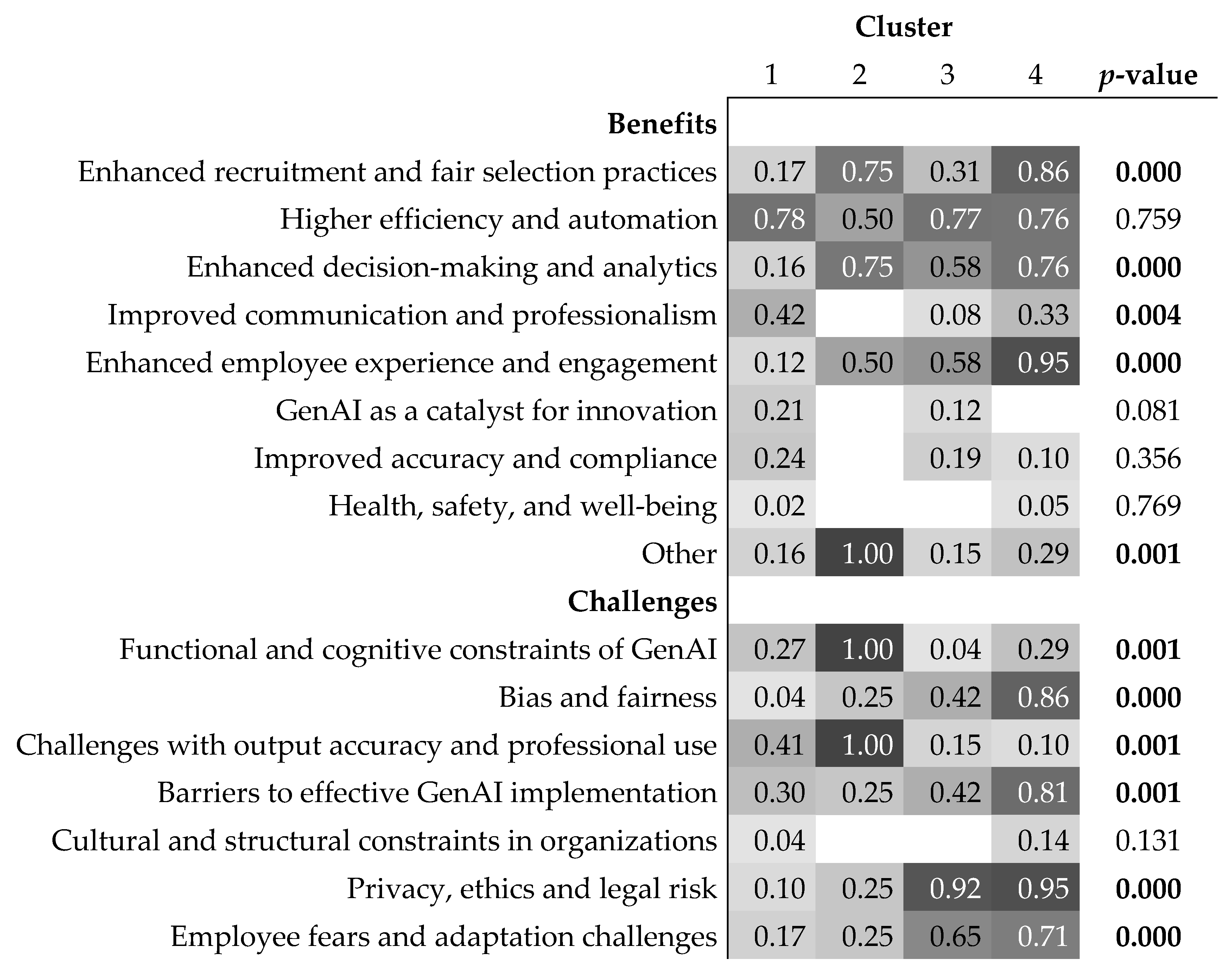
Cluster analysis identified four distinct profiles based on perceived benefits and challenges of GenAI use in HRM (Figure 3). Given the exploratory design and uneven cluster sizes, the clusters are interpreted as empirically derived profiles in this sample rather than as population prevalence estimates. Also, the p-values should be read as descriptive markers of which benefits/challenges differentiate profiles, and not as confirmatory evidence. Cluster 2 (n = 4) is therefore treated as an illustrative archetype and interpreted cautiously.
Figure 3. Perceived benefits and challenges by cluster. Note: Given Cluster 2’s very small size (n = 4), inferential comparisons involving this cluster are interpreted descriptively.
No significant differences emerged by industry (p = 0.377). In contrast, frequency of GenAI use (H = 11.48, p = 0.009) and organizational size (H = 8.81, p = 0.032) differed significantly across clusters. However, in a sensitivity analysis excluding Cluster 2, the differences in frequency of use were no longer statistically significant, whereas the differences in organizational size remained significant (Appendix C). Overall, the differences between profiles are more closely associated with organizational scale rather than sectoral context. The profiles are described below.

4.4.1. Cluster 1: Cautious Optimists

The first cluster included ninety-nine respondents, making it the largest group. Cluster 1 reported higher efficiency and automation, and improved communication and professionalism as the most salient benefits. One participant gave the following explanation:
“GenAI saved a ton of time by automating repetitive tasks… made hiring easier and faster by helping screen candidates and create personalized interview questions… kept communication clear, professional and consistent.”
Challenges were mentioned at moderate levels and were mainly related to output accuracy and professional use, and functional and cognitive constraints. Concerns about privacy, ethics, legal risks, and employee fears and adaptation challenges were comparatively low. As one participant noted:
“It sometimes needs a lot of revisions… can be limited in what it knows… sometimes does not understand the correct context.”
This cluster reported a moderate level of use (mean = 3.80), and included organizations of comparatively larger size (mean = 3.23). Several sectors were represented: Professional Services, Health Care and Social Assistance, Manufacturing, Educational Services, Finance and Insurance, Retail Trade, and Construction. These industries are usually marked by regulation and structured work processes. The overall pattern suggests a selective, efficiency-focused style of use.

4.4.2. Cluster 2: Enthusiastic Users with Technical Concerns (Illustrative Archetype)

The second cluster was the smallest, with four respondents, and thus is presented as an illustrative archetype and interpreted cautiously. Despite its size, several benefits were reported across multiple dimensions, namely enhanced recruitment and selection, decision-making, efficiency and automation, and employee experience. One participant wrote:
“It helps expedite hiring… create custom training plans… it gives us useful insights for performance reviews and promotions.”
Challenges were dominated by functional and cognitive constraints, and output accuracy and professional use. In contrast, their perceived social and ethical challenges (bias and fairness, privacy, ethics and legal risks, employee fears and adaptation challenges) were less significant. This description is consistent with an emphasis on technical limitations rather than on broader ethical concerns, although this interpretation remains tentative given the very small size.
Use frequency was lower than in Clusters 3 and 4 (mean = 3.50), which is consistent with a more tentative use pattern. Respondents came from Construction, Health Care and Social Assistance, Manufacturing, and Retail Trade, with only one participant per sector. The configuration can be described as high enthusiasm tempered by technical limitations.

4.4.3. Cluster 3: Pragmatic Frequent Users

Twenty-six participants formed the third cluster, which was moderately sized. Cluster 3 exhibited a high level of use (mean = 4.23). Their perceived benefits (efficiency, decision-making, and employee engagement) were moderately strong, which suggests an informed, utilitarian orientation.
What set this cluster apart was the weight they placed on ethical and organizational concerns, specifically privacy, ethics and legal risks, and employee fears and adaptation issues. One respondent summarized these concerns:
“Ensure the content aligns with company culture and values… address privacy and security when using employee information… balance automation with human connection… train the model for unique or complex scenarios… address skepticism or resistance from employees.”
Respondents in Cluster 3 typically worked for smaller companies (mean = 2.38). Sectoral concentration was greater in Finance and Insurance, Manufacturing, Management of Companies and Enterprises, Administrative and Support Services, and Public Administration. This combination suggests a practical, efficiency-oriented use, coupled with a high awareness of governance and compliance issues likely because of limited internal structures.

4.4.4. Cluster 4: Critical Lead Users

Cluster 4 was moderately sized, comprising twenty-one participants. It showed the highest level of use (mean = 4.52) and reported several benefits with high frequency: recruitment and fair selection, efficiency, decision-making, and employee experience. As one respondent stated:
“It streamlines… performance evaluation… helps process large applicant pools… reduces all info to suitability scores, and generates data as to what justifies the ratings.”
However, this cluster also reported an extensive set of challenges, including privacy, ethics, and legal risks, bias and fairness, employee fears, and implementation barriers. Another respondent wrote:
“Potential biases in outputs… issues with data privacy and compliance with GDPR… mistrust among employees… over-reliance on generative AI that can overlook the human aspect in HR activities.”
Cluster 4 included organizations from Finance and Insurance, Professional, Scientific, and Technical Services, Manufacturing, Agriculture, and Administrative and Support Services, and leaned toward a smaller size (mean = 2.62). The mix of intensive use and a more critical awareness suggests a group of advanced, hands-on users who recognize both the potential and risks of GenAI.

5. Discussion

This study adds to the HRM literature on GenAI by investigating reported patterns of use and providing evidence beyond the largely conceptual and practice-oriented work done to date (e.g., Budhwar et al., 2023; Aguinis et al., 2024; Chowdhury et al., 2024). Although most empirical research has focused on recruitment and selection (Abdelhay et al., 2025; Phillips & Robie, 2024; Szandała, 2025), our findings show that GenAI is now embedded in a much broader set of HRM activities. This underscores the importance of viewing GenAI as part of a wider HRM system.
The benefits and challenges described here are consistent with previous conceptual work (Budhwar et al., 2023; Chowdhury et al., 2024; Andrieux et al., 2024). What our results add, however, is a detailed perspective on the way these tensions are manifested in daily HRM practice, including their relative prominence and their combination into distinct usage profiles. This is evident in the cluster analysis: usage is not uniform, varying instead alongside different views on opportunity and risk.

5.1. Theoretical Implications

A theoretical implication concerns the alignment between research and practice of GenAI. The predominant focus on recruitment and selection reflects the strategic importance of this function as well as the concentration of many ethical and legal risks (Ployhart, 2006; Mori et al., 2025). However, our findings show that practitioners already use GenAI in a wider range of HRM activities. This research-practice gap suggests that future theorizing should consider that the patterns of use are more heterogeneous if it is to capture how GenAI is embedded in HRM practice.
A second implication is related to the heterogeneity of the four use profiles. The clusters reveal that GenAI use varies with how HR professionals weigh benefits and challenges and with the organizational context, particularly organizational scale; this interplay supports calls for more contextualized, multilevel perspectives on GenAI in HRM (Chowdhury et al., 2024; Pereira et al., 2023). In this sample, more frequent users expressed more ethical, legal, and organizational concerns, suggesting an important insight: risk perception may develop with experience as limitations become visible in real tasks. This is consistent with arguments that many weaknesses of GenAI only become apparent through practical use (Andrieux et al., 2024; Jiang et al., 2025), and indicates that continued use may involve increasing discernment. The present research design cannot determine why these patterns arise (e.g., learning vs. selection effects), which calls for longitudinal, multi-method research. This pattern is also consistent with a co-evolutionary view in which responsible GenAI use becomes routinized through human–AI learning and codified practices (Khalili & Jahanbakht, 2025). In HRM, where tacit judgment is central, governance may develop alongside use as evaluation routines are externalized, checked, and progressively formalized.
The findings also refine established technology frameworks. From a DOI lens (Rogers, 2003), relative advantage, compatibility, and complexity help interpret the differences among the four user profiles. However, in HRM settings, where privacy, fairness, and compliance are fundamental, ethical and legal compatibility emerges as an additional factor that may influence sustained use. From a TOE perspective (Tornatzky & Fleischer, 1990), organizational context, specifically size and to some extent policy environment, appears more influential than industry pressures. This pattern is directionally consistent with internal readiness arguments, albeit sensitivity checks suggest that policy-related differences should be interpreted cautiously. At the task level, the results also show that TTF (Goodhue & Thompson, 1995) alone cannot fully explain GenAI use. Even when GenAI is well suited to a task, Table 3 indicates that its role can differ markedly by HRM activity, ranging from content assistance (drafting or refining HRM materials) to decision support (summarizing evidence or generating options to inform judgment) and, in a few instances, outputs that come closer to decision automation (e.g., candidate ranking/suitability scoring or performance-related outputs). Thus, as GenAI use shifts from content assistance toward decision support and more consequential evaluative outputs, the perceived stakes for privacy, fairness, legal liability, and trust can outweigh technical fit, which helps explain why GenAI may be used selectively in tasks with consequential employee implications. To make this more explicit, we summarize a pragmatic risk-level scheme across the observed uses (Table 6), framed as a lightweight heuristic that is consistent with more structured approaches in the literature (Jiang et al., 2025). Overall, the evidence supports the view that GenAI use in HRM is influenced by the interaction of normative and compliance pressures, internal governance and structural conditions, and the demands of specific HRM tasks.
Table 6. Risk levels of the reported uses of GenAI in HRM (from Table 3).
Proposition 1.
In HRM contexts, the sustained use of GenAI may depend not only on traditional DOI attributes but also on perceived ethical and legal compatibility.
Proposition 2.
In HR functions where accuracy, trust, and compliance are high, perceived ethical, bias, and legal risks may moderate the relationship between perceived benefits and the extent of GenAI use.
Proposition 3.
Among organizations that use GenAI, usage intensity is likely to be higher in smaller organizations than in larger ones, reflecting differences in organizational structure and resource configuration.
Proposition 4.
Organizations with formal GenAI policies may be more likely to exhibit higher and more consistent usage than those with informal permissive policies or no policies.
Proposition 5.
Even when GenAI shows strong task–technology fit, usage may remain low in areas that involve consequential decisions (e.g., decisions with fairness, legal, ethical implications).

5.2. Practical Implications

Our findings have several implications for HR professionals who are using GenAI in HRM. The reported benefits, specifically improved communication and enhanced decision-making, suggest that GenAI can augment many HRM tasks beyond just automating them. Thus, organizations may consider extending GenAI into a broader set of areas (e.g., training design, performance feedback drafting, policy drafting), as long as strong oversight and review mechanisms are in place. This can involve simple human-in-the-loop review protocols (e.g., second-person review for communications sent to employees) and a graded, risk-level approach where consequential decisions demand stricter controls than low-stakes tasks like drafting, as summarized in Table 6.
Second, the challenges identified in this study reinforce the need to develop GenAI governance as an administrative capability. In the sample, formal, permissive policies were directionally associated with higher reported use, suggesting that clear rules manage risk and make daily use easier. In this sense, governance includes the routines and accountability needed to standardize use, manage exceptions, and support controlled scaling throughout HRM tasks, including policy formalization, ethical oversight, and human-in-the-loop controls. HR leaders should therefore establish policies that clearly define acceptable use, data protection, human oversight, and documentation procedures. In particular, policies can specify (i) approved and prohibited use cases by HRM tasks, (ii) data-handling rules (e.g., for identifiable employee data), (iii) minimum documentation for high-stakes tasks, and (iv) clear procedures for reporting and resolving outputs that raise concerns about privacy, bias or compliance.
Third, many challenges also point to skills gaps. Competencies in prompting, output evaluation, and task selection are essential for responsible use, particularly when contextual understanding or sensitive information is involved. Hence, targeted training can make GenAI both safer and more effective by focusing on verification routines (e.g., fact-checking, consistency checks, and “red flag” criteria) and on clarifying when not to use GenAI (e.g., tasks involving consequential judgments about employees).
Finally, the differences across the four user profiles indicate that GenAI implementation should be tailored. Cluster 1 may benefit from clearer “approved use cases” and templates that reduce rework; Cluster 2 (illustrative archetype) from technical guidance and quality checks before expanding use; Cluster 3 from clear policies and oversight (e.g., privacy/compliance checklists, clear steps for flagging and resolving concerns); and Cluster 4 from a defined role to pilot use cases, coach colleagues, and refine the rules and checks as use expands. Embedding GenAI in HRM is thus best approached as an organizational change process that accommodates these differences.

5.3. Limitations

This study has several caveats. The cross-sectional design provides only a snapshot of current practice and cannot capture how GenAI use changes or becomes routinized over time. Our sample of HR professionals in the UK and US, recruited through Prolific, helps ensure respondent quality but may limit generalizability to other contexts. The data also rely on self-reports; such accounts can differ from actual use patterns and may be subject to common-method and social-desirability bias, albeit the open-ended responses provide some additional depth. The survey distinguishes stand-alone tools from GenAI embedded in HRM software and elicits the organization’s policy environment, but it does not capture the extent to which GenAI is formally implemented in HRM processes. The cluster analysis is exploratory and is limited by the indicators of benefits and challenges available in the dataset; the four profiles are thus interpretable, but not exhaustive. In addition, cluster sizes were uneven, and the smallest profile (n = 4) is best interpreted as an illustrative archetype; accordingly, comparisons involving it should be interpreted cautiously. These limitations could be addressed through longitudinal, cross-national, and multi-method research.

6. Conclusions

The research is among the earliest efforts to investigate the use of GenAI in HRM. The findings indicate that its use is already spread among various HR functions, each of which is affected by different task demands and organizational factors. They further indicate that the integration of GenAI in HRM reflects a mixture of efficiency opportunities, normative constraints, and the realities of daily HRM practice.
The theoretical implications point to several refinements of established technology frameworks. Ethical and legal compatibility is a critical condition for sustained use in the context of HRM, which extends traditional DOI assumptions. Organizational attributes, specifically size and to a lesser extent policy environment, appear more influential than sectoral pressures, which gives a clearer interpretation of TOE dynamics in this early stage of GenAI use. At the task level, the results reveal a boundary condition of task technology fit: even when GenAI is technically appropriate, its use may remain limited when decisions have serious implications on employees. This suggests that the path of GenAI in HRM will rely on a combination of its fit with organizational norms and expectations, as well as its technical capabilities.
The practical implications show the need for clear governance rules, proper user skills, and transparent communication to support responsible use. These needs grow as organizations integrate GenAI into strategic HRM activities.
Future studies would be needed to trace the current patterns and monitor their evolution over time, analyze the governance arrangements more thoroughly and cover several organizational actors. Cross-country comparisons would also be valuable, given that institutional and regulatory conditions may shape how GenAI is governed and used in HRM. Researchers could also build on the profiles identified here to develop and test a confirmatory model linking attitudes, affordance perceptions, governance arrangements, and outcomes.

Author Contributions

Conceptualization, N.M. and J.R.; methodology, N.M. and J.R.; software, N.M.; validation, N.M. and J.R.; formal analysis, N.M. and J.R.; investigation, N.M.; resources, N.M.; data curation, N.M.; writing—original draft preparation, N.M.; writing—review and editing, N.M. and J.R.; visualization, N.M.; supervision, N.M.; project administration, N.M.; funding acquisition, none. All authors have read and agreed to the published version of the manuscript.

Funding

This research received no external funding.

Institutional Review Board Statement

The study was conducted in accordance with the Declaration of Helsinki, and approved by the Ethics Committee of the Polytechnic Institute of Viseu (protocol code 58/SUB/2025 and 22 January 2026).

Data Availability Statement

The raw data supporting the conclusions of this article will be made available by the authors on request.

Acknowledgments

During the preparation of this work, the authors utilized Grammarly (v. 6.8.263) and ChatGPT (v. 5.2) to enhance the readability and sentence structure. After using these tools, the authors reviewed and edited the content as needed and take full responsibility for the content of the publication.

Conflicts of Interest

The authors declare no conflicts of interest.

Abbreviations

The following abbreviations are used in this manuscript:
GenAIGenerative Artificial Intelligence
HRMHuman Resource Management
HRHuman Resource
UKUnited Kingdom
USUnited States
DOIDiffusion of Innovation
TOETechnology-Organization-Environment
TTFTask-Technology Fit
GDPRGeneral Data Protection Regulation
FDRFalse-Discovery-Rate

Appendix A

The questionnaire included the following items:
(1)
Gender:
(a)
Male
(b)
Female
(c)
Other
(2)
Age:
(a)
18–25 years
(b)
26–35 years
(c)
36–45 years
(d)
46–55 years
(e)
Over 55 years
(3)
Highest level of education:
(a)
No formal education
(b)
Primary or elementary education
(c)
Secondary or high school education
(d)
Vocational or technical training
(e)
Bachelor’s degree
(f)
Master’s degree or higher
(4)
Country of residence:
(a)
UK
(b)
USA
(5)
Years of experience in HRM:
(a)
Less than 3 years
(b)
3–5 years
(c)
6–10 years
(d)
11–20 years
(e)
Over 20 years
(6)
Current job position level:
(a)
Entry-level (e.g., HR Assistant)
(b)
Mid-level (e.g., HR Specialist)
(c)
Senior level or manager (e.g., Senior HR Manager)
(d)
Director or Executive (e.g., HR Director, CEO)
(e)
Other (please specify):
(7)
Industry sector:
(a)
Agriculture, Forestry, Fishing, and Hunting
(b)
Mining
(c)
Utilities
(d)
Construction
(e)
Manufacturing
(f)
Wholesale Trade
(g)
Retail Trade
(h)
Transportation and Warehousing
(i)
Information
(j)
Finance and Insurance
(k)
Real Estate Rental and Leasing
(l)
Professional, Scientific, and Technical Services
(m)
Management of Companies and Enterprises
(n)
Administrative and Support Services
(o)
Educational Services
(p)
Health Care and Social Assistance
(q)
Arts, Entertainment, and Recreation
(r)
Accommodation and Food Services
(s)
Other Services (except Public Administration)
(t)
Public Administration
(8)
Number of employees:
(a)
Less than 50 employees
(b)
50–249 employees
(c)
250–999 employees
(d)
1000–4999 employees
(e)
Over 4999 employees
(9)
What kind of policy does your organization have about the use of GenAI?
(a)
Formal policy allowing use of GenAI
(b)
Formal policy prohibiting use of GenAI
(c)
Informal policy against use of GenAI
(d)
Informal policy allowing use of GenAI
(e)
No formal or informal policy
(10)
Which GenAI tools do you use in your HRM activities?
(a)
ChatGPT
(b)
Gemini
(c)
Copilot
(d)
NotebookLM
(e)
GenAI embedded in HRM software
(f)
Other (please specify):
(11)
How frequently do you use GenAI tools in your HRM activities?
(a)
At least once a day
(b)
At least every two days
(c)
At least once a week
(d)
At least every two weeks
(e)
At least once a month
(12)
Which HRM activities do you use GenAI for?
(a)
Job Analysis and Design
(b)
Strategic Human Resource Management
(c)
Workforce Planning
(d)
HR Technology and Analytics
(e)
Compliance with Laws and Regulations
(f)
Recruitment and Selection
(g)
Training and Development
(h)
Performance Management
(i)
Compensation and Benefits
(j)
Employee Relations
(k)
Employee Engagement and Retention
(l)
Health, Safety, and Well-being
(m)
Other (Please specify):
(13)
Please describe your current use of GenAI in your HRM activities.
(14)
What benefits have you experienced from using GenAI in your HRM activities?
(15)
What challenges have you encountered while using GenAI in your HRM activities?
(16)
Please provide any additional comments or insights regarding the use of GenAI in HRM at your organization.

Appendix B

Table A1. Measurement and coding summary for key variables.
ItemItem FormatResponse OptionsCoding Used Why Is AppropriateWhat It Cannot Capture
Frequency of GenAI useSingle itemAt least once a day; at least every two days; at least once a week; at least every two weeks; at least once a monthOrdinalCaptures usage intensity parsimoniously in an exploratory designDoes not capture session duration, or within-person variability over time
GenAI policy environmentSingle itemFormal policy allowing use of GenAI; formal policy prohibiting use of GenAI; informal policy against use of GenAI; informal policy allowing use of GenAI; no formal or informal policyCategoricalSingle classification is appropriate for mapping governance setting as reported by respondentsDoes not measure enforcement, awareness, or policy maturity; relies on respondent knowledge
Organization sizeSingle itemLess than 50 employees; 50–249 employees; 250–999 employees; 1000–4999 employees; over 4999 employeesOrdinal-coded category indexStandard proxy for structural/resource differencesCannot capture resource slack or HRM function size
IndustrySingle itemAgriculture, forestry, fishing, and hunting; mining; utilities; construction; manufacturing; wholesale trade; retail trade; transportation and warehousing; information; finance and insurance; real estate rental and leasing; professional, scientific, and technical services; management of companies and enterprises; administrative and support services; educational services; health care and social assistance; arts, entertainment, and recreation; accommodation and food services; other services (except public administration); public administration.CategoricalIndustry is a contextual classifier; single item is standard in surveysCannot represent within-industry heterogeneity
CountrySingle itemUK; USCategoricalUsed for sampling frame description rather than causal inferenceNot used to claim national effects in this paper
Tool types usedMultiple-response checklistChatGPT; Gemini; Copilot; NotebookLM; GenAI embedded in HRM software; otherBinaryChecklists are appropriate for enumerating tool ecology in early-stage practiceDoes not capture depth of use per tool, governance restrictions per tool, or tool proficiency
HRM functions where GenAI is appliedMultiple-response checklistJob analysis and design; strategic human resource management; workforce planning; HR technology and analytics; compliance with laws and regulations; recruitment and selection; training and development; performance management; compensation and benefits; employee relations; employee engagement and retention; health, safety, and well-being; otherBinaryCaptures breadth of application across HRM activities without assuming a single latent dimensionDoes not capture process integration level, criticality of the activity, or activity frequency
Perceived benefitsOpen-ended responseOpen text9 themes; binary indicator per theme based on code presenceOpen-ended elicitation avoids imposing categories; binary theme presence supports profiling without treating themes as reflective scalesDoes not measure strength/importance of each benefit; theme presence depends on what respondents choose to mention
Perceived challengesOpen-ended responseOpen text7 themes; binary indicator per theme based on code presenceSame rationale as benefits; supports pattern detection (co-occurrence)Does not capture severity, probability, or organizational consequences of each challenge
How GenAI is incorporated into HRM activitiesOpen-ended responseOpen textCoded to HRM functions (per codebook)Provides contextual detail that complements closed items (triangulation)Not a behavioral trace; cannot verify actual use; depends on recall and self-presentation

Appendix C

Appendix C.1. Internal Validation and Linkage Sensitivity

Table A2. Silhouette and linkage sensitivity.
kSilhouette ARI (Average vs. Complete)ARI (Average vs. Single)
30.2560.5360.028
40.1900.5580.026
50.1680.5130.021
Note: Silhouette values are computed on the precomputed Gower distance matrix. ARI = Adjusted Rand Index comparing partitions obtained under different linkage methods using the same distance matrix. Single linkage produced markedly different partitions (very low ARI relative to average linkage), whereas average and complete linkage showed moderate agreement.

Appendix C.2. Subsampling Stability

Table A3. Subsampling stability summary.
MetricValue
Subsample fraction0.80
Iterations500
ARI mean0.745
ARI median0.752
ARI (25th percentile)0.683
ARI (75th percentile)0.810
Median minimum cluster size across runs2
% runs with any cluster ≤ 4 cases91.6%
Note: Subsampling indicates good overall stability of the k = 4 structure (median ARI ≈ 0.75), while frequently reproducing very small cluster(s). This suggests that the presence of small clusters is robust, even when exact membership may vary across subsamples.

Appendix C.3. Sensitivity Analysis Excluding the Smallest Cluster

To assess whether key inferences depended on the very small cluster, we re-estimated the main tests between clusters after excluding Cluster 2 (remaining clusters: 1, 3, and 4; n = 146).
Table A4. Kruskal–Wallis tests after excluding Cluster 2.
VariableTest Statistic (H)dfpGroup Sizes
Frequency of GenAI use1.17220.557{1: 99, 3: 26, 4: 21}
Organizational size12.51420.0019{1: 99, 3: 26, 4: 21}
Post hoc (organizational size): pairwise Mann–Whitney U with BH/FDR correction
ContrastUpp (FDR)
Cluster 1 vs. 31749.50.00290.0087
Cluster 1 vs. 41366.50.01730.0260
Cluster 3 vs. 4256.50.68900.6890
Table A5. Categorical tests after excluding Cluster 2.
VariableTestpp (FDR)
IndustryFisher–Freeman–Halton test with Monte Carlo Simulation0.1200.169
Policy environmentFisher–Freeman–Halton test with Monte Carlo Simulation0.1690.169
Interpretation: Excluding Cluster 2 leaves the substantive pattern broadly similar: organizational size continues to differ across profiles, whereas industry and policy environment do not. However, the previously observed difference between clusters in frequency of GenAI use is not robust to excluding the smallest cluster, indicating that frequency-based comparisons are more sensitive to this archetype.

Appendix D

Table A6. Cluster membership by country (counts; column %).
Cluster (k = 4)UK (n = 70)USA (n = 80)Total
145 (64.3%)54 (67.5%)99
22 (2.9%)2 (2.5%)4
313 (18.6%)13 (16.2%)26
410 (14.3%)11 (13.8%)21
Association test--χ2(3) = 0.20, p = 0.978
Note: A permutation-based sensitivity check (country labels shuffled; fixed cluster memberships) yielded p ≈ 0.977, consistent with the χ2 result.
Table A7. Directional comparison of key outcomes by country frequency of use: UK median = 4; USA median = 4; Mann–Whitney p = 0.700.
Top reported benefits
Benefit theme (top 5 overall)UK %USA %pp (FDR)
Higher efficiency and automation81.472.50.2470.658
Improved communication and professionalism28.638.80.2280.658
Enhanced decision-making and analytics42.925.00.0250.393
Enhanced employee experience and engagement27.137.50.2220.658
Enhanced recruitment and fair selection practices24.336.20.1550.658
Top reported challenges
Challenge theme (top 5 overall)UK %USA %pp (FDR)
Barriers to effective implementation42.936.20.5030.944
Privacy, ethics and legal risk37.136.21.0001.000
Output accuracy and professional use37.131.20.4920.944
Employee fears and adaptation challenges35.731.20.6050.944
Functional and cognitive constraints of GenAI27.123.80.7080.944

References

  1. Abdelhay, S., Haider, S., Hazaimeh, H. M., El-Bannany, M., & Marie, A. (2025). The impact of generative AI (ChatGPT) on recruitment efficiency and candidate quality: The mediating role of process automation level and the moderating role of organizational size. Frontiers in Human Dynamics, 4, 1487671. [Google Scholar] [CrossRef]
  2. Aguinis, H., Beltran, J. R., & Cope, A. (2024). How to use generative AI as a human resource management assistant. Organizational Dynamics, 53(1), 101029. [Google Scholar] [CrossRef]
  3. Andrieux, P., Johnson, R. D., Sarabadani, J., & Van Slyke, C. (2024). Ethical considerations of generative AI-enabled human resource management. Organizational Dynamics, 53(1), 101032. [Google Scholar] [CrossRef]
  4. Anshima, Bhardwaj, B., & Sharma, D. (2026). Paradoxes of implementing AI-augmented HRM in the workplace: A systematic literature review and future research agenda. Management Review Quarterly, 1–40. [Google Scholar] [CrossRef]
  5. Banh, L., & Strobel, G. (2023). Generative artificial intelligence. Electronic Markets, 33(1), 63. [Google Scholar] [CrossRef]
  6. Berg, J. M., Raj, M., & Seamans, R. (2023). Capturing value from artificial intelligence. Academy of Management Discoveries, 9(4), 424–428. [Google Scholar] [CrossRef]
  7. Bousquette, I. (2025, May 12). Why moderna merged its tech and HR departments. The Wall Street Journal. Available online: https://www.wsj.com/articles/why-moderna-merged-its-tech-and-hr-departments-95318c2a (accessed on 12 May 2025).
  8. Braun, V., & Clarke, V. (2006). Using thematic analysis in psychology. Qualitative Research in Psychology, 3(2), 77–101. [Google Scholar] [CrossRef]
  9. Braun, V., & Clarke, V. (2021). One size fits all? What counts as quality practice in (reflexive) thematic analysis? Qualitative Research in Psychology, 18(3), 328–352. [Google Scholar] [CrossRef]
  10. Brown, O., Davison, R. M., Decker, S., Ellis, D. A., Faulconbridge, J., Gore, J., Greenwood, M., Islam, G., Lubinski, C., MacKenzie, N. G., Meyer, R., Muzio, D., Quattrone, P., Ravishankar, M. N., Zilber, T., Ren, S., Sarala, R. M., & Hibbert, P. (2024). Theory-driven perspectives on generative artificial intelligence in business and management. British Journal of Management, 35(1), 3–23. [Google Scholar] [CrossRef]
  11. Bryman, A. (2006). Integrating quantitative and qualitative research: How is it done? Qualitative Research, 6(1), 97–113. [Google Scholar] [CrossRef]
  12. Budhwar, P., Chowdhury, S., Wood, G., Aguinis, H., Bamber, G. J., Beltran, J. R., Boselie, P., Lee Cooke, F., Decker, S., DeNisi, A., Dey, P. K., Guest, D., Knoblich, A. J., Malik, A., Paauwe, J., Papagiannidis, S., Patel, C., Pereira, V., Ren, S., … Varma, A. (2023). Human resource management in the age of generative artificial intelligence: Perspectives and research directions on ChatGPT. Human Resource Management Journal, 33(3), 606–659. [Google Scholar] [CrossRef]
  13. Chowdhury, S., Budhwar, P., & Wood, G. (2024). Generative artificial intelligence in business: Towards a strategic human resource management framework. British Journal of Management, 35(4), 1680–1691. [Google Scholar] [CrossRef]
  14. Dessler, G. (2024). Human resource management (17th ed.). Pearson. [Google Scholar]
  15. Dutta, D., & Naveen, P. M. (2025). Transforming recruitment and selection practices in organizations through discriminative and generative AI adoption: A structuration lens. Human Resource Management, 65(1), 77–115. [Google Scholar] [CrossRef]
  16. Dwivedi, Y. K., Kshetri, N., Hughes, L., Slade, E. L., Jeyaraj, A., Kar, A. K., Baabdullah, A. M., Koohang, A., Raghavan, V., Ahuja, M., Albanna, H., Albashrawi, M. A., Al-Busaidi, A. S., Balakrishnan, J., Barlette, Y., Basu, S., Bose, I., Brooks, L., Buhalis, D., … Wright, R. (2023). “So what if ChatGPT wrote it?” Multidisciplinary perspectives on opportunities, challenges and implications of generative conversational AI for research, practice and policy. International Journal of Information Management, 71, 102642. [Google Scholar] [CrossRef]
  17. Edmondson, A. C., & McManus, S. E. (2007). Methodological fit in management field research. Academy of Management Review, 32(4), 1155–1179. [Google Scholar] [CrossRef]
  18. Flynn, J., Commisso, C., Mallon, D., Van Durme, Y., Harrington, S., & Lahiri, G. (2025). 2025 global human capital trends: Turning tensions into triumphs—Helping leaders transform uncertainty into opportunity. Deloitte Insights. Available online: https://www2.deloitte.com/us/en/insights/focus/human-capital-trends.html (accessed on 12 May 2025).
  19. Gandhi, N., Lim, R., Durth, S., Bérubé, V., Seiler, C., & Kedia, K. (2025). The critical role of strategic workforce planning in the age of AI. McKinsey’s & Company. Available online: https://www.mckinsey.com/capabilities/people-and-organizational-performance/our-insights/the-critical-role-of-strategic-workforce-planning-in-the-age-of-ai?utm_source=chatgpt.com#/ (accessed on 12 May 2025).
  20. Garcia, R. F., & Kwok, L. (2025). Generative artificial intelligence in human resource management: A critical reflection on impacts, resilience and roles. International Journal of Contemporary Hospitality Management, 37(9), 3136–3158. [Google Scholar] [CrossRef]
  21. Goodhue, D., & Thompson, R. (1995). Task-technology fit and individual performance. MIS Quarterly, 19(2), 213–236. [Google Scholar] [CrossRef]
  22. Jiang, Y., Cai, Z., & Wang, X. (2025). Leverage Generative AI for human resource management: Integrated risk analysis approach. The International Journal of Human Resource Management, 36(11), 1929–1959. [Google Scholar] [CrossRef]
  23. Kanbach, D. K., Heiduk, L., Blueher, G., Schreiter, M., & Lahmann, A. (2024). The GenAI is out of the bottle: Generative artificial intelligence from a business model innovation perspective. Review of Managerial Science, 18(4), 1189–1220. [Google Scholar] [CrossRef]
  24. Khalili, N., & Jahanbakht, M. (2025). Unveiling the Unspoken: A Conceptual Framework for AI-Enabled Tacit Knowledge Co-Evolution. Knowledge, 6(1), 1. [Google Scholar] [CrossRef]
  25. Korzynski, P., Mazurek, G., Altmann, A., Ejdys, J., Kazlauskaite, R., Paliszkiewicz, J., Wach, K., & Ziemba, E. (2023). Generative artificial intelligence as a new context for management theories: Analysis of ChatGPT. Central European Management Journal, 31(1), 3–13. [Google Scholar] [CrossRef]
  26. Koteczki, R., Csikor, D., & Balassa, B. E. (2025). The role of generative AI in improving the sustainability and efficiency of HR recruitment process. Discover Sustainability, 6(1), 1–28. [Google Scholar] [CrossRef]
  27. Kshetri, N., Dwivedi, Y. K., Davenport, T. H., & Panteli, N. (2024). Generative artificial intelligence in marketing: Applications, opportunities, challenges, and research agenda. International Journal of Information Management, 75, 102716. [Google Scholar] [CrossRef]
  28. Li, B., & Cheng, Y. (2025). ChatGPT in human resource management: A systematic review of influential factors, processes, and outcomes. Heliyon, 11(15), e44048. [Google Scholar] [CrossRef]
  29. Metzger, M., O’Reilly, S., & Mac an Bhaird, C. (2025). Generative artificial intelligence augmenting SME financial management. Technovation, 147, 103313. [Google Scholar] [CrossRef]
  30. Mori, M., Sassetti, S., Cavaliere, V., & Bonti, M. (2025). A systematic literature review on artificial intelligence in recruiting and selection: A matter of ethics. Personnel Review, 54(3), 854–878. [Google Scholar] [CrossRef]
  31. Naghshineh, B., & Carvalho, H. (2025). Exploring the effects of additive manufacturing technology adoption on the state of the supply chain: A resilience perspective. Operations Management Research, 18, 495–517. [Google Scholar] [CrossRef]
  32. Nyberg, A. J., Schleicher, D. J., Bell, B. S., Boon, C., Cappelli, P., Collings, D. G., Molle, J. E. D., Feuerriegel, S., Gerhart, B., Jeong, Y., Korsgaard, M. A., Minbaeva, D., & Ployhart, R. E. (2025). A brave new world of human resources research: Navigating perils and identifying grand challenges of the GenAI revolution. Journal of Management, 51(6), 2677–2718. [Google Scholar] [CrossRef]
  33. Palan, S., & Schitter, C. (2018). Prolific. ac—A subject pool for online experiments. Journal of Behavioral and Experimental Finance, 17, 22–27. [Google Scholar] [CrossRef]
  34. Peer, E., Brandimarte, L., Samat, S., & Acquisti, A. (2017). Beyond the Turk: Alternative platforms for crowdsourcing behavioral research. Journal of Experimental Social Psychology, 70, 153–163. [Google Scholar] [CrossRef]
  35. Pereira, V., Hadjielias, E., Christofi, M., & Vrontis, D. (2023). A systematic literature review on the impact of artificial intelligence on workplace outcomes: A multi-process perspective. Human Resource Management Review, 33(1), 100857. [Google Scholar] [CrossRef]
  36. Phillips, J., & Robie, C. (2024). Hacking the perfect score on high-stakes personality assessments with generative AI. Personality and Individual Differences, 231, 112840. [Google Scholar] [CrossRef]
  37. Ployhart, R. E. (2006). Staffing in the 21st century: New challenges and strategic opportunities. Journal of Management, 32(6), 868–897. [Google Scholar] [CrossRef]
  38. Poitevin, H., & Rizaoglu, E. (2023). How to evaluate use cases for generative AI in HR. Gartner. Available online: https://reportds.s3.us-east-2.amazonaws.com/How+to+Evaluate+Use+Cases+for+Generative+AI+in+HR+-+Gartner.pdf (accessed on 12 May 2025).
  39. Popera, A. (2024). Survey reveals HR’s role in AI adoption. Available online: https://www.shrm.org/enterprise-solutions/insights/survey-reveals-hr-s-role-in-ai-adoption- (accessed on 12 May 2025).
  40. Prasad, D. K., & De, S. (2024). Generative AI as a catalyst for HRM practices: Mediating effects of trust. Humanities and Social Sciences Communications, 11, 1362. [Google Scholar] [CrossRef]
  41. Rogers, E. M. (2003). Diffusion of innovations (5th ed.). Free Press. [Google Scholar]
  42. Spector, P. E. (2019). Do not cross me: Optimizing the use of cross-sectional designs. Journal of Business and Psychology, 34, 125–137. [Google Scholar] [CrossRef]
  43. Statista. (2025). Generative AI—Worldwide. Statista Market Forecast. [Google Scholar]
  44. Stergiou, D. (2025). Using ChatGPT to support human resource management in the hotel industry. Worldwide Hospitality and Tourism Themes, 17(5), 602–615. [Google Scholar] [CrossRef]
  45. Szandała, T. (2025). ChatGPT vs. human expertise in the context of IT recruitment. Expert Systems with Applications, 264, 125868. [Google Scholar] [CrossRef]
  46. Timmermans, S., & Tavory, I. (2024). Data analysis in qualitative research: Theorizing with abductive analysis. University of Chicago Press. [Google Scholar]
  47. Tornatzky, L., & Fleischer, M. (1990). The processes of technological innovation. Lexington Books. [Google Scholar]
  48. UPWS. (2025). 2025 generative AI report: Learning fuels human + AI collaboration (white paper). University of Phoenix Workforce Solutions. Available online: https://www.phoenix.edu/content/dam/edu/media-center/doc/whitepapers/genai-report-final-remediated.pdf (accessed on 12 May 2025).
  49. Vojnovski, T. (2024, May 31). Generative AI + immersive training: SweetRush’s power duo for effective, engaging guest service training at Hilton. SweetRush. Available online: https://www.sweetrush.com/generative-ai-immersive-training-sweetrush-and-hilton/ (accessed on 12 May 2025).
  50. Wamba, S. F., Guthrie, C., Queiroz, M. M., & Minner, S. (2024). ChatGPT and generative artificial intelligence: An exploratory study of key benefits and challenges in operations and supply chain management. International Journal of Production Research, 62(16), 5676–5696. [Google Scholar] [CrossRef]
  51. Wamba, S. F., Queiroz, M. M., Jabbour, C. J. C., & Shi, C. V. (2023). Are both generative AI and ChatGPT game changers for 21st-Century operations and supply chain excellence? International Journal of Production Economics, 265, 109015. [Google Scholar] [CrossRef]
  52. Wilkinson, L. (2023, October 18). How P&G rolled out its internal generative AI model. CIO Dive. Available online: https://www.ciodive.com/news/procter-gamble-PG-chatgp-AI-openAI/697067/ (accessed on 12 May 2025).
  53. Zielinski, D. (2024, July 8). Personalization, GenAI transform engagement at Johnson & Johnson. SHRM. Available online: https://www.shrm.org/topics-tools/news/technology/personalization--genai-transform-engagement-at-johnson---johnson (accessed on 12 May 2025).
Disclaimer/Publisher’s Note: The statements, opinions and data contained in all publications are solely those of the individual author(s) and contributor(s) and not of MDPI and/or the editor(s). MDPI and/or the editor(s) disclaim responsibility for any injury to people or property resulting from any ideas, methods, instructions or products referred to in the content.

Article Metrics

Citations

Article Access Statistics

Multiple requests from the same IP address are counted as one view.