1. Introduction
Sustainability is a critical challenge for organizations. They must adopt strategies to meet the Sustainable Development Goals (SDGs) of the 2030 Agenda. Responsible management is vital to create policies that deliver sustainable and effective results for communities (
Ahmadi et al., 2020).
Agency theory helps explain these dynamics within Local Public Administration (LPA). It describes a contract between two sides: principals representing the public interest, and agents, the municipal managers acting on their behalf (
Dong et al., 2021). Problems arise when principals cannot monitor agents, leading to information gaps and conflicting goals (
Davis et al., 2021). When interests align, results are efficient. When they do not, adverse selection and moral hazard can harm performance and public value (
Beal Partyka, 2022;
Lüdeke-Freund, 2020;
Manninen et al., 2024;
Pinkse & Bohnsack, 2021). Innovation and sustainability become tools for aligning both sides, promoting the responsible use of public resources (
Maletič et al., 2021).
Climate change, biodiversity loss, pollution, poverty, and hunger show why municipalities need integrated and sustainable management (
Koskela & Paloniemi, 2023). Human agency plays a central role. Decision-making, conflict management, and responsiveness to social and institutional pressures are essential for real change. Municipal agents who promote innovation and align actions with community needs, help build effective public policies and improve local quality of life (
A. F. Silva et al., 2023).
Achieving the Sustainable Development Goals, especially SDG 9 on industry, innovation, and infrastructure, is the foundation of this study. It examines how public investment, citizen trust, and development prospects are interrelated (
Kump, 2023;
Zhang et al., 2024). Recent studies show that the shift toward sustainable management is already in progress. Municipalities are integrating the SDGs into resource management, balancing social, economic, and environmental priorities (
Sajjad et al., 2024;
Zenda & Rudolph, 2024). Innovation and sustainability have become central to effective LPA and local development (
Kump, 2023;
Wang & Xu, 2024). In this study, SDG 9 is adopted as an overarching analytical framework, focusing on its core dimensions related to innovation, sustainable infrastructure, and inclusive economic development at the municipal level, rather than on the direct operationalization of its individual targets.
Although research highlights the importance of these dimensions, there is a limited understanding of how citizens perceive the role of municipal organizations in these transformations. Trust in local institutions and alignment between public expectations and investment decisions determine how effective policies are (
Mokone & Gumede, 2025). Understanding how citizens view municipal efforts to promote innovation, develop sustainable infrastructure, and support inclusive and responsible industrialization, in line with SDG 9, helps identify barriers and opportunities to improve local governance.
This study aims to analyze citizens’ perceptions of municipal organizations’ performance in promoting innovation, implementing sustainable infrastructure, and supporting responsible industrialization. It also examines how public investment, trust in municipal organizations, and local development prospects are associated with perceptions of the effectiveness of LPA. The study contributes to the literature by explicitly integrating SDG 9 and analyzing the interrelation of these dimensions within LPA, with a particular focus on citizens’ perceptions.
The next sections present a literature review and research hypotheses, followed by the research method, results, discussion, and final recommendations.
2. Theoretical Framework
This research analyses the central role of SDG-9, in the context of LPA, highlighting its structuring function as a link between the three main constructs: public investment, public trust in municipal organizations, and prospects for future development. SDG-9 emphasizes the construction of resilient infrastructure, the promotion of inclusive and sustainable industrialization, and the fostering of innovation, which are fundamental elements for driving the economic and social development of municipalities. In this sense, municipal efforts to promote innovation and sustainability are materialized in strategic policies and investments that articulate public resources, organizational capacity, and community involvement.
Agency theory offers a robust conceptual framework for examining the relationship between citizens, as principals, and public managers, as agents, within the context of LPA (
Onjewu et al., 2023). This perspective is particularly relevant in municipal governance, where information asymmetries and potential divergences of interest can undermine accountability and the effective delivery of public policies (
Elkjær, 2020). By applying agency theory, it becomes possible to understand how mechanisms such as transparency, public participation, and trust can mitigate these asymmetries and align managerial behavior with citizens’ interests. In this sense, innovative and sustainable public strategies that respond to community expectations not only reduce the risk of agency loss but also strengthen trust in municipal organizations and foster positive perceptions of future development (
Jeanneret Medina et al., 2024;
Koskela & Paloniemi, 2023). Consequently, the interplay between innovation, public investment, and trust emerges as a crucial dimension for aligning interests, promoting legitimacy, and ensuring more efficient management of municipal resources.
In this study, innovation refers to the use of new technologies, organizational practices, and collaborative methods that transform municipal activities. Examples include digital services for transport and smart cities, as well as participatory initiatives such as recycling programs, renewable energy production, and social innovation projects (
Curzi & Ferrarini, 2024). This concept extends beyond technology. It includes the institutional ability to experiment, adapt, and design sustainable solutions that address local needs.
The following subsections present in detail the main constructs that underpin the conceptual model, as well as the associated research hypotheses.
2.1. Public Investment
Public investment has grown steadily, both in absolute terms and in proportion to the economy. The literature points out that increases in this type of investment are associated with improvements in economic, fiscal, and social performance, often boosted by external contributions that stimulate capital investment in public organizations (
Rojas Canela & Moreno-Brid, 2021;
Tilahun, 2021).
Given this scenario, there has been increased interest in understanding the relationship between public investment, organizational quality, and budget management, since state capacity plays a decisive role in converting these investments into productive assets or, conversely, into wasted resources (
Matvejevs & Tkacevs, 2025). Particularly in the context of SDG-9, public investment plays a driving role in directing resources towards resilient infrastructure, technological innovation, and inclusive industrialization, which are strategic pillars for promoting sustainable municipal development.
In the local context, the population’s perception of public investment includes support for research activities (
Pretorius et al., 2021), incentives for small and medium-sized enterprises to adopt new technologies (
Henriques & Catarino, 2016), access to renewable energy sources (
Smaisim et al., 2023), development of digital public services (
Khoeroni et al., 2023), modernization of transport infrastructure (
Calvo-Poyo et al., 2020), vocational training (
Chiang et al., 2022) and creation of infrastructure in line with social and environmental needs (
Zimmermann & Lee, 2021). These elements are crucial to generating tangible impacts that strengthen the population’s confidence in the LPA.
The literature indicates that strategic public investments are associated with improvements in the population’s perception of the future capacity of municipalities to become innovative and efficient centers (
Mora et al., 2022). Thus, a higher level of public investment should translate into more positive prospects for future development.
2.2. Public Trust in Municipal Organizations
The population’s trust in municipal organizations is an essential determinant of the effectiveness of the LPA (
L. Silva et al., 2023). This concept reflects the degree of satisfaction of populations regarding their expectations of the services provided and is influenced by the cultural and organizational context (
Alshwayat et al., 2021). Studies indicate that benefits perceived by the community increase levels of trust and that trust-based leadership promotes greater cooperation and effectiveness (
Bentzen, 2023;
Jenkner et al., 2022).
Agency theory provides a useful framework for understanding the role of trust as a mechanism for alignment between principals, represented by the population, and agents, represented by municipal managers. When these agents act with transparency, efficiency, and a focus on sustainable outcomes, trust in municipal organizations tends to increase, thereby reinforcing the legitimacy of public actions. At the same time, organizational performance in meeting socioeconomic needs, integrating skilled human resources, and optimizing financial resources significantly contributes to strengthening the relationship of trust between the population and municipal organizations (
Hariputra et al., 2024;
Leal D’Avila & De Montreuil Carmona, 2025).
In this context, trust in municipal organizations emerges as a mediating variable between public investment and development prospects. Thus, the greater the perceived investment, the higher the level of trust in local organizations tends to be, which in turn results in more positive expectations regarding the future (
Jeanneret Medina et al., 2024;
Mora et al., 2022).
2.3. Prospects for Future Development of Municipal Organizations
Prospects for future development are an essential construct, representing the population’s expectations regarding the evolution of municipal administrative practices and the impact of organizational decisions on the community (
Beckert, 2021). Relevant indicators include strategic planning, technological and innovative projections, economic forecasts, and efficiency plans, considering technical, economic, and social impacts (
Brecher et al., 2022).
In the field of innovation and sustainability, these prospects include goals such as energy transition, renewable energy generation, smart urban design, and digital public services. They also involve policies that promote well-being and citizen participation. These expectations reflect both an assessment of current municipal performance and the perceived credibility and future capacity of local organizations (
Csereklyei et al., 2023;
Damanik et al., 2024;
Saqib et al., 2023;
Tuhana et al., 2023).
2.4. Research Hypotheses
The theoretical and empirical analysis presented in the previous sections allows us to outline a set of hypotheses that seek to translate, in an integrated manner, the relationships between public investment, public confidence in municipal organizations, and prospects for future development. These hypotheses are based on classic and recent contributions from the international literature on local innovation and modernization, public administration, and sustainability, but also result from a critical reading that seeks to adapt these frameworks to the municipal context.
Public investment has been widely recognized as a key element of economic and social development. Theories such as endogenous growth (
Romer, 1989) and the place-based approach (
Barca, 2008) emphasize that public policies focused on infrastructure, knowledge, and innovation create the conditions for sustained growth. Beyond theory, several studies empirically show that public investments geared towards innovation and sustainability have positive impacts on organizations and the territory, contributing to strengthening the strategic capacity of municipalities (
Chen, 2021;
Mora et al., 2022;
Rodríguez-Pose & Garcilazo, 2015). Thus, higher levels of public investment should translate into more positive perceptions of the future innovation and sustainability capacity of municipal organizations. The first hypothesis is stated as follows:
Hypothesis 1. Public investment exerts a direct, positive, and significant influence on citizens’ perceptions of the future development capacity of municipal organizations.
The relationship between public investment and public trust in municipal organizations has been gaining prominence in the literature on LPA.
Ikenberry et al. (
2000) emphasize that public trust depends not only on political culture, but above all on the performance of municipal organizations. Consistent and transparent public investment tends to translate into higher quality services, which in turn reinforces the legitimacy and credibility of public organizations (
Bouckaert & Van De Walle, 2003;
Christensen & Lægreid, 2005). More recent research confirms that strategic, visible, and participatory public investments increase levels of social trust and trust in municipal organizations, especially in local contexts (
Basloom et al., 2022;
De Graaf, 2010;
DiMaggio et al., 1999;
Sánchez-Hernández et al., 2020). Thus, public investment is expected to play a decisive role in strengthening the population’s trust in municipal organizations. The second hypothesis to be tested is that:
Hypothesis 2. Public investment exerts a direct, positive, and significant influence on citizens’ trust in municipal organizations.
Trust in municipal organizations is a fundamental pillar for sustaining innovation, strategic planning, and long-term sustainable development processes. According to social capital theory, high levels of trust reduce coordination costs, strengthen cooperation, and encourage active participation by the population (
Putnam et al., 1994;
Venkatesh & Davis, 2000).
Ikenberry and Fukuyama (
1996) add that trust acts as a social asset that enables organizations to mobilize resources and implement transformation strategies more effectively. Empirical studies have shown that trust in organizations is positively associated with better performance and the ability to mobilize for collective goals, including the formulation of more robust visions for the future (
Al-kfairy et al., 2024;
Ikenberry & Fukuyama, 1996;
Thanetsunthorn, 2022). In this context, higher levels of trust in municipal organizations should translate into more optimistic perspectives on future development. The last hypothesis is that:
Hypothesis 3. Citizens’ trust in municipal organizations exerts a direct, positive, and significant influence on their perceptions of future municipal development prospects.
2.5. Conceptual Model
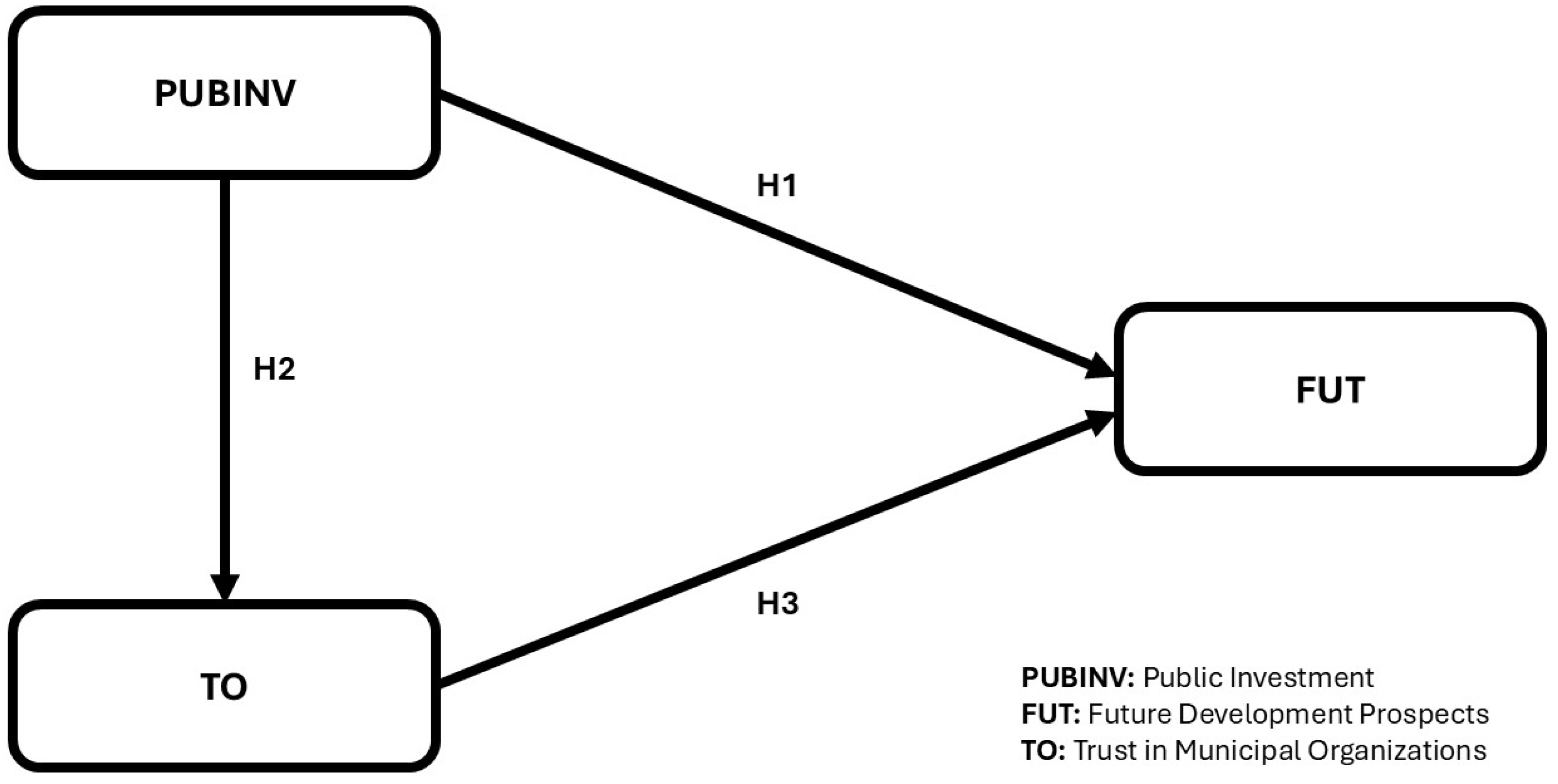
Based on the theoretical framework presented, a conceptual model was developed that represents the proposed relationships between the three main constructs of the study: Public Investment (PUBINV), Trust in Municipal Organizations (TO) and Future Development Prospects (FUT).
The model assumes that public investment plays a driving role, directly influencing both trust in municipal organizations and development prospects. In turn, higher levels of public trust in municipal organizations lead to more positive perceptions of the municipality’s future capacity for innovation and sustainability. This causal structure is in line with the approach of the RRI2SCALE project (
Angelidou et al., 2022;
Panori et al., 2022), which identifies the integration of public investment, institutional trust, and visions of the future as central elements of regional innovation ecosystems. Thus, the proposed model reflects a chain process: strategic public investments tend to increase trust in municipal organizations, which strengthens prospects for future development, providing a basis for empirical validation through structural equation modelling (PLS-SEM).
Figure 1 illustrates the proposed causal structure between the three main constructs of the study: PUBINV, TO, and FUT. The model assumes that public investment positively influences both trust in municipal organizations and future prospects, while higher levels of trust lead to more positive perceptions of the municipality’s future development.
3. Materials and Methods
The objective of this study is to analyze how the performance of public investment, aligned with SDG 9, influences citizens’ trust in municipal organizations and their perceptions of future development prospects. In addition, the study examines the mediating role of trust, proposing that higher levels of trust in municipal organizations strengthen citizens’ expectations for a better future, thereby revealing the effectiveness of LPA.
To achieve this objective, the conceptual model was empirically validated using Partial Least Squares Structural Equation Modelling (PLS-SEM), which is widely used in exploratory studies and in contexts where data do not meet the assumptions of multivariate normality (
Hair et al., 2019). This methodology enabled the simultaneous evaluation of the measurement models, through the analysis of the reliability and validity of the scales, as well as the structural model, by testing the research hypotheses (
Sánchez-Hernández et al., 2025).
All analyses were carried out using a combination of statistical and computational tools to ensure the rigor and transparency of the methodological process. SmartPLS 4 was employed for PLS-SEM modelling, allowing for the estimation of the theoretically developed reflective model and a clear visualization of the results. In addition, following the methodological recommendations outlined by
Suriyadi et al. (
2024), good data pre-processing practices were considered, including the verification of extreme values, normalization, and the treatment of missing values.
3.1. Data Collection Tool
The questionnaire used in this study was adapted from the European project RRI2SCALE (
Panori et al., 2022), which examines the integration of Responsible Research and Innovation (RRI) principles within regional ecosystems, particularly in smart cities, energy, and transport. The adaptation ensured alignment with the specific context and objectives of this study while remaining consistent with the original RRI2SCALE framework.
Responses were collected using a five-point Likert scale, from 1 (Strongly disagree) to 5 (Strongly agree), as recommended by
Panori et al. (
2022) for assessing perceptions and attitudes in contexts of innovation and trust in municipal organizations. The questionnaire was organized into three blocks corresponding to the constructs defined in the conceptual model and grounded in the literature.
To ensure conceptual validity and methodological consistency, the constructs were operationalized through items developed with reference to the literature and previously validated instruments, translated, and semantically adjusted to the Portuguese LPA context. The number of items per construct differs (seven for PUBINV; five for TO and FUT) because in reflective measurement models, indicators represent manifestations of the latent variable rather than exhaustive content coverage. It is therefore theoretically and methodologically appropriate for constructs to have different numbers of indicators, provided they adequately capture the concept. Each item was carefully selected to reflect empirically relevant and theoretically supported dimensions of the construct, ensuring internal consistency, convergent validity, and discriminant validity. Pre-testing of the questionnaire confirmed that all items were comprehensible, relevant, and representative of the constructs, without redundancy.
The first block, PUBINV, consists of seven items that assess perceptions of municipal investment in research and innovation, support for local organizations and public services, incentives for the use of renewable energy, the development of digital services, and the creation of smart infrastructures. Each of these items was developed based on the literature demonstrating that public investment aimed at innovation and sustainability strengthens the capacity of municipal organizations and supports territorial development. In particular,
Matvejevs and Tkacevs (
2025) highlight the importance of administrative capacity and organizational quality in transforming investment into public value;
Mora et al. (
2022) emphasize that strategic investment improves citizens’ perception of the future potential of municipalities;
Panori et al. (
2022) underline that public investment should be aligned with principles of responsible innovation; and
Sánchez-Hernández et al. (
2020) show that visible investments, tailored to social needs, strengthen the relationship between the community and the LPA. Based on these contributions, the items included in the PUBINV block were formulated to reflect specific practices, such as supporting research and innovation activities, promoting renewable energy, developing digital services, and investing in smart infrastructures, directly translating the insights of these authors.
The second block, TO, includes five items that measure trust in municipal organizations, such as non-governmental organizations, educational institutions, public services, and the LPA itself. These items were constructed based on studies showing that trust results from the perception of reliability, consistency, and organizational responsibility.
Alshwayat et al. (
2021) demonstrate that institutional trust depends on how citizens evaluate the performance and relationships of public organizations;
Bentzen (
2023) shows that leadership acting with integrity reinforces cooperation and effectiveness;
Jeanneret Medina et al. (
2024) explain that trust emerges when transparency and consistency exist in public actions; and
L. Silva et al. (
2023) confirm that social capital and credibility within municipal organizations strongly influence citizens’ trust. Thus, the items used in the TO block were designed to reflect validated dimensions in the literature, namely the perception of transparency in municipal organizations, the fulfilment of institutional commitments, and the ability to respond to citizens’ needs.
The third block, FUT, comprises five items that assess perceptions regarding the municipality’s future capacity to promote innovation, digitalize services, improve energy efficiency, strengthen mobility, and enhance quality of life. The formulation of these items was based on literature linking future expectations with the capacity of municipal organizations to plan and implement sustainable strategies.
Beckert (
2021) discusses the relevance of future projections for guiding collective decisions;
Brecher et al. (
2022) show that innovation and efficient administration influence public perceptions of future development;
Csereklyei et al. (
2023) analyze the role of energy transition in citizens’ trust;
Panori et al. (
2022) reinforce the importance of digitalizing services and citizen participation in territorial innovation processes; and
Tuhana et al. (
2023) demonstrate that sustainable policies contribute to more positive expectations regarding quality of life. Based on these contributions, the items in the FUT block were designed to capture aspects such as the municipality’s capacity to promote innovation, improve energy efficiency, enhance urban mobility, and develop sustainable strategies, directly reflecting the future-oriented dimensions highlighted by these authors.
Table 1 summarizes the operationalization of the constructs, including all items and bibliographic sources.
The operationalization presented clarifies the correspondence between the theoretical constructs and the observable variables included in the questionnaire. The column listing the items indicates the number of questions used to measure each construct, providing transparency and supporting replication of the study. This approach ensures methodological rigor and allows for consistent interpretation of the empirical results.
3.2. Data Collection Procedure
Data collection was carried out throughout 2024, using an online questionnaire aimed at the population residing in Portugal. The criterion for participation was to be over 18 years of age, and the invitation was widely disseminated digitally, allowing for voluntary and convenient participation.
A total of 215 valid responses were obtained, covering municipalities across mainland Portugal and the archipelagos of the Azores and Madeira. Although geographically diverse, the sample was not probabilistic and does not statistically represent the resident population, thus constituting a methodological limitation.
Participants provided responses grounded in their experiences and perceptions of their municipality. Apart from the concept of innovation, no topics were predefined, allowing for subjective but informed reflections.
3.3. Sample Characterization
The sample was predominantly composed of female participants (60%). In terms of education, there was a notable concentration of graduates (47.9%), followed by individuals with secondary education (29.8%) and those holding a master’s degree (15.8%), reflecting a diverse and well-qualified academic profile.
In terms of professional activity, the majority work in the business sector (33.5%), followed by university students (19.1%), employees of higher education institutions (17.7%) and public sector workers (15.8%). Other segments, including civil society and volunteering, represent 14% of the sample.
The age distribution is mainly concentrated between 35 and 65 years old (62.8%), with smaller proportions in the 18–24 age group (17.2%), 25–34 age group (15.8%) and over 65 age group (4.2%). Geographically, there is a strong concentration in Greater Lisbon (51.2%), followed by the Centre regions (13.5%), the Setúbal Peninsula (11.6%) and the West and Tagus Valley (9.3%). Other regions, including the North (7.9%), the Azores (3.7%), Alentejo (1.4%), Algarve (0.9%) and Madeira (0.5%), are less significant but ensure territorial diversity. Overall, the sample reflects a diverse profile in terms of age, education, professional activity, and geographical distribution, allowing for a robust analysis of perceptions of municipal efforts in Portugal.
3.4. Data Analysis and Psychometric Evaluation
Before analysis, the data was carefully filtered to ensure the validity of the responses. Only cases with valid responses were included, with values set between 1 and 5 for all indicators. The statistical analysis followed the steps recommended for PLS-SEM, as described by
Hair et al. (
2019).
Firstly, the measurement model was evaluated, which included the analysis of external loads, the verification of internal reliability using Cronbach’s alpha and composite reliability, the evaluation of convergent validity through the extracted mean variance, as well as the analysis of discriminant validity based on the HTMT criterion. Next, the structural model was evaluated by estimating path coefficients, applying statistical significance tests by bootstrapping with five thousand subsamples, calculating determination coefficients, and analyzing overall fit measures, with emphasis on the SRMR index.
Table 2 presents the reliability and convergent validity indicators for each construct. All have Cronbach’s
≥ 0.83, CR > 0.87, and AVE > 0.58, indicating adequate internal consistency and convergent validity.
Discriminant validity was assessed using the Heterotrait–Monotrait (HTMT) criterion. All HTMT values were below the conservative threshold of 0.90, as shown in
Table 3, indicating adequate discriminant validity. This result indicates that the constructs of the model are empirically distinct from each other. The adoption of the HTMT criterion, recommended by
Henseler et al. (
2015), reinforces the robustness of the assessment, especially in PLS-SEM modelling contexts, where discriminant validity is not always guaranteed by traditional methods such as Fornell-Larcker.
Table 3 presents the HTMT matrix, showing that FUT (Future Prospects) has values of 0.856 with PUBINV (Public Investment) and 0.328 with TO (Confidence), while PUBINV has 0.281 with TO, confirming the distinction between the constructs and the consistency of the model.
Thus, the data filtering process and the careful application of PLS-SEM analyses ensured the validity and reliability of the responses, as well as guaranteeing that the constructs evaluated were distinct and consistent. These methodological precautions provide a solid basis for interpreting the results and reliably support the structural analyses and subsequent conclusions of the study.
4. Results
The empirical analysis was conducted using a two-stage PLS-SEM approach in SmartPLS 4 (
Suriyadi et al., 2024), starting with the assessment of the measurement model and proceeding to the structural model analysis. After confirming the reliability and validity of the scales, the structural model was estimated using bootstrapping with 5000 subsamples.
We first assessed multicollinearity among the predictor constructs using variance inflation factors (VIFs), following the recommendations of
Hair et al. (
2022).
Table 4 reports the VIF values for all indicators included in the structural model.
All VIF values fall below the conservative threshold of 3.3 (
Diamantopoulos & Siguaw, 2006), indicating that multicollinearity is not a concern and that the structural path estimates can be interpreted reliably.
After establishing the absence of multicollinearity issues, the structural model was evaluated.
Table 5 presents the estimated path coefficients,
t-values,
-values, and 95% confidence intervals for each hypothesized relationship.
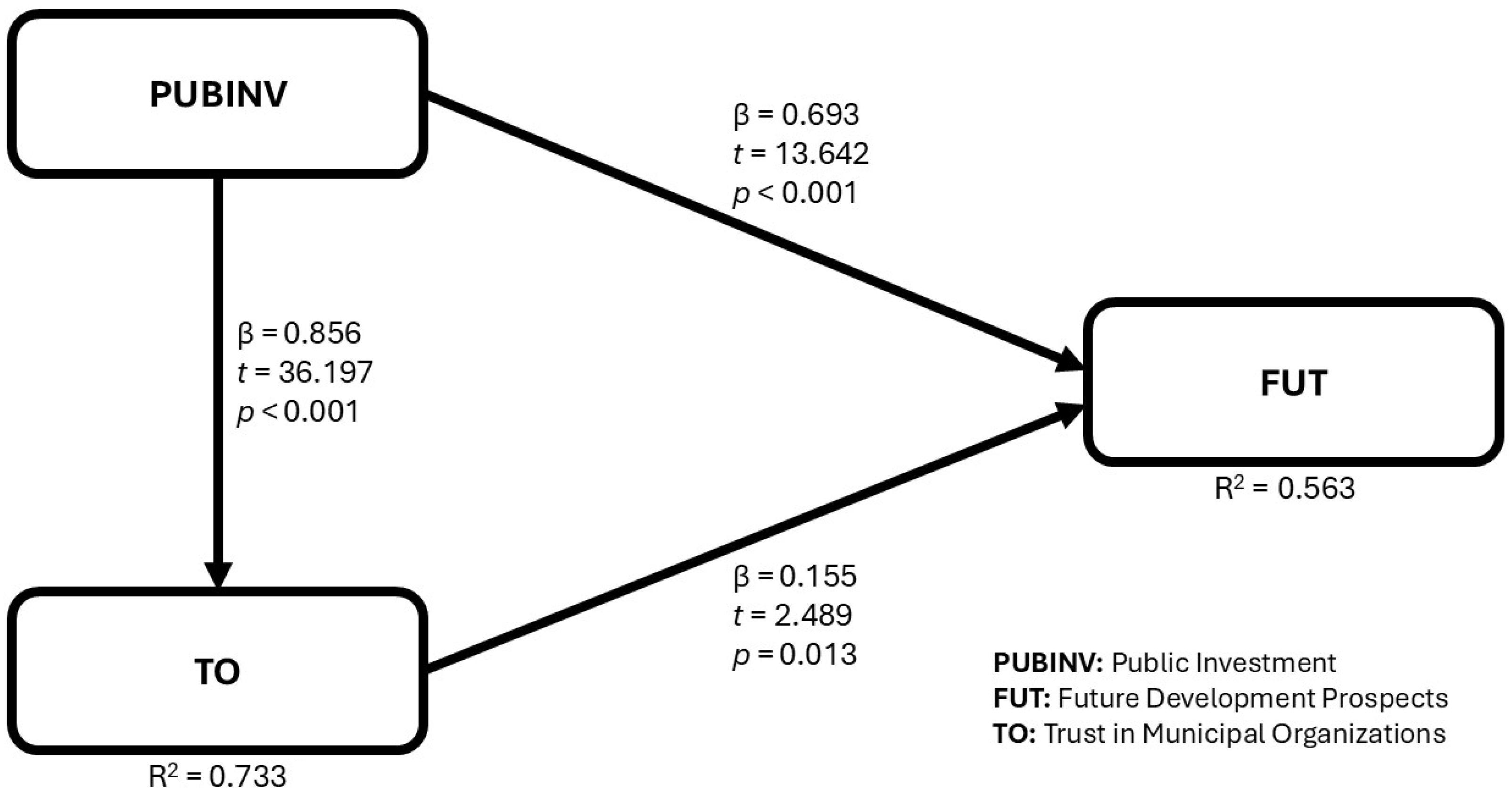
All hypotheses were confirmed: public investment is positively associated with perceptions of future development (
= 0.693;
t = 13.642;
< 0.001), corroborating the literature linking strategic investments with more favorable perceptions of innovation capacity and local development (
Matvejevs & Tkacevs, 2025;
Panori et al., 2022). Public investment is also positively associated with citizens’ trust in municipal organizations (
= 0.856;
t = 36.197;
< 0.001), with a high
of 0.733, indicating that the perception of tangible investments in areas of direct impact, such as transport, energy, or digital services, is strongly related to higher levels of trust in municipal organizations. In turn, citizens’ trust is positively associated with perceptions of future development (
= 0.155;
t = 2.489;
= 0.013), suggesting a mediating relationship between investment and perceptions of the future. The coefficients of determination (
) for the endogenous constructs are reported in
Table 6.
The model shows high explanatory power and good fit (SRMR = 0.058), below the recommended threshold of 0.08, and with an
of 0.563 for future development perceptions, indicating that more than half of the variance in this construct is statistically explained by the associations between investment and trust, empirically validating the proposed theoretical framework.
Figure 2 illustrates the structural model with the estimated path coefficients.
Beyond their statistical significance, the results suggest that public investments are associated not only with perceptions of improved infrastructure and services, but also with symbolic and communicative effects, which are linked to the legitimacy of local administrations and the perception of technical and ethical competence of managers.
Finally, we further assessed the model’s out-of-sample predictive power using the PLSpredict procedure. PLSpredict generates holdout samples through k-fold cross-validation, allowing evaluation of predictive performance on new observations beyond the estimation sample, complementing the in-sample explanatory metrics (
) reported above. Specifically, we applied the PLSpredict algorithm using 10-fold cross-validation with 10 repetitions, as recommended by
Hair et al. (
2019).
Table 7 presents the PLSpredict results for the indicators associated with the endogenous constructs FUT and TO.
The PLSpredict results indicate that the PLS-SEM model outperforms the linear benchmark model (LM) for the majority of indicators associated with the endogenous constructs, as evidenced by lower prediction errors (RMSE). According to established guidelines (
Hair et al., 2019;
Shmueli et al., 2019), this pattern suggests medium to high predictive power, confirming that the model is not only explanatory but also capable of producing reliable predictions beyond the estimation sample.
5. Discussion
The results confirm that public investment is strongly associated with local transformation, showing significant relationships with perceptions of future development and citizens’ trust in municipal organizations. This relationship indicates that strategic public policies focused on innovation, smart infrastructure, and sustainability are linked to more positive perceptions of the future and are associated with stronger municipal organizational performance.
These results can also be interpreted in light of SDG 9, which emphasizes the promotion of innovation, the development of sustainable infrastructure, and inclusive and responsible industrialization. The empirical evidence suggests that municipal public investment, when perceived by citizens as directed toward infrastructure and services with tangible impact, is associated with higher levels of trust in municipal organizations and more favorable expectations regarding future development. In this sense, LPA plays a central role as a catalyst for the principles of SDG 9, translating global objectives of innovation and sustainability into concrete actions with locally perceived impact. This perspective allows the contribution of LPA to SDG 9 objectives to be discussed through citizens’ perceptions, rather than through a direct and disaggregated assessment of formal SDG indicators. Future research could complement this approach by examining individual SDG 9 targets using a combination of perceptual and objective data.
From a theoretical perspective, the findings extend the application of agency theory in the context of LPA by empirically demonstrating how public investment and trust in municipal organizations are interrelated in ways that may help reduce information asymmetries and are associated with enhanced perceptions of future development. Trust is therefore not merely a byproduct of institutional actions but emerges as a crucial mediator that helps explain how material resources are translated into social capital, promoting cooperation, policy acceptance, and collective mobilization around shared future visions (
Basloom et al., 2022;
De Graaf, 2010;
DiMaggio et al., 1999;
Ikenberry et al., 2000;
Sánchez-Hernández et al., 2020).
Empirically, the study shows that citizens’ trust is associated with greater perceived effectiveness of public investment, even when the direct effect is modest. This suggests that proximity policies, transparent communication, and citizen participation are important contextual factors through which investments are perceived as contributing to future development and local innovation. The high explanation of trust by investment (
= 0.733) demonstrates that, in contexts like Portugal, the perception of tangible impact is crucial for consolidating institutional legitimacy (
Afonso et al., 2024;
Alessandro et al., 2021).
The results also highlight that public investment serves a dual function: technical (improvement of infrastructure, services, and innovation) and relational (symbol of competence, ethics, and transparency). This dual dimension is essential to sustain local innovation ecosystems and is associated with stronger trust, aligning with participatory governance approaches and principles of endogenous territorial development (
Barca, 2008;
Böhm & Alexander, 2024;
Cvetanovic et al., 2015;
McDonald et al., 2019;
Romer, 1989).
Furthermore, the findings provide practical insights for public policy formulation: strategic, visible investments aligned with collective needs are associated with positive perceptions of the future and higher levels of citizens’ trust. Innovation strategies should include participatory mechanisms that allow citizens to contribute to the design and monitoring of public policies, especially in smaller or peripheral municipalities, where trust is more sensitive to the direct perception of investments (
Bentzen & Bringselius, 2023;
McCambly & Colyvas, 2023).
Beyond reinforcing existing trust–governance models, this study adds empirical evidence that, in the context of LPA, citizens’ perceptions of public investment are directly associated with trust in municipal organizations and expectations of future development. The effects appear particularly relevant where investment is highly visible and directly experienced by citizens, such as local infrastructure, public services, and innovation projects with tangible impact. While the study design does not allow for robust segmentation by municipality type, the evidence suggests that citizens are more sensitive to the visibility and quality of investment than to its absolute scale, highlighting a promising avenue for future research.
In summary, the analysis shows that the interaction between investment, trust, and perceptions of the future constitutes a key relational pattern for a responsible, transparent, and innovative LPA, particularly relevant in the context of digital and green transitions. The study demonstrates that the combination of tangible investment, transparent communication, and citizen engagement is strongly associated with institutional legitimacy and the success of local development strategies (
Koskela & Paloniemi, 2023;
Yang & Lv, 2025).
6. Conclusions
This study demonstrates that municipalities that strategically invest in innovation, smart infrastructure, and sustainability are associated with significant differences in perceptions of the future and citizens’ trust. By highlighting the relationship between public investment and trust, municipal organizations can be understood as converting material resources into social capital, which is linked to cooperation and acceptance of public policies.
The significance of this research lies in showing that LPA should not be viewed merely as a policy executor, but as an active agent of sustainable territorial transformation. The results empirically indicate that public investment is strongly associated with the alignment of managers and citizens, lower levels of perceived information asymmetries, and higher perceived institutional legitimacy. This contribution is particularly relevant in the context of SDG 9, as it highlights the role of public investment and organizational trust as complementary mechanisms that are jointly associated with innovation-oriented and sustainable local governance.
From a practical standpoint, the study provides clear guidance for public decision-makers: prioritize projects with tangible impact, promote transparent communication, and involve citizens in policy design and monitoring, ensuring that investments not only improve infrastructure but also reinforce trust and positive development perceptions.
This study presents limitations that should be considered. The sample is non-probabilistic, based on voluntary participation, and unbalanced in terms of municipal representation, which may limit the generalizability of the findings to municipalities with different socioeconomic, territorial, or administrative characteristics. The cross-sectional nature of the data restricts the ability to establish causal relationships, and the observed associations should not be interpreted as definitive evidence of causality. Additionally, the model includes only three main constructs, leaving other potentially influential dimensions, such as economic factors or organizational characteristics, unexplored.
Future research could benefit from incorporating additional contextual variables, such as socioeconomic indicators or municipal size, as well as using representative samples and longitudinal research designs that allow for the analysis of temporal dynamics, such as changes in perceptions, and the validation of causal inferences over time. Comparative studies across different European regions could further strengthen the validity and applicability of the model in diverse territorial contexts.
Theoretically, the research contributes to the literature by extending the application of agency theory in the context of LPA, showing that trust functions both as a mediator and as a strategic asset that enhances the perceived effectiveness of public investments.
From a practical standpoint, the results suggest that local decision-makers should prioritize public investment strategies that are both innovation-oriented and clearly communicated to citizens, reinforcing the perception of social impact and utility. The promotion of municipal projects aligned with innovation and sustainability goals can contribute to strengthening trust in municipal organizations and consolidating positive expectations for future development, supporting a more inclusive and sustainable LPA.
In summary, this study demonstrates that, in times of digital and green transitions, the alignment of public investment, citizens’ trust, and shared visions of the future represents a robust associative pattern underlying innovative, sustainable, and socially legitimized policies. By synthesizing the relationships between investment, trust, and future development perceptions, the article provides an integrated framework that guides future research and offers practical recommendations to strengthen the effectiveness and legitimacy of LPA.