You are currently viewing a new version of our website. To view the old version click .
Administrative Sciences
  • Systematic Review
  • Open Access

17 December 2025

From Design to Theory: Understanding the Evolution of Blockchain Research in Project Management


,
and
College of Business & Information Systems, Dakota State University, Madison, SD 57042, USA
*
Authors to whom correspondence should be addressed.
Adm. Sci.2025, 15(12), 495;https://doi.org/10.3390/admsci15120495 
(registering DOI)
This article belongs to the Special Issue Research on Blockchain Technology and Business Process Design

Abstract

This study presents a systematic literature review of 58 peer-reviewed publications on blockchain-based project management to examine the dominant research methods and theoretical approaches in the field. Using an established Information Systems theory classification framework, the review classifies existing studies into four categories: Explicit Theory-Driven, Conceptual/Framework-Oriented, Design Science/Artifact-Oriented, and Descriptive/Empirical without Theory. Findings reveal that current research is largely technology-centric, with nearly 70% of studies adopting design-science or artifact-oriented methods and fewer than 10% engaging explicit theoretical foundations. This indicates that blockchain-project management scholarship remains in a pre-theoretical stage, focusing primarily on prototype development rather than explanatory or predictive theorizing. A clear method–theory coupling also emerges, where design-science methods align with artifact creation, quantitative surveys with theory-driven studies, and qualitative cases with descriptive work. Temporal patterns show gradual movement toward theory-informed and mixed-method research, signaling early maturation of the field. The review concludes by outlining three priorities for future research: translating design insights into theoretical constructs, developing hybrid frameworks that integrate behavioral and institutional perspectives, and adopting multi-level approaches to examine blockchain’s impact across project ecosystems. These insights provide a structured foundation for advancing both scholarly theory and practical applications in blockchain-enabled project management.

1. Introduction

Blockchain technology has emerged as a transformative innovation with the capacity to reshape organizational processes, governance mechanisms, and information systems across industries (Saberi et al., 2019; Treiblmaier, 2018). In project management (PM), blockchain offers potential to improve transparency, trust, traceability, and automation through decentralized data sharing and smart contracts (Ahmadisheykhsarmast & Sonmez, 2020; Mukkamala et al., 2018). As project environments increasingly span multiple stakeholders, blockchain promises to address persistent challenges such as accountability gaps, fragmented communication, and contract enforcement inefficiencies (Perera et al., 2023) Over the past decade, research exploring blockchain applications in project management and construction has grown rapidly, ranging from technical implementations and conceptual frameworks to adoption and governance studies. Despite this growth, the field remains methodologically and theoretically fragmented, spanning disciplines such as information systems, construction engineering, and organizational management, each adopting distinct methodological and theoretical perspectives (Perera et al., 2023; Li et al., 2022). Consequently, there is limited understanding of how scholars study blockchain in PM and which theoretical lenses guide this emerging research domain.
Previous literature reviews have primarily focused on application domains (e.g., supply chain, construction, procurement) or technical architectures (e.g., smart contracts, data integrity) rather than examining the nature of theorizing in this interdisciplinary field (Saberi et al., 2019; Sharma et al., 2023). Few studies have systematically compared research methodologies and theoretical foundations to assess the field’s maturity. As blockchain-based PM research evolves from exploratory case studies to more formalized frameworks, understanding its theoretical and methodological orientation becomes crucial for shaping future inquiry.
Although prior reviews of blockchain applications in domains such as supply chain, construction, and procurement have mapped technological implementations and application areas (e.g., Saberi et al., 2019; Perera et al., 2023), they rarely examine how blockchain research in project management is theoretically constructed or methodologically grounded. These reviews primarily use cases, benefits, challenges, or technical architecture. They do not evaluate: how scholars theorize blockchain in PM, which methodological traditions dominate the field, whether research is maturing beyond prototypes toward explanatory or predictive theorizing, or how the field aligns with established IS theory-development trajectories. As a result, little is known about the dominant research paradigms, theoretical orientations, or methodological trajectories that define this emerging field. Without such mapping, the maturity, coherence, and theoretical progression of blockchain-based project management research remain unclear. Thus, the theoretical and methodological structure of blockchain-based project management research remains unexamined, creating uncertainty about the field’s maturity, coherence, and future research direction. This represents a clear and important gap, particularly as blockchain scholarship transitions from early proof-of-concept studies toward more formalized empirical and theoretical work.
To fill this gap, this study conducts a Systematic Literature Review (SLR) by mapping and classifying the research methods and theoretical approaches used in blockchain-based project management research. By integrating methodological analysis with theoretical categorization, this review provides a meta-level understanding of how knowledge is produced and how theory is applied within this growing domain. Accordingly, this SLR is guided by the following research question:
RQ: What research methods and theoretical approaches characterize and dominate the current body of blockchain-based project management research?
The review makes three contributions. First, it provides the first structured mapping of blockchain-based project management research according to both methodological orientation and theoretical purpose, offering a field-level assessment of its developmental stage. Second, it identifies a dominant emphasis on design-science and artifact-oriented work, revealing limited engagement with explanatory or predictive theories. Third, it outlines pathways to advance the field toward greater theoretical integration, including translating design insights into conceptual constructs and adopting multi-level, theory-informed research designs. Together, these contributions sharpen our understanding of where blockchain project management research stands today and chart a pathway toward its theoretical and methodological evolution.

2. Literature Review

2.1. Blockchain and Project Management

Blockchain’s introduction into project management has generated increasing academic and industry attention for its potential to transform contract administration, data transparency, and stakeholder coordination (Li et al., 2022; Turk & Klinc, 2017). Within project-intensive industries such as construction, infrastructure, and information systems, blockchain is recognized as a foundational technology for decentralized collaboration, reducing reliance on intermediaries and enhancing trust in project delivery processes.
Blockchain’s decentralized architecture directly challenges traditional governance logics in project settings, where authority, accountability, and trust are typically centralized in lead contractors or clients. This shift raises fundamental organizational questions regarding decision rights, verification authority, and collaborative control structures.
Early studies predominantly focused on technical feasibility, developing prototypes or simulation frameworks to automate procurement, progress tracking, or payment certification (Perera et al., 2023). Subsequent research expanded toward organizational and behavioral aspects, examining adoption readiness, governance, and integration with existing project management information systems (Ahmadisheykhsarmast & Sonmez, 2020). Despite this evolution, the field remains fragmented: some studies are grounded in technical design science paradigms, others in conceptual or theoretical modeling, and still others in exploratory case analyses.
This diversity raises fundamental questions regarding the nature of theorizing in blockchain-PM research. While information systems scholars emphasize theory development and validation (Gregor, 2006; Weber, 2012), much of the blockchain literature remains artifact-centric, prioritizing system design over theory integration (Mendling et al., 2018). The absence of a unified theoretical foundation limits cumulative knowledge building and makes it difficult to assess the field’s maturity. Taken together, existing research demonstrates blockchain’s potential to reshape collaboration and transparency in project environments. However, prior reviews have emphasized technical applications rather than examining the theoretical and methodological foundations driving the field. What remains unclear is how blockchain and PM research are evolving in terms of theory development and how methodological choices shape knowledge development. This gap motivates the need for a systematic review focused explicitly on the relationship between research methods and theoretical approaches. Table 1 contrasts prior SLRs with the present review. It highlights how this study uniquely shifts the analytical focus from application-centric insights to a theory- and methodology-driven assessment of blockchain research in project management.
Table 1. How Prior SLRs Differ from the Present Review.

2.2. The Need for Theoretical and Methodological Mapping

Systematic reviews in related areas, such as blockchain in supply chain management (Saberi et al., 2019) and construction engineering (Perera et al., 2023), have highlighted the dominance of design-science and conceptual approaches, but rarely evaluated the underlying theoretical logic of these studies. For instance, Saberi et al. (2019) found that most blockchain-SCM papers emphasize what blockchain can do rather than why and how it creates value, signaling limited theoretical sophistication. The same pattern is visible in PM research, where design frameworks and technical architectures often outnumber theory-driven empirical investigations (Ahmadisheykhsarmast & Sonmez, 2020; Li et al., 2022).
Given this fragmentation, there is a growing need to assess how theory is being used, or neglected, in blockchain-PM studies. As Information Systems scholars have long recognized (Gregor, 2006; Weber, 2012), theory plays multiple roles: describing phenomena, explaining causal relationships, predicting outcomes, and guiding design. This review, therefore, adopts Gregor’s (2006) Nature of Theory in Information Systems typology to systematically classify and evaluate the theoretical and methodological foundations of blockchain-PM scholarship.

2.3. Gregor’s (2006) Typology as a Framework for Theoretical Assessment

Gregor’s (2006) framework provides an ideal lens for evaluating blockchain-based PM research because it distinguishes the purpose of theoretical contribution, whether a study seeks to describe, explain, predict, or design, rather than focusing solely on method or data type. This distinction is particularly relevant for blockchain research, which spans technical design-science artifacts and organizational–behavioral inquiry.
To systematically evaluate the theoretical orientation of blockchain-PM research, this review adopts Gregor’s (2006) influential framework, The Nature of Theory in Information Systems, which defines five types of theory:
(1)
Theory for analyzing,
(2)
Theory for explaining,
(3)
Theory for predicting,
(4)
Theory for explaining and predicting, and
(5)
Theory for design and action.
These theory types collectively capture the spectrum of how knowledge evolves from descriptive classification to explanatory models and ultimately to design principles for system development. Gregor’s framework has become a cornerstone for assessing theoretical maturity in IS research because it distinguishes the purpose of a study’s theoretical contribution rather than its method alone (Gregor & Hevner, 2013).
Applying Gregor’s typology within a project management context allows the classification of blockchain research along two complementary axes: (1) knowledge purpose, whether studies aim to analyze, explain, predict, or design, and (2) disciplinary orientation, technical versus organizational. This connection is essential because project management scholarships often emphasize governance mechanisms, coordination structures, and stakeholder trust, concepts that require theoretical articulation beyond artifact development. Mapping blockchain-PM studies through this dual lens reveals how far the field has progressed from descriptive exploration toward explanatory and prescriptive theorizing.
Given the interdisciplinary nature of blockchain-PM research, Gregor’s five types were consolidated into four practical categories to ensure consistent coding across studies. Table 2 summarizes these categories and their corresponding descriptions, illustrating how each theoretical approach type was applied to classify the reviewed studies.
Table 2. Theoretical Approach Categories Derived from Gregor’s (2006) Typology.
This adapted framework bridges IS theory typologies with project management research, allowing a systematic classification of both methodological approach and theoretical intent. Through this dual mapping, the SLR identifies the dominant paradigms shaping blockchain-PM research and provides insights into where future theoretical development is most needed.

3. Materials and Methods

3.1. Review Design

This study adopts a Systematic Literature Review (SLR) methodology to ensure transparency, replicability, and rigor in identifying, screening, and analyzing research on blockchain-based project management. The review design aligns with the PRISMA guidelines (Page et al., 2021) and Kitchenham and Charters (2007) recommendations for evidence-based reviews in information systems and software engineering.
Distinct from prior SLRs that focus on blockchain applications or use, the objective of this SLR is to systematically identify, classify, and analyze the research methods and theoretical approaches used in blockchain-based project management studies, thereby mapping the methodological diversity and theoretical maturity of the field. An SLR is particularly appropriate because the goal is not to evaluate the effectiveness of a single intervention, but to map and synthesize an emerging, fragmented body of work across multiple disciplines.

3.2. Search Strategy

A comprehensive search was conducted across major scientific databases—ABI/INFORM Collection, ACM Digital Library, Academic Search Premier, Business Source Premier, Web of Science, ScienceDirect, and IEEE Xplore. They were selected for their interdisciplinary coverage of both information systems and project management research. The time window (2017–2025) reflects the point at which blockchain research first entered the project management literature and aligns with the emergence of operational blockchain platforms. The study selection process followed the PRISMA guidelines, as shown in Figure 1, which outlines the identification, screening, and inclusion stages.
Figure 1. Identification, screening, and inclusion stages following PRISMA. (*—number of records identified from each database or register searched).
The study identification and screening process followed the PRISMA guidelines, as illustrated in Figure 1, which depicts the stages of identification, screening, and inclusion. Screening was conducted manually using Microsoft Excel to efficiently manage and filter the large set of retrieved records. The process unfolded as follows. A total of 4342 records were initially retrieved from the selected databases. Prior to screening, 1315 records were removed, including those missing abstracts (n = 666), non-research items such as books and editorials (n = 255), duplicate records (n = 323), and other items such as table of contents pages or cover pages (n = 72). During the title or abstract screening stage (n = 3027), records were evaluated based on the presence of the keywords “blockchain” or “project management” in either field. This step excluded2934 irrelevant records, resulting in 92 studies eligible for further review. These 92 studies were then categorized into two thematic groups: (i) blockchain applications within project management, and (ii) applications of project management methods within blockchain system development. As the present study focuses on blockchain applications in project management, only the first category was retained, yielding 77 studies. Full-text examination of these studies identified 19 reviews, leaving 58 primary research articles included in the final analysis.
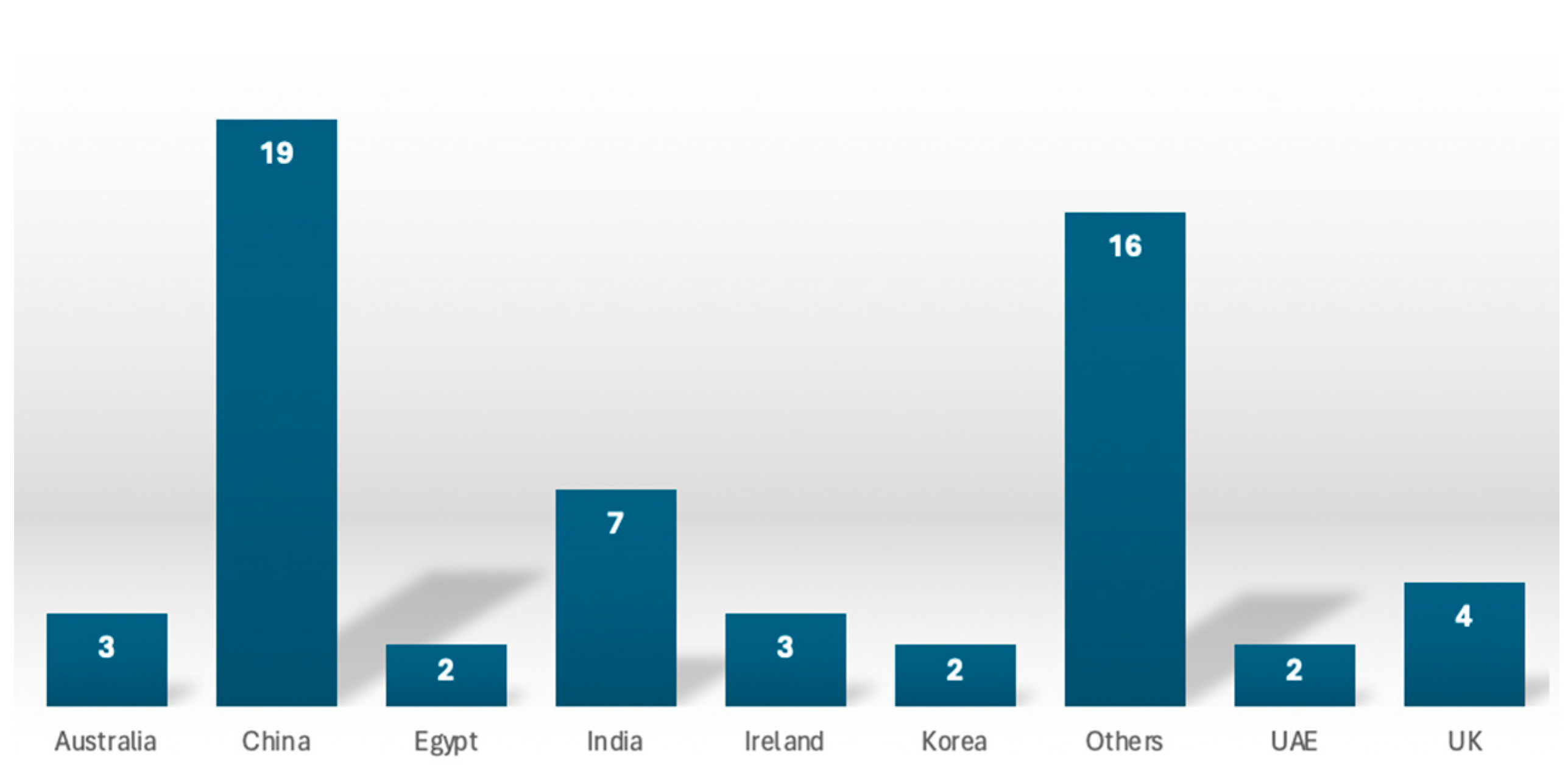
Figure 2 shows the global distribution of the 58 studies, with China contributing the largest share (n = 19, 32.8%), followed by India (n = 7, 12.1%). Additional studies originate from the United Kingdom (n = 4), Australia and Ireland (n = 3 each), and the United Arab Emirates, South Korea, and Egypt (n = 2 each). The other 27.6% are single-country contributions distributed across 16 nations, including Europe, the United States, the Middle East, and Africa.
Figure 2. Global distribution of blockchain-project management studies by country.
The search results were screened in multiple stages (title, abstract, and full text) using inclusion and exclusion criteria to ensure relevance and quality. A total of 58 papers met the inclusion criteria after screening, as documented in the PRISMA flow diagram. To ensure methodological rigor and relevance, specific inclusion and exclusion criteria were applied during the screening process. These criteria guided the selection of studies focusing on blockchain applications in project management and related domains, while filtering out non-peer-reviewed, irrelevant, or inaccessible sources. Table 3 summarizes the inclusion and exclusion parameters used in this review.
Table 3. Inclusion and Exclusion Criteria.

3.3. Data Extraction

A structured data extraction form was developed in Microsoft Excel to capture relevant information from each paper. Each entry included: (1) the title, author, year, and type of publication (journal article, conference paper); (2) the primary focus or domain of the study (e.g., construction, IT, or project governance); (3) the project management methodology applied, categorized as agile, traditional, or hybrid; (4) the blockchain type or framework used (e.g., Hyperledger, Ethereum, or consortium-based systems); (5) the identified adoption drivers or success factors; (6) the research methodology, such as design science, case study, quantitative, or mixed-method approaches; (7) the reported challenges or limitations; and (8) the theoretical approach type, classified according to the framework described below. This structured dataset facilitated both quantitative and qualitative synthesis of research methods and theoretical orientations across the reviewed studies.

3.4. Theoretical Framework for Classification

Gregor’s (2006) theory typology was operationalized in this review using the four-category classification introduced in Section 2.3. This adaptation consolidated Gregor’s five theory types into four practical categories to ensure consistent coding across the interdisciplinary studies of blockchain-based project management. The typology served as the analytical framework for assessing the theoretical orientation of each paper, whether a study emphasized analysis, explanation, prediction, or design. Table 4 summarizes the four classification categories, their correspondence to Gregor’s original theory types, and their defining characteristics.
Table 4. SLR Categories Derived from Gregor’s (2006) Theory Typology.

3.5. Coding and Reliability

Each article was independently reviewed and coded along two dimensions: Research Methodology and Theoretical Approach Type (using the four-category framework described above). Coding followed an iterative two-pass process to ensure rigor and dependability.
In the first pass (Version 1), theoretical categories were assigned using a liberal rule set that recognized both explicit and implicit cues of theoretical orientation (e.g., references to prototypes, frameworks, or adoption models). In the second pass (Version 2), a stricter rule set was applied, requiring explicit mention of theoretical or methodological elements such as Design Science Research (DSR), Technology Acceptance Model (TAM), or Structural Equation Modeling (SEM). Ambiguous cases were re-examined to ensure consistency.
This dual-pass coding served as an intra-coder reliability check, following guidance from Saldana (2021), Nowell et al. (2017), and Campbell et al. (2013) that emphasize iterative coding and reflexive validation. To quantify agreement between the two passes, Cohen’s κ = 0.72 was calculated, indicating substantial reliability (Landis & Koch, 1977). Minor discrepancies (~18%) were manually reconciled, primarily involving conceptual papers lacking explicit theoretical grounding.
This process aligns with recommendations by Kitchenham and Charters (2007) and Boell and Cecez-Kecmanovic (2015), who note that transparency and replicability—rather than coder multiplicity—establish reliability in systematic reviews. The final validated dataset of 58 studies formed the basis for the descriptive statistics, theoretical classification, and methodological cross-comparison presented in Section 4.

4. Results

A total of 58 studies were included in the final review, covering blockchain-based applications in project management, construction management, and IT-driven project governance between 2017 and 2025. The studies span both journal and conference publications, demonstrating increasing academic attention to blockchain’s role in managing distributed, multi-stakeholder projects.
The temporal distribution revealed a steady growth trend, with an early cluster (2017–2019) dominated by conceptual and design-science papers, followed by a surge of empirical investigations post-2020 as blockchain applications matured.

4.1. Distribution of Theoretical Approaches

Each study was classified using the four-category typology adapted from Gregor’s (2006) “Nature of Theory in Information Systems” framework.
  • A. Explicit Theory-Driven: Studies applying established theories (e.g., TAM, DOI, Institutional Theory) to explain or predict blockchain adoption and performance in project management contexts.
  • B. Conceptual/Framework-Oriented: Papers proposing integrative or conceptual models (e.g., smart contract frameworks) without empirical testing or explicit theoretical foundation.
  • C. Design Science/Artifact-Oriented: Studies that design, develop, or evaluate blockchain-based systems, prototypes, or architectures aimed at improving PM functions.
  • D. Descriptive/Empirical without Theory: Qualitative or case-based works that describe blockchain use or assess adoption barriers without grounding in formal theory.
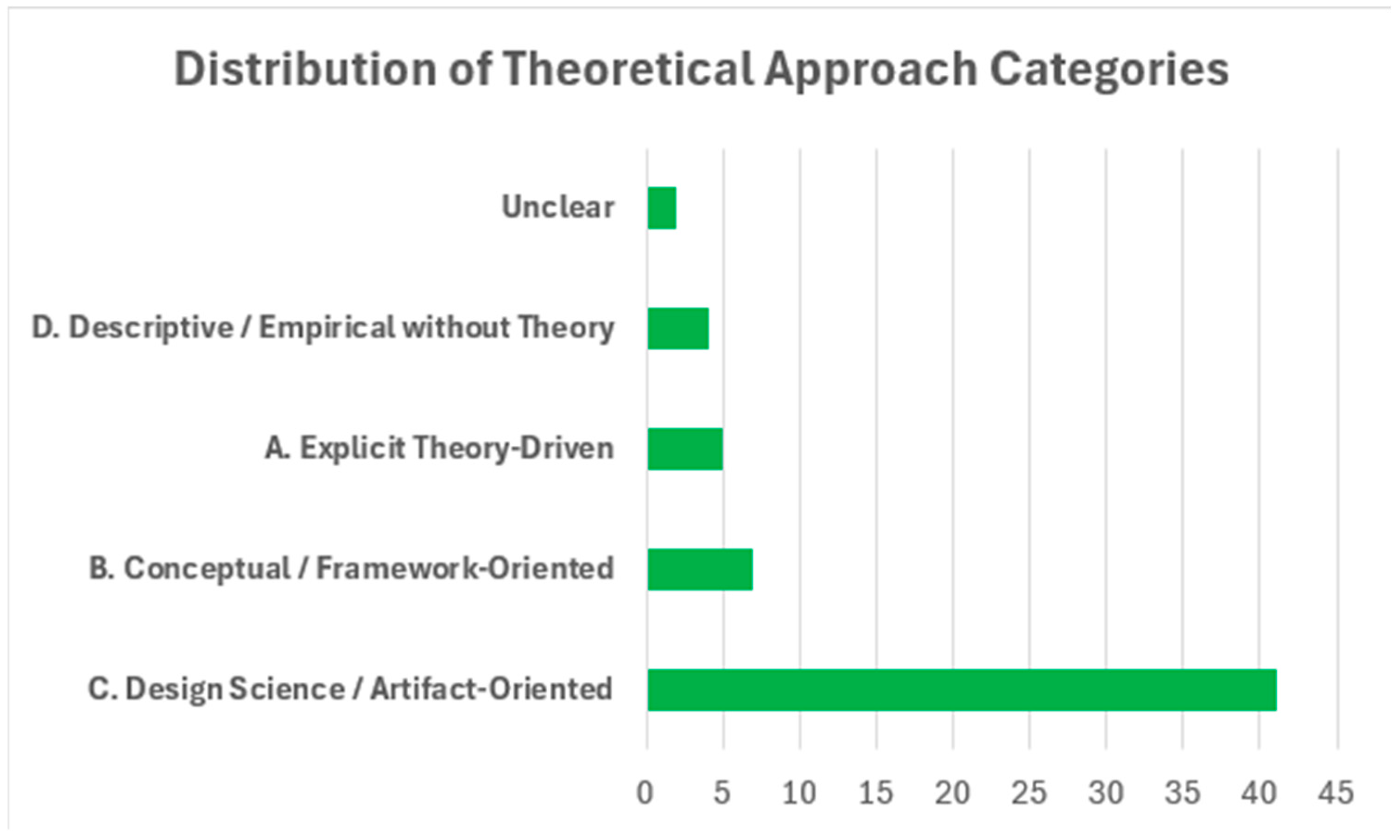
Each of the 58 studies was classified according to the four theoretical approach types derived from Gregor’s (2006) typology. This categorization enabled the identification of dominant research orientations within blockchain-based project management scholarship. Table 5 summarizes the frequency, relative share, and nature of contributions for each category, while Figure 3 visually illustrates the distribution of theoretical approaches across the reviewed studies. Both the tabular and graphical results highlight the overwhelming prevalence of design-science and artifact-oriented research, indicating that project management in blockchain remains primarily in a technology-driven rather than theory-driven phase of development.
Table 5. Distribution of Theoretical Approach Categories Among Reviewed Studies.
Figure 3. Distribution of Theoretical Approach Categories.
Figure 3 depicts the number of studies under each theoretical category. Design Science/Artifact-Oriented studies dominate, highlighting a technology-centric research orientation. The results suggest that blockchain-based project management research remains technically focused and artifact-centric, emphasizing design and proof-of-concept validation (Gregor’s Type V). However, explicit theory-driven inquiry remains comparatively scarce, signaling that theoretical integration has not yet caught up with technological experimentation.
The field of blockchain-based project management research is heavily dominated by design-science and artifact-oriented contributions (70%), underscoring a strong technology-centric orientation.
In contrast, explicitly theory-driven and empirically grounded studies collectively account for less than 15% of publications, indicating that theoretical formalization has not yet caught up with technical experimentation. Conceptual frameworks (12%) serve as transitional contributions, bridging design artifacts with nascent theoretical perspectives.

4.2. Research Methods and Their Link to Theoretical Orientation

To explore how research design relates to theoretical orientation, a cross-tabulation was conducted between the reported methodology and the assigned theoretical category. To strengthen the analytical linkage between research design and theoretical orientation, each study was cross-referenced according to its methodological pattern and corresponding theoretical category. Table 6, Table 7, Table 8 and Table 9 present the methodological patterns identified in the reviewed literature, their corresponding theoretical categories, and the associated studies.

4.2.1. Design Science and Technical Development

Most studies categorized as Design Science/Artifact-Oriented employed design-science methodology, simulation experiments, or prototype development. These works introduced smart-contract models, blockchain-based information systems, or decentralized project tracking mechanisms. Table 6 summarizes the full set of publications categorized under the Design Science/Artifact-Oriented pattern, highlighting studies that employ prototype development, simulation, or technical framework design as their core methodological approach.
Table 6. Design Science Pattern and Theoretical Category.
Methodological PatternCorresponding Theoretical CategoryCitations
Design Science and Technical DevelopmentDesign Science/Artifact-Oriented(Zhao et al., 2023; Wang et al., 2018; Udvaros et al., 2023; Yoon et al., 2024; Çakmak et al., 2022; AL Ghadmi et al., 2023; Rahman et al., 2025; Machado et al., 2020; Khalfan et al., 2022; Ni et al., 2021; H. Bai et al., 2024; Shen, 2024; Liu et al., 2019; Hu et al., 2024; Lafhaj et al., 2025; Arunkumar et al., 2024; El Khatib et al., 2022; Liao et al., 2024; Li et al., 2022; Elazhary & Hosny, 2023; Rocky et al., 2021; El Khatib et al., 2023; J. Zhou, 2023; Wu et al., 2022; Bahnas et al., 2024; Spychiger et al., 2023; Lee & Yoon, 2019; Guo et al., 2022; Han et al., 2022; Y. Bai et al., 2018; S K & N, 2022; Ebekozien et al., 2024; Choudhari et al., 2021; Alkhaldi & Al-Omary, 2024; da Silva & Rosamilha, 2024; Li et al., 2023; Bharadwaj et al., 2023; Meng & Sun, 2021; L. Zhou, 2024; Serrano, 2022; Xu et al., 2024)

4.2.2. Quantitative/Theory-Testing Studies

In contrast to the technically focused studies, a smaller subset of papers explicitly engaged with established theoretical frameworks to explain or predict blockchain adoption and its implications for project management. These works applied behavioral and organizational theories such as the Technology Acceptance Model (TAM), Diffusion of Innovation (DOI), and Institutional Theory to examine factors influencing blockchain implementation. Table 7 presents the studies categorized under the Explicit Theory-Driven pattern, illustrating how formal theorization has been applied within blockchain-based project management research.
Table 7. Quantitative Pattern and Theoretical Category.
Methodological PatternCorresponding Theoretical CategoryCitations
Quantitative/Theory-testing StudiesExplicit Theory Driven(Kim et al., 2020; Gao et al., 2023; Deep et al., 2022; Demirkesen et al., 2024; Duan et al., 2023)

4.2.3. Qualitative/Case-Based Research

The Descriptive/Empirical without Theory group primarily comprised case studies and exploratory research, often focusing on pilot implementations in construction or IT projects. While contextually rich, these studies rarely articulated theoretical propositions. Table 8 lists the studies classified under this category, reflecting the field’s continued emphasis on practical observation over formal theorization.
Table 8. Qualitative Pattern and Theoretical Category.
Methodological PatternCorresponding Theoretical CategoryCitations
Qualitative/Case-based researchDescriptive/Empirical without Theory(Renwick & Tierney, 2020; Lotfi et al., 2022; Sharma et al., 2023)

4.2.4. Conceptual Frameworks

Conceptual/Framework-Oriented papers proposed high-level models integrating blockchain with IoT, BIM, and AI, but lacked empirical validation. These contributions offer valuable integrative perspectives for future hypothesis-driven studies. Table 9 summarizes the studies categorized under this category, highlighting how these contributions bridge technological affordances with project-management theory development.
Table 9. Conceptual Framework and Theoretical Category.
Methodological PatternCorresponding Theoretical CategoryCitations
Conceptual FrameworksConceptual/Framework-Oriented(Jain et al., 2024; Lu et al., 2022; Brüggemann & Timinger, 2023; Hong et al., 2020; Hargaden et al., 2019; Alkhudary & Gardiner, 2024; Serrano & Barnett, 2023)
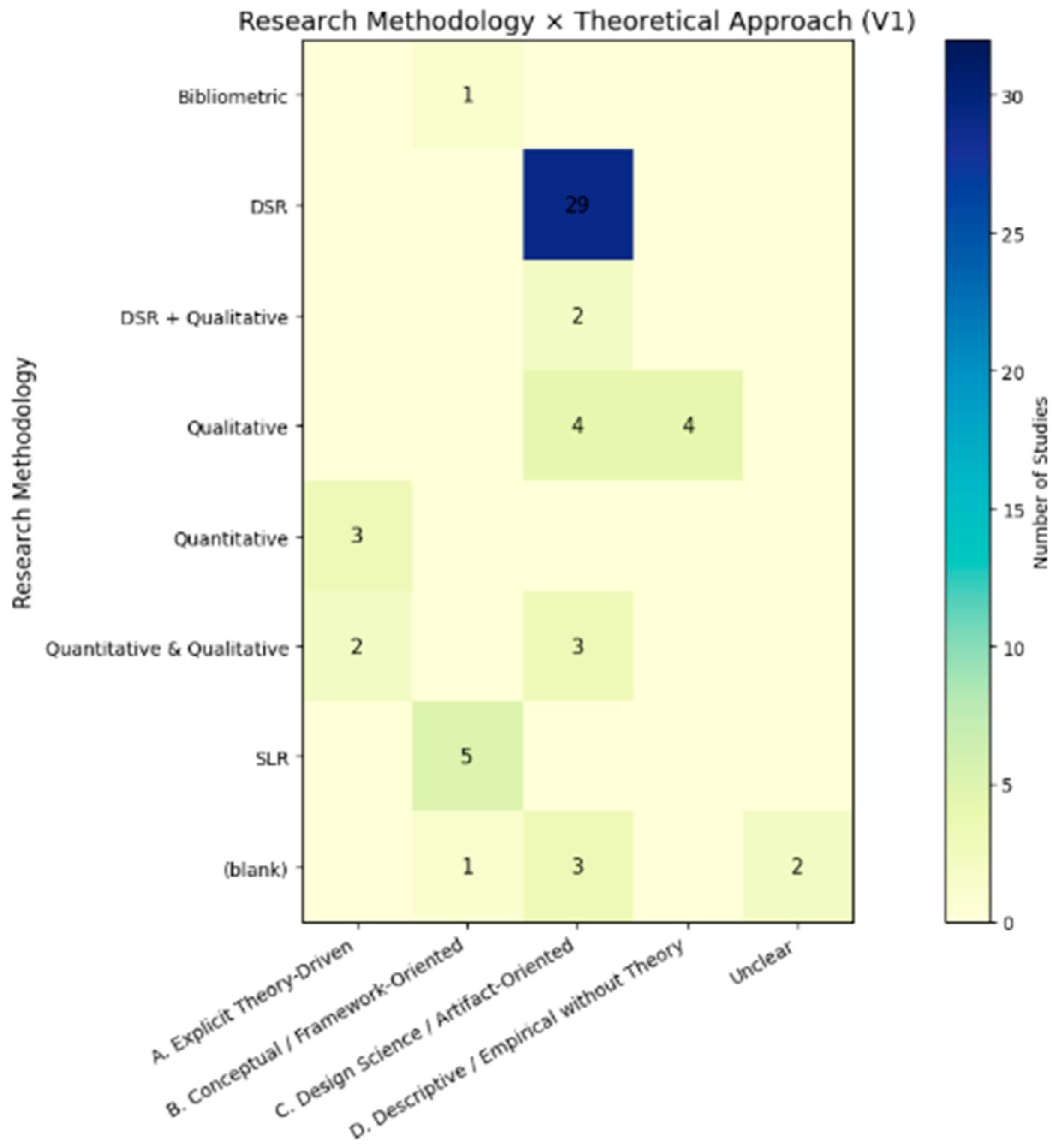
To examine the relationship between research design and theoretical orientation, a cross-tabulation was conducted, mapping the research methodologies used in the reviewed studies against their corresponding theoretical approach categories. This visualization highlights how specific methodological traditions align with different types of theoretical contributions. As illustrated in Figure 4, Design Science Research (DSR) overwhelmingly dominates the Design Science/Artifact-Oriented category, with 29 studies employing DSR as the primary methodology. In contrast, theory-driven and mixed-method studies remain comparatively scarce, indicating a strong methodological concentration around artifact development and evaluation rather than theory testing or integration.
Figure 4. Research Methodology × Theoretical Approach (V1).
The heatmap visualizes the relationship between research methods and theoretical categories. Design Science studies align strongly with the Artifact-Oriented category, while quantitative methods dominate the Explicit Theory-Driven group.
Interpretation:
The heatmap and cross-tabulation reveal a clear method–theory coupling:
  • Design Science → Design Science/Artifact-Oriented
  • Quantitative → Explicit Theory-Driven
  • Qualitative → Descriptive
This alignment demonstrates that methodological preferences largely dictate theoretical positioning, reflecting the field’s early-stage maturity.

4.3. Coding Reliability and Agreement

To ensure coding rigor, two classification rule sets were applied.
  • Version 1 (V1) used a comprehensive rule-based classifier that captured both explicit and implicit theoretical cues across focus, methodology, and adoption context.
  • Version 2 (V2) employed a stricter, conservative rule set that required explicit evidence of theory or methodology labeling.
Comparison between V1 and V2 classifications produced a Cohen’s κ ≈ 0.72, indicating substantial agreement (Landis & Koch, 1977). Disagreements (≈15–18%) primarily stemmed from borderline cases where a conceptual model contained limited empirical analysis or where “framework validation” was ambiguously described.
All disagreements were manually reviewed and adjudicated, resulting in a finalized dataset of 58 records with confidence ratings of High (61%), Medium (29%), and Low (10%).
While both coding versions contributed to the reliability assessment, only the V1 dataset was used for analytical visualizations (Figure 3 and Figure 4).
  • V1 captures the full conceptual and methodological landscape of blockchain-based project-management research by recognizing both explicit and implicit theoretical indicators.
  • The V2 dataset served solely as a validation layer to test coding consistency.
The substantial V1–V2 agreement (κ = 0.72) confirms that the distributions and patterns visualized in Figure 3 and Figure 4 are methodologically stable and reproducible, even under stricter interpretive criteria.

4.4. Thematic Insights

Beyond categorical frequencies, several cross-cutting patterns emerged:
Technology-First Orientation: The dominance of Design Science and Descriptive Research indicates a technology-driven rather than theory-driven focus. Researchers have emphasized how to build blockchain-enabled PM systems, with less emphasis on why or under what conditions they succeed.
Fragmented Theoretical Foundations: The limited use of explicit theories (20%) and minimal cross-theoretical integration reflect a conceptual gap. Theoretical foundations are often borrowed from IS adoption or organizational studies rather than developed natively within project management.
Evolving Empirical Sophistication: Recent (post-2022) studies show a shift toward mixed-method and quantitative approaches, marking a transition toward theory validation and model testing. This trajectory mirrors the evolution observed in emerging IS domains (Gregor, 2006; Weber, 2012).
Potential for Integrative Theory Building: Combining technical, organizational, and strategic dimensions presents opportunities for hybrid theories that integrate design, behavioral, and institutional perspectives, a direction ripe for future exploration.
These thematic insights collectively answer the research question by revealing that blockchain technology-centric, design-science approaches with limited theoretical integration dominate PM scholarship. While the field has begun transitioning toward explanatory and predictive work, it remains in a pre-theoretical phase, requiring deliberate synthesis across IS and PM. The field is evolving toward theory-driven empirical inquiry, following trajectories similar to prior IS technologies such as cloud computing and IoT (Gregor & Hevner, 2013).
Future research should integrate behavioral, organizational, and design perspectives to develop unified theoretical frameworks, advancing blockchain’s role within the broader landscape of information systems and project management theory.

5. Discussion

This systematic literature review examined 58 studies on blockchain-based project management to identify the dominant research methods and theoretical approaches shaping the field. The findings reveal a research domain in its formative stage, characterized by rapid technological experimentation but limited theoretical maturity. While blockchain has been positioned as a transformative enabler of transparency, traceability, and automation in project environments, most research remains centered on artifact design and proof-of-concept validation rather than theory-driven inquiry.

5.1. Theoretical Implications

  • Dominance of Design Science and Research
The prominence of Design Science/Artifact-Oriented studies (70%) underscores an overwhelming technology-driven orientation in blockchain-based project management research. This indicates that the field is still in an engineering-focused phase, where prototype development and proof-of-concept validation dominate over theory-building or hypothesis testing. Following Gregor’s (2006) typology, most works align with Type V (Design and Action) theories, which aim to create and evaluate artifacts that solve practical problems. This trend is unsurprising, as blockchain is still an emerging technology where conceptual and technical feasibility dominate scholarly attention (Hevner et al., 2004; Peffers et al., 2007).
However, while design science contributions have advanced prototype development and smart-contract frameworks, they seldom engage with explanatory or predictive theorizing. Few studies extend their design findings to articulate why blockchain mechanisms succeed in improving governance, coordination, or trust across project ecosystems. This gap limits the field’s ability to build cumulative theoretical knowledge, a hallmark of mature Information Systems research.
  • Underdeveloped Theoretical Foundations
Only 8.6% (5 studies) explicitly applied established theories (e.g., TAM, DOI, Institutional Theory). This reveals a significant theoretical gap in blockchain-based project management research. Existing applications tend to borrow from general Information Systems adoption theories without adapting them to project-management contexts that involve multi-party coordination, trust, and temporal dependencies.
Project management’s distinct features, such as contractual governance, stakeholder alignment, and inter-organizational accountability, require theoretical extensions that current IS theories do not fully capture. Future research should link blockchain’s decentralized logic with frameworks like agency theory, transaction-cost economics, and governance theory to explain how distributed trust affects project performance and decision autonomy.
  • Conceptual and Framework-Oriented Studies as a Bridge
The 12% of framework-oriented studies provide important conceptual bridges between technical design and theory development. These papers often combine blockchain with other digital technologies, such as IoT and AI, to propose integrative frameworks for data governance and collaboration. Although largely conceptual, such work lays the foundation for future empirical testing and mid-range theory formation (Gregor & Hevner, 2013). By bridging technological affordances with organizational outcomes, these studies can facilitate the transition from artifact demonstration to cumulative knowledge building.
  • Implications for Theoretical Development
The current imbalance, with nearly 70% of studies focused on design and fewer than 10% explicitly grounded in theory, indicates that blockchain-based project management is still in a pre-theoretical phase of disciplinary evolution (Weber, 2012). To progress toward a mature research domain, future work should: (1) Translate design insights into theoretical constructs, linking artifact features to organizational outcomes like trust and accountability, (2) Develop integrative frameworks that combine design, behavioral, and institutional perspectives, (3) Adopt multi-level analysis, bridging system-level design and individual user adoption theories to capture blockchain’s decentralized impact on project ecosystems.

5.2. Methodological Implications

The results demonstrate a strong method–theory coupling, where research design often dictates theoretical orientation. Design science studies dominate artifact-oriented work, surveys underpin theory-driven inquiries, and case studies populate descriptive research. This pattern mirrors the early evolution of other digital innovation fields, such as cloud computing and IoT, which initially emphasized system development before progressing toward theoretical explanation (Taroun & Yang, 2011; Oliveira et al., 2012).
However, this methodological clustering also reveals limited methodological diversity. Few studies employ mixed-method designs, longitudinal investigations, or comparative analyses, which are essential for advancing from descriptive to explanatory understanding. Strengthening methodological rigor, through triangulation, experimental design, or cross-sector comparisons, would enhance the validity and generalizability of blockchain-PM findings.

5.3. Emerging Trends

The temporal trend (2017–2025) illustrates a clear evolutionary trajectory. Early studies (2017–2019) were dominated by conceptual and exploratory design research, reflecting blockchain’s nascency. From 2020 onward, studies increasingly incorporated empirical validation, although they were still primarily technical in orientation.
This progression mirrors other emergent IS domains such as cloud computing, IoT, and AI integration, where early research emphasizes technical feasibility before moving toward organizational integration and theory testing (Oliveira et al., 2012; Taroun & Yang, 2011). The transition now visible in blockchain research, toward mixed-method, theory-informed inquiries, suggests the field is approaching an inflection point where design-science maturity can evolve into conceptual consolidation.
The findings reveal a significant gap between blockchain design and managerial applications. Although design-science studies dominate, few address the organizational prerequisites for successful deployment in project environments. To translate research into practice, project managers and organizations should:
  • Integrate blockchain prototypes within existing project governance structures rather than treating them as isolated tools.
  • Establish interoperability standards connecting blockchain systems with BIM, ERP, and supply chain management platforms.
  • Prioritize change management and user readiness, ensuring that technological adoption aligns with project workflows.
  • Foster multi-stakeholder collaboration, involving clients, contractors, and regulators in blockchain design and governance.
These practical steps align with socio-technical design principles, ensuring that blockchain’s implementation enhances not only transparency and efficiency but also trust, accountability, and resilience across project ecosystems.
Overall, blockchain-based project management research is in a technology-dominant but theory-deficient phase. Approximately 70% of publications focus on technical artifacts, while less than 10% engage with explicit theoretical frameworks. Conceptual papers remain scarce but promising bridges toward cumulative theory building.
To mature as a research stream, the field must transition from artifact construction to theory-informed explanation, connecting blockchain’s design features with behavioral and organizational constructs.
  • Synthesis: From Findings to Theoretical Significance
Taken together, these findings portray a research field that is technologically advanced but conceptually underdeveloped, rich in design innovation yet limited in theoretical integration. The dominance of artifact-oriented research demonstrates the community’s technical capability, while the scarcity of theory-driven studies exposes an opportunity for conceptual deepening. In other words, blockchain-based project management research knows how to build systems but is still learning why and under what conditions they work.
This transition phase, where design-driven insights begin informing broader theoretical reflection, is precisely where cumulative knowledge can emerge. The next step, therefore, involves transforming empirical design evidence into generalizable theoretical propositions that explain blockchain’s socio-technical effects on coordination, governance, and decision-making within projects.
These patterns demonstrate how blockchain research in project environments has developed to date and where opportunities for deeper conceptual insight now emerge. As the field continues to evolve, it becomes essential to move beyond describing or demonstrating blockchain applications and toward theorizing the underlying dynamics they introduce into project settings. The next section discusses these theory-building implications in greater detail.
  • Theory-Building Implications (Why findings matter for theory)
The findings of this review indicate that blockchain-based project management research remains in a predominantly design-science and artifact-oriented phase, with comparatively limited engagement in explanatory or predictive theorization. While existing studies demonstrate the functional value of blockchain technologies, such as enhancing transparency, automating transaction flows through smart contracts, and distributing data trust across project stakeholders, they rarely articulate the underlying mechanisms through which these affordances reshape coordination, governance, or decision-making in project contexts.
Advancing theoretical development in this domain requires translating blockchain’s technical features into analytically meaningful constructs that explain how decentralization redistributes authority, alters accountability structures, or influences perceptions of fairness and trust among project participants. Traditional project governance models, which assume centralized control and hierarchical oversight, may need to be reconsidered as blockchain introduces distributed decision rights and shared data visibility; thus, theories such as agency theory, transaction cost economics, institutional theory, and project governance theory should be revisited and potentially extended to account for these decentralizing dynamics.
Additionally, blockchain affects project environments at multiple levels: individual, organizational, and inter-organizational—suggesting the need for multi-level theoretical models that capture how technological affordances interact with behavioral responses and structural realignments across stakeholders. Progressing from artifact-focused research toward cumulative knowledge building will require more deliberate integration of design-science outputs with behavioral and organizational inquiry, such that prototype development and implementation outcomes inform theory refinement rather than remaining isolated demonstrations of feasibility.

6. Implications for Research and Practice

6.1. Implications for Research

This review reveals that blockchain-based project management research is predominantly technology-oriented (approximately 70%), with limited engagement in explanatory or predictive theorizing. Only 8.5% of studies explicitly apply established theories, indicating a significant gap in conceptual maturity. To advance beyond proof-of-concept innovation toward cumulative theory development, future research should pursue three key directions that integrate methodological rigor with theoretical depth.
  • Translate Design Insights into Theoretical Constructs
While Design Science Research dominates blockchain–project management scholarship, most studies remain confined to artifact development and proof-of-concept evaluation. Future research should move beyond treating blockchain features—such as transparency, immutability, and distributed ledgers—as purely technical attributes. Instead, scholars should theorize how these design mechanisms shape coordination, trust, and control across multi-stakeholder project environments. Translating design insights into theoretical constructs can bridge the gap between technical innovation and behavioral understanding, linking system-level design (e.g., smart contracts, consensus algorithms) with organizational phenomena such as accountability, inter-organizational governance, and performance outcomes. Doing so will enable cumulative knowledge building consistent with the goals of mature IS research domains (Gregor & Hevner, 2013).
  • Develop Hybrid Theoretical Frameworks
The underrepresentation of explicit theories (only 8.5%) underscores the inadequacy of traditional IS adoption frameworks—such as TAM and DOI—in capturing blockchain’s distributed and multi-party dynamics. Future research should integrate project governance, agency theory, and institutional perspectives to theorize how blockchain redistributes decision rights, power, and accountability across organizational boundaries. Such hybrid theoretical frameworks will help explain how decentralized structures reshape control mechanisms and trust relationships within project ecosystems. By combining design-science foundations with organizational and governance theories, scholars can generate mid-range theories that better reflect the socio-technical complexity of blockchain-enabled projects.
  • Adopt Multi-Level and Mixed-Method Designs
Blockchain’s socio-technical nature demands methodological diversity. Yet, 70% of current studies employ Design Science or single-method designs. To capture blockchain’s cross-layer effects, researchers should adopt multi-level and mixed-method approaches that connect system-level architecture with organizational workflows and human behavioral responses. Longitudinal and cross-project studies are particularly needed to assess blockchain’s sustained impact on collaboration, performance, and stakeholder trust. Combining qualitative depth with quantitative validation will not only strengthen methodological rigor but also enable explanatory and predictive theorizing—facilitating the transition from artifact-centric experimentation to theory-informed generalization.

6.2. Implications for Practice

The findings of this review have several actionable implications for project managers, executives, and organizations pursuing blockchain-based project management. As blockchain transitions from experimental prototypes to operational ecosystems, practitioners must address not only technical implementation but also organizational readiness, governance design, and capability development. These recommendations align with empirical findings from prior blockchain implementation research in supply chain management (Sekar et al., 2025), which emphasize that success depends as much on organizational adaptation and stakeholder coordination as on technical sophistication.
  • Align Blockchain Use with Project Governance Structures
Practitioners should begin by translating design insights into governance mechanisms. Rather than viewing blockchain features such as transparency, immutability, and distributed ledgers as purely technical attributes, organizations must define how these design properties redistribute authority, accountability, and decision rights within project structures. Embedding decentralized rules into project charters, procurement contracts, and approval workflows ensures that blockchain-enabled automation complements, rather than conflicts with, established governance frameworks. By aligning design logic with governance logic, project managers can enhance transparency, minimize disputes, and ensure traceable decision-making across multi-stakeholder ecosystems.
  • Plan for Interoperability and Systems Integration
Effective blockchain adoption requires hybrid integration—both technically and organizationally. While most studies (nearly 70%) emphasize design and artifact development, few address how blockchain connects to broader project information ecosystems. Practitioners must prioritize interoperability by integrating blockchain platforms with BIM, ERP, and supply chain systems to prevent data silos and ensure end-to-end visibility. This also extends to organizational interoperability—coordinating between IT, project management, and finance functions to align technical capabilities with decision-making structures. A hybrid implementation roadmap that bridges system architecture and organizational processes will enable smoother adoption and more measurable performance outcomes.
  • Invest in Change Management and Skills Development
Blockchain adoption fundamentally alters roles, workflows, and control mechanisms—demanding a multi-level change approach. Training should extend beyond technical users to include project managers, contract administrators, and leadership teams who interpret and act upon blockchain data. Investing in structured change management programs, pilot-based learning, and professional certification initiatives can help reduce user resistance and enhance long-term adoption. Just as mixed-method research connects system-level design with behavioral responses, organizations must connect technological change with human capability development. Building competencies in data interpretation, smart-contract design, and decentralized governance will ensure that blockchain functions as a sustainable enabler of project coordination and accountability.

6.3. Integrative Perspective

The insights from both research and practice underscore that blockchain’s transformative potential in project management depends on strategic alignment between technology, organization, and theory. Realizing this potential requires evolving from isolated technical experimentation toward cumulative theoretical frameworks that explain how decentralization reshapes governance and collaboration. It also requires embedding blockchain initiatives within broader digital transformation strategies that emphasize interoperability, data integrity, and shared value creation across project ecosystems.
The next phase of blockchain-based project management research must therefore bridge design and theory, technology and governance, and academic and practical domains. This convergence will enable scholars to move beyond demonstrating what blockchain can do to explain why and under what conditions it transforms coordination, control, and accountability in multi-stakeholder projects. For practitioners, it signals the need to integrate blockchain into long-term governance and capability development strategies rather than treating it as a stand-alone technological pilot.
Ultimately, blockchain should be understood not only as a technological innovation but as a governance innovation—a new paradigm for organizing trust, transparency, and decision rights in project environments. Advancing blockchain-enabled project management will require coordinated progress across three fronts: (1) developing rigorous theoretical frameworks that capture blockchain’s socio-technical effects; (2) designing and refining artifacts that operationalize these theories in practice; and (3) building organizational capabilities that support decentralized collaboration. Aligning research agendas with implementation challenges will accelerate the field’s evolution from experimental prototypes to scalable, theoretically informed, and strategically integrated adoption strategies.

7. Conclusions

Through a systematic review of 58 peer-reviewed studies published between 2017 and 2025, this analysis shows that blockchain–project management research remains technology-dominant and theory-deficient. Approximately 70% of publications employed Design Science or artifact-oriented approaches, reflecting the field’s emphasis on technical feasibility and prototype development. Only 8.6% applied explicit theories such as TAM, DOI, or Institutional Theory, while about 12% proposed conceptual frameworks without empirical testing. These findings directly answer the research question: blockchain-PM scholarship is primarily driven by design-science methods with limited engagement in explanatory or predictive theorization.
Mapping the field onto Gregor’s (2006) theory typology reveals that most studies cluster in Type V (Design and Action), underscoring the need to broaden inquiry toward theories of explanation and prediction that clarify blockchain’s organizational and behavioral consequences. Practically, the results highlight the importance of aligning blockchain prototypes with governance structures, interoperability requirements, and organizational processes to enable real-world scalability.
Future research must go beyond technical feasibility by translating blockchain’s design features into theoretical constructs and examining their effects on trust, coordination, decision rights, and accountability in multi-stakeholder project environments. This shift requires mixed-method and longitudinal designs capable of capturing blockchain’s socio-technical impact over time. The following research questions are proposed: (1) How do blockchain mechanisms such as smart contracts, distributed ledgers, and immutable audit trails reshape governance structures and decision rights in project organizations? (2) Under what conditions do blockchain-enabled transparency and automation improve (or worsen) coordination, trust, and conflict resolution among project stakeholders? (3) How do multi-level interactions—between technological architecture, organizational processes, and individual behavior—jointly influence blockchain adoption and project performance outcomes?
This review, like all SLRs, has several limitations that should be acknowledged. The search was restricted to peer-reviewed, English-language publications across selected databases, which may have excluded relevant gray literature or non-indexed studies. The focus on the 2017–2025 period reflects blockchain’s emergence in PM but limits longitudinal generalizability as the field continues to evolve. Although a rigorous two-stage coding process and reliability checks were employed, theoretical classification still involves interpretive judgment that may differ across reviewers. Finally, the heterogeneity of study designs prevented meta-analytic synthesis, limiting the ability to quantify effect patterns across studies. These constraints should be considered when interpreting the findings.
By pursuing these questions, blockchain-PM research can advance from isolated design artifacts toward cumulative theoretical insight, supporting the maturation of blockchain as both a technological and governance innovation in project management.

Author Contributions

Conceptualization, C.N. and A.S.; Methodology, C.N. and A.S.; Formal analysis, C.N. and A.S.; Data curation, S.N.S.; Writing—original draft, A.S.; Writing—review & editing, C.N., A.S. and S.N.S.; Visualization, C.N. and A.S.; Supervision, C.N.; Project administration, C.N. All authors have read and agreed to the published version of the manuscript.

Funding

This research received no external funding.

Institutional Review Board Statement

Not applicable.

Data Availability Statement

No new data were created.

Conflicts of Interest

The authors declare no conflicts of interest.

References

  1. Ahmadisheykhsarmast, S., & Sonmez, R. (2020). A smart contract system for security of payment of construction contracts. Automation in Construction, 120, 103401. [Google Scholar] [CrossRef]
  2. AL Ghadmi, B. A. A., Abdulkader, O. A., & Alwarhi, A. A. (2023). Blockchain based software engineering requirements analysis and management. In X.-S. Yang, S. Sherratt, N. Dey, & A. Joshi (Eds.), Proceedings of seventh international congress on information and communication technology (pp. 75–83). Springer Nature. [Google Scholar] [CrossRef]
  3. Alkhaldi, B., & Al-Omary, A. (2024). Supply-blockchain functional prototype for optimizing port operations using hyperledger fabric. Blockchains, 2(3), 217. [Google Scholar] [CrossRef]
  4. Alkhudary, R., & Gardiner, P. (2024). Utilizing blockchain to enhance project management information systems: Insights into project portfolio success, knowledge management and learning capabilities. International Journal of Managing Projects in Business, 17(4/5), 731–754. [Google Scholar] [CrossRef]
  5. Arunkumar, O. N., Divya, D., & Kurian, J. S. (2024). Dark side of blockchain technology adoption in SMEs: An Indian perspective. Journal of Information Communication & Ethics in Society, 22(1), 6–37. [Google Scholar] [CrossRef]
  6. Bahnas, N., Adel, K., Khallaf, R., & Elhakeem, A. (2024). Monitoring and controlling engineering projects with blockchain-based critical chain project management. Automation in Construction, 165, 105484. [Google Scholar] [CrossRef]
  7. Bai, H., Li, Z., Chen, K., & Li, X. (2024). Blockchain-based responsibility management framework for smart city building information modeling projects using non-fungible tokens. Buildings, 14(11), 3647. [Google Scholar] [CrossRef]
  8. Bai, Y., Li, Z., Wu, K., Yang, J., Liang, S., Ouyang, B., Chen, Z., & Wang, J. (2018, November 30–December 2). Researchain: Union blockchain based scientific research project management system. 2018 Chinese Automation Congress (CAC) (pp. 4206–4209), Xi’an, China. [Google Scholar]
  9. Bharadwaj, P. K., Lakhanpal, S., Uniyal, V., Kumar, R. R., Al-Chilibi, H., & Alazzam, M. B. (2023, May 12–13). The role of smart contracts in cryptocurrency-based project management. 2023 3rd International Conference on Advance Computing and Innovative Technologies in Engineering (ICACITE) (pp. 950–954), Greater Noida, India. [Google Scholar] [CrossRef]
  10. Boell, S. K., & Cecez-Kecmanovic, D. (2015). On being ‘Systematic’ in literature reviews in IS. Journal of Information Technology, 30(2), 161–173. [Google Scholar] [CrossRef]
  11. Brüggemann, R., & Timinger, H. (2023, April 20–22). Blockchain-based task planning and management system for project management. 2023 IEEE European Technology and Engineering Management Summit (E-TEMS) (pp. 183–188), Kaunas, Lithuania. [Google Scholar] [CrossRef]
  12. Campbell, J., Quincy, C., Osserman, J., & Pedersen, O. K. (2013). Coding in-depth semistructured interviews. Sociological Methods & Research, 42(3), 294–320. [Google Scholar] [CrossRef]
  13. Choudhari, S., Das, S., Parasher, S., & Gangwar, D. (2021, April 2–4). Sub contractor life cycle management in enterprise system using blockchain technology. 6th International Conference for Convergence in Technology (I2CT), Maharashtra, India. [Google Scholar] [CrossRef]
  14. Çakmak, A., Özcan, B., Özdem, M., Bekin, F., Kırtekin, K., Aydın, Ş., & Ayaz, E. (2022, December 15–16). Blockchain based project management. 2022 3rd International Informatics and Software Engineering Conference (IISEC) (pp. 1–6), Ankara, Turkey. [Google Scholar] [CrossRef]
  15. da Silva, L. F., & Rosamilha, N. J. (2024). Sustainability, circular economy, and projects: Research opportunities. Revista de Gestao e Projetos, 15(3), 463–475. [Google Scholar] [CrossRef]
  16. Deep, S., Bhoola, V., Verma, S., & Ranasinghe, U. (2022). Identifying the risk factors in real estate construction projects: An analytical study to propose a control structure for decision-making. Journal of Financial Management of Property and Construction, 27(2), 220–238. [Google Scholar] [CrossRef]
  17. Demirkesen, S., Tezel, A., Uysal, F., & Ozturk, Z. (2024). Investigating the impact of blockchain on project risk management success: A structural equation model. IEEE Transactions on Engineering Management, 71, 8356–8368. [Google Scholar] [CrossRef]
  18. Duan, K., Caballero, J. M., & Jing, X. (2023, May 18–19). Scrum-based development model: Improve the engineering quality and testing method of blockchain projects. 2023 8th International Conference on Business and Industrial Research (ICBIR) (pp. 807–811), Bangkok, Thailand. [Google Scholar] [CrossRef]
  19. Ebekozien, A., Aigbavboa, C., Adekunle, S. A., Samsurijan, M. S., Aliu, J., Arthur-Aidoo, B. M., & Amadi, G. C. (2024). Smart contract applications in the built environment: How prepared are Nigerian construction stakeholders? Frontiers of Engineering Management, 11(1), 50–61. [Google Scholar] [CrossRef]
  20. Elazhary, M., & Hosny, O. (2023). Framework for the application of blockchain technology to delay analysis. Journal of Legal Affairs and Dispute Resolution in Engineering and Construction, 15(2), 04522063. [Google Scholar] [CrossRef]
  21. El Khatib, M., Alnaqbi, A., Alnaqbi, A., Alsuwaidi, H., & El Khatib, A. (2023, March 7–8). How blockchain and IoT affect project risk management. 2023 International Conference on Business Analytics for Technology and Security (ICBATS) (pp. 1–7), Dubai, United Arab Emirates. [Google Scholar] [CrossRef]
  22. El Khatib, M., Bin Khadim, S., Al Ketbi, W., Al Kuwaiti, N. H., & El Khatib, A. (2022, October 6–7). Digital transformation and disruptive technologies: Effect of blockchain on managing construction projects. 2022 International Conference on Cyber Resilience (ICCR) (pp. 1–9), Dubai, United Arab Emirates. [Google Scholar] [CrossRef]
  23. Gao, Y., Casasayas, O., Wang, J., & Xu, X. (2023). Factors affecting the blockchain application in construction management in China: An ANP-SWOT hybrid approach. Architectural Engineering and Design Management, 19(6), 665–680. [Google Scholar] [CrossRef]
  24. Gregor, S. (2006). The nature of theory in information systems. Management information systems quarterly. Available online: https://www.academia.edu/4857259/The_Nature_of_Theory_in_Information_Systems (accessed on 18 October 2025).
  25. Gregor, S., & Hevner, A. (2013). Positioning and presenting design science research for maximum impact. MIS Quarterly, 37, 337–356. [Google Scholar] [CrossRef]
  26. Guo, Q., Chen, S., Wang, J., & Pan, X. (2022, July 15–17). Research and design of electric power engineering project management system bsed on blockchain technology. 2022 International Conference on Blockchain Technology and Information Security (ICBCTIS) (pp. 80–84), Huaihua City, China. [Google Scholar] [CrossRef]
  27. Han, Z., Li, L., & Ding, Y. (2022, October 28–30). Research on the application of blockchain technology in defense engineering. 2022 2nd International Conference on Computer Science and Blockchain (CCSB) (pp. 1–6), Wuhan, China. [Google Scholar] [CrossRef]
  28. Hargaden, V., Papakostas, N., Newell, A., Khavia, A., & Scanlon, A. (2019, June 17–19). The role of blockchain technologies in construction engineering project management. 2019 IEEE International Conference on Engineering, Technology and Innovation (ICE/ITMC), Valbonne Sophia-Antipolis, France. [Google Scholar]
  29. Hevner, A. R., March, S. T., Park, J., & Ram, S. (2004). Design science in information systems research. Management Information Systems Quarterly, 28, 75. [Google Scholar] [CrossRef]
  30. Hong, J., Li, J., Zhang, L., Huang, X., Tu, X., & Liu, Y. (2020, November 23–25). The application of blockchain for the management of engineering projects in power system. 2020 IEEE Sustainable Power and Energy Conference (iSPEC) (pp. 1648–1654), Chengdu, China. [Google Scholar] [CrossRef]
  31. Hu, Y., McFarlane, A., & Hussain, F. (2024). CarbonApp: Blockchain enabled carbon offset project management. In L. Barolli (Ed.), Advanced information networking and applications (Vol. 202, pp. 13–25). Springer Nature. [Google Scholar] [CrossRef]
  32. Jain, D., Harinder, D., Peera, K. M., Balamaheswari, M., Pandey, A. K., & Abraham, D. S. (2024). Applications of blockchain technology in civil engineering. Journal of Computational Analysis and Applications (JoCAAA), 33(06), 186–196. [Google Scholar]
  33. Khalfan, M., Azizi, N., Haass, O., Maqsood, T., & Ahmed, I. (2022). Blockchain technology: Potential applications for public sector e-procurement and project management. Sustainability, 14(10), 5791. [Google Scholar] [CrossRef]
  34. Kim, K., Lee, G., & Kim, S. (2020). A study on the application of blockchain technology in the construction industry. KSCE Journal of Civil Engineering, 24(9), 2561–2571. [Google Scholar] [CrossRef]
  35. Kitchenham, B., & Charters, S. (2007). Guidelines for performing systematic literature reviews in software engineering. Keele University. [Google Scholar]
  36. Lafhaj, Z., Rebai, S., Hamdi, O., Jabbar, R., Ayech, H., & Yim, P. (2025). Copula: A decentralized solution for construction project monitoring using blockchain. Smart and Sustainable Built Environment, 14(5), 1483–1512. [Google Scholar] [CrossRef]
  37. Landis, J. R., & Koch, G. G. (1977). The measurement of observer agreement for categorical data. Biometrics, 33(1), 159. [Google Scholar] [CrossRef] [PubMed]
  38. Lee, E., & Yoon, Y. I. (2019, May 29–31). Project management model based on consistency strategy for blockchain platform. 2019 IEEE 17th International Conference on Software Engineering Research, Management and Applications (SERA) (pp. 38–44), Honolulu, HI, USA. [Google Scholar] [CrossRef]
  39. Li, D., Han, D., Xia, B., Weng, T.-H., Castiglione, A., & Li, K.-C. (2022). Fabric-GC: A blockchain-based gantt chart system for cross-organizational project management. Computer Science and Information Systems, 19(3), 1213–1240. [Google Scholar] [CrossRef]
  40. Li, D., Shen, J., Dai, J., & Xia, Y. (2023). The analysis of a power information management system based on machine learning algorithm. International Journal of Information Technologies and Systems Approach, 16(3), 1–14. [Google Scholar] [CrossRef]
  41. Liao, L., Ye, Y., Wei, N., Li, H., & Fan, C. (2024). Exploring blockchain technology acceptance among non-managerial construction practitioners in Shenzhen, China. Engineering Construction and Architectural Management, 31(5), 2053–2076. [Google Scholar] [CrossRef]
  42. Liu, Z., Jiang, L., Osmani, M., & Demian, P. (2019). Building information management (BIM) and blockchain (BC) for sustainable building design information management framework. Electronics, 8(7), 724. [Google Scholar] [CrossRef]
  43. Lotfi, R., Kargar, B., Gharehbaghi, A., Hazrati, H., Nazari, S., & Amra, M. (2022). Resource-constrained time-cost-quality-energy-environment tradeoff problem by considering blockchain technology, risk and robustness: A case study of healthcare project. Environmental Science and Pollution Research, 29(42), 63560–63576. [Google Scholar] [CrossRef] [PubMed]
  44. Lu, W., Wu, L., & Xue, F. (2022). Blockchain technology for projects: A multicriteria decision matrix. Project Management Journal, 53(1), 84–99. [Google Scholar] [CrossRef]
  45. Machado, T. B., Ricciardi, L., & Oliveira, M. B. P. P. (2020). Blockchain technology for the management of food sciences researches. Trends in Food Science & Technology, 102, 261–270. [Google Scholar] [CrossRef]
  46. Mendling, J., Weber, I., Aalst, W. V. D., Brocke, J. V., Cabanillas, C., Daniel, F., Debois, S., Ciccio, C. D., Dumas, M., Dustdar, S., Gal, A., García-Bañuelos, L., Governatori, G., Hull, R., Rosa, M. L., Leopold, H., Leymann, F., Recker, J., Reichert, M., … Zhu, L. (2018). Blockchains for business process management—Challenges and opportunities. ACM Transactions on Management Information Systems (TMIS), 9(1), 1–6. [Google Scholar] [CrossRef]
  47. Meng, Q., & Sun, R. (2021). Towards secure and efficient scientific research project management using consortium blockchain. Journal of Signal Processing Systems for Signal Image and Video Technology, 93(2–3), 323–332. [Google Scholar] [CrossRef]
  48. Mukkamala, R. R., Vatrapu, R., Ray, P. K., Sengupta, G., & Halder, S. (2018). Blockchain for social business: Principles and applications. IEEE Engineering Management Review, 46(4), 94–99. [Google Scholar] [CrossRef]
  49. Ni, Y., Sun, B., & Wang, Y. (2021). Blockchain-based BIM digital project management mechanism research. IEEE Access, 9, 161342–161351. [Google Scholar] [CrossRef]
  50. Nowell, L., Norris, J., White, D., & Moules, N. (2017). Thematic analysis: Striving to meet the trustworthiness criteria. International Journal of Qualitative, 16, 1–13. [Google Scholar] [CrossRef]
  51. Oliveira, M., Mccormack, K., & Trkman, P. (2012). Business analytics in supply chains—The contingent effect of business process maturity. Expert Systems with Applications, 39, 5488–5498. [Google Scholar] [CrossRef]
  52. Page, M. J., McKenzie, J. E., Bossuyt, P. M., Boutron, I., Hoffmann, T. C., Mulrow, C. D., Shamseer, L., Tetzlaff, J. M., Akl, E. A., Brennan, S. E., Chou, R., Glanville, J., Grimshaw, J. M., Hróbjartsson, A., Lalu, M. M., Li, T., Loder, E. W., Mayo-Wilson, E., McDonald, S., … Moher, D. (2021). The PRISMA 2020 statement: An updated guideline for reporting systematic reviews. Systematic Reviews, 10(1), 89. [Google Scholar] [CrossRef]
  53. Peffers, K., Tuunanen, T., Rothenberger, M. A., & Chatterjee, S. (2007). A design science research methodology for information systems research. Journal of Management Information Systems, 24, 45. [Google Scholar] [CrossRef]
  54. Perera, R., Wickramarachchi, R., & Rajapakse, C. (2023, March 3–5). Applications of blockchain technology in project management—A systematic literature review. 2023 2nd International Conference for Innovation in Technology (INOCON) (pp. 1–7), Bangalore, India. [Google Scholar] [CrossRef]
  55. Rahman, T. N., Abedin Khan, M. F., Bin Shahed, L., & Kafi, A. H. (2025, January 19–22). Blockchain in project management for information security, transparency and accountability. 2025 International Conference on Electronics, Information, and Communication (ICEIC) (pp. 1–4), Osaka, Japan. [Google Scholar] [CrossRef]
  56. Renwick, R., & Tierney, B. (2020). Are blockchain-based systems the future of project management? A preliminary exploration. The Journal of The British Blockchain Association. [Google Scholar] [CrossRef]
  57. Rocky, S. K., Rahim, L. A., Ahmad, R., & Sarlan, A. (2021, December 1–2). Hierarchical permissioned blockchain and traceability of requirement changes. 2021 International Conference on Intelligent Cybernetics Technology & Applications (ICICyTA) (pp. 144–148), Bandung, Indonesia. [Google Scholar] [CrossRef]
  58. Saberi, S., Kouhizadeh, M., Sarkis, J., & Shen, L. (2019). Blockchain technology and its relationships to sustainable supply chain management. International Journal of Production Research, 57(7), 2117–2135. [Google Scholar] [CrossRef]
  59. Saldana, J. (2021). The coding manual for qualitative researchers. Available online: https://collegepublishing.sagepub.com/products/the-coding-manual-for-qualitative-researchers-4-273583 (accessed on 18 October 2025).
  60. Sekar, A., Noteboom, C., & Tech, D. (2025). Strategic factors for blockchain implementation in supply chains. Administrative Sciences, 15(11), 410. [Google Scholar] [CrossRef]
  61. Serrano, W. (2022). Verification and validation for data marketplaces via a blockchain and smart contracts. Blockchain: Research and Applications, 3(4), 100100. [Google Scholar] [CrossRef]
  62. Serrano, W., & Barnett, J. (2023). Verification and validation for a project information model based on a blockchain. In X.-S. Yang, S. Sherratt, N. Dey, & A. Joshi (Eds.), Proceedings of seventh international congress on information and communication technology (pp. 219–233). Springer Nature. [Google Scholar] [CrossRef]
  63. Sharma, V., Oyebode, O. J., Uniyal, V., Rajyalaxmi, M., Al-Taee, M., & Alazzam, M. B. (2023, May 12–13). Technical use of smart contracts in blockchain-based project management. 2023 3rd International Conference on Advance Computing and Innovative Technologies in Engineering (ICACITE) (pp. 272–276), Greater Noida, India. [Google Scholar] [CrossRef]
  64. Shen, Y. (2024, November 20–22). Blockchain-driven project management system for digital transformation: Enhancing transparency and security. 2024 4th International Conference on Digital Society and Intelligent Systems (DSInS) (pp. 272–275), Sydney, Australia. [Google Scholar] [CrossRef]
  65. S K, P. N., & N, D. L. (2022, March 16–18). Secure metadata curating the agile software development process and its need for blockchain storage. 2022 International Conference on Electronics and Renewable Systems (ICEARS) (pp. 958–963), Tuticorin, India. [Google Scholar] [CrossRef]
  66. Spychiger, F., Lustenberger, M., Martignoni, J., Schädler, L., & Lehner, P. (2023). Organizing projects with blockchain through a decentralized autonomous organization. Project Leadership and Society, 4, 100102. [Google Scholar] [CrossRef]
  67. Taroun, A., & Yang, J. (2011). Dempster-shafer theory of evidence: Potential usage for decision making and risk analysis in construction project management. Available online: https://personalpages.manchester.ac.uk/staff/jian-bo.yang/JB%20Yang%20Journal_Papers/TarounYang_JBHER_ER-ProjectRisk.pdf (accessed on 18 October 2025).
  68. Treiblmaier, H. (2018). The impact of the blockchain on the supply chain: A theory-based research framework and a call for action. Supply Chain Management: An International Journal, 23(6), 545–559. [Google Scholar] [CrossRef]
  69. Turk, Ž., & Klinc, R. (2017). Potentials of blockchain technology for construction management. Procedia Engineering, 196, 638–645. [Google Scholar] [CrossRef]
  70. Udvaros, J., Forman, N., & Avornicului, S. M. (2023). Agile storyboard and software development leveraging smart contract technology in order to increase stakeholder confidence. Electronics, 12(2), 426. [Google Scholar] [CrossRef]
  71. Wang, S., Ni, X., Yuan, Y., Wang, X., Ouyang, L., & Wang, F.-Y. (2018, July 30–August 3). A preliminary research of prediction markets based on blockchain powered smart contracts. IEEE 2018 International Congress on Cybermatics/2018 IEEE Conferences on Internet of Things, Green Computing and Communications, Cyber, Physical and Social Computing, Smart Data, Blockchain, Computer and Information Technology (pp. 1287–1293), Halifax, NS, Canada. [Google Scholar] [CrossRef]
  72. Weber, R. (2012). Evaluating and developing theories in the information systems discipline. Journal of the Association for Information Systems, 13(1), 2. [Google Scholar] [CrossRef]
  73. Wu, L., Lu, W., Xue, F., Li, X., Zhao, R., & Tang, M. (2022). Linking permissioned blockchain to Internet of Things (IoT)-BIM platform for off-site production management in modular construction. Computers in Industry, 135, 103573. [Google Scholar] [CrossRef]
  74. Xu, Y., Chi, M., Chong, H.-Y., Lee, C.-Y., & Chen, K. (2024). When BIM meets blockchain: A mixed-methods literature review. Journal of Civil Engineering and Management, 30(7), 646–669. [Google Scholar] [CrossRef]
  75. Yoon, J. H., Aurangzeb, I., & McNamara, S. (2024). Bim- and blockchain-enabled automatic procurement system (Bbaps) removing relationship bias: Proof-of-concept. Elsevier BV. [Google Scholar] [CrossRef]
  76. Zhao, R., Chen, Z., & Xue, F. (2023). A blockchain 3.0 paradigm for digital twins in construction project management. Automation in Construction, 145, 104645. [Google Scholar] [CrossRef]
  77. Zhou, J. (2023). Information construction of construction project management based on internet of things blockchain. Security and Privacy, 6(2), e221. [Google Scholar] [CrossRef]
  78. Zhou, L. (2024). Trustworthy digital twinning data platform for power infrastructure construction projects using blockchain and semantic web. Frontiers in Built Environment, 10, 1440513. [Google Scholar] [CrossRef]
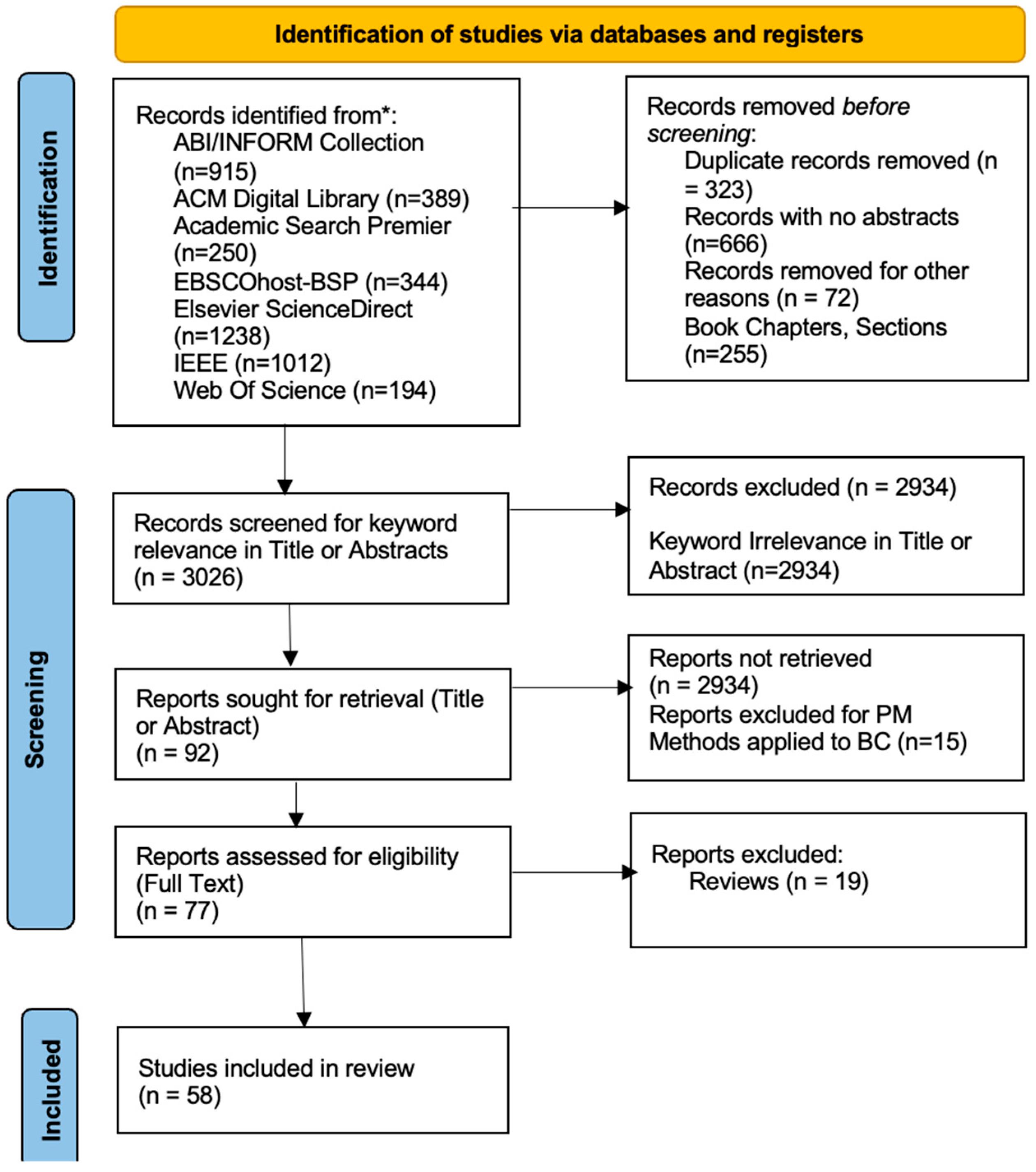
Disclaimer/Publisher’s Note: The statements, opinions and data contained in all publications are solely those of the individual author(s) and contributor(s) and not of MDPI and/or the editor(s). MDPI and/or the editor(s) disclaim responsibility for any injury to people or property resulting from any ideas, methods, instructions or products referred to in the content.

Article Metrics

Citations

Article Access Statistics

Article metric data becomes available approximately 24 hours after publication online.