Navigating the Challenges: A Commentary on Barriers to Autism Screening in Childcare Centers

 , , , , , and
Abstract
1. Lay Summary
2. Navigating the Challenges: A Commentary on Barriers to Autism Screening in Childcare Centers
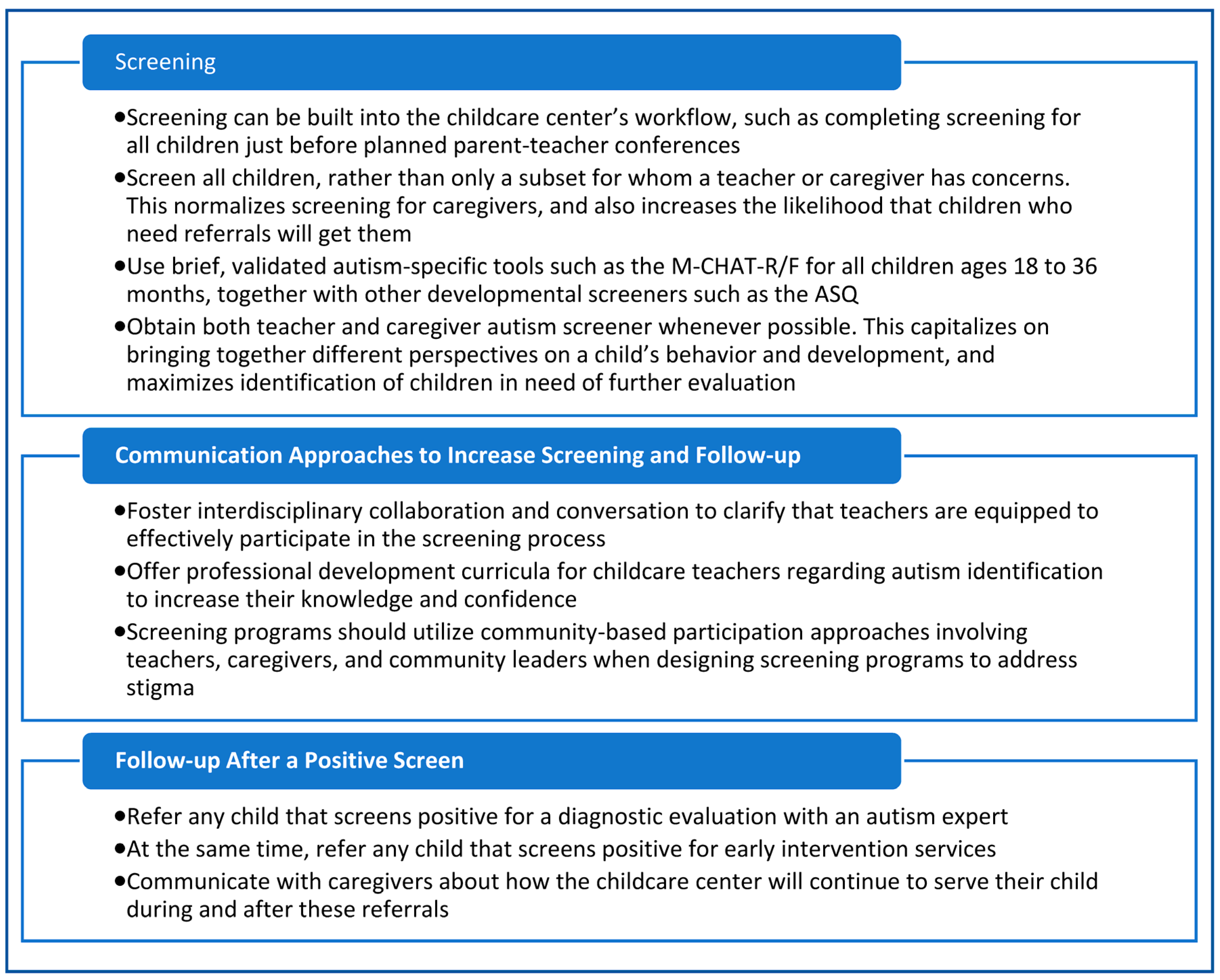
Challenges/Barriers and Suggested Strategies to Address Them
Author Contributions
Funding
Institutional Review Board Statement
Informed Consent Statement
Data Availability Statement
Acknowledgments
Conflicts of Interest
Abbreviations
| ASQ-3 | Ages & Stages Questionnaire |
| ASQ:SE:2 | Ages & Stages Questionnaire: Social Emotional |
| CBO | Community-based Organizations |
| CDC | Centers for Disease Control and Prevention |
| M-CHAT-R/F | Modified Checklist for Autism in Toddlers, Revised, with Follow-Up |
| NDBI | Naturalistic Developmental Behavioral Interventions |
| NAEYC | National Association for the Education of Young Children |
| US | United States |
References
- Branson, D., Vigil, D. C., & Bingham, A. (2008). Community childcare providers’ role in the early detection of autism spectrum disorders. Early Childhood Education Journal, 35(6), 523–530. [Google Scholar] [CrossRef]
- Campbell, D. E., Kamat, D. M., McInerny, T. K., Kelleher, K. J., & Adam, H. M. (2014). Screening: General considerations. In American academy of pediatrics textbook of pediatric care. American Academy of Pediatrics. [Google Scholar]
- Carbone, P. S., Campell, K., Wilkes, J., Stoddard, G., Huynh, K., Young, P., & Gabrielsen, T. (2020). Primary care autism screening and later autism diagnosis. Pediatrics, 146(2), e20192314. [Google Scholar] [CrossRef] [PubMed]
- Carbone, P. S., Murphy, N. A., Norlin, C., Azor, V., & Young, P. C. (2010). Parent and pediatrician perspectives regarding the primary care of children with autism spectrum disorders. Journal of Autism and Developmental Disorders, 43(4), 964–972. [Google Scholar] [CrossRef] [PubMed]
- Centers for Disease Control and Prevention. (2024). Developmental monitoring and screening. Available online: https://www.cdc.gov/act-early/about/developmental-monitoring-and-screening.html (accessed on 15 October 2025).
- Centers for Disease Control and Prevention. (2025). Learn the signs act early. Available online: https://www.cdc.gov/act-early/index.html (accessed on 30 October 2025).
- Clark, M. L. E., Vinen, Z., Barbara, J., & Dissanayake, C. (2018). School age outcomes of children diagnosed early and later with autism spectrum disorder. Journal of Autism and Developmental Disorders, 48(1), 92–102. [Google Scholar] [CrossRef]
- Dawson, G., Rogers, S., Munson, J., Smith, M., Winter, J., Greenson, J., Donaldson, A., & Varley, J. (2010). Randomized, controlled trial of an intervention for toddlers with autism: The Early Start Denver Model. Pediatrics, 125(1), e17–e23. [Google Scholar] [CrossRef]
- De Los Reyes, A., Thomas, S. A., Goodman, K. L., & Kundey, S. M. A. (2013). Principles underlying the use of multiple informants’ reports. Annual Review of Clinical Psychology, 9, 123–149. [Google Scholar] [CrossRef]
- DeLucia, E. A., Dike, J., Andrzejewski, T. M., & McDonnell, C. G. (2024). Autism screening practices in preschools and early childcare centers: A systematic review. Review Journal of Autism and Developmental Disorders, 11, 1–20. [Google Scholar] [CrossRef]
- Dereu, M., Raymaekers, R., Warreyn, P., Schietecatte, I., Meirsschaut, M., & Roeyers, H. (2012). Can childcare workers contribute to the early detection of autism spectrum disorders? A comparison between screening instruments with child care workers versus parents as informants. Journal of Autism and Developmental Disorders, 42(5), 781–796. [Google Scholar] [CrossRef]
- Dereu, M., Warreyn, P., Raymaekers, R., Meirsschaut, M., Pattyn, G., Schietecatte, I., & Roeyers, H. (2010). Screening for autism spectrum disorders in Flemish day-care centres with the checklist for early signs of developmental disorders. Journal of Autism and Developmental Disorders, 40(10), 1247–1258. [Google Scholar] [CrossRef]
- Dimian, A. F., Symons, F. J., & Wolff, J. J. (2020). Delay to early intensive behavioral intervention and educational outcomes for a medicaid-enrolled cohort of children with autism. Journal of Autism and Developmental Disorders, 51(4), 1054–1066. [Google Scholar] [CrossRef]
- Downs, S. M., Bauer, N. S., Saha, C., Ofner, S., & Carroll, A. E. (2019). Effect of a Computer-based decision support intervention on autism spectrum disorder screening in pediatric primary care clinics: A cluster randomized clinical trial. JAMA Network Open, 2(12), e1917676. [Google Scholar] [CrossRef] [PubMed]
- Early Childhood Technical Assistance Center. (2025). Screening. Available online: https://ectacenter.org/topics/earlyid/screeneval.asp (accessed on 17 October 2025).
- Frick, E., Wieckowski, A. T., Perez Liz, G., Austin, A., Nguyen, C., Robins, D. L., Koku, E., & McGhee Hassrick, E. (2024, November 14–17). Qualitative data analysis of childcare center processes around autism screening. Poster presented at the annual meeting of the Association for Behavioral and Cognitive Therapies, Philadelphia, PA, USA. [Google Scholar]
- Guinchat, V., Chamak, B., Bonniau, B., Bodeau, N., Perisse, D., Cohen, D., & Danion, A. (2012). Very early signs of autism reported by parents include many concerns not specific to autism criteria. Research in Autism Spectrum Disorders, 6(2), 589–601. [Google Scholar] [CrossRef]
- Guthrie, W., Wallis, K., Bennett, A., Brooks, E., Dudley, J., Gerdes, M., Pandey, J., Levy, S. E., Schultz, R. T., & Miller, J. S. (2019). Accuracy of autism screening in a large pediatric network. Pediatrics, 144(4), e20183963. [Google Scholar] [CrossRef]
- Guthrie, W., Wetherby, A. M., Woods, J., Schatschneider, C., Holland, R. D., Morgan, L., & Lord, C. E. (2023). The earlier the better: An RCT of treatment timing effects for toddlers on the autism spectrum. Autism, 27(8), 13623613231159153. [Google Scholar] [CrossRef]
- Hardy, S., Haisley, L., Manning, C., & Fein, D. (2015). Can screening with the ages and stages questionnaire detect autism? Journal of Developmental and Behavioral Pediatrics: JDBP, 36(7), 536–543. [Google Scholar] [CrossRef]
- Head Start. (2024–2025). Child screening and assessment. Available online: https://headstart.gov/child-screening-assessment (accessed on 17 October 2025).
- Herlihy, L., Knoch, K., Vibert, B., & Fein, D. (2015). Parents’ first concerns about toddlers with autism spectrum disorder: Effect of sibling status. Autism, 19(1), 20–28. [Google Scholar] [CrossRef]
- Herlihy, L. E., Brooks, B., Dumont-Mathieu, T., Barton, M. L., Fein, D., Chen, C. M., & Robins, D. L. (2014). Standardized screening facilitates timely diagnosis of autism spectrum disorders in a diverse sample of low-risk toddlers. Journal of Developmental and Behavioral Pediatrics, 35(2), 85. [Google Scholar] [CrossRef]
- Hyman, S. L., Levy, S. E., Myers, S. M., & Council on Children with Disabilities, Section on Developmental and Behavioral Pediatrics. (2020). Identification, evaluation, and management of children with autism spectrum disorder. Pediatrics, 145(1), e20193447. [Google Scholar] [CrossRef]
- Janvier, Y. M., Harris, J. F., Coffield, C. N., Louis, B., Xie, M., Cidav, Z., & Mandell, D. S. (2016). Screening for autism spectrum disorder in underserved communities: Early childcare providers as reporters. Autism, 20(3), 364–373. [Google Scholar] [CrossRef]
- Karp, E. A., Dudovitz, R., Nelson, B. B., Shih, W., Gulsrud, A., Orlich, F., Colombi, C., & Kuo, A. A. (2018). Family characteristics and children’s receipt of autism services in low-resourced families. Pediatrics, 141(Suppl. 4), S280–S286. [Google Scholar] [CrossRef]
- King, T. M., Tandon, S. D., Macias, M. M., Healy, J. A., Duncan, P. M., Swigonski, N. L., Skipper, S. M., & Lipkin, P. H. (2010). Implementing developmental screening and referrals: Lessons learned from a national project. Pediatrics, 125(2), 350–360. [Google Scholar] [CrossRef] [PubMed]
- Larsen, K., Aasland, A., & Diseth, T. H. (2018a). Brief report: Agreement between parents and day-care professionals on early symptoms associated with autism spectrum disorders. Journal of Autism and Developmental Disorders, 48(4), 1063–1068. [Google Scholar] [CrossRef] [PubMed]
- Larsen, K., Aasland, A., & Diseth, T. H. (2018b). Identification of symptoms of autism spectrum disorders in the second year of life at day-care centres by day-care staff: Step one in the development of a short observation list. Journal of Autism and Developmental Disorders, 48(7), 2267–2277. [Google Scholar] [CrossRef]
- Larsen, K., Aasland, A., Schjølberg, S., Hansen, U. I., & Diseth, T. H. (2020). Piloting the use of a short observation list for ASD-symptoms in day-care: Challenges and further possibilities. Journal of Autism and Developmental Disorders, 50(9), 3413–3423. [Google Scholar] [CrossRef]
- Liptak, G. S., Benzoni, L. B., Mruzek, D. W., Nolan, K. W., Thingvoll, M. A., Wade, C. M., & Fryer, G. E. (2008). Disparities in diagnosis and access to health services for children with autism: Data from the national survey of children’s health. Journal of Developmental & Behavioral Pediatrics, 29(3), 152–160. [Google Scholar]
- Lord, C., Luyster, R., Guthrie, W., & Pickles, A. (2012). Patterns of developmental trajectories in toddlers with autism spectrum disorder. Journal of Consulting and Clinical Psychology, 80(3), 477. [Google Scholar] [CrossRef]
- Mitchell, G. E., & Locke, K. D. (2015). Lay beliefs about autism spectrum disorder among the general public and childcare providers. Autism, 19(5), 553–561. [Google Scholar] [CrossRef]
- Monteiro, S. A., Dempsey, J., Berry, L. N., Voigt, R. G., & Goin-Kochel, R. P. (2019). Screening and referral practices for autism spectrum disorder in primary pediatric care. Pediatrics, 144(4), e20183326. [Google Scholar] [CrossRef]
- National Association for the Education of Young Children [NAEYC]. (2020, April). Developmentally appropriate practice: A position statement of the national association for the education of young children. Available online: https://www.naeyc.org/resources/position-statements/dap/contents (accessed on 17 October 2025).
- Office of Head Start. (2025). The administration for children and families. Available online: https://acf.gov/ohs/comms-fact-sheet/office-head-start (accessed on 30 October 2025).
- Reichow, B., Hume, K., Barton, E. E., & Boyd, B. A. (2018). Early intensive behavioral intervention (EIBI) for young children with autism spectrum disorders (ASD). The Cochrane Database of Systematic Reviews, 5(5), CD009260. [Google Scholar] [CrossRef]
- Robins, D. L., Casagrande, K., Barton, M., Chen, C. M., Dumont-Mathieu, T., & Fein, D. (2014). Validation of the modified checklist for Autism in toddlers, revised with follow-up (M-CHAT-R/F). Pediatrics, 133(1), 37–45. [Google Scholar] [CrossRef]
- Shaw, K. A., Williams, S., Patrick, M. E., Valencia-Prado, M., Durkin, M. S., Howerton, E. M., Ladd-Acosta, C. M., Pas, E. T., Bakian, A. V., Bartholomew, P., Nieves-Muñoz, N., Sidwell, K., Alford, A., Bilder, D. A., DiRienzo, M., Fitzgerald, R. T., Furnier, S. M., Hudson, A. E., Pokoski, O. M., … Maenner, M. J. (2025). Prevalence and early identification of autism spectrum disorder among children aged 4 and 8 years—Autism and developmental disabilities monitoring network, 16 sites, United States, 2022. MMWR. Surveillance Summaries, 74(2), 1–22. [Google Scholar] [CrossRef] [PubMed]
- Squires, J., Bricker, D., & Twombly, E. (2009). Ages & stages questionnaires (ASQ3): A parent-completed child-monitoring system (3rd ed.). Paul Brookes Publishing Company. [Google Scholar]
- Squires, J., Bricker, D., & Twombly, E. (2015). ASQ-SE-2 user’s guide (2nd ed.). Paul Brookes Publishing Company. [Google Scholar]
- Tomlin, A., Koch, S. M., Raches, C., Minshawi, N. F., & Swiezy, N. B. (2013). Autism screening practices among early intervention providers in Indiana. Infants & Young Children, 26, 74–88. [Google Scholar] [CrossRef]
- U.S. Census Bureau. (2023, December 21). About 1 in 5 parents relied on a relative for child care. Census.gov. Available online: https://www.census.gov/library/stories/2023/11/child-care.html (accessed on 30 October 2025).
- Uzonyi, T. E., Page, J. M., DuBay, M., & Crais, E. R. (2022). Perceptions on screening for developmental disabilities and autism in childcare settings. Infants & Young Children, 35(2), 133–149. [Google Scholar] [CrossRef]
- van’t Hof, M., Tisseur, C., van Berckelear-Onnes, I., Van Nieuwenhuyzen, A., Daniels, A. M., Deen, M., Hoek, H. W., & Ester, W. A. (2021). Age at autism spectrum disorder diagnosis: A systematic review and meta-analysis from 2012 to 2019. Autism, 25(4), 862–873. [Google Scholar] [CrossRef]
- Vivanti, G., Algur, Y., Ryan, V., McClure, L. A., Fein, D., Stahmer, A. C., Wieckowski, A. T., & Robins, D. L. (2025). The impact of using standardized autism screening on referral to specialist evaluation for young children on the autism spectrum: A cluster-randomized controlled trial. Journal of the American Academy of Child and Adolescent Psychiatry, 64(6), 686–698. [Google Scholar] [CrossRef]
- Vivanti, G., Dissanayake, C., & Victorian ASELCC Team. (2016). Outcome for children receiving the Early Start Denver Model before and after 48 months. Journal of Autism and Developmental Disorders, 46(7), 2441–2449. [Google Scholar] [CrossRef]
- Wang, C., Bovaird, S., Ford-Jones, E. L., Bender, R., Parsonage, C., Yau, M., & Ferguson, B. (2011). Vision and hearing screening in school settings: Reducing barriers to children’s achievement. Paediatrics & Child Health, 16(5), 271–272. [Google Scholar] [CrossRef]
- Wiggins, L. D., Piazza, V., & Robins, D. L. (2012). Comparison of a broad-based screen versus disorder-specific screen in detecting young children with an autism spectrum disorder. Autism, 18(2), 76–84. [Google Scholar] [CrossRef]
- Wolf, E. R., Donahue, E., Sabo, R. T., Nelson, B. B., & Krist, A. H. (2021). Barriers to attendance of prenatal and well-child visits. Academic Pediatrics, 21(6), 955–960. [Google Scholar] [CrossRef]
- Wolf, E. R., Hochheimer, C. J., Sabo, R. T., DeVoe, J., Wasserman, R., Geissal, E., Opel, D. J., Warren, N., Puro, J., O’Neil, J., Pecsok, J., & Krist, A. H. (2018). Gaps in well-child care attendance among primary care clinics serving low-income families. Pediatrics, 142(5), e20174019. [Google Scholar] [CrossRef]
- Zeidan, J., Fombonne, E., Scorah, J., Ibrahim, A., Durkin, M. S., Saxena, S., Yusuf, A., Shih, A., & Elsabbagh, M. (2022). Global prevalence of autism: A systematic review update. Autism Research: Official Journal of the International Society for Autism Research, 15(5), 778–790. [Google Scholar] [CrossRef]
- Zero to Three. (2025). Infant and toddler development, screening, and assessment. Available online: https://www.zerotothree.org/resource/infant-and-toddler-development-screening-and-assessment (accessed on 17 October 2025).
- Zuckerman, K. E., Lindly, O. J., & Sinche, B. K. (2015). Parental concerns, provider response, and timeliness of autism spectrum disorder diagnosis. The Journal of Pediatrics, 166(6), 1431–1439. [Google Scholar] [CrossRef]
- Zuckerman, K. E., Mattox, K., Donelan, K., Batbayar, O., Baghaee, A., & Bethell, C. (2013). Pediatrician identification of Latino children at risk for autism spectrum disorder. Pediatrics, 132, 445–453. [Google Scholar] [CrossRef] [PubMed Central]


| Child | Sex | Age (Months) | Positive Screener(s) | Outcome |
|---|---|---|---|---|
| 1 | F | 29 | Teacher: ASQ:SE-2 | Evaluated (TD) |
| 2 | M | 39 | Caregiver: ASQ:SE-2 | Lost to follow-up |
| 3 | M | 16 | Teacher: ASQ-3 | Lost to follow-up |
| 4 | F | 15 | Caregiver: ASQ-3 Teacher: ASQ-3 | Lost to follow-up |
| 5 | F | 27 | -- | No evaluation needed |
| 6 | F | 38 | -- | No evaluation needed |
| 7 | M | 26 | -- | No evaluation needed |
| 8 | M | 35 | Teacher: ASQ-3 | Evaluated (Unspecified Communication Disorder) |
| 9 | M | 36 | Caregiver: M-CHAT-R/F, ASQ:SE-2, ASQ-3 Teacher: M-CHAT-R/F, ASQ:SE-2, ASQ-3 | Evaluated (ASD) |
| 10 | F | 31 | -- | No evaluation needed |
| 11 | F | 17 | -- | No evaluation needed |
| 12 | F | 41 | -- | No evaluation needed |
| 13 | F | 34 | Caregiver: M-CHAT-R/F, ASQ:SE-2, ASQ-3 | Evaluated (ASD) |
| 14 | M | 22 | -- | No evaluation needed |
| 15 | F | 22 | -- | No evaluation needed |
Disclaimer/Publisher’s Note: The statements, opinions and data contained in all publications are solely those of the individual author(s) and contributor(s) and not of MDPI and/or the editor(s). MDPI and/or the editor(s) disclaim responsibility for any injury to people or property resulting from any ideas, methods, instructions or products referred to in the content. |
© 2026 by the authors. Licensee MDPI, Basel, Switzerland. This article is an open access article distributed under the terms and conditions of the Creative Commons Attribution (CC BY) license.
Share and Cite
Wieckowski, A.T.; Perez Liz, G.; McGhee Hassrick, E.; Koku, E.; Frick, E.; Austin, A.; Robins, D.L. Navigating the Challenges: A Commentary on Barriers to Autism Screening in Childcare Centers. Behav. Sci. 2026, 16, 79. https://doi.org/10.3390/bs16010079
Wieckowski AT, Perez Liz G, McGhee Hassrick E, Koku E, Frick E, Austin A, Robins DL. Navigating the Challenges: A Commentary on Barriers to Autism Screening in Childcare Centers. Behavioral Sciences. 2026; 16(1):79. https://doi.org/10.3390/bs16010079
Chicago/Turabian StyleWieckowski, Andrea Trubanova, Georgina Perez Liz, Elizabeth McGhee Hassrick, Emmanuel Koku, Erika Frick, Autumn Austin, and Diana L. Robins. 2026. "Navigating the Challenges: A Commentary on Barriers to Autism Screening in Childcare Centers" Behavioral Sciences 16, no. 1: 79. https://doi.org/10.3390/bs16010079
APA StyleWieckowski, A. T., Perez Liz, G., McGhee Hassrick, E., Koku, E., Frick, E., Austin, A., & Robins, D. L. (2026). Navigating the Challenges: A Commentary on Barriers to Autism Screening in Childcare Centers. Behavioral Sciences, 16(1), 79. https://doi.org/10.3390/bs16010079