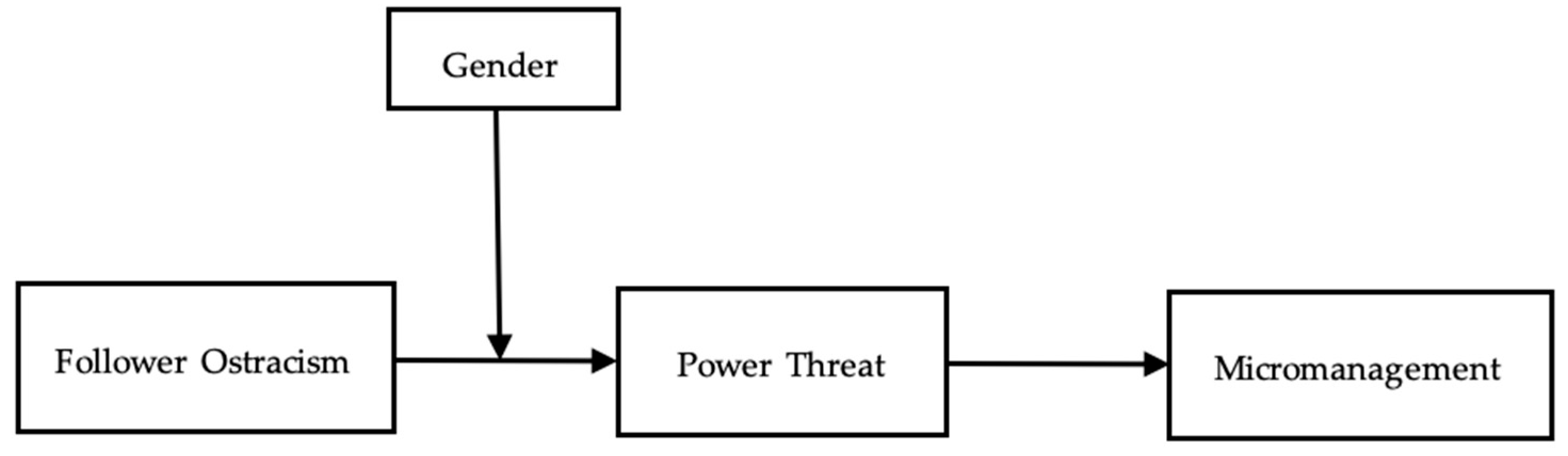
Follower Ostracism and Micromanagement Leadership: The Roles of Power Threat and Gender


Abstract
1. Introduction
2. Literature Review and Hypothesis Development
2.1. The Relationship Between Follower Ostracism and Leader Micromanagement
2.2. The Mediating Effect of Power Threat on the Relationship Between Follower Ostracism and Leader Micromanagement
2.3. The Moderating Effect of Leader Gender
3. Methods
3.1. Participants and Procedure
3.2. Measures
3.2.1. Time 1
3.2.2. Time 2
3.2.3. Control Variables
4. Results
4.1. Confirmatory Factor Analysis
4.2. Hypothesis Testing
5. Discussion
5.1. Theoretical Contributions
5.2. Practical Contributions
5.3. Limitations and Future Research
6. Conclusions
Author Contributions
Funding
Institutional Review Board Statement
Informed Consent Statement
Data Availability Statement
Conflicts of Interest
Appendix A
| Follower Ostracism Items Indicate the extent to which the following statements applied to you at the workplace |
| 1 = Never 7 = Always |
| 1. My employees ignored me at work. |
| 2. My employees left the area when I entered. |
| 3. My greetings have gone unanswered by employees at work. |
| 4. I involuntarily sat alone in a crowded lunchroom at work. |
| 5. My employees avoided me at work. |
| 6. I noticed my employees would not look at me at work. |
| 7. My employees at work shut me out of the conversation. |
| 8. My employees refused to talk to me at work. |
| 9. My employees at work treated me as if I were not there. |
| 10. My employees did not invite me or ask me if I wanted anything when they went out for a coffee break. |
| Power Threat Items |
| Indicate the extent to which the following statements applied to you at the workplace |
| 1 = strongly disagree 7 = strongly agree |
| 1. I sometimes fear that my leadership will be undermined by my subordinates. |
| 2. I sometimes feel that some of my subordinates are striving for my positions. |
| 3. I am sometimes apprehensive about my subordinates resisting my directives. |
| Micromanagement Items |
| Indicate the extent to which the following statements applied to you at the workplace in the past 2 weeks |
| 1 = strongly disagree 5 = strongly agree |
| 1. In the past 2 weeks, I checked on if things are done by methods dictated by me. |
| 2. In the past 2 weeks, I monitored even the routine activities constantly. |
| 3. In the past 2 weeks, I required frequent and unnecessary status reports. |
| 4. In the past 2 weeks, I felt dissatisfied with acting without consulting me. |
| 5. In the past 2 weeks, I had the worry that the subordinates will leave me in the background. |
| 6. In the past 2 weeks, I made the subordinates feel that they were always being monitored. |
References
- Allcorn, S. (2022). Micromanagement in the workplace. Organizational and Social Dynamics, 22(1), 83–98. [Google Scholar] [CrossRef]
- Bedi, A. (2019). No herd for black sheep: A meta-analytic review of the predictors and outcomes of workplace ostracism. Applied Psychology, 70(2), 861–890. [Google Scholar] [CrossRef]
- Benenson, J. F., Markovits, H., Hultgren, B., Nguyen, T., Bullock, G., & Wrangham, R. (2013). Social exclusion: More important to human females than to males. PLoS ONE, 8(2), e55851. [Google Scholar] [CrossRef] [PubMed]
- Bernerth, J. B., Cole, M. S., Taylor, E. C., & Walker, H. J. (2018). Control variables in leadership research: A qualitative and quantitative review. Journal of Management, 44(1), 131–160. [Google Scholar]
- Biron, M., & Bamberger, P. A. (2011). More than lip service: Linking the intensity of empowerment initiatives to individual well-being and performance. The International Journal of Human Resource Management, 22(2), 258–278. [Google Scholar] [CrossRef]
- Cappelli, P., Bonet, R., & Hamori, M. (2023). The changing ranks of corporate leaders. California Management Review, 66(2), 5–29. [Google Scholar] [CrossRef]
- Carli, L. L. (1999). Gender, interpersonal power, and social influence. Journal of Social Issues, 55(1), 81–99. [Google Scholar] [CrossRef]
- Chan, D. (2009). So why ask me? Are self-report data really that bad? In C. E. Lance, & R. J. Vandenberg (Eds.), Statistical and methodological myths and urban legends: Doctrine, verity and fable in the organizational and social sciences (pp. 309–336). Routledge. [Google Scholar]
- Chatterjee, S., Chaudhuri, R., Thrassou, A., & Vrontis, D. (2021). Antecedents and consequences of knowledge hiding: The moderating role of knowledge hiders and knowledge seekers in organizations. Journal of Business Research, 128, 303–313. [Google Scholar] [CrossRef]
- Cleary, M., Hungerford, C., Lopez, V., & Cutcliffe, J. R. (2015). Towards effective management in psychiatric-mental health nursing: The dangers and consequences of micromanagement. Mental Health Nursing, 36(6), 424–429. [Google Scholar] [CrossRef]
- Dirik, D. (2021). Leader power bases and perceived leader effectiveness: Conservation of gender stereotypes. Current Psychology, 40(12), 6175–6186. [Google Scholar] [CrossRef]
- Eagly, A. H., & Karau, S. J. (2002). Role congruity theory of prejudice toward female leaders. Psychological Review, 109(3), 573. [Google Scholar] [CrossRef]
- Eagly, A. H., Makhijani, M. G., & Klonsky, B. G. (1992). Gender and the evaluation of leaders: A meta-analysis. Psychological Bulletin, 111(1), 3–22. [Google Scholar]
- Einarsen, S. V., Hoel, H., Zapf, D., & Cooper, C. L. (2020). The concept of bullying and harassment at work: The European tradition. In S. V. Einarsen, H. Hoel, D. Zapf, & C. L. Cooper (Eds.), Bullying and harassment in the workplace: Theory, research and practice (pp. 3–53). CRC Press. [Google Scholar]
- Emerson, R. M. (1962). Power-dependence relations. American Sociological Review, 27, 31–41. [Google Scholar] [CrossRef]
- Erickson, A., Shaw, B., Murray, J., & Branch, S. (2015). Destructive leadership: Causes, consequences and countermeasures. Organizational Dynamics, 44(4), 266–272. [Google Scholar] [CrossRef]
- Fast, N. J., & Chen, S. (2009). When the boss feels inadequate: Power, incompetence, and aggression. Psychological Science, 20(11), 1406–1413. [Google Scholar] [CrossRef]
- Ferris, D. L., Brown, D. J., Berry, J. W., & Lian, H. (2008). The development and validation of the workplace ostracism scale. Journal of Applied Psychology, 93(6), 1348–1366. [Google Scholar] [CrossRef]
- Ferris, D. L., Chen, M., & Lim, S. (2017). Comparing and contrasting workplace ostracism and incivility. Annual Review of Organizational Psychology and Organizational Behavior, 4(1), 315–338. [Google Scholar] [CrossRef]
- Flinchum, J. R., Kreamer, L. M., Rogelberg, S. G., & Gooty, J. (2022). One-on-one meetings between managers and direct reports: A new opportunity for meeting science. Organizational Psychology Review, 13(4), 478–505. [Google Scholar] [CrossRef]
- Fornell, C., & Larcker, D. F. (1981). Evaluating structural equation models with unobservable variables and measurement error. Journal of Marketing Research, 18(1), 39. [Google Scholar] [CrossRef]
- Goodwin, R. D., Dodson, S. J., Chen, J. M., & Diekmann, K. A. (2020). Gender, sense of power, and desire to lead: Why women don’t “lean in” to apply to leadership groups that are majority male. Psychology of Women Quarterly, 44(4), 468–487. [Google Scholar] [CrossRef]
- Gordon, R. (2011). Leadership and power. In A. Bryman, D. L. Collinson, K. Grint, B. Jackson, & M. Uhl-Bien (Eds.), The Sage handbook of leadership (pp. 195–202). SAGE. [Google Scholar]
- Graen, G. B., & Uhl-Bien, M. (1995). Relationship-based approach to leadership: Development of leader-member exchange (LMX) theory of leadership over 25 years: Applying a multi-level multi-domain perspective. The Leadership Quarterly, 6(2), 219–247. [Google Scholar] [CrossRef]
- Hawkley, L. C., Williams, K. D., & Cacioppo, J. T. (2011). Responses to ostracism across adulthood. Social Cognitive and Affective Neuroscience, 6(2), 234–243. [Google Scholar] [CrossRef]
- Hayes, A. F. (2017). Introduction to mediation, moderation, and conditional process analysis: A regression-based approach. Guilford Press. [Google Scholar]
- Howard, M. C., Cogswell, J. E., & Smith, M. B. (2020). The antecedents and outcomes of workplace ostracism: A meta-analysis. Journal of Applied Psychology, 105(6), 577. [Google Scholar]
- Hu, Y., Chen, Y., & Ye, M. (2023). Eager to belong: Social cyberloafing as a coping response to workplace ostracism. Current Psychology, 42(4), 3372–3381. [Google Scholar]
- Jahanzeb, S., Fatima, T., & Malik, M. A. R. (2018). Supervisor ostracism and defensive silence: A differential needs approach. European Journal of Work and Organizational Psychology, 27(4), 430–440. [Google Scholar] [CrossRef]
- Krasikova, D. V., Green, S. G., & LeBreton, J. M. (2013). Destructive leadership: A theoretical review, integration, and future research agenda. Journal of Management, 39(5), 1308–1338. [Google Scholar] [CrossRef]
- Li, P., Yin, K., Shi, J., Damen, T. G., & Taris, T. W. (2024). Are bad leaders indeed bad for employees? A meta-analysis of longitudinal studies between destructive leadership and employee outcomes. Journal of Business Ethics, 191(2), 399–413. [Google Scholar] [CrossRef]
- Lian, H., Ferris, D. L., & Brown, D. J. (2012). Does taking the good with the bad make things worse? How abusive supervision and leader–member exchange interact to impact need satisfaction and organizational deviance. Organizational Behavior and Human Decision Processes, 117(1), 41–52. [Google Scholar] [CrossRef]
- Liang, L. H., Brown, D. J., Ferris, D. L., Hanig, S., Lian, H., & Keeping, L. M. (2018). The dimensions and mechanisms of mindfulness in regulating aggressive behaviors. Journal of Applied Psychology, 103(3), 281. [Google Scholar] [CrossRef]
- Liang, L. H., Coulombe, C., Brown, D. J., Lian, H., Hanig, S., Ferris, D. L., & Keeping, L. M. (2022). Can two wrongs make a right? The buffering effect of retaliation on subordinate well-being following abusive supervision. Journal of Occupational Health Psychology, 27(1), 37. [Google Scholar] [CrossRef]
- Limon, İ., & Dilekçi, Ü. (2021). Development and initial validation of micromanagement scale for school principals. Participatory Educational Research, 8(1), 123–140. [Google Scholar] [CrossRef]
- Lin, W., Wang, L., & Chen, S. (2013). Abusive supervision and employee well-being: The moderating effect of power distance orientation. Applied Psychology, 62(2), 308–329. [Google Scholar] [CrossRef]
- Litano, M. L., & Major, D. A. (2016). Facilitating a whole-life approach to career development: The role of organizational leadership. Journal of Career Development, 43(1), 52–65. [Google Scholar] [CrossRef]
- Liu, C. (2019). Ostracism, attributions, and their relationships with international students’ and employees’ outcomes: The moderating effect of perceived harming intent. Journal of Occupational Health Psychology, 24(5), 556–571. [Google Scholar] [CrossRef]
- Liu, C., Li, H., & Li, L. (2022). Examining the curvilinear relationship of job performance, supervisor ostracism, and turnover intentions. Journal of Vocational Behavior, 138, 103787. [Google Scholar] [CrossRef]
- Liu, C., Li, L., Li, H., Bruk-Lee, V., Ma, J., & Liu, Y. (2023). Supervisor–employee task conflict and supervisor ostracism: The moderating effect of interpersonal harmony values. Applied Psychology, 72(3), 971–997. [Google Scholar] [CrossRef]
- Liu, C., Peng, Y., Xu, S., & Azeem, M. U. (2024). Proactive employees perceive coworker ostracism: The moderating effect of team envy and the behavioral outcome of production deviance. Journal of Occupational Health Psychology, 29(6), 445–459. [Google Scholar] [CrossRef] [PubMed]
- Loh, M. Y., & Dollard, M. F. (2024). Acting out when psychosocial safety climate is low: Understanding why middle-level managers experience upward mistreatment. Frontiers in Psychology, 15, 1336130. [Google Scholar] [CrossRef] [PubMed]
- Lundmark, R. (2023). A power-sharing perspective on employees’ participatory influence over organizational interventions: Conceptual explorations. Frontiers in Psychology, 14, 1185735. [Google Scholar] [CrossRef]
- Lunenburg, F. C. (2012). Power and leadership: An influence process. International Journal of Management, Business, and Administration, 15(1), 1–9. [Google Scholar]
- Mackey, J. D., Ellen, B. P., III, McAllister, C. P., & Alexander, K. C. (2021). The dark side of leadership: A systematic literature review and meta-analysis of destructive leadership research. Journal of Business Research, 132, 705–718. [Google Scholar] [CrossRef]
- Maner, J. K., & Mead, N. L. (2010). The essential tension between leadership and power: When leaders sacrifice group goals for the sake of self-interest. Journal of Personality and Social Psychology, 99(3), 482. [Google Scholar]
- Mead, N. L., & Maner, J. K. (2012). On keeping your enemies close: Powerful leaders seek proximity to ingroup power threats. Journal of Personality and Social Psychology, 102(3), 576. [Google Scholar] [CrossRef]
- Mishra, N., Rajkumar, M., & Mishra, R. (2019). Micromanagement: An employer’s perspective. International Journal of Scientific & Technology Research, 8(10), 2949–2952. [Google Scholar]
- Mostafa, A. M. S., Wu, C. H., Yunus, S., Deng, H., & Zaharie, M. (2025). Perceived abusive supervision and service performance: An attachment theory perspective. Human Performance, 38(2), 81–106. [Google Scholar] [CrossRef]
- Munduate, L., & Medina, F. (2004). Power, authority, and leadership. Encyclopedia of Applied Psychology, 10, 91–99. [Google Scholar]
- Ndidi, A. M., Amah, E., & Okocha, B. F. (2022). Micromanaging behaviour and employee productivity in SMEs in Rivers State. International Journal of Research and Innovation in Social Science, 6(4), 745–755. [Google Scholar] [CrossRef]
- Neall, A. M., & Tuckey, M. R. (2014). A methodological review of research on the antecedents and consequences of workplace harassment. Journal of Occupational and Organizational Psychology, 87(2), 225–257. [Google Scholar] [CrossRef]
- Noor, S., & Abbas, M. (2024). Workplace ostracism and employees’ affective commitment: Testing the role of resource depletion and psychological safety. Cogent Business & Management, 11(1), 2331087. [Google Scholar] [CrossRef]
- O’Reilly, J., Robinson, S. L., Berdahl, J. L., & Banki, S. (2015). Is negative attention better than no attention? The comparative effects of ostracism and harassment at work. Organization Science, 26(3), 774–793. [Google Scholar] [CrossRef]
- Podsakoff, P. M., MacKenzie, S. B., Lee, J. Y., & Podsakoff, N. P. (2003). Common method biases in behavioral research: A critical review of the literature and recommended remedies. Journal of Applied Psychology, 88(5), 879–903. [Google Scholar] [CrossRef]
- Poornima, M. (2017). A study on effect of micromanagement towards BPO employees. International Journal of Applied Research, 3(11), 89–93. [Google Scholar]
- Preacher, K. J., & Hayes, A. F. (2008). Asymptotic and resampling strategies for assessing and comparing indirect effects in multiple mediator models. Behavior Research Methods, 40, 879–891. [Google Scholar] [CrossRef]
- Raj, G., Jayson, J., Deshpande, P., & Sood, N. (2025). The role of journaling in enhancing workplace productivity, emotional well-being, and team dynamics. Public Administration and Law Review, 3(23), 80–90. [Google Scholar] [CrossRef]
- Ren, D., Wesselmann, E. D., & Williams, K. D. (2018). Hurt people hurt people: Ostracism and aggression. Current Opinion in Psychology, 19, 34–38. [Google Scholar] [CrossRef]
- Robinson, S. L., O’Reilly, J., & Wang, W. (2013). Invisible at work: An integrated model of workplace ostracism. Journal of Management, 39(1), 203–231. [Google Scholar]
- Rospenda, K. M., & Richman, J. A. (2004). The factor structure of generalized workplace harassment. Violence and Victims, 19(2), 221–238. [Google Scholar] [CrossRef]
- Rus, D., Sleebos, E., & Wisse, B. (2025). Fear is the path to the dark side: The interplay of leader fear of power loss and leader Machiavellianism on abusive supervision. Journal of Managerial Psychology. [Google Scholar] [CrossRef]
- Schein, V. E., Mueller, R., Lituchy, T., & Liu, J. (1996). Think manager-think male: A global phenomenon? Journal of Organizational Behavior, 17(1), 33–41. [Google Scholar]
- Schmid, E. A., Pircher Verdorfer, A., & Peus, C. V. (2018). Different shades-different effects? Consequences of different types of destructive leadership. Frontiers in Psychology, 9, 1289. [Google Scholar]
- Schwartz, S. (2006). A theory of cultural value orientations: Explication and applications. Comparative Sociology, 5(23), 137–182. [Google Scholar] [CrossRef]
- Schyns, B., & Schilling, J. (2013). How bad are the effects of bad leaders? A meta-analysis of destructive leadership and its outcomes. The Leadership Quarterly, 24(1), 138–158. [Google Scholar] [CrossRef]
- Shamspour, H. R., Kamali, M., & Narouei, B. (2024). Impact of micromanagement on organizational commitment through mediating role of job stress, moderating effect of hostile attribution bias. International Journal of Business and Management Sciences, 5(3), 56–77. [Google Scholar]
- Shih, F. C., Yeh, S. C. J., & Hsu, W. L. (2023). Abusive supervision and employee well-being of nursing staff: Mediating role of occupational stress. Journal of Advanced Nursing, 79(2), 664–675. [Google Scholar]
- Sinaga, B. A. (2025). The effect of micromanage leadership style on Generation Z workers: Self-efficacy as a mediation of job satisfaction. Multidisciplinary Indonesian Center Journal, 2(2), 1454–1466. [Google Scholar] [CrossRef]
- Spector, P. E., & Brannick, M. T. (2011). Methodological urban legends: The misuse of statistical control variables. Organizational Research Methods, 14(2), 287–305. [Google Scholar] [CrossRef]
- Sturm, R. E., Herz, H., & Antonakis, J. (2021). The science of leader power. The Leadership Quarterly, 32(4), 101550. [Google Scholar] [CrossRef]
- Tavanti, M. (2011). Managing toxic leaders: Dysfunctional patterns in organizational leadership and how to deal with them. Human Resource Management, 6, 127–136. [Google Scholar]
- Tuckey, M. R., Oppert, M., Neall, A. M., Li, Y., & Selby, H. (2024). Exploring the enablers, motivators, and triggers of upwards bullying. Work & Stress, 38(3), 321–347. [Google Scholar] [CrossRef]
- Vahle-Hinz, T. (2019). Little things matter: A daily diary study of the within-person relationship between workplace incivility and work-related rumination. Industrial Health, 57(6), 676–690. [Google Scholar]
- Vance, C. M., Ensher, E. A., Hendricks, F. M., & Harris, C. (2004). Gender-based vicarious sensitivity to disempowering behavior in organizations: Exploring an expanded concept of hostile working environment. Employee Responsibilities and Rights Journal, 16, 135–147. [Google Scholar] [CrossRef]
- Wang, H., Chen, X., Wang, H., & Xie, M. (2022). Employee innovative behavior and workplace wellbeing: Leader support for innovation and coworker ostracism as mediators. Frontiers in Psychology, 13, 1014195. [Google Scholar] [CrossRef]
- Warburton, W. A., Williams, K. D., & Cairns, D. R. (2006). When ostracism leads to aggression: The moderating effects of control deprivation. Journal of Experimental Social Psychology, 42(2), 213–220. [Google Scholar] [CrossRef]
- Weik, U., Maroof, P., Zöller, C., & Deinzer, R. (2010). Pre-experience of social exclusion suppresses cortisol response to psychosocial stress in women but not in men. Hormones and Behavior, 58(5), 891–897. [Google Scholar] [CrossRef]
- Wesselmann, E. D., Ren, D., & Williams, K. D. (2017). Ostracism and aggression. In B. J. Bushman (Ed.), Aggression and violence: A social psychological perspective (pp. 155–168). Routledge. [Google Scholar]
- Williams, K. D. (2007). Ostracism: The kiss of social death. Social and Personality Psychology Compass, 1(1), 236–247. [Google Scholar] [CrossRef]
- Williams, K. D. (2009). Ostracism: A temporal need-threat model. Advances in Experimental Social Psychology, 41, 275–314. [Google Scholar]
- Wisse, B., Rus, D., Keller, A. C., & Sleebos, E. (2019). “Fear of losing power corrupts those who wield it”: The combined effects of leader fear of losing power and competitive climate on leader self-serving behavior. European Journal of Work and Organizational Psychology, 28(6), 742–755. [Google Scholar] [CrossRef]
- Wu, L., Long, A., Hu, C., & Xu, Y. (2023). An identity threat perspective on why and when employee voice brings abusive supervision. Frontiers in Psychology, 14, 1133480. [Google Scholar] [CrossRef]
- Yang, T., Jiang, X., & Cheng, H. (2022). Employee recognition, task performance, and OCB: Mediated and moderated by pride. Sustainability, 14(3), 1631. [Google Scholar] [CrossRef]
- Ye, Y., Wu, L. Z., Kwan, H. K., & Liu, X. (2025). From deception to rejection: Unraveling the impact of workplace cheating behavior on coworker ostracism. Journal of Business Ethics, 200(1), 157–173. [Google Scholar] [CrossRef]
- Yukl, G. (1989). Managerial leadership: A review of theory and research. Journal of Management, 15(2), 251–289. [Google Scholar] [CrossRef]
- Zhang, Y., & Bednall, T. C. (2016). Antecedents of abusive supervision: A meta-analytic review. Journal of Business Ethics, 139(3), 455–471. [Google Scholar] [CrossRef]
- Zhou, Z. E., Che, X., & Rainone, N. A. (2021). Workplace ostracism and employee prosocial and antisocial organizational behaviors. In C. Liu, & J. Ma (Eds.), Workplace ostracism: Its nature, antecedents, and consequences (pp. 133–157). Palgrave Macmillan. [Google Scholar]
- Zimmerman, C. A., Carter-Sowell, A. R., & Xu, X. (2016). Examining workplace ostracism experiences in academia: Understanding how differences in the faculty ranks influence inclusive climates on campus. Frontiers in Psychology, 7, 753. [Google Scholar] [CrossRef] [PubMed]

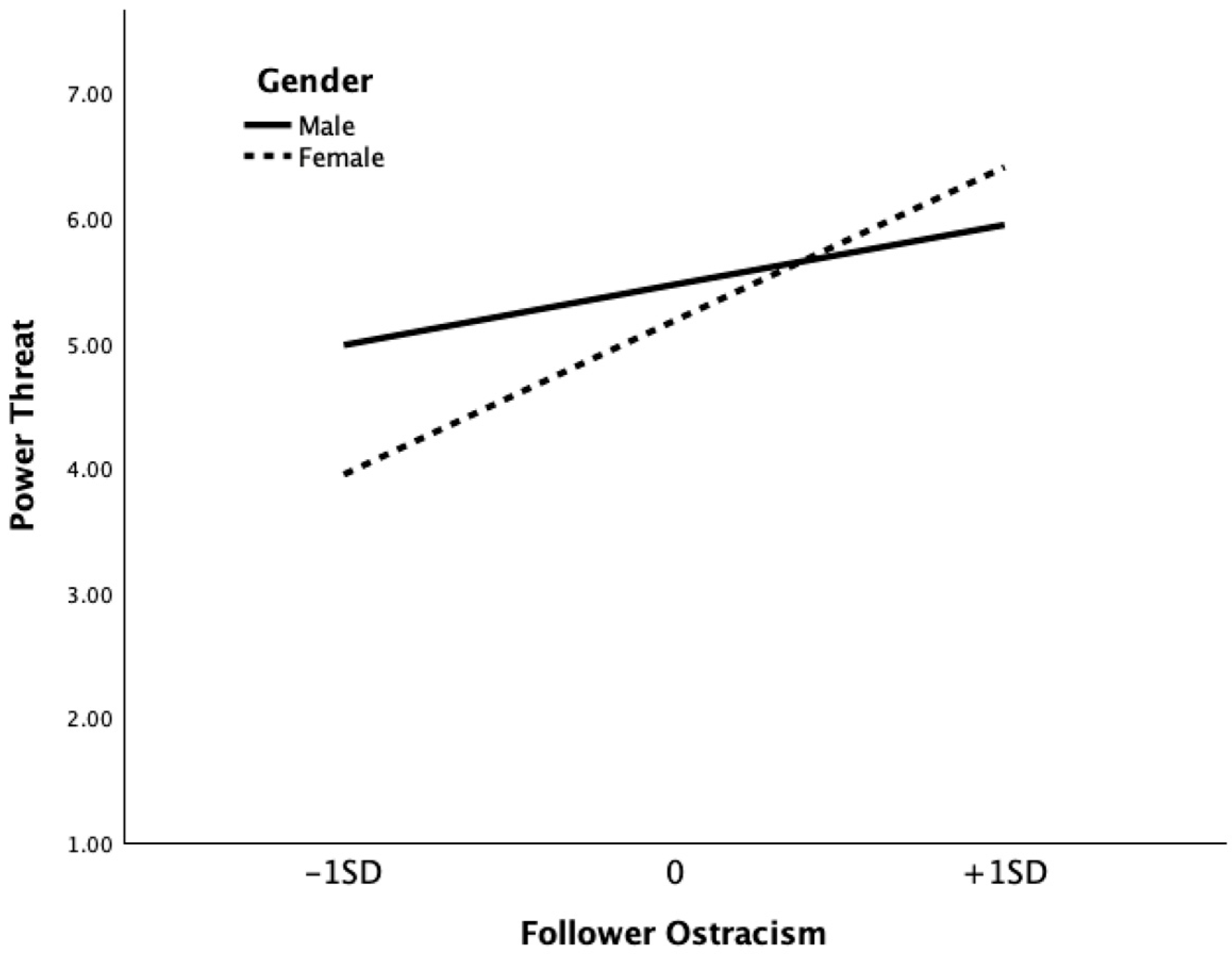

| Factor Model | χ2/df | p | CFI | TLI | RMSEA | SRMR | Δχ2/Δdf |
|---|---|---|---|---|---|---|---|
| Three-factor model | 213.87/129 | <0.001 | 0.94 | 0.93 | 0.05 | 0.05 | -- |
| Two-factor model | 255.85/131 | <0.001 | 0.92 | 0.90 | 0.08 | 0.07 | 41.98 ***/2 |
| One-factor model | 333.09/132 | <0.001 | 0.87 | 0.85 | 0.11 | 0.09 | 77.24 ***/1 |
| Mean | SD | 1 | 2 | 3 | 4 | 5 | 6 | 7 | |
|---|---|---|---|---|---|---|---|---|---|
| 1. Gender | 1.26 | 0.44 | - | 0.08 | 0.02 | −0.11 | 0.04 | −0.09 | −0.00 |
| 2. Age (years) | 32.15 | 7.86 | 0.08 | - | 0.23 ** | 0.02 | −0.16 | −0.10 | −0.07 |
| 3. Tenure (years) | 6.25 | 6.61 | 0.02 | 0.23 ** | - | 0.05 | 0.02 | 0.01 | 0.03 |
| 4. Managerial position (years) | 1.85 | 0.65 | −0.11 | 0.02 | 0.05 | - | −0.10 | −0.05 | −0.11 |
| 5. Follower ostracism | 4.86 | 1.42 | 0.04 | −0.16 | 0.02 | −0.10 | (0.96) | 0.61 *** | 0.40 *** |
| 6. Power threat | 5.40 | 1.04 | −0.09 | −0.10 | 0.01 | −0.05 | 0.61 *** | (0.80) | 0.54 *** |
| 7. Micromanagement | 3.82 | 0.61 | −0.00 | −0.07 | 0.03 | −0.11 | 0.40 *** | 0.54 *** | (0.73) |
| Power Threat | Micromanagement | |||
|---|---|---|---|---|
| b (SE) | b (SE) | b (SE) | b (SE) | |
| FO | 0.44 *** (0.05) | 0.26 *** (0.17) | 0.17 *** (0.03) | |
| PT | 0.32 *** (0.04) | |||
| Gender | 0.65 *** (0.07) | |||
| FO × Gender | 0.66 *** (0.14) | |||
| 0.36 | 0.48 | 0.16 | 0.29 | |
| F | 76.21 *** | 40.39 *** | 25.37 *** | 56.23 *** |
| Power Threat | ||
|---|---|---|
| Effect Estimates | 95%CI | |
| Direct effect | 0.05 (0.04) | [−0.03, 0.13] |
| Indirect effect | 0.12 (0.04) | [0.03, 0.20] |
| Gender | ||
| Male | 0.09 (0.04) | [0.02, 0.18] |
| Female | 0.24 (0.06) | [0.09, 0.35] |
| Index of moderated mediation | 0.15 (0.05) | [0.05, 0.24] |
Disclaimer/Publisher’s Note: The statements, opinions and data contained in all publications are solely those of the individual author(s) and contributor(s) and not of MDPI and/or the editor(s). MDPI and/or the editor(s) disclaim responsibility for any injury to people or property resulting from any ideas, methods, instructions or products referred to in the content. |
© 2025 by the authors. Licensee MDPI, Basel, Switzerland. This article is an open access article distributed under the terms and conditions of the Creative Commons Attribution (CC BY) license.
Share and Cite
Phung, V.; Liu, C.; Luo, Z. Follower Ostracism and Micromanagement Leadership: The Roles of Power Threat and Gender. Behav. Sci. 2026, 16, 35. https://doi.org/10.3390/bs16010035
Phung V, Liu C, Luo Z. Follower Ostracism and Micromanagement Leadership: The Roles of Power Threat and Gender. Behavioral Sciences. 2026; 16(1):35. https://doi.org/10.3390/bs16010035
Chicago/Turabian StylePhung, Vi, Cong Liu, and Zhi Luo. 2026. "Follower Ostracism and Micromanagement Leadership: The Roles of Power Threat and Gender" Behavioral Sciences 16, no. 1: 35. https://doi.org/10.3390/bs16010035
APA StylePhung, V., Liu, C., & Luo, Z. (2026). Follower Ostracism and Micromanagement Leadership: The Roles of Power Threat and Gender. Behavioral Sciences, 16(1), 35. https://doi.org/10.3390/bs16010035