


Income Inequality and Self-Serving Belief in Burden-Sharing: An Experimental Study


Abstract
1. Introduction
2. Experiment 1
2.1. Method
2.1.1. Participants
2.1.2. Design
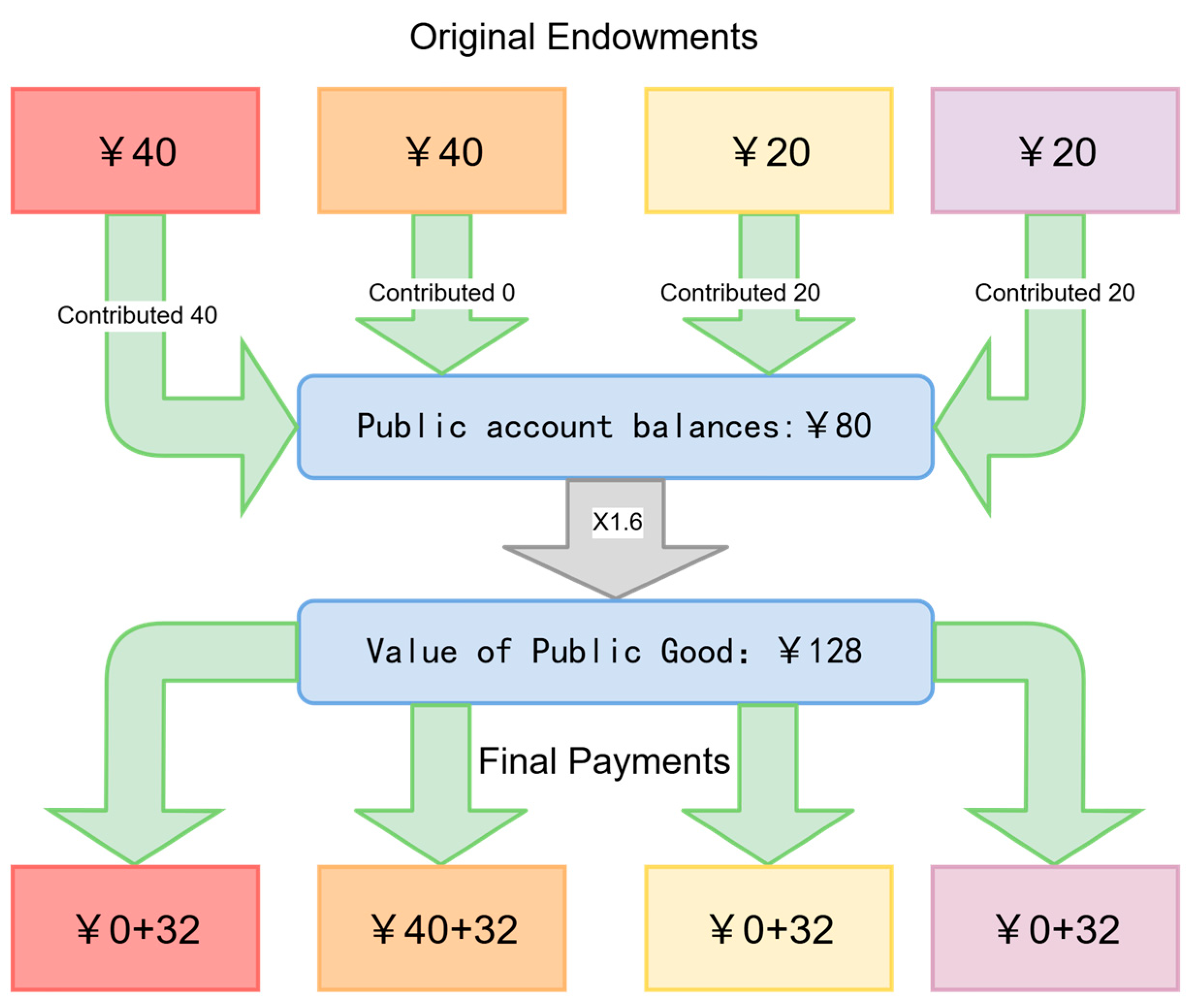
- High-endowment scenario (n = 182): Participants were explicitly told to imagine they were assigned to a public goods game scenario with an initial endowment of 40 tokens (e.g., Member 1 in the lab experiment).
- Low-endowment scenario (n = 183): Participants were explicitly told to imagine they were assigned to a public goods game scenario with an initial endowment of 20 tokens (e.g., Member 3 in the lab experiment).
- Baseline scenario (control group, n = 185): Participants were informed about the general structure and endowment heterogeneity (40 vs. 20 tokens) of the public goods game but were not assigned to any specific role or endowment level for themselves. This group served as a neutral benchmark to assess general normative beliefs in the absence of a hypothetical high- or low-endowment experience.
2.1.3. Materials
- Hypothetical Public Goods Game Scenario
- Measures
- Allocation behavior: As an involved allocator, participants were asked to hypothetically specify the exact contribution amount (0 to full endowment) for each of the four group members by entering the amount each member should contribute into clearly labeled fields (“Member 1,” “Member 2,” “Member 3,” and “Member 4”). This measure captured participants’ preferred distribution of contributions given the endowment.
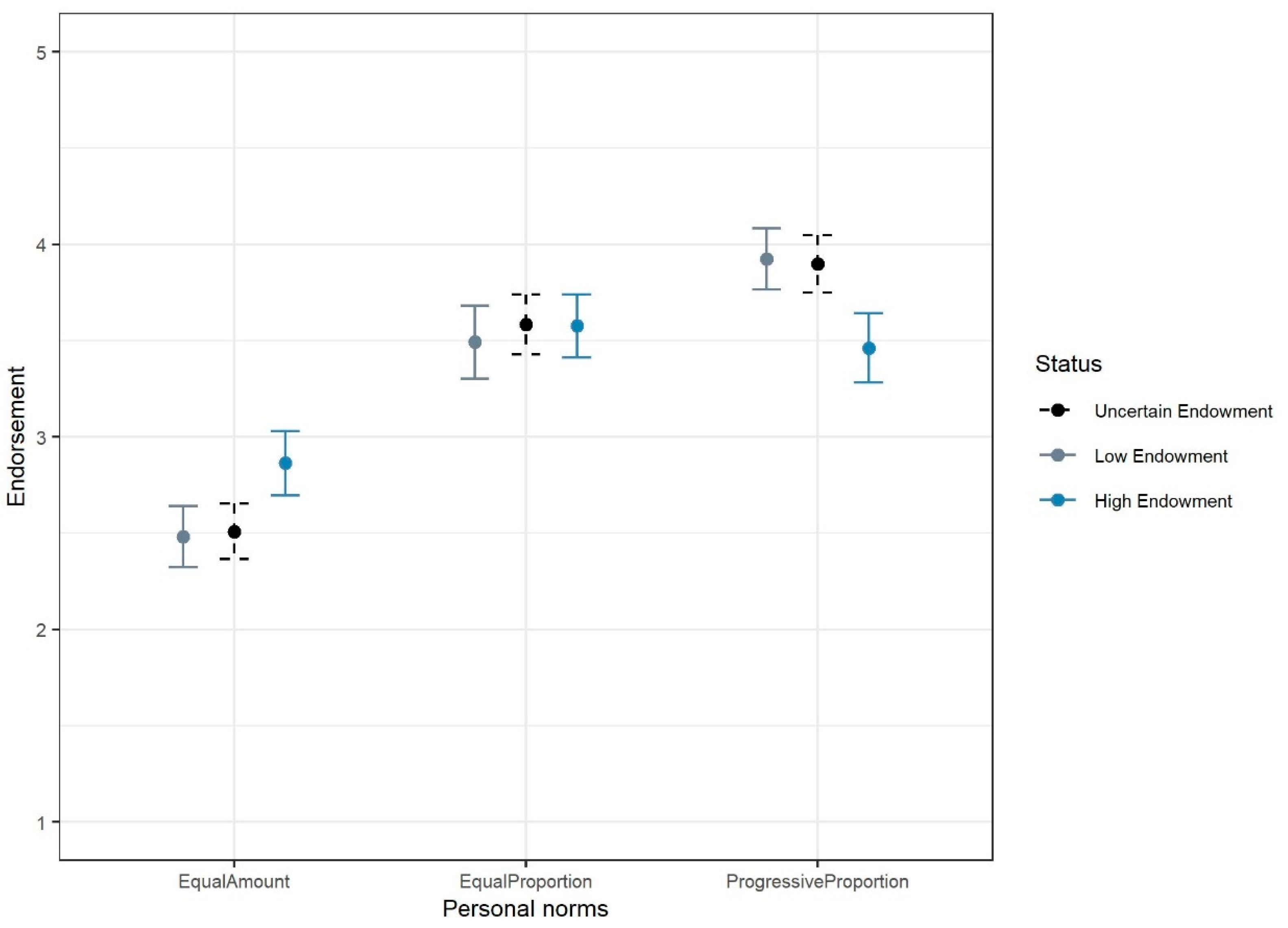
- Personal beliefs: Participants rated the perceived fairness of three distinct burden-allocation scenarios on a 5-point Likert scale (1 = “very unfair” to 5 = “very fair”): equal amount of contribution, equal proportional contribution, and progressive contribution proportion.
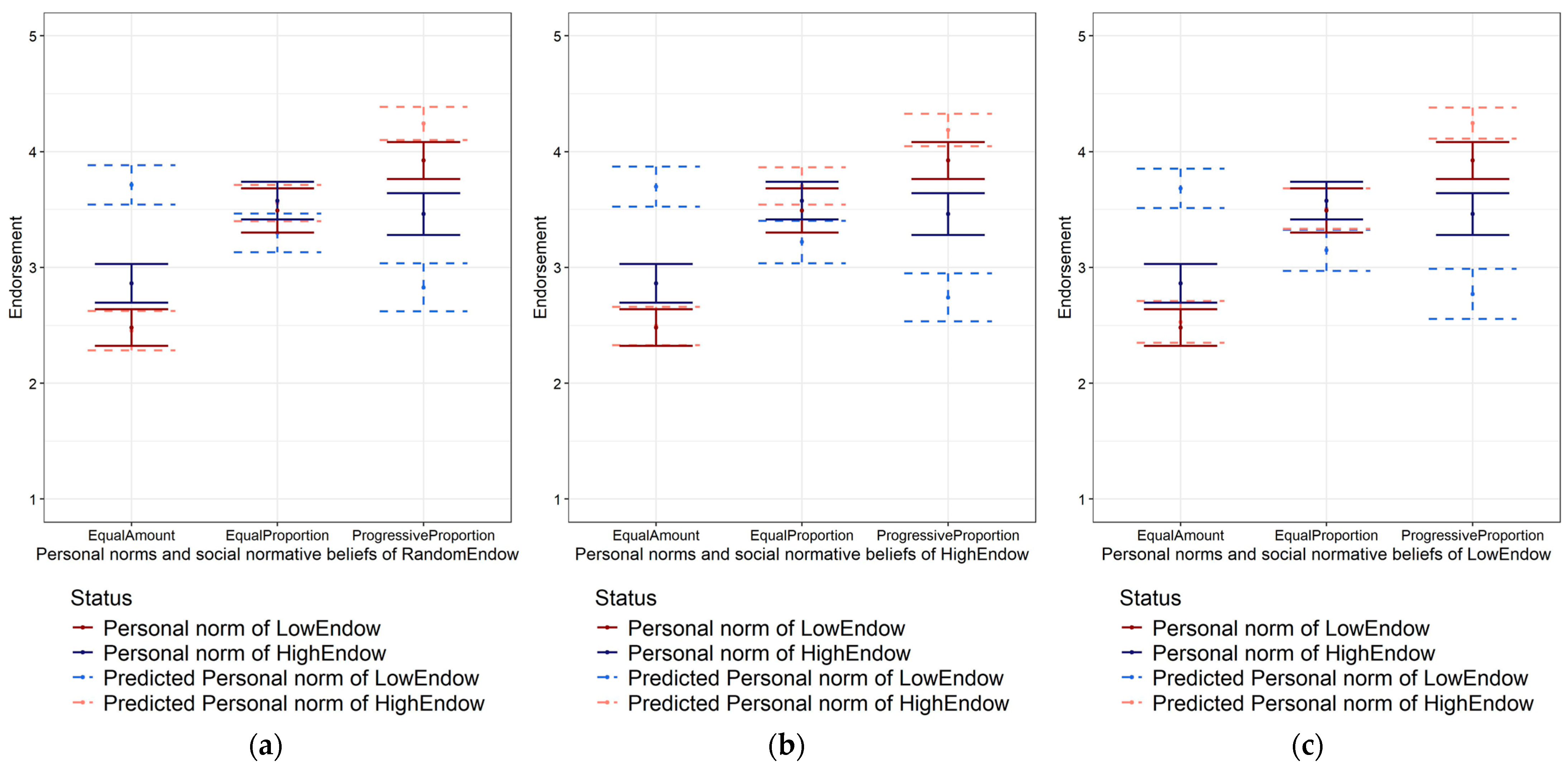
- Social normative beliefs: Participants estimated how “most participants in the real experimental scenario” in high-endowment and low-endowment roles would judge the fairness of the same three burden-allocation principles, using the same 5-point scale. They were asked to predict perceptions of high-endowment players and low-endowment players separately2.
- Control variables: We collected standard demographic data (age, gender, urban/rural residency, education, household income) and subjective views (social trust, self-efficacy), as well as an embedded attention check item. We included measures of other-regarding preferences (reciprocity, perceptions of public goods adequacy, and distributional fairness) adapted from the Global Preferences Survey (Falk et al., 2018).
2.1.4. Procedure
2.2. Results
2.2.1. Descriptive Statistics
2.2.2. Endowment Status and Normative Beliefs
2.2.3. Mediating Effects: Trade-Off Between Self-Serving Bias and Other-Regarding Preferences
3. Experiment 2
3.1. Method
3.1.1. Participants
3.1.2. Design
3.1.3. Measures
3.2. Results
3.2.1. Information on Real Income Status and Normative Beliefs
3.2.2. Mediating Effects with Information on Real Income Status
4. Discussion and Conclusions
4.1. General Discussion
4.2. Limitations and Future Research
Supplementary Materials
Author Contributions
Funding
Institutional Review Board Statement
Informed Consent Statement
Data Availability Statement
Conflicts of Interest
| 1 | The situational descriptions presented in our questionnaire were derived from an actual laboratory experiment carried out at Renmin University of China from 2021 to 2022. The questionnaire briefly outlined the experiment’s setup, procedures, and participant numbers, with all sensitive data being excluded. |
| 2 | The prompt for this task clarified that, “In the actual experimental game, we also asked all participants the same fairness judgment questions as above. Please estimate, based on the prompt, how these participants would judge the fairness of the above statements.” Participants also reported their certainty about these predictions on a 0–10 scale (0 = “very uncertain” to 10 = “very certain”). |
| 3 | The empirical specifications in this study all controlled for demographic characteristics (age, gender, household income, urban residency, education, and relative income), subjective measures (familiarity with common public goods, social trust and self-efficacy), and province fixed effects. |
| 4 | Income group classifications were based on the “Statistical Communiqué of the People’s Republic of China on the 2022 National Economic and Social Development” issued by the National Bureau of Statistics of China. Participants were divided into five groups according to their personal disposable income: low income, lower-middle income, middle income, upper-middle income, and high income. |
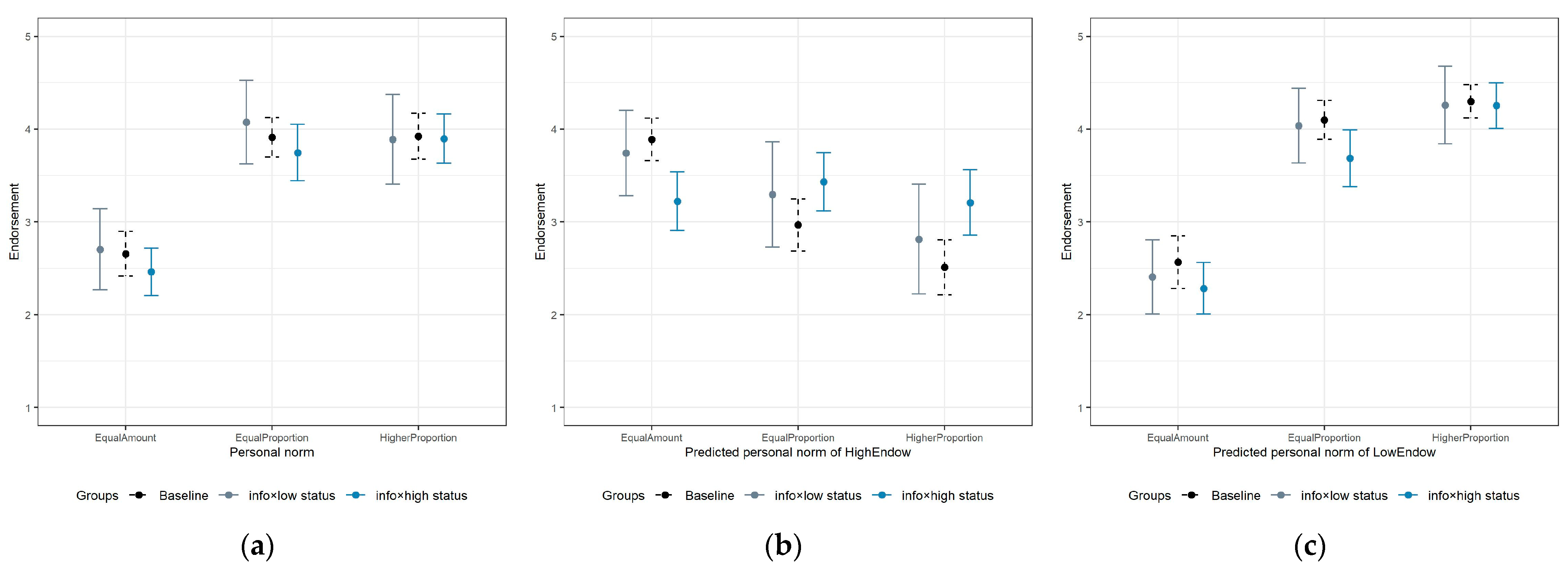
| 5 | Participants were presented with a message such as: “According to the statistical results released by the National Bureau of Statistics, the distribution of per capita disposable income across different income groups in 2022 is shown below. Based on the disposable income level you reported for 2022, your actual position is closest to the low-income group. You accurately estimated your relative income position during the earlier estimation task.” The individual’s actual income group was highlighted in a ladder diagram. |
References
- Almas, I., Cappelen, A. W., Sorensen, E. O., & Tungodden, B. (2022). Global evidence on the selfish rich inequality hypothesis. Proceedings of the National Academy of Sciences of the United States of America, 119(3), e2109690119. [Google Scholar] [CrossRef] [PubMed]
- Amasino, D. R., Pace, D. D., & van der Weele, J. (2023). Self-serving bias in redistribution choices: Accounting for beliefs and norms. Journal of Economic Psychology, 98, 102654. [Google Scholar] [CrossRef]
- Battigalli, P., & Dufwenberg, M. (2022). Belief-dependent motivations and psychological game theory. Journal of Economic Literature, 60(3), 833–882. [Google Scholar] [CrossRef]
- Benabou, R., & Tirole, J. (2006). Belief in a just world and redistributive politics. Quarterly Journal of Economics, 121(2), 699–746. [Google Scholar] [CrossRef]
- Buckley, E., & Croson, R. (2006). Income and wealth heterogeneity in the voluntary provision of linear public goods. Journal of Public Economics, 90(4–5), 935–955. [Google Scholar] [CrossRef]
- Charness, G., Gneezy, U., & Rasocha, V. (2021). Experimental methods: Eliciting beliefs. Journal of Economic Behavior & Organization, 189, 234–256. [Google Scholar] [CrossRef]
- Cherry, T. L., Kroll, S., & Shogren, J. F. (2005). The impact of endowment heterogeneity and origin on public good contributions: Evidence from the lab. Journal of Economic Behavior & Organization, 57(3), 357–365. [Google Scholar] [CrossRef]
- Dorin, C., Hainguerlot, M., Huber-Yahi, H., Vergnaud, J.-C., & de Gardelle, V. (2023). How economic success shapes redistribution: The role of self-serving beliefs, in-group bias and justice principles. Judgment and Decision Making, 16(4), 932–949. [Google Scholar] [CrossRef]
- Dufwenberg, M., Gächter, S., & Hennig-Schmidt, H. (2011). The framing of games and the psychology of play. Games and Economic Behavior, 73(2), 459–478. [Google Scholar] [CrossRef]
- Falk, A., Becker, A., Dohmen, T., Enke, B., Huffman, D., & Sunde, U. (2018). Global evidence on economic preferences. Quarterly Journal of Economics, 133(4), 1645–1692. [Google Scholar] [CrossRef]
- Fehr, E., & Schmidt, K. M. (1999). A theory of fairness, competition, and cooperation. The Quarterly Journal of Economics, 114(3), 817–868. [Google Scholar] [CrossRef]
- Gallier, C., Kesternich, M., & Sturm, B. (2016). Voting for burden sharing rules in public goods games. Environmental and Resource Economics, 67(3), 535–557. [Google Scholar] [CrossRef]
- Goeschl, T., Kettner, S. E., Lohse, J., & Schwieren, C. (2020). How much can we learn about voluntary climate action from behavior in public goods games? Ecological Economics, 171, 106591. [Google Scholar] [CrossRef]
- Kriss, P. H., Loewenstein, G., Wang, X., & Weber, R. A. (2011). Behind the veil of ignorance: Self-serving bias in climate change negotiations. Judgment and Decision Making, 6(7), 602–615. [Google Scholar] [CrossRef]
- Krupka, E. L., & Weber, R. A. (2013). Identifying social norms using coordination games: Why does dictator game sharing vary? Journal of the European Economic Association, 11(3), 495–524. [Google Scholar] [CrossRef]
- Loewenstein, G., O’Donoghue, T., & Rabin, M. (2003). Projection bias in predicting future utility. Quarterly Journal of Economics, 118(4), 1209–1248. [Google Scholar] [CrossRef]
- Martinangeli, A. F. M., & Martinsson, P. (2020). We, the rich: Inequality, identity and cooperation. Journal of Economic Behavior & Organization, 178, 249–266. [Google Scholar] [CrossRef]
- Mastromatteo, G., & Russo, F. F. (2017). Inequality and charity. World Development, 96, 136–144. [Google Scholar] [CrossRef]
- McCaffery, E. J., & Baron, J. (2004). Framing and taxation: Evaluation of tax policies involving household composition. Journal of Economic Psychology, 25(6), 679–705. [Google Scholar] [CrossRef]
- Momeni, F. (2021). Voluntary and mandatory provision of common-pool resources with heterogeneous users. Journal of Economic Behavior & Organization, 185, 785–813. [Google Scholar]
- O’brien, R. M. (2007). A caution regarding rules of thumb for variance inflation factors. Quality & Quantity, 41(5), 673–690. [Google Scholar]
- Pittarello, A., Motsenok, M., Dickert, S., & Ritov, I. (2022). When the poor give more than the rich: The role of resource evaluability on relative giving. Journal of Behavioral Decision Making, 36, e2293. [Google Scholar] [CrossRef]
- Rabin, M. (1993). Incorporating fairness into game theory and economics. The American Economic Review, 83, 1281–1302. [Google Scholar]
- Rawls, J. (1971). A theory of justice. Belknap Press. [Google Scholar]
- Rockenbach, B., Tonke, S., & Weiss, A. R. (2021). Self-serving behavior of the rich causes contagion effects among the poor. Journal of Economic Behavior & Organization, 183, 289–300. [Google Scholar] [CrossRef]
- Tucker, S., & Xu, Y. (2023). Fairness, (perception of) inequality, and redistribution preferences. Journal of Economic Surveys, 37, 1529–1533. [Google Scholar] [CrossRef]
- Zelmer, J. (2003). Linear public goods experiments: A meta-analysis. Experimental Economics, 6(3), 299–310. [Google Scholar] [CrossRef]
- Zhang, Y., Zuo, C., & Zhang, B. (2022). Income inequality and collective action: Evidence from rural tax-for-fee reform in China. Journal of Agrotechnical Economics, 41(7), 4–15. [Google Scholar]


| Treatment | Low-Endowment Status | High-Endowment Status | Random Endowment (Baseline) | p-Values | |||
|---|---|---|---|---|---|---|---|
| N = 183 | N = 182 | N = 185 | |||||
| Variables * | Mean | sd | Mean | sd | Mean | sd | |
| hcontri | 22.385 | 9.707 | 17.708 | 9.072 | 20.605 | 9.669 | 0.597 |
| lcontri | 10.333 | 6.321 | 8.971 | 6.098 | 9.035 | 6.605 | 0.558 |
| rate | 257.609 | 148.302 | 267.017 | 168.751 | 307.799 | 179.427 | 0.040 |
| age | 2.628 | 1.155 | 2.533 | 1.08 | 2.443 | 0.859 | 0.000 |
| ifmale | 0.448 | 0.499 | 0.407 | 0.493 | 0.384 | 0.488 | 0.955 |
| urban | 0.503 | 0.501 | 0.637 | 0.482 | 0.486 | 0.501 | 0.833 |
| edu | 0.842 | 0.366 | 0.819 | 0.386 | 0.881 | 0.325 | 0.059 |
| ln_income | 10.76 | 1.272 | 10.521 | 1.704 | 10.771 | 1.39 | 0.000 |
| Treatment | Baseline (Info = 0) | Information Intervention (Info = 1) | p-Values | ||
|---|---|---|---|---|---|
| N = 90 | N = 94 | ||||
| Variables | Mean | sd | Mean | sd | |
| age | 2.889 | 0.929 | 3.096 | 1.219 | 0.011 |
| ifmale | 0.478 | 0.502 | 0.426 | 0.497 | 0.921 |
| status | 3.8 | 1.552 | 3.766 | 1.562 | 0.953 |
| urban | 0.711 | 0.456 | 0.67 | 0.473 | 0.730 |
| edu | 0.833 | 0.375 | 0.819 | 0.387 | 0.761 |
| ln_income | 10.858 | 1.154 | 10.813 | 1.288 | 0.299 |
| (1) | (2) | (3) | (4) | (5) | (6) | (7) | (8) | (9) | |
|---|---|---|---|---|---|---|---|---|---|
| Personal Norm | Predicted Personal Norm of HighEndow | Predicted Personal Norm of LowEndow | |||||||
| Variables | Equal Amount | Equal Proportion | Progressive Proportion | Equal Amount | Equal Proportion | Progressive Proportion | Equal Amount | Equal Proportion | Progressive Proportion |
| info × status | −0.073 | −0.193 | −0.015 | −0.152 | 0.055 | 0.395 ** | 0.175 | −0.285 ** | −0.092 |
| (0.081) | (0.135) | (0.059) | (0.108) | (0.080) | (0.122) | (0.113) | (0.063) | (0.046) | |
| info | 0.202 | 0.404 | 0.121 | 0.270 | −0.012 | −0.967 | −0.971 | 0.582 | 0.245 |
| (0.300) | (0.691) | (0.162) | (0.460) | (0.362) | (0.434) | (0.538) | (0.287) | (0.106) | |
| status | −0.050 | −0.236 | −0.160 | −0.336 | −0.115 | −0.146 | −0.406 | −0.105 | 0.066 |
| (0.170) | (0.255) | (0.215) | (0.176) | (0.059) | (0.123) | (0.251) | (0.202) | (0.133) | |
| Controls | Yes | Yes | Yes | Yes | Yes | Yes | Yes | Yes | Yes |
| Province Fixed Effect | Yes | Yes | Yes | Yes | Yes | Yes | Yes | Yes | Yes |
| Observations | 184 | 184 | 184 | 184 | 184 | 184 | 184 | 184 | 184 |
| R-squared | 0.263 | 0.222 | 0.263 | 0.235 | 0.305 | 0.244 | 0.367 | 0.259 | 0.258 |
Disclaimer/Publisher’s Note: The statements, opinions and data contained in all publications are solely those of the individual author(s) and contributor(s) and not of MDPI and/or the editor(s). MDPI and/or the editor(s) disclaim responsibility for any injury to people or property resulting from any ideas, methods, instructions or products referred to in the content. |
© 2025 by the authors. Licensee MDPI, Basel, Switzerland. This article is an open access article distributed under the terms and conditions of the Creative Commons Attribution (CC BY) license (https://creativecommons.org/licenses/by/4.0/).
Share and Cite
Zhou, L.; Wang, X. Income Inequality and Self-Serving Belief in Burden-Sharing: An Experimental Study. Behav. Sci. 2025, 15, 1689. https://doi.org/10.3390/bs15121689
Zhou L, Wang X. Income Inequality and Self-Serving Belief in Burden-Sharing: An Experimental Study. Behavioral Sciences. 2025; 15(12):1689. https://doi.org/10.3390/bs15121689
Chicago/Turabian StyleZhou, Lan, and Xianghong Wang. 2025. "Income Inequality and Self-Serving Belief in Burden-Sharing: An Experimental Study" Behavioral Sciences 15, no. 12: 1689. https://doi.org/10.3390/bs15121689
APA StyleZhou, L., & Wang, X. (2025). Income Inequality and Self-Serving Belief in Burden-Sharing: An Experimental Study. Behavioral Sciences, 15(12), 1689. https://doi.org/10.3390/bs15121689

