A Meta-Analysis of Functional Communication Training for Young Children with ASD and Challenging Behavior in Natural Settings



Abstract
1. Introduction
2. Method
2.1. Literature Search and Eligibility Criteria
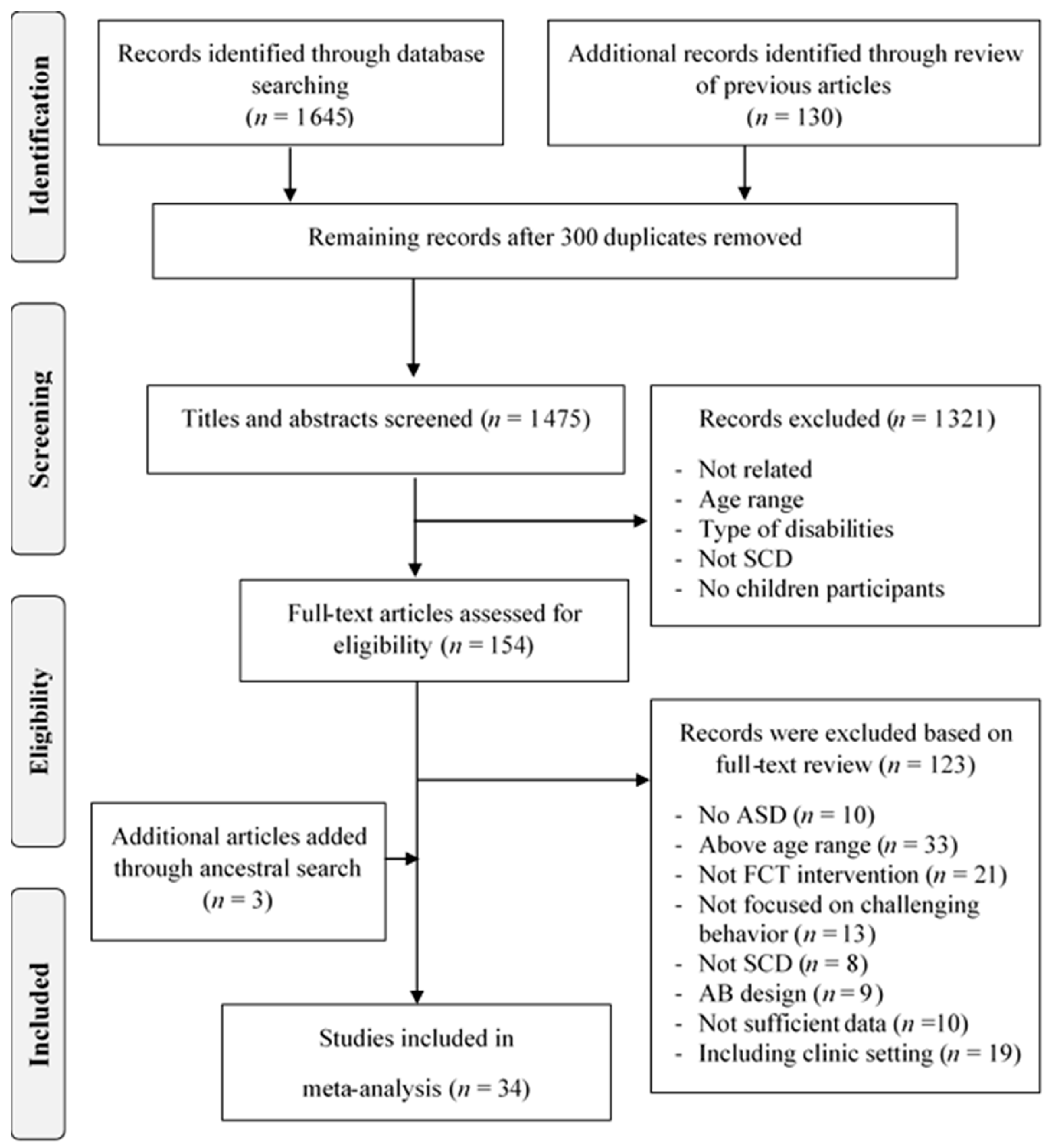
2.2. Article Selection Procedures
2.3. Extraction of Graphical Data
2.4. Variable Coding
2.4.1. Study Characteristics
2.4.2. Methodological Quality Coding
2.5. Effect Size Calculations
2.6. Moderator Analysis
3. Results
3.1. Characteristics of Studies
3.1.1. Child Participants and Setting
3.1.2. Target Challenging Behavior and Behavioral Functions
3.1.3. Preference Assessment and FCT Components
3.1.4. Implementers and Dependent Variables
3.2. Methodological Quality Assessment Results
3.2.1. Study Design Quality
3.2.2. Assessment of Fidelity, Social Validity, Maintenance, and Generalization
3.2.3. Information on Implementer Training and Implementation Support
3.3. Effect Size and Moderators
4. Discussion
4.1. Child and Setting Characteristics
4.2. Preference Assessment
4.3. FCT Components, Intervention Duration, and Implementers
4.4. Methodological Quality
4.5. Magnitude of FCT Intervention and Moderating Variables
4.6. Limitations and Conclusion
Author Contributions
Funding
Institutional Review Board Statement
Informed Consent Statement
Conflicts of Interest
Appendix A

| Reason for Exclusion | Representative Excluded Studies |
| Involving children with disabilities other than ASD | Brown, K. A., Wacker, D. P., Derby, K. M., Peck, S. M., Richman, D. M., Sasso, G. M., Knutson, C. L., & Harding, J. W. (2000). Evaluating the effects of functional communication training in the presence and absence of establishing operations. Journal of Applied Behavior Analysis, 33(1), 53–71. Benson, S. S., Dimian, A. F., Elmquist, M., Simacek, J., McComas, J. J., & Symons, F. J. (2018). Coaching parents to assess and treat self-injurious behaviour via telehealth. Journal of Intellectual Disability Research, 62(12), 1114–1123. |
| Including participants over 8 years old | Falcomata, T. S., Muething, C. S., Gainey, S., Hoffman, K., & Fragale, C. (2013). Further evaluations of functional communication training and chained schedules of reinforcement to treat multiple functions of challenging behavior. Behavior Modification, 37(6), 723–746. Falcomata, T. S., Muething, C. S., Silbaugh, B. C., Adami, S., Hoffman, K., Shpall, C., & Ringdahl, J. E. (2018). Lag schedules and functional communication training: Persistence of mands and relapse of problem behavior. Behavior Modification, 42(3), 314–334. |
| Using behavioral procedures other than FCT | Murdock, L. C., Ganz, J., & Crittendon, J. (2013). Use of an iPad play story to increase play dialogue of preschoolers with autism spectrum disorders. Journal of Autism and Developmental Disorders, 43(9), 2174–2189. Kim, S. (2016). Use of video modeling to teach developmentally appropriate play with Korean American children with autism. Research and Practice for Persons with Severe Disabilities, 41(3), 158–172. |
| Not focusing on challenging behavior outcomes | Anderson, A., Moore, D. W., & Bourne, T. (2007). Functional communication and other concomitant behavior change following PECS training: A case study. Behaviour Change, 24(3), 173–181. Suess, A. N., Romani, P. W., Wacker, D. P., Dyson, S. M., Kuhle, J. L., Lee, J. F., Lindgren, S. D., Kopelman, T. G., Pelzel, K. E., & Waldron, D. B. (2014). Evaluating the treatment fidelity of parents who conduct in-home functional communication training with coaching via telehealth. Journal of Behavioral Education, 23(1), 34–59. |
| Not employing an appropriate SCD | Anderson, E., Barretto, A., McLaughlin, T. F., & McQuaid, T. (2016). Case report: Effects of functional communication training with and without delays to decrease aberrant behaviour in a child with autism spectrum disorder. Journal on Developmental Disabilities, 22(1), 101. Boyle, M. A., Ortman, M. E., Beckman, A. C., Aholt, S. L., & Keenan, G. L. (2018). Functional communication training and noncontingent reinforcement in treatment of stereotypy. Behavioral Interventions, 33(1), 79–86. |
| Lacking graphical data to calculate effect sizes | Brian, J. A., Smith, I. M., Zwaigenbaum, L., Roberts, W., & Bryson, S. E. (2016). The Social ABCs caregiver-mediated intervention for toddlers with autism spectrum disorder: Feasibility, acceptability, and evidence of promise from a multisite study. Autism Research, 9(8), 899–912. Napolitano, D. A., Blakkman, L. A., Kohl, L. B., Vallese, H. M., & McAdam, D. B. (2007). The use of functional communication training to reduce pica. The Journal of Speech and Language Pathology–Applied Behavior Analysis, 2(1), 25. |
| Conducted in a clinical setting | Boyle, M. A., Ortman, M. E., Beckman, A. C., Aholt, S. L., & Keenan, G. L. (2018). Functional communication training and noncontingent reinforcement in treatment of stereotypy. Behavioral Interventions, 33, 79–86. Hagopian, L. P., Wilson, D. M., & Wilder, D. A. (2001). Assessment and treatment of problem behavior maintained by escape from attention and access to tangible items. Journal of Applied Behavior Analysis, 34, 229–232. |
References
- Andzik, N. R., Cannella-Malone, H. I., & Sigafoos, J. (2016). Practitioner-implemented functional communication training: A review of the literature. Research and Practice for Persons with Severe Disabilities, 41, 79–89. [Google Scholar] [CrossRef]
- Bacon, E. C., Courchesne, E., Barnes, C. C., Cha, D., Pence, S., Schreibman, L., Stahmer, A. C., & Pierce, K. (2018). Rethinking the idea of late autism spectrum disorder onset. Development and Psychopathology, 30(2), 553–569. [Google Scholar] [CrossRef]
- Bailey, K. M., & Blair, K. S. (2015). Feasibility and potential efficacy of the family-centered prevent-teach-reinforce model with families of children with developmental disorders. Research in Developmental Disabilities, 47, 218–233. [Google Scholar] [CrossRef]
- Berdeaux, K. L., Lerman, D. C., & Williams, S. D. (2022). Effects of environmental distractions on teachers’ procedural integrity with three function-based treatments. Journal of Applied Behavior Analysis, 55(3), 832–850. [Google Scholar] [CrossRef] [PubMed]
- Berg, W. K., Wacker, D. P., Harding, J. W., Ganzer, J., & Barretto, A. (2007). An evaluation of multiple dependent variables across distinct classes of antecedent stimuli pre and post functional communication training. Journal of Early and Intensive Behavior Intervention, 4(1), 305–333. [Google Scholar] [CrossRef]
- Bormann, I. (2012). DigitizeIt© (version 2.0). Digitizelt. Available online: http://www.digitizeit.de/ (accessed on 15 December 2018).
- Bott, C., Farmer, R., & Rohde, J. (1997). Behaviour problems associated with lack of speech in people with learning disabilities. Journal of Intellectual Disability Research, 41, 3–7. [Google Scholar] [CrossRef] [PubMed]
- Boyle, M. A., Bacon, M. T., Brewer, E. M., Carton, S. M., & Gaskill, L. A. (2020). Evaluating a treatment without extinction for elopement maintained by access to stereotypy. Journal of Applied Behavior Analysis, 53(3), 1531–1541. [Google Scholar] [CrossRef]
- Boyle, M. A., Bacon, M. T., Carton, S. M., Augustine, J. J., Janota, T. A., Curtis, K. S., Forck, K. L., & Gaskill, L. A. (2021). Comparison of naturalistic and arbitrary discriminative stimuli during schedule thinning following functional communication training. Behavioral Interventions, 36(1), 3–20. [Google Scholar] [CrossRef]
- Bozkus-Genc, G., & Yucesoy-Ozkan, S. (2016). Meta-analysis of pivotal response training for children with autism spectrum disorder. Education and Training in Autism and Developmental Disabilities, 51, 13–26. [Google Scholar] [CrossRef]
- Braithwaite, K. L., & Richdale, A. L. (2000). Functional communication training to replace challenging behaviors across two behavioral outcomes. Behavioral Interventions: Theory & Practice in Residential & Community-Based Clinical Programs, 15, 21–36. [Google Scholar] [CrossRef]
- Brown, K. R., Gaynor, R. N., Randall, K. R., & Zangrillo, A. N. (2022). A comparative analysis of procedures to teach delay tolerance. Behavior Analysis: Research and Practice, 22(2), 195–211. [Google Scholar] [CrossRef]
- Buckley, S. D., & Newchok, D. K. (2005). Differential impact of response effort within a response chain on use of mands in a student with autism. Research in Developmental Disabilities, 26, 77–85. [Google Scholar] [CrossRef] [PubMed]
- Carr, E. G., & Durand, V. M. (1985). Reducing behavior problems through functional communication training. Journal of Applied Behavior Analysis, 18, 111–126. [Google Scholar] [CrossRef] [PubMed]
- Centers for Disease Control and Prevention. (2012). Prevalence of autism spectrum disorders—Autism and developmental disabilities monitoring network, 14 sites, United States, 2008. MMWR Surveillance Summaries, 61(3), 1–19. [Google Scholar]
- Centers for Disease Control and Prevention. (2020). Prevalence of autism spectrum disorder among children aged 8 years—Autism and developmental disabilities monitoring network, 11 sites, United States, 2016. MMWR Surveillance Summaries, 69(4), 1–12. [Google Scholar]
- Chezan, L. C., Wolfe, K., & Drasgow, E. (2018). A meta-analysis of functional communication training effects on problem behavior and alternative communicative responses. Focus on Autism and Other Developmental Disabilities, 33, 195–205. [Google Scholar] [CrossRef]
- Chung, M. Y., Meadan, H., Snodgrass, M. R., Meyer, L. E., Halle, J. W., & Vail, C. O. (2020). Assessing the social validity of a telepractice training and coaching intervention. Journal of Behavioral Education, 29(3), 382–408. [Google Scholar] [CrossRef]
- Dalmau, Y. C. P., Wacker, D. P., Harding, J. W., Berg, W. K., Schieltz, K. M., Lee, J. F., Breznican, G. P., & Kramer, A. R. (2011). A preliminary evaluation of functional communication training effectiveness and language preference when Spanish and English are manipulated. Journal of Behavioral Education, 20, 233–251. [Google Scholar] [CrossRef]
- Davis, T. N., Fuentes, L., & Durand, S. (2014). Examination of systematic durations of presession reinforcer access on functional communication training. Journal of Developmental and Physical Disabilities, 26, 263–270. [Google Scholar] [CrossRef]
- Davis, T. N., Gerow, S., Wicker, M., Cosottile, D., Exline, E., Swensson, R., & Lively, P. (2023). Utilizing telehealth to coach parents to implement trial-based functional analysis and treatment. Journal of Behavioral Education, 32, 703–727. [Google Scholar] [CrossRef]
- Davis, T. N., O’Reilly, M. F., Kang, S., Rispoli, M., Lang, R. B., Machalicek, W., Chan, J. M., Lancioni, G., & Sigafoos, J. (2009). Impact of presession access to toys maintaining challenging behavior on functional communication training: A single case study. Journal of Developmental and Physical Disabilities, 21, 515. [Google Scholar] [CrossRef]
- DeLeon, I. G., & Iwata, B. A. (1996). Evaluation of a multiple-stimulus presentation format for assessing reinforcer preferences. Journal of Applied Behavior Analysis, 29, 519–533. [Google Scholar] [CrossRef]
- DeMuesy, R. W., Jr., & Clark-Shofar, A. (2025). Training a special education teacher to implement a universal protocol treatment package: Effects on challenging behaviors. Education Sciences, 15(6), 675. [Google Scholar] [CrossRef]
- Dionne, G., Tremblay, R., Boivin, M., Laplante, D., & Pérusse, D. (2003). Physical aggression and expressive vocabulary in 19-month-old twins. Developmental Psychology, 39(2), 261–273. [Google Scholar] [CrossRef]
- Dominick, K. C., Davis, N. O., Lainhart, J., Tager-Flusberg, H., & Folstein, S. (2007). Atypical behaviors in children with autism and children with a history of language impairment. Research in Developmental Disabilities, 28, 145–162. [Google Scholar] [CrossRef] [PubMed]
- Dunlap, G., & Fox, L. (1999). A demonstration of behavioral support for young children with autism. Journal of Positive Behavior Interventions, 1, 77–87. [Google Scholar] [CrossRef]
- Durand, V. M., & Moskowitz, L. (2015). Functional communication training: Thirty years of treating challenging behavior. Topics in Early Childhood Special Education, 35, 116–126. [Google Scholar] [CrossRef]
- Edelson, S. M. (2022). Understanding challenging behaviors in autism spectrum disorder: A multi-component, inter-disciplinary model. Journal of Personalized Medicine, 12(7), 1127. [Google Scholar] [CrossRef]
- Falcomata, T. S., Roane, H. S., Feeney, B. J., & Stephenson, K. M. (2010). Assessment and treatment of elopement maintained by access to stereotypy. Journal of Applied Behavior Analysis, 43, 513–517. [Google Scholar] [CrossRef]
- Falcomata, T. S., Roane, H. S., Muething, C. S., Stephenson, K. M., & Ing, A. D. (2012a). Functional communication training and chained schedules of reinforcement to treat challenging behavior maintained by terminations of activity interruptions. Behavior Modification, 36, 630–649. [Google Scholar] [CrossRef]
- Falcomata, T. S., Shpall, C. S., Ringdahl, J. E., Ferguson, R. H., Wingate, H. V., & Swinnea, S. B. (2017). A comparison of high and low-proficiency mands during functional communication training across multiple functions of problem behavior. Journal of Developmental and Physical Disabilities, 29, 983–1002. [Google Scholar] [CrossRef]
- Falcomata, T. S., Wacker, D. P., Ringdahl, J. E., Vinquist, K., & Dutt, A. (2013). An evaluation of generalization of mands during functional communication training. Journal of Applied Behavior Analysis, 46, 444–454. [Google Scholar] [CrossRef] [PubMed]
- Falcomata, T. S., White, P., Muething, C. S., & Fragale, C. (2012b). A functional communication training and chained schedule procedure to treat challenging behavior with multiple functions. Journal of Developmental and Physical Disabilities, 24(6), 529–538. [Google Scholar] [CrossRef]
- Ferron, J., Owens, C. M., & Bell, B. A. (2010, April 30–May 4). Multilevel models for combining single-case data: A Monte Carlo examination of treatment effect estimates and inferences. Annual Meeting of the American Educational Research Association, Denver, CO, USA. [Google Scholar]
- Fettig, A., & Barton, E. E. (2014). Parent implementation of function-based intervention to reduce children’s challenging behavior: A literature review. Topics in Early Childhood Special Education, 34, 49–61. [Google Scholar] [CrossRef]
- Fisher, W. W., Thompson, R. H., Hagopian, L. P., Bowman, L. G., & Krug, A. (2000). Facilitating tolerance of delayed reinforcement during functional communication training. Behavior Modification, 24(1), 3–29. [Google Scholar] [CrossRef]
- Franco, J. H., Lang, R. L., O’Reilly, M. F., Chan, J. M., Sigafoos, J., & Rispoli, M. (2009). Functional analysis and treatment of inappropriate vocalizations using a speech-generating device for a child with autism. Focus on Autism and Other Developmental Disabilities, 24, 146–155. [Google Scholar] [CrossRef]
- Frea, W. D., Arnold, C. L., & Vittimberga, G. L. (2001). A demonstration of the effects of augmentative communication on the extreme aggressive behavior of a child with autism within an integrated preschool setting. Journal of Positive Behavior Interventions, 3, 194–198. [Google Scholar] [CrossRef]
- Fuhrman, A. M., Greer, B. D., Zangrillo, A. N., & Fisher, W. W. (2018). Evaluating competing activities to enhance functional communication training during reinforcement schedule thinning. Journal of Applied Behavior Analysis, 51(4), 931–942. [Google Scholar] [CrossRef]
- Gerow, S., Davis, T., Radhakrishnan, S., Gregori, E., & Rivera, G. (2018). Functional communication training: The strength of evidence across disabilities. Exceptional Children, 85, 86–103. [Google Scholar] [CrossRef]
- Ghaemmaghami, M., Hanley, G. P., Jessel, J., & Landa, R. (2018). Shaping complex functional communication responses. Journal of Applied Behavior Analysis, 51(3), 502–520. [Google Scholar] [CrossRef]
- Ghaemmaghami, M., Hanley, G. P., Jin, S. C., & Vanselow, N. R. (2016). Affirming control by multiple reinforcers via progressive treatment analysis. Behavioral Interventions, 31(1), 70–86. [Google Scholar] [CrossRef]
- Gibson, J. L., Pennington, R. C., Stenhoff, D. M., & Hopper, J. S. (2010). Using desktop videoconferencing to deliver interventions to a preschool student with autism. Topics in Early Childhood Special Education, 29, 214–225. [Google Scholar] [CrossRef]
- Gregori, E., Rispoli, M. J., Lory, C., Kim, S. Y., & David, M. (2022). Effects of teachers as coaches for paraprofessionals implementing functional communication training. Journal of Positive Behavior Interventions, 24(2), 133–144. [Google Scholar] [CrossRef]
- Grow, L. L., Kelley, M. E., Roane, H. S., & Shillingsburg, M. A. (2008). Utility of extinction-induced response variability for the selection of mands. Journal of Applied Behavior Analysis, 41(1), 15–24. [Google Scholar] [CrossRef]
- Hagopian, L. P., Boelter, E. W., & Jarmolowicz, D. P. (2011). Reinforcement schedule thinning following functional communication training: Review and recommendations. Behavior Analysis in Practice, 4(1), 4–16. [Google Scholar] [CrossRef]
- Hagopian, L. P., Fisher, W. W., Sullivan, M. T., Acquisto, J., & LeBlanc, L. A. (1998). Effectiveness of functional communication training with and without extinction and punishment: A summary of 21 inpatient cases. Journal of applied behavior analysis, 31(2), 211–235. [Google Scholar] [CrossRef]
- Hagopian, L. P., Long, E. S., & Rush, K. S. (2004). Preference assessment procedures for individuals with developmental disabilities. Behavior Modification, 28, 668–677. [Google Scholar] [CrossRef]
- Hanley, G. P., Iwata, B. A., & Thompson, R. H. (2001). Reinforcement schedule thinning following treatment with functional communication training. Journal of Applied Behavior Analysis, 34(1), 17–38. [Google Scholar] [CrossRef]
- Hawkins, R. P. (1991). Is social validity what we are interested in? Argument for a functional approach. Journal of Applied Behavior Analysis, 24(2), 205–213. [Google Scholar] [CrossRef]
- Heath, A. K., Ganz, J. B., Parker, R., Burke, M., & Ninci, J. (2015). A meta-analytic review of functional communication training across mode of communication, age, and disability. Review Journal of Autism and Developmental Disorders, 2, 155–166. [Google Scholar] [CrossRef]
- Heinicke, M. R., Carr, J. E., Pence, S. T., Zias, D. R., Valentino, A. L., & Falligant, J. M. (2016). Assessing the efficacy of pictorial preference assessments for children with developmental disabilities. Journal of Applied Behavior Analysis, 49, 848–868. [Google Scholar] [CrossRef]
- Horner, R. H., Carr, E. G., Halle, J., McGee, G., Odom, S., & Wolery, M. (2005). The use of single-subject research to identify evidence-based practice in special education. Exceptional Children, 71, 165–179. [Google Scholar] [CrossRef]
- Horner, R. H., & Day, H. M. (1991). The effects of response efficiency on functionally equivalent competing behaviors. Journal of Applied Behavior Analysis, 24(4), 719–732. [Google Scholar] [CrossRef] [PubMed]
- Jashar, D. T., Brennan, L. A., Barton, M. L., & Fein, D. (2016). Cognitive and adaptive skills in toddlers who meet criteria for autism in DSM-IV but not DSM-5. Journal of Autism and Developmental Disorders, 46(12), 3667–3677. [Google Scholar] [CrossRef] [PubMed]
- Kahng, S., Hendrickson, D. J., & Vu, C. P. (2000). Comparison of single and multiple functional communication training responses for the treatment of problem behavior. Journal of Applied Behavior Analysis, 33, 321–324. [Google Scholar] [CrossRef]
- Kanne, S. M., & Mazurek, M. O. (2011). Aggression in children and adolescents with ASD: Prevalence and risk factors. Journal of Autism and Developmental Disorders, 41, 926–937. [Google Scholar] [CrossRef]
- Koegel, L. K., Stiebel, D., & Koegel, R. L. (1998). Reducing aggression in children with autism toward infant or toddler siblings. Journal of the Association for Persons with Severe Handicaps, 23(2), 111–118. [Google Scholar] [CrossRef]
- Kranak, M. P., & Falligant, J. M. (2022). Analysis of terminal schedule probes and schedule thinning effects following functional communication training. Behavioral Interventions, 37(2), 323–333. [Google Scholar] [CrossRef]
- Kratochwill, T. R., Horner, R. H., Levin, J. R., Machalicek, W., Ferron, J., & Johnson, A. (2021). Single-case design standards: An update and proposed upgrades. Journal of School Psychology 89, 91–105. [Google Scholar] [CrossRef]
- Lai, M.-C., Lombardo, M. V., & Baron-Cohen, S. (2014). Autism. The Lancet, 383(9920), 896–910. [Google Scholar] [CrossRef]
- Ledford, J. R., Hall, E., Conder, E., & Lane, J. D. (2016). Research for young children with autism spectrum disorders: Evidence of social and ecological validity. Topics in Early Childhood Special Education, 35, 223–233. [Google Scholar] [CrossRef]
- Lindor, E., Sivaratnam, C., May, T., Stefanac, N., Howells, K., & Rinehart, N. (2019). Problem behavior in autism spectrum disorder: Considering core symptom severity and accompanying sleep disturbance. Frontiers in Psychiatry, 10, 487. [Google Scholar] [CrossRef] [PubMed]
- Lobar, S. L. (2016). DSM-V changes for autism spectrum disorder (ASD): Implications for diagnosis, management, and care coordination for children with ASDs. Journal of Pediatric Health Care, 30(4), 359–365. [Google Scholar] [CrossRef] [PubMed]
- Luo, L., Gage, N. A., & Prykanowski, D. A. (2019). Systematic review of functional communication training in early care and education settings. Education and Training in Autism and Developmental Disabilities, 54, 358–376. [Google Scholar] [CrossRef]
- Maenner, M. J., Warren, Z., Williams, A. R., Amoakohene, E., Bakian, A. V., Bilder, D. A., Durkin, M. S., Fitzgerald, R. T., Furnier, S. M., Hughes, M. M., Ladd-Acosta, C. M., McArthur, D., Pas, E. T., Salinas, A., Vehorn, A., Williams, S., Esler, A., Grzybowski, A., Hall-Lande, J., … Shaw, K. A. (2023). Prevalence and characteristics of autism spectrum disorder among children aged 8 years—Autism and Developmental Disabilities Monitoring Network, 11 sites, United States, 2020. MMWR Surveillance Summaries, 72(SS-2), 1–14. [Google Scholar] [CrossRef]
- Mancil, G. R. (2006). Functional communication training: A review of the literature related to children with autism. Education and Training in Developmental Disabilities, 41, 213–224. [Google Scholar]
- Mancil, G. R., Conroy, M. A., & Haydon, T. F. (2009). Effects of a modified milieu therapy intervention on the social communicative behaviors of young children with autism spectrum disorders. Journal of Autism and Developmental Disorders, 39, 149. [Google Scholar] [CrossRef]
- Mancil, G. R., Conroy, M. A., Nakao, T., & Alter, P. J. (2006). Functional communication training in the natural environment: A pilot investigation with a young child with autism spectrum disorder. Education and Treatment of Children, 29, 615–633. [Google Scholar]
- Mandell, D. S., Stahmer, A. C., Shin, S., Xie, M., Reisinger, E., & Marcus, S. C. (2013). The role of treatment fidelity on outcomes during a randomized field trial of an autism intervention. Autism, 17, 281–295. [Google Scholar] [CrossRef]
- Masud, A. B., Walker, V. L., Carpenter, M. E., & Anderson, A. (2023). Functional communication training in inclusive school settings for students with intellectual and developmental disabilities: A literature review. Journal of Positive Behavior Interventions, 25(4), 239–252. [Google Scholar] [CrossRef]
- Mildon, R. L., Moore, D. W., & Dixon, R. S. (2004). Combining noncontingent escape and functional communication training as a treatment for negatively reinforced disruptive behavior. Journal of Positive Behavior Interventions, 6, 92–102. [Google Scholar] [CrossRef]
- Minshawi, N. F., Hurwitz, S., Fodstad, J. C., Biebl, S., Morriss, D. H., & McDougle, C. J. (2014). The association between self-injurious behaviors and autism spectrum disorders. Psychology Research and Behavior Management, 7, 125–136. [Google Scholar] [CrossRef] [PubMed]
- Moes, D. R., & Frea, W. D. (2002). Contextualized behavioral support in early intervention for children with autism and their families. Journal of Autism and Developmental Disorders, 32, 519–533. [Google Scholar] [CrossRef] [PubMed]
- Muething, C., Pavlov, A., Call, N., Ringdahl, J., & Gillespie, S. (2021). Prevalence of resurgence during thinning of multiple schedules of reinforcement following functional communication training. Journal of Applied Behavior Analysis, 54(2), 813–823. [Google Scholar] [CrossRef]
- Muharib, R., Alrasheed, F., Ninci, J., Walker, V. L., & Voggt, A. P. (2019). Thinning schedules of reinforcement following functional communication training for children with intellectual and developmental disabilities: A meta-analytic review. Journal of Autism and Developmental Disorders, 49, 4788–4806. [Google Scholar] [CrossRef] [PubMed]
- Muharib, R., Voggt, A. P., Wood, C. L., Pennington, R. C., & Lang, R. (2021). Further evaluation of a multiple schedule thinning procedure following functional communication training in a school setting. Advances in Neurodevelopmental Disorders, 5(2), 204–217. [Google Scholar] [CrossRef]
- Neely, L., Garcia, E., Bankston, B., & Green, A. (2018). Generalization and maintenance of functional communication training for individuals with developmental disabilities: A systematic and quality review. Research in Developmental Disabilities, 79, 116–129. [Google Scholar] [CrossRef]
- Olive, M. L., Lang, R. B., & Davis, T. N. (2008). An analysis of the effects of functional communication and a voice output communication aid for a child with autism spectrum disorder. Research in Autism Spectrum Disorders, 2, 223–236. [Google Scholar] [CrossRef]
- Ozonoff, S., Young, G. S., Landa, R. J., Brian, J., Bryson, S., Charman, T., Chawarska, K., Macari, S. L., Messinger, D., Stone, W. L., Zwaigenbaum, L., & Iosif, A. M. (2015). Diagnostic stability in young children at risk for autism spectrum disorder: A baby siblings research consortium study. Journal of Child Psychology and Psychiatry, 56(9), 988–998. [Google Scholar] [CrossRef]
- Park, E. Y., & Blair, K. S. C. (2019). Social validity assessment in behavior interventions for young children: A systematic review. Topics in Early Childhood Special Education, 39, 156–169. [Google Scholar] [CrossRef]
- Pierce, K., Gazestani, V. H., Bacon, E., Barnes, C. C., Cha, D., Nalabolu, S., Lopez, L., Moore, A., Pence-Stophaeros, S., & Courchesne, E. (2019). Evaluation of the diagnostic stability of the early autism spectrum disorder phenotype in the general population starting at 12 months. JAMA Pediatrics, 173(6), 578–587. [Google Scholar] [CrossRef] [PubMed]
- Prykanowski, D. A., Conroy, M. A., & Reichow, B. (2021). Schedule thinning during functional communication training in the home for young children with autism. Journal of Positive Behavior Interventions, 23(4), 257–271. [Google Scholar] [CrossRef]
- Rakap, S., Rakap, S., Evran, D., & Cig, O. (2016). Comparative evaluation of the reliability and validity of three data extraction programs: UnGraph, GraphClick, and DigitizeIt. Computers in Human Behavior, 55, 159–166. [Google Scholar] [CrossRef]
- Reichow, B., Volkmar, F. R., & Cicchetti, D. V. (2008). Development of the evaluative method for evaluating and determining evidence-based practices in autism. Journal of Autism and Developmental Disorders, 38, 1311–1319. [Google Scholar] [CrossRef]
- Roberts, M. Y., Curtis, P. R., Sone, B. J., & Hampton, L. H. (2019). Association of parent training with child language development: A systematic review and meta-analysis. JAMA Pediatrics, 173, 671–680. [Google Scholar] [CrossRef]
- Saini, V., Miller, S. A., & Fisher, W. W. (2016). Multiple schedules in practical application: Research trends and implications for future investigation. Journal of Applied Behavior Analysis, 49(2), 421–444. [Google Scholar] [CrossRef]
- Schardt, C., Adams, M. B., Owens, T., Keitz, S., & Fontelo, P. (2007). Utilization of the PICO framework to improve searching PubMed for clinical questions. BMC Medical Informatics and Decision Making, 7(1), 16. [Google Scholar] [CrossRef]
- Schieltz, K. M., Romani, P. W., Wacker, D. P., Suess, A. N., Huang, P., Berg, W. K., Lindgren, S. D., & Kopelman, T. G. (2018). Single-case analysis to determine reasons for failure of behavioral treatment via telehealth. Remedial and Special Education, 39, 95–105. [Google Scholar] [CrossRef]
- Schindler, H. R., & Horner, R. H. (2005). Generalized reduction of problem behavior of young children with autism: Building trans-situational interventions. American Journal on Mental Retardation, 110, 36–47. [Google Scholar] [CrossRef]
- Sidener, T. M., Shabani, D. B., Carr, J. E., & Roland, J. P. (2006). An evaluation of strategies to maintain mands at practical levels. Research in Developmental Disabilities, 27(6), 632–644. [Google Scholar] [CrossRef]
- Sigafoos, J., & Meikle, B. (1996). Functional communication training for the treatment of multiply determined challenging behavior in two boys with autism. Behavior Modification, 20, 60–84. [Google Scholar] [CrossRef]
- Silbaugh, B. C., Swinnea, S., & Falcomata, T. S. (2020). Replication and extension of the effects of lag schedules on mand variability and challenging behavior during functional communication training. The Analysis of Verbal Behavior, 36(1), 49–73. [Google Scholar] [CrossRef] [PubMed]
- Simacek, J., Dimian, A. F., & McComas, J. J. (2017). Communication intervention for young children with severe neurodevelopmental disabilities via telehealth. Journal of Autism and Developmental Disorders, 47(3), 744–767. [Google Scholar] [CrossRef] [PubMed]
- Soke, G. N., Rosenberg, S. A., Hamman, R. F., Fingerlin, T., Robinson, C., Carpenter, L., Giarelli, E., Lee, L. C., Wiggins, L. D., Durkin, M. S., & DiGuiseppi, C. (2016). Brief report: Prevalence of self-injurious behaviors among children with autism spectrum disorder-a population-based study. Journal of Autism and Developmental Disorders, 46, 3607–3614. [Google Scholar] [CrossRef] [PubMed]
- Steinbrenner, J. R., Hume, K., Odom, S. L., Morin, K. L., Nowell, S. W., Tomaszewski, B., Szendrey, S., McIntyre, N. S., Yucesoy-Ozkan, S., & Savage, M. N. (2020). Evidence-based practices for children, youth, and young adults with Autism. The University of North Carolina at Chapel Hill, Frank Porter Graham Child Development Institute, National Clearinghouse on Autism Evidence and Practice Review Team. Available online: https://ncaep.fpg.unc.edu/sites/ncaep.fpg.unc.edu/files/imce/documents/EBP%20Report%202020.pdf (accessed on 19 December 2019).
- Stevinson, C., & Lawlor, D. A. (2004). Searching multiple databases for systematic reviews: Added value or diminishing returns? Complementary Therapies in Medicine, 12(4), 228–232. [Google Scholar] [CrossRef]
- Strand, R. C., & Eldevik, S. (2018). Improvements in problem behavior in a child with autism spectrum diagnosis through synthesized analysis and treatment: A replication in an EIBI home program. Behavioral Interventions, 33, 102–111. [Google Scholar] [CrossRef]
- Suess, A. N., Schieltz, K. M., Wacker, D. P., Detrick, J., & Podlesnik, C. A. (2020). An evaluation of resurgence following functional communication training conducted in alternative antecedent contexts via telehealth. Journal of the Experimental Analysis of Behavior, 113(1), 278–301. [Google Scholar] [CrossRef]
- Thompson, R. H., Fisher, W. W., Piazza, C. C., & Kuhn, D. E. (1998). The evaluation and treatment of aggression maintained by attention and automatic reinforcement. Journal of Applied Behavior Analysis, 31(1), 103–116. [Google Scholar] [CrossRef]
- Thurm, A., Farmer, C., Salzman, E., Lord, C., & Bishop, S. (2019). State of the field: Differentiating intellectual disability from autism spectrum disorder. Frontiers in Psychiatry, 10, 526. [Google Scholar] [CrossRef]
- Tiger, J. H., Hanley, G. P., & Bruzek, J. (2008). Functional communication training: A review and practical guide. Behavior Analysis in Practice, 1, 16–23. [Google Scholar] [CrossRef]
- Tomlinson, S. R. L., Gore, N., & McGill, P. (2018). Training individuals to implement applied behavior analytic procedures via telehealth: A systematic review of the literature. Journal of Behavioral Education, 27(2), 172–222. [Google Scholar] [CrossRef]
- Tsami, L., Lerman, D., & Toper-Korkmaz, O. (2019). Effectiveness and acceptability of parent training via telehealth among families around the world. Journal of Applied Behavior Analysis, 52(4), 1113–1129. [Google Scholar] [CrossRef] [PubMed]
- Unholz-Bowden, E., McComas, J. J., McMaster, K. L., Girtler, S. N., Kolb, R. L., & Shipchandler, A. (2020). Caregiver training via telehealth on behavioral procedures: A systematic review. Journal of Behavioral Education, 29(2), 246–281. [Google Scholar] [CrossRef] [PubMed]
- Venker, C. E., Ray-Subramanian, C. E., Bolt, D. M., & Ellis Weismer, S. (2014). Trajectories of autism severity in early childhood. Journal of Autism and Developmental Disorders, 44(3), 546–563. [Google Scholar] [CrossRef]
- Vismara, L. A., & Rogers, S. J. (2010). Behavioral treatments in autism spectrum disorder: What do we know? Annual Review of Clinical Psychology, 6, 447–468. [Google Scholar] [CrossRef]
- Wacker, D. P., Harding, J. W., Morgan, T. A., Berg, W. K., Schieltz, K. M., Lee, J. F., & Padilla, Y. C. (2013). An evaluation of resurgence during functional communication training. The Psychological Record, 63, 3–20. [Google Scholar] [CrossRef]
- Walker, V. L., Carpenter, M. E., Lyon, K. J., Garcia, M., & Johnson, H. (2021). Coaching paraeducators to implement functional communication training involving augmentative and alternative communication for students with autism spectrum disorder. Augmentative and Alternative Communication, 37(2), 129–140. [Google Scholar] [CrossRef]
- Walker, V. L., Lyon, K. J., Loman, S. L., & Sennott, S. (2018). A systematic review of Functional Communication Training (FCT) interventions involving augmentative and alternative communication in school settings. Augmentative and Alternative Communication, 34, 118–129. [Google Scholar] [CrossRef]
- What Works Clearinghouse. (2020). Standards handbook (version 4.01). Institute of Education Sciences. [Google Scholar]
- Wong, C., Odom, S. L., Hume, K. A., Cox, A. W., Fettig, A., Kucharczyk, S., Brock, M. E., Plavnick, J. B., Fleury, V. P., & Schultz, T. R. (2015). Evidence-based practices for children, youth, and young adults with autism spectrum disorder: A comprehensive review. Journal of Autism and Developmental Disorders, 45(7), 1951–1966. [Google Scholar] [CrossRef]
- Yassa, R. R., Mitteer, D. R., Greer, B. D., Angley, S. M., McCabe, L. H., & Elwasli, O. M. (2024). Teaching trainees to implement functional communication training with multiple schedules: An evaluation of training effects and durability. Journal of Applied Behavior Analysis, 57(4), 999–1015. [Google Scholar] [CrossRef]

| Category | Coding Variables |
|---|---|
| Child characteristics |
|
| Communication mode |
|
| FCT features |
|
| Target challenging behavior |
|
| Function of challenging behavior |
|
| Author (Year) | n | Age | Diag. | Comm. Mode | Target CB | Function | Pref. Ass. | FCT Compo. | Setting | Implementer | Initial Training | Coach./Feed. | FD | SV | M | G | DV | Tau-BC | WWC Stand. |
|---|---|---|---|---|---|---|---|---|---|---|---|---|---|---|---|---|---|---|---|
| Boyle et al. (2020) | 1 | 5 | ASD | Picture | SIB | Social (A) | NR | FCT + TT/ST | Home | Mother | NR | NR | Y | N | N | N | CB RB | 1.0 0.89 | 0 |
| Braithwaite and Richdale (2000) | 1 | 7 | ASD/ID | Vocal | SIB, Aggression | Social (T, E) | NR | FCT + DR | School | Therapist | NR | NR | N | N | N | N | CB RB | 1.0 1.0 | 0 |
| Buckley and Newchok (2005) | 1 | 7 | ASD | Picture | Aggression | Social (T) | NR | FCT + Ext | School | Therapist | NR | NR | N | N | N | N | CB RB | 0.92 NA | 0 |
| Dalmau et al. (2011) | 2 | 5.2, 6.2 | SMA/PDD, ASD/ID | Picture, VOCA | SIB, Aggression, PD | Social (E/T, A/E) | T | FCT | Home | Mother | NR | NR | N | N | N | N | CB RB | 0.67 0.83 | 0 |
| Davis et al. (2014) | 1 | 6 | ASD/ID | Vocal | Aggression, Stereotypy | Social (T) | T | FCT | School | Researcher | NR | NR | N | N | N | N | CB RB | 1.0 0.75 | 0 |
| Davis et al. (2009) | 1 | 4 | PDD-NOS | Vocal | Disruption | Social (T) | NR | FCT | School | Researcher | NR | NR | N | N | N | N | CB RB | 1.0 1.0 | 0 |
| Falcomata et al. (2010) | 1 | 5 | ASD | Gesture | Elopement. Disruption | Social (T) | NR | FCT + DR | Com. | Therapist | NR | NR | N | N | N | N | CB RB | 0.59 NA | 0 |
| Falcomata et al. (2012a) | 2 | 8 | ASD (Asperger) | Vocal | Aggression, PD, SIB, Disruption | Social (T) | NR | FCT | School | Researcher | NR | NR | Y | N | N | N | CB RB | 0.97 0.85 | 0 |
| Falcomata et al. (2017) | 2 | 2.5, 4.5 | ASD | VOCA | SIB, Disruption, Aggression | Social (A/T, E) | F | FCT | Home | Mother/ Researcher | NR | NR | N | N | N | N | CB RB | −0.89 NA | 0 |
| Falcomata et al. (2012b) | 1 | 8 | ASD | Vocal | Disruption | Social (A/T, E) | NR | FCT | Home | Therapist | NR | NR | N | N | N | N | CB RB | 0.87 NA | 0 |
| Franco et al. (2009) | 1 | 7.5 | ASD | VOCA | Disruption | Social (A/T; E) | NR | FCT | School | Therapist | NR | NR | Y | N | Y | N | CB RB | 1.0 1.0 | 0 |
| Frea et al. (2001) | 1 | 4 | ASD | VOCA | Aggression | Social (T) | NR | FCT | School | Teacher | NR | NR | N | N | N | N | CB RB | 0.85 1.0 | 0 |
| Gibson et al. (2010) | 1 | 4 | ASD | Vocal | Elopement | Social (T) | F | FCT | School | Teacher | <1 h | Daily | Y | Y | N | N | CB RB | 1.0 NA | 1 |
| Grow et al. (2008) | 1 | 8 | ASD | Vocal | Aggression, Disruption | Social (A, E) | NR | FCT + Ext | Living Unit | Therapist | NR | NR | N | N | N | N | CB RB | 0.49 0.79 | 1 |
| Kahng et al. (2000) | 1 | 7 | ASD/ ID | Picture/ VOCA | Aggression, SIB, PD | Social (T) | T | FCT | Living unit | Therapist | NR | NR | N | N | N | N | CB RB | 0.98 NA | 0 |
| Koegel et al. (1998) | 3 | 4, 4, 5 | ASD | Vocal | Aggression | Social (E) | NR | FCT + AI | Home | Parents | NR | Daily | N | Y | Y | N | CB | 0.98 N/A | 0 |
| Mancil et al. (2009) | 1 | 4 | PDD | Picture/ Vocal | Tantrum | Social (T/A) | T | FCT | Home | Researcher | NR | NR | N | N | N | N | CB RB | 1.0 1.0 | 2 |
| Mancil et al. (2006) | 3 | 7.9, 4.1, 4.8 | ASD | Picture, Vocal | Aggression, SIB, Tantrum | Social (T) | T | FCT | Home | Parents | Y | NR | Y | Y | Y | Y | CB RB | 0.1.0 0.49 | 1 |
| Mildon et al. (2004) | 1 | 4 | ASD | Vocal | Aggression, Disruption | Social (E) | NR | FCT + NCR | Home | Researcher | NR | NR | Y | N | N | N | CB RB | 1.0 0.53 | 1 |
| Muharib et al. (2019) | 2 | 5, 6 | ASD | VOCA | Disruption, SIB | Social (A) | I | FCT + Ext | School | Researcher | NR | NR | Y | N | N | N | CB | 1.0 NA | 1 |
| Muharib et al. (2021) | 2 | 5, 8 | ASD, ASD+ID | Picture, Vocal | Disruption, SIB | Social (A) | I, T | FCT + Ext | School | Researcher | NR | NR | Y | Y | Y | Y | CB RB | 0.82 0.61 | 0 |
| Olive et al. (2008) | 1 | 4 | ASD | VOCA | Aggression Elopement | Social (A) | NR | FCT + Ext | Home | Mother | Y | Daily | Y | Y | N | N | CB RB | 1.0 0.78 | 0 |
| Prykanowski et al. (2021) | 2 | 3, 5 | ASD | Picture, Vocal | Aggression, Disruption | Social (A, E) | I | FCT + Ext/DR | Home | Researcher | NR | NR | Y | Y | N | N | CB RB | 1.0 1.0 | 1 |
| Schieltz et al. (2018) | 2 | 2.8, 6.9 | ASD | VOCA | SIB, Aggression, PD | Social (T; T/E) | NR | FCT | Home | Mother | <1 h | Weekly | Y | N | N | N | CB RB | 0.00 NA | 0 |
| Schindler and Horner (2005) | 3 | 4, 4, 5 | ASD | Gesture, Vocal | Aggression, Tantrums | Social (T, E) | I | FCT | School/ Home | Parents/ Teacher | >1 h | 2 SS | Y | N | N | N | CB RB | 0.86 0.90 | 2 |
| Sigafoos and Meikle (1996) | 2 | 8, 8 | ASD | Gesture, Vocal | Aggression, SIB, Disruption | Social (A/T) | NR | FCT | School | Teacher | NR | NR | N | N | Y | N | CB RB | 1.0 0.65 | 2 |
| Strand and Eldevik (2018) | 1 | 4 | ASD | Vocal | Tantrums | Social (T) | NR | FCT | Home | Teacher | NR | NR | N | Y | N | N | CB RB | 1.0 −0.04 | 0 |
| Silbaugh et al. (2020) | 2 | 4, 5 | ASD, ASD+ ADHD | VOCA | Crying, Elopement, Aggression | Social (A, E) | F | FCT + LS | Home | Researcher | NR | NR | N | N | N | N | CB RB | 0.98 −0.09 | 0 |
| Simacek et al. (2017) | 2 | 3, 4 | ASD | Picture | Tantrums | Social (A, E) | NR | FCT | Home | Parents | >1 h | NR | Y | N | N | N | CB RB | 0.88 0.90 | 0 |
| Suess et al. (2020) | 4 | 6, 3, 6, 4 | ASD | VOCA | Aggression, PD, SIB, Screaming | Social (A, E) | NR | FCT | Home | Consultant + Caregiver | NR | NR | N | N | Y | Y | CB RB | 0.98 N/A | 0 |
| Tsami et al. (2019) | 10 | 3–8 | ASD | Picture, Vocal | Multiple Individually Defined | Social (A, E) | NR | FCT | Home | Mother | <1 h | Daily | Y | Y | N | Y | CB RB | 0.97 N/A | 0 |
| Thompson et al. (1998) | 1 | 7 | PDD-NOS, ID | Picture | Aggression, Chin Grinding | Automatic Social (A) | NR | FCT+ Ext | Living Unit | Therapist | NR | NR | N | N | N | N | CB RB | 0.88 NA | 0 |
| Wacker et al. (2013) | 17 | 2.4–6.7 | PDD-NOS (10), ASD (7) | Vocal | Aggression, PD, SIB, Disruption | Social (A, E, T, E/T) | NR | FCT | Home | Parents | >1 h | Weekly | N | Y | N | N | CB RB | 0.61 NA | 0 |
| Walker et al. (2021) | 2 | 7, 7 | ASD+ID, ASD+DD | VOCA, Picture | SIB, Disruption | Social (E) | NR | FCT | School | P-educator | <1 h | Daily | Y | Y | Y | N | CB RB | 0.70 NA | 1 |
| Moderator | k | Tau-BC (SE) | H/U | p |
|---|---|---|---|---|
| FCT component | ||||
| FCT-only | 50 | 0.93 (0.016) | 479.500 | 0.561 |
| FCT plus additional component | 21 | 0.91 (0.032) | ||
| Outcome | ||||
| Challenging behavior | 44 | 0.97 (0.007) | 437.000 | 0.356 |
| Replacement behavior | 23 | 0.78 (0.065) | ||
| Setting | ||||
| Home a | 36 | 0.89 (0.029) | 6.329 | 0.042 |
| School b | 23 | 0.97 (0.015) | ||
| Community ab | 4 | 0.94 (0.065) | ||
| Implementer | ||||
| Parent or caregiver | 20 | 0.89 (0.039) | 2.875 | 0.411 |
| Therapist | 12 | 0.99 (0.110) | ||
| Researcher | 26 | 0.92 (0.029) | ||
| Teacher | 6 | 0.95 (0.044) | ||
| Fidelity assessment | ||||
| Yes | 39 | 0.95 (0.009) | 528.500 | 0.263 |
| No | 32 | 0.98 (0.009) | ||
| Social validity assessment | ||||
| Yes | 55 | 0.89 (0.046) | 378.000 | 0.368 |
| No | 16 | 0.93 (0.016) |
Disclaimer/Publisher’s Note: The statements, opinions and data contained in all publications are solely those of the individual author(s) and contributor(s) and not of MDPI and/or the editor(s). MDPI and/or the editor(s) disclaim responsibility for any injury to people or property resulting from any ideas, methods, instructions or products referred to in the content. |
© 2025 by the authors. Licensee MDPI, Basel, Switzerland. This article is an open access article distributed under the terms and conditions of the Creative Commons Attribution (CC BY) license (https://creativecommons.org/licenses/by/4.0/).
Share and Cite
Blair, K.-S.C.; Park, E.-Y.; Risse, M.R. A Meta-Analysis of Functional Communication Training for Young Children with ASD and Challenging Behavior in Natural Settings. Behav. Sci. 2025, 15, 1688. https://doi.org/10.3390/bs15121688
Blair K-SC, Park E-Y, Risse MR. A Meta-Analysis of Functional Communication Training for Young Children with ASD and Challenging Behavior in Natural Settings. Behavioral Sciences. 2025; 15(12):1688. https://doi.org/10.3390/bs15121688
Chicago/Turabian StyleBlair, Kwang-Sun Cho, Eun-Young Park, and Madeline R. Risse. 2025. "A Meta-Analysis of Functional Communication Training for Young Children with ASD and Challenging Behavior in Natural Settings" Behavioral Sciences 15, no. 12: 1688. https://doi.org/10.3390/bs15121688
APA StyleBlair, K.-S. C., Park, E.-Y., & Risse, M. R. (2025). A Meta-Analysis of Functional Communication Training for Young Children with ASD and Challenging Behavior in Natural Settings. Behavioral Sciences, 15(12), 1688. https://doi.org/10.3390/bs15121688