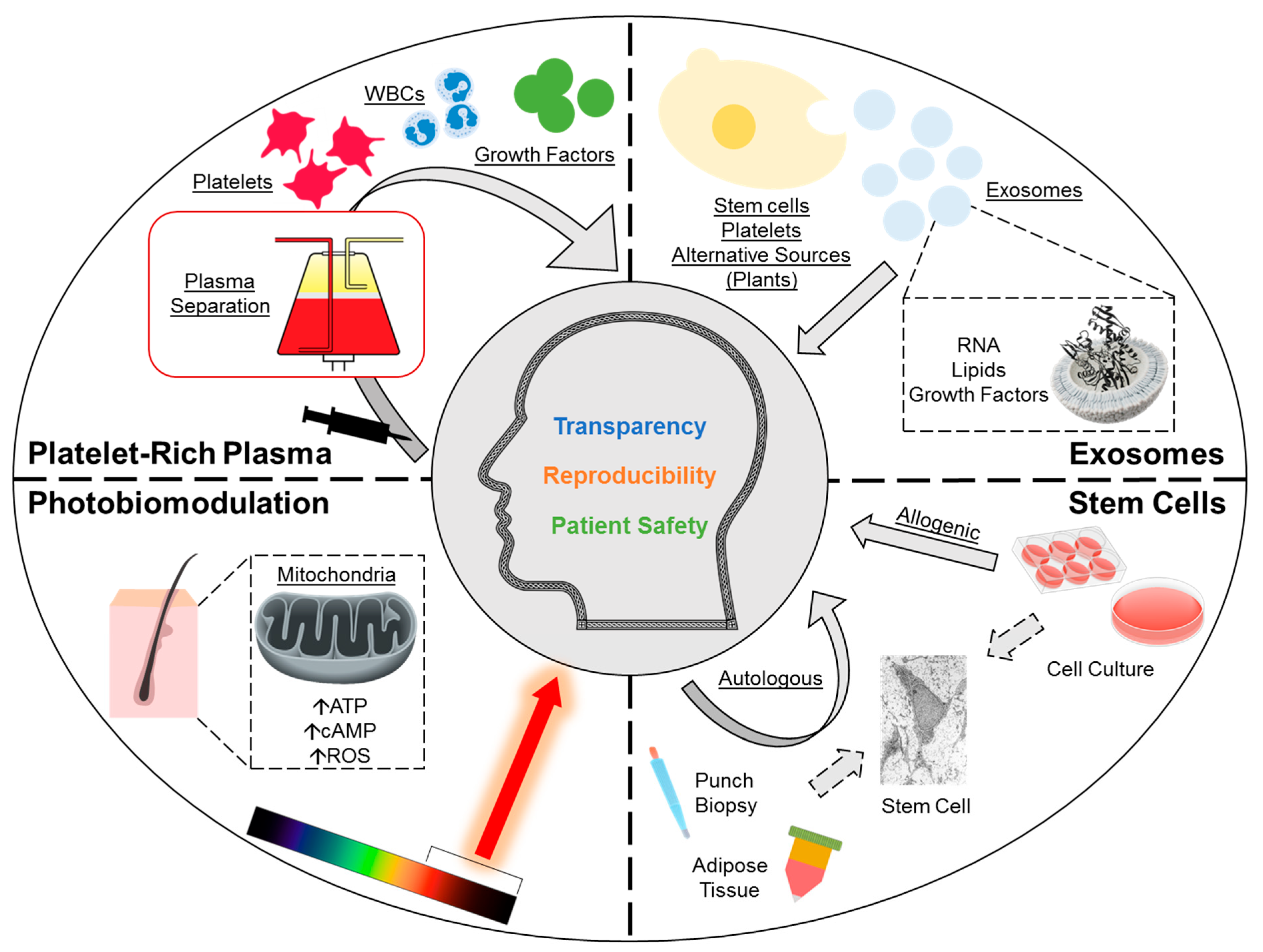

Promises and Pitfalls of Regenerative Therapies for Androgenetic Alopecia: Platelet-Rich Plasma, Photobiomodulation, Stem Cells, and Exosomes



Abstract
1. Introduction
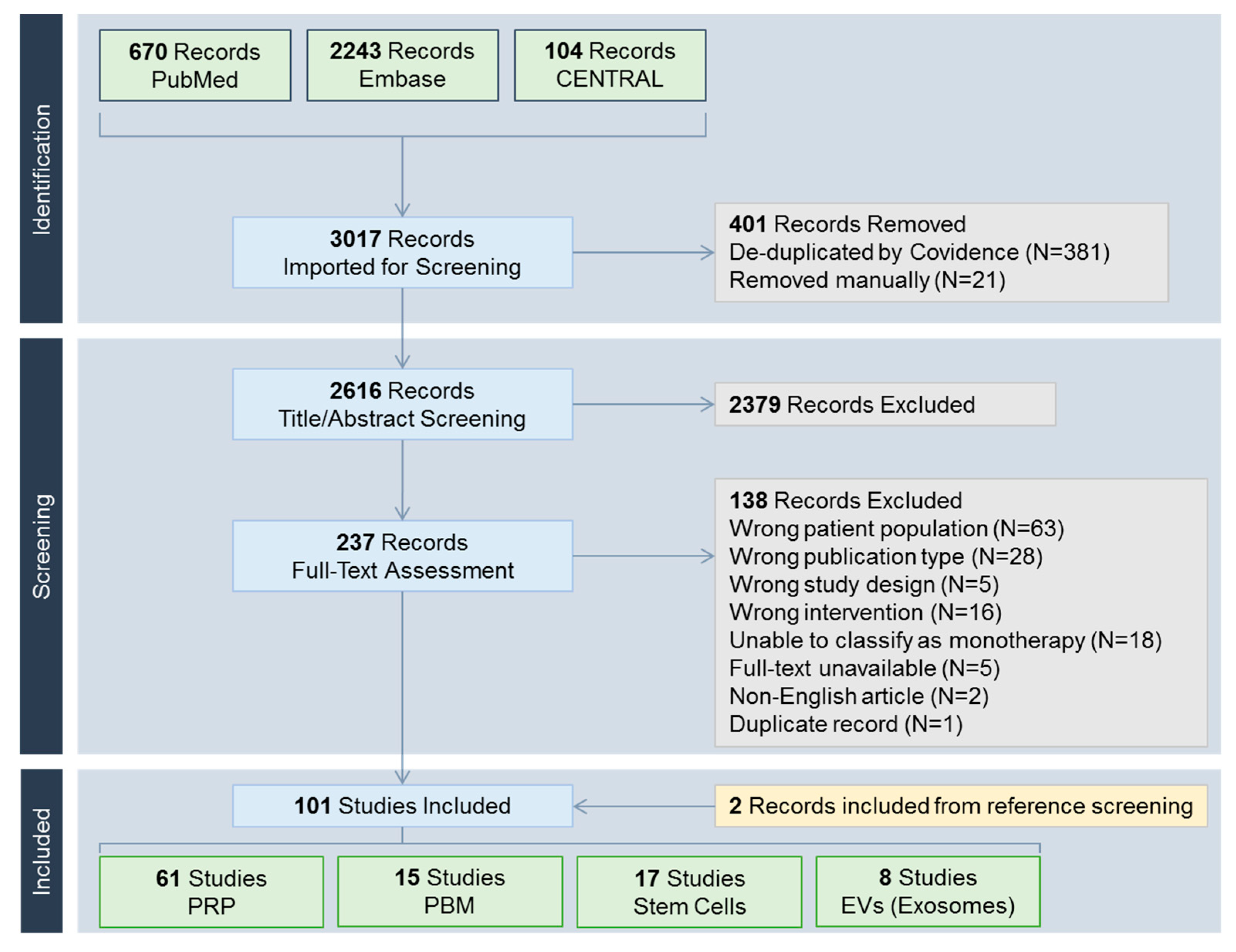
2. Materials and Methods
3. Results and Discussion
3.1. Platelet-Rich Plasma (PRP)
3.1.1. Mechanisms of Action
3.1.2. Clinical Studies
3.1.3. Adverse Events
3.1.4. Controversies
3.2. Photobiomodulation (PBM)
3.2.1. Mechanisms of Action
3.2.2. Clinical Studies
3.2.3. Adverse Events
3.2.4. Controversies
3.3. Stem Cells
3.3.1. Mechanisms of Action
3.3.2. Clinical Studies
3.3.3. Adverse Events
3.3.4. Controversies
3.4. Exosomes
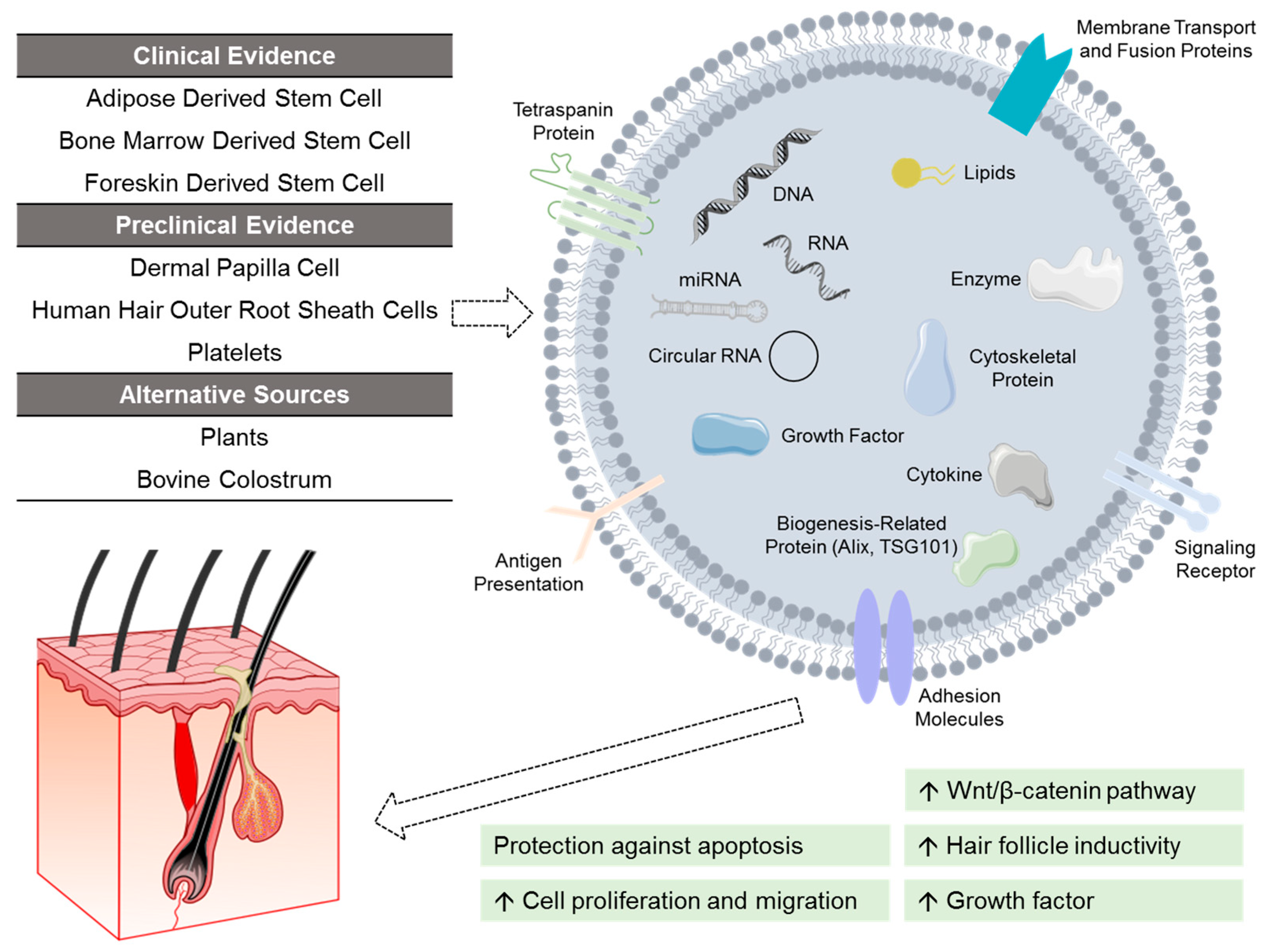
3.4.1. Mechanisms of Action
3.4.2. Clinical Studies
3.4.3. Adverse Events
3.4.4. Controversies
4. Conclusions
Supplementary Materials
Author Contributions
Funding
Institutional Review Board Statement
Data Availability Statement
Conflicts of Interest
References
- Gupta, A.K.; Cole, J.; Deutsch, D.P.; Everts, P.A.; Niedbalski, R.P.; Panchaprateep, R.; Rinaldi, F.; Rose, P.T.; Sinclair, R.; Vogel, J.E.; et al. Platelet-Rich Plasma as a Treatment for Androgenetic Alopecia. Dermatol. Surg. 2019, 45, 1262–1273. [Google Scholar] [CrossRef]
- Kourosh, A.S.; Santiago Mangual, K.P.; Farah, R.S.; Rao, M.; Hordinsky, M.K.; Arruda, S.; Sadick, N. Platelet-Rich Plasma: Advances and Controversies in Hair Restoration and Skin Rejuvenation. Dermatol. Surg. 2024, 50, 446–452. [Google Scholar] [CrossRef]
- Maghfour, J.; Mineroff, J.; Ozog, D.M.; Jagdeo, J.; Lim, H.W.; Kohli, I.; Anderson, R.; Kelly, K.M.; Mamalis, A.; Munavalli, G.; et al. Evidence-Based Consensus on the Clinical Application of Photobiomodulation. J. Am. Acad. Dermatol. 2025, 93, 429–443. [Google Scholar] [CrossRef]
- Keene, S.A. LLLT Part 3: Critically Assessing Recent Published LLLT Device Trials: Limitations, Recommendations, and Conclusions. Int. Soc. Hair Restor. Surg. 2015, 25, 102–105. [Google Scholar] [CrossRef]
- Gupta, A.K.; Wang, T.; Rapaport, J.A. Systematic Review of Exosome Treatment in Hair Restoration: Preliminary Evidence, Safety, and Future Directions. J. Cosmet. Dermatol. 2023, 22, 2424–2433. [Google Scholar] [CrossRef]
- Liu, Y.; Tosti, A.; Wang, E.C.E.; Heilmann-Heimbach, S.; Aguh, C.; Jimenez, F.; Lin, S.-J.; Kwon, O.; Plikus, M.V. Androgenetic Alopecia. Nat. Rev. Dis. Prim. 2025, 11, 73. [Google Scholar] [CrossRef]
- Tricco, A.C.; Lillie, E.; Zarin, W.; O’Brien, K.K.; Colquhoun, H.; Levac, D.; Moher, D.; Peters, M.D.J.; Horsley, T.; Weeks, L.; et al. PRISMA Extension for Scoping Reviews (PRISMA-ScR): Checklist and Explanation. Ann. Intern. Med. 2018, 169, 467–473. [Google Scholar] [CrossRef]
- Afzal, G.; Ahmed, N.; Zahoor, F.; Malik, T.; Farooq, O. Efficacy of Platelet-Rich Plasma versus 5% Topical Monixidil for the Treatment of Androgenetic Alopecia. J. Coll. Physicians Surg. 2024, 34, 11–15. [Google Scholar] [CrossRef]
- Ali Khan, A.; Goyal, N.; Gupta, K.; Agarwal, U.S.; Devanda, R.; Kaur Randhawa, N. Comparative Study of Minoxidil Solution (5%) and Platelet Rich Plasma in Male Pattern Hair Loss. Int. J. Life Sci. Biotechnol. Pharma Res. 2024, 13, 191–197. [Google Scholar]
- Butt, G.; Hussain, I.; Ahmad, F.J.; Choudhery, M.S. Stromal Vascular Fraction-Enriched Platelet-Rich Plasma Therapy Reverses the Effects of Androgenetic Alopecia. J. Cosmet. Dermatol. 2020, 19, 1078–1085. [Google Scholar] [CrossRef]
- Carvalho, J.F.; Santos, D.F.; Rocha, S.S.V.; Costa, M.M.; Shoenfeld, Y.; Abdalla, B.M.Z.; Criado, P.R. Platelet-Rich Plasma for Male Androgenetic Alopecia: Results from an Open Randomized Finasteride-Controlled Study. J. Appl. Cosmetol. 2020, 38, 37–44. [Google Scholar]
- Chuah, S.Y.; Tan, C.H.; Wang, E.C.E.; Tan, K.T.; Chan, R.K.W.; Zhao, X.; Lee, S.S.J. Efficacy of Platelet-Rich Plasma in Asians with Androgenetic Alopecia: A Randomized Controlled Trial. Indian J. Dermatol. Venereol. Leprol. 2023, 89, 135–138. [Google Scholar] [CrossRef]
- Dicle, Ö.; Bilgic Temel, A.; Gülkesen, K.H. Platelet-Rich Plasma Injections in the Treatment of Male Androgenetic Alopecia: A Randomized Placebo-Controlled Crossover Study. J. Cosmet. Dermatol. 2020, 19, 1071–1077. [Google Scholar] [CrossRef] [PubMed]
- Dubin, D.P.; Lin, M.J.; Leight, H.M.; Farberg, A.S.; Torbeck, R.L.; Burton, W.B.; Khorasani, H. The Effect of Platelet-Rich Plasma on Female Androgenetic Alopecia: A Randomized Controlled Trial. J. Am. Acad. Dermatol. 2020, 83, 1294–1297. [Google Scholar] [CrossRef] [PubMed]
- El-Husseiny, R.M.; Saleh, H.M.; Moustafa, A.A.; Salem, S.A. Comparison between Single- versus Double-Spin Prepared Platelet-Rich Plasma Injection in Treatment of Female Pattern Hair Loss: Clinical Effect and Relation to Vascular Endothelial Growth Factor. Arch. Dermatol. Res. 2021, 313, 557–566. [Google Scholar] [CrossRef] [PubMed]
- Gentile, P.; Garcovich, S. Autologous Activated Platelet-Rich Plasma (AA-PRP) and Non-Activated (A-PRP) in Hair Growth: A Retrospective, Blinded, Randomized Evaluation in Androgenetic Alopecia. Expert Opin. Biol. Ther. 2020, 20, 327–337. [Google Scholar] [CrossRef]
- Gressenberger, P.; Pregartner, G.; Gary, T.; Wolf, P.; Kopera, D. Platelet-Rich Plasma for Androgenetic Alopecia Treatment: A Randomized Placebo-Controlled Pilot Study. Acta Derm. Venereol. 2020, 100, 5858. [Google Scholar] [CrossRef]
- Haddad, N.; Arruda, S.; Swearingen, A.; Forouzan, E.; Sadick, N.S. Evaluating the Efficacy of Platelet Rich Plasma and 1550 Nm Fractional Laser in Combination and Alone for Management of Androgenetic Alopecia. J. Drugs Dermatol. 2022, 21, 1166–1169. [Google Scholar] [CrossRef]
- Hetz, S.P.; Martin, J.; Pototschnig, H. Patient Satisfaction and Clinical Effects of Platelet-Rich Plasma on Pattern Hair Loss in Male and Female Patients. Cureus 2022, 14, e28801. [Google Scholar] [CrossRef]
- Anees, M.; Tariq, H.; Batool, S.; Azam, N.B.; Mariam, I.; Aman, S. Efficacy of Platelet Rich Plasma Therapy in Patients of Androgenic Alopecia: A Myth or Fact! J. Pak. Assoc. Dermatol. 2023, 33, 841–845. [Google Scholar]
- Khoso, H.; Fahim, M. Comparison of Platelet Rich Therapy Alone with Platelet Rich Therapy Along with Daily Topical 5% Procapil Application for the Treatment of Androgenetic Alopecia. J. Ayub Med. Coll. 2024, 36, 299–304. [Google Scholar] [CrossRef]
- İşlek, A.; Karaaslan, E.; Şimşek, S.; Merve Çetin, F. Platelet-Rich Plasma Treatment for Accelerated Androgenetic Alopecia Pattern Hair Loss After COVID-19 Infection: A Case Series. J. Cosmet. Dermatol. 2022, 21, 590–594. [Google Scholar] [CrossRef]
- Ince, B.; Kendir, M.S.; Kilinc, I.; Avunduk, M.C.; Dadaci, M.; Savaci, N. Does Estradiol Level in Platelet-Rich Plasma Improve Efficacy of Androgenic Alopecia Treatment? Aesthetic Surg. J. 2020, 40, NP613–NP618. [Google Scholar] [CrossRef]
- Lotfi, E.; Aramianpour, N.; Salehi, B. Combination of Platelet-rich Plasma and Platelet Gel in Treatment of Resistance Androgenic Alopecia: A Case Series Study. J. Cosmet. Dermatol. 2022, 21, 4307–4312. [Google Scholar] [CrossRef]
- Linkov, G.; Sukhdeo, K.; Grand, E. A Novel Needleless Delivery System for Scalp Platelet-Rich Plasma: Pilot Study. Dermatol. Surg. 2022, 48, 474–476. [Google Scholar] [CrossRef] [PubMed]
- Leonik, S.; Smoczok, M.; Bergler-Czop, B. Evaluation of the Efficacy of Microneedling without and with Minoxidil 5% and Autologous Platelet-Rich Plasma for Androgenetic Alopecia in Men. Postep. Dermatol. I Alergol. 2024, 41, 505–514. [Google Scholar] [CrossRef] [PubMed]
- Singh, S.K.; Kumar, V.; Rai, T. Comparison of Efficacy of Platelet-Rich Plasma Therapy with or without Topical 5% Minoxidil in Male-Type Baldness: A Randomized, Double-Blind Placebo Control Trial. Indian J. Dermatol. Venereol. Leprol. 2020, 86, 150–157. [Google Scholar] [CrossRef] [PubMed]
- Kapoor, R.; Shome, D.; Vadera, S.; Ram, M.S. QR 678 & QR678 Neo Vs PRP-A Randomised, Comparative, Prospective Study. J. Cosmet. Dermatol. 2020, 19, 2877–2885. [Google Scholar] [CrossRef]
- Makki, M.; Younes, A.K.H.; Salah, I. Evaluation of the Effect of Autologous Platelet-Rich Plasma on Androgenic Alopecia. J. Cosmet. Laser Ther. 2020, 22, 190–194. [Google Scholar] [CrossRef]
- Maletic, A.; Dumic-Cule, I.; Brlek, P.; Zic, R.; Primorac, D. Autologous Platelet-Rich Plasma (PRP) for Treating Androgenetic Alopecia: A Novel Treatment Protocol Standardized on 2 Cases. J. Clin. Med. 2022, 11, 7327. [Google Scholar] [CrossRef]
- Anjum, R.; Hassan, T.; Shahzad, M.K.; Hanif, N.; Anjum, Z.; Rukh, G.-E. Efficacy Differences of Platelet Rich Plasma for Treatment of Androgenetic Alopecia between Men and Women. Pak. J. Med. Health Sci. 2023, 17, 85–87. [Google Scholar] [CrossRef]
- Marin, A.; Băloi, S.E.; Ion, D.; Andrei, C.L.; Marinescu, S.A.; Burcea-Dragomiroiu, G.T.A.; Giuglea, C. Clinical Assessment of the Therapeutic Options for Alopecia Treatment. Farmacia 2021, 69, 1120–1127. [Google Scholar] [CrossRef]
- Moftah, N.H.; Taha, N.E.E.; Alhabibi, A.M.; Hamdino, M. Different Platelet-Rich Plasma Preparation Protocols in Female Pattern Hair Loss: Does It Affect the Outcome? A Pilot Study. J. Cosmet. Dermatol. 2022, 21, 3316–3326. [Google Scholar] [CrossRef] [PubMed]
- Okita, A.L.; Steiner, D.; Berbert Ferreira, S.; Müller Ramos, P.; Ferreira, W.; Silveira, R.; Mussi, M.L.; Vaidergorn, R.E.; Berbert Ferreira, R. Treatment of Male-Pattern Alopecia with Platelet-Rich Plasma. Skin Appendage Disord. 2020, 6, 97–101. [Google Scholar] [CrossRef]
- Pakhomova, E.E.; Smirnova, I.O. Comparative Evaluation of the Clinical Efficacy of PRP-Therapy, Minoxidil, and Their Combination with Immunohistochemical Study of the Dynamics of Cell Proliferation in the Treatment of Men with Androgenetic Alopecia. Int. J. Mol. Sci. 2020, 21, 6516. [Google Scholar] [CrossRef]
- Paththinige, N.D.; Akarawita, J.K.W.; Jeganathan, G. The Clinical Efficacy and Safety of Autologous Activated Platelet-Rich Plasma Injection in Androgenetic Alopecia. Skin Appendage Disord. 2020, 6, 19–24. [Google Scholar] [CrossRef]
- Peng, X.-L.; Li, S.-W.; Zhou, X.-Q.; Zhu, K.-X.; Ni, X.-R.; Qi, X.-D. A Prospective Self-Controlled Clinical Trial of Nonactivated Low Leukocyte PRP in Female Pattern Hair Loss Patients of Childbearing Age. Dermatol. Surg. 2024, 50, 926–930. [Google Scholar] [CrossRef]
- Potdar, S.; Gosavi, A.; Chavan, R.; Ramawanshi, S.; Borade, S. Evaluation of Hair Regrowth in Men with Androgenetic Alopecia Treated with Autologous Platelet-Rich Plasma. Przegl. Dermatol. 2022, 109, 185–203. [Google Scholar] [CrossRef]
- Qu, Q.; Zhou, Y.; Shi, P.; Du, L.; Fan, Z.; Wang, J.; Li, X.; Chen, J.; Zhu, D.; Ye, K.; et al. Platelet-Rich Plasma for Androgenic Alopecia: A Randomized, Placebo-Controlled, Double-Blind Study and Combined Mice Model Experiment. J. Cosmet. Dermatol. 2021, 20, 3227–3235. [Google Scholar] [CrossRef] [PubMed]
- Ruthvik, S.; John, R.S.; George, M.; Kumar, S.P.; Krishnan, M. Comparison of Efficacy of Platelet-Rich Plasma with and Without Topical Minoxidil for Hair Growth in Patients With Androgenetic Alopecia: A Prospective Study. Cureus 2024, 16, e53875. [Google Scholar] [CrossRef]
- Sasaki, G.H. The Effects of Lower vs Higher Cell Number of Platelet-Rich Plasma (PRP) on Hair Density and Diameter in Androgenetic Alopecia (AGA): A Randomized, Double-Blinded, Placebo, Parallel-Group Half-Scalp IRB-Approved Study. Aesthetic Surg. J. 2021, 41, NP1659–NP1672. [Google Scholar] [CrossRef]
- Asim, M.; Shah, R.; Sharif, S.; Ouellette, S.; Shah, A.; Rao, B. A Randomized Control Trial Comparing the Efficacy of Platelet-Rich Plasma and 5% Topical Minoxidil for the Treatment of Androgenetic Alopecia. J. Drugs Dermatol. 2023, 22, 905–909. [Google Scholar]
- Shapiro, J.; Ho, A.; Sukhdeo, K.; Yin, L.; Lo Sicco, K. Evaluation of Platelet-Rich Plasma as a Treatment for Androgenetic Alopecia: A Randomized Controlled Trial. J. Am. Acad. Dermatol. 2020, 83, 1298–1303. [Google Scholar] [CrossRef]
- Sharma, S.; Vhadra, B.; Quinlan, D.J.; Shatta, B.; Hassan, H. Injectable Platelet-Rich Fibrin for Treatment of Female Pattern Hair Loss. J. Cosmet. Laser Ther. 2024, 26, 17–25. [Google Scholar] [CrossRef]
- Shashank, B.; Bhushan, M. Injectable Platelet-Rich Fibrin (PRF): The Newest Biomaterial and Its Use in Various Dermatological Conditions in Our Practice: A Case Series. J. Cosmet. Dermatol. 2021, 20, 1421–1426. [Google Scholar] [CrossRef]
- Siah, T.W.; Guo, H.; Chu, T.; Santos, L.; Nakamura, H.; Leung, G.; Shapiro, J.; McElwee, K.J. Growth Factor Concentrations in Platelet-rich Plasma for Androgenetic Alopecia: An Intra-subject, Randomized, Blinded, Placebo-controlled, Pilot Study. Exp. Dermatol. 2020, 29, 334–340. [Google Scholar] [CrossRef] [PubMed]
- Singh, S.K.; Singh, S. Effect of Platelet Counts and Activator in Platelet-Rich Plasma on the Treatment of Androgenetic Alopecia, Split-Head Comparison: A Randomised, Double-Blind Study. Indian J. Dermatol. Venereol. Leprol. 2023, 89, 647–655. [Google Scholar] [CrossRef] [PubMed]
- Sorce, M.; Pistone, G.; Mazzola, G.; Patti, I.; Bongiorno, M.R. Autologous Platelet-Rich Plasma in the Treatment of Androgenetic Alopecia: Results of a 54-Patient Prospective Study. Skinmed 2021, 19, 189–196. [Google Scholar] [PubMed]
- Stefanis, A.J.; Arenberger, P.; Arenbergerova, M.; Rigopoulos, D. Efficacy of Platelet-Rich Plasma versus Mesotherapy with Recombinant Growth Factors and Stem Cell-Conditioned Media in Androgenetic Alopecia: A Retrospective Study. Skin Appendage Disord. 2024, 10, 376–382. [Google Scholar] [CrossRef]
- Sultana, B.B.; Paul, H.K. Efficacy and Safety of Platelet Rich Plasma Therapy in Male Androgenetic Alopecia. J. Pak. Assoc. Dermatol. 2020, 30, 375–381. [Google Scholar]
- Tawfik, A.; Gahdan, N.; Nosseir, M. Fractional CO2 Laser, Platelet Rich Plasma and Combination of Both in Treatment of Female Pattern Hair Loss. J. Egypt. Women’s Dermatol. Soc. 2024, 21, 144–154. [Google Scholar] [CrossRef]
- Tawfik, C.; Tejeda, C.I.; Haughton, A.M. Case Series Evaluating the Efficacy and Safety of Platelet-Rich Plasma for Androgenetic Alopecia in Pediatric Patients. JAAD Case Rep. 2023, 37, 8–12. [Google Scholar] [CrossRef]
- Balasundaram, M.; Kumari, R.; Ramassamy, S. Efficacy of Autologous Platelet-Rich Plasma Therapy versus Topical Minoxidil in Men with Moderate Androgenetic Alopecia: A Randomized Open-Label Trial. J. Dermatol. Treat. 2023, 34, 2182618. [Google Scholar] [CrossRef]
- Wei, W.; Zhang, Y.; Long, B.; Zhang, Y.; Zhang, C.; Zhang, S. Injections of Platelet-Rich Plasma Prepared by Automatic Blood Cell Separator Combined with Topical 5% Minoxidil in the Treatment of Male Androgenetic Alopecia. Skin Res. Technol. 2023, 29, e13315. [Google Scholar] [CrossRef]
- Yao, S.; Chen, X.; Li, S.; Zhou, L.; Bai, Q.; Zhao, C.; Huang, S. New Tool in Our Arsenal: Efficacy of Injectable Platelet-Rich Fibrin (i-PRF) in Androgenetic Alopecia Treatment. Arch. Dermatol. Res. 2025, 317, 493. [Google Scholar] [CrossRef]
- Khaled Yaseer, S.; Jamil Hassan, F.; Badi Suleiman, H. Efficacy of Platelet Rich Plasma Intradermal Injections for Androgenetic Alopecia Treatment in Males: A Before and after Study. Actas Dermo-Sifiliográficas (Engl. Ed.) 2020, 111, 574–578. [Google Scholar] [CrossRef]
- Zhang, Q.; Wang, Y.; Ran, C.; Zhou, Y.; Zhao, Z.; Xu, T.; Hou, H.; Lu, Y. Characterization of Distinct Microbiota Associated with Androgenetic Alopecia Patients Treated and Untreated with Platelet-rich Plasma (PRP). Anim. Models Exp. Med. 2024, 7, 106–113. [Google Scholar] [CrossRef]
- Zhou, Y.; Liu, Q.; Bai, Y.; Yang, K.; Ye, Y.; Wu, K.; Huang, J.; Zhang, Y.; Zhang, X.; Thianthanyakij, T.; et al. Autologous Activated Platelet-Rich Plasma in Hair Growth: A Pilot Study in Male Androgenetic Alopecia with in Vitro Bioactivity Investigation. J. Cosmet. Dermatol. 2021, 20, 1221–1230. [Google Scholar] [CrossRef] [PubMed]
- Nguyen, L.V.; Nguyen, T.T.T. Effectiveness of Autologous Platelet-Rich Plasma for Androgenetic Alopecia: A Double-Center, Non-Controlled, Randomized Clinical Study in Vietnam. Clin. Cosmet. Investig. Dermatol. 2025, 18, 1645–1656. [Google Scholar] [CrossRef]
- Koç Babayiğit, F.; Kartal, D.; Çinar, S.L.; Borlu, M. Effects of Platelet-Rich Plasma Application on Hair Follicle Count, Telogen/Anagen Ratio, and Miniaturized Hair Ratio in Patients with Androgenic Alopecia: Alone or in Combination with Other Treatments. J. Dermatol. Treat. 2025, 36, 2528343. [Google Scholar] [CrossRef] [PubMed]
- Brinks, A.; Desai, D.D.; Needle, C.; Kearney, C.A.; Nohria, A.; Sikora, M.; Oh, C.S.; Anyanwu, N.; Shapiro, J.; Lo Sicco, K.I. Evaluating the Accuracy of Patient-Reported Hair Outcomes versus Trichometric Measurements in PRP Therapy. Arch. Dermatol. Res. 2025, 317, 772. [Google Scholar] [CrossRef]
- Farooqi, M.; Sayed, J.; Sayed, S.; Imran, O. Evaluating the Effectiveness of Injectable Platelet-Rich Fibrin in Androgenetic Alopecia Management. Int. J. Pharm. Res. Technol. 2025, 15, 2339–2350. [Google Scholar]
- Khan, A.M.; Chawdhary, A.A.; Attar, J.R.; Gawali, M.; Panakaje, M.S.; Misra, K.K.; Datla, P.K.V. Evaluation of Role and Efficacy of Autologous Platelet-Rich Plasma Injection Treatment for Hair Loss: A Prospective Clinical Trial. J. Pharm. Bioallied Sci. 2025, 17, S2381–S2383. [Google Scholar] [CrossRef]
- Batni, K.; Khetan, D.; Bhatnagar, A.; Chaudhary, R.K.; Verma, A. Novel Method for Preparation of Autologous Leucocyte Rich Platelet-Rich Plasma (L-PRP) under Closed System and Assessment of Its Clinical Efficacy in Androgenetic Alopecia—A Retrospective Cohort Study. J. Plast. Reconstr. Aesthetic Surg. 2025, 103, 128–139. [Google Scholar] [CrossRef]
- Nilforoushzadeh, M.A.; Roohaninasab, M.; Behrangi, E.; Jafarzadeh, A.; Nouri, M.; Zare, S.; Zare, S. Phase I Clinical Trial: Evaluating the Efficacy, Safety, and Patient Satisfaction of Platelet-Rich Plasma (PRP) Injections and Microneedling for Androgenetic Alopecia Treatment. J. Cosmet. Dermatol. 2025, 24, e70408. [Google Scholar] [CrossRef]
- Behrangi, E.; Rahimi, S.T.; Zare, S.; Goodarzi, A.; Ghassemi, M.; Khodadad, F.; Nouri, M.; Mozafarpoor, S.; Dehghani, A.; Nilforoushzadeh, M.A.; et al. Evaluation of the Effects of Adding an Adipose Tissue-Derived Stromal Vascular Fraction to Platelet-Rich Plasma Injection in the Treatment of Androgenetic Alopecia: A Randomized Clinical Trial. Skin Res. Technol. 2024, 30, e13700. [Google Scholar] [CrossRef] [PubMed]
- Bruce, A.J.; Pincelli, T.P.; Heckman, M.G.; Desmond, C.M.; Arthurs, J.R.; Diehl, N.N.; Douglass, E.J.; Bruce, C.J.; Shapiro, S.A. A Randomized, Controlled Pilot Trial Comparing Platelet-Rich Plasma to Topical Minoxidil Foam for Treatment of Androgenic Alopecia in Women. Dermatol. Surg. 2020, 46, 826–832. [Google Scholar] [CrossRef]
- Budania, A.; Mandal, S.; Agrawal, A.; Lahoria, U.; Pathania, Y.S. A Split Scalp Study to Evaluate the Effects of Platelet Rich Plasma Prepared by Two Different Methods in Androgenetic Alopecia. Australas. J. Dermatol. 2023, 64, 278–281. [Google Scholar] [CrossRef] [PubMed]
- Mahe, Y.F.; Cheniti, A.; Tacheau, C.; Antonelli, R.; Planard-Luong, L.; de Bernard, S.; Buffat, L.; Barbarat, P.; Kanoun-Copy, L. Low-Level Light Therapy Downregulates Scalp Inflammatory Biomarkers in Men with Androgenetic Alopecia and Boosts Minoxidil 2% to Bring a Sustainable Hair Regrowth Activity. Lasers Surg. Med. 2021, 53, 1208–1219. [Google Scholar] [CrossRef] [PubMed]
- Yoon, J.S.; Ku, W.Y.; Lee, J.H.; Ahn, H.C. Low-Level Light Therapy Using a Helmet-Type Device for the Treatment of Androgenetic Alopecia:A 16-Week, Multicenter, Randomized, Double-Blind, Sham Device-Controlled Trial. Medicine 2020, 99, E21181. [Google Scholar] [CrossRef]
- Liu, Y.; Jiang, L.L.; Liu, F.; Qu, Q.; Fan, Z.X.; Guo, Z.; Miao, Y.; Hu, Z. qi Comparison of Low-Level Light Therapy and Combination Therapy of 5% Minoxidil in the Treatment of Female Pattern Hair Loss. Lasers Med. Sci. 2021, 36, 1085–1093. [Google Scholar] [CrossRef]
- Kim, J.H.; Son, H.S.; Yu, D.-A.; Choe, Y.B.; Lee, Y.W. Assessment of Effects of Low-Level Light Therapy on Scalp Condition and Hair Growth. Indian J. Dermatol. 2023, 68, 487–492. [Google Scholar] [CrossRef]
- Gemeda, M.; Raymond, O.; Bohjanen, S.; Farah, R.; Hordinsky, M. Participant Satisfaction Survey Outcomes in a Comparative At-Home Photobiomodulation Device Study for Hair Loss. J. Am. Acad. Dermatol. 2023, 89, AB203. [Google Scholar] [CrossRef]
- Chandrashekar, B.; Lobo, O.C.; Fusco, I.; Madeddu, F.; Zingoni, T. The Effectiveness of 675 Nm Wavelength Laser Therapy in the Treatment Androgenetic Alopecia among Indian Patients. JMIR Dermatol. 2024, 7, e60858. [Google Scholar] [CrossRef]
- Cao, Z.; Liu, X.; Zhang, L.; Zhang, Y.; Zhou, Z.; Zhang, G.; Wang, P.; Hu, W.; Wang, X. Treatment of Androgenetic Alopecia with 5-Aminolevulinic Acid Photodynamic Therapy: A Randomized, Placebo-Controlled, Split-Scalp Study of Efficacy and Safety. Photodiagnosis Photodyn. Ther. 2021, 36, 102491. [Google Scholar] [CrossRef]
- Eitta, M.A.; Sadek, A.; Amer, N.A.; Samy, N.; Abdallah, N. Efficacy Of Photobiomodulation Versus Its Combination with Plasma Rich Growth Factors or Minoxidil in Management of Androgenetic Alopecia. NeuroQuantology 2022, 20, 3860–3871. [Google Scholar]
- Amer, M.; Nassar, A.; Attallah, H.; Amer, A. Results of Low-Level Laser Therapy in the Treatment of Hair Growth: An Egyptian Experience. Dermatol. Ther. 2021, 34, e14940. [Google Scholar] [CrossRef] [PubMed]
- Tantiyavarong, J.; Charoensuksira, S.; Meephansan, J.; Hanvivattanakul, S.; Rayanasukha, Y.; Boonkoom, T.; Tantisantisom, K. Red and Green LED Light Therapy: A Comparative Study in Androgenetic Alopecia. Photodermatol. Photoimmunol. Photomed. 2024, 40, e13004. [Google Scholar] [CrossRef]
- Thomas, M.; Stockslager, M.; Oakley, J.; Womble, T.M.; Sinclair, R. Clinical Safety and Efficacy of Dual Wavelength Low-Level Light Therapy in Androgenetic Alopecia: A Double-Blind Randomized Controlled Study. Dermatol. Surg. 2025, 51, 416–421. [Google Scholar] [CrossRef]
- Sorbellini, E.; Fusco, I.; Madeddu, F.; Libra, M. Experience of Novelty Laser Therapy Emission with 675 Nm Wavelength for the Treatment of Androgenetic Alopecia in Male and Female Patients: A Case Series Study. Photobiomodulation Photomed. Laser Surg. 2023, 41, 265–271. [Google Scholar] [CrossRef] [PubMed]
- Qiu, J.; Yi, Y.; Jiang, L.; Miao, Y.; Jia, J.; Zou, J.; Hu, Z. Efficacy Assessment for Low-Level Laser Therapy in the Treatment of Androgenetic Alopecia: A Real-World Study on 1383 Patients. Lasers Med. Sci. 2022, 37, 2589–2594. [Google Scholar] [CrossRef] [PubMed]
- Lodi, G.; Sannino, M.; Cannarozzo, G.; Giudice, A.; Del Duca, E.; Tamburi, F.; Bennardo, L.; Nisticò, S.P. Blue Light-Emitting Diodes in Hair Regrowth: The First Prospective Study. Lasers Med. Sci. 2021, 36, 1719–1723. [Google Scholar] [CrossRef] [PubMed]
- Neema, S.; Mannu, A.; Vasudevan, B.; Sandhu, S.; Vendhan, S.; Radhakrishnan, S. Low-Level Light Therapy versus Topical 5% Minoxidil in the Management of Androgenetic Alopecia in Males: A Randomised Controlled Trial. Med. J. Armed Forces India 2024, 81, 445–452. [Google Scholar] [CrossRef] [PubMed]
- Tak, Y.J.; Lee, S.Y.; Cho, A.R.; Kim, Y.S. A Randomized, Double-Blind, Vehicle-Controlled Clinical Study of Hair Regeneration Using Adipose-Derived Stem Cell Constituent Extract in Androgenetic Alopecia. Stem Cells Transl. Med. 2020, 9, 839–849. [Google Scholar] [CrossRef]
- Nilforoushzadeh, M.A.; Lotfi, E.; Heidari-Kharaji, M.; Torkamaniha, E.; Hanifnia, A.R. Autologous Whole Fat Injection Stimulates Hair Growth in Resistant Androgenetic Alopecia: Report of Nine Cases. J. Cosmet. Dermatol. 2021, 20, 2480–2485. [Google Scholar] [CrossRef]
- Gentile, P.; Scioli, M.G.; Cervelli, V.; Orlandi, A.; Garcovich, S. Autologous Micrografts from Scalp Tissue: Trichoscopic and Long-Term Clinical Evaluation in Male and Female Androgenetic Alopecia. BioMed Res. Int. 2020, 2020, 7397162. [Google Scholar] [CrossRef]
- Harada, K.; Ohyama, M.; Niiyama, S.; Irisawa, R.; Mae, K.; Mori, M.; Wakimoto, H.; Kinoshita-Ise, M.; Fukuyama, M.; Hayakawa, R.; et al. Efficacy of Autologous Dermal Sheath Cup Cell Transplantation in Male and Female Pattern Hair Loss: A Single-Arm, Multi-Center, Phase III Equivalent Clinical Study. J. Dermatol. 2023, 50, 1539–1549. [Google Scholar] [CrossRef]
- Gentile, P.; Garcovich, S.; Perego, F.; Arsiwala, N.; Yavuz, M.F.; Pessei, V.; Pusceddu, T.; Zavan, B.; Arsiwala, S. Autologous Micrografts Containing Nanovesicles, Exosomes, and Follicle Stem Cells in Androgenetic Alopecia: In Vitro and In Vivo Analysis Through a Multicentric, Observational, Evaluator-Blinded Study. Aesthetic Plast. Surg. 2025, 49, 43–58. [Google Scholar] [CrossRef]
- Ruiz, R.G.; Rosell, J.M.C.; Ceccarelli, G.; De Sio, C.; De Angelis, G.C.; Pinto, H.; Astarita, C.; Graziano, A. Progenitor-cell-enriched Micrografts as a Novel Option for the Management of Androgenetic Alopecia. J. Cell. Physiol. 2020, 235, 4587–4593. [Google Scholar] [CrossRef]
- Vincenzi, C.; Cameli, N.; Pessei, V.; Tosti, A. Role of Autologous Micrografting Technology through Rigenera ® System in the Treatment of Androgenetic Alopecia. Ski. Appendage Disord. 2024, 11, 119–127. [Google Scholar] [CrossRef]
- Legiawati, L.; Sitohang, I.B.S.; Yusharyahya, S.N.; Sirait, S.P.; Novianto, E.; Liem, I.K.; Kurniawati, T.; Putri, I.S.; Rahmadika, F.D.; Hakiki, N.P.; et al. Hair Regeneration in Androgenetic Alopecia Using Secretome of Adipose-Derived Stem Cells (ADSC) and Minoxidil: A Comparative Study of Three Groups. Arch. Dermatol. Res. 2025, 317, 486. [Google Scholar] [CrossRef]
- Zhang, Z.; Chen, N.; Xiao, L.; Li, K.; Liu, H. Injection of the Concentrate Derived from Nanofat Graft Promotes Hair Growth in Patients of Male Androgenetic Alopecia: A Clinical Pilot Study. Aesthetic Plast. Surg. 2025, 49, 5548–5558. [Google Scholar] [CrossRef]
- Mathen, C.; Dsouza, W. In Vitro and Clinical Evaluation of Umbilical Cord-derived Mesenchymal Stromal Cell-conditioned Media for Hair Regeneration. J. Cosmet. Dermatol. 2022, 21, 740–749. [Google Scholar] [CrossRef]
- Krefft-Trzciniecka, K.; Cisoń, H.; Pakiet, A.; Nowicka, D.; Szepietowski, J.C. Enhancing Quality of Life and Sexual Functioning in Female Androgenetic Alopecia: Therapeutic Potential of Hair Follicle-Derived Stem Cells. Healthcare 2024, 12, 608. [Google Scholar] [CrossRef]
- Krefft-Trzciniecka, K.; Piętowska, Z.; Pakiet, A.; Nowicka, D.; Szepietowski, J.C. Short-Term Clinical Assessment of Treating Female Androgenetic Alopecia with Autologous Stem Cells Derived from Human Hair Follicles. Biomedicines 2024, 12, 153. [Google Scholar] [CrossRef]
- Ishimatsu-Tsuji, Y.; Niiyama, S.; Irisawa, R.; Harada, K.; Kishimoto, J.; Tsuboi, R. High Migratory Activity of Dermal Sheath Cup Cells Associated with the Clinical Efficacy of Autologous Cell-Based Therapy for Pattern Hair Loss. J. Dermatol. Sci. 2024, 113, 26–33. [Google Scholar] [CrossRef]
- Tsuboi, R.; Niiyama, S.; Irisawa, R.; Harada, K.; Nakazawa, Y.; Kishimoto, J. Autologous Cell–Based Therapy for Male and Female Pattern Hair Loss Using Dermal Sheath Cup Cells: A Randomized Placebo-Controlled Double-Blinded Dose-Finding Clinical Study. J. Am. Acad. Dermatol. 2020, 83, 109–116. [Google Scholar] [CrossRef] [PubMed]
- Gan, Y.; Du, L.; Wang, H.; Li, K.; Fan, Z.; Sun, P.; Zhang, J.; Hu, Z.; Miao, Y. A Clinical Trial of Treating Androgenic Alopecia with Mesenchymal Stem Cell Suspension Derived from Autologous Hair Follicle. Plast. Reconstr. Surg. 2024, 154, 444e–450e. [Google Scholar] [CrossRef] [PubMed]
- El-Khalawany, M.; Rageh, M.A.; Elnokrashy, I.; Ibrahim, S.M.A. Efficacy of Autologous Stromal Vascular Fraction Injection in the Treatment of Androgenic Alopecia. Arch. Dermatol. Res. 2022, 315, 1269–1276. [Google Scholar] [CrossRef]
- Coban, Y.K. A Preliminary Result of Adipose Derived Stem Cell Treatment for Female Pattern Hair Loss. J. Cosmet. Dermatol. 2022, 21, 1303–1304. [Google Scholar] [CrossRef] [PubMed]
- Ersan, M.; Ozer, E.; Akin, O.; Tasli, P.N.; Sahin, F. Effectiveness of Exosome Treatment in Androgenetic Alopecia: Outcomes of a Prospective Study. Aesthetic Plast. Surg. 2024, 48, 4262–4271. [Google Scholar] [CrossRef]
- Lee, E.; Choi, M.S.; Cho, B.S.; Won, Y.J.; Lee, J.H.; Kim, S.R.; Kim, M.H.; Jeon, J.H.; Park, G.H.; Kwon, H.H.; et al. The Efficacy of Adipose Stem Cell-Derived Exosomes in Hair Regeneration Based on a Preclinical and Clinical Study. Int. J. Dermatol. 2024, 63, 1212–1220. [Google Scholar] [CrossRef] [PubMed]
- Nadeem, H.; Mahrukh; Farhan, F.; Rafay Mahmood, A.; ul Munam, A.; Gul, M.; Zafar, S.; Haleema, S. Exploring the Efficacy and Therapeutic Potential of Mesenchymal Stem Cell-Derived Exosomes for the Treatment of Androgenetic Alopecia. J. Popul. Ther. Clin. Pharmacol. 2024, 31, 1752–1760. [Google Scholar] [CrossRef]
- Park, B.S.; Choi, H.I.; Huh, G.; Kim, W.S. Effects of Exosome from Adipose-Derived Stem Cell on Hair Loss: A Retrospective Analysis of 39 Patients. J. Cosmet. Dermatol. 2022, 21, 2282–2284. [Google Scholar] [CrossRef] [PubMed]
- Sasaki, G.H. Clinical Use of Extracellular Vesicles in the Management of Male and Female Pattern Hair Loss: A Preliminary Retrospective Institutional Review Board Safety and Efficacy Study. Aesthetic Surg. J. Open Forum 2022, 4, ojac045. [Google Scholar] [CrossRef] [PubMed]
- Wan, J.; Kim, S.-B.; Cartier, H.; Garson, S.; Frank, K.; Haykal, D.; Yi, K.-H. A Prospective Study of Exosome Therapy for Androgenetic Alopecia. Aesthetic Plast. Surg. 2025, 49, 3151–3156. [Google Scholar] [CrossRef]
- Wortsman, X.; Quezada, N. Color Doppler Ultrasound Pattern of Cutaneous Exosomes at High and Ultra-High Frequency. J. Ultrasound Med. 2025, 44, 2355–2360. [Google Scholar] [CrossRef]
- Cao, Z.; Li, P.; Zhang, M.; Cai, S.; Li, N.; Luo, M.; Li, Y.; Wu, H.; Mao, X.; Ren, R.; et al. Erythrocyte Extracellular Vesicles Amalgamate into the Hair and Skin to Maintain Homeostasis. J. Extracell. Vesicles 2025, 14, e70080. [Google Scholar] [CrossRef]
- Bigby, M.; Grimalt, R. Platelet-Rich Plasma Lacks Evidence of Clinically Significant Improvement in Androgenetic Alopecia. J. Am. Acad. Dermatol. 2021, 84, 1183–1185. [Google Scholar] [CrossRef]
- Hooper, D. Platelet-Rich Plasma Has a Place in the Treatment of Androgenetic Alopecia. J. Am. Acad. Dermatol. 2021, 84, 1186–1187. [Google Scholar] [CrossRef]
- Lin, J.; Sclafani, A.P. Platelet-Rich Plasma for Skin Rejuvenation and Tissue Fill. Facial Plast. Surg. Clin. N. Am. 2018, 26, 439–446. [Google Scholar] [CrossRef]
- Shaik, J.A.; Estharabadi, N.; Farah, R.S.; Hordinsky, M.K. Heterogeneity in Amount of Growth Factors Secreted by Platelets in Platelet-rich Plasma Samples from Alopecia Patients. Exp. Dermatol. 2020, 29, 1004–1011. [Google Scholar] [CrossRef] [PubMed]
- Inyang, M.; Shaik, J.A.; Hussain, N.; Hordinsky, M.; Sadick, N.; Gregorich, G.; Asiala, J.; Freese, R.; Farah, R.S. Inconsistent Platelet-Rich Plasma Product from Devices Cleared by the US FDA: A Retrospective Review of Clinic Data. J. Am. Acad. Dermatol. 2021, 85, 788–790. [Google Scholar] [CrossRef]
- Proffer, S.L.; Wyles, S.P.; Hausauer, A.K. Update on Platelet-Rich Plasma and Platelet-Rich Fibrin for Dermatologic Surgery: Addressing Knowns and Unknowns. Dermatol. Surg. 2024, 50, S149–S159. [Google Scholar] [CrossRef]
- Ren, J.; Sun, J.; Li, Z.; Zhao, Y.; Tuan, H. The Impact of Growth Factors in Platelet-Rich Plasma Combination Therapy for Androgenic Alopecia. Dermatol. Ther. 2024, 2024, 8452387. [Google Scholar] [CrossRef]
- Pozo-Pérez, L.; Tornero-Esteban, P.; López-Bran, E. Clinical and Preclinical Approach in AGA Treatment: A Review of Current and New Therapies in the Regenerative Field. Stem Cell Res. Ther. 2024, 15, 260. [Google Scholar] [CrossRef]
- Lipner, S.R.; Falotico, J.M. Lessons Learned from Orthopedics: A Call to Action for More Rigorous Platelet-Rich Plasma Hair Loss Clinical Trials. Am. J. Clin. Dermatol. 2022, 23, 421–424. [Google Scholar] [CrossRef] [PubMed]
- Kon, E.; Di Matteo, B.; Delgado, D.; Cole, B.J.; Dorotei, A.; Dragoo, J.L.; Filardo, G.; Fortier, L.A.; Giuffrida, A.; Jo, C.H.; et al. Platelet-Rich Plasma for the Treatment of Knee Osteoarthritis: An Expert Opinion and Proposal for a Novel Classification and Coding System. Expert Opin. Biol. Ther. 2020, 20, 1447–1460. [Google Scholar] [CrossRef]
- Sharun, K.; Pawde, A.M. Minimum Requirements for Reporting Clinical Trials Evaluating the Therapeutic Potential of Platelet-Rich Plasma. J. Am. Acad. Dermatol. 2021, 84, e43–e44. [Google Scholar] [CrossRef]
- Harrison, P.; Alsousou, J. Studies on Platelet Rich Plasma—New Editorial Policy for “Platelets”. Platelets 2020, 31, 281–282. [Google Scholar] [CrossRef] [PubMed]
- OCEBM Levels of Evidence Working Group. The Oxford 2011 Levels of Evidence. Available online: https://www.cebm.ox.ac.uk/resources/levels-of-evidence/ocebm-levels-of-evidence (accessed on 13 May 2025).
- Yam, P.K. The Emperor Has No Platelets: Minimal Effects in an Alopecia Split-Scalp Study Unsurprising as Platelet-Rich Plasma Was Actually Platelet-Poor. Aesthetic Surg. J. 2022, 42, NP365–NP367. [Google Scholar] [CrossRef]
- Sharma, A.; Chouhan, K.; Bhatia, S.; Dashore, S. Platelet-Rich Plasma in Androgenetic Alopecia. Indian Dermatol. Online J. 2021, 12, S31–S40. [Google Scholar] [CrossRef]
- Hausauer, A.K.; Jones, D.H. Evaluating the Efficacy of Different Platelet-Rich Plasma Regimens for Management of Androgenetic Alopecia: A Single-Center, Blinded, Randomized Clinical Trial. Dermatol. Surg. 2018, 44, 1191–1200. [Google Scholar] [CrossRef]
- Jaalouk, D.; Prasai, A.; Goldberg, D.J.; Yoo, J.Y. Regulatory Aspects of Regenerative Medicine in the United States and Abroad. Dermatol. Rev. 2024, 5, e244. [Google Scholar] [CrossRef]
- Beitzel, K.; Allen, D.; Apostolakos, J.; Russell, R.P.; McCarthy, M.B.; Gallo, G.J.; Cote, M.P.; Mazzocca, A.D. US Definitions, Current Use, and FDA Stance on Use of Platelet-Rich Plasma in Sports Medicine. J. Knee Surg. 2015, 28, 29–34. [Google Scholar] [CrossRef] [PubMed]
- Shah, J.; Fidel, M.G.; Bal, D.S.; Kharazi, A.; Roque, C.F.; Ko, Y.; Sidhom, K.; Bouhadana, D.; Petrella, F.; Patel, P. An Overview of the Canadian Landscape on the Use of Restorative Therapies for Erectile Dysfunction and Peyronie’s Disease. Can. Urol. Assoc. J. 2024, 18, 420–424. [Google Scholar] [CrossRef] [PubMed]
- Rossi, A.M.; Wilson, B.; Hibler, B.P.; Drake, L.A. Nonphysician Practice of Cosmetic Dermatology: A Patient and Physician Perspective of Outcomes and Adverse Events. Dermatol. Surg. 2019, 45, 588–597. [Google Scholar] [CrossRef] [PubMed]
- Perez, S.M.; Vattigunta, M.; Kelly, C.; Eber, A. Low-Level Laser and LED Therapy in Alopecia: A Systematic Review and Meta-Analysis. Dermatol. Surg. 2024, 51, 179–183. [Google Scholar] [CrossRef]
- U.S. Food and Drug Administration (FDA). 510(k) Summary: Lexington International, LLC LaserComb. Available online: https://www.accessdata.fda.gov/cdrh_docs/pdf6/K060305.pdf (accessed on 26 May 2025).
- Wang, S.; Seth, D.; Ezaldein, H.; Tripathi, R.; Merati, M.; Muakkassa, F.; Scott, J. Shedding Light on the FDA’s 510(k) Approvals Process: Low-Level Laser Therapy Devices Used in the Treatment of Androgenetic Alopecia. J. Dermatol. Treat. 2019, 30, 489–491. [Google Scholar] [CrossRef]
- Queen, D.; Avram, M.R. Comment on Perez et al. Low-Level Laser and LED Therapy in Alopecia: A Systematic Review and Meta-Analysis. Dermatol. Surg. 2025, 51, 184. [Google Scholar] [CrossRef]
- de Freitas, L.F.; Hamblin, M.R. Proposed Mechanisms of Photobiomodulation or Low-Level Light Therapy. IEEE J. Sel. Top. Quantum Electron. 2016, 22, 348–364. [Google Scholar] [CrossRef]
- Ren, Y.; Miao, X.; Jiang, H.; Li, A.; Huo, L.; Zhang, X.; Fu, Q.; Yang, J.; Tian, J.; Liu, M. Photobiomodulation Mitigates DHT-Induced Apoptosis in Dermal Papilla Cells via Mitochondrial Rescue and Wnt/TGF-β/BMP Signaling Modulation. J. Photochem. Photobiol. B Biol. 2025, 270, 113210. [Google Scholar] [CrossRef]
- Kocher, J.; Jandick, N.; Spragion, D.; DeSena, P.J.; Womble, T.M.; Crizer, K.; Stasko, N. Dual Wavelength LEDs Induce Reactive Oxygen Species and Nitric Oxide That Inhibit the Production of Dihydrotestosterone by 5-α Reductase. J. Biophotonics 2025, 18, e202400388. [Google Scholar] [CrossRef] [PubMed]
- U.S. Food and Drug Administration. Photobiomodulation (PBM) Devices—Premarket Notification [510(k)] Submissions: Draft Guidance for Industry and Food and Drug Administration Staff. Available online: https://www.fda.gov/regulatory-information/search-fda-guidance-documents/photobiomodulation-pbm-devices-premarket-notification-510k-submissions (accessed on 28 May 2025).
- Dodd, E.M.; Winter, M.A.; Hordinsky, M.K.; Sadick, N.S.; Farah, R.S. Photobiomodulation Therapy for Androgenetic Alopecia: A Clinician’s Guide to Home-Use Devices Cleared by the Federal Drug Administration. J. Cosmet. Laser Ther. 2018, 20, 159–167. [Google Scholar] [CrossRef]
- Wu, Y.; Wang, S.; Wu, P.; Fan, S.M.; Chiu, H.; Tsai, T.; Lin, S. Enhancing Hair Follicle Regeneration by Nonablative Fractional Laser: Assessment of Irradiation Parameters and Tissue Response. Lasers Surg. Med. 2015, 47, 331–341. [Google Scholar] [CrossRef]
- Zarbafian, M.; Fabi, S.G.; Dayan, S.; Goldie, K. The Emerging Field of Regenerative Aesthetics—Where We Are Now. Dermatol. Surg. 2022, 48, 101–108. [Google Scholar] [CrossRef] [PubMed]
- Mao, Y.; Liu, P.; Wei, J.; Xie, Y.; Zheng, Q.; Li, R.; Yao, J. Cell Therapy for Androgenetic Alopecia: Elixir or Trick? Stem Cell Rev. Rep. 2023, 19, 1785–1799. [Google Scholar] [CrossRef]
- Shimizu, Y.; Ntege, E.H.; Sunami, H.; Inoue, Y. Regenerative Medicine Strategies for Hair Growth and Regeneration: A Narrative Review of Literature. Regen. Ther. 2022, 21, 527–539. [Google Scholar] [CrossRef]
- Casado-Díaz, A. Stem Cells in Regenerative Medicine. J. Clin. Med. 2022, 11, 5460. [Google Scholar] [CrossRef]
- Guo, Y.; Hu, Z.; Chen, J.; Zhang, J.; Fan, Z.; Qu, Q.; Miao, Y. Feasibility of Adipose-Derived Therapies for Hair Regeneration: Insights Based on Signaling Interplay and Clinical Overview. J. Am. Acad. Dermatol. 2023, 89, 784–794. [Google Scholar] [CrossRef] [PubMed]
- Yang, Y.-H.K.; Ogando, C.R.; Wang See, C.; Chang, T.-Y.; Barabino, G.A. Changes in Phenotype and Differentiation Potential of Human Mesenchymal Stem Cells Aging in Vitro. Stem Cell Res. Ther. 2018, 9, 131. [Google Scholar] [CrossRef]
- Dominici, M.; Le Blanc, K.; Mueller, I.; Slaper-Cortenbach, I.; Marini, F.; Krause, D.; Deans, R.; Keating, A.; Prockop, D.; Horwitz, E. Minimal Criteria for Defining Multipotent Mesenchymal Stromal Cells. The International Society for Cellular Therapy Position Statement. Cytotherapy 2006, 8, 315–317. [Google Scholar] [CrossRef]
- Marks, P.W.; Witten, C.M.; Califf, R.M. Clarifying Stem-Cell Therapy’s Benefits and Risks. N. Engl. J. Med. 2017, 376, 1007–1009. [Google Scholar] [CrossRef]
- McMahon, D.S. The Global Industry for Unproven Stem Cell Interventions and Stem Cell Tourism. Tissue Eng. Regen. Med. 2014, 11, 1–9. [Google Scholar] [CrossRef]
- Beetler, D.J.; Di Florio, D.N.; Law, E.W.; Groen, C.M.; Windebank, A.J.; Peterson, Q.P.; Fairweather, D. The Evolving Regulatory Landscape in Regenerative Medicine. Mol. Asp. Med. 2023, 91, 101138. [Google Scholar] [CrossRef]
- Fujita, M.; Hatta, T.; Ikka, T.; Onishi, T. The Urgent Need for Clear and Concise Regulations on Exosome-Based Interventions. Stem Cell Rep. 2024, 19, 1517–1519. [Google Scholar] [CrossRef] [PubMed]
- Singh, N.; Brown, A.N.; Gold, M.H. PRP, Exosomes, and Stem Cells: An International Perspective. Dermatol. Rev. 2024, 5, e70000. [Google Scholar] [CrossRef]
- Ma, C.; Cheng, M.; Xiao, T.; Qi, R.; Gao, X.; Chen, H.; Wu, Y.; Xu, X. MiR-574-3p and MiR-125a-5p in Adipose-Derived Mesenchymal Stem Cell Exosomes Synergistically Target TGF-B1/SMAD2 Signaling Pathway for the Treatment of Androgenic Alopecia. J. Investig. Dermatol. 2025, 145, 2719–2735.e3. [Google Scholar] [CrossRef] [PubMed]
- Norouzi, F.; Aghajani, S.; Vosoughi, N.; Sharif, S.; Ghahremanzadeh, K.; Mokhtari, Z.; Verdi, J. Exosomes Derived Stem Cells as a Modern Therapeutic Approach for Skin Rejuvenation and Hair Regrowth. Regen. Ther. 2024, 26, 1124–1137. [Google Scholar] [CrossRef] [PubMed]
- Cheng, K.; Kalluri, R. Guidelines for Clinical Translation and Commercialization of Extracellular Vesicles and Exosomes Based Therapeutics. Extracell. Vesicle 2023, 2, 100029. [Google Scholar] [CrossRef]
- Lueangarun, S.; Cho, B.S.; Tempark, T. Rose Stem Cell-Derived Exosomes for Hair Regeneration Enhancement via Noninvasive Electroporation in Androgenetic Alopecia. J. Cosmet. Dermatol. 2024, 23, 3791–3794. [Google Scholar] [CrossRef]
- Amini, F.; Teh, J.J.; Tan, C.K.; Tan, E.S.S.; Ng, E.S.C. A Pilot Randomized Controlled Trial (RCT) Evaluating the Efficacy of an Exosome-Containing Plant Extract Formulation for Treating Male Alopecia. Life 2025, 15, 500. [Google Scholar] [CrossRef] [PubMed]
- Rahman, E.; Sayed, K.; Rao, P.; Abu-Farsakh, H.; Sadeghi-Esfahlani, S.; Garcia, P.E.; Ioannidis, S.; Nassif, A.D.; Goodman, G.; Webb, W.R. Exosome Revolution or Marketing Mirage? AI-Based Multi-Domain Evaluation of Claims, Scientific Evidence, Transparency, Public Sentiment, and Media Narratives. Aesthetic Plast. Surg. 2025, 49, 3454–3479. [Google Scholar] [CrossRef] [PubMed]
- Yu, A.; Zhang, Y.; Zhong, S.; Yang, Z.; Xie, M. Human Umbilical Cord Mesenchymal Stem Cell-Derived Exosomes Enhance Follicular Regeneration in Androgenetic Alopecia via Activation of Wnt/β-Catenin Pathway. Stem Cell Res. Ther. 2025, 16, 418. [Google Scholar] [CrossRef]
- Wang, X.; Han, X.; Wu, J.; Yuan, Q.; Zhou, J.; Yu, Z.; Han, X.; Guan, X. Single-Cell RNA Sequencing Highlights a Contribution of Human Amniotic Mesenchymal Stem Cells-Derived Exosomes to Androgenetic Alopecia. FASEB J. 2025, 39, e70820. [Google Scholar] [CrossRef]
- Mao, Y.; Liu, P.; Wei, J.; Xie, Y.; Zheng, Q.; Hu, X.; Yao, J.; Meng, W. Exosomes Derived from Umbilical Cord Mesenchymal Stem Cell Promote Hair Regrowth in C57BL6 Mice through Upregulation of the RAS/ERK Signaling Pathway. J. Transl. Intern. Med. 2024, 12, 478–494. [Google Scholar] [CrossRef]
- Fiore, K. Serious Illnesses in Nebraska Tied to Exosome Therapy. Available online: https://www.medpagetoday.com/special-reports/exclusives/83928 (accessed on 28 April 2025).
- Asadpour, A.; Yahaya, B.H.; Bicknell, K.; Cottrell, G.S.; Widera, D. Uncovering the Gray Zone: Mapping the Global Landscape of Direct-to-Consumer Businesses Offering Interventions Based on Secretomes, Extracellular Vesicles, and Exosomes. Stem Cell Res. Ther. 2023, 14, 111. [Google Scholar] [CrossRef] [PubMed]
- Turner, L.; Martinez, J.R.; Najjar, S.; Arachchilage, T.R.; Sahrai, V.; Wang, J.C. Safety and Efficacy Claims Made by US Businesses Marketing Purported Stem Cell Treatments and Exosome Therapies. Regen. Med. 2023, 18, 781–793. [Google Scholar] [CrossRef]


| Study | No. Patients | AGA Severity | Formulation (Activation) | Change in Total Hair Density (n/cm2) | Other Clinical Outcomes |
|---|---|---|---|---|---|
| Singh [47] | 80 | HN: II–VI | - (Ca gluc) | Month 6: 27.7 (11.3) * | Increase in hair thickness |
| 80 | HN: II–VI | - (None) | Month 6: 23.1 (9.6) * | Increase in hair thickness | |
| Sorce [48] | 54 | HN: III–VI Ludwig: I–III | - (None) | NR | Increase in hair thickness |
| Batni [64] | 46 | Mild (N = 8) Moderate (N = 26) Severe (N = 12) | L-PRP (None) | NR | Negative hair pull test |
| Moftah [33] | 40 | Ludwig: I–II | - (None) | NR | Increase in terminal hair density and terminal to vellus hair ratio |
| Balasundaram [53] | 32 | HN: III–IV | Pure PRP (None) | Week 12: 8.1 * (p = 0.001) | Increase in terminal hair density |
| Pakhomova [35] | 23 | HN: II–IV | - (CaCl2) | Month 7: 44.6 (p < 0.001) | Increase in hair thickness and telogen hair |
| Budania [68] | 22 | HN: 3.2 ± 0.6 | - (Ca gluc) (Low temp) | NR | Increase in terminal to vellus hair ratio |
| Bruce [67] | 20 | Ludwig: I–II | - (None) | Week 12: 10 (−11, 22) ** | Increase in vellus hair density |
| Okita [34] | 20 | NR | - (Ca gluc) | Month 3: No improvement | No improvement in terminal hair density and terminal to vellus hair ratio |
| Singh [27] | 19 | HN: II–V | - (Ca gluc) | Month 5: 49.4 (5.8) * (p < 0.001) | - |
| Peng [37] | 15 | Ludwig: >II | Pure PRP (None) | Month 3: 19 | - |
| Wei [54] | 15 | BASP: Mild/Moderate to Moderate/Severe | - (None) | Month 3: No improvement | No improvement in hair thickness |
| Maletic [30] | 1 | HN: IV | Pure PRP (Calcium) | NR | Increase in hair thickness Increase in 2-hair and 3-hair FU |
| 1 | HN: III (vertex) | L-PRP (Calcium) | NR | Increase in hair thickness Increase in 3-hair FU |
| Study | No. Patients | AGA Severity | Device Type Wavelength (nm) | Power Density (mW/cm2) Fluence (J/cm2) | Change in Total Hair Density (n/cm2) |
|---|---|---|---|---|---|
| Qiu [81] | 597 | BASP: mild to severe | Helmet 650 | NR NR | Week 38–40: 23.3% significantly effective * |
| Kim [72] | 49 | HN: I–VI Ludwig: I–III | Helmet 630–970 ** | 1.3 NR | Week 24: 15 |
| Thomas [79] | 39 | HN: II–V Ludwig: I–II | Cap 625–660 | 1.6 NR | Week 26: −2.9 ± 46.5 (p = NS) |
| 41 | HN: II–V Ludwig: I–II | Cap 425 | 1.6 NR | Week 26: 13 ± 55.6 (p = NS) | |
| 38 | HN: II–V Ludwig: I–II | Cap 425/625–660 | 3.3 NR | Week 26: 10.7 ± 67 (p = NS) | |
| Neema [83] | 37 | HN: II–VI | Helmet 633 ± 10 | 80 ± 10% NR | Month 6: 104.8 ± 22.7 to 130 ± 25.7 (p < 0.001) |
| Liu [71] | 30 | Ludwig: I–III | Helmet 650 | NR NR | Month 6: 79.3 ± 5.4 to 104.8 ± 5.4 (p < 0.001) |
| Yoon [70] | 30 | HN: II–V Ludwig: I–II | Helmet 655 ± 5 | 2.5 NR | Week 16: 41.9 |
| Lodi [82] | 20 | HN: III–VI | NR 417 ± 10 | 60 ± 20% 120 | Week 16: 106 ± 66 to 117 ± 69 (p = 0.001) |
| Chandrashekar [74] | 20 | HN: I–V Ludwig: I–III | Handheld Applicator 675 | NR NR | Month 4: 115.8 ± 26.2 to 135.7 ± 33.4 (17.1%) |
| Sorbellini [80] | 17 | HN: I–III Ludwig: I–II | Handheld Applicator 675 | NR NR | Month 5: 249 ± 68 to 281 ± 68 (13.2%) |
| Tantiyavarong [78] | 17 | HN: III–IV Ludwig: I–II | Helmet 633 | 50 40 | Month 6: 8.2 (1.9, 14.4) § |
| Helmet 522 | 50 40 | Month 6: 7.7 (1.0, 14.4) § | |||
| Eitta [76] | 15 | HN: II–IV | Helmet 655/650–670 | NR NR | Month 6: 109.5 ± 15.8 to 108.5 ± 11.5 (p = NS) |
| Amer [77] | 13 | NR | Helmet 655 | NR NR | Week 29: 222.3 ± 33.5 to 252.8 ± 30.4 (p < 0.05) |
| Cao [75] | 7 | HN: III–V | Comb 630 ± 5 | 90 60 | Week 24: −12 ± 16.2 |
| Study | No. Patients | AGA Severity | Intervention | Regimen | Change in Total Hair Density (n/cm2) |
|---|---|---|---|---|---|
| Tsuboi [97] | 62 | HN: III–VI S: III–VI | DSC cells (Autologous) | Single 1 mL injection (3 × 10⁵—7.5 × 10⁶ cells) per 2 cm2 | Month 9: 3.6 (CI: 1.6, 5.7) (p < 0.05) * |
| Gentile [88] | 60 | HN: I–III Ludwig: I–II | HFSC (Autologous) | Single interfollicular infusion (0.1 mL/cm2) | Month 12: 30 ± 5 (male); 28 ± 4 (female) |
| Gan [98] | 50 | HN: II–V Ludwig: I–III | HFSC (Autologous) | Multiple 100 µL injections (1 × 10⁵ cells) per 1 cm2 | Month 3: increase in hair diameter ** |
| Harada [87] | 36 | HN: III–VI S: III–VI | DSC cells (Autologous) | Two sessions of multiple intradermal injections (total volume: 12 mL [3.6 × 10⁶ cells]) per 105 cm2 at Months 0 and 3 | Month 12: −2.1 ± 3.5 |
| El-Khalawany [99] | 30 | HN: I–VI Ludwig: I–III | Total-stromal cells (Autologous) | Single intradermal injection 0.1 mL/cm2 | Month 6: 130.8 ± 14 to 151.9 ± 22.3 (p < 0.001) |
| Gentile [86] | 27 | HN: II–V Ludwig: I–II | HFSC (Autologous) | Three sessions of interfollicular infusion (0.2 mL/cm2) every 45 days | Week 58: 23.3 |
| Legiawati [91] | 20 | HN: III–VI | ADSC-CM (Allogenic) | Three monthly sessions | Week 12: 40.19 ± 30.07 |
| Tak [84] | 18 | BASP: M2, C2, U1, V1, F1 | ADSC-CE 1% (Allogenic) | Topical application 2 ml twice daily | Month 16: 3.8 ± 3 |
| Vincenzi [90] | 17 | HN: I–III Ludwig: I–II | HFSC (Autologous) | Single injection | Month 6: increase in hair diameter |
| 13 | HN: I–III Ludwig: I–II | HFSC (Autologous) | Two injections at Month 0 and 6 | Month 12: no change | |
| Ruiz [89] | 10 | NR | HFSC (Autologous) | Single injection | Month 2: 15.2 to 48.5 |
| Zhang [92] | 10 | HN: III–VI | ADSC (Autologous) | Three intradermal injections (0.25 mL/cm2) per month | Month 12: 22.4 |
| Nilforoushzadeh [85] | 9 | NR | Whole fat (Autologous) | Single injection 1 mL/cm2 | Month 6: 100 to 230 (p < 0.001) |
Disclaimer/Publisher’s Note: The statements, opinions and data contained in all publications are solely those of the individual author(s) and contributor(s) and not of MDPI and/or the editor(s). MDPI and/or the editor(s) disclaim responsibility for any injury to people or property resulting from any ideas, methods, instructions or products referred to in the content. |
© 2025 by the authors. Licensee MDPI, Basel, Switzerland. This article is an open access article distributed under the terms and conditions of the Creative Commons Attribution (CC BY) license.
Share and Cite
Gupta, A.K.; Wang, T.; Welter, R.; Unger, R.; Mejia, R. Promises and Pitfalls of Regenerative Therapies for Androgenetic Alopecia: Platelet-Rich Plasma, Photobiomodulation, Stem Cells, and Exosomes. Med. Sci. 2026, 14, 5. https://doi.org/10.3390/medsci14010005
Gupta AK, Wang T, Welter R, Unger R, Mejia R. Promises and Pitfalls of Regenerative Therapies for Androgenetic Alopecia: Platelet-Rich Plasma, Photobiomodulation, Stem Cells, and Exosomes. Medical Sciences. 2026; 14(1):5. https://doi.org/10.3390/medsci14010005
Chicago/Turabian StyleGupta, Aditya K., Tong Wang, Ryan Welter, Robin Unger, and Ricardo Mejia. 2026. "Promises and Pitfalls of Regenerative Therapies for Androgenetic Alopecia: Platelet-Rich Plasma, Photobiomodulation, Stem Cells, and Exosomes" Medical Sciences 14, no. 1: 5. https://doi.org/10.3390/medsci14010005
APA StyleGupta, A. K., Wang, T., Welter, R., Unger, R., & Mejia, R. (2026). Promises and Pitfalls of Regenerative Therapies for Androgenetic Alopecia: Platelet-Rich Plasma, Photobiomodulation, Stem Cells, and Exosomes. Medical Sciences, 14(1), 5. https://doi.org/10.3390/medsci14010005