You are currently viewing a new version of our website. To view the old version click .

Medical Sciences, Volume 10, Issue 3

September 2022 - 19 articles

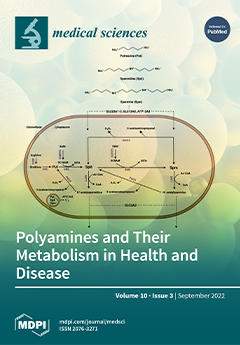
Cover Story: Polyamines, spermidine, and spermine are positively charged aliphatic cations. They are critical in the regulation of molecular interactions and biological functions. Because of their important physiological role, their cellular levels are tightly regulated through their import, export, de novo synthesis, and catabolism. Enzymes and enzymatic cascades involved in polyamine metabolism are well characterized. Disturbances in the activity of enzymes involved in polyamine metabolism and the consequent changes in polyamine levels and products of their metabolism lead to cell injury and tissue damage. The preponderance of scientific evidence substantiates the critical role of polyamines and their metabolism in the maintenance of physiological normalcy and the disturbances in polyamine levels and catabolism in the mediation of tissue injury. View this paper
  • Issues are regarded as officially published after their release is announced to the table of contents alert mailing list .
  • You may sign up for email alerts to receive table of contents of newly released issues.
  • PDF is the official format for papers published in both, html and pdf forms. To view the papers in pdf format, click on the "PDF Full-text" link, and use the free Adobe Reader to open them.

Articles (19)

  • Review
  • Open Access
3 Citations
5,958 Views
18 Pages

13 September 2022

Cervical cancer is the 4th most common type of cancer in women world-wide. Many factors play a role in cervical cancer development/progression that include genetics, social behaviors, social determinants of health, and even the microbiome. The preval...

  • Communication
  • Open Access
16 Citations
4,243 Views
13 Pages

10 September 2022

The polyamines putrescine, spermidine and spermine are nutrient-like polycationic molecules involved in metabolic processes and signaling pathways linked to cell growth and cancer. One important pathway is the PI3K/Akt pathway where studies have show...

  • Review
  • Open Access
6 Citations
4,276 Views
14 Pages

10 September 2022

Capsaicin acts on sensory nerves via vanilloid receptors. TRPV1 has been extensively studied with respect to functional lower urinary tract (LUT) conditions in rodents and humans. We aimed to (1) provide background information on capsaicin and TRPV1...

  • Article
  • Open Access
6 Citations
2,932 Views
8 Pages

Vitamin D Supplementation in the Assessment of Cardiovascular Risk Factors in Overweight and Obese Children

  • Luca Pecoraro,
  • Fulvio Nisi,
  • Angela Serafin,
  • Franco Antoniazzi,
  • Luca Dalle Carbonare,
  • Giorgio Piacentini and
  • Angelo Pietrobelli

5 September 2022

Background: Childhood obesity is associated with cardiovascular-disease (CVD) risk factors, an unfavorable lipid profile and reduced levels of 25(OH)D. The aim of our study is to evaluate whether vitamin D supplementation may play a role in the asses...

  • Article
  • Open Access
2 Citations
3,352 Views
10 Pages

Medication-Wide Association Study Plus (MWAS+): A Proof of Concept Study on Drug Repurposing

  • Yan Cheng,
  • Edward Zamrini,
  • Ali Ahmed,
  • Wen-Chih Wu,
  • Yijun Shao and
  • Qing Zeng-Treitler

31 August 2022

The high cost and time for developing a new drug or repositioning a partially-developed drug has fueled interest in “repurposing” drugs. Drug repurposing is particularly of interest for Alzheimer’s disease (AD) or AD-related dementi...

  • Article
  • Open Access
8 Citations
5,958 Views
15 Pages

Identification and Characterization of Novel Small-Molecule SMOX Inhibitors

  • Amelia B. Furbish,
  • Ahmed S. Alford,
  • Pieter Burger,
  • Yuri K. Peterson,
  • Tracy Murray-Stewart,
  • Robert A. Casero and
  • Patrick M. Woster

30 August 2022

The major intracellular polyamines spermine and spermidine are abundant and ubiquitous compounds that are essential for cellular growth and development. Spermine catabolism is mediated by spermine oxidase (SMOX), a highly inducible flavin-dependent a...

  • Article
  • Open Access
3 Citations
3,698 Views
9 Pages

Plasma Concentrations of Vinculin versus Talin-1 in Coronary Artery Disease

  • Masayuki Aoyama,
  • Yoshimi Kishimoto,
  • Emi Saita,
  • Reiko Ohmori,
  • Kojiro Tanimoto,
  • Masato Nakamura,
  • Kazuo Kondo and
  • Yukihiko Momiyama

26 August 2022

Vinculin and talin-1, which are cytoskeletal proteins affecting focal adhesions, were reported to be down-expressed in atherosclerotic lesions. Recently, we reported high concentrations of plasma talin-1 in patients with coronary artery disease (CAD)...

  • Brief Report
  • Open Access
4 Citations
2,382 Views
9 Pages

Elucidating the Role of Chmp1 Overexpression in the Transport of Polyamines in Drosophila melanogaster

  • Coryn L. Stump,
  • Robert A. Casero,
  • Otto Phanstiel,
  • Justin R. DiAngelo and
  • Shannon L. Nowotarski

25 August 2022

Polyamines are small organic cations that are essential for many biological processes such as cell proliferation and cell cycle progression. While the metabolism of polyamines has been well studied, the mechanisms by which polyamines are transported...

  • Article
  • Open Access
10 Citations
3,568 Views
16 Pages

Polyamine-Based Nanostructures Share Polyamine Transport Mechanisms with Native Polyamines and Their Analogues: Significance for Polyamine-Targeted Therapy

  • Cassandra E. Holbert,
  • Jackson R. Foley,
  • Ao Yu,
  • Tracy Murray Stewart,
  • Otto Phanstiel,
  • David Oupicky and
  • Robert A. Casero

22 August 2022

Polyamines are small polycationic alkylamines involved in many fundamental cellular processes, including cell proliferation, survival, and protection from oxidative stress. Polyamine homeostasis is tightly regulated through coordinated biosynthesis,...

  • Article
  • Open Access
2 Citations
3,082 Views
11 Pages

Multiple Asparaginase Infusions Cause Increasingly Severe Acute Hyperammonemia

  • Randal K Buddington,
  • Karyl K Buddington and
  • Scott C. Howard

12 August 2022

Adverse reactions during and shortly after infusing asparaginase for the treatment of acute lymphoblastic leukemia can increase in severity with later doses, limiting further use and increasing relapse risk. Although asparaginase is associated with h...

of 2

Get Alerted

Add your email address to receive forthcoming issues of this journal.

XFacebookLinkedIn
Med. Sci. - ISSN 2076-3271