
Identification of Aquifer Systems in Weathered and Fractured Sandstone Based on 3D Geological Modeling in the Mesa de Los Santos (Santander, Colombia)

 ,
,  , , , , , , and
Abstract
1. Introduction
2. Description of the Study Area
2.1. Location and Climate of the Study Area
2.2. Geological Framework
2.2.1. Lithostratigraphic Framework
2.2.2. Structural Framework
2.3. Hydrogeological Framework
3. Materials and Methods
3.1. Geological 3D Model
3.2. Hydrodynamic Model
4. Results and Discussion
4.1. Geological Model
4.1.1. Lithological Observations
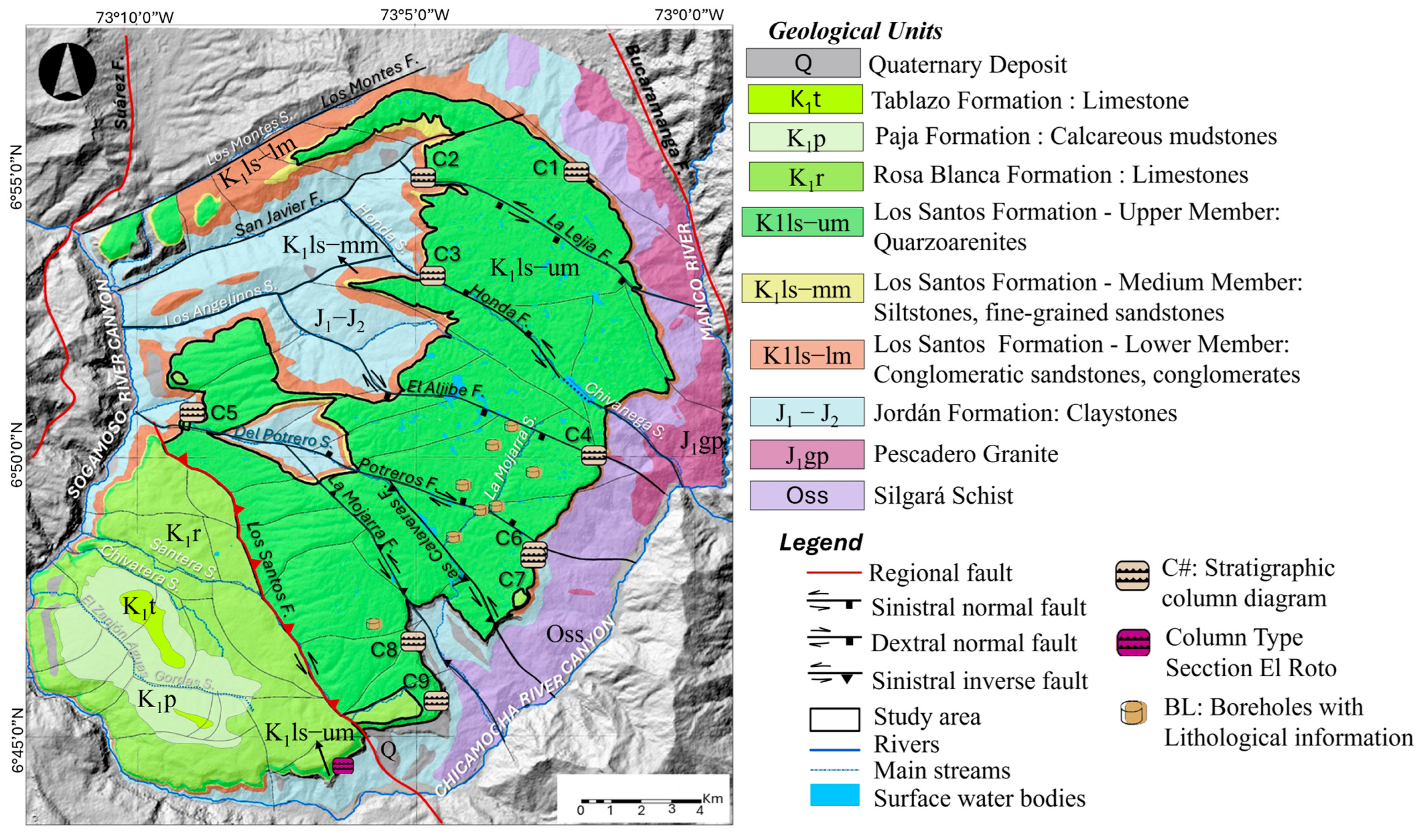
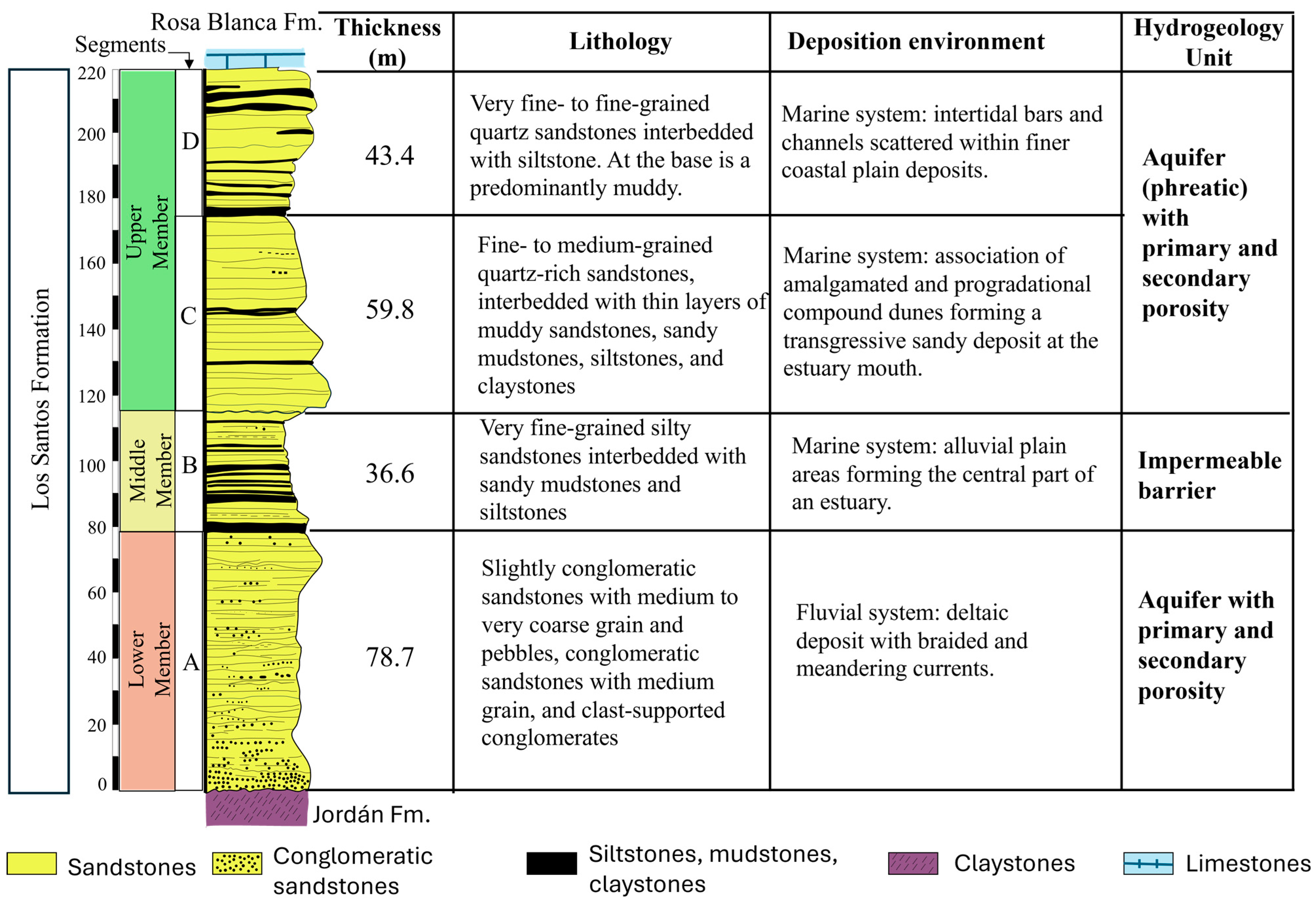
- Lower Member (>6 m, segment A): thick fractured layers of light purple fractured sandy conglomerate. It contains subangular gravel with sizes ranging from granules to cobbles (2 to 55 mm), embedded in a medium-grained sand matrix. Compositionally, the gravel consists of quartz, sedimentary lithic fragments, potassium feldspar, and black lithics, with mica as an accessory mineral. The grain size of the rock matrix suggests high primary porosity and permeability, giving the Lower Member good potential for groundwater storage and transport through rock pores and fractures.
- Middle Member (51 m, segment B): a sequence of thin to medium tabular layers with irregular, well-defined contacts, composed of very fine to very coarse-grained sandstone with color variations ranging from violet to light gray and, to a lesser extent, light green. These sandstones are interbedded with medium to very thick layers of siltstone and mudstone in violet and green shades, containing muscovite. The sandstone grains are subrounded to subangular and are composed of quartz, black lithics, iron oxides, glauconite, plagioclase, and potassium feldspar, with a siliceous cement. Compositionally, the sandstones are classified as quartz arenites to sublitharenites. These layers exhibit very low primary porosity and no permeability, acting as a seal that separates the aquifers of the Upper Member and the Lower Member.
- Upper Member (90 m, segments C and D): a sequence of thick to medium tabular and wedge-shaped fractured layers with well-defined planar contacts. These layers consist of fine- to coarse-grained sandstone with colors ranging from light gray to yellowish-gray and orange-gray. The grains are subangular to subrounded and exhibit saturated contacts with siliceous cement precipitation, reducing the primary porosity, highlighting the importance of secondary porosity associated with fractures, in the storage and flow of groundwater present in the Upper Member. Compositionally, the sandstones contain between 80% and 95% quartz, along with black lithics, iron, manganese, and copper oxides, and traces of muscovite. The sandstones are classified as quartz arenites to sublitharenites. Toward the middle and top of the member, violet-colored mudstone layers are observed, separating segment C from D, allowing the description of two different aquifers. It is worth mentioning that this layer is not recorded in all columns.
4.1.2. Geometry of the Strata

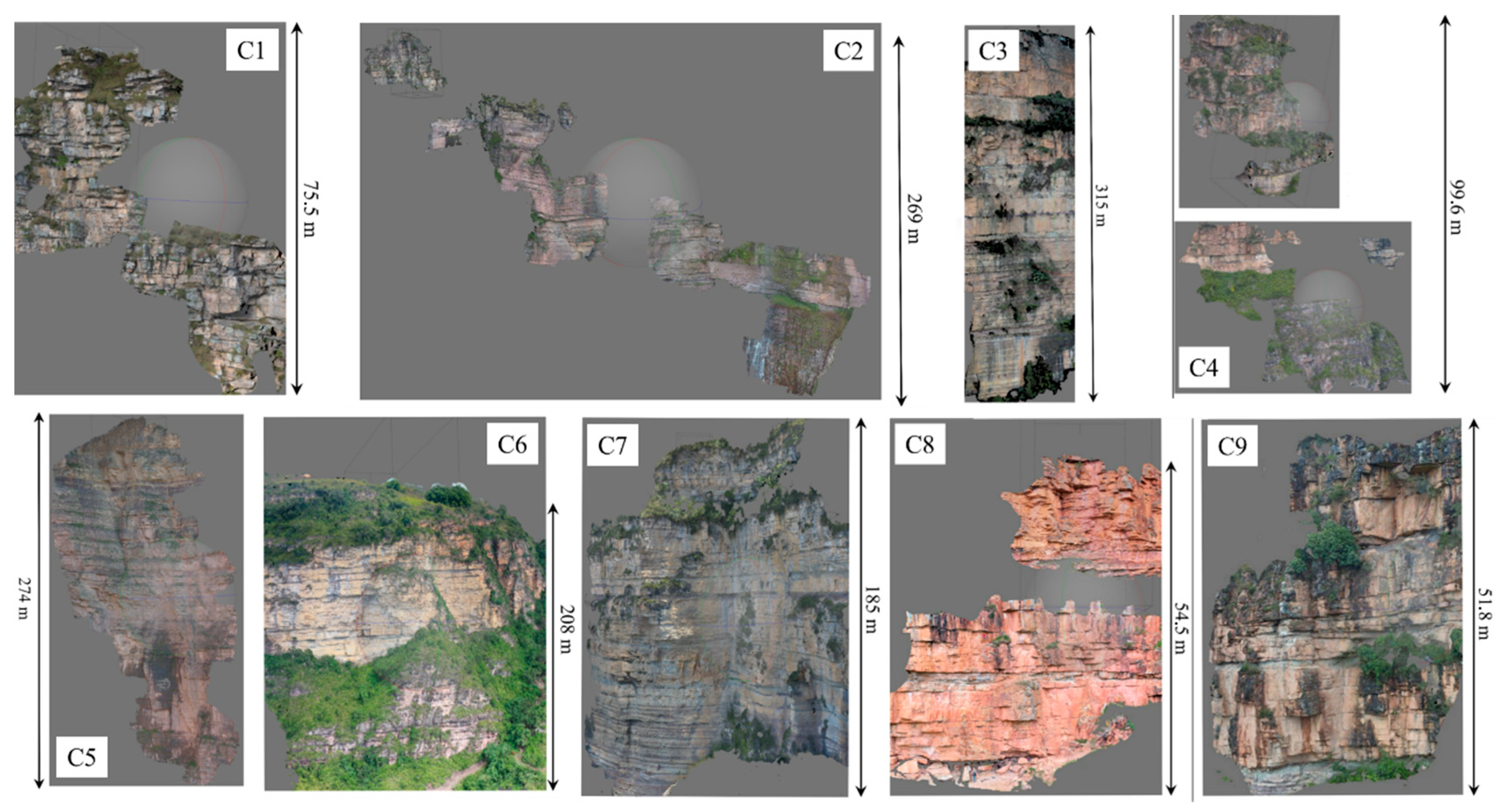
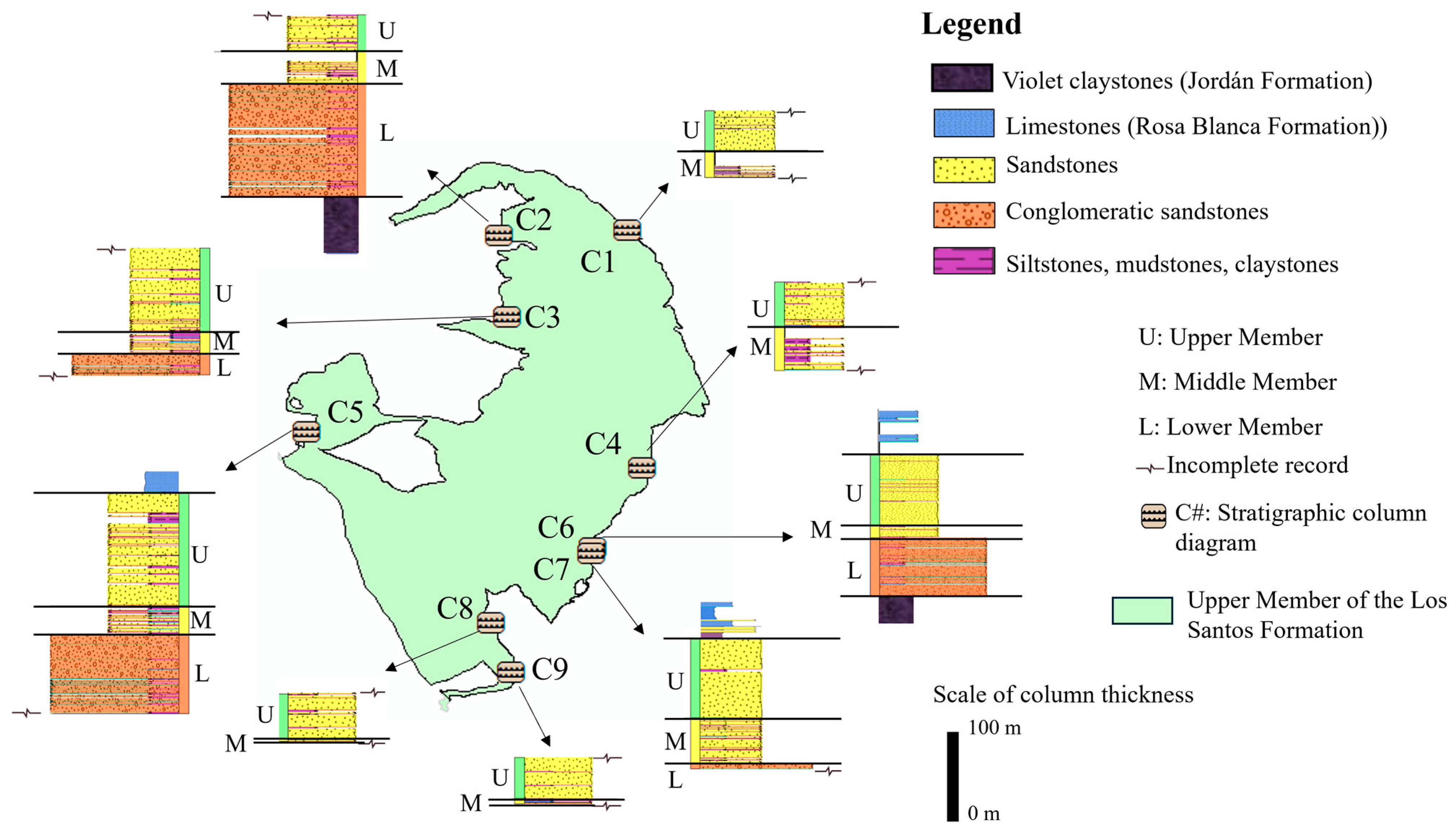
| Los Santos Formation | Columns | C1 | C2 | C3 | C4 | C5 | C6 | C7 | C8 | C9 | El Roto [42] | |
| Surface elevation (masl) | 1691 | 1470 | 1605 | 1772 | 1002 | 1742 | 1742 | 1618 | 1529 | 1113 | ||
| Member | Segment | Column Thicknesses (m) | ||||||||||
| Upper | D | 45 | 41 | 60 | 43 | 38 * | 53 * | 38 * | 52 | 46 | 43.4 * | |
| C | 30 | 87 | 26 | 52 | 59.8 | |||||||
| Middle | B | 31 | 38 | 29 | 57 | 34 | 14 | 51 | 3 | 6 | 36.6 | |
| Lower | A | 126 * | 24 | 90 | 66 * | 6 | 78.7 | |||||
| TOTAL | 76 | 205 | 143 | 100 | 249 | 159 * | 147 | 55 | 52 | 218.5 * | ||
4.1.3. Three-Dimensional Model
4.2. Hydrodynamic Model
4.2.1. Shallow Aquifer System (SAS)
4.2.2. Upper Aquifer 1 (UA1)
4.2.3. Upper Aquifer 2 (UA2)
4.3. Hydraulic Parameters
4.4. Conceptual Hydrogeological Model and Hypothesis on Water Resource Volumes
5. Conclusions
Author Contributions
Funding
Data Availability Statement
Acknowledgments
Conflicts of Interest
Correction Statement
Abbreviations
| SAS | Shallow Aquifer System |
| UA1 | Upper Aquifer 1 |
| UA2 | Upper Aquifer 2 |
| EC | Electrical Conductivity |
| pH | Potential of hydrogen |
| T | Temperature |
| SWB | Soil water balance |
| IDEAM | Instituto de Hidrología, Meteorología y Estudios Ambientales |
| GPH | Research Group on Water Resources and environmental sanitation |
| UAV | Unmanned Aerial Vehicles |
| DOM | Digital Outcrop Models |
| DEM | Digital Elevation Model |
| C | Column |
| masl | Meters above sea level |
| SHmax | Maximum horizontal tensor |
References
- Conti, K.I.; IGRAC; University of Amsterdam. Groundwater in the Sustainable Development Goals; IGRAC: The Hague Area, The Netherlands, 2015. [Google Scholar]
- United Nations. Sustainable Development Goal 6 Synthesis Report 2018 on Water and Sanitation; United Nations: New York, NY, USA, 2018. [Google Scholar]
- UNESCO. The United National World Water Development Report 2022. Groundwater: Making the Invisible Visible. 2022. Available online: https://unesdoc.unesco.org/ark:/48223/pf0000380721 (accessed on 1 March 2024).
- Bridge, J.S.; Hyndman, D.W. (Eds.) Aquifer Characterization; Special Publication No. 80; SEPM: Tulsa, OK, USA, 2004. [Google Scholar]
- Allen, P.A.; Allen, J.R. Basin Analysis: Principles and Application to Petroleum Play Assessment; John Wiley & Sons, Ltd.: Hoboken, NJ, USA, 2013. [Google Scholar]
- Yuan, G.; Cao, Y.; Schulz, H.M.; Hao, F.; Gluyas, J.; Liu, K.; Li, F. A review of feldspar alteration and its geological significance in sedimentary basins: From shallow aquifers to deep hydrocarbon reservoirs. Earth-Sci. Rev. 2019, 191, 114–140. [Google Scholar] [CrossRef] [Scilit]
- Cendón, D.I.; Hankin, S.I.; Williams, J.P.; Van der Ley, M.; Peterson, M.; Hughes, C.E.; Chisari, R. Groundwater residence time in a dissected and weathered sandstone plateau: Kulnura–Mangrove Mountain aquifer, NSW, Australia. Aust. J. Earth Sci. 2014, 61, 475–499. [Google Scholar] [CrossRef] [Scilit]
- Worthington, S.R.; Davies, G.J.; Alexander, E.C., Jr. Enhancement of bedrock permeability by weathering. Earth-Sci. Rev. 2016, 160, 188–202. [Google Scholar] [CrossRef] [Scilit]
- Bertassello, L.E.; Rao, P.S.C.; Jawitz, J.W.; Aubeneau, A.F.; Botter, G. Wetlandscape hydrologic dynamics driven by shallow groundwater and landscape topography. Hydrol. Process. 2020, 34, 1460–1474. [Google Scholar] [CrossRef] [Scilit]
- Van der Kamp, G.; Hayashi, M. Groundwater-wetland ecosystem interaction in the semiarid glaciated plains of North America. Hydrogeol. J. 2009, 17, 203. [Google Scholar] [CrossRef] [Scilit]
- Carol, E.; Pilar Alvarez, M.D.; Santucci, L.; Candanedo, I.; Arcia, M. Origin and dynamics of surface water-groundwater flows that sustain the Matusagaratí Wetland, Panamá. Aquat. Sci. 2022, 84, 16. [Google Scholar] [CrossRef] [Scilit]
- Medjani, F.; Djidel, M.; Labar, S.; Bouchagoura, L.; Rezzag Bara, C. Groundwater physico-chemical properties and water quality changes in shallow aquifers in arid saline wetlands, Ouargla, Algeria. Appl. Water Sci. 2021, 11, 82. [Google Scholar] [CrossRef] [Scilit]
- Jourde, H.; Cornaton, F.; Pistre, S.; Bidaux, P. Flow behavior in a dual fracture network. J. Hydrol. 2002, 266, 99–119. [Google Scholar] [CrossRef] [Scilit]
- Bense, V.F.; Gleeson, T.; Loveless, S.E.; Bour, O.; Scibek, J. Fault zone hydrogeology. Earth-Sci. Rev. 2013, 127, 171–192. [Google Scholar] [CrossRef] [Scilit]
- Medici, G.; West, L.J.; Mountney, N.P. Characterizing flow pathways in a sandstone aquifer: Tectonic vs sedimentary heterogeneities. J. Contam. Hydrol. 2016, 194, 36–58. [Google Scholar] [CrossRef] [Scilit]
- Batlle-Aguilar, J.; Banks, E.W.; Batelaan, O.; Kipfer, R.; Brennwald, M.S.; Cook, P.G. Groundwater residence time and aquifer recharge in multilayered, semi-confined and faulted aquifer systems using environmental tracers. J. Hydrol. 2017, 546, 150–165. [Google Scholar] [CrossRef] [Scilit]
- Tóth, E.; Hrabovszki, E.; Schubert, F.; Tóth, T.M. Lithology-controlled hydrodynamic behaviour of a fractured sandstone–claystone body in a Radioactive Waste Repository Site, SW Hungary. Appl. Sci. 2022, 12, 2528. [Google Scholar] [CrossRef] [Scilit]
- Huang, Q.; Angelier, J. Inversion of field data in fault tectonics to obtain the regional stress-II using conjugate sets within heterogeneous families for computing palaeostress axes. J. Geophys. 1989, 96, 139–149. [Google Scholar] [CrossRef] [Scilit]
- Fossen, H. Structural Geology; Cambridge University Press: Cambridge, UK, 2010; p. 463. [Google Scholar]
- Davis, G.; Reynolds, S.; Kluth, C. Structural Geology of Rocks and Regions, 3rd ed.; John Wiley & Sons: New York, NY, USA, 2012; p. 861. [Google Scholar]
- Worthington, S.R. Diagnostic tests for conceptualizing transport in bedrock aquifers. J. Hydrol. 2015, 529, 365–372. [Google Scholar] [CrossRef] [Scilit]
- FUNDEMESA. Mesa de los Santos. In Memorias del Paraíso; Fundación para el Desarrollo de la Mesa de los Santos: Bucaramanga, Colombia, 2009; p. 96. [Google Scholar]
- Prieto-Jiménez, D.; Oviedo-Ocaña, E.R.; Gómez-Isidro, S.; Domínguez, I.C. A multicriteria decision analysis for selecting rainwater harvesting systems in rural areas: A tool for developing countries. Environ. Sci. Pollut. Res. 2024, 31, 42476–42491. [Google Scholar] [CrossRef] [Scilit]
- Bredehoeft, J. The conceptualization model problem—Surprise. Hydrogeol. J. 2005, 13, 37–46. [Google Scholar] [CrossRef] [Scilit]
- Anderson, M.P.; Woessner, W.W.; Hunt, R.J. Modeling Purpose and Conceptual Model. In Applied Groundwater Modeling; Anderson, M.P., Woessner, W.W., Hunt, R.J., Eds.; Elsevier Inc.: San Diego, CA, USA, 2015; pp. 27–67. [Google Scholar]
- Enemark, T.; Peeters, L.J.; Mallants, D.; Batelaan, O. Hydrogeological conceptual model building and testing: A review. J. Hydrol 2019, 569, 310–329. [Google Scholar] [CrossRef] [Scilit]
- Blavoux, B.; Letolle, R. Apports des techniques isotopiques á la connaissance des eaux souterraines (Contribution of isotopic tools to the knowledge of groundwaters). Geochronique 1995, 54, 12–15. [Google Scholar]
- Gonfiantini, R.; Roche, M.A.; Olivry, J.C.; Fontes, J.C.; Zuppi, G.M. The altitude effect on the isotopic composition of tropical rains. Chem. Geol. 2001, 181, 147–167. [Google Scholar] [CrossRef] [Scilit]
- Cetina, M.; Taupin, J.D.; Gómez, S.; Patris, N. Hydrodynamic conceptual model of groundwater in the headwater of the Rio de 774 Oro, Santander (Colombia) by geochemical and isotope tools. Water Supply 2020, 20, 1567–1579. [Google Scholar] [CrossRef] [Scilit]
- Hamidi, M.D.; Gröcke, D.R.; Joshi, S.K.; Greenwell, H.C. Investigating groundwater recharge using hydrogen and oxygen stable isotopes in Kabul city, a semi-arid region. J. Hydrol. 2023, 626, 130187. [Google Scholar] [CrossRef] [Scilit]
- Wang, L.; Sun, Y.; Yang, C.; Dong, Y. Groundwater–surface water interactions across an arid river basin: Spatial patterns revealed by stable isotopes and hydrochemistry. Hydrol. Earth Syst. Sci. 2025, 29, 4417–4436. [Google Scholar] [CrossRef] [Scilit]
- CNPV. Censo Nacional de Población y Vivienda. 2018. Available online: https://www.dane.gov.co/index.php/estadisticas-por-tema/demografia-y-poblacion/censo-nacional-de-poblacion-y-vivenda-2018 (accessed on 17 March 2021).
- CNA. Censo Nacional Agropecuario. 2014. Available online: https://www.datos.gov.co/widgets/6pmq-2i7c (accessed on 17 March 2021).
- Díaz, E.J.; Contreras, N.M.; Pinto, J.E.; Velandia, F.; Morales, C.J.; Hincapie, G. Evaluación hidrogeológica preliminar de las unidades geológicas de la Mesa de los Santos, Santander. Bol. Geol. 2009, 31, 61–70. [Google Scholar]
- Moreno, M.L.; Silva, K.D. Identificación de Ambientes Geomorfológicos y Elaboración de un Mapa de Favorabilidad para la Percolación de la Zona de la Mesa de Los Santos, Santander. In Trabajo de Grado Para Optar Por el Título de Geólogo; Universidad Industrial de Santander: Bucaramanga, Colombia, 2021. Available online: https://noesis.uis.edu.co/handle/20.500.14071/41138 (accessed on 1 February 2025).
- Becerra, N.J.; Parra, C.G. Balance Hídrico para Estimar Recarga Potential en la Mesa de Los Santos y Dirección de Flujo de Aguas Subterráneas. In Trabajo de Grado Para Optar Por el Título de Ingeniero Civil; Universidad Industrial de Santander: Bucaramanga, Colombia, 2016. Available online: https://noesis.uis.edu.co/handle/20.500.14071/33946 (accessed on 1 February 2025).
- Garzón, Y.X.; Salcedo, H.D. Estimación de la Recarga Potencial Mensual en La Mesa de Los Santos (Santander). In Trabajo de Grado Para Optar Por el Título de Ingeniero Civil; Universidad Industrial de Santander: Bucaramanga, Colombia, 2022. Available online: https://noesis.uis.edu.co/handle/20.500.14071/9902 (accessed on 1 February 2025).
- Julivert, M. La morfoestructura de la zona de Mesas al SW de Bucaramanga (Colombia, S.A). Bol. Geol. 1958, 1, 7–43. [Google Scholar]
- Julivert, M.; Barrero, D.; Navas, J. Geología de la Mesa de Los Santos. Bol. Geol. 1964, 18, 5–11. [Google Scholar]
- Ward, D.; Goldsmith, R.; Cruz, J.; Jaramillo, L.; Vargas, R. Geología del Cuadrángulo Pamplona H-12, escala 1:100.000; Instituto Colombiano de Geología Y Minas: Bogotá, Colombia, 1977.
- Julivert, M.; Tellez, N. Sobre la presencia de fallas de edad pre-Cretácica y post-Girón (Jura-Triásico) en el flanco W del Macizo de Santander (Cordillera Oriental de Colombia). Bol. Geol. 1963, 12, 5–17. [Google Scholar]
- Laverde, F. La Formación Los Santos: Un depósito continental anterior al ingreso marino del Cretácico. In Proyecto Cretácico; Etayo-Serna, F., Laverde, F., Eds.; Contribuciones: Ingeominas Publicaciones Geológicas Especiales 16; Instituto Nacional de Investigaciones Geológico-Mineras (INGEOMINAS): Bogotá, Colombia, 1985; pp. xx-1–xx-24. [Google Scholar]
- Laverde, F. Revisiting the latest Jurassic-earliest Cretaceous Los Santos Formation, Eastern Cordillera of Colombia. A–The history of its origin and the lowermost part of the unit. Boletín Geológico 2023, 50, 689. [Google Scholar] [CrossRef] [Scilit]
- Laverde, F.L. Revisiting the latest Jurassic-earliest Cretaceous Los Santos Formation, Eastern Cordillera of Colombia. B–A transgressive river mouth deposit in a syntectonic scenario. Boletín Geológico 2023, 50, 690. [Google Scholar] [CrossRef] [Scilit]
- García-Arias, S.; Velandia, F.; Alvarez, A.; Sanabria-Gómez, J.D.; Tarazona, Y.; Vargas, M.C. Stress tensors and quantification of fracture patterns to analyze connectivity and potential fluid flow in a mesa landform of the Northern Andes. J. Mt. Sci. 2024, 21, 271–291. [Google Scholar] [CrossRef] [Scilit]
- Langenheim, R.L. Preliminary report on the stratigraphy of the Giron Formation in Santander and Boyacá. Bol. Geol. 1959, 3, 35–40. [Google Scholar]
- Pinto, J.E.; Clavijo, J.; Gómez, S.; Bermoudes, O. Geological and hydrogeological research project in Mesa de Los Santos, northeast sector of Curití and western edge of the Santander Massif, department of Santander. In Explanatory Report on the Geological and Hydrogeological Research in Mesa de Los Santos and the Northeast Sector of Curití; Instituto Colombiano de Geología y Minería: Bucaramanga, Colombia, 2007. [Google Scholar]
- Ingeominas. Informe Hidrogeológico de la Mesa de Los Santos; Instituto de Investigaciones e Información Geocientífica Minero-Ambiental y Nuclear (Ingeominas, ahora Servicio Geológico Colombiano): Bogotá, Colombia, 2009; p. 75.
- Velandia, F.; Bermúdez, M.A. The transpressive southern termination of the Bucaramanga fault (Colombia): Insights from geological mapping, stress tensors, and fractal analysis. J. Struct. Geol. 2018, 115, 190–207. [Google Scholar] [CrossRef] [Scilit]
- Diederix, H.; Bohórquez, O.P.; Mora–Páez, H.; Peláez, J.R.; Cardona, L.; Corchuelo, Y.; Ramírez, J.; Díaz–Mila, F. Quaternary activity of the Bucaramanga Fault in the Departments of Santander and Cesar. In The Geology of Colombia, Quaternary; Gómez, J., Pinilla–Pachon, A.O., Eds.; Publicaciones Geológicas Especiales 38; Servicio Geológico Colombiano: Bogotá, Colombia, 2020; Volume 4, pp. 453–477. [Google Scholar] [CrossRef] [Scilit]
- Casadiegos-Agudelo, L.; Cetina-Tarazona, M.A.; Dominguez-Rivera, I.C.; Gomez-Isidro, S. Validation of the intrinsic vulnerability to pollution of fractured siliciclastic aquifers using natural background levels. Groundw. Sustain. Dev. 2024, 25, 101143. [Google Scholar] [CrossRef] [Scilit]
- Cetina, M.A.; Taupin, J.D.; Gómez, S.; Patris, N. Isotope study of monthly rainfall and its response in the Santos Formation phreatic aquifer, Mesa de Los Santos, Santander (Colombia). Proc. IAHS 2024, 385, 231–237. [Google Scholar] [CrossRef] [Scilit]
- Sarmiento-Rojas, L.; Van Wess, J.; Cloetingh, S. Mesozoic transtensional basin history of the eastern Cordillera, Colombian Andes: Inferences from tectonic models. J. S. Am. Earth Sci. 2006, 21, 383–411. [Google Scholar] [CrossRef] [Scilit]
- Araque Gómez, C.N.; Otero-Ramírez, J.L. Zonas Transversales y su Relación con Estructuras Regionales, Flanco O-Cordillera Oriental. In Trabajo de Grado Para Optar Por el Título de Geólogo; Universidad Industrial de Santander: Bucaramanga, Colombia, 2016. Available online: https://noesis.uis.edu.co/handle/20.500.14071/35014 (accessed on 1 February 2025).
- Singhal, B.B.S.; Gupta, R.P. Applied Hydrogeology of Fractured Rocks; Springer Science & Business Media: Dordrecht, The Netherland, 2010. [Google Scholar]


| Item | Code | Type | Altitude (masl) | W/B Depth (m) | G.D Avg (m) | G.L Avg (masl) | EC Avg (μS/cm) | pH Avg | T Avg (°C) | δ18O ± 0.05‰ | d-Exc ‰ | Isotopic Behavior | Field Observations | Water Uses |
|---|---|---|---|---|---|---|---|---|---|---|---|---|---|---|
| Cluster 1 | ||||||||||||||
| 1 | W2 | Well | 1665.7 | 7 | 1.0 | 1664.8 | 162 | 6.05 | 19.94 | −8.17 to −5.96 | 11.6 to 12.87 | Large variability | Black soil development. | livestock |
| 2 | W3 | Well | 1689.2 | 8.8 | 1.0 | 1688.2 | 24 | 5.49 | 20.41 | −6.59 * | 10.84 * | Low variability | Nearby surface water body and Black soil development | Gardening |
| 3 | W4 | Well | 1693.0 | 8 | 0.5 | 1692.5 | 241 | 6.29 | 20.34 | −8.42 to −5.99 | 10.73 to 12.10 | Large variability | Black soil development | Domestic |
| 4 | W5 | Well | 1691.7 | 10.5 | 0.7 | 1691.0 | 239 | 6.41 | 19.95 | −6.75 * | 11.34 * | Low variability | Black soil development | Domestic |
| 5 | W6 | Well | 1702.5 | 8.3 | 4.1 | 1698.5 | 42 | 6.00 | 20.54 | −6.89 * | 10.05 * | Low variability | Human consumption | |
| 6 | W7 | Well | 1703.3 | 10 | 1.5 | 1701.8 | 634 | 5.72 | 20.74 | −7.5 to −5.9 | 10.06 to 11.03 | Large variability | Nearby surface water body and Black soil development | Livestock |
| 7 | W8 | Well | 1704.1 | 8 | 4.9 | 1699.2 | 151 | 6.24 | 21.23 | −6.18 to −3.05 | −6.68 to 4.32 | Evaporated | Nearby surface water body | Livestock |
| 8 | W13 | Well | 1695.2 | 4.95 | 2.2 | 1693.8 | 68 | 6.31 | 21.61 | −6.91 * | 10.64 * | Low variability | Human consumption | |
| 9 | W19 | Well | 1675 | 11.5 | 4.9 | 1670.5 | 170 | 6.16 | 21.65 | −9.64 to −5.34 | 9.58 to 11.5 | Large variability | Nearby surface water body | Human consumption |
| 10 | W20 | Well | 1679.7 | 6 | 1.4 | 1678.2 | 117 | 5.90 | 20.75 | −4.51 to −3.25 | −4.94 to −3.05 | Evaporated | Nearby surface water body | Gardening |
| 11 | W21 | Well | 1668.5 | 4.8 | 3.3 | 1665.3 | 277 | 7.13 | 20.96 | −9.46 to −1.07 | 10.06 to 17.47 | Large variability | Nearby surface water body | Unused |
| 12 | W23 | Well | 1680.8 | 8.5 | 0.9 | 1679.9 | 70 | 5.59 | 22.09 | −6.76 * | 11.05 * | Low variability | Black soil development | Unused |
| 13 | W24 | Well | 1692.5 | 5.63 | 0.6 | 1691.9 | 90 | 6.19 | 20.10 | −6.96 * | 10.86 * | Low variability | Black soil development | Human consumption |
| 14 | W25 | Well | 1686.4 | 7.6 | 3.4 | 1683.0 | 736 | 5.40 | 22.31 | −7.45 * | 11.07 * | Low variability | Domestic | |
| 15 | W26 | Well | 1672.3 | 8 | 1.5 | 1670.8 | - | - | - | - | - | - | Nearby surface water body and Black soil development | Unused |
| 16 | W27 | Well | 1714.8 | 17 | 7.1 | 1707.8 | 67 | 6.63 | 23.16 | −7.44 * | 9.13 * | Low variability | Human consumption | |
| 17 | W28 | Well | 1727.6 | 5 | 1.3 | 1726.3 | 111 | 6.02 | 20.57 | −4.4 to −3.74 | −3.5 to −5.5 | Evaporated | Nearby surface water body | Unused |
| 18 | W29 | Well | 1676.6 | 8.5 | 4.9 | 1671.7 | 101 | 6.28 | 20.29 | −8.30 * | 9.04 * | Low variability | Domestic | |
| 19 | W31 | Well | 1711.6 | 5.5 | 2.9 | 1708.7 | - | - | - | - | - | - | Unused | |
| 20 | W32 | Well | 1692.7 | 9.6 | 2.9 | 1689.7 | - | - | - | - | - | - | Unused | |
| 21 | B14 | Borehole | 1717.5 | 90 | 11.2 | 1706.3 | 40 | 6.50 | 23.67 | −7.08 to −5.21 | 4.6 to −2.0 | Evaporated | Nearby surface water body | Human consumption |
| Cluster 2 | ||||||||||||||
| 22 | W9 | Well | 1636.0 | 5.5 | 1.7 | 1634.3 | 102 | 5.98 | 21.67 | −3.67 to −2.74 | −5.68 to −4.02 | Evaporated | Nearby surface water body and Black soil development | livestock |
| 23 | W10 | Well | 1627.6 | 18 | 5.3 | 1622.3 | 77 | 6.34 | 21.65 | −7.16 * | 10.70 * | Low variability | Human consumption | |
| 24 | W11 | Well | 1619.0 | 9 | 3.5 | 1615.5 | 21 | 5.91 | 21.93 | −8.54 to −6.17 | 6.40 to 9.47 | Large variability | Nearby surface water body | Gardening |
| 25 | W12 | Well | 1623.7 | 7 | 2.6 | 1621.1 | 36 | 6.36 | 21.27 | −7.73 * | 11.42 * | Low variability | Human consumption | |
| 26 | W30 | Well | 1656.1 | 8.5 | 0.6 | 1655.4 | - | - | - | - | - | - | Nearby surface water body and Black soil development | Unused |
| 27 | W33 | Well | 1630.8 | 12.8 | 1.8 | 1629.1 | - | - | - | - | - | - | Unused | |
| 28 | B2 | Borehole | 1657.9 | 22 | 6.84 | 1652.7 | 325 | 5.89 | 21.34 | −6.44 * | 9.53 * | Low variability | livestock | |
| 29 | B4 | Borehole | 1677.8 | 62 | 37.2 | 1640.6 | 91 | 6.15 | 22.75 | −7.80 * | 10.07 * | Low variability | Human consumption | |
| 30 | B10 | Borehole | 1649.5 | 81 | 18.1 | 1631.5 | 77 | 6.13 | 22.69 | −6.15 * | 5.47 * | Low variability | Human consumption | |
| 31 | B11 | Borehole | 1671.7 | 50 | 17.0 | 1654.7 | 76 | 6.29 | 21.97 | −7.22 * | 8.18 * | Low variability | Human consumption | |
| Cluster 3 | ||||||||||||||
| 32 | W1 | Well | 1608.7 | 7 | 1.4 | 1607.3 | - | - | - | - | - | - | Unused | |
| 33 | B1 | Borehole | 1608.7 | 27 | 8.2 | 1600.5 | 69 | 5.28 | 22.19 | −8.29 to −6.84 | 11.97 to 12.97 | Large variability | Livestock, Poultry farming. | |
| 34 | B5 | Borehole | 1619.8 | 98 | 55.3 | 1564.6 | 102 | 6.38 | 23.17 | −7.80 * | 9.36 * | Low variability | Human consumption | |
| 35 | P | Piezometer | 1584.3 | 4 | 1.5 | 1582.8 | - | - | - | - | - | - | Nearby surface water body | Unused |
| No water table data | ||||||||||||||
| 36 | W14 | Well | 1691.1 | 22 | - | - | 28 | 5.84 | 22.75 | −7.57 * | 10.98 * | Low variability | Human consumption | |
| 37 | W15 | Well | 1687.5 | 20 | - | - | 41 | 6.27 | 21.59 | −7.56 * | 10.87 * | Low variability | Human consumption | |
| 38 | W16 | Well | 1685.5 | 9 | - | - | 34 | 6.30 | 21.30 | −8.39 * | 10.32 * | Low variability | Human consumption | |
| 39 | W17 | Well | 1688.0 | 11 | - | - | 117 | 6.58 | 22.34 | −8.49 * | 9.30 * | Low variability | Human consumption | |
| 40 | W18 | Well | 1678.7 | 15 | - | - | 30 | 6.30 | 21.44 | −7.39 * | 7.18 * | Low variability | Human consumption | |
| 41 | W22 | Well | 1733.7 | 4.5 | - | - | 24 | 5.69 | 21.92 | −7.84 * | 10.43 * | Low variability | Domestic | |
| 42 | B3 | Borehole | 1628.8 | 55 | - | - | 19 | 6.15 | 21.89 | −7.20 * | 8.11 * | Low variability | Human consumption | |
| 43 | B6 | Borehole | 1675.7 | 48 | - | - | 79 | 6.27 | 23.39 | −8.28 * | 8.90 * | Low variability | Human consumption | |
| 44 | B7 | Borehole | 1678.2 | 29 | - | - | 23 | 6.25 | 22.44 | −7.77 * | 6.98 * | Low variability | Human consumption | |
| 45 | B8 | Borehole | 1676.2 | 33 | - | - | 39 | 6.12 | 23.28 | −8.55 * | 9.28 * | Low variability | Human consumption | |
| 46 | B9 | Borehole | 1684.8 | 90 | - | - | 32 | 4.83 | 21.71 | −6.71 * | 10.33 * | Low variability | Human consumption | |
| 47 | B12 | Borehole | 1627.0 | 55 | - | - | 191 | 6.61 | 23.53 | −7.96 * | 9.05 * | Low variability | Human consumption | |
| 48 | B13 | Borehole | 1641.9 | 102 | - | - | 52 | 6.03 | 22.48 | −8.24 * | 9.25 * | Low variability | Human consumption | |
| 49 | S1 | Spring | 1712.5 | - | - | - | 42 | 6.32 | 20.19 | −7.98 * | 9.79 * | Low variability | Unused | |
| 50 | S2 | Spring | 1657.1 | - | - | - | 42 | 6.92 | 23.34 | −8.52 to −5.27 | 8.95 to 11.48 | Large variability | Human consumption | |
| 51 | S3 | Spring | 1650.4 | - | - | - | 28 | 6.34 | 21.84 | −8.42 * | 10.51 * | Low variability | Human consumption | |
| 52 | S4 | Spring | 1616.9 | - | - | - | 154 | 7.33 | 23.42 | −8.89 * | 9.33 * | Low variability | Human consumption | |
| 53 | S5 | Spring | 1641.8 | - | - | - | 24 | 6.94 | 23.24 | −8.47 to −5.19 | 4.22 to 6.56 | Large variability | Human consumption | |
| 54 | S6 | Spring | 1675.8 | - | - | - | 36 | 6.09 | 18.98 | −6.76 to −5.62 | 6.7 to 4.1 | Large variability | Human consumption | |
| 55 | S7 | Spring | 1546.5 | - | - | - | 11 | 7.33 | 24.07 | −8.39 to −0.94 | −3.09 to 6.30 | Evaporated sing | Unused | |
| Aquifer | Code | Altitude (Masl) | Groundwater Level (Masl) | T (m2/day) | K (m/day) |
|---|---|---|---|---|---|
| SAS | W32 | 1692.7 | 1689.7 | 3 | 0.19 |
| UA1 | B4 | 1677.8 | 1640.6 | 23.9 | 5.98 |
| UA2 | BL | 1587.0 | 1564.0 | 2.4 | 0.06 |
Disclaimer/Publisher’s Note: The statements, opinions and data contained in all publications are solely those of the individual author(s) and contributor(s) and not of MDPI and/or the editor(s). MDPI and/or the editor(s) disclaim responsibility for any injury to people or property resulting from any ideas, methods, instructions or products referred to in the content. |
© 2025 by the authors. Licensee MDPI, Basel, Switzerland. This article is an open access article distributed under the terms and conditions of the Creative Commons Attribution (CC BY) license (https://creativecommons.org/licenses/by/4.0/).
Share and Cite
Cetina, M.; Velandia, F.; Gómez, S.; Patris, N.; Sánchez, A.; Duarte, E.; Carrillo-Hernández, M.; Silva, J.; Taupin, J.-D. Identification of Aquifer Systems in Weathered and Fractured Sandstone Based on 3D Geological Modeling in the Mesa de Los Santos (Santander, Colombia). Geosciences 2025, 15, 476. https://doi.org/10.3390/geosciences15120476
Cetina M, Velandia F, Gómez S, Patris N, Sánchez A, Duarte E, Carrillo-Hernández M, Silva J, Taupin J-D. Identification of Aquifer Systems in Weathered and Fractured Sandstone Based on 3D Geological Modeling in the Mesa de Los Santos (Santander, Colombia). Geosciences. 2025; 15(12):476. https://doi.org/10.3390/geosciences15120476
Chicago/Turabian StyleCetina, Maria, Francisco Velandia, Sully Gómez, Nicolas Patris, Andrés Sánchez, Edward Duarte, Mauricio Carrillo-Hernández, Johel Silva, and Jean-Denis Taupin. 2025. "Identification of Aquifer Systems in Weathered and Fractured Sandstone Based on 3D Geological Modeling in the Mesa de Los Santos (Santander, Colombia)" Geosciences 15, no. 12: 476. https://doi.org/10.3390/geosciences15120476
APA StyleCetina, M., Velandia, F., Gómez, S., Patris, N., Sánchez, A., Duarte, E., Carrillo-Hernández, M., Silva, J., & Taupin, J.-D. (2025). Identification of Aquifer Systems in Weathered and Fractured Sandstone Based on 3D Geological Modeling in the Mesa de Los Santos (Santander, Colombia). Geosciences, 15(12), 476. https://doi.org/10.3390/geosciences15120476