Review

Updated Synthesis of the Upper Cretaceous Vertebrate Assemblages from the Northern Onshore Sector of the Portuguese West Iberian Margin


by
Ricardo Jorge Pimentel
1,2,*,
Fernando Barroso-Barcenilla
1,2,3,
Mélani Berrocal-Casero
1,2,3 and
Pedro Miguel Callapez
1,2,4
1
Grupo de Investigación PaleoIbérica, Departamento de Geología, Geografía y Medio Ambiente, Universidad de Alcalá, 28805 Alcalá de Henares, Spain
2
CITEUC—Centro de Investigação da Terra e do Espaço da Universidade de Coimbra, Universidade de Coimbra, 3040-004 Coimbra, Portugal
3
Grupo de Investigacion Procesos Bióticos Mesozoicos, Departamento de Geodinámica, Estratigrafía y Paleontología, Universidad Complutense de Madrid, 28040 Madrid, Spain
4
Departamento de Ciências da Terra, Universidade de Coimbra, 3030-790 Coimbra, Portugal
*
Author to whom correspondence should be addressed.
Geosciences 2025, 15(12), 477; https://doi.org/10.3390/geosciences15120477
Submission received: 28 October 2025 / Revised: 9 December 2025 / Accepted: 13 December 2025 / Published: 18 December 2025
(This article belongs to the Section Sedimentology, Stratigraphy and Palaeontology)

Abstract

Vertebrate remains from the Upper Cretaceous of Portugal have been studied for more than 140 years, beginning with the pioneering work of the Geological Commissions and early vertebrate specialists. The Cenomanian of Portugal occupies a key position in understanding vertebrate assemblages from the south-western European Late Cretaceous archipelago. Recent discoveries in the Cenomanian of the onshore northern sector of the Portuguese West Iberian Margin have revealed two new genera of Squamata and Crocodylomorpha, as well as extended biogeographical ranges for groups such as Obaichthyidae. Although Campanian–Maastrichtian fossils are limited to the northern sector, they provide valuable insights into the composition and evolution of western Iberian vertebrate faunas, including significant remains of small dinosaurs and mammals, and the westernmost European occurrences of Pycnodontiformes, Holostei, Elopiformes, Amphibia, Testudines, Squamata, and Crocodylomorpha. The Upper Cretaceous of the Portuguese onshore northern sector of the West Iberian Margin has yielded six vertebrate holotypes, four lectotypes, and syntypes though much material remains undescribed or in need of revision. Identifying additional fossil sites is essential to further expand the dataset. This contribution integrates historical and current knowledge and highlights key priorities for future research.

1. Introduction

The study of the Cretaceous System in mainland Portugal dates back to the 1830s [1] and has proven fundamental in advancing knowledge of the Late Cretaceous vertebrate faunas of southwestern Europe [2]. These studies explored an extensive stratigraphic record with rich faunal assemblages associated with the post-rift infill episodes of the West Iberian Margin (WIM) (Figure 1a) [3], focusing on the Aveiro–Vagos–Mira, Coimbra–Tentúgal–Figueira da Foz (Baixo Mondego), Nazaré–Leiria–Ourém, and Lisbon–Cascais–Sintra onshore sectors of the proto-Atlantic Lusitanian Basin [4].
For the Upper Cretaceous series, these studies contributed to revealing the existence of rich vertebrate assemblages, mostly from marginal marine environments, and preserved in Cenomanian carbonate and mixed facies of the West Portuguese Carbonate Platform (WPCP) [5,6]. Most works deal with exposures and findings located in the southern and central sectors of the WIM, between Nazaré and Lisbon (Figure 1b). They encompass taxonomic groups such as sharks, holosteans, teleosts, turtles, crocodylomorphs, squamates, and plesiosaurians (e.g., [7,8,9,10,11,12,13,14,15,16,17,18,19,20,21,22,23,24,25,26,27,28,29]).
By contrast, the WPCP carbonate and mixed sequences from the sector of Coimbra–Tentúgal–Figueira da Foz until recently remained largely unexplored (Figure 1c), apart from references to pycnodontiforms in the classic work of Sauvage [12] and an occasional contribution on a pycnodontiform by Silva [30]. Only recently have new studies highlighted the vertebrate diversity of this region in the middle and upper Cenomanian. Research and fieldwork have led to the identification of new genera and species of a crocodylomorph [31], and a marine squamate [32,33]. Furthermore, remains of Obaichthyidae have been recorded for the first time in Coimbra [34], in addition to new ichnotaxa and vertebrate ichnofossils [35,36].
Apart from these Cenomanian assemblages, the uppermost Cretaceous of the WIM also has yielded significant vertebrate records, this time from the above-mentioned sectors of Aveiro–Vagos–Mira and Coimbra–Tentúgal–Figueira da Foz (Figure 1c). These vertebrate fossils are late Campanian to Maastrichtian in age, and their remains have been known since the field collection carried out by the Swiss geologist Paul Choffat (1849–1919) and by collectors of the 3rd Portuguese Geological Commission at the end of the 19th Century, mostly in the locality of Viso (Montemor-o-Velho) (Figure 1c). These assemblages of alluvial to lagoonal environments include remains of actinopterygians, amphibians, turtles, crocodyliforms, and dinosaurs [10,11,12,37,38,39].
Also, the uppermost Cretaceous of Taveiro (Figure 1c) yields fossil remains of terrestrial fauna, including dinosaurs, putative pterosaurs, and mammals [40,41,42,43,44,45]. The correlative successions of the Vagos–Aveiro region reveal a palaeogeographical setting characterised by more distal environments and some degree of marine influence. The study of the vertebrate record from the upper Campanian–Maastrichtian of Vagos–Aveiro received an important contribution during the mid-20th Century from João Carrington da Costa (1891–1982). The correlative assemblages include remains of sharks, guitarfishes, holosteans, teleosts, amphibians, turtles, crocodilians, and juvenile mosasaurs [11,12,46,47,48,49,50,51]. Fossils of terrestrial squamates, dinosaurs, pterosaurs, and mammals are scarce [51]. The study of these vertebrate faunas from the uppermost Cretaceous is inextricably associated with the work of Miguel Telles Antunes (b. 1937), whose seminal contributions have been fundamental to the advancement of vertebrate palaeontology in Portugal.
Recent fieldwork has led to the localisation of a new vertebrate fossil site in Póvoa do Valado (Aveiro), which is currently undergoing detailed study (Figure 1c).
The aim of this work is to synthesise the state of the art regarding the study of fossil vertebrates from the Upper Cretaceous units of the Aveiro–Vagos–Mira and Coimbra–Tentúgal–Figueira da Foz (Baixo Mondego) sectors of the WIM (Figure 1c).

2. General Geographical and Stratigraphical Settings

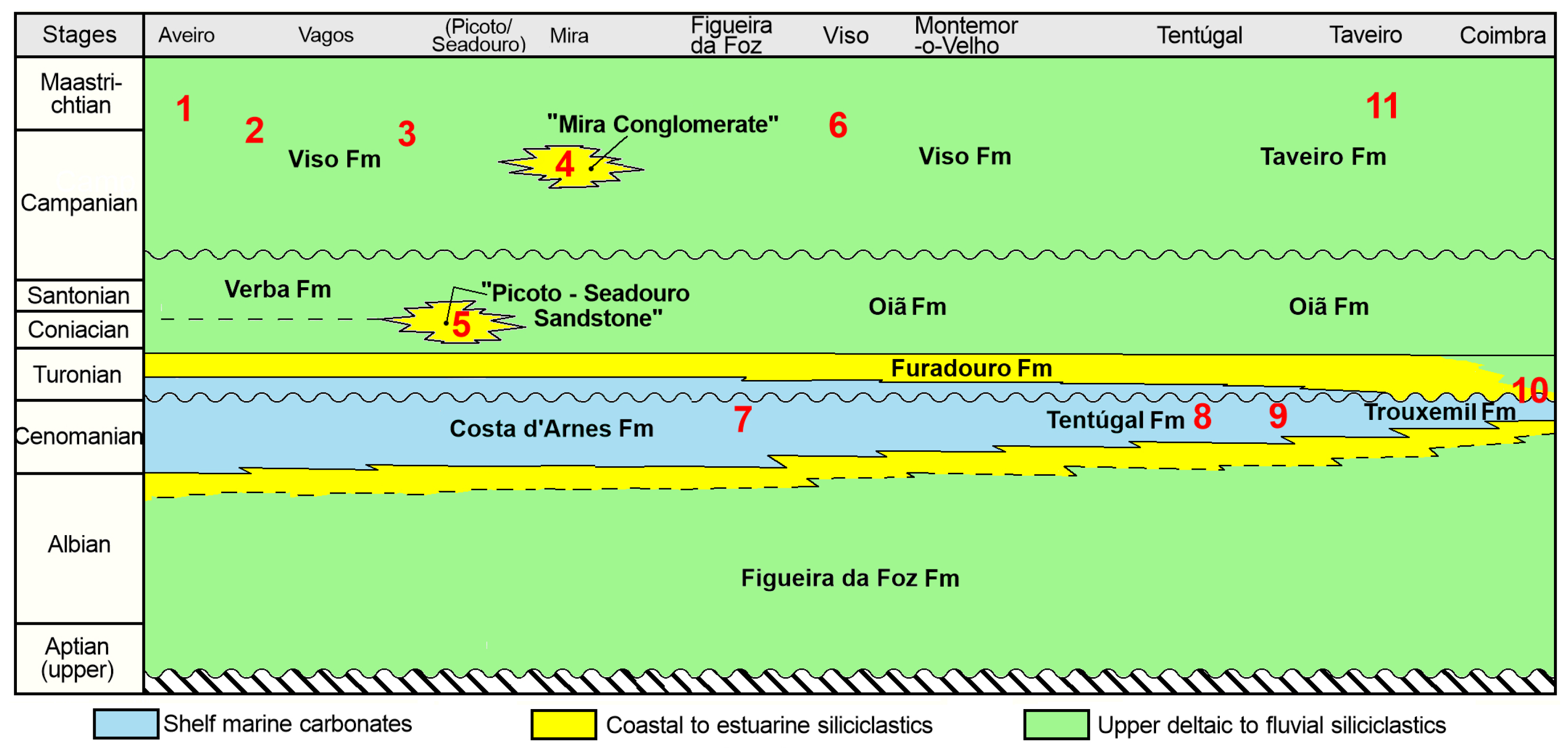
During the Late Cretaceous interval (100.5 Ma–66 Ma), eustatic sea levels reached some of the highest values in the entire Phanerozoic (e.g., [52,53,54,55]). At that large interval of Earth’s history, the Iberian region, due to its westernmost position within the European Archipelago, was influenced by both the Tethys Realm and the Proto-Atlantic Ocean [56,57,58]). On the Portuguese onshore sectors of the West Iberian Margin (WIM) (Figure 1), the sedimentary record of the Cenomanian, and the Campanian and Maastrichtian stages is particularly significant and includes shallow marine to transitional environments and alluvial suitable for a diversity of vertebrate palaeobiocoenoses (e.g., [3,59]) (Figure 2 and Figure 3).
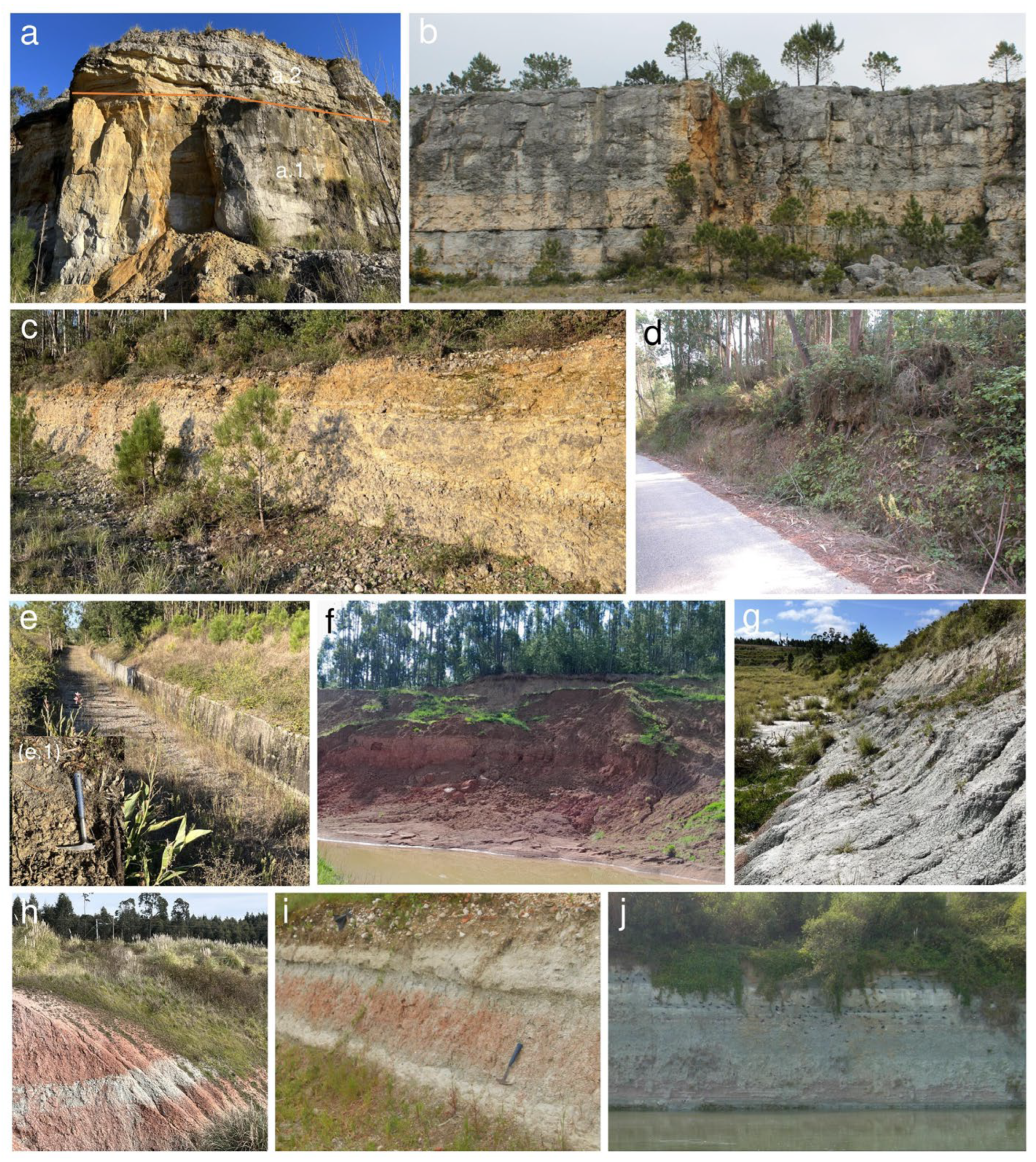
The post-rift passive infill in WIM and its tectono-sedimentary evolution from a previous context with records of several rifting phases on the Lusitanian Basin, during the Middle to Late Triassic, Jurassic, and Early Cretaceous, has been extensively discussed (e.g., [3,4,58,60,61,62,63,64,65,66,67,68,69,70,71,72,73,74,75,76,77,78,79,80,81,82]). The lower part of these post-rift depositional series consists of upper Aptian (Lower Cretaceous) to Cenomanian coarse-grained, braided alluvial siliciclastics interbedded with lutites, sometimes with abundant plant remains, referred as the Figueira da Foz Formation [83,84,85,86] (Figure 2 and Figure 3a). These diachronous units extended to all Portuguese sectors of the WIM, are overlain by middle to upper Albian, Cenomanian and lower Turonian transgressive sequences with mixed and carbonate, fossil-rich facies, of the Tethyan West Portuguese Carbonate Platform (WPCP) [1,3,5,6,58,61,63,64,87,88,89,90,91,92,93,94,95]. This shallow marine, shelf succession is recorded by the Costa d’Arnes Formation [96], the Tentúgal Formation [97], and the Trouxemil Formation [98] in the northern sectors of the onshore of the Portuguese WIM discussed in this study (Figure 2 and Figure 3a–c). Its biostratigraphic setting has been fully studied, allowing precise correlations based on foraminifera [79,93] and assemblage biozones with Acanthoceratidae and Vascoceratidae ammonoids (e.g., [6,94,99]). This detailed setting allows accurate dating of the vertebrate remains and their correlation with the Spanish Iberian Basin and other European and North-African contexts.
Above the lower Turonian, the post-rift record is limited to the regions located between the localities of Nazaré, Coimbra, and Aveiro (Figure 1b). It is predominantly alluvial, with the exception of a brief marine incursion that occurred at the late Coniacian [1,93,100,101]. This episode is recorded by the “Picoto-Seadouro Sandstone” [102] (Figure 2 and Figure 3d), a lenticular unit of fossiliferous coarse sandstones and laminated marls containing a brackish to shallow marine invertebrate assemblage [100,102], including the ammonoid Hemitissotia ceadouroensis Choffat, 1898 [103].
A lower Campanian unconformity, also recognised in the Iberian Basin [3,59], separates the previous series from Campanian and Maastrichtian thick alluvial and marginal marine successions recorded by the Viso and Taveiro formations [40,98,104] (Figure 2 and Figure 3e,f). Palaeocurrent analysis and the geometry and lateral changes of these green to reddish claystone facies indicate that a meandriform fluvial drainage was dominant in the palaeogeographic setting, mostly oriented towards the northwest, with the most distal settings located in the Aveiro region and nearby offshore [70,71].
A remarkable exception to this general Campanian–Maastrichtian framework is a fully marine unit interbedded with the Viso Formation, localised near the locality of Mira (Figure 1c and Figure 2), and informally known as the “Mira Conglomerate”. This unit records a transgressive parasequence, beginning with a fossil-rich basal conglomerate that contains the upper Campanian ammonite Hoplitoplacenticeras marroti (Coquand, 1859) [105]. The fossil assemblage comprises reworked concentrations of small scleractinian corals, molluscs, and the macroforaminifera Larrazetia larrazeti (Munier-Chalmas in Schlumberger, 1898) [106] (see [3] and references herein).
The uppermost Cretaceous of Taveiro (Figure 3f) records a palaeoenvironment characterised by tropical to subtropical conditions, with a low topography and mostly fine-grained depositional settings. The region was relatively dry but occasionally subject to alluvial flooding, as part of the large NNW-SSE meandriform system mentioned above [70,71]. The correlative successions in the Aveiro–Vagos region (Figure 3g–j), also reveal evidence of a tropical to subtropical climate [107,108], but located in a more distal palaeogeographical setting characterised by a low coastal plain. Further inland, the environment was drier and forested [50,51,109,110,111].

3. Materials and Methods

This study aims to provide a comprehensive overview of the current state of palaeontological research on vertebrate faunas from the Upper Cretaceous of the Aveiro–Vagos–Mira and Coimbra–Tentúgal–Figueira da Foz (Baixo Mondego) sectors of the West Iberian Margin (WIM). Vertebrate taxa from other sectors of the onshore WIM are generally discussed only when their occurrence is also documented in the regions under study.
The sequence in which the major taxonomic groups are presented in Section 4 is largely based on Benton [112].
Within the tables, taxa of the same taxonomic group and rank are arranged in alphabetical order, and fossil localities are listed according to current orthography. A separate table is not provided for mammalian occurrences, as all records derive from a single geological formation and locality, which can be fully traced to a single published reference. It should be noted that many of these fossil sites—where specimens were collected as early as the 19th Century—are no longer accessible, having since been subsumed into the urban fabric of towns and villages or obliterated through the deliberate infilling of abandoned open pits no longer available for exploration.
In each table, abbreviations are used for ages/stages, formations (including informal units), and localities as follows: Ave—Aveiro; Ca—Campanian; Ca–Ma—Campanian–Maastrichtian; Can—Cantanhede; Cas—Casais dos Carecos; Ce—Cenomanian; Cho—Chousa do Fidalgo; Co—Coniacian; Co Fm—Costa d’Arnes Formation; Coi—Coimbra; “MC”—“Mira Conglomerate” informal unit; Cov—Covões; Fig—Figueira da Foz; “P–SS”—“Picoto-Seadouro Sandstone” informal unit (sensu Barbosa [102]); Hen—Henricas; Ilh—Ílhavo; Lic—Liceia; Mal—Mala; Mir—Mira; Mon—Montemor-o-Velho; Out—Outeirinho; Qui—Quintãs; S.And—Santo André; S.Cat—Santa Catarina; Sar—Sargento-Mor; Sea—Seadouro; Ta Fm—Taveiro Formation; Tav—Taveiro; Te Fm—Tentúgal Formation; Toc—Tocha; Tr Fm—Trouxemil Formation; Vag—Vagos; Vi Fm—Viso Formation; Vil—Vilar; Vis—Viso.
For the genus-level diversity dataset, taxa assigned only to a suprageneric taxonomic rank were conservatively treated as a single genus occurrence. Ambiguous assignments involving two potential genera were resolved by counting only one genus, thereby minimising artificial inflation of diversity. In such cases, precedence was given to the genus already documented from the region, and no additional genus was recorded.
The vertebrate fossils from the Upper Cretaceous of the onshore of the WIM, referenced throughout this study, are housed at the Geological Museum (Lisbon, Portugal) (MG), the Natural History and Science Museum of the University of Porto (Porto, Portugal) (UP-MHNFCP), the Department of Earth Sciences of the University of Coimbra (Coimbra, Portugal) (DCT) (temporarily deposited in the Department of Geology, Geography and Environment, University of Alcalá, Spain), Lourinhã Museum (Lourinhã, Portugal) (ML), and is maintained under the care of Miguel Telles Antunes at the Academy of Sciences of Lisbon (Collection MTA).
Although a review of the entire Upper Cretaceous vertebrate fauna of Portugal falls outside the scope of the present study, some DCT specimens were documented to provide illustrative support for this work. Photographic data were acquired using a Canon© EOS 550D digital camera equipped with a Canon© EFS 18–55 mm lens.
Specimens described in the classical literature (e.g., [12]), particularly those belonging to the palaeontological collection of the Geological Museum, are reproduced through the assembly of selected images taken from the plates published in those works. The identification of the specimens follows the information recorded in the Geological Museum’s catalogue.
Taxonomic qualifiers aff. and cf., together with quotation marks, are applied herein following the sensu of Bengtson [113].

4. Remarks on the Upper Cretaceous Vertebrate Record of the Portuguese Northern Onshore West Iberian Margin

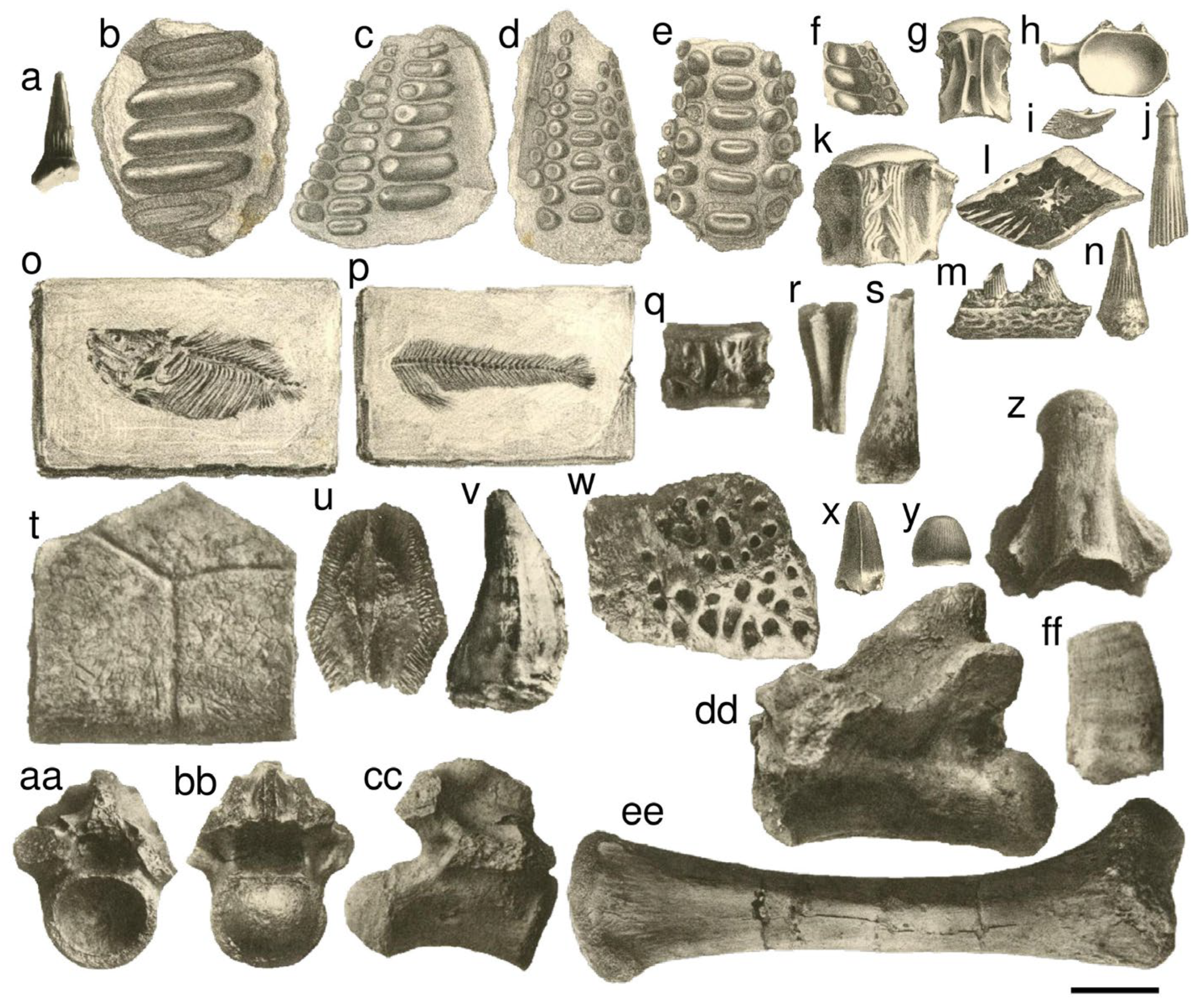
In the closing decades of the 19th Century, the work of Choffat (e.g., [1,7]) on the Cretaceous System of the Portuguese West Iberian Margin (WIM), carried out in collaboration with the Geological Commission of the Kingdom, brought to light important Cenomanian vertebrate remains sampled from marine and marginal marine facies of the West Portuguese Carbonate Platform (WPCP). Although the majority of fossil material was recovered from the Lisbon–Sintra–Cascais sector (Figure 1b), additional finds—particularly of pycnodont fishes—were documented further north, between Coimbra and Figueira da Foz. Subsequent fieldwork at the railway cutting at Viso (Montemor-o-Velho) (Figure 1c and Figure 3e), as well as in more northerly localities extending to the Aveiro region (Figure 1c) [1,114], resulted in the recovery of numerous vertebrate fossils mostly from paralic and floodplain facies belonging to depositional sequences today attributed to the upper Coniacian, and upper Campanian–Maastrichtian stages [50,102]. These specimens were assigned to Henri Émile Sauvage (1842–1917), one of the leader vertebrate palaeontologists of the late 19th Century, who studied them, culminating in one of the seminal contributions to the early development of Portuguese vertebrate palaeontology [12] (Figure 4, Table 1).
After this first research period, investigations into Upper Cretaceous vertebrates from the Portuguese northern onshore sectors of the WIM have focused predominantly on Testudines, particularly those recovered from the Campanian–Maastrichtian of Aveiro [47,48,49]. In this region, the most recent vertebrate fossil assemblages were recovered during field campaigns carried out in the late 1960s and in the early 1970s [41,51]. These efforts were primarily concentrated on the former clay pit of the Empresa de Cerâmica do Vouga, located in Vilar (Aveiro), where the local Upper Cretaceous lagoonal facies were particularly well exposed. Fossil remains were predominantly obtained from channel infill sequences [51]. Parallel investigations undertaken in the 1970s at Taveiro (west of Coimbra), in the clay pit operated by Cerâmica do Mondego, Lda., also yielded vertebrate material from channel infill contexts (see Table 1). Although the Taveiro assemblage shares several taxa with those from Aveiro and Viso, it exhibits notable faunal distinctions—most significantly, a higher diversity of dinosaurs and the occurrence of mammalian dental remains [40].
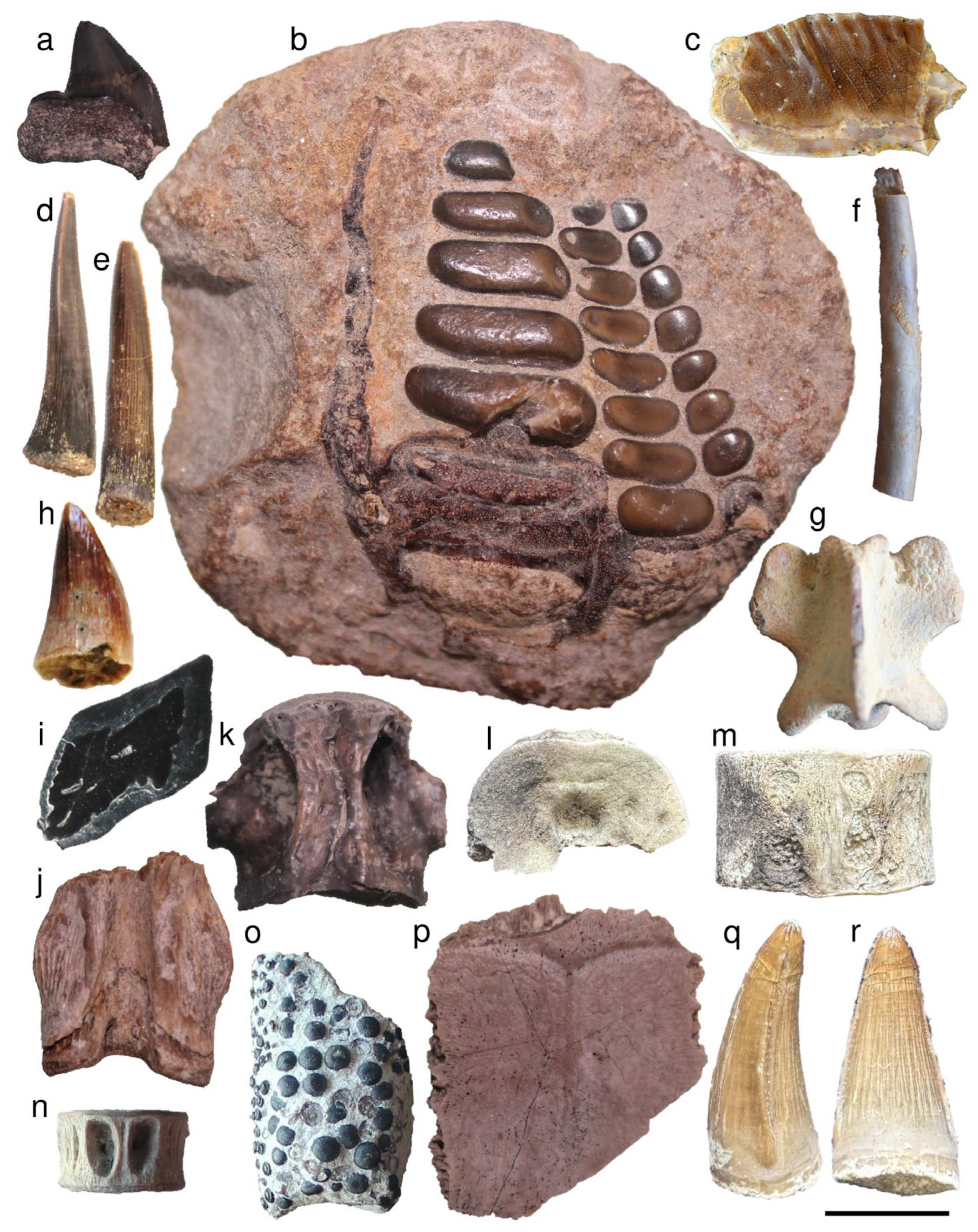
Over the past decade, renewed fieldwork in Cenomanian outcrops between Coimbra and Figueira da Foz has significantly expanded the vertebrate record of this sector of the WIM (Figure 5a–h). These efforts have led to the discovery of new reptile taxa [31,32,33] (Table 1), as well as fossil remains—currently under study—of both Chondrichthyes and Osteichthyes [34]. Recent fieldwork at a newly identified upper Campanian–Maastrichtian exposure located in the Aveiro region has led to the finding of a rich assemblage of vertebrate micro remains, predominantly of fish, chelonians, and crocodylomorphs, which are currently under detailed palaeontological study (Figure 5i–r).

4.1. Chondrichthyes Huxley, 1880 [115] (Table 2, Figure 4a)

Chondrichthyans records from the Upper Cretaceous of the WIM are relatively scarce. The specimens described to date predominantly comprise sharks belonging to the families Odontaspididae and Lamnidae, as well as a rajiform, recovered from several outcrops in the middle to upper Cenomanian units of Sintra and Cascais areas [7,11,12,14,19]. In contrast, occurrences from the Portuguese northern region of the WIM are restricted to the upper Coniacian of Picoto–Seadouro (Cantanhede) [1,11,12,14,19], where material has been identified as an Odontaspididae (Figure 4a), alongside rare remains attributed to a Mitsukurinidae shark, a Rhinobatidae guitarfish, and a Dasyatidae stingray, recorded from the upper Campanian–Maastrichtian of Aveiro [51].
Table 2. Chondrichthyes from the Upper Cretaceous series of the Portuguese onshore northern sectors of the West Iberian Margin.
TaxaAgeFormation/
“Informal Unit”
LocalityReferences
CoCaCa–Ma“P–SS”“MC”Vi FmAveCanMir
Palaeohypotodus bronni (Agassiz, 1843) [116]X X X
(Cov)
[1] (p. 209); [12] (p. 45, pl. 10, Figure 5); [14] (p. 258, pl. 1, Figure 3); [19] (p. 208)
Scapanorhynchus rhaphiodon
(Geinitz, 1839) [117]
X XX [51] (p. 160, Table 1)
Lamniformes X X X[1] (p. 228)
Myledaphus bipartitus Cope, 1876 [118] X XX [51] (p. 160, Table 1)
Dasyatis sp. X XX [51] (p. 160, Table 1)

4.2. Actinopterygii Woodward 1891 [119]

The earliest documented references to Cretaceous Pycnodontiforms in Portugal date to the 1880s, when fossils attributed to the genus “Pycnodus” were collected from the Cretaceous of Cascais and Sintra [7]. Sauvage [12] described new species of Coelodus and Anomoeodus, some of which were found in the northern Portuguese sectors of the WIM. Most of these taxa originally described by Sauvage were based on fragmentary and poorly preserved material, necessitating a thorough re-evaluation and, in all likelihood, revised taxonomic assignments.
A few vomers and prearticular specimens recovered from Cenomanian exposures located between Coimbra and Figueira da Foz were described and assigned to the genera Anomoeodus and Coelodus [12,30] (Figure 4b–e). The prearticular specimen referred to Anomoeodus displays dental features that are characteristic of the genus (see [121,122]). The teeth of the principal prearticular row are distinctly elongated, obliquely aligned, and tightly arranged, with only minute diastemata separating adjacent elements [12] (pl. 1, Figure 20). The attribution of the vomers to the genus Coelodus was supported by the diagnostic features recognised at the time [12] (pl. 1, Figures 11, 12, 12a), particularly the distinctive dental arrangement and morphology organised into five tooth series (e.g., [121,123,124]). The teeth of the principal row are transversely broader and may exhibit a slightly concave posterior margin. Each tooth bears a transverse ridge which, when worn, may appear as a groove. The four lateral rows comprise smaller teeth, clearly separated from the main row, and exhibiting a subcircular to polygonal outline.
Concerning the dentition of the prearticular bones [12] (pl. 1, Figure 15), [30] (pl. 1), the specimens were also assigned to Coelodus based on the diagnostic characters defined during that period (see [124], p. 47). These include three tooth rows, of which the medial row bears transversely elongated teeth, generally rectangular or occasionally trapezoidal, with rounded edges (e.g., [121,123]). These teeth often display transverse ridges that, when worn, can develop into apical grooves, and may also show latero-apical wear facets. The lingual and labial rows consist of smaller teeth; those of the lingual row are relatively larger and more rectangular in outline than the more diminutive teeth of the labial row.
Other genera of Portuguese Cretaceous pycnodonts in the literature are “Mesodon”, “Microdon” (Figure 4f), and Sylvienodus [12,14,19,26]. Most of the Portuguese Cretaceous specimens were described based on the dentition characteristics of vomers and prearticular bones, collected across a stratigraphic range from the upper Barremian [125] (pp. 11, 52) to the upper Campanian–Maastrichtian (e.g., [12,19]). It is worth noting that many Cenomanian specimens are attributed to the Turonian in the original literature, as the strata from which they were collected were dated as such at the time, before a revaluation of the Cenomanian-Turonian boundary [91,92,126].
Articulated pycnodontiform remains from the Cretaceous of Portugal are also rare. A partial postcranial skeleton has been tentatively referred to Coelodus aff. saturnus Heckel, 1854 [127] by Zbyszewski and Almeida [13]. Multiple articulated specimens from the Cenomanian of Laveiras (Oeiras) have been attributed to Sylvienodus laveirensis [14,26].
In recent years, six well-preserved vomers and prearticulars from large individuals have been recovered from the Cenomanian of Figueira da Foz, Granja de Ancã (Cantanhede), and Trouxemil (Coimbra) (Figure 1c and Figure 2) and are currently undergoing detailed study.
Table 3. Pycnodontiforms from the Upper Cretaceous of the Portuguese onshore northern sectors of the West Iberian Margin.
TaxaAgeFormation/
“Informal Unit”
LocalityReferences
CeCoCa–MaCo Fm“P–SS”Te FmTr FmVi FmAveCanCoiFigMon
Anomoeodus aff. subclavatus (Agassiz, 1834) [116] X X X
(Sea)
[1] (p. 209); [11] (p. 446); [12] (p. 44)
Anomoeodus woodwardi Sauvage, 1897 [12]X X X
(Toc)
X [12] (p. 18, pl. 1, Figure 20); [19] (pp. 230–231); [128]
Coelodus bocagei Sauvage, 1897 [12]X X X
(Mal)
X (Sar) [12] (p. 17, pl. 1, Figures 15–17); [19] (pp. 227–228, pl. 3, Figure 2); [30] (pl. 1)
Coelodus cuneiformis Sauvage, 1897 [12]X X X
(Lic)
[12] (p. 16, pl. 1, Figure 11); [19] (pp. 225–226, pl. 3, Figure 6)
Coelodus ribeiroi Sauvage, 1897 [12]X X X (Sar) [12] (p. 17, pl. 1, Figures 12–12a); [19] (pl. 1, Figure 12)
Coelodus sp. X XX X
(Vis)
[51] (p. 160, Table 1)
Microdon” sp. X X X
(Vis)
[12] (p. 39, pl. 1, Figure 21); [19] (p. 224)
Sauvage [11] reports fragmentary materials from the Cenomanian of Liceia (Montemor-o-Velho), tentatively referred to a large-bodied lepidotid, possibly “Lepidotus”.
Fossil remains attributed to Amia sp. have been reported from the Campanian–Maastrichtian of the northern Portuguese WIM, specifically within the Taveiro and Viso formations [40,51]. In the latter, occurrences have been documented at the localities of Aveiro and Viso (Montemor-o-Velho). Despite these records, the material remains neither described nor illustrated.
Obaichthyidae scales have been recorded from the Cenomanian of Sintra since the late 19th Century [7]. At that time, they were tentatively classified as “ganoid fish” [7], and Palaeoniscidae indet. [12]. These scales were later mentioned [130] (p. 30) in the description of “Stromerichthys aethiopicus” Weiler, 1935 [130]. The fish remains initially assigned to “Stromerichthys” [15,17,18,19] were subsequently referred to Obaichthys africanus Grande 2010 [131] by Cavin et al. [132], while other remains, described as Paralepidosteus cacemensis Jonet, 1981 [19] and Lepidotus minimus Jonet, 1981 [19], were considered to likely belong to Dentilepisosteus kemkemensis Grande, 2010 [131].
Pimentel et al. [34] reported O. africanus from the Cenomanian of Casais dos Carecos (Coimbra) (Figure 1c, Figure 3a and Figure 5c), thereby extending the palaeogeographical distribution of this spiny gar to the northern Portuguese sectors of the WIM.
Lepisosteidae from the uppermost Cretaceous (upper Campanian–Maastrichtian) of Portugal have been known since the field collection made by the Portuguese Geological Commission at the end of the 19th Century in the locality of Viso (Montemor-o-Velho) (Figure 1c, Figure 3e and Figure 4g–n). Sauvage [10,12], described the lepisosteid gars “Clastes lusitanicus” (Figure 4g–j), and “Clastes pustulosus” (Figure 4k–n) from Viso. Sauvage also illustrates additional specimens of “Clastes” from equivalent deposits in the Aveiro and Vagos regions [12]. Both designations are considered nomina dubia [131], as specific diagnoses based on isolated vertebrae, centra, and scales are not viable. Ferreira [14], and Jonet [19] assigned “Clastes” to “Lepidosteus”, an unaccepted name to Lepisosteus (see Table 1). However, the opisthocoelous centra indicate lepisosteiform, while the scale morphology and the age of the Viso Formation suggest that the material belongs to an unidentified lepisosteid gar. Antunes [50], and Antunes and Pais [40] assign Lepisosteus to the upper Campanian–Maastrichtian of Aveiro and Taveiro, while Antunes and Broin [51] attribute the lepisosteid gar remains from Aveiro, Taveiro, and Viso to the genus Atractosteus.
Table 4. Holostei from the Upper Cretaceous of the onshore northern sectors of the Portuguese West Iberian Margin.
TaxaAgeFormationLocalityReferences
CeCa–MaTa FmTe FmVi FmAveCoiMonVag
Lepidotus sp.X X X
(Lic)
[12] (p. 15)
Amia sp. XX XXX
(Tav)
X
(Vis)
[51] (p. 160, Table 1)
Obaichthys africanus Grande, 2010 [131]X X X
(Cas)
[34] (Figures 3 and 4)
Atractosteus sp. XX XXX
(Tav)
X
(Vis)
[51] (p. 160, Table 1)
Clastes lusitanicus” Sauvage, 1897 [10] X X
(Vil)
X
(Vis)
X
(Hen)
[10] (pp. 93–94, pl.2, Figures 11–26); [11] (pp. 445–446); [12] (pp. 37–38, 45, pl. 9, Figures 1–25, pl. 10, Figure 6)
Clastes pustulosus” Sauvage, 1897 [10] X X
(Vil)
X
(Vis)
X
(Hen,
S.Cat)
[10] (pp. 94–95, pl.2, Figures 1–10); [11] (pp. 445–446); [12] (pp. 38, 45, pl. 9, Figures 26–41, pl. 10, Figures 7 and 8);
Lepisosteus sp. XX XX
(Tav)
[40] (p. 118); [50] (p. 152)
Fossil remains of Aulopiformes have been documented from the Cenomanian of the Oeiras–Sintra region in the Lisboa–Cascais–Sintra sector of the WIM [16,17,19], including specimens attributed to Enchodus lewesiensis (Mantell, 1822) [134], and E. elegans Dartevelle and Casier, 1949 [135]. An additional aulopiform taxon, Apateodus aff. striatus Woodward, 1901 [136], has also been reported from this region [19]. The occurrence of cf. Enchodus is recorded from the middle Cenomanian of Nazaré [27]. In contrast, aulopiforms have not previously been recorded from the Cenomanian of the Portuguese northern sectors of the WIM, with the sole exception of references to enchodontid teeth recovered from Casais dos Carecos (Figure 5d,e) [32,34]. However, this material remains under study, and no formal descriptions or illustrations have been published to date. Antunes and Broin [51] refer to E. cf. elegans from the upper Campanian–Maastrichtian of Aveiro and Taveiro, as well as to Cimolichthys sp. from Aveiro.
Platacodon cf. nanus Marsh, 1889 [137], an acanthomorph taxon initially misidentified as a mammal [137] (p. 178), was subsequently assigned to the Sciaenidae by Estes [138]. Its phylogenetic relationships to extant teleosts, however, remain unresolved [139]. The species is recorded from uppermost Cretaceous of Aveiro [51].
Elopiforms have been recorded from the upper Campanian–Maastrichtian of the Viso and Taveiro formations. In particular, Antunes and Broin [51] reported the occurrence of Paralbula casei Estes, 1969 [140].
On the Cenomanian of Lisboa–Sintra, multiple occurrences of clupeomorph fishes (sensu Grande [141]) have been documented, including representatives of the genera Clupea, Diplomystus, and Lusitanichthys (e.g., [12,14,19,22]). In contrast, no clupeomorph occurrences have been reported to date from the Cenomanian carbonate facies of the WPCP in the Portuguese northern onshore sectors of the WIM. Nonetheless, on the upper Campanian–Maastrichtian units, the presence of taxa attributed to Clupea and Diplomystus has been recorded [12,19,40,51]. Sauvage [12] described the species Clupea arazedi based on articulated specimens collected from the Viso locality (Figure 4o,p). Jonet [19] subsequently assigned one of the illustrated specimens [12] (pl. 2, Figure 6), (Figure 4o) to Diplomystus brevissimus (Blainville, 1818) [142]. However, Grande [143] argued that the inclusion of this taxon within Diplomystus would render the genus paraphyletic and therefore reassigned the species to the genus Armigatus.
The Sparidae and Sciaenidae were also recorded, with the genus Diplodus identified from the Coniacian, and either Diplodus or Chrysophrys from the upper Campanian–Maastrichtian [12].
Table 5. Teleostei from the Upper Cretaceous of the Portuguese onshore northern sectors of the West Iberian Margin.
TaxaAgeFormationLocalityReferences
CoCa–MaTa FmVi FmAveCanCoiIlhMon
Cimolichthys sp. X XX [51] (p. 160, Table 1)
Enchodus cf. elegans Dartevelle and Casier, 1949 [135] XXXX X
(Tav)
[51] (p. 160, Table 1)
Paralbula casei Estes, 1969 [140] XXXX X
(Tav)
X
(Vis)
[51] (p. 160, Table 1)
Platacodon cf. nanus Marsh, 1889 [137] X XX [51] (p. 160, Table 1)
Clupeia arazedi Sauvage, 1898 [12] X X X
(Vis)
[12] (p. 39, pl. 2, Figures 6–8)
Clupeidae gen. sp. X XX X
(Vis)
[51] (p. 160, Table 1)
cf. Diplomystus sp. XX X
(Tav)
[51] (p. 160, Table 1)
Diplodus sp.X X X
(Sea)
[12] (p. 46, pl. 10, Figures 10 and 11)
Diplodus sp. or Chrysophrys sp. X XX
(Vil)
X [12] (p. 46)

4.3. Amphibia Linnaeus 1758 [144] (Table 6, Figure 4r,s)

The amphibian record from the Portuguese Mesozoic includes several significant occurrences, most notably temnospondyl remains from the Upper Triassic of the Algarve Basin [145], and a well-represented Late Jurassic lissamphibian assemblage [146,147]. Among the latter, albanerpetontids are particularly abundant, especially in the Upper Jurassic beds of the Guimarota coal mine (Leiria) [146], as well as at Porto Dinheiro and Porto das Barcas (Lourinhã) [147]. In contrast, Cretaceous records are exceedingly scarce (Table 6), and with the exception of a “large-bodied ecaudate” from the Upper Cretaceous of Viso, illustrated by Sauvage [12] (Figure 4r,s), the material remains undescribed and unfigured.
Table 6. Amphibia from the Upper Cretaceous of the onshore northern sectors of the Portuguese West Iberian Margin.
TaxaAgeFormationLocalityReferences
Ca–MaTa FmVi FmAveCoiMon
Anura indet. XXXXX
(Tav)
X
(Vis)
[51] (p. 160, Table 1)
Batrachia EcaudataX X X
(Vis)
[11] (p. 445); [12] (pl. 8, Figures 2 and 3)
Urodela indet.XXXXX [51] (p. 160, Table 1)

4.4. Testudines Batsch, 1788 [148] (Table 7, Figure 4t,u and Figure 5p)

References to turtles from the Cenomanian of the WPCP remain relatively scarce and are, to date, restricted to the Portuguese central and southern sectors of de WIM. Documented occurrences include indeterminate testudines from Lisbon, Odivelas, and Sintra [12]; Pan-Chelonioidea remains from Nazaré [27]; and the bothremydid Algorachelus peregrina Pérez-García, 2017 [149] reported from both Nazaré and Sintra [28,29]. In contrast, the northern sector has yielded the bothremydid Rosasia soutoi Costa, 1940 [47], known from Campanian–Maastrichtian of Aveiro, Viso, and Taveiro [40,47,48,49,51] with a few complete carapace specimens exceptionally preserved. The isolated plates originally described by Sauvage [12] and Choffat [1] (Figure 4t,u), and tentatively assigned to “tortue de marais” (Emydidae), are recognised as belonging to R. soutoi [51].
Table 7. Testudines from the Upper Cretaceous of the Portuguese onshore northern sectors of the West Iberian Margin.
TaxaAgeFormation/”Informal Unit”LocalityReferences
CoCa–Ma“P–SS”Ta FmVi FmAveCanCoiMonVag
Emydidae XXX XX
(Out, Qui, Vil)
X
(Sea)
X
(Vis)
X
(S. And)
[1] (pp. 209, 217, 219–220); [11] (p. 445); [12] (pl. 8, Figures 4–6)
Rosasia soutoi Costa, 1940 [47] X XXX X
(Tav)
X
(Vis)
[40] (pp. 115–116); [47] (pls. 1–3); [49] (pls. 3–6); [51] (pp. 162–176, text Figures 3–8, pl. 2, Figure 4, pl. 3, Figures 1–3, pl. 4, Figures 1–3, pl. 5, Figures 1–4)

4.5. Lepidosauria Haeckel, 1866 [150]

Squamates from the Portuguese Cenomanian have been documented since the late 19th Century (e.g., [9,11,12,17,19]), although these records originate from the Sintra sector of the West Iberian Margin. They include the pachyostotic, hind-limbed ophidians Simoliophis rochebrunei Sauvage, 1880 [152], and Simoliophis delgadoi Sauvage 1896 [9], which is now considered a synonym of S. rochebrunei (e.g., [153,154]). Recently, from the middle Cenomanian marginal marine facies of the northern sector of the WPCP at Casais dos Carecos, a new genus and species of aquatic pachyostotic pythonomorph was described as Segurasurus soaresi (Pimentel, Berrocal-Casero, Audije-Gil and Callapez, 2023) [32] (Figure 5g).
Mosasaur remains are rare in Portugal, with only two teeth reported from the Upper Cretaceous of the Portuguese northern onshore sectors of the WIM [11,12]. The same worker assigned one of these teeth to Mosasaurus sp. (Figure 4v), and the other to an indeterminate mosasaurian. However, Castanhinha and Mateus [155] conservatively referred the Mosasaurus sp. tooth to the Mosasaurinae. According to Bardet et al. [156], two of the vertebrae originally attributed to “Crocodilusblavieri from Viso could, in fact, be assigned to plioplatecarpine mosasaurids. Antunes and Broin [51] documented rare juvenile mosasaur remains from the upper Campanian–Maastrichtian of Aveiro, recovered through the sieving of approximately four tonnes of sediment. Rare ophidian fossils assigned to Boidae, as well as to lizard remains attributable to Varanoidea, were also recovered during these sorting procedures [51].

4.6. Archosauria Cope, 1870 [157]

Crocodylomorph fossil record from the Portuguese Upper Cretaceous is abundant and diverse, but it is mostly composed of fragmentary material and need an updated review and probably new taxonomic assignments [159]. Among the diverse Cenomanian outcrops of the Lisboa and Nazaré sectors of the WIM, several crocodylomorphs have been identified. These include specimens attributed to the genera Goniopholis, Oweniasuchus, and Thoracosaurus, as well as other undetermined eusuchian remains [11,12,19,20,27,160].
The Cenomanian WPCP beds from the Portuguese northern sectors of the WIM, at Casais dos Carecos, provided a partial skull and a partially preserved left mandible that enabled the definition of a new genus and species, Portugalosuchus azenhae Mateus, Puértolas-Pascual and Callapez, 2018 [31]. Initially described as possibly the oldest member of Crocodylia, P. azenhae has been the subject of ongoing debate regarding its classification [161,162]. The skull also allowed for a detailed anatomical description of the braincase and a neuroanatomical study [163]. Crocodylomorph material was also reported for the upper Campanian–Maastrichtian (e.g., [12,51]). The uppermost Cretaceous crocodylomorph remains from Viso were assigned by Sauvage [11,12] to “Crocodylusblavieri Gray, 1831 [164] (Figure 4w–ee), a nomen dubium. However, the disarticulated material requires revision [31].
Galton [39] (Figure 1I–J) tentatively reassigned three teeth from Taveiro—previously described as ornithopod by Antunes and Sigogneau-Russell [43] (Figures 7 and 8; pl. 3, Figures 9 and 10)—to dwarf crocodilians (?Atoposauridae).
Table 9. Crocodylomorpha from the Upper Cretaceous of the Portuguese onshore northern sectors of the West Iberian Margin.
TaxaAgeFormationLocalityReferences
CeCa–MaTa FmTe FmVi FmAveCoiMon
?Atoposauridae XX X
(Tav)
[39] (Figure 1I–J); [43] (Figures 7 and 8; pl. 3, Figures 9 and 10)
Crocodylia gen. sp. XX XXX
(Tav)
X
(Vis)
[51] (p. 160, Table 1)
Crocodilusblavieri Gray, 1831 [164] X X X
(Vis)
[11] (p. 445); [12] (p. 41, pl. 8, Figures 7–15; pl. 9, Figures 42–44)
Portugalosuchus azenhae Mateus, Puértolas-Pascual and Callapez, 2018 [31]X X X
(Cas)
[31] (Figures 2–10 and 13); [163] (Figures 1–3)
Portugal has a notable dinosaur fossil record; however, the majority of specimens have been recovered from the Upper Jurassic of the Lusitanian Basin (e.g., [45,166,167,168,169,170,171]). Occurrences of dinosaurs from the Cretaceous of Portugal are comparatively rare. Dinosaur fossil remains have been documented from the Barremian (Lower Cretaceous) of the Sesimbra region (e.g., [45,170,172,173,174]), whereas Upper Cretaceous occurrences are geographically confined to the Portuguese west northern sectors of the WIM (Table 10).
Dinosaur remains from Viso were reported and assigned to “Megalosaurus sp.” by Sauvage [12], and to “Megalosaurus cf. pannoniensis” Seeley, 1881 [175], by Lapparent and Zbyszewski [37]. Sauvage [12] documented only dental elements, whereas subsequently Lapparent and Zbyszewski [37], Jonet [19], and Galton [38] reported the presence of ungual phalanges. Following Malafaia et al. [170], the Viso tooth fragment (Figure 4ff) exhibits a labiolingually compressed crown with a lanceolate basal cross-section and gently convex labial and lingual faces. The distal carina preserves vestigial denticles, and the mesial carina likewise appears denticulate, and can therefore be attributed to indeterminate theropod. The enamel is essentially smooth, showing only faint, irregular ornamentation.
After Galton [38], the size and recurved shape of the ungual phalanges suggest they can reasonably be attributed to a small maniraptoran coelurosaur. Their morphology closely resembles that of the manual unguals found in Oviraptorosauria, Troodontidae, and Dromaeosauridae, as well as the second pedal ungual typical of troodontids and dromaeosaurids. One of the ungual phalanges [38] (Figure 3P–Q) differs noticeably from the others, indicating it may belong to other maniraptoran taxon [38]. Moreover, the same worker assigned the teeth to Carnosauria incertae sedis.
Galton [38] notes that the two distal caudal vertebrae recovered from Viso [38] (Figure 3A–E) bear morphological affinities to those of small maniraptoran theropods, in which the caudal elements are notably avian-like, exhibiting extremely thin cortical bone walls. Two additional bones were referred to as indeterminate [38] (Figure 3F–I). These specimens have been variously referred to avialans [12] (p. 36), long-tailed pterosaurs [37] (p. 58), or tentatively to a long-tailed bird [40] (p. 121).
From Aveiro, Taveiro, and Viso, Antunes and Sigogneau-Russell [42] (Table 1), [43] (Table 2), [44] (Table 1) described an assemblage of small dinosaurs, including a new species assigned to a theropod and other to an ornithischian, both from Taveiro [42]. The new taxa Euronychodon portucalensis Antunes and Sigogneau-Russell, 1991 [42], and Taveirosaurus costai Antunes and Sigogneau-Russell, 1991 [42], were described on the basis of fossilised dental remains and are inferred to have been of relatively small body size. According to Antunes and Sigogneau-Russell [43] (Table 2), [44] (Table 1), the remaining fossil evidence of small-bodied dinosaurs includes representatives of Troodontidae, Dromaeosauridae, various coelurid-related forms and indeterminate Theropoda, as well as a small titanosaurid and an indeterminate ornithopod. In the authors’ view, the data suggest a marked decline in the diversity of large fauna during the Late Cretaceous, with the extinction of most large-sized dinosaurs in the area, while a diverse assemblage of small-sized dinosaurs persisted [42,43,44]. The extinction of the larger forms was attributed to the reduction in terrestrial surface associated with insularity [44,176]. However, the subsequent discovery of other fossil-rich uppermost Cretaceous sites, such as Laño (Burgos, Spain) and Lo Hueco (Cuenca, Spain), also reveals the presence of a diverse mid- to large-sized dinosaur fauna on the Iberian Island during the Late Cretaceous (e.g., [177,178,179,180,181,182,183]). Nevertheless, the interpretation of these fossil remains attributed to small dinosaurs has been subject to ongoing debate.
The teeth of E. portucalensis were originally referred to Paronychodon lacustris Cope, 1876 [118], by Antunes and Broin [51] (Table 1). After Rauhut [184], Euronychodon could be considered a synonym of the North American Paronychodon, as the teeth of both are indistinguishable. Euronychodon portucalensis was initially assigned to ?Dromaeosauridae [42], but was later reinterpreted as cf. Coeluridae [44] (Table 1). Taveirosaurus costai was initially assigned to Pachycephalosauria [42,43], which would have been unprecedented in the European fauna, but was later reassigned to Nodosauridae [44] (Table 1) and Fabrosauridae [39]. According to Galton [39] (p. 87), this referral is based on the resemblance of the teeth to those of Portuguese Jurassic “fabrosaurids”—with the crown shape similar to Alcodon, and both the crown and root closely resembling those of Trimucrodon. After Csiki-Sava et al. [2], the dental material assigned to T. costai, is considered non-diagnostic and, as such, the taxon should be regarded as a nomen dubium.
The suggestion of a possible indeterminate ceratopsid from the Portuguese Upper Cretaceous [40] (p. 116), which would have been an unprecedented addition to the European dinosaur fauna, was not supported [45].
Table 10. Dinosauria from the uppermost Cretaceous (Campanian–Maastrichtian) of the Portuguese onshore northern sectors of the West Iberian Margin.
TaxaFormationLocalityReferences
Ta FmVi FmAveCoiMon
cf. TroodontidaeXXXX
(Tav)
[43] (pp. 52–53, text Figure 1, pl. 1, Figures 9–11)
cf. DromaeosauridaeXXXX
(Tav)
[43] (p. 53, text Figure 2, pl. 1, Figures 1–3)
aff. MegalosauridaeXXXX
(Tav)
X
(Vis)
[40] (p. 116); [43] (pp. 53–54, text Figures 3–5, pl. 3, Figures 1–4); [44] (Table 1)
Megalosaurus sp. X X
(Vis)
[11] (p. 445); [12] (pp. 40–41, pl. 8, Figure 16)
Megalosaurus cf. pannoniensis Seeley, 1881 [175] X [37] (p. 27, pl. 12, Figures 4, 5, 19, 20, 23 and 24)
Maniraptora X X
(Vis)
[38] (p. 261, Figure 3A–E,J–O)
aff. CoeluridaeXXXX
(Tav)
[43] (p. 55, pl. 2, Figures 1–8, pl. 3, Figures 5–7)
Euronychodon portucalensis Antunes and Sigogneau-Russell, 1991 [42]X X
(Tav)
[42] (pl. E. portucalensis, A–F); [45] (p. 90, Figure 15A)
Theropoda indet.XXXX
(Tav)
X
(Vis)
[43] (pp. 55–56, text Figure 6, pl. 1, Figures 4–8); [170] (pp. 147–148, supplementary online material 5, Figure S2E1–E5)
Sauropoda X X
(Tav)
[43] (p. 56, pl. 3, Figure 8)
Ornithopoda indet.X X
(Tav)
[43] (pp. 56–57, text Figures 7 and 8, pl. 3, Figures 9 and 10 (see also Table 9 in this work)
Taveirosaurus costai Antunes and Sigogneau-Russell, 1991 [42]X X
(Tav)
[39] (Figure 1A–E); [42] (pl. T. costai, A–K); [45] (p. 90, Figure 15B)

4.7. Mammalia Linnaeus, 1758 [144]

Portugal holds a significant record of Mesozoic mammals, but predominantly from the Upper Jurassic of the Lusitanian Basin. Notably, the Guimarota coal mine (Leiria) has yielded an exceptionally rich and well-preserved assemblage, providing a rare and invaluable window into the diversity of mammalian taxa during this interval. Guimarota is widely regarded as one of the most productive and taxonomically diverse Upper Jurassic mammal localities known to date [185,186]. The assemblage encompasses representatives of four major Mesozoic mammalian clades—Docodonta, Multituberculata, Dryolestida, and Zatheria (e.g., [187,188,189,190,191,192,193,194,195,196,197])—with the family Paulchoffatiidae being particularly well-represented and taxonomically diverse within the sample (e.g., [186,198]).
However, the only known mammalian fossil remains from the Upper Cretaceous of Portugal consist of five incomplete teeth from the upper Campanian–Maastrichtian of Taveiro (Coimbra), described by Antunes et al. [41] (Figure A–G,J,K) as therian mammals. At the time of their discovery, this molar and premolar assemblage was regarded as the “largest” collection of Late Cretaceous mammal teeth from Europe [41] (p. 1250), representing at least three distinct taxa. Notably, it included what were then interpreted as the earliest European records of marsupials and “Lipotyphla”.
Three of the dental remains were interpreted as belonging to Marsupialia. Two of these were tentatively assigned to aff. Alphadon [41] (fig. B) and aff. Pediomys [41] (Figure C,D), while the third exhibits morphological features consistent with those genera or potentially with Glasbius [41] (Figure A). The remaining two specimens were attributed to Eutheria, one of which was cautiously referred to aff. Leptacodon based on available diagnostic characteristics [41] (Figure E–G). The other tooth was a premolar [41] (Figure J,K), for which the authors did not made taxonomic comparisons due to the limited availability of published illustrations of such Cretaceous Eutheria teeth at the time.
An additional specimen, representing a lower molar, was also figured [41] (Figure H,I). Although its whereabouts were unknown at the time, it had previously been assigned to a possible representative of “Symmetrodonta” [40] (p. 116).

5. Synthesis and Discussion

A comprehensive review of Upper Cretaceous vertebrate remains from the northern onshore sectors of the West Iberian Margin (WIM) documents a taxonomically diverse assemblage representing most major vertebrate clades. Their reported occurrences reflect the prevailing depositional environments and facies associations, which in turn record the tectono-sedimentary dynamics and palaeogeographical evolution of the northern Lusitanian Basin during its transition towards a passive-margin setting. These assemblages provide valuable insights into the interplay between vertebrate palaeobiodiversity and basin evolution, and contribute to broader reconstructions of Late Cretaceous ecosystems along the western Tethyan margins.
During the Cenomanian to early Turonian, the Aveiro–Vagos–Mira and Coimbra–Tentúgal–Figueira da Foz (Baixo Mondego) sectors formed part of non-rudist shallow-marine environments within the Tethyan West Portuguese Carbonate Platform (WPCP) (e.g., [6]). These carbonate settings hosted diverse aquatic invertebrate communities, particularly molluscs and echinoids (e.g., [6,87,94,95,103,199,200,201,202]), and also supported vertebrate assemblages including lamniform sharks, obaichthyids, pycnodonts, enchodontids, squamates, and crocodylomorphs [12,30,31,32,33,34,35] (Figure 4b–e and Figure 5a–h).
The coprolites recovered from the proximal facies provide important insights into the taphonomic and palaeoenvironmental dynamics of this depositional setting [35]. Their preservation suggests that both coprolites and vertebrates experienced only brief exposure at the fluid–sediment interface before being rapidly entombed in fine-grained tidal deposits. Such conditions are consistent with episodes of accelerated silt and clay sedimentation, which would have promoted the exceptional preservation of delicate material [35]. The associated beds are particularly rich in invertebrate assemblages, dominated by shallow-water bivalves that reveal a broad degree of adaptation to rather restricted environments. Notable among these are pavements of the oyster Gyrostrea, clusters of the byssate mussel Septifer, and infaunal clams of Anisocardia (e.g., [6,87,89]).
The presence of these body and trace fossils testifies to the development of marginal, low-energy habitats within a depositional setting otherwise dominated by siliciclastic input. Rather than merely reflecting the interaction between sedimentary dynamics and pathways of taphonomic preservation, such occurrences underscore the presence of a vertebrate diversity that remains largely undocumented; the palaeoecological roles of these taxa within marginal settings are still poorly resolved, yet they hold significant potential for elucidating both the ecological structuring of these environments and the broader biotic responses to the prevailing sedimentary regime.
Within the most distal facies, the vertebrate fossil record is, thus far, restricted to vomers and prearticulars of pycnodonts [12], which some new specimens remain under detailed investigation. Notably, all recovered elements exhibit durophagous dentition arranged in well-developed occlusal crushing pavements, a morphology that is widely recognised as diagnostic of feeding strategies specialised towards hard-shelled invertebrates (e.g., [203,204,205]).
To date, lower Turonian successions, which represent the final stages of carbonate platform development in the WPCP, have not yielded vertebrate material. This absence is more plausibly attributable to limited outcrop availability and sampling effort than to unfavourable ecological conditions.
Following the retreat of the WPCP and uplift of the WIM, from the late Turonian to the latest Santonian or earliest Campanian, the sedimentary infill of the Portuguese onshore sectors of the WIM was mostly alluvial with coarse-grained siliciclastic facies, generally inhibiting vertebrate fossil preservation. A brief exception occurred in the late Coniacian, during a eustatic highstand correlated with the Hemitissotia series of the Iberian Basin [100,101], when tidal-flat sediments with mixed sandy–carbonate facies deposited locally at Picoto–Seadouro, yielding Odontaspididae, Pycnodontidae, and Sparidae (Figure 4a,f). The occurrence of these taxa further supports the transgressive episode, despite their association with a palaeogeographic setting indicative of a relatively proximal environment.
From the early Campanian to the Maastrichtian, a major tectono-sedimentary readjustment of the WIM was followed by the deposition of thick reddish- to greenish-coloured alluvial lutites, interbedded with channel infills and calcrete palaeosols with root marks. These fine-grained, laminated facies have locally yielded abundant vertebrate remains, notably at Taveiro (Coimbra) in an inland setting. In contrast, more distal areas to the NNW, around Mira, Vagos and Aveiro, preserve evidence of a marine incursion (Mira) and extensive lagoonal facies. The Taveiro assemblage provides a significant window into the vertebrate diversity of the WIM Late Cretaceous. Although the assemblage is dominated by small-bodied dinosaurs and mammals preserved within channel-infill deposits in an alluvial facies setting [40], it almost certainly reflects a significant taphonomic bias. The hydraulic sorting selectively concentrated smaller, more easily transported elements, whereas larger carcasses would rarely have entered the channel before undergoing disarticulation or decay on adjacent floodplains and alluvial plains. On the other hand, the channel fill is described as conglomeratic in nature [40] (pp. 114–115), possibly representing a channel-lag deposit in which bones are entombed together with coarse lithologies near the bases of active channels. This assemblage likely comprises transported remains derived from a range of adjacent habitats [206], within which only the smallest skeletal elements would be expected to preserve their recognisable morphology. The preservational conditions characteristic of such environments preferentially promote the accumulation of diminutive and easily transportable elements, thereby yielding only a partial and distorted representation of the original fauna. Its uniqueness lies in being the sole Portuguese occurrence of mammals for the Upper Cretaceous, underscoring its palaeobiogeographical importance. The associated freshwater taxa—holosteans, amphibians, turtles, and crocodiles—indicate the presence of channels and seasonally inundated habitats. Collectively, these faunal elements point to a mosaic landscape in which terrestrial, freshwater, and semi-aquatic communities coexisted.
The lagoonal facies of Viso and Aveiro–Vagos preserve faunal assemblages encompassing the same major groups recorded at Taveiro (notably holosteans and dinosaurs) (Figure 4g–n,ff and Figure 5i–m), with the exception of mammals, which have not yet been reported. These assemblages also display a higher ichthyofaunal diversity, particularly among teleosts, and squamates, together with rare marine elements, including selachians, batoids, and mosasaurs (Figure 4v). Such occurrences indicate that these lagoonal and flooded ecosystems maintained, at least episodically, a connection with the open marine realm [50,51].
Quantification of vertebrate diversity in the Upper Cretaceous of this sector of the WIM remains preliminary, largely due to limitations in the available data. Historical collections require thorough taxonomic revision, and recently collected material is not yet suitable for integration into formal diversity assessments. Many taxa were originally described from single, fragmentary, or poorly preserved specimens, while others have been cited without formal description or illustration. Potential synonymies, invalid names, and misidentifications further contribute to the uncertainty. Even under conservative estimates, at least forty genera are represented, with Actinopterygii among the “Pisces” (fourteen genera) and Sauropsida within the Tetrapoda (sixteen genera) standing out as the most diverse clades (Table 11).
The vertebrate assemblages from the region between Figueira da Foz, Coimbra, and Aveiro are of considerable significance within the Iberian palaeontological framework [2]. They provide an important basis for comparison with coeval faunas elsewhere on the Iberian Peninsula and Europe.
Cenomanian vertebrate remains are generally scarce in the European record [2], which underscores the importance of the Iberian Peninsula as a key area for the study of Cenomanian fossil assemblages, which are far rarer than vertebrate records from the Lower and uppermost Cretaceous (e.g., [207]). Several taxa of the Cenomanian faunas from Casais dos Carecos (Coimbra) show notable affinities with those from Algora (Guadalajara) in the Iberian Basin (central-eastern Spain), as well as with material from La Cabaña (Oviedo) in the Asturian Central Depression (northern Spain) (e.g., [32,33,34,207,208,209,210,211]). These similarities suggest that comparable palaeoenvironmental conditions may have prevailed across different margins of the then-insular Iberia, particularly in marginal-marine and lagoonal settings influenced by substantial terrigenous input. Such patterns also provide insights into the biogeographical ranges of several important vertebrate groups (e.g., Obaichthyidae, Pycnodontiformes, Aulopiformes, and Pythonomorpha).
During the Campanian and Maastrichtian, several clades that today represent major components of modern ecosystems—mammals, birds, squamate reptiles, and lissamphibians—underwent significant diversification [212]. Conversely, this interval marks the final appearance of pterosaurs and non-avian dinosaurs (e.g., [212]). Within this broader evolutionary context, the uppermost Cretaceous of the Iberian Peninsula has yielded particularly informative nom-marine vertebrate assemblages [2], especially from the sedimentary sequences of the South-Cantabrian Synclinorium (north-central Spain), Iberian Basin, and the South-Pyrenean Basin (north-eastern Spain), where extensive research has documented lepisosteiform and teleost fishes, amphibians, turtles, pterosaurs, squamates, crocodyliforms, dinosaurs, and mammals (e.g., [177,178,179,180,181,182,183,213,214,215,216,217,218,219,220,221,222,223,224,225,226,227,228,229,230,231,232,233,234,235,236,237,238,239,240,241]). In the South-Pyrenean Basin, several sites preserve substantial remains of the latest vertebrate assemblages of the European Archipelago prior to the end-Cretaceous mass extinction (e.g., [241]).
Given that the Coimbra–Aveiro region contains the only known uppermost Cretaceous (upper Campanian-Maastrichtian) vertebrate occurrences from the WIM (e.g., [12,39,40,41,42,43,45,46,47,48,49,50,51]), any Portuguese fossil remains attributable to the taxonomic groups listed above assume exceptional significance. They provide a rare and valuable window into the final stages of the Cretaceous in westernmost Iberia, offering key insights for comparative analyses and for understanding the composition, distribution and environmental context of terminal Mesozoic vertebrate communities in the latest Cretaceous Ibero-Armorican Island.
Continued sampling of the few accessible outcrops is expected to expand the fossil record and enable a more robust assessment of vertebrate diversity in the northernmost sector of the Portuguese WIM. Even at this stage, the evidence suggests that the Upper Cretaceous faunal assemblage of the region is considerably richer than previously recognised, emphasizing the potential of ongoing fieldwork and systematic revision to refine our knowledge of Late Cretaceous vertebrate diversity and faunal turnover in this still understudied region.

6. Final Remarks

The Upper Cretaceous sedimentary successions of west Portugal, located in the onshore of the West Iberian Margin (WIM), represent a stratigraphic key for the study of Cretaceous vertebrate faunas, particularly those associated with marginal marine and transitional palaeoenvironments within the southwestern sector of the European Cretaceous Archipelago. On the lowermost Upper Cretaceous (Cenomanian), the Portuguese southern sector of the WIM has yielded abundant vertebrate fossil material since the early geological surveys of the 19th Century. Much of this historically collected material remains in need of systematic revision and re-evaluation in the context of current palaeontological and stratigraphic frameworks.
Conversely, the northern sectors have only recently begun to demonstrate their palaeontological potential, revealing promising new data that may significantly advance our understanding of the composition, diversity, and palaeobiogeographic significance of Late Cretaceous vertebrate assemblages on the Iberian palaeoisland. Notably, the Tentúgal Formation has emerged as a palaeontologically significant unit, yielding novel vertebrate taxa and fossil material currently under study. Preliminary results suggest the possible presence of vertebrate groups not previously reported from the Upper Cretaceous post-rift series of the northern Lusitanian Basin, with implications for regional and broader-scale palaeobiogeographic models.
In contrast, the uppermost Cretaceous (upper Campanian–Maastrichtian) record is more robustly represented in the Portuguese northern sectors of the WIM, which provides a rare opportunity to investigate vertebrate faunal dynamics during the final stages of the Cretaceous on the western of the Ibero-Armorican landmass. The Viso Formation, first studied in the 19th Century through the seminal work of Paul Choffat, has played a foundational role in the characterisation of these faunas in Iberia.
Despite significant advances made during the latter half of the 20th Century, particularly under the leadership of Miguel Telles Antunes, much of the collected material in Viso and Taveiro formations remains undescribed in the scientific literature.
More recent fieldwork in the Viso Formation of Aveiro region has resulted in the recovery of additional microvertebrate fossil remains, which are currently undergoing preparation and analysis. These new finds have the potential to expand our knowledge of the taxonomic diversity, palaeoecology, and evolutionary significance of the vertebrate communities that inhabited western Iberia during the Late Cretaceous between the Tethys and the temperate realms.

Author Contributions

Conceptualization, R.J.P., F.B.-B., M.B.-C. and P.M.C.; investigation, R.J.P., F.B.-B., M.B.-C. and P.M.C.; methodology, R.J.P., F.B.-B., M.B.-C. and P.M.C.; resources, R.J.P., F.B.-B., M.B.-C. and P.M.C.; supervision, M.B.-C. and P.M.C.; writing—original draft, R.J.P.; writing—review and editing, R.J.P., F.B.-B., M.B.-C. and P.M.C. All authors have read and agreed to the published version of the manuscript.

Funding

Research grants UIDP/00611/2025 and UIDB/00611/2025 of FCT—Portuguese Foundation for Science and Technology. Research Project SPLY/25/180801/000069 of the Junta de Castilla-La Mancha and the University of Alcalá (Spain).

Data Availability Statement

No new data were created or analyzed in this study.

Acknowledgments

The authors gratefully acknowledge the support of the Centre for Earth and Space Research at the University of Coimbra (CITEUC), Portugal; and the PALEOIBERICA consolidated research group at the University of Alcalá, Spain.

Conflicts of Interest

The authors declare no conflicts of interest.

References

  1. Choffat, P.L. Recueil de Monographies Stratigraphiques sur le Système Crétacique du Portugal—Deuxième étude—Le Crétacé Supérieur au Nord du Tage; Direction des Services Géologiques du Portugal: Lisbonne, Portugal, 1900.
  2. Csiki-Sava, Z.; Buffetaut, E.; Ősi, A.; Suberbiola, X.P.; Brusatte, S.L. Island life in the Cretaceous-faunal composition, biogeography, evolution, and extinction of land-living vertebrates on the Late Cretaceous European archipelago. ZooKeys 2015, 469, 1–161. [Google Scholar] [CrossRef] [PubMed]
  3. Callapez, P.M.; Barroso-Barcenilla, F.; Berrocal-Casero, M.; Cunha, P.P.; Dinis, P.A.; Lopes, F.C.; Ozkaya de Juanas, S.; Mendes, M.M.; Pimentel, R.J.; Santos, V.F.; et al. The Cretaceous post-rift series from the Portuguese onshore ranges of the West Iberian Margin and their history of research. In Cretaceous Project 200: Regional Studies; Hart, M.B., Batenburg, S.J., Huber, B.T., Price, G.D., Thibault, N., Wagreich, M., Walaszczyk, I., Eds.; Geological Society, London, Special Publications 545; Geological Society of London: London, UK, 2025; pp. 157–196. ISBN 978-1-78620-610-7. [Google Scholar]
  4. Wilson, R.C.L. A reconnaissance study of Upper Jurassic sediments of the Lusitanian Basin. Ciências Terra 1979, 5, 53–84. [Google Scholar]
  5. Berthou, P.Y. Le Cénomanien de l’Estrémadure portugaise. Mem. Serv. Geol. Port. N. S. 1973, 23, 1–169. [Google Scholar]
  6. Callapez, P.M. Palaeobiogeographic evolution and marine faunas of the Mid-Cretaceous Western Portuguese Carbonate Platform. Thalassas 2008, 24, 29–52. [Google Scholar]
  7. Choffat, P.L. Recueil de Monographies Stratigraphiques sur le Système Crétacique da Portugal. Première étude, Contrées de Cintra, de Bellas et de Lisbonne; Section des Travaux Géologiques du Portugal: Lisbonne, Portugal, 1885.
  8. Sauvage, H.E. Les crocodiliens et les dinosauriens des terrains mésozoïques du Portugal. Bull. Société Géologique Fr. 1896, 24, 46–48. [Google Scholar]
  9. Sauvage, H.E. Sur un ophidien des terrains cretaciques du Portugal. Comptes Rendus Hebd. Séances L’académie Sci. 1896, 122, 251–252. [Google Scholar]
  10. Sauvage, H.E. Note sur les lépidostéidés du terrain garumnien du Portugal. Bull. Société Géologique Fr. 1897, 25, 92–96. [Google Scholar]
  11. Sauvage, H.E. Les reptiles et les poissons des terrains mésozoïques du Portugal. Bull. Société Géologique Fr. 1898, 26, 442–446. [Google Scholar]
  12. Sauvage, H.E. Vertébrés Fossiles du Portugal. Contributions à l’étude des Poissons et des Reptiles du Jurassique et du Crétacé; Direction des Travaux Géologiques du Portugal: Lisbonne, Portugal, 1897–1898.
  13. Zbyszewski, G.; Almeida, F.M. Um Pycnodontidae do Cenomaniano dos arredores de Lisboa. Comun. Serv. Geol. Port. 1951, 32, 65–70. [Google Scholar]
  14. Ferreira, O.V. Fauna ictiológica do Cretácico de Portugal. Comun. Serv. Geol. Port. 1961, 45, 251–278. [Google Scholar]
  15. Jonet, S. Contribution à la connaissance de la faune ichthyologique crétacée. I-Éléments de la faune cénomanienne. Bol. Soc. Geol. Port. 1963, 15, 113–115. [Google Scholar]
  16. Jonet, S. Contribution à la connaissance de la faune ichthyologique crétacée. II-Élements de la faune turonnienne. Boletim Soc. Geol. Port. 1964, 15, 157–174. [Google Scholar]
  17. Jonet, S. Considérations préliminaires sur des vertébrés cénomaniens des environs de Lisbonne. Bol. Soc. Geol. Port. 1971, 17, 177–180. [Google Scholar]
  18. Jonet, S. Présence du poisson ganoïde Stromerichthys aethiopicus Weiler dans le Cénomanien portugais. Bol. Soc. Port. Ciênc. Nat. 1970–1971, 13, 33–38. [Google Scholar]
  19. Jonet, S. Contribution à l’étude des vertébrés du Crétacé portugais et spécialement du Cénomanien de l’Estrémadure. Com. Serv. Geol. Port. 1981, 67, 191–300. [Google Scholar]
  20. Buffetaut, E.; Lauverjat, J. Un Crocodilien d’un type particulier dans le Cénomanien de Nazaré (Portugal). Comptes Rendus Somm. Société Géologique Fr. 1978, 2, 79–82. [Google Scholar]
  21. Gaudant, M. Contribution à l’étude anatomique et systématique de l’ichthyofaune cénomanienne du Portugal. Premiére partie: Les “acanthoptérygiens”. Comun. Serv. Geol. Port. 1978, 63, 105–149. [Google Scholar]
  22. Gayet, M. Contribution a l’Etude Anatomique et Systematique de l’Ichthyofaune Cenomanienne du Portugal. Deuxieme partie: Les Ostariophysaires. Comun. Serv. Geol. Port. 1981, 67, 173–190. [Google Scholar]
  23. Gayet, M. Contribution à l’étude anatomique et systématique de l’ichthyofaune cénomanienne du Portugal. III. Complément à l’étude des Ostariophysaires. Comun. Serv. Geol. Port. 1985, 71, 91–118. [Google Scholar]
  24. Gayet, M. Relations Phylogénétiques de Barcarenichthys joneti Gayet du Cénomanien de Barcarena (Portugal) au sein des Salmoniformes. Comun. Serv. Geol. Port. 1988, 74, 85–103. [Google Scholar]
  25. Gayet, M. Barcarenichthys joneti nov. gen., nov. sp., du Cenomanien marin de Barcarena (Portugal) et ses relations phylogenetiques au sein des “Salmoniformes”. Comptes Rendus L’academie Sci. Ser. II Mec. Phys. Chim. Sci. L’univers Sci. Terre 1989, 308, 137–140. [Google Scholar]
  26. Poyato-Ariza, F.J. Sylvienodus, a new replacement genus for the Cretaceous pycnodontiform fish “Pycnoduslaveirensis. Comptes Rendus Palevol 2013, 12, 91–100. [Google Scholar] [CrossRef]
  27. Callapez, P.M.; Barroso-Barcenilla, F.; Cambra-Moo, O.; Ortega, F.; Pérez-García, A.; Segura, M.; Torices, A. Fossil assemblages and palaeoenvironments in the Cenomanian vertebrate site of Nazaré (West Central Portugal). Neu. Jahrb. Geol. Paläontol. 2014, 273, 179–195. [Google Scholar] [CrossRef]
  28. Pérez-García, A.; Antunes, M.T.; Barroso-Barcenilla, F.; Callapez, P.M.; Segura, M.; Soares, A.F.; Torices, A. A bothremydid from the middle Cenomanian of Portugal identified as one of the oldest pleurodiran turtles in Laurasia. Cretac. Res. 2017, 78, 61–70. [Google Scholar] [CrossRef]
  29. Antunes, M.T.; Pérez-García, A. A bothremydid turtle (Pleurodira) from the middle Cenomanian of Vale de Figueira (Belas, Portugal). Anat. Rec. 2025, 308, 1573–1579. [Google Scholar] [CrossRef]
  30. Silva, G.H. Nota sobre uma placa dentária de Coelodus bocagei Sauvage do Cretácico dos arredores de Coimbra. Memórias Notícias 1960, 49, 15–19. [Google Scholar]
  31. Mateus, O.; Puértolas-Pascual, E.; Callapez, P.M. A new eusuchian crocodylomorph from the Cenomanian (Late Cretaceous) of Portugal reveals novel implications on the origin of Crocodylia. Zool. J. Linn. Soc. 2018, 186, 521–528. [Google Scholar] [CrossRef]
  32. Pimentel, R.J.; Audije-Gil, J.; Barroso-Barcenilla, F.; Berrocal-Casero, M.; Callapez, P.M.; Ozkaya de Juanas, S.; Segura, M. On the occurrence of Carentonosaurus Rage and Néraudeau, 2004 (Squamata, Pythonomorpha) in the Iberian Cretaceous, with description of a new species from the uppermost middle Cenomanian of West Portugal. Cretac. Res. 2023, 151, 105469. [Google Scholar] [CrossRef]
  33. Berrocal-Casero, M.; Pimentel, R.; Callapez, P.M.; Barroso-Barcenilla, F.; Ozkaya de Juanas, S. On Segurasaurus (Squamata: Pythonomorpha), a New Genus of Lizard from the Cenomanian (Upper Cretaceous) of Portugal. Geosciences 2024, 14, 84. [Google Scholar] [CrossRef]
  34. Pimentel, R.; Barroso-Barcenilla, F.; Berrocal-Casero, M.; Callapez, P.M.; Ozkaya de Juanas, S.; dos Santos, V.F. On the Occurrence of the Gar Obaichthys africanus Grande in the Cretaceous of Portugal: Palaeoecological and Palaeobiogeographical Implications. Geosciences 2023, 13, 372. [Google Scholar] [CrossRef]
  35. Pimentel, R.J.; Callapez, P.; Barroso-Barcenilla, F.; Berrocal-Casero, M.; Santos, V.F. Vertebrate coprolites from the marine Upper Cretaceous of Coimbra (west-central Portugal): Palaeoenvironmental and palaeoecological significance. Cretac. Res. 2025, 176, 106190. [Google Scholar] [CrossRef]
  36. Pimentel, R.J.; Hunt, A.P.; Barroso-Barcenilla, F.; Berrocal-Casero, M. A new dentalite, Piscidenticulus callapezi igen. et isp. nov., on a crocodylomorph coprolite from the Upper Cretaceous of west-central Portugal. Cretac. Res. 2025, 176, 106193. [Google Scholar] [CrossRef]
  37. Lapparent, A.F.; Zbyszewski, G. Les dinosauriens du Portugal. Mémoires Serv. Géologiques Port. N.S. 1957, 2, 1–63. [Google Scholar]
  38. Galton, P.M. Notes on Dinosauria and Pterodactylia from the Cretaceous of Portugal. Neues Jahrb. Geol. Paläontologie Abh. 1994, 1994, 253–267. [Google Scholar] [CrossRef]
  39. Galton, P.M. Notes on Dinosauria from the Upper Cretaceous of Portugal. Neues Jahrb. Geol. Paläontologie Monatshefte 1996, 1996, 83–90. [Google Scholar] [CrossRef]
  40. Antunes, M.T.; Pais, J. Notas sobre os depósitos de Taveiro, estratigrafia, paleontologia, idade, paleoecologia. Ciências Terra 1978, 4, 109–128. [Google Scholar]
  41. Antunes, M.T.; Sigogneau-Russel, D.; Russel, D.E. Sur quelques dents de Mammiferes du Crétacé supérieur de Taveiro, Portugal (Note préliminaire). C. R. Acad. Sci. Ser. II 1986, 303, 1247–1250. [Google Scholar]
  42. Antunes, M.T.; Sigogneau-Russell, D. Nouvelles données sur les dinosaures du Crétacé supérieur du Portugal. C. R. Acad. Sci. Ser. II 1991, 313, 113–119. [Google Scholar]
  43. Antunes, M.T.; Sigogneau-Russell, D. La faune de petits dinosaures du Crétacé terminal portugais. Comun. Serv. Geol. Port. 1992, 78, 49–62. [Google Scholar]
  44. Antunes, M.T.; Sigogneau-Russell, D. Le Crétacé terminal portugais et son apport au problème de l’extinction des dinosaurs. Bull. Mus. Natl. Hist. Nat. 4ème Sér. 1996, 18, 595–606. [Google Scholar]
  45. Antunes, M.T.; Mateus, O. Dinosaurs of Portugal. Comptes Rendus Palevol 2003, 2, 77–95. [Google Scholar] [CrossRef]
  46. Costa, J.C. O Neocretácico da Beira Litoral. Publicações Mus. Laboratório Geológico Miner. Fac. Ciências Porto 1st Ser. 1937, 5, 5–34. [Google Scholar]
  47. Costa, J.C. Um novo quelónio fóssil. Comun. Serv. Geol. Port. 1940, 21, 107–125. [Google Scholar]
  48. Costa, J.C. Os fósseis de Aveiro e algumas considerações geológicas. Arq. Dist. Aveiro 1941, 7, 83–98. [Google Scholar]
  49. Costa, J.C. Novos metatipos para o género Rosasia (Testudinata, Pelomedusidae). Comun. Serv. Geol. Port. 1958, 42, 5–30. [Google Scholar]
  50. Antunes, M.T. Ensaio de síntese crítica acerca do Cretácico terminal e do Paleocénico de Portugal. Ciências Terra 1979, 5, 145–174. [Google Scholar]
  51. Antunes, M.T.; Broin, F. Le Crétacé Terminal de Beira Litoral, Portugal, remarques stratigraphiques et écologiques, étude complémentaire de Rosasia soutoi (Chelonii, Bothremydidae). Ciências Terra 1988, 9, 153–200. [Google Scholar]
  52. Haq, B.U.; Hardenbol, J.; Vail, P.R. Mesozoic and Cenozoic Chronostratigraphy and Eustatic Cycles. In Sea-Level Changes: An Integrated Approach; Wilgus, C.K., Hastings, B.S., Kendall, C.G.S.C., Posamentier, H.W., Ross, C.A., Van Wagoner, J.C., Eds.; SEPM Special Publication 42; SEPM (Society for Sedimentary Geology): Tulsa, OK, USA, 1988; pp. 71–108. ISBN 978-0918985743. [Google Scholar]
  53. Haq, B.U. Cretaceous eustasy revisited. Glob. Planet. Change 2014, 113, 44–58. [Google Scholar] [CrossRef]
  54. Seton, M.; Gaina, C.; Müller, R.D.; Heine, C. Mid-Cretaceous seafloor spreading pulse: Fact or fiction? Geology 2009, 37, 687–690. [Google Scholar] [CrossRef]
  55. Seton, M.; Muller, R.D.; Zahirovic, S.; Gaina, C.; Torsvik, T.; Shephard, G.; Talsma, A.; Gurnis, M.; Turner, M.; Maus, S.; et al. Global continental and ocean basin reconstructions since 200 Ma. Earth Sci. Rev. 2012, 113, 212–270. [Google Scholar] [CrossRef]
  56. Dercourt, J.; Ricou, L.E.; Vrielynck, B. Atlas Tethys, Palaeoenvironmental Maps; Gauthier-Villars: Paris, France, 1993; ISBN 9782951718159. [Google Scholar]
  57. Dercourt, J.; Gaetani, M.; Vrielynck, B.; Barrier, E.; Biju-Duval, B.; Brunet, M.F.; Cadet, J.P.; Crasquin, S.; Sandulescu, M. Atlas Peri-Tethys, Palaeogeographical Maps; CCGM/CCMW: Paris, France, 2000. [Google Scholar]
  58. Callapez, P.M.; Barroso-Barcenilla, F.; Segura, M.; Soares, A.F.; Dinis, P.M.; Marques, J.F. The West Iberian Continental Margin. In The Geology of Iberia: A Geodynamic Approach; Quesada, C., Oliveira, J.T., Eds.; Springer Nature: Cham, Switzerland, 2019; Volume 3, pp. 341–354. ISBN 978-3-030-11294-3. [Google Scholar]
  59. Segura, M.; Ozkaya de Juanas, S.; Berrocal-Casero, M.; Barroso-Barcenilla, F.; Callapez, P.M. The Cretaceous of the Spanish Central System: A review of the lithostratigraphy, palaeontology and sequence stratigraphy, including new educational perspectives. Geol. Soc. Lond. Spec. Publ. 2024, 545, 197–218. [Google Scholar] [CrossRef]
  60. Wilson, R.C.L. Mesozoic development of the Lusitanian Basin, Portugal. Rev. Soc. Geol. Esp. 1988, 1, 393–407. [Google Scholar]
  61. Rey, J. Le Crétacé inférieur de la marge atlantique portugaise: Biostratigraphie, organisation séquentielle, évolution paléogéographique. Ciências Terra 1979, 5, 97–121. [Google Scholar]
  62. Rey, J. Dynamique et paléoenvironnements du bassin mésozoïque d’Estremadura (Portugal), au Crétacé inférieur. Cretac. Res. 1982, 3, 103–111. [Google Scholar] [CrossRef]
  63. Rey, J. Stratigraphie séquentielle et séquences de dépôt dans le Crétacé Inférieur du Bassin Lusitanien. Ciências Terra Spec. Vol. 2006, 6, 1–120. [Google Scholar]
  64. Rey, J. La dynamique sédimentaire des Bassins Lusitanien et de l’Algarve au Crétacé Inférieur. Ciências Terra 2010, 17, 45–52. [Google Scholar]
  65. Berthou, P.Y.; Soares, A.F.; Lauverjat, J. Portugal. Mid Cretaceous Events Iberian Field Conference 77. Guide-book 1. Cuad. Geol. Ibérica 1979, 5, 31–124. [Google Scholar]
  66. Ribeiro, A.; Antunes, M.T.; Ferreira, P.; Rocha, R.B.; Soares, A.F.; Zbyszewsky, G.; Almeida, F.M.; Carvalho, D.; Monteiro, J. Introduction à la Géologie Générale du Portugal; Serviços Geológicos de Portugal: Lisboa, Portugal, 1979.
  67. Wilson, R.C.L.; Hiscott, R.N.; Willis, M.G.; Gradstein, F.M. The Lusitanian Basin of west-central Portugal: Mesozoic and Tertiary tectonic, stratigraphic and subsidence history. AAPG Mem. 1989, 46, 341–361. [Google Scholar]
  68. Dinis, J.L.; Trincão, P. Controlos deposicionais e biostratigrafia da base dos “grés belasianos” (Aptiano, Bacia Lusitaniana). Comun. Serv. Geol. Port. 1991, 77, 89–102. [Google Scholar]
  69. Dinis, J.L.; Trincão, P. Recognition and stratigraphical significance of the Aptian unconformity in the Lusitanian Basin, Portugal. Cretac. Res. 1995, 16, 171–186. [Google Scholar] [CrossRef]
  70. Cunha, P.P. Estratigrafia e Sedimentologia dos Depósitos do Cretácico Superior e Terciário de Portugal Central, a Leste de Coimbra. Ph.D. Thesis, Universidade de Coimbra, Coimbra, Portugal, 1992. [Google Scholar]
  71. Cunha, P.P.; Reis, R.P. Cretaceous sedimentary and tectonic evolution of the northern sector of the Lusitanian Basin (Portugal). Cretac. Res. 1995, 16, 155–170. [Google Scholar] [CrossRef]
  72. Pinheiro, L.; Wilson, R.; Reis, R.P.; Whitmarsh, R.; Ribeiro, A. The western Iberia margin, a geophysical and geological overview. Proc. Ocean. Drill. Program Sci. Results 1996, 149, 3–23. [Google Scholar]
  73. Hardenbol, J.; Thierry, J.; Farley, M.B.; Jacquin, T.; de Graciansky, P.-C.; Vail, P.R. Mesozoic and Cenozoic Sequence Chronostratigraphic Framework of European Basins. In Mesozoic and Cenozoic Sequence Stratigraphy of European Basins; de Graciansky, P.-C., Hardenbol, J., Jacquin, T., Vail, P.R., Eds.; SEPM Special Publication 60; SEPM (Society for Sedimentary Geology): Tulsa, OK, USA, 1998; Chart 1; ISBN 978-1-56576-043-1. [Google Scholar]
  74. Reis, R.P. Depositional systems and sequences in a geological setting displaying variable sedimentary geometries and controls: Example of the Late Cretaceous Lusitanian Basin (central Portugal). Comun. Inst. Geológico Min. 2000, 87, 63–76. [Google Scholar]
  75. Dinis, J.L.; Rey, J.; Graciansky, P.C. Le Bassin Lusitanien (Portugal) à l’Aptien supérieur-Albien, organisation séquentielle, proposition de corrélations, évolution. Comptes Rendus Geosci. 2002, 334, 757–764. [Google Scholar] [CrossRef]
  76. Dinis, P.A.; Dinis, J.L.; Mendes, M.M.; Rey, J.; Pais, J. Geochemistry and mineralogy of the Lower Cretaceous of the Lusitanian Basin (western Portugal), deciphering palaeoclimates from weathering indices and integrated vegetational data. C. R. Geosci. 2016, 346, 139–149. [Google Scholar] [CrossRef]
  77. Rey, J.; Graciansky, P.C.; Jacquin, T. Les séquences de dépôt dans le Crétacé Inférieur du Bassin Lusitanien. Comun. Inst. Geológico Min. 2003, 90, 15–42. [Google Scholar]
  78. Alves, T.M.; Gawthorpe, R.L.; Hunt, D.W.; Monteiro, J.H. Post–Jurassic tectono–sedimentary evolution of the Northern Lusitanian Basin (Western Iberian margin). Basin Res. 2003, 15, 227–250. [Google Scholar] [CrossRef]
  79. Hart, M.B.; Callapez, P.M.; Fisher, J.K.; Hannant, K.; Monteiro, J.F.; Price, G.D.; Watkinson, M.P. Micropalaeontology and stratigraphy of the Cenomanian/ Turonian boundary in the Lusitanian Basin, Portugal. J. Iber. Geol. 2005, 31, 311–326. [Google Scholar]
  80. Pereira, R.; Alves, T.M. Post-rift compression on the Southwest Iberian margin (Eastern North Atlantic): A case of prolonged inversion in the Ocean-Continent transition. J. Geol. Soc. 2011, 168, 1249–1263. [Google Scholar] [CrossRef]
  81. Soares, A.F.; Kullberg, J.C.; Marques, J.F.; Rocha, R.B.; Callapez, P.M. Tectono-sedimentary model for the evolution of the Silves Group (Triassic, Lusitanian Basin, Portugal). Bull. Soc. Géol. Fr. 2012, 183, 203–216. [Google Scholar] [CrossRef]
  82. Pereira, R.; Alves, T.M.; Mata, J. Alternating crustal architecture in West Iberia: A review of its significance in the context of NE Atlantic rifting. J. Geol. Soc. 2017, 174, 522–540. [Google Scholar] [CrossRef]
  83. Dinis, J.L. Definição da Formação da Figueira da Foz—Aptiano a Cenomaniano do sector central da margem oeste ibérica. Comun. Inst. Geológico Min. 2001, 88, 127–160. [Google Scholar]
  84. Mendes, M.M.; Dinis, J.L.; Esteban, L.G.; Palacios, P.; Fernández, F.G.; Pais, J. Early Cretaceous woods of Figueira da Foz Formation in western Portugal, Palaeoenviromental, palaeoclimatic and palaeobiogeographic insights. Cretac. Res. 2014, 51, 112–120. [Google Scholar] [CrossRef]
  85. Mendes, M.M.; Friis, E.M. The Nossa Senhora da Luz flora from the Early Cretaceous (early Aptian-late Albian) of Juncal in the western Portuguese Basin. Acta Palaeobot. 2018, 58, 159–174. [Google Scholar] [CrossRef]
  86. Mendes, M.M.; Kvaček, J. Frenelopsis antunesii sp. nov., a new cheirolepidiaceous conifer from the Lower Cretaceous of Figueira da Foz Formation in western Portugal. Rev. Palaeobot. Palynol. 2022, 300, 104643. [Google Scholar] [CrossRef]
  87. Soares, A.F. Estudo das formações pós-jurássicas das regiões de entre Sargento-Mor e Montemor-o-Velho (margem direita do Rio Mondego). Memórias Notícias 1966, 62, 1–343. [Google Scholar]
  88. Soares, A.F. Contribuição para o estudo do Cretácico em Portugal (o Cretácico Superior da Costa de Arnes). Memórias Notícias 1972, 74, 1–56. [Google Scholar]
  89. Soares, A.F. A “Formação Carbonatada” na região do Baixo Mondego. Comun. Serv. Geol. Port. 1980, 66, 99–109. [Google Scholar]
  90. Rey, J. Recherches géologiques sur le Crétacé inférieur de l’Estremadura (Portugal). Mem. Serv. Geol. Port. 1972, 21, 1–477. [Google Scholar]
  91. Berthou, P.Y. Répartition stratigraphique actualisée des principaux foraminifères benthiques du Crétacé moyen et supérieur du Bassin Occidental Portugais. Benthos 1984, 83, 45–54. [Google Scholar]
  92. Berthou, P.Y. Albian-Turonian stage boundaries and subdivisions in the Western Portuguese Basin, with special emphasis on the Cenomanian-Turonian boundary in the Ammonite Facies and Rudist Facies. Bull. Geol. Soc. Den. 1984, 33, 41–45. [Google Scholar] [CrossRef]
  93. Lauverjat, J. Le Crétacé Supérieur dans le Nord du Bassin Occidental Portugais. Ph.D. Thesis, Université Pierre et Marie Curie, Paris, France, 1982. [Google Scholar]
  94. Callapez, P.M. Estratigrafia e Paleobiologia do Cenomaniano-Turoniano. O significado do eixo da Nazaré-Leiria-Pombal. Ph.D. Thesis, Universidade de Coimbra, Coimbra, Portugal, 1998. [Google Scholar]
  95. Callapez, P.M.; Barroso-Barcenilla, F.; Soares, A.F.; Segura, M.; Santos, V.F. On the co-occurrence of Rubroceras and Vascoceras (Ammonoidea, Vascoceratidae) in the upper Cenomanian of the West Portuguese Carbonate Platform. Cretac. Res. 2017, 88, 325–336. [Google Scholar] [CrossRef]
  96. Rocha, R.B.; Manuppella, G.; Mouterde, R.; Ruget, C.; Zbyszewski, G. Carta Geológica de Portugal na Escala de 1:50,000. Notícia Explicativa da Folha 19C-Figueira da Foz; Serviços Geológicos de Portugal: Lisboa, Portugal, 1981.
  97. Soares, A.F.; Marques, J.F.; Rocha, R.B. Contribuição para o conhecimento geológico de Coimbra. Memórias Notícias 1985, 100, 41–72. [Google Scholar]
  98. Barbosa, B.P.; Soares, A.F.; Rocha, R.B.; Manuppella, G.; Henriques, M.H. Carta Geológica de Portugal na Escala de 1:50,000. Notícia Explicativa da Folha 19A-Cantanhede; Serviços Geológicos de Portugal: Lisboa, Portugal, 1988.
  99. Barroso-Barcenilla, F.; Callapez, P.M.; Ferreira Soares, A.; Segura, M. Cephalopod associations and depositional sequences from the upper Cenomanian and lower Turonian of the Iberian Peninsula (Spain and Portugal). J. Iber. Geol. 2011, 37, 9–28. [Google Scholar] [CrossRef]
  100. Barroso-Barcenilla, F.; Callapez, P.M.; Segura, M. Revision and new data on the Coniacian ammonite genus Hemitissotia in the Iberian Peninsula (Spain and Portugal). Palaontol. Z. 2013, 87, 201–217. [Google Scholar] [CrossRef]
  101. Segura, M.; Barroso-Barcenilla, F.; Callapez, P.; García-Hidalgo, J.F.; Gil, J. Depositional Sequences and Cephalopod Assemblages in the upper Cenomanian-lower Santonian of the Iberian Peninsula (Spain and Portugal). Geol. Acta 2014, 12, 19–27. [Google Scholar]
  102. Barbosa, B.P. Carta Geológica de Portugal na Escala de 1:50,000. Notícia Explicativa da Folha 16C-Vagos; Serviços Geológicos de Portugal: Lisboa, Portugal, 1981.
  103. Choffat, P.L. Recueil d’études paléontologiques sur la Faune Crétacique du Portugal, II—Les ammonées du Bellasien, des Couches à Neolobites vibrayeanus, du Turonien et du Sénonien; Section des Travaux Géologiques du Portugal: Lisbonne, Portugal, 1898.
  104. Soares, A.F.; Marques, J.F.; Sequeira, J.D. Carta Geológica de Portugal na Escala de 1:50,000. Notícia Explicativa da Folha 19 D-Coimbra-Lousã; Instituto Nacional de Engenharia, Tecnologia e Inovação: Lisboa, Portugal, 2007.
  105. Coquand, H. Synopsis des animaux et des vegetaux fossiles observes dans la formation Crétacée du sud-ouest de la France. Bull. Soc. Geol. Fr. 1859, 16, 945–1023. [Google Scholar]
  106. Schlumberger, C. Note sur le genre Meandropsina Mun.-Chalm., n. g. Bull. Soc. Geol. France, Sér. 3 1898, 26, 336–339. [Google Scholar]
  107. Rocha, F. Argilas Aplicadas a Estudos Litoestratigráficos e Paleoambientais na Bacia Sedimentar de Aveiro. Ph.D. Thesis, Universidade de Aveiro, Aveiro, Portugal, 1993. [Google Scholar]
  108. Rocha, F.; Gomes, C. Palaeoenvironment of the Aveiro region of Portugal during the Cretaceous, based on clay mineralogy. Cretac. Res. 1995, 16, 187–194. [Google Scholar] [CrossRef]
  109. Teixeira, C. Flora cretácica de Esgueira (Aveiro). Port. Acta Biol. 1946, 1, 235–242. [Google Scholar]
  110. Kedves, M.; Diniz, F. Quelque type sporomorphes de sediments crétacé d’Aveiro, Portugal. Comun. Serv. Geol. Port. 1967, 52, 17–26. [Google Scholar]
  111. Friis, E.M.; Crane, P.R.; Pedersen, K.R. Early flowers of primuloid Ericales from the Late Cretaceous of Portugal and their ecological and phytogeographic implications. Foss. Impr. 2021, 77, 214–230. [Google Scholar] [CrossRef]
  112. Benton, M.J. Vertebrate Palaeontology, 4th ed.; Wiley-Blackwell: Chichester, UK, 2014; ISBN 978-1-118-40684-7. [Google Scholar]
  113. Bengtson, P. Open nomenclature. Palaeontology 1988, 31, 223–227. [Google Scholar]
  114. Choffat, P.L. Recueil D’études Paléontologiques sur la Faune CRÉTACIQUE du Portugal, III-IV Mollusques du Sénonien à Faciès Fluviomarin, Espèces Nouvelles ou Peu Connues; Direction des Services Géologiques du Portugal: Lisbonne, Portugal, 1901–1902.
  115. Huxley, T.H. On the application of the laws of evolution to the arrangement of the Vertebrata and more, particularly the Mammalia. Proc. Zool. Soc. Lond. 1880, 1880, 649–662. [Google Scholar]
  116. Agassiz, L. Recherches sur les poissons fossils; Imprimerie de Petitpierre: Neuchâtel, Switzerland, 1833–1844; Volume 2. [Google Scholar]
  117. Geinitz, H.B. Characteristik der Schichten und Petrefacten des sächsisch-böhmischen Kreidegebirges, sowie der Versteinerungen von Kieslingswalda; Arnoldischen buchhandlung: Leipzig, Germany, 1839. [Google Scholar]
  118. Cope, E.D. Descriptions of some vertebrate remains from the Fort Union Beds of Montana. Proc. Acad. Nat. Sci. Phila. 1876, 28, 248–261. [Google Scholar]
  119. Woodward, A.S. Catalogue of the Fossil Fishes in the British Museum (Natural History); British Museum (Natural History): London, UK, 1891; Volume 2. [Google Scholar]
  120. Berg, L.S. A classification of fish-like vertebrates. Bull. Acad. Sci. URSS Cl. Sci. Math. Nat. 1937, 4, 1277–1280. [Google Scholar]
  121. Poyato-Ariza, F.J.; Wenz, S. A new insight into pycnodontiform fishes. Geodiversitas 2002, 24, 139–248. [Google Scholar]
  122. Kriwet, J. Dental morphology of the pycnodontid fish †Stemmatodus rhombus (Agassiz 1844) (Neopterygii, †Pycnodontiformes) from the Early Cretaceous, with comments on its systematic position. Trans. R. Soc. Edinb. Earth Sci. 2004, 24, 145–155. [Google Scholar] [CrossRef]
  123. Vullo, R.; Archambeau, J.-P.; Bailly, G.; Bénéfice, P. Reassessment of Cosmodus Sauvage, 1879, a poorly known genus of large pycnodont fish (Actinopterygii, Pycnodontiformes) from the Cenomanian (Upper Cretaceous) of Western Europe. Cretac. Res. 2018, 91, 217–228. [Google Scholar] [CrossRef]
  124. Hornung, J. Pycnodonte Fische (Actinopterygii: Pycnodontiformes) in der Unterkreide von Norddeutschland—Diversität und palökologische Beziehungen—Pycnodont fishes (Actinopterygii: Pycnodontiformes) from the Lower Cretaceous of northern Germany—Diversity and palecological relationships. Ber. Naturwiss. Ver. Bielef. Umgeg. Berichte Naturwiss. Ver. Bielef. Umgeg. 2021, 58, 4–77. [Google Scholar]
  125. Choffat, P.L. Le Crétacique dans l’Árrabida et dans la contrée d’Ericeira. Comun. Comissão Serviço Geológico Port. 1904–1907, 6, 1–51. [Google Scholar]
  126. Berthou, P.Y. Résumé synthétique de la stratigraphie et de la paléogéographie du Crétacé moyen et supérieur du bassin occidental portugais. Geonovas 1984, 7, 99–120. [Google Scholar]
  127. Heckel, J. Über den Bau und die Eintheilung der Pycnodonten, nebst kurzer Beschreibung einiger neuen Arten derselben. Sitzungsberichte Kais. Akad. Wiss. Math. Naturwissenschaftliche Kl. 1854, 12, 433–464. [Google Scholar]
  128. Almeida, F.M. Notas geológicas sobre a região da Tocha. Bol. Soc. Geol. Port. 1948, 7, 95–98. [Google Scholar]
  129. Müller, J. Über den Bau und die Grenzen der Ganoiden und über das natürliche System der Fische. Ber. Akad. Wiss. Berl. 1845, 1844, 416–422. [Google Scholar]
  130. Weiler, W. Ergebnisse der Forschungsreisen Prof. E. Stromers in den Wüsten Ägyptens. II. Wirbeltierreste der Baharîje-Stufe (unterstes Cenoman). Neue Untersuchungen Fishresten. Abh. Bayer. Akad. Wiss. Math. Naturwiss. Abt. Neue Folge 1935, 32, 1–57. [Google Scholar]
  131. Grande, L. An empirical synthetic pattern study of gars (Lepisosteiformes) and closely related species, based mostly on skeletal anatomy. The resurrection of Holostei. Copeia Am. Soc. Ichthyol. Herpetol. Spec. Publ. 2010, 6, 1–871. [Google Scholar]
  132. Cavin, L.; Boudad, L.; Tong, H.; Läng, E.; Tabouelle, J.; Vullo, R. Taxonomic composition and trophic structure of the continental bony fish assemblage from the early Late Cretaceous of southeastern Morocco. PLoS ONE 2015, 10, e0125786. [Google Scholar] [CrossRef]
  133. Müller, J. Über den Bau und die Grenzen der Ganoiden und über das natürliche System der Fische. Arch. Naturgeschichte 1845, 11, 91–141. [Google Scholar]
  134. Mantell, G.A. The Fossils of the South Downs or Illustrations of the Geology of Sussex; Lupton Relfe: London, UK, 1822. [Google Scholar]
  135. Dartevelle, E.; Casier, E. Les Poissons fossiles du Bas-Congo et des régions voisines (Deuxième partie). Ann. Musée Congo Belg. Série A Géologie Géographie Phys. Minéralogie Paléontologie 1949, 3, 201–256. [Google Scholar]
  136. Woodward, A.S. Catalogue of the Fossil Fishes in the British Museum (Natural History); British Museum (Natural History): London, UK, 1901; Volume 4. [Google Scholar]
  137. Marsh, O.C. Discovery of Cretaceous Mammalia. Part II. Am. J. Sci. 1889, 38, 177–180. [Google Scholar] [CrossRef]
  138. Estes, R. Fossil Vertebrates from the Late Cretaceous Lance Formation, eastern Wyoming; University of California Publications in Geological Sciences; University of California Press: Berkeley, CA, USA, 1964; Volume 49. [Google Scholar]
  139. Patterson, C. An overview of the early fossil record of acanthomorphs. Bull. Mar. Sci. 1993, 52, 29–59. [Google Scholar]
  140. Estes, R. Studies on fossil phyllodont fishes, interrelationships and evolution in the Phyllodontidae (Albuloidei). Copeia 1969, 1969, 317–331. [Google Scholar] [CrossRef]
  141. Grande, L. Recent and fossil clupeomorph fishes with materials for revision of the subgroups of clupeoids. Bull. Amer. Mus. Nat. Hist. 1985, 181, 231–372. [Google Scholar]
  142. Blainville, H.M.D. Sur les ichthyolites ou les poissons fossiles. In Nouveau Dictionnaire d’Histoire Naturelle; De L’imprimerie d’Abel Lanoe: Paris, France, 1818; Volume 27, pp. 310–395. [Google Scholar]
  143. Grande, L. A revision of the fossil genus Diplomystus, with comments on the interrelationships of clupeomorph fishes. Am. Mus. Novit. 1982, 2728, 1–34. [Google Scholar]
  144. Linnaeus, C. Systema Naturae Per Regna Tria Naturae, Secundum Classes, Ordines, Genera, Species, Cum Characteribus, Differentiis, Synonymis, Locis; Laurentii Salvii: Stockholm, Sweden, 1758. [Google Scholar]
  145. Brusatte, S.L.; Butler, R.J.; Mateus, O.; Steyer, J.S. A new species of Metoposaurus from the Late Triassic of Portugal and comments on the systematics and biogeography of metoposaurid temnospondyls. J. Vertebr. Paleontol. 2015, 35, e912988. [Google Scholar] [CrossRef]
  146. Wiechmann, M.F. The albanerpetontids from the Guimarota mine. In Guimarota—A Jurassic Ecosystem; Martin, T., Krebs, B., Eds.; Verlag Dr. Friedrich Pfeil: Munich, Germany, 2000; pp. 51–54. ISBN 978-3931516802. [Google Scholar]
  147. Guillaume, A.R.D.; Natário, C.; Mateus, O.; Moreno-Azanza, M. Plasticity in the morphology of the fused frontals of Albanerpetontidae (Lissamphibia; Allocaudata). Hist. Biol. 2022, 35, 537–554. [Google Scholar] [CrossRef]
  148. Batsch, G.C. Versuch einer Anleitung, zur Kenntniß und Geschichte der Thiere und Mineralien: Für Akademische Vorlesungen Entworfen, und Mit den Nöthigsten Abbildungen Versehen; Akademischen Buchhandlung: Iena, Germany, 1788; Volume 1. [Google Scholar]
  149. Pérez-García, A. A new turtle taxon (Podocnemidoidea, Bothremydidae) reveals the oldest known dispersal event of the crown Pleurodira from Gondwana to Laurasia. J. Syst. Paleontol. 2017, 15, 709–731. [Google Scholar] [CrossRef]
  150. Haeckel, E. Generelle Morphologie der Organismen; Reimer: Berlin, Germany, 1866; Volume 2. [Google Scholar]
  151. Oppel, M. Suite du 1er. Mémoire sur la classification des reptiles. Ord. II. Squammata mihi. Sect. II. Ophidii. Ord. III. Ophidii, Brongniart. Ann. Mus. Hist. Nat. 1811, 16, 376–393. [Google Scholar]
  152. Sauvage, H.E. Sur l’existence d’un reptile du type ophidien dans les couches à Ostrea columba des Charentes. Comptes Rendus Hebd. Séances L’académie Sci. 1880, 91, 671–672. [Google Scholar]
  153. Nopcsa, F. Ergebnisse der Forschungsreisen Prof. E. Stromers in den Wüsten Ägyptens II. Wirbeltier-Reste der Baharîje-Stufe (unterstes Cenoman) 5. Die Symoliophis-Reste. Abh. Bayer. Akad. Der Wiss. Math. Naturwissenschaftliche Abt. 1925, 30, 3–27. [Google Scholar]
  154. Rage, J.C. Encyclopedia of Paleoherpetology, Part 11: Serpentes; Gustav Fischer: Stuttgart, Germany, 1984; ISBN 978-3437304484. [Google Scholar]
  155. Castanhinha, R.; Mateus, O. A review on the marine reptiles of Portugal: Ichthyosaurs, Plesiosaurs and Mosasaurs. J. Vertebr. Paleontol. 2007, 27, 57A. [Google Scholar]
  156. Bardet, N.; Suberbiola, X.P.; Omeñeca, J.I.R. Mesozoic marine reptiles from the Iberian Peninsula. Geotemas 2008, 10, 1245–1248. [Google Scholar]
  157. Cope, E.D. Synopsis of the extinct batrachia, Reptilia and Aves of North America. Trans. Am. Philos. Soc. New Ser. 1870, 14, 1–252. [Google Scholar] [CrossRef]
  158. Hay, O.P. Second bibliography and catalogue of the fossil vertebrata of North America. Carnegie Inst. Wash. Publ. 1930, 390, 1–1074. [Google Scholar]
  159. Puértolas-Pascual, E.; Mateus, O. A three-dimensional skeleton of Goniopholididae from the Late Jurassic of Portugal: Implications for the Crocodylomorpha bracing system. Zool. J. Linn. Soc. 2020, 189, 521–548. [Google Scholar] [CrossRef]
  160. Crespo, E.G. Paleoherpetofauna Portuguesa. Rev. Española Herpetol. 2002, Special Volume, 17–35. [Google Scholar]
  161. Rio, J.P.; Mannion, P.D. Phylogenetic analysis of a new morphological dataset elucidates the evolutionary history of Crocodylia and resolves the long-standing gharial problem. PeerJ 2021, 9, e12094. [Google Scholar] [CrossRef] [PubMed]
  162. Darlim, G.; Lee, M.S.Y.; Walter, J.; Rabi, M. The impact of molecular data on the phylogenetic position of the putative oldest crown crocodilian and the age of the clade. Biol. Lett. 2022, 18, 20210603. [Google Scholar] [CrossRef]
  163. Puértolas-Pascual, E.; Kuzmin, I.T.; Serrano-Martínez, A.; Mateus, O. Neuroanatomy of the crocodylomorph Portugalosuchus azenhae from the late cretaceous of Portugal. J. Anat. 2023, 242, 1146–1171. [Google Scholar] [CrossRef]
  164. Gray, J.E. Synopsis Reptilium; or Short Description of the Species Reptiles. Part 1–Catafhracta. Tortoises, Crocodiles and Enaliosaurians; Treuttel, Wurtz, and Co.: London, UK, 1831. [Google Scholar]
  165. Owen, R. Report on British fossil reptiles, part II. Rep. Br. Assoc. Adv. Sci. 1842, 11, 60–204. [Google Scholar]
  166. Dantas, P. Dinossáurios de Portugal. Gaia 1990, 2, 17–26. [Google Scholar]
  167. Mateus, O.; Walen, A.; Antunes, M.T. The large theropod fauna of the Lourinhã Formation (Portugal) and its similarity to the Morrison Formation, with a description of a new species of Allosaurus. New Mex. Mus. Nat. Hist. Sci. Bull. 2006, 36, 123–129. [Google Scholar]
  168. Mateus, O.; Mannion, P.D.; Upchurch, P. Zby atlanticus, a new turiasaurian sauropod (Dinosauria, Eusauropoda) from the Late Jurassic of Portugal. J. Vertebr. Paleontol. 2014, 34, 618–634. [Google Scholar] [CrossRef]
  169. Mocho, P.; Royo-Torres, R.; Escaso, F.; Malafaia, E.; Miguel Chaves, C.; Narváez, I.; Pérez-García, A.; Pimentel, N.; Silva, B.C.; Ortega, F. Upper Jurassic sauropod record in the Lusitanian Basin (Portugal): Geographical and lithostratigraphical distribution. Palaeontol. Electron. 2017, 20, 1–50. [Google Scholar] [CrossRef]
  170. Malafaia, E.; Mocho, P.; Escaso, F.; Narvaéz, I.; Ortega, F. Taxonomic and stratigraphic update of the material historically attributed to Megalosaurus from Portugal. Acta Palaeontol. Pol. 2024, 69, 127–171. [Google Scholar] [CrossRef]
  171. Rotatori, F.M.; Escaso, F.; Camilo, B.; Bertozzo, F.; Malafaia, E.; Mateus, O.; Mocho, P.; Ortega, F.; Moreno-Azanza, M. Evidence of large-sized ankylopollexian dinosaurs (Ornithischia: Iguanodontia) in the Upper Jurassic of Portugal. J. Syst. Palaeontol. 2025, 23, 2470789. [Google Scholar] [CrossRef]
  172. Malafaia, E.; Gasulla, J.M.; Escaso, F.; Narvaéz, I.; Ortega, F. An update of the spinosaurid (Dinosauria: Theropoda) fossil record from the Lower Cretaceous of the Iberian Peninsula: Distribution, diversity, and evolutionary history. J. Iber. Geol. 2020, 46, 431–444. [Google Scholar] [CrossRef]
  173. Mateus, O.; Estraviz-López, D. A new theropod dinosaur from the early cretaceous (Barremian) of Cabo Espichel, Portugal: Implications for spinosaurid evolution. PLoS ONE 2022, 17, e0262614. [Google Scholar] [CrossRef]
  174. Bertozzo, F.; Camilo, B.; Araújo, R.; Manucci, F.; Kullberg, J.C.; Cerio, D.G.; Carvalho, V.; Marrecas, P.; Figueiredo, S.; Godefroit, P. Cariocecus bocagei, a new basal hadrosauroid from the Lower Cretaceous of Portugal. J. Syst. Palaeontol. 2025, 23, 2536347. [Google Scholar] [CrossRef]
  175. Seeley, H.G. The reptile fauna of the Gosau Formation preserved in the geological museum of the University of Vienna. Quart. J. Geol. Soc. London 1881, 37, 620–702. [Google Scholar]
  176. Antunes, M.T.; Sigogneau-Russell, D. O Cretácico terminal português e o seu contributo para o esclarecimento da extinção dos dinossauros. Memórias Acad. Ciências Lisb. 1995, 35, 131–144. [Google Scholar]
  177. Sanz, J.L.; Powell, J.E.; Le Loeuff, J.; Martínez, R.; Pereda-Suberbiola, X. Sauropod remains from the Upper Cretaceous of Laño (Northcentral Spain). Titanosaur phylogenetic relationships. Estud. Mus. Cienc. Nat. Álava 1999, 14, 235–255. [Google Scholar]
  178. Ortega, F.; Bardet, N.; Barroso-Barcenilla, F.; Callapez, P.M.; Cambra-Moo, O.; Daviero-Gómez, V.; Díez Díaz, V.; Domingo, L.; Elvira, A.; Escaso, F.; et al. The biota of the Upper Cretaceous site of “Lo Hueco” (Cuenca, Spain). J. Iber. Geol. 2015, 41, 83–99. [Google Scholar] [CrossRef]
  179. Pereda-Suberbiola, X.; Corral, J.C.; Astibia, H.; Badiola, A.; Bardet, N.; Berreteaga, A.; Buffetaut, E.; Buscalioni, A.D.; Cappetta, H.; Cavin, L.; et al. Late Cretaceous continental and marine vertebrate assemblages of the Laño Quarry (Basque-Cantabrian Region, Iberian Peninsula): An update. J. Iber. Geol. 2015, 41, 101–124. [Google Scholar] [CrossRef]
  180. Díez Díaz, V.; Mocho, P.; Páramo, A.; Escaso, F.; Marcos-Fernández, F.; Sanz, J.L.; Ortega, F. A new titanosaur (Dinosauria, Sauropoda) from the Upper Cretaceous of Lo Hueco (Cuenca, Spain). Cretac. Res. 2016, 68, 49–60. [Google Scholar] [CrossRef]
  181. Páramo, A.; Escaso, F.; Mocho, P.; Marcos-Fernandez, F.; Sanz, J.L.; Ortega, F. 3D geometric morphometrics of the hind limb in the titanosaur sauropods from Lo Hueco (Cuenca, Spain). Cretac. Res. 2022, 134, 105147. [Google Scholar] [CrossRef]
  182. Malafaia, E.; Escaso, F.; Coria, R.A.; Ortega, F. An Eudromaeosaurian Theropod from Lo Hueco (Upper Cretaceous. Central Spain). Diversity 2023, 15, 141. [Google Scholar] [CrossRef]
  183. Mocho, P.; Escaso, F.; Marcos-Fernández, F.; Páramo, A.; Sanz, J.L.; Vidal, D.; Ortega, F. A Spanish saltasauroid titanosaur reveals Europe as a melting pot of endemic and immigrant sauropods in the Late Cretaceous. Commun. Biol. 2024, 7, 1016. [Google Scholar] [CrossRef]
  184. Rauhut, O.W.M. Dinosaur teeth from the Barremian of Uña, Province of Cuenca, Spain. Cretac. Res. 2002, 23, 255–263. [Google Scholar] [CrossRef]
  185. Kielan-Jaworowska, Z.; Cifelli, R.L.; Luo, Z.X. Mammals from the age of dinosaurs: Origins, evolution, and structure; Columbia University Press: New York, NY, USA, 2004; ISBN 978-0231119184. [Google Scholar]
  186. Martin, T. Mammalian fauna of the Late Jurassic Guimarota ecosystem. Publicación Electrónica Asoc. Paleontológica Argent. 2015, 7, 123–126. [Google Scholar]
  187. Hahn, G. Beitragezur Fauna der Grube Guimarota Nr.3. Die Multituberculata. Palaeontogr. A 1969, 133, 1–100. [Google Scholar]
  188. Hahn, G. Neue Schadel-Restevon Multituberculaten (Mamm.) aus dem Malm Portugals. Geol. Palaeontol. 1977, 11, 161–186. [Google Scholar]
  189. Krusat, G. Contribuição para o conhecimento da fauna do Kimeridgiano da mina de lignito Guimarota (Leiria, Portugal). IV Parte. Haldanodon exspectatus Kühne & Krusat 1972 (Mammalia, Docodonta). Memórias Serviços Geológicos Port. 1980, 27, 1–79. [Google Scholar]
  190. Krebs, B. Das Skelett von Henkelotherium guimarotae gen. et sp. nov. aus dem Oberen Jura von Portugal. Berl. Geowiss. Abh. A 1991, 133, 1–110. [Google Scholar]
  191. Krebs, B. Drescheratherium acutum gen. et sp. nov., ein neuer Eupantotherier (Mammalia) aus dem Oberen Jura von Portugal. Berl. Geowiss. Abh. E 1998, 28, 91–111. [Google Scholar]
  192. Martin, T. Tooth replacement in Late Jurassic Dryolestidae (Eupantotheria, Mammalia). J. Mamm. Evol. 1997, 4, 1–18. [Google Scholar] [CrossRef]
  193. Martin, T. The dryolestids and the primitive “peramurid” from the Guimarota mine. In Guimarota—A Jurassic Ecosystem; Martin, T., Krebs, B., Eds.; Verlag Dr. Friedrich Pfeil: Munich, Germany, 2000; pp. 109–120. ISBN 978-3931516802. [Google Scholar]
  194. Martin, T. New stem-lineage representatives of Zatheria (Mammalia) from the Late Jurassic of Portugal. J. Vertebr. Paleontol. 2002, 22, 332–348. [Google Scholar] [CrossRef]
  195. Martin, T. Postcranial anatomy of Haldanodon exspectatus (Mammalia, Docodonta) from the Late Jurassic (Kimmeridgian) of Portugal and its bearing for mammalian evolution. Zool. J. Linn. Soc. 2005, 145, 219–248. [Google Scholar] [CrossRef]
  196. Martin, T. Mammalian postcranial bones from the Late Jurassic of Portugal and their implications for forelimb evolution. J. Vertebr. Paleontol. 2013, 33, 1432–1441. [Google Scholar] [CrossRef]
  197. Luo, Z.X.; Ruf, I.; Martin, T. The petrosal and inner ear of the Late Jurassic cladotherian mammal Dryolestes leiriensis and implications for ear evolution in therian mammals. Zool. J. Linn. Soc. 2012, 166, 433–463. [Google Scholar] [CrossRef]
  198. Martin, T.; Krebs, B. (Eds.) Guimarota—A Jurassic Ecosystem; Verlag Dr Friedrich Pfeil: Munich, Germany, 2000; ISBN 978-3931516802. [Google Scholar]
  199. Choffat, P.L. Recueil D’études Paléontologiques sur la Faune Crétacique du Portugal, I—Espèces Nouvelles ou Peu Connues; Section des Travaux Géologiques du Portugal: Lisbonne, Portugal, 1886.
  200. de Loriol, P. Recueil D’études Paléontologiques Sur la Faune Crétacique du Portugal, II—Description des Echinodermes; Commission des Travaux Géologiques du Portugal: Lisbonne, Portugal, 1887–1888.
  201. Soares, A.F.; Devriès, A. Un genre nouveau de la Famille des Periscomidae dans le Crétacé du Portugal. Memórias Notícias 1967, 63, 55–63. [Google Scholar]
  202. Soares, A.F.; Marques, L.F. Os equinídeos cretácicos da região do Rio Mondego (Estudo sistemático). Memórias Notícias 1973, 75, 1–46. [Google Scholar]
  203. Nursall, J.R. Distribution and ecology of pycnodont fishes. In Mesozoic Fishes—Systematics and Paleoecology; Arratia, G., Viohl, G., Eds.; Verlag Dr. F. Pfeil: Munich, Germany, 1996; pp. 115–124. ISBN 978-3923871902. [Google Scholar]
  204. Kriwet, J. Feeding mechanisms and ecology of pycnodont fishes (Neopterygii, †Pycnodontiformes). Mitteilungen Mus. Naturkunde Berl. Geowiss. Reihe 2001, 4, 139–165. [Google Scholar]
  205. Kriwet, J. A comprehensive study of the skull and dentition of pycnodont fishes. Zitteliana Ser. A 2005, 45, 135–186. [Google Scholar]
  206. Behrensmeyer, A.K. Vertebrate preservation in fluvial channels. Palaeogeogr. Palaeoclimatol. Palaeoecol. 1988, 63, 183–199. [Google Scholar] [CrossRef]
  207. Vullo, R.; Bernárdez, E.; Buscalioni, A. Vertebrates from the middle?-late Cenomanian La Cabaña Formation (Asturias, northern Spain): Palaeoenvironmental and palaeobiogeographic implications. Palaeogeogr. Palaeoclimatol. Palaeoecol. 2009, 276, 120–129. [Google Scholar] [CrossRef]
  208. Segura, M.; Barroso-Barcenilla, F.; Cambra-Moo, O.; Pérez-García, A.; Torices, A. Introduction to the new cenomanian palaeontological site “Algora” (Upper Cretaceous, Guadalajara, Spain). Carnets Geol. 2010, 7, 232–233. [Google Scholar]
  209. Torices, A.; Barroso-Barcenilla, F.; Cambra-Moo, O.; Pérez-García, A.; Segura, M. Palaeontological and Palaeobiogeographical implications of the new Cenomanian site of Algora, Guadalajara, Spain. Cretac. Res. 2012, 37, 231–239. [Google Scholar] [CrossRef]
  210. Pérez-García, A.; Bardet, N.; Frenegal-Martínez, M.A.; Martín-Jiménez, M.; Mocho, P.; Narváez, I.; Torices, A.; Vullo, R.; Ortega, F. Cenomanian vertebrates from Algora (central Spain): New data on the establishment of the European Upper Cretaceous continental faunas. Cretac. Res. 2020, 115, 104566. [Google Scholar] [CrossRef]
  211. Cabezuelo-Hernández, A.; Pérez-García, A. A new species of the Pythonomorph Carentonosaurus from the Cenomanian of Algora (Guadalajara, Central Spain). Animals 2023, 13, 1197. [Google Scholar] [CrossRef]
  212. Rage, J.-C. The continental Late Cretaceous of Europe: Toward a better understanding. C. R. Palevol. 2002, 1, 257–258. [Google Scholar] [CrossRef]
  213. Astibia, H.; Buffetaut, E.; Buscalioni, A.D.; Cappetta, H.; Corral, C.; Estes, R.; Garcia-Garmilla, F.; Jaeger, J.J.; Jimenez-Fuentes, E.; Le Loeuff, J.; et al. The fossil vertebrates from Laño (Basque Country, Spain): New evidence of the composition and affinities of the Late Cretaceous continental faunas of Europe. Terra Nova 1990, 2, 460–466. [Google Scholar] [CrossRef]
  214. Cavin, L. Osteichthyes from the Upper Cretaceous of Laño (Iberian Peninsula). Estud. Mus. Cienc. Nat. Álava 1999, 14, 105–110. [Google Scholar]
  215. Serrano, H.; Torices, A.; Ortega, F. Preliminary study of the lepisosteids (Actinopterygia) from the Upper Cretaceous of “Lo Hueco” (Cuenca, Spain). In Proceedings of the 10th Annual Meeting of the European Association of Vertebrate Palaeontologists; Royo-Torres, R., Gascó, F., Alcalá, L., Eds.; Fundación Conjunto Paleontológico de Teruel—Dinópolis: Teruel, Spain, 2012; pp. 237–238. ISBN 978-84-938173-4-3. [Google Scholar]
  216. Duffaud, S.; Rage, J.-C. Amphibians from the Upper Cretaceous of Laño (Basque Country, Spain). Estud. Mus. Cienc. Nat. Álava 1999, 14, 111–120. [Google Scholar]
  217. Lapparent de Broin, F.d.; Murelaga, X. Turtles from the Upper Cretaceous of Laño (Iberian Peninsula). Estud. Mus. Cienc. Nat. Álava 1999, 14, 135–211. [Google Scholar]
  218. Pérez-García, A.; Ortega, F.; Murelaga, X. Two Synchronic and Sympatric Bothremydidae Taxa (Chelonii, Pleurodira) in the Late Cretaceous Site of “Lo Hueco” (Cuenca, Spain). In Morphology and Evolution of Turtles; Brinkman, D., Holroyd, P., Gardner, J., Eds.; Vertebrate Paleobiology and Paleoanthropology; Springer: Dordrecht, The Netherlands, 2013; pp. 251–259. ISBN 978-94-007-4308-3. [Google Scholar]
  219. Buffetaut, E. Pterosauria from the Upper Cretaceous of Laño (Iberian Peninsula): A preliminary comparative study. Estud. Mus. Cienc. Nat. Álava 1999, 14, 289–294. [Google Scholar]
  220. Rage, J.-C. Squamates (Reptilia) from the Upper Cretaceous of Laño (Basque Country, Spain). Estud. Mus. Cienc. Nat. Álava 1999, 14, 121–133. [Google Scholar]
  221. Buscalioni, A.D.; Ortega, F.; Vasse, D. The Upper Cretaceous crocodilian assemblage from Laño (Northcentral Spain): Implications in the knowledge of the finicretaceous European faunas. Estud. Mus. Cienc. Nat. Álava 1999, 14, 213–233. [Google Scholar]
  222. Narváez, I.; Brochu, C.A.; Escaso, F.; Pérez-García, A.; Ortega, F. New crocodyliforms from southwestern Europe and definition of a diverse clade of european Late Cretaceous basal eusuchians. PLoS ONE 2015, 10, e0140679. [Google Scholar] [CrossRef] [PubMed]
  223. Narvaez, I.; Brochu, C.A.; Escaso, F.; Perez-Garcia, A.; Ortega, F. New Spanish Late Cretaceous eusuchian reveals the synchronic and sympatric presence of two allodaposuchids. Cretac. Res. 2016, 65, 112–125. [Google Scholar] [CrossRef]
  224. Gheerbrant, E.; Astibia, H. The Upper Cretaceous mammals from Laño (Spanish Basque Country). Estud. Mus. Cienc. Nat. Álava 1999, 14, 295–323. [Google Scholar]
  225. Gheerbrant, E.; Astibia, H. Addition to the Late Cretaceous Laño mammal faunule (Spain), and to the knowledge of European “Zhelestidae” (Lainodontinae nov.). Bull. Soc. Géol. Fr. 2012, 183, 537–546. [Google Scholar] [CrossRef]
  226. Barroso-Barcenilla, F.; Cambra-Moo, O.; Escaso, F.; Ortega, F.; Pascual, A.; Pérez-García, A.; Rodríguez-Lázaro, J.; Sanz, J.L.; Segura, M.; Torices, A. New and exceptional discovery in the Upper Cretaceous of the Iberian Peninsula: The palaeontological site of “Lo Hueco”, Cuenca, Spain. Cretac. Res. 2009, 30, 1268–1278. [Google Scholar] [CrossRef]
  227. Fondevilla, V.; Dinarès-Turell, J.; Oms, O. The chronostratigraphic framework of the South-Pyrenean Maastrichtian succession reappraised: Implications for basin development and end-Cretaceous dinosaur faunal turnover. Sediment. Geol. 2016, 337, 55–68. [Google Scholar] [CrossRef]
  228. Narváez, I.; Ortega, F. Análisis preliminar de los restos de Iguanidae indet. del Cretácico Superior de Lo Hueco (Fuentes, Cuenca). Cidaris 2010, 30, 205–209. [Google Scholar]
  229. Blain, H.A.; Canudo, J.I.; Cuenca-Bescós, G.; López-Martínez, N. Amphibians and squamate reptiles from the latest Maastrichtian (Upper Cretaceous) of Blasi 2 (Huesca, Spain). Cretac. Res. 2010, 31, 433–446. [Google Scholar] [CrossRef]
  230. Blanco, A.; Szabó, M.; Blanco-Lapaz, À.; Marmi, J. Late Cretaceous (Maastrichtian) Chondrichthyes and Osteichthyes from northeastern Iberia. Palaeogeogr. Palaeoclimatol. Palaeoecol. 2017, 465, 278–294. [Google Scholar] [CrossRef]
  231. Blanco, A.; Puértolas-Pascual, E.; Marmi, J.; Vila, B.; Sellés, A.G. Allodaposuchus palustris sp. nov. from the Upper Cretaceous of Fumanya (south-eastern Pyrenees, Iberian Peninsula): Systematics, palaeoecology and palaeobiogeography of the enigmatic allodaposuchian crocodylians. PLoS ONE 2014, 9, e115837. [Google Scholar] [CrossRef] [PubMed]
  232. Puértolas-Pascual, E.; Canudo, J.I.; Moreno-Azanza, M. The eusuchian crocodylomorph Allodaposuchus subjuniperus sp. nov., a new species from the latest Cretaceous (upper Maastrichtian) of Spain. Hist. Biol. 2014, 26, 91–109. [Google Scholar] [CrossRef]
  233. Blanco, A.; Bolet, A.; Blain, H.A.; Fondevilla, V.; Marmi, J. Late Cretaceous (Maastrichtian) amphibians and squamates from northeastern Iberia. Cretac. Res. 2016, 57, 624–638. [Google Scholar] [CrossRef]
  234. Dalla Vecchia, F.M.; Riera, F.M.; Oms, J.O.; Dinarès-Turell, J.; Gaete, R.; Galobart, A. The last pterosaurs: First record from the uppermost Maastrichtian of the Tremp Syncline (Northern Spain). Acta Geol. Sin. 2013, 87, 1198–1227. [Google Scholar] [CrossRef]
  235. Blanco, A.; Fortuny, J.; Vicente, A.; Luján, A.H.; García-Marçà, J.A.; Sellés, A. A new species of Allodaposuchus (Eusuchia, Crocodylia) from the Maastrichtian (Late Cretaceous) of Spain: Phylogenetic and paleobiological implications. PeerJ 2015, 3, e1171. [Google Scholar] [CrossRef]
  236. Blanco, A.; Prieto-Márquez, A.; de Esteban-Trivigno, S. Diversity of hadrosauroid dinosaurs from the Late Cretaceous Ibero-Armorican Island (European Archipelago) assessed from dentary morphology. Cretac. Res. 2015, 56, 447–457. [Google Scholar] [CrossRef]
  237. Cruzado-Caballero, P.; Pereda-Suberbiola, X.; Ruiz-Omeñaca, J.I. Blasisaurus canudoi gen. et sp. nov., a new lambeosaurine dinosaur (hadrosauridae) from the latest cretaceous of Arén (Huesca, Spain). Can. J. Earth Sci. 2010, 47, 1507–1517. [Google Scholar] [CrossRef]
  238. Cruzado-Caballero, P.; Canudo, J.I.; Moreno-Azanza, M.; Ruiz-Omeñaca, J.I. New material and phylogenetic position of Arenysaurus ardevoli, a lambeosaurine dinosaur from the late Maastrichtian of Arén (Northern Spain). J. Vertebr. Paleontol. 2013, 33, 1367–1384. [Google Scholar] [CrossRef]
  239. Company, J.; Cruzado-Caballero, P.; Canudo, J.I. Presence of diminutive hadrosaurids (Dinosauria: Ornithopoda) in the Maastrichtian of the south-central Pyrenees (Spain). J. Iber. Geol. 2015, 41, 71–81. [Google Scholar] [CrossRef]
  240. Pérez-Pueyo, M.; Puértolas-Pascual, E.; Moreno-Azanza, M.; Cruzado-Caballero, P.; Gasca, J.M.; Núñez-Lahuerta, C.; Canudo, J.I. First record of a giant bird (Ornithuromorpha) from the uppermost Maastrichtian of the Southern Pyrenees, NE Spain. J. Vertebr. Paleontol. 2021, 41, e1900210. [Google Scholar] [CrossRef]
  241. Pérez-Pueyo, M.; Cruzado-Caballero, P.; Moreno-Azanza, M.; Vila, B.; Castanera, D.; Gasca, J.M.; Puértolas-Pascual, E.; Bádenas, B.; Canudo, J.I. The Tetrapod Fossil Record from the Uppermost Maastrichtian of the Ibero-Armorican Island: An Integrative Review Based on the Outcrops of the Western Tremp Syncline (Aragón, Huesca Province, NE Spain). Geosciences 2021, 11, 162. [Google Scholar] [CrossRef]
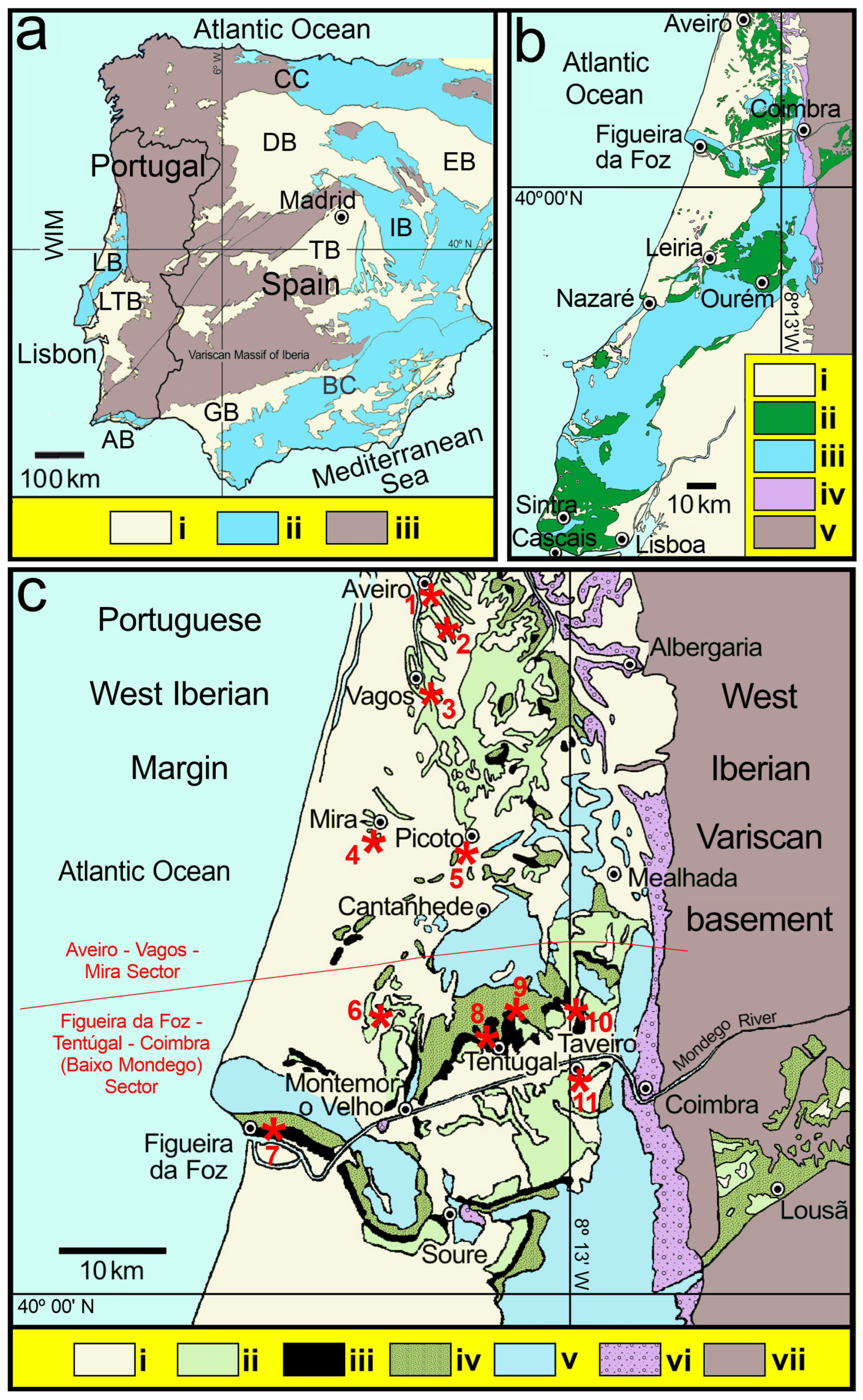
Figure 1. General geographical and geological settings. (a) Synthesis map of the Iberian Peninsula showing the Variscan basement areas bordered by the Mesozoic and Cenozoic basins, and the alpine chains (AB, Algarve Basin; BC, Betic Chain; CC, Cantabrian Chain; DB, Douro Basin; EB, Ebro Basin; GB, Guadalquivir Basin; IB, Iberian Basin; LB, Lusitanian Basin; LTB, Lower Tagus basin; TB, Tagus Basin; WIM, West Iberian Margin). i—Cenozoic; ii—Mesozoic; iii—Upper Proterozoic and Palaeozoic. (b) General map of the onshore areas of the West Portuguese Margin, where the Mesozoic Lusitanian Basin and its Cretaceous post-rift cover series are developed; i—Cenozoic; ii—Cretaceous; iii—Jurassic, iv—Middle Triassic and lowermost Jurassic; v—Upper Proterozoic and Palaeozoic. (c) Geological map of the studied area corresponding to the northern onshore areas of the West Portuguese Margin, the red asterisks indicate the location of the Cretaceous fossil sites with vertebrate remains (1—Aveiro (upper Campanian–Maastrichtian); 2—Póvoa do Valado (upper Campanian–Maastrichtian); 3—Vagos (upper Campanian–Maastrichtian); 4—Mira (upper Campanian); 5—Picoto (upper Coniacian); 6—Viso (upper Campanian–Maastrichtian); 7—Salmanha (upper Cenomanian); 8—Nossa Senhora dos Olivais (middle to upper Cenomanian); 9—Casais dos Carecos (middle to upper Cenomanian); 10—Granja de Ançã (upper Cenomanian); 11—Taveiro (Campanian–Maastrichtian). i—Cenozoic; ii—Coniacian to Maastrichtian mostly alluvial siliciclastics with interbedded marginal marine facies; iii—Cenomanian and Turonian platform carbonates, iv—Aptian to Cenomanian coarse to fine alluvial siliciclastics; v—Jurassic, mostly carbonate units of the Lusitanian Basin; vi—Middle to Upper Triassic red beds and lowermost Jurassic hypersaline facies; vii—Upper Proterozoic and Palaeozoic metasedimentary units of the Variscan massif of Iberia.
Geosciences 15 00477 g001
Figure 2. Synthetic stratigraphic chart of the upper Aptian to Maastrichtian post-rift units from the northern onshore sector of the Portuguese West Iberian Margin. Location and age of the fossil sites with vertebrate remains mentioned in the text and Figure 1c: 1—Aveiro; 2—Póvoa do Valado; 3—Vagos; 4—Mira; 5—Picoto–Seadouro; 6—Viso; 7—Salmanha; 8—Nossa Senhora dos Olivais; 9—Casais dos Carecos; 10—Granja de Ançã; 11—Taveiro.
Geosciences 15 00477 g002
Figure 3. Photographic views of main outcrops with exposures of the post-rift Upper Cretaceous from the onshore northern sector of the Portuguese West Iberian Margin. (a) Casais dos Carecos, Coimbra: a.1—Uppermost part of the Figueira da Foz Formation (middle Cenomanian); a.2—Tentúgal Formation (upper Cenomanian). (b) Salmanha, Figueira da Foz: Costa d’Arnes Formation (Cenomanian–Turonian). (c) Nossa Senhora dos Olivais, Montemor-o-Velho: Tentúgal Formation. (d) Picoto, Cantanhede: “Picoto-Seadouro Sandstone” (upper Coniacian). (e) Kilometre 20 of the abandoned Figueira da Foz–Pampilhosa railway, site of vertebrate fossils studied by H. Sauvage, near the locality of Viso, Montemor-o-Velho; e.1—detail of the Viso Formation (upper Campanian–Maastrichtian) exposed in the railway cutting. (f) Taveiro, Coimbra: Taveiro Formation (upper Campanian–Maastrichtian). (g) Póvoa do Valado, Aveiro: Viso Formation (detail of the fossiliferous greenish-grey sandy-clay, floodplain facies). (h) Póvoa do Valado, Aveiro: Viso Formation (detail of the reddish lutite beds and carbonated palaeosoils with root marks, suggesting more proximal, alluvial facies). (i) São Roque, Aveiro: Viso Formation. (j) Jerónimo Pereira Campos clay open-pit, Aveiro: Viso Formation.
Geosciences 15 00477 g003
Figure 4. Representative historical late 19th Century fossil vertebrates from the Upper Cretaceous of the onshore northern sector of the Portuguese West Iberian Margin. Geological Museum collection (images selected from Sauvage [12]). (a) Palaeohypotodus bronni tooth (liv); MG 78. (b) Prearticular fragment of Anomoeodus woodwardi (ov); MG 45 (ho). (c) Left prearticular of Coelodus bocagei (ov); MG 25712 *. (d) Vomer of Coelodus cuneiformis (ov); MG 48 (le). (e) Vomer of Coelodus ribeiroi (ov); MG 25714 *. (f) Right prearticular of “Microdon” sp. (ov); MG 25710. (gj) “Clastes lusitanicus”, (g) vertebral centrum (vv), (h) vertebral centrum (pv), (i) postcleithral scale (ev), (j) lanceolate tooth with plicidentine pattern; MG 86 (le). (kn) “Clastes pustulosus”, (k) dorsal vertebral centrum (dv), (l) scale (ev), (m) jaw fragment with two partial teeth with plicidentine pattern (liv), (n) tooth with plicidentine pattern; MG 84 (le). (o,p) Clupea arazedi (specimen “o” Diplomystus brevissimus after Jonet [19]); MG 75 (le). (q) Teleost vertebral centrum (dv ?); MG 77. (r,s) Anura limbs (lav); MG *. (t,u) Testudine, (t) plastron fragment (ev), (u) neural plate (iv); MG *. (v) Mosasaurinae tooth (lv); MG 72. (wee) “Crocodylusblavieri, (w) osteoderm (dv), (x) tooth (lv), (y) tooth (lav), (z) vertebra (vv), (aacc) vertebra (av, pv, rlv), (dd) vertebra (llv), (ee) tibia; MG 70. (ff) “Megalosaurus” sp. tooth fragment (lav or liv); MG 73. Fossil sites: (a) Picoto (Cantanhede), Coniacian; (b) Figueira da Foz, Cenomanian; (c,e) Sargento-Mor (Coimbra), Cenomanian; (d) Liceia (Montemor-o-Velho), Cenomanian; (fu,wff), Viso (Montemor-o-Velho), upper Campanian–Maastrichtian; (v) Santa Catarina (Vagos), upper Campanian–Maastrichtian. Abbreviations: av, anterior view; dv, dorsal view; ev, external view; ho, holotype; iv, internal view; lav, labial view; le, lectotype; liv, lingual view; llv, left lateral view; lv, lateral view; ov, occlusal view; pv, posterior view; rlv, right lateral view; vv, ventral view. * specimen(s) currently unlocated. Scale bar = 1 cm.
Geosciences 15 00477 g004
Figure 5. Representative fossil vertebrates from the Upper Cretaceous of the onshore northern sector of the Portuguese West Iberian Margin. (ah) Cenomanian; (ir) upper Campanian–Maastrichtian. (a) Squalicorax sp. lateral tooth (liv); DCT us. (b) Right prearticular of Coelodus bocagei (ov); DCT, us. (c) Obaichthys africanus scale (ev); DCT-CC-17. (d,e) Enchodus sp. tooth, (d) (lav), (e) (liv); DCT us. (f) Pachyostotic rib fragment attributable to S. soaresi (lav); DCT, us. (g) Dorsal vertebra of Segurasaurus soaresi (dv); DCT-CC-35. (h) Crocodylomorph tooth (lav); DCT-CC-10. (i) Lepisosteidae scale (ev); DCT, us. (j) Lepisosteidae occipital condyle (dv); DCT-Av-39. (k) Lepisosteidae dorsal vertebral centrum (dv); DCT-Av-66. (l,m) Amiidae centrum, (l) (av), (m) (dv); DCT-Av-50. (n) Paralbula sp. vertebral centrum (dv); DCT-Av-45. (o) Basibranchial tooth plate of Paralbula sp. (ov); DCT-Av-63. (p) Fragment of a testudine plastron (ev); DCT-Av-188. (q,r) Crocodylomorph tooth, (q) (lav), (r) (liv); DCT-Av-198. Fossil sites: (a,ch) Casais dos Carecos (Coimbra); (b), Mala (Aveiro); (ir), Póvoa do Valado (Aveiro). Abbreviations: av, anterior view; dv, dorsal view; ev, external view; lav, lateral view; liv, lingual view; ov, occlusal view; us, unregistered specimen. Scale bar = 1 cm.
Geosciences 15 00477 g005
Table 1. Catalogue records of the institutional and MTA collections from the Upper Cretaceous series of the Portuguese onshore northern sectors of the West Iberian Margin. * Material requiring review (cited exactly as in the original catalogue of the Geological Museum).
TaxonCatalog No.Material
Palaeohypotodus bronniMG 78One tooth
* Anomoeodus aff. subclavatusMG 25713Teeth
* Anomoeodus woodwardiMG 45 (holotype)Fragment of prearticular with main row teeth
MG 11026Two teeth
* Coelodus bocageiMG 25712Left prearticular (missing from the collection)
DCT (uncatalogued)Right prearticular
* Coelodus ribeiroiMG 25714Vomer (missing from the collection)
* Coelodus cuneiformisMG 48 (lectotype)Vomer
* Microdon sp.MG 25710Right prearticular
Obaichthys africanusDCT-CC-15, DCT-CC-16, DCT-CC-17, DCT-CC-18, DCT-CC-19, DCT-CC-32Five flank scales and one ventral scale
* Lepidosteus lusitanicusMG 86 (lectotype)Thirteen scales, six vertebral centra, and one tooth
* Lepidosteus pustulosusMG 84 (lectotype)Nine scales, one vertebral centrum, and two teeth (jawbone missing from the collection)
* Clupea arazediMG 75 (lectotype)Three specimens over claystone (one is missing from the collection)
* Osmeroides sp. ?MG 83Impressions of fish scales
Diplodus sp.MG 81Two teeth
Teleost indet. MG 77One vertebral centrum
Rosasia soutoiUP-MHNFCP-016271 (holotype)
MG 4880 (metatype)
Carapaces and plastrons
Segurasaurus soaresiDCT-CC-1 (holotype)
DCT-CC-4, DCT-CC-5,
DCT-CC-2, DCT-CC-7, DCT-CC-8, DCT-CC-27, DCT-CC-28, DCT-CC-29, DCT-CC-31 (paratypes)
DCT-CC-35 (other material)
Nine dorsal and two cervical vertebrae
MosasaurinaeMG 72One tooth
* Crocodilus blavieriMG 70Five vertebrae, two osteoderms, and one tibia (two vertebrae missing from the collection)
Portugalosuchus azenhaeML 1818 (holotype)Incomplete skull and incomplete left mandible
Euronychodon portucalensisDinosaurs from Taveiro: MTA TV 18, MTA TV 19, MTA TV 20 (holotype)Three teeth
Taveirosaurus costaiDinosaurs from Taveiro: MTA TV6, MTA TV7, MTA TV8, MTA TV9, MTA TV10 (holotype), MTA TV13, MTA TV14, MTA TV15, MTA TV16Nine teeth
Theropoda indet.MG 73Tooth crown without the apex
aff. AlphadonMammals from Taveiro: MTA TV2Lingual half of an upper molar
aff. PediomysMammals from Taveiro: MTA TV3Upper premolar
MarsupialiaMammals from Taveiro: MTA TV1Labial fragment of an upper molar
aff. LeptacodonMammals from Taveiro: MTA TV4Lower premolar
EutheriaMammals from Taveiro: MTA TV5Premolar
Table 8. Squamata from the Upper Cretaceous of the Portuguese onshore northern sectors of the West Iberian Margin.
TaxaAgeFormationLocationReferences
CeCa–MaTe FmVi FmAveCoiIlhMonVag
Boidae gen. sp. X XX [51] (p. 160, Table 1)
Varanoidea gen. sp. X XX X
(Vis)
[51] (p. 160, Table 1)
Mosasauridae gen. sp. X XX X
(Cho)
[12] (p. 46); [51] (p. 160, Table 1)
Mosasaurus sp. X X X
(S.Cat)
[12] (p. 46, pl. 10, Figure 9)
Segurasaurus soaresi (Pimentel, Berrocal-Casero, Audije-Gil and Callapez, 2023) [32] X X X
(Cas)
[32] (Figures 5–7); [33] (Figure 2)
Table 11. Generic diversity per taxonomic group from the Upper Cretaceous of the Portuguese onshore northern sectors of the West Iberian Margin.
Taxonomic GroupsGenera Count per Group
“Pisces”ChondrichtyesSelachii1842
Batoidea 2
OsteichthyesPycnodontiformes 143
Holostei 4
Teleostei 7
TetrapodaAmphibia
(only lissamphibians)
Anura2221
Urodela 1
TestudinesBothremydidae 11
Lepidosauria
(only squamates)
Varanoidea 41
Unranked Pythonomorpha 1
Mosasauridae 1
Boidae 1
ArchosauriaCrocodilomorpha 113
Dinosauria 8
Mammalia“Symmetrodonta” 41
Marsupialia 2
Eutheria 1
Disclaimer/Publisher’s Note: The statements, opinions and data contained in all publications are solely those of the individual author(s) and contributor(s) and not of MDPI and/or the editor(s). MDPI and/or the editor(s) disclaim responsibility for any injury to people or property resulting from any ideas, methods, instructions or products referred to in the content.