Abstract
Based on comprehensive interpretation of three-dimensional seismic data and quantitative analysis of basin-boundary fault activity in the Nanpu Sag, this study employs subsidence history backstripping and equilibrium profile techniques to reconstruct the structural evolution of the main profile. The results indicate that the Cenozoic evolution of the Nanpu Sag can be divided into a syn-rift stage and a post-rift stage, with the syn-rift stage further subdivided into Rift I and Rift II episodes. During Rift I, tectonic activity was primarily controlled by the NE- and NEE-trending Xinanzhuang Fault, Shabei Fault, and No. 2 Fault Zone, which formed under a NW–SE extensional stress regime and governed the development of NE- or NEE-trending faults and associated sedimentary subsidence centers. In Rift II, tectonic activity was dominated by a southward-curved normal fault system, composed of the Xinanzhuang, Gaoliu, and Baigezhuang faults, as well as the Shabei Fault, reflecting the influence of a near N–S ex-tensional stress field. The progressive southward migration of the Sag’s subsidence center over time—from the Linque sub-sag in the third section of the Shahe Formation to the Caofeidian sub-sag in the Dongying Formation—and noting, coupled with the pronounced left-lateral strike-slip characteristics of the Baigezhuang Fault and No. 4 Fault, and regional tectonic evolution analysis of the Bohai Bay Basin, support the proposal that a strike-slip extension mechanism—characterized by lateral strike-slip and forward extension—constitutes the fundamental developmental model of the Nanpu Sag. This study deepens the understanding of the tectonic evolution of the Nanpu Sag and provides new insights in-to the dynamic mechanisms governing the formation of similar Sags in the Bohai Bay Basin.
1. Introduction
The Nanpu Sag, situated in the northern part of the Bohai Bay Basin, is a classic Mesozoic–Cenozoic superimposed rift basin located on the southern edge of the Yanshan Fold Belt along the eastern margin of the North China Craton. Spanning nearly 2000 square kilometers, it is abundant in oil and gas resources and is considered one of the most promising secondary structural units for exploration within the Bohai Bay Basin [1,2,3]. The Sag is bounded by the Xinanzhuang Baigezhuang Fault and the Yanshan Uplift to the north, the Sha Bei Fault and Sha Lei Tian Uplift to the south, the western boundary of the Tan Lu Fault Zone to the east, and the Zhangjiakou Penglai Deep Fault Zone to the west. It lies at the junction of the Tan Lu right-lateral strike-slip pull-apart system and the extensional structure of the North China Craton [4,5]. Since the Cenozoic era, the regional stress field has gradually rotated clockwise from a NW-SE orientation to nearly a north–south direction, influenced by multiple forces including the subduction and rollback of the Pacific Plate, the distant effects of the collision between the Indian and Eurasian Plates, and mantle thermal dynamics. This has resulted in multiple phases of deformation in the Nanpu Sag, characterized by misalignment, layered extension, and a combination of strike-slip and extensional tectonics [2,6,7,8,9,10].
Previous research has demonstrated that the Cenozoic tectonic evolution of the Nanpu Sag is characterized by episodic faulting. During the Eocene Shahejie period (Es4–Es∝), the region experienced NW-SE extension, resulting in a NE-trending fault system. In the Oligocene Dongying period (Ed), the stress field shifted to a near north–south orientation, reactivating the Gaoliu fault and creating a southward-dipping, arc-shaped fault zone alongside the Xinanzhuang Baigezhuang fault. This caused the sedimentary center to migrate southward. The Miocene Guantao period (Ng) marked a phase of regional thermal subsidence. From the Upper Miocene Minghua period (Nm) onward, the regional stress field adjusted again, with significant right-lateral strike-slip and extensional superposition effects along the Tanlu Fault Zone. This led to the development of negative flower structures and back-shaped negative flower structures, and renewed activity of basin-controlling faults [2,9]. Concurrently, thick mudstone layers within the Shahejie Formation acted as an ideal ductile detachment layer inside the Sag, producing a dual-layer fault system structure vertically characterized by “basement involvement” and “cap slip.” Horizontally, the fault system exhibits a complex pattern of north–south zoning, east–west segmentation, and interwoven broom-like structures [6,7].
Analyzing structural evolution is fundamental to understanding basin formation patterns. Through quantitative assessments of fault activity, subsidence history regression, and equilibrium profile restoration, researchers both domestically and internationally have systematically studied several typical Sags in the Bohai Bay Basin. These include the Bohai Central Sag [11], the Gulf of Thailand Basin [12], and the Xihu Sag on the East China Sea Shelf [13]. They have introduced concepts such as strike-slip extensional composite basins, “pull-apart extensional” basin formation models, and “episodic rifting with southward subsidence.” Regarding the Nanpu Sag, various genetic models have been proposed: an extensional-type Sag [1]; a strike-slip type Sag controlled by a north-northeast right-lateral strike-slip system [14]; a Yanshanian strike-slip basin model [15]; a single-stage rift controlled by boundary conditions [16]; a two-stage extensional deformation superposition model [2]; and a multi-stage deformation superposition model [17]. Additionally, Zhang Cuimei et al. observed in adjacent areas that the Xinanzhuang Baigezhuang fault zone exhibited left-lateral strike-slip and extensional characteristics during the Paleogene, suggesting that traditional extensional models may underestimate the role of strike-slip components in basin formation [18].
Despite extensive prior research on the origin, structural styles, and evolutionary processes of the Nanpu Sag fault system, several controversies and gaps remain: (1) there is no consensus on the division of structural evolution stages and the timing of stress field transitions; (2) the relative roles and interaction mechanisms of strike-slip and extensional components in the formation and development of the Sags are not well understood; (3) the influence of the ductile slip layer on the spatial distribution and transformation of fracture system structures has not been systematically clarified.
To address these issues, this study utilizes the latest 3D continuous seismic data combined with high-precision structural interpretation, quantitative fault activity analysis, balanced profile restoration, structural physics simulations, and regional structural comparisons. The research reconstructs the Cenozoic structural evolution of the Nanpu Sag, identifies key stress field transition points, and proposes a “lateral strike-slip forward tension” drawer-style strike-slip extension superposition basin mechanism. It also reveals how ductile slip layers control fault system deformation across layers, zones, and segments. These findings not only enhance the understanding of the structural dynamics of the Nanpu Sag but also offer new theoretical insights and technical support for oil and gas exploration in similar Sags within the Bohai Bay Basin.
2. Geologic Background
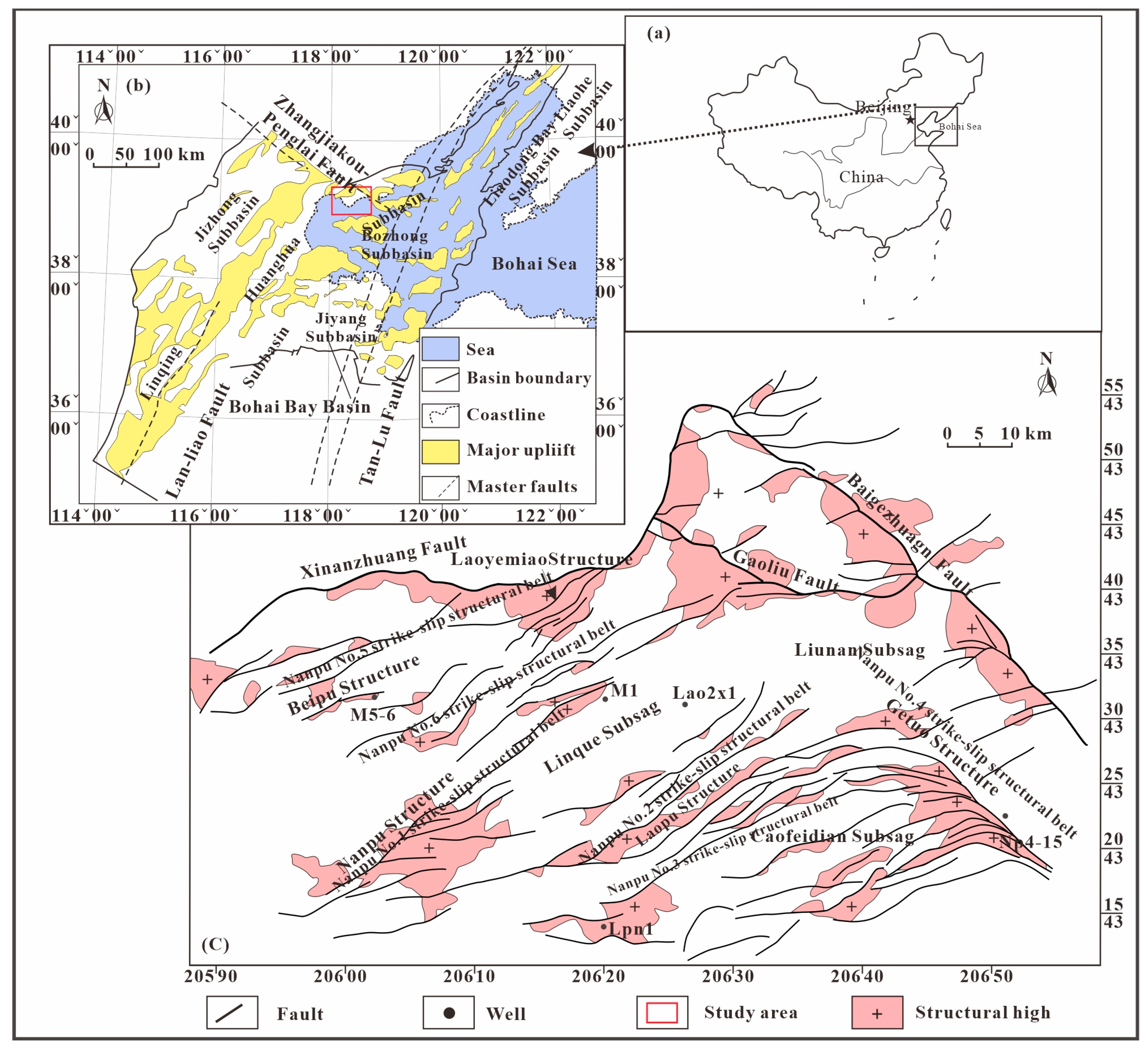
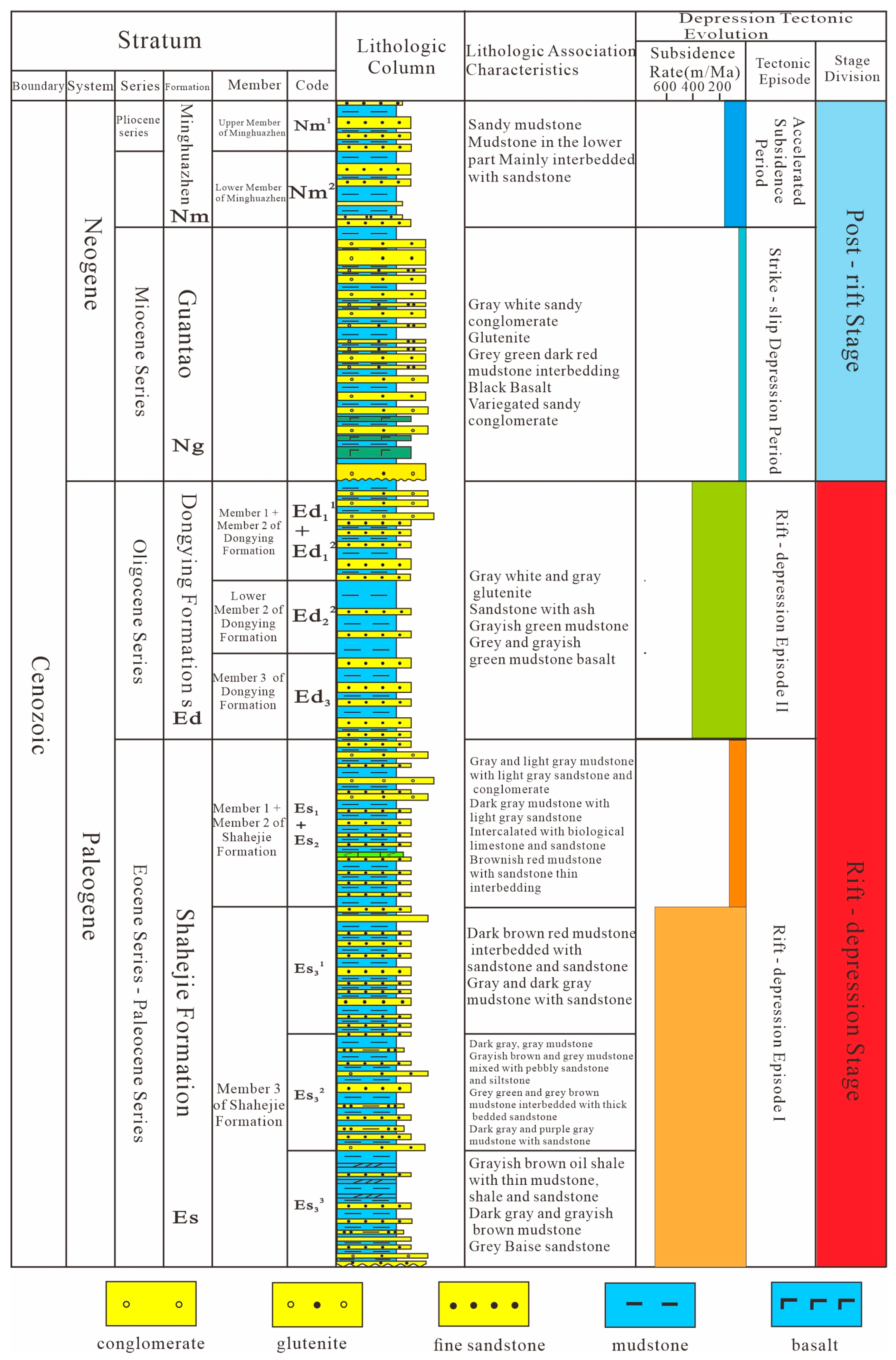
As a significant Mesozoic–Cenozoic superimposed hydrocarbon-bearing depression in the northern margin of the Bohai Bay Basin, the Nanpu Sag possesses a unique geological setting that provides a vital foundation for structural evolution analysis and basin formation model research. The sag is located in the northern part of the North China Block, between Tangshan and Qinhuangdao in Hebei Province. Its eastern and southern boundaries are adjacent to the Bohai Sea (delimited by the east of the Jian River), while the northern margin borders the Yanshan region. Covering an area of approximately 1932 km2, Nanpu Sag is tectonically classified as a secondary negative structural unit within the Cenozoic rift basin of the Huanghua Depression. It is situated in the northeastern part of the North China Platform, along the southern edge of the Yanshan fold belt, with the basement formed by the North China Platform. The structural framework and the comprehensive lithostratigraphic column of Nanpu Sag are illustrated in Figure 1 and Figure 2 [2,19].
Regarding its evolutionary history, the Nanpu Sag began developing during the Mesozoic era and gradually took shape through multiple tectonic events spanning the Mesozoic and Cenozoic eras. It predominantly exhibits a NNE-oriented structural pattern, combining features of a north–south Chaoshan fault Sag with characteristics of a north–south and east–west Chaoshan semi-graben basin. This structural configuration results from various tectonic processes and fault developments [20,21,22]. The Sag’s boundaries are defined by several faults, including the Xinnanzhuang Fault to the northwest, the Baigezhuang Fault to the northeast (both part of the same fault zone known as the Xininanhuang Baigezhuang Fault Zone), and the Shabei Fault to the south. These faults separate the Sag from adjacent uplifts such as Laowangzhuang, Baigezhuang, Matouying, and Shaleitian, as shown in Figure 1c. The Xinanzhuang Baigezhuang Fault Zone plays a pivotal role in controlling the Sag’s formation and evolution [1,15]. Internally, the Sag features a complex structure, with the east–west trending Gaoliu fault zone dividing it into two main sedimentary regions: the northern area serves as the sedimentary center for the third to second members of the Sha Formation, while the southern area is the sedimentary center for the first member to the Dongying Formation of the Sha Formation. Additionally, five northeast-trending structural zones (from northwest to southeast: Nanpu 5th, 6th, 1st, 2nd, and 3rd structural zones) significantly influenced the migration of sedimentary centers and the distribution of sedimentary systems.
Three significant seismic zones—the NW Zhangjiakou Bohai seismic zone, the North China Plain seismic zone, and the NE Tanlu seismic zone—surrounding the Nanpu sag offer insights into the regional tectonic dynamics driving its evolution. Notably, the Zhangjiakou Penglai fault zone within the Zhangjiakou Bohai seismic belt, which originated in the Mesozoic era, influenced sedimentation, magmatic activity, and tectonics on both sides. Since the Cenozoic era, particularly during the Quaternary, this fault zone has been affected by changes in the regional tectonic stress field and displays left-lateral strike-slip characteristics. This tectonic activity has significantly shaped the formation of the Nanpu Sag basin.
The Cenozoic strata in the Nanpu Sag primarily consist of the Paleogene and Ed members of the Shahejie Formation and the Dongying Formation from the Paleogene, as well as the Neogene and Nm members of the Guantao Formation and Minghuazhen Formation from the Neogene.
The Cenozoic strata in Nanpu Sag mainly include Paleogene Shahejie Formation (Es) and Dongying Formation (Ed) and Neogene Guantao Formation (Ng) and Minghuazhen Formation (Nm). Intense tectonic movements during the Paleogene caused notable spatial and temporal variations in the lithology and thickness of the Shahejie and Dongying formations. In contrast, the overall subsidence of the Neogene basin led to a more uniform regional distribution of the Guantao and Minghuazhen formations, with relatively gentle variations in thickness [14,23].
Figure 1.
(a) Geographic location of the Nanpu Sag within the Bohai Bay Basin; (b) structural framework of the Nanpu Sag; (c) structural Pattern of Nanpu Depression in the Study Area.
Figure 2.
Comprehensive lithologic–stratigraphic column of the Nanpu Sag, Bohai Bay Basin (Wang, Y.H. et al.) [19].
3. Data and Methodology
This study integrates 3D seismic interpretation, quantitative fault activity analysis, and structural restoration to reconstruct the tectonic evolution of the Nanpu Sag. The dataset comprises contiguous 3D seismic surveys (covering ~1932 km2 with inline spacing ≤25 m), well logs and core descriptions from 32 exploration wells, and regional geological maps. Key stratigraphic boundaries (e.g., T50 at the base of Sha-2 Member, T100 at the base of Sha-3 Member) were calibrated using gamma-ray (GR), acoustic (AC), and resistivity (RT) logs.
Fault activity was quantified through fault throw analysis and activity rate calculation along major boundary faults (Xinanzhuang, Baigezhuang, Gaoliu, and Shabei faults). Measurement points were spaced at 5 km intervals (20 points total). Fault throw was measured at critical horizons (Es3, Ed, Ng). Activity rates (V, m/Ma) were computed as V = ΔH/Δt, where ΔH is vertical displacement and Δt is depositional duration.
Subsidence history was reconstructed using backstripping techniques on the NP-3 seismic profile. Sediment loading was incrementally removed with paleobathymetry corrections (based on microfossils) and porosity-depth modeling to isolate tectonic subsidence. Balanced cross-section restoration was performed in 2Dmove (v7.0, Midland Valley), validating deformation via line-length and area balancing. Extension magnitudes were derived from restorations (e.g., ~500 m during Sha-1/2; ~6.5 km during Dongying). Stress fields were inferred from fault geometries (e.g., NE-striking normal faults indicating NW-SE extension) and kinematic indicators (negative flower structures) [24].
4. Quantitative Analysis of Basin Tectonic Activity
4.1. Analysis of the Activity of Main Faults
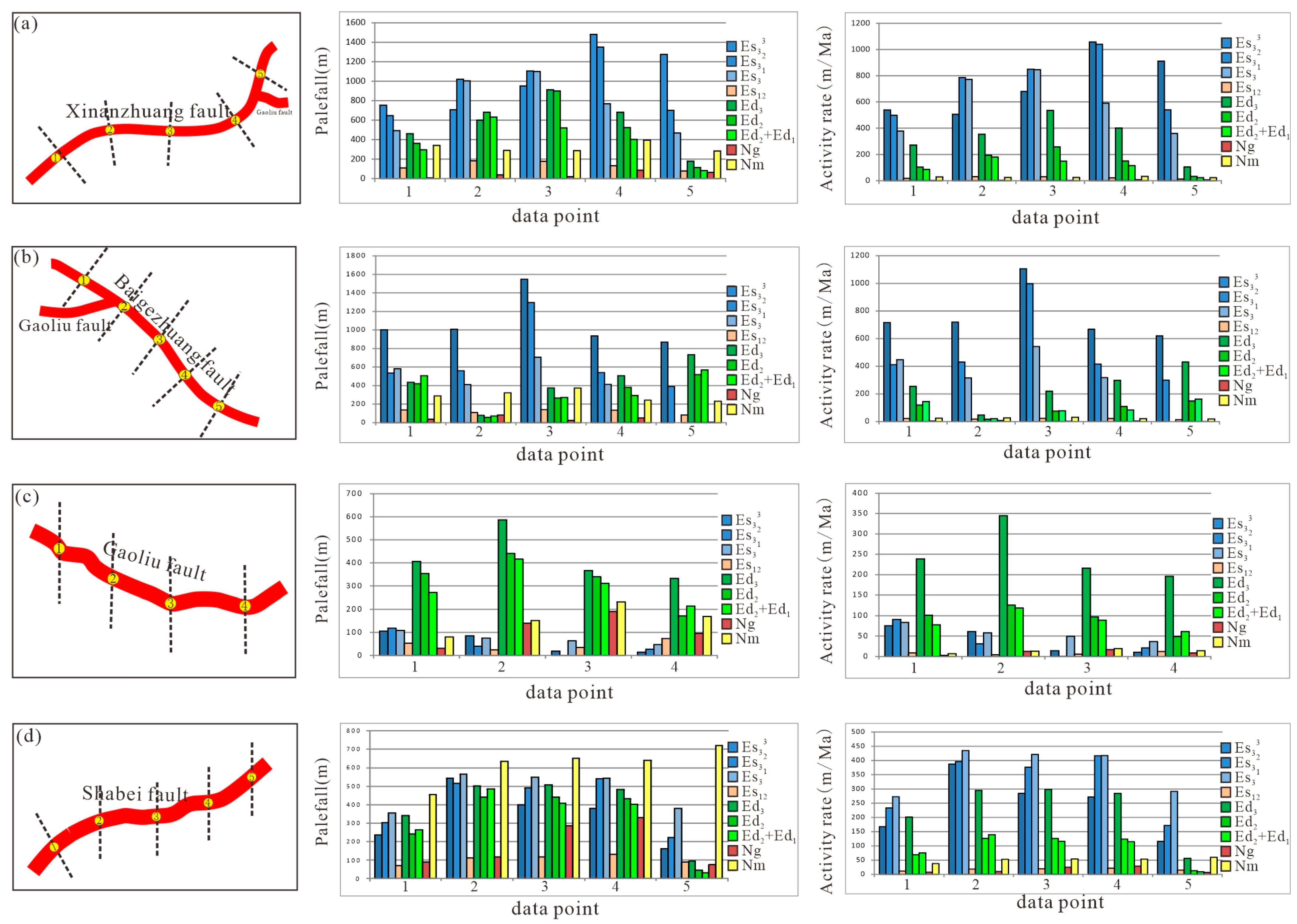
Using the paleofall method and fault activity rate method, the activity of four major basin-controlling faults in Nanpu Sag—namely the Xinanzhuang fault, Baigezhuang fault, Gaoliu fault, and Shabei fault—was systematically and quantitatively analyzed [24,25]. Taking the Xinanzhuang fault as an example, five measurement points were evenly spaced along its strike, as illustrated in Figure 3a. By reconstructing the paleofall at each point over different periods and calculating the corresponding activity rates, significant segmentation differences were revealed: the western segment trends northeast and exhibited strong extensional activity during the deposition of the third member of the Shahejie Formation. The peak activity rate during the lower sub-member of this formation reached 540 m per million years (with a vertical displacement of 780 m over 1.44 million years), corresponding to an extension coefficient (β) of 1.11, and a maximum paleofall of approximately 780 m. Activity during the deposition of the first and second members of the Shahejie Formation was notably reduced but reactivated during the Dongying Formation deposition, showing typical episodic revival characteristics. The middle section trends nearly east–west and represents the most active part of the fault, with activity intensity increasing from west to east, indicating control by regional extensional stress concentration. The eastern segment’s activity significantly decreased during the Dongying Formation sedimentation due to segmentation and regulation by the Gaoliu fault, demonstrating that the Gaoliu fault’s development strongly inhibits the inherited tectonic activity of the eastern Xinanzhuang fault segment. Overall, each segment of the Xinanzhuang fault exhibits episodic activity, with varying tectonic responses along different strike segments.
Figure 3.
(a) quantitative analysis of paleofall and activity rate of Xinanzhuang fault at the main boundary of Nanpu Sag; (b) quantitative analysis diagram of paleofall and activity rate of Baigezhuang fault at the main boundary of Nanpu Sag; (c) quantitative analysis diagram of paleofall and activity rate of Gaoliu fault on the main boundary of Nanpu Sag; (d) quantitative analysis diagram of paleofall and activity rate of Shabei fault at the main boundary of Nanpu Sag; Es33 = third member of the Shahejie Formation (Es); Es32 = second member of Es; Es31 = first member of Es; Es12 = second member of the first Es; Ed3 = third member of the Dongying Formation (Ed); Ed2 = lower second member of Ed; Ed1 = first member of Ed; Ng = Guantao Formation; Nm = Minghuazhen Formation.
Five measurement points were selected along the Baigezhuang fault, as illustrated in Figure 3b. Analysis of the paleofall and activity rate changes at each point indicates that the Baigezhuang fault can be divided into a northern section, located north of its intersection with the Gaoliu fault, and a southern section, situated south of this intersection. At the junction of the Baigezhuang and Gaoliu faults, the activity rate and paleofall during the sedimentation of the Dongying Formation are minimal, with an activity rate of approximately 10 m/Ma, likely due to the influence of the Gaoliu fault. Consequently, the Dongying Formation exhibits more intense activity on the Baigezhuang fault at locations farther from the Gaoliu fault. The central part of the southern segment of the Baigezhuang fault was most active during the deposition of the third member of the Shahejie Formation, showing the highest paleofall and activity rate. Specifically, the activity rate in this area reached 1100 m/Ma, with a vertical displacement of 1.32 km and a strike-slip to extension ratio (r) of 0.83, indicating a combination of tension, torsion, and extension.
The Gaoliu fault is a major growth normal fault situated between the Xinanzhuang and Baigezhuang faults, as shown in Figure 3c. Its Cenozoic activity began relatively late. While previous studies suggested that the Gaoliu fault formed during the SHA-1 period, this study reveals its formation occurred in the Dong-3 period. Four points were selected along the Gaoliu fault, as depicted in Figure 2. Activity is strongest in the middle section of the fault, while the segments connecting to the Baigezhuang and Xinanzhuang faults show relatively weaker activity. During the Shahejie Formation, the Gaoliu fault exhibited very low paleofall and activity rates, remaining nearly inactive. However, during the sedimentation of the Dongying Formation, both paleofall and activity rates increased sharply, marking the onset of vigorous movement along the Gaoliu fault. In the Dongsan period, the activity rate reached 340 m/Ma with a vertical displacement of 900 m, which is 17 times higher than during the Shahejie-2 period (20 m/Ma). This sudden increase coincides with the timing of activity on the Tanlu Lanliao fault (around 32 Ma). The Gaoliu fault maintained high activity during the Dongyi period, influencing the development of the Liunan sub-sag and the Gaoshangpu structural belt. It also showed minor activity during the deposition of the Guantao and Minghuazhen formations. Overall, the Gaoliu fault is characterized by episodic activity.
The Shabei fault is a northeast–southwest trending fault situated southeast of the Nanpu Sag and north of the Shaleitian uplift [26]. It has a steep northward dip, extends over a large area, and cuts through all geological layers from the basement to the Quaternary. Measurements were taken at five points along the Shabei fault, as illustrated in Figure 3d. Along the fault’s strike, the activity rate exhibits a “slow-fast-slow” pattern, meaning that both ends show low activity rates and paleofall, while the central section has higher activity rates and paleofall, with the maximum activity rate reaching up to 300 m per million years. At all measured sites, the Shabei fault displays episodic activity.
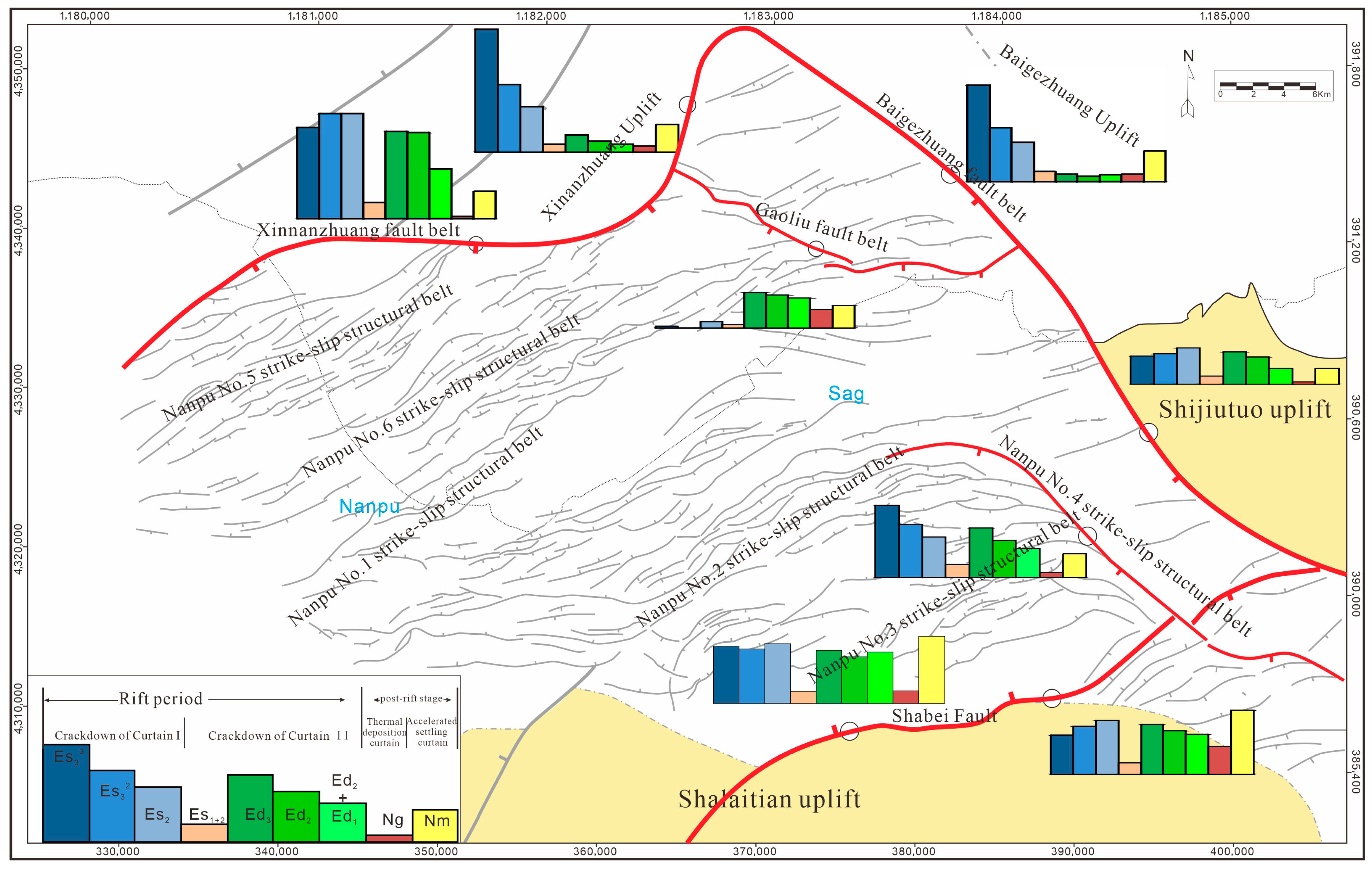
Based on the quantitative analysis of fault activity for the Xinanzhuang, Baigezhuang, Gaoliu, and Shabei faults, these four main faults exhibit typical episodic activity patterns (Figure 4). Moreover, the activity characteristics vary across different sections of each fault during various geological periods. Between 42 and 38 million years ago, during the third member of the Shahejie Formation, the basin-boundary faults Xinanzhuang, Baigezhuang, and Shabei experienced significant extension, while the Gaoliu fault remained largely inactive. From 38 to 32 million years ago, in the second member of the Shahejie Formation, overall fault activity in the region declined. During the Dongying Formation stage (32 to 23.3 million years ago), the Gaoliu fault became rapidly active, linking the Xinanzhuang and Baigezhuang faults into a south-dipping arc fault zone. The Shabei fault was also strongly active at the same time, with faults concentrated within this arc system. In the Guantao Formation period (23.3 to 12 million years ago), activity across all faults generally diminished, and the basin underwent thermal subsidence. Since then, during the Minghuazhen Formation, fault activity has increased again, displaying a clear and recognizable episodic evolutionary pattern.
Figure 4.
Activity rate distribution of the main boundary fault. The red curve is the main fault that surrounds the basin; Es3 refers to the third member of the Shahejie Formation; Es1+2 denotes the second member of the first Shahejie Formation; Ed represents the Dongying Formation; Ng is the Guantao Formation; Nm is the Minghuazhen Formation.
4.2. Settlement History Analysis
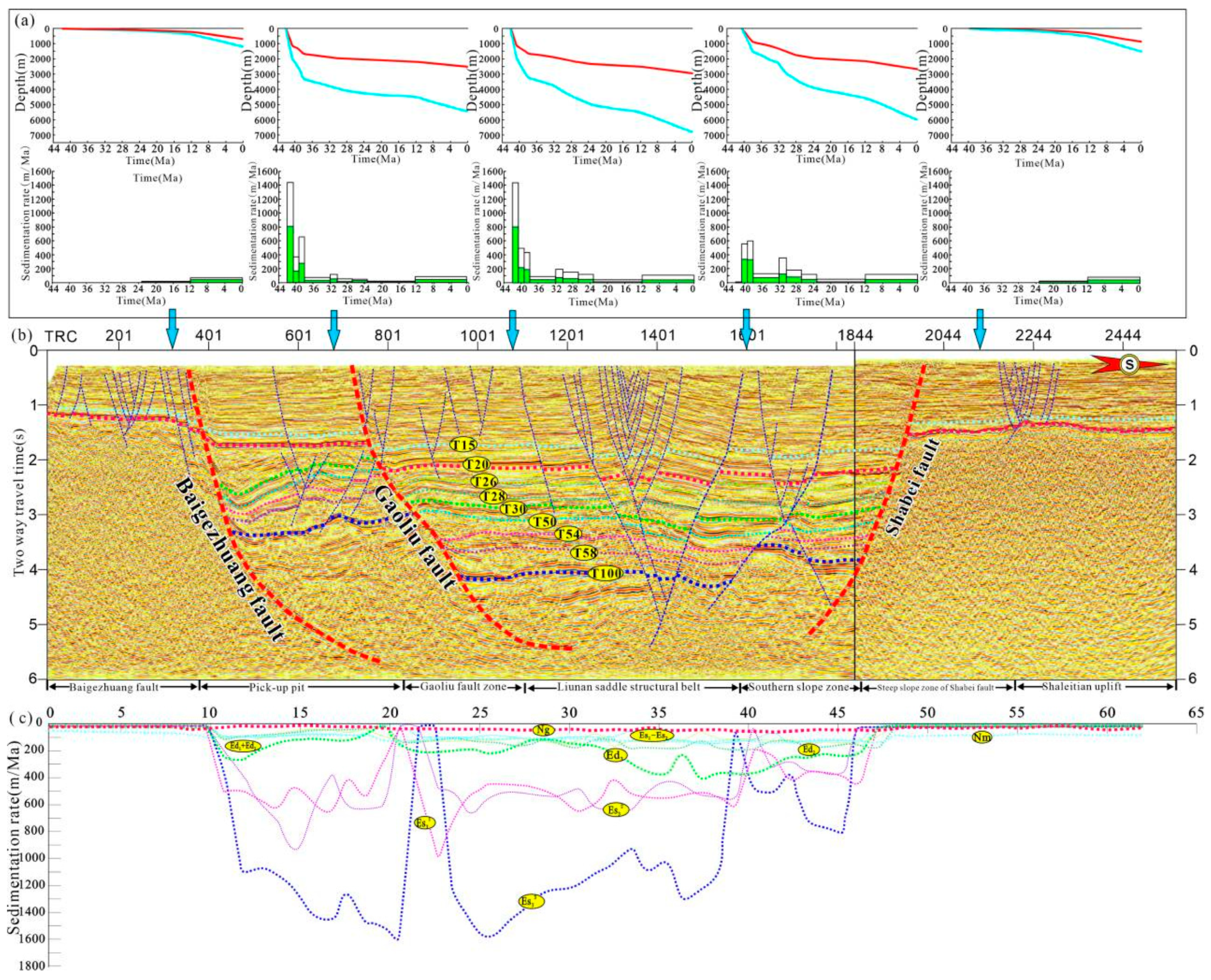
Figure 5 illustrates the subsidence curve and subsidence rate for the NP-3 seismic profile in the Nanpu Sag, derived from subsidence history analysis using backstripping techniques based on time-depth conversions of the original seismic stratigraphic interpretation profile. The profile trends north–south and traverses several key structural units, including the Baigezhuang Uplift, Shichang Sub-sag, Gaoliu Fault Zone, Liunan Saddle Structural Zone, Southern Slope Zone, Shabei Fault Steep Slope Zone, and Shaleitian Uplift. As shown in Figure 5b, the subsidence patterns of the Shichang Sub-sag, Gaoliu Fault Zone, and Southern Slope Zone (represented by points 2, 3, and 4, respectively) are notably similar. The subsidence rate exhibits three distinct peaks, corresponding to the third member of the Shahejie Formation (42–38 Ma), the Dongying Formation (32–23.3 Ma), and the Minghuazhen Formation (12 Ma to present). Among these, the third member of the Shahejie Formation displays the highest peak, while the peaks associated with the Dongying and Minghuazhen Formations are relatively lower. The backstripping analysis indicates that the total subsidence of the Cenozoic strata reaches approximately 6000 m, with tectonic subsidence contributing about 2500 m. During each interval, tectonic subsidence accounts for roughly half of the total subsidence, while the remaining 3500 m are attributed to sediment accumulation and water load effects.
Figure 5.
Analysis of the seismic profile and subsidence history at well NP-3 in Nanpu Sag is presented as follows: (a) The relationship among depth, sedimentation rate, and geological time at various locations along the seismic profile of well NP-3 is examined; (b) The subsidence curve derived from the seismic profile at well NP-3 is analyzed; (c) The subsidence rate of the seismic profile at well NP-3 is further investigated. T15 refers to the basal interface of the Minghuazhen Formation, T20 is the basal interface of the Guantao Formation, T26 denotes the basal interface of the upper member of the Minghuazhen Formation, T28 represents the basal interface of the upper member of the Guantao Formation, T30 indicates the basal interface of the third member of the Dongying Formation, T50 signifies the basal interface of the second submember of the first member of the Shahejie Formation, T54 stands for the basal interface of the first submember of the first member of the Shahejie Formation, T58 is the basal interface of the first member of the Dongying Formation, and T100 refers to the basal interface of the third member of the Shahejie Formation.
Figure 5c illustrates that the total settlement rate of the lower Es3 subsection is highest in the Shichang sub-sag and the Liunan Anzhuang structural belt, reaching up to 1600 m/million years (m/ma). Moving eastward toward the Liunan saddle belt, this rate decreases to 800 m/ma, with a gradient of 0.12 m/ma per kilometer. The settlement rate gradually diminishes toward both sides. The middle and upper Es1 submembers exhibit similar patterns, averaging around 800 m/ma. In the sha-1-2 member, the overall subsidence rate is low and shows minimal fluctuation within the sag, averaging about 20 m/ma. The Dong-3 member’s subsidence rate varies slightly, peaking at approximately 400 m/ma in the Anzhuang structural belt of Liunan. The lower, upper, and first members of the east-2 member display little change in subsidence rate, averaging about 50 m/ma. The Guantao Formation has a low total sedimentation rate, less than 10 m/ma, while the Minghuazhen Formation also shows a small rate, averaging around 30 m/ma. Overall, fluctuations are minor and the rates remain relatively stable.
From this data, it can be inferred that the sedimentation evolution process of the NP-3 section, as shown in Figure 5, follows a distinct episodic cycle: During the deposition of the third member of the Shahejie Formation, the Baigezhuang and Shabei faults were active, confining settlement strictly to the fault block between them, with settlement rates systematically decreasing from north to south. The first and second members of the Shahejie Formation represent a period of tectonic calm, with the subsidence field showing uniform, low-amplitude thermal subsidence along the profile. During the Dongying Formation’s sedimentary period, the Gaoliu fault became active and dominated the tectonic framework; the subsidence rate on the hanging wall was significantly lower, while the subsidence gradient between the Bogezuang and Shabei fault zones increased from north to south due to fault linkage. In the Guantao Formation period, the main boundary fault ceased movement, and the Nanpu Sag entered a post-fracture thermal subsidence stage characterized by uniform and low subsidence rates across the profile. Since the Minghuazhen Formation (<12 million years ago), changes in the regional stress field within the Nanpu Sag have triggered an accelerated subsidence phase, with subsidence rates increasing uniformly throughout the area, although tectonic extension contributed only weakly. Therefore, the NP-3 section fully records the cyclical evolution of fault activity coupled with subsidence, confirming the dominant influence of episodic tectonic events on basin development in this region.
4.3. Structural Evolution Analysis of Nanpu Sag
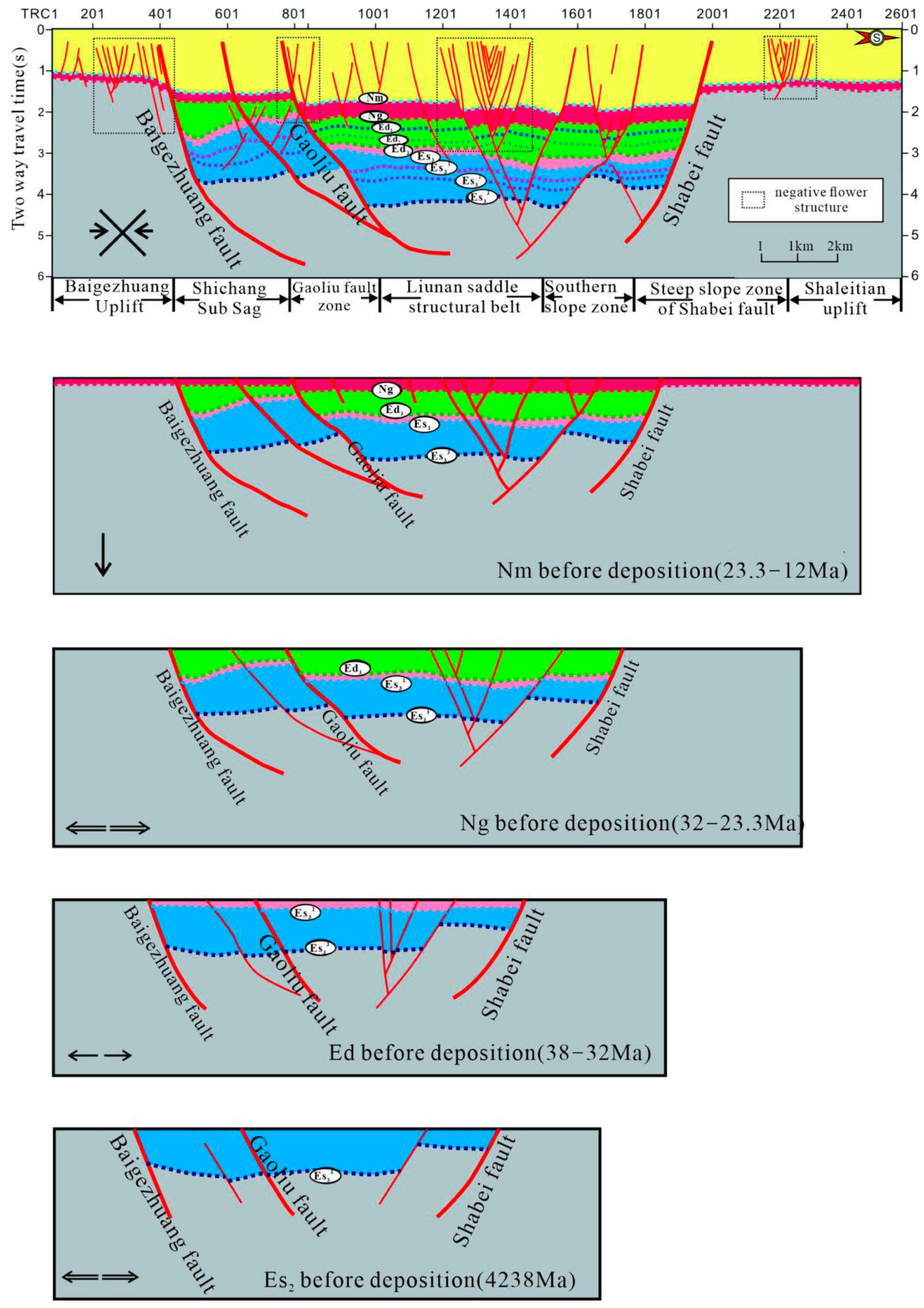
Based on the 2D move balanced section restoration results, the NP-3 profile comprehensively records the multi-stage cycles of the Cenozoic tectonic evolution of the Nanpu Sag. The results are shown in Figure 6. During the deposition of the Sha 3 Member, extension was approximately 0.5 km. The Baigezhuang and Shabei faults were the first to undergo significant extension and dominated the initial formation of the sag, while the Gaoliu Fault remained relatively inactive. During the Sha 1–2 Member period, fault activity across the region weakened, and the basin entered a tectonically quiet phase characterized by weak extension. During the Dongying Formation stage, extension suddenly increased to about 6.5 km. The regional strike-slip and extensional superposition caused rapid reactivation of the Gaoliu Fault, which coupled with the Baigezhuang Fault to form a south-dipping, arc-shaped fault zone. This fault zone jointly controlled the development of the Shichang sub-sag and the Liunan saddle-shaped structure. The Shabei Fault also experienced strong simultaneous activation. During the Guantao Formation period, extension contracted to about 1.5 km, and the main faults largely ceased activity, marking the basin’s transition into the post-rift thermal subsidence stage. Since the Minghuazhen Formation, extension has remained around 1.5 km. Adjustments in the regional stress field induced renewed strengthening of strike-slip activity, resulting in the formation of typical positive flower structures [5]. Thus, the NP-3 profile clearly reveals the phased coupling relationships among fault activity, extension, and subsidence rates, fully confirming the overall control of episodic tectonic evolution on the basin-forming process of the Nanpu Sag.
Figure 6.
Structural evolution of the np-3 seismic section in Nanpu Sag.
The tectonic development of the Nanpu Sag is characterized by episodic phases alternating between periods of heightened activity and relative quiescence. During the deposition of the third member of the Shahejie Formation, the principal boundary faults of the Nanpu Sag exhibited significant activity, which was instrumental in the sag’s formation. Conversely, fault activity was minimal during the deposition of the first and second members of the Shahejie Formation, indicating a tectonically subdued phase dominated primarily by gradual, thermally induced subsidence. Intense movement of the Gaoliu fault occurred during the deposition of the Dongying Formation. At the onset of the Neogene, the Nanpu Sag experienced regional uplift and erosion, leading to the development of an angular unconformity between the Guantao Formation and the underlying Dongying Formation. During this interval, the main boundary faults were largely inactive, and the basin transitioned into a post-rift subsidence phase characterized by the formation of a series of negative flower structures [5].
Integrating quantitative evaluations of principal fault activity, subsidence history, and structural evolution, the structural development of the Nanpu Sag can be delineated into syn-rift and post-rift stages. These stages correspond to the emergence of two distinct basin types: fault-controlled during the syn-rift phase and Sag-controlled during the post-rift phase. Throughout the syn-rift stage, most major faults exhibited two distinct peaks of rapid activity—first during the third member of the Shahejie Formation and subsequently during the Dongying Formation—separated by a period of subdued activity during the first and second members of the Shahejie Formation (refer to Figure 3 and Figure 4). The subsidence history curve (Figure 5) similarly reveals a reduction and deceleration in subsidence amplitude and rate during the first and second Shahejie members, followed by a resurgence during the Dongying Formation. These findings suggest that the syn-rift stage can be further subdivided into two principal tectonic evolution episodes. Moreover, considering the pronounced downward erosion and upward overthrust characteristics of the T50 interface observed in seismic profiles, the syn-rift stage evolution can be further partitioned into two episodes: rifting episode I (Es3) and rifting episode II (Es1, Es2, and Es3).
The Cenozoic evolution of the Nanpu Sag demonstrates characteristic episodic cyclicity, as evidenced by the activity rates of principal faults, subsidence history analyses, and equilibrium profile assessments. During the deposition of the third member of the Shahejie Formation (42–38 Ma), the principal boundary faults underwent intense extensional activity, resulting in the rapid development of the fault-controlled Sag. Subsequently, in the interval corresponding to the second member of the Shahejie Formation (38–32 Ma), overall fault activity diminished, and the basin entered a tectonically quiescent phase marked by gradual subsidence predominantly driven by thermal cooling processes. During the sedimentation of the Dongying Formation (32–23.3 Ma), reactivation of the Gaoliu fault occurred, generating a south-dipping arcuate fault zone in conjunction with the Xinanzhuang–Baigezhuang fault. This phase was characterized by a renewed increase in extension rates, with subsidence amplitude and rate attaining their maximum values concurrently. At the onset of the Neogene, the region experienced regional uplift and erosion, with the Guantao Formation unconformably overlying the Dongying Formation at an angular discordance, while principal fault activity waned. Consequently, the basin transitioned into a post-rift thermal subsidence stage, accompanied by the development of negative flower structures. Quantitative analyses indicate that the syn-rift stage was interrupted by a period of subdued activity during Es1 and Es2, resulting in two pronounced peaks of activity during Es3 and the Dongying Formation (refer to Figure 3 and Figure 4). The subsidence history curve further reveals a marked reduction in subsidence rates during the first and second members of the Shahejie Formation, followed by a rapid resurgence to peak levels during the Dongying Formation (Figure 5). Taking into account the erosional and depositional characteristics of the T50 interface, the syn-rift interval can be subdivided into two secondary episodes: Rift Episode I (Es3) and Rift Episode II (Es1-2-Es3), which correspond, respectively, to the initial formation and subsequent evolutionary phases of the fault and Sag prototypes.
5. The Main Structural Framework and Developmental Patterns of the Nanpu Sag During Various Geological Periods
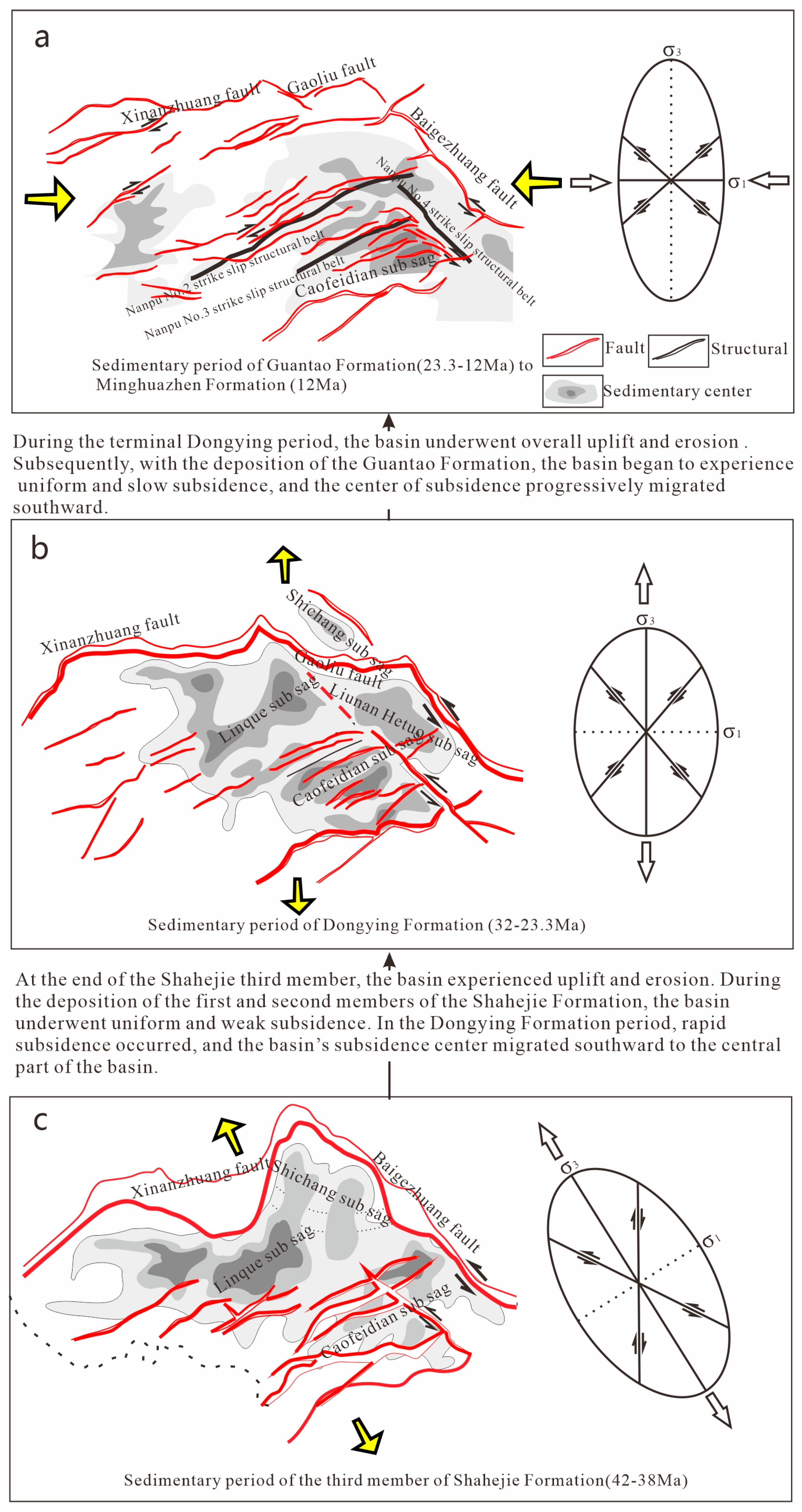
Based on the previously delineated stages of tectonic evolution for Nanpu Sag, in conjunction with residual thickness maps corresponding to each basin period, quantitative evaluations of the principal fault activities, and the developmental patterns of the sedimentary subsidence center, a paleotectonic framework map has been constructed for the distinct evolutionary phases of Nanpu Sag (Figure 7). This map serves to elucidate the underlying mechanisms and processes governing its tectonic evolution.
Figure 7.
Paleotectonic Framework and Stress Field Analysis of Nanpu Sag: (a) The paleotectonic composition of Nanpu Sag during the sedimentation of the Guantao Formation to Minghuazhen Formation; (b) the paleotectonic composition of Nanpu Sag throughout the deposition of the Dongying Formation; (c) the paleotectonic composition of Nanpu Sag during the accumulation of the third member of the Shahejie Formation.
5.1. Rift Stage I—Sedimentary Period of the Third Member of Shahejie Formation
As shown in Figure 7c, during this period, the main active faults in the Nanpu Sag were the Xinanzhuang Fault, Baigezhuang Fault, Shabei Fault, and the early-stage faults in the No. 2, No. 3, and No. 4 strike-slip structural belts. The largest subsidence center in the basin, the Linque sub-sag, is associated with the development of the Xinanzhuang Fault. Additionally, several secondary subsidence centers are observed in the Shichang and Caofeidian sub-sags. These subsidence centers are generally distributed in a NE direction, indicating that the principal stress during this depositional period was oriented NW–SE. The main subsidence center migrated southward from 39.4° N (Shahejie Member 3, Linque sub-sag) to 39.0° N (Dongying Formation, Caofeidian sub-sag), representing a lateral shift of 30 km at an average migration rate of 1.4 km/Ma. During this period, basin development was characterized by sinistral strike-slip extension along the Baigezhuang Fault and the No. 4 structural belt, inducing normal faulting in the deeper parts of the Xinanzhuang Fault and the No. 2 and No. 3 structural belts, as well as fault-controlled subsidence along the Shabei Fault.
5.2. Rift Stage II—Dongying Formation Sedimentary Period
The most significant feature during this period is the increased activity of the Gaoliu Fault, which was largely inactive during the deposition of the Shahejie Formation. The Gaoliu Fault became more active and, together with the Xinanzhuang and Baigezhuang faults, formed a large arcuate normal fault zone, which predominantly controlled the evolution of the Nanpu Sag during the deposition of the Dongying Formation (see Figure 7b). North of the Gaoliu Fault, the onshore segment of the Xinanzhuang Fault (eastern section) became essentially inactive, while the onshore segment of the Baigezhuang Fault (northern section) remained active but was mainly restricted to the Shichang sub-sag. Considering the basin-controlling boundary faults during this period—namely, the nearly EW-oriented, south-dipping arcuate Xinanzhuang–Gaoliu–Baigezhuang normal fault belt—the tectonic stress field of the basin had undergone a clockwise rotation compared to the depositional period of the third member of the Shahejie Formation. Fault orientation statistics indicate that the minimum principal stress (σ3) shifted from 135° (NW–SE) during the first phase of rifting to 010° (near SN) during the second phase, synchronous with the right-lateral transtension along the Tan-Lu Fault Zone.
As shown in Figure 7, the subsidence center of the basin migrated from the onshore area to the central part of the Nanpu Sag. However, secondary subsidence centers remained active mainly in the central and western parts of the basin, displaying a NE-trending distribution. Notably, the No. 4 structural belt extended further northwest compared to the Shahejie Member 3 depositional period, thereby delineating the NE-oriented centers of subsidence (and thickness maxima), indicating that strike-slip deformation continued to play a dominant role within the basin. During the Shahejie Member 3 deposition, strike-slip activity was mainly concentrated along the Baigezhuang Fault Zone, whereas in the Dongying Formation depositional period, it became focused on the No. 4 structural belt.
5.3. Thermal Subsidence Curtain and Accelerated Subsidence Curtain—Sedimentary Periods of Guantao Formation and Minghuazhen Formation
At the end of Dongying Formation sedimentation, in Figure 5b, due to the obvious regional unconformity at the bottom interface (Ng) of Guantao formation, the basin was uplifted and denuded as a whole, accompanied by strong volcanism, and then the basin entered the post rift subsidence stage. Subsequently, the basin entered a post-rift subsidence phase. The primary tectonic feature during this period was the development of two sets of X-shaped conjugate shear fault zones against the background of overall basin subsidence. Seismic profiles reveal densely distributed small normal faults forming classic negative flower structures. The major early faults predominantly exhibited inherited strike-slip activity [4]. Based on the orientation of the X-shaped conjugate shear faults, the principal compressive stress during this period can be inferred to be oriented in the SN direction. Within the basin, the Shabei Fault and the No. 2, No. 3, and No. 4 structural belts were the main active faults, controlling the subsidence centers at this stage (Figure 7c). Compared to the Dongying Formation depositional period, the subsidence center migrated southward to the Caofeidian sub-sag in the southern part of the basin.
5.4. Development and Evolution Model of Nanpu Sag
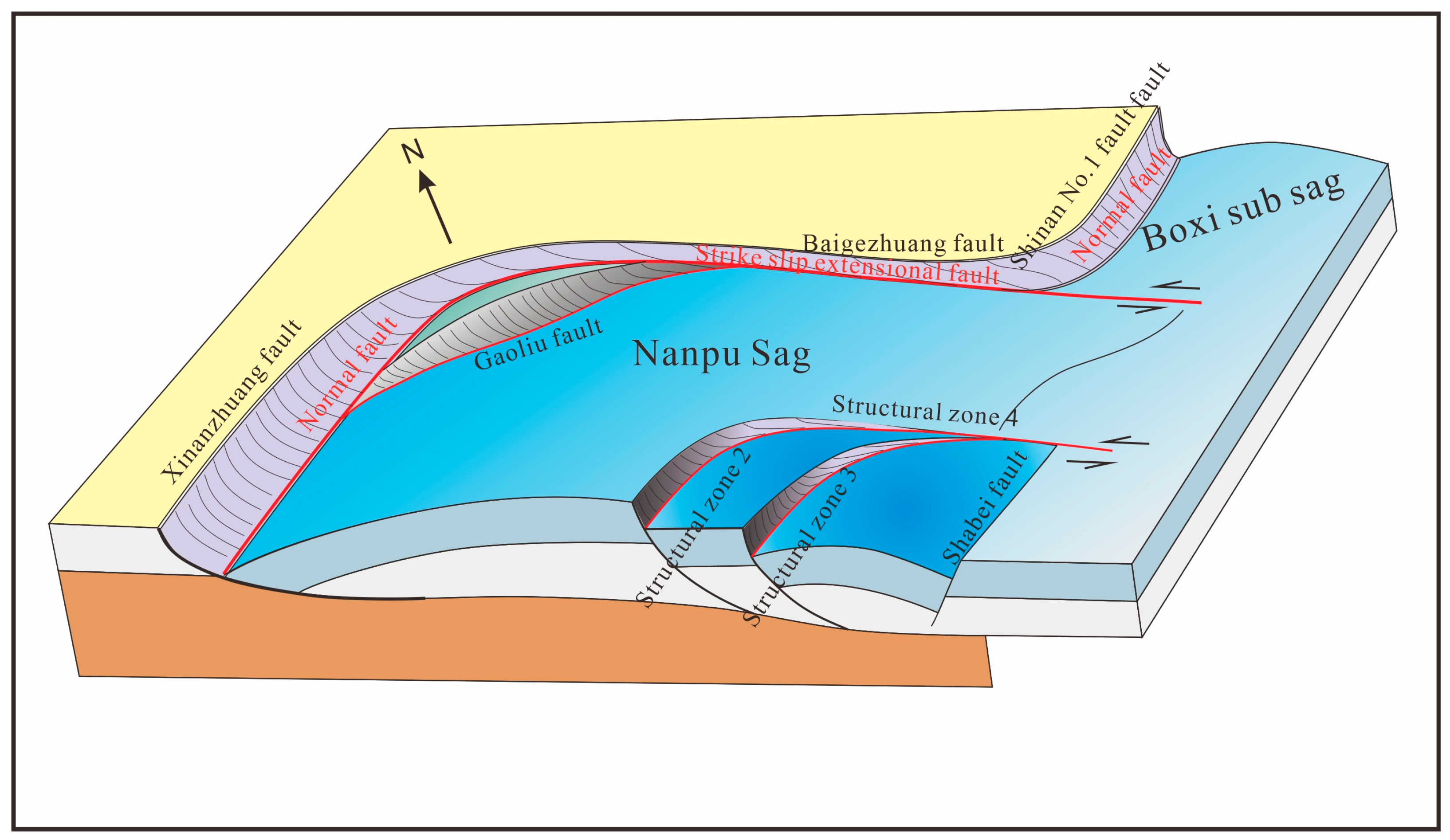
Based on the comprehensive analysis of the geometric and kinematic relationships among the major faults in the basin, as well as the sedimentary subsidence evolution process, this study proposes that the development of the Nanpu Sag exhibits a “lateral strike-slip, normal extension” tectonic movement pattern, as illustrated in Figure 8. The variation in the type and strength of tectonic movements along the boundary faults in Nanpu Sag during different historical periods contributed to the sag’s formation and development. The left-lateral strike-slip movement along the Baigezhuang fault caused the Xinanzhuang fault to extend, resulting in the creation of the Nanpu Sag. At the southern tip of the Baigezhuang Fault, the Shinan-1 Fault also controls the formation of an extensional sub-sag, the Bozhongxi sub-Sag, which, similar to the Nanpu Sag, experienced extensional faulting prior to the deposition of the Guantao Formation. These observations suggest that the Baigezhuang Fault acts as a strike-slip extensional transfer zone between different extensional sub-basins. The transtensional stress along the Baigezhuang Fault generates a localized NW- or near SN-oriented extensional stress field at its terminus, which drives the development and evolution of the Nanpu Sag. From the viewpoint of the geometric arrangement and movement features of these boundary faults, the southern sag behaves as if its basement is being pulled southward. The Baigezhuang fault exhibits a left-lateral strike-slip displacement of 2.3 km with a slip angle of 15°, and the basement being pulled moves southward, resulting in a vertical normal fault component of 6.5 km, which aligns with extensional movement.
Figure 8.
Formation pattern of Nanpu sag—basin at the end of strike-slip and extensional faults.
A similar deformation mechanism is evident in the development of the internal sub-sags within the Nanpu Sag. Although limited in scale, the No. 4 fault zone—whose orientation is consistent with that of the Baigezhuang Fault—acts as a transfer or accommodation fault. Together with the No. 2 and No. 3 fault zones and the Shabei Fault, it collectively controls the formation and evolution of the Caofeidian sub-sag. Umhoefer et al. defined such basins, controlled by boundary fault terminations, as “strike-slip extensional fault termination basins,” noting that they typically develop at the ends of strike-slip systems where extension occurs along the fault trend [27,28]. These types of basins are commonly found in extensional basin transfer zones or at obliquely convergent plate margins. Classic examples include the Gulf of California–Death Valley rift system [29] and the North Aegean pull-apart basin [30,31,32,33].
Accompanying the evolution of this deformation pattern, the subsidence center of the Nanpu Sag also exhibits a systematic migration: it was located in the northern part of the sag during the deposition of the third member of the Shahejie Formation, shifted to the central region during the Dongying Formation, and further migrated southward to the Caofeidian sub-sag by the time of the Guantao Formation.
6. Discussion and Conclusions
6.1. Discussion
The Nanpu Sag is situated at the northern margin of the Bohai Bay Basin, between the Lanliao and Tan-Lu fault zones. Its formation and evolution are clearly influenced by the dynamic processes associated with these major basement strike-slip faults. However, the spatial and temporal heterogeneity in the development of the Bohai Bay Basin has resulted in a complex tectonic setting for the Nanpu Sag region [34,35]. The following discussion integrates previous research to further elaborate on these aspects.
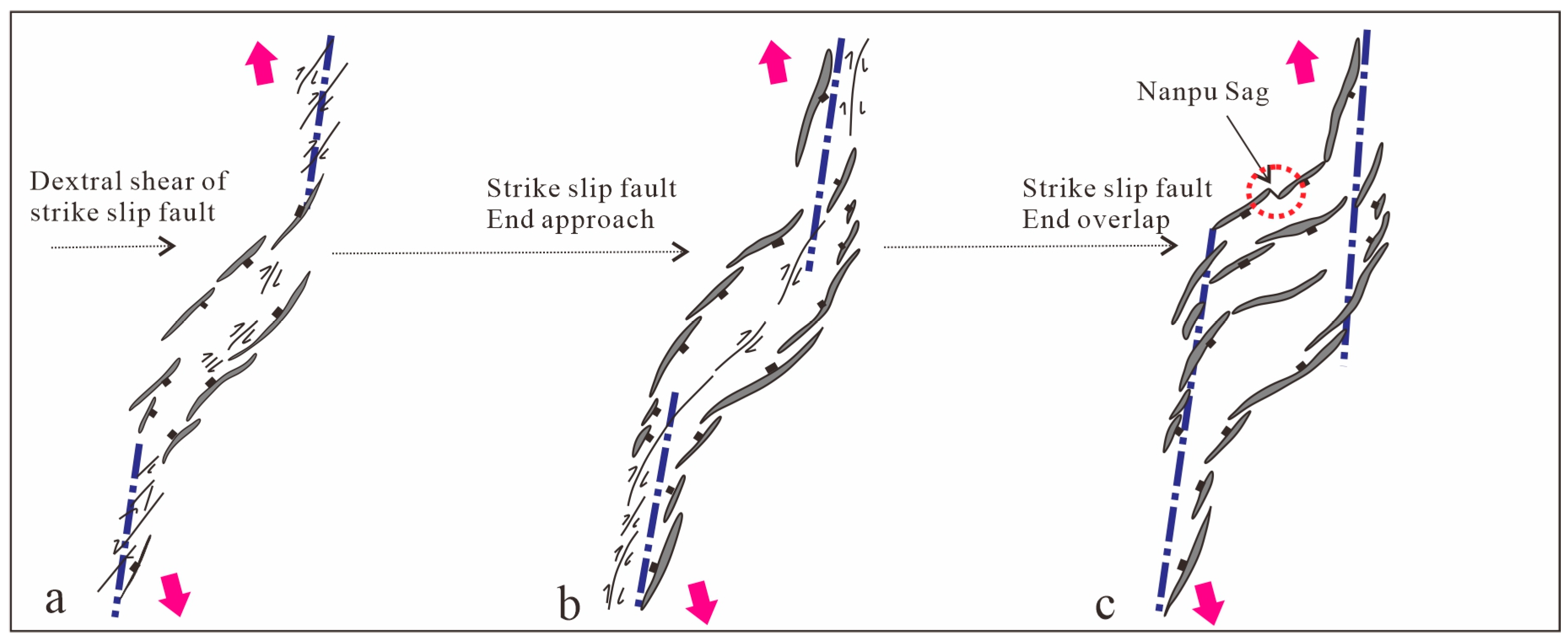
Figure 9 presents a conceptual model for the development and evolution of the Bohai Bay strike-slip pull-apart basin, primarily focusing on the offshore basin [36]. During the Kongdian Formation to the fourth member of the Shahejie Formation, the Tanlu and Lanliao faults, located along the east–west boundary of the Bohai Sea, exhibited no tectonic activity. At this stage, the basin’s development and evolution were predominantly governed by the interplay between the regional tectonic stress field and pre-existing basement structures. As geological evolution progressed, the influence of active fault dynamics became increasingly significant. Ultimately, the basin’s final configuration resulted from the combined effects of the regional tectonic stress field, pre-existing basement structures, and active faulting. Initially, the structural framework of the basin was established through the joint action of basement structures and regional stress fields, while subsequent fault activity further modified and finalized its ultimate form. From the late Eocene onwards (beginning with the base of the third member of the Shahejie Formation), dextral (right-lateral) strike-slip movement along these two fault zones began to govern subsidence and evolution in the Bohai Bay Basin (Figure 9a,b). In the early part of this stage, the two strike-slip faults did not overlap (Figure 9a); the Lanliao Fault propagated northward while the Tan-Lu Fault propagated southward, gradually bringing the two closer together. Consequently, basin development during this interval was characterized by northeastward deflection and expansion along the strike-slip faults, resulting in NE-trending faulted basins between them. During the deposition of the first and second members of the Shahejie Formation and the Dongying Formation, partial overlap developed between the boundary strike-slip faults, intensifying their interaction and leading to the formation of nearly east–west trending faulted basins in the overlapping region (Figure 9c).
Figure 9.
The formation pattern in strike-slip Bohai Bay basin and the regional tectonic location of the Nanpu Sag: (a) the two dextral strike-slip faults begin to move, and the ends of the fault extension have a trend of approaching each other. The left-order oblique normal fault system is generated; (b) the ends of the extended layers continue to approach each other, and the scale of the basin controlled by the left-order oblique normal fault system increases; (c) The ends of fault extension overlap, and the normal faults in the east–west direction are derived in the overlapping section.
Compared to the Bohai Bay Basin, the Nanpu Sag is relatively small, a subordinate tectonic unit located in the mid-section of the northern basin margin. The Cenozoic development and evolution of the Nanpu Sag commenced in the late Eocene during the deposition of the third member of the Shahejie Formation. Thus, the developmental process of the Nanpu Sag primarily records the history of the Bohai Bay Basin’s transition into a pull-apart basin. During the third member of the Shahejie Formation, the Lanliao and Tan-Lu fault zones had not yet overlapped, and the Nanpu Sag was controlled by a NW-SE extensional stress field, resulting in a NE-trending faulted basin dominated by Shahejie Member 3 deposits. In the subsequent first and second members of the Shahejie Formation and the Dongying Formation, overlap and interaction began between the Lanliao and Tan-Lu fault zones, forming a series of parallel basement strike-slip faults and generating a N-S extensional stress field in the overlapping zone. This facilitated the development of the Xinanzhuang–Gaoliu–Baigezhuang south-dipping arcuate faults, which controlled the formation of a nearly east–west oriented subsidence center in the basin.
The “lateral strike-slip and normal extension model” offers superior explanatory power regarding the structural features of the basin. This model effectively accommodates NE, NW, and EW-oriented normal faults and provides a coherent explanation for the development of multi-directional strike-slip faults. Furthermore, the predicted strike-slip displacements align well with the observed characteristics of strike-slip faults that are prevalent throughout the basin. Additionally, the model’s proposed mechanism of “inherited reactivation of pre-existing faults” enables a dynamic reconstruction of the basin’s multi-stage deformation history, addressing inconsistencies present in alternative models related to the asymmetry of principal faults and the genesis of strike-slip faults. Consequently, the “lateral strike-slip and normal extension model” presents a more comprehensive and plausible framework for the structural interpretation of the study area. A comparative analysis of the various models is illustrated in Table 1.
Table 1.
Comparison of structural models for the basin (benefits of the strike-slip + extension model).
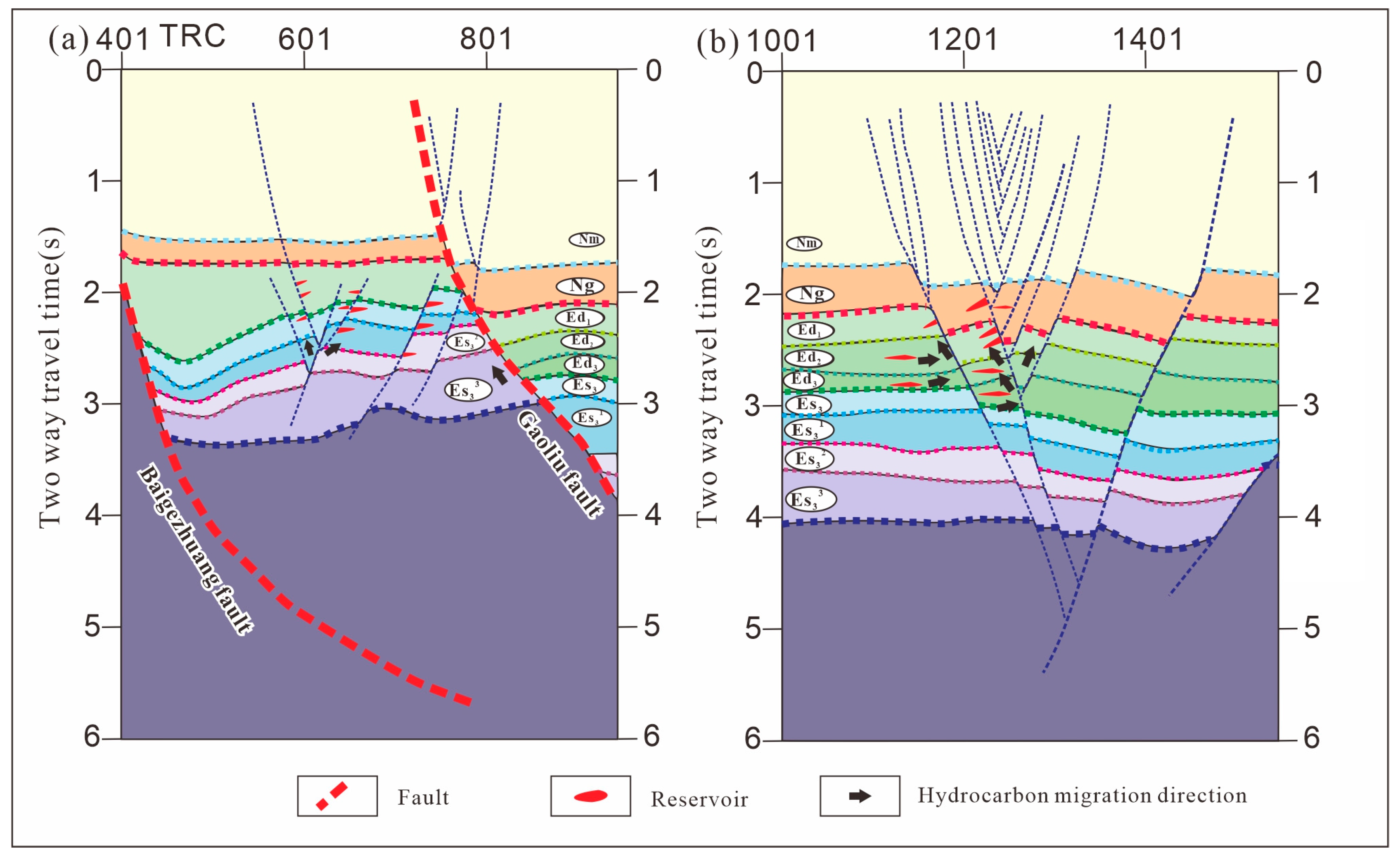
In the study area, complex fault systems developed during post-rift tectonic activities, with flower-like structures representing the most characteristic features. These structures can be categorized into two types based on their scale and stratigraphic horizon. The smaller normal flower-like structures predominantly formed during the Neogene period and do not connect with deep source rocks; hydrocarbon accumulation in these structures primarily depends on the filling of major faults. Oil and gas are mainly concentrated within these structures, with the micro-Horst located between paired flower structures serving as a favorable site for the development of anticlinal hydrocarbon reservoirs. In contrast, the larger flower-like structures originated during the Paleogene period, where inherited active faults on the periphery function as principal hydrocarbon conduits, effectively linking deep source rocks with shallow Neogene channel sand bodies. Faults within these structures facilitate the upward migration of hydrocarbons through a relay mechanism. However, the densely faulted and highly active zones at the crest of these structures often result in hydrocarbon leakage, whereas the more stable flanks tend to promote the formation of thick fault-sealed lithologic reservoirs (Figure 10).
Figure 10.
Prediction model of faulted anticline hydrocarbon accumulation in Liunan saddle structural belt; (a) small flower-like structure; (b) large flower-like structure.
6.2. Conclusions
- (1)
- Episodic activity of major boundary faults shows the southward migration of the subsidence center. The Xinan Zhuang, Baigezhuang, Gaoliu, and Shabei faults exhibit episodic behavior characterized by alternating periods of activity and quiescence. During the deposition of the Sha-3 Member (42–38 Ma), intense activity along the boundary faults resulted in the formation of a northern subsidence center. In the Dongying Formation period (32–23.3 Ma), fault activity migrated southward, focusing on the arcuate fault system comprising the Xinan Zhuang–Gaoliu–Baigezhuang belt and Shabei Fault, which led to the relocation of the subsidence center toward the central part of the sag. In the post-rift period (23.3 Ma to present), conjugate strike-slip faulting further accompanied the southward shift in the subsidence center into the Caofeidian sub-sag.
- (2)
- Two episodes of rifting correspond to regional stress field rotation. The Cenozoic evolution of the Nanpu Sag can be divided into a syn-rift stage (42–23.3 Ma) and a post-rift stage (23.3 Ma to present). The syn-rift stage is further subdivided by the T50 surface at the base of the Sha-2 Member into two episodes: Rift Episode I (Sha-3 Member) was governed by NW–SE-oriented extensional stress, resulting in the development of NE-trending fault systems; Rift Episode II (Dongying Formation) was dominated by a clockwise-rotating stress field that became nearly SN-oriented, leading to the activation of the Gaoliu Fault and its linkage with the Xinan Zhuang–Baigezhuang faults to form an arcuate fault belt, which controlled the formation of an approximately EW-trending basin structure. This evolutionary process reflects the episodic accompanied exerted by the right-lateral pull-apart system of the Bohai Bay Basin.
- (3)
- Using fault kinematics, subsidence migration, and stress field control analysis, Nanpu Sag is characterized as a strike-slip extensional fault terminal basin. The left-lateral strike-slip movement of the Baigezhuang fault caused the basement block to shift southward (normal extension), leading to the formation of an extensional basin.
Author Contributions
L.X. and H.Y.; methodology, L.X., R.Z. and H.Y.; software, Z.L. and J.X.; validation, J.X., Z.L. and W.D.; resources, J.X. and W.D.; data curation, Z.L.; writing—original draft preparation, L.X., H.Y., R.Z. and W.D.; writing—review and editing, W.D., R.Z. and J.X.; supervision, W.D.; project administration, W.D. All authors have read and agreed to the published version of the manuscript.
Funding
This research was funded by the National Natural Science Foundation of China, grant number 42376058.
Data Availability Statement
We cannot disclose data due to confidentiality restrictions.
Conflicts of Interest
The authors declare no conflicts of interest.
References
- Zhou, H.M.; Wei, Z.W.; Cao, Z.H.; Cong, L.Z. Relationship between formation, evolution and hydrocarbon in Nanpu Sag. Oil Gas Geol. 2000, 21, 345–349. [Google Scholar]
- Tong, H.M.; Zhao, B.Y.; Cao, Z.; Liu, G.X.; Dun, X.M.; Zhao, D. Structural analysis of faulting system origin in the Nanpu Sag, Bohai Bay Basin. Acta Geol. Sin. 2013, 87, 1647–1661. [Google Scholar]
- Liu, L.; Sun, Y.H.; Chen, C.; Lou, R.; Wang, Q. Fault reactivation in No.4 structural zone and its control on oil and gas accumulation in Nanpu Sag, Bohai Bay Basin, China. Pet. Explor. Dev. 2022, 49, 716–727. [Google Scholar] [CrossRef]
- Qi, J.F.; Deng, R.J.; Zhou, X.H.; Zhang, K.X. Structure of the Tan Lu Fault Zone in the Cenozoic Basin of the Bohai Sea. Sci. China (Terrae) 2008, 38 (Suppl. S1), 22–32. [Google Scholar]
- Liu, X.F.; Dong, Y.X.; Wang, H. Antiformal negative flower structure in Nanpu Sag, Bohai Bay Basin. Earth Sci. 2010, 35, 1029–1034. [Google Scholar]
- Wang, Y.H.; Yu, F.S.; Song, L.; Wang, D.D.; Zhao, B.Y.; Qi, Y.L.; Meng, L.J. Genesis analysis of the Nanpu Sag, Bohai Bay Basin: Insights from seismic data interpretation and 3D sandbox analogue modelling. Acta Geol. Sin. 2025, 99, 2597–2620. [Google Scholar]
- Zhao, B.Y.; Yang, X.L.; Xu, Y.X.; Meng, L.J.; Cui, Z.X.; Wang, F.L.; Liu, J.L.; Yu, F.S. Characteristics and reservoir control of Cenozoic tectonic evolution of Nanpu Sag, Bohai Bay Basin. Lithol. Reserv. 2025, 37, 59–69. [Google Scholar]
- Qi, J.F.; Zhang, Y.W.; Lu, K.Z.; Yang, Q.; Chen, F.J. Extensional pattern and dynamic process of the Cenozoic rifting basin in the Bohai Bay. Pet. Geol. Exp. 1995, 17, 316–323. [Google Scholar]
- Allen, M.B.; MacDonald, D.I.M.; Zhao, X.; Vincent, S.J.; Brouet-Menzies, C. Early Cenozoic two-phase extension and late Cenozoic thermal subsidence and inversion of the Bohai Basin, northern China. Mar. Pet. Geol. 1997, 14, 951–972. [Google Scholar] [CrossRef]
- Yu, F.S.; Koyi, H. Cenozoic tectonic model of the Bohai Bay Basin in China. Geol. Mag. 2016, 153, 866–886. [Google Scholar] [CrossRef]
- Pang, X.J.; Li, J.P.; Wang, G.M.; Wang, Y.; Zhou, X.F. Characteristics and controlling effect of fault activity of Paleogene in Shinan area of Bozhong Depression on sedimentary facies. J. Xi’an Shiyou Univ. (Nat. Sci. Ed.) 2012, 27, 11–16. [Google Scholar]
- Morley, C.K.; Haranya, C.; Phoosongsee, W.; Pongwapee, S.; Kornsawan, A.; Wonganan, N. Activation of rift oblique and rift parallel pre-existing fabrics during extension and their effect on deformation style: Examples from the rifts of Thailand. J. Struct. Geol. 2004, 26, 1803–1829. [Google Scholar] [CrossRef]
- Zhao, J.; Tang, X.J.; Jiang, Y.M.; Zou, W.; Liu, Y.R. Confirmation and genesis of the Middle Eocene tectonic transformation in northwestern margin of Xihu Depression, East China Sea Basin. Bull. Geol. Sci. Technol. 2020, 39, 58–67. [Google Scholar]
- Xu, A.N.; Zheng, H.J.; Dong, Y.X.; Wang, Z.C.; Yin, J.F.; Yan, W.P. Sequence stratigraphic framework and sedimentary facies prediction in Dongying Formation of Nanpu Sag. Pet. Explor. Dev. 2006, 33, 437–443. [Google Scholar]
- Dong, Y.X.; Wang, Z.C.; Zheng, H.J.; Xu, A.N. Control of strike-slip faulting on reservoir formation of oil and gas in Nanpu Sag. Pet. Explor. Dev. 2008, 35, 424–430. [Google Scholar] [CrossRef]
- Zhou, T.W.; Zhou, J.X.; Dong, Y.X.; Wang, X.D.; Chang, H.W. Formation mechanism of Cenozoic fault system of Nanpu Sag in Bohai Bay Basin. J. China Univ. Pet. (Nat. Sci. Ed.) 2009, 33, 12–17. [Google Scholar]
- Liang, J.; Yu, F.S.; Liu, G.X.; Wang, T.K.; Li, D.H.; Ma, K. Deformation superimposition characteristics resulting from stretching direction changes in Nanpu Sag: Insight from physical modeling. Geoscience 2014, 28, 139–148. [Google Scholar]
- Zhang, C.M.; Liu, X.F. The boundary faults and basin-formation mechanism of Nanpu Sag. Acta Petrol. Sin. 2012, 33, 581–587. [Google Scholar]
- Wang, H.; Jiang, H.; Lin, Z.L.; Zhao, S.E. Relations between synsedimentary tectonic activity and sedimentary framework of Dongying Formation in Nanpu Sag. J. Earth Sci. Environ. 2011, 33, 70–77. [Google Scholar]
- Du, Q.X.; Guo, S.B.; Shen, X.L.; Cao, Z.; Zhang, X.; Li, Y. Paleo-water characteristics of the Member 1 of Paleogene Shahejie Formation in southern Nanpu Sag, Bohai Bay Basin. J. Palaeogeogr. (Chin. Ed.) 2016, 18, 173–183. [Google Scholar]
- Gai, C.C.; Zhao, Z.X.; Ren, L.; Yan, Y.; Hou, B. Research and application of well location deployment parameters for cluster development of medium-deep hydrothermal geothermal resources: A case study of HTC geothermal field. Pet. Reserv. Eval. Dev. 2024, 14, 638–646. [Google Scholar]
- Tang, H.Y.; Xian, B.Z.; Li, C.; Wang, P.Y.; Chen, L.; Chen, S.R.; Yang, R.C.; Tian, R.H. Quality difference and genesis of clastic reservoirs in the Nanpu Sag: A case study of the Paleogene in the No.4 structural belt. Acta Sedimentol. Sin. 2025, 43, 288–300. [Google Scholar]
- Jiang, H.; Wang, H.; Lin, Z.L.; Fang, X.X.; Zhao, S.E.; Ren, G.Y. Periodic rifting activity and its controlling on sedimentary filling of Paleogene period in Nanpu Sag. Acta Sedimentol. Sin. 2009, 27, 976–982. [Google Scholar]
- Liu, J.Y.; Lü, J.; Wang, L. An approach to the quantitative fault description. Comput. Tech. Geophys. Geochem. Explor. 2002, 24, 328–331. [Google Scholar]
- Ren, J.Y. Genetic dynamics of China offshore Cenozoic basins. Earth Sci. 2018, 43, 3337–3361. [Google Scholar]
- Wang, Y.L.; Chen, S.G. Tectonic-sedimentary analysis of Shabei area in Bozhong depression. Pet. Geol. Recovery Effic. 2015, 22, 26–32. [Google Scholar]
- Umhoefer, P.J.; Schwennicke, T.; Del Margo, M.T.; Ruiz-Geraldo, G.; Ingle, J.C., Jr.; McIntosh, W. Transtensional fault-termination basins: An important basin type illustrated by the Pliocene San Jose Island basin and related basins in the southern Gulf of California, Mexico. Basin Res. 2007, 19, 297–322. [Google Scholar] [CrossRef]
- Busby, C.; Ingersoll, R.V. Tectonics of Sedimentary Basins; Wiley: Hoboken, NJ, USA, 2011. [Google Scholar]
- Cemen, I.; Yeats, R.S. San Cayetano fault: Near surface expression of a midcrustal thrust in the California Transverse Ranges. Geol. Soc. Am. Abstr. Programs 1985, 17. [Google Scholar]
- Cemen, I.; Wright, L.A.; Drake, R.E.; Johnson, F.C. Cenozoic Sedimentation and Sequence of Deformational Events at Southeastern End of the Furnace Creek Strike-Slip Fault Zone, Death Valley Region, California; Society of Economic Paleontologists and Mineralogists: Tulsa, OK, USA, 1985. [Google Scholar]
- Dooley, T.P.; Schreurs, G. Analogue modelling of intraplate strike-slip tectonics: A review and new experimental results. Tectonophysics 2012, 574–575, 1–71. [Google Scholar] [CrossRef]
- Mann, P. Model for the formation of large, transtensional basins in zones of tectonic escape. Geology 1997, 25, 211–214. [Google Scholar] [CrossRef]
- Koukouvelas, I.K.; Aydin, A. Fault structure and related basins of the North Aegean Sea and its surroundings. Tectonics 2002, 21, 10–11. [Google Scholar] [CrossRef]
- Hou, G.T. The origin of the Bohai Bay Basin. Acta Sci. Nat. Univ. Pekin. 1998, 34, 503–509. [Google Scholar]
- Qi, J.F.; Zhou, X.H.; Wang, Q.S. Structural model and Cenozoic kinematics of Tan-Lu deep fracture zone in Bohai Sea area. Geol. China 2010, 37, 1231–1242. [Google Scholar]
- Qi, J.F.; Yang, Q. Dynamic analysis of continental rifting basin. Earth Sci. Front. 2012, 19, 19–26. [Google Scholar]
Disclaimer/Publisher’s Note: The statements, opinions and data contained in all publications are solely those of the individual author(s) and contributor(s) and not of MDPI and/or the editor(s). MDPI and/or the editor(s) disclaim responsibility for any injury to people or property resulting from any ideas, methods, instructions or products referred to in the content. |
© 2025 by the authors. Licensee MDPI, Basel, Switzerland. This article is an open access article distributed under the terms and conditions of the Creative Commons Attribution (CC BY) license (https://creativecommons.org/licenses/by/4.0/).