Galba truncatula: Distribution, Presence in Fountains and Identification of Factors Related to Its Occurrence in Bulgaria

Simple Summary
Abstract
1. Introduction
2. Materials and Methods
2.1. Study Area
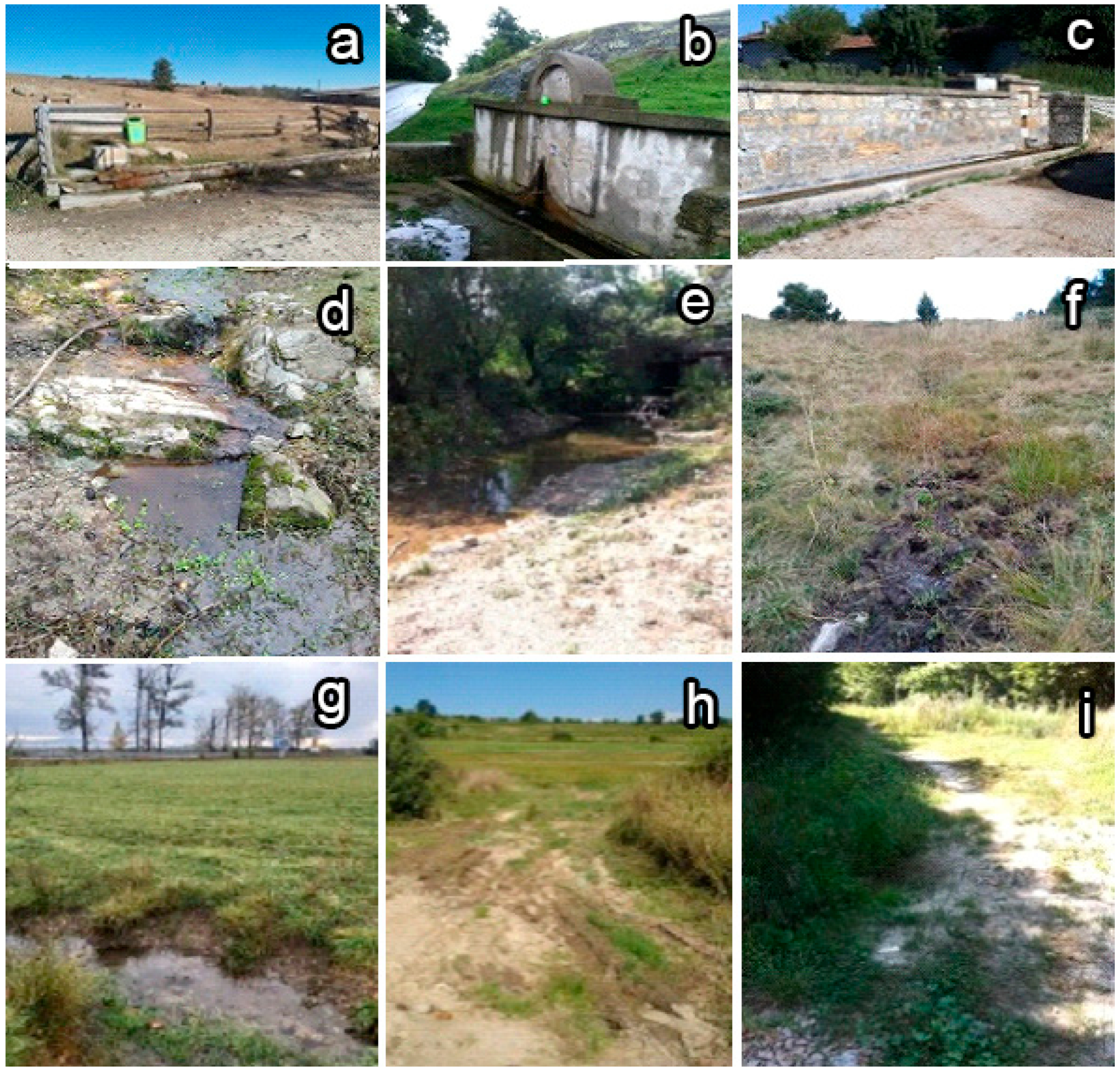
2.2. Sampling Location
2.3. Collection of G. truncatula Snails
2.4. Environmental Data and Analyzed Parameters
2.5. Statistical Analysis
3. Results
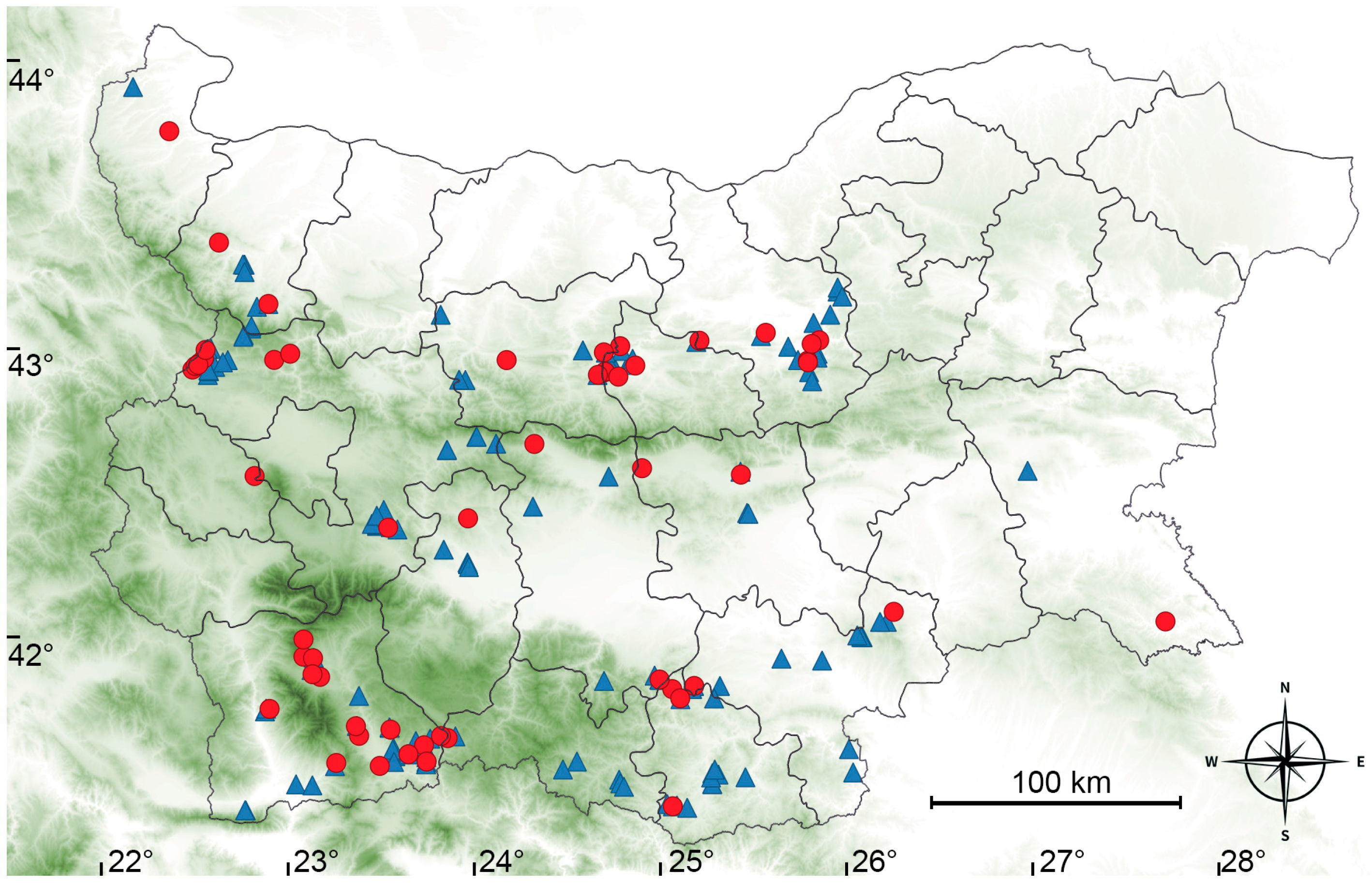
3.1. Habitat Frequency of G. truncatula
3.2. Environmental Factors and Occurrence of G. truncatula
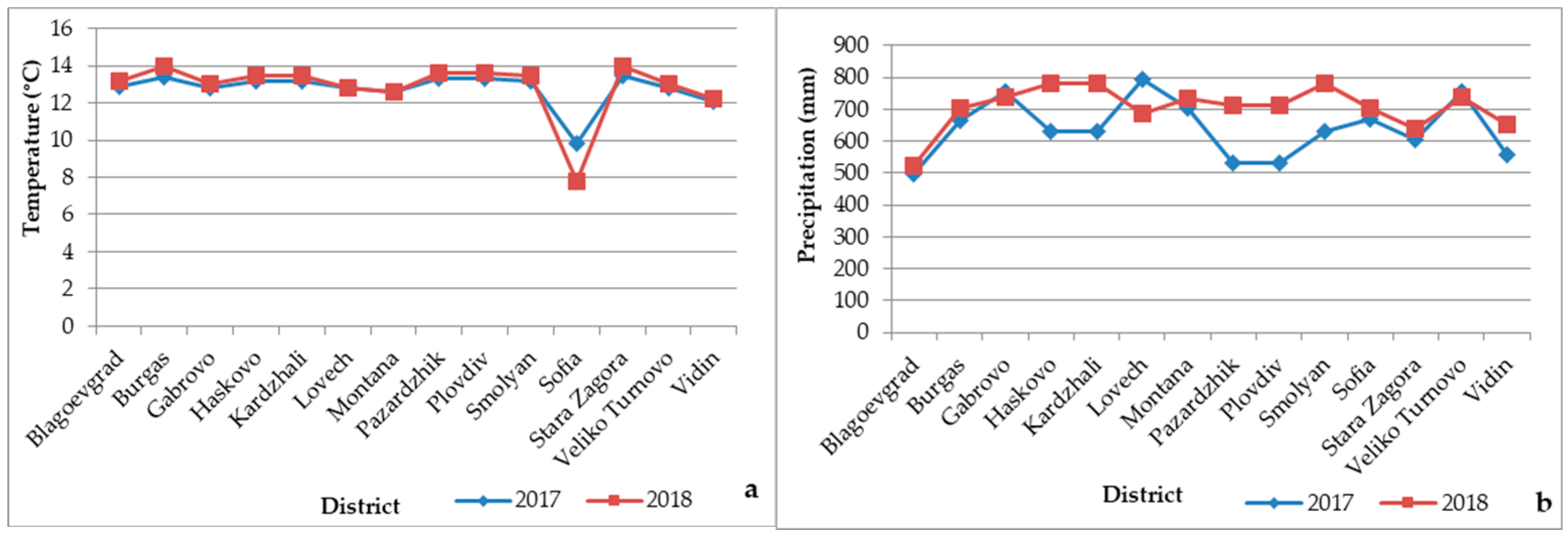
3.2.1. Characteristics of the Altitude, Temperature and Precipitation in the Study Area
3.2.2. Identification of Factors Related to the Presence of G. truncatula Snails
4. Discussion
5. Conclusions
Supplementary Materials
Author Contributions
Funding
Institutional Review Board Statement
Informed Consent Statement
Data Availability Statement
Acknowledgments
Conflicts of Interest
References
- Mas-Coma, S.; Valero, M.A.; Bargues, M.D. Chapter 2. Fasciola, lymnaeids and human fascioliasis, with a global overview on disease transmission, epidemiology, evolutionary genetics, molecular epidemiology and control. Adv. Parasitol. 2009, 69, 41–146. [Google Scholar] [CrossRef] [PubMed]
- Cwiklinski, K.; O’Neill, S.M.; Donnelly, S.; Dalton, J.P. A prospective view of animal and human fasciolosis. Parasite Immunol. 2016, 38, 558–568. [Google Scholar] [CrossRef] [PubMed]
- Mehmood, K.; Zhang, H.; Sabir, A.J.; Abbas, R.Z.; Ijaz, M.; Durrani, A.Z.; Saleem, M.H.; Ur Rehman, M.; Iqbal, M.K.; Wang, Y.; et al. A review on epidemiology, global prevalence and economical losses of fasciolosis in ruminants. Microb. Pathog. 2017, 109, 253–262. [Google Scholar] [CrossRef] [PubMed]
- Huson, K.M.; Oliver, N.A.M.; Robinson, M.W. Paramphistomosis of ruminants: An emerging parasitic disease in Europe. Trends Parasitol. 2017, 33, 836–844. [Google Scholar] [CrossRef]
- Velev, V.; Vutova, K.; Pavlova, M.; Mangarov, I. A case of fasciolosis in a 11-year-old Syrian immigrant boy. J. Trop. Pediatr. 2020, 66, 226–227. [Google Scholar] [CrossRef]
- Mas-Coma, S. Human fascioliasis emergence risks in developed countries: From individual patients and small epidemics to climate and global change impacts. Enfermedades Infecc. Microbiol. Clin. 2020, 38, 253–256. [Google Scholar] [CrossRef]
- Caravedo, M.A.; Cabada, M. Human fascioliasis: Current epidemiological status and strategies for diagnosis, treatment, and control. RRTM 2020, 11, 149–158. [Google Scholar] [CrossRef]
- European Commisson. A Decade of EU-Funded Animal Health Research; European Commisson: Brussels, Belgium, 2012. [Google Scholar] [CrossRef]
- Arias, M.; Piñeiro, P.; Sánchez-Andrade, R.; Suárez, J.L.; Hillyer, G.V.; Díez-Baños, P.; Paz-Silva, A.; Morrondo, P. Relationship between exposure to Fasciola hepatica in roe deer (Capreolus capreolus) and cattle extensively reared in an endemic area. Res. Vet. Sci. 2013, 95, 1031–1035. [Google Scholar] [CrossRef]
- Roldán, C.; Begovoeva, M.; López-Olvera, J.R.; Velarde, R.; Cabezón, Ó.; Min, A.R.M.; Pizzato, F.; Pasquetti, M.; Aguilar, X.F.; Mentaberre, G.; et al. Endemic occurrence of Fasciola hepatica in an Alpine ecosystem, Pyrenees, Northeastern Spain. Transbound. Emerg. Dis. 2020, 68, 2589–2594. [Google Scholar] [CrossRef]
- Hidalgo, S.G.; Baños, N.D.; Argüello, M.R.H.; Martínez-Delgado, A. Natural infection by Fasciola hepatica in red deer (Cervus elaphus) from NW Spain: The usefulness of necropsy, coprology, and three enzyme-linked immunosorbent assays for the diagnosis. Animals 2025, 15, 2649. [Google Scholar] [CrossRef]
- Sattmann, H.; Hörweg, C.; Gaub, L.; Feix, A.S.; Haider, M.; Walochnik, J.; Rabitsch, W.; Prosl, H. Wherefrom and whereabouts of an alien: The american liver fluke Fascioloides magna in Austria: An overview. Wien. Klin. Wochenschr. 2014, 126, 23–31. [Google Scholar] [CrossRef]
- Juhász, A.; Majoros, G.A. Proposed ectochory of Galba truncatula snails between wallow sites enhances transmission of Fascioloides magna at gemenc, in Hungary. Int. J. Parasitol. Parasites Wildl. 2023, 21, 219–223. [Google Scholar] [CrossRef]
- Sindičić, M.; Davinack, A.; Bujanić, M.; Bugarski, D.; Mirčeta, J.; Ferroglio, E.; Konjević, D. A new insight into genetic structure of Danube and Italian foci of fascioloidosis. Vet. Parasitol. 2023, 314, 109854. [Google Scholar] [CrossRef] [PubMed]
- Vignoles, P.; Rondelaud, D.; Dreyfuss, G. The populations of Galba truncatula, known for their natural infections with Haplometra cylindracea (Digenea, Plagiorchioidea), are better intermediate hosts for metacercarial production of Fasciola hepatica. Parasitol. Res. 2007, 100, 1371–1373. [Google Scholar] [CrossRef] [PubMed]
- Hörweg, C.; Prosl, H.; Wille-Piazzai, W.; Joachim, A.; Sattmann, H. Prevalence of Fascioloides magna in Galba truncatula in the Danube backwater area east of Vienna, Austria. WTM 2011, 98, 261–267. Available online: https://www.wtm.at/explorer/WTM/Archiv/2011/WTM_11-12-2011_Artikel_5.pdf (accessed on 25 September 2025).
- Radev, V.; Hrusanov, D.; Georgieva, K.; Bankov, I. Galba truncatula (Muller, 1774): A factor for spreading of fasciolosis. Proc. Bulg. Acad. Sci. 2008, 61, 1033–1036. [Google Scholar]
- Smith, C.D.; Morgan, E.R.; Jones, R.A. Environmental influences on the distribution and ecology of the fluke intermediate host Galba truncatula: A systematic review. Parasitology 2024, 151, 1201–1224. [Google Scholar] [CrossRef]
- Bulgarian Industrial Association. Available online: https://www.bia-bg.com/magazine/view/30162/ (accessed on 25 September 2025).
- Lalkovski, N.; Radev, V.; Nedelchev, N.; Kostova, T.; Katerinova, I.; Sabev, P. Trematodes in small domestic ruminants in Bulgaria. J. Mt. Agric. Balk. 2016, 19, 27–38. [Google Scholar]
- Dakova, V. Studies on Some Aspects of Parasitosis in Wild Animals in Bulgaria. Ph.D. Thesis, Institute of Experimental Morphology, Pathology and Anthropology with Museum, Bulgarian Academy of Sciences, Sofia, Bulgaria, 2020. [Google Scholar]
- Sey, O.; Vishnyakov, Y. Examination of paramphistomid species of Bulgarian domestic ruminants. Parasitol. Hung. 1976, 9, 25–29. [Google Scholar]
- Available online: https://www.mzh.government.bg/media/filer_public/2018/07/12/ra339-livestock_nov2017.pdf (accessed on 25 September 2025).
- Criteria for Determining Difficulty of Access of the Regions of the Country and the Settlements in Them. Available online: https://crc.bg/files/_bg/pa37.htm (accessed on 25 September 2025).
- QGIS Geographic Information System 2025. Available online: https://www.qgis.org (accessed on 5 December 2025).
- Georgiev, D. The Freshwater Snails of Bulgaria, 1st ed.; Dedov, I., Hubenov, Z., Eds.; Plovdiv University Press: Plovdiv, Bulgaria, 2014. [Google Scholar]
- R Core Team. R: A Language and Environment for Statistical Computing; R Core Team: Vienna, Austria, 2024; Available online: https://www.R-project.org/ (accessed on 21 November 2025).
- Falniowski, A.; Lewarne, B.; Rysiewska, A.; Osikowski, A.; Hofman, S. Crenobiont, stygophile and stygobiont molluscs in the hydrographic area of the Trebišnjica River Basin. ZooKeys 2021, 1047, 61–89. [Google Scholar] [CrossRef]
- Dmitrović, D.; Savic, A.; Pešić, V. Discharge, substrate type and temperature as factors affecting gastropod assemblages in springs in Northwestern Bosnia and Herzegovina. Arch. Biol. Sci. 2016, 68, 613–621. [Google Scholar] [CrossRef]
- Beran, L. Non-marine aquatic molluscs (Gastropoda, Bivalvia) of Rab Island (Croatia). Nat. Croat. 2015, 24, 255–264. [Google Scholar] [CrossRef]
- Beran, L. A Contribution to knowledge of freshwater molluscs (Mollusca) of the Krka River in the Krka National Park (Croatia). Nat. Croat. 2016, 25, 295–304. [Google Scholar] [CrossRef]
- Páll-Gergely, B.; Csabai, Z. Notes on the continental malacofauna of Rhodes, with two new species to the fauna of the island. Malacol. Bohemoslov. 2008, 7, 76–78. [Google Scholar] [CrossRef]
- Georgiev, D.; Stoycheva, S. Notes on the ecology and species diversity of the inland molluscs of Samothraki Island (North-Eastern Greece). North-West. J. Zool. 2010, 6, 71–78. [Google Scholar]
- Georgopoulou, E.; Glöer, P.; Simaiakis, S.M. Contribution to the freshwater gastropods of the island of Andros in the Northern Cyclades (Aegean islands, Greece). Folia Malacol. 2016, 24, 275–287. [Google Scholar] [CrossRef]
- Sîrbu, I. The freshwater molluscs from the Târnava Rivers Basin (Transylvania, Romania). Transylv. Rev. Syst. Ecol. Res. 2005, 2, 51–60. [Google Scholar]
- Domokos, T.; Lennert, J. Standard faunistical work on the molluscs of Codru-Moma Mountains (Romania). Nymphaea 2007, 34, 67–95. [Google Scholar]
- Nicoară, M.; Erhan, M.; Plăvan, G.; Cojocaru, I.; Davideanu, A.; Nicoară, A. The ecological complex role of the macroinvertebrate fauna from the River Ciric (Iași, România). An. Științ. Univ. Al. I. Cuza Iasi Biol. Anim. 2009, 15, 125–132. [Google Scholar]
- Domokos, T.; Páll-Gergely, B. Sporadic notes on the land snail (Gastropoda) fauna of the North Bihor Mountains, Romania. Nymphaea 2021, 48, 109–130. [Google Scholar]
- Đuknić, J.; Stojanović, K.; Durutović, A.; Jovanovic, V. Ecological survey of macroinvertebrate communities in the Vrelska Padina and the Ivanštica Rivers (Eastern Serbia). In Proceedings of the BALWOIS 2010, Ohrid, North Macedonia, 25–29 May 2010. [Google Scholar]
- Şahin, S.K.; Yildirim, M. The mollusk fauna of Lake Sapanca (Turkey: Marmara) and some physico-chemical parameters of their abundance. Turk. J. Zool. 2007, 31, 47–52. [Google Scholar]
- Sahin, S.K. An investigation on the distribution of mollusc fauna of Lake Terkos (Istanbul/Turkey) related with some environmental parameters. J. Anim. Vet. Adv. 2012, 11, 3045–3049. [Google Scholar] [CrossRef]
- Georgiev, D.; Hubenov, Z. Freshwater snails (Mollusca: Gastropoda) of Bulgaria: An updated annotated checklist. Folia Malacol. 2013, 21, 237–263. [Google Scholar] [CrossRef][Green Version]
- Rodrigo, F.S. A Simple approach for the study of the relationship between temperature and precipitation. Theor. Appl. Climatol. 2022, 150, 215–228. [Google Scholar] [CrossRef]
- Anistratenko, V.V.; Furyk, Y.I.; Anistratenko, O.; Degtyarenko, E.V. A Review of species diversity, distribution and ecology of freshwater gastropod mollusks inhabiting the Ukrainian Transcarpatian. Vestn. Zologii 2019, 53, 349–374. [Google Scholar] [CrossRef][Green Version]
- Roessler, A.S.; Oehm, A.W.; Knubben-Schweizer, G.; Groll, A. A machine learning approach for modelling the occurrence of Galba truncatula as the major intermediate host for Fasciola hepatica in Switzerland. Prev. Vet. Med. 2022, 200, 105569. [Google Scholar] [CrossRef]
- Dreyfuss, G.; Vignoles, P.; Rondelaud, D. Relationships between the distribution of Galba truncatula (Gastropoda: Lymnaeidae) climatic conditions and the altitude of municipalities in Haute Vienne (France). Ann. Limnol.-Int. J. Lim. 2018, 54, 19. [Google Scholar] [CrossRef]
- Mas-Coma, S.; Funatsu, I.R.; Bargues, M.D. Fasciola hepatica and lymnaeid snails occurring at very high altitude in South America. Parasitology 2001, 123, S115–S127. [Google Scholar] [CrossRef]
- Novobilský, A.; Novák, J.; Björkman, C.; Höglund, J. Impact of meteorological and environmental factors on the spatial distribution of Fasciola hepatica in beef cattle herds in Sweden. BMC Vet. Res. 2015, 11, 128. [Google Scholar] [CrossRef]
- Charlier, J.; Soenen, K.; De Roeck, E.; Hantson, W.; Ducheyne, E.; Van Coillie, F.; De Wulf, R.; Hendrickx, G.; Vercruysse, J. Longitudinal study on the temporal and micro-spatial distribution of Galba truncatula in four farms in Belgium as a base for small-scale risk mapping of Fasciola hepatica. Parasites Vectors 2014, 26, 528. [Google Scholar] [CrossRef]
- Belfaiza, M.; Moncef, M.; Rondelaud, D. Fasciola hepatica: An unusual case of adaptation to a Moroccan population of Galba truncatula. Parasitol. Res. 2005, 95, 374–378. [Google Scholar] [CrossRef] [PubMed]
- Goumghar, M.D.; Rondelaud, D.; Dreyfuss, G.; Benlemlih, M. Influence of aestivation on the survival of Galba truncatula (Mollusca: Gastoropoda) populations according to altitude. Ann. Limnol.-Int. J. Lim. 2001, 37, 211–217. [Google Scholar] [CrossRef]
- Jones, R.A.; Davis, C.N.; Jones, D.L.; Tyson, F.; Davies, E.; Cutress, D.; Brophy, P.M.; Rose, M.T.; Williams, M.; Williams, H.W. Temporal dynamics of trematode intermediate snail host environmental DNA in small water body habitats. Parasitology 2021, 148, 1490–1496. [Google Scholar] [CrossRef] [PubMed]
- Mahulu, A.; Clewing, C.; Stelbrink, B.; Chibwana, F.D.; Tumwebaze, I.; Stothard, J.R.; Albrecht, C. Cryptic intermediate snail host of the liver fluke Fasciola hepatica in Africa. Parasites Vectors 2019, 12, 573. [Google Scholar] [CrossRef]
- Rapsch, C.; Dahinden, T.; Heinzmann, D.; Torgerson, P.R.; Braun, U.; Deplazes, P.; Hurni, L.; Bär, H.; Knubben-Schweizer, G. An interactive map to assess the potential spread of Lymnaea truncatula and the free-living stages of Fasciola hepatica in Switzerland. Vet. Parasitol. 2008, 154, 242–249. [Google Scholar] [CrossRef]
- de Kock, K.N.; Wolmarans, C.T.; Bornman, M. Distribution and habitats of the snail Lymnaea truncatula, intermediate host of the liver fluke Fasciola hepatica, in South Africa. J. S. Afr. Vet. Assoc. 2003, 74, 117–122. [Google Scholar] [CrossRef]
- Abdel-Malek, E. Factors conditioning the habitat of bilharziasis intermediate hosts of the family Planorbidae. Bull. World Health Organ. 1958, 18, 785–818. [Google Scholar]
- Dreyfuss, G.; Vignoles, P.; Rondelaud, D.; Cabaret, J. The Mud Snail (Galba truncatula) Ecology, Parasitism and Control; Lap Lambert Academic Publishing: Saarbrücken, Germany, 2015. [Google Scholar]
- Jones, R.A.; Davis, C.N.; Nalepa-Grajcar, J.; Woodruff, H.; Williams, H.W.; Brophy, P.M.; Jones, E. Identification of factors associated with Fasciola hepatica infection risk areas on pastures via an environmental DNA survey of Galba truncatula distribution using droplet digital and quantitative real-time PCR assays. Environ. DNA 2024, 6, e371. [Google Scholar] [CrossRef]
- Vareille-Morel, C.; Dreyfuss, G.; Rondelaud, D. The characteristics of habitats colonized by three species of Lymnaea (Mollusca) in swampy meadows on acid soil: Their interest for control of fasciolosis. Ann. Limnol. 1999, 35, 173–178. [Google Scholar] [CrossRef]
- Bába, K. Living gastropod species collected from bird feathers. Tiscia 2006, 35, 91–93. [Google Scholar]



| District | Number of Sites Surveyed (with Snails) | Frequency (%) |
|---|---|---|
| Blagoevgrad | 44 (15) | 34.1 |
| Burgas | 2 (1) | 50.0 |
| Gabrovo | 10 (5) | 50.0 |
| Haskovo | 13 (2) | 15.4 |
| Kardzhali | 21 (4) | 19.0 |
| Lovech | 9 (3) | 33.3 |
| Montana | 9 (2) | 22.2 |
| Pazardzhik | 5 (1) | 20.0 |
| Plovdiv | 6 (2) | 33.3 |
| Smolyan | 7 (1) | 14.3 |
| Sofia | 37 (11) | 29.7 |
| Stara Zagora | 5 (2) | 40.0 |
| Veliko Turnovo | 21 (6) | 28.6 |
| Vidin | 2 (1) | 50.0 |
| Total | 191 (56) | 29.3 |
| Parameters Pearson’s Coefficients (95% CI) | Altitude | Mean Annual Temperature |
|---|---|---|
| Mean annual temperature | −0.202 (−0.335; −0.062) * | - |
| Mean annual precipitation | −0.402 (−0.514; −0.276) ** | −0.001(−0.143; 0.140) |
| Parameter | Altitude Range (m.a.s.l.) | Temperature Range (°C) | Precipitation Range (mm) | Shade | Type of Water Body | Total | ||||||||||||
|---|---|---|---|---|---|---|---|---|---|---|---|---|---|---|---|---|---|---|
| < 500 | 501– 1000 | > 1000 | 7.8, 9.8 | 12.2–12.8 | 13.0–14.0 | 523, 532 | 603– 686 | 702– 796 | No | Partial | Yes | p A | p B | p C | p D | p,t E | ||
| Number of sites with G. truncatula | 26 | 25 | 5 | 11 | 17 | 28 | 16 | 13 | 27 | 36 | 17 | 3 | 28 | 5 | 12 | 6 | 5 | 56 |
| Number of sites without G. truncatula | 68 | 55 | 12 | 26 | 28 | 81 | 34 | 29 | 72 | 84 | 28 | 23 | 88 | 24 | 8 | 6 | 9 | 135 |
| Total | 94 | 80 | 17 | 37 | 45 | 109 | 50 | 42 | 99 | 120 | 45 | 26 | 116 | 29 | 20 | 12 | 14 | 191 |
| Frequency (%) | 27.7 | 31.3 | 29.4 | 29.7 | 37.8 | 25.7 | 32.0 | 31.0 | 27.3 | 30.0 | 35.6 | 11.5 | 24.1 * | 17.2 * | 60.0 * | 50.0 | 35.7 | 29.3 |
| Variables | Estimate | Standard Error | Z Value | Pr (>|z|) |
|---|---|---|---|---|
| Intercept | −2.85 | 1.206 | −2.363 | 0.018 * |
| Altitude 501–1000 m | 0.624 | 0.536 | 1.163 | 0.245 |
| Altitude > 1000 m | 0.902 | 0.71 | 1.27 | 0.2 |
| Temperature 12.2–12.8 °C | 2.385 | 0.983 | 2.427 | 0.015 * |
| Temperature 13.0–14.0 °C | 1.2888 | 0.887 | 1.453 | 0.146 |
| Precipitation 603–686 mm | 0.632 | 0.826 | 0.766 | 0.444 |
| Precipitation 702–796 mm | −0.139 | 0.523 | −0.265 | 0.791 |
| Shade Partial | 0.269 | 0.428 | 0.643 | 0.52 |
| Shade Yes | −1.615 | 0.727 | −2.222 | 0.026 * |
| Water_body Fountains type B | −0.29 | 0.562 | −0.516 | 0.606 |
| Water_body Streams | 1.62 | 0.559 | 2.895 | 0.004 ** |
| Water_body Small rivers | 1.638 | 0.735 | 2.227 | 0.026 * |
| Water_body Other | 0.612 | 0.648 | 0.943 | 0.346 |
| Predictors | Odds Ratios | Confidence Intervals | p-Value |
|---|---|---|---|
| Temperature 12.2–12.8 °C | 3.12 | 1.04–10.12 | 0.048 * |
| Temperature 13.0–14.0 °C | 1.57 | 0.59–4.53 | 0.381 |
| Shade Partial | 1.43 | 0.64–3.13 | 0.378 |
| Shade Yes | 0.26 | 0.05–0.90 | 0.054 |
| Water_body Fountains type B | 0.66 | 0.20–1.84 | 0.458 |
| Water_body Streams | 4.85 | 1.73–14.57 | 0.003 ** |
| Water_body Small rivers | 4.64 | 1.14–19.52 | 0.032 * |
| Water_body Other | 2.13 | 0.59–7.12 | 0.227 |
| Observations = 191 AIC = 224.920 R2 Tjur = 0.124 |
| Country | Number and Type (Superscript) of Water Bodies Studied | Frequency (%) | References |
|---|---|---|---|
| Bulgaria | 191 1,2,3,4,7 | 29.3 | This study |
| Bosnia and Herzegovina | 23 2,5,7 | 8.0 | [28] |
| 19 2 | 52.6 | [29] | |
| Croatia | 14 4 | 7.1 | [30,31] |
| 49 2,3,4,7 | 71.4 | ||
| Greece | 35 1,2,3,5,7 | 28.6 | [32] |
| 6 1,2,4 | 16.7 | [33] | |
| 27 1,2,3,7 | 14.8 | [34] | |
| Romania | 17 2,3,7 | 35.3 | [35] |
| 16 4,6 | 6.3 | [36] | |
| 5 5 | 20.0 | [37] | |
| 4 2,4 | 20.0 | [38] | |
| Serbia | 15 4 | 20.0 | [39] |
| Turkey | 5 5 | 80.0 | [40,41] |
| 5 5 | 100.0 |
Disclaimer/Publisher’s Note: The statements, opinions and data contained in all publications are solely those of the individual author(s) and contributor(s) and not of MDPI and/or the editor(s). MDPI and/or the editor(s) disclaim responsibility for any injury to people or property resulting from any ideas, methods, instructions or products referred to in the content. |
© 2026 by the authors. Licensee MDPI, Basel, Switzerland. This article is an open access article distributed under the terms and conditions of the Creative Commons Attribution (CC BY) license.
Share and Cite
Georgieva, K.; Neov, B. Galba truncatula: Distribution, Presence in Fountains and Identification of Factors Related to Its Occurrence in Bulgaria. Animals 2026, 16, 226. https://doi.org/10.3390/ani16020226
Georgieva K, Neov B. Galba truncatula: Distribution, Presence in Fountains and Identification of Factors Related to Its Occurrence in Bulgaria. Animals. 2026; 16(2):226. https://doi.org/10.3390/ani16020226
Chicago/Turabian StyleGeorgieva, Katya, and Boyko Neov. 2026. "Galba truncatula: Distribution, Presence in Fountains and Identification of Factors Related to Its Occurrence in Bulgaria" Animals 16, no. 2: 226. https://doi.org/10.3390/ani16020226
APA StyleGeorgieva, K., & Neov, B. (2026). Galba truncatula: Distribution, Presence in Fountains and Identification of Factors Related to Its Occurrence in Bulgaria. Animals, 16(2), 226. https://doi.org/10.3390/ani16020226