First Record of Amphitrite cirrata (Polychaeta: Terebellidae) in Association with the Barents Sea Red King Crab Paralithodes camtschaticus (Malacostraca: Lithodidae)



Simple Summary
Abstract
1. Introduction
2. Materials and Methods
3. Results
4. Discussion
5. Conclusions
Author Contributions
Funding
Institutional Review Board Statement
Informed Consent Statement
Data Availability Statement
Conflicts of Interest
References
- Jakobsen, T.; Ozhigin, V.K. (Eds.) The Barents Sea: Ecosystem, Resources, Management: Half a Century of Russian-Norwegian Co-operation; Tapir Academic Press: Trondheim, Norway, 2011. [Google Scholar]
- Dvoretsky, A.G.; Dvoretsky, V.G. Fluctuations of net primary production along a standard transect in the Barents Sea and their relationships with environmental factors. Environ. Res. 2026, 288, 123177. [Google Scholar] [CrossRef] [PubMed]
- Sirenko, B.I. (Ed.) List of Species of Free-Living Invertebrates of Eurasian Arctic Seas and Adjacent Deep Waters; Russian Academy of Sciences, Zoological Institute: Moscow, Russia, 2001. [Google Scholar]
- Dvoretsky, A.G.; Dvoretsky, V.G. Filling knowledge gaps in Arctic marine biodiversity: Environment, plankton, and benthos of Franz Josef Land, Barents Sea. Ocean Coast. Manag. 2024, 249, 106987. [Google Scholar] [CrossRef]
- Dvoretsky, A.G.; Dvoretsky, V.G. Commercial fish and shellfish in the Barents Sea: Have introduced crab species affected the population trajectories of commercial fish? Rev. Fish Biol. Fish. 2015, 25, 297–322. [Google Scholar] [CrossRef]
- Kuzmin, S.A.; Gudimova, E.N. Introduction of the Kamchatka (Red King) Crab in the Barents Sea: Peculiarities of Biology, Perspectives of Fishery; Kola Scientific Center RAS: Apatity, Russia, 2002. (In Russian) [Google Scholar]
- Dvoretsky, V.G.; Dvoretsky, A.G. Ecology and distribution of red king crab larvae in the Barents Sea: A review. Water 2022, 14, 2328. [Google Scholar] [CrossRef]
- Dvoretsky, A.G.; Dvoretsky, V.G. Epibionts of an introduced king crab in the Barents Sea: A second five-year study. Diversity 2023, 15, 29. [Google Scholar] [CrossRef]
- Dvoretsky, A.G.; Dvoretsky, V.G. Stock dynamics of female red king crab in a small bay of the Barents Sea in relation to environmental factors. Animals 2025, 15, 99. [Google Scholar] [CrossRef]
- Dvoretsky, A.G.; Dvoretsky, V.G. Inter-annual dynamics of the Barents Sea red king crab (Paralithodes camtschaticus) stock indices in relation to environmental factors. Polar Sci. 2016, 10, 541–552. [Google Scholar] [CrossRef]
- Dvoretsky, A.G.; Dvoretsky, V.G. 2020 Effects of environmental factors on the abundance, biomass, and individual weight of juvenile red king crabs in the Barents Sea. Front. Mar. Sci. 2020, 7, 726. [Google Scholar] [CrossRef]
- Dvoretsky, A.G.; Dvoretsky, V.G. 2022с Renewal of the recreational red king crab fishery in Russian waters of the Barents Sea: Potential benefits and costs. Mar. Policy 2022, 136, 104916. [Google Scholar] [CrossRef]
- Rzhavskiy, A.V.; Pereladov, M.V. Feeding of king crab (Paralithodes camtschaticus) on the Varanger-fjord shoalness (Barents Sea): Studies of the alimentary canal content and visual observations. Tr. VNIRO 2003, 51, 120–130. (In Russian) [Google Scholar]
- Talberg, N.B. Comparative characteristics in the red king crab migration pattern in the shallows of the Barents and Okhotsk Sea. Tr. VNIRO 2005, 142, 91–101. (In Russian) [Google Scholar]
- Dvoretsky, A.G.; Dvoretsky, V.G. 2009 Limb autotomy patterns in Paralithodes camtschaticus (Tilesius, 1815), an invasive crab, in the coastal Barents Sea. J. Exp. Mar. Biol. Ecol. 2009, 377, 20–27. [Google Scholar] [CrossRef]
- Sokolov, V.I.; Milyutin, D.M. Statistical regularities in injury of walking limbs of the red king crab (Paralithodes camtschaticus) in the region of its introduction (the Barents Sea). Zool. Zhur. 2008, 87, 650–657. (In Russian) [Google Scholar]
- Dvoretsky, A.G.; Dvoretsky, V.G. Size-at-age of juvenile red king crab Paralithodes camtschaticus (Tilesius, 1815) in the coastal Barents Sea. Cah. Biol. Mar. 2014, 55, 43–48. [Google Scholar]
- Pavlova, L.V. Ration of the red king crab on coastal shoals of the Barents Sea. Dokl. Biol. Sci. 2015, 463, 200–204. [Google Scholar] [CrossRef] [PubMed]
- Dvoretsky, A.G.; Dvoretsky, V.G. Size at maturity of female red king crab, Paralithodes camtschaticus, from the coastal zone of Kola Peninsula (southern Barents Sea). Cah. Biol. Mar. 2015, 56, 49–54. [Google Scholar]
- Pavlova, L.V.; Dvoretsky, A.G. Prey selectivity in juvenile red king crabs from the coastal Barents Sea. Diversity 2022, 14, 568. [Google Scholar] [CrossRef]
- Dvoretsky, A.G.; Dvoretsky, V.G. Some aspects of the biology of the amphipods Ischyrocerus anguipes associated with the red king crab, Paralithodes camtschaticus, in the Barents Sea. Polar Biol. 2009, 32, 463–469. [Google Scholar] [CrossRef]
- Dvoretsky, A.G.; Dvoretsky, V.G. Distribution of amphipods Ischyrocerus on the red king crab, Paralithodes camtschaticus: Possible interactions with the host in the Barents Sea. Estuar. Coast. Shelf Sci. 2009, 82, 390–396. [Google Scholar] [CrossRef]
- Dvoretsky, A.G.; Dvoretsky, V.G. Epifauna associated with an introduced crab in the Barents Sea: A 5-year study. ICES J. Mar. Sci. 2010, 67, 204–214. [Google Scholar] [CrossRef][Green Version]
- Dvoretsky, A.G.; Dvoretsky, V.G. Copepods associated with the red king crab Paralithodes camtschaticus (Tilesius, 1815) in the Barents Sea. Zool. Stud. 2013, 52, 17. [Google Scholar] [CrossRef]
- Bakay, Y.I.; Kuzmin, S.A.; Utevsky, S.Y. Ecological and parasitologic investigations on the Barents Sea red king crab Paralithodes camtschaticus (the first results). Int. Counc. Explor. Sea 1998, 1998/AA, 4. [Google Scholar]
- Dvoretsky, A.G.; Dvoretsky, V.G. Population biology of Ischyrocerus commensalis, a crab-associated amphipod, in the southern Barents Sea: A multi-annual summer study. Mar. Ecol. 2011, 32, 498–508. [Google Scholar] [CrossRef]
- Dvoretsky, A.G.; Dvoretsky, V.G. New echinoderm-crab epibiotic associations from the coastal Barents Sea. Animals 2021, 11, 917. [Google Scholar] [CrossRef] [PubMed]
- Dvoretsky, A.G.; Dvoretsky, V.G. Epibiotic communities of common crab species in the coastal Barents Sea: Biodiversity and infestation patterns. Diversity 2022, 14, 6. [Google Scholar] [CrossRef]
- Evseeva, O.Y.; Dvoretsky, A.G. Littoral bryozoan communities in the high Arctic: A latitudinal comparison. Sci. Nat. 2026, 113, 4. [Google Scholar] [CrossRef]
- Evseeva, O.Y.; Ishkulova, T.G.; Dvoretsky, A.G. Environmental drivers of an intertidal bryozoan community in the Barents Sea: A case study. Animals 2022, 12, 552. [Google Scholar] [CrossRef] [PubMed]
- Donaldson, W.E.; Byersdorfer, S.E. Biological Field Techniques for Lithodid Crabs; Alaska Sea Grant College Program, University of Alaska: Fairbanks, AK, USA, 2005. [Google Scholar]
- Bush, A.O.; Lafferty, K.D.; Lotz, J.M.; Shostak, A.W. Parasitology meets ecology on its own terms: Margolis et al. revisited. J. Parasitol. 1997, 83, 575–583. [Google Scholar] [CrossRef]
- Khalaman, V.V.; Naumov, A.D. Long-term dynamics of common species of polychaetes in fouling communities of the White Sea. Rus. J. Mar. Biol. 2009, 35, 463–473. [Google Scholar] [CrossRef]
- Jirkov, I.A. Review of the European Amphitrite (Polychaeta: Terebellidae) with description of two new species. Invert. Zool. 2020, 17, 311–360. [Google Scholar] [CrossRef]
- Jirkov, I.A. Polychaeta of the North Polar Basin; Yanus-K: Moscow, Russia, 2001. [Google Scholar]
- Uschakov, P.V. Polychaete Worms of Far-Eastern Seas of the USSR. Identification Keys to the Fauna of the USSR, Issue 56; Zoological Institute, USSR Academy of Sciences: Saint Petersburg, Russia, 1955. [Google Scholar]
- Holthe, T. Polychaeta Terebellomorpha; Marine Invertebrates of Scandinavia; Brill: Leiden, The Netherlands, 1986; Volume 7, pp. 1–194. [Google Scholar]
- Oug, E. Relating species patterns and environmental variables by canonical ordination: An analysis of soft-bottom macrofauna in the region of Tromsø, northern Norway. Mar. Environ. Res. 1998, 45, 29–45. [Google Scholar] [CrossRef]
- Frolova, E.A. Fauna and Ecology of Polychaete (Polychaeta) in the Kara Sea; Kola Science Centre RAS: Apatity, Russia, 2009. [Google Scholar]
- Williams, J.D.; McDermott, J.J. Hermit crab biocoenoses; a worldwide review of the diversity and natural history of hermit crab associates. J. Exp. Mar. Biol. Ecol. 2004, 305, 1–128. [Google Scholar] [CrossRef]
- Martin, D.; Britayev, T.A. Symbiotic Polychaetes: Review of known species. Oceanogr. Mar. Biol. Annu. Rev. 1998, 36, 217–340. [Google Scholar]
- Martin, D.; Britayev, T.A. Symbiotic polychaetes revisited: An update of the known species and relationships (1998–2017). Oceanogr. Mar. Biol. Annu. Rev. 2018, 56, 371–447. [Google Scholar]
- Øresland, V. The polychaete Histriobdella homari and major groups of epibionts on the European lobster, Homarus gammarus and other decapods. Crustaceana 2019, 92, 189–203. [Google Scholar] [CrossRef]
- Dvoretsky, A.G.; Dvoretsky, V.G. Symbionts of red king crab from the Sea of Okhotsk: A review of Russian studies. Biology 2025, 14, 148. [Google Scholar] [CrossRef] [PubMed]
- Wahl, M.; Mark, O. The predominantly facultative nature of epibiosis: Experimental and observational evidence. Mar. Ecol. Prog. Ser. 1999, 187, 59–66. [Google Scholar] [CrossRef]
- Gibson, R.N.; Barnes, M.; Atkinson, R.J.A. Life-history patterns in serpulimorph polychaetes: Ecological and evolutionary perspectives. Oceanogr. Mar. Biol. Ann. Rev. 2001, 39, 1–101. [Google Scholar]
- Evans, S.M. Behavior in polychaetes. Q. Rev. Biol. 1971, 46, 379–405. [Google Scholar] [CrossRef]



| Parameter | Crab 1 | Crab 2 | Crab 3 |
|---|---|---|---|
| Collection date | 6 July 2015 | 9 July 2015 | 2 July 2025 |
| Depth, m | 18 | 30 | 19 |
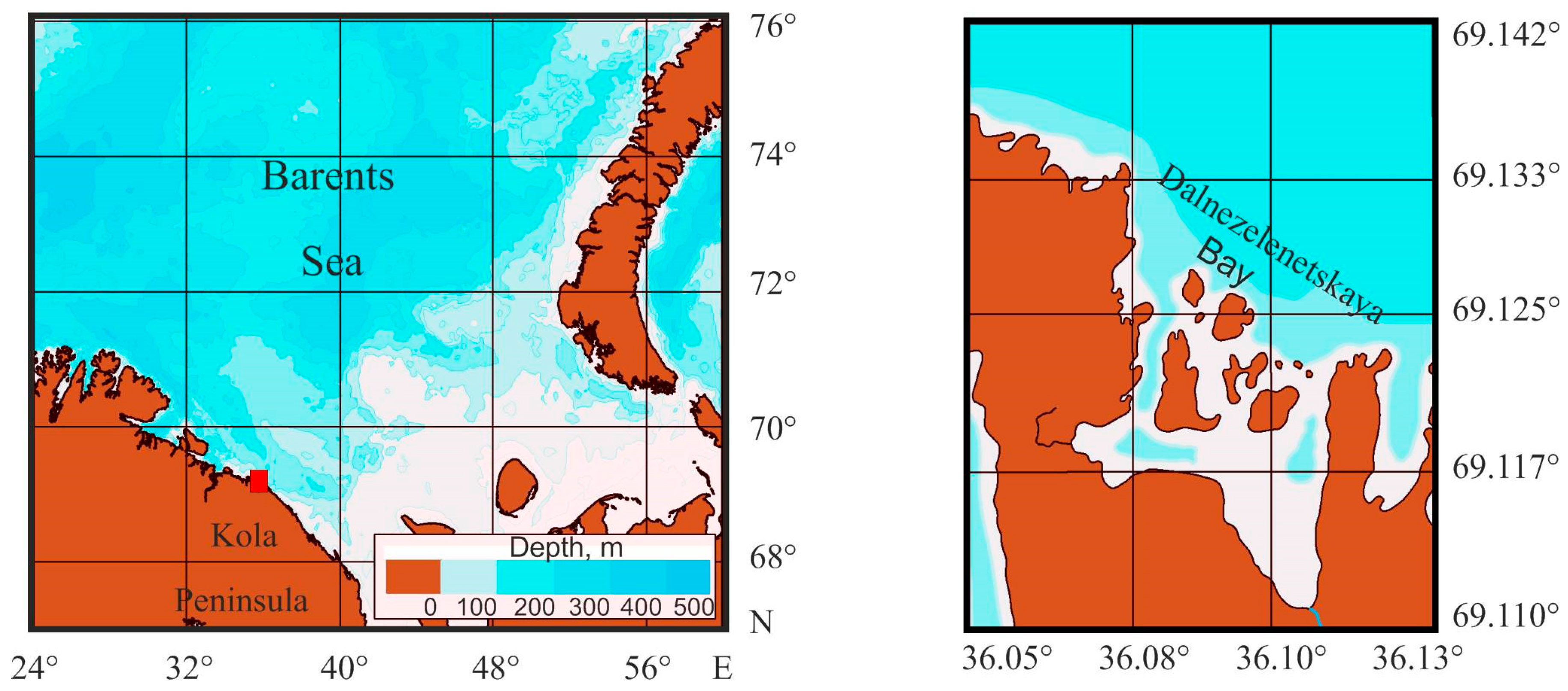
| Coordinates | 69°07′03″ N, 36°04′23″ E | 69°07′33″ N, 36°05′26″ E | 69°07′02″ N, 36°04′26″ E |
| Crab sex | Male | Female | Male |
| Carapace length, mm | 165.6 | 156.0 | 152.6 |
| Weight, g | 3822 | 3126 | 3261 |
| Shell condition | Very old shell | Old shell | Old shell |
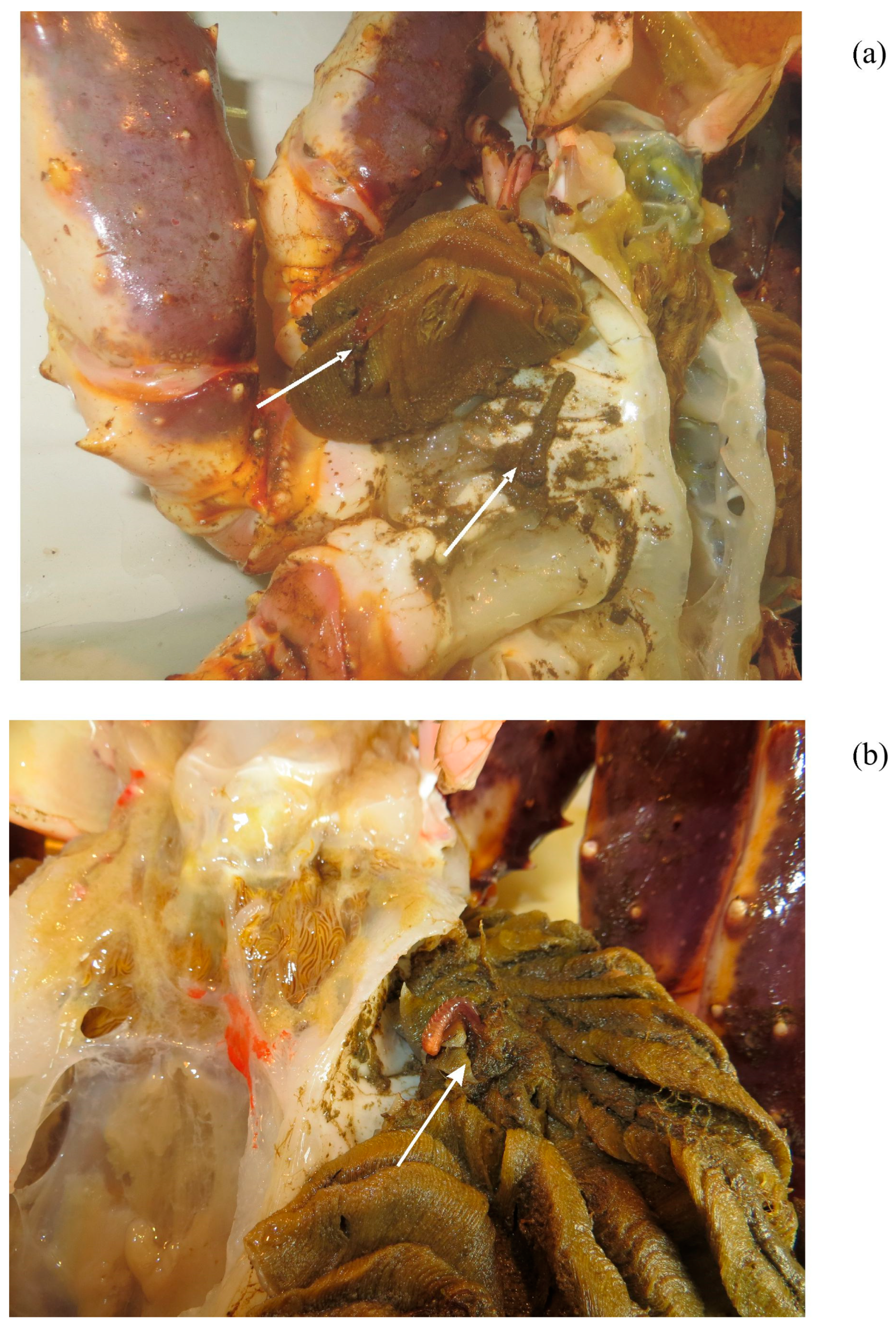
| Number of Amphitrite cirrata | 9 | 2 | 1 |
| Size range of worms, mm | 28–53 | 45–56 | 52 |
Disclaimer/Publisher’s Note: The statements, opinions and data contained in all publications are solely those of the individual author(s) and contributor(s) and not of MDPI and/or the editor(s). MDPI and/or the editor(s) disclaim responsibility for any injury to people or property resulting from any ideas, methods, instructions or products referred to in the content. |
© 2025 by the authors. Licensee MDPI, Basel, Switzerland. This article is an open access article distributed under the terms and conditions of the Creative Commons Attribution (CC BY) license.
Share and Cite
Dvoretsky, A.G.; Dvoretsky, V.G. First Record of Amphitrite cirrata (Polychaeta: Terebellidae) in Association with the Barents Sea Red King Crab Paralithodes camtschaticus (Malacostraca: Lithodidae). Animals 2026, 16, 78. https://doi.org/10.3390/ani16010078
Dvoretsky AG, Dvoretsky VG. First Record of Amphitrite cirrata (Polychaeta: Terebellidae) in Association with the Barents Sea Red King Crab Paralithodes camtschaticus (Malacostraca: Lithodidae). Animals. 2026; 16(1):78. https://doi.org/10.3390/ani16010078
Chicago/Turabian StyleDvoretsky, Alexander G., and Vladimir G. Dvoretsky. 2026. "First Record of Amphitrite cirrata (Polychaeta: Terebellidae) in Association with the Barents Sea Red King Crab Paralithodes camtschaticus (Malacostraca: Lithodidae)" Animals 16, no. 1: 78. https://doi.org/10.3390/ani16010078
APA StyleDvoretsky, A. G., & Dvoretsky, V. G. (2026). First Record of Amphitrite cirrata (Polychaeta: Terebellidae) in Association with the Barents Sea Red King Crab Paralithodes camtschaticus (Malacostraca: Lithodidae). Animals, 16(1), 78. https://doi.org/10.3390/ani16010078