


Simple Summary
Inflammatory diseases are frequently encountered in dogs, yet standard markers like white blood cell counts and C-reactive protein have limitations in predicting patient survival. The erythrocyte sedimentation rate (ESR) is a well-established test in human medicine for assessing inflammation and prognosis; however, its prognostic value in veterinary medicine remains underexplored. This study evaluated the potential of ESR as a prognostic biomarker in 350 dogs, including both healthy individuals and dogs with various underlying diseases, including those with systemic inflammation. The results showed that ESR levels were significantly higher in diseased dogs compared to healthy controls. Notably, elevated ESR levels were associated with higher mortality rates, particularly in dogs with systemic inflammatory response syndrome. Specifically, an ESR value exceeding 18 mm/h was a strong predictor of poor outcomes in these critically ill patients. These findings suggest that ESR serve as a practical and valuable tool for risk stratification, offering veterinarians a useful indicator for predicting prognosis in dogs with systemic inflammation.
Abstract
Inflammatory diseases are common in companion dogs. Although white blood cell (WBC) count and C-reactive protein (CRP) are routinely used to assess systemic inflammation, their individual prognostic value remains limited. The erythrocyte sedimentation rate (ESR), reflecting red blood cell aggregation driven by plasma proteins, has long been applied in human medicine as both an inflammatory and prognostic marker. This study evaluated the prognostic utility of ESR in dogs, including clinically healthy and diseased populations. Associations between ESR, other inflammatory markers, and age were examined, and its role as an independent predictor of mortality and optimal clinical cut-off were determined. A subgroup of dogs meeting the systemic inflammatory response syndrome (SIRS) criteria were also analyzed to assess the latter’s usefulness in acute settings. A total of 350 dogs were enrolled: 241 diseased and 109 healthy. ESR was measured using an automated analyzer. Receiver operating characteristic (ROC) curve analysis, expressed as the area under the curve (AUC), evaluated diagnostic accuracy, followed by Kaplan–Meier survival and Cox proportional hazard analyses. ESR values were significantly higher in the disease group than in the healthy group (p < 0.0001). ESR showed fair to good prognostic accuracy for mortality in both the overall cohort (AUC = 0.776 [95% CI: 0.709–0.842]) and the SIRS subgroup (AUC = 0.846 [95% CI: 0.747–0.946]). An ESR cut-off of 18 mm/h was associated with mortality in SIRS dogs with 87.5% specificity. In the multivariate analysis, ESR showed an independent association with mortality (hazard ratio 1.013 [95% CI: 1.004–1.022], p = 0.004). These findings support ESR as a practical and independent prognostic marker for risk stratification in dogs with systemic inflammation.
1. Introduction
Inflammatory diseases are among the most frequently encountered clinical conditions in companion dogs. Various hematologic and biochemical markers, including white blood cell (WBC) count and C-reactive protein (CRP), are routinely used as indicators to quantify inflammatory activity [1]. However, increases in these individual inflammatory markers do not necessarily indicate poor prognosis. Consequently, recent studies have focused on developing various combinations based on these parameters or identifying novel biomarkers to evaluate their prognostic utility in veterinary medicine [2].
Among inflammatory markers, the erythrocyte sedimentation rate (ESR) is a well-established parameter that reflects red blood cell aggregation influenced by plasma proteins such as fibrinogen [3]. More specifically, the ESR represents a hematological measurement of the vertical settling rate of erythrocytes in anticoagulated blood and is directly modulated by acute-phase proteins—including fibrinogen and immunoglobulins—which reduce the zeta potential of red blood cells and thereby accelerate sedimentation [3]. It has long been used as a representative indicator of systemic inflammation in human medicine [3,4]. In human medicine, the ESR is widely recognized as a nonspecific but integrative marker that reflects the cumulative burden of inflammation and correlates with disease activity and prognosis across various disorders, including infections, autoimmune diseases, and malignancies [4,5,6]. Recent veterinary studies have begun to explore its diagnostic utility in inflammatory diseases [3,4,6], yet reports remain limited, and its prognostic value has not been systematically evaluated.
Within the spectrum of inflammatory conditions, severe inflammatory states—particularly systemic inflammatory response syndrome (SIRS)—are clinically important indicators of disease severity and progression [7,8]. SIRS involves dysregulated inflammation that may progress to multi-organ dysfunction [7,8,9,10], and in these systemic inflammatory states or multiple-organ dysfunction syndrome, the ESR has been identified as an important prognostic marker that reflects the severity of inflammation and predicts adverse outcomes and mortality [4,5,6,11,12,13]. These findings suggest that the ESR may serve not only as a marker of inflammation but also as a valuable prognostic indicator in specific disease contexts within veterinary medicine.
This study investigates the clinical and prognostic significance of the ESR as an inflammatory biomarker in dogs, including both clinically healthy individuals and those with systemic inflammatory diseases. We aimed to evaluate the prognostic value of the ESR in dogs with inflammatory diseases and subsequently focused on dogs with SIRS to explore whether the ESR could serve as a rapid and practical prognostic tool for assessing mortality and disease severity in acute clinical settings.
2. Materials and Methods
2.1. Study Design and Population Selection
This study was designed as a retrospective observational cohort study. As this was an observational study, group allocation was based on clinical presentation and diagnosis, and thus randomization was not applied. The study was conducted in an unblinded manner, where clinicians and laboratory personnel were aware of the dog’s clinical status. The sample size was not predetermined by a statistical power analysis but was defined by the consecutive enrollment of all dogs that visited the hospital during the study period and met the specific inclusion and exclusion criteria detailed below. Dogs were included only when complete diagnostic information and full inflammatory marker panels were available, whereas cases were excluded if essential clinical data were missing or if concurrent diseases that could interfere with the interpretation of inflammatory markers were identified.
This study utilized blood samples collected from dogs that visited a single referral hospital between October 2023 and February 2025. All parameters were obtained at initial presentation. Cases were included only when the diagnostic assessment, as determined by the attending clinician, was sufficient to confirm a final diagnosis. In addition, dogs included in this study underwent comprehensive clinical evaluations including a physical examination and blood tests such as a complete blood count (CBC), serum biochemistry analysis, and blood gas analysis to confirm the absence of clinically relevant abnormalities To be included in the study, each dog was required to have concurrent measurements of all inflammatory markers—ESR, CRP, albumin-globulin ratio (A/G), neutrophil-lymphocyte ratio (NLR), and WBC count—as well as complete data for calculating the Acute Patient Physiologic and Laboratory Evaluation Fast (APPLEfast)score, including platelet count, plasma glucose, serum albumin, blood lactate concentration, and mentation score. The experimental design was approved by the University Institutional Animal Care and Use Committee (Approval number: CNU IACUC-YB-R-2025-42).
2.2. Animals
A population of 109 healthy dogs was included in this study (healthy group). These dogs were presented to a local animal hospital for routine health check-ups, neutering, dental scaling, or mild gastrointestinal symptoms such as transient anorexia. Owners provided written informed consent prior to participation, and blood sampling via jugular venipuncture was performed only after obtaining permission in accordance with institutional ethical guidelines. Healthy dogs were defined based on their clinical history, physical examination findings, CBC, and biochemical profile. A total of 241 dogs were classified as having underlying diseases (disease group). In these cases, the diagnosis was determined by the attending veterinarian based on their clinical history, physical examination findings, hematological and biochemical analyses, histopathologic examination, and imaging studies. These dogs presented with conditions requiring medical intervention including infectious diseases, endocrine disorders, cardiovascular diseases, and neoplastic conditions. For each case, the data collected included the breed, age, sex, neutering status, follow-up duration, and overall survival.
2.3. Criteria for Subgroup Categorization
A prognostic evaluation was conducted for subgroups within the disease group, specifically those including dogs with SIRS. SIRS subgroups were selected due to their strong pathophysiological association with systemic inflammation.
The dogs were classified into the SIRS group if they underwent a physical examination that included the measurement of rectal temperature, heart rate, respiratory rate, and WBC count with band neutrophil percentage. The SIRS group was defined by meeting at least two of the following criteria: rectal temperature (<38.1 °C or >39.2 °C), heart rate (>120 beats per minute), respiratory rate (>20 breaths per minute), and WBC count (<6 × 10⁹/L or >16 × 109/L) with band neutrophils >3% [14].
2.4. ESR Measurement
The ESR assay was conducted using an automated ESR in the animal hospital (MINI-PET, DIESSE, Diagnostica Senese S.p.A., Monteriggioni, Italy) following the manufacturer’s guidelines. The analysis was performed within minutes after the same 1 mL K3-EDTA tube (Idexx Laboratories, Westbrook, ME, USA) had been used for a CBC evaluation (Idexx Procyte Dx, Idexx Laboratories, Westbrook, ME, USA) [15]. After the 14 min optical reading, the ESR result (mm/h) is displayed on the machine. The ESR was measured immediately following jugular venipuncture, and no storage of blood samples was performed prior to analysis.
2.5. Selection and Measurement of Inflammatory and Prognostic Biomarkers
In the selection of inflammatory biomarkers, four key indicators including CRP, NLR, A/G, and WBC count were chosen along with the ESR. These biomarkers were selected based on their established associations with systemic inflammation and their prognostic relevance, particularly in assessing disease severity and outcomes in various clinical conditions [1,2,4,7,9,10,11]. The values of these biomarkers for each case were determined based on the initial blood test results obtained at the time of the first presentation to the veterinary hospital, and the selected biomarkers were measured using the following methods. A CBC evaluation was performed using a 1 mL K3-EDTA tube (Idexx Laboratories, Westbrook, ME, USA) and analyzed with a hematology analyzer (Idexx ProCyte Dx, Idexx Laboratories, Westbrook, ME, USA). CRP, total protein, lactate, glucose and albumin were measured using an automatized biochemistry analyzer (Idexx Catalyst Dx, Idexx Laboratories, Westbrook, ME, USA) with plain serum tubes (Idexx Laboratories, Westbrook, ME, USA). The A/G was calculated as the albumin-globulin ratio, and the NLR was determined as the neutrophil-lymphocyte ratio.
In addition, for prognostic assessment, the APPLEfast score was calculated for each patient based on five variables: platelet count, plasma glucose, serum albumin, blood lactate concentration, and mentation score, as previously described in the literature [16]. This composite scoring system has been validated as an early outcome predictor in critically ill dogs, integrating both hematobiochemical and clinical parameters.
2.6. Statistical Methods
Only dogs with complete measurements for the ESR, CRP, A/G, NLR, and WBC count were included. Similarly, dogs with missing data for any relevant biomarker measurements were excluded from the respective analyses including subgroup comparisons, correlation analyses, and prognostic assessments.
The normality of continuous variables, including the ESR, CRP level, NLR, and WBC count, was assessed using the Shapiro–Wilk test. Variables were classified as non-normally distributed if p < 0.05; otherwise, they were classified as normally distributed variables. Normally distributed variables were analyzed using an unpaired t-test, while non-normally distributed variables were analyzed using the Mann–Whitney U test. The comparison of the ESR, CRP level, NLR, and WBC count between the disease and healthy groups were evaluated using the unpaired t-test. Similarly, the ESR in the SIRS subgroup and healthy group was compared using the same method. Prognostic evaluation using the ESR in SIRS subgroups was conducted using the Mann–Whitney U test, as the data did not meet the conditions of normality.
To determine the optimal cut-off values for the ESR, ROC curve analysis was performed, and the corresponding sensitivities and specificities were calculated. The optimal cut-off values were determined using the Youden index (J), calculated as J = Sensitivity + Specificity − 1, to identify the threshold that maximizes the sum of sensitivity and specificity. In addition, ROC curve analysis was conducted for each biomarker to identify the threshold values that best discriminated between survivors and non-survivors.
The correlation between the ESR and inflammatory biomarkers (CRP level, A/G, NLR, WBC count) as well as hematocrit (HCT) was assessed using Pearson’s correlation analysis. Correlation analysis between age and ESR was also conducted in both the healthy and disease groups. We separately analyzed the correlation between ESR and age in the healthy and disease groups, as inflammatory status in diseased patients could confound this relationship. Although an age-related increase in ESR has been reported in humans [11], we aimed to clarify whether this association truly reflects an age effect or is instead influenced by the higher prevalence of illness in older individuals.
For Kaplan–Meier survival analysis, the entire study population was divided into quartiles based on the ESR. In addition, dogs in the SIRS subgroups were categorized into two groups (Group A: below the cut-off ESR value, Group B: equal to or above the cut-off ESR value) according to the optimal cut-off values derived from the ROC curve analyses. Statistical significance was assessed using the log-rank test.
To identify independent prognostic factors for all-cause mortality, Cox proportional hazards models were utilized. First, a univariate analysis was performed for each variable. Subsequently, variables were selected for the multivariate Cox regression model based on statistical significance in the univariate analysis (p < 0.1) or their established clinical relevance as key inflammatory or prognostic indicators (e.g., ESR, CRP, NLR, APPLEfast). This dual approach ensured that potential confounders were adjusted for, allowing for a robust evaluation of prognostic independence regardless of initial univariate thresholds. For this analysis, each dog was assigned a numerical value corresponding to the number of SIRS criteria met, with a score of 2, 3, or 4 given when two, three, or four criteria were satisfied, respectively. Signalment variables (age, sex, and body weight) were included in the multivariate models to adjust for their potential confounding effects.
All statistical analyses were conducted using two-tailed tests with a significance threshold set at 0.05. Statistical trends were defined for p values between 0.05 and 0.1. All statistical analyses and data processing were conducted using commercially available software, GraphPad Prism version 10.0 (GraphPad Software Inc., San Diego, CA, USA).
3. Results
3.1. Study Population
A total of 350 dogs including 109 healthy dogs (healthy group) and 241 dogs with various diseases (disease group) were enrolled in the study. The dogs in the healthy group were significantly younger (median age: 4.2 years; range: 0.2–15 year; IQR: 2–9.5 years) than the dogs in the disease group (median age: 10.1 years; range: 0.2–18 years; IQR: 6.3–12.5 years; p < 0.0001). In addition, the median hematocrit (HCT) was significantly lower in the disease group (median: 40.6%; IQR: 34.6–46.6%) compared to the healthy group (median: 46.6%; IQR: 41.5–51.3%; p < 0.0001). The participant demographics are detailed in Table 1. Of the 241 dogs in the disease group, 53 deceased and 188 survived. Dogs in the disease group that met the criteria for SIRS were selected for subgroup analyses, a cohort of 64 dogs diagnosed with SIRS was identified exclusively from within the disease group. This SIRS cohort was composed of 16 dogs that had died and 48 that had survived.
Table 1.
Demographics of the study population of 350 dogs.
Among deceased dogs in the entire group, the median time to death (not median survival time) was 69 days (range:0–469, IQR: 21–146 days). Among the deceased dogs from the entire study population, excluding those with SIRS, the median time to death was 113 days (range: 1–305, IQR: 38–172 days). Among deceased dogs in SIRS subgroup, the median time to death was 52 days (range: 0–469, IQR: 14–143 days).
3.2. Comparison of Inflammatory Biomarkers Between the Healthy and Disease Groups
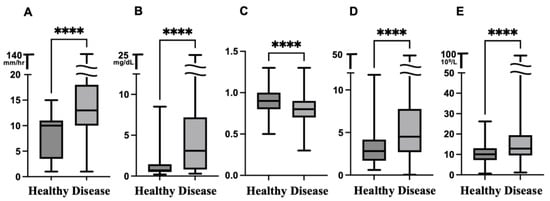
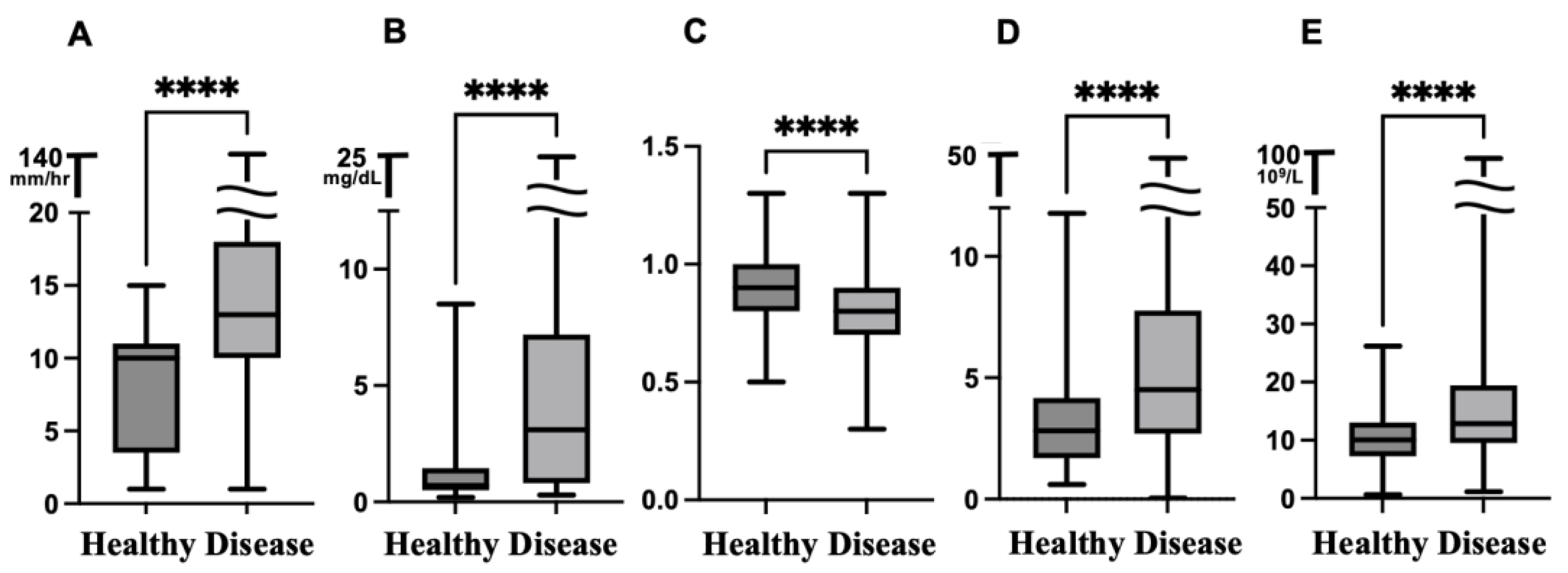
The median ESR was significantly higher in the disease group (median ESR: 13 mm/h; Interquartile range (IQR): 10–18 mm/h) than in the healthy group (median ESR: 10 mm/h; IQR: 4–11 mm/h; p < 0.0001). Similar significant differences were observed in other inflammatory markers including the CRP level, A/G, NLR, and WBC count between the disease and healthy group (all p < 0.0001, Table 2, Figure 1). ROC curve analysis comparing the ESR between the disease and healthy group yielded an AUC of 0.766 [95% CI:0.717–0.814], with an ESR cutoff value of 12 mm/h (sensitivity: 77.98%, specificity: 64.17%; p < 0.0001).
Table 2.
Inflammatory marker comparison in the disease and healthy groups.
Figure 1.
Comparison of inflammatory biomarkers between the healthy and disease groups. Box plots showing the distribution of inflammatory markers: (A) Erythrocyte sedimentation rate (mm/h), (B) C-reactive protein level (mg/dL), (C) Albumin-to-globulin ratio, (D) Neutrophil-to-lymphocyte ratio, (E) White blood cell count (109/L). Note that panels C and D represent ratios and are therefore unitless. The horizontal line within each box represents the median value, and the top and bottom edges of the box indicate the interquartile range (IQR, 25–75th percentiles). The whiskers extend to the minimum and maximum values. The disease group showed significantly elevated levels of inflammatory markers compared to the healthy group (p < 0.0001). Statistical comparisons were performed using the unpaired t-test. Note the break in the y-axis for panels (A), (B), (D) and (E) to accommodate outliers. Significance levels are indicated as follows: **** p < 0.0001.
All inflammatory markers showed statistically significant differences between the disease and healthy groups (p < 0.0001), indicating that the disease group exhibited a markedly elevated inflammatory state compared with the healthy controls. The markers analyzed included: Erythrocyte sedimentation rate (ESR), C-reactive protein level (CRP), Albumin-to-globulin ratio (A/G), Neutrophil-to-lymphocyte ratio (NLR), and White blood cell (WBC) count. Statistical comparisons were performed using the unpaired t-test.
3.3. Correlation Analysis Between the ESR and Other Biomarkers
The results of the correlation analysis are reported in Table 3. The analyses indicated that the ESR was positively correlated with the CRP level, NLR, and WBC count, while it was negatively correlated with the A/G and HCT. All values showed a weak correlation (p = 0.006 to p <0.0001, r value: 0.1–0.3). The correlation between the ESR and other inflammatory biomarkers was consistent with previous reports (17). Although not statistically significant, Correlation analysis indicated a positive trend toward increasing ESR with advancing age in both the healthy and disease groups (0.05 ≤ p < 0.10).
Table 3.
Pearson’s correlation between the erythrocyte sedimentation rate (ESR) and other investigated inflammatory markers.
3.4. ROC Curve Analysis
In the entire cohort, ESR demonstrated the strongest prognostic value as a single biomarker (ROC AUC = 0.776 [95% CI: 0.71–0.84]; Cut-off: 14 mm/h; Sensitivity: 74.41%, Specificity: 71.7%, p < 0.0001). Other inflammatory markers, including NLR, A/G ratio, WBC count, and CRP, were also significantly associated with survival (p < 0.05 for all). In contrast, the APPLEfast score was not a significant predictor of mortality. The median values, p values, ROC AUCs, sensitivities, specificities, and cut-off values for each marker are detailed in Table 4.
Table 4.
Comparison of Prognostic Accuracy of Inflammatory Markers and Acute Patient Physiologic and Laboratory Evaluation Fast (APPLEfast) Score.
The prognostic performance of the ESR was subsequently evaluated in the SIRS subgroup. For dogs diagnosed with SIRS, the ESR was significantly higher than that in healthy dogs (p < 0.0001) and showed the strongest prognostic value as a single biomarker within the SIRS group (ROC AUC = 0.846 [95% CI: 0.747–0.946]; Cut-off: 18 mm/h; Sensitivity: 77.08%, Specificity: 87.5%, p < 0.0001). The A/G ratio was also significantly associated with prognosis (ROC AUC = 0.727 [95% CI: 0.576–0.878]; Cut-off: 0.75; Sensitivity: 63.04%, Specificity: 75%, p = 0.005). Similarly, the APPLEfast score demonstrated a statistically significant association with prognosis (ROC AUC = 0.672 [95% CI: 0.532–0.811]; Cut-off: 19 (score); Sensitivity: 41.67%; Specificity: 93.75%; p = 0.041), whereas other inflammatory markers including CRP, NLR, and WBC count were not significantly associated with survival. The median values, p values, ROC AUCs, sensitivities, specificities, and cut-off values for each inflammatory marker and prognostic indicator, including the APPLEfast score, are detailed in Table 4.
3.5. Kaplan–Meier Survival Analyses
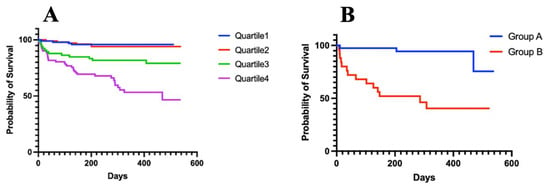
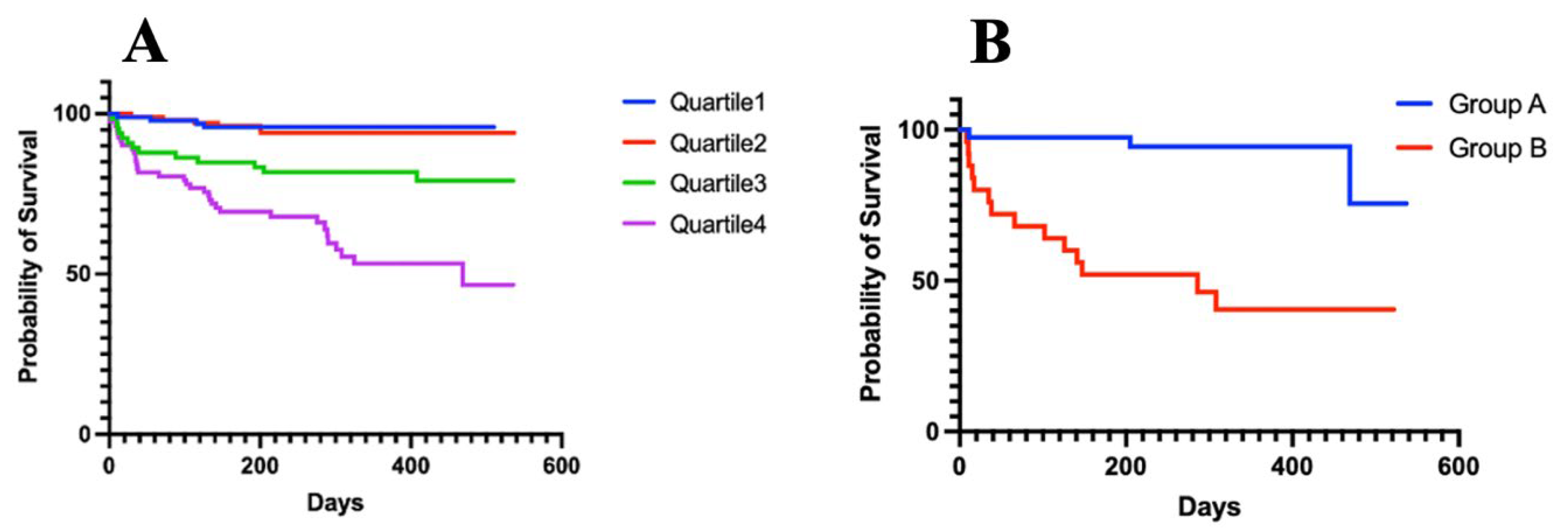
Kaplan–Meier survival analyses were performed for the entire study population, stratified into quartiles (Q1–Q4) based on the ESR (Figure 2A) with a maximum follow-up period of 537 days. For both analyses, cumulative survival probabilities showed a clear and progressive decline as quartile scores increased, indicating poorer outcomes in dogs with higher ESR. In the ESR analysis, the log-rank test for trend confirmed a significant difference among quartiles (p < 0.0001), with the median survival time (MST) not reached (NR) for Q1–Q3 and 469 days (95% CI: 289–not estimated [NE]) for Q4.
Figure 2.
Kaplan–Meier survival analyses. Survival analyses were performed for the entire study population, stratified into quartiles (Q1–Q4) based on the ESR (A), with a maximum follow-up period of 537 days. For the erythrocyte sedimentation rate (ESR) analysis, cumulative survival rates progressively declined as the quartile increased (log-rank test for trend, p < 0.0001) (A). The median survival time (MST) was not reached (NR) for quartiles Q1–Q3, whereas the MST for Q4 was 469 days (95% Confidence Interval [CI]: 289—Not Estimated [NE]). (B) For the SIRS subgroup, dogs were categorized into two groups (Group A: below cut-off; Group B: ≥cut-off) using ROC-derived thresholds. In the ESR-based analysis of the SIRS group, the median survival time (MST) for Group A was not reached, while the MST for Group B was 286 days (95% CI: 66—Not Estimated [NE]). Log-rank tests showed significant survival differences between Group A and Group B in both the ESR analyses for the SIRS group (p < 0.0001).
Survival analyses were performed for the SIRS subgroup, stratified according to the optimal cut-off values derived from ROC analysis for ESR (18 mm/h) (Figure 2B). In the ESR-based analysis, dogs with ESR < 18 mm/h (Group A) had a median survival time (MST) that was not reached (NR), whereas those with ESR ≥ 18 mm/h (Group B) had an MST of 286 days (95% CI: 66–NE). Log-rank tests confirmed significant survival differences between Groups A and B in both analyses (p < 0.0001).
In the SIRS subgroup, elevated ESR were found to be independently and significantly associated with reduced survival probabilities.
3.6. Cox Proportional Hazards Analysis
The results of the Cox proportional hazards analyses are presented in Table 5.
Table 5.
Cox proportional hazards analysis identifying predictors of all-cause mortality among signalment, inflammatory, and prognostic markers. Data are presented as hazard ratio (HR) and 95% confidence interval (CI). ns = No significance.
In the univariate analysis for the entire group, age, ESR, CRP, A/G, NLR and the SIRS criteria, were significantly associated with mortality (p < 0.05), whereas the WBC count showed a statistical trend toward significance (0.05 ≤ p < 0.1). For the SIRS subgroup, univariate analysis identified age, ESR, A/G, APPLEfast score as independent prognostic factors (p < 0.05; Table 5).
Subsequent multivariate analysis of the entire group revealed that age, ESR, NLR, and SIRS criteria were independent predictors of mortality. In the SIRS subgroup, age and the APPLEfast score remained as independent prognostic indicators, while ESR showed a statistical trend toward significance (Table 5).
Notably, across all multivariate analyses, age consistently emerged as the most powerful independent prognostic predictor for mortality.
4. Discussion
This study evaluated the prognostic value of the ESR in dogs. Our study reconfirms ESR’s utility as an inflammatory marker and newly evaluates its prognostic role, aiming to establish the prognostic value of both ESR in systemic inflammatory conditions. Notably, only a limited number of contemporary veterinary studies have examined ESR dynamics in systemic inflammation or prognostic aspects [3,15,17]. Therefore, part of the mechanistic interpretation in the present study relies on established human literature, and some level of translational extrapolation remains unavoidable. Future work focusing specifically on canine haemorrheological responses and acute-phase protein interactions will be essential to strengthen species-specific evidence.
In veterinary medicine, the reference range for the ESR in healthy dogs is relatively low—generally reported between 1 and 10 mm/h [3,17]. In our study, the optimal cut-off value between the disease group and the healthy group was calculated as 12 mm/h; this result is similar to that from a previous report. The sensitivity was 77.98%, and the specificity was 64.17%, demonstrating a relatively low specificity consistent with previous reports [3] (Table 2).
The ESR has long been recognized as an inflammatory biomarker for disease diagnosis and monitoring [3]. It is widely employed in chronic inflammatory conditions such as rheumatoid arthritis and cancer [8,10]. The ESR reflects the overall burden of systemic inflammation rather than rapid acute-phase changes and thus is frequently used alongside acute-phase markers such as CRP and WBC counts, particularly in critical care settings like sepsis or SIRS. However, ESR is nonspecific, unable to distinguish inflammatory etiologies, and demonstrates a time-dependent limitation, rising 24–48 h after inflammation onset and remaining elevated for weeks despite resolution of the underlying cause. Rather than being solely a limitation, this characteristic allows the ESR to better indicate persistent or cumulative inflammation, complementing acute-phase indicators [3,17].
This cumulative reflection of inflammation by ESR is driven by slower-changing plasma proteins such as fibrinogen and immunoglobulins and influenced by plasma viscosity, erythrocyte aggregation (e.g., rouleaux, agglutination), and hematocrit levels [3,15]. In this study, the correlation between HCT and ESR was analyzed, confirming a statistically significant negative correlation (r = −0.306, p < 0.001). A reduced hematocrit can facilitate rouleaux formation and thereby accelerate the rate of erythrocyte sedimentation [15]. Accordingly, while the significantly lower HCT observed in the disease group may physiologically contribute to accelerated sedimentation, anemia should be viewed as an integral component of the systemic inflammatory process rather than a standalone confounder. Given the strong influence of fibrinogen established in previous studies, the observed ESR elevations likely reflect the cumulative inflammatory burden rather than hematocrit alterations alone [3,17].
Although ESR has been reported to increase with age in humans [3,11], this study did not reveal a statistically significant correlation between ESR and age in either the healthy or disease groups, despite a mild positive trend (0.05 ≤ p < 0.10). Further studies with longer follow-up periods may be needed to clarify this association (Table 3).
Correlations between ESR and other inflammatory markers vary among studies. Human medical research, which often considers specific disease conditions, infections, or timing factors, generally reports stronger correlations compared to veterinary studies [18,19,20]. Veterinary studies typically report weak to moderate correlations [3,17,21]. Our results align with previous veterinary studies reporting low correlation coefficients between ESR and CRP (previously r ≈ 0.18), although we observed a slightly higher correlation (r = 0.30) (Table 3). Similarly, statistically significant but weak correlations were observed between ESR and other biomarkers including CRP, NLR, WBC count, and A/G (p = 0.006 to p < 0.0001; r = 0.1–0.3), classified as weak (0.1–0.3), moderate (0.4–0.6), or strong (0.7–0.9) [17,22]. These weak correlations in veterinary medicine may be attributed to differing biomarker kinetics. Future studies should further explore temporal dynamics and disease-specific variations to improve the clinical interpretation of biomarkers.
In human medicine, recent studies have demonstrated that the ESR, along with other inflammatory markers, has significant potential as a prognostic indicator [10,11]. Large-scale cohort studies have shown that elevated ESR is independently associated with increased mortality irrespective of age [11]. Similar trends are observed in cancer patients, where elevated ESR correlates with poorer prognoses across various tumor types, including soft tissue sarcoma, renal cell carcinoma, and multiple myeloma [12,13,18,23]. Additionally, recent studies of critically ill patients admitted to intensive care units with severe infections—such as COVID-19—have highlighted ESR’s prognostic value, with significantly elevated ESR levels independently predicting disease severity and mortality [24]. These findings underscore the clinical utility of ESR in assessing disease progression and prognosis across diverse critical conditions.
In our prognostic analyses, the Kaplan–Meier survival analysis for the entire group clearly demonstrated that cumulative survival probabilities significantly decreased as the ESR quartiles increased, highlighting its role in long-term outcomes (Figure 2). Furthermore, ESR emerged as an independent and significant prognostic marker in this general cohort, as supported by both ROC curve analysis and multivariate Cox regression.
In our SIRS subgroup, ESR was significantly higher compared to the healthy group, indicating a markedly elevated inflammatory state in SIRS dogs (Table 2). ESR may not increase rapidly in acute systemic conditions such as SIRS [18]; however, recent evidence indicates its potential utility in acute settings, especially in patients with chronic comorbidities undergoing exacerbation [25,26]. This supports the notion that the ESR is not entirely insensitive in acute inflammatory states and can contribute prognostic value depending on the clinical context and underlying conditions. Dogs with SIRS are at risk of progressing to sepsis, making early identification and accurate risk assessment crucial [27,28]. In veterinary medicine, although ESR is not routinely measured in SIRS cases, our study demonstrated superior predictive performance for mortality compared to other inflammatory markers. In our study, ESR alone showed the highest prognostic accuracy in the SIRS subgroup ROC curve analysis, with a statistically significant association with mortality (p < 0.0001) (Table 4). In terms of prognostic capacity, ESR demonstrated superior performance compared to established markers in this cohort. While CRP and NLR are sensitive diagnostic markers, they did not show independent prognostic significance in our multivariate model. In contrast, ESR showed the highest AUC (0.846 [95% CI: 0.747–0.946]) in the SIRS subgroup, outperforming the A/G ratio (AUC 0.727 [95% CI: 0.576–0.878]). This suggests that while CRP reflects the immediate inflammatory status, ESR—driven by fibrinogen—better captures the cumulative severity that correlates with mortality [3,15,17]. Most importantly, this analysis provides a practical threshold for clinicians: an ESR cut-off of 18 mm/h predicted mortality with a high specificity of 87.5% in SIRS dogs. This high specificity is clinically significant, as it implies that a dog with SIRS presenting with an ESR above 18 mm/h has a strong likelihood of a poor outcome. This highlights the ESR’s value as a time-accumulated marker of systemic inflammation, particularly relevant in SIRS, where chronic and acute inflammation often coexist. These findings support the clinical utility of routine ESR measurement in dogs with SIRS, given its simplicity, low cost, and prognostic value in early risk stratification.
It is important to interpret the distinct ESR cut-off values identified in this study within their specific clinical contexts. The 12 mm/h threshold served as a diagnostic cut-off to differentiate diseased dogs from healthy individuals. In terms of prognosis, a cut-off of 14 mm/h was identified for predicting mortality in the overall disease cohort. Meanwhile, a higher threshold of 18 mm/h was determined for the SIRS subgroup, with high specificity (87.5%) to identify dogs at the greatest risk of death in acute conditions. Used alongside age and the APPLEfast score, ESR adds a valuable layer of risk stratification.
Our Cox proportional hazards analysis identified several independent predictors of mortality. In the multivariate analysis of the entire cohort, age, ESR, NLR, and the presence of SIRS were identified as independent prognostic factors for survival, whereas the A/G ratio showed a trend toward significance (Table 5). This finding is consistent with previous reports identifying the presence of systemic inflammation as a prognostic factor influencing survival [7,8]. Of the single inflammatory markers evaluated, ESR was a key prognostic tool, proving to be a significant independent predictor in the entire group (p = 0.005). Ultimately, the evidence for ESR as a predictor of long-term mortality was most clearly established in the overall population analysis.
In the SIRS subgroup—a condition closely associated with poor outcomes—ESR also showed a trend toward significance (p = 0.062). This trend is particularly noteworthy as none of the other single inflammatory markers reached statistical significance in this severe cohort, suggesting ESR’s potential as a prognostic marker even in these critical cases. This trend is particularly noteworthy, as none of the other single inflammatory markers reached statistical significance within the SIRS subgroup. Although the statistical power of this subgroup analysis is limited by the modest sample size, ESR recorded the highest AUC (0.846 [95% CI: 0.747–0.946]) among single inflammatory biomarkers—outperforming CRP and NLR—and demonstrated the strongest prognostic association excluding the composite APPLEfast score, thereby supporting its potential utility even in acute high-risk settings like SIRS.
The difference in prognostic performance of biomarkers between the overall and SIRS groups may be attributed to the pathophysiologic dynamics among biomarkers [19,20,25,26]. The APPLEfast score, originally developed to predict short-term mortality [16], did not show strong prognostic performance in the entire cohort but demonstrated significant predictive power within the SIRS subgroup, which reflects an acute inflammatory state. This discrepancy may reflect differences in the predominant inflammatory status (chronic vs. acute) and survival timelines (long-term vs. short-term; specifically, the difference in median time to death of deceased patients between the entire group and the SIRS group) represented by the overall and SIRS groups, respectively.
In our study, age was consistently the most powerful independent predictor of mortality across all analysis. This finding aligns with numerous studies in veterinary medicine where advancing age is a key negative prognostic indicator across a wide range of conditions [29,30]. This is likely because advancing age likely reflects complex biological factors not fully captured by other biomarkers, such as a diminished physiological reserve to cope with severe illness, the gradual decline of the immune system (immunosenescence), and a higher likelihood of subclinical comorbidities [31,32]. Given this dominant influence, any biomarker like ESR that demonstrates significant prognostic value independent of age would be of considerable clinical importance.
Considering these results, the inclusion of ESR in future multi-biomarker prognostic scoring systems, analogous to the APPLEfast score, could provide substantial clinical benefits. Given its demonstrated value, particularly for long-term prognosis in the general cohort, further research is warranted to investigate the development and validation of new, ESR-inclusive scoring models.
This study has several limitations. As a single-center study, our findings are potentially subject to selection bias and limited generalizability. The modest sample size, particularly within subgroups, may have restricted statistical power. Another limitation is the lack of covariate analysis for factors known to influence the ESR, such as serum protein status. Additionally, the Neutrophil–Lymphocyte Ratio (NLR) was calculated based on automated differential counts, and the lack of manual smear verification for all samples may have reduced the accuracy of this specific metric compared with manual counting. Moreover, the inherent non-specificity of the conventional SIRS diagnostic criteria raises the possibility that patients without true systemic inflammation were inadvertently included in the SIRS subgroup analysis, which may have affected the precision of the prognostic evaluation in this cohort. Furthermore, while the proposed cut-offs offer practical guidance for risk stratification, they should be interpreted with caution due to the retrospective nature of the study. In particular, the cut-off of 18 mm/h in SIRS patients prioritizes specificity, thereby identifying those at highest risk of mortality. It is also important to note that, although blood samples were collected at the initial hospital presentation before any in-hospital treatment commenced, we could not completely rule out the potential confounding influence of prior medication administration (e.g., corticosteroids or NSAIDs) or hydration status that may affect ESR [33]. Lastly, biological interpretations of ESR in this study partly rely on human literature due to the limited availability of veterinary ESR research, and thus some degree of translational extrapolation should be considered when interpreting these findings. Future studies should aim to validate the prognostic utility of ESR across diverse cohorts, especially in longitudinal designs assessing its trends over time. Such efforts would allow for deeper insights into treatment monitoring, relapse prediction, and long-term prognostication.
5. Conclusions
In conclusion, this study demonstrates an independent association between elevated ESR and mortality in the general disease cohort (p = 0.005). Our findings suggest a tiered clinical application: an ESR > 12 mm/h supports the diagnosis of systemic inflammation, while a cut-off of >14 mm/h indicates increased mortality risk in the general population. Notably, within the high-risk SIRS subgroup, an ESR cut-off of >18 mm/h exhibited superior prognostic performance compared to CRP and NLR, identifying patients at high risk of mortality with 87.5% specificity. These findings suggest that ESR serves as a practical, objective tool for risk stratification, reflecting the cumulative burden of systemic inflammation. Future prospective studies are warranted to validate these cut-offs across diverse disease etiologies.
Author Contributions
Conceptualization, W.-B.R. and C.-M.L.; methodology, J.-B.J. and K.K.; validation, J.-B.J. and K.K.; formal analysis, J.-B.J. and K.K.; investigation, J.-B.J. and K.K.; resources, W.-B.R. and C.-M.L.; data curation, J.-B.J. and K.K.; writing—original draft preparation, J.-B.J. and K.K.; writing—review and editing, J.-B.J., K.K., W.-B.R. and C.-M.L.; visualization, J.-B.J. and K.K.; supervision, W.-B.R. and C.-M.L.; project administration, W.-B.R. and C.-M.L.; funding acquisition, W.-B.R. and C.-M.L. All authors have read and agreed to the published version of the manuscript.
Funding
This work was supported financially by the Korea Rural Development Administration (RDA) under grant number RS-2023-00232301; the National Research Foundation of Korea (NRF) grant funded by the Korea government (MSIT) (RS-2025-16069829); and the “Regional Innovation System & Education (RISE)” through the Gwangju RISE Center, funded by the Ministry of Education (MOE) and the Gwangju Metropolitan Government, Republic of Korea (2025-RISE-05-011).
Institutional Review Board Statement
This study did not require ethical approval because it did not involve any interventions and utilized previously collected animal tissues obtained as part of diagnostic pathology procedures. All methods were carried out in accordance with relevant guidelines and regulations. The University Institutional Animal Care and Use Committee (Approval number: CNU IACUC-YB-R-2025-42) reviewed the study protocol and waived the need for formal ethics approval as no live animals were used and all data were de-identified.
Informed Consent Statement
Informed consent was obtained from all subjects involved in the study.
Data Availability Statement
The original contributions presented in this study are included in the article.
Conflicts of Interest
The authors declare that they have no competing interests.
Abbreviations
| APPLEfast | Acute Patient Physiologic and Laboratory Evaluation Fast |
| A/G | Albumin-Globulin (ratio) |
| AUC | Area Under the Curve |
| CBC | Complete Blood Count |
| CI | Confidence Interval |
| CRP | C-Reactive Protein |
| ESR | Erythrocyte Sedimentation Rate |
| HCT | Hematocrit |
| HR | Hazard Ratio |
| IACUC | Institutional Animal Care and Use Committee |
| IQR | Interquartile Range |
| K3-EDTA | Tripotassium Ethylenediaminetetraacetic Acid |
| NE | Not Estimated |
| NLR | Neutrophil-Lymphocyte Ratio |
| ns/NS | No significance/non-significant |
| MST | Median Survival Time |
| RBC(s) | Red Blood Cell(s) |
| ROC | Receiver Operating Characteristic (curve) |
| SIRS | Systemic Inflammatory Response Syndrome |
| WBC | White Blood Cell (count) |
References
- Malin, K.; Witkowska-Pilaszewicz, O. C-Reactive Protein as a Diagnostic Marker in Dogs—A Review. Animals 2022, 12, 2888. [Google Scholar] [CrossRef] [Scilit] [PubMed]
- Pierini, A.; Gori, E.; Lippi, I.; Lubas, G.; Marchetti, V. Are leukocyte and platelet abnormalities and complete blood count ratios potential prognostic markers in canine sepsis? Front. Vet. Sci. 2020, 7, 578846. [Google Scholar] [CrossRef] [Scilit] [PubMed]
- Diamanti, D.; Pieroni, C.; Pennisi, M.G.; Marchetti, V.; Gori, E.; Paltrinieri, S.; Lubas, G. The erythrocyte sedimentation rate (ESR) in veterinary medicine: A focused review in dogs and cats. Animals 2025, 15, 246. [Google Scholar] [CrossRef] [Scilit]
- Cerón, J.J.; Eckersall, P.D.; Martínez-Subiela, S. Acute phase proteins in dogs and cats: Current knowledge and future perspectives. Vet. Clin. Pathol. 2005, 34, 85–99. [Google Scholar] [CrossRef] [Scilit]
- Hashemi, R.; Majidi, A.; Motamed, H.; Amini, A.; Najari, F.; Tabatabaey, A. Erythrocyte sedimentation rate measurement using as a rapid alternative to the Westergren method. Emergency 2015, 3, 50–53. [Google Scholar]
- Narang, V.; Grover, S.; Kang, A.K.; Garg, A.; Sood, N. Comparative analysis of erythrocyte sedimentation rate measured by automated and manual methods in anaemic patients. J. Lab. Physicians 2020, 12, 239–243. [Google Scholar] [CrossRef] [Scilit]
- Byler, S.; Baker, A.; Freiman, E.; Herigon, J.C.; Eisenberg, M.A. Utility of specific laboratory biomarkers to predict severe sepsis in pediatric patients with SIRS. Am. J. Emerg. Med. 2021, 50, 778–783. [Google Scholar] [CrossRef] [Scilit]
- Rasmussen, L.J.H.; Schultz, M.; Gaardsting, A.; Ladelund, S.; Garred, P.; Iversen, K.; Eugen-Olsen, J.; Helms, M.; David, K.P.; Kjær, A.; et al. Inflammatory biomarkers and cancer: CRP and suPAR as markers of incident cancer in patients with serious nonspecific symptoms and signs of cancer. Int. J. Cancer 2017, 141, 191–199. [Google Scholar] [CrossRef] [Scilit]
- Dragoescu, A.; Doganci, M.; Eraslan Doganay, G.; Sazak, H.; Alagöz, A.; Ozgur Cirik, M.; Hoşgün, D.; Cakiroglu, E.B.; Yildiz, M.; Ari, M.; et al. The utility of C-reactive protein, procalcitonin, and leukocyte values in predicting the prognosis of patients with pneumosepsis and septic shock. Medicina 2024, 60, 1560. [Google Scholar] [CrossRef] [Scilit]
- Oubaya, N.; Soubeyran, P.; Reinald, N.; Fonck, M.; Allain, M.; Zebachi, S.; Heitz, D.; Laurent, M.; Delattre, C.; Caillet, P.; et al. Prognostic value of routinely measured inflammatory biomarkers in older cancer patients: Pooled analysis of three cohorts. Cancers 2021, 13, 6154. [Google Scholar] [CrossRef] [Scilit]
- Fest, J.; Ruiter, R.; Mooijaart, S.P.; Ikram, M.A.; van Eijck, C.H.J.; Stricker, B.H. Erythrocyte sedimentation rate as an independent prognostic marker for mortality: A prospective population-based cohort study. J. Intern. Med. 2019, 285, 341–348. [Google Scholar] [CrossRef] [Scilit]
- Ljungberg, B.; Grankvist, K.; Rasmuson, T. Serum acute phase reactants and prognosis in renal cell carcinoma. Cancer 1995, 76, 1435–1439. [Google Scholar] [CrossRef] [Scilit]
- Johansson, J.E.; Sigurdsson, T.; Holmberg, L.; Bergstrom, R. Erythrocyte sedimentation rate as a tumor marker in human prostatic cancer: An analysis of prognostic factors in 300 population-based consecutive cases. Cancer 1992, 70, 1556–1563. [Google Scholar] [CrossRef] [Scilit] [PubMed]
- Spillane, A.M.; Haraschak, J.L.; Gephard, S.E.; Nerderman, B.E.; Fick, M.E.; Reinhart, J.M. Evaluating the clinical utility of the systemic inflammatory response syndrome criteria in dogs and cats presenting to an emergency department. J. Vet. Emerg. Crit. Care 2023, 33, 315–326. [Google Scholar] [CrossRef] [Scilit] [PubMed]
- Militello, C.; Pasquini, A.; Andrea, A.; Valentin, M.; Simčič, P.; De Feo, G.; Lubas, G. The canine erythrocyte sedimentation rate (ESR): Evaluation of a point-of-care testing device (MINIPET DIESSE). Vet. Med. Int. 2020, 2020, 3146845. [Google Scholar] [CrossRef] [Scilit]
- Hayes, G.; Mathews, K.; Doig, G.; Kruth, S.; Boston, S.; Nykamp, S.; Poljak, Z.; Dewey, C. The acute patient physiologic and laboratory evaluation (APPLE) score: A severity of illness stratification system for hospitalized dogs. J. Vet. Intern. Med. 2010, 24, 1034–1047. [Google Scholar] [CrossRef] [Scilit]
- Gori, E.; Pierini, A.; Pasquini, A.; Diamanti, D.; Carletti, C.; Lubas, G.; Marchetti, V. The erythrocyte sedimentation rate (ESR) in canine inflammation. Vet. J. 2023, 294, 105949. [Google Scholar] [CrossRef] [Scilit]
- Yale, S.H.; Bray, C.; Bell, L.N.; Liang, H.; Haykal, R.; Kaiksow, F.; Mazza, J.J. Erythrocyte sedimentation rate and C-reactive protein measurements and their relevance in clinical medicine. Wis. Med. J. 2016, 115, 317–321. [Google Scholar]
- Chen, Y.H.; Wang, L.; Feng, S.Y.; Cai, W.M.; Chen, X.F.; Huang, Z.M. The relationship between C-reactive protein/albumin ratio and disease activity in patients with inflammatory bowel disease. Gastroenterol. Res. Pract. 2020, 2020, 3467419. [Google Scholar] [CrossRef] [Scilit]
- Yoon, J.Y.; Park, S.J.; Hong, S.P.; Kim, T.I.; Kim, W.H.; Cheon, J.H. Correlations of C-reactive protein levels and erythrocyte sedimentation rates with endoscopic activity indices in patients with ulcerative colitis. Dig. Dis. Sci. 2014, 59, 829–837. [Google Scholar] [CrossRef] [Scilit]
- Asawapattanakul, T.; Pintapagung, T.; Piratae, S.; Juntautsa, S.; Chancharoen, P. Erythrocyte sedimentation rate, C-reactive protein, and interleukin-6 as inflammatory biomarkers in dogs naturally infected with Ehrlichia canis. Vet. World 2021, 14, 2325–2331. [Google Scholar] [CrossRef] [Scilit]
- Akoglu, H. User’s guide to correlation coefficients. Turk. J. Emerg. Med. 2018, 18, 91–93. [Google Scholar] [CrossRef] [Scilit]
- Wu, S.; Zhou, Y.; Hua, H.Y.; Zhang, Y.; Zhu, W.Y.; Wang, Z.Q.; Li, J.; Gao, H.-Q.; Wu, X.-H.; Lu, T.-X.; et al. Inflammation marker ESR is effective in predicting outcome of diffuse large B-cell lymphoma. BMC Cancer 2018, 18, 997. [Google Scholar] [CrossRef] [Scilit] [PubMed]
- Kaya, T.; Nalbant, A.; Kılıçcıoğlu, G.K.; Çayır, K.T.; Yaylacı, S.; Varım, C. The prognostic significance of erythrocyte sedimentation rate in COVID-19. Rev. Assoc. Médica Bras. 2021, 67, 1305–1310. [Google Scholar] [CrossRef] [Scilit] [PubMed]
- Kriplani, A.; Pandit, S.; Chawla, A.; de la Rosette, J.J.M.C.H.; Laguna, P.; Jayadeva Reddy, S.; Somani, B.K. Neutrophil–lymphocyte ratio (NLR), platelet–lymphocyte ratio (PLR), and lymphocyte–monocyte ratio (LMR) in predicting systemic inflammatory response syndrome (SIRS) and sepsis after percutaneous nephrolithotomy (PNL). Urolithiasis 2022, 50, 341–348. [Google Scholar] [CrossRef] [Scilit]
- Ganesan, V.; Brown, R.D.; Jiménez, J.A.; De, S.; Monga, M. C-reactive protein and erythrocyte sedimentation rate predict systemic inflammatory response syndrome after percutaneous nephrolithotomy. J. Endourol. 2017, 31, 638–644. [Google Scholar] [CrossRef] [Scilit]
- Wu, W.; Zhang, D.; Jin, T.; Lu, T.; Zhou, F. Progress in the study of biomarkers for early prediction of systemic inflammatory response syndrome after percutaneous nephrolithotomy. Front. Immunol. 2023, 14, 1142346. [Google Scholar] [CrossRef] [Scilit]
- Taniguchi, L. Systemic inflammatory response syndrome criteria and the prediction of hospital mortality in critically ill patients: A retrospective cohort study. Rev. Bras. Ter. Intensiv. 2017, 29, 317–324. [Google Scholar] [CrossRef] [Scilit]
- Schultz, D.M.; Rivera, C.; Jeffery, N.; Cianciolo, R.E.; Hokamp, J.A.; Labato, M.A.; Nabity, M.B. Analysis of survival among biopsy-determined categories of kidney disease in dogs. J. Vet. Intern. Med. 2025, 39, e17301. [Google Scholar] [CrossRef] [Scilit]
- Smith, A.A.; Frimberger, A.E.; Moore, A.S. Retrospective study of survival time and prognostic factors for dogs with small intestinal adenocarcinoma treated by tumor excision with or without adjuvant chemotherapy. J. Am. Vet. Med. Assoc. 2019, 254, 243–250. [Google Scholar] [CrossRef] [Scilit]
- McKenzie, B.A.; Chen, F.L.; Gruen, M.E.; Olby, N.J. Canine Geriatric Syndrome: A Framework for Advancing Research in Veterinary Geroscience. Front. Vet. Sci. 2022, 9, 853743. [Google Scholar] [CrossRef] [Scilit]
- Li, B.; Ding, Y.; Han, M.; Zhang, Z.; Ling, Z.; Zhu, W.; Zhao, X.; Zhang, Y.; Lv, C.; Li, N.; et al. Multiomics analysis of canine aging markers and cellular senescence in dogs. Commun. Biol. 2025, 8, 905. [Google Scholar] [CrossRef] [Scilit]
- Hegg, R.; Lee, A.G.; Tagg, N.T.; Zimmerman, M.B. Statin or nonsteroidal anti-inflammatory drug use is associated with lower erythrocyte sedimentation rate in patients with giant cell arteritis. J. Neuro-Ophthalmol. 2011, 31, 135–138. [Google Scholar] [CrossRef] [Scilit]

Disclaimer/Publisher’s Note: The statements, opinions and data contained in all publications are solely those of the individual author(s) and contributor(s) and not of MDPI and/or the editor(s). MDPI and/or the editor(s) disclaim responsibility for any injury to people or property resulting from any ideas, methods, instructions or products referred to in the content. |
© 2025 by the authors. Licensee MDPI, Basel, Switzerland. This article is an open access article distributed under the terms and conditions of the Creative Commons Attribution (CC BY) license.