Optimization of the Embryo Transfer Technique in the Korean Native Cattle: Effects of Key Influencing Factors

 ,
,  and
and
Simple Summary
Abstract
1. Introduction
2. Materials and Methods
2.1. Location and Animals
2.2. Experimental Design
2.2.1. Effects of ET on Pregnancy Rates
2.2.2. Results of Pregnancy Rate After ET and MPT Analysis
2.3. Embryo Production
2.3.1. OPU
2.3.2. Oocyte Retrieval and In Vitro Maturation
2.3.3. IVF and In Vitro Culture
2.3.4. Slow Freezing and Thawing
2.3.5. Synchronization of Estrus and ET
2.4. Blood Collection
2.5. MPT Analysis
2.6. Statistical Analysis
3. Results
3.1. Impact of Various Factors on ET
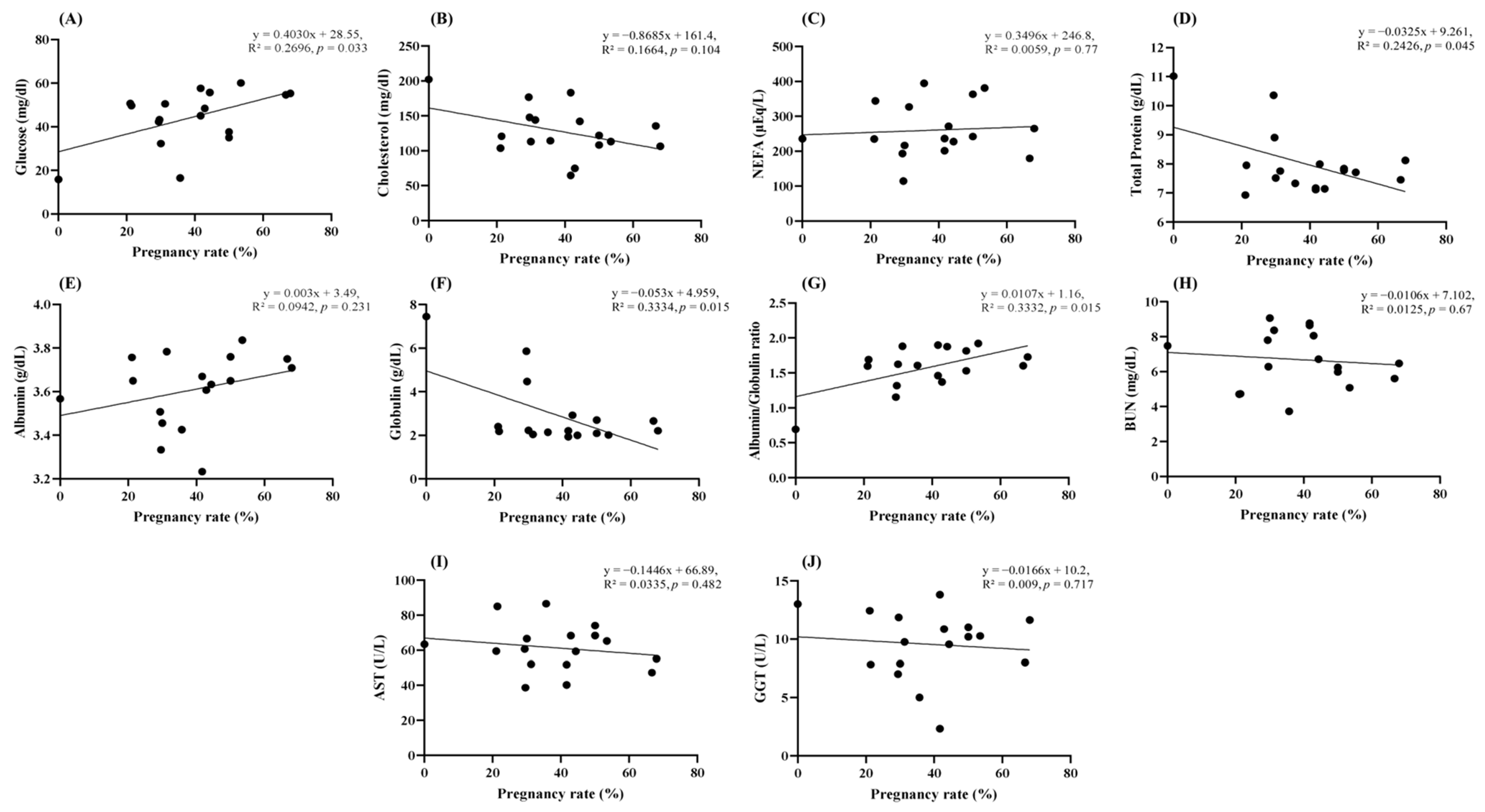
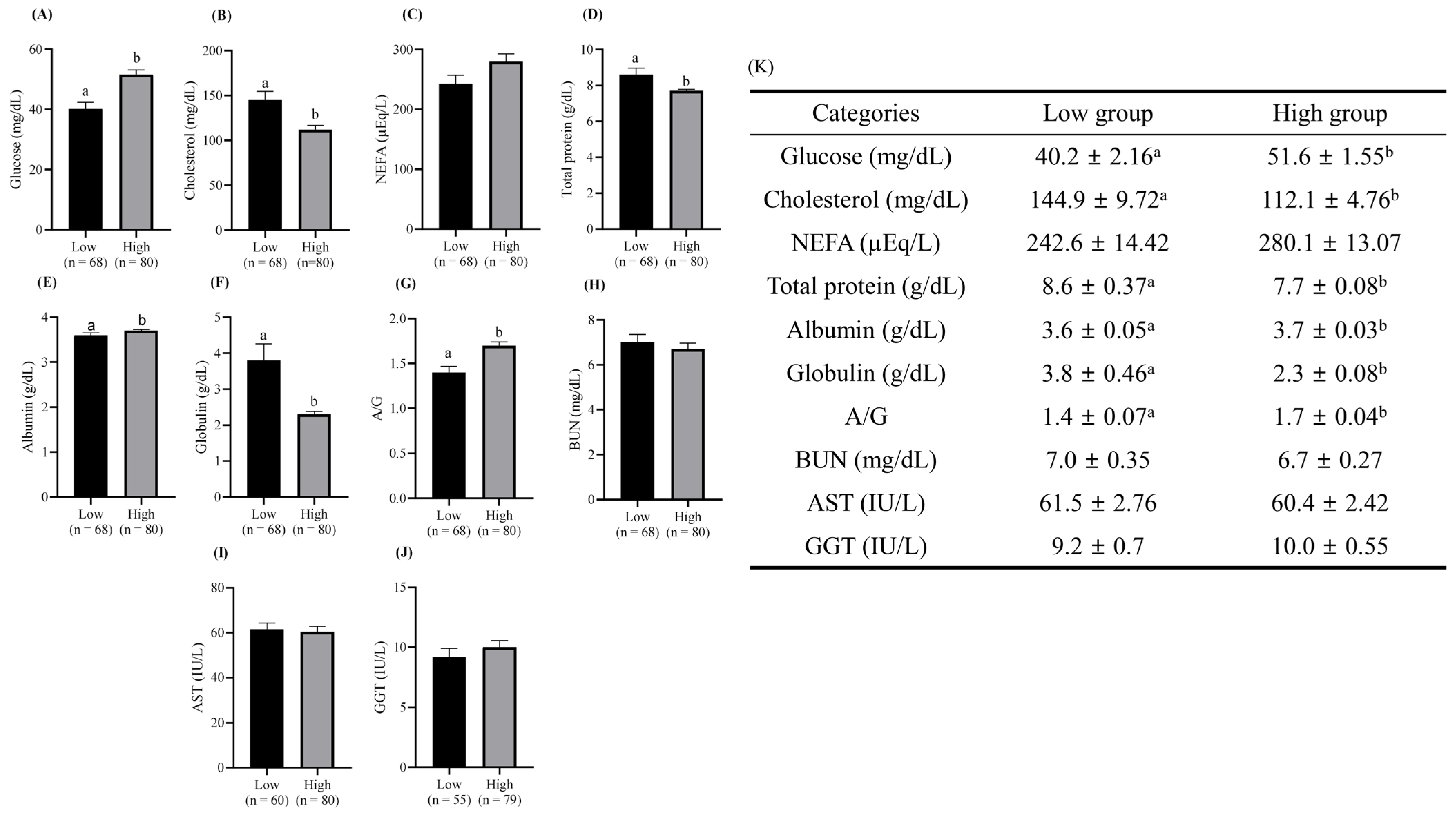
3.2. Pregnancy Rates After ET Based on the MPT Results
4. Discussion
5. Conclusions
Author Contributions
Funding
Institutional Review Board Statement
Informed Consent Statement
Data Availability Statement
Acknowledgments
Conflicts of Interest
Abbreviations
| A/G | Albumin/globulin |
| AI | Artificial insemination |
| AMH | Anti-Müllerian hormone |
| ANOVA | Analysis of variance |
| AST | Aspartate aminotransferase |
| BUN | Blood urea nitrogen |
| COC | Cumulus–oocyte complex |
| ET | Embryo transfer |
| FBS | Fetal bovine serum |
| GGT | gamma-glutamyl transferase |
| IVC | In vitro culture |
| IVD | In vivo derived |
| IVF | In vitro fertilization |
| IVM | In vitro maturation |
| MOET | Multiple ovulation embryo transfer |
| MPTs | Metabolic profile tests |
| NEFA | Non-esterified fatty acid |
| OPU | Ovum pickup |
References
- Pontes, J.H.; Nonato-Junior, I.; Sanches, B.V.; Ereno-Junior, J.C.; Uvo, S.; Barreiros, T.R.; Oliveira, J.A.; Hasler, J.F.; Seneda, M.M. Comparison of embryo yield and pregnancy rate between in vivo and in vitro methods in the same Nelore (Bos indicus) donor cows. Theriogenology 2009, 71, 690–697. [Google Scholar] [CrossRef] [PubMed]
- Viana, J. 2021 statistics of embryo production and transfer in domestic farm animals. Embryo Technol. Newsl. 2022, 40, 22–40. [Google Scholar]
- Pugliesi, G.; Guimaraes da Silva, A.; Viana, J.H.M.; Siqueira, L.G.B. Review: Current status of corpus luteum assessment by Doppler ultrasonography to diagnose non-pregnancy and select embryo recipients in cattle. Animal 2023, 17, 100752. [Google Scholar] [CrossRef]
- Morotti, F.; Dos Santos, G.M.G.; Silva-Santos, K.C.; Dias, J.H.A.; Seneda, M.M. Strategic use of estrus intensity to combine timed artificial insemination and embryo transfer in large-scale cattle reproduction programs. Theriogenology 2025, 235, 162–167. [Google Scholar] [CrossRef] [PubMed]
- Karasahin, T.; Alkan, H.; Satilmis, F.; Dursun, S.; Erdem, H. Effect of flunixin meglumine treatment during and after embryo transfer on the pregnancy rate in cattle. Reprod. Domest. Anim. 2021, 56, 1555–1561. [Google Scholar] [CrossRef]
- Alkan, H.; Karasahin, T.; Dursun, S.; Satilmis, F.; Erdem, H.; Guler, M. Evaluation of the factors that affect the pregnancy rates during embryo transfer in beef heifers. Reprod. Domest. Anim. 2020, 55, 421–428. [Google Scholar] [CrossRef]
- Khurana, N.K.; Niemann, H. Energy metabolism in preimplantation bovine embryos derived in vitro or in vivo. Biol. Reprod. 2000, 62, 847–856. [Google Scholar] [CrossRef]
- Corcoran, D.; Rizos, D.; Fair, T.; Evans, A.C.; Lonergan, P. Temporal expression of transcripts related to embryo quality in bovine embryos cultured from the two-cell to blastocyst stage in vitro or in vivo. Mol. Reprod. Dev. 2007, 74, 972–977. [Google Scholar] [CrossRef]
- Noguchi, T.; Aizawa, T.; Munakata, Y.; Iwata, H. Comparison of gene expression and mitochondria number between bovine blastocysts obtained in vitro and in vivo. J. Reprod. Dev. 2020, 66, 35–39. [Google Scholar] [CrossRef]
- Siqueira, L.G.; Torres, C.A.; Souza, E.D.; Monteiro, P.L., Jr.; Arashiro, E.K.; Camargo, L.S.; Fernandes, C.A.; Viana, J.H. Pregnancy rates and corpus luteum-related factors affecting pregnancy establishment in bovine recipients synchronized for fixed-time embryo transfer. Theriogenology 2009, 72, 949–958. [Google Scholar] [CrossRef]
- Lopez, H.; Satter, L.D.; Wiltbank, M.C. Relationship between level of milk production and estrous behavior of lactating dairy cows. Anim. Reprod. Sci. 2004, 81, 209–223. [Google Scholar] [CrossRef] [PubMed]
- Bonacker, R.C.; Gray, K.R.; Breiner, C.A.; Anderson, J.M.; Patterson, D.J.; Spinka, C.M.; Thomas, J.M. Comparison of the 7 & 7 Synch protocol and the 7-day CO-Synch + CIDR protocol among recipient beef cows in an embryo transfer program. Theriogenology 2020, 158, 490–496. [Google Scholar] [CrossRef] [PubMed]
- Ferraz, P.A.; Burnley, C.; Karanja, J.; Viera-Neto, A.; Santos, J.E.; Chebel, R.C.; Galvao, K.N. Factors affecting the success of a large embryo transfer program in Holstein cattle in a commercial herd in the southeast region of the United States. Theriogenology 2016, 86, 1834–1841. [Google Scholar] [CrossRef] [PubMed]
- Nishisozu, T.; Singh, J.; Abe, A.; Okamura, K.; Dochi, O. Effects of the temperature-humidity index on conception rates in Holstein heifers and cows receiving in vitro-produced Japanese Black cattle embryos. J. Reprod. Dev. 2023, 69, 72–77. [Google Scholar] [CrossRef]
- Hansen, P.J.; Arechiga, C.F. Strategies for managing reproduction in the heat-stressed dairy cow. J. Anim. Sci. 1999, 77, 36–50. [Google Scholar] [CrossRef]
- Lopez-Damian, E.P.; Jimenez-Medina, J.A.; Alarcon, M.A.; Lammoglia, M.A.; Hernandez, A.; Galina, C.S.; Fiordelisio, T. Cryopreservation induces higher oxidative stress levels in Bos indicus embryos compared with Bos taurus. Theriogenology 2020, 143, 74–81. [Google Scholar] [CrossRef]
- Min, S.H.; Kim, J.W.; Lee, Y.H.; Park, S.Y.; Jeong, P.S.; Yeon, J.Y.; Park, H.; Chang, K.T.; Koo, D.B. Forced collapse of the blastocoel cavity improves developmental potential in cryopreserved bovine blastocysts by slow-rate freezing and vitrification. Reprod. Domest. Anim. 2014, 49, 684–692. [Google Scholar] [CrossRef]
- Jung, S.; Sul, H.; Oh, D.; Jung, Y.G.; Lee, J.; Hyun, S.H. Slow freezing cryopreservation of Korean bovine blastocysts with an additional sucrose pre-equilibration step. Front. Vet. Sci. 2024, 11, 1400899. [Google Scholar] [CrossRef]
- Jung, S.; Jung, Y.; Sul, H.; Jung, Y.G.; Ham, J.; Oh, D.; Lee, J.; Hyun, S.H. L-proline supplementation in the freezing medium enhances the viability and quality of bovine blastocysts after slow freezing and thawing. Theriogenology 2025, 240, 117399. [Google Scholar] [CrossRef]
- Fontes, P.L.P.; Oosthuizen, N.; Ciriaco, F.M.; Sanford, C.D.; Canal, L.B.; Cooke, R.F.; Pohler, K.G.; Henry, D.D.; Mercadante, V.R.G.; Ealy, A.D.; et al. Effects of nutrient restriction on the metabolic profile of Bos indicus-influenced and B. taurus suckled beef cows. Animal 2021, 15, 100166. [Google Scholar] [CrossRef]
- Kida, K. Use of every ten-day criteria for metabolic profile test after calving and dry off in dairy herds. J. Vet. Med. Sci. 2002, 64, 1003–1010. [Google Scholar] [CrossRef] [PubMed]
- Takasu, M.; Yayota, M.; Nakano, M.; Nishii, N.; Ohba, Y.; Okada, K.; Maeda, S.; Miyazawa, K.; Kitagawa, H. Results of metabolic profile test in Japanese black cattle with growth retardation. J. Vet. Med. Sci. 2005, 67, 1269–1271. [Google Scholar] [CrossRef] [PubMed][Green Version]
- Garverick, H.A.; Harris, M.N.; Vogel-Bluel, R.; Sampson, J.D.; Bader, J.; Lamberson, W.R.; Spain, J.N.; Lucy, M.C.; Youngquist, R.S. Concentrations of nonesterified fatty acids and glucose in blood of periparturient dairy cows are indicative of pregnancy success at first insemination. J. Dairy Sci. 2013, 96, 181–188. [Google Scholar] [CrossRef] [PubMed]
- Bo, G.; Mapletoft, R. Evaluation and classification of bovine embryos. Anim. Reprod. 2013, 10, 344–348. [Google Scholar]
- Erdem, H.; Karasahin, T.; Alkan, H.; Dursun, S.; Satilmis, F.; Guler, M. Effect of embryo quality and developmental stages on pregnancy rate during fresh embryo transfer in beef heifers. Trop. Anim. Health Prod. 2020, 52, 2541–2547. [Google Scholar] [CrossRef]
- Dochi, O. Direct transfer of frozen-thawed bovine embryos and its application in cattle reproduction management. J. Reprod. Dev. 2019, 65, 389–396. [Google Scholar] [CrossRef]
- Carrascal-Triana, E.L.; Zolini, A.M.; de King, A.R.; Penitente-Filho, J.M.; Hansen, P.J.; Torres, C.A.A.; Block, J. Effect of addition of ascorbate, dithiothreitol or a caspase-3 inhibitor to cryopreservation medium on post-thaw survival of bovine embryos produced in vitro. Reprod. Domest. Anim. 2022, 57, 1074–1081. [Google Scholar] [CrossRef]
- Ishii, T.; Mori-Kobayashi, K.; Nakamura, S.; Ohkura, S.; Matsuyama, S. Carnosine supplementation in cryopreservation solution improved frozen-thawed bovine embryo viability. J. Reprod. Dev. 2024, 70, 279–285. [Google Scholar] [CrossRef]
- Dochi, O.; Yamamoto, Y.; Saga, H.; Yoshiba, N.; Kano, N.; Maeda, J.; Miyata, K.; Yamauchi, A.; Tominaga, K.; Oda, Y.; et al. Direct transfer of bovine embryos frozen-thawed in the presence of propylene glycol or ethylene glycol under on-farm conditions in an integrated embryo transfer program. Theriogenology 1998, 49, 1051–1058. [Google Scholar] [CrossRef]
- Lee, J.; Lee, S.; Ryu, G.; Kim, D.; Baek, H.U.; Kim, J.; Lee, K.; Kim, S.; Kim, S.; Dang, C.G.; et al. A retrospective analysis of conception per embryo transfer in dairy cattle in South Korea. Theriogenology 2024, 226, 363–368. [Google Scholar] [CrossRef]
- Dimmick, M.A.; Gimenez, T.; Spitzer, J.C. Ovarian endocrine activity and development of ovarian follicles during the postpartum interval in beef cows. Anim. Reprod. Sci. 1991, 24, 173–183. [Google Scholar] [CrossRef]
- Meikle, A.; Kulcsar, M.; Chilliard, Y.; Febel, H.; Delavaud, C.; Cavestany, D.; Chilibroste, P. Effects of parity and body condition at parturition on endocrine and reproductive parameters of the cow. Reproduction 2004, 127, 727–737. [Google Scholar] [CrossRef] [PubMed]
- Kida, K. The metabolic profile test: Its practicability in assessing feeding management and periparturient diseases in high yielding commercial dairy herds. J. Vet. Med. Sci. 2002, 64, 557–563. [Google Scholar] [CrossRef] [PubMed]
- Vasconcelos, J.L.; Jardina, D.T.; Sa Filho, O.G.; Aragon, F.L.; Veras, M.B. Comparison of progesterone-based protocols with gonadotropin-releasing hormone or estradiol benzoate for timed artificial insemination or embryo transfer in lactating dairy cows. Theriogenology 2011, 75, 1153–1160. [Google Scholar] [CrossRef] [PubMed]
- Kasimanickam, R.K.; Hall, J.B.; Estill, C.T.; Kastelic, J.P.; Joseph, C.; Abdel Aziz, R.L.; Nak, D. Flunixin meglumine improves pregnancy rate in embryo recipient beef cows with an excitable temperament. Theriogenology 2018, 107, 70–77. [Google Scholar] [CrossRef]
- Baek, D.J.; Kwon, H.C.; Mun, A.L.; Lim, J.R.; Park, S.W.; Han, J.S. A comparative analysis of rumen pH, milk production characteristics, and blood metabolites of Holstein cattle fed different forage levels for the establishment of objective indicators of the animal welfare certification standard. Anim. Biosci. 2022, 35, 147–152. [Google Scholar] [CrossRef]
- Okawa, H.; Yukiyama, N.; Yamato, O.; Goto, A.; Widodo, O.S.; Fushimi, Y.; Takagi, M. Factors influencing in vivo embryo production in Japanese Black donors: The role of anti-Mullerian hormone and inflammation parameters. J. Reprod. Dev. 2025, 71, 93–98. [Google Scholar] [CrossRef]
- Sakagami, N.; Nishino, O.; Adachi, S.; Umeki, H.; Uchiyama, H.; Ichikawa, K.; Takeshita, K.; Kaneko, E.; Akiyama, K.; Kobayashi, S.; et al. Improvement of preimplantation development of in vitro-fertilized bovine zygotes by glucose supplementation to a chemically defined medium. J. Vet. Med. Sci. 2014, 76, 1403–1405. [Google Scholar] [CrossRef]
- Mohebbi-Fani, M.; Omidi, A.; Mirzaei, A.; Nazifi, S.; Nowroozi, K. A field study on glucose, non-esterified fatty acids, beta-hydroxybutyrate and thyroid hormones in dairy cows during the breeding period in Fars province, Iran. Iran. J. Vet. Res. 2019, 20, 55–59. [Google Scholar]
- Takahashi, M.; Sawada, K.; Kawate, N.; Inaba, T.; Tamada, H. Improvement of superovulatory response and pregnancy rate after transfer of embryos recovered from Japanese Black cows fed rumen bypass polyunsaturated fatty acids. J. Vet. Med. Sci. 2013, 75, 1485–1490. [Google Scholar] [CrossRef]
- Thongrueang, N.; Yang, S.F.; Ke, G.M.; Hsu, H.Y.; Lee, H.H. Albumin and other metabolic parameters as potential indicators of purulent vaginal discharge in dairy cows during the transition period. J. Vet. Med. Sci. 2023, 85, 743–750. [Google Scholar] [CrossRef]
- Chastant, S.; Saint-Dizier, M. Inflammation: Friend or foe of bovine reproduction? Anim. Reprod. 2019, 16, 539–547. [Google Scholar] [CrossRef]
- Rowlands, G.J.; Little, W.; Kitchenham, B.A. Relationships between blood composition and fertility in dairy cows—A field study. J. Dairy Res. 1977, 44, 1–7. [Google Scholar] [CrossRef]



| Groups | No. of Embryo Transfer | No. of Pregnancy | Pregnancy Rate (%) |
|---|---|---|---|
| Year | |||
| 2022 | 75 | 26 | 34.7 |
| 2023 | 248 | 102 | 41.1 |
| 2024 | 59 | 32 | 54.2 |
| Embryo type | |||
| Fresh | 281 | 116 | 41.3 |
| Frozen | 101 | 44 | 43.6 |
| Parity | |||
| 0 | 28 | 12 | 42.9 |
| 1 | 99 | 42 | 42.4 |
| 2 | 106 | 36 | 34.0 |
| ≥3 | 149 | 70 | 47.0 |
| Total | 382 | 160 | 41.9 |
| Farms | No. of Embryo Transfer | No. of Pregnancy | Pregnancy Rate (%) |
|---|---|---|---|
| A | 25 | 17 | 68.0 a |
| B | 21 | 14 | 66.7 a |
| C | 43 | 23 | 53.5 a |
| D | 14 | 7 | 50.0 |
| E | 6 | 3 | 50.0 |
| F | 27 | 12 | 44.4 |
| G | 28 | 12 | 42.9 * |
| H | 12 | 5 | 41.7 |
| I | 12 | 5 | 41.7 |
| J | 14 | 5 | 35.7 |
| K | 16 | 5 | 31.3 |
| L | 10 | 3 | 30.0 |
| M | 27 | 8 | 29.6 |
| N | 17 | 5 | 29.4 |
| O | 14 | 3 | 21.4 |
| P | 19 | 4 | 21.1 |
| Q | 14 | 0 | 0.0 b* |
| Total | 319 | 131 | 41.1 |
| Farms | No. of Blood Samples Collected | Glucose (mg/dL) | Cholesterol (mg/dL) | NEFA (µEq/L) 1 | Total Protein (g/dL) | Albumin (g/dL) | Globulin (g/dL) | A/G 2 | BUN (mg/dL) 3 | AST (IU/L) 4 | GGT (IU/L) 5 |
|---|---|---|---|---|---|---|---|---|---|---|---|
| A | 11 | 55.3 ± 3.0 a | 106.4 ± 7.5 a | 264.9 ± 33.3 a | 8.1 ± 0.3 ab | 3.7 ± 0.1 | 2.2 ± 0.1 a | 1.7 ± 0.1 a | 6.5 ± 0.6 | 55.2 ± 4.4 ab | 11.6± 1.3 |
| B | 8 | 54.6 ± 3.7 a | 135.5 ± 8.2 ab | 179.4 ± 27.1 a | 7.5 ± 0.4 a | 3.8 ± 0.1 | 2.7 ± 0.4 a | 1.6 ± 0.2 a | 5.6 ± 1.1 | 47.3 ± 4.3 a | 8.0 ± 1.1 |
| C | 11 | 60.1 ± 3.8 a | 113.3 ± 11.7 a | 381.0 ± 15.9 b | 7.7 ± 0.2 a | 3.8 ± 0.1 | 2.0 ± 0.0 a | 1.9 ± 0.1 a | 5.1 ± 0.6 | 65.2 ± 4.4 b | 10.3 ± 1.6 |
| Q | 6 | 15.8 ± 6.2 b | 202.2 ± 56.4 b | 235.8 ± 53.5 a | 11.0 ± 2.1 b | 3.6 ± 0.3 | 7.5 ± 2.3 b | 0.7 ± 0.2 b | 7.5 ± 1.0 | 63.4 ± 6.0 ab | 13.0 ± 4.0 |
Disclaimer/Publisher’s Note: The statements, opinions and data contained in all publications are solely those of the individual author(s) and contributor(s) and not of MDPI and/or the editor(s). MDPI and/or the editor(s) disclaim responsibility for any injury to people or property resulting from any ideas, methods, instructions or products referred to in the content. |
© 2026 by the authors. Licensee MDPI, Basel, Switzerland. This article is an open access article distributed under the terms and conditions of the Creative Commons Attribution (CC BY) license.
Share and Cite
Jung, S.; Yang, H.; Jung, Y.; Lee, M.; Sul, H.; Jung, Y.-G.; Lee, J.; Hyun, S.-H. Optimization of the Embryo Transfer Technique in the Korean Native Cattle: Effects of Key Influencing Factors. Animals 2026, 16, 125. https://doi.org/10.3390/ani16010125
Jung S, Yang H, Jung Y, Lee M, Sul H, Jung Y-G, Lee J, Hyun S-H. Optimization of the Embryo Transfer Technique in the Korean Native Cattle: Effects of Key Influencing Factors. Animals. 2026; 16(1):125. https://doi.org/10.3390/ani16010125
Chicago/Turabian StyleJung, Seungki, Heejae Yang, Yeonsub Jung, Minki Lee, Hyeonseok Sul, Yeon-Gil Jung, Joohyeong Lee, and Sang-Hwan Hyun. 2026. "Optimization of the Embryo Transfer Technique in the Korean Native Cattle: Effects of Key Influencing Factors" Animals 16, no. 1: 125. https://doi.org/10.3390/ani16010125
APA StyleJung, S., Yang, H., Jung, Y., Lee, M., Sul, H., Jung, Y.-G., Lee, J., & Hyun, S.-H. (2026). Optimization of the Embryo Transfer Technique in the Korean Native Cattle: Effects of Key Influencing Factors. Animals, 16(1), 125. https://doi.org/10.3390/ani16010125