Assessing Executive Cognitive Functions in Sheep: A Scoping Review of Recent Literature on Cognitive Tasks

Simple Summary
Abstract
1. Introduction
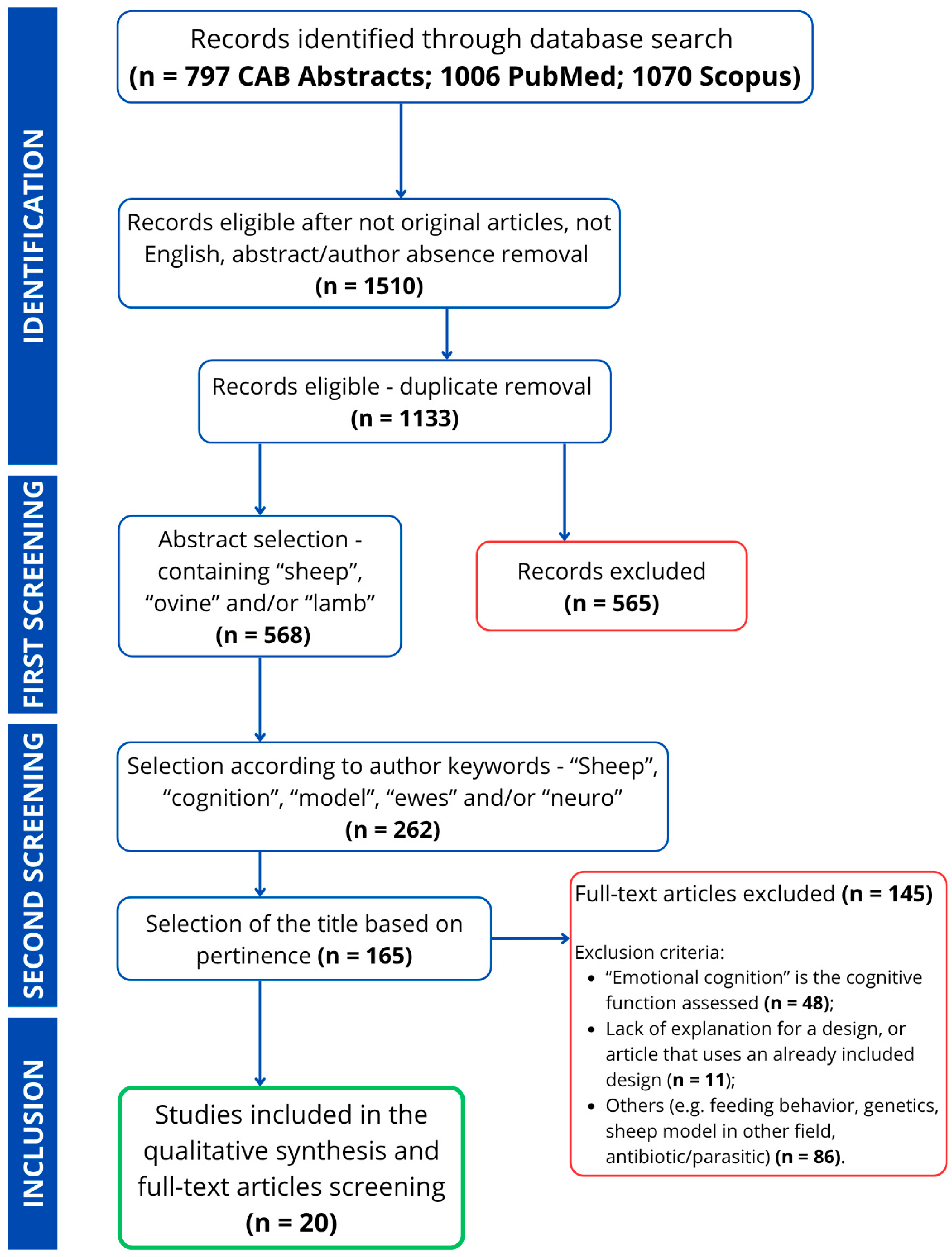
2. Materials and Methods
3. Results
3.1. Executive Cognitive Functions
3.1.1. Cognitive Flexibility and Memory
3.1.2. Sensory Discrimination and Association
3.1.3. Problem-Solving and Decision-Making
3.2. Type of Test
4. Discussion
4.1. Executive Cognitive Functions
4.1.1. Cognitive Flexibility and Memory
4.1.2. Sensory Discrimination and Association
4.1.3. Problem-Solving and Decision-Making
4.2. Type of Test
4.2.1. Maze and Labyrinth
4.2.2. Testing Arena
4.2.3. Problem-Solving Apparatus
4.3. Limitations of This Scoping Review
5. Conclusions
Author Contributions
Funding
Institutional Review Board Statement
Informed Consent Statement
Data Availability Statement
Conflicts of Interest
References
- Keeler, J.F.; Robbins, T.W. Translating Cognition from Animals to Humans. Biochem. Pharmacol. 2011, 81, 1356–1366. [Google Scholar] [CrossRef]
- Broom, D.M. Animal Welfare: An Aspect of Care, Sustainability, and Food Quality Required by the Public. J. Vet. Med. Educ. 2010, 37, 83–88. [Google Scholar] [CrossRef] [PubMed]
- Bushby, E.V.; Friel, M.; Goold, C.; Gray, H.; Smith, L.; Collins, L.M. Factors Influencing Individual Variation in Farm Animal Cognition and How to Account for These Statistically. Front. Vet. Sci. 2018, 5, 132. [Google Scholar] [CrossRef]
- Lazăr, C.; Alexandru Gras, M.; Stefania Pelmus, R.; Mircea Rotar, C.; Popa, F. Review Regarding the Genomic Evolution in Sheep Milk Production and Their Application to Improve the Selection Criteria. Emir. J. Food Agric. 2020, 32, 691–701. [Google Scholar] [CrossRef]
- Murray, T.L.; Blache, D.B.; Bencini, R. The Selection of Dairy Sheep on Calm Temperament Before Milking and Its Effect on Management and Milk Production. Small Rumin. Res. 2009, 87, 45–49. [Google Scholar] [CrossRef]
- Zhang, J.; Qian, S.; Chen, J.; Ding, L.; Wang, M.; Maloney, S.K.; Blache, D. Calm Hu Ram Lambs Assigned by Temperament Classification Are Healthier and Have Better Meat Quality than Nervous Hu Ram Lambs. Meat Sci. 2021, 175, 108436. [Google Scholar] [CrossRef]
- Blache, D.; Bickell, S.L. Temperament and Reproductive Biology: Emotional Reactivity and Reproduction in Sheep. Rev. Bras. De Zootec. 2010, 39, 401–408. [Google Scholar] [CrossRef]
- Marino, L.; Merskin, D. Intelligence, Complexity, and Individuality in Sheep. Anim. Sentience 2019, 4, 1. [Google Scholar] [CrossRef]
- Coulon, M.; Hild, S.; Schroeer, A.; Janczak, A.M.; Zanella, A.J. Gentle vs. Aversive Handling of Pregnant Ewes: II. Physiology and Behavior of the Lambs. Physiol. Behav. 2011, 103, 575–584. [Google Scholar] [CrossRef]
- Hunter, D.S.; Hazel, S.J.; Kind, K.L.; Liu, H.; Marini, D.; Owens, J.A.; Pitcher, J.B.; Gatford, K.L. Do I Turn Left or Right? Effects of Sex, Age, Experience and Exit Route on Maze Test Performance in Sheep. Physiol. Behav. 2015, 139, 244–253. [Google Scholar] [CrossRef] [PubMed]
- Ben Abdallah, N.M.B.; Fuss, J.; Trusel, M.; Galsworthy, M.J.; Bobsin, K.; Colacicco, G.; Deacon, R.M.J.; Riva, M.A.; Kellendonk, C.; Sprengel, R.; et al. The Puzzle Box as a Simple and Efficient Behavioral Test for Exploring Impairments of General Cognition and Executive Functions in Mouse Models of Schizophrenia. Exp. Neurol. 2011, 227, 42–52. [Google Scholar] [CrossRef] [PubMed]
- Mar, A.C.; Horner, A.E.; Nilsson, S.R.O.; Alsiö, J.; Kent, B.A.; Kim, C.H.; Holmes, A.; Saksida, L.M.; Bussey, T.J. The Touchscreen Operant Platform for Assessing Executive Function in Rats and Mice. Nat. Protoc. 2013, 8, 1985–2005. [Google Scholar] [CrossRef]
- Hölter, S.M.; Garrett, L.; Einicke, J.; Sperling, B.; Dirscherl, P.; Zimprich, A.; Fuchs, H.; Gailus-Durner, V.; Hrabe de Angelis, M.; Wurst, W. Assessing Cognition in Mice. Curr. Protoc. Mouse Biol. 2015, 5, 331–358. [Google Scholar] [CrossRef]
- Prieur, E.A.K.; Jadavji, N.M. Assessing Spatial Working Memory Using the Spontaneous Alternation Y-Maze Test in Aged Male Mice. Bio-Protocol 2019, 9, e3162. [Google Scholar] [CrossRef] [PubMed]
- d’Isa, R.; Comi, G.; Leocani, L. Apparatus Design and Behavioural Testing Protocol for the Evaluation of Spatial Working Memory in Mice Through the Spontaneous Alternation T-Maze. Sci. Rep. 2021, 11, 21177. [Google Scholar] [CrossRef] [PubMed]
- Young, B.K.; Brennan, J.N.; Wang, P.; Tian, N. Virtual Reality Method to Analyze Visual Recognition in Mice. PLoS ONE 2018, 13, e0196563. [Google Scholar] [CrossRef]
- Bissonette, G.B.; Powell, E.M. Reversal Learning and Attentional Set-Shifting in Mice. Neuropharmacology 2012, 62, 1168–1174. [Google Scholar] [CrossRef]
- 18; Boissy, A.; Lee, C. How Assessing Relationships Between Emotions and Cognition Can Improve Farm Animal Welfare. Rev. Sci. Tech. 2014, 33, 103–110. [Google Scholar]
- Forkman, B.; Boissy, A.; Meunier-Salaün, M.C.; Canali, E.; Jones, R.B. A Critical Review of Fear Tests Used on Cattle, Pigs, Sheep, Poultry and Horses. Physiol. Behav. 2007, 92, 340–374. [Google Scholar] [CrossRef]
- Murray, S.J.; Mitchell, N.L. The Translational Benefits of Sheep as Large Animal Models of Human Neurological Disorders. Front. Vet. Sci. 2022, 9, 831838. [Google Scholar]
- Paul, E.S.; Sher, S.; Tamietto, M.; Winkielman, P.; Mendl, M.T. Towards a Comparative Science of Emotion: Affect and Consciousness in Humans and Animals. Neurosci. Biobehav. Rev. 2020, 108, 749–770. [Google Scholar] [CrossRef] [PubMed]
- Abecia, J.A.; Casao, A.; Pascual-Alonso, M.; Lobón, S.; Aguayo-Ulloa, L.A.; Meikle, A.; Forcada, F.; Sosa, C.; Marín, R.H.; Silva, M.A.; et al. The Effect of Periconceptional Undernutrition of Sheep on the Cognitive/Emotional Response and Oocyte Quality of Offspring at 30 Days of Age. J. Dev. Orig. Health Dis. 2014, 5, 79–87. [Google Scholar] [CrossRef]
- McBride, S.D.; Perentos, N.; Morton, A.J. A Mobile, High-Throughput Semi-Automated System for Testing Cognition in Large Non-Primate Animal Models of Huntington Disease. J. Neurosci. Methods 2016, 265, 25–33. [Google Scholar] [CrossRef]
- Higgins, J.P.T.; Thomas, J.; Chandler, J.; Cumpston, M.; Li, T.; Page, M.J.; Welch, V.A. Cochrane Handbook for Systematic Reviews of Interventions; Version 6.5 (updated August 2024); Cochrane: London, UK, 2024; Available online: www.training.cochrane.org/handbook (accessed on 9 October 2024).
- Peters, M.D.J.; Godfrey, C.M.; Khalil, H.; McInerney, P.; Parker, D.; Soares, C.B. Guidance for Conducting Systematic Scoping Reviews. Int. J. Evid. Based Healthc. 2015, 13, 141–146. [Google Scholar] [CrossRef] [PubMed]
- Munn, Z.; Peters, M.D.J.; Stern, C.; Tufanaru, C.; McArthur, A.; Aromataris, E. Systematic Review or Scoping Review? Guidance for Authors When Choosing Between a Systematic or Scoping Review Approach. BMC Med. Res. Methodol. 2018, 18, 143. [Google Scholar] [CrossRef]
- Thornton, A.; Lukas, D. Individual Variation in Cognitive Performance: Developmental and Evolutionary Perspectives. Philos. Trans. R. Soc. B Biol. Sci. 2012, 367, 2773–2783. [Google Scholar] [CrossRef] [PubMed]
- Ghafarimoghadam, M.; Mashayekh, R.; Gholami, M.; Fereydani, P.; Shelley-Tremblay, J.; Kandezi, N.; Sabouri, E.; Motaghinejad, M. A Review of Behavioral Methods for the Evaluation of Cognitive Performance in Animal Models: Current Techniques and Links to Human Cognition. Physiol. Behav. 2022, 244, 113652. [Google Scholar] [CrossRef]
- Moher, D.; Shamseer, L.; Clarke, M.; Ghersi, D.; Liberati, A.; Petticrew, M.; Shekelle, P.; Stewart, L.A.; Estarli, M.; Barrera, E.S.A.; et al. Preferred Reporting Items for Systematic Review and Meta-Analysis Protocols (PRISMA-P) 2015 Statement. Rev. Esp. De Nutr. Humana Y Diet. 2016, 20, 148–160. [Google Scholar] [CrossRef]
- Morton, A.J.; Avanzo, L. Executive Decision-Making in the Domestic Sheep. PLoS ONE 2011, 6, e15752. [Google Scholar] [CrossRef]
- Knolle, F.; McBride, S.D.; Stewart, J.E.; Goncalves, R.P.; Morton, A.J. A Stop-Signal Task for Sheep: Introduction and Validation of a Direct Measure for the Stop-Signal Reaction Time. Anim. Cogn. 2017, 20, 615–626. [Google Scholar] [CrossRef]
- Raoult, C.M.C.; Osthaus, B.; Hildebrand, A.C.G.; McElligott, A.G.; Nawroth, C. Goats Show Higher Behavioural Flexibility than Sheep in a Spatial Detour Task. R. Soc. Open Sci. 2021, 8, 201627. [Google Scholar] [CrossRef] [PubMed]
- Doyle, R.E.; Freire, R.; Cowling, A.; Knott, S.A.; Lee, C. Performance of Sheep in a Spatial Maze Is Impeded by Negative Stimuli. Appl. Anim. Behav. Sci. 2014, 151, 36–42. [Google Scholar] [CrossRef]
- Knolle, F.; Goncalves, R.P.; Davies, E.L.; Duff, A.R.; Morton, J.A. Response-Inhibition During Problem Solving in Sheep (Ovis Aries). Int. J. Comp. Psychol. 2019, 32, 1–14. [Google Scholar] [CrossRef]
- Duffrene, J.; Petit, O.; Thierry, B.; Nowak, R.; Dufour, V. Both Sheep and Goats Can Solve Inferential by Exclusion Tasks. Anim. Cogn. 2022, 25, 1631–1644. [Google Scholar] [CrossRef]
- Nawroth, C.; Von Borell, E.; Langbein, J. Exclusion Performance in Dwarf Goats (Capra Aegagrus Hircus) and Sheep (Ovis Orientalis Aries). PLoS ONE 2014, 9, e93534. [Google Scholar] [CrossRef]
- McBride, S.D.; Perentos, N.; Morton, A.J. Understanding the Concept of a Reflective Surface: Can Sheep Improve Navigational Ability through the Use of a Mirror? Anim. Cogn. 2015, 18, 361–371. [Google Scholar] [CrossRef] [PubMed]
- Johnson, T.B.; Stanton, M.E.; Goodlett, C.R.; Cudd, T.A. T-Maze Learning in Weanling Lambs. Dev. Psychobiol. 2012, 54, 785–797. [Google Scholar] [CrossRef]
- Perentos, N.; Krstulovic, M.; Morton, A.J. Deep Brain Electrophysiology in Freely Moving Sheep. Curr. Biol. 2022, 32, 763–774.e4. [Google Scholar] [CrossRef]
- Wojniusz, S.; Vögele, C.; Ropstad, E.; Evans, N.; Robinson, J.; Sütterlin, S.; Erhard, H.W.; Solbakk, A.K.; Endestad, T.; Olberg, D.E.; et al. Prepubertal Gonadotropin-Releasing Hormone Analog Leads to Exaggerated Behavioral and Emotional Sex Differences in Sheep. Horm. Behav. 2011, 59, 22–27. [Google Scholar] [CrossRef]
- Hough, D.; Bellingham, M.; Haraldsen, I.R.; McLaughlin, M.; Robinson, J.E.; Solbakk, A.K.; Evans, N.P. A Reduction in Long-Term Spatial Memory Persists After Discontinuation of Peripubertal GnRH Agonist Treatment in Sheep. Psychoneuroendocrinology 2017, 77, 1–8. [Google Scholar] [CrossRef]
- Henrique, F.L.; Zanella, A.J.; Bezerra, H.V.A.; Polato, H.Z.; Fernandes, A.C.; Hooper, H.B.; Pulido-Rodríguez, L.F.; Titto, E.A.L.; Pereira, A.M.F.; Titto, C.G. Stress During First Gestation of Ewes Impairs Memory and Learning of Male Offspring. Vet. Res. Commun. 2021, 45, 251–260. [Google Scholar] [CrossRef] [PubMed]
- Wojniusz, S.; Ropstad, E.; Evans, N.; Robinson, J.; Solbakk, A.K.; Endestad, T.; Haraldsen, I.R.H. Sex-Specific Development of Spatial Orientation Is Independent of Peripubertal Gonadal Steroids. Psychoneuroendocrinology 2013, 38, 1709–1716. [Google Scholar] [CrossRef]
- Bellegarde, L.G.A.; Erhard, H.W.; Weiss, A.; Boissy, A.; Haskell, M.J. Valence of Facial Cues Influences Sheep Learning in a Visual Discrimination Task. Front. Vet. Sci. 2017, 4, 188. [Google Scholar] [CrossRef]
- Morris, J.E.; Fisher, A.D.; Doyle, R.E.; Bush, R.D. Determination of Sheep Learning Responses to a Directional Audio Cue. J. Appl. Anim. Welf. Sci. 2010, 13, 347–360. [Google Scholar] [CrossRef] [PubMed]
- Guesdon, V.; Nowak, R.; Meurisse, M.; Boivin, X.; Cornilleau, F.; Chaillou, E.; Lévy, F. Behavioral Evidence of Heterospecific Bonding Between the Lamb and the Human Caregiver and Mapping of Associated Brain Network. Psychoneuroendocrinology 2016, 71, 159–169. [Google Scholar] [CrossRef]
- Monk, J.E.; Doyle, R.E.; Colditz, I.G.; Belson, S.; Cronin, G.M.; Lee, C. Towards a More Practical Attention Bias Test to Assess Affective State in Sheep. PLoS ONE 2018, 13, e0190404. [Google Scholar] [CrossRef]
- García y González, E.; Cuellar, A.; Hernández, H.; Nandayapa, E.; Álvarez, L.; Tórtora, J.; Terrazas, A. Maternal Experience in Romanov Sheep Impairs Mother-Lamb Recognition During the First 24 hours Postpartum. J. Vet. Behav. Clin. Appl. Res. 2015, 10, 66–72. [Google Scholar] [CrossRef]
- Ardila, A. On the Evolutionary Origins of Executive Functions. Brain Cogn. 2008, 68, 92–99. [Google Scholar] [CrossRef]
- Banstola, A.; Reynolds, J.N.J. The Sheep as a Large Animal Model for the Investigation and Treatment of Human Disorders. Biology 2022, 11, 1251. [Google Scholar] [CrossRef] [PubMed]
- Lee, C.; Colegate, S.; Fisher, A.D. Development of a Maze Test and Its Application to Assess Spatial Learning and Memory in Merino Sheep. Appl. Anim. Behav. Sci. 2006, 96, 43–51. [Google Scholar] [CrossRef]
- Uddin, L.Q. Cognitive and Behavioural Flexibility: Neural Mechanisms and Clinical Considerations. Nat. Rev. Neurosci. 2021, 22, 167–179. [Google Scholar] [CrossRef] [PubMed]
- Frankland, P.W.; Bontempi, B. The Organization of Recent and Remote Memories. Nat. Rev. Neurosci. 2005, 6, 119–130. [Google Scholar] [CrossRef]
- Moscovitch, M.; Nadel, L.; Winocur, G.; Gilboa, A.; Rosenbaum, R.S. The Cognitive Neuroscience of Remote Episodic, Semantic and Spatial Memory. Curr. Opin. Neurobiol. 2006, 16, 179–190. [Google Scholar] [CrossRef]
- Hunter, D.S.; Hazel, S.J.; Kind, K.L.; Liu, H.; Marini, D.; Giles, L.C.; De Blasio, M.J.; Owens, J.A.; Pitcher, J.B.; Gatford, K.L. Placental and Fetal Growth Restriction, Size at Birth and Neonatal Growth Alter Cognitive Function and Behaviour in Sheep in an Age- and Sex-Specific Manner. Physiol. Behav. 2015, 152, 1–10. [Google Scholar] [CrossRef]
- Kendrick, K.M.; Atkins, K.; Hinton, M.R.; Broad, K.D.; Fabre-Nys, C.; Kevernet, B. Facial and Vocal Discrimination in Sheep. Anim. Behav. 1995, 49, 1665–1676. [Google Scholar] [CrossRef]
- Kleanthous, N.; Hussain, A.; Sneddon, J.; Khan, W.; Khan, B.; Aung, Z.; Liatsis, P. Towards a Virtual Fencing System: Training Domestic Sheep Using Audio Stimuli. Animals 2022, 12, 2920. [Google Scholar] [CrossRef]
- Mora-Medina, P.; Orihuela-Trujillo, A.; Arch-Tirado, E.; Roldan-Santiago, P.; Terrazas, A.; Mota-Rojas, D. Sensory Factors Involved in Mother-Young Bonding in Sheep: A Review. Vet. Med. 2016, 61, 595–611. [Google Scholar] [CrossRef]
- Nawroth, C.; Baciadonna, L.; McElligott, A.G. Goats Learn Socially from Humans in a Spatial Problem-Solving Task. Anim. Behav. 2016, 121, 123–129. [Google Scholar] [CrossRef]
- Tanila, H. Testing Cognitive Functions in Rodent Disease Models: Present Pitfalls and Future Perspectives. Behav. Brain Res. 2018, 352, 23–27. [Google Scholar] [CrossRef]
- Hunsaker, M.R. The Importance of Considering All Attributes of Memory in Behavioral Endophenotyping of Mouse Models of Genetic Disease. Behav. Neurosci. 2012, 126, 371–380. [Google Scholar] [CrossRef] [PubMed]
- Finkemeier, M.A.; Langbein, J.; Puppe, B. Personality Research in Mammalian Farm Animals: Concepts, Measures, and Relationship to Welfare. Front. Vet. Sci. 2018, 5, 131. [Google Scholar] [CrossRef] [PubMed]
- Pham, M.T.; Rajić, A.; Greig, J.D.; Sargeant, J.M.; Papadopoulos, A.; Mcewen, S.A. A Scoping Review of Scoping Reviews: Advancing the Approach and Enhancing the Consistency. Res. Synth. Methods 2014, 5, 371–385. [Google Scholar] [CrossRef]
- Gatford, K.L.; Morton, A.J.; McBride, S.D. Learning and Cognitive Flexibility in Two-Choice Visual Discrimination Tasks Are Similar in Juvenile and Adult Sheep. Appl. Anim. Behav. Sci. 2025, 291, 106735. [Google Scholar] [CrossRef]
- Jing-Yi, T.U.; Chang-Qing, S.; Wang, S.-C.; Peng, S.-Q.; Sun, Y.-H.; Rui-Ling, L.; Chang-An, C.; Xiong, X.; Yong-Ju, Z.; Qiu, X.-Y. Effects of Music on the Spatial Cognitive Performance, 2 Growth Performance, and Stress Response of Sheep. Anim. Biosci. 2025, 38, 1543–1556. [Google Scholar] [CrossRef]
- Destrez, A.; Deiss, V.; Belzung, C.; Lee, C.; Boissy, A. Does Reduction of Fearfulness Tend to Reduce Pessimistic-Like Judgment in Lambs? Appl. Anim. Behav. Sci. 2012, 139, 233–241. [Google Scholar] [CrossRef]
- McBride, S.D.; Morton, A.J. Indices of Comparative Cognition: Assessing Animal Models of Human Brain Function. Exp. Brain Res. 2018, 236, 3379–3390. [Google Scholar] [CrossRef] [PubMed]



| Cognitive Function | Typology of the Test | Animal Included (Category) | Sex | Age | Reference |
|---|---|---|---|---|---|
| Cognitive flexibility | Modified Y-maze | Prepubertal lambs and adult sheep | Both | 18- and 40-week-old | [10] |
| 8 consecutive Y-mazes | Adult ewes | Female | ~1 year-old | [30] | |
| Semi-automated for a two-choice task | Adult ewes | Female | 7–8-year-old | [31] | |
| Spatial A-not-B detour task | Adult ewes and adult goats (mixed sex) | Female | ~6–8-month-old | [32] | |
| Decision-making and problem-solving | Spatial maze (modified Y-maze) | Castrated adult sheep | Male | 6-month-old | [33] |
| Cylinder task | “Old” and “young” sheep | Both | 8-month-old and ~ 8-year-old | [34] | |
| Cup task and tube task | Adult sheep and goats | Both | 2–10-year-old | [35] | |
| Cup task | Adult sheep and goats (female) | Both | ~2-year-old | [36] | |
| 8 consecutive Y-mazes | Adult ewes | Female | ~1 year-old | [30] | |
| Locomotor-based decision-making task | Adult sheep | Both | ~18–56-month-old | [37] | |
| Memory and spatial orientation | Modified Y-maze | Prepubertal lambs and adult sheep | Both | 18- and 40-week-old | [10] |
| T-maze | Lambs | Both | 2–5-month-old | [38] | |
| Two-choice discrimination task | Adult ewes | Female | 17- and 19-month-old | [39] | |
| Spatial A-not-B detour task | Adult ewes and adult goats (mixed sex) | Female | ~6–8-month-old | [32] | |
| Cylinder task | “Old” and “young” sheep | Both | 8-month-old and ~ 8-year-old | [34] | |
| Food acquisition task in the arena | Yearling sheep | Both | From 10- and 30-week-old to 12-month-old | [40] | |
| Spatial maze | Lambs | Both | ~1-month-old | [9] | |
| 3 Spatial mazes | Adult sheep | Male | From 8-month-old to 2-year-old | [41] | |
| T-maze | Lambs | Male | 30-day-old | [42] | |
| Spatial maze | Lambs and adult sheep (twins) | Both | 8- 28- and 48-month-old | [43] | |
| Sensory discrimination and association | T-maze | Lambs | Male | 30-day-old | [42] |
| T-maze, with isolation and a novel object | Lambs | Both | 30-day-old | [22] | |
| Two-choice discrimination task (Y-maze) | Adult ewes | Female | 10–12-month-old | [44] | |
| Semi-automated for a two-choice task | Adult ewes and castrated males | Both | 37- and 25-month-old | [23] | |
| Y-maze | Adult sheep | Both | 1-year-old | [45] | |
| Semi-automated for a two-choice task | Adult ewes | Female | 7–8-year-old | [31] |
| Type of Test | Pre-Test Period | Dimension | Architecture | Timing and Functioning | Reference |
|---|---|---|---|---|---|
| Maze | Training (1 day) | 1.5 m long arms. | Diamond-shaped maze, darkened walls, and a non-opaque ending gate. | Five days: after the training phase, tasks on learning, memory, and reversal were conducted. | [10] |
| Habituation (total of 4 months) | 8.5 × 2.5 m | 8 rectangular modified Y-mazes, with corridors and gates following one another. | 21 days: daily discrimination tasks (from 1 to 6 sets per day); correct choices were rewarded with food. | [30] | |
| Habituation (3 × 5 days), and 2 Training (exp. 1–5) | Start box (0.91 × 0.91 m), corridor (1.82 × 0.91 m), two goal arms (1.22 × 0.91 m). | A plywood T with a start box, a corridor, and two goal arms with hidden food. | 5 exp.—nonmatching-to-place (reward in the opposite arm from the forced-run), matching-to-place (reward in the same arm as the forced-run), position habit (fixed rewarded arm on every trial), position habit reversal (rewarded arm reversed). | [38] | |
| Habituation (2 days) | 7.5 × 3 m | Rectangular metal structure, movable maze barriers covered by opaque canvas. | 2 trials during the same day: morning and afternoon. Behavioral aspects and completion time to rejoin the familiar group were recorded. | [9] | |
| Training (2 days) | 10.8 × 4.6 m | Rectangular arena with maze barriers in different positions: Layouts 1, 2, and 3. | Weeks 41 and 83: spatial orientation tested in Layouts 1, 2; week 99: Layout 2 for long-term memory, Layout 3 for novel maze assessment. | [41] | |
| No | 7.5 m long × 1.0 m wide × 1.20 m high and two arms (1.30 × 1.20 × 0.80 m each) at the end. | The maze has metal frames covered with black plastic and two arms. | 3 days: lambs navigated the T-maze toward the maternal call; choice side, completion time, and predefined behavioral activities were recorded for each trial. | [42] | |
| No | Maximum of ~8 × 4.6 m | Rectangular arena with four main spaces, divided by metal walls. | 3 trials in 3 time points: orientation and flexibility. Time taken to rejoin the familiar group was recorded. | [43] | |
| Arena | Training (3 stages) | 8.7 × 3.1 m and a final wall 2.2 m high. | Rectangular arena and a final wall. | Stop-signal task using both colors and sounds. 25 sessions: correct responses were rewarded; movements, reaction times, and stopping ability assessed. | [31] |
| Habituation (familiar location with familiar people) | 5.3 × 7 m | Large rectangular pen 5.3 × 7 m with a straight central barrier and a visible gap. | During the test, animals navigated a visible gap in a central barrier: four times in one position (A), then switched to another position (B) four times. | [32] | |
| No | 2.2 × 6.6 m | Rectangular arena. | Sheep performed multiple (up to 100 trials) two-choice discrimination tasks; additional tests included reversal learning and spatial exploration tasks, with resting-state activity recorded. | [39] | |
| Training (18 individual runs) | 1 m high plastic walls and gates. | Big rectangular arena divided into different spaces. | In the test phase, eight 1 min runs assessed each sheep’s food preferences. | [40] | |
| Problem-solving | Habituation (2 × 5 min sessions) and Training (up to 7 sessions, 10 trials) | The cylinder task was carried out in a 1.5 × 1.5 m arena [23] | Rectangular testing area [23]. | After seven weeks of training, sheep retrieved rewards from opaque or transparent cylinders. | [34] |
| Type of Test | Pre-Test Period | Dimension | Architecture | Timing and Functioning | Reference |
|---|---|---|---|---|---|
| Maze | No | 7.5 m long × 1.0 m wide × 1.20 m high and two arms (1.30 × 1.20 × 0.80 m each) at the end. | The maze has metal frames covered with black plastic and two arms. | 3 days: lambs navigated the T-maze toward the maternal call; choice side, completion time, and predefined behavioral activities were recorded for each trial. | [42] |
| No | Chamber (2 × 2 m), corridor (4 × 0.70 m) | Three different chambers connected as a T-maze through a corridor | After 20 s in the isolation pen, lambs were individually tested (5 min) using sound cues. | [22] | |
| Habituation (2 days) and training (around 20 sessions) | 4.8 × 3.6 m | Inside the global arena a two-armed maze is built, following a decision area equipped with screens displaying cues. | First training on colored cards; second phase on facial cues. Finally, two test sessions were conducted to generalize the learned associations to new and familiar faces. | [44] | |
| Habituation (5 weeks) and training (5 days) | Arena (2 × 2.85 m) Central solid wall (1.8 m high) | A Y-maze inside a sheep pen with solid wood separating the two feeding buckets. | During testing, sheep made choices in the Y-maze, guided by visual or auditory cues that led to food rewards (4 trials per day over 10 days). | [45] | |
| Arena | Habituation (4 × 15 min sessions), and Training (10 trials each, ~ 4–8 min) | 8.7 × 3.1 m and a final wall 2.2 m high. | Rectangular arena and a final wall. | Visual discrimination and memory task (up to 13 sessions). Correct responses earned rewards. Learning criteria were identified. | [23] |
| Training (3 stages) | 8.7 × 3.1 m and a final wall 2.2 m high. | Rectangular arena and a final wall. | Stop-signal task using both colors and sounds. 25 sessions: correct responses were rewarded; movements, reaction times, and stopping ability assessed. | [31] |
| Type of Test | Pre-Test Period | Dimension | Architecture | Timing and Functioning | Reference |
|---|---|---|---|---|---|
| Maze | Training (5 days) | 20 × 9 m | Rectangular arena with two error zones, corridors, and opaque exterior walls. | Three days: they were pre-exposed to food reward or a dog. Afterward, they ran the maze to assess stress and distraction effects on cognitive performance. | [33] |
| Training (8.3 ± 3.2 sessions (10 trials each)) | Training mirror exposure: two arenas (3 × 4 m) and (5 × 15 m), with different mirror positions. | Training spatial: rectangular maze with gates, grates, and a visible bucket. Testing: same as training spatial, with mirrors. | Mirror exposure followed the training, with behavioral analysis during sessions (10 trials) to assess decision-making accuracy. | [37] | |
| Habituation (total of 4 months) | 8.5 × 2.5 m | 8 rectangular modified Y-mazes, with corridors and gates following one another. | 21 days: daily discrimination tasks (from 1 to 6 sets per day); correct choices were rewarded with food. | [30] | |
| Problem-solving | Training (3 phases) | 7 × 7 m 1.20 m high | The tests were conducted in a familiar paddock, covered with a roof and with wooden board fences. | Cup task: 10 sessions with 8 trials each to test deductive reasoning. Bent tube task: 12 sessions with 10 trials each, testing inferential ability. | [35] |
| Habituation (2 × 5 min sessions) and Training (up to 7 sessions, 10 trials) | The cylinder task was carried out in a 1.5 × 1.5 m arena [23] | Rectangular testing area [23]. | After seven weeks of training, sheep retrieved rewards from opaque or transparent cylinders. | [34] | |
| Habituation (at least 4 trials) and training (at least 2 sessions and 10 trials) | 1.2 × 2.7 m 60 × 25 cm sliding table is used for the cups. | Sheep were kept in a pen, visually isolated but with sensory contact. | Ex 1: 10 sessions with 8 trials, testing 4 conditions (both, baited, empty, control) and 5 s cues. Bowls were randomly baited. Ex 2: like Ex 1, with inner cups to prevent local enhancement | [36] |
Disclaimer/Publisher’s Note: The statements, opinions and data contained in all publications are solely those of the individual author(s) and contributor(s) and not of MDPI and/or the editor(s). MDPI and/or the editor(s) disclaim responsibility for any injury to people or property resulting from any ideas, methods, instructions or products referred to in the content. |
© 2025 by the authors. Licensee MDPI, Basel, Switzerland. This article is an open access article distributed under the terms and conditions of the Creative Commons Attribution (CC BY) license (https://creativecommons.org/licenses/by/4.0/).
Share and Cite
Galanti, D.; Dalla Costa, E.; Barbieri, S.; Minero, M. Assessing Executive Cognitive Functions in Sheep: A Scoping Review of Recent Literature on Cognitive Tasks. Animals 2025, 15, 3647. https://doi.org/10.3390/ani15243647
Galanti D, Dalla Costa E, Barbieri S, Minero M. Assessing Executive Cognitive Functions in Sheep: A Scoping Review of Recent Literature on Cognitive Tasks. Animals. 2025; 15(24):3647. https://doi.org/10.3390/ani15243647
Chicago/Turabian StyleGalanti, Davide, Emanuela Dalla Costa, Sara Barbieri, and Michela Minero. 2025. "Assessing Executive Cognitive Functions in Sheep: A Scoping Review of Recent Literature on Cognitive Tasks" Animals 15, no. 24: 3647. https://doi.org/10.3390/ani15243647
APA StyleGalanti, D., Dalla Costa, E., Barbieri, S., & Minero, M. (2025). Assessing Executive Cognitive Functions in Sheep: A Scoping Review of Recent Literature on Cognitive Tasks. Animals, 15(24), 3647. https://doi.org/10.3390/ani15243647