Simple Summary
Understanding how similar animal species share space and time is essential for maintaining biodiversity in mountain ecosystems. We used camera traps to study several species of wild ungulates living together in the Kazila Mountain area of southwestern China. From 2023 to 2025, seven species were recorded, including tufted deer, musk deer, goral, and wild boar. Each species showed distinct daily and seasonal activity patterns. For example, tufted deer and wild boar were mainly active during the day, while others showed no clear preference between day and night. These differences, together with spatial separation, help reduce competition for food and habitat. Our findings show that flexible activity rhythms and habitat use allow these species to coexist in the same environment, providing valuable insights for wildlife conservation and management in mountainous regions.
Abstract
Spatiotemporal niche differentiation plays a critical role in facilitating mutual adaptation and sustaining coexistence among sympatric species. We investigated these patterns in sympatric ungulates through an infrared camera trap survey conducted in the Kazila Mountain region of southwestern China from July 2023 to May 2025. A total of seven species were recorded across 54 camera sites, with tufted deer (Elaphodus cephalophus) being the most frequently detected, while forest musk deer (Moschus berezovskii) and Chinese goral (Naemorhedus griseus) were the least. Nocturnality indices (β > 0.54 indicating nocturnal, β < 0.54 indicating diurnal, and β = 0.54 indicating no distinct diel preference) revealed significant differences in activity patterns among the five species. Tufted deer (β = 0.415), alpine musk deer (Moschus chrysogaster) (β = 0.438), and wild boar (Sus scrofa) (β = 0.234) were predominantly diurnal. In contrast, sambar (Rusa unicolor) (β = 0.571) was nocturnal, while the Chinese serow (Capricornis milneedwardsii) (β = 0.534) showed no strong diel preference. Nine of ten species pairs exhibited significant diel rhythm differences, with the exception of sambar-Chinese serow, and these rhythms showed marked seasonal variation, particularly in tufted deer, Chinese serow, and sambar. Temporal overlap was generally higher in the cold season for seven species pairs, suggesting that such overlap may be related to resource availability and increased interspecific competition under harsher conditions. Pianka’s overlap index (Oik) (ranging from 0 to 1, where 0 indicates no overlap and 1 indicates complete overlap) was used to assess spatial niche overlap, with values ranging from 0.16 (alpine musk deer–wild boar) to 0.86 (tufted deer–wild boar). Spatial autocorrelation and clustering analysis showed that tufted deer exhibited significant positive spatial autocorrelation, indicating a clustered high-value distribution, while the other species were randomly distributed. Spatial hotspot analysis revealed substantial overlap between tufted deer and wild boar, while the remaining species showed higher levels of spatial segregation. Collectively, these results suggest that seasonal variation in activity patterns, coupled with spatial segregation, mitigates interspecific competition and supports the stable sympatric coexistence of ungulates in this montane ecosystem.
1. Introduction
The dynamics of competition and coexistence among sympatric species have long been central topics in community ecology and conservation biology, with profound implications for understanding interspecific interactions, population regulation, and ecological adaptation [1,2]. The competitive exclusion principle posits that species with highly similar ecological niches cannot stably coexist [3,4]. When species at the same trophic level exploit shared but limited resources, interspecific competition inevitably arises [5]. To alleviate excessive niche overlap and avoid competitive exclusion, sympatric species often partition resources across multiple ecological dimensions—including space, time, and diet—thereby promoting stable coexistence [6,7,8,9]. Such niche differentiation reduces interspecific competition, enhances resource-use efficiency, and contributes to the stability of community structure [8,10].
Among the various niche dimensions, the spatial and temporal components are considered the most fundamental [11]. Spatial and temporal patterns of habitat use and activity reflect the physiological constraints, ecological requirements, and interspecific interactions of species, and provide a critical framework for elucidating coexistence mechanisms and informing targeted biodiversity conservation. In this study, we define spatiotemporal niche differentiation as interspecific variation in habitat use and temporal activity patterns that reduces niche overlap and facilitates stable coexistence. Ungulates play key ecological roles in forest ecosystems, shaping vegetation structure and regeneration through foraging, trampling, and defecation, and influencing trophic dynamics and nutrient cycles [12,13,14,15,16,17]. In montane forest systems such as the Kazila Mountain region, where multiple ungulate species co-occur, understanding their ecological interactions and niche partitioning is essential for assessing community stability and guiding conservation.
Earlier studies on ungulates predominantly focused on single-species or single-dimension niche interactions [18,19,20,21,22,23,24]. However, in recent years, there has been a growing interest in multi-species and multi-dimensional approaches, addressing interactions across spatial, temporal, and dietary dimensions [25,26]. Despite this shift, relatively little attention has been given to interspecific interactions and seasonal variations in the spatiotemporal activity patterns of ungulates in high-altitude coniferous forests. Camera trapping technology has become a key tool for enhancing our understanding of wildlife interactions. It offers significant advantages, including extended monitoring durations, minimal disturbance to wildlife, and the ability to collect objective data on species distribution and activity patterns [27,28]. As a non-invasive method, camera trapping has been widely applied in ecological and conservation research, particularly in studies on species distribution, spatiotemporal niche differentiation, and biodiversity assessments. It is particularly well-suited for investigating interspecific interactions and seasonal variations in the activity patterns of ungulates in complex ecosystems.
Based on infrared camera-trap data collected from July 2023 to May 2025 in the Kazila Mountain region of southwestern China, this study investigated the composition and spatiotemporal distribution patterns of sympatric ungulates. Specifically, we aimed to: (1) identify daily activity rhythms and quantify the nocturnality of ungulates; (2) assess seasonal differences and overlaps in temporal activity patterns between cold and warm seasons; and (3) examine spatial niche differentiation and co-occurrence relationships among ungulate species. The findings provide new insights into spatiotemporal niche partitioning and coexistence mechanisms in this biodiverse montane ecosystem and offer valuable guidance for targeted conservation and sustainable management.
2. Materials and Methods
2.1. Study Area
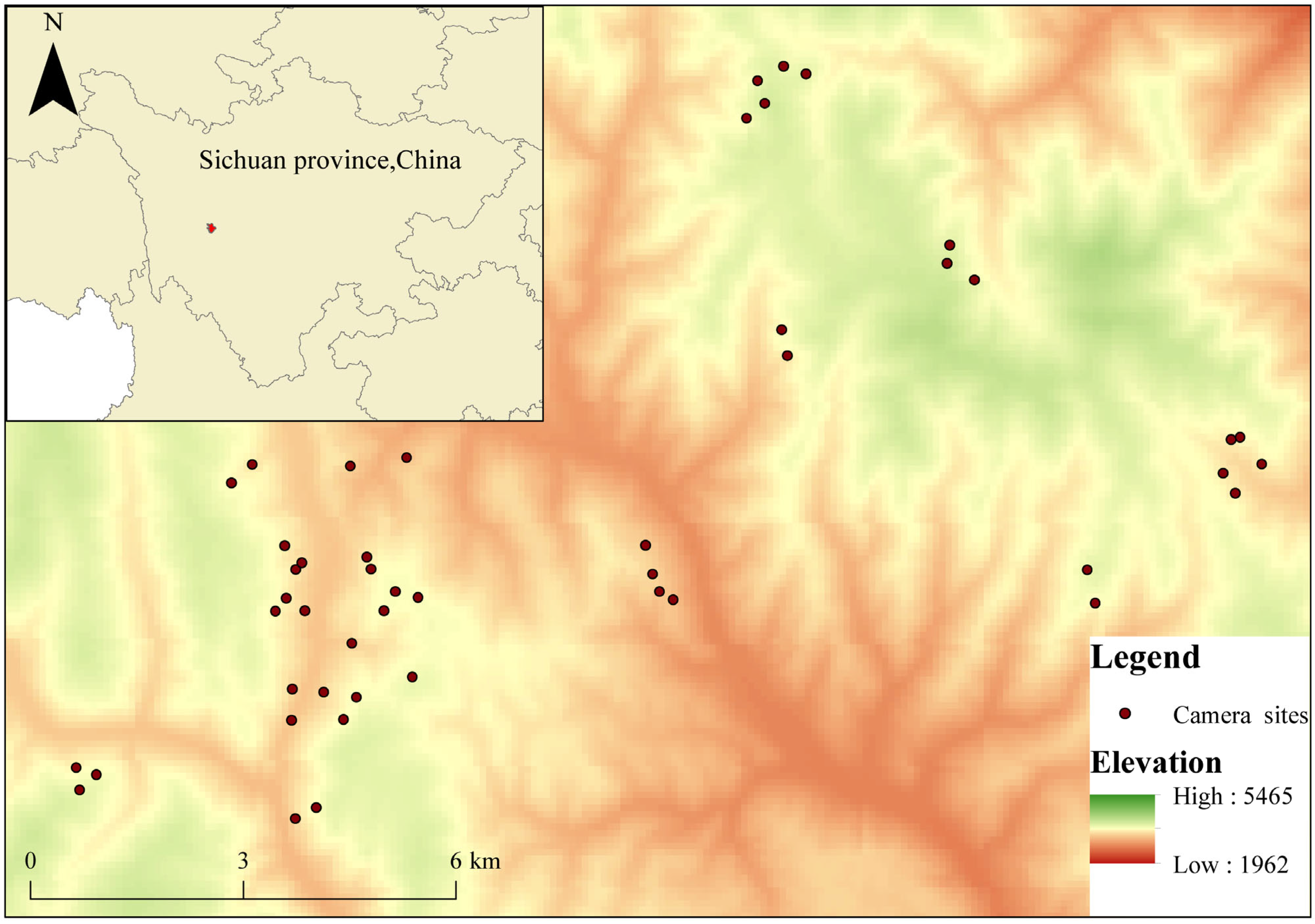
The study area is located in Yajiang County, Ganzi Tibetan Autonomous Prefecture, Sichuan Province, situated on the southeastern edge of the Qinghai–Tibet Plateau, in the midsection of the Hengduan Mountains, between the Daxue and Shaluli mountain ranges (Figure 1). The region exhibits diverse vegetation types with distinct vertical zonation. The distribution is as follows: below 3000 m, deciduous broadleaf forests and mixed coniferous-broadleaf forests dominate; between 3000 and 4000 m, mixed coniferous-broadleaf forests, coniferous forests, and oak forests (e.g., Quercus species) are found; above 4000 m, alpine meadows predominate; above 4500 m, alpine screes and sparse vegetation on rocky flows are dominant. The area receives an average annual precipitation of 705 mm, with the rainy season concentrated between May and September. From November to April of the following year, the area is generally covered with snow. The Eruo River, a secondary tributary of the Yalong River, flows from north to south along the eastern side of Kazila Mountain. The region is rich in wildlife, home to several nationally protected ungulate species in China, including the forest musk deer, alpine musk deer, tufted deer, Chinese serow, Chinese goral, and sambar. For this study, we primarily conducted field research in the high-altitude core area of Kazila Mountain. The geographical coordinates of the study area range from 100°33′ E to 100°47′ E and 29°54′ N to 30°09′ N, with an elevation range of approximately 3100 to 4300 m, and an average altitude of around 3800 m.
Figure 1.
Infrared Camera Locations in the Kazila Mountain region of southwestern China.
2.2. Camera Trap Deployment
From July 2023 to May 2025, a total of 54 infrared camera (model LTI-6511, LTI Industrial Company Ltd., Shenzhen, China) traps were deployed in the Kazila Mountain region (see Figure 1). The locations of the camera traps were carefully selected based on a variety of natural factors and practical considerations to ensure the representativeness and scientific validity of the monitoring data. The selection of camera trap sites strictly followed ecological and geographical standards to accurately reflect the distribution of wildlife in the region.
The selection of camera trap locations took into account several factors, including habitat type, wildlife activity signs, geographical distribution, and topographical features. In terms of habitat type, areas with high canopy cover and open understory vegetation were specifically chosen, as these regions represent typical ecological environments of the area and facilitate coverage of different species’ activity spaces. Additionally, the cameras were placed in areas with frequent wildlife activity, such as animal corridors, water sources, or food resources, to ensure effective monitoring of various species. To avoid overlapping monitoring areas and ensure data independence, A distance of at least 500 m was maintained between most camera pairs, with the aim of minimizing the possibility of data duplication.
The cameras were installed on small- to medium-sized trees or shrubs at a height of 40–80 cm above the ground, and shrub and herbaceous vegetation within the monitoring area was cleared to reduce the risk of false triggers. For each camera station, geographic coordinates, habitat type, topographic features, distance to the nearest water source, and vegetation characteristics were recorded on-site using handheld GPS devices. The cameras were configured to capture three consecutive photos and record a 10 s video upon each trigger event, with a 10 s interval between triggers. Each image automatically recorded the date, time, and ambient temperature. Data were retrieved every 4 to 6 months, during which the batteries and memory cards were replaced, and cameras with poor image quality were adjusted as needed.
2.3. Data Analysis
2.3.1. Nocturnality Index (β)
To minimize repeated detections, records of the same species captured at the same camera station within a 30 min interval were treated as a single independent detection event [29]. To assess animal nocturnal activity patterns, we defined the period from 18:00 to 06:00 as nighttime and from 06:00 to 18:00 as daytime. We then used the nocturnality index (β) to determine whether each ungulate species exhibited nocturnal or diurnal activity patterns. This method is based on the calculation principle of the relative abundance index [30], and the index was computed using the following formula:
where Di is the number of independent valid photographs of species i taken during the nighttime period (18:00–06:00), and Ni is the total number of independent valid photographs of species i. β values > 0.54 indicate that the species is nocturnal. β values < 0.54 indicate diurnal activity. β values close to 0.54 suggest mixed activity with insignificant nocturnal behavior.
2.3.2. Kernel Density Analysis
We applied the kernel density estimation (KDE) method to assess the overall daily activity rhythms of ungulate species throughout the year within the study area [31]. To eliminate differences in daily sunrise and sunset times across seasons, we converted detection times for each species from standard clock time to relative solar time [32]. We divided the year into a warm season (May–September) and a cold season (October to April of the following year), and analyzed daily activity rhythms separately for each season. We generated kernel density curves using the “overlap” (v 0.3.9) and “activity” (v 1.3.4) packages in R (v 4.2.3). In the resulting plots, the x-axis represents time, while the y-axis indicates activity intensity—the probability of detecting the target species at a given time point. We used the densityPlot() function to visualize daily activity rhythms for individual species, while the overlapPlot() function allowed us to compare daily activity patterns of ungulates between the warm and cold seasons.
We quantified the degree of overlap in daily activity rhythms between seasonal periods and among multiple species using the overlap index (Δ), calculated with the overlapEst() function. This index estimates the similarity in activity patterns between species, with values ranging from 0 to 1. Higher values indicate greater overlap, and a value of Δ = 1 denotes complete overlap between the activity patterns of two species. Following Ridout & Linkie’s method [31], we used Δ4 when both species had sample sizes ≥ 50, and Δ1 when the smaller sample size was <50. To improve reliability and assess differences in activity rhythms, we performed 1000 bootstrap resamplings using the compareCkern() function from the “activity” package [33]. We classified the degree of overlap as follows: Δ ≥ 0.8 indicates high overlap; 0.5 ≤ Δ < 0.8 indicates moderate overlap; and Δ < 0.5 indicates low overlap [34].
2.3.3. Spatial Co-Occurrence Analysis
We used Pianka’s index (Oik) to evaluate spatial niche differentiation and coexistence among ungulate species. To account for variations in sampling effort across sites, we calculated the relative abundance index for each species at each site to assess spatial co-occurrence patterns. Pianka’s index (Oik) quantifies spatial niche overlap between species, ranging from 0 (no overlap) to 1 (complete overlap) [35]. We calculated the index using the following formula:
The formula shows that Pij and Pkj represent the ratio of independent detections of species i and species K at site j to the total independent detections of species. r refers to the total number of cameras.
Secondly, we used the number of independent valid detections as an indicator of activity intensity. To account for the uneven spatial distribution of camera traps, we first performed a kernel density analysis on all camera locations to obtain a local trap-density value for each station. We then standardized the activity intensity of each species at each station by dividing the number of independent detections by the corresponding trap-density value, yielding a trap-density-corrected activity intensity. We subsequently used this corrected activity intensity for spatial analyses.
To visualize the spatial distribution patterns, we used ESRI ArcGIS 10.8 to interpolate the corrected activity intensity values using the Inverse Distance Weighting (IDW) method. We conducted spatial statistical analyses using the Spatial Statistics Tools in ArcGIS, including global spatial autocorrelation analysis (Global Moran’s I) to examine overall spatial dependence [36], and high/low clustering analysis (Getis-Ord General G) to identify global clustering trends. Finally, we performed hotspot analysis (Getis-Ord Gi) using the Mapping Clusters tool to detect local clusters of high and low activity intensity for each species across the study area [37].
3. Results
3.1. Camera Monitoring Results
A total of 27,570 camera-days were accumulated from July 2023 to May 2025, yielding 6818 independent wildlife detections, of which 3291 belonged to ungulates (Table 1). Seven ungulate species were recorded, including two Class I National Protected Species in China (forest musk deer and alpine musk deer) and four Class II National Protected species in China (tufted deer, Chinese serow, sambar, and Chinese goral). Among all species, tufted deer showed a much higher detection frequency than the others, whereas Chinese goral and forest musk deer were rarely recorded. Due to their extremely small sample sizes, these two species were excluded from subsequent analyses.
Table 1.
Composition of Ungulate Species and Independent Detection Count.
3.2. Temporal Niche Differentiation Among Ungulate Species
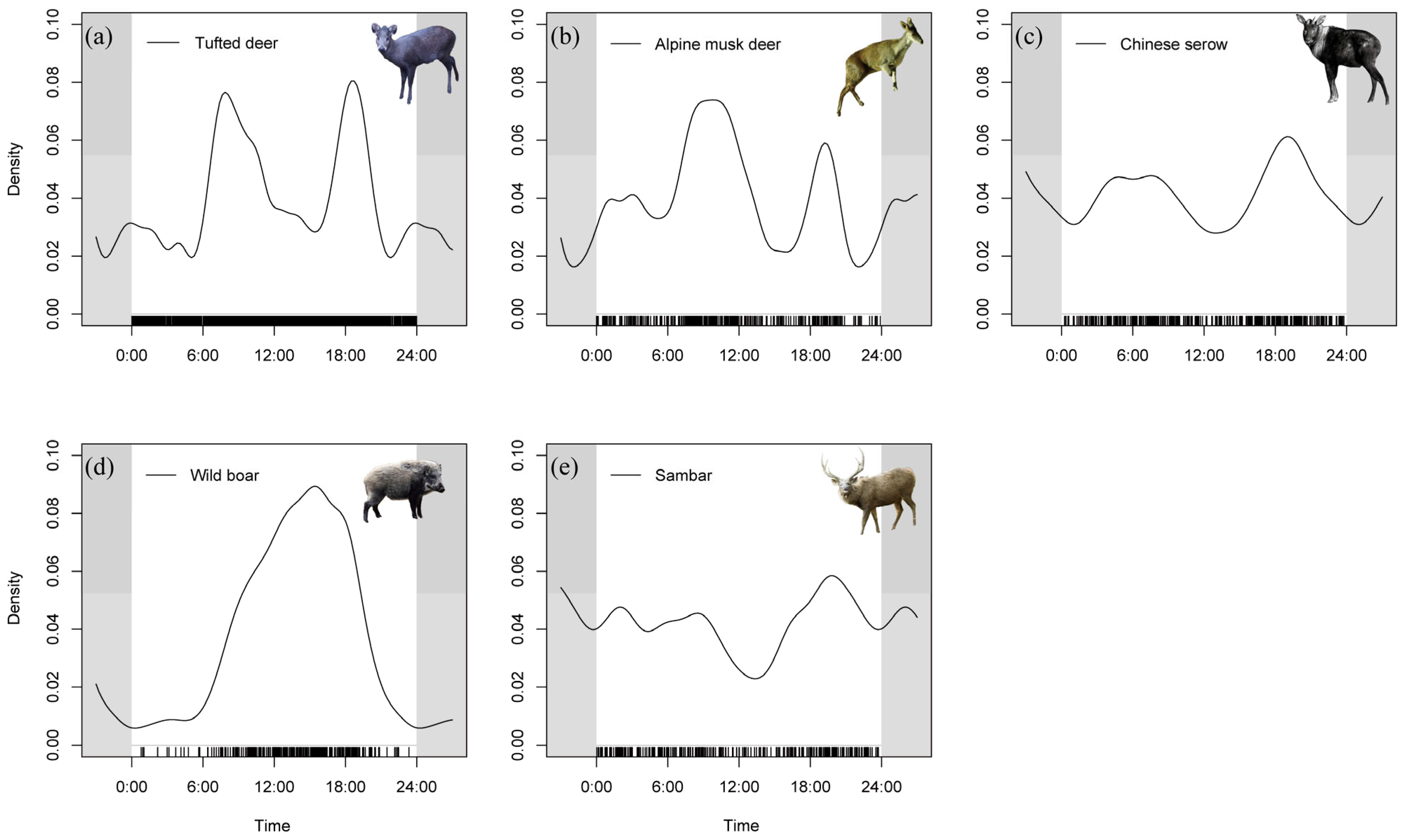
Based on the nocturnality analysis, tufted deer (β = 0.415), alpine musk deer (β = 0.438), and wild boar (β = 0.234) were identified as typical diurnal species. Both tufted deer and alpine musk deer exhibited distinct bimodal activity patterns. Tufted deer showed activity peaks at approximately 08:00 and 19:00 (Figure 2a), while alpine musk deer peaked around 09:00 and 19:00 (Figure 2b). In contrast, wild boar displayed a unimodal daily activity pattern, with a peak around 15:00 (Figure 2d). The Chinese serow (β = 0.534) showed no clear difference between daytime and nighttime activity, with activity distributed evenly throughout the 24 h cycle. It exhibited two activity peaks, one between 04:00 and 08:00 and another around 19:00 (Figure 2c). The sambar (β = 0.571) is nocturnal, with three minor activity peaks at approximately 02:00, 09:00, and 20:00, along with a noticeable trough around 12:00 (Figure 2e).
Figure 2.
Daily Activity Rhythm of Ungulates. (a) Tufted deer, (b) Alpine musk Deer, (c) Chinese serow, (d) Wild boar, (e) Sambar.
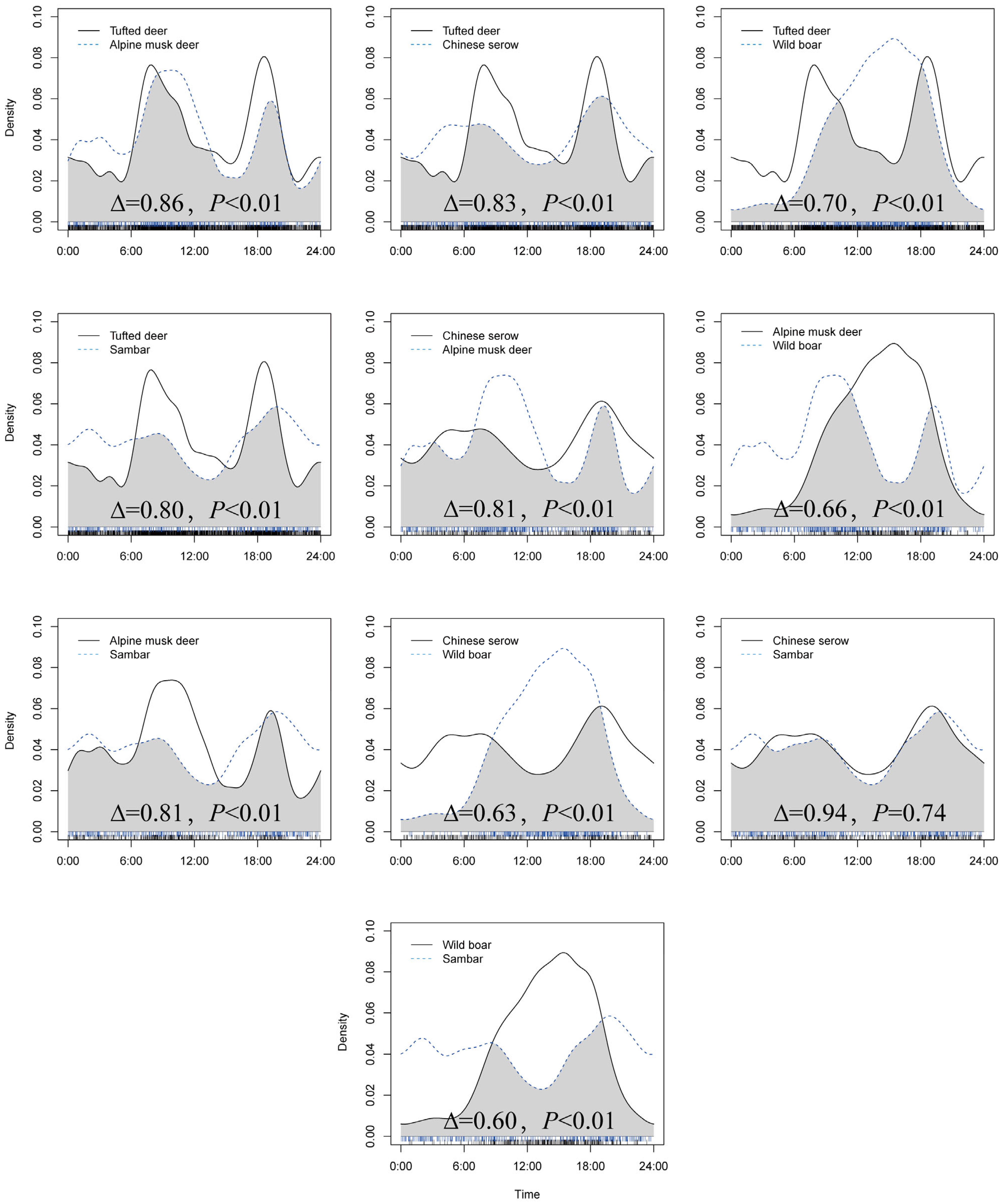
All species pairs exhibited varying degrees of overlap in their activity rhythms (Figure 3). The highest degree of overlap was observed between Chinese serow and sambar (∆ = 0.94, p > 0.05, Figure 3), indicating highly similar daily activity patterns. In contrast, the lowest overlap occurred between sambar and wild boar (∆ = 0.60, p < 0.01, Figure 3), whose activity rhythms differed substantially—wild boar’s activity peak coincided with the activity trough of sambar. For all other species pairs, daily activity rhythms differed significantly (p < 0.01).
Figure 3.
Comparison of Daily Activity Rhythm Differences Among Ungulate Species.
3.3. Seasonal Differentiation Among Ungulate Species
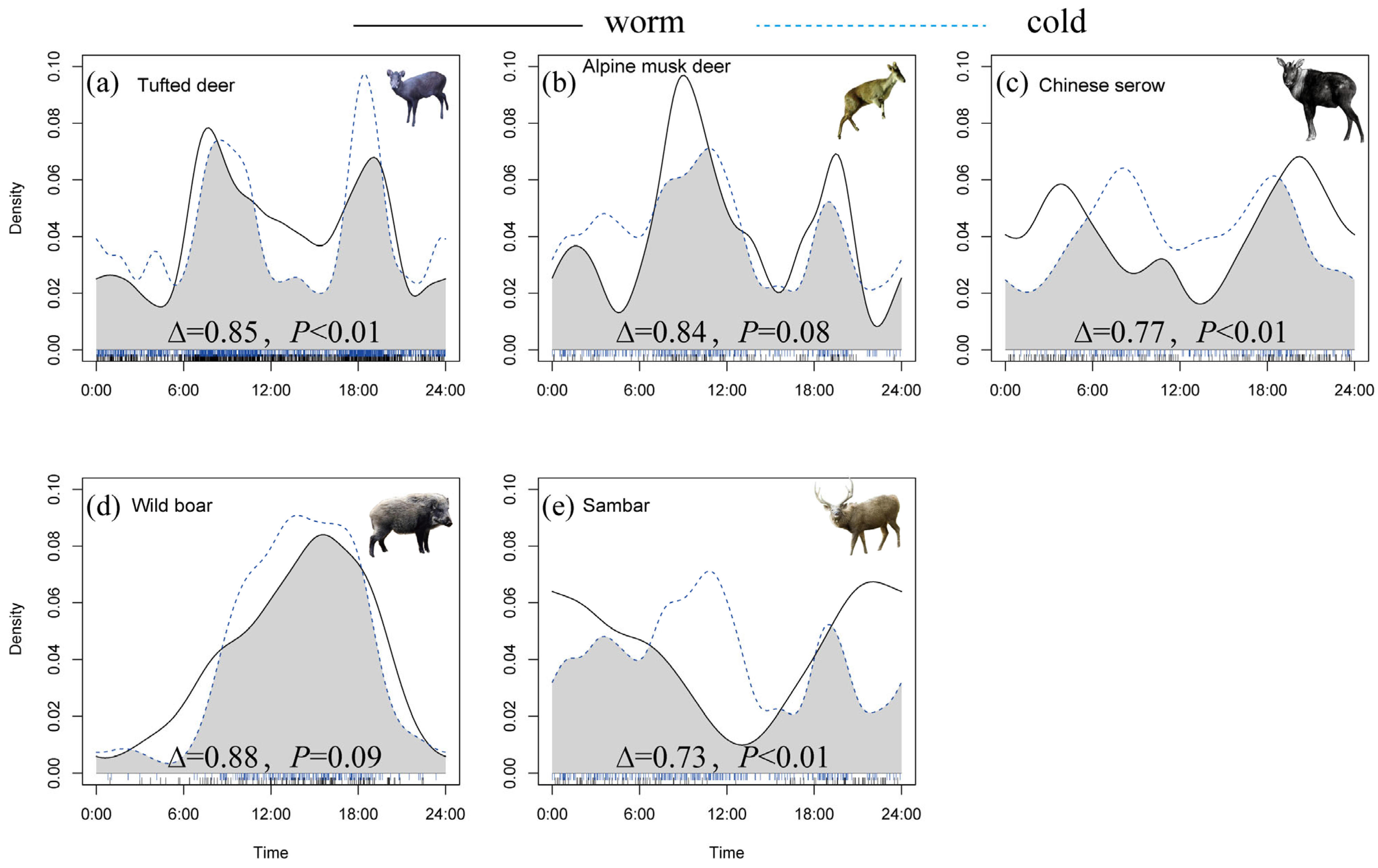
Seasonal comparisons revealed clear differences in daily activity rhythms among the ungulate species (Figure 4). Tufted deer, Chinese serow, and sambar exhibited significant seasonal shifts, whereas alpine musk deer and wild boar showed broadly consistent activity patterns across seasons.
Figure 4.
Comparison of Daily Activity Rhythm Differences of Ungulate Species Between Cold and Warm Seasons. (a) Tufted deer. (b) Alpine musk deer. (c) Chinese serow. (d) Wild boar. (e) Sambar.
Across species, seasonal changes were mainly reflected in the relative timing and intensity of morning and evening activity peaks. Tufted deer maintained a bimodal pattern year-round, but both peaks shifted toward later morning and earlier evening during the cold season, accompanied by reduced midday activity. Alpine musk deer also retained a consistent tri-modal pattern, with all peaks occurring slightly later in the cold season. Chinese serow displayed the most pronounced temporal shift, with both morning and evening peaks delayed during the cold season and daytime activity becoming more prominent. Wild boar preserved a unimodal pattern across seasons, though the timing of the single peak advanced in the cold season. Sambar showed the strongest seasonal contrast, shifting from a mainly nocturnal pattern in the warm season to a broadly diurnal distribution with two daytime peaks in the cold season.
We found notable differences in overlap patterns between the cold and warm seasons within the study area (Table 2). Overall, inter-species daily activity overlap was generally higher in the cold season. Among the ten species pairs formed by the five ungulate species, all pairs exhibited moderate to high overlap in both seasons. However, during the warm season, only two species pairs showed high overlap, while in the cold season, six species pairs exhibited high overlap. Additionally, in seven of the ten species pairs, the overlap index was higher in the cold season than in the warm season. Only three species pairs had higher overlap values in the warm season compared to the cold season.
Table 2.
Overlap of daily Activity Rhythms Among Five Ungulate Species in Kazila Mountain During the Cold and Warm Seasons.
3.4. Spatial Niche Differentiation Among Ungulate Species
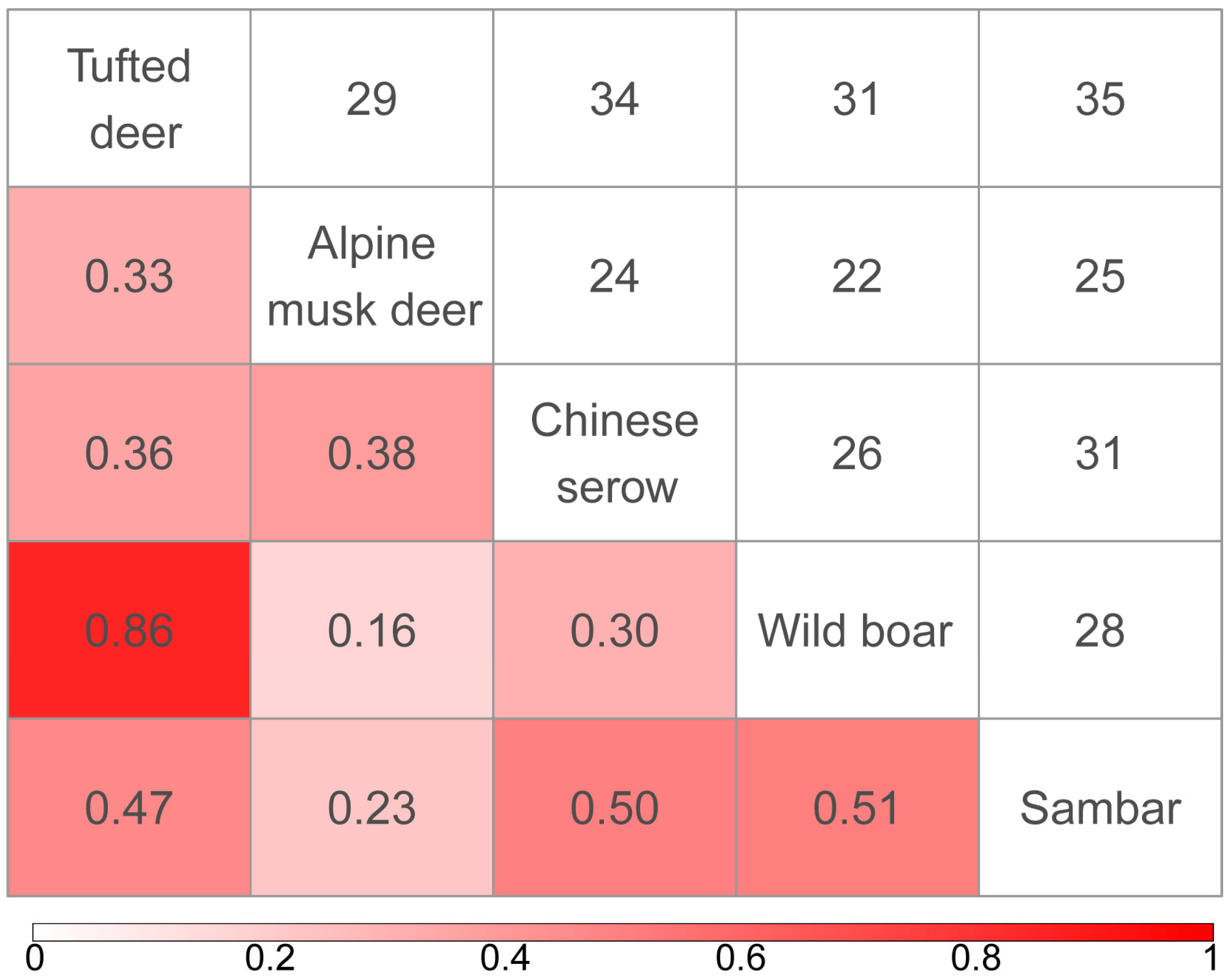
The spatial co-occurrence analysis of ungulate species in the study area revealed that spatial niche overlap indices (Oik) among the five species ranged from 0.16 to 0.86 (Figure 5). The highest spatial niche overlap occurred between tufted deer and wild boar (n = 31, Oik = 0.86), while the lowest was observed between alpine musk deer and wild boar (n = 22, Oik = 0.16).
Figure 5.
Spatial Niche Overlap among Ungulate Species. The lower-left diagonal shows the species’ niche overlap index (Pianka’s Index), and the upper-right diagonal shows the number of co-occurring sites of the species.
No significant spatial autocorrelation was detected in the activity intensity of the four ungulate species, other than tufted deer, with their distributions randomly dispersed across the study area (Table 3). In contrast, tufted deer exhibited significant positive spatial autocorrelation, with Moran’s I = 0.3055, Z = 2.4347, and p = 0.0149, indicating a spatially clustered distribution pattern. Further analysis using the Getis-Ord General G statistic (General G = 0.0296, Z = 2.3760, p = 0.0175) confirmed that the activity intensity of tufted deer formed high-value spatial clusters, suggesting a pronounced aggregation in their spatial distribution (Table 3).
Table 3.
Spatial Autocorrelation and Cluster Analysis of Activity Intensity for Each Species.
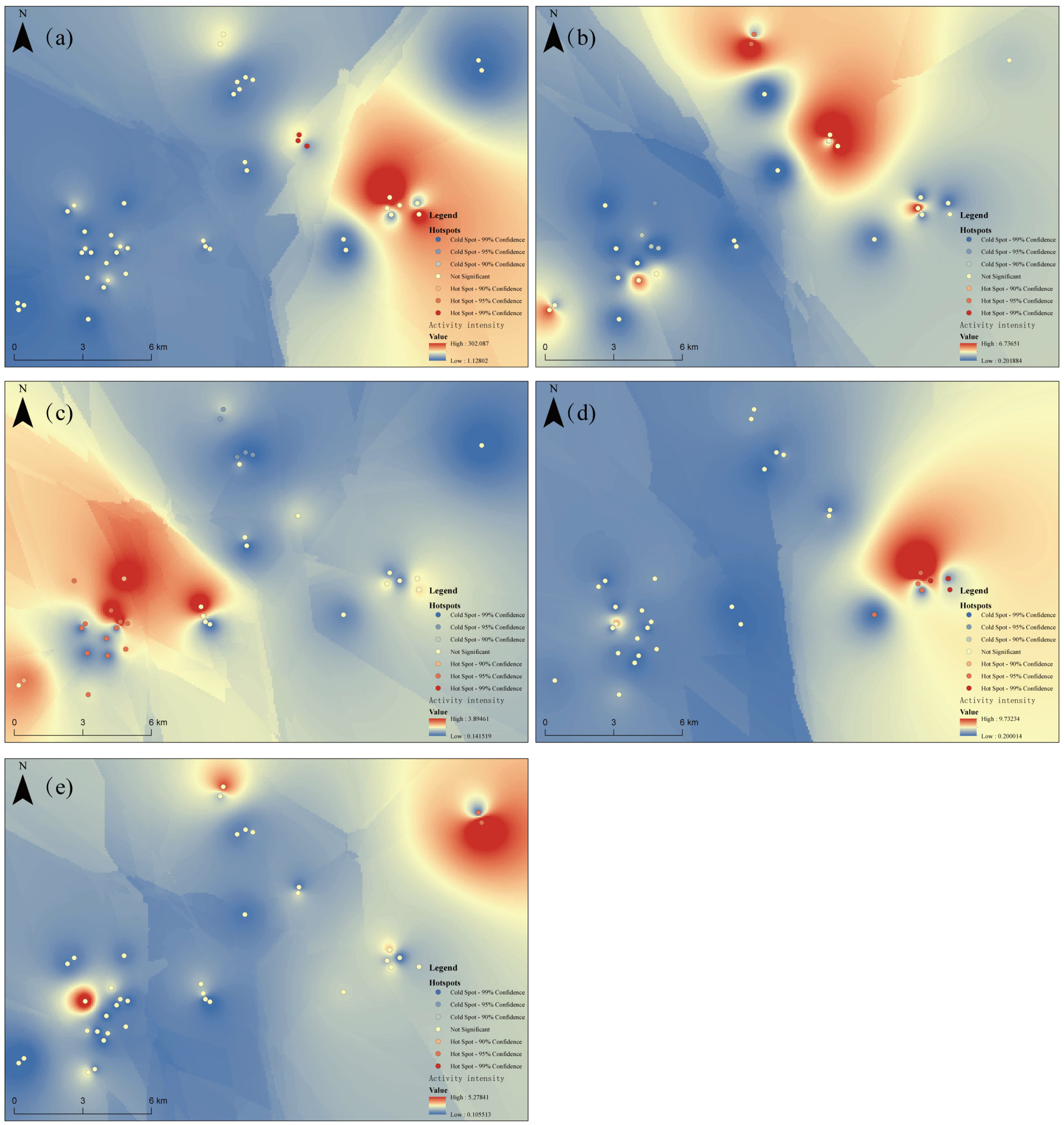
Further spatial hotspot analysis showed that all ungulate species exhibited some degree of spatial differentiation in their activity hotspots (Figure 6). Although the hotspot locations varied among species, tufted deer and wild boar displayed a high degree of similarity in their overall activity-intensity distribution patterns, indicating substantial spatial co-occurrence across general use areas. In contrast, the remaining species pairs showed largely segregated spatial distribution patterns, suggesting lower levels of spatial co-occurrence within their core high-use areas.
Figure 6.
Activity Hotspot Analysis of Ungulate Species. (a) Tufted deer. (b) Alpine musk deer. (c) Chinese serow. (d) Wild boar. (e) Sambar.
4. Discussion
4.1. Daily Activity Rhythms
The temporal separation of activity across diurnal, crepuscular, and nocturnal periods is recognized as an important mechanism for reducing competition and promoting species coexistence [38]. Diel activity rhythms are regulated by the combined influence of endogenous biological clocks and external factors such as genetic traits and seasonal variation [39]. Ungulate species commonly display substantial variation in diel activity patterns across different spatial scales [40].
In this study, pronounced interspecific differences in diel activity rhythms were observed among the focal ungulate species. Except for Chinese serow and sambar, most species pairs exhibited significant differences in their activity patterns, suggesting that closely related species may undergo temporal niche differentiation when sympatrically distributed, driven by differences in environmental adaptation and interspecific competition [41].
Comparisons between our findings and studies from other regions revealed both similarities and discrepancies. The crepuscular bimodal activity patterns of tufted deer and alpine musk deer were consistent with observations from the Gongga Mountain region in Sichuan [24], indicating that crepuscular activity may represent a common behavioral strategy among forest-dwelling ungulates in the mountainous regions of southwestern China. The dawn-and-dusk peaks of Chinese serow were also consistent with findings from Fanjingshan [42], and the unimodal diurnal activity of wild boar aligned with reports from Fanjingshan and other mountainous areas of southwestern China [42,43]. However, several species in this study exhibited diel activity patterns distinct from those reported elsewhere. For instance, tufted deer showed a unimodal diurnal pattern in Fanjingshan [42], whereas alpine musk deer in Tibet were predominantly nocturnal [44]. In this study, Chinese serow exhibited no pronounced activity peaks and maintained activity throughout the day, unlike the afternoon and midnight peaks reported from Gaoligong Mountain [45] or the predominantly diurnal activity observed in the Qinling Mountains [26]. Sambar displayed a three-peak diel pattern, which differed from the bimodal pattern documented in Gongga Mountain and the unimodal nocturnal pattern observed in southwestern China [24,43]. In addition, studies from Europe and the Mediterranean have commonly characterized wild boar as nocturnal [46,47,48], contrasting sharply with the diurnal tendency observed in our study area. These regional discrepancies underscore the strong plasticity of ungulate diel activity rhythms.
Multiple ecological factors may account for such variation. First, environmental heterogeneity—including differences in climate, elevation, vegetation structure, and seasonal resource availability—can strongly influence the activity budgets of ungulates [49,50]. Second, regional differences in community composition and interaction networks—such as variation in predator distributions, interspecific competition, and levels of human disturbance—can reshape diel activity strategies [51,52]. Moreover, human disturbance itself is an important driver of wildlife activity rhythms [53]. The Kazila Mountain region is characterized by steep terrain, dense forest cover, and pronounced seasonality, and these unique ecological conditions likely shape the temporal strategies of local ungulate populations.
4.2. Seasonal Differences in Daily Activity Rhythms
Changes in resource availability and climatic conditions can drive seasonal shifts in activity patterns, reflecting the intensity of interspecific competition among sympatric species [54,55]. Our analysis of seasonal daily activity patterns showed that tufted deer, Chinese serow, and sambar exhibited significant differences between the cold and warm seasons, while alpine musk deer and wild boar showed no significant seasonal variation. For all species, activity peaks shifted across seasons: morning peaks were delayed, and evening peaks occurred earlier in the cold season. These shifts suggest that ungulates adjust their activity schedules to cope with seasonal environmental changes.
Two primary mechanisms may explain these seasonal shifts: (1) Seasonal factors, such as temperature, precipitation, and food availability, have cumulative effects on animal physiology, movement ecology, foraging strategies, and survival [26,56,57]. In the cold season, lower nighttime and crepuscular temperatures, combined with reduced food quality, may constrain activity. In contrast, higher midday temperatures prompt animals to concentrate their activity during warmer periods, minimizing the energetic costs of thermoregulation. (2) In the cold season, limited availability of local edible fungi, such as cordyceps and matsutake, and reduced human disturbance due to winter herding practices may create more favorable conditions for ungulates to be active around midday.
The seasonal analysis of temporal niche overlap revealed higher daily activity overlap in the cold season compared to the warm season. For species pairs excluding Chinese serow and sambar, the overlap indices generally decreased in the cold season, suggesting niche separation in response to intensified competition. However, pairs involving Chinese serow and sambar showed higher overlap in the cold season, possibly due to reduced nocturnal foraging opportunities, leading to a shift in daily activity towards the daytime to adapt to temperature fluctuations [58,59]. This shift could increase competition with primarily diurnal species. Additionally, the consistently high activity overlap between tufted deer and alpine musk deer, and between sambar and Chinese serow, suggests that temporal niche partitioning is not the main mechanism driving coexistence for these species pairs. Instead, spatial or trophic niche differentiation may help mitigate competition and support their coexistence.
4.3. Spatial Co-Occurrence Patterns
Different species vary in their resource selection and habitat use due to the combined influence of multiple ecological factors; therefore, daily activity rhythms alone cannot fully explain interspecific interactions [60,61]. Spatial partitioning is likewise an important mechanism that mitigates competition and facilitates long-term coexistence among sympatric species [62].
Interspecific differences in habitat selection can effectively reduce competition for space and other environmental resources, thus promoting the coexistence of sympatric species [63]. In this study, except for tufted deer and wild boar, the other species exhibited relatively low spatial overlap. Such significant differences in habitat selection help minimize their competition for the same resources, effectively reducing interspecific competition and facilitating stable coexistence. In contrast, tufted deer and wild boar showed higher spatial niche overlap, indicating potential habitat competition between the two species. However, their long-term coexistence in the region suggests that differences in other ecological dimensions may mitigate the competitive pressure associated with spatial overlap. First, their temporal overlap was moderate; therefore, even when using the same areas, they did not always utilize them at the same time, and partial temporal segregation may reduce direct encounters and immediate competition. Secondly, wild boar exhibit broad omnivory and high ecological plasticity [26,64], allowing them to exploit a wide range of resources not utilized by tufted deer, further reducing the potential for resource competition.
Taken together, even when species exhibit substantial spatial overlap, differences in temporal activity and resource-use strategies can still reduce direct competition and promote coexistence. This highlights that spatial niche overlap should not be interpreted in isolation; rather, it must be considered alongside differentiation in other niche dimensions to more fully understand the coexistence mechanisms of sympatric species.
5. Conclusions
Spatiotemporal niche differentiation plays a crucial role in shaping behavioral adaptation and facilitating long-term coexistence among sympatric ungulates. Based on infrared camera-trap data, this study systematically examined the temporal and spatial niche relationships of five ungulate species in the Kazila Mountain region. Overall, the species exhibited varying degrees of differentiation in daily activity rhythms, seasonal behavioral adjustments, and spatial habitat use, and such multidimensional niche partitioning effectively reduced potential competitive pressure. Even where spatial overlap occurred, differences in temporal activity and resource-use strategies buffered direct competition, supporting the stable coexistence of these sympatric ungulates. These findings provide essential baseline information on interspecific interactions and offer a scientific reference for habitat management and conservation planning in the region.
Author Contributions
Q.J. contributed to the conceptualization, methodology, formal analysis, and writing of the original draft. J.X. and M.H. provided the conceptualization, methodology, writing—review and editing, investigation, and funding support. Z.Z. provided conceptual guidance and contributed to writing—review and editing. H.X., H.Z., Y.L., L.K., L.Y., Y.S., and J.Z. all contributed to the resources and investigation. J.F. contributed to the investigation and software. A.M. contributed to the investigation and Writing—review and editing. Q.L. contributed to the investigation and Methodology. All authors have read and agreed to the published version of the manuscript.
Funding
This study was supported by the National Natural Science Foundation of China (grant no. 32470516 and 31900337), Sichuan Natural Science Foundation (grant no. 2024NSFSC2082), Giant Pandas International Cooperation Foundation of State Forestry Administration (2023), and the Innovation Team Funds of China West Normal University (grant no. KCXTD2022-7).
Institutional Review Board Statement
Not applicable. No ethical approval was required for the non-invasive camera trapping method.
Informed Consent Statement
Not applicable.
Data Availability Statement
The camera-trapping data are owned by the China West Normal University and are authorized for use in this study.
Acknowledgments
We are grateful to the editors and reviewers for their valuable comments, as well as to other ones involved in the investigation.
Conflicts of Interest
The authors declare no conflicts of interest.
References
- Hardin, G. The competitive exclusion principle. Science 1960, 131, 1292–1297. [Google Scholar] [CrossRef]
- Ji, Y.; Liu, F.; Li, D.; Chen, Z.; Chen, P. Spatial–Temporal Patterns of Sympatric Asiatic Black Bears (Ursus thibetanus) and Brown Bears (Ursus arctos) in Northeastern China. Animals 2022, 12, 1262. [Google Scholar] [CrossRef]
- MacArthur, R.; Levins, R. The Limiting Similarity, Convergence, and Divergence of Coexisting Species. Am. Nat. 1967, 101, 377–385. [Google Scholar] [CrossRef]
- Abrams, P. The Theory of Limiting Similarity. Annu. Rev. Ecol. Syst. 1983, 14, 359–376. [Google Scholar] [CrossRef]
- Schoener, T.W. Resource Partitioning in Ecological Communities. Science 1974, 185, 27–39. [Google Scholar] [CrossRef] [PubMed]
- Tracy, C.R.; Christian, K.A. Ecological Relations Among Space, Time, and Thermal Niche Axes. Ecology 1986, 67, 609–615. [Google Scholar] [CrossRef]
- Letten, A.D.; Ke, P.; Fukami, T. Linking modern coexistence theory and contemporary niche theory. Ecol. Monogr. 2017, 87, 161–177. [Google Scholar] [CrossRef]
- Costa-Pereira, R.; Araújo, M.S.; Souza, F.L.; Ingram, T. Competition and resource breadth shape niche variation and overlap in multiple trophic dimensions. Proc. R. Soc. B 2019, 286, 20190369. [Google Scholar] [CrossRef]
- Pastore, A.I.; Barabás, G.; Bimler, M.D.; Mayfield, M.M.; Miller, T.E. The evolution of niche overlap and competitive differences. Nat. Ecol. Evol. 2021, 5, 330–337. [Google Scholar] [CrossRef]
- Croose, E.; Bled, F.; Fowler, N.L.; Beyer, D.E., Jr.; Belant, J.L. American marten and fisher do not segregate in space and time during winter in a mixed-forest system. Ecol. Evol. 2019, 9, 4906–4916. [Google Scholar] [CrossRef]
- Cusack, J.J.; Dickman, A.J.; Kalyahe, M.; Rowcliffe, J.M.; Carbone, C.; Macdonald, D.W.; Coulson, T. Revealing kleptoparasitic and predatory tendencies in an African mammal community using camera traps: A comparison of spatiotemporal approaches. Oikos 2017, 126, 812–822. [Google Scholar] [CrossRef]
- Tahtinen, B.E.; Murray, B.D.; Webster, C.; Tarasoff, C.; Burton, A. Does Ungulate Foraging Behavior in Forest Canopy Gaps Produce a Spatial Subsidy with Cascading Effects on Vegetation. For. Sci. 2014, 60, 819–829. [Google Scholar] [CrossRef]
- Woodward, A.; Jenkins, K.J.; Harmon, M.E. Plant community succession following ungulate exclusion in a temperate rainforest. Ecosphere 2021, 12, e03876. [Google Scholar] [CrossRef]
- Lillian, S.; Redak, R.A.; Daugherty, M.P. Assessing the Role of Differential Herbivore Performance Among Plant Species in Associational Effects Involving the Invasive Stink Bug Bagrada hilaris (Hemiptera: Pentatomidae). Environ. Entomol. 2019, 48, 114–121. [Google Scholar] [CrossRef]
- Rooney, T.P. High white-tailed deer densities benefit graminoids and contribute to biotic homogenization of forest ground-layer vegetation. Plant Ecol. 2009, 202, 103–111. [Google Scholar] [CrossRef]
- Schulze, E.D.; Bouriaud, O.B.; Wäldchen, J.; Eisenhauer, N.; Walentowski, H.; Seele, C.; Heinze, E.; Pruschitzki, U.; Dănilă, G.; Marin, G.; et al. Ungulate browsing causes species loss in deciduous forests independent of community dynamics and silvicultural management in Central and Southeastern Europe. Ann. For. Res. 2014, 57, 267–288. [Google Scholar] [CrossRef]
- Kasahara, M.; Fujii, S.; Tanikawa, T.; Mori, A.S. Ungulates decelerate litter decomposition by altering litter quality above and below ground. Eur. J. For. Res. 2016, 135, 849–856. [Google Scholar] [CrossRef]
- Mamo, Y.; Asefa, A.; Mengesha, G. Habitat use of ungulates in Bale Mountains National Park, Ethiopia. Afr. J. Ecol. 2015, 53, 512–520. [Google Scholar] [CrossRef]
- Viana, D.S.; Granados, J.E.; Fandos, P.; Pérez, J.M.; Cano-Manuel, F.J.; Burón, D.; Fandos, G.; Párraga Aguado, M.Á.; Figuerola, J.; Soriguer, R.C. Linking seasonal home range size with habitat selection and movement in a mountain ungulate. Mov. Ecol. 2018, 6, 1. [Google Scholar] [CrossRef]
- Semenzato, P.; Cagnacci, F.; Ossi, F.; Eccel, E.; Morellet, N.; Hewison, A.J.M.; Sturaro, E.; Ramanzin, M. Behavioural heat-stress compensation in a cold-adapted ungulate: Forage-mediated responses to warming Alpine summers. Ecol. Lett. 2020, 24, 1556–1568. [Google Scholar] [CrossRef]
- Spitzer, R.; Felton, A.; Landman, M.; Singh, N.J.; Widemo, F.; Cromsigt, J.P.G.M. Fifty years of European ungulate dietary studies: A synthesis. Oikos 2020, 129, 1668–1680. [Google Scholar] [CrossRef]
- Ikeda, T.; Nakamori, S.; Ando, M.; Shirakawa, T.; Okamoto, T.; Suzuki, M. Seasonal Diel Activity Patterns of Three Sympatric Ungulates in Forested Area in Central Japan. Mamm. Study 2021, 47, 47–56. [Google Scholar] [CrossRef]
- Shakeri, Y.N.; White, K.S.; Waite, J.N. Staying close to home: Ecological constraints on space use and range fidelity in a mountain ungulate. Ecol. Evol. 2021, 11, 11051–11064. [Google Scholar] [CrossRef] [PubMed]
- You, Z.; Lu, B.; Du, B.; Liu, W.; Jiang, Y.; Ruan, G.; Yang, N. Spatio-Temporal Niche of Sympatric Tufted Deer (Elaphodus cephalophus) and Sambar (Rusa unicolor) Based on Camera Traps in the Gongga Mountain National Nature Reserve, China. Animals 2022, 12, 2694. [Google Scholar] [CrossRef]
- Karanth, K.K. Wildlife in the Matrix: Spatio-Temporal Patterns of Herbivore Occurrence in Karnataka, India. Environ. Manag. 2015, 57, 189–206. [Google Scholar] [CrossRef]
- Li, J.; Xue, Y.; Liao, M.; Dong, W.; Wu, B.; Li, D. Temporal and Spatial Activity Patterns of Sympatric Wild Ungulates in Qinling Mountains, China. Animals 2022, 12, 1666. [Google Scholar] [CrossRef]
- Frey, S.; Fisher, J.T.; Burton, A.C.; Volpe, J.P. Investigating animal activity patterns and temporal niche partitioning using camera-trap data: Challenges and opportunities. Remote Sens. Ecol. Conserv. 2017, 3, 123–132. [Google Scholar] [CrossRef]
- Zhang, D.; An, B.; Chen, L.; Sun, Z.; Mao, R.; Zhao, C.; Zhang, L. Camera Trapping Reveals Spatiotemporal Partitioning Patterns and Conservation Implications for Two Sympatric Pheasant Species in the Qilian Mountains, Northwestern China. Animals 2022, 12, 1657. [Google Scholar] [CrossRef]
- Feng, J.; Sun, Y.; Li, H.; Xiao, Y.; Zhang, D.; Smith, J.L.D.; Ge, J.; Wang, T. Assessing mammal species richness and occupancy in a Northeast Asian temperate forest shared by cattle. Divers. Distrib. 2021, 27, 857–872. [Google Scholar] [CrossRef]
- O’Brien, T.G.; Kinnaird, M.F.; Wibisono, H.T. Crouching tigers, hidden prey: Sumatran tiger and prey populations in a tropical forest landscape. Anim. Conserv. 2003, 6, 131–139. [Google Scholar] [CrossRef]
- Ridout, M.S.; Linkie, M. Estimating overlap of daily activity patterns from camera trap data. J. Agric. Biol. Environ. Stat. 2009, 14, 322–337. [Google Scholar] [CrossRef]
- Nouvellet, P.; Rasmussen, G.S.A.; Macdonald, D.W.; Courchamp, F. Noisy clocks and silent sunrises: Measurement methods of daily activity pattern. J. Zool. 2011, 286, 179–184. [Google Scholar] [CrossRef]
- Rowcliffe, J.M.; Kays, R.; Kranstauber, B.; Carbone, C.; Jansen, P.A. Quantifying levels of animal activity using camera trap data. Methods Ecol. Evol. 2014, 5, 1170–1179. [Google Scholar] [CrossRef]
- Tian, C.; Zhang, Y.; Liu, Z.; Dayananda, B.; Fu, X.; Yuan, D.; Tu, Z.; Luo, C.; Li, J. Temporal niche patterns of large mammals in Wanglang National Nature Reserve, China. Glob. Ecol. Conserv. 2020, 22, e01015. [Google Scholar] [CrossRef]
- Pianka, E.R. Niche Overlap and Diffuse Competition. Proc. Natl. Acad. Sci. USA 1974, 71, 2141–2145. [Google Scholar] [CrossRef]
- Tokarz, R.; Novak, R.J. Spatial–temporal distribution of Anopheles larval habitats in Uganda using GIS/remote sensing technologies. Malar. J. 2018, 17, 420. [Google Scholar] [CrossRef]
- Kouris, A.D.; Christopoulos, A.; Vlachopoulos, K.; Christopoulou, A.; Dimitrakopoulos, P.G.; Zevgolis, Y.G. Spatiotemporal Patterns of Reptile and Amphibian Road Fatalities in a Natura 2000 Area: A 12-Year Monitoring of the Lake Karla Mediterranean Wetland. Animals 2024, 14, 708. [Google Scholar] [CrossRef]
- Broekhuis, F.; Cozzi, G.; Valeix, M.; McNutt, J.W.; Macdonald, D.W. Risk avoidance in sympatric large carnivores: Reactive or predictive? J. Anim. Ecol. 2013, 82, 1098–1105. [Google Scholar] [CrossRef]
- Kronfeld-Schor, N.; Dayan, T. Partitioning of Time as an Ecological Resource. Annu. Rev. Ecol. Syst. 2003, 34, 153–181. [Google Scholar] [CrossRef]
- Kang, D.; Lv, J.; Li, S.; Chen, X.; Wang, X.; Li, J. Integrating indices to evaluate the effect of artificial restoration based on different comparisons in the Wanglang Nature Reserve. Ecol. Indic. 2018, 91, 423–428. [Google Scholar] [CrossRef]
- Davies, A.B.; Tambling, C.J.; Marneweck, D.G.; Ranc, N.; Druce, D.J.; Cromsigt, J.P.G.M.; Le Roux, E.; Asner, G.P. Spatial heterogeneity facilitates carnivore coexistence. Ecology 2021, 102, e03319. [Google Scholar] [CrossRef] [PubMed]
- Xiang, D.; Meng, B.; Xie, B.; Huang, X.; Wang, C.; Ran, J.; Su, H.; Zhang, M. Daily activity rhythm of sympatric ungulate species in Fanjingshan Reserve, China. Glob. Ecol. Conserv. 2024, 56, e03271. [Google Scholar] [CrossRef]
- Li, Q.; Zhang, Q.; Jiang, Q.; Zhou, H.; Zhang, Z.; Zhou, H.; Wei, W.; Hong, M. Daily Activity Rhythms of Animals in the Southwest Mountains, China: Influences of Interspecific Relationships and Seasons. Animals 2024, 14, 2842. [Google Scholar] [CrossRef] [PubMed]
- Li, X.; Bleisch, W.V.; Jiang, X. Unveiling a wildlife haven: Occupancy and activity patterns of mammals at a Tibetan sacred mountain. Eur. J. Wildl. Res. 2018, 64, 64. [Google Scholar] [CrossRef]
- Chen, Y.; Xiao, Z.; Zhang, L.; Wang, X.; Li, M.; Xiang, Z. Activity Rhythms of Coexisting Red Serow and Chinese Serow at Mt. Gaoligong as Identified by Camera Traps. Animals 2019, 9, 1071. [Google Scholar] [CrossRef]
- Brivio, F.; Grignolio, S.; Brogi, R.; Benazzi, M.; Bertolucci, C.; Apollonio, M. An analysis of intrinsic and extrinsic factors affecting the activity of a nocturnal species: The wild boar. Mamm. Biol. 2017, 84, 73–81. [Google Scholar] [CrossRef]
- Yildiz, F.; Uzun, A. Daily Activity Patterns and Overlap Activity of Medium–Large Mammals in Sülüklü Lake Nature Park, Western Black Sea Region, Türkiye. Ecol. Evol. 2024, 14, e70654. [Google Scholar] [CrossRef]
- Rossa, M.; Lovari, S.; Ferretti, F. Spatiotemporal patterns of wolf, mesocarnivores and prey in a Mediterranean area. Behav. Ecol. Sociobiol. 2021, 75, 32. [Google Scholar] [CrossRef]
- Noor, A.; Mir, Z.R.; Veeraswami, G.G.; Habib, B. Activity patterns and spatial co-occurrence of sympatric mammals in the moist temperate forest of the Kashmir Himalaya, India. Folia Zool. 2017, 66, 231–241. [Google Scholar] [CrossRef]
- Gordigiani, L.; Viviano, A.; Brivio, F.; Grignolio, S.; Lazzeri, L.; Marcon, A.; Mori, E. Carried away by a moonlight shadow: Activity of wild boar in relation to nocturnal light intensity. Mamm. Res. 2021, 67, 39–49. [Google Scholar] [CrossRef]
- Mason, T.H.E.; Stephens, P.A.; Apollonio, M.; Willis, S.G. Predicting potential responses to future climate in an alpine ungulate: Interspecific interactions exceed climate effects. Glob. Chang. Biol. 2014, 20, 3872–3882. [Google Scholar] [CrossRef] [PubMed]
- Vallejo-Vargas, A.F.; Sheil, D.; Semper-Pascual, A.; Beaudrot, L.; Ahumada, J.A.; Akampurira, E.; Bitariho, R.; Espinosa, S.; Estienne, V.; Jansen, P.A.; et al. Consistent diel activity patterns of forest mammals among tropical regions. Nat. Commun. 2022, 13, 7102. [Google Scholar] [CrossRef] [PubMed]
- Salvatori, M.; Oberosler, V.; Augugliaro, C.; Krofel, M.; Rovero, F. Effects of free-ranging livestock on occurrence and interspecific interactions of a mammalian community. Ecol. Appl. 2022, 32, e2644. [Google Scholar] [CrossRef] [PubMed]
- Monterroso, P.; Alves, P.C.; Ferreras, P. Plasticity in circadian activity patterns of mesocarnivores in Southwestern Europe: Implications for species coexistence. Behav. Ecol. Sociobiol. 2014, 68, 1403–1417. [Google Scholar] [CrossRef]
- Ikeda, T.; Uchida, K.; Matsuura, Y.; Takahashi, H.; Yoshida, T.; Kaji, K.; Koizumi, I. Seasonal and Diel Activity Patterns of Eight Sympatric Mammals in Northern Japan Revealed by an Intensive Camera-Trap Survey. PLoS ONE 2016, 11, e0163602. [Google Scholar] [CrossRef]
- Bogdan, V.; Jůnek, T.; Vymyslická, P.J. Temporal overlaps of feral cats with prey and competitors in primary and human-altered habitats on Bohol Island, Philippines. PeerJ 2016, 4, e2288. [Google Scholar] [CrossRef]
- O’Kane, C.A.J.; Macdonald, D.W. Seasonal influences on ungulate movement within a fenced South African reserve. J. Trop. Ecol. 2018, 34, 200–203. [Google Scholar] [CrossRef]
- Mori, E.; Bagnato, S.; Serroni, P.; Sangiuliano, A.; Rotondaro, F.; Marchianò, V.; Cascini, V.; Poerio, L.; Ferretti, F. Spatiotemporal mechanisms of coexistence in an European mammal community in a protected area of southern Italy. J. Zool. 2019, 310, 232–245. [Google Scholar] [CrossRef]
- Wolfson, D.W.; Schlichting, P.E.; Boughton, R.K.; Miller, R.S.; Vercauteren, K.C.; Lewis, J.S. Comparison of daily activity patterns across seasons using GPS telemetry and camera trap data for a widespread mammal. Ecosphere 2023, 14, e4728. [Google Scholar] [CrossRef]
- Schoener, T.W. The Anolis Lizards of Bimini: Resource Partitioning in a Complex Fauna. Ecology 1968, 49, 704–726. [Google Scholar] [CrossRef]
- Matsuo, R.; Ochiai, K. Dietary Overlap Among Two Introduced and One Native Sympatric Carnivore Species, the Raccoon, the Masked Palm Civet, and the Raccoon Dog, in Chiba Prefecture, Japan. Mamm. Study 2009, 34, 187–194. [Google Scholar] [CrossRef]
- Chesson, P. Mechanisms of Maintenance of Species Diversity. Annu. Rev. Ecol. Syst. 2000, 31, 343–366. [Google Scholar] [CrossRef]
- Parra, G.J. Resource partitioning in sympatric delphinids: Space use and habitat preferences of Australian snubfin and Indo-Pacific humpback dolphins. J. Anim. Ecol. 2006, 75, 862–874. [Google Scholar] [CrossRef]
- Liu, X.; Wu, P.; Shao, X.; Songer, M.; Cai, Q.; He, X.; Zhu, Y. Diversity and activity patterns of sympatric animals among four types of forest habitat in Guanyinshan Nature Reserve in the Qinling Mountains, China. Environ. Sci. Pollut. Res. 2017, 24, 16465–16477. [Google Scholar] [CrossRef]
Disclaimer/Publisher’s Note: The statements, opinions and data contained in all publications are solely those of the individual author(s) and contributor(s) and not of MDPI and/or the editor(s). MDPI and/or the editor(s) disclaim responsibility for any injury to people or property resulting from any ideas, methods, instructions or products referred to in the content. |
© 2025 by the authors. Licensee MDPI, Basel, Switzerland. This article is an open access article distributed under the terms and conditions of the Creative Commons Attribution (CC BY) license (https://creativecommons.org/licenses/by/4.0/).