


Error in Figure/Table
In the original publication [1], there was a mistake in Table 3 as published. The table incorrectly described the methods for the quantification of struggling behaviour. The corrected Table 3 appears below.

Table 3.
Visual overt behavioural observations during non-tail and the conventional tail restraint methods.
In the original publication [1], there was a mistake in Figure 4 as published. The colour of the bars for panel F were the wrong way around, and there was an error in the description of the groups in the legend. The corrected Figure 4 and legend appears below.
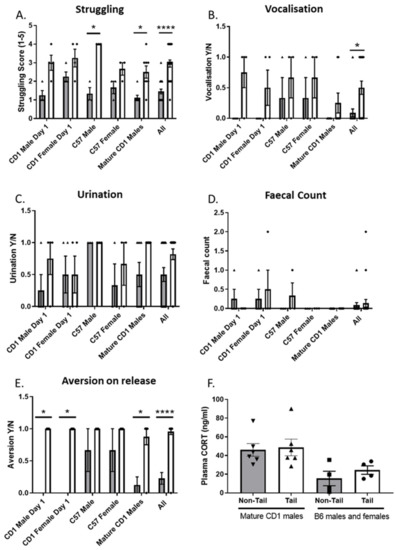
Figure 4.
Effect of handling method on overt behaviours following different restraint methods. (A) Mice handled by non-tail restraint showed lower scores for struggling (Kruskal–Wallis ANOVA p < 0.0001), (B) Mice handled by non-tail restraint showed lower occurrence of vocalization (Kruskal–Wallis ANOVA p < 0.0121), (C) lower occurrence of urination, (D) lower average faecal count, (E) lower scores for aversion to release (Kruskal–Wallis ANOVA p < 0.0001). For groups CD1 males n = 16 (tail = 8, arm = 8), CD1 females n = 16 (tail = 8, arm = 8), B6 males n = 6 (tail n = 2, arm n = 4), B6 females n = 6 (tail = 4, arm n = 2), CD1 mature males n = 8 (tail = 4, arm = 4). (F) No effects on CORT were observed CD1 males (tail = 4, arm = 4) and B6 male and female (tail n = 6, arm n = 6). Data shown as mean ± S.E.M. (* p < 0.05, **** p < 0.0001). Grey bar = non-tail restraint, White bar = tail restraint.
The authors would like to apologize for any inconvenience to the readers caused by these errors. The authors state that the scientific conclusions are unaffected. This correction was approved by the Academic Editor. The original publication has also been updated.
Reference
- Davies, J.R.; Purawijaya, D.A.; Bartlett, J.M.; Robinson, E.S.J. Impact of Refinements to Handling and Restraint Methods in Mice. Animals 2022, 12, 2173. [Google Scholar] [CrossRef] [PubMed]
Disclaimer/Publisher’s Note: The statements, opinions and data contained in all publications are solely those of the individual author(s) and contributor(s) and not of MDPI and/or the editor(s). MDPI and/or the editor(s) disclaim responsibility for any injury to people or property resulting from any ideas, methods, instructions or products referred to in the content. |
© 2023 by the authors. Licensee MDPI, Basel, Switzerland. This article is an open access article distributed under the terms and conditions of the Creative Commons Attribution (CC BY) license (https://creativecommons.org/licenses/by/4.0/).