

You are currently viewing a new version of our website. To view the old version click .

Animals, Volume 11, Issue 6

June 2021 - 366 articles

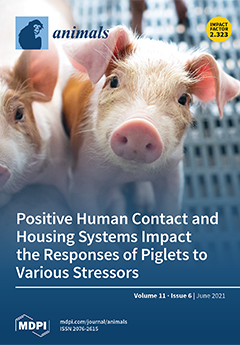
Cover Story: Commercial pigs are exposed to several stressful situations as part of routine production, including painful husbandry procedures, close contact with stockpeople, exposure to novel environments, weaning and mixing with unfamiliar pigs. Stress resilience has obvious implications for pigs, as an impaired ability to cope with these routine stressors is likely to negatively affect pig welfare and productivity. Stress resilience can be shaped by several early-life environmental experiences, and for pigs, the physical environment, maternal care from the sow and interactions with humans are likely candidates. This research examined the effects of lactation housing systems and positive human interaction on stress in young pigs. View this paper
  • Issues are regarded as officially published after their release is announced to the table of contents alert mailing list .
  • You may sign up for email alerts to receive table of contents of newly released issues.
  • PDF is the official format for papers published in both, html and pdf forms. To view the papers in pdf format, click on the "PDF Full-text" link, and use the free Adobe Reader to open them.

Articles (366)

  • Communication
  • Open Access
8 Citations
3,768 Views
7 Pages

Lack of Evidence That Bird Feeders Are a Source of Salmonellosis during Winter in Poland

  • Martyna Frątczak,
  • Piotr Indykiewicz,
  • Beata Dulisz,
  • Jacek J. Nowakowski,
  • Tomasz Janiszewski,
  • Jan Szeptycki,
  • Jarosław Wilczyński and
  • Piotr Tryjanowski

19 June 2021

Bird feeders are known to be a transfer site for many important bird pathogens, such as zoonotic Salmonella spp., known to be widespread among wild birds in Poland. The aim of the study was to investigate (1) whether feeders can be a source of Salmon...

  • Article
  • Open Access
2 Citations
3,867 Views
13 Pages

Adrenal Gland Ultrasonographic Measurements and Plasma Hormone Concentrations in Clinically Healthy Newborn Thoroughbred and Standardbred Foals

  • Eleonora Lauteri,
  • Jole Mariella,
  • Francesca Beccati,
  • Ellen Roelfsema,
  • Carolina Castagnetti,
  • Marco Pepe,
  • Tanja Peric,
  • Olimpia Barbato,
  • Marta Montillo and
  • Stefanie Rouge
  • + 1 author

19 June 2021

Adrenal hormones, ACTH plasma concentrations and the ultrasonographic evaluation of the adrenal glands are considered complementary in clinical evaluations of the hypothalamic–pituitary–adrenal (HPA) axis function in several species. In dogs, age, si...

  • Review
  • Open Access
46 Citations
9,314 Views
16 Pages

19 June 2021

Heat stress is a current challenge for livestock production, and its impact could dramatically increase if global temperatures continue to climb. Exposure of agricultural animals to high ambient temperatures and humidity would lead to substantial eco...

  • Review
  • Open Access
5 Citations
8,925 Views
11 Pages

19 June 2021

Tarsus lesions are not common in dogs, but they can cause serious health problem. They can lead to permanent changes in the joint and, in dogs involved in canine sports, to exclusion from training. The most common diseases and injuries involving the...

  • Review
  • Open Access
16 Citations
5,687 Views
33 Pages

18 June 2021

Milk fat is an important nutritional compound in the human diet. From the health point of view, some fatty acids (FAs), particularly long-chain PUFAs such as EPA and DHA, have been at the forefront of interest due to their antibacterial, antiviral, a...

  • Review
  • Open Access
29 Citations
5,934 Views
14 Pages

Veterinary Education during Covid-19 and Beyond—Challenges and Mitigating Approaches

  • Jennifer Routh,
  • Sharmini Julita Paramasivam,
  • Peter Cockcroft,
  • Vishna Devi Nadarajah and
  • Kamalan Jeevaratnam

18 June 2021

The public health implications of the Covid-19 pandemic have caused unprecedented and unexpected challenges for veterinary schools worldwide. They are grappling with a wide range of issues to ensure that students can be trained and assessed appropria...

  • Review
  • Open Access
22 Citations
6,433 Views
24 Pages

Current Status for Controlling the Overlooked Caprine Fasciolosis

  • Gemma Zerna,
  • Terry W. Spithill and
  • Travis Beddoe

18 June 2021

The disease fasciolosis is caused by the liver flukes Fasciola hepatica and F. gigantica, which infect a wide range of mammals and production livestock, including goats. These flatworm parasites are globally distributed and predicted to cost the live...

  • Article
  • Open Access
15 Citations
3,750 Views
13 Pages

18 June 2021

The Ridden Horse Pain Ethogram (RHpE) comprising 24 behaviours was developed to facilitate the identification of musculoskeletal discomfort, with scores of ≥8/24 indicating the presence of pain. The median RHpE score for 147 competitors at World Cup...

  • Article
  • Open Access
5 Citations
3,283 Views
9 Pages

Influence of Residual Feed Intake and Cow Age on Dry Matter Intake Post-Weaning and Peak Lactation of Black Angus Cows

  • Cory T. Parsons,
  • Julia M. Dafoe,
  • Samuel A. Wyffels,
  • Timothy DelCurto and
  • Darrin L. Boss

18 June 2021

We evaluated heifer post-weaning residual feed intake (RFI) classification and cow age on dry matter intake (DMI) at two stages of production. Fifty-nine non-lactating, pregnant, (Study 1) and fifty-four lactating, non-pregnant (Study 2) commercial b...

  • Article
  • Open Access
1 Citations
2,993 Views
11 Pages

A Machine Learning Approach to Study Demographic Alterations in Honeybee Colonies Using SDS–PAGE Fingerprinting

  • Riccardo Cabbri,
  • Enea Ferlizza,
  • Elisa Bellei,
  • Giulia Andreani,
  • Roberta Galuppi and
  • Gloria Isani

18 June 2021

Honeybees, as social insects, live in highly organised colonies where tasks reflect the age of individuals. As is widely known, in this context, emergent properties arise from interactions between them. The accelerated maturation of nurses into forag...

of 37

Get Alerted

Add your email address to receive forthcoming issues of this journal.

XFacebookLinkedIn
Animals - ISSN 2076-2615