Simple Summary
Various methods such as in situ, gas production and enzymatic methods are exercised to estimate the in vivo fermentable organic matter (FOM). However, each of these methods has its limitations. The in vivo method with fistulated animals for FOM determination is expensive, laborious and negatively affects animal welfare. Similarly, the in situ method also requires rumen fluid and is costly. However, enzymatic methods eliminate the need for fistulated animals and are comparatively simple, cheaper, faster, have greater repeatability, and also ensure the standardization of the process. Additionally, in situ technique can be disregarded as a standard method to test the accuracy of other techniques in cases where in vivo testing is not feasible. Therefore, in the current study, we compared the in situ nylon bag technique with the in vitro neutral detergent cellulase method and chemical composition to estimate in vivo FOM of roughages.
Abstract
In Vivo fermentable organic matter (FOM) reflects the energy production and the potential of rumen’s microbial protein synthesis. However, the in vivo method with fistulated animals for FOM measurement compromises animal welfare and is laborious as well as expensive. Although the alternative in situ nylon bag technique has been widely used, it is also costly and requires rumen liquor. Therefore, the present study was performed to compare the in situ nylon bag technique with the in vitro neutral detergent cellulase (NDC) method or chemical composition to estimate in vivo FOM of roughages. For this purpose, we selected 12 roughages, including six each from forages and crop residues. Our results have shown the strong correlation equations between FOMin situ and FOMNDC of forages (n = 6; R2 = 0.79), crop residues (n = 6; R2 = 0.80), and roughages (n = 12; R2 = 0.84), respectively. Moreover, there were also strong correlations between the chemical composition of roughages and FOMin situ (n = 12; R2 = 0.84–0.93) or FOMNDC (n = 12; R2 = 0.79–0.89). In conclusion, the in vitro NDC method and chemical composition were alternatives to in situ nylon bag technique for predicting in vivo FOM of roughages in the current experiment.
1. Introduction
In Vivo fermentable organic matter (FOM) of roughages reflects the rumen’s energy production and the potential of microbial protein synthesis [1]. The determination of in vivo FOM of forages with fistulated animals is costly, time-consuming, and negatively affects animal welfare [2]. On the other hand, in the French small intestine digestible protein system, FOM is calculated from organic matter total tract digestibility (OMD) [3,4].
Previous studies have shown that the methods of in situ nylon bag, gas production, pepsin–cellulase (PC), Tilley and Terry, and neutral detergent cellulase (NDC) are well correlated with in vivo OMD [5,6,7,8,9]. Although the in situ nylon bag technique has been widely used, this method requires fistulated animals and is also expensive [5]. Other existing in vitro methods, such as Tilley and Terry [5] and gas production [7], also need rumen liquor. Compared to rumen liquor-based methods, enzymatic methods eliminate the need for fistulated animals, are simpler, cheaper, faster, have greater repeatability, and ensure the standardization of the process [1,9]. Moreover, the PC method requires regular evaluation to ensure accurate results, while the NDC method has not been updated [6] and is faster than the pretreatment of samples with pepsin [10]. Therefore, it seems that NDC method may be an attractive alternative for predicting in vivo FOM. Moreover, it was shown that in vitro digestibility determined by rumen fluid or enzymes was superior to chemical characteristics [5,11]; however, the chemical composition method is considered the simpler, faster, and cheaper method [12]. Thus, the chemical composition method has also attempted to predict in vivo FOM in the current study. Kitessa et al. [3] reported that the in situ nylon bag technique could be disregarded as a standard method to test the accuracy of other techniques in cases where in vivo testing is not feasible. Additionally, the in situ nylon bag technique with the Bang-Bang (BB) apparatus was inexpensive, portable, and easy to operate to measure the rumen degradation characteristics of feedstuffs than traditional steel chain or flexible plastic tubes for binding the bags used in the in situ nylon bag technique [13]. Therefore, in the current study, we considered the in situ nylon bag technique with the BB apparatus as the reference method.
To our knowledge, no study has performed an in vitro NDC method to predict in vivo FOM, and the correlation of chemical composition to predict in vivo FOM is also controversial and unclear. This study aimed to determine the possibility of predicting in vivo FOM of roughages using the in vitro NDC method or chemical composition. Thus, we hypothesized that the in vitro NDC method and chemical composition are suitable methods for an alternative in vivo FOM of roughages.
2. Materials and Methods
2.1. Sample Collection
Twelve roughage samples, including six each from forages and crop residues, were collected from five main beef cattle breeding areas in China. Specifically, the samples were langsdorff small reed (Hulunbuir City, Inner Mongolia), alfalfa, avena nuda straw, corn straw (Zuoyun County, Shanxi Province), mixed forage, oat straw, hulless barley straw, rapeseed straw (Hezuo City, Gansu Province), lolium perenne (Xiahe County, Gansu Province), poa annua (Nagqu Prefecture, Tibet Autonomous Region), alpine kobresia (Maizhokunggar County, Tibet Autonomous Region), and barley straw (Haiyan County, Qinghai Province). Mixed forage was collected from the natural meadow. Three samples were selected from each forage and crop residue for further analysis.
2.2. Chemical Analysis
The samples were oven-dried at 55 °C for 48 h and ground to a 2-mm mesh-screen size using a feed mill (DF-20, Wenling Linda Machinery Co. Ltd., Wenling, Zhejiang, China). Dry matter (DM; method 930.15) and ash (method 942.05) were analyzed by AOAC methods (2000) [14]. Nitrogen was determined using a protein analyzer (Rapid N III, Elementar Inc., Germany), and CP was calculated as the percentage of nitrogen × 6.25. Further, crude fiber (CF), neutral detergent fiber (NDF), and acid detergent fiber (ADF) were determined using a fiber analyzer (ANKOM A220, ANKOM Technology Corp., Macedon, NY, USA). Ether extract (EE) was extracted using an automatic extractor (ANKOM XT101, ANKOM Technology Corp., Macedon, NY, USA). Nitrogen-free extract (NFE) was calculated using the formula: w(NFE) = w(DM) − w(CP) – w(EE) – w(CF) – w(Ash). The chemical compositions and digestibility of each sample were calculated in triplicate.
2.3. In Situ Nylon Bag Technique
Three Angus steers fitted with a permanent rumen cannula (450 ± 15 kg) were utilized to determine the effective rumen degradability of the organic matter of roughages with the nylon bag technique within the BB apparatus [13]. Animals were fed a total mixed ration at 8:00 h and 16:00 h according to NRC 2000 to meet the ME requirement for 1.3 × maintenance [15], and ad libitum access to water and a mineral block was provided. This animal experiment was approved by the China Agricultural University Animal Care and Use Committee (AW28059102-1, Beijing, China). The sample was weighed (4.00 ± 0.01 g) in nylon bags (80 × 140 mm) with a pore size of 37 µm, and then suspended in the rumen before morning feeding. Bags were removed after 6, 24, 48, 72, 96, 120, and 144 h of incubation. After removal, the bags were immediately immersed in cold water to stop fermentation, washed six times (1 min/rinse) in a washing machine until the water was clean, then dried at 65 °C for 48 h. Rumen degradation kinetics was determined using the following equations.
Rumen dynamic degradation rate: y = a + b (1 − e−ct)
Effective degradability: ED = a + (b × c) / (c + k)
Here, y is the rumen degradation rate at time t, a, b, c, t, and k stand for the rapidly degraded fraction (%), the slowly degraded fraction (%), the degradation rate constant at which b is degraded (%/h), incubation time, and rumen passage rate at 0.0253%/h, respectively. The effective degradability (ED) of organic matter was regarded as the rumen fermentable organic matter (FOMin situ) [16].
2.4. In Vitro Neutral Detergent-Cellulase Plus Amylase Method
The in vitro organic matter digestibility was determined by NDC plus amylase method using small nylon bags (37 µm, 25 × 60 mm). Samples (0.50 ± 0.001 g) were transferred to small nylon bags, sealed (FR-300B, Blueberry, Shanghai, China), boiled in neutral detergent solution with heat-stable α-amylase for 75 min (ANKOM A220, ANKOM Technology Corp., Macedon, NY, USA), then oven-dried at 65 °C for 48 h. For the cellulase buffer solution preparation, we incubated 20 g cellulase [17] in a 1 L acetic acid buffer (pH 4.8) for 1 h at 40 °C. Two small nylon bags were randomly placed in 100-mL culture tubes and pre-warmed overnight at 39 °C. The next morning, cellulase buffer solution (80 mL) was added into each preheated 100-mL culture tube using an automatic pump and then incubated for 24 h in a 40 ± 2 °C water at 40–60 rpm (DSHZ-300A, Jiangsu, China). Following incubation, the bags were immersed in cold water to stop fermentation, washed as in situ nylon bag technique, and oven-dried at 65 °C for 48 h.
2.5. Statistical Analysis
We analyzed the chemical composition and in situ organic matter degradation characteristics of samples using a two-tailed Student’s t-test [18]. Then we compared the FOMin situ and FOMNDC of samples using the general linear model (GLM) procedure of SAS version 9.0 (SAS Institute Inc., Cary, NC, USA): yij = μ + ai + eij, where yij is jth observation value at the ith level of factor a, μ is the population mean, ai is the treatment effect at level i of factor a, and eij is the individual random residual error. The data of the prediction equations were analyzed using the linear regression procedure (REG) of SAS version 9.0 (SAS Institute Inc., Cary, NC, USA): y = b0 + b1x1 + b2x2 + ⋯ + bmxm, where y is the dependent variable and x1, x2, x3, ⋯ xmrepresent m independent variables. Statistical significance was set at p < 0.05.
3. Results
3.1. Chemical Compositions of Roughages
The data regarding chemical analysis for contents (%) of DM, OM, EE, CP, CF, NDF, ADF, Ash, and NFE are presented in Table 1. Compared with crop residues, EE, CP and NFE of forages were higher (p < 0.01), but CF, NDF, and ADF were lower (p < 0.01).
Table 1.
Chemical compositions of roughages (DM basis, expressed as %).
3.2. In Situ Organic Matter Degradation
In Situ organic matter degradation characteristics of roughages are shown in Table 2. Compared with crop residues, a (p < 0.01), b (p < 0.01), c (p = 0.01), and FOMin situ (p < 0.01) were higher in the forages.
Table 2.
In Situ organic matter degradation characteristics of roughages.
3.3. In Situ Organic Matter Disappearance Rate
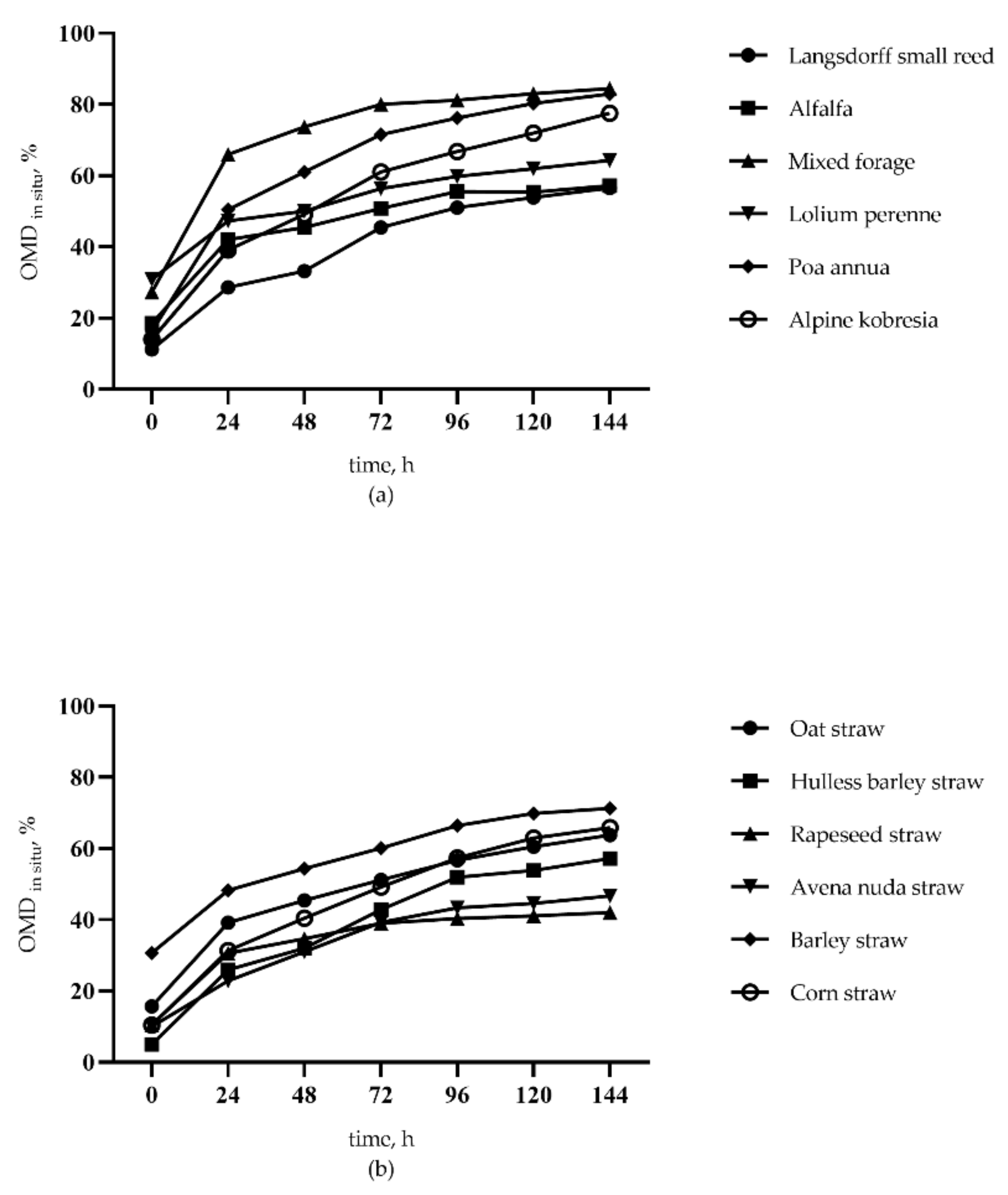
In Situ organic matter disappearance rate (OMDin situ) of forages (a) and crop residues (b) are demonstrated in Figure 1. In brief, our data show that at 144 h, OMDin situ of forages from high to low were mixed forage (84.82), poa annua (82.92%), alpine kobresia (77.55%), lolium perenne (64.24%), alfalfa (57.21%), and langsdorff small reed (56.23%). Consequently, OMDin situ of crop residues were 71.27% in barley straw, 65.88% in corn straw, 63.77% in oat straw, 57.91% in hulless barley straw, 46.72% in avena nuda straw, and 42.08% in rapeseed straw.
Figure 1.
Incubated time (x) and in situ organic matter disappearance rate (y) of forages (a) and crop residues (b), respectively.
3.4. Prediction Equations of FOMin situ Based on Chemical Composition
The regression equations between FOMin situ and chemical composition (EE, CP, CF, NDF, ADF, Ash, and NFE) of roughages (n = 12) are presented in Table 3. From equations 1 to 5 achieved higher reliability (p < 0.01), which contain CF (R2 = 0.84), ADF (R2 = 0.87), EE and CF (R2 = 0.92), EE, CP and ADF (R2 = 0.92), EE, CP, and CF (R2 = 0.93).
Table 3.
Prediction equations between FOMin situ and chemical compositions of roughages.
3.5. Comparison of FOMNDC and FOMin situ
The FOMNDC and FOMin situ were presented in Table 4. For forages and crop residues, we only obtained a difference in alfalfa (p = 0.02).
Table 4.
Comparison between FOMNDC and FOMin situ of roughages (DM basis, expressed as %).
3.6. Correlation Analysis between FOMNDC and FOMin situ of Forages, Crop Residues, and Roughages
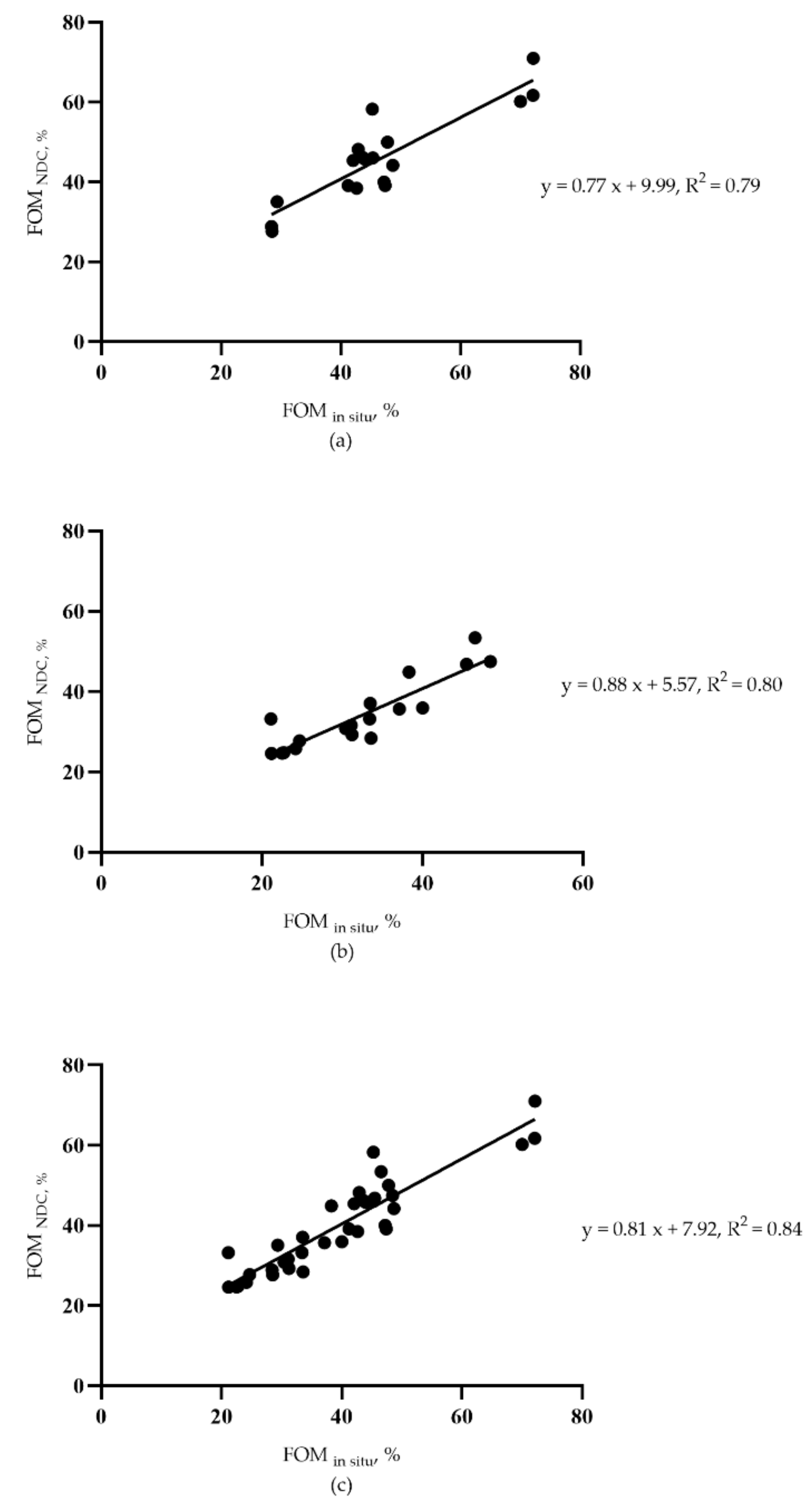
The correlation analysis between FOMNDC and FOMin situ of forages (a), crop residues (b), and roughages (c) is presented in Figure 2. Our results show the strong correlation equations between FOMin situ and FOMNDC of forages (n = 6; R2 = 0.79), crop residues (n = 6; R2 = 0.80), and roughages (n = 12; R2 = 0.84), respectively.
Figure 2.
Linear equations of fermentable organic matter between determined by the in vitro neutral detergent–cellulase plus amylase method (x) and the in situ nylon bag technique (y) among forages (a), crop residues (b) and roughages (c), respectively.
3.7. Prediction Equations of FOMNDC Based on Chemical Composition
The regression equations generated between FOMNDC and chemical composition (EE, CP, CF, NDF, ADF, Ash, and NFE) of roughages are presented in Table 5. Based on our findings, it was shown that the R2 increased in equations 1 through 8 (p < 0.01), which contains a chemical composition of CF (R2 = 0.79), EE and NDF (R2 = 0.83), ADF (R2 = 0.84), EE, CP and NDF (R2 = 0.84), EE and ADF (R2 = 0.84), EE, CP and ADF (R2 = 0.88), EE, CP, CF (R2 = 89), EE and CF (R2 = 0.89), respectively.
Table 5.
Prediction equations between FOMNDC and chemical compositions of roughages.
4. Discussion
In Vivo FOM depends on rumen dynamic processes, while in vivo OMD depends on the digestion of OM in the total digestive tract, and a reduction in the rumen can be compensated with the enhancement of the fermentation of the hindgut. Therefore, in vivo FOM’s determination is more difficult than that of in vivo OMD; the measurement of in vivo FOM is also less precise than in vivo OMD. Consistently, the differences between alternative methods will probably be more pronounced when correlated with in vivo FOM than with in vivo OMD [1].
It was shown in a previous report that the in vitro method is the most inaccurate in predicting the digestibility of some low-quality feeds, such as hay and grain by-products [3]. The low-quality feed has higher contents of insoluble material, which up to some extent, determines the digestibility of a feed. When the roughage is treated with neutral detergent solution, the soluble carbohydrates, pectin, proteins, and other soluble components dissolve, leaving insoluble cell walls, which can be degraded by cellulase [10]. Therefore, in our study, we selected the NDC method. Consequently, to combine the characteristics of beef roughage, we used low-quality roughages as experimental material, which is in line with previous findings [19].
Although studies have suggested that the feedstuff’s chemical composition cannot be used to predict OMD satisfactorily [3,20,21]. On the contrary, a good relationship between chemical composition and FOMin situ or FOMNDC of roughages was observed in the current study. These findings suggest that it is possible to predict in vivo FOM by the chemical compositions of a sample. Moreover, research has shown that chemical composition is related to DMI, DMI is negatively related to NDF, and NDF associated with gastrointestinal filling [22], and a strong relationship between NDF and ADF is well established, which can explain that equations based on ADF and NDF are accurate enough to predict FOMin situ or FMNDC of roughages. Additionally, the prediction of EE, CP, and CF in the same equation was more accurate than that of CF or ADF alone, suggesting that using chemical composition to predict in vivo FOM may be more correlated with fiber components. In the future, with increasing the number of samples, more accurate prediction equations are expected to be obtained.
The findings of our study showed a strong correlation between FOMNDC and FOMin situ of roughages (R2 = 0.84). Consistently, Mary et al. [10] had documented the correlation between NDC and in vivo values and seemed to be consistent with those obtained by Tilley and Terry techniques. Moreover, that relationship was increased with the number of samples. Givens et al. [23] also reported a higher R2 value between in vivo OMD and in vitro OMD in the spring forage than in the autumn forage. Future samples collected only once to construct the equation will not be adequate; the collection of more samples at different times of the year is suggested.
It may be noted that enzyme-based FOM measurements did not take into account possible interactions between microbial species present in the rumen. Although the nylon bag technique feed samples are digested in the actual rumen environment, many of the procedures involved in this method have not been standardized, and the range of variability within laboratories may be greater than all other in vitro methods [3]. Therefore, different methods have their advantages and disadvantages, but as long as the correlation between methods is strong, they might be replaced by each other.
5. Conclusions
Altogether, it was concluded that there is a strong relationship between FOM values obtained with the in situ nylon bag technique and the in vitro NDC method, which FOMin situ = 0.77 FOMNDC + 9.90 (forages, R2 = 0.79), FOMin situ = 0.88 FOMNDC + 5.57 (crop residues, R2 = 0.80), FOMin situ = 0.81 FOMNDC + 7.92 (roughages, R2 = 0.84). Moreover, the FOM predicted by chemical composition correlates very well with the in situ nylon bag technique (R2 = 0.84–0.93) and in vitro NDC method (R2 = 0.79–0.89), respectively. Therefore, the NDC method and chemical composition seem adequate to develop equations to predict the in vivo FOM. However, more research is warranted to develop local equations considering specific pasture types, environmental conditions such as harvest season, and phenological stages, and to corroborate such predictions with in vivo data where conditions permit.
Author Contributions
Z.Z., Q.M., and H.W. designed this experiment and reviewed the manuscript. Y.L. and R.L. experimented and analyzed the data. Y.L. wrote the manuscript. M.Z.K. edited the article and modified the language. Z.Z. had responsibility for the final content. All authors have read and agreed to the published version of the manuscript.
Funding
This research was funded by the Government’s Purchase Service (16190050, 16190070), the National Key Research and Development Program of China (2018 YFD0502301), and the China Agricultural Research System of MOF and MARA (CARS-37).
Institutional Review Board Statement
The study approved by the Institutional Review Board of the China Agricultural University Animal Care and Use Committee (AW28059102-1, 15 August 2018, Beijing, China).
Data Availability Statement
All the data are already provided in the main manuscript.
Acknowledgments
The authors would like to thank the staffs at Beef Cattle Research Center of China Agricultural University for their help with sampling and laboratory analyses.
Conflicts of Interest
The authors declare no competing interests.
References
- Gosselink, J.M.J.; Dulphy, J.P.; Poncet, C.; Jailler, M.; Tamminga, S.; Cone, J.W. Prediction of forage digestibility in ruminants using in situ and in vitro techniques. Anim. Feed. Sci. Technol. 2004, 115, 227–246. [Google Scholar] [CrossRef]
- Pagella, J.H.; Mayes, R.W.; Pérez-Barbería, F.J.; Ørskov, E.R. The development of an intraruminal nylon bag technique using non-fistulated animals to assess the rumen degradability of dietary plant materials. Animals 2017, 12. [Google Scholar] [CrossRef] [PubMed]
- Kitessa, S.; Irish, G.G.; Flinn, P.C. Comparison of methods used to predict the in vivo digestibility of feeds in ruminants. Aust. J. Agric. Res. 1999, 50, 825–841. [Google Scholar] [CrossRef]
- Jones, D.I.H.; Theodorou, M.K. Enzyme techniques for estimating digestibility. Forage Eval. Rumin. Nutr. 2000, 155–173. [Google Scholar] [CrossRef]
- Tilley, J.M.A.; Terry, R.A. A two-stage technique for the in vitro digestion of forage crops. J. Brit. Forageland. Soc. 1963, 18, 104–111. [Google Scholar] [CrossRef]
- Aufrerre, J.; Michalet-Doreau, B. Comparison of methods for predicting digestibility of feeds. Anim. Feed. Sci. Technol. 1988, 20, 203–218. [Google Scholar] [CrossRef]
- Menke, K.H.; Steingass, H. Estimation of the energetic feed value obtained from chemical analysis and in vitro gas production using rumen fluid. Anim. Res. Dev. 1988, 28, 7–55. [Google Scholar]
- Fonseca, A.J.M.; Dias-da-Silva, A.A.; Orskov, E.R. In sacco degradation characteristics as predictors of digestibility and voluntary intake of roughages by mature ewes. Anim. Feed. Sci. Technol. 1998, 72, 205–219. [Google Scholar] [CrossRef]
- Morgan, D.J.; Stakelum, G. The Prediction of the Digestibility of Herbage for Dairy Cows. Irish J. Agr. Food. Res. 1987, 26, 23–34. Available online: https://www.jstor.org/stable/25556174 (accessed on 1 August 2018).
- Dowman, M.G.; Collins, F.C. The Use of Enzymes to Predict the Digestibility of Animal Feeds. J. Sci. Food Agric. 1982, 33, 689–696. [Google Scholar] [CrossRef]
- Steg, A.; Spoelstra, S.F.; Van der Meer, J.M.; Hindle, V.A. Digestibility of grass silage. Neth. J. Agric. Sci. 1990, 38, 407–422. [Google Scholar] [CrossRef]
- Tamminga, S.; Van Straalen, W.M.; Subnel, A.P.J.; Meijer, R.G.M.; Steg, A.; Wever, C.J.G.; Blok, M.C. The dutch protein evaluation system: The DVE/OEB-system. Livest. Prod. Sci. 1994, 40, 139–155. [Google Scholar] [CrossRef]
- Wang, F.; Li, D.Y.; Meng, Q.X. Technical note: A special apparatus for facilitating the in situ nylon bag measurement of the ruminal degradation of feedstuffs in cattle. J. Anim. Sci. 2016, 94, 3457–3463. [Google Scholar] [CrossRef] [PubMed][Green Version]
- Association of Official Analytical Chemists (AOAC). Official Methods of Analysis, 17th ed.; Association of Official Analytical Chemists: Arlington, VA, USA, 2000. [Google Scholar]
- NRC (National Research Council). Nutrient Requirements of Beef Cattle, 7th ed.; National Academy of Sciences: Washington, DC, USA, 2000. [Google Scholar]
- Orskov, E.R.; McDonald, I. The estimation of protein degradability in the rumen from incubation measurements weighted according to rate of passage. J. Agric. Sci. 1979, 92, 499–503. [Google Scholar] [CrossRef]
- Kowalski, Z.M.; Ludwin, J.; Górka, P.; Rinne, M.; Weisbjerg, M.R.; Jagusiak, W. The use of cellulase and filter bag technique to predict digestibility of forages. Anim. Feed. Sci. Technol. 2014, 198, 49–56. [Google Scholar] [CrossRef]
- Keady, T.; Lively, F.O.; Kilpatrick, D.J.; Moss, B.W. Effects of replacing grass silage with either maize or whole-crop wheat silages on the performance and meat quality of beef cattle offered two levels of concentrates. J. Anim. Sci. 2007, 1, 613–623. [Google Scholar] [CrossRef] [PubMed]
- Krizsan, S.J.; Nyholm, L.; Nousiainen, J.; Südekum, K.H.; Huhtanen, P. Comparison of in vitro and in situ methods in evaluation of forage digestibility in ruminants. J. Anim. Sci. 2012, 90, 3162–3173. [Google Scholar] [CrossRef] [PubMed]
- Huhtanen, P.; Nousiainen, J.; Rinne, M. Recent developments in forage evaluation with special reference to practical applications. Agric. Food. Sci. 2006, 15, 293–323. [Google Scholar] [CrossRef]
- Nousiainen, J.; Ahvenjärvi, S.; Rinne, M.; Hellämäki, M.; Huhtanen, P. Prediction of indigestible cell wall fraction of grass silage by near infrared reflectance spectroscopy. Anim. Feed. Sci. Technol. 2004, 115, 295–311. [Google Scholar] [CrossRef]
- Van Soest, P.J. Nutritional Ecology of the Ruminant; Cornell University Press: New York, NY, USA, 1982. [Google Scholar]
- Givens, D.I.; Moss, A.R.; Adamson, A.H. Influence of growth stage and season on the energy value of fresh herbage. 1. changes in metabolizable energy content. Grass. Forage Sci. 1993, 48, 166–174. [Google Scholar] [CrossRef]
Publisher’s Note: MDPI stays neutral with regard to jurisdictional claims in published maps and institutional affiliations. |
© 2021 by the authors. Licensee MDPI, Basel, Switzerland. This article is an open access article distributed under the terms and conditions of the Creative Commons Attribution (CC BY) license (https://creativecommons.org/licenses/by/4.0/).