Distribution and Transfer of Plasmid Replicon Families among Multidrug-Resistant Enterococcus faecalis and Enterococcus faecium from Poultry
 , ,
, ,  and
and
Abstract
1. Introduction
2. Materials and Methods
2.1. Bacterial Strains, Isolation, and Identification
2.2. Antimicrobial Susceptibility Testing
2.3. Replicon Typing
2.4. Bacterial Matings
2.5. Statistical Analysis of Tetracycline Resistance and rep-Family
3. Results
3.1. Presence of rep-Families among E. faecalis and E. faecium
3.2. Resistance Profiles among rep-Positive Enterococci
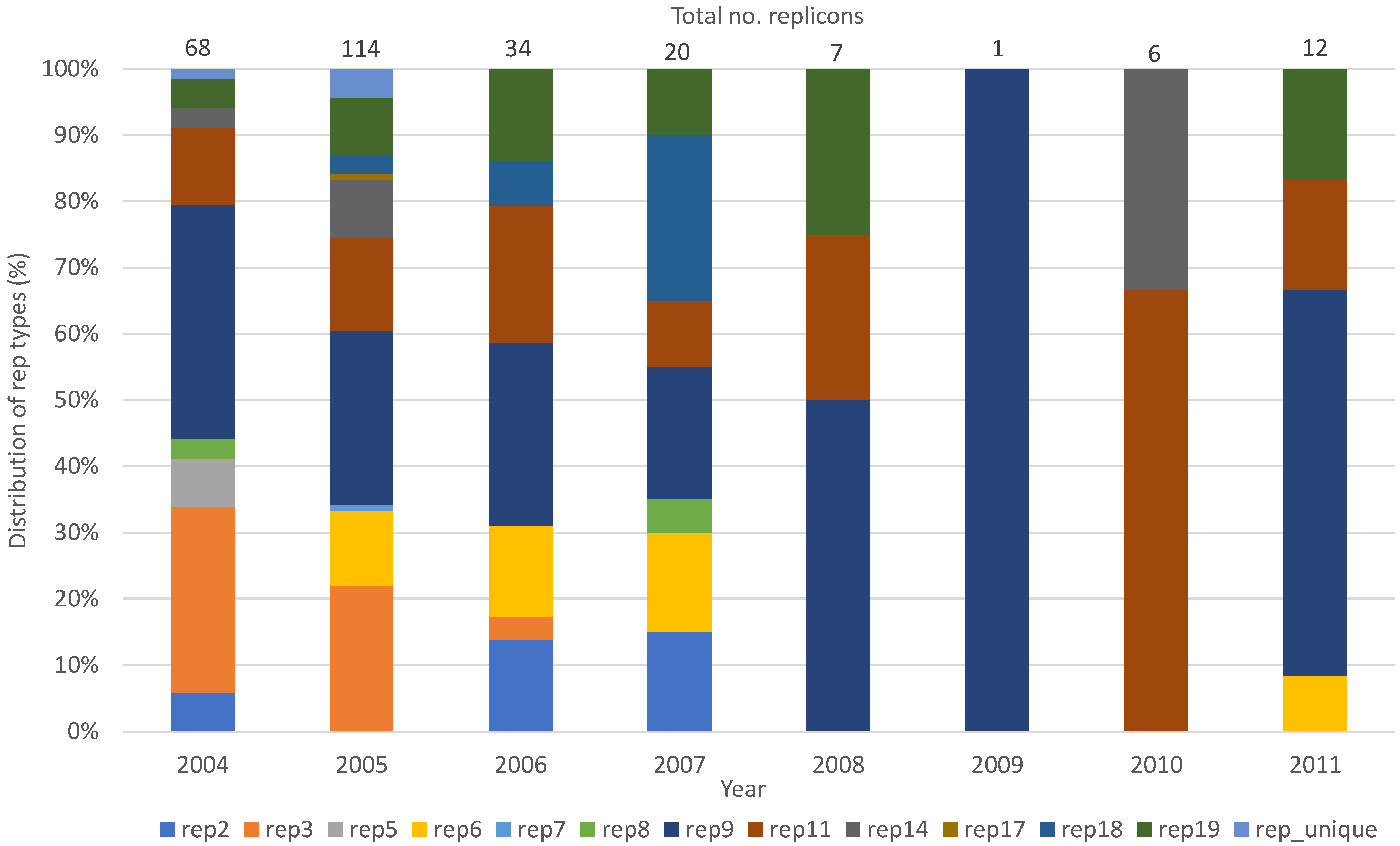
3.3. Distribution of rep-Families over Time
3.4. Transfer of rep-Families
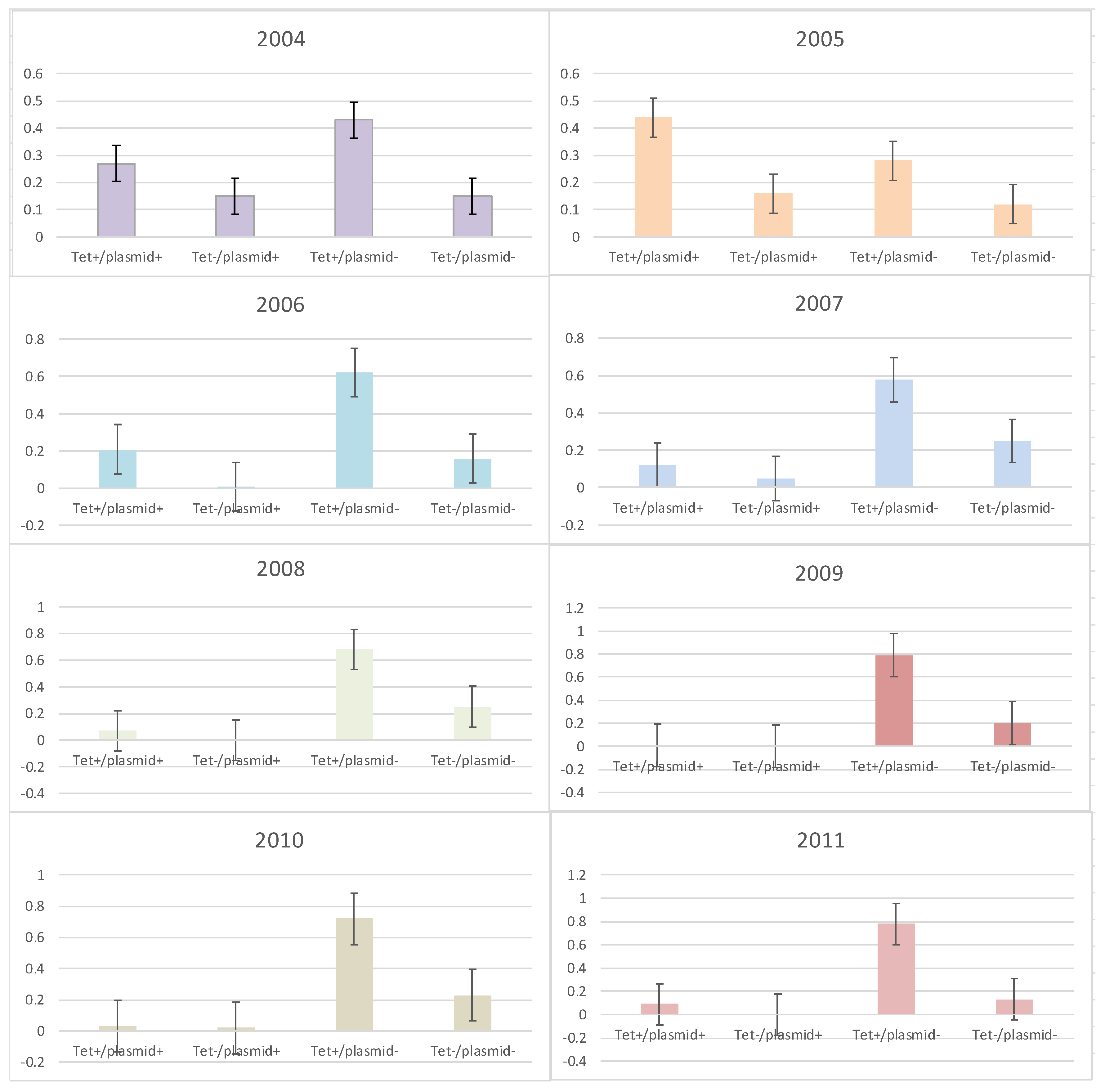
3.5. Frequency of rep-Families in Tetracycline-Resistant Enterococci
4. Discussion
5. Conclusions
Supplementary Materials
Author Contributions
Funding
Institutional Review Board Statement
Informed Consent Statement
Data Availability Statement
Acknowledgments
Conflicts of Interest
Disclaimer
References
- Martin, J.D.; Mundt, J.O. Enterococci in insects. J. Appl. Microbiol. 1972, 24, 575–580. [Google Scholar] [CrossRef] [PubMed]
- Murray, B.E. The life and times of the Enterococcus. Clin. Microbiol. Rev. 1990, 3, 46–65. [Google Scholar] [CrossRef] [PubMed]
- Mundt, J.O. Occurrence of enterococci in animals in a wild environment. Appl. Microbiol. 1963, 11, 136–140. [Google Scholar] [CrossRef] [PubMed]
- Weiner, L.M.; Webb, A.K.; Limbago, B.; Dudeck, M.A.; Patel, J.; Kallen, A.J.; Edwards, J.R.; Sievert, D.M. Antimicrobial-resistant pathogens associated with healthcare-associated infections: Summary of data reported to the National Healthcare Safety Network at the Centers for Disease Control and Prevention, 2011–2014. Infect. Control Hosp. Epidemiol. 2016, 37, 1288–1301. [Google Scholar] [CrossRef]
- Magill, S.S.; O’Leary, E.; Janelle, S.J.; Thompson, D.L.; Dumyati, G.; Nadle, J.; Wilson, L.E.; Kainer, M.A.; Lynfield, R.; Greissman, S.; et al. Emerging Infections Program Hospital Prevalence Survey, T. Changes in prevalence of health care-associated infections in U.S. hospitals. N. Engl. J. Med. 2018, 379, 1732–1744. [Google Scholar] [CrossRef]
- Lake, J.G.; Weiner, L.M.; Milstone, A.M.; Saiman, L.; Magill, S.S.; See, I. Pathogen distribution and antimicrobial resistance among pediatric healthcare-associated infections reported to the National Healthcare Safety Network, 2011–2014. Infect. Control Hosp. Epidemiol. 2018, 39, 1–11. [Google Scholar] [CrossRef]
- Karp, B.E.; Tate, H.; Plumblee, J.R.; Dessai, U.; Whichard, J.M.; Thacker, E.L.; Hale, K.R.; Wilson, W.; Friedman, C.R.; Griffin, P.M.; et al. National Antimicrobial Resistance Monitoring System: Two decades of advancing public health through integrated surveillance of antimicrobial resistance. Foodborne Pathog. Dis. 2017, 14, 545–557. [Google Scholar] [CrossRef]
- Weigel, L.M.; Clewell, D.B.; Gill, S.R.; Clark, N.C.; McDougal, L.K.; Flannagan, S.E.; Kolonay, J.F.; Shetty, J.; Killgore, G.E.; Tenover, F.C. Genetic analysis of a high-level vancomycin-resistant isolate of Staphylococcus aureus. Science 2003, 302, 1569–1571. [Google Scholar] [CrossRef]
- Courvalin, P. Transfer of antibiotic resistance genes between gram-positive and gram-negative bacteria. Antimicrob. Agents Chemother. 1994, 38, 1447–1451. [Google Scholar] [CrossRef]
- Jensen, L.B.; Garcia-Migura, L.; Valenzuela, A.J.; Lohr, M.; Hasman, H.; Aarestrup, F.M. A classification system for plasmids from enterococci and other Gram-positive bacteria. J. Microbiol. Methods 2010, 80, 25–43. [Google Scholar] [CrossRef]
- Jackson, C.R.; Fedorka-Cray, P.J.; Barrett, J.B. Use of a genus- and species-specific multiplex PCR for identification of enterococci. J. Clin. Microbiol. 2004, 42, 3558–3565. [Google Scholar] [CrossRef] [PubMed]
- CLSI. Performance Standards for Antimicrobial Susceptibility Testing; Twenty-First Informational Supplement, CLSI Document M100-S; Clinical and Laboratory Standards Institute: Wayne, PA, USA, 2011. [Google Scholar]
- CLSI. Performance Standards for Antimicrobial Susceptibility Testing, 30th ed.; CLSI Supplement M; Clinical and Laboratory Standards Institute (CLSI): Wayne, PA, USA, 2020; Volume M100. [Google Scholar]
- Simjee, S.; Fraise, A.P.; Gill, M.J. Plasmid heterogeneity and identification of a Tn5281-like element in clinical isolates of high-level gentamicin-resistant Enterococcus faecium isolated in the UK. J. Antimicrob. Chemother. 1999, 43, 625–635. [Google Scholar] [CrossRef] [PubMed][Green Version]
- Mikalsen, T.; Pedersen, T.; Willems, R.; Coque, T.M.; Werner, G.; Sadowy, E.; van Schaik, W.; Jensen, L.B.; Sundsfjord, A.; Hegstad, K. Investigating the mobilome in clinically important lineages of Enterococcus faecium and Enterococcus faecalis. BMC Genom. 2015, 16, 282. [Google Scholar]
- Alzahrani, O.M.; Fayez, M.; Alswat, A.S.; Alkafafy, M.; Mahmoud, S.F.; Al-Marri, T.; Almuslem, A.; Ashfaq, H.; Yusuf, S. Antimicrobial resistance, biofilm formation, and virulence genes in Enterococcus species from small backyard chicken flocks. Antibiotics 2022, 11, 380. [Google Scholar] [CrossRef] [PubMed]
- Dabul, A.N.G.; Avaca-Crusca, J.S.; Navais, R.B.; Merlo, T.P.; Van Tyne, D.; Gilmore, M.S.; Camargo, I. Molecular basis for the emergence of a new hospital endemic tigecycline-resistant Enterococcus faecalis ST103 lineage. Infect. Genet. Evol. 2019, 67, 23–32. [Google Scholar] [CrossRef] [PubMed]
- Cho, S.; Barrett, J.B.; Frye, J.G.; Jackson, C.R. Antimicrobial resistance gene detection and plasmid typing among multidrug resistant enterococci isolated from freshwater environment. Microorganisms 2020, 8, 1338. [Google Scholar] [CrossRef] [PubMed]
- Wardal, E.; Gawryszewska, I.; Hryniewicz, W.; Sadowy, E. Abundance and diversity of plasmid-associated genes among clinical isolates of Enterococcus faecalis. Plasmid 2013, 70, 329–342. [Google Scholar] [CrossRef]
- Wardal, E.; Markowska, K.; Zabicka, D.; Wroblewska, M.; Giemza, M.; Mik, E.; Polowniak-Pracka, H.; Wozniak, A.; Hryniewicz, W.; Sadowy, E. Molecular analysis of VanA outbreak of Enterococcus faecium in two Warsaw hospitals: The importance of mobile genetic elements. Biomed. Res. Int. 2014, 2014, 575367. [Google Scholar] [CrossRef] [PubMed]
- San Millan, A.; MacLean, R.C. Fitness costs of plasmids: A limit to plasmid transmission. Microb. Transm. 2017, 5, 65–79. [Google Scholar] [CrossRef]
- U.S. Food and Drug Administration, CFVM. Summary Report on Antimicrobials Sold or Distributed for Use in Food-Producing Animals; FDA: Rockville, MD, USA, 2015. Available online: https://www.fda.gov/media/102160/download (accessed on 22 March 2022).
- U.S. Food and Drug Administration, CFVM. Summary Report on Antimicrobials Sold or Distributed for Use in Food-Producing Animals; FDA: Rockville, MD, USA, 2017. Available online: https://www.fda.gov/media/119332/download (accessed on 22 March 2022).
- Clewell, D.B.; Weaver, K.E.; Dunny, G.M.; Coque, T.M.; Francia, M.V.; Hayes, F. Extrachromosomal and mobile elements in enterococci: Transmission, maintenance, and epidemisology. In Enterococci: From Commensals to Leading Causes of Drug Resistant Infection; Gilmore, M.S., Clewell, D.B., Ike, Y., Shankar, N., Eds.; Massachusetts Eye and Ear Infirmary: Boston, MA, USA, 2014. [Google Scholar]
- Torres, C.; Alonso, C.A.; Ruiz-Ripa, L.; Leon-Sampedro, R.; Del Campo, R.; Coque, T.M. Antimicrobial resistance in Enterococcus spp. of animal origin. Microbiol. Spectr. 2018, 6, 4. [Google Scholar] [CrossRef]
- Song, X.; Sun, J.; Mikalsen, T.; Roberts, A.P.; Sundsfjord, A. Characterisation of the plasmidome within Enterococcus faecalis isolated from marginal periodontitis patients in Norway. PLoS ONE 2013, 8, e62248. [Google Scholar] [CrossRef] [PubMed]
- Hegstad, K.; Mikalsen, T.; Coque, T.M.; Werner, G.; Sundsfjord, A. Mobile genetic elements and their contribution to the emergence of antimicrobial resistant Enterococcus faecalis and Enterococcus faecium. Clin. Microbiol. Infect. 2010, 16, 541–554. [Google Scholar] [CrossRef]
- Rosvoll, T.C.; Lindstad, B.L.; Lunde, T.M.; Hegstad, K.; Aasnaes, B.; Hammerum, A.M.; Lester, C.H.; Simonsen, G.S.; Sundsfjord, A.; Pedersen, T. Increased high-level gentamicin resistance in invasive Enterococcus faecium is associated with aac(6′)Ie-aph(2″)Ia-encoding transferable megaplasmids hosted by major hospital-adapted lineages. FEMS Immunol. Med. Microbiol. 2012, 66, 166–176. [Google Scholar] [CrossRef] [PubMed]
- Rosvoll, T.C.; Pedersen, T.; Sletvold, H.; Johnsen, P.J.; Sollid, J.E.; Simonsen, G.S.; Jensen, L.B.; Nielsen, K.M.; Sundsfjord, A. PCR-based plasmid typing in Enterococcus faecium strains reveals widely distributed pRE25-, pRUM-, pIP501- and pHTbeta-related replicons associated with glycopeptide resistance and stabilizing toxin-antitoxin systems. FEMS Immunol. Med. Microbiol. 2010, 58, 254–268. [Google Scholar] [CrossRef] [PubMed]
- Neyaz, L.; Rajagopal, N.; Wells, H.; Fakhr, M.K. Molecular characterization of Staphylococcus aureus plasmids associated with strains isolated from various retail meats. Front. Microbiol. 2020, 11, 223. [Google Scholar] [CrossRef]
- Garcia-Migura, L.; Sanchez-Valenzuela, A.J.; Jensen, L.B. Presence of glycopeptide-encoding plasmids in enterococcal isolates from food and humans in Denmark. Foodborne Pathog. Dis. 2011, 8, 1191–1197. [Google Scholar] [CrossRef]
- Smillie, C.; Garcillan-Barcia, M.P.; Francia, M.V.; Rocha, E.P.; de la Cruz, F. Mobility of plasmids. Microbiol. Mol. Biol Rev. 2010, 74, 434–452. [Google Scholar] [CrossRef]
- Palmer, K.L.; Kos, V.N.; Gilmore, M.S. Horizontal gene transfer and the genomics of enterococcal antibiotic resistance. Curr. Opin. Microbiol. 2010, 13, 632–639. [Google Scholar] [CrossRef]


| No. Isolates (%) | |||
|---|---|---|---|
| Rep Family | Plasmid Prototype | E. faecalis (n = 47) | E. faecium (n = 110) |
| 1 | pIP501 | 1 (2.1) | 7 (6.4) |
| 2 | pRE25 | 2 (4.3) | 9 (8.2) |
| 3 | pAW63 | 19 (40.4) | 26 (23.6) |
| 4 | pMBB1 | ND | ND |
| 5 | pSAS/pN315 | ND | 5 (4.5) |
| 6 | pS86 | 9 (19.1) | 12 (10.9) |
| 7 | pUSA02 | 1 (2.1) | ND |
| 8 | pAM373 | ND | 3 (2.7) |
| 9 | pCF10 | 32 (68.1) | 44 (40) |
| 10 | pIM13 | ND | ND |
| 10b * | pSK6 | ND | ND |
| 11 | pEF1071 | 13 (27.7) | 26 (23.6) |
| 12 * | pBMB67 | ND | ND |
| 13 | pC194 | ND | ND |
| 14 | pRI | 5 (10.6) | 9 (8.2) |
| 15 | pUSA03 | ND | ND |
| 16 | pSAS | ND | ND |
| 17 | pRUM | 1 (2.1) | ND |
| 18 | pEF418 | 3 (6.4) | 7 (6.4) |
| 19 | pUB101 | 9 (19.1) | 13 (11.8) |
| Unique | pMG1(pHTβ) | 3 (6.4) | 3 (2.7) |
| Species | Resistance Profile a | No. Resistances | Plasmid Replicon | Replicon Family |
|---|---|---|---|---|
| Enterococcus faecalis (n = 11) | Bac Lin Nit | 3 | pCF10 | 9 |
| Bac Lin Tet Tyl | 4 | pCF10 | 9 | |
| Bac Ery Lin Tyl | 4 | pCF10 | 9 | |
| Gen Kan Lin Tet | 4 | pCF10 | 9 | |
| Gen Kan Lin Tet | 4 | pCF10 | 9 | |
| Kan Lin Str Tet | 4 | pCF10 | 9 | |
| Bac Ery Lin Nit Tet Tyl | 6 | pRE25, pAW63, pEF1071 | 2, 3, 11 | |
| Bac Flv Gen Kan Lin Tet | 6 | pAW63 | 3 | |
| Bac Gen Kan Lin Str Tet | 6 | pAW63 | 3 | |
| Ery Gen Kan Lin Tet Tyl | 6 | pCF10 | 9 | |
| Bac Ery Kan Lin Str Tet Tyl | 7 | pAW63, pCF10 | 3, 9 | |
| Enterococcus faecium (n = 31) | Bac Cip Flv | 3 | pAW63, pCF10 | 3, 9 |
| Bac Flv Str | 3 | pCF10 | 9 | |
| Bac Flv Tet | 3 | pEF1071 | 11 | |
| Bac Lin Nit | 3 | pAW63, pCF10, pEF1071 | 3, 9, 11 | |
| Cip Lin Nit | 3 | pAM373 | 8 | |
| Lin Nit Pen | 3 | pAW63, pCF10, pUB101 | 3, 9, 19 | |
| Lin Nit Tet | 3 | pRE25, pAW63, pMG1(pHTβ) | 2, 3, Unique | |
| Lin Nit Tet | 3 | pAW63 | 3 | |
| Str Syn Tet | 3 | pUB101 | 19 | |
| Bac Cip Lin Nit | 4 | pEF1071 | 11 | |
| Bac Flv Lin Syn | 4 | pAW63, pCF10 | 3,9 | |
| Bac Lin Nit Pen | 4 | pSAS | 5 | |
| Cip Ery Flv Syn | 4 | pAW63, pCF10 | 3, 9 | |
| Cip Lin Nit Pen | 4 | pAW63, pAM373, pCF10, pEF1071 | 3, 8, 9, 11 | |
| Cip Lin Str Tet | 4 | pAW63, pCF10 | 3, 9 | |
| Cip Lin Pen Tet | 4 | pCF10, pEF1071 | 9, 11 | |
| Lin Str Syn Tet | 4 | pAW63, pUB101 | 3, 19 | |
| Bac Cip Flv Lin Tet | 5 | pAW63, pSAS, pCF10 | 3, 5, 9 | |
| Cip Lin Nit Syn Tet | 5 | pCF10 | 9 | |
| Cip Lin Nit Syn Tet | 5 | pRI | 14 | |
| Bac Ery Flv Kan Lin Tet | 6 | pSAS | 5 | |
| Bac Flv Lin Str Syn Tet | 6 | pSAS, pCF10 | 5, 9 | |
| Bac Lin Nit Pen Syn Tet | 6 | pAW63, pEF1071 | 3, 11 | |
| Bac Lin Nit Pen Syn Tet | 6 | pAW63 | 3 | |
| Bac Cip Flv Lin Nit Syn Tet | 7 | pCF10 | 9 | |
| Bac Cip Lin Nit Str Syn Tet | 7 | pRE25, pCF10 | 2, 9 | |
| Bac Flv Lin Nit Pen Syn Tet | 7 | pEF1071 | 11 | |
| Ery Gen Kan Lin Nit Pen Tyl | 7 | pCF10 | 9 | |
| Bac Cip Flv Gen Kan Lin Nit Pen | 8 | pRE25, pAW63, pSAS, pRI | 2, 3, 5, 14 | |
| Bac Cip Flv Lin Nit Pen Syn Tet | 8 | pAW63, | 3 | |
| Bac Dap Gen Kan Lin Nit Pen Syn | 8 | pCF10 | 9 |
| Species | Resistance Profile a | No. Resistances | Plasmid Replicon | Replicon Family |
|---|---|---|---|---|
| Enterococcus faecalis (n = 29) | Bac Lin Tet | 3 | pMG1(pHTβ) | Unique |
| Cip Lin Str | 3 | pCF10 | 3, 6, 9 | |
| Gen Kan Lin | 3 | pCF10 | 9 | |
| Gen Kan Tet | 3 | pAW63, pS86, pCF10, pEF1071, pEF418, pUB101 | 3, 6, 9, 11, 18, 19 | |
| Gen Kan Tet | 3 | pAW63, pS86, pEF1071, pUB101 | 3, 6, 11, 19 | |
| Lin Str Tet | 3 | pEF1071, pRI | 11, 14 | |
| Bac Gen Kan Tet | 4 | pAW63, pCF10 | 3, 9 | |
| Bac Gen Kan Tet | 4 | pCF10 | 9 | |
| Bac Gen Kan Tet | 4 | pRI | 14 | |
| Bac Gen Kan Tet | 4 | pRI | 14 | |
| Bac Lin Str Tet | 4 | pAW63, pS86, pCF10, pMG1(pHTβ), pRUM, pUB101 | 3, 6, 9, Unique, 17, 19 | |
| Ery Kan Lin Tet | 4 | pAW63, pS86, pCF10, pUB101 | 3, 6, 9, 19 | |
| Ery Kan Lin Tyl | 4 | pMG1(pHTβ) | Unique | |
| Ery Lin Tet Tyl | 4 | pS86, pEF1071 | 6, 11 | |
| Gen Kan Lin Tet | 4 | pCF10 | 9 | |
| Gen Kan Lin Tet | 4 | pCF10 | 9 | |
| Kan Lin Tet Tyl | 4 | pCF10, pRI | 9, 14 | |
| Bac Gen Kan Lin Nit | 5 | pAW63, pCF10 | 3, 9 | |
| Bac Gen Kan Lin Tet | 5 | pAW63, pS86, pEF1071 | 3, 9, 11 | |
| Bac Ery Lin Tet Tyl | 5 | pAW63, pCF10, pEF1071 | 3, 9, 11 | |
| Bac Ery Lin Tet Tyl | 5 | pCF10 | 9 | |
| Ery Lin Str Tet Tyl | 5 | pAW63, pUSA02, pCF10, pEF1071, pUB101 | 3, 7, 9, 11, 19 | |
| Ery Lin Nit Tet Tyl | 5 | pAW63 | 3 | |
| Bac Gen Kan Lin Str Tet | 6 | pRI, pEF418 | 14, 18 | |
| Ery Gen Kan Lin Tet Tyl | 6 | pAW63, pS86, pCF10, pEF1071, pUB101 | 3, 6, 9, 11, 19 | |
| Bac Ery Gen Kan Lin Tet Tyl | 7 | pAW63, pS86, pCF10, pEF1071, pUB101 | 3, 6, 9, 11, 19 | |
| Bac Ery Gen Kan Lin Tet Tyl | 7 | pAW63, pCF10 | 3,9 | |
| Bac Ery Gen Kan Lin Tet Tyl | 7 | pCF10 | 9 | |
| Bac Ery Gen Kan Lin Str Tet Tyl | 8 | pCF10, pRI | 9, 14 | |
| Enterococcus faecium (n = 25) | Bac Flv Str | 3 | pCF10, pEF1071 | 9, 11 |
| Lin Nit Pen | 3 | pCF10 | 9 | |
| Lin Nit Pen | 3 | pEF1071 | 11 | |
| Lin Nit Tet | 3 | pCF10, pUB101 | 9, 19 | |
| Lin Pen Tet | 3 | pRI | 14 | |
| Bac Cip Lin Nit | 4 | pAW63, pCF10, pEF418 | 3, 9, 18 | |
| Bac Ery Lin Tet | 4 | pAW63 | 3 | |
| Bac Flv Lin Tet | 4 | pCF10 | 9 | |
| Cip Lin Nit Tet | 4 | pAW63, pCF10, pEF1071 | 3, 9, 11 | |
| Gen Kan Lin Pen | 4 | pAW63, pRI | 3, 14 | |
| Lin Pen Syn Tet | 4 | pRI | 14 | |
| Lin Str Syn Tet | 4 | pAW63, pCF10, pUB101 | 3, 9, 19 | |
| Dap Lin Nit Syn Tet | 5 | pAW63, pS86, pCF10, pEF1071, pUB101 | 3, 6, 9, 11, 19 | |
| Bac Flv Lin Pen Tet | 5 | pCF10, pEF1071 | 9, 11 | |
| Bac Cip Lin Nit Pen Tet | 6 | pAW63, pS86, pMG1(pHTβ) | 3, 6, Unique | |
| Bac Cip Lin Pen Syn Tet | 6 | pMG1(pHTβ) | Unique | |
| Bac Lin Nit Pen Syn Tet | 6 | pAW63, pCF10 | 3, 9 | |
| Ery Lin Nit Syn Tet Tyl | 6 | pRI | 14 | |
| Gen Kan Lin Nit Pen Tet | 6 | pAW63, pS86, pEF1071 | 3, 6, 11 | |
| Bac Cip Lin Nit Pen Syn Tet | 7 | pAW63, pEF1071 | 3, 11 | |
| Cip Gen Kan Lin Nit Pen Syn | 7 | pCF10 | 9 | |
| Ery Lin Nit Pen Syn Tet Tyl | 7 | pS86 | 6 | |
| Bac Ery Flv Kan Lin Pen Str Tyl | 8 | pAW63 | 3 | |
| Gen Kan Lin Nit Pen Str Syn Tet | 8 | pS86 | 6 | |
| Bac Chl Cip Dap Flv Gen Kan Nit Pen Str Tet Tyl | 12 | pRI | 14 |
| Year | Species | Resistance Profile a | No. Resistances | Plasmid Replicon | Replicon Family |
|---|---|---|---|---|---|
| 2006 | Enterococcus faecalis (n = 3) | Gen Kan Tet | 3 | pEF1071, pUB101 | 11, 19 |
| Lin Nit Tet | 3 | pIP501 | 1 | ||
| Ery Lin Tet Tyl | 4 | pCF10 | 9 | ||
| Enterococcus faecium (n = 19) | Flv Lin Syn | 3 | pCF10, pUB101 | 9, 19 | |
| Lin Nit Tet | 3 | pIP501, pRE25 | 1, 2 | ||
| Lin Pen Tet | 3 | pRE25 | 2 | ||
| Lin Syn Tet | 3 | pS86, pEF1071, pEF418, pUB101 | 6, 11, 18, 19 | ||
| Ery Pen Str Tet | 4 | pCF10 | 9 | ||
| Lin Nit Syn Tet | 4 | pRE25 | 2 | ||
| Lin Nit Syn Tet | 4 | pCF10, pEF418 | 9, 18 | ||
| Cip Nit Pen Syn Tet | 5 | pEF1071 | 11 | ||
| Gen Kan Lin Nit Tet | 5 | pCF10 | 9 | ||
| Lin Nit Pen Syn Tet | 5 | pCF10 | 9 | ||
| Ery Flv Lin Syn Tet Tyl | 6 | pS86 | 6 | ||
| Ery Gen Lin Nit Tet Tyl | 6 | pAW63, pEF1071 | 3, 11 | ||
| Cip Ery Gen Lin Syn Tet Tyl | 7 | pIP501 | 1 | ||
| Cip Ery Lin Nit Syn Tet Tyl | 7 | pCF10 | 9 | ||
| Cip Gen Kan Lin Nit Syn Tet | 7 | pIP501 | 1 | ||
| Cip Ery Lin Pen Syn Tet Tyl | 7 | pIP501 | 1 | ||
| Ery Flv Lin Nit Syn Tet Tyl | 7 | pCF10 | 9 | ||
| Ery Gen Kan Lin Str Syn Tet Tyl | 8 | pRE25, pS86, pEF1071 | 2, 6, 11 | ||
| Ery Kan Lin Nit Str Syn Tet Tyl | 8 | pS86, pEF1071, pUB101 | 6, 11, 19 | ||
| 2007 | Enterococcus faecalis (n = 3) | Cip Flv Lin | 3 | pRE25, pS86, pEF1071 | 2, 6, 11 |
| Ery Lin Tyl | 3 | pCF10 | 9 | ||
| Flv Lin Tet | 3 | pEF418 | 18 | ||
| Enterococcus faecium (n = 14) | Lin Nit Pen | 3 | pEF418 | 18 | |
| Lin Syn Tet | 3 | pUB101 | 19 | ||
| Cip Flv Lin Tet | 4 | pS86 | 6 | ||
| Cip Lin Nit Tet | 4 | pUB101 | 19 | ||
| Flv Lin Syn Tet | 4 | pCF10 | 9 | ||
| Lin Nit Pen Tet | 4 | pCF10, pEF1071 | 9, 11 | ||
| Cip Ery Lin Nit Tyl | 5 | pAM373 | 8 | ||
| Cip Lin Pen Syn Tet | 5 | pEF418 | 18 | ||
| Gen Kan Lin Nit Tet | 5 | pCF10 | 9 | ||
| Cip Flv Lin Nit Syn Tet | 6 | pRE25 | 2 | ||
| Ery Gen Kan Lin Tet Tyl | 6 | pEF418 | 18 | ||
| Ery Lin Pen Syn Tet Tyl | 6 | pEF418 | 18 | ||
| Flv Gen Kan Lin Nit Tgc | 6 | pRE25 | 2 | ||
| Cip Flv Lin Nit Pen Str Syn Tet Tgc | 9 | pS86 | 6 |
| Year | Species | Resistance Profile a | No. Resistances | Plasmid Replicon | Replicon Family |
|---|---|---|---|---|---|
| 2008 | Enterococcus faecalis (n = 1) | Gen Kan Lin Tet | 4 | pUB101 | 19 |
| Enterococcus faecium (n = 6) | Cip Flv Lin Tet | 4 | pCF10 | 9 | |
| Cip Lin Nit Syn Tet | 5 | pIP501 | 1 | ||
| Dap Flv Lin Nit Tet | 5 | pCF10 | 9 | ||
| Lin Nit Pen Syn Tet | 5 | pIP501 | 1 | ||
| Cip Flv Lin Nit Pen Syn Tet | 7 | pEF1071 | 11 | ||
| Cip Ery Flv Lin Nit Pen Syn Tet Tyl | 9 | pIP501 | 1 | ||
| 2009 | Enterococcus faecium (n = 1) | Lin Nit Syn Tet | 4 | pCF10 | 9 |
| 2010 | Enterococcus faecium (n = 5) | Cip Lin Nit | 3 | pEF1071, pRI | 11, 14 |
| Cip Lin Nit Pen | 4 | pEF1071 | 11 | ||
| Lin Str Syn Tet | 4 | pEF1071 | 11 | ||
| Cip Lin Nit Pen Syn Tet | 6 | pEF1071 | 11 | ||
| Ery Lin Nit Pen Str Syn Tet Tyl | 8 | pRI | 14 | ||
| 2011 | Enterococcus faecium (n = 9) | Lin Syn Tet | 3 | pCF10, pUB101 | 9, 19 |
| Ery Lin Syn Tet | 4 | pEF1071 | 11 | ||
| Ery Lin Syn Tet | 4 | pCF10 | 9 | ||
| Lin Str Syn Tet | 4 | pS86, pCF10, pUB101 | 6, 9, 19 | ||
| Lin Nit Pen Syn Tet | 5 | pCF10 | 9 | ||
| Cip Lin Nit Pen Syn Tet | 6 | pCF10 | 9 | ||
| Cip Lin Nit Pen Str Syn Tet | 7 | pCF10 | 9 | ||
| Ery Gen Kan Lin Syn Tet Tyl | 7 | pEF1071 | 11 | ||
| Cip Ery Kan Lin Nit Str Tet Tyl | 8 | pCF10 | 9 |
| Donor ID | Species | Plasmid Replicon Profile | Replicon Family Profile | Transconjugant Replicon Profile | Replicon Family Transferred |
|---|---|---|---|---|---|
| ARS820 | E. faecalis | pAW63 | 3 | pAW63 | 3 |
| ARS323 | E. faecalis | pUB101 | 19 | pUB101 | 19 |
| ARS808 | E. faecalis | pAW63, pS86, pCF10, pMG1(pHTβ), pRUM, pUB101 | 3, 6, 9, Unique, 17, 19 | pAW63, pS86, pCF10, pRUM, pUB101 | 3, 6, 9, 17, 19 |
| ARS828 | E. faecalis | pAW63, pUSA02, pCF10, pEF1071, pUB101 | 3, 7, 9, 11, 19 | pAW63, pUSA02, pUB101 | 3, 7, 19 |
| ARS515 | E. faecalis | pRE25, pAW63, pEF1071 | 2, 3, 9 | pAW63 | 3 |
| ARS796 | E. faecalis | pRI | 14 | Colonies, no replicon transfer | N/A |
| ARS858 | E. faecalis | pMG1(pHTβ) | Unique | pMG1(pHTβ) | Unique |
| ARS795 | E. faecalis | pAW63, pS86, pCF10, pEF1071, pEF418, pUB101 | 3, 6, 9, 11, 18, 19 | pS86 | 6 |
| ARS151 | E. faecalis | pEF418 | 18 | pEF418 | 18 |
| ARS085 | E. faecalis | pIP501 | 1 | Colonies, no replicon transfer | N/A |
Publisher’s Note: MDPI stays neutral with regard to jurisdictional claims in published maps and institutional affiliations. |
© 2022 by the authors. Licensee MDPI, Basel, Switzerland. This article is an open access article distributed under the terms and conditions of the Creative Commons Attribution (CC BY) license (https://creativecommons.org/licenses/by/4.0/).
Share and Cite
Cho, S.; McMillan, E.A.; Barrett, J.B.; Hiott, L.M.; Woodley, T.A.; House, S.L.; Frye, J.G.; Jackson, C.R. Distribution and Transfer of Plasmid Replicon Families among Multidrug-Resistant Enterococcus faecalis and Enterococcus faecium from Poultry. Microorganisms 2022, 10, 1244. https://doi.org/10.3390/microorganisms10061244
Cho S, McMillan EA, Barrett JB, Hiott LM, Woodley TA, House SL, Frye JG, Jackson CR. Distribution and Transfer of Plasmid Replicon Families among Multidrug-Resistant Enterococcus faecalis and Enterococcus faecium from Poultry. Microorganisms. 2022; 10(6):1244. https://doi.org/10.3390/microorganisms10061244
Chicago/Turabian StyleCho, Sohyun, Elizabeth A. McMillan, John B. Barrett, Lari M. Hiott, Tiffanie A. Woodley, Sandra L. House, Jonathan G. Frye, and Charlene R. Jackson. 2022. "Distribution and Transfer of Plasmid Replicon Families among Multidrug-Resistant Enterococcus faecalis and Enterococcus faecium from Poultry" Microorganisms 10, no. 6: 1244. https://doi.org/10.3390/microorganisms10061244
APA StyleCho, S., McMillan, E. A., Barrett, J. B., Hiott, L. M., Woodley, T. A., House, S. L., Frye, J. G., & Jackson, C. R. (2022). Distribution and Transfer of Plasmid Replicon Families among Multidrug-Resistant Enterococcus faecalis and Enterococcus faecium from Poultry. Microorganisms, 10(6), 1244. https://doi.org/10.3390/microorganisms10061244