You are currently viewing a new version of our website. To view the old version click .
Social Sciences
  • Article
  • Open Access

29 October 2025

Sacred Yet Connected? How Contemporary Pilgrims Construct Digital Authenticity on the Camino de Santiago


1
Department of Philosophy and Anthropology, Universidade de Santiago de Compostela (USC), 15703 Santiago de Compostela, Spain
2
Instituto de Investigación en Humanidades (iHUS), Universidade de Santiago de Compostela (USC), 15703 Santiago de Compostela, Spain

Abstract

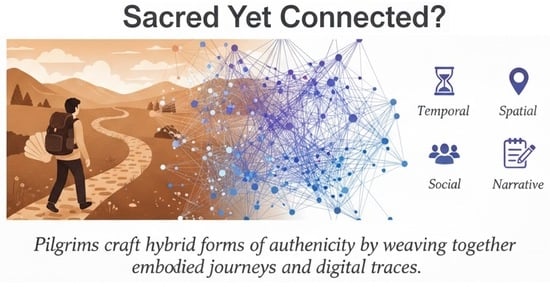
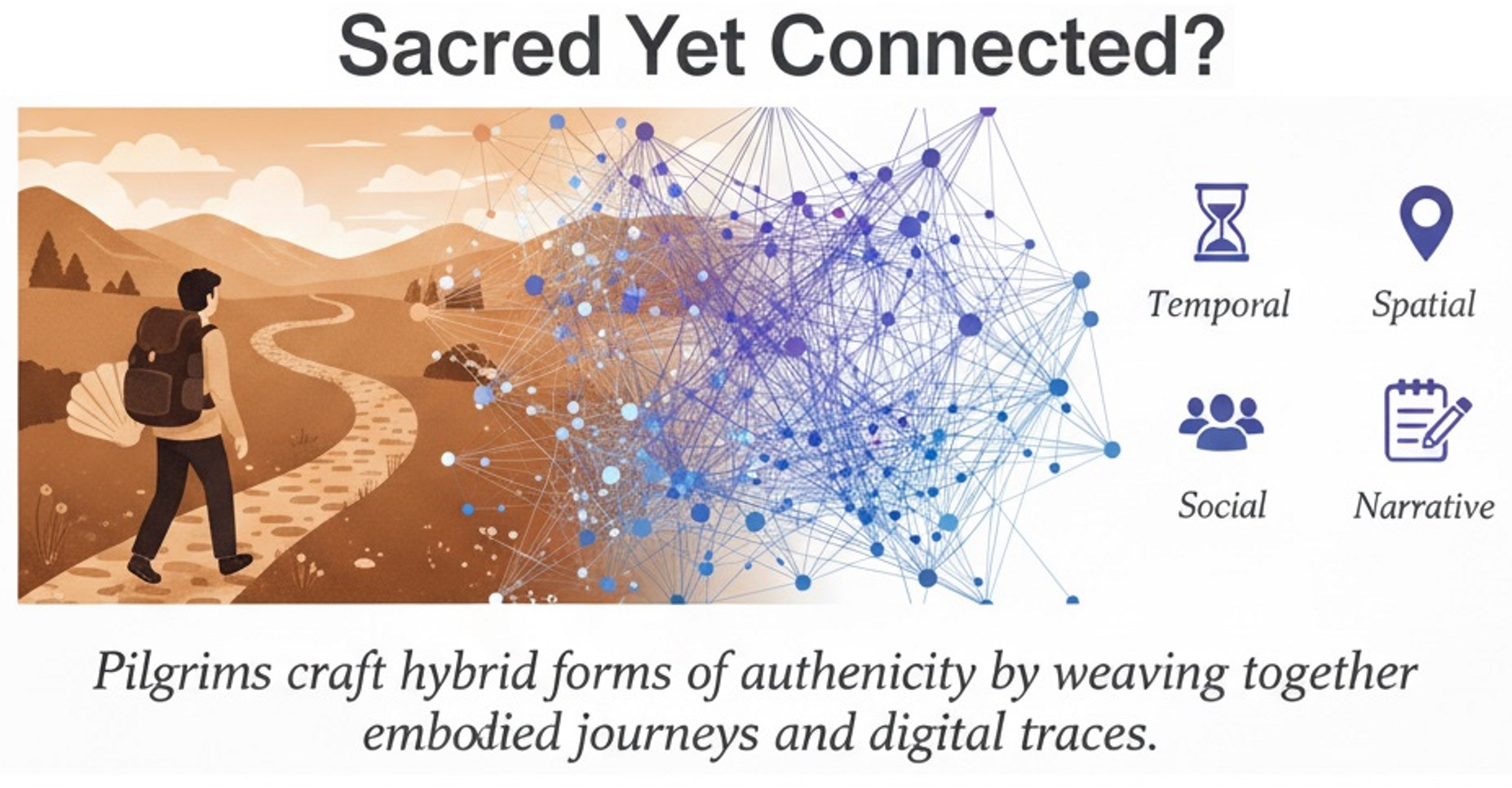
The proliferation of smartphones and social media has intensified debates about authenticity in contemporary pilgrimage, with critics arguing that digital connectivity undermines the spiritual depth of sacred journeys. This article explores how pilgrims on the Camino de Santiago negotiate this tension, asking whether digital mediation necessarily diminishes authentic experience. Through ethnographic fieldwork in Santiago de Compostela, semi-structured interviews with 20 pilgrims, and digital ethnography of online forums and social media platforms, the study identifies four interconnected ‘digital authentication strategies’: temporal regulations (when to connect/disconnect), spatial restrictions (where technology is appropriate), social negotiations (group norms), and narrative curation (selective digital storytelling). Rather than abandoning technology or experiencing diminished authenticity, pilgrims develop reflexive practices that integrate physical and digital dimensions while maintaining subjective experiences of spiritual legitimacy. These findings challenge classical anthropological models positioning pilgrimage as total separation from everyday life. Instead, contemporary pilgrims inhabit ‘connected liminality’—a digitally mediated liminal state where transformation occurs amid continuous connectivity, and where authenticity emerges through attentional discipline rather than technological absence. Digital mediation thus operates not as contamination but as transformation, creating hybrid ritual forms that reflect broader shifts in late modern religiosity.

1. Introduction

The Camino de Santiago has undergone profound transformation since the 1990s. What was once predominantly a journey of religious devotion and physical endurance has evolved into a complex social space where spirituality, tourism, and digital culture intersect in often unexpected ways (Coleman and Eade 2004; Amaro et al. 2018). Today’s pilgrims—religious and secular, local and international—navigate experiences that blend contemplation with consumption, solitude with connectivity. These shifts raise fundamental questions about whether pilgrimage necessarily entails withdrawal from ordinary life, or whether the very concept of withdrawal requires rethinking in an age of ubiquitous connectivity.
While the Camino de Santiago represents one of the most intensively studied pilgrimages worldwide, it also constitutes a singular phenomenon within the global landscape of sacred travel. Unlike many ritual journeys characterized by fixed ritual prescriptions or collective timing, the Camino’s model of individually paced long-distance walking combines religious heritage, touristic infrastructure, and quests for self-discovery (Digance 2003). Its exponential growth—from only a few thousand pilgrims in the early 1980s to more than 400,000 annually in the 2020s—illustrates both its spiritual appeal and its role as an engine of rural revitalization and global imitation. Numerous regions, including Ireland, Australia, and Japan, have since developed ‘Camino-inspired’ trails that emulate its hybrid formula of physical endurance, cultural immersion, and reflexive spirituality (Lois-González and Santos 2015).
This growth, however, has generated tensions around authenticity and legitimate participation. Narratives of the ‘true pilgrim’—those who walk long distances, carry their own pack, avoid pre-booking, or disconnect from technology—coexist with critiques of the ‘turigrino’, the comfort-seeking tourist who undermines the pilgrimage spirit (Frey 1998; Lois-González and Santos 2015). Online forums and media debates reflect a collective controversy about what constitutes legitimate participation and how authenticity should be measured in an era of digital mediation.
The proliferation of smartphones, apps, and social media has intensified these debates. Digital infrastructures shape almost every stage of the journey: preparation, navigation, lodging, storytelling, and remembrance. Yet they also raise questions about presence, attention, and meaning. Scholars of digital religion and media anthropology have described this as the paradox of connectivity—the simultaneous desire to be in communion and to disconnect, to seek solitude while remaining in contact (Campbell 2012; Hutchings 2017; Couldry 2012). The Camino thus exemplifies how sacred experience and digital mediation now shape each other in twenty-first-century religious life.

Research Aims and Hypotheses

This article explores how contemporary pilgrims negotiate authenticity in this entanglement. Rather than presuming that digital mediation diminishes spiritual depth, it examines how pilgrims themselves make sense of, regulate, and legitimize their technological practices. Through ethnographic and digital fieldwork—including participant observation in Santiago de Compostela, engagement with online forums, and semi-structured interviews with pilgrims of diverse backgrounds—the study identifies and analyses a set of ‘digital authentication strategies.’ These strategies articulate the ways in which pilgrims integrate the physical and digital dimensions of the Camino while maintaining a sense of authenticity, presence, and transformation.
By addressing these practices, the study engages three bodies of scholarship. First, it engages with anthropological approaches to pilgrimage that emphasize the Camino as a site of moral and social negotiation (Badone and Roseman 2004; Coleman and Elsner 1995; Eade and Sallnow 2000). Second, it dialogs with debates on authenticity in tourism and heritage (MacCannell 1973; Bruner 1994; Wang 1999; Cohen and Cohen 2012), extending them to the sphere of digital mediation. Third, it connects to recent scholarship on digital religion and networked spirituality, which examines how online affordances reshape ritual, authority, and belonging (Campbell 2012; Pink et al. 2016; Grieve 2016).
The study tests the hypothesis that the Camino de Santiago today represents a hybrid ritual form: neither the unmediated ‘traditional’ pilgrimage of the past nor a mere tourist spectacle, but a dynamic assemblage of physical and digital practices. Authenticity emerges not from the absence of technology but from the reflexive ways pilgrims integrate it into their search for meaning. Rather than a binary of authentic/inauthentic, authenticity in the digital Camino is conceptualized as a continuum, co-produced across embodied and mediated domains.
The main findings, detailed in the results section below, reveal four interconnected ‘digital authentication strategies’: temporal regulations (when to connect/disconnect), spatial restrictions (where technology is appropriate), social negotiations (group norms), and narrative curation (selective digital storytelling). These strategies demonstrate that contemporary pilgrims inhabit ‘connected liminality’—a digitally mediated liminal state where transformation occurs amid continuous connectivity. Digital mediation thus operates not as contamination but as transformation, creating hybrid ritual forms that reflect broader shifts in late modern religiosity.

2. Literature Review

2.1. Theoretical Background: Pilgrimage as Liminal Process

Pilgrimage can be understood as a ritualized form of travel oriented toward moral, spiritual, or existential transformation (Turner and Turner 1978; Coleman and Elsner 1995; Reader 2014). It involves departure from ordinary settings and movement toward spaces imbued with symbolic or sacred value. Although not every pilgrimage yields transformation, the expectation of change—through bodily effort, exposure to unfamiliarity, and disciplined attention—constitutes a recurrent anthropological motif (Margry 2008). This clarification anchors the Camino within a long tradition linking spatial mobility to inner reconfiguration while opening the question of how digital mediation reshapes that relationship.
Anthropological studies of pilgrimage have been deeply influenced by Van Gennep’s ([1909] 1960) tripartite schema of rites of passage—separation, liminality, and reintegration—and its application by Turner 1969; Turner and Turner 1978 to Christian pilgrimage. Pilgrimage is thereby understood as a ritualized process of removal from ordinary social life, entrance into a threshold state, and eventual reinsertion into society. The liminal phase, in particular, has been conceptualized as a transformative interval in which participants suspend their everyday roles, undergo existential trials, and experience communitas, a temporary egalitarian solidarity among fellow travelers.
This classical framework assumes pilgrimage requires rupture from ordinary life. Eade and Sallnow (2000) underline how the ‘separation’ from quotidian environments creates a sacred temporality distinct from secular time. Pilgrims’ embodied practices—walking long distances, relinquishing comforts, embracing solitude—produce what Frey (1998, p. 43) called a ‘bracketed time away,’ conducive to reflection and meaning-making. As Szakolczai (2009) adds, such liminality may even generate ‘permanent liminality,’ a destabilization of habitual patterns that opens possibilities for transformation.

2.2. Authenticity in Pilgrimage Studies: Contested Definitions

Alongside liminality, the concept of authenticity has occupied a central position in anthropological and tourism scholarship. MacCannell’s (1976) notion of ‘staged authenticity’ established a foundational tension: modern subjects seek the ‘real’ as an antidote to alienation, yet often encounter representations crafted for consumption. Cohen (1988) reframed authenticity as subjective, highlighting that its significance lies less in the genuineness of objects than in existential engagement. Wang (1999) later systematized these debates by distinguishing between objective authenticity (linked to factual genuineness), constructive authenticity (socially negotiated), and existential authenticity (states of self-realization). Existential authenticity matters most in pilgrimage studies because it emphasizes the pilgrim’s subjective fulfillment rather than the historical veracity of sites (Steiner and Reisinger 2006).
A growing body of work treats authenticity as processual. Belhassen et al. (2008), studying Jerusalem pilgrims, show that authenticity emerges through situated beliefs, practices, and attachments. Andriotis (2009) further identifies multiple ‘genres of authenticity’—natural, original, referential, and influential—operating simultaneously in sacred contexts. Reader (2014) names this ‘ascetic authenticity,’ whereby hardship and renunciation legitimize genuine experience. From a broader anthropological lens, Vannini and Williams (2009) argue that authenticity must be understood as a cultural construct, enacted and contested in practice, rather than as an ontological property.
Yet these conceptualizations of pilgrimage authenticity—whether ascetic, existential, or constructive—emerged within a pre-digital world. They presume conditions of relative isolation, delayed communication, and bounded ritual time. The digital revolution of recent decades fundamentally challenges these presumptions, demanding that we reconsider not whether authenticity survives technological mediation, but how it is reconfigured through it.

2.3. Digital Mediation and the Disruption of Classical Models

Digital technologies have destabilized the assumptions underlying classical pilgrimage models. Frey (2017) documents how the Camino de Santiago has become progressively technologized: from the early 2000s onward, smartphones, apps, and social platforms have been woven into pilgrimage practice. Mobile connectivity collapses the spatial and temporal distance that once defined liminality, enabling pilgrims to remain continuously connected to external networks (Campbell and Evolvi 2020).
This shift reconfigures all three stages of Turner’s model. Pre-pilgrimage planning increasingly unfolds online, where forums, blogs, and social media allow aspirants to craft expectations before setting foot on the trail. During pilgrimage, practices are fragmented between embodied immersion and digital engagement—taking photographs, updating blogs, or communicating through WhatsApp. Innocenti (2023) shows that pilgrims often take thousands of images, curating experiences in real time. Post-pilgrimage, journeys are extended through ongoing online sharing, community participation, and retrospective narrative construction.
These transformations generate new experiential and ethical dilemmas for contemporary pilgrims. If liminality requires separation, what happens when separation becomes partial and negotiated? If authenticity depends on unmediated presence, how do pilgrims validate experiences that unfold simultaneously in physical and digital registers? The digital Camino thus becomes a site where pilgrims must actively work to maintain coherence between embodied movement and virtual connectivity—a labor that itself becomes central to contemporary pilgrimage practice.
Digital connectivity introduces new experiential conditions. Gergen’s (2002) notion of ‘absent presence’ captures the paradox of pilgrims physically walking together while mentally dispersed through devices. Turkle (2011) similarly speaks of being ‘alone together,’ highlighting how pilgrims can remain socially connected yet existentially distracted. As Frey (2017, p. 8) notes, the Camino once allowed ‘the cork of stress to release’; now, achieving such release is more challenging when everyday demands remain just a notification away.

2.4. Rethinking Authenticity in the Digital Age

These transformations require us to rethink authenticity outside the binary of ‘traditional’ versus ‘contaminated’ experience. Tran and Davies (2024) propose the framework of ‘hybrid authenticity,’ identifying multiple dimensions—object-based, constructive, interpersonal, and intrapersonal—through which authenticity is negotiated in digital religious practices. This resonates with Cohen and Cohen’s (2012) concept of ‘strategies of authentication,’ whereby individuals adopt situated tactics to sustain feelings of genuineness amid mediating influences. Similarly, Campbell’s (2012) idea of ‘networked religion’ captures how pilgrims increasingly experience the sacred through distributed digital platforms and personalized networks (Wellman 2001; Rainie and Wellman 2012).
From this perspective, the authenticity of pilgrimage in the digital age is not diminished but reconfigured. Digital affordances (Gibson 1979; Norman 1988) enable novel forms of connection, documentation, and reflection, while pilgrims exercise agency in relation to these affordances. Giddens (1991) theory of reflexive self-identity helps frame how pilgrims integrate digital sharing into biographical narratives, sometimes enhancing meaning-making, sometimes creating performative pressure (Rettberg 2014).
What emerges is the need for a processual model of authenticity that recognizes its relational, negotiated, and hybrid nature (Vannini and Williams 2009). As we will discuss, digitally mediated pilgrimage, authenticity is not a static property but an emergent achievement shaped by practices, technologies, and communities.

3. Materials and Methods

This study combines semi-structured interviews, digital ethnography, and participant observation in Santiago de Compostela. Fieldwork was carried out between May and October 2025.

3.1. Semi-Structured Interviews

Twenty semi-structured interviews were conducted with pilgrims who demonstrated varied patterns of physical-digital integration in their Camino experiences (Table 1). Informants were recruited through purposive sampling (Patton 2015) using multiple channels: direct contact through online forums; Instagram outreach to pilgrims whose accounts demonstrated reflective engagement with digital practices; and snowball sampling from initial contacts who recommended fellow pilgrims with diverse technological approaches.
Table 1. Description of the pilgrims participating in the study.
The sample was designed to maximize diversity across key variables:
Nationality: Spain (n = 5), United States (n = 5), New Zealand (n = 2), Germany (n = 2), Australia (n = 2), and one each from Canada, Ireland, Italy, and United Kingdom.
Age range: 35 to 80 years, capturing generational differences in digital nativity and technological adoption patterns.
Digital intensity: From technological rejection (using only basic phones or leaving devices behind entirely) to micro-influencers with thousands of social media followers.
Routes and timing: Multiple Camino routes (Francés, Portugués, Norte, Primitivo, Vía de la Plata, and others) walked between 2001 and 2025, allowing analysis of technological evolution over two decades.
Motivations: Spiritual/religious, cultural/historical, sports/adventure, social, and mixed motivations.
Informants were assigned alphanumeric codes (P01–P20) to protect anonymity, with a secure master list maintained separately linking codes to demographic details and contact information.
Interviews lasted 25–90 min and were conducted in English or Spanish. All interviews were audio-recorded with explicit permission and transcribed verbatim. The interview protocol employed a semi-structured format with core questions addressing: initial motivations for walking the Camino; pre-Camino research and planning practices; daily technological routines during the pilgrimage; specific moments of technological engagement and disconnection; strategies for managing digital connectivity; conceptions of pilgrimage authenticity; perceived tensions between physical experience and digital mediation; and retrospective evaluation of technology’s role in their experience.

3.2. Participant Observation

Intensive participant observation was conducted in Santiago de Compostela, the culmination point where pilgrims’ authentication strategies become particularly visible through their interactions with institutional certification processes, communal spaces, and digital documentation practices. I selected observation sites that revealed how pilgrims integrate physical and digital practices:
Sacred and institutional spaces: The Cathedral of Santiago (interior and exterior), focusing on pilgrims’ behaviors during the Pilgrims’ Mass, interactions with the Botafumeiro ritual, and the queue for the blessing; the Pilgrim Office (Oficina del Peregrino), where pilgrims obtain the Compostela certificate and negotiate official authentication of their journey.
Communal gathering spaces: Praza do Obradoiro, the main plaza where pilgrims congregate upon arrival, serving as a liminal space between journey completion and return to ordinary life; Praza da Quintana, a secondary gathering point popular for evening socializing; Parque da Alameda, where pilgrims engage in post-arrival reflection and digital documentation with panoramic views of the Cathedral.
Transitional commercial spaces: In the historic center, where pilgrims purchase souvenirs, ship equipment home, and frequent establishments with WiFi access; cafés and restaurants surrounding the Cathedral that function as informal meeting points for digital connectivity and social exchange.
Observation protocols focused on documenting: pilgrims’ smartphone usage; photography and videography practices at key ritual moments; negotiations around technology use in group contexts; transitions between physical engagement and digital documentation; interactions with official certification processes; and informal conversations about authenticity, technology, and pilgrimage experience.
Field notes were recorded using a combination of handwritten notebooks (in spaces where digital devices seemed intrusive) and voice memos (recorded privately after observation sessions).

3.3. Digital Ethnography

Following established protocols for digital ethnographic research (Pink et al. 2016; Postill and Pink 2012), the study included systematic observation and participation in key online spaces where pilgrims plan, document, and retrospectively construct their Camino experiences:
Forum participation: I maintained a public researcher identity and participated in the main Camino de Santiago forums—caminodesantiago.me (English-language) and Gronze.com (Spanish-language)—the primary platforms for discussions about technology use, booking practices, and authenticity debates. Particular attention was paid to threads addressing the ‘pilgrim vs. tourist’ distinction, pre-booking controversies, and tensions around digital practices.
Social media observation: Monitoring of Instagram hashtags (#caminodesantiago, #buencamino) and dedicated Camino accounts to identify visual and narrative patterns in digital documentation. Analysis focused on: timing of posts (real-time vs. curated post-journey), captioning strategies, interaction patterns in comments, use of location tags, and self-presentation techniques.
Specialized platforms: blogs hosted on platforms like WordPress and Blogger, and video content on YouTube documenting Camino experiences. Special attention was given to how creators justify their technological choices and construct narratives of authenticity.
Digital ethnographic data collection respected platform terms of service and focused on publicly accessible content. When specific posts or profiles were selected for detailed analysis, explicit informed consent was obtained from content creators.

3.4. Data Analysis

Interview transcripts, field notes, and digital ethnographic materials were analyzed using constructivist grounded theory methods (Charmaz 2014). Analysis proceeded through iterative cycles of coding, memo-writing, and theoretical sampling. Initial open coding identified preliminary categories of authentication strategies and technological practices. Focused coding refined these categories, examining relationships between pilgrims’ motivations, their technological choices, and their constructions of authenticity. Theoretical coding integrated emerging patterns into broader analytical frameworks, particularly drawing on concepts of technological affordances (Gibson 1979; Norman 1988), practice theory (Bourdieu 1977), and processual understandings of authenticity (Bruner 1994; Vannini and Williams 2009).
Comparing interviews systematically revealed four primary typologies of authentication strategies—temporal, spatial, social, and narrative—each with multiple sub-variations. Negative case analysis actively sought examples that challenged emerging typologies, leading to refinement of categories and recognition of hybrid strategies that combined multiple approaches.
Data analysis was conducted using Atlas.ti software (version 22) for systematic coding management, with analytic memos documenting theoretical insights and emergent patterns throughout the research process.

3.5. Ethical Considerations

All participants provided written informed consent after receiving detailed information about the research purpose, procedures, and their rights as participants. Informed consent for digital content analysis was obtained separately: participants explicitly authorized analysis of their social media posts, blogs, and forum contributions, with the understanding that all identifying information would be removed or altered in publications.
Anonymization protocols included: removal of names and replacement with alphanumeric codes; exclusion of distinctive biographical details; and careful review of quoted material to ensure no inadvertent identification through unique phrasing or circumstances.
Digital data (interview recordings, transcripts, field notes, screenshots of digital content) were stored on encrypted, password-protected devices with access restricted solely to the author. Physical documents (consent forms, field notebooks) were maintained in locked storage.
Particular ethical attention was paid to the dual role of researcher and forum participant. My presence as a researcher in online spaces was disclosed publicly, and I distinguished between general observation of public discussions and specific analysis of individual contributions, obtaining explicit consent for the latter.

4. Results

Field data reveal four recurrent modalities through which contemporary pilgrims integrate technology into their journeys while maintaining the sense of spiritual and experiential legitimacy central to pilgrimage: temporal, spatial, social, and narrative strategies of digital authentication. These strategies, far from being mutually exclusive, often coexist and overlap, shaping a complex field of negotiations between connectivity and withdrawal, documentation and introspection, individual experience and collective validation.

4.1. Temporal Strategies (When to Connect/When to Switch Off)

Pilgrims develop practices that regulate when they use devices—not as a single binary (on/off) but as a set of time-based rules and rhythms that structure the pilgrim day. Many described routines that separate walking time from communication time: phones tend to be used for navigation and emergency contact while on the trail, and for social exchange, blogging or calls at predictable moments (end of day, midday checkpoint). For example, one pilgrim explains that the phone is a walking tool and a nightly communication device: ‘I used it frequently every day for navigation…I would post every night.’
Beyond smartphones, several participants incorporated wearable devices—smartwatches or fitness trackers—into their daily routines. These devices recorded steps, heart rate, and distance continuously throughout the day, generating data that some pilgrims reviewed each evening. For these individuals, checking daily statistics became a reflective ritual, allowing them to see their physical effort quantified and accumulated over time. One pilgrim explained: ‘Looking at the data [at the end of the day] made me realize how far I’d actually come… it was [an] achievement.’ This practice illustrates how digital mediation extends beyond communication or documentation: it also operates through bodily monitoring, creating ‘data doubles’ (Lupton 2016) that allow pilgrims to observe and narrate their own endurance.
Temporal rules are enacted for different reasons. Some participants treat the Camino as a temporal bubble to be protected: one participant reports having prepared copious pre-trip notes but then deliberately stopped consulting them once the walk began—an explicit attempt to compress planning into a pre-Camino timeframe and preserve presence during the walk: ‘Once I got on the Camino, after a while I stopped looking at my notes and I was trying to just be there.’
Other pilgrims show negotiated temporal routines oriented to family obligations and safety. One interviewee describes daily scheduling of calls to match time zones and to reassure relatives, turning communication into a predictable ritual rather than continuous connectivity: ‘I used to call my wife every day at 12 because it was 8…I did a video call every day around 12–12:30.’
Temporal strategies also include deliberate short windows of intense posting (evening blog updates, a nightly photo upload) combined with extended daytime disconnection. This pattern allows pilgrims to maintain ties with home—thus validating the pilgrimage socially—without allowing connectivity to dominate walk time. As one participant put it, ‘as a good modern, I will check it on my phone because I always have doubts’ (about dates, bookings), but that checking is bounded to specific moments.

4.2. Spatial Strategies (Where Devices Are Acceptable/Taboo)

Participants differentiate spaces along the route and assign different technological rules to them. Two recurring sub-patterns appear: (a) sacred or commemorative spaces (cathedral squares, sanctified sites) are often policed by personal norms of low visibility technology use; (b) domestic or service spaces (albergues, cafés) host negotiated rules that regulate charging, sharing, and the timing of social media activity.
Informants described voluntary restrictions inside sacred places: one pilgrim framed arrival at Santiago as an encounter that makes loudness or performative connectivity feel inappropriate, arguing that some forms of display (e.g., live video calls in the plaza) conflict with the place’s solemnity. ‘I realized…you don’t need a video call with your girlfriend while walking the Camino,’ said one participant when reflecting on the approach and arrival to Santiago.
Albergues and communal eating areas are the most concretely contested spatial sites. Some pilgrims report that albergues are places where group norms about phone use are enforced informally: arriving pilgrims may plug in and become absorbed in screens, while others treat the same space as a conversational commons. One participant contrasted these behaviors: ‘young people arrive at the albergue and immediately connect their phone…our community was about walking rather than being plugged in.’
Space also structures pragmatic tasks: use of GPS or map apps typically occurs in urban or confusing transitional space (‘when we left Oviedo we got lost, that’s when I took the phone out’), while charging and posting are often deferred to albergue evenings where Wi-Fi or plugs are available. These spatial practices create micro-zones of authentication where the physical place (pilgrim’s bed, cathedral square, route junction) cues specific technological behaviors.

4.3. Social Strategies (Group Rules, Shared Infrastructures, and Negotiation)

Authentication is profoundly social: pilgrims negotiate acceptable device use on the ground, and collective practices (WhatsApp groups, blogs) are deployed as tools of coordination and communal witnessing. Groups often create shared channels to coordinate lodging, share real-time updates, and build a small, distributed accountability network that substitutes for formal infrastructures.
For example, piloting of a small group practice appears across interviews: some groups create a WhatsApp thread specifically for daily logistics—‘we created a WhatsApp group…and then passed information: ‘I’m here, there’s a good café’—thereby using the platform to manage material tasks while keeping face-to-face time available for interpersonal exchange.
Social norms also mediate what counts as acceptable self-presentation. Several informants emphasized that, within their walking cohorts, posting decisions were negotiated (what to post, when, and who could post on a shared account). One participant described an internal distribution of roles: one companion would post publicly while others preferred not to, and that division was respected: ‘one of the companions would post some photos…but we didn’t decide to put everything.’
Groups also discipline connectivity for safety and logistics—sharing live locations, coordinating pre-bookings by phone, calling ahead to albergues—showing that social practices simultaneously enable and limit digital exposure. Sharing location or maintaining a small group blog creates an evidentiary trail (who was where when), which participants treat as a form of collective authentication.

4.4. Narrative Strategies (Curation, Timing, and the Performance of Authenticity)

Finally, pilgrims deploy narrative strategies to craft an acceptable public account of their Camino. Curation is selective: participants choose what to make visible (high-intensity, meaningful moments) and what to omit (fatigue, commercialized attractions). This selective narration operates as a process of authenticating the experience for distant audiences and for the self.
Informants explained that they use short multimedia artifacts (apps that auto-compose short movies, nightly blog posts) to produce a digestible, temporally bounded account: ‘we used an app called Relee…it creates a little movie of about two minutes which we then put on the blog.’ The movie-and-blog combination becomes a staged but temporally contained performance that validates the pilgrimage without sustaining continual disclosure.
Wearable devices—smartwatches and fitness trackers—introduce a distinct form of narrative practice. Unlike photos or blog posts that require conscious curation, wearables generate continuous quantitative records: daily step counts, elevation gains, kilometers accumulated. Several participants described reviewing these data each evening as a reflective ritual: ‘Twenty-eight kilometers doesn’t sound like much, but seeing it mapped… that told the story of how hard the day was.’ These quantified narratives generally remained private, shared selectively with close companions rather than broadcast publicly. They functioned less as social authentication than as personal validation, transforming bodily effort into objective evidence that could be revisited and reflected upon.
Curation is not only about highlight selection but also about representational ethics. One respondent reflected critically on image selection: photos often show smiling faces while concealing fatigue or pain; choices to include images of blister care or tears are deliberate decisions about the ‘truth’ of the journey: ‘this is the photo of the moment…it’s not the chosen photo…not everything is the happiness sold on social networks; there are moments of sadness and bitterness.’
These narrative strategies are intimately tied to temporal and social rules: pilgrims time their posts (evenings), curate what is shared (selective photos), and often aggregate content into a small set of formalized outputs (a blog entry, a short reel) that stand as the authenticated public trace of the Camino. As one participant synthesized the practice: the phone is both an instrumental tool and a storytelling device—used for route tracking by day and for carefully composed narrative work by night.

5. Discussion

How do contemporary pilgrims construct and negotiate digital authenticity? The ethnographic evidence gathered along the Camino de Santiago suggests that digital technology reconfigures rather than eliminates pilgrimage liminality. While this challenges classical anthropological models in important ways, it simultaneously opens possibilities for understanding new forms of sacred experience in networked societies.
This reconfiguration involves more than pilgrims simply choosing how to use devices. Digital infrastructures themselves shape what becomes possible or meaningful during pilgrimage. Navigation apps privilege certain routes over others; booking platforms structure accommodation rhythms; social media algorithms determine which moments gain visibility and validation. Pilgrims negotiate these structured possibilities—sometimes accepting them, sometimes resisting, sometimes repurposing them creatively—and through these negotiations co-produce what counts as authentic experience. Recognizing technology as an active participant in pilgrimage, rather than merely a neutral tool, aligns with recent anthropological approaches that examine how human and non-human actors jointly constitute social practice (Latour 2005; Lupton 2016; Campbell and Evolvi 2020).

5.1. Reframing Liminality in the Digital Age

Turner’s (1969) classical tripartite model—separation, liminality, and reintegration—needs reconceptualization when applied to contemporary pilgrimage. Contemporary pilgrims do not experience total rupture from everyday life. Instead, they inhabit a ‘connected liminality.’ The four digital authentication strategies identified—temporal regulations, spatial restrictions, social negotiations, and narrative curation—represent mechanisms through which pilgrims actively manage this negotiation.
These findings extend Frey’s (2017) documentation of technological integration on the Camino by demonstrating that pilgrims are not passive recipients of digital disruption but active agents developing reflexive practices. Where Frey identified fragmentation and loss of ‘bracketed time away,’ our data reveal strategic responses that preserve ritual temporality through selective disconnection rather than total separation. Morning silence combined with evening posting, designated ‘phone-free’ zones within sacred spaces, and deliberate delays in sharing content all represent what Pink et al. (2016) describe as emplaced digital practices—technological uses that are contextually situated and ethically informed.
The concept of connected liminality also resonates with Campbell and Evolvi’s (2020) analysis of digital religion, where online and offline dimensions increasingly constitute a unified experiential field. However, our findings add specificity regarding how this unification occurs in practice. Pilgrims do not simply merge physical and digital experiences indiscriminately; instead, they develop sophisticated attentional disciplines that calibrate connectivity according to spatial, temporal, and social contexts. This calibration itself becomes a form of ritual work, replacing physical separation with attentional regulation as the primary mechanism for creating sacred experience.

5.2. Authenticity as Relational Ethics

The evidence presented here confronts essentialist approaches to authenticity—particularly those positioning it as an inherent property that demands technological absence. Pilgrims’ actual practices align more closely with processual understandings, where authenticity emerges through ongoing negotiation and social validation (Bruner 1994; Vannini and Williams 2009; Cohen and Cohen 2012). Authenticity on the digital Camino is constructed not by rejecting technology outright, but through cultivating what might be called ethical relationships with digital tools—relationships marked by reflexivity, restraint, and context-sensitivity.
This finding extends Wang’s (1999) typology of authenticity—objective, constructive, and existential—by showing how these dimensions operate simultaneously in digitally mediated contexts. Object-based authenticity appears in pilgrims’ careful selection of photographic subjects, privileging landscape and communal moments over commercialized attractions. Constructive authenticity emerges through social negotiations within walking groups about acceptable technology use, creating shared norms that define legitimate participation. Existential authenticity manifests in pilgrims’ subjective experiences of presence, transformation, and spiritual fulfillment—experiences they maintain despite (or sometimes through) digital connectivity.
The ethics of presence documented in our fieldwork—voluntary restraint from photographing during Mass, negotiated group agreements about meal-time phone use, deliberate delays in sharing content—exemplify what Lambek (2010) terms ordinary ethics: practical judgments about appropriate conduct embedded in everyday practice rather than abstract moral codes. These micro-ethical decisions accumulate to construct what pilgrims experience as authentic participation, suggesting that authenticity in contemporary contexts may depend less on technological absence than on demonstrated capacity for ethical discernment.
This perspective also relates to ongoing debates in online forums between ‘peregrinos’ and ‘turigrinos.’ Rather than viewing these debates as moral panics about authenticity’s erosion, they can be understood as constitutive of an ethical field (Zigon 2007) where participants collectively negotiate standards for legitimate participation. The intensity of these debates reflects not authenticity’s disappearance but its active construction through contested discourse—precisely the process through which cultural categories maintain vitality and relevance.

5.3. Hybrid Ritual Forms and Late Modern Religiosity

The integration of physical and digital practices documented in this study exemplifies what Tran and Davies (2024) term ‘hybrid authenticity’ in virtual religious experiences. However, our findings extend their framework by showing how hybridity operates not merely in fully virtual contexts but in experiences that interweave embodied movement through physical landscapes with digital documentation, communication, and community formation.
The narrative strategies pilgrims employ—curating selective representations, timing posts for evening reflections, creating short multimedia summaries—transform the pilgrimage into a distributed ritual, extending across physical and digital domains while maintaining experiential coherence. This distribution parallels Campbell’s (2012) concept of ‘networked religion,’ where religious experience unfolds through personalized digital networks rather than bounded institutional spaces. The Camino pilgrim’s evening blog post or Instagram story becomes not a supplement to the ‘real’ pilgrimage but an integral component of how meaning is constructed and validated.
These hybrid forms reflect broader transformations in late modern religiosity characterized by individualization, bricolage, and the negotiation of authority across multiple sources (Giddens 1991; Rainie and Wellman 2012). Contemporary pilgrims exercise unprecedented autonomy in crafting their journeys—selecting routes, choosing accommodations, determining technological boundaries—while simultaneously seeking validation from peer networks rather than institutional authorities alone.

5.4. Implications for Pilgrimage Studies

These findings have several implications for pilgrimage scholarship. First, they suggest that classical models emphasizing physical separation and communitas require updating to account for how connectivity reconfigures rather than eliminates liminal experience. Future research might productively examine connected liminality across diverse pilgrimage contexts to identify both universal patterns and culturally specific variations in digital authentication strategies.
Second, the study demonstrates that authenticity debates, rather than representing nostalgic resistance to modernity, constitute active sites where pilgrimage traditions adapt to contemporary conditions. Anthropological attention to these debates can illuminate how cultural practices maintain continuity while absorbing innovation—a process central to understanding religious change more broadly.
Third, the concept of digital authentication strategies offers analytical insights for examining other contexts where sacred and technological practices intersect: meditation apps, virtual reality religious experiences, livestreamed services, or digital memorialization practices. The temporal, spatial, social, and narrative dimensions identified here may operate across these diverse contexts, providing a comparative framework for digital religion research.
These patterns are not unique to the Camino. Similar forms of digital mediation appear in other pilgrimage traditions worldwide. Research on the Hajj, for example, documents how mobile apps, online communities, and selfie practices reshape boundaries between ritual presence and virtual participation (Bianchi 2004). These parallels suggest that the authentication strategies observed on the Camino reflect broader, cross-cultural transformations in how sacred mobility unfolds within digitally mediated societies.

5.5. Limitations and Future Directions

This study provides insights into digital authentication strategies among Camino pilgrims, yet certain methodological boundaries suggest productive avenues for future research. The sample, while diverse in nationality, age, and technological practices, was recruited from pilgrims who completed their journeys and engaged with digital platforms or researcher outreach. Future studies might benefit from exploring the experiences of pilgrims who maintain minimal digital presence.
The fieldwork period (May–October 2025) captured the Camino’s high season, when infrastructure is most developed and pilgrim density highest. Seasonal variation research could show how winter’s solitude and reduced services shape different technological practices and authentication strategies, potentially revealing how environmental and social contexts influence digital integration.
While this study employed semi-structured interviews that allowed participants to reflect thoughtfully on their practices, complementary approaches could add valuable dimensions. Real-time ethnographic accompaniment during pilgrimages could capture spontaneous decision-making and embodied negotiations with technology as they unfold. Longitudinal designs tracking pilgrims before, during, and months after their journeys could illuminate how authentication strategies evolve across pilgrimage phases and inform subsequent life transitions.
The concept of connected liminality and the four authentication strategies identified here warrant testing across diverse pilgrimage contexts. Comparative research examining routes with different religious traditions, cultural contexts, and technological infrastructures could reveal whether these patterns represent culturally specific adaptations. Such comparative work would strengthen theoretical frameworks for understanding digital religion and contemporary ritual practice.
Additionally, generational research could explore how digital natives—those who came of age with smartphones and social media—construct authentication differently from older cohorts. Their relationships with photography, sharing, and online/offline boundaries may reflect distinct assumptions that challenge or extend our findings. Cross-generational studies could show how technological literacies and cultural expectations shape authentication practices.
Finally, the authentication strategies documented here may operate in other contexts where sacred and technological practices intersect, such as digital meditation platforms, virtual reality religious experiences, livestreamed ceremonies, and wellness tourism. Examining whether temporal, spatial, social, and narrative authentication dimensions appear across these diverse practices could establish a broader comparative framework for studying spirituality in digital age.
These research directions would not only address the specific boundaries of this study but also contribute to broader conversations in pilgrimage studies, digital religion, and the anthropology of ritual about how sacred experience adapts to technological change while maintaining continuity with tradition.

6. Conclusions

The contemporary Camino de Santiago exemplifies a broader transformation in how sacred experience is constructed and validated in digitally saturated societies. This study demonstrates that digital technologies have not diminished pilgrimage authenticity but fundamentally reconfigured how it emerges. Authenticity on the digital Camino is neither lost nor preserved but continuously produced through reflexive practices that integrate physical movement, technological mediation, and ethical discernment.
The four digital authentication strategies identified reveal contemporary pilgrims as active agents rather than passive consumers of either tradition or technology. These strategies demonstrate that modern pilgrims do not simply accept or reject digital connectivity; they actively craft hybrid practices that reconcile competing values of presence and sharing, solitude and community, spontaneity and documentation.
Theoretically, this study advances two primary contributions. The first concerns liminality itself. Rather than viewing liminality as a structural condition requiring physical separation, the Camino data points toward liminality as an attentional practice. ‘Connected liminality’—maintaining technological connectivity while cultivating intervals of focused presence—may increasingly characterize how contemporary pilgrims generate transformative experience.
Second, the study reframes authenticity as a relational ethics enacted through situated practices rather than as an essential quality requiring technological absence. Pilgrims validate their experiences not through conforming to fixed standards but through demonstrating capacity for ethical discernment in technological use. This processual understanding of authenticity resonates with broader anthropological insights into how cultural values are negotiated and maintained through practice rather than residing in unchanging essences.
The Camino of the twenty-first century reveals that sacredness persists not despite connectivity but through it—when pilgrims cultivate reflexive awareness of how they navigate between networks and stones, screens and silence, documentation and presence. The authenticity of contemporary pilgrimage lies not in technological rejection but in the ways pilgrims integrate digital tools into their search for transformation and meaning. In this sense, the digital Camino represents not pilgrimage’s degradation but its adaptation—a living tradition evolving to meet the spiritual needs and material realities of contemporary seekers while maintaining continuity with centuries of practice.

Funding

This research was funded by the Universidade de Santiago de Compostela—Cátedra Institucional da USC do Camiño de Santiago e das Peregrinacións, grant number 6051.K1GU.64100. The APC was funded by Universidade de Santiago de Compostela—Cátedra Institucional da USC do Camiño de Santiago e das Peregrinacións.

Institutional Review Board Statement

This study was conducted in accordance with the principles of the Declaration of Helsinki. In accordance with applicable national and institutional regulations, formal ethical approval was not required for this type of research, as it involved qualitative, ethnographic methods in the social sciences and did not include biomedical procedures, clinical interventions, or the collection of sensitive personal or health data. The ethical considerations of the study were reviewed within the context of the funding process under the VIII Convocatoria de Axudas á Investigación sobre o Camiño de Santiago e as Peregrinacións.

Data Availability Statement

The data presented in this study are available on request from the corresponding author due to ethical and privacy restrictions. Interview transcripts contain personally identifiable information and sensitive reflections on spiritual experiences that cannot be anonymized without substantially compromising data integrity. Sharing such data could violate participants’ privacy and breach the terms of informed consent, which guaranteed confidentiality.

Acknowledgments

During the preparation of this manuscript, the author used Claude 4.5 (Anthropic, version Sonnet 4.5) for the purposes of reviewing orthography, grammar, and stylistic consistency of the English text. The author has reviewed and edited all output and takes full responsibility for the content of this publication. The author gratefully acknowledges the pilgrims who generously shared their time, experiences, and reflections during fieldwork. The author thanks the moderators and members of online pilgrim communities, particularly caminodesantiago.me and Gronze.com, whose thoughtful discussions enriched this research.

Conflicts of Interest

The author declares no conflicts of interest.

References

  1. Amaro, Suzanne, Antónia Antunes, and Celeste Henriques. 2018. A Closer Look at Santiago de Compostela’s Pilgrims through the Lens of Motivations. Tourism Management 64: 271–80. [Google Scholar] [CrossRef]
  2. Andriotis, Konstantinos. 2009. Sacred Site Experience: A Phenomenological Study. Annals of Tourism Research 36: 64–84. [Google Scholar] [CrossRef]
  3. Badone, Ellen, and Sharon R. Roseman, eds. 2004. Intersecting Journeys: The Anthropology of Pilgrimage and Tourism. Urbana: University of Illinois Press. [Google Scholar]
  4. Belhassen, Yaniv, Kellee Caton, and William P. Stewart. 2008. The Search for Authenticity in the Pilgrim Experience. Annals of Tourism Research 35: 668–89. [Google Scholar] [CrossRef]
  5. Bianchi, Robert Richard. 2004. Guests of God: Pilgrimage and Politics in the Islamic World. Oxford: Oxford University Press. [Google Scholar] [CrossRef]
  6. Bourdieu, Pierre. 1977. Outline of a Theory of Practice. Translated by Richard Nice. Cambridge: Cambridge University Press. [Google Scholar] [CrossRef]
  7. Bruner, Edward M. 1994. Abraham Lincoln as Authentic Reproduction: A Critique of Postmodernism. American Anthropologist 96: 397–415. [Google Scholar] [CrossRef]
  8. Campbell, Heidi A. 2012. Digital Religion: Understanding Religious Practice in New Media Worlds. London: Routledge. [Google Scholar] [CrossRef]
  9. Campbell, Heidi A., and Giulia Evolvi. 2020. Contextualizing Current Digital Religion Research on Emerging Technologies. Human Behavior and Emerging Technologies 2: 5–17. [Google Scholar] [CrossRef]
  10. Charmaz, Kathy. 2014. Constructing Grounded Theory, 2nd ed. London: SAGE Publications. [Google Scholar]
  11. Cohen, Erik. 1988. Authenticity and Commoditization in Tourism. Annals of Tourism Research 15: 371–86. [Google Scholar] [CrossRef]
  12. Cohen, Erik, and Scott A. Cohen. 2012. Authentication: Hot and Cool. Annals of Tourism Research 39: 1295–314. [Google Scholar] [CrossRef]
  13. Coleman, Simon, and John Eade, eds. 2004. Reframing Pilgrimage: Cultures in Motion. London: Routledge. [Google Scholar]
  14. Coleman, Simon, and John Elsner. 1995. Pilgrimage: Past and Present in the World Religions. Cambridge: Harvard University Press. [Google Scholar]
  15. Couldry, Nick. 2012. Media, Society, World: Social Theory and Digital Media Practice. Cambridge: Polity Press. [Google Scholar]
  16. Digance, Justine. 2003. Pilgrimage at Contested Sites. Annals of Tourism Research 30: 143–59. [Google Scholar] [CrossRef]
  17. Eade, John, and Michael J. Sallnow, eds. 2000. Contesting the Sacred: The Anthropology of Christian Pilgrimage, 2nd ed. Urbana: University of Illinois Press. [Google Scholar]
  18. Frey, Nancy Louise. 1998. Pilgrim Stories: On and Off the Road to Santiago. Berkeley: University of California Press. [Google Scholar]
  19. Frey, Nancy Louise. 2017. The Smart Camino: Pilgrimage in the Internet Age. Paper presented at the Annual General Meeting of the Confraternity of St James, London, UK, January 28; Available online: https://www.walkingtopresence.com/research/text-pilgrimage-in-the-internet-age (accessed on 10 October 2025).
  20. Gergen, Kenneth J. 2002. The Challenge of Absent Presence. In Perpetual Contact: Mobile Communication, Private Talk, Public Performance. Edited by James E. Katz and Mark A. Aakhus. Cambridge: Cambridge University Press, pp. 227–41. [Google Scholar] [CrossRef]
  21. Gibson, James J. 1979. The Ecological Approach to Visual Perception. Boston: Houghton Mifflin. [Google Scholar]
  22. Giddens, Anthony. 1991. Modernity and Self-Identity: Self and Society in the Late Modern Age. Stanford: Stanford University Press. [Google Scholar]
  23. Grieve, Gregory Price. 2016. Cyber Zen: Imagining Authentic Buddhist Identity, Community, and Practices in the Virtual World of Second Life. New York: Routledge. [Google Scholar]
  24. Hutchings, Tim. 2017. Creating Church Online: Ritual, Community and New Media. London: Routledge. [Google Scholar]
  25. Innocenti, Perla. 2023. Pilgrim’s Progress? A Field Ethnography of Multimodal Recording, Curating and Sharing of the Camino de Santiago Experience. Journal of Documentation 79: 290–312. [Google Scholar] [CrossRef]
  26. Lambek, Michael, ed. 2010. Ordinary Ethics: Anthropology, Language, and Action. New York: Fordham University Press. [Google Scholar]
  27. Latour, Bruno. 2005. Reassembling the Social: An Introduction to Actor-Network-Theory. Oxford: Oxford University Press. [Google Scholar] [CrossRef]
  28. Lois-González, Rubén C., and Xosé M. Santos. 2015. Tourists and Pilgrims on Their Way to Santiago: Motives, Caminos and Final Destinations. Journal of Tourism and Cultural Change 13: 149–64. [Google Scholar] [CrossRef]
  29. Lupton, Deborah. 2016. The Quantified Self. Cambridge: Polity Press. [Google Scholar]
  30. MacCannell, Dean. 1973. Staged Authenticity: Arrangements of Social Space in Tourist Settings. American Journal of Sociology 79: 589–603. [Google Scholar] [CrossRef]
  31. MacCannell, Dean. 1976. The Tourist: A New Theory of the Leisure Class. New York: Schocken Books. [Google Scholar]
  32. Margry, Peter Jan, ed. 2008. Shrines and Pilgrimage in the Modern World: New Itineraries into the Sacred. Amsterdam: Amsterdam University Press. [Google Scholar]
  33. Norman, Donald A. 1988. The Psychology of Everyday Things. New York: Basic Books. [Google Scholar]
  34. Patton, Michael Quinn. 2015. Qualitative Research & Evaluation Methods: Integrating Theory and Practice, 4th ed. Thousand Oaks: SAGE Publications. [Google Scholar]
  35. Pink, Sarah, Heather Horst, John Postill, Larissa Hjorth, Tania Lewis, and Jo Tacchi. 2016. Digital Ethnography: Principles and Practice. London: SAGE Publications. [Google Scholar]
  36. Postill, John, and Sarah Pink. 2012. Social Media Ethnography: The Digital Researcher in a Messy Web. Media International Australia 145: 123–34. [Google Scholar] [CrossRef]
  37. Rainie, Lee, and Barry Wellman. 2012. Networked: The New Social Operating System. Cambridge: MIT Press. [Google Scholar]
  38. Reader, Ian. 2014. Pilgrimage in the Marketplace. New York: Routledge. [Google Scholar]
  39. Rettberg, Jill Walker. 2014. Seeing Ourselves through Technology: How We Use Selfies, Blogs and Wearable Devices to See and Shape Ourselves. Basingstoke: Palgrave Macmillan. [Google Scholar] [CrossRef]
  40. Steiner, Carol J., and Yvette Reisinger. 2006. Understanding Existential Authenticity. Annals of Tourism Research 33: 299–318. [Google Scholar] [CrossRef]
  41. Szakolczai, Arpad. 2009. Liminality and Experience: Structuring Transitory Situations and Transformative Events. International Political Anthropology 2: 141–72. [Google Scholar]
  42. Tran, Mai Khanh, and Andrew Davies. 2024. The Hybrid Authenticity of Virtual Pilgrimage. Marketing Theory 24: 391–415. [Google Scholar] [CrossRef]
  43. Turkle, Sherry. 2011. Alone Together: Why We Expect More from Technology and Less from Each Other. New York: Basic Books. [Google Scholar]
  44. Turner, Victor. 1969. The Ritual Process: Structure and Anti-Structure. Chicago: Aldine. [Google Scholar]
  45. Turner, Victor, and Edith Turner. 1978. Image and Pilgrimage in Christian Culture: Anthropological Perspectives. New York: Columbia University Press. [Google Scholar]
  46. Van Gennep, Arnold. 1960. The Rites of Passage. Translated by Monika B. Vizedom, and Gabrielle L. Caffee. Chicago: University of Chicago Press. First published 1909. [Google Scholar]
  47. Vannini, Phillip, and James Patrick Williams, eds. 2009. Authenticity in Culture, Self, and Society. Farnham: Ashgate. [Google Scholar]
  48. Wang, Ning. 1999. Rethinking Authenticity in Tourism Experience. Annals of Tourism Research 26: 349–70. [Google Scholar] [CrossRef]
  49. Wellman, Barry. 2001. Physical Place and Cyberplace: The Rise of Personalized Networking. International Journal of Urban and Regional Research 25: 227–52. [Google Scholar] [CrossRef]
  50. Zigon, Jarrett. 2007. Moral Breakdown and the Ethical Demand: A Theoretical Framework for an Anthropology of Moralities. Anthropological Theory 7: 131–50. [Google Scholar] [CrossRef]

Disclaimer/Publisher’s Note: The statements, opinions and data contained in all publications are solely those of the individual author(s) and contributor(s) and not of MDPI and/or the editor(s). MDPI and/or the editor(s) disclaim responsibility for any injury to people or property resulting from any ideas, methods, instructions or products referred to in the content.

Article Metrics

Citations

Article Access Statistics

Multiple requests from the same IP address are counted as one view.