


Abstract
This paper examines how access to law studies in British India challenged social stratifications within the colony, from the 1850s up to the 1940s. It highlights the impact of educational trajectories—colonial, imperial and global—on social positions and professional careers. Universities in British India have included faculties of law since the foundation of the first three universities in 1857. Although numerous native students enrolled at these Indian institutions, some of them chose to pursue their legal training in the imperial metropole. Being admitted into an Inn of Court, they could consequently become barristers, a title that was not available for holders of an Indian degree. This dual system differentiated degree-holders, complexifying the colonial hierarchy in a way that was sometimes denounced by both the colonized and the imperial authorities. Last but not least, access to higher education also impacted gendered identities: academic migration at times allowed some Indian women to graduate in Law but these experiences remained quite exceptional until the end of the Second Word War.
“The times are changed. And none of you can expect to succeed to your father’s gadi without having had a proper education. Now as this boy is still pursuing his studies, you should all look to him to keep the gadi. It will take him four or five years to get his B.A. degree, which will at best qualify him for a sixty rupees’ post, not for a Diwanship. If like my son he went in for law it would take him still longer, by which time there would be a host of lawyers, aspiring for a Diwan’s post. I would far rather that you sent him to England. My son Kevalram says it is very easy to become a barrister. In three years’ time he will return. Also expenses will not exceed four to five thousand rupees.”(Gandhi 2018)
In 1887, Mohandas Karamchand Gandhi passed the University of Bombay’s matriculation examination and enrolled at Samaldas College to prepare for the degree of Bachelor of Arts (BA) (Guha 2014). During the following Summer, Mavji Dave, “an old friend and adviser of [Gandhi’s] family” (Gandhi 2018) visited the young student and recommended him to reorientate towards law studies if he wished to preserve his father’s social position. Although legal training existed in British India at the time, Dave insisted on the impact of metropolitan education, which was deemed easier, shorter, cheaper, and led to a better professional situation. This assumption was not exceptional within the Indian colonial community, as more and more students, whether they be Natives or Europeans, were reaching the imperial metropole to enroll either in faculties or in Inns of Court, i.e., British and Irish institutions educating barristers. However, through his own son’s instance, Mavji Dave also underscored that legal training was available in the British Raj, extending the length of the studies after the obtention of the BA. He stressed the growing Indian interest in qualifying as lawyers, which might ultimately threaten job prospects. Faculties of law were actually established in the mid-19th century in India, when the first universities were founded. They admitted a thriving number of students in the following decades up to the Second World War. Eventually abandoning his Bombay curriculum and reaching London in 1888, Gandhi’s experience consequently highlights complementarity and competition between the colonial and imperial levels regarding law education. Despite Gandhi’s subsequent fame, his youthful trajectory was common to tens—and later hundreds—of young Indians, most of them being men, engaged in higher education. However, scholars have overlooked the multiscale dimension of this educational phenomenon so far, disconnecting higher education from extra-colonial paths. Historical works dealing with access to higher education in British India (Seshadri 1935; Chauhan 1990; Sen 1991; Ghosh 2000; Singh 2014) are generally separated from pieces of scientific literature scrutinizing student mobility towards the imperial metropole and/or foreign territories (Singh 1963; Lahiri 2000; Visram 2002; Mukerjee 2010; Bassett 2016; Mulvagh 2016). On the contrary, I aim at reconnecting educational attempts on the colonial scale with academic migration in order to globally understand higher training and its impact on colonial and imperial societies. As Mavji Dave illustrates when advising Gandhi, from the mid-19th century onwards, academic mobility became an educational option for Indian students besides enrolling at a colonial institution. Crossing these different levels of learning, this paper echoes works reevaluating imperial and global connections since the late 20th century (Said 1993; Boehmer 2015). Ann Laura Stoler and Frederick Cooper highlighted complementarity between the metropole and its colonies and the difficult task of “identifying th[eir] social and political reverberations” (Cooper and Stoler 1997). Gandhi’s trajectory was not only influenced by the desire to acquire some knowledge but also—if not especially—by the will to preserve his and his family’s social status by reaching a specific position. Here, the case of legal classes, labeled as professional training, stresses social and professional goals associated with the acquisition of degrees leading to specific careers.
Therefore, this paper challenges the role of legal education as to the shaping of an imperial society in British India by offering a global and connected analysis of access to law studies within and outside the Raj and its consequences regarding social stratification. Rather than limiting itself to an institutional description of colonial legal education, it aims at revealing professional and social strategies associated to it by a multiplicity of actors. This study discloses how the colonizers were willing to organize and fashion the British Indian society, teaching and bestowing degrees upon educated Anglo-Indians and Natives that were, above all, men. If race, class and gender intertwine (Cooper and Stoler 1997), I argue that colonial supply for education cannot be separated from demand. As Benedict Anderson showed for the Dutch Indies and French Indochina, the shaping of colonial communities through the hierarchized establishment of schools entailed that students took part in these educational “pilgrimages”, eventually enrolling at higher institutions located in higher administrative centers (Anderson 1991). It thus reveals how the students and their relatives negotiated with an educational system aiming at securing colonial rule and so, stresses their agency regarding their own educational and professional trajectories.
This global social approach of law education in British India is based on the crossing and connection of multiple primary sources, most of them being kept at the British Library in London, at the National Archives of India in New Delhi and at the West Bengal State Archives in Calcutta. On the one hand, university minutes and calendars on the colonial level and handbooks on the extra-colonial level introduce the byelaws and the official modalities and objectives of access to legal education. On the other hand, statistics and reports produced by educational or imperial authorities help determine who and how many the students were. Last but not least, correspondence, memoranda and some individual testimonies, including Gandhi’s aforementioned autobiography, allow us to seize negotiation regarding the professional and social openings of legal education. First, the successful development of faculties of law in British India participated in differentiating urban and peripherical territories while being dedicated to male students. Moreover, some of them reached the imperial metropole where they could get different degrees leading to the highest positions, still giving few spaces to women.
1. Under Colonial Law: The Multiple Development of Legal Education in British India
The first law faculties of British India were organized in 1857. Although they took part in the shaping of a colonial higher education system in this South Asian colony, then based on three universities located in Calcutta, Bombay and Madras1, legal training was not a complete novelty at that time. On the one hand, former schools and colleges have already included the study of law scriptures to their curricula since the late 18th century (Deer 2005): in 1781, the Calcutta Madrassa—also known as Muhammadan College—was created by the then de facto Governor General of Bengal Warren Hastings after a Muslim memorandum begging for the “instruction of young students in Muhammadan Law and in such other sciences as were generally taught in madrassas” (Sen 1991). Ten years later, some pundits from Benares created a college for the teaching of Hindu sacred and secular texts, aiming, among other things, to “qualify Hindu assistants to European judges” (Sen 1991). However, law studies were then always integrated into a wider curriculum, including theology, medicine, history, philosophy, music, grammar and so on. On the other hand, colonial attempts to organize law classes have already happened outside of the British empire during the first half of the 19th century: in Pondicherry, a French trading post in Southeast India, these classes were organized in 1838 by French administrators willing to recruit judiciary collaborators (Anonymous 1838; Legrandjacques 2017). However, no connection existed between this French colonial—and time-limited—attempt and British India. Consequently, the decade of 1850 still matches the creation of an independent law curriculum integrated within a larger university system that attracted many students up to the 1947 independence.
1.1. The Birth of the Faculties of Law
The first three Indian universities were provided with faculties of law, besides those of arts, sciences, engineering and, in the cases of Calcutta and Bombay, medicine. This integration of professional studies echoed the Wood’s Despatch on Education (Board of Commissioners for the Affairs of India 1880). Penned in 1854 by the then President of the East India Company’s Board of Control, Charles Wood, it praised the organization of a complete educational system, including universities. It also stressed professional training in order to secure vocational efficiency against unemployment. The new institutions that emerged three years later included professional faculties and were based on a metropolitan model: the University of London. Consequently, the three universities were not teaching institutions but affiliated public and private colleges in which students were trained in order to take—and pass—the university’s examinations. This imperial circulation of educational organization must not conceal the involvement of local elites in the shaping of faculties: in 1857, Calcutta University’s faculty of law counted nine fellows with two Hindus—Baboo2 Prasanna Coomar Tagore and Baboo Ramapersad Roy—and one Muslim, Moulvie3 Mahommed Wujeeh. These three personalities embodied a continuity with former initiatives as Tagore was a legal expert that had enrolled at Calcutta’s Hindu College and Mahommed Wujeed, a specialist of Muhammadan law.
Despite this colonial legacy, a fresh organization of studies and examinations characterized the faculties. Students could qualify for the Bachelor of Laws (BL) and the Honors in Laws. To do so, they had to follow a preliminary curriculum in Arts, leading to the degree of BA, reachable after having passed the University’s entrance—also called “matriculation”—examination. Theoretically speaking, university admission was quite inclusive: a 1857 minute from the University of Calcutta stressed that “any one above the age of sixteen may be a Candidate, wherever he may have been educated4”. However, women were at that time excluded from higher education. In addition, access to law studies required to be able to fund a quite long curriculum—in Arts and then in Laws5—and to pass several examinations, including the BAs. Any candidate to the Bachelor of Laws also had to “produce Certificates of his having attended Lectures in some School of Law recognized by the Senate for a period of three years in a whole6”. Once the BL’s examination passed, he could compete for Honors7. In the late 19th century, a third degree allowed the most gifted lawyers to become Doctor of Laws:
“No examination shall be held, but any person who has graduated as Bachelor in Law, and has at any time passed the Honor Examination, may be admitted to the degree of Doctor in Law without examination, provided that—
- (1)
- Two members of the Faculty of Law or two Doctors in Law shall testify, to the satisfaction of the Syndicate, that since graduating he has practiced his profession with repute for five years, and that in habits and character he is a fit and proper person for the degree of Doctor; and
- (2)
- He shall produce an essay approved by the President of the Faculty of Law for the time being, on some subject connected with Law or Jurisprudence8.”
At first glance, the colonial supply in law degrees was similar to the metropolitan offer. This educational organization accentuated both theoretical abilities and professional experiences of lawyers qualified in India. In fact, differences appeared within the faculties’ syllabi. In India, they included classes dealing with Hindu and/or Muhammadan law on a compulsory basis. For instance, in 1892, the Honors Degree was based on six papers “of which two at least shall be in Hindu and Mahomedan law9”. Moreover, the list of subjects specified that some of them, e.g., “the Law of Limitation and Prescription” and “the Law of Tenure of Immoveable Property”, should be studied “as administered in India10”. Here, law studies had to participate in organizing and ruling the colonial society, catering for legal professionals able to ensure the respect of official measures. This role was particularly emphasized in the memorandum on technical education published in 1886, in a paragraph dealing with the spread of law colleges in Bombay and Madras presidency:
“There is a wide career of usefulness open all over the settled districts of India for trained lawyers. The Bench absorbs a large number, with the result that the administration of justice is greatly improved. And besides this improvement, there is another gain in the better tone and morale of the native civil judiciary, consequent on the criticisms to which they are exposed at the hands of an instructed and independent Bar11.”
1.2. An Extensive Demand in the 19th Century
Echoing this supply in law classes, students joined the Indian faculties of law as early as the late 1850s. In 1858, the first candidates to the degree of Bachelor of Law signed up for the examinations held at Calcutta University12. There were 19 students who, as no BA degree was bestowed in British India before 1861, must have obtained their previous diploma outside the colony, probably in the metropole or from one of the imperial universities (Pietsch 2013). Indeed, following the byelaws established in 1857, the first candidates passing the Indian BL examination after a complete Indian curriculum might have enrolled from 1861 onwards. However, as Figure 1 illustrates, this year does not match a specific increase in the number of candidates. Applications started rocketing from the late 1860s, exceeding the hundred in 1868. From the 1880s onward, figures encompass the total number of students rather than the number of candidates to a specific degree. As Figure 2 shows, a steady growth of student attendance characterized the end of the 19th century. A will to secure a social and professional position thanks to an academic degree explains this increasing demand. However, details are still lacking regarding the geographical and social background of these students. Their interest in legal studies was notwithstanding confirmed by the opening of a law school in Punjab before the establishment of the local university in Lahore in 1882. In the mid-1880s, 71 students were enrolled at this school then supported by the university and in 1886, they reached 11113.
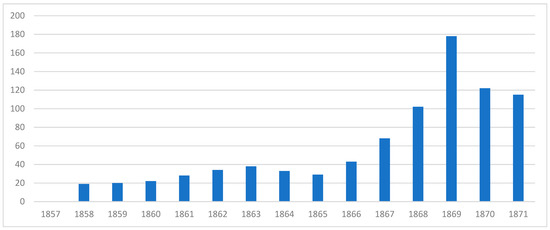
Figure 1.
Total of students enrolled in law examinations in Indian universities, 1857–1871. This figure presents the total number of students taking the examinations for the degrees of Bachelor and Honors in Laws at the Universities of Calcutta, Bombay and Madras, from 1857 to 1871.
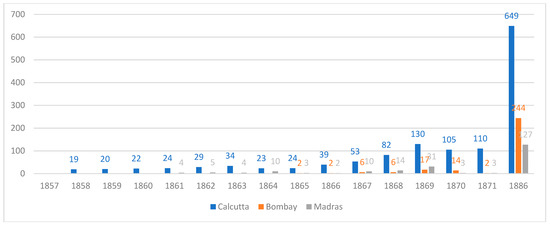
Figure 2.
Number of students enrolled in law examinations by universities, 1857–1886. This figure presents the number of students taking the examinations for the degrees of Bachelor and Honors in Laws by universities, i.e., Calcutta University, Bombay University and Madras University, from 1857 to 1886.
However, the distribution of law students within the British Raj was not homogenous at that time. Calcutta University was the first institution welcoming lawyers-to-be up to 1861. After that date and for five years on, Madras accompanied its Bengali counterpart, before being joined by Bombay University which actually became the second university in number of students at the end of the century. Calcutta’s predominance was not exceptional but reflects its place within the educational landscape of British India. Its university welcomed the greatest total number of students—from 12 in 1857 to 461 in 1871—benefiting both from the city’s status of colonial capital and from previous interest and attempts by local elites to adopt western education (Deer 2005). Before 1864, no college catered for law classes outside of this Bengali city. Nevertheless, a few years later, the University of Calcutta affiliated colleges outside of the Bengal Presidency, especially from the North-Western Provinces and Oudh, which conferred, sooner or later, some legal training. In the mid-1880s, before the establishment of Allahabad University in 1887 including its own faculty of law, these external affiliations consisted of three colleges: Benares College established in 1884 and gathering seventeen law students, Muir College in Allahabad and its 31 students and Canning College enrolling 57 students14.
This regional distribution highlighted the role of major cities—heading an Indian province or district—as to higher education, fostering school pilgrimage as described by Benedict Anderson (Anderson 1991). In other words, access to legal studies required to live in or to join an important urban center and participated in fostering flows from rural to urban areas. From the 1860s to the last decades of the 19th century, the urban dimension of law studies entailed debates among administrators and some representatives of local populations: in 1863, the Director of Bengal Public Instruction replied “to an enquiry as to what arrangement he would propose for providing legal instruction in the Colleges and Schools in the Mofussil15”. He explained that in his opinion, “it does not appear (…) under present circumstances to be either necessary or desirable to incur additional expense by establishing similar Lectureships in other colleges and schools16”. His reaction underscores a socio-geographical stratification amongst the Indian population, as students from the Mofussil could not benefit from legal training without leaving their homeland to attend lectures in Calcutta or in Dacca. The director clarified this social elitism regarding access to higher education by adding:
“Candidates in a respectable position in life, such I should suppose the High Court would alone desire to admit to the practice of the legal profession, will have no difficulty in resorting to one or other of the abovenamed Colleges, and their numbers will not probably be sufficiently to require the services of other lecturers in addition to those already provided or asked for17”.
If in 1860s Bengal, access to legal studies targeted an urban elite, a similar phenomenon characterized the development of law schools in Madras presidency twenty years later. There, the idea of increasing the number of law classes came from the local director of Public Instruction (Nash 1893). This initiative aimed at creating “a well-instructed and independent bar, competent to raise the tone and morale generally of the legal profession and of the native civil judiciary in the country18”. However, both the High Court and some members of the faculty stressed the general lack of colleges in the mofussil and were doubtful about the success of any law schools in that context. They highlighted competition from Madras’ own colleges but also some already embarrassing attendance figures regarding Pleaders’ examinations:
“Whatever may be the demand for legal education in the mofussil, it is also important to note the fact that the number of candidates who pass the first and second grade Pleaders’ tests every year is in excess of the requirements of the public service, and that graduates in law are spreading over the mofussil in increased numbers every year, and are, in the ordinary course of progress, pushing inferior practitioners into positions commensurate with their education status and legal acquirements19”.
1.3. Long-Lasting Successes in the Early 20th Century?
The second half of the 19th century saw the development of colonial higher education in India through the establishment of universities including law curricula. Educational urban centers emerged, entailing disparities between them and peripherical areas. The significant weight of Indian legal studies remained real until the Second World War. If the turn of the 20th century matches a stagnation of student attendance slightly under 3000 individuals, Figure 3 shows that an important increase happened during the following decades. Despite a decrease during the second half of the Interwar period and the war, figures never fell under 5000 enrolled students after 1916. Faculties of law were then the main professional course chosen by young men—and a few women (Bureau of Education 1950)—studying in India, even though the regional distribution of those attendees remained heterogeneous (See Figure 4).
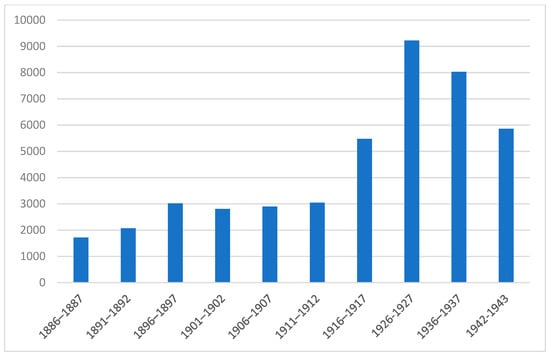
Figure 3.
Total of students enrolled in law studies in Indian universities, 1886–1942. This figure presents the total number of students enrolling in law studies in one of the Indian universities from 1886 to 1942. It gives figures for some academic years within this timespan.
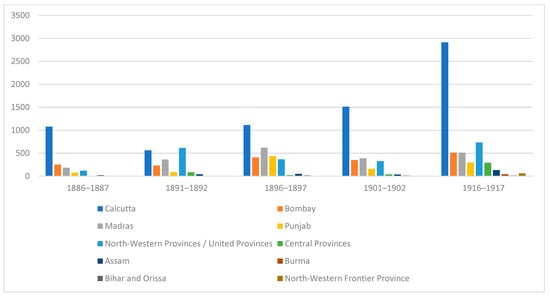
Figure 4.
Number of students enrolled in law studies by colonial province, 1886–1917. This figure presents the number of students enrolling in law studies by university from 1886 to 1917. It gives figures for some academic years within this timespan.
At the turn of the 20th century, faculties of law attracted around 3000 students, the majority—for instance, 1510 in 1901–1902—enrolling at an institution affiliated with the University of Calcutta. Beyond that unequal geographical distribution, officials investigating on the development of education in British India emphasized the diversity of its organisation, changing from a province to another. In his review entitled “Progress of Education in India” (1903), R. Nathan aimed at summing up the heterogenous organization of law and, consequently, of associated degrees in the presidencies of Madras, Bombay and Calcutta, in the United Provinces and in Punjab:
“In Madras, there are three grades: High Court pleaders, and subordinate court pleaders of the first and second grades; in Bombay there are two grades: High court pleaders and subordinate court pleaders; in Bengal there are three grades: High Court pleaders, subordinate court pleaders and mukhtiyars”.(Nathan 1903)
If in Madras or Bengal, a High Court pleader needed a “law degree and prescribed professional experience”, in Bombay, a law degree could be replaced by the “University entrance examination and High Court pleaders’ examination, higher standard” (Nathan 1903). The author underscores that “in the United provinces, the system runs on similar lines, but is more complicated; in the Punjab different grades of University qualifications are prescribed, the Bachelor’s degree for Chief Court pleaders, the Licentiate for subordinate court pleaders, and the first certificate in law examination for mukhtiyars” (Nathan 1903). At that time, the course of studies differed too: for instance, the course for Bachelor of Laws extended over two years in Calcutta and Allahabad but over three years in Bombay. A few years later, the degree of Doctor of Laws was given “in all universities salve Bombay” (Anonymous 1919). This heterogeneity of legal systems within the British Raj, impacting on legal education, underscores the federal administration of this colonial territory. This multipolarity of higher education grew during the first half of the 20th century as new universities were regularly established from the 1910s onward20. As such, 14 over 16 of them included legal studies that never attracted under 50 students (Bureau of Education 1950). They participated in the increase of law enrolment at that time, even though some officials stressed the impact of the Great War in the 1910s, some parents refusing to send their children to Europe (Bureau of Education 1950).
The 1930s decrease, explained by the congestion striking law positions in India (Sargent 1940), must not be overestimated. Law studies continued to attract many Indian students. Geographical stratification—between administrative centers and the Mofussil—is difficult to apprehend then but gender differentiation can be stressed. In the late 19th century, only a handful of women students studied, enrolling in medicine or education rather than law. Old prejudices against women’s education, deemed “unnecessary, dangerous and unorthodox”, were slowly vanishing with the development of educational movements (Basu 2005) and women remained less educated than men. Colonial higher education preserved this stratification by first addressing men. Moreover, the predominance of medical and teaching studies underscores the gendered division of the Indian colonial society as it led to professional positions, as teachers and doctors, amongst women. Figures slowly increased in the following century. In 1942–1943, 1714 women were engaged in professional studies against 24,378 men (Bureau of Education 1950). However, few of these women students attended law courses. In 1942–1943, only 55 women for 5808 men read for a law degree against 956 for a degree in medicine and 655 for a degree in education (Bureau of Education 1950).
2. Extra-Colonial Stratification: Law Studies on the Imperial Scale
From the decade 1850 onwards, law education developed in British India and revealed both the complexity of higher education within this colonial land and social and gendered stratifications that featured its society. Urban men were the first target and audience of the recently organized law classes. However, legal training in India was not limited to this colonial scale; several scholars have already highlighted the imperial and global dimension of higher education in India through the development of student mobility as early as the mid-19th century (Singh 1963; Lahiri 2000; Visram 2002; Mukerjee 2010; Boehmer 2015; Bassett 2016; Mulvagh 2016). Extra-colonial curricula led some of these moving students towards metropolitan and international faculties and schools of law in which they could obtain a degree that did not always match qualifications available in India. Social and professional objectives motivated lawyers-to-be without abolishing social and gendered hierarchy and, even sometimes, reinforcing it.
2.1. Legal Mobility
In the mid-19th century, outbound student mobility started to develop in India (Fisher 2004; Deer 2005). It first concerned medical and engineering students in the 1830s and the 1840s, but the first law students left India in the following decade. In the 1850s, admission books and registers from legal institutions, especially Inns of Court training barristers in Great Britain and Ireland, started to enlist candidates arriving from the “Jewel of the British Crown”. At Inner Temple—one of the four Inns of Court in London besides Gray’s Inn, Lincoln’s Inn and Middle Temple—the first student from India enrolled on 17 November 185221. Gregory Charles Paul was the eldest son of the esquire Peter I. Paul, living in Calcutta. Here, the first Indian candidate was not a Native but an Anglo-Indian, i.e., the son of a colonial officer established in the British Raj. This Anglo-Indian lead was common to most of the British universities and schools: students came first to the metropole, aiming to study in prestigious British institutions and to get a degree that was not specifically Indian. They also benefitted from a better knowledge and understanding of British education when few information on metropolitan opportunities circulated within the colonized communities22. Thus, between 1852 and 1868, 23 Anglo-Indians enrolled at Inner Temple23. However, the number of Native Indians grew from the 1870s onwards. There were 23 at Inner Temple during this specific decade. Law institutions seemed to encourage colonial admissions as specific rules were adopted to facilitate them:
“Every person not otherwise disqualified, who has passed a Public Examination at any University, within the British Dominions, or for the Indian Civil Service, is entitled to be admitted as a Student at one of the four Inns of Court, without passing a preliminary Examination. Other applicants for admission must pass an Examination in the English and Latin languages, and English History. But Indian Candidates can obtain an exemption from examination in Latin on applying for the same”.(National Indian Association 1893)
The specificities of Indian higher education were taken into account and these initiatives fostered flows of students arriving from the Raj, including Mohandas Gandhi in 1888 (Guha 2014). In 1903, the India Office estimated that between 150 and 200 law students were living in lodgings in London, 74 of them belonging to Gray’s Inn24. Figures continued to increase after the First World War: from 1920 to 1925, between 583 and 647 Indian Natives were enrolled at one of the four abovementioned Inns of Court. Admission data sometimes informs on the social and professional background of these moving students: the majority of the Anglo-Indians and Natives enrolling at Inner Temple were members of the colonial elite, whether it be political, intellectual or economic. Sons of esquires and civil servants mixed with sons of merchants, zamindars or doctors. Professional reproduction was also at stake: for instance, William Peacock enrolled in 1862, and Arratoon Carapiel, admitted 10 year later, were both sons of legal solicitors.
Furthermore, Gregory Charles Paul’s trajectory underscores the complementary of different institutions on the metropolitan scale as he was studying law at Cambridge’s Trinity College when he gained admission to Inner Temple25. Being a degree-holder from Cambridge exempted him from taking the Inn’s preliminary examination. Here, university studies became a preliminary step to qualify as a barrister. This complementarity between different institutions and degrees also took an imperial dimension, some students furthering their law studies by travelling to the United Kingdom after having obtained an Indian degree. For instance, Himansunath Rai was first a law student at the University of Calcutta. In the early 1920s, he reached London to train as a lawyer (Nasta 2013). In a nutshell, law studies remained one of the most attractive metropolitan courses for students coming from India, after medical training and often besides engineering. However, flows towards legal schools declined from the mid-Interwar years onwards (Sargent 1940). This dynamic could first be linked to the similar decrease that touched law education in British India due to the professional overcrowding before being reinforced by the war years.
Last but not least, a handful of students enrolled at foreign institutions. In 1902, one of them signed up for legal education at Columbia University, New York26. During the Interwar period, a few Indians studied law in some European universities: there were four in France between 1928 and 1930, seven and eight in Germany in 1930–1931 and 1931–1932; one student a year enrolled at Geneva between 1930 and 1933 and one in Vienna in 1929–1930 and 1931–193227. Despite these elements, information has been lacking regarding foreign legal trajectories so far.
2.2. Imperial Hierarchy
While metropolitan schools and faculties of law welcomed Indian—both Anglo-Indian and Native—students, an educational hierarchy appeared, differentiating law studies in India and in the metropole. Mobile students who left behind them higher education as it was organized in their homeland had to follow new byelaws as to embrace the British system. As early as the late 19th century, officials and private organizations stressed the necessity for the students to inquire about admission rules before their departures. They also urged to secure a sum of money in order to pay the deposit required from barristers-to-be and to cater for their daily needs, including suitable lodgings (National Indian Association 1914). Those rules were generally described in handbooks that thereupon give an insight of the stratification that characterized legal education and, by extension, professional prospects.
First of all, law subjects differed between the colony and the metropole. Law studies outside of India opened new horizons for a professional qualification, promoting Britishness instead of a colonial belonging. In the 1890s, no class dealing with Indian laws was available at the Inns of Court (National Indian Association 1893). Only Indian Civil Service probationers benefited from a specific training in Indian legislation. Hindu and Muhammadan Law was added to the Barrister examination’s subjects at the turn of the 20th century. However, entrance examinations never offered the possibility to choose an Indian subject28 (National Indian Association 1914). Indian students taking the solicitor’s examination in the United Kingdom had to face the same situation: the two language papers could be taken in some European languages—including German, French, Spanish and Italian—but no paper in an Oriental language was proposed. Imperial studies demanded to adapt to British criteria and so, differentiated a colonial training from an imperial one.
Second, if some institutions adopted exemptions for candidates trained in the South-Asian colony, Indian curricula were not seen as equivalent to metropolitan ones. This stance was reinforced by the adoption of new byelaws for the Inns of Court during the first decades of the 20th century: according to the 1914 handbook, admission should be given to “every person not otherwise disqualified who shall have passed on […] examinations” from British, Irish and Dominions’ universities (National Indian Association 1914). No Indian university was added to that list and only professional experience as a High Court’s Vakil spared Indian candidates from entrance examinations. Consequently, most of Indian candidates had to join one of the aforementioned universities—mostly in Britain but also in Ireland (Mulvagh 2016)—before enrolling at an Inn of Court, extending their extra-colonial stays. Few changes happened in the following years, despite the approvement of several Indian universities—Calcutta, Bombay, Madras, Allahabad and the Punjab University—by the Council of Legal Education in 1914 that only seemed to facilitate access to the Inns for Indian Civil Service probationers coming from one of these universities29. These hesitations and defiance were also illustrated by the implementation of further measures of control over Indian students, their former curriculum and career:
“If he is a native of India, [the Applicant shall also produce] a certificate from the Secretary for Indian students appointed by the Secretary of State for India, or a certificate from a Collector or Deputy Commissioner, or in the case of a Native State from the Political Officer.The Secretary for Indian students is required by the Council of Legal Education to see every Indian student who seeks his certificates for admission to one of the Inns of Court, and to obtain from the Secretary of the Advisory Committee of the province from which the student comes, certificates and information in regard to his circumstances and career.Applicants should make enquiries from the Secretary of the nearest Advisory Committee before leaving India so as to ascertain what certificates are required”.(National Indian Association 1914)
In the early 20th century, these specific rules aimed at regulating the increasing flows of Indian students willing to call to the Bar, worrying some educational and political officials. In February 1902, Middle Temple’s Under-Treasurer stated that “very few [Indian students] have failed to pass the examinations or to be called at the bar” in spite of “a few instances of Indians withdrawing from the Inn30”. Yet his Inner Temple’s homologue was less optimistic, explaining that “many [Indian students] suffer severely from getting into bad ways while over here31”. The lack of monitoring and supervision was seen as a hindrance regarding the educational success of students that did not live on a university campus:
“If he were to enter as a student at Oxford or Cambridge, he would be kept under discipline, and his progress would be tested by frequent examinations, but in London he is left to himself and the result is too often disastrous (…) A promising young man was sent here to study for the Bar, and, after running his father with his extravagance, was prosecuted for cheating and obtaining money under false pretenses; he has never been called to the Bar and has married a prostitute32”.
Imperial sojourns for barristers-to-be were depicted as dangerous. These fears were imbued with racial prejudices as native Indians were deemed less capable to study under no supervision than British students. Despite this racist and infantilizing differentiation, no practical measures preventing or regulating colonial enrolment were adopted in the early 1900s. A few years later, in 1907, the Lee-Warner Committee appointed by the India Office to investigate on Indian students in Britain echoed these concerns regarding Indians engaged in a law curriculum. The students’ lack of abilities and knowledge was stressed besides their potential drift towards a shameful life during their stay. Two causes of attraction were exposed in the official report: “the special privileges enjoyed by barristers in India”; “the system of examinations for the Bar in England33”. On the first hand, becoming a barrister directly led to a position in a High Court in India unlike Indian degrees. Barristers benefited from advantages over India-trained lawyers, generally named vakils:
“It would appear that the first attraction to Indian students of membership of the English Bar is that it qualifies a student for admission to the Roll of Advocates in any of the High Courts of India. The advantages enjoyed by an advocate over the ‘vakils’, who form the great majority of practitioners in India courts, may be summarized as follows:
- (1)
- The advocate has the right, which is denied to vakils, of practicing on the original side of the Calcutta and Bombay High Courts.
- (2)
- Advocates enjoy precedence and pre-audience of vakils in all courts. The result of this privilege is (…) that ‘if a barrister advocated of one month’s standing and a vakil of, say, 20 years’, standing, are engaged on the same side in a suit or motion, the barrister advocate has the right to the leading brief (…)
- (3)
- Vakils are under a further disadvantage, as compared with advocates, in that ‘no vakil can appear in any case in court for a client until he has obtained from his client a power of attorney (vakalatnama), and has filed it in the court’, whereas an advocate can appear for his client without a power of attorney34.”
On the other hand, metropolitan studies were easier than Indian studies:
“Parenthetically, it may be explained that a call to the Bar in England, Scotland, or Ireland, is not the only avenue to admission to the Roll of Advocates in all the Indian High Courts. The same goal can, in some High Courts, also be reached by obtaining an Indian law degree. But the latter process occupies a longer period and involves a severer intellectual test. A vakil of Allahabad High Court, now studying for the English Bar informed us that ‘it would take him 10 years to become an advocate by passing University examinations in India’ whereas he could “achieve the same object in a much shorter period by being called to the Bar in England35.”
Here, imperial stratification was both educational and professional, promoting metropolitan studies and leading to a congestion of the legal sector in India. Thus, suggestions were made regarding the abolition of these specific privileges, the organization of special examination on Indian law and the necessity to get certificates before enrolling at an Inn of Court. Despite a few changes, confirmed by information available in the aforementioned 1914 handbook, calling at the bar in Britain or Ireland remained prestigious and an educational objective for many Indian students up to the Interwar years.
2.3. A Man’s Imperial World?
Law education on the imperial scale reinforced social and professional differentiation by bestowing greater privileges upon mobile students enrolling in metropolitan curricula. Available material has not given proof of similar advantages for foreign-trained lawyers so far. Moreover, most of these educational travelers were men. According to the Indian Students’ Department, there were only 75 women for 805 men studying in Great Britain, all curricula included36, in 1934–1935. The figures reached 71 for 381 in 1939–194037. These women were first and foremost studying medicine and education, sometimes in institutions reserved for them like London School of Medicine for Women (Burton 1996) or Maria Grey’s Training College (Lilley 1981). Law students were rarely female students. However, reaching the metropole remained a way for women to enroll in law training. In the late 1880s, Cornelia Sorabji became the first woman of all time taking—and passing—law examinations at Oxford University. She first studied in British India, passing Bombay University’s BA examination in the 1880s. She subsequently became a Professor of English at Guzerat College but was willing to further her studies by going to England38. However, she already had to face gender stratification before her departure as Government of India scholarships were reserved exclusively for men at the time. She was eventually able to reach England thank to donations coming from British personalities. She integrated Somerville College, a college for women affiliated to the University of Oxford, during Michaelmas Term 188939. After studies in literature, she decided to prepare for the Bachelor of Law, passing it in 1892. This situation was exceptional as women were not allowed to enroll in law courses. She benefited from contacts with important members of Oxford academia, including Benjamin Jowett, Master of Balliol College. After getting her degree, she became a clerk at a solicitors’ office. She was back in India in 1894 and was a partner for a Bombay solicitor’s firm and a legal practitioner both in Bombay and Poona, her hometown. Despite this professional position associated to her legal training, she was not admitted to the bar before 1922 (Mukerjee 2010). Thus, her role as a lawyer remained secondary, separating her from the highest positions both in the metropole and in India. Despite this personal disappointment, Sorabji still participated in fostering women student mobility toward the imperial metropole, supported by external supporters. A few women continued to engage in metropolitan legal education up to the Second World War, including Kamila Tyabji enrolled at St Hugh’s College, Oxford University, in 1937 and then a social and legal worker in London (Mukerjee 2010).
3. Conclusions
In 1939–1940, S.A. Khan from Hyderabad obtained his Bachelor of Law at Cambridge University40. His name was added to the list of Indian postgraduate students in Britain, apparently highlighting the fact that he was already the holder of another bachelor’s degree before enrolling at the prestigious British university. The same year, two other Native students obtained first class honors at Middle Temple, N. Saghal and M. Mohammed Khan, both coming from Punjab and passing the Bar Final Examination. Last but not least, N.C. Saha from Bengal obtained the J.R.K. Law scholarship of £150 per annum for two years in order to further his curriculum at Glasgow University. Consequently, at the outset of the Second World War, metropolitan legal education was still attracting students from the British Raj, while colonial law schools continued to admit a quite important number of pupils, exceeding 5800 individuals for the academic year 1942–194341.
Legal education has asserted itself as one of the main components of Indian higher education since the mid-1850s. It illustrates the multiscale dimension of further training, encompassing and crossing colonial, imperial and foreign trajectories. If colonial authorities developed a local supply through faculties of law as early as 1857, it did not prevent some students from choosing extra-colonial curricula. This academic migration, mostly made of sons of colonial elites, underscores the complex connections that existed between the colony and its metropole, based on both complementarity and competition. When getting a metropolitan degree influenced his or her holder’s professional and, by extension, social status in the colony, British universities and schools sometimes adapted themselves to Indian arrivals by modifying their admission rules. Colonial access to law education fostered global networks including both Native and Anglo-Indian students motivated by educational but also social and professional objectives. However, this inclusive enrolment must not hide levels of stratification: first, a both geographical and professional stratification separating, on the colonial level, urban centers from peripherical areas where law schools were lacking and, on the imperial level, the colony from the metropole as degrees bestowed in the latter secured access to the highest legal positions in British India. If imperial authorities organized law education in British India following the metropolitan model, this educational mimicry still included differences and imperial hierarchies, as metropolitan degrees remained more prestigious than colonial ones. Following Homi Bhabha’s work on colonial discourse, law education in British India stressed “the difference between being English and being Anglicized” (Bhabha 1997) and influenced the former students’ social status within the colonial society. Second, a gendered stratification limited women enrollment in legal studies, a phenomenon that was not specific of colonial education but typical of British education at the time. Therefore, educational training in British India participated in the shaping of colonial and imperial societies, dividing its members regarding their geographical, professional and gendered identities. The end of the Second World War and the 1947 proclamation of independence matched an increase in university enrolments, including law courses: these figures must now lead to challenge the idea of rupture between the colonial and postcolonial period.
Funding
This research received no external funding.
Institutional Review Board Statement
Ethical review and approval were waived for this study due to use of archival materials older than 75 years.
Informed Consent Statement
Not applicable.
Data Availability Statement
Data available in a publicly accessible repository that does not issue DOIS. Publicly available datasets were analyzed in this study. This data can be found at the British Library (London), Somerville College Archives (Oxford), the National Archives of India (New Delhi) and the West Bengal State Archives (Kolkata).
Conflicts of Interest
The author declares no conflict of interest.
References
- Anderson, Benedict. 1991. Imagined Communities. Reflections on the Origin and Spread of Nationalism. London and New York: Verso. [Google Scholar]
- Anonymous. 1838. Bulletin des actes administratifs des établissements français de l’Inde. Tome onzième, année 1938. Pondichéry: Imprimerie du Gouvernement. [Google Scholar]
- Anonymous. 1919. Progress of Education in India. 1912–1917. London: His Majesty’s Stationery Office. [Google Scholar]
- Bassett, Ross. 2016. The Technological Indian. Cambridge and London: Havard University Press. [Google Scholar]
- Basu, Aparna. 2005. A century and a Half’s Journey: Women’s Education in India, 1850s to 2000. In History of Science, Philosophy and Culture in Indian Civilization, Vol. IX, Part 3: Women of India, Colonial and Post-Colonial Periods. Edited by Bharati Ray. New Delhi: Sage, pp. 183–208. [Google Scholar]
- Bhabha, Homi. 1997. Of Mimicry and Man. The Ambivalence of Colonial Discourse. In Tensions of Empire. Colonial Culture in a Bourgeois World. Edited by Frederick Cooper and Ann Laura Stoler. Berkeley, Los Angeles and London: University of California Press, pp. 152–60. [Google Scholar]
- Board of Commissioners for the Affairs of India. 1880. The Despatch of 1854 on “General Education in India”. London: General Council on Education in India. [Google Scholar]
- Boehmer, Elleke. 2015. Indian Arrivals, 1870–1915. Networks of British Empire. Oxford: Oxford University Press. [Google Scholar]
- Bureau of Education. 1950. Education in Universities in India 1947–1948. Delhi: Manager of Publications. [Google Scholar]
- Burton, Antoinette. 1996. The Mission to Make “Lady Doctors for India”. Journal of British Studies 35: 368–97. [Google Scholar] [CrossRef]
- Chauhan, Chetandra Pratap Singh. 1990. Higher Education in India (Achievements, Failures and Strategies). New Delhi: Ashish Publishing House. [Google Scholar]
- Cooper, Frederick, and Ann Laura Stoler. 1997. Tensions of Empire. Colonial Culture in a Bourgeois World. Berkeley, Los Angeles and London: University of California Press. [Google Scholar]
- Deer, Cécile. 2005. L’empire britannique et l’instruction en Inde (1780–1854). Paris: L’Harmattan. [Google Scholar]
- Fisher, Michael Herbert. 2004. Counterflows to Colonialism. Indian Travellers and Settlers in Britain (1600–1857). New Delhi: Permanent Black. [Google Scholar]
- Gandhi, Mahatma. 2018. An Autobiography or the Story of My Experiments with Truth. A Critical Edition. New Haven and London: Yale University Press, pp. 100–1. [Google Scholar]
- Ghosh, Sureshachandra. 2000. The History of Education in Modern India, 1757–1998. Hyderabad: Orient Longman. [Google Scholar]
- Guha, Ramachandra. 2014. Gandhi before India. London: Penguin Books, p. 32. [Google Scholar]
- Lahiri, Shompa. 2000. Indians in Britain. Anglo-Indian Encounters, Race and Identity 1880–1930. London and Portland: Franck Cass. [Google Scholar]
- Legrandjacques, Sara. 2017. L’enseignement supérieur en Asie française et britannique: Expériences croisées à l’âge des Empires (Années 1850–1930). Outre-Mers. Revue D’histoire 394–395: 39–60. [Google Scholar]
- Lilley, Irene. 1981. Maria Grey College 1878–1976. London: West London Institute of Higher Education. [Google Scholar]
- Mukerjee, Sumita. 2010. Nationalism, Education and Migrant Identities. The England-Returned. London: Routledge. [Google Scholar]
- Mulvagh, Conor. 2016. Irish Days, Indian Memories. V.V. Giri and Indian Law Students at University College Dublin, 1913–1916. Sallis: Irish Academic Press. [Google Scholar]
- Nash, A. M. 1893. Progress of Education in India 1887–1888 to 1891–1892. Calcutta: Office of the Superintendent of the Government Printing, p. 220. [Google Scholar]
- Nasta, Susheila, ed. 2013. India in Britain. South Asian Networks and Connections, 1858–1950. Basingstoke: Palgrave Macmillan. [Google Scholar]
- Nathan, R. 1903. Progress of Education in India. 1897–1898 to 1901–1902. Calcutta: Office of the Superintendent of Government Printing. [Google Scholar]
- National Indian Association. 1893. Handbook of Information for Indian Students Relating to University and Professional Studies etc. in the United Kingdom. Westminster: Archibald Constable & Company. [Google Scholar]
- National Indian Association. 1914. Handbook of Information for Indian Students Relating to University and Professional Studies etc. in the United Kingdom. London: National Indian Association. [Google Scholar]
- Pietsch, Tamson. 2013. Empire of Scholars. Universities, Networks and the British Academic World, 1850–1939. Manchester: Manchester University Press. [Google Scholar]
- Said, Edward W. 1993. Culture and Imperialism. New York: Knopf. [Google Scholar]
- Sargent, John. 1940. Progress of Education in India 1932–1937. Delhi: Manager of Publications. [Google Scholar]
- Sen, Samarendra Nath. 1991. Scientific and Technical Education in India (1781–1900). New Delhi: Indian National Science Academy. [Google Scholar]
- Seshadri, P. 1935. The Universities of India. Oxford: Oxford University Press. [Google Scholar]
- Singh, Amar Kumar. 1963. Indian Students in Britain. A Survey of Their Adjustment and Attitudes. London: Asia Publishing House. [Google Scholar]
- Singh, Nazer. 2014. History and Education in India. New Delhi: Commonwealth Publishers. [Google Scholar]
- Visram, Rozina. 2002. Asians in Britain. 400 Years of History. London: Pluto Press. [Google Scholar]
| 1 | The University of Calcutta started to welcome students in June 1857, the University of Bombay in July and the University of Madras in September. |
| 2 | “Baboo” is a Hindu word that can be translated into “gentleman”. |
| 3 | “Moulvie” is the title of a doctor in Muhammadan law. |
| 4 | Calcutta University Archives (CUA): Minutes of the Senate—1857: “Minutes of the Provisional Committee for the year 1857, n 1, 10 January, p. 4”. |
| 5 | CUA: Minutes of the Senate—1857: “Appendix A. Regulations as to Degrees in Laws, p. 48”. |
| 6 | CUA: Minutes of the Senate—1857: “Appendix A. Regulations as to Degrees in Laws. |
| 7 | CUA: Minutes of the Senate—1857: “Appendix A. Regulations as to Degrees in Laws, p. 49”. |
| 8 | CUA: Minutes of the Senate—1857: “Appendix A. Regulations as to Degrees in Laws, pp. 50–51”. |
| 9 | CUA: Minutes of the Senate—1857: “Appendix A. Regulations as to Degrees in Laws, pp. 50”. |
| 10 | CUA: Minutes of the Senate—1857: “Appendix A. Regulations as to Degrees in Laws, pp. 50–51”. |
| 11 | British Library (BL), file V/27/865/1: Technical Education in India 1886–1904: “Memorandum on Technical Education in India prior to 1886, p. 29”. |
| 12 | CUA: University Education: Evolution and Growth: “Statistical details of examinations being conducted in various disciplines by University of Calcutta”. |
| 13 | BL, file V/27/865/1: Technical Education in India 1886–1904: “Memorandum on Technical Education in India prior to 1886, p. 29”. |
| 14 | BL, file V/27/865/1: Technical Education in India 1886–1904: “Memorandum on Technical Education in India prior to 1886”. |
| 15 | West Bengal State Archives (WBSA), Education Department, proceedings 50–51: “The Director of Public Instruction in reply to an enquiry as to what arrangement he would propose for providing legal instructions in the Colleges and Schools in the Mofussil, referred to his letter of the 7 December 1863, and stated that the institution of the Law Lectureships therein proposed at Berhampore and Patna would be a sufficient provision for the object in view”. |
| 16 | WBSA, Education Department, proceedings 50–51: “Letter from the Director of Public Instruction in Bengal to the Secretary of Government of Bengal, 31 December 1863”. |
| 17 | WBSA, Education Department, proceedings 50–51: “Letter from the Director of Public Instruction in Bengal to the Secretary of Government of Bengal, 31 December 1863”. |
| 18 | BL, India Office Records (IOR), file V/27/865/1: Technical Education in India 1886–1904: “Memorandum on Technical Education in India prior to 1886”. |
| 19 | BL, IOR, file V/27/865/1: Technical Education in India 1886-1904: “Memorandum on Technical Education in India prior to 1886”. |
| 20 | These new universities were located in: Mysore (1916), Bénarès (1916), Patna (1917), Hyderabad (1918), Rangoon (1920), Aligarh (1920), Dacca (1921), Lucknow (1921), Delhi (1922), Nagpur (1923), Andhra (1926), Agra (1927), Annamalai Nagar (1928), Travancore (1937), Bombay (1938) and Utkal (1943). |
| 21 | Inner Temple Archives (ITA): Inner Temple Admission Database: http://innertemplearchives.org.uk/ (accessed on 10 December 2020). |
| 22 | The first handbooks dealing with British higher education, describing metropolitan studies, were published in the 1880s by the National Indian Association. |
| 23 | ITA: Inner Temple Admission Database: http://innertemplearchives.org.uk/ (accessed on 10 December 2020). |
| 24 | BL, MSS EUR F 111/281: Curzon Collection—International Administration, part III: Hostel for Indians in London: “Note from Charles Lyall to Curzon-Wyllie, 1903”. |
| 25 | ITA: Inner Temple Admission Database: http://innertemplearchives.org.uk/ (accessed on 10 December 2020). |
| 26 | Columbia University Archives: Columbia Annual Reports: “year 1902”. |
| 27 | BL, IOR, V/24/832: Indian Students’ Department Reports: “year 1928–1929”; “year 1929–1930”; “year 1930–1931”; “year 1931–1932”; “year 1932–1933”. |
| 28 | BL, IOR, Q/10/2/2: Statement by John Felix Waley, barrister-at-law and secretary to the Council of Legal Education and enclosing a set of eight documents marked from A to H. |
| 29 | BL, IOR, Q/10/2/2: Statement by John Felix Waley… op.cit.: “List of Universities in the British Dominions approved by the Council of Legal Education, 26 March 1914”; “Changes in Regulations for Admission of Students at the Inns of Court, 1922”. |
| 30 | BL, MSS EUR F 111/281: Curzon Collection—International Administration, part III: Hostel for Indians in London: “Letter from the Under-Treasurer, Middle Temple, to Curzon-Wyllie, 12 February 1903”. |
| 31 | BL, MSS EUR F 111/281: Curzon Collection—International Administration, part III: Hostel for Indians in London: Letter from the Sub-Treasurer, Inner Temple, to Curzon-Wyllie, 10 February 1903”. |
| 32 | BL, MSS EUR F 111/281: Curzon Collection—International Administration, part III: Hostel for Indians in London: “Note by Mr W.R. Hamilton, 1903”. |
| 33 | BL, IOR, V/26/864/13: Report of the Committee on India Students, 1921–1922: “Report of the Committee appointed by the Secretary of State for India in 1907 to inquire into the position of Indian Students in the United Kingdom, p. 98”. |
| 34 | BL, IOR, V/26/864/13: Report of the Committee on India Students, 1921–1922: “Report of the Committee appointed by the Secretary of State for India in 1907 to inquire into the position of Indian Students in the United Kingdom, p. 98”. |
| 35 | BL, IOR, V/26/864/13: Report of the Committee on India Students, 1921–1922: “Report of the Committee appointed by the Secretary of State for India in 1907 to inquire into the position of Indian Students in the United Kingdom, p. 98”. |
| 36 | BL, IOR, V/24/832: Indian Students’ Department Reports Report on the Work of the Education Department, London: “year 1934–1935, pp. 14–16”. |
| 37 | BL, IOR, V/24/832: Indian Students’ Department Reports Report on the Work of the Education Department, London: “year 1939–1940, pp. 17–19”. |
| 38 | Somerville College Archives (SCA): SC/AO/RG/CR/SH: Somerville Hall Register 1879–1895: “Miss Cornelia Sorabji”. |
| 39 | SCA, SC/AO/RG/CR/SH: Somerville Hall Register 1889–1896: “Sorabji Cornelia”. |
| 40 | BL, IOR, V/24/832: Indian Students’ Department Reports Report on the Work of the Education Department, London: “year 1939–1940, p. 22”. |
| 41 | BL, IOR, V/24/832: Indian Students’ Department Reports Report on the Work of the Education Department, London: “year 1939–1940, p. 23”. |
Publisher’s Note: MDPI stays neutral with regard to jurisdictional claims in published maps and institutional affiliations. |
© 2021 by the author. Licensee MDPI, Basel, Switzerland. This article is an open access article distributed under the terms and conditions of the Creative Commons Attribution (CC BY) license (http://creativecommons.org/licenses/by/4.0/).