


Abstract
A growing body of literature argues in favor of the influence of organizational culture (OC) on firm performance (FP). Yet this consensus often emanates from studies that over-emphasize the direct culture–performance relationship, with methodologies that are deficient in revealing causal mechanisms and prone to giving ambiguous results. To address these gaps, this study proposes and tests an integrated theoretical framework, synthesizing the Schema Theory, Resource-Based View/Capability theory, and Contingency Theory of Firm Performance. This framework establishes a foundational influence mechanism of OC on performance, moving from cognitive schemas to actualized capabilities and environmental fit. Using data from 249 construction firms in Ghana, we employed a three-stage analytical process; using cluster analysis, we identified five cultural clusters, dominated by Clan and Adhocracy culture types (Organic cultures). Cross-tabulation revealed that large and resource-rich firms (D1K1 and D2K2) were more likely to exhibit balanced cultural profiles. Initial analysis using Kruskal–Wallis H Test showed no significant performance difference between balanced and organic clusters. However, when multiple regression was employed to control for firm classification and adverse industry conditions, the Balanced Culture profile emerged as a statistically significant predictor of superior performance. Consequently, we argue that while an Appropriate Culture, one dominated by organic traits and values, provides survival in a challenged environment, the Balanced Culture profile serves as a critical enabler of superior firm performance, once resource constraints and industry stressors are neutralized. Our findings hold particular importance for international–local joint ventures, where cultural alignment is a critical success factor. Additionally, the proposed framework establishes a robust theoretical foundation for future studies, especially those conceptualizing organizational culture as a foundational, independent variable.
1. Introduction
The growing body of literature on organizational culture (OC) argues in favor of how OC is crucial in enterprise strategy and effective internal resource alignment for addressing business challenges in almost every sector. Indeed, as a testament to the growing body of literature on OC, a cursory keyword search on “organizational culture” and “company performance” limited to English articles between 2001 and 2024, in Scopus alone produces over 3000 articles. Seen as a complex social phenomenon of a firm’s values, established norms, and operational routines [1], organizational culture, when aligned with a firm’s tangible resources, allows them to effectively confront and exploit external challenges and opportunities [2,3]. An appropriate and functional organizational culture therefore leads to improved performance, while a dysfunctional culture can adversely affect performance and lead to a dysfunctional organization [4,5].
Researchers in different fields have attempted to investigate the impact of organizational culture on several organizational outcomes including innovation [5,6,7], knowledge management [8], project citizenship behavior in construction [9], supply chain [10] and organizational performance and competitive advantage [11,12].
Notwithstanding these scholarly attempts, much remains to be known regarding how OC impacts firms’ performance (FP) [12]. More importantly, previous studies have over-emphasized the direct culture–performance relationship, with methodologies that are not only deficient in revealing causal pathways [11] but also likely to give ambiguous results [13]. These methodologies largely ignored the confounding effects of adverse industry conditions, which has led to inconclusive evidence of why some cultural profiles seem effective in theory but fail to give results in practice. Furthermore, researchers often overlook or fail to provide an appropriate theoretical framework that relates OC to these outcome variables [14].
To the best of our knowledge, especially within the construction management genre, Zhang and Liu [14] appear to be the only researchers to propose a theoretical framework that explains the link between OC and the performance of construction firms. However, apart from the lack of empirical data to support the framework, their concept of culture and how it leads to behavioral outcomes ignored the role of abilities or capabilities as a function of behavior. This is contrary to the findings of Brady et al. [15], who posit that employee work-related and discretionary behaviors are both a function of ability and authority. In other words, employees can only actualize certain behaviors if they have the capability (skill/competence) and authority or freedom to do so [16].
Furthermore, the model did not account for the effects of environmental stressors that could filter the effect of culture on performance. By overlooking the congruence between internal routines and external factors, not only did they assume a stable market but also, their framework lacked the contingency perspective required to explain firm survival in adversarial industry conditions prevalent in developing countries like Ghana. Thus, omitting the capability to act and the need to adapt underscore the necessity to pursue a more comprehensive influence mechanism.
This is especially relevant when compared to previous studies that proposed mediation models involving organizational culture. Notably, Dadzie et al. [11] conceptualized competitive strategy as a mediator between OC and firm performance in their study in Ghana. Similarly, Naranjo-Valencia [3] studied the influence of OC on performance through innovation in Spain. While innovation and competitive strategy represent corporate choices, emanating from senior management decisions where culture may take a “back seat” [17], this study argues that organizational culture exerts maximum influence on the functional and operational spheres of the firm [18]. These functional and operational routines such as communication flows, quality and cost control procedures and marketing, make corporate strategies achievable. Thus, by focusing on these socially complex routines, this study bridges the gap between high level strategy and bottom-up execution required in the construction industry. This leads us to our fundamental research question: amid adverse industry conditions, how can the influence of organizational culture on firm performance be conceptualized?
To systematically analyze these operational routines where culture is thought to have maximum impact, we adopt the Competing Values Framework (CVF) proposed by Quinn and Rohrbaugh [19]. According to the CVF, the culture of an organization may (i) either be internally or externally focused, or (ii) prioritize flexibility and discretion over stability and control. It is based on these dimensions that the culture of an organization can be categorized into four quadrants—Clan culture, Hierarchy culture, Adhocracy culture and Market culture. Clan culture is focused inward and flexible. It is operated like a family, emphasizes teamwork and employee involvement. Adhocracy culture is also flexible, focused outward and entrepreneurial. Similarly, Market culture is externally oriented but with core values such as competitiveness, achievement and consistency. Finally, Hierarchy culture is rule-based, emphasizing stability, control, and efficiency.
CVF is particularly useful and popular for mapping cultural values and norms of organizational routines. Due to its robust theoretical underpinnings, it is among the forty (40) most influential frameworks in the history of business research [20,21,22]. While the robustness of the CVF is not in doubt, the dominant cultural type in Ghana remains unclear. Additionally, it is widely acknowledged that the values of the four organizational culture types occur in every organization, even though one eventually becomes dominant. Consequently, our second research question is: what are the dominant cultural configurations within construction firms and how are these profiles distributed across different firm classes in Ghana?
In accordance with the CVF, a plethora of studies coalesce around the notion that a balanced culture—one emphasizing all four culture types of the competing values frameworks (CVF)—is the panacea for good organizational performance [23,24,25].
However, this study contends that the most effective culture configuration is contingent upon the local context [26]. Therefore, given the nature of the Ghanaian construction industry, characterized by adverse industry condition such as high inflation, economic instability, lack of credit facilities and stiff competition from foreign firms [27,28], this study proposes the Appropriate Culture Paradigm. This paradigm posits that the most effective culture configuration may be balanced or unbalanced depending on how it aligns with the functional exigencies of the industry and whether it can enhance firms’ survival or growth. Under this paradigm, business environmental dynamism will periodically lead organizations to emphasize different culture values over others. Thus, within any reasonable period, there exists an appropriate culture, whether balanced or not, that could lead to better performance. This leads us to our final research question: once firm resources and adverse industry conditions are controlled for, which cultural configuration, balanced or appropriate, emerges as the most significant predictor of firm performance in Ghana?
To answer the above research questions, we intend to:
- I.
- Establish the mechanism of influence of organizational culture on firms’ performance via multi-theory integration.
- II.
- Determine the dominant culture and investigate whether there is any underlying structure of Ghanaian construction enterprises across the four types of culture
- III.
- Determine if significant performance differences exist among the clusters identified and
- IV.
- Investigate which culture configuration drives performance after neutralizing the effects of company resources and adverse industry conditions.
Accordingly, we test the following hypotheses:
H1:
Ghanaian construction firms exhibit diverse cultural profiles with predominance of organic cultures (Clan and Adhocracy culture).
H2:
Firms with a balanced cultural profile do not demonstrate significant performance difference from those with Appropriate (organic) cultural configuration in the Ghanaian context.
H3:
When financial resources and adverse industry conditions are controlled for, a balanced cultural profile emerges as a better predictor of superior performance.
This study addresses the weakness of early research by proposing a robust theoretical framework that establishes the mechanism of influence of organizational culture on firm performance. This framework could become a suitable guide for future organizational culture studies. The results of the study will also reveal the most dominant culture in the Ghanaian construction industry, which can inform and guide practitioners in formulating company goals and strategy. Lastly, as a contextual alternative to the balanced culture narrative, the Appropriate Culture paradigm proposed in this study has the potential to stimulate debate within the organizational culture scholarship and engender new research questions.
The rest of the manuscript is arranged as follows: the next section looks at the research context, followed by the theoretical framework for this study. Thereafter the study’s method is presented, followed by the data analysis. We conclude with discussions and implications of the findings for practice and future research.
A Brief Overview of Ghana’s Construction Industry
Ghana’s construction sector employs up to 4.7% of the active work force [29] and accounts for more than 16% of the country’s Gross Domestic Product [30]. Despite the importance of the industry to the country’s economy, its performance has been sub-optimal [31], mainly due to several factors that are beyond the control of construction firms. Between January 2020 and January 2021, the construction sector’s share of GDP rose by 8% and decreased by 7.5% during the same period between 2022 and 2023, showcasing the effects of macro-economic pressures such as inflation, currency fluctuations and pandemics [32]. Additionally, between December 2023 and December of 2024, inflation in the construction sub-sector rose to 29% whilst the Ghanaian Cedis depreciated by more than 17% to major trading currencies such as the US Dollar and the British Pound sterling [29].
Given the above macro-economic challenges, construction firms face existential threats through payment delays, increasing cost of materials and operations, and eroded profits. While these firms may not be able to control these challenges, organizational culture can determine their ability to sense crisis, respond as a team, and adapt or overcome these challenges [5]. To understand how organizational culture engenders such responses, a cognitive perspective is necessary. It is based on this perspective that we advance an integrated theoretical framework that shows how capabilities transform culture to performance. To explain this transformation, we begin by examining the cognitive foundations of organizational action through the Schema Theory.
2. Organizational Culture and Performance Nexus: Towards a Multi-Theoretical Framework
2.1. Schema Theory
Schema Theory provides the lens for understanding how shared values and norms guide sense making, behavior, and ultimate action. It was first proposed by the German philosopher Kant in 1781 [33]. Kant identified the connection between concepts and the attributes of objects as a “schema.” He evinced that the principles for ascertaining the spatial and time attributes of things can facilitate an individual’s intuition and notions and foster the organization and association of items based on their similarities. Defined as a collection of intellectual and perceptual associations, established through repeated experience, schemas convey information and enhance interpretation and action [34,35]. These bundles of schemas direct the individual’s work-related and discretionary behaviors.
Accordingly, psychologists assert that behavior is in response to an immediate stimulus—an array of instigating and inhibitory forces generated by an individual’s immediate environment—which influences the individual’s propensity to either engage or refrain from specific actions [36].
Generally, behavior is central to our understanding of culture [14], and organizational culture encompasses the visible actions, structures, and conduct of individuals within an organization. Recognizing that choices underpin an individual’s behavior, Liu and Walker [37] proposed the Behavior–Performance–Outcome cycle (B–P–O). These choices emanate from an individual’s judgment, which is shaped by the culture—norms and acceptable practices—of the environment they may find themselves in. As a matter of fact, emphasizing these culturally rooted aspects could provide a more nuanced understanding of their impact on behavior [38]. As such, performance is always linked to behavior and is assessed by the behavioral outcome. Hence, the B–P–O cycle.
The implication is that the cognitive (knowledge and beliefs) and affective (attitudes, emotions) elements that individuals accumulate about stimulus can be schematized, and individuals accumulate many schemas, which together direct their behavior and actions [33]. Behavior in this respect includes task-performance behaviors and voluntary or discretionary behaviors, each contributing to the attainment of the goals of the firm [16]. Indeed, self-schema has been found to have significant correlations between the intentions and dieting behavior of undergraduate students in the study of Kendzierski and Whitaker [39] and has been used as a basis to ascertain behavior and recommend therapy for criminal and violent actions of individuals [40].
Consequently, organizations usually develop context-specific schemas, which interact with the individual’s self-schema to determine the behavior of employees. Eventually, these context-specific schemas or cultural schemas as proposed by Buki et al. [38], are seen as the most pertinent for comprehending the culture of the organization because social knowledge is typically contextually bound [41]. Cultural schemas are central cognitive mechanisms that influence how culture impacts actions within organizations. They are socially shared attributes that can be deployed in automatic cognition, making them crucial for understanding organizational culture [42,43]. Mapping cultural schemas can reveal how different groups within an organization perceive and interpret cultural elements, which can be predictive of their attitudes and behaviors [44].
So therefore, Schema Theory presents relevant implications to enhance the understanding of the influence of organizational culture on company performance. It is increasingly being adopted as the most plausible theoretical explanation of how culture influences an individual’s actions and beliefs in various fields such as cultural sociology, social psychology, as well as sociology in religion, race, morality and occupational studies [43].
In the construction management domain, Zhang and Liu [14] appear to be the first to propose Schema Theory for studying organizational culture profiles of construction enterprises in China. However, even though they recognized that performance = behavior + ability, they basically assumed away the relevance of the capability aspect of the performance paradigm.
Ability or capability is the accumulation of skills and competences to undertake a certain behavior. Without capability, individuals can only wish to undertake certain behaviors without actualizing them. It is worthy to note that capability is not confined to only the individual’s bundle of skills but also the authority or freedom to undertake such behavior.
In the context of organizations, the interaction between self-schemas and organizational schemas underpins firm-specific behavior. To move from these cognitive foundations to outcomes, these firm-specific behaviors must be actualized. How behavior is actualized is the subject of the Resource-Based View/Capability theory. It provides the theoretical bridge for understanding how behaviors are institutionalized as capabilities to lead to outcomes. In effect, Schema Theory serves as the theoretical foundation for the organizational culture concept of this study, while the RBV explains the pathway to execution.
2.2. The Resource-Based View
Chronologically, research aimed at finding ways for competitiveness and performance at the organizational level has moved from competitive positioning [45] through the identification of scarce, valuable and inimitable resources, to quite recently the possession of organizational capabilities. It is now being held that the most plausible approach to competitiveness and superior performance is not investing in resources but the ability to convert resources into products and services efficiently [46]. This transformation is known in the literature as a firm’s capabilities.
Amitt and Schoemaker [47] see capabilities as carved according to a firm’s basic functional domains, such as marketing and product innovation. Collis [48] observed that organizational capabilities are the “socially complex routines that determine the efficiency with which firms physically transform inputs into outputs.”
Accordingly, the study concentrates on the first part of Collis’s [48] definition. That is, “socially complex routines”, which denotes organizational capability as a function of organizational structures, culture and employees’ relationships [49]. Given this conceptual foundation, it is reasonable to posit that a firm with the appropriate organizational culture (OC) may outperform its competitors not only because of the resources it has but because it capitalizes on OC to deploy its capabilities efficiently [50]. As a matter of fact, the resource-based theory emphasizes how social complexity, path dependency and causal ambiguity are cardinal to a firm’s superior performance [49]. Therefore, the notion that organizational culture is extremely inimitable due to its inherent tacitness, complexity and specificity [51], lends credence to the view that organizational culture, when aligned with the appropriate capabilities, may constitute a critical determinant of superior firm performance.
Although operationalized as a firm-level phenomenon, we contend that teams may leverage the capabilities of their individual members to form team capabilities. Team capabilities will then be reflected in employees’ attitudes and behaviors to facilitate their organizational prevalence. By extension, any basic function of the firm, such as innovation, originates from individual creativity and team-level innovation.
With this premise, firm-differential performance will emanate from top managers’ ability to coordinate and develop these capabilities [52], implement complementarity or co-specialization among assets, formulate novel business models, and make important investment decisions [53,54]. These responsibilities, known as dynamic managerial capabilities, shape employee and company behavior and direct ways for competitive performance [55,56,57].
However, leveraging these capabilities to predict firms’ performance is dependent upon having a nuanced understanding of the external environment [58]. To this end, the study proceeds with the notion that the performance of construction firms will require a contingent approach. This approach is rooted in the appreciation of contextual challenges such as fewer job opportunities due to poor economic growth, high inflation, and competition with foreign contractors with greater financial resources among others [27].
2.3. The Contingency Theory of Firm Performance
This emphasis on external alignment introduces the relevance of the Contingency Theory of Firm Performance. The theory contends that leveraging a firm’s resources and capabilities for superior performance is contingent on the external environment [59]. Thus, internal organizational factors such as people, structure, culture and strategy do not exist in isolation. Their effectiveness is contingent upon the stability or otherwise of the market [60]. It is this concept of internal organizational and external environmental fit that birthed the Contingency Theory.
In the context of the Ghanaian construction industry, the logic of fit with the market even becomes more significant, given that the industry is defined by business environmental stressors such as high material price fluctuations, and chronic payment delays. In such situations, the balanced culture reputed to be the universal panacea may not fit appropriately.
Following the view of Tosi and Slocum [61] the contingency movement flourished due to its alignment with the logic of equifinality, reflected in the idea that there are multiple ways to superior organizational performance, depending on specific situations. This view is contrary to classical theories, which advocate for “one best way” of running an organization. In other words, to achieve improved performance, specific circumstances dictate organizational behavior, and that one behavior cannot be suitable for all situations.
Therefore, while the RBV/Capability framework underscore top managers’ capabilities to deploy various organizational capabilities, Contingency Theory underpins performance emanating from the congruence between the firm’s culture, firms’ capabilities, and the firm’s environment. Thus, beyond setting organizational goals in response to the business environment, top managers also have the responsibility to ensure that individual and team objectives are synchronized with the organization’s goals and strategy [62]. When this alignment is achieved, it enhances role clarity, increases employee job satisfaction and fosters motivation for improved performance [63].
2.4. The Multi-Theory Framework
Consequently, this study adopted Schema Theory as the conduit through which shared cultural schemas interact with employees’ cognitive frameworks to shape behavior, the RBV/Capability Theory as the lens through which employees actualize role and discretionary behaviors [64] and the Contingency Theory as the fit between internal dynamics and external factors [65].
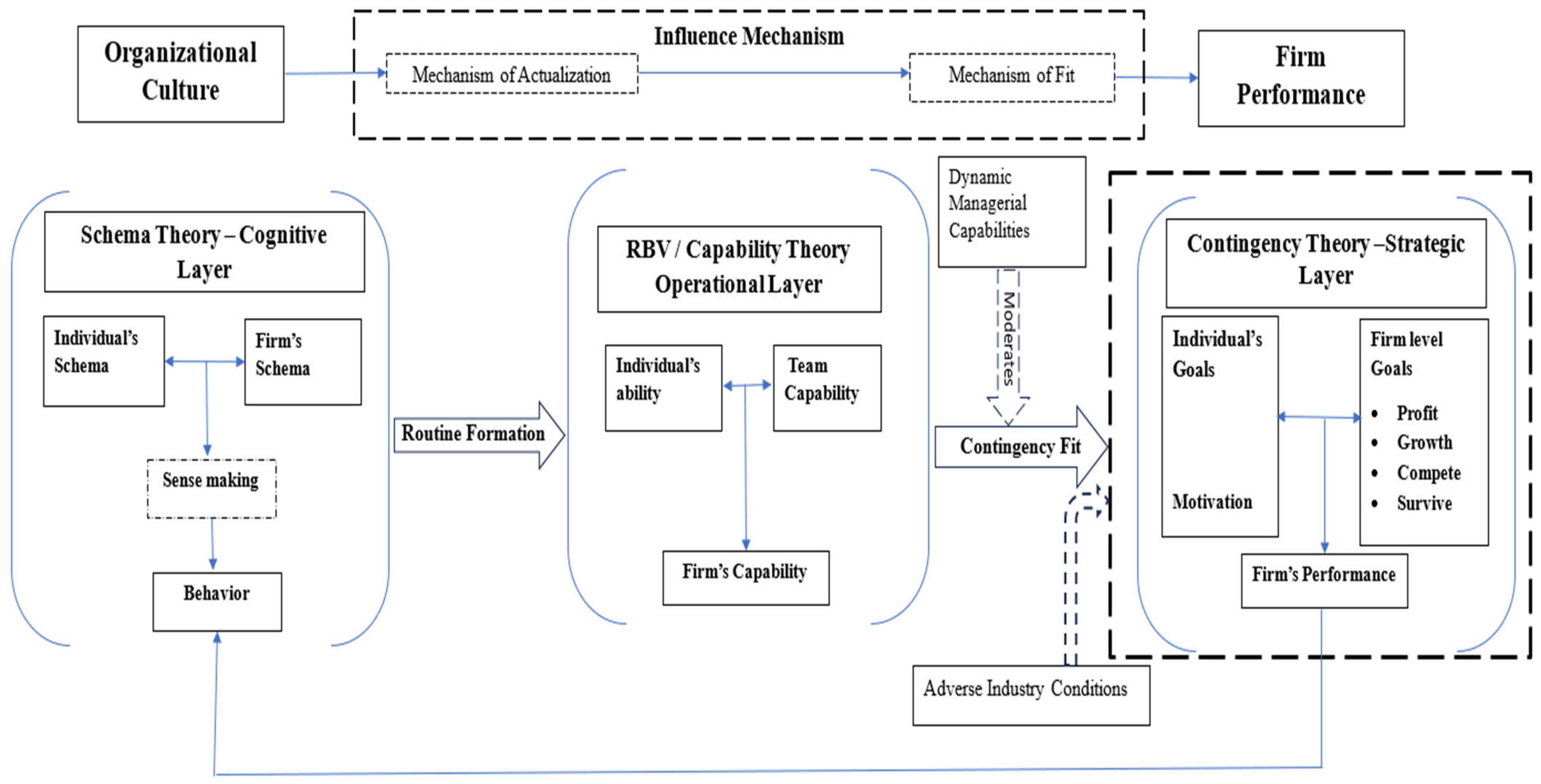
As illustrated in Figure 1, the proposed framework demonstrates how these three theories shape and underscore the culture–performance nexus from the employee level, through teams, to the organizational level. The pathway flows through two interconnected layers which together define the mechanism of influence.
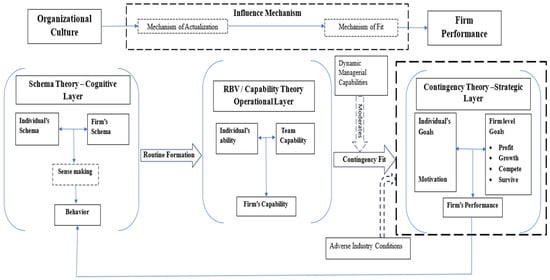
Figure 1.
The multi-theoretical framework of the culture–performance nexus.
First, it originates from the cognitive layer, where culture shapes individual schemas. These individuals’ schemas interact with existing firm-level schemas for sense making. Sense making in turn drives collective behavior based on established assumptions and norms from organizational events and directives.
Secondly, these culturally induced behaviors feed into the operational layer, where they are institutionalized and aggregated as firm-level capabilities. These capabilities are then deployed through the integration and reconfiguration of resources by top management (dynamic managerial capabilities) depending on the conditions of the industry. Together these capabilities form the core operational layer that transforms culture to performance outcomes. We include Dynamic Managerial Capabilities (DMC) to illustrate that the culture–performance relationship is not static and therefore depends on the ability of top management to repeatedly align cultural behaviors to strategic renewal. This multi-theory framework provides a comprehensive mechanism through which organizational culture influences firm performance in the Ghanaian Construction industry. This process is unending as success or failure reinforces future behavior and actions.
However, the influence on performance by organizational culture is susceptible to adverse industry conditions, such as material price changes, payment delays, limited credit facilities and high interest rates. For Ghana in particular, we contend that these adverse conditions may mask or amplify the effect of some cultural routines. Therefore, we integrate these conditions into our theoretical framework, ensuring that it adequately reflects the contingency-based perspective of firm performance within this challenging environment.
This integrated theoretical framework is well supported by the literature. It is consistent with the view that a significant but overlooked implication of the RBV/Capability Theory is its capacity to link organizational psychology to organizational performance [66]. Additionally, the natural fit between the Contingency Theory and firm performance is well established [67,68] and for construction management research, integrating the RBV and Contingency Theory for organizational performance has gained notable traction [69]. Empirical support further strengthens our approach, as meta-analysis indicates that the RBV performs better in a mediated model (as adopted in this research) compared to the direct-effect model [46].
3. Materials and Methods
3.1. Data and Sample
The study adopts a post-positivist quantitative research design to investigate the relationship between organizational culture and firm performance. Data was obtained via questionnaire from 249 construction firms. In Ghana, the Ministry of Works and Housing (MWH) classifies construction firms into four tiers—D1K1, D2K2, D3K3, and D4K4. This system of classification reflects the financial and resource capacity of the firm. The larger and resourceful contractors are classified under D1K1, with high annual turnover, large equipment and plant holding, and many highly qualified personnel [70]. D1K1 firms have the capacity to execute projects exceeding US $500,000.00. The next class is D2K2 whose project threshold does not exceed US $500,000.00. D3K3 contractors are qualified for projects not exceeding US $200,000.00, while D4K4, the lowest ranked contractors are eligible for projects not exceeding US $75,000.00.
3.2. Measures
To operationalize the core constructs of the study, the following measures were used for organizational culture, firm performance, and adverse industry conditions.
3.2.1. Organizational Culture
The study used 24 items constituting Organizational Culture Assessment Instrument (OCAI) to measure organizational culture. OCAI is developed to diagnose the culture of organizations based on the competing value framework. OCAI provides six critical measurements for diagnosing the culture of every organization at any given time [71]. These are the dominant characteristics, leadership style, organizational glue, strategic emphasis, the success criteria, and the management of employees [1]. Each of these six dimensions has four alternative statements representing the four culture types under the CVF. Originally, depending on how closely each alternative statement resembled the organization, respondents diagnosed their corporate culture by dividing 100 points among the four alternative statements representing the four cultural types. This is the ipsative scale [1]. However, because the ipsative scale does not give independent responses [21], most researchers in construction adopt the Likert scale [20]. Thus, the four alternative statements representing the four culture types for the six key dimensions of OCAI were anchored on a five-point Likert scale (1 = strongly disagree to 5 = strongly agree).
3.2.2. Firm Performance
In addition, the study used six perceptual scales drawn from extant construction management literature to measure firm performance [72,73,74]. These measures consist of financial and non-financial measures within the last three years. Respondents rated their firm’s performance in the last three years using a five-point Likert scale of Low (1) to Very High (5). Table 1 below shows the indicators for the firm-performance construct.

Table 1.
Measure Indicators for Firm Performance.
3.2.3. Adverse Industry Conditions
In accordance with our proposed framework, the culture–performance nexus is susceptible to external environmental stressors. Therefore, for the Ghanaian construction industry, where construction firms operate in a highly unstable market, operationalizing the adverse environmental conditions presents the required boundary condition that can either obstruct the benefits of a balance culture or induce the adoption of an appropriate culture for survival. To operationalize this construct, five indicators that reflect the economic climate of the Ghanaian construction industry were identified from the recent literature, as detailed in Table 2. Respondents rated the impact of these conditions on their performance on a five-point Likert scale. Thus, Very Low (5) to Very High (1).
Table 2.
Measure indicators for Adverse Industry Conditions.
4. Data Analysis
The respondent profile was as follows: 18.1% from D1K1 firms, 48.6% from D2K2, 21.3% from D3K3, and 12.0% from D4K4. With respect to company size, 20.9% had up to 20 employees, 36.9% had 21–40, 27.7% had 41–60, and 14.5% had more than 60. Academically, 36.6% of respondents held university degrees and 63.4% held post-graduate degrees. Professionally, 53.8% had at least ten years of industry experience, while 46.2% had a maximum of ten years. The primary roles of respondents were construction managers (34.5%), quantity surveyors (29.7%), civil engineers (24.9%), and architects (10.8%).
4.1. Test for Data Normality
Preliminary data screening was done to assess the normality of the data. The Kolmogorov–Smirnov and Shapiro–Wilk Tests for the indicators of both firm performance and adverse industry conditions yielded significant values of p < 0.001 (See Appendix A). This indicates a complete departure from normality assumption. Thus, the data is non-normal and subsequent analysis such as the Kruskal–Wallis test is based on this finding.
4.2. Cluster Analysis
In line with our second objective to investigate whether there is any underlying structure of Ghanaian construction enterprises across the four types of culture, we employed cluster analysis. Cluster analysis is a statistical technique used to group similar items based on specific characteristics. In cluster analysis a set of objects are grouped in such a way that members in the same group (or cluster) are more similar than those in different groups. This technique is widely used in various fields, such as machine learning, data mining, pattern recognition, and bioinformatics, to uncover the underlying structure of data. In construction management, this method has been applied in various ways to enhance decision making, improve efficiency, and facilitate knowledge transfer.
For instance, to manage product complexity, Ji et al. [77] used cluster analysis to group prefabricated construction products based on their complexity, quality performance measures and design information. Ozyurt et al. [78] clustered countries based on factors affecting international construction projects. This, according to the authors, can efficiently enhance knowledge transfer and improve competitiveness in international markets with similar characteristics. Other studies that used cluster analysis include the cultural profile of Chinese construction firms by Zhang and Liu [14] and the evaluation and selection of contractors based on their ability to complete a project within time, within budget and expected quality standards by Holt [79].
Therefore, this study used cluster analysis to determine whether there is any underlying structure of Ghanaian construction enterprises across the four categories of culture (variables). There are two basic methods of clustering: hierarchical clustering and non-hierarchical clustering, also known as K-means clustering. In this study, both hierarchical and non-hierarchical (K-means clustering) were used. Hierarchical clustering is usually used to automatically give the researcher an idea of the number of clusters that may be present in the data.
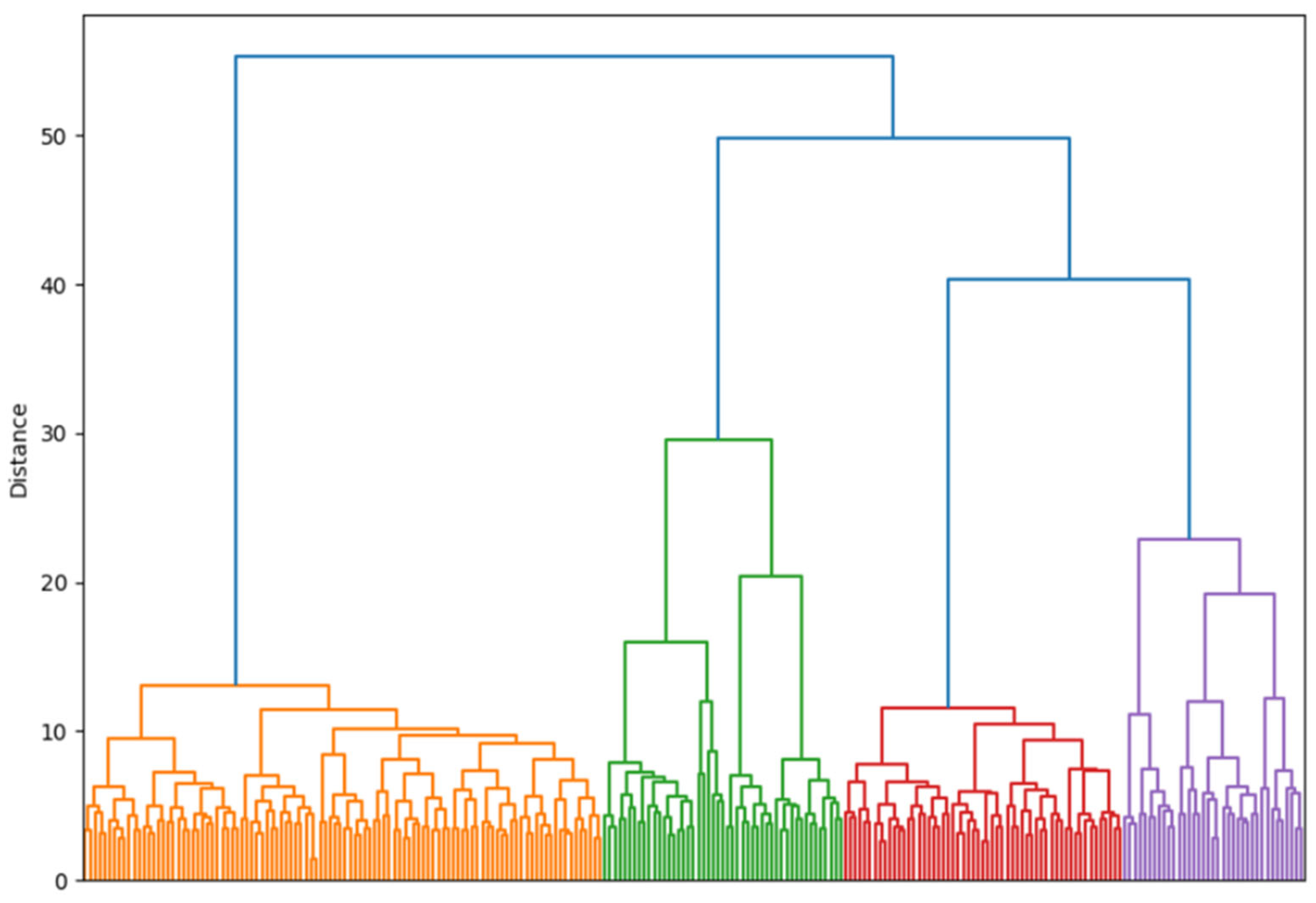
After feeding the raw data into Sci-kit Learn, a machine-learning program for Python 3.13, the results of hierarchical clustering recommended a number of five clusters (Figure 2). Therefore, the study used the K-means clustering to cluster the data into three, four and five clusters to determine the optimum number of clusters.
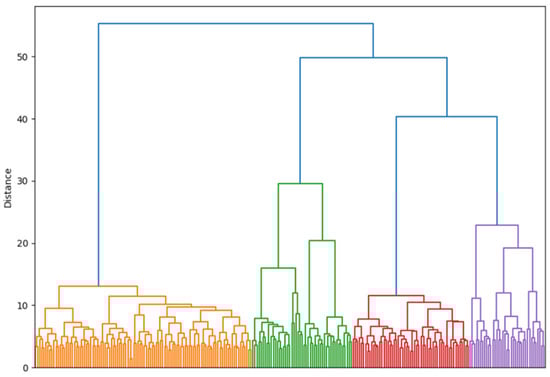
Figure 2.
Recommended number of clusters based on Hierarchical Clustering in Python.
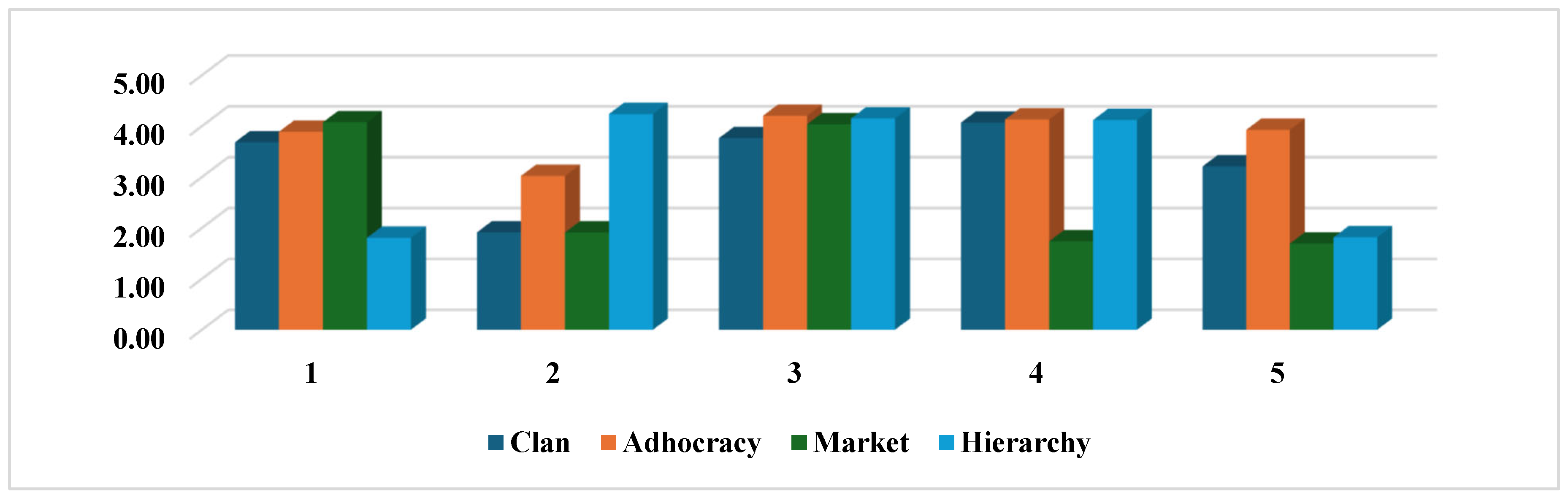
The results from SPSS version 26 analysis show that four-cluster (Table 3) and five-cluster (Table 4 and Figure 3) solutions yielded significant results. One of the variables (Hierarchy culture) in the three-cluster solution was insignificant and so the three-cluster solution was discarded. There are no hard rules in determining the number of clusters. Zhang and Liu [14] proposed that in deciding the number of clusters, the researcher should consider the meaningful size of clusters and the ratio of total within-group variance to the total between-group variances for the k-means procedure.
Table 3.
Stabilized Final Four-Clusters with ANOVA Results.
Table 4.
Stabilized Final Five-Clusters with ANOVA Results.
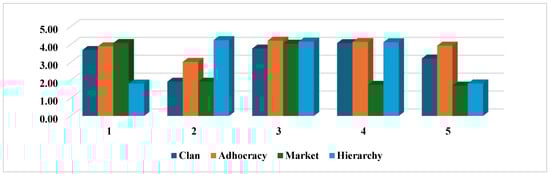
Figure 3.
Graph of Stabilized Final Five-Cluster Solution.
Comparing four-cluster and five-cluster solutions, the five-cluster solution presents the optimum classification. Third cluster membership for both four-cluster and five-cluster does not change much (114 compared to 113). In addition, the F-values, which is the ratio of between group and within group variances for each cluster, generally increase after the four-cluster solution. Thus, it is obvious that the five-cluster solution presents the best option to classify Ghanaian construction firms based on their cultural profiles.
Consequently, for the five-cluster solution, 9.64% (24) are in Cluster 1, with an unbalanced culture profile of high clan, adhocracy, and market culture, but low hierarchy culture. Cluster 2 has 30 enterprises (12.05%) with high hierarchy culture, moderate adhocracy culture and low clan and market cultures. The third cluster contains 45.38% of Ghanaian construction firms (113) with very balanced cultural profile. In this cluster all the four types of cultures are high. The fourth cluster contains 57 construction firms (22.89%) with high clan, adhocracy and hierarchy cultures but low market culture. The fifth group has 25 construction firms (10%) with an unbalanced cultural profile as shown in Figure 3. It can also be seen that the most prominent culture type among Ghanaian construction firms is adhocracy culture, followed by clan culture.
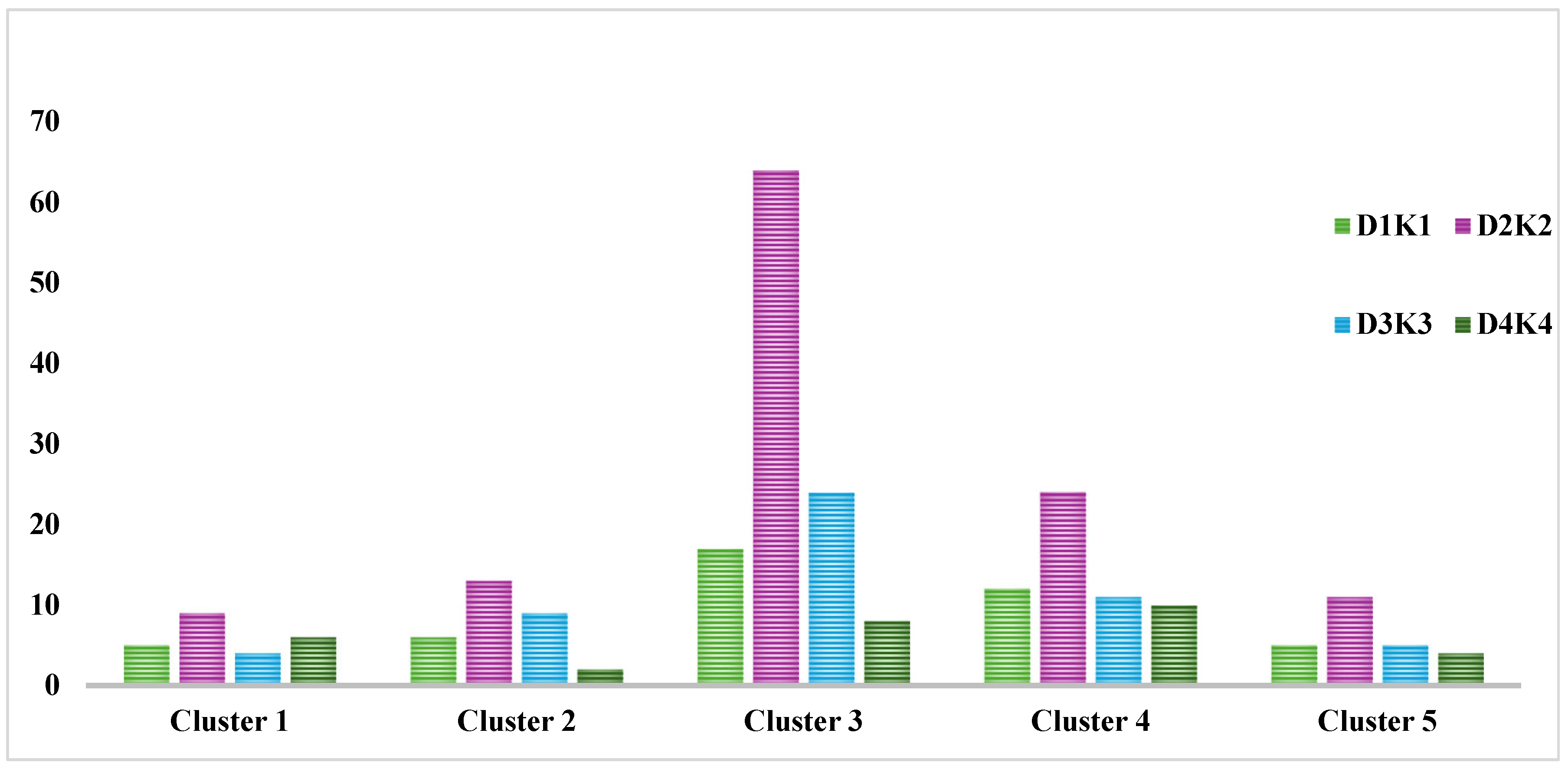
Additionally, to reveal the distribution of cluster membership in each financial class, a cross-tabulation of companies’ financial class versus cluster membership is run in SPSS version 26. The results are shown in Table 5 and Figure 4.
Table 5.
Cross-tabulation of Companies’ Financial Class Versus Cluster Number of Case.
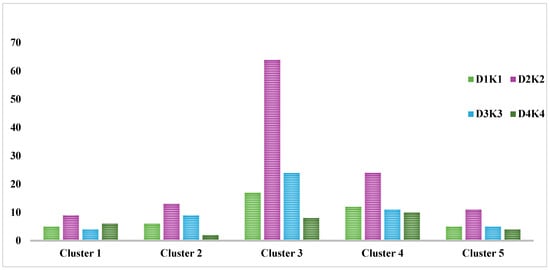
Figure 4.
Companies’ Financial Class versus Cluster Membership.
Based on the company’s financial class, more than half (52.9% of D2K2 contractors) are in Cluster 3, 37.8% of D1K1 contractors are in Cluster 3. The rest are 45.3% for D3K3 contractors and 26.7% for D4K4. Based on cluster membership in Cluster 3, more than half (56.6%) are D2K2 contractors, 15% are D1K1, 21.1% are D3K3 and 7.1% are D4K4. Thus, the majority of the two top class (D1K1 and D2K2) contractors are in Cluster 3 with a very balanced organizational culture.
Given that organizations typically exhibit a mix of the characteristics of all four culture types even though there is usually a dominant culture [80,81], the study tested whether the clusters differ with respect to firm performance using the Kruskal–Wallis H Test.
4.3. Kruskal–Wallis H Test
The Kruskal–Wallis H test, commonly referred to as “one-way ANOVA on ranks,” is a rank-based non-parametric test employed to ascertain statistically significant differences among two or more groups of an independent variable concerning a continuous or ordinal dependent variable [82]. It is regarded as the nonparametric alternative to one-way ANOVA and an extension of the Mann–Whitney U test for comparing more than two independent groups. Therefore, after determining the number of clusters, the study used Kruskal–Wallis H Test to determine if there are any significant differences among the clusters with respect to firm’s performance.
To determine the suitability of the Kruskal–Wallis H test, we tested the null hypothesis that the data was normally distributed using the Kolmogorov–Smirnov and Shapiro–Wilk Tests. The p-values for both these tests were all less than 0.50, which implies a significant deviation from the normal distribution. Therefore Kruskal–Wallis H presents the appropriate avenue to compare the clusters with respect to firm performance. Using SPSS version 26, the result of Kruskal–Wallis H test is shown in Table 6.
Table 6.
Result of Kruskal–Wallis H test.
The test shows a statistically significant difference in firm performance between the different clusters, χ2(4) = 33.82, p = 0.000, with a mean rank of 152.54 for Cluster 1, 65.62 for Cluster 2, 142.72 for Cluster 3, 112.83 for Cluster 4 and 117.46 for Cluster 5.
Post Hoc Kruskal–Wallis Test
Even though Kruskal–Wallis H test results indicate statistically significant differences among the clusters with respect to firm performance, the test does not indicate where the differences occur among the clusters.
This presents some limitations in interpreting the results. To reveal which groups are significantly different, the study conducted a post hoc test that compared the five clusters regarding firm performance. The results of the post hoc analysis are shown in Table 7.
Table 7.
Pairwise Comparisons of Cluster Number of Case.
As seen in Table 7, there is a significant difference in firm performance between Cluster 2 and Cluster 4 (p < 0.05) Cluster 2 and Cluster 3 (p < 0.001), and Cluster 2 and Cluster 1 (p < 0.001). Thus, except for Cluster 2, there are no significant differences between Cluster 3, which has a balanced profile, and Cluster 1, Cluster 4, and Cluster 5. This result supports our Appropriate Culture Paradigm, where different culture configurations can lead to similar outcomes in a volatile market.
4.4. Multiple Regression Analysis
However, the Kruskal–Wallis test did not account for firm resource levels (firm classification) and the effect of external environmental stressors. To achieve our fourth objective and test the third hypothesis, it is necessary to move beyond the observed differences and isolate the influence of organizational culture configuration.
Therefore, multiple regression was conducted by introducing firm classification, as a proxy for firm resourcefulness, and adverse industry conditions as control variables. This was necessary to determine whether the Appropriate Culture paradigm or the Balanced Cultural profile significantly drives superior performance once these conditions are neutralized. The results of the regression analysis are shown in Table 8.
Table 8.
Results of Multiple Regression.
As indicated in Table 8, the regression model accounted for 33.1% (R2 = 0.3308) of the variance in firm performance, using DIKI (Top tier resourceful firms) and Cluster 1 (Reference culture cluster) as baseline groups for comparison.
Cluster 3, with the balanced cultural profile, shows a significant positive relationship with performance (β = 0.8248, p < 0.1), while Clusters 2 (β = −0.8628., p < 0.1). and 5 (β = −0.8896., p < 0.01) both have significant negative relationships with firm performance. The influence of Cluster 4 on firm performance was insignificant. This indicates that the balanced cultural profile serves as the optimal driver of firm performance when resources and environmental factors are controlled for.
Additionally, adverse industry conditions demonstrate significant negative effects on firm performance (β = −0.3514, p < 0.05). This result confirms the role of adverse industry conditions as a filter of firm performance in the Ghanaian construction industry.
Finally, while the effect of firm class, D2K2, and D3K3 did not show any significant effect on performance compared to D1K1 firms, the lowest-ranked class, D4K4, showed remarkable significant positive effect on performance (β = 0.4587, p < 0.05). This finding is particularly insightful, given that 53.3% of these firms are distributed across clusters dominated by organic cultures (Clan and Adhocracy culture). This result suggests that smaller firms can leverage their appropriate cultural configuration to survive.
5. Discussion of Results
The cluster analysis revealed five distinct cultural clusters among construction enterprises in Ghana, with predominance of clan and adhocracy culture. This confirms our hypothesis H1. Also, the cross-tabulation (Table 5) indicates that firms in class D1K1 and D2K2, highly resourceful firms, are more likely to have balanced cultural profiles. On the other hand, lower-ranked firms, especially D4K4, gravitate towards clan and adhocracy cultures (organic culture profiles), leveraging social cohesion, creativity and innovation to navigate resource scarcity.
In addition, the Kruskal–Wallis test revealed no significant performance difference between the Balanced Culture Profile (Cluster 3) and Organic Culture Profile (Cluster 2, 4 and 5). This result supports the second hypothesis H2 and aligns with our proposed Appropriate Culture paradigm. It suggests that in adverse industry conditions, the Appropriate Culture paradigm is as effective for survival as the Balanced Culture Profile. Indeed, the positive performance of D4K4 contractors relative to D1K1 suggests that smaller firms can leverage organic cultures to match larger firms and achieve contingency fit.
Further, transitioning to multiple regression uncovered the foundational influence mechanism. Once we controlled adverse industry conditions and firm classification, the Balanced Culture Profile emerged as a significant positive predictor of firm performance. Apart from supporting our third hypothesis H3, it revealed a critical distinction. That, while the Appropriate Culture paradigm is crucial for survival of firms with resource constraints during environmental volatility, the Balanced Culture Profile is the best engine for growth once environmental stressors are neutralized.
Given that lower-tired firms, D3K3 and D4K4 firms exhibit predominantly organic cultures, their ultimate transition to balanced culture segment requires resource accumulation. Thus, one might surmise that, for larger and more resourceful firms (D1K1 and D2K2) the Balanced Culture is not just a preference, but a strategic asset that is essential for sustained market dominance.
5.1. Implications for Practice
Based on our findings that the Appropriate Culture is crucial for resilience, while the Balanced Culture drives superior performance, construction managers should adopt the following strategies.
For smaller firms (D3K3 and D4K4), the Appropriate (Organic) Culture is their greatest asset for survival, especially when the business environment is turbulent. However, for growth, they must begin introducing hierarchy and market culture values and norms to pursue offensive competitive strategies such as cost leadership and differentiation.
For larger and more resourceful firms, their performance is highly sensitive to environmental stressors and so managers should accentuate organic cultures which appear to counter adverse conditions while using market culture to enhance their reputation. This strategy will give them the edge to pursue rare procurement opportunities.
Finally, managers for both groups should develop their dynamic managerial capabilities that will enable them to sense when the industry requires a shift from organic cultural norms and routines to mechanistic, bureaucratic ones. This flexibility is the hallmark of the Balanced Culture Profile that has been proven to be the ultimate driver of performance.
5.2. Future Research Directions
A significant opportunity for further studies lies in testing our proposed Appropriate Culture Paradigm across different jurisdictions. While we found that organic (clan and adhocracy) configurations provide a survival fit for small firms (D3K3, D4K4) in a challenged environment, the organic cultures also seem to align with Ghana’s collectivistic cultural values [83,84,85].
Similarly, a recent study by Balková and Jambal [81] found that, in the Czech Republic, the most prevalent organizational culture is clan-based, especially among smaller firms. This revelation, which is similar to the findings of this study, offers a critical question that future studies can investigate. Is the clan-based tactical response a universal “crisis tool” for small firms regardless of the national culture?
In Nigeria, market and hierarchy culture (mechanistic) leads to better performance [86], despite sharing similar national culture with Ghana [87]. Comparative studies can investigate if the mechanistic cultural values drive performance in Nigeria because it contradicts the national culture or found a way to co-exist.
In Finland, where the national culture is individualistic and low power distance [88], construction firms are dominated by clan and hierarchy cultures, although employees prefer adhocracy culture [21]. So, research can investigate whether the appropriate culture is shaped more by employees’ preference for autonomy or external stressors just like Ghana.
Finally, both the existing hierarchy culture and the preferred clan culture contradict the values of Croatia’s individualistic national culture [89,90]. Thus, the case of Croatia presents a unique research opportunity to examine how firms perform when the existing culture, employees’ preferred culture and the national culture are all in contradiction.
Put together, these suggested future research directions have the potential to transform the Appropriate Culture Paradigm into a model that could predict whether national culture and organizational culture fit, or employees preferred culture and organizational culture fit, or employees’ preferred culture and national culture fit, or national culture–employees’ preferred culture–organizational culture fit, is the primary driver of performance in any jurisdiction. This is necessary because OC is affected by national culture and national culture differs across countries [91,92,93,94].
This study used cross-sectional data, capturing the period when there were significant adverse conditions in the industry. Future research could utilize longitudinal data to observe how cultural profiles evolve as firms move from lower classifications to high class firms.
While this study is exclusively for Ghana, the findings may be applicable to other jurisdictions, especially Sub-Sahara African markets with similar conditions.
6. Conclusions
The study successfully used the Schema Theory, The Resource-based View/Capability Theory and The Contingency Theory of firm performance to establish the foundational influence mechanism of organizational culture on firm performance.
The study also found that construction firms in Ghana belong to five distinct groups based on their organizational culture profile, although the dominant culture typology is adhocracy and clan culture (organic cultures). Further analysis revealed that while the Appropriate Culture Paradigm, dominated by organic cultures, provides survival fit in times of adverse industry conditions, the Balanced Culture remains the universal panacea for superior firm performance once adverse industry conditions and firms’ resources are neutralized. All our proposed hypotheses were supported by the data.
Author Contributions
Conceptualization, A.M.O. and Y.L.; Methodology, A.M.O.; Formal analysis, A.M.O. and E.A.; Writing—original draft, A.M.O.; Writing—review and editing, Y.L. and E.A.; Supervision, Y.L. All authors have read and agreed to the published version of the manuscript.
Funding
This research received no external funding.
Data Availability Statement
All or some of the data is available from the corresponding author upon reasonable request.
Conflicts of Interest
The authors declare no conflict of interest.
Appendix A
Table A1.
Results of Test of Normality.
Table A1.
Results of Test of Normality.
| Variable | Kolmogorov–Smirnov a | Shapiro–Wilk | ||||||
|---|---|---|---|---|---|---|---|---|
| Skewness | Kurtosis | Statistic | df | Sig. | Statistic | df | Sig. | |
| FP_1 | −1.005 | 0.198 | 0.237 | 248 | 0 | 0.818 | 248 | 0 |
| FP_2 | −1.212 | 0.397 | 0.283 | 248 | 0 | 0.764 | 248 | 0 |
| FP_3 | −1.296 | 0.709 | 0.305 | 248 | 0 | 0.754 | 248 | 0 |
| FP_4 | −1.087 | 0.869 | 0.294 | 248 | 0 | 0.818 | 248 | 0 |
| FP_5 | −1.106 | 0.32 | 0.311 | 248 | 0 | 0.795 | 248 | 0 |
| FP_6 | −1.111 | −0.116 | 0.31 | 248 | 0 | 0.75 | 248 | 0 |
| ICF_1 | −0.92 | 0.111 | 0.263 | 248 | 0 | 0.84 | 248 | 0 |
| ICF_2 | −0.699 | −0.421 | 0.226 | 248 | 0 | 0.861 | 248 | 0 |
| ICF_3 | −0.818 | −0.129 | 0.246 | 248 | 0 | 0.852 | 248 | 0 |
| ICF_4 | −0.928 | 0.103 | 0.275 | 248 | 0 | 0.838 | 248 | 0 |
| ICF_5 | −0.715 | −0.267 | 0.223 | 248 | 0 | 0.866 | 248 | 0 |
References
- Cameron, K.S.; Quinn, R.E. Diagnosing and Changing Organisational Culture; Jossey-Bass, A Wiley Imprint: San Francisco, CA, USA, 2011. [Google Scholar]
- Sanz-Valle, R.; Jiménez-Jiménez, D.; Naranjo-Valencia, J.C. Linking organizational learning with technical innovation and organizational culture. J. Knowl. Manag. 2011, 15, 997–1015. [Google Scholar] [CrossRef]
- Naranjo-Valencia, J.C.; Jiménez-Jiménez, D.; Sanz-Valle, R. Studying the links between organizational culture, innovation, and performance in Spanish companies. Rev. Latinoam. Psicol. 2016, 48, 30–41. [Google Scholar] [CrossRef]
- Balthazard, P.A.; Cooke, R.A.; Potter, R.E. Dysfunctional culture, dysfunctional organization: Capturing the behavioral norms that form organizational culture and drive performance. J. Manag. Psychol. 2006, 21, 709–732. [Google Scholar] [CrossRef]
- Naveed, R.T.; Alhaidan, H.; Al-Halbusi, H.; Al-Swidi, A.K. Do organizations really evolve? The critical link between organizational culture and organizational innovation toward organizational effectiveness: Pivotal role of organizational resistance. J. Innov. Knowl. 2022, 7, 100178. [Google Scholar] [CrossRef]
- Lam, L.; Nguyen, P.; Le, N.; Khoa, T. The Relation among Organizational Culture, Knowledge Management, and Innovation Capability: Its Implication for Open Innovation. J. Open Innov. Technol. Mark. Complex. 2021, 7, 66. [Google Scholar] [CrossRef]
- Pedraza-Rodríguez, J.A.; Ruiz-Vélez, A.; Sánchez-Rodríguez, M.I. Management skills and organizational culture as sources of innovation for firms in peripheral regions. Technol. Forecast. Soc. Change 2023, 191, 122518. [Google Scholar] [CrossRef]
- Rohim, A.; Budhiasa, I.G.S. Organizational culture as moderator in the relationship between organizational reward on knowledge sharing and employee performance. J. Manag. Dev. 2019, 38, 538–560. [Google Scholar] [CrossRef]
- Zhao, X.; Lu, W.; Liu, B. How to Foster Project Citizenship Behavior in Construction Industry: Organizational Culture Matters. IEEE Trans. Eng. Manag. 2024, 71, 4308–4321. [Google Scholar] [CrossRef]
- Mello, J.E.; Stank, T.P. Linking firm culture and orientation to supply chain success. Int. J. Phys. Distrib. Logist. Manag. 2005, 35, 542–554. [Google Scholar] [CrossRef]
- Dadzie, C.A.; Winston, E.M.; Dadzie, K.Q. Organizational Culture, Competitive Strategy, and Performance in Ghana. J. Afr. Bus. 2012, 13, 172–182. [Google Scholar] [CrossRef]
- Osman, A.M.; Liu, Y.; Wang, Z. Influence of Organizational Culture on Construction Firms’ Performance: The Mediating Roles of Innovation and Marketing Capabilities. Buildings 2023, 13, 308. [Google Scholar] [CrossRef]
- Wilderom, C.P.; Glunk, U.; Maslowski, R. Organizational Culture as a Predictor of Organizational Performance. In Handbook of Organizational Culture and Climate; Ashkanasy, N.M., Wilderom, C.P.M., Peterson, M.F., Eds.; SAGE: Newbury Park, CA, USA, 2000; pp. 193–209. [Google Scholar]
- Zhang, S.B.; Liu, A.M.M. Organisational culture profiles of construction enterprises in China. Constr. Manag. Econ. 2006, 24, 817–828. [Google Scholar] [CrossRef]
- Brady, G.; Truxillo, D.; Cadiz, D.; Rineer, J.; Caughlin, D.; Bodner, T. Opening the black box: Examining the nomological network of work ability and its role in organizational research. J. Appl. Psychol. 2020, 105, 637. [Google Scholar] [CrossRef] [PubMed]
- Dirican, A.; Erdil, O. The influence of ability-based emotional intelligence on discretionary workplace behaviors. J. Hum. Behav. Soc. Environ. 2020, 30, 369–382. [Google Scholar] [CrossRef]
- Kaul, A. Culture vs strategy: Which to precede, which to align? J. Strategy Manag. 2018, 12, 116–136. [Google Scholar] [CrossRef]
- Zhang, J.; Jehangir, F.N.; Yang, L.; Tahir, M.A.; Tabasum, S. Competitive advantage and firm performance: The role of organizational culture, organizational innovation, and knowledge sharing. J. Knowl. Econ. 2025, 16, 3081–3107. [Google Scholar] [CrossRef]
- Quinn, R.E.; Rohrbaugh, J. A Spatial Model of Effectiveness Criteria: Towards a Competing Values Approach to Organizational Analysis. Manag. Sci. 1983, 29, 363–377. [Google Scholar] [CrossRef]
- Coelho, C.; Mojtahedi, M.; Kabirifar, K.; Yazdani, M. Influence of organisational culture on total quality management implementation in the Australian construction industry. Buildings 2022, 12, 496. [Google Scholar] [CrossRef]
- Teräväinen, V.; Junnonen, J.M.; Salopää, T.; Sobolev, A. Relationships between Organisational Culture and Efficiency in Finnish Construction Projects. Int. J. Constr. Manag. 2018, 21, 12–26. [Google Scholar] [CrossRef]
- Willar, D.; Trigunarsyah, B.; Coffey, V. Organizational culture and quality management system implementation in Indonesian construction companies. Eng. Constr. Archit. Manag. 2016, 23, 114–133. [Google Scholar] [CrossRef]
- Gordon, G.G.; Ditomaso, N. Predicting Corporate Performance from Organizational Culture. J. Manag. Stud. 1992, 29, 783–798. [Google Scholar] [CrossRef]
- Polychroniou, P.; Trivellas, P. The impact of strong and balanced organizational cultures on firm performance. Int. J. Qual. Serv. Sci. 2018, 10, 16–35. [Google Scholar] [CrossRef]
- Assens-Serra, J.; Boada-Cuerva, M.; Serrano-Fernández, M.; Villajos, E.; Boada-Grau, J. Spanish Adaptation of the Organizational Culture Assessment Instrument: Reflection on the Difficulty in Transferring the ad hoc Factor. Front. Psychol. 2021, 12, 817232. [Google Scholar] [CrossRef]
- O’Reilly, C.; Cao, X.; Sull, D. Organizational culture archetypes and firm performance. J. Bus. Res. 2024, 182, 114780. [Google Scholar] [CrossRef]
- Osman, A.M.; Sheng, L.Y. Critical determinants of the competitiveness of the Ghanaian construction industry. J. Constr. Dev. Ctries. 2023, 28, 267–291. [Google Scholar] [CrossRef]
- Manaan, O.A.; Ahadzie, D.K.; Panford, J.K.; Proverbs, D.G. Competency-based evaluation of project managers’ performance in mass house building projects in Ghana–the fuzzy set theory approach. J. Sci. Technol. 2014, 34, 46–62. [Google Scholar] [CrossRef][Green Version]
- Ghana Statistical Service. Productivity, Employment and Growth: National Report 2024; Ghana Statistical Service: Accra, Ghana, 2025. [Google Scholar]
- Ghana Statistical Service. 2017 Annual Gross Domestic Product: Annual Report; Ghana Statistical Service: Accra, Ghana, 2018. [Google Scholar]
- Atuahene, B.T.; Baiden, B.K. Organizational culture of Ghanaian construction firms. Int. J. Constr. Manag. 2018, 18, 177–188. [Google Scholar] [CrossRef]
- Trading Economics. Ghana GDP from Construction. Available online: https://tradingeconomics.com/ghana/gdp-from-construction (accessed on 6 June 2023).
- Huang, T.F.; Chou, S.C.; Liao, A. Schema theory’s immediate impact on college students’ Chinese reading comprehension. Int. J. Eval. Res. Educ. 2024, 13, 3535. [Google Scholar] [CrossRef]
- DiMaggio, P. Culture and Cognition. Annu. Rev. Sociol. 1997, 23, 263–287. [Google Scholar] [CrossRef]
- Strauss, C.; Quinn, N. A Cognitive Theory of Cultural Meaning; Cambridge University Press: Cambridge, UK, 1997; Volume 9. [Google Scholar]
- Atkinson, J.W.; Birch, D. Dynamics of Action; Wiley: New York, NY, USA, 1970. [Google Scholar]
- Liu, A.M.M.; Walker, A. Evaluation of project outcomes. Constr. Manag. Econ. 1998, 16, 209–219. [Google Scholar] [CrossRef]
- Buki, L.; Johnson, J.; Knight, K.; Walton, A. “Cultural and conceptual knowledge”: Reformulation and conceptual analysis of a key component of the health literacy model. Soc. Sci. Med. 2024, 356, 117150. [Google Scholar] [CrossRef]
- Kendzierski, D.; Whitaker, D.J. The Role of Self-Schema in Linking Intentions with Behavior. Pers. Soc. Psychol. Bull. 1997, 23, 139–147. [Google Scholar] [CrossRef]
- Keulen-de Vos, M.E.; Bernstein, D.P.; Vanstipelen, S.; de Vogel, V.; Lucker, T.P.C.; Slaats, M.; Hartkoorn, M.; Arntz, A. Schema modes in criminal and violent behaviour of forensic cluster B PD patients: A retrospective and prospective study. Leg. Criminol. Psychol. 2016, 21, 56–76. [Google Scholar] [CrossRef]
- Harris, S.G. Organizational culture and individual sense-making. In Cognition Within and Between Organizations; Meindle, J.R., Stubbart, C., Porac, J.F., Eds.; Sage Publications: Thousand Oaks, CA, USA, 1996. [Google Scholar]
- Boutyline, A.; Soter, L. Cultural Schemas: What They Are, How to Find Them, and What to Do Once You’ve Caught One. Am. Sociol. Rev. 2020, 86, 728–758. [Google Scholar] [CrossRef]
- Hunzaker, M.; Valentino, L. Mapping Cultural Schemas: From Theory to Method. Am. Sociol. Rev. 2019, 84, 950–981. [Google Scholar] [CrossRef]
- Rossoni, L.; Gonçalves, C.; Silva, M.; Gonçalves, A. Mapping Organizational Culture Schemas Based on Correlational Class Analysis. Rev. Adm. Contemp. 2021, 25, 200096. [Google Scholar] [CrossRef]
- Porter, M.E. From competitive advantage to corporate strategy. In Readings in Strategic Management; Asch, D., Kaye, B., Eds.; Macmillan Education UK: London, UK, 1989; pp. 234–255. [Google Scholar]
- Mansour, H.; Aminudin, E.; Mansour, T.; Abidin, N.; Lou, E. Resource-Based View in Construction Project Management Research: A Meta-Analysis. IOP Conf. Ser. Earth Environ. Sci. 2022, 1067, 012057. [Google Scholar] [CrossRef]
- Amit, R.; Schoemaker, P.J. Strategic assets and organizational rent. Strateg. Manag. J. 1993, 14, 33–46. [Google Scholar] [CrossRef]
- Collis, D.J. Research note: How valuable are organizational capabilities? Strateg. Manag. J. 1994, 15, 143–152. [Google Scholar] [CrossRef]
- Barney, J.B.; Ketchen, D.J., Jr.; Wright, M. Resource-based theory and the value creation framework. J. Manag. 2021, 47, 1936–1955. [Google Scholar] [CrossRef]
- Deshpandé, R.; Farley, J.U.; Webster, F.E. Corporate Culture, Customer Orientation, and Innovativeness in Japanese Firms: A Quadrad Analysis. Dev. Mark. Orientat. 2012, 57, 79–102. [Google Scholar]
- Chan, L.L.; Shaffer, M.A.; Snape, E. In search of sustained competitive advantage: The impact of organizational culture, competitive strategy and human resource management practices on firm performance. Int. J. Hum. Resour. Manag. 2004, 15, 17–35. [Google Scholar] [CrossRef]
- Albogami, M.; Sharawi, O.; Khan, R.M. Organizational culture adaptability by leaders and its influence on firm performance. In Proceedings of the International Conference on Industrial Engineering and Operations Management, Dubai, United Arab Emirates, 11–14 February 2024. [Google Scholar]
- Adner, R.; Helfat, C.E. Corporate effects and dynamic managerial capabilities. Strateg. Manag. J. 2003, 24, 1011–1025. [Google Scholar] [CrossRef]
- Barney, J.B. Why resource-based theory’s model of profit appropriation must incorporate a stakeholder perspective. Strateg. Manag. J. 2018, 39, 3305–3325. [Google Scholar] [CrossRef]
- Mostafiz, M.I.; Sambasivan, M.; Goh, S.K. Impacts of dynamic managerial capability and international opportunity identification on firm performance. Multinat. Bus. Rev. 2019, 27, 339–363. [Google Scholar] [CrossRef]
- Heubeck, T.; Meckl, R. More capable, more innovative? An empirical inquiry into the effects of dynamic managerial capabilities on digital firms’ innovativeness. Eur. J. Innov. Manag. 2022, 25, 892–915. [Google Scholar] [CrossRef]
- Heubeck, T. Looking back to look forward: A systematic review of and research agenda for dynamic managerial capabilities. Manag. Rev. Q. 2023, 74, 2243–2287. [Google Scholar] [CrossRef]
- Moorman, C.; Slotegraaf, R.J. The Contingency Value of Complementary Capabilities. J. Mark. Res. 1999, 36, 239–257. [Google Scholar] [CrossRef]
- Heubeck, T. Managerial capabilities as facilitators of digital transformation? Dynamic managerial capabilities as antecedents to digital business model transformation and firm performance. Digit. Bus. 2023, 3, 100053. [Google Scholar] [CrossRef]
- Venkatraman, N.; Ramanujam, V. Measurement of Business Performance in Strategy Research: A Comparison of Approaches. Acad. Manag. Rev. 1986, 11, 801–814. [Google Scholar] [CrossRef]
- Tosi, H.L.; Slocum, J.W. Contingency Theory: Some Suggested Directions. J. Manag. 1984, 10, 9–26. [Google Scholar] [CrossRef]
- Park, S.; Choi, S. Performance Feedback, Goal Clarity, and Public Employees’ Performance in Public Organizations. Sustainability 2020, 12, 3011. [Google Scholar] [CrossRef]
- Arefin, M.; Faroque, O.; Zhang, J.; Long, L. High-performance work systems and organizational citizenship behavior: The role of goal congruence and servant leadership. Int. J. Emerg. Mark. 2022, 18, 5432–5453. [Google Scholar] [CrossRef]
- Sackett, P.; Demeke, S.; Bazian, I.; Griebie, A.; Priest, R.; Kuncel, N. A contemporary look at the relationship between general cognitive ability and job performance. J. Appl. Psychol. 2023, 109, 687. [Google Scholar] [CrossRef] [PubMed]
- Cho, H.J.; Jin, B.E.; Shin, D.C. Do contingencies matter between organizational capabilities and SME export performance? Rev. Int. Bus. Strategy 2023, 33, 605–626. [Google Scholar] [CrossRef]
- Ployhart, R.E. Resources for What? Understanding Performance in the Resource-Based View and Strategic Human Capital Resource Literatures. J. Manag. 2021, 47, 1771–1786. [Google Scholar] [CrossRef]
- Amhalhal, A.; Anchor, J.; Tipi, N.; Elgazzar, S. The impact of contingency fit on organisational performance: An empirical study. Int. J. Product. Perform. Manag. 2021, 71, 2214–2234. [Google Scholar] [CrossRef]
- Damayanthi, I.; Wiagustini, N.; Suartana, I.; Rahyuda, H. Loan restructuring as a banking solution in the COVID-19 pandemic: Based on contingency theory. Banks Bank Syst. 2022, 17, 196. [Google Scholar] [CrossRef]
- Wahid, I.; Shahzad, W.; Rasheed, N.; Rotimi, J.O.B. Analysis of Theoretical Viewpoints Explaining the Performance Differentials of Construction Firms. Int. J. Constr. Educ. Res. 2024, 20, 2–25. [Google Scholar] [CrossRef]
- Jackson, E.N.; Priya, T.S. Identification and classification of construction-risk factors for Ghanaian construction projects: An integrated study with structural equation modelling. Heliyon 2024, 10, e31243. [Google Scholar] [CrossRef]
- Meidawati, N.; Rosida, G.; Hudayati, A. Corporate governance, organizational culture, and firm performance: A systematic literature review (SLR) and future research opportunities. Int. J. Res. Bus. Soc. Sci. 2025, 14, 333. [Google Scholar]
- Tan, Y.; Shen, L.; Langston, C. Competition environment, strategy, and performance in the Hong Kong construction industry. J. Constr. Eng. Manag. 2012, 138, 352–360. [Google Scholar] [CrossRef]
- Ho, P.H. Analysis of competitive environments, business strategies, and performance in Hong Kong’s construction industry. J. Manag. Eng. 2016, 32, 04015044. [Google Scholar] [CrossRef]
- Duodu, B.; Rowlinson, S. Intellectual capital, innovation, and performance in construction contracting firms. J. Manag. Eng. 2021, 37, 04020097. [Google Scholar] [CrossRef]
- Fehan, H.; Aigbogun, O. The Effect of Environmental Factors and Institutional Pressures on Construction Firms’ Performance: A Proposed Model. In International School on Neural Networks; Springer: Cham, Switzerland, 2022; pp. 1293–1302. [Google Scholar]
- Chih, Y.Y.; Hsiao, C.Y.L. Brace for another crisis: Empirical evidence from US construction industry and firm performance during and after 2007–2009 global financial crisis. J. Manag. Eng. 2023, 39, 04022069. [Google Scholar] [CrossRef]
- Ji, W.; AbouRizk, S.M.; Zaïane, O.R.; Li, Y. Complexity analysis approach for prefabricated construction products using uncertain data clustering. J. Constr. Eng. Manag. 2018, 144, 04018063. [Google Scholar] [CrossRef]
- Ozyurt, B.; Dikmen, I.; Birgonul, M.T. Clustering of host countries to facilitate learning between similar international construction markets. Eng. Constr. Archit. Manag. 2020, 27, 66–82. [Google Scholar] [CrossRef]
- Holt, G.D. Applying cluster analysis to construction contractor classification. Build. Environ. 1996, 31, 557–568. [Google Scholar] [CrossRef]
- Vlaicu, F.; Neagoe, A.; Țîru, L.; Otovescu, A. The Organizational Culture of a Major Social Work Institution in Romania: A Sociological Analysis. Sustainability 2019, 11, 3587. [Google Scholar] [CrossRef]
- Balková, M.; Jambal, T. Evaluation of organizational culture in enterprises in the Czech Republic using OCAI. Front. Psychol. 2023, 14, 1297041. [Google Scholar] [CrossRef]
- Field, A. Exploring data. In Discovering Statistics Using SPSS; Sage: London, UK, 2005; Volume 2, pp. 63–106. [Google Scholar]
- Brion, C.; Ampah-Mensah, A. Changing cultural norms through education: Voices from Ghanaian women principals. Int. J. Educ. Manag. 2021, 35, 1458–1475. [Google Scholar] [CrossRef]
- Tetteh, S.; Mensah, R.; Opata, C.; Agyapong, G. Beyond monetary motivation: The moderation of Hofstede’s cultural dimensions. Int. J. Product. Perform. Manag. 2021, 72, 156–179. [Google Scholar] [CrossRef]
- Boateng, H.; Agyemang, F. The Role of Culture in Knowledge Sharing in a Public-Sector Organization in Ghana: Revisiting Hofstede’s Model. Int. J. Public Adm. 2015, 38, 486–495. [Google Scholar] [CrossRef]
- To, A.; Oo, A. Organisational culture of construction companies in Lagos State, Nigeria. Organ. Technol. Manag. Constr. 2020, 12, 2158–2169. [Google Scholar]
- Usoro, A.; Abiagam, B. Culture effect on knowledge management adoption in Nigerian hospitality industry. VINE J. Inf. Knowl. Manag. Syst. 2018, 48, 314–332. [Google Scholar] [CrossRef]
- Hallikainen, H.; Laukkanen, T. National culture and consumer trust in e-commerce. Int. J. Inf. Manag. 2018, 38, 97–106. [Google Scholar] [CrossRef]
- Sandrk Nukic, I.; Huemann, M. Organizational culture of the Croatian construction industry. Eng. Constr. Archit. Manag. 2016, 23, 237–260. [Google Scholar] [CrossRef]
- Švarc, J.; Lažnjak, J.; Dabic, M. Regional innovation culture in innovation laggard: A case of Croatia. Technol. Soc. 2019, 58, 101123. [Google Scholar] [CrossRef]
- Ansah, M.; Louw, L. The influence of national culture on organizational culture of multinational companies. Cogent Soc. Sci. 2019, 5, 1623648. [Google Scholar] [CrossRef]
- Szydło, J.; Grześ-Bukłaho, J. Relations between National and Organisational Culture—Case Study. Sustainability 2020, 12, 1522. [Google Scholar] [CrossRef]
- Hung, Y.; Su, T.; Lou, K. Impact of Organizational Culture on Individual Work Performance with National Culture of Cross-Strait Enterprises as a Moderator. Sustainability 2022, 14, 11697. [Google Scholar] [CrossRef]
- Mansaray, H.E.; Mansaray Jnr, H.E. The Connection between National Culture and Organizational Culture: A Literature Review. Bus. Innov. Oper. Health Sci. 2020, 2, 179–189. [Google Scholar] [CrossRef]
Disclaimer/Publisher’s Note: The statements, opinions and data contained in all publications are solely those of the individual author(s) and contributor(s) and not of MDPI and/or the editor(s). MDPI and/or the editor(s) disclaim responsibility for any injury to people or property resulting from any ideas, methods, instructions or products referred to in the content. |
© 2026 by the authors. Licensee MDPI, Basel, Switzerland. This article is an open access article distributed under the terms and conditions of the Creative Commons Attribution (CC BY) license.