


Abstract
China’s rapid urbanization has intensified its intra-urban differentiation, with housing prices increasingly reflecting the uneven distribution of public resources and development opportunities. Taking Nanchang as a case study, this study examines the spatial structure of housing prices and the heterogeneity of their driving mechanisms. By comparing ordinary least squares and geographically weighted regression models, we identify a strong spatial non-stationarity in the determinants of housing prices, with key factors exhibiting location-dependent effects and, in some cases, directional reversals. To enhance spatial interpretation, Kriging interpolation is applied to local coefficients, revealing continuous spatial gradients in the factors’ influence. Building on these findings, a capitalization potential index is simulated under standardized resource-improvement scenarios to diagnose potential mismatches between market price responsiveness and spatial equity. The results indicate that areas with high capitalization potential often coincide with relatively low housing prices, suggesting a structural misalignment between market efficiency and spatial equity. This study contributes to a deeper understanding of housing price spatial heterogeneity and provides insights for promoting spatial equity and sustainable urban development.
1. Introduction
Recently, China’s rapid urbanization has reshaped its cities’ spatial structure, with functional differentiation and spatial segregation within urban areas becoming increasingly pronounced. In this process, housing prices—as the result of the combined effects of land, location, and resource factors—have become the most sensitive and intuitive economic indicator of urban spatial differentiation. Specifically, housing prices’ spatial inequality patterns directly reflect the disparate distribution of public services, access to development opportunities, and living conditions within cities, which exacerbate spatial inequity and social stratification within urban areas to some extent [1,2]. Therefore, guided by China’s national strategic goals of “common prosperity” and “livable cities,” systematically revealing the spatial mechanisms underlying urban housing-price differentiation has become a crucial research topic for advancing spatial equity and enhancing urban livability.
In classical housing economics research, residential properties are widely regarded as highly heterogeneous commodities [3]. Homebuyers not only pay for living space but also pay a premium for its surrounding location and environmental characteristics, including access to public services [4], convenience facilities [5], and the quality of the ecological environment [6]. Consequently, empirical studies have often employed attribute pricing models to analyze the relationship between housing transaction prices and structural attributes, location conditions, and environmental factors [7,8].
Against the backdrop of China’s rapid urbanization, research has confirmed that land costs, development intensity, and distance from the city center are key determinants of housing prices. Moreover, studies have examined transportation infrastructure’s and public services’ roles in shaping residential accessibility and living conditions [9,10]. However, as urban systems grow increasingly complex, the housing market exhibits pronounced spatial heterogeneity: the same influencing factor may trigger vastly different price responses across distinct areas. These disparities often stem from urban functional differentiation, stratified resident demands, and public resources’ uneven distribution [11].
While research has deepened our understanding of housing price formation mechanisms at multiple levels, its analytical perspectives and methodological assumptions remain limited and cannot explain intra-urban housing price differentiation. Most studies have emphasized economic value and market efficiency, focusing on the capitalization effects of location and public resources [12] while mostly neglecting the subjective experiential dimensions underlying housing price disparities—e.g., life satisfaction, perceived well-being, and spatial equity [13,14,15]. Methodologically, globally regressive models have been commonly employed, typically assuming spatial stability in the determinants of housing prices [16]. However, in highly structurally differentiated urban spaces, this assumption is often inaccurate. The average effects derived from such models tend to obscure the spatial non-stationarity of the underlying mechanisms, thus hindering a deeper understanding of the processes driving housing price differentiation.
Against this research backdrop and aiming to address the existing gaps, this study examines the area within Nanchang’s third ring road. It aims to explore the mechanisms underlying intra-urban housing price differentiation from a spatial heterogeneity perspective; in doing so, its findings are expected to provide empirical evidence for understanding the spatial equity issues embedded in housing price disparities. The remainder of this paper is organized as follows: Section 2 reviews the relevant literature, focusing on housing price spatial differentiation, capitalization mechanisms, and spatial equity; Section 3 presents an overview of the study area, data sources, and methodological framework; Section 4 presents the results of the analysis of housing prices’ spatial patterns and influencing mechanisms; and Section 5 discusses the findings. Finally, the study’s conclusions and limitations are presented in Section 6.
2. Literature Review
This section reviews the literature on housing prices’ spatial disparities and their impact on urban equity and subjective well-being while also outlining the primary methodologies for capturing spatial heterogeneity within cities. First, it examines studies on housing price capitalization, spatial equity, and the uneven market recognition of public resources. Next, at the methodological-paradigm level, it compares the positioning and integration pathways of local regression and spatial econometric models within the explanation–prediction–causation analytical framework. Further, building upon this foundation, we summarize the typical levels of spatial analysis in housing price research, exploring the functional division of labor and the complementary relationship among global analysis, local modeling, and spatial representation methods. This provides a basis for selecting the most appropriate empirical analysis methods, as well as for structuring subsequent research.
2.1. Housing Price Capitalization, Spatial Equity, and Capitalization Potential
Housing prices are not merely the market valuation of living space but rather the outcome of multiple locational factors and public resources operating through market mechanisms [17]. Housing price capitalization refers to the economic mechanism through which the value of specific locational advantages and resource elements, such as high-quality schools [18,19], parks [20], and transportation hubs [21], is reflected in residential real estate prices through market transactions. Its theoretical foundation lies in the characteristic price model, which treats housing as a heterogeneous good whose market price implicitly reflects buyers’ willingness to pay for attributes such as building features, neighborhood environment, and accessibility to public services. Thus, spatial variation in housing prices fundamentally reflects how market forces recognize and price resource conditions and locational advantages across spatial units [22,23].
In urban governance and spatial planning practice, the trilemma of efficiency, equity, and resource allocation remains a persistent challenge. Public facility allocation and the housing economy often struggle to achieve equilibrium among maximizing economic efficiency, spatial equity, and resource allocation. Early facility siting models emphasized efficiency while frequently neglecting distributive justice, thereby exacerbating spatial inequality. Conversely, equity-oriented planning may lead to the underutilization of resources [24]. Thus, understanding the mechanisms underlying the formation of housing price differentials and the underlying market response logic is crucial for discussing urban spatial equity and resource allocation strategies.
Against this backdrop, this paper introduces the concept of capitalization potential to bridge the gap between housing price capitalization mechanisms and spatial equity discourse [25,26]. Capitalization potential is the latent responsiveness of housing prices to standardized resource improvement scenarios within given spatial structures and market conditions, which can serve as a diagnostic tool to identify structural misalignments between housing prices and resource allocation.
In summary, housing price capitalization shows how resource factors are translated into price outcomes through market mechanisms. Spatial equity focuses on the uneven spatial consequences of this transformation, while capitalization potential further delineates the differentiated response capabilities of regions under scenarios of resource improvement. This supports market-signal-based decision-making to optimize spatial resources for equitable development.
2.2. Local Regression and Spatial Econometrics
As spatial analysis methods have become more refined, research on urban spatial structures has shifted from a traditional global perspective to a dual focus on local variations and spatial interconnections. Within this context, geographically weighted regression (GWR) and spatial econometric models (e.g., spatial autoregressive, spatial error, and spatial Durbin models) represent two distinct spatial modeling approaches.
GWR and its extended models (multi-scale GWR [MGWR] and geographically and temporally weighted regression) have been widely applied in housing price research [27,28]. They capture mechanism differences across regions, emphasize spatial heterogeneity, and estimate local regression coefficients using geographic location weighting to reveal the spatial variation in variable effects. By contrast, spatial econometric models describe spatial propagation and spillover effects between variables or outcomes at the global level by incorporating spatial lag or error terms. Thus, these approaches’ applicability differs significantly: spatial autoregression/spatial Durbin models [29] are better suited for explaining the interactions between neighboring regions, policy diffusion, or market spillover effects. Conversely, when research focuses on mechanism differences, resource allocation, or functional structural variations within a city, local models such as GWR/MGWR are more effective in revealing spatial non-stationarity characteristics.
At the research-objective level, both approaches exhibit distinct positioning and boundaries within the explanation–prediction–causation analytical framework. GWR and its extended models emphasize explanatory and exploratory functions, while they can reveal local relationships and spatial heterogeneity. However, their parameter estimates lack rigorous structural constraints, which render them unsuitable for causal inferences. Meanwhile, spatial econometric models are built upon explicit assumptions of spatial transmission mechanisms, which makes them more appropriate for identifying spatial spillover effects and policy impacts. In recent years, some studies have attempted to integrate both approaches to balance explanatory and structural aspects. For instance, the MGWR-spatial autocorrelation model proposed by Tomal [30] can simultaneously handle spatial dependence, spatial heterogeneity, and modeling across different spatial scales while outperforming other models in terms of fit metrics. Similarly, the GWR-spatial autoregression framework introduced by Fotheringham et al. [31] incorporates spatial lag terms into the GWR, thereby significantly enhancing interpretability by capturing both local mechanisms and structural spatial dependence.
2.3. Analytical Levels in Housing Price Research
In existing housing price research, spatial analysis typically relies on a multi-level framework rather than a single modeling approach [32]. Various studies have progressively revealed the differentiation of housing prices within cities by examining overall trends, local mechanisms, and spatial expressions.
Global regression models have been widely used to estimate the average relationship between housing prices and their influencing factors within a given study area. Based on the assumption of spatial stationarity, such models aim to identify overall associations between housing prices and variables such as public services, transportation accessibility, and amenity facilities [33,34]. Due to their simplicity, intuitiveness, and interpretability, such models have become a fundamental analytical tool in housing economics and urban studies. However, in urban spaces characterized by significant functional differentiation and uneven resource allocation, the average effects estimated by such models often obscure actual parameter variations across locations, thereby making it difficult to capture the spatial non-stationarity of price-forming mechanisms. This limitation has driven research toward localized modeling approaches.
Therefore, local regression models have been introduced to address global models’ shortcomings in revealing intra-urban variations. They enable the examination of spatial changes in variable relationships at finer scales, identifying differences in the mechanisms influencing housing prices across distinct locations. Specifically, spatial interpolation methods enhance the visualization and interpretation of analytical results across spatial dimensions by modeling discrete observations or local parameters as continuous variables. Meanwhile, Kriging, grounded in regionalized variable theory, leverages the spatial autocorrelation structure of sample points to provide optimal predictions for unknown locations [35,36]. Thus, it has been widely applied in studies on soil hydraulic property zoning [37], surface vegetation distribution [38], air pollution mapping [39], and urban land price distribution [35].
In summary, the spatial analysis of housing prices often relies on the synergy of multi-level approaches: global models provide benchmarks for overall trends, local models reveal spatial variations in mechanisms, and interpolation methods enhance the spatial presentation and interpretation of results. This layered and complementary analytical logic enables the examination of housing price dynamics across different spatial perspectives and scales, forming the methodological framework for this study’s empirical research.
3. Materials and Methods
3.1. Study Area
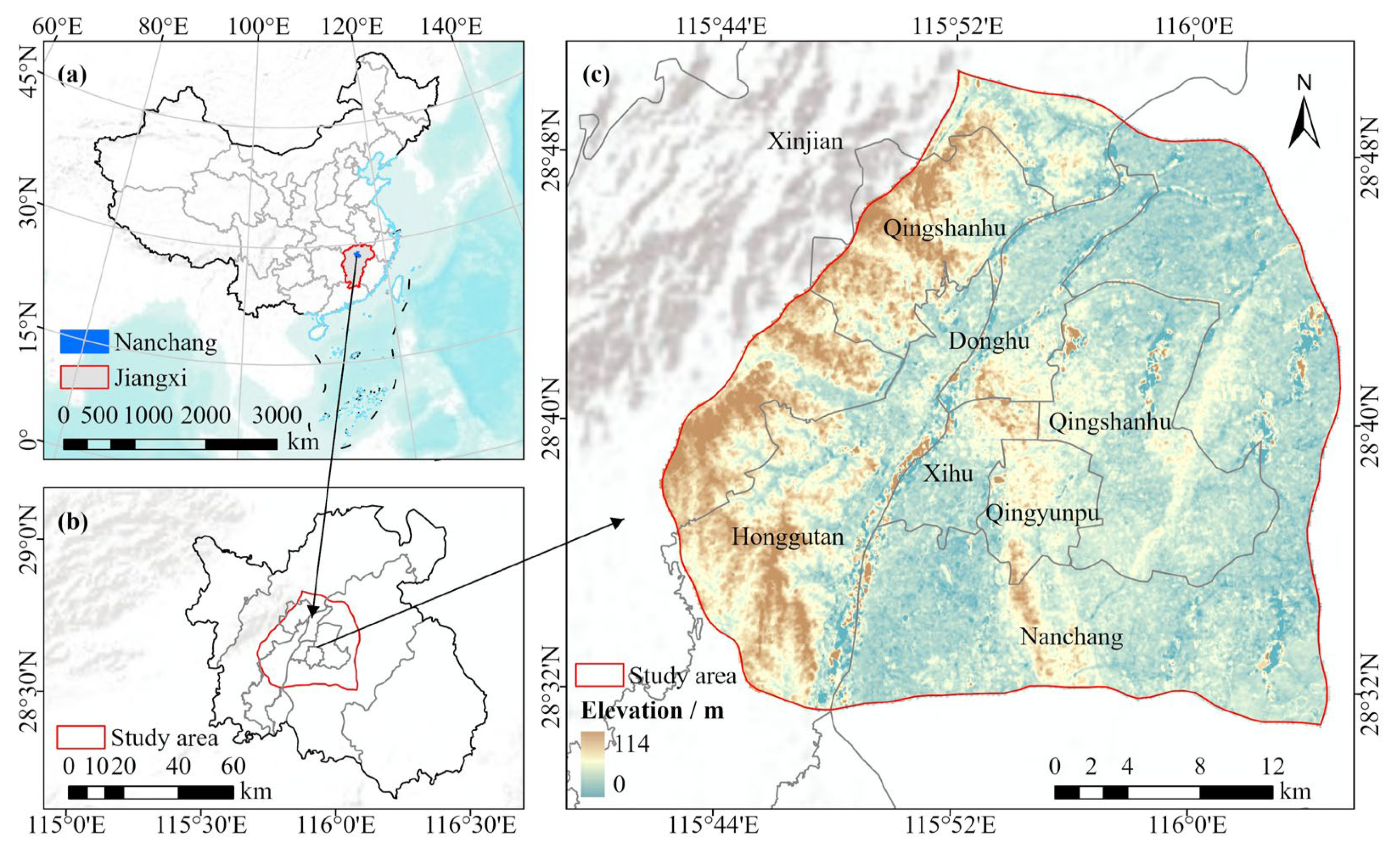
This study focused on the area within the third ring road of Nanchang, Jiangxi Province, China (Figure 1), establishing a high-resolution spatial analysis framework comprising 10,237 hexagonal grids, each covering 0.1 km2. The study area encompasses the Donghu, Xihu, and Qingyunpu districts, as well as portions of Nanchang County and the Honggutan, Qingshanhu, and Xinjian districts. The inner-ring area exhibits the characteristics of both historic urban districts and rapidly urbanizing new zones. The old city primarily serves administrative and traditional commercial functions, whereas the new zones are oriented toward residential development and industrial clustering. Significant differences exist between them vis-à-vis land-use intensity, public service levels, and residential environments. This spatial structural diversity results in a pronounced gradient in housing prices, thereby serving as a representative study area for analyzing intra-urban housing prices’ spatial heterogeneity and driving mechanisms.

Figure 1.
Location of the study area. (a) Location of Jiangxi Province within China; (b) Location of the study area within Nanchang; (c) Elevation distribution and administrative divisions of the study area.
3.2. Data Sources and Variables
3.2.1. Housing Price Data
The housing price data used in this study was sourced from the real estate transaction website Lianjia, which covers listing and transaction records for ordinary residential properties within Nanchang’s Third Ring Road in 2022. The research subjects were defined as ordinary residential properties with comparable market pricing mechanisms, excluding special property types such as villas, commercial-residential buildings, and affordable housing units. Subsequently, the original records were systematically cleaned to remove duplicate entries, missing values, and samples with obvious anomalies. Transaction prices were prioritized. For grid cells with insufficient transaction records, the listed price was adjusted based on the ratio of the average transaction price to the listed price within the spatio-temporal neighborhood, and the adjusted price was incorporated. Residential unit prices (RMB/m2) were uniformly standardized and geoprojected onto a 0.1-km2 hexagonal-grid system within the study area. The average value of samples within each grid cell represents the housing price level for that spatial unit. For sparsely sampled low-density grid cells, their values were supplemented using inverse distance-weighted spatial interpolation to maintain continuity. Thus, a continuous and comparable spatial housing price dataset was formed that supports subsequent spatial pattern identification and regression modeling.
3.2.2. Explanatory Variables
To systematically identify the spatial influence mechanisms of housing prices within Nanchang’s Third Ring Road, ten variables spanning five dimensions were selected (Table 1). Data for these variables were sourced from multiple channels: points of interest (education, dining, commerce) and environmental features (parks, water bodies) were obtained from the Baidu Maps Open Platform (2022); building data was obtained from the Geospatial Remote Sensing Ecological Network Platform; road network data was sourced from the OpenStreetMap (OSM) platform; and 2019 GDP density data was acquired from the Resource and Environment Science Data Center. Collectively, these variables reflect Nanchang’s residential environment features, locational conditions, and socioeconomic status, thereby revealing housing prices’ spatial heterogeneity and multidimensional driving mechanisms.

Table 1.
Variable list and descriptions.
3.3. Methodology
3.3.1. Spatial Pattern Identification
Spatial Trend Analysis
Trend surface analysis is an ArcGIS method for exploratory spatial data analysis, aiming to reveal the overall spatial variation trends of geographic variables. Its fundamental principle involves fitting the attribute values of spatially sampled points using global polynomial functions and transforming discrete two-dimensional spatial sample data into a continuous three-dimensional visual surface. This approach illustrates the macro-level spatial distribution patterns of the study subject.
Let denote the observed housing price variable (the grid-based average housing price level) for the ith spatial unit and denote the trend surface fitted value:
where represents the geographic coordinates, while denotes the residual term, indicating the deviation between the actual observed value and the fitted value.
Spatial Autocorrelation Analysis (Moran’s I)
To identify housing prices’ spatial clustering patterns, we conducted a spatial autocorrelation analysis using Moran’s I. We used the global Moran’s I to determine the overall spatial correlation throughout the entire region and determined whether housing prices exhibit significant clustering or dispersion patterns. Meanwhile, we used the local Moran’s I index to identify high–high, low–low, high–low, and low–high local clustering patterns, thus revealing the spatial heterogeneity of housing prices at both the macro and micro scales.
Hot Spot Analysis
Hot spot analysis (Getis-Ord Gi*) is a spatial statistics-based method for identifying significant clusters of high (hot spots) and low values (cold spots) within a study area. It calculates composite scores for each spatial unit and its neighborhood to determine the spatial clustering distribution of high or low values. We employed this method to identify the spatial clustering patterns of housing prices within Nanchang’s Third Ring Road. Using a p < 0.05 significance threshold, we extracted the distribution characteristics of high- and low-price zones to reveal spatial disparities in urban housing prices. The mathematical formula is as follows:
where is the attribute value of element ; is the spatial weight of elements i and ; n is the number of elements; is the mean value; and Gi* is the score. If Gi* is high and significant, it indicates a high-value spatial cluster—i.e., a hot spot. Conversely, if Gi* is low, negative, and significant, it indicates a low-value spatial cluster—i.e., a cold spot.
3.3.2. Spatial Regression and Multi-Scale Modeling
Ordinary Least Squares
Ordinary least squares (OLS) is a global regression method that estimates linear relationships between variables by minimizing the sum of the squared residuals between the observed and fitted values. We utilized an OLS model to analyze the overall relationship between housing prices within Nanchang’s Third Ring Road and multidimensional influencing factors. This served as the benchmark model for GWR, enabling a comparison between global and local estimation results and validating the spatial heterogeneity characteristics.
GWR
GWR is a local regression model derived from traditional OLS and is designed to capture the spatial non-stationarity of variable relationships. Its core principle is that observations in geographically proximate locations exhibit stronger correlations, compared with distant observations. Therefore, by incorporating a spatial weight matrix, it assigns varying weights to samples at different locations, enabling the estimation of regression parameters within localized regions. The general form of the GWR model is expressed as follows:
where denotes the geographic coordinates of sample point i; is the local regression coefficient for the th independent variable at location , reflecting the spatial variation in the variable’s influence; and is the residual term.
We employed a GWR model within ArcGIS 10.6 software, utilizing a Gaussian kernel function with a fixed bandwidth to generate the spatial weight matrix. The bandwidth parameter was automatically optimized using the corrected Akaike Information Criterion (AICc) within ArcGIS 10.6 to ensure an appropriate balance between model fit and complexity. Given the uniform scale and relatively even spatial distribution of hexagonal grid cells within the study area, the fixed bandwidth facilitates cross-cell comparative analysis at a consistent spatial scale. Meanwhile, the Gaussian kernel function enables continuous, smooth weight decay with distance, which makes it a common and robust choice for processing socioeconomic spatial data.
Additional diagnostic checks indicate that local multicollinearity and coefficient instability are within acceptable ranges. The spatial distribution and statistical ranges of local coefficients do not show abnormal inflation or irregular fluctuations. In addition, the residual distribution does not exhibit systematic distortion near the boundaries, suggesting that boundary effects are limited and that the GWR results remain reliable across the study area.
3.3.3. Spatial Continuation and Optimization Analysis
Kriging is a geographic information system-based interpolation method derived from Matheron’s theory of regionalized variables [40]. Its core principle involves modeling spatial autocorrelation structures between sample points to achieve the optimal prediction of unknown attribute values. In this study, Kriging interpolation was not employed to establish new inferential models or perform causal estimation. Instead, it served as a spatial continuity tool to smooth the locally estimated regression coefficients from the GWR model. This approach enabled the intuitive visualization of influence gradients and spatial variations in different factors across urban areas, thereby supporting a comprehensive analysis of the spatial mechanisms underlying housing price formation.
To ensure reliable spatial visualization and address the estimation uncertainty inherent in local regression coefficients, the Ordinary Kriging interpolation process was standardized and validated. Given the spatial autocorrelation of socioeconomic variables, a spherical model was used for semi-variogram fitting. Key parameters were automatically optimized in ArcGIS 10.6: a step size of 145 m (matching the 0.1 km2 hexagonal grid scale) and a variable search radius referencing the nearest 12 sample points. Leave-one-out cross-validation (LOOCV) was conducted to evaluate interpolation accuracy, yielding a mean error (ME) of −0.03 (indicating negligible systematic bias) and a root mean square error (RMSE) of 0.18. Relative to the local coefficient range, the interpolation error is minimal for spatial trend interpretation, confirming that continuous coefficient surfaces do not amplify estimation uncertainty.
3.3.4. Methodology for Calculating the Capitalization Potential Index
Building on the Geographically Weighted Regression model, this study simulates potential market responses across spatial units under standardized resource improvement scenarios by calculating a Capitalization Potential Index. The simulation assumes that the current spatial structure and regression relationships remain unchanged, aiming to reveal spatial heterogeneity in the capitalization potential of resource improvements rather than to evaluate actual policy effects or to measure subjective well-being directly.
Entropy-Based Weighting Method
To avoid biases arising from subjective weighting and objectively reflect different impact factors’ information contribution to spatial heterogeneity, this study employed an entropy-based method to weight each indicator [38,39]. Specifically, based on the local regression coefficients for the impact factors ultimately included in the model, we calculated their spatial distributions within the study area and the corresponding information entropy values. This process yielded the objective weight () for each indicator. Indicators exhibiting more pronounced spatial variation received higher entropy-based weights, indicating their greater informational contribution to the comprehensive incremental assessment.
Calculation of the Capitalization Potential Index
After determining the entropy weights, the CPI for each spatial unit was calculated. Given that all explanatory variables were standardized prior to modeling, the contextual marginal change was uniformly defined as an improvement of one standardized unit. Specifically, for positive resource variables, ; for distance variables, . Under this unified assumption, the scale of change for different influencing factors remains consistent, ensuring spatial comparability. Based on this, the formula for the CPI in the th spatial unit was as follows:
where is the Capitalization Potential Index for spatial unit, represents the local regression coefficient of the th influencing factor in that spatial unit, is the corresponding weight calculated using the entropy method, and indicates the number of selected influencing factors.
4. Results
4.1. Spatial Differentiation Characteristics of Housing Prices
4.1.1. Spatial Trend Analysis of Housing Prices
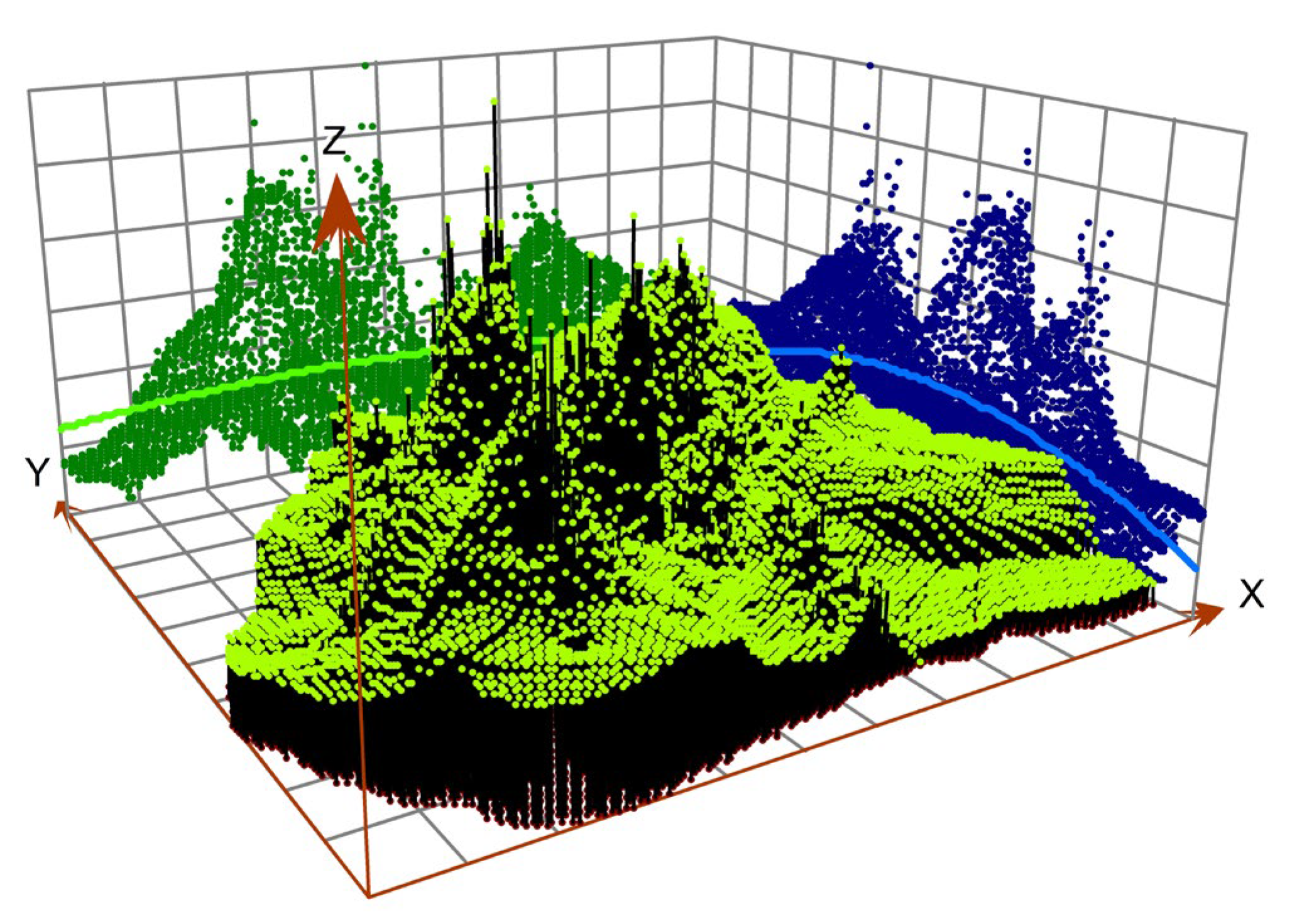
We constructed a three-dimensional spatial trend map of housing prices within Nanchang’s Third Ring Road (Figure 2), aiming to analyze spatial trends and reveal the overall spatial patterns of housing price changes. Overall, housing prices exhibit a multi-core elevation–peripheral decline spatial pattern. High-value zones primarily extend along the south-central–southeast axis, forming a spatial structure supported by multiple high-value cores. Low-value zones are concentrated at the city periphery, creating a continuous low-value belt. This distribution closely correlates with the layout of urban functional zones, reflecting housing prices’ high sensitivity to location conditions and functional positioning.

Figure 2.
Nanchang housing price trend analysis. The X and Y axes represent the east–west and north–south spatial directions, respectively, while the Z axis denotes the observed housing price levels across the study area.
The primary peak zone is in the southwest, encompassing Honggutan (classified as a new district) and the Jiulonghu area. This cluster concentrates core functions, such as government administration, finance, and high-end residential development, establishing it as the city’s premier high-end zone. The Xianghu riverside area in the southeast, where housing prices have risen significantly due to policy support and an exceptional livable environment, forms a secondary peak. The northeastern region, where the Qingshan Lake area meets the high-tech zone, exhibits a localized peak within its industry–academia–research complex. In contrast, the old traditional urban districts (Donghu, Xihu, and Qingyunpu) maintain mature support facilities and convenient transportation. However, constrained by aging buildings and delayed renewal, the potential for sustained mid-to-high-income housing price growth remains limited. Peripheral areas, such as Jinxian and Anyi, demonstrate a typical peripheral decay effect.
4.1.2. Spatial Correlation Analysis
As an economic variable with pronounced spatial attributes, housing prices typically exhibit nonrandom spatial clustering or heterogeneous structures in their distribution. This study employed global Moran’s I to examine the overall spatial autocorrelation of housing prices’ distribution within Nanchang’s Third Ring Road. The results indicate a Moran’s I value of 0.9755 (p < 0.01), revealing a strong positive spatial autocorrelation in housing prices. Specifically, high-price areas tend to adjoin other high-price areas, while low-price areas exhibit a clustered distribution.
As shown in Figure 3, housing prices within Nanchang’s Third Ring Road exhibit a highly concentrated hot spot clustering pattern. Significant hot spots are primarily distributed in Honggutan’s central business district, Jiulonghu’s government district, and Xianghu’s riverside area, manifesting as continuous high-value clusters. Conversely, cold spots are mainly located in northern urban areas and urban-rural fringe zones where prices are significantly below average. The overall housing price distribution exhibits a spatial gradient decreasing from the center to the periphery, reflecting the high spatial imbalance in land value, resource allocation, and market preferences.

Figure 3.
Hot and cold spot analysis of housing prices in Nanchang.
The results of the local spatial autocorrelation analysis, shown in Figure 4, reveal that housing prices in Nanchang exhibited significant spatial autocorrelation, with a pattern characterized by the coexistence of high- and low-value clusters. High–high clusters generally possess superior locational advantages and comprehensive functional strengths, as exemplified by emerging districts such as Honggutan, Xianghu, Jiulonghu, and certain traditional residential areas, forming continuous high-value zones. Low–low clusters are predominantly located in urban–rural fringe areas and remote suburbs, characterized by limited transportation accessibility, inadequate public services, and underdeveloped living amenities, resulting in persistently low housing prices. High–low and low–high spatial units are often distributed in transitional zones between high- and low-value areas. Influenced by uneven resource allocation and functional structural disparities, housing prices form distinct spatial gradients within local areas.

Figure 4.
Local Moran’s I analysis.
This spatial clustering pattern not only reveals significant housing price disparities across functional zones, development stages, and locational conditions but also suggests potential links between price distribution and residents’ quality of life and resource accessibility. Public resource advantages and high-quality living environments in high–high clusters may positively influence resident well-being. Conversely, resource scarcity and inadequate amenities in low–low clusters may lead to decreased well-being. Therefore, building upon the identification of spatial clustering patterns in housing prices, incorporating a spatial well-being economics perspective, and utilizing GWR to quantify price differentiation’s marginal impact on different social groups’ well-being can help reveal the social effects underlying price distribution and provide decision-making support for optimizing spatial resource allocation.
4.2. Analysis of Factors Influencing Spatial Differentiation in Housing Prices
4.2.1. Comparison and Insights from OLS and GWR Model Results
Multicollinearity Test
Prior to regression modeling, SPSS 27 software was used to test for multicollinearity among the explanatory variables, using the variance inflation factor (VIF) as the diagnostic indicator and setting 7.5 as the conventional threshold. The preliminary results (Row I in Table 2) indicated that the VIF values for both educational point of interest (POI) density (X1) and commercial POI density (X3) exceeded this threshold, thereby confirming multicollinearity between these variables.
Table 2.
Results of multicollinearity tests.
To address this issue, subsequent variable screening was conducted. After a comprehensive evaluation of statistical redundancy and conceptual overlap, it was determined that commercial POI density (X3) exhibited strong spatial overlap with variables such as restaurant facility density and transportation accessibility. Consequently, its independent explanatory power for housing prices was relatively limited, warranting its prioritized exclusion. In contrast, educational resources serve as a critical factor in residential decision-making [41], particularly within the school district housing context of our study area. Their theoretical significance is well established, though they are expected to exhibit greater spatial heterogeneity. Consequently, educational POI density (X1) was retained. After excluding commercial POI density, a new multicollinearity test was conducted. The results are shown in Row II of Table 2.
OLS Estimation Results and Residual Characteristics
The regression results indicate that all variables exhibited highly statistically significant regression coefficients (p-values < 0.001), thus confirming a significant linear correlation with housing prices (Table 3). Among these, the coefficient for subway station density (X5) was the largest, demonstrating that rail transit exerted the strongest positive pull on housing prices. Both road network density (X6) and educational POI density (X1) exerted positive influences. In contrast, catering POI density (X2), building density (X4), bus stop density (X7), distance to park (X8), and distance to water body (X9) exhibited negative coefficients in the global OLS model. These negative values do not imply that the factors universally exerted negative impacts. Rather, they reflect the average net effect within the study area: in high-density or functionally saturated zones, the marginal benefits from dense facilities and intensive development may be offset by negative externalities such as noise, congestion, and environmental pressures, resulting in an overall inhibitory effect.
Table 3.
Least-squares regression results.
Simultaneously, the standardized residual plot (Figure 5) reveals pronounced spatial heterogeneity within the study area, with distinct fitting-bias characteristics observed between the central urban area and peripheral regions. Specifically, areas in the south-central and southwestern regions exhibit higher housing prices compared with model predictions. The analysis suggests that these areas benefit from multiple value overlays—including transportation, education, ecology, and brand developer clustering—demonstrating the nonlinearity and spatial heterogeneity that the OLS model struggles to capture. Conversely, an overestimation occurs in the northern and southeastern peripheral zones. This demonstrates traditional OLS models’ structural limitations in addressing spatial heterogeneity.

Figure 5.
Spatial distribution map of OLS standardized residuals (StdResid).
4.2.2. Analysis of the GWR Results
Comparison of the OLS and GWR Models
To assess the need to introduce the GWR model, this study systematically compared the spatial structure of housing prices between the OLS and GWR models along two dimensions: spatial autocorrelation of residuals and goodness-of-fit.
The Moran’s I test (Table 4) revealed significant spatial autocorrelation in the OLS model residuals (Moran’s I = 0.2755, Z = 127.45, p < 0.01), indicating that the OLS model inadequately captures the spatial dependencies in housing prices, which warrants further analysis using local regression methods. In contrast, the GWR model residuals exhibited a Moran’s I value close to zero and failed to pass the significance test (Z = −1.88, p = 0.06). This indicates that by incorporating spatial weights and a local-regression mechanism, the GWR model effectively captured spatial dependence and non-stationarity in the data, thereby significantly controlling spatial clustering of residuals. These results confirm that spatial dependence in the residuals is effectively reduced after introducing the GWR model, supporting the adequacy of the local regression specification.
Table 4.
Comparison of OLS and GWR Residuals with Moran’s I.
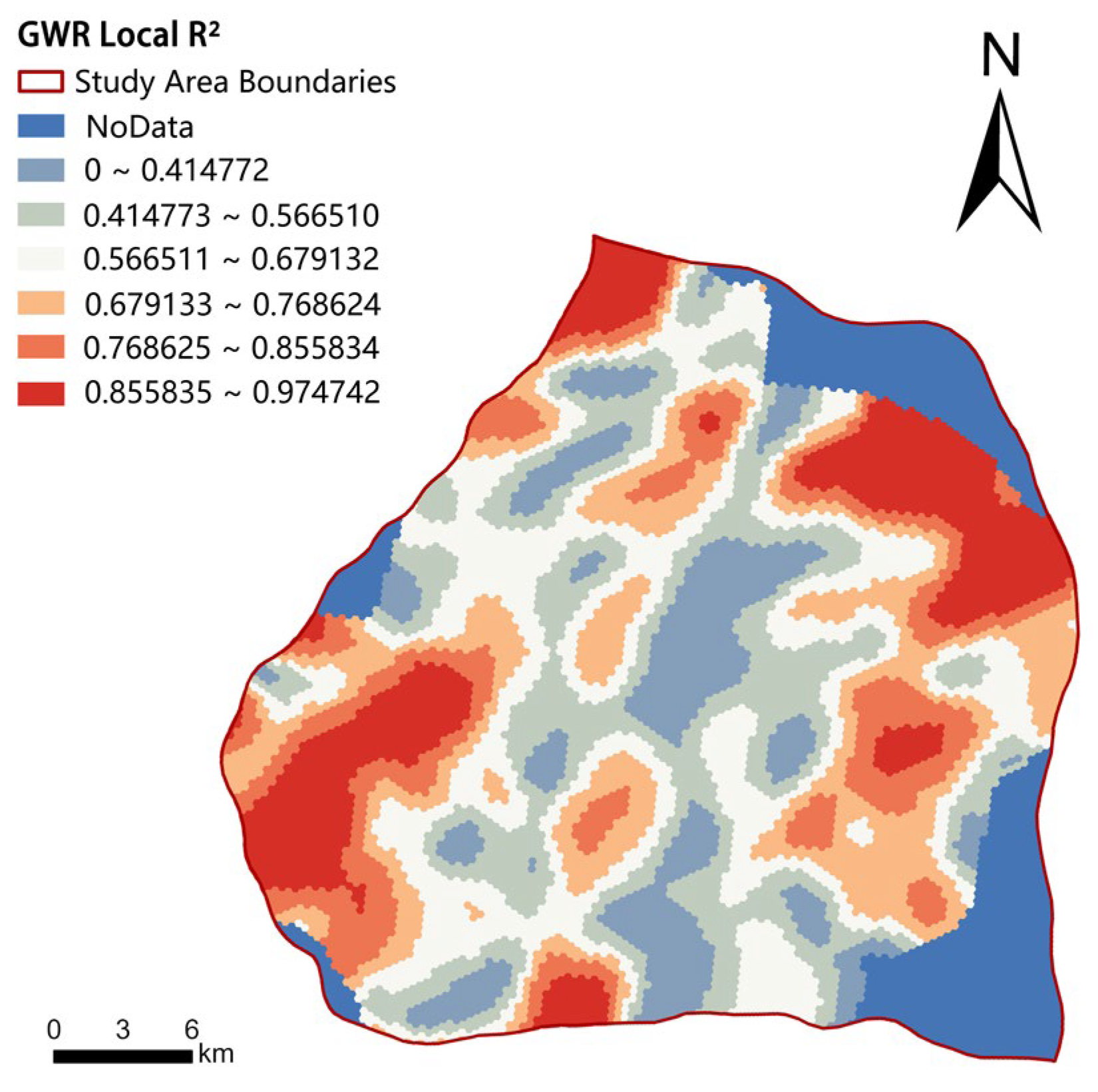
Regarding the models’ goodness-of-fit (Table 5), both the R2 and adjusted R2 values of the GWR model exceeded those of the OLS model, indicating a superior fit. Concurrently, the AICc value of the GWR model was significantly lower than that of the OLS model, underscoring the GWR model’s superior fit. The GWR model revealed, through the spatial distribution of local R2 results (Figure 6), that Nanchang exhibits an overall distribution pattern characterized by high central values and low peripheral values. Comparing the graphical results, the high-fit zones of the GWR model strongly complemented the high residual zones identified by the OLS. Specifically, GWR provides enhanced explanatory power in areas where OLS provides an inadequate fit. Additional comparisons between global and local models further indicate that the main coefficient patterns remain stable across model specifications, suggesting satisfactory robustness of the estimation results.
Table 5.
Comparison Table of the OLS and GWR Results.

Figure 6.
GWR local R2 distribution plot.
Spatial Heterogeneity of Local Regression Coefficients
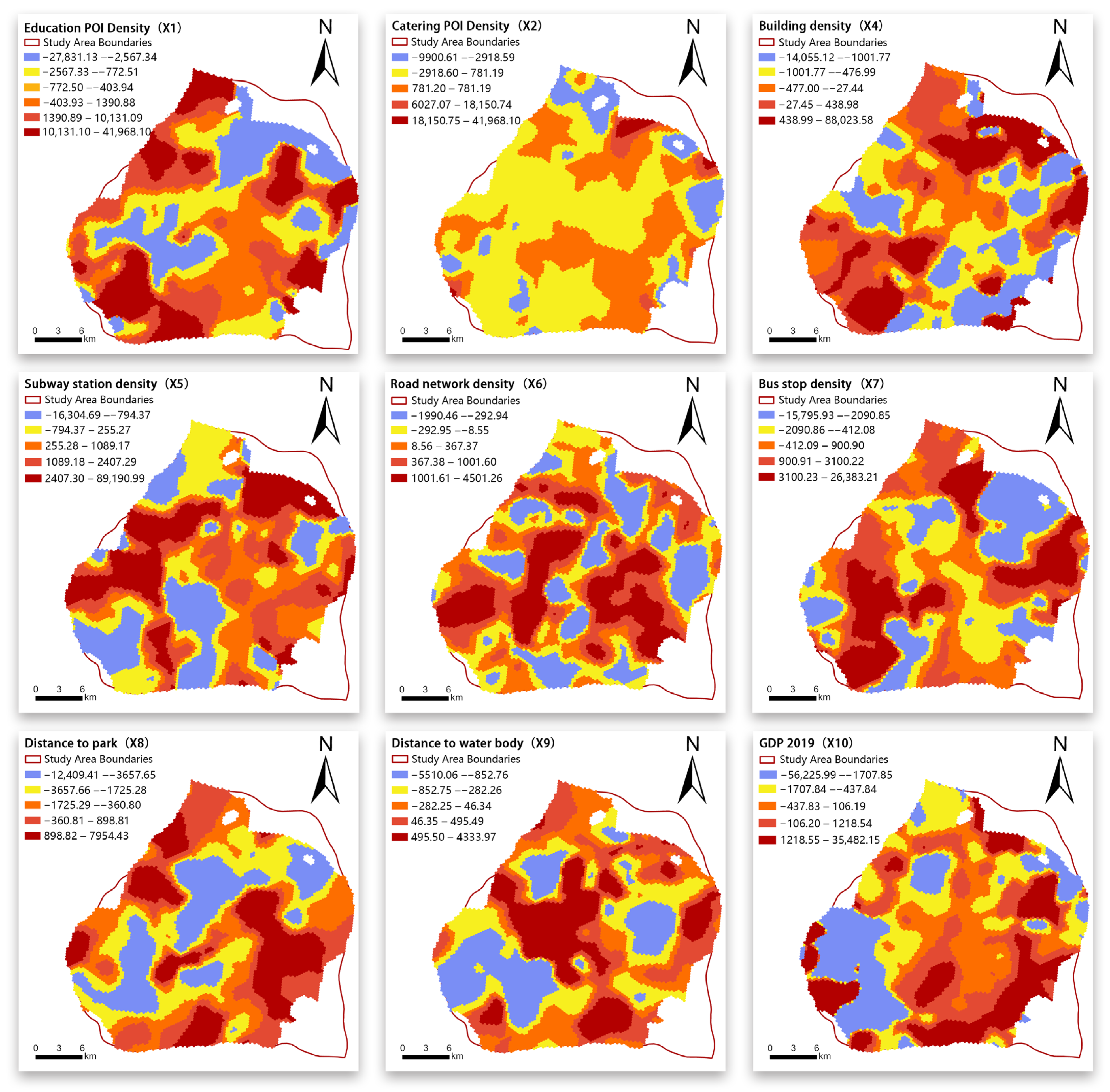
As shown in Table 6, the GWR coefficients for the explanatory variables exhibit distinct spatial variability and imbalance, indicating that highly diverse mechanisms shape housing prices. Nanchang’s spatial price formation follows a distinctive factor imbalance-driven pattern with regional variation adjustment, in which the impact of various spatial factors differs considerably across various urban functional zones. To further characterize the spatial patterns of how various spatial factors influence residential prices, this study employs a GWR model to visually represent the spatial distribution of local regression coefficients for key explanatory variables, as shown in Figure 7. The coefficient distribution reveals significant spatial heterogeneity across variables within the study area. This not only reflects the complexity of housing price formation driven by multiple factors but also highlights how differences in functional structure, population concentration, and development stages within cities reallocate the relative influence of these factors. In addition, the statistical outputs of the GWR model indicate that all explanatory variables remain significant at conventional levels, suggesting that the observed spatial variations in local coefficients mainly reflect spatial heterogeneity rather than random statistical fluctuations.
Table 6.
Results of the GWR model.

Figure 7.
Spatial Distribution of Impact Factor Regression Coefficients.
The regression coefficients for variables related to the built environment and service facilities generally exhibited spatially divergent characteristics, with both positive and negative effects coexisting and large standard deviations. Among these, the coefficient dispersion between education POI density and building density was particularly pronounced, accompanied by significant sign reversals. This indicates that their impact on housing prices depends heavily on local development intensity, functional positioning, and environmental carrying capacity. In core urban areas, educational resources are highly concentrated, and a significantly positive regression coefficient indicates that the convenience and abundance of educational facilities substantially enhance residential appeal and value. Conversely, in peripheral urban zones and newly developed districts, the influence of this variable diminishes, reflecting that areas with insufficient educational resources or incomplete supporting facilities struggle to establish stable price support.
Transportation variables exhibited spatial variation. Both road network density and bus stop density showed overall positive coefficients with relatively small standard deviations, indicating the stable positive effects of transportation accessibility on housing prices across most areas, though their contributions varied spatially. In contrast, the impact of subway station density exhibits a more pronounced “core-periphery” pattern. Although their overall statistical characteristics are similar, spatial distribution results show that in certain emerging development areas, improved subway accessibility significantly enhances commuting efficiency and residential convenience, thereby boosting market expectations and exerting a noticeable upward pull on housing prices. In contrast, traditional districts within the main urban area and certain high-density old industrial zones exhibit lower or even negative regression coefficients. This indicates that the concentration of subway resources has not effectively translated into residential advantages, potentially due to factors such as spatial congestion, aging infrastructure, or insufficient renewal efforts.
Regarding natural environment factors, the coefficients for distance to parks and water bodies remained predominantly negative, denoting that housing near parks or water bodies commands a significant natural landscape premium—consistent with the general principle of capitalizing on ecological resources. Compared with built environment variables, natural environment factors exhibited lower spatial heterogeneity, with their influence mechanisms showing greater spatial consistency.
4.2.3. Spatial Gradient Analysis Based on Kriging Interpolation
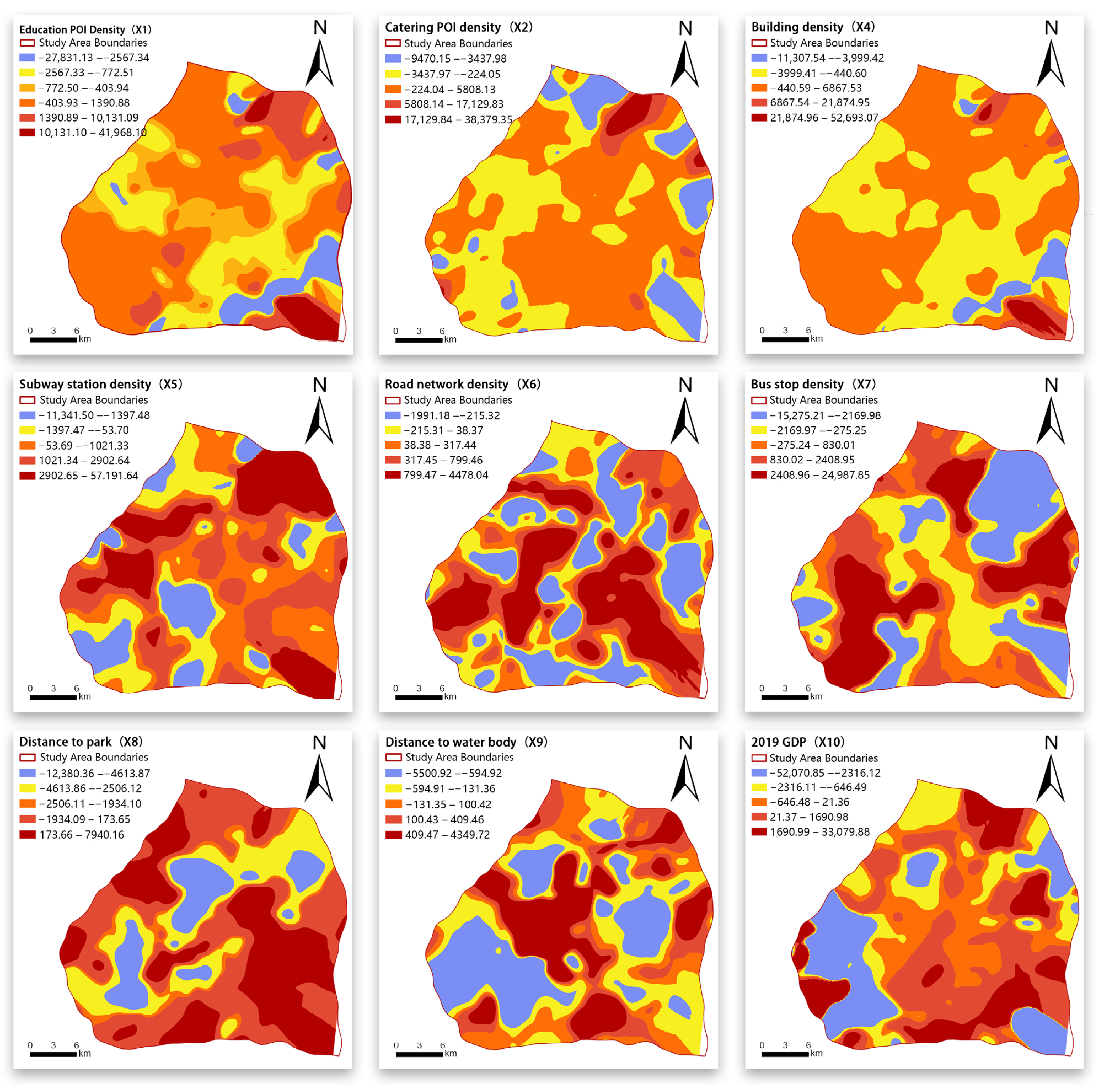
To better illustrate the spatial distribution of the factors affecting housing prices and overcome the spatial discontinuity limitations of the areal GWR results, this study used ordinary Kriging based on the regression coefficients from the GWR model. Thus, maps showing the spatial continuity of nine key influencing factors were created (Figure 8) that highlight the spatial gradients and regional differences in the impact strength of each variable.

Figure 8.
Spatial continuity distribution of regression coefficients for various influencing factors. Warmer colors indicate stronger positive effects, while cooler colors reflect weaker or negative effects.
Based on the Kriging interpolation output variance, the spatial pattern of estimation uncertainty was further analyzed. High-error units (standard error > 0.3) account for only 8.7% of the total study area and are concentrated in urban-rural fringe zones (e.g., northern Jinxian and western Anyi), where sample density is relatively low. In contrast, 78.2% of the study area—predominantly core functional zones, including Honggutan, Jiulonghu, and Xianghu—has a standard error < 0.15, indicating low uncertainty. This spatial pattern of uncertainty aligns with the significance distribution of GWR coefficients: core areas with statistically significant coefficients (p < 0.05) correspond to low interpolation errors, ensuring the reliability of gradient analysis for key functional zones.
Core Functional Orientation Factors
The core functional orientation factors include educational resources and transportation accessibility. This study’s interpolation results show that variables such as educational POI density and public transport factors generally exhibited high, positive values in urban core areas, gradually decreasing toward peripheral zones (even becoming negative). This indicates that the impact of such resources on housing prices exhibits significant distance decay and spatial heterogeneity, rather than exerting a uniform effect across the entire study area.
Lifestyle Services and Built Environment Factors
Lifestyle services and built environment factors include the density of catering POIs and buildings. The regression coefficients exhibited significant spatial variability and directional asymmetry: positive correlations were observed in some areas, while in others, the effect was weak or even negative. This indicates that the impact of living service accessibility and development intensity on housing prices is highly context-dependent, with both the direction and magnitude of their influence varying markedly across locations.
Ecological and Economic Factors
Ecological and economic factors include the distance to parks, the distance to rivers, and the regional GDP levels. Among these, distance variables related to ecological environments exhibited a stable negative relationship across most areas, indicating that proximity to nature consistently generates landscape premiums. In contrast, the coefficients for regional GDP showed greater spatial variability and inconsistent signs, thus reflecting big local differences in the relationship between local economic conditions and housing prices.
It is critical to clarify that Kriging-interpolated continuous surfaces only serve to visualize the spatial gradients of local coefficients. All quantitative analyses, including the calculation of the Capitalization Potential Index, rely on the original GWR coefficient values and their inherent standard deviations. In high-uncertainty fringe areas, overinterpretation of spatial trends was avoided; instead, interpretations were tethered to the significance of local coefficients (e.g., 91.2% of core-area coefficients are significant at p < 0.05). This approach ensures that interpolation does not convert “estimates with standard errors” into “pseudo-real spatial fields,” effectively mitigating over-smoothing risks while preserving the integrity of analytical conclusions.
4.3. Spatial Distribution Characteristics of Capitalization Potential
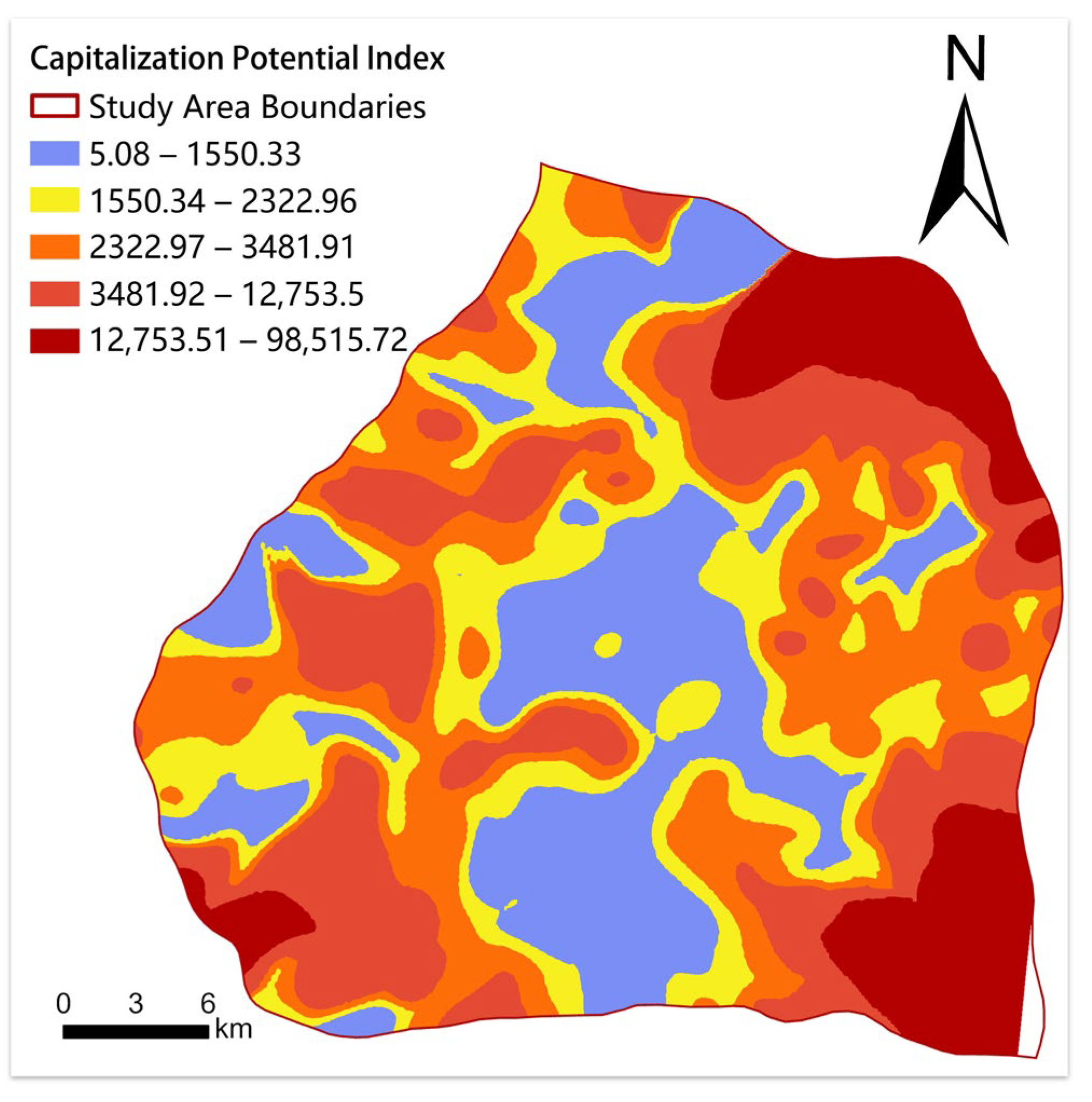
Using the capitalization potential index (CPI) developed in the methodology section, we calculated the capitalization potential for each spatial grid within Nanchang’s Third Ring Road. For each grid, the maximum predicted price response across standardized resource-improvement scenarios was extracted to characterize its relative sensitivity to potential resource enhancements. This maximum capitalization potential was then spatially visualized to generate a capitalization potential distribution map (Figure 9), revealing spatial disparities in the responsiveness of housing prices to resource improvements under the model’s scenario assumptions.

Figure 9.
Optimal action-space distribution map for enhancing capitalization potential. Map shows the spatial pattern of the capitalization potential index. Warmer colors indicate areas with higher potential housing price responsiveness to resource improvements, while cooler colors indicate lower capitalization potential.
The capitalization potential exhibits a markedly uneven spatial distribution across the study area. Low-value zones (5.08–1550.33) are primarily concentrated in the western urban areas and certain well-developed old districts. These areas are characterized by relatively dense public resources and mature infrastructure systems, leaving limited room for additional capitalization through improvements to resources. Medium-to-low-value zones (1550.34–3481.91) are often located in secondary urban clusters and transitional zones between old and new urban districts. Their improvement potential is constrained by land-use saturation and the uneven distribution of service facilities. Medium-to-high value zones (3481.92–12,753.50) are concentrated in new urban expansion areas, newly developed districts, and around certain industrial parks. These zones offer substantial scope to enhance market responsiveness through targeted improvements to public facilities and accessibility conditions. High-value zones (12,753.51–98,515.72) are primarily situated at urban peripheries and urban-rural interfaces, where insufficient public services, low accessibility, and weak market recognition result in pronounced latent capitalization potential.
Overall, Nanchang’s capitalization potential shows clear spatial clustering and concentric differentiation. Peripheral development zones and functional transition areas are key locations where improvements in resource allocation are most likely to yield stronger market responses. A spatial optimization directive map can be generated by integrating the optimal action plans for each grid. This map identifies priority resource types for each area (e.g., new green spaces, additional bus stops, and commercial service facilities) and provides a scientific basis for zoned and tiered optimization strategies.
5. Discussion
5.1. Key Findings
This study revealed that the core characteristic of Nanchang’s housing price differentiation mechanism is its pronounced spatial non-stationarity. Housing prices are not driven by a single homogeneous mechanism but result from the dynamic interplay between regional functional positioning and resource suitability. Overall, spatial autocorrelation tests confirmed prices’ high concentration and polycentric pattern, while GWR revealed the driving factors’ differentiated and heterogeneous spatial impacts. This spatial non-stationarity manifests through three universal characteristics. First, the relationship between living services and built environment factors and housing prices exhibited both positive and negative local correlations across different spatial locations, which shows that their influence effects have pronounced spatial variability. Second, the value of natural ecological resources exhibits significant location dependency, with proximity to green spaces and waterfronts translating into premiums only in areas with high resource quality and strong accessibility. Third, areas exhibiting high capitalization potential tend to spatially overlap with low-price clusters, indicating a structural mismatch between housing price patterns and public resource allocation. This highlights the spatial disconnection between market efficiency and spatial equity. Fundamentally, housing price differentiation embodies spatial adaptation dynamics, with nonequilibrium patterns providing diagnostic entry points for precise resource governance.
This study confirms the spatial non-stationarity of housing prices’ driving factors. The results indicate that dining facilities’ impact on housing prices exhibits significant context dependency: in core areas, these facilities generate premiums through agglomeration effects, whereas in peripheral zones, external constraints and market underdevelopment result in adverse effects. Dining facilities face limitations from noise and other environmental factors, while commercial facilities struggle to sustain premiums due to insufficient maturity. This finding resonates with Hu et al.’s study on Wuhan residential land prices [42], which revealed that the adverse effect of distance from the central business district is pronounced only in highly developed subcenters, whereas it is weaker in underdeveloped areas. This indicates the spatial boundaries of locational factors’ influence. By contrast, transportation facilities exhibit distinct patterns [2]; while research generally emphasizes their premium effect, this study’s GWR results reveal marked differentiation: In saturated core areas, the capitalization effect weakens or even reverses, whereas peripheral zones show stronger positive impacts. This weaker-in-the-center/stronger-in-the-periphery pattern challenges the conventional wisdom of universal accessibility premiums by indicating threshold constraints. Thus, the spatial reversal of commercial service facilities stems from stage-specific adaptability, whereas transportation facilities’ diminishing impact reflects the threshold effects on carrying capacity. Spatial non-stationarity is not the manifestation of a single process but the combined result of the dual mechanisms of development stage adaptability and carrying-capacity threshold. This study’s framework not only deepens our understanding of the spatial reversal of housing price drivers but also provides a new analytical perspective for deciphering the formation logic of housing prices across different urban functional zones.
Beyond identifying overall trends, our analysis also revealed several noteworthy anomalies—namely, certain variables showed insignificant effects in localized areas or their impact direction diverged from that described by the prevalent understanding in the literature. Simply attributing these anomalies to model noise risks overlooks their potential underlying mechanisms. For instance, the failure of urban fringe areas to generate premiums does not indicate ineffective environmental influence but rather limited use efficiency due to low-quality green spaces or poor transportation accessibility. The negative effects observed for commercial facilities within certain industrial zones suggest that overdevelopment or mismatched business formats can diminish residential appeal. Furthermore, it is crucial to distinguish between statistical non-significance and practical relevance. In highly heterogeneous urban spaces, statistically insignificant variables often indicate local patterns or structural deficiencies yet retain practical guidance value. For instance, while certain transportation facility variables may not reach statistical significance, their spatial coupling with high capitalization potential suggests that these areas can be prioritized in public service allocation. Thus, unexpected results not only enrich our understanding of spatial non-stationarity but also offer new directions for refining theoretical frameworks and optimizing policy interventions.
5.2. Limitations and Future Work
This study exhibited several limitations. First, its temporal and spatial coverage of the data was limited, as it focused on cross-sectional analysis, which makes it difficult to capture the long-term dynamic evolution of housing price formation mechanisms, thus potentially leading to interpretations biased toward short-term phenomena and an incomplete reflection of structural trends. Second, while this study’s explanatory variables covered key dimensions such as transportation, commerce, education, and the ecological environment, we did not incorporate qualitative factors such as community culture, residents’ subjective preferences, and developer behavior. This partially weakened the study’s explanatory power regarding the social dynamics underlying housing price differentiation. Third, the Capitalization Potential Index is constructed based on static spatial structure assumptions. While it effectively identifies sensitive areas for current resource allocation, it cannot simulate potential spatial structural evolution triggered by resource inputs, thus presenting limitations in long-term forecasting.
Considering these limitations, future studies should address the following. First, studies should incorporate spatiotemporal GWR [43] or panel spatial econometric models [44] to reveal the dynamic evolution of housing prices’ drivers, aiming to effectively distinguish short-term fluctuations from long-term structural trends, thereby enhancing the model’s explanatory power regarding price formation processes. Second, studies should integrate multi-source data and mixed research methods to construct a more comprehensive and granular explanatory variable system, thereby capturing soft factors. For instance, Ma et al. analyzed urban street environments by integrating multidimensional information such as street view imagery, spatial syntax, street greening indicators, and pedestrian flow metrics [45,46,47]. Third, studies should actively promote interdisciplinary integration and practical applications. For instance, factor-sensitive zones could be identified through GWR for smart city management [9] and spatial policy evaluation frameworks, with the aim of assisting in delineating priority areas for urban renewal. Simultaneously, environmental psychology [45] and behavioral economics theories [48] should be used to analyze different social groups’ response mechanisms to residential environmental disparities. This is expected to drive a research paradigm shift from spatial structure optimization to human-centered governance, thus enhancing the theoretical depth and practical value of research outcomes across interdisciplinary fields.
6. Conclusions
This study systematically analyzed the spatial differentiation characteristics of housing prices in Nanchang, China. It revealed their formation mechanisms, aiming to uncover the spatial logic and heterogeneity of housing prices within Nanchang. The main conclusions are as follows:
- Housing prices in Nanchang exhibit distinct spatial clustering. Prices form several core areas, with values decreasing toward the periphery. This pattern aligns closely with Nanchang’s functional structure and concentration of public resources, indicating that locational advantages and public services comprise key factors driving spatial inequality in housing prices.
- At the mechanism level, the dominant factors vary significantly across regions: Scarce public resources (e.g., education and transportation) in core areas exhibit a stable, positive correlation with housing prices. In contrast, ecological environments and infrastructure conditions in peripheral areas exert stronger explanatory power over property values. In transitional zones between old and new urban areas, built environment factors, such as dining options and building density, demonstrate dual effects—namely, a convenience premium and a congestion discount. This indicates that housing prices are shaped by the combined influence of multidimensional factors and exhibit pronounced spatial heterogeneity.
- Simulation results based on the capitalization potential index indicate that under established model assumptions and scenario conditions, certain low-price housing areas exhibit higher potential price responsiveness. This characteristic reveals a possible structural mismatch between the existing housing price distribution and the spatial allocation of public resources. Housing prices primarily reflect location advantages and resource endowments that have been recognized and capitalized by the market, while high capitalization potential corresponds to spatial units that have not yet been fully translated into price signals. The two exhibit fundamental differences in their representational dimensions and formation mechanisms.
In summary, the spatial imbalance in Nanchang’s housing prices stems from the combined effects of the urban functional structure, resource distribution, and uneven development. Only by fully understanding the spatial logic and resource distribution patterns underlying housing value can urban governance truly shift from an efficiency-first paradigm to a development path oriented toward balanced public services and continuous improvement of the residential environment.
Author Contributions
Conceptualization, Z.X. and J.Z.; methodology, Z.X.; software, J.Z.; validation, Z.X., Y.D. and J.Z.; formal analysis, Z.X.; investigation, Z.X.; resources, J.Z.; data curation, Z.X.; writing—original draft preparation, Z.X.; writing—review and editing, Y.D.; visualization, Z.X.; supervision, Y.D.; funding acquisition, J.Z. All authors have read and agreed to the published version of the manuscript.
Funding
This study is supported by the Fund for the National Natural Science Foundation of China (Grant No. 52308048, Grant No. 52568010).
Data Availability Statement
The original contributions presented in this study are included in the article. Further inquiries can be directed to the corresponding author.
Acknowledgments
The authors thank the anonymous reviewers for their valuable comments and suggestions on this article.
Conflicts of Interest
The authors declare no conflicts of interest.
References
- Zhou, H.; Wang, Y.; Gao, L.; Wu, H. How Housing Price Fluctuation Affects Resource Allocation: Evidence from China. Emerg. Mark. Financ. Trade 2020, 56, 3084–3094. [Google Scholar] [CrossRef]
- Zhang, L.; Zhou, T.; Mao, C. Does the Difference in Urban Public Facility Allocation Cause Spatial Inequality in Housing Prices? Evidence from Chongqing, China. Sustainability 2019, 11, 6096. [Google Scholar] [CrossRef]
- McLeod, P.B. The Demand for Local Amenity: An Hedonic Price Analysis. Environ. Plann. A Econ. Space 1984, 16, 389–400. [Google Scholar] [CrossRef]
- Lan, F.; Wu, Q.; Zhou, T.; Da, H. Spatial Effects of Public Service Facilities Accessibility on Housing Prices: A Case Study of Xi’an, China. Sustainability 2018, 10, 4503. [Google Scholar] [CrossRef]
- Chiang, Y.-H.; Peng, T.-C.; Chang, C.-O. The Nonlinear Effect of Convenience Stores on Residential Property Prices: A Case Study of Taipei, Taiwan. Habitat Int. 2015, 46, 82–90. [Google Scholar] [CrossRef]
- Wu, C.; Ye, X.; Du, Q.; Luo, P. Spatial Effects of Accessibility to Parks on Housing Prices in Shenzhen, China. Habitat Int. 2017, 63, 45–54. [Google Scholar] [CrossRef]
- He, C.; Wang, Z.; Guo, H.; Sheng, H.; Zhou, R.; Yang, Y. Driving Forces Analysis for Residential Housing Price in Beijing. Procedia Environ. Sci. 2010, 2, 925–936. [Google Scholar] [CrossRef]
- Wen, H.; Tao, Y. Polycentric Urban Structure and Housing Price in the Transitional China: Evidence from Hangzhou. Habitat Int. 2015, 46, 138–146. [Google Scholar] [CrossRef]
- Zhao, W.; Zhong, J.; Lv, J. Influencing Factors and Spatial Differentiation of Rental Housing in a Smart City: A GWR Model Analysis. Meas. Sens. 2024, 33, 101126. [Google Scholar] [CrossRef]
- Li, N.; Li, R.Y.M.; Nuttapong, J. Factors Affect the Housing Prices in China: A Systematic Review of Papers Indexed in Chinese Science Citation Database. Prop. Manag. 2022, 40, 780–796. [Google Scholar] [CrossRef]
- Chen, S.; Fang, M.; Zhuang, D. Spatial Non-Stationarity and Heterogeneity of Metropolitan Housing Prices: The Case of Guangzhou, China. IOP Conf. Ser. Mater. Sci. Eng. 2019, 563, 42008. [Google Scholar] [CrossRef]
- Hilber; Christian, A.L. The Economic Implications of House Price Capitalization: A Synthesis. Real Estate Econ. 2017, 45, 301–339. [Google Scholar] [CrossRef]
- Liao, L.; Wu, W.; Zhang, C. Housing Prices and the Subjective Well-Being of Migrant Workers: Evidence from China. J. Happiness Stud. 2022, 23, 3363–3388. [Google Scholar] [CrossRef]
- Pan, Z.; Liu, Y.; Wang, H.; Liu, Y. How Do House Prices Affect Subjective Wellbeing in Urban China? Mediating Effects of Subjective Socioeconomic Status and Household Consumption. J. Hous. Built Environ. 2023, 38, 2559–2580. [Google Scholar] [CrossRef]
- Yu, P.; Yung, E.H.K.; Chan, E.H.W.; Zhang, S.; Wang, S.; Chen, Y. The Spatial Effect of Accessibility to Public Service Facilities on Housing Prices: Highlighting the Housing Equity. ISPRS Int. J. Geo-Inf. 2023, 12, 228. [Google Scholar] [CrossRef]
- Kim, J.-J.; Cho, M.-J.; Lee, M.-H. An Analysis of the Price Determinants of Multiplex Houses through Spatial Regression Analysis. Sustainability 2022, 14, 7116. [Google Scholar] [CrossRef]
- Li, H.; Wang, Q.; Deng, Z.; Shi, W.; Wang, H. Local Public Expenditure, Public Service Accessibility, and Housing Price in Shanghai, China. Urban Aff. Rev. 2019, 55, 148–184. [Google Scholar] [CrossRef]
- Reback, R. House Prices and the Provision of Local Public Services: Capitalization under School Choice Programs. J. Urban Econ. 2005, 57, 275–301. [Google Scholar] [CrossRef]
- Wen, H.; Xiao, Y.; Hui, E.C.M. Quantile Effect of Educational Facilities on Housing Price: Do Homebuyers of Higher-Priced Housing Pay More for Educational Resources? Cities 2019, 90, 100–112. [Google Scholar] [CrossRef]
- Kim, H.-S.; Lee, G.-E.; Lee, J.-S.; Choi, Y. Understanding the Local Impact of Urban Park Plans and Park Typology on Housing Price: A Case Study of the Busan Metropolitan Region, Korea. Landsc. Urban Plan. 2019, 184, 1–11. [Google Scholar] [CrossRef]
- Theebe, M.A.J. Planes, Trains, and Automobiles: The Impact of Traffic Noise on House Prices. J. Real Estate Financ. Econ. 2004, 28, 209–234. [Google Scholar] [CrossRef]
- Wang, S.; Wang, J.; Wang, Y. Effect of Land Prices on the Spatial Differentiation of Housing Prices: Evidence from Cross-County Analyses in China. J. Geogr. Sci. 2018, 28, 725–740. [Google Scholar] [CrossRef]
- Liu, C.; Song, W. Perspectives of Socio-Spatial Differentiation from Soaring Housing Prices: A Case Study in Nanjing, China. Sustainability 2019, 11, 2627. [Google Scholar] [CrossRef]
- McAllister, D.M. Equity and Efficiency in Public Facility Location. Geogr. Anal. 1976, 8, 47–63. [Google Scholar] [CrossRef]
- Lyshchikova, J.V.; Orlova, A.V.; Nikulina, Y.V.; Anokhin, Y.I. Regional Resources Capitalization: Theoretical and Methodological Basis. Int. J. Econ. Financ. Issues 2016, 6, 1684–1689. [Google Scholar]
- Hilber, C.A.L. The Economic Implications of House Price Capitalization: A Survey of an Emerging Literature. SSRN Electron. J. 2011. [Google Scholar] [CrossRef]
- Garang, Z.; Wu, C.; Li, G.; Zhuo, Y.; Xu, Z. Spatio-Temporal Non-Stationarity and Its Influencing Factors of Commercial Land Price: A Case Study of Hangzhou, China. Land 2021, 10, 317. [Google Scholar] [CrossRef]
- Wu, C.; Ren, F.; Hu, W.; Du, Q. Multiscale Geographically and Temporally Weighted Regression: Exploring the Spatiotemporal Determinants of Housing Prices. Int. J. Geogr. Inf. Sci. 2019, 33, 489–511. [Google Scholar] [CrossRef]
- Yang, Z.; Ran, W.; Chongwen, Z. Research on Spatial Spillover Effects and Regional Differences of Urban Housing Price in China. Econ. Comput. Econ. Cybern. Stud. Res. 2021, 55, 211–228. [Google Scholar] [CrossRef]
- Tomal, M. Exploring the Meso-Determinants of Apartment Prices in Polish Counties Using Spatial Autoregressive Multiscale Geographically Weighted Regression. Appl. Econ. Lett. 2022, 29, 822–830. [Google Scholar] [CrossRef]
- Tomal, M. Modelling Housing Rents Using Spatial Autoregressive Geographically Weighted Regression: A Case Study in Cracow, Poland. ISPRS Int. J. Geo-Inf. 2020, 9, 346. [Google Scholar] [CrossRef]
- Wang, Y.; Wang, S.; Li, G.; Zhang, H.; Jin, L.; Su, Y.; Wu, K. Identifying the Determinants of Housing Prices in China Using Spatial Regression and the Geographical Detector Technique. Appl. Geogr. 2017, 79, 26–36. [Google Scholar] [CrossRef]
- Imhoff, M. Using Nighttime DMSP/OLS Images of City Lights to Estimate the Impact of Urban Land Use on Soil Resources in the United States. Remote Sens. Environ. 1997, 59, 105–117. [Google Scholar] [CrossRef]
- Coppel, G.; Wüstemann, H. The Impact of Urban Green Space on Health in Berlin, Germany: Empirical Findings and Implications for Urban Planning. Landsc. Urban Plan. 2017, 167, 410–418. [Google Scholar] [CrossRef]
- Derdouri, A.; Murayama, Y. A Comparative Study of Land Price Estimation and Mapping Using Regression Kriging and Machine Learning Algorithms across Fukushima Prefecture, Japan. J. Geogr. Sci. 2020, 30, 794–822. [Google Scholar] [CrossRef]
- Chica-Olmo, J.; Cano-Guervos, R.; Chica-Rivas, M. Estimation of Housing Price Variations Using Spatio-Temporal Data. Sustainability 2019, 11, 1551. [Google Scholar] [CrossRef]
- Iamtrakul, P.; Chayphong, S.; Gao, W. Assessing Spatial Disparities and Urban Facility Accessibility in Promoting Health and Well-Being. Transp. Res. Interdiscip. Perspect. 2024, 25, 101126. [Google Scholar] [CrossRef]
- Nissi, E.; Sarra, A. A Measure of Well-Being across the Italian Urban Areas: An Integrated DEA-Entropy Approach. Soc. Indic. Res. 2018, 136, 1183–1209. [Google Scholar] [CrossRef]
- Jiang, Q.; Zhao, Y.; Wei, J. Measuring Urban Community Residents’ Well-Being: Indicator System Construction and Weighting Based on Factor Analysis and the Entropy Method. SSRN 2025. [Google Scholar] [CrossRef]
- Oliver, M.A.; Webster, R. Kriging: A Method of Interpolation for Geographical Information Systems. Int. J. Geogr. Inf. Syst. 1990, 4, 313–332. [Google Scholar] [CrossRef]
- Luo, H. Research on the Interaction between Higher Education Resource Allocation and Real Estate Price. OPEN J. Soc. Sci. 2020, 8, 58–68. [Google Scholar] [CrossRef]
- Hu, S.; Yang, S.; Li, W.; Zhang, C.; Xu, F. Spatially Non-Stationary Relationships between Urban Residential Land Price and Impact Factors in Wuhan City, China. Appl. Geogr. 2016, 68, 48–56. [Google Scholar] [CrossRef]
- Yang, Z.; Dai, W.; Yu, W.; Shi, Q.; Santerre, R. Mixed Geographically and Temporally Weighted Regression for Spatio-Temporal Deformation Modelling. Surv. Rev. 2022, 54, 290–300. [Google Scholar] [CrossRef]
- Ihlanfeldt, K.; Mayock, T. Panel Data Estimates of the Effects of Different Types of Crime on Housing Prices. Reg. Sci. Urban Econ. 2010, 40, 161–172. [Google Scholar] [CrossRef]
- Ma, Q.; Zhang, J.; Li, Y. Advanced Integration of Urban Street Greenery and Pedestrian Flow: A Multidimensional Analysis in Chengdu’s Central Urban District. ISPRS Int. J. Geo-Inf. 2024, 13, 254. [Google Scholar] [CrossRef]
- Zhang, J.; Xiang, R.; Kuang, Z.; Wang, B.; Li, Y. ArchGPT: Harnessing Large Language Models for Supporting Renovation and Conservation of Traditional Architectural Heritage. Herit. Sci. 2024, 12, 220–235. [Google Scholar] [CrossRef]
- Zhang, J. Urban Safety Perception Assessments via Integrating Multimodal Large Language Models with Street View Images. Cities 2025, 165, 106122. [Google Scholar] [CrossRef]
- He, Y.; Xia, F. Heterogeneous Traders, House Prices and Healthy Urban Housing Market: A DSGE Model Based on Behavioral Economics. Habitat Int. 2020, 96, 102085. [Google Scholar] [CrossRef]


Disclaimer/Publisher’s Note: The statements, opinions and data contained in all publications are solely those of the individual author(s) and contributor(s) and not of MDPI and/or the editor(s). MDPI and/or the editor(s) disclaim responsibility for any injury to people or property resulting from any ideas, methods, instructions or products referred to in the content. |
© 2026 by the authors. Licensee MDPI, Basel, Switzerland. This article is an open access article distributed under the terms and conditions of the Creative Commons Attribution (CC BY) license.