From Biomimicry to Climate-Responsive Architecture: Prioritizing Bio-Based and Bio-Inspired Strategies for Sustainable Buildings in Tropical Monsoon Climates


Abstract
1. Introduction
- (1)
- To identify key solutions for the application of bio-based and bio-inspired materials in sustainable building design appropriate for tropical monsoon climates.
- (2)
- To identify the top most influential solutions from the integrated design strategies of key solutions.
- (3)
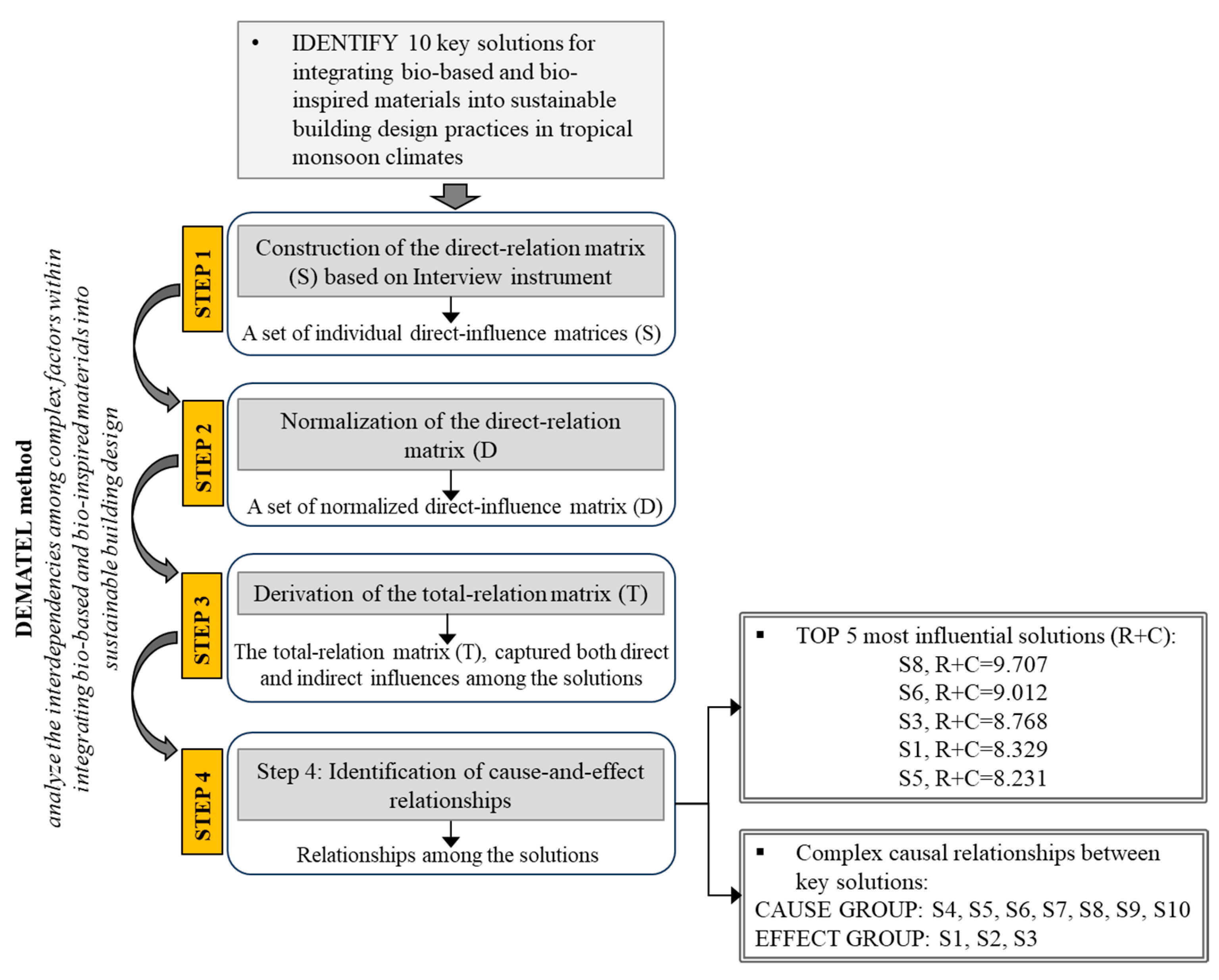
- To analyze the interdependencies of key solutions using the DEMATEL method, thereby clarifying the complex causal relationships between them.
2. Literature Review and Research Gaps
2.1. Past Studies on Bio-Based or Bio-Inspired Materials in Building Design and Construction
2.1.1. Material Diversity and Property Characterization
2.1.2. Building Performance, Applications, and Energy Efficiency
2.1.3. Sustainability Assessment, Life Cycle Analysis, and Circularity
2.1.4. Bio-Inspiration and Biomimicry in Design
2.1.5. Challenges, Barriers to Bio-Based and Bio-Inspired Construction Materials in Tropical Monsoon Climates
2.1.6. The Role of Policy and Technological Advancements
2.2. Identifying Key Solutions for Integrating Bio-Based and Bio-Inspired Materials into Sustainable Building Design Practices in Tropical Monsoon Climates
2.3. Research Gaps
3. Research Methodology
3.1. The DEMATEL Method
3.1.1. Step 1: Construction of the Direct-Relation Matrix (S)
3.1.2. Step 2: Normalization of the Direct-Relation Matrix (D)
3.1.3. Step 3: Derivation of the Total-Relation Matrix (T)
3.1.4. Step 4: Identification of Cause-and-Effect Relationships
3.2. Interview Instrument Development and Data Collection
4. Results
4.1. Results of Developing the Direct-Relation Matrix (S)
4.2. Results of Normalizing the Direct-Influence Matrix (D)
4.3. Results of Generating the Total-Relation Matrix (T)
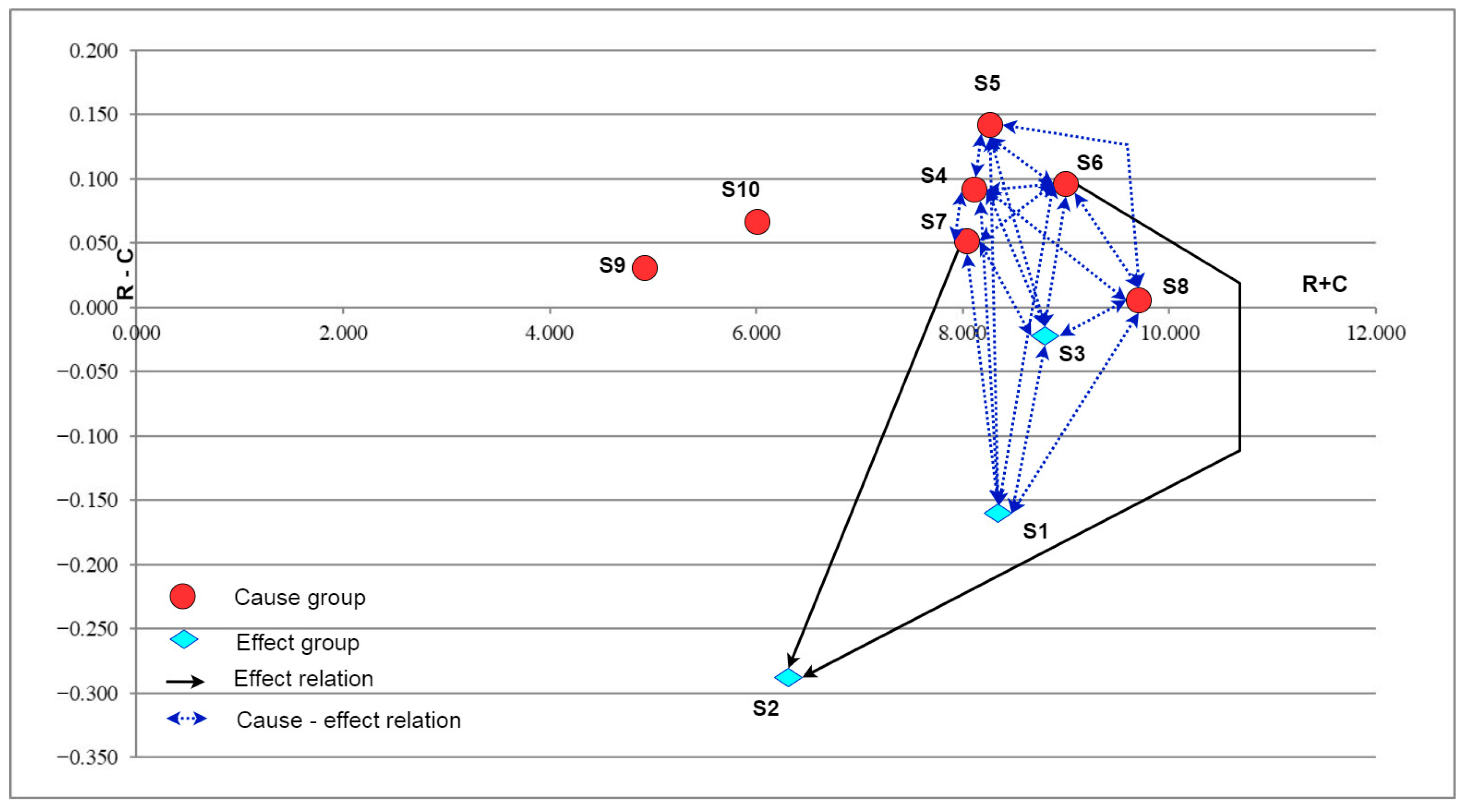
4.4. Results of Determining the Cause-and-Effect Relationships
5. Discussion
Theoretical and Practical Contributions of This Study
6. Conclusions and Limitations
Author Contributions
Funding
Data Availability Statement
Acknowledgments
Conflicts of Interest
References
- Sayce, S.; Wilkinson, S.; Organ, S. The climate crisis: Why it matters for the built environment. In Resilient Building Retrofits; Routledge: London, UK, 2022; pp. 3–20. [Google Scholar]
- Hussain, A.; Hussain, I. Modeling and multi-objective optimization of time, greenhouse gas emissions, and resources for sustainable construction projects. Sustain. Prod. Consum. 2023, 39, 269–284. [Google Scholar] [CrossRef] [Scilit]
- Min, J.; Yan, G.; Abed, A.M.; Elattar, S.; Khadimallah, M.A.; Jan, A.; Ali, H.E. The effect of carbon dioxide emissions on the building energy efficiency. Fuel 2022, 326, 124842. [Google Scholar] [CrossRef] [Scilit]
- Hong, J.; Shen, G.Q.; Feng, Y.; Lau, W.S.-T.; Mao, C. Greenhouse gas emissions during the construction phase of a building: A case study in China. J. Clean. Prod. 2015, 103, 249–259. [Google Scholar] [CrossRef] [Scilit]
- Inyim, P.; Rivera, J.; Zhu, Y. Integration of building information modeling and economic and environmental impact analysis to support sustainable building design. J. Manag. Eng. 2015, 31, A4014002. [Google Scholar] [CrossRef] [Scilit]
- Lehmann, S. Sustainable building design and systems integration: Combining energy efficiency with material efficiency. In Designing for Zero Waste; Routledge: London, UK, 2013; pp. 209–246. [Google Scholar]
- Botchwey, N.; Dannenberg, A.L.; Frumkin, H. Making Healthy Places: Designing and Building for Well-Being, Equity, and Sustainability; Island Press: Washington, DC, USA, 2022. [Google Scholar] [CrossRef] [Scilit]
- Keeler, M.; Vaidya, P. Fundamentals of Integrated Design for Sustainable Building; John Wiley & Sons: Hoboken, NJ, USA, 2016. [Google Scholar]
- Ayoobi, A.W.; Inceoğlu, M.; Inceoğlu, G. A next-generation holistic building design framework: A focus on integrating sustainable and vernacular design principles. Smart Constr. Sustain. Cities 2024, 2, 18. [Google Scholar] [CrossRef] [Scilit]
- Krause, P.; Pokorska-Silva, I.; Kosobucki, Ł. Determining Moisture Condition of External Thermal Insulation Composite System (ETICS) of an Existing Building. Materials 2025, 18, 614. [Google Scholar] [CrossRef] [Scilit]
- Aghamohammadi, N.; Shahmohammadi, M. Towards sustainable development goals and role of bio-based building materials. In Bio-Based Materials and Waste for Energy Generation and Resource Management; Elsevier: Amsterdam, The Netherlands, 2023; pp. 243–279. [Google Scholar] [CrossRef] [Scilit]
- Le, D.L.; Salomone, R.; Nguyen, Q.T. Circular bio-based building materials: A literature review of case studies and sustainability assessment methods. Build. Environ. 2023, 244, 110774. [Google Scholar] [CrossRef] [Scilit]
- Yang, B.; Wang, Q.; Man, S.S. Sustainable material innovation design for building construction: Exploring bio-based alternatives. In Design Studies and Intelligence Engineering; IOS Press: Amsterdam, The Netherlands, 2024; pp. 81–87. [Google Scholar] [CrossRef] [Scilit]
- Romano, A.; Bras, A.; Grammatikos, S.; Shaw, A.; Riley, M. Dynamic behaviour of bio-based and recycled materials for indoor environmental comfort. Constr. Build. Mater. 2019, 211, 730–743. [Google Scholar] [CrossRef] [Scilit]
- Torres-Rivas, A.; Palumbo, M.; Haddad, A.; Cabeza, L.F.; Jiménez, L.; Boer, D. Multi-objective optimisation of bio-based thermal insulation materials in building envelopes considering condensation risk. Appl. Energy 2018, 224, 602–614. [Google Scholar] [CrossRef] [Scilit]
- Bourbia, S.; Kazeoui, H.; Belarbi, R. A review on recent research on bio-based building materials and their applications. Mater. Renew. Sustain. Energy 2023, 12, 117–139. [Google Scholar] [CrossRef] [Scilit]
- Riley, M.; Cotgrave, A.; Farragher, M. Building Design, Construction and Performance in Tropical Climates; Routledge: London, UK, 2018. [Google Scholar]
- Aste, N.; Butera, F.M.; Adhikari, R.S.; Leonforte, F. Sustainable building design for tropical climates. In Innovative Models for Sustainable Development in Emerging African Countries; Springer: Cham, Switzerland, 2020; pp. 37–46. [Google Scholar] [CrossRef] [Scilit]
- Zhang, K.; Garg, A.; Mei, G.; Jiang, M.; Wang, H.; Huang, S.; Gan, L. Thermal performance and energy consumption analysis of eight types of extensive green roofs in subtropical monsoon climate. Build. Environ. 2022, 216, 108982. [Google Scholar] [CrossRef] [Scilit]
- Hofbauer, W.K.; Gärtner, G. Microbial life on Façades; Springer: Berlin/Heidelberg, Germany, 2021. [Google Scholar] [CrossRef] [Scilit]
- Mirrahimi, S.; Mohamed, M.F.; Haw, L.C.; Ibrahim, N.L.N.; Yusoff, W.F.M.; Aflaki, A. The effect of building envelope on the thermal comfort and energy saving for high-rise buildings in hot–humid climate. Renew. Sustain. Energy Rev. 2016, 53, 1508–1519. [Google Scholar] [CrossRef] [Scilit]
- Saber, E.M.; Tham, K.W.; Leibundgut, H. A review of high temperature cooling systems in tropical buildings. Build. Environ. 2016, 96, 237–249. [Google Scholar] [CrossRef] [Scilit]
- Gandhi, S.; Mangla, S.K.; Kumar, P.; Kumar, D. Evaluating factors in implementation of successful green supply chain management using DEMATEL: A case study. Int. Strateg. Manag. Rev. 2015, 3, 96–109. [Google Scholar] [CrossRef] [Scilit]
- Kaur, J.; Sidhu, R.; Awasthi, A.; Chauhan, S.; Goyal, S. A DEMATEL based approach for investigating barriers in green supply chain management in Canadian manufacturing firms. Int. J. Prod. Res. 2018, 56, 312–332. [Google Scholar] [CrossRef] [Scilit]
- Van Tam, N.; Quynh, T.T.H.; Toan, N.Q. How Vietnam can achieve net-zero carbon emissions in construction and built environment by 2050: An integrated AHP and DEMATEL approach. Build. Environ. 2025, 274, 112752. [Google Scholar] [CrossRef] [Scilit]
- Chayaamor-Heil, N.; Perricone, V.; Gruber, P.; Guéna, F. Bioinspired, biobased and living material designs: A review of recent research in architecture and construction. Bioinspiration Biomim. 2023, 18, 041001. [Google Scholar] [CrossRef] [Scilit]
- Abed, J.; Rayburg, S.; Rodwell, J.; Neave, M. A Review of the Performance and Benefits of Mass Timber as an Alternative to Concrete and Steel for Improving the Sustainability of Structures. Sustainability 2022, 14, 5570. [Google Scholar] [CrossRef] [Scilit]
- Al-Qahtani, S.; Koç, M.; Isaifan, R.J. Mycelium-based thermal insulation for domestic cooling footprint reduction: A review. Sustainability 2023, 15, 13217. [Google Scholar] [CrossRef] [Scilit]
- Alaux, N.; Vašatko, H.; Maierhofer, D.; Saade, M.R.M.; Stavric, M.; Passer, A. Environmental potential of fungal insulation: A prospective life cycle assessment of mycelium-based composites. Int. J. Life Cycle Assess. 2024, 29, 255–272. [Google Scholar] [CrossRef] [Scilit]
- Fellah, M.; Ouhaibi, S.; Belouaggadia, N.; Mansouri, K.; Naji, H. Thermal insulation and energy performance’s assessment of a mycelium-based composite wall for sustainable buildings. Case Stud. Constr. Mater. 2024, 20, e02786. [Google Scholar] [CrossRef] [Scilit]
- Raja, P.; Murugan, V.; Ravichandran, S.; Behera, L.; Mensah, R.A.; Mani, S.; Kasi, A.; Balasubramanian, K.B.N.; Sas, G.; Vahabi, H. A review of sustainable bio-based insulation materials for energy-efficient buildings. Macromol. Mater. Eng. 2023, 308, 2300086. [Google Scholar] [CrossRef] [Scilit]
- Binici, H.; Aksogan, O.; Demirhan, C. Mechanical, thermal and acoustical characterizations of an insulation composite made of bio-based materials. Sustain. Cities Soc. 2016, 20, 17–26. [Google Scholar] [CrossRef] [Scilit]
- Palumbo, M.; Lacasta, A.; Giraldo, M.; Haurie, L.; Correal, E. Bio-based insulation materials and their hygrothermal performance in a building envelope system (ETICS). Energy Build. 2018, 174, 147–155. [Google Scholar] [CrossRef] [Scilit]
- Ventura, A.; Ouellet-Plamondon, C.; Röck, M.; Hecht, T.; Roy, V.; Higuera, P.; Lecompte, T.; Faria, P.; Hamard, E.; Morel, J.-C. Environmental potential of earth-based building materials: Key facts and issues from a life cycle assessment perspective. In Testing and Characterisation of Earth-based Building Materials and Elements: State-of-the-Art Report of the RILEM TC 274-TCE; Springer International Publishing: Cham, Switzerland, 2022; pp. 261–296. [Google Scholar] [CrossRef] [Scilit]
- Laborel-Préneron, A.; Aubert, J.-E.; Magniont, C.; Tribout, C.; Bertron, A. Plant aggregates and fibers in earth construction materials: A review. Constr. Build. Mater. 2016, 111, 719–734. [Google Scholar] [CrossRef] [Scilit]
- Van Tam, N.; Toan, N.Q.; Duong, P.T.T. Identifying circular economy strategies for decarbonization in built environment: A comparative analysis of key stakeholders in Vietnam. Sustain. Futures 2025, 9, 100611. [Google Scholar] [CrossRef] [Scilit]
- Latapie, S.R.; Sabathier, V.; Abou-Chakra, A. Bio-based building materials: A prediction of insulating properties for a wide range of agricultural by-products. J. Build. Eng. 2024, 86, 108867. [Google Scholar] [CrossRef] [Scilit]
- Wang, J.; Demartino, C.; Xiao, Y.; Li, Y. Thermal insulation performance of bamboo-and wood-based shear walls in light-frame buildings. Energy Build. 2018, 168, 167–179. [Google Scholar] [CrossRef] [Scilit]
- Mnasri, F.; Bahria, S.; Slimani, M.E.-A.; Lahoucine, O.; El Ganaoui, M. Building incorporated bio-based materials: Experimental and numerical study. J. Build. Eng. 2020, 28, 101088. [Google Scholar] [CrossRef] [Scilit]
- Lopez-Carreon, I.; Jahan, E.; Yari, M.H.; Esmizadeh, E.; Riahinezhad, M.; Lacasse, M.; Xiao, Z.; Dragomirescu, E. Moisture Ingress in Building Envelope Materials:(II) Transport Mechanisms and Practical Mitigation Approaches. Buildings 2025, 15, 762. [Google Scholar] [CrossRef] [Scilit]
- Guo, X.; Gao, H. Bio-inspired material design and optimization. In IUTAM Symposium on Topological Design Optimization of Structures, Machines and Materials: Status and Perspectives; Springer: Dordrecht, The Netherlands, 2006; pp. 439–453. [Google Scholar]
- Shan, B.; Qiu, J.; Xu, H.; Li, T.; Xiao, Y.; Qin, S.; Gao, L.; Li, Z. Experimental research on standardized bamboo culm components for developing prefabricated bamboo building. In Structures; Elsevier: Amsterdam, The Netherlands, 2023; pp. 272–285. [Google Scholar] [CrossRef] [Scilit]
- Bredenoord, J. Bamboo as a sustainable building material for innovative, low-cost housing construction. Sustainability 2024, 16, 2347. [Google Scholar] [CrossRef] [Scilit]
- Javadian, A.; Smith, I.F.; Hebel, D.E. Application of sustainable bamboo-based composite reinforcement in structural-concrete beams: Design and evaluation. Materials 2020, 13, 696. [Google Scholar] [CrossRef] [Scilit] [PubMed]
- Sheng, D.D.C.V.; Ramegowda, N.S.; Guna, V.; Reddy, N. Groundnut shell and coir reinforced hybrid bio composites as alternative to gypsum ceiling tiles. J. Build. Eng. 2022, 57, 104892. [Google Scholar] [CrossRef] [Scilit]
- Bala, A.; Gupta, S. Engineered bamboo and bamboo-reinforced concrete elements as sustainable building materials: A review. Constr. Build. Mater. 2023, 394, 132116. [Google Scholar] [CrossRef] [Scilit]
- Sandak, A.; Butina Ogorelec, K. Bioinspired building materials—Lessons from nature. Front. Mater. 2023, 10, 1283163. [Google Scholar] [CrossRef] [Scilit]
- Švajlenka, J.; Kozlovská, M. Evaluation of the efficiency and sustainability of timber-based construction. J. Clean. Prod. 2020, 259, 120835. [Google Scholar] [CrossRef] [Scilit]
- Pujadas-Gispert, E.; Alsailani, M.; van Dijk, K.; Rozema, A.; ten Hoope, J.; Korevaar, C.; Moonen, S. Design, construction, and thermal performance evaluation of an innovative bio-based ventilated façade. Front. Archit. Res. 2020, 9, 681–696. [Google Scholar] [CrossRef] [Scilit]
- Nazrun, T.; Hassan, M.K.; Hossain, M.D.; Ahmed, B.; Hasnat, M.R.; Saha, S. Application of biopolymers as sustainable cladding materials: A Review. Sustainability 2024, 16, 27. [Google Scholar] [CrossRef] [Scilit]
- Stazi, F.; Tomassoni, F.; Veglio, A.; Di Perna, C. Experimental evaluation of ventilated walls with an external clay cladding. Renew. Energy 2011, 36, 3373–3385. [Google Scholar] [CrossRef] [Scilit]
- Radić, M.; Brković Dodig, M.; Auer, T. Green facades and living walls—A review establishing the classification of construction types and mapping the benefits. Sustainability 2019, 11, 4579. [Google Scholar] [CrossRef] [Scilit]
- Perini, K.; Ottelé, M. Designing green façades and living wall systems for sustainable constructions. Int. J. Des. Nat. Ecodynamics 2014, 9, 31–46. [Google Scholar] [CrossRef] [Scilit]
- Perini, K.; Ottelé, M.; Haas, E.; Raiteri, R. Vertical greening systems, a process tree for green façades and living walls. Urban Ecosyst. 2013, 16, 265–277. [Google Scholar] [CrossRef] [Scilit]
- Susorova, I. Green facades and living walls: Vertical vegetation as a construction material to reduce building cooling loads. In Eco-Efficient Materials for Mitigating Building Cooling Needs; Elsevier: Amsterdam, The Netherlands, 2015; pp. 127–153. [Google Scholar] [CrossRef] [Scilit]
- Ottelé, M.; Perini, K.; Fraaij, A.; Haas, E.; Raiteri, R. Comparative life cycle analysis for green façades and living wall systems. Energy Build. 2011, 43, 3419–3429. [Google Scholar] [CrossRef] [Scilit]
- Wood, D.; Cheng, T.; Tahouni, Y.; Menges, A. Material programming for bio-inspired and bio-based hygromorphic building envelopes. In Advanced Materials in Smart Building Skins for Sustainability: From Nano to Macroscale; Springer: Berlin/Heidelberg, Germany, 2022; pp. 99–112. [Google Scholar] [CrossRef] [Scilit]
- Soliman, M.E.; Bo, S. An innovative multifunctional biomimetic adaptive building envelope based on a novel integrated methodology of merging biological mechanisms. J. Build. Eng. 2023, 76, 106995. [Google Scholar] [CrossRef] [Scilit]
- Alkhayyat, J. Design strategy for adaptive kinetic patterns: Creating a generative design for dynamic solar shading systems. Archit. Univ. Salford 2013. [Google Scholar]
- Kamal, M.A. An overview of passive cooling techniques in buildings: Design concepts and architectural interventions. Acta Tech. Napoc. Civ. Eng. Archit. 2012, 55, 84–97. [Google Scholar]
- Pfafferott, J.; Herkel, S.; Jäschke, M. Design of passive cooling by night ventilation: Evaluation of a parametric model and building simulation with measurements. Energy Build. 2003, 35, 1129–1143. [Google Scholar] [CrossRef] [Scilit]
- Prieto, A.; Knaack, U.; Auer, T.; Klein, T. Passive cooling & climate responsive façade design: Exploring the limits of passive cooling strategies to improve the performance of commercial buildings in warm climates. Energy Build. 2018, 175, 30–47. [Google Scholar] [CrossRef] [Scilit]
- Aslan, D.; Selçuk, S.A.; Avinç, G.M. A biomimetic approach to water harvesting strategies: An architectural point of view. Int. J. Built Environ. Sustain. 2022, 9, 47–60. [Google Scholar] [CrossRef] [Scilit]
- Solano, T.; Bernal, A.; Mora, D.; Chen Austin, M. How bio-inspired solutions have influenced the built environment design in hot and humid climates. Front. Built Environ. 2023, 9, 1267757. [Google Scholar] [CrossRef] [Scilit]
- Zhang, S.; Huang, J.; Chen, Z.; Lai, Y. Bioinspired special wettability surfaces: From fundamental research to water harvesting applications. Small 2017, 13, 1602992. [Google Scholar] [CrossRef] [Scilit]
- Bordah, V.; Alhassan, K.N.; Boadi, K.K. Design and Construction of Water Filtration System for Ghanaian Households; Ashesi University: Berekuso, Ghana, 2022; Available online: https://air.ashesi.edu.gh/server/api/core/bitstreams/4a5fc2ac-0e0f-43f6-8027-18f084ff4323/content (accessed on 12 December 2025).
- Gil-Ozoudeh, I.; Iwuanyanwu, O.; Okwandu, A.C.; Ike, C.S. Water conservation strategies in green buildings: Innovations and best practices. Eng. Sci. Technol. J. 2024, 4, 651–671. [Google Scholar] [CrossRef] [Scilit]
- Chang, N.-B.; Rivera, B.J.; Wanielista, M.P. Optimal design for water conservation and energy savings using green roofs in a green building under mixed uncertainties. J. Clean. Prod. 2011, 19, 1180–1188. [Google Scholar] [CrossRef] [Scilit]
- Ashraf, N.; Abdin, A.R. Biomimetic design synthesis and digital optimization of building shading skin: A novel conceptual framework for enhanced energy efficiency. Energy Build. 2024, 323, 114824. [Google Scholar] [CrossRef] [Scilit]
- Horn, R.; Dahy, H.; Gantner, J.; Speck, O.; Leistner, P. Bio-inspired sustainability assessment for building product development—Concept and case study. Sustainability 2018, 10, 130. [Google Scholar] [CrossRef] [Scilit]
- Galimshina, A.; Moustapha, M.; Hollberg, A.; Padey, P.; Lasvaux, S.; Sudret, B.; Habert, G. Bio-based materials as a robust solution for building renovation: A case study. Appl. Energy 2022, 316, 119102. [Google Scholar] [CrossRef] [Scilit]
- Peñaloza, D.; Erlandsson, M.; Falk, A. Exploring the climate impact effects of increased use of bio-based materials in buildings. Constr. Build. Mater. 2016, 125, 219–226. [Google Scholar] [CrossRef] [Scilit]
- Gardner, H.M.; Hasik, V.; Banawi, A.; Olinzock, M.; Bilec, M.M. Whole building life cycle assessment of a living building. J. Archit. Eng. 2020, 26, 04020039. [Google Scholar] [CrossRef] [Scilit]
- Dams, B.; Maskell, D.; Shea, A.; Allen, S.; Cascione, V.; Walker, P. Upscaling bio-based construction: Challenges and opportunities. Build. Res. Inf. 2023, 51, 764–782. [Google Scholar] [CrossRef] [Scilit]
- Van Tam, N. Promoting net-zero carbon in the Vietnamese construction sector: Potential benefits and challenges identified by key stakeholders. Smart Sustain. Built Environ. 2025; Epub ahead of printing. [CrossRef] [Scilit]
- Van Tam, N. Mitigating digital transformation risks for circular construction in emerging economies: An empirical investigation in Vietnam. Int. J. Constr. Manag. 2024, 25, 1130–1140. [Google Scholar] [CrossRef] [Scilit]
- David, M.-N.; Miguel, R.-S.; Ignacio, P.-Z. Timber Structures Designed for Disassembly: A Cornerstone for Sustainability in 21st Century Construction. J. Build. Eng. 2024, 96, 110619. [Google Scholar] [CrossRef] [Scilit]
- Le-Thanh, L.; Le-Duc, T.; Ngo-Minh, H.; Nguyen, Q.-H.; Nguyen-Xuan, H. Optimal design of an Origami-inspired kinetic façade by balancing composite motion optimization for improving daylight performance and energy efficiency. Energy 2021, 219, 119557. [Google Scholar] [CrossRef] [Scilit]
- Sojobi, A.; Liew, K. Multi-objective optimization of high performance bio-inspired prefabricated composites for sustainable and resilient construction. Compos. Struct. 2022, 279, 114732. [Google Scholar] [CrossRef] [Scilit]
- Van der Lugt, P.; Vogtländer, J.; Brezet, H. Bamboo: A sustainable Solution for Western Europe Design Cases, LCAs and Land-Use; INBAR Technical Report No. 30, Delft University of Technology, Faculty of Industrial Design Engineering, Design for Sustainability Program; VSSD: Delft, The Netherlands, 2009. [Google Scholar]
- Lee, J.-Y.; Lee, S.-E.; Lee, D.-W. Current status and future prospects of biological routes to bio-based products using raw materials, wastes, and residues as renewable resources. Crit. Rev. Environ. Sci. Technol. 2022, 52, 2453–2509. [Google Scholar] [CrossRef] [Scilit]
- Koul, B.; Yakoob, M.; Shah, M.P. Agricultural waste management strategies for environmental sustainability. Environ. Res. 2022, 206, 112285. [Google Scholar] [CrossRef] [Scilit]
- De Araujo, V. Timber construction as a multiple valuable sustainable alternative: Main characteristics, challenge remarks and affirmative actions. Int. J. Constr. Manag. 2023, 23, 1334–1343. [Google Scholar] [CrossRef] [Scilit]
- Nagy, B.; Simon, T.K.; Nemes, R. Effect of built-in mineral wool insulations durability on its thermal and mechanical performance. J. Therm. Anal. Calorim. 2020, 139, 169–181. [Google Scholar] [CrossRef] [Scilit]
- Nowoświat, A.; Miros, A.; Krause, P. Change in the Properties of Expanded Polystyrene Exposed to Solar Radiation in Real Aging Conditions. Sustainability 2024, 16, 7320. [Google Scholar] [CrossRef] [Scilit]
- Phuong, N.T.K.; Chan, Y.-C.; Do, C.T.; Tuan, N.A.; Rinchumphu, D. A simulation-based workflow to calculate overall thermal transfer value when implementing daylighting-oriented shading control. J. Build. Eng. 2024, 84, 108616. [Google Scholar] [CrossRef] [Scilit]
- Sara, J.; Stikkelman, R.M.; Herder, P.M. Assessing relative importance and mutual influence of barriers for CCS deployment of the ROAD project using AHP and DEMATEL methods. Int. J. Greenh. Gas Control 2015, 41, 336–357. [Google Scholar] [CrossRef] [Scilit]
- Balsara, S.; Jain, P.K.; Ramesh, A. An integrated approach using AHP and DEMATEL for evaluating climate change mitigation strategies of the Indian cement manufacturing industry. Environ. Pollut. 2019, 252, 863–878. [Google Scholar] [CrossRef] [Scilit]
- Yuan, H.; Du, W.; Ma, X.; Liu, J.; Li, L. Critical factors to influence the illegal dumping behavior of construction and demolition waste: An ISM-DEMATEL analysis. Dev. Built Environ. 2023, 14, 100159. [Google Scholar] [CrossRef] [Scilit]
- Si, S.-L.; You, X.-Y.; Liu, H.-C.; Zhang, P. DEMATEL Technique: A Systematic Review of the State-of-the-Art Literature on Methodologies and Applications. Math. Probl. Eng. 2018, 2018, 3696457. [Google Scholar] [CrossRef] [Scilit]
- Yazdi, M.; Khan, F.; Abbassi, R.; Rusli, R. Improved DEMATEL methodology for effective safety management decision-making. Saf. Sci. 2020, 127, 104705. [Google Scholar] [CrossRef] [Scilit]
- Nguanson, C.; Taweekun, J.; Dai, Y.; Ge, T. The criteria of passive and low energy in building design for tropical climate in Thailand. Int. J. Integr. Eng. 2020, 12, 241–252. [Google Scholar] [CrossRef] [Scilit]



| Expert ID | Qualification | Age | Years of Experience | Organization | Position | Expertise |
|---|---|---|---|---|---|---|
| E1 | Ph.D | 45 | 20 | University, and Architecture and design firm | Lecturer, and Architectural design specialist | Architecture |
| E2 | Ph.D | 36 | 10 | University, and Architecture and design firm | Lecturer, and Architectural design specialist | Architectural engineering |
| E3 | Assoc. Prof., Ph.D | 49 | 25 | University, and Architecture and design firm | Lecturer, and Architectural design specialist | Architecture and urban planning |
| E4 | MSc | 50 | 26 | Architecture and design firm | Project manager | Civil engineering |
| E5 | MSc | 36 | 10 | University, and Architecture and design firm | Lecturer, and Architectural design specialist | Architecture |
| E6 | Ph.D | 46 | 22 | University | Lecturer | Material engineering |
| E7 | MSc | 40 | 15 | University | Researcher | Built environment |
| E8 | MSc | 35 | 10 | University, and Architecture and design firm | Lecturer, and Architectural design specialist | Architecture |
| E9 | Dr. | 34 | 10 | University, and Architecture and design firm | Lecturer, and Architectural design specialist | Architectural engineering |
| E10 | MSc | 42 | 18 | University, and Architecture and design firm | Lecturer, and Architectural design specialist | Architecture |
| E11 | MSc | 41 | 18 | University, and Architecture and design firm | Lecturer, and Architectural design specialist | Architecture |
| E12 | MSc | 43 | 18 | University | Lecturer | Environmental engineering |
| E13 | Full Professor, Ph.D | 48 | 24 | University | Lecturer | Building materials |
| E14 | Ph.D | 40 | 14 | University, and Architecture and design firm | Lecturer, and Architectural design specialist | Architecture |
| E15 | Ph.D | 41 | 15 | University, and Architecture and design firm | Lecturer, and Architectural design specialist | Architecture |
| E16 | Assoc. Prof., Ph.D | 51 | 28 | University | Lecturer | Architecture |
| E17 | MSc | 38 | 12 | University | Lecturer | Architecture |
| E18 | Ph.D | 42 | 13 | University | Lecturer | Architecture |
| E19 | Ph.D | 51 | 29 | University, and Architecture and design firm | Lecturer, and Architectural design specialist | Architecture |
| E20 | MSc | 35 | 10 | Architecture and design firm | Architectural design specialist | Architecture |
| E21 | MSc | 42 | 15 | Architecture and design firm | Green building consultuant | Architecture |
| Solution | Ri | Ci | Ri + Ci | Rank | Ri-Ci | Identify |
|---|---|---|---|---|---|---|
| S1 | 4.085 | 4.244 | 8.329 | 4 | −0.160 | Effect |
| S2 | 3.010 | 3.298 | 6.308 | 8 | −0.287 | Effect |
| S3 | 4.373 | 4.396 | 8.768 | 3 | −0.023 | Effect |
| S4 | 4.109 | 4.019 | 8.128 | 6 | 0.090 | Cause |
| S5 | 4.185 | 4.046 | 8.231 | 5 | 0.140 | Cause |
| S6 | 4.554 | 4.458 | 9.012 | 2 | 0.095 | Cause |
| S7 | 4.031 | 3.981 | 8.013 | 7 | 0.050 | Cause |
| S8 | 4.854 | 4.852 | 9.707 | 1 | 0.002 | Cause |
| S9 | 2.470 | 2.441 | 4.911 | 10 | 0.028 | Cause |
| S10 | 3.037 | 2.972 | 6.009 | 9 | 0.065 | Cause |
Disclaimer/Publisher’s Note: The statements, opinions and data contained in all publications are solely those of the individual author(s) and contributor(s) and not of MDPI and/or the editor(s). MDPI and/or the editor(s) disclaim responsibility for any injury to people or property resulting from any ideas, methods, instructions or products referred to in the content. |
© 2026 by the authors. Licensee MDPI, Basel, Switzerland. This article is an open access article distributed under the terms and conditions of the Creative Commons Attribution (CC BY) license.
Share and Cite
Quoc Toan, N.; Phuong, N.T.K.; Van Tam, N.; Quoc Viet, L. From Biomimicry to Climate-Responsive Architecture: Prioritizing Bio-Based and Bio-Inspired Strategies for Sustainable Buildings in Tropical Monsoon Climates. Buildings 2026, 16, 771. https://doi.org/10.3390/buildings16040771
Quoc Toan N, Phuong NTK, Van Tam N, Quoc Viet L. From Biomimicry to Climate-Responsive Architecture: Prioritizing Bio-Based and Bio-Inspired Strategies for Sustainable Buildings in Tropical Monsoon Climates. Buildings. 2026; 16(4):771. https://doi.org/10.3390/buildings16040771
Chicago/Turabian StyleQuoc Toan, Nguyen, Nguyen Thi Khanh Phuong, Nguyen Van Tam, and Le Quoc Viet. 2026. "From Biomimicry to Climate-Responsive Architecture: Prioritizing Bio-Based and Bio-Inspired Strategies for Sustainable Buildings in Tropical Monsoon Climates" Buildings 16, no. 4: 771. https://doi.org/10.3390/buildings16040771
APA StyleQuoc Toan, N., Phuong, N. T. K., Van Tam, N., & Quoc Viet, L. (2026). From Biomimicry to Climate-Responsive Architecture: Prioritizing Bio-Based and Bio-Inspired Strategies for Sustainable Buildings in Tropical Monsoon Climates. Buildings, 16(4), 771. https://doi.org/10.3390/buildings16040771