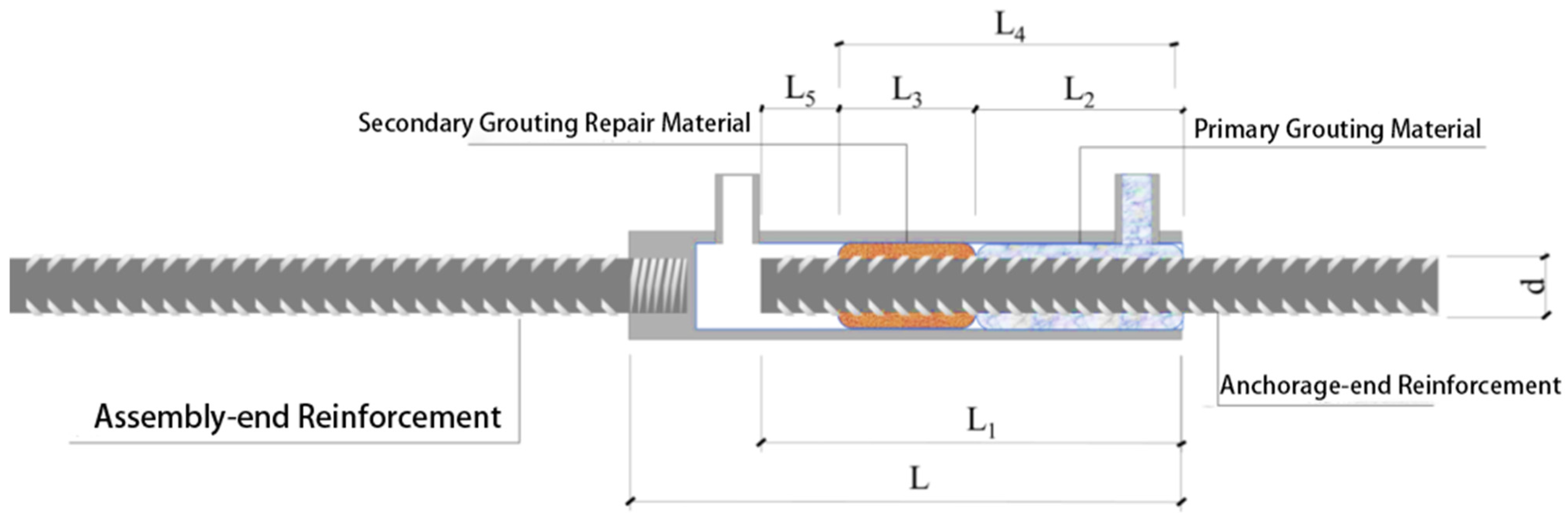
Figure 1.
Specimen Construction Details. L—Total length of half-grouted sleeve, L1—Insertion depth of reinforcing steel bar in grouted section of sleeve, L2—Total anchorage length of initial grouting, L3—Anchorage length of supplementary grouting, L4—Total anchorage length of both initial and supplementary grouting, L5—Defect length formed due to unanchored section.
Figure 1.
Specimen Construction Details. L—Total length of half-grouted sleeve, L1—Insertion depth of reinforcing steel bar in grouted section of sleeve, L2—Total anchorage length of initial grouting, L3—Anchorage length of supplementary grouting, L4—Total anchorage length of both initial and supplementary grouting, L5—Defect length formed due to unanchored section.
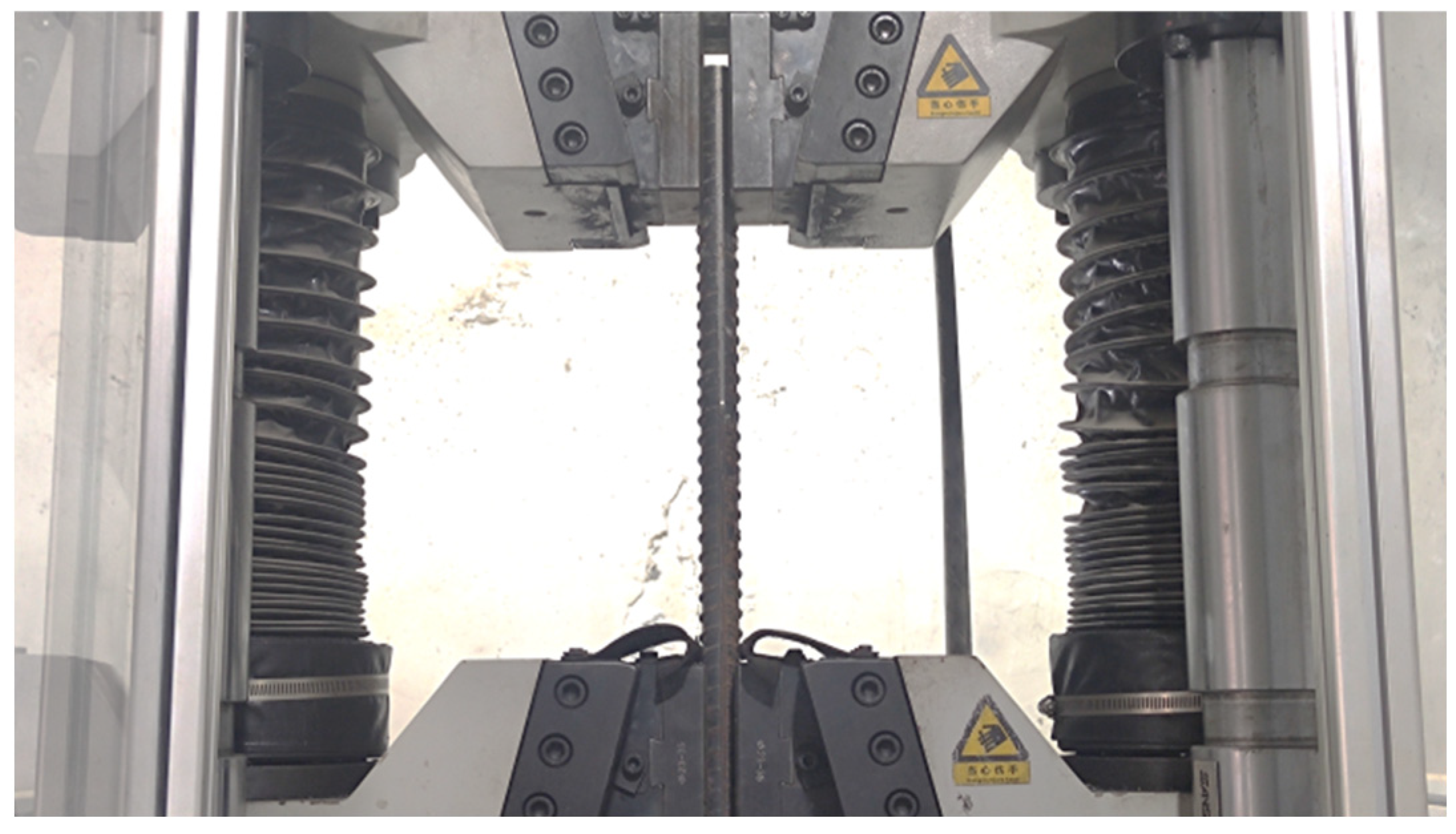
Figure 2.
Reinforcing Bar Material Performance Test.
Figure 2.
Reinforcing Bar Material Performance Test.
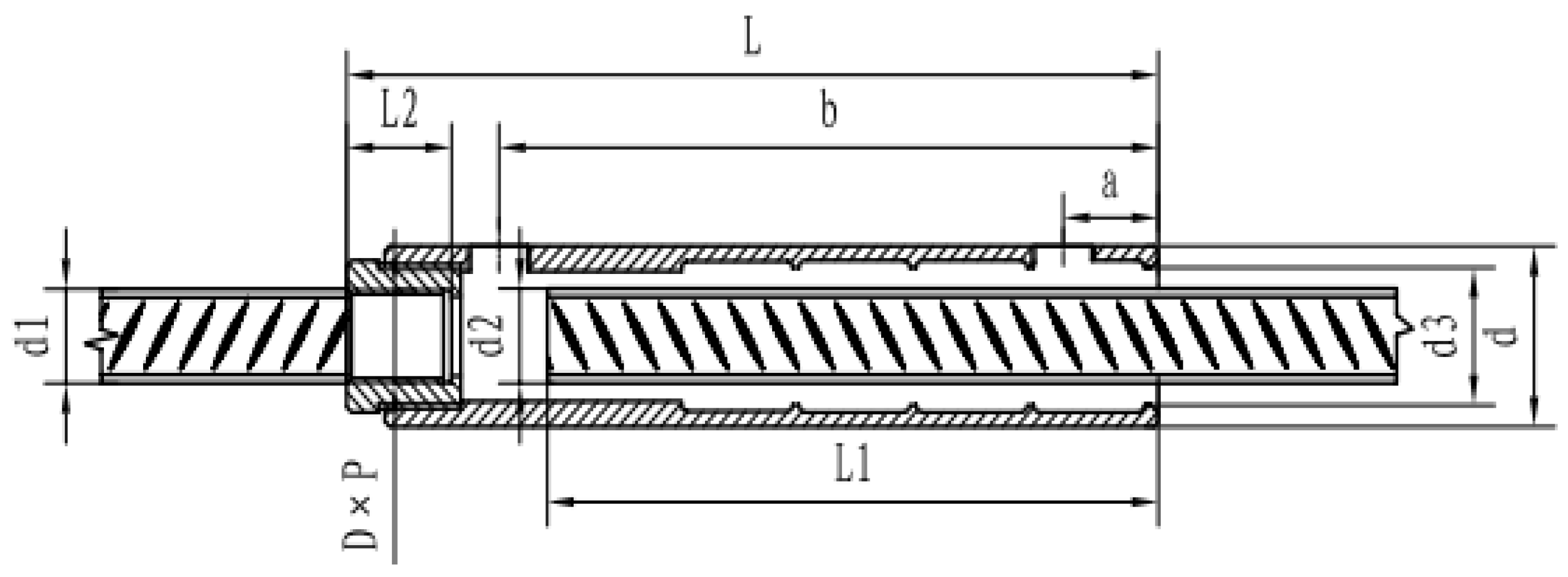
Figure 3.
Geometric Parameters of Grouted Sleeves. L—Total length of half-grouted sleeve, L1—Insertion depth of reinforcing steel bar in grouted section of sleeve, L2—Depth of internal threaded hole, d—Outer diameter of half-grouted sleeve, d1—Diameter of threaded connection reinforcing steel bar, d2—Diameter of reinforcing steel bar at grouted connection end, d3—Inner diameter of sleeve, a—Position of grouting hole, b—Position of bleeding hole.
Figure 3.
Geometric Parameters of Grouted Sleeves. L—Total length of half-grouted sleeve, L1—Insertion depth of reinforcing steel bar in grouted section of sleeve, L2—Depth of internal threaded hole, d—Outer diameter of half-grouted sleeve, d1—Diameter of threaded connection reinforcing steel bar, d2—Diameter of reinforcing steel bar at grouted connection end, d3—Inner diameter of sleeve, a—Position of grouting hole, b—Position of bleeding hole.
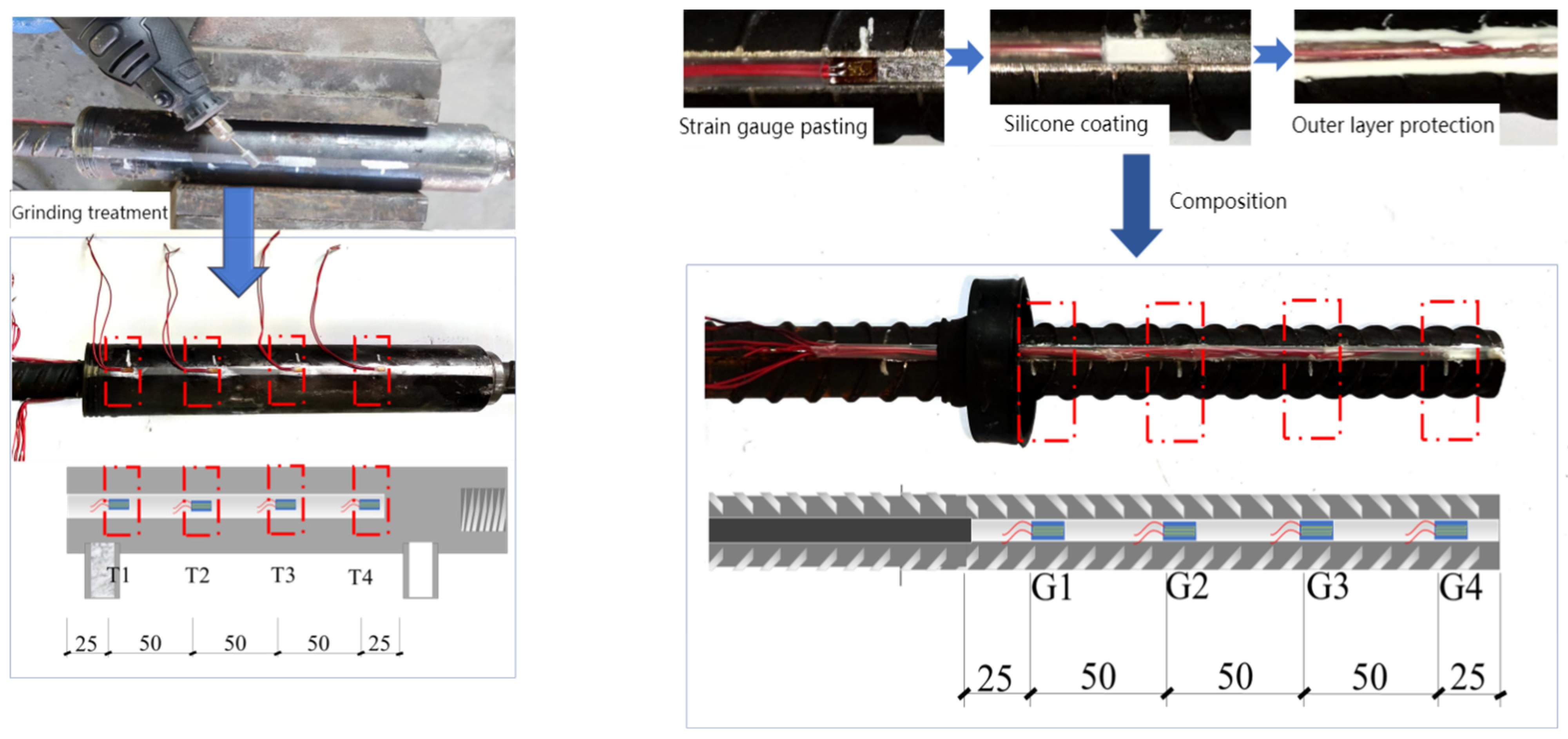
Figure 4.
Strain gauge arrangement.
Figure 4.
Strain gauge arrangement.
Figure 5.
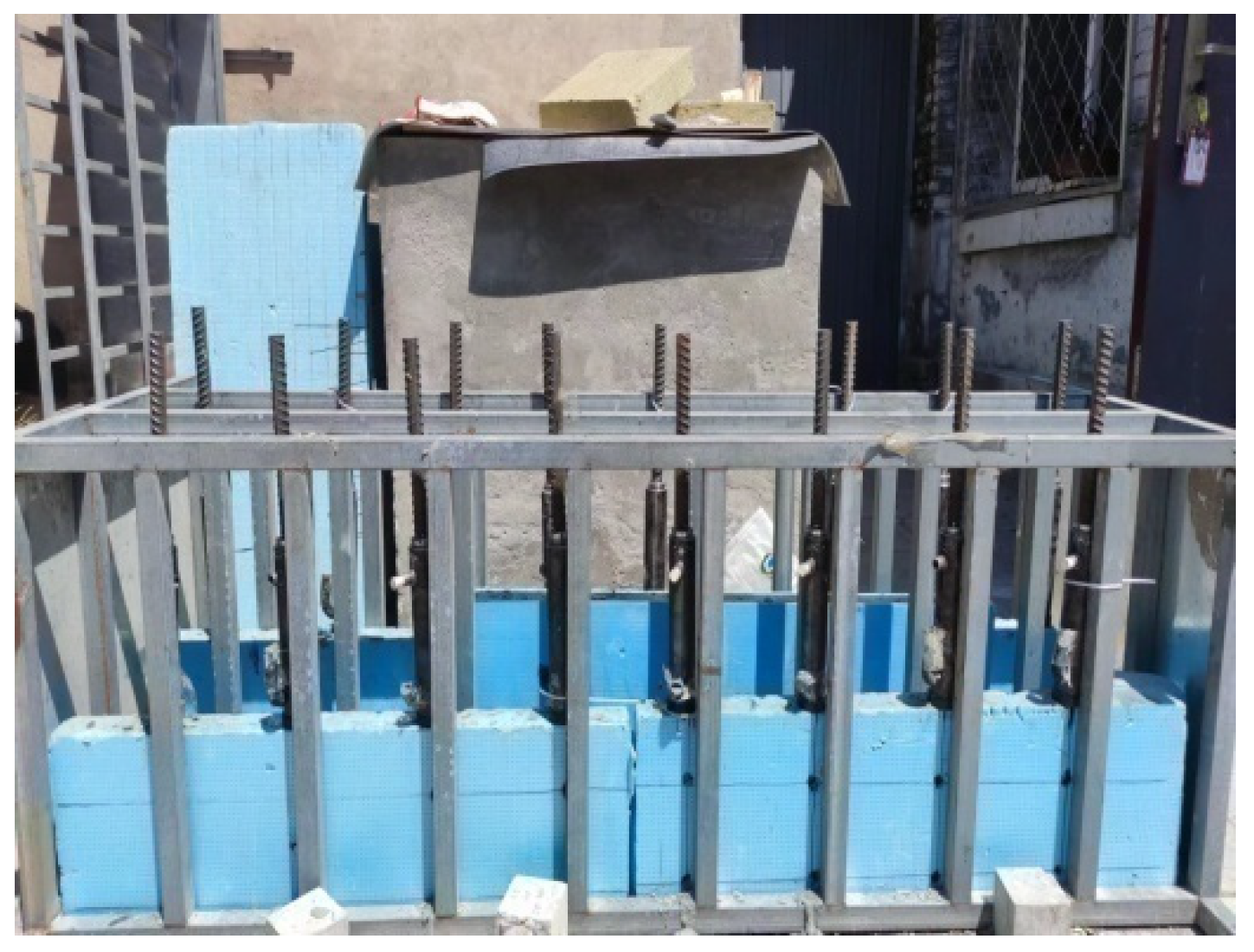
Grouting and Curing Apparatus for the Test.
Figure 5.
Grouting and Curing Apparatus for the Test.
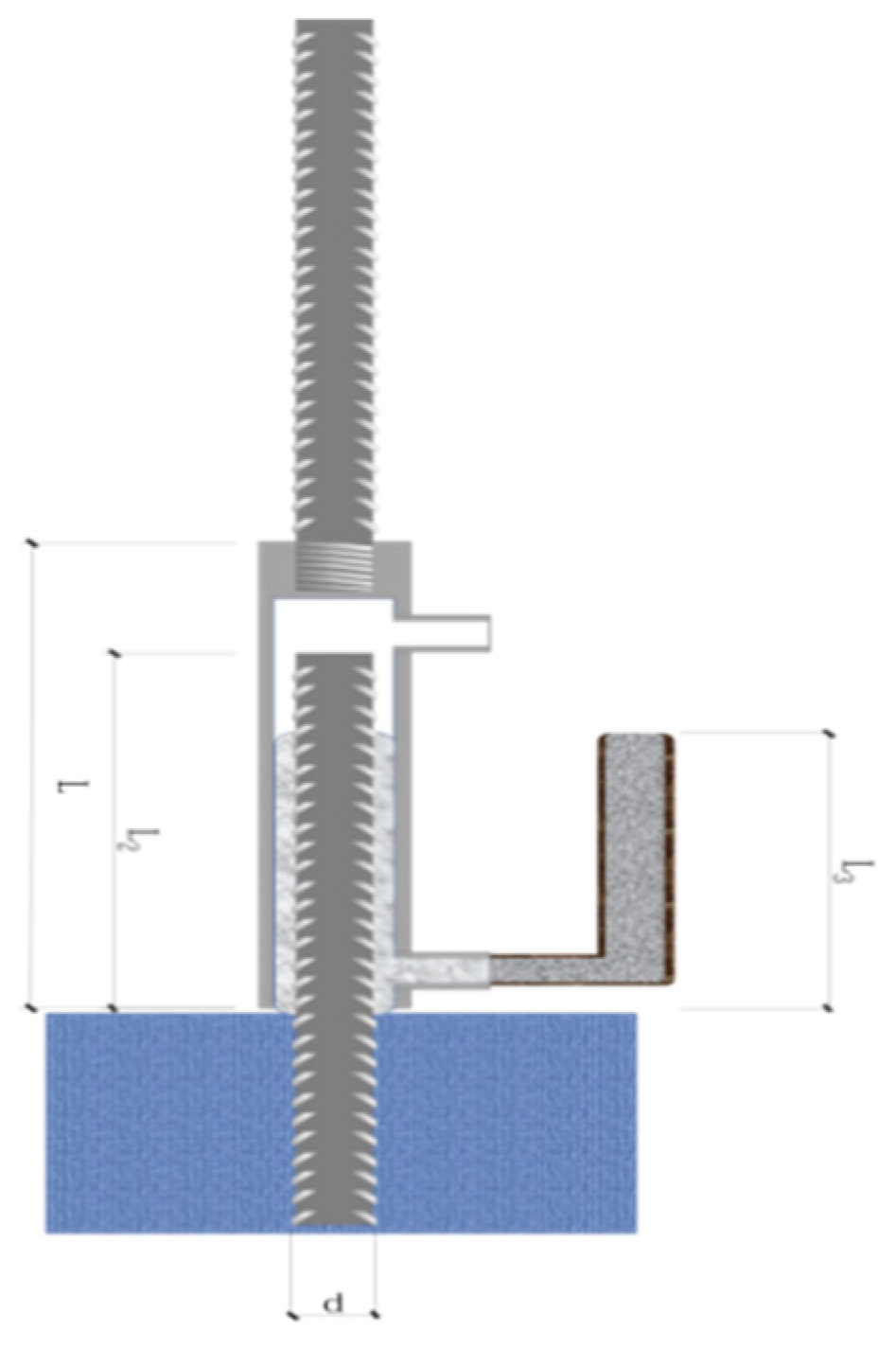
Figure 6.
Schematic Diagram of the Grouting Mechanism. L—Total length of the half-grouted sleeve; L1—Insertion depth of the reinforcing steel bar in the grouted section of the sleeve; L3—Height of grout controlled by the corrugated tube, defining the effective anchorage length within the sleeve.
Figure 6.
Schematic Diagram of the Grouting Mechanism. L—Total length of the half-grouted sleeve; L1—Insertion depth of the reinforcing steel bar in the grouted section of the sleeve; L3—Height of grout controlled by the corrugated tube, defining the effective anchorage length within the sleeve.
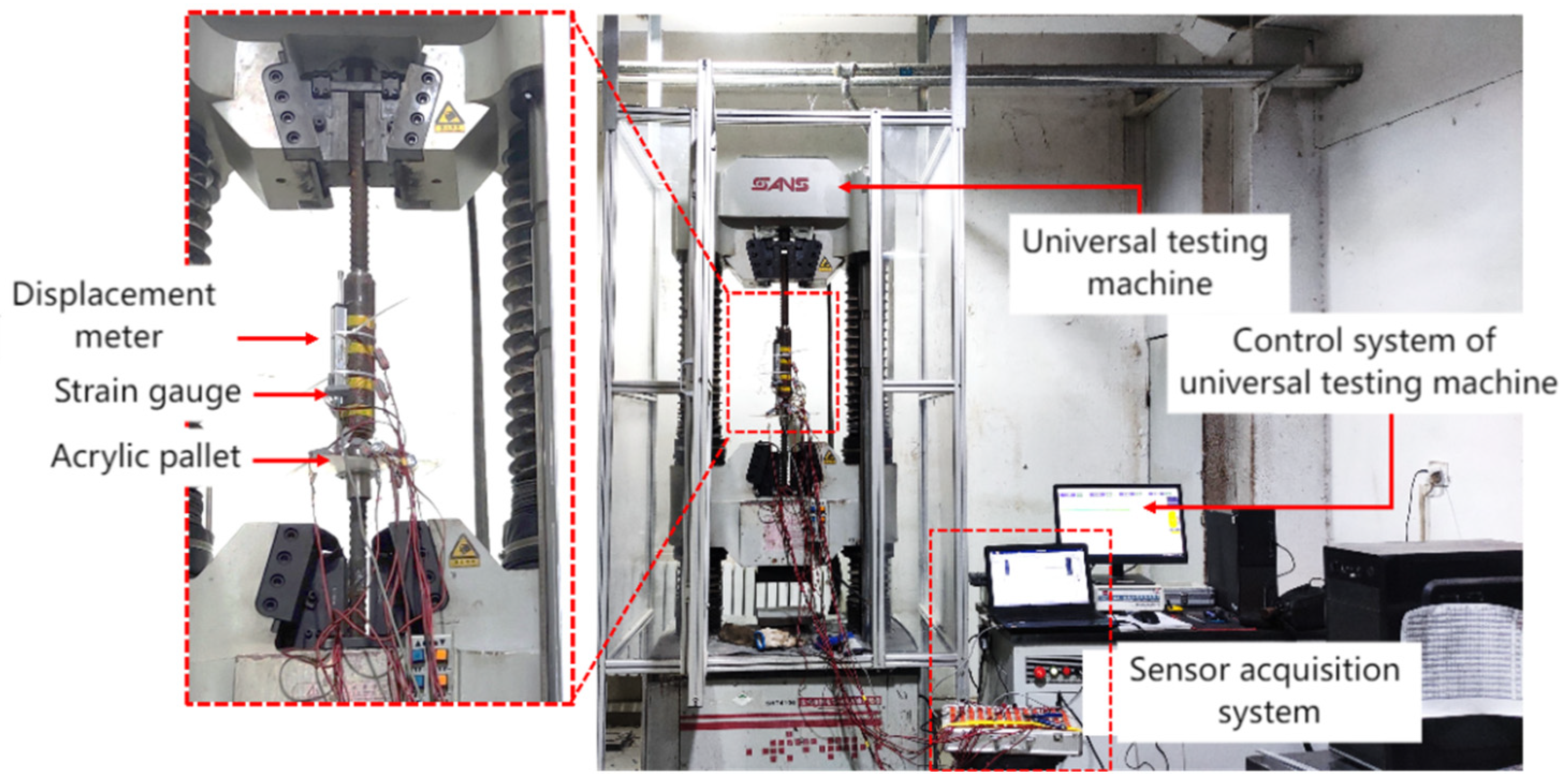
Figure 7.
Loading Setup for Grouted Sleeve Tests.
Figure 7.
Loading Setup for Grouted Sleeve Tests.
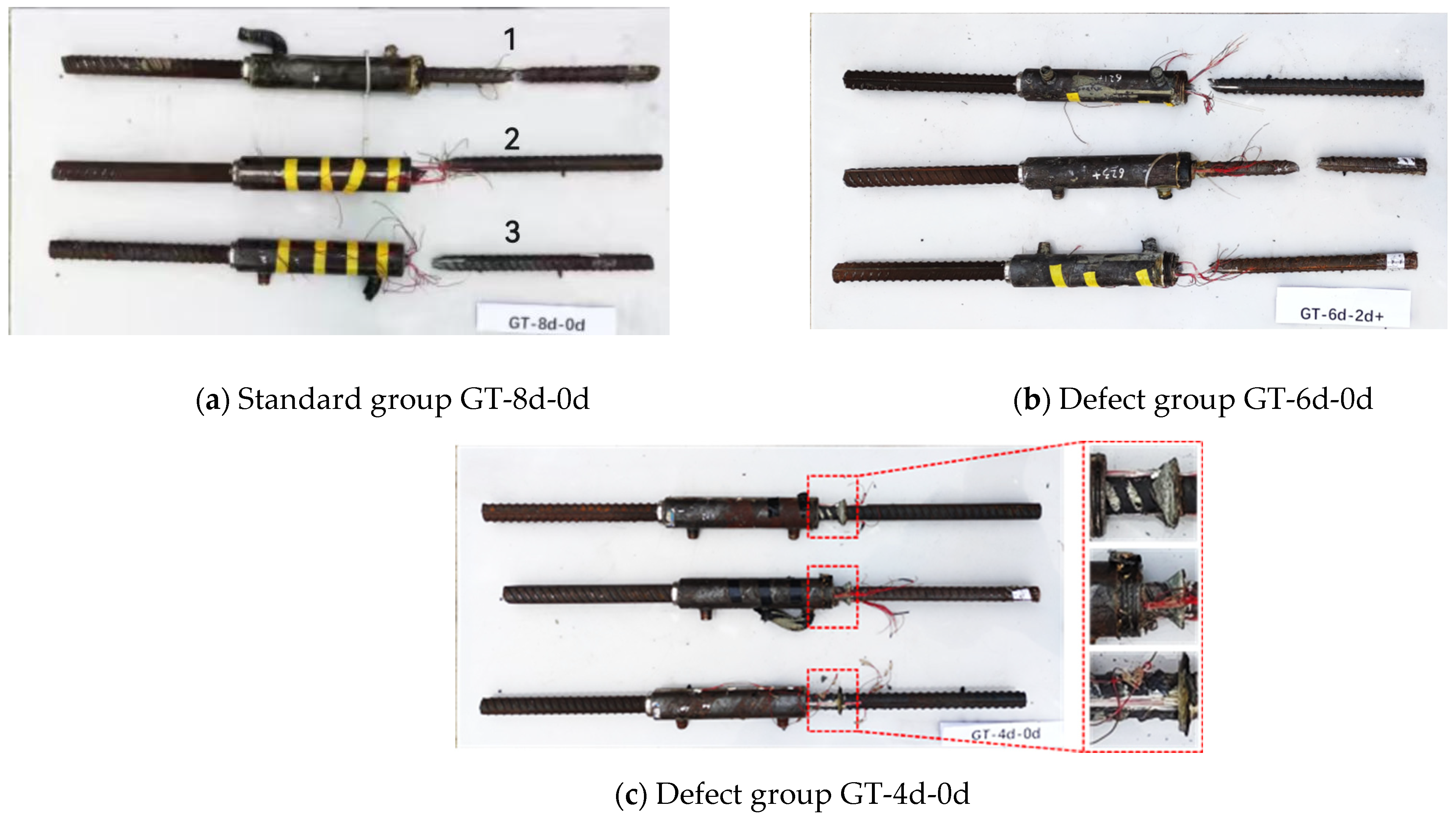
Figure 8.
Damage to standard group and defect group specimens (Numbers 1–3 indicate the specimen numbering sequence).
Figure 8.
Damage to standard group and defect group specimens (Numbers 1–3 indicate the specimen numbering sequence).
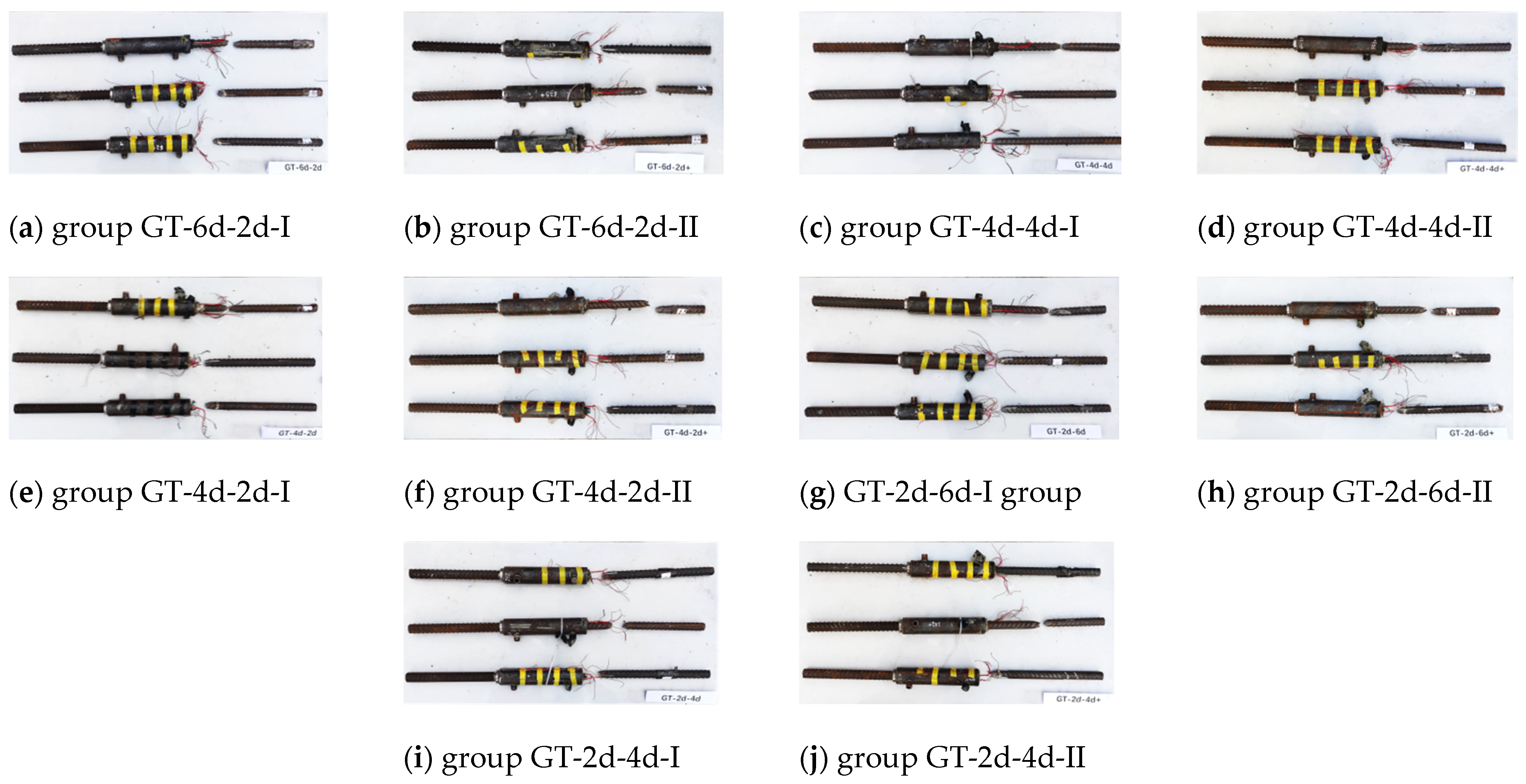
Figure 9.
Repair group damage diagram.
Figure 9.
Repair group damage diagram.
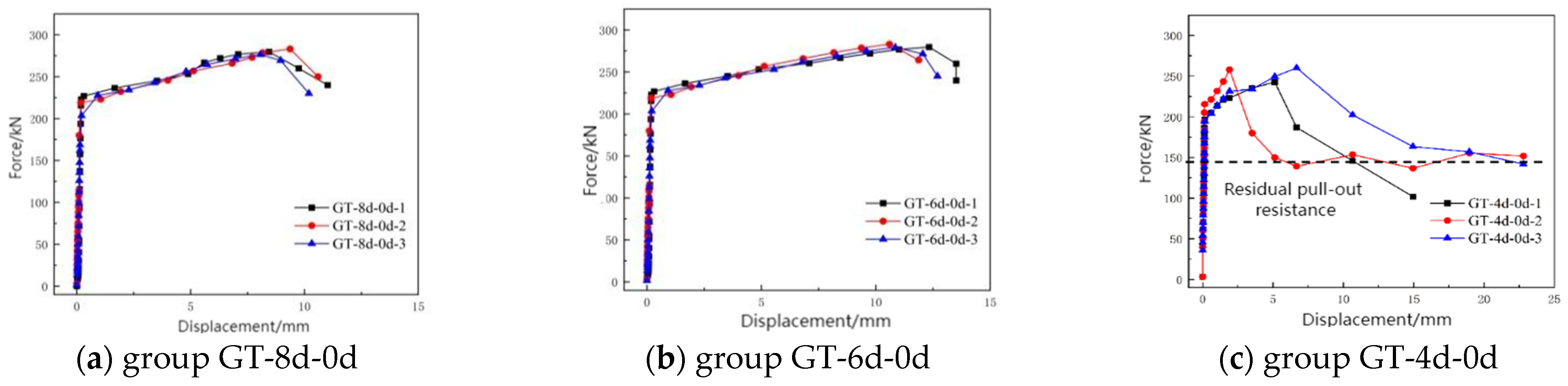
Figure 10.
Load–slip curves of standard group and defect group.
Figure 10.
Load–slip curves of standard group and defect group.
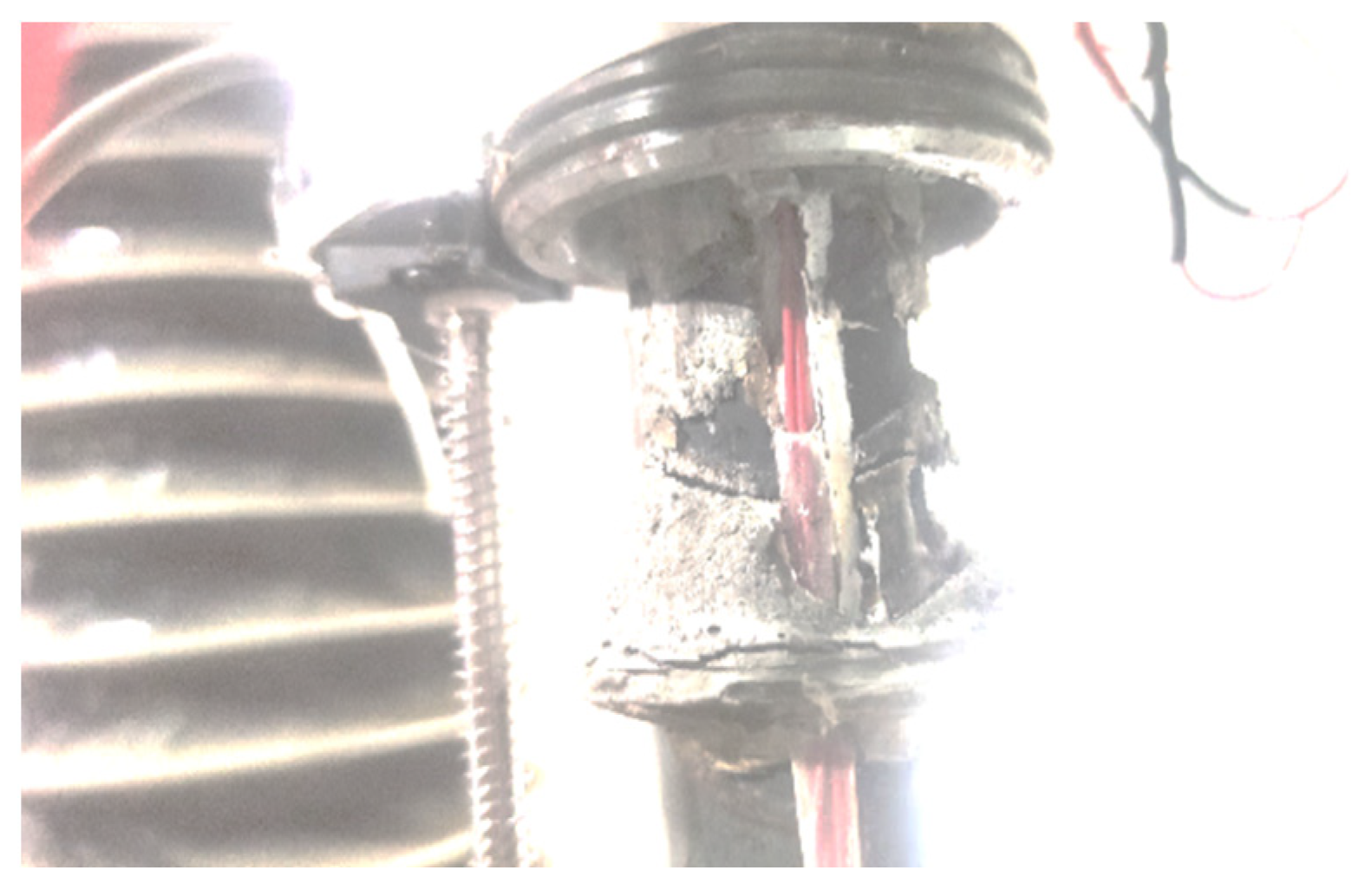
Figure 11.
GT-8d-0d-1 specimen joint reinforcement fracture failure.
Figure 11.
GT-8d-0d-1 specimen joint reinforcement fracture failure.
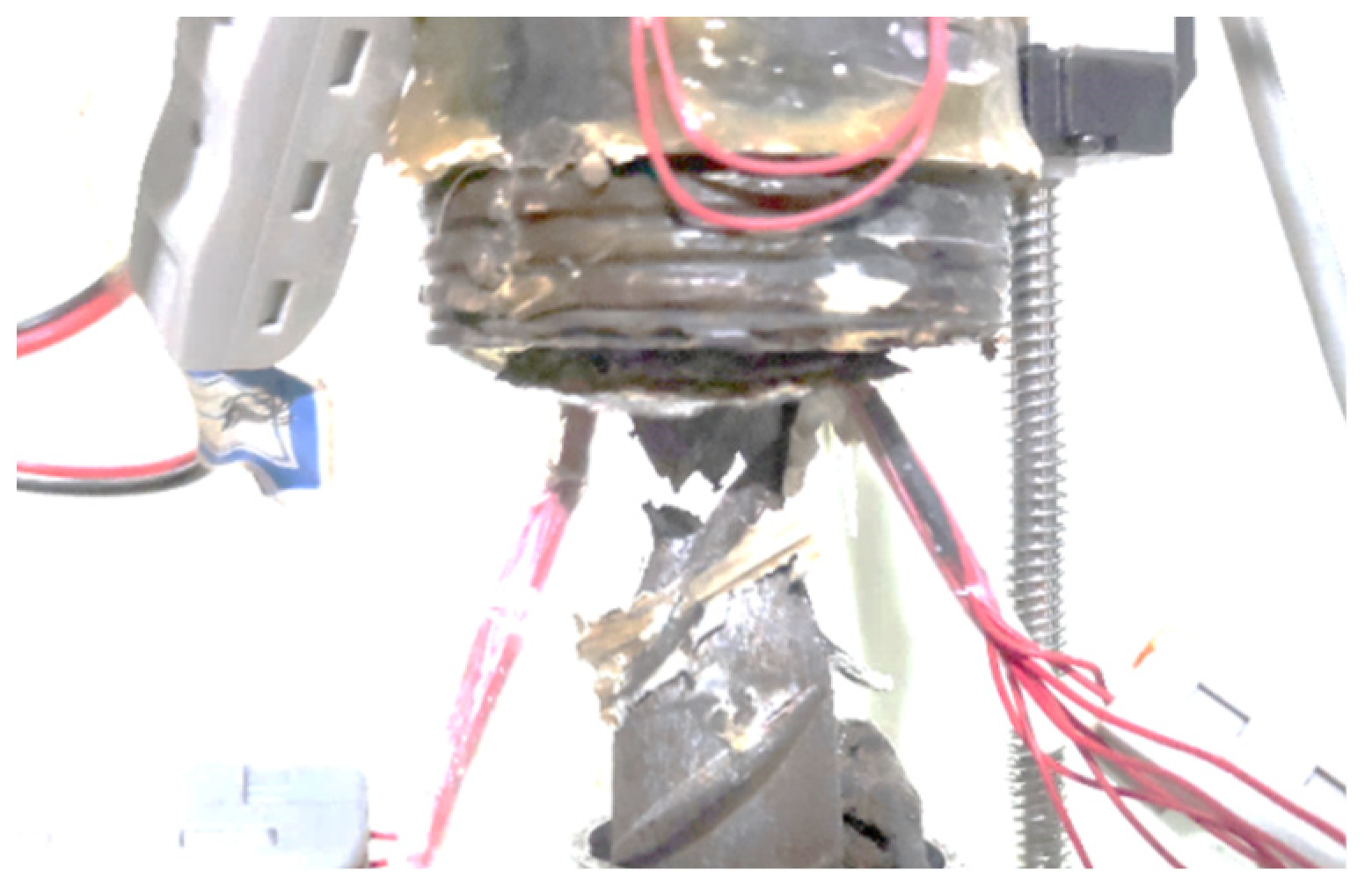
Figure 12.
Photo of GT-4d-0d-1 specimen jointfailure.
Figure 12.
Photo of GT-4d-0d-1 specimen jointfailure.
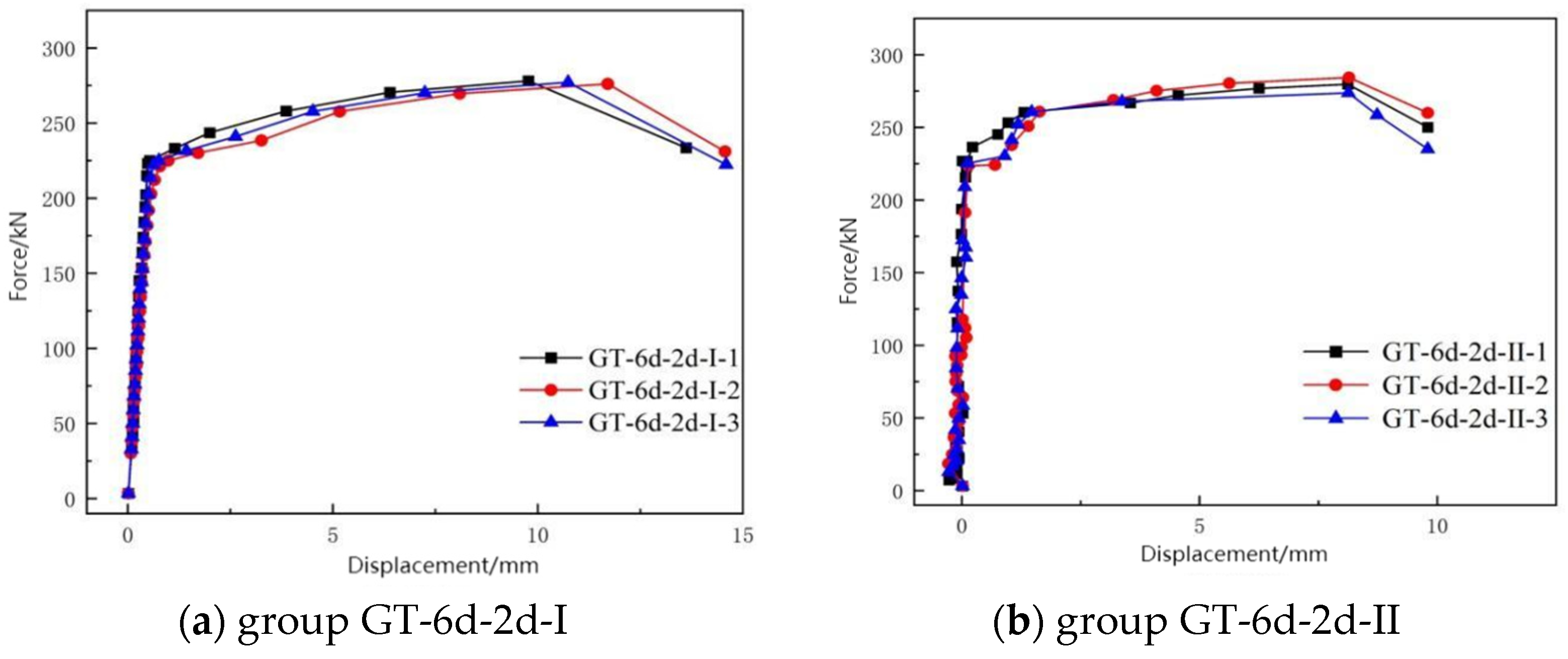
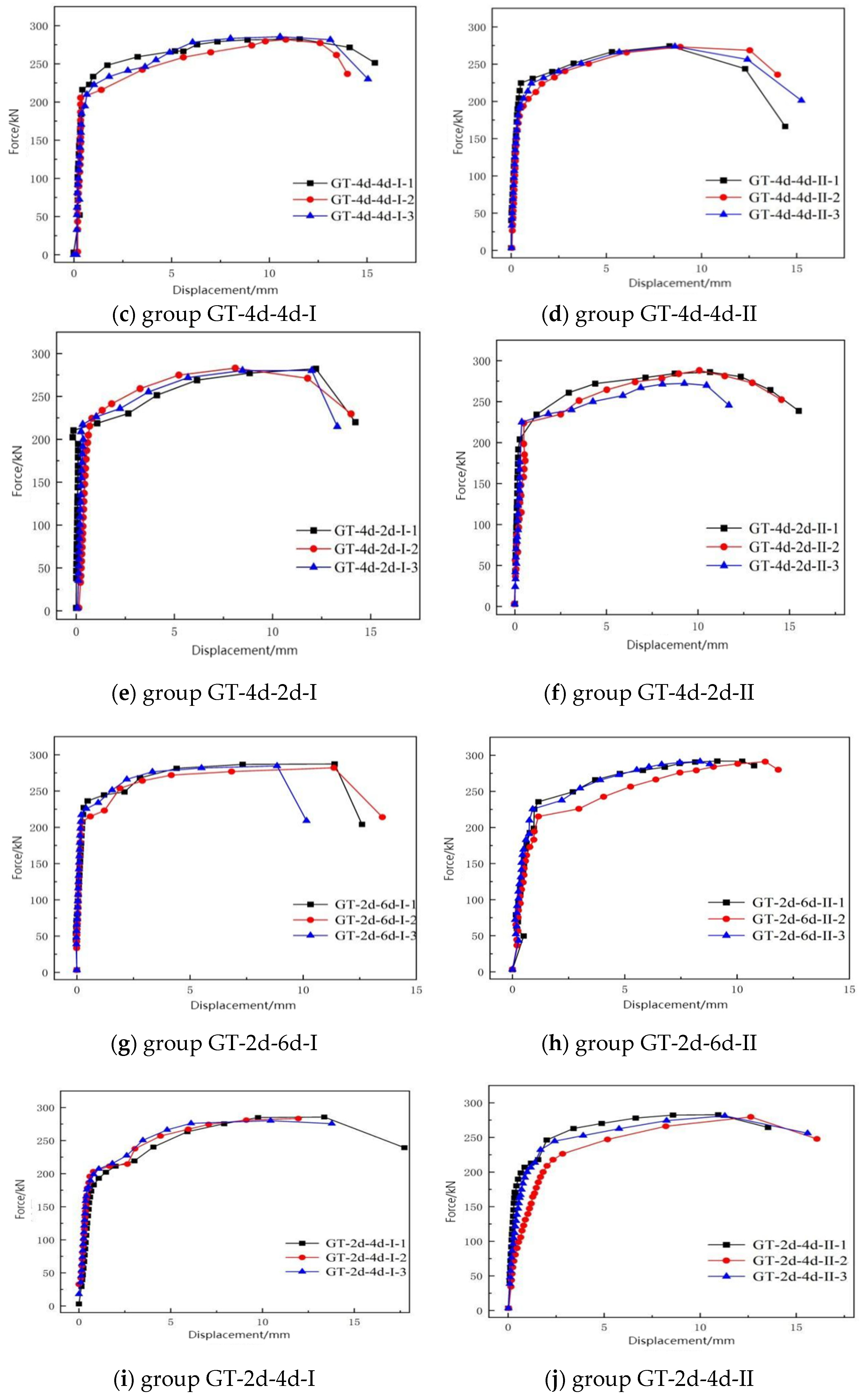
Figure 13.
Repair group load–slip curve.
Figure 13.
Repair group load–slip curve.
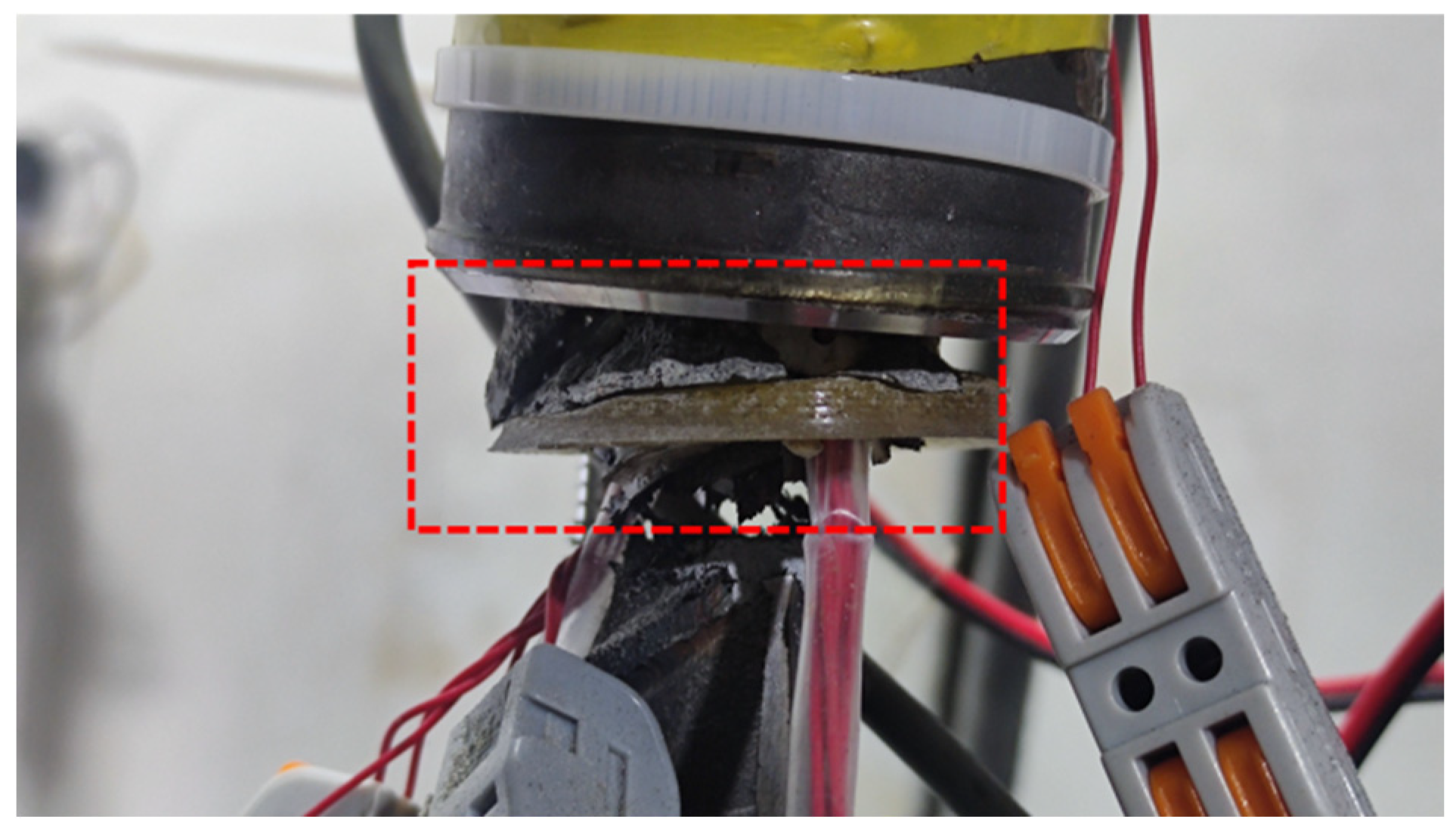
Figure 14.
Repair group GT-2d-4d-I-2 damage.
Figure 14.
Repair group GT-2d-4d-I-2 damage.
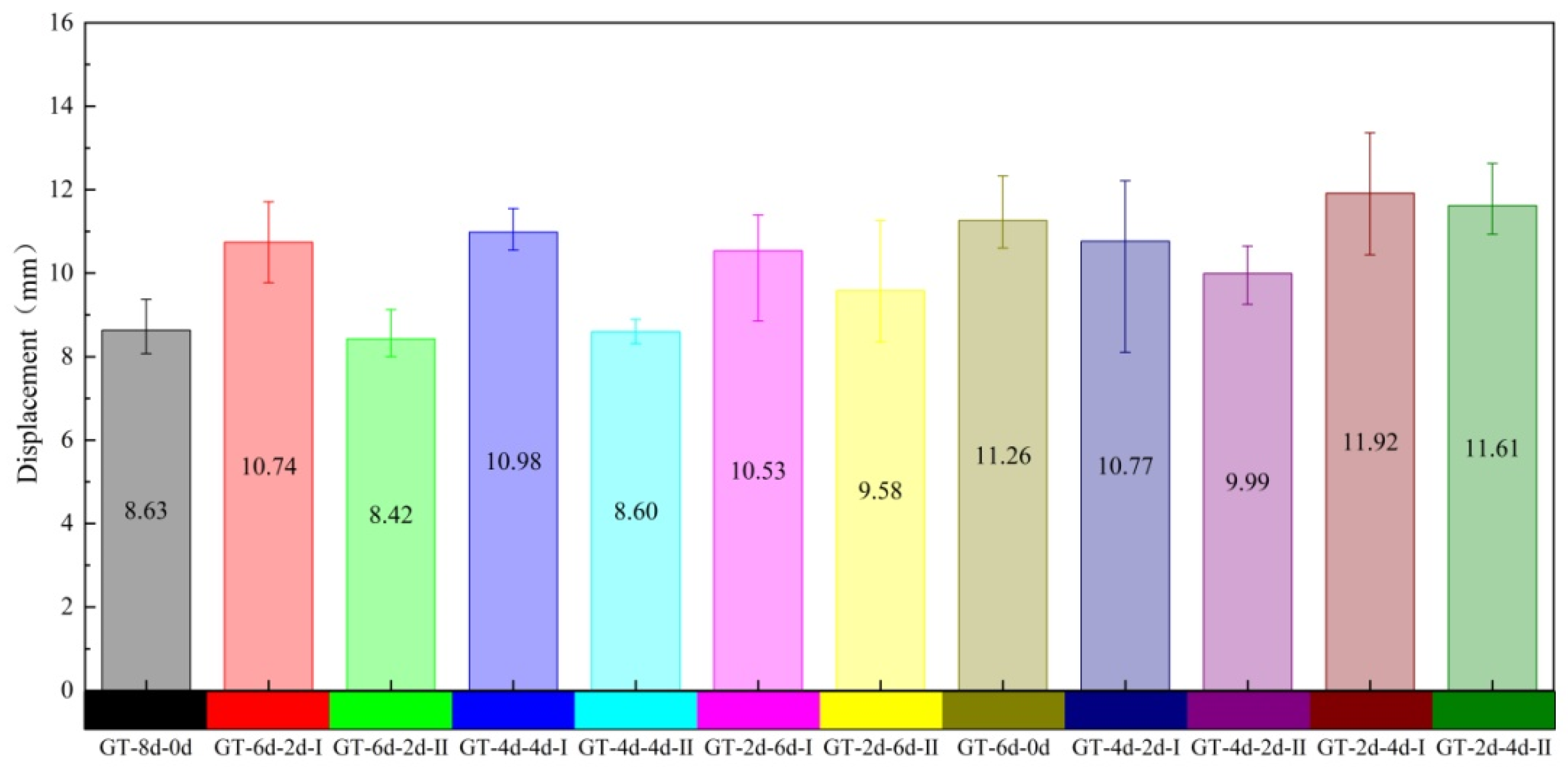
Figure 15.
Data range of specimen slip gauge.
Figure 15.
Data range of specimen slip gauge.
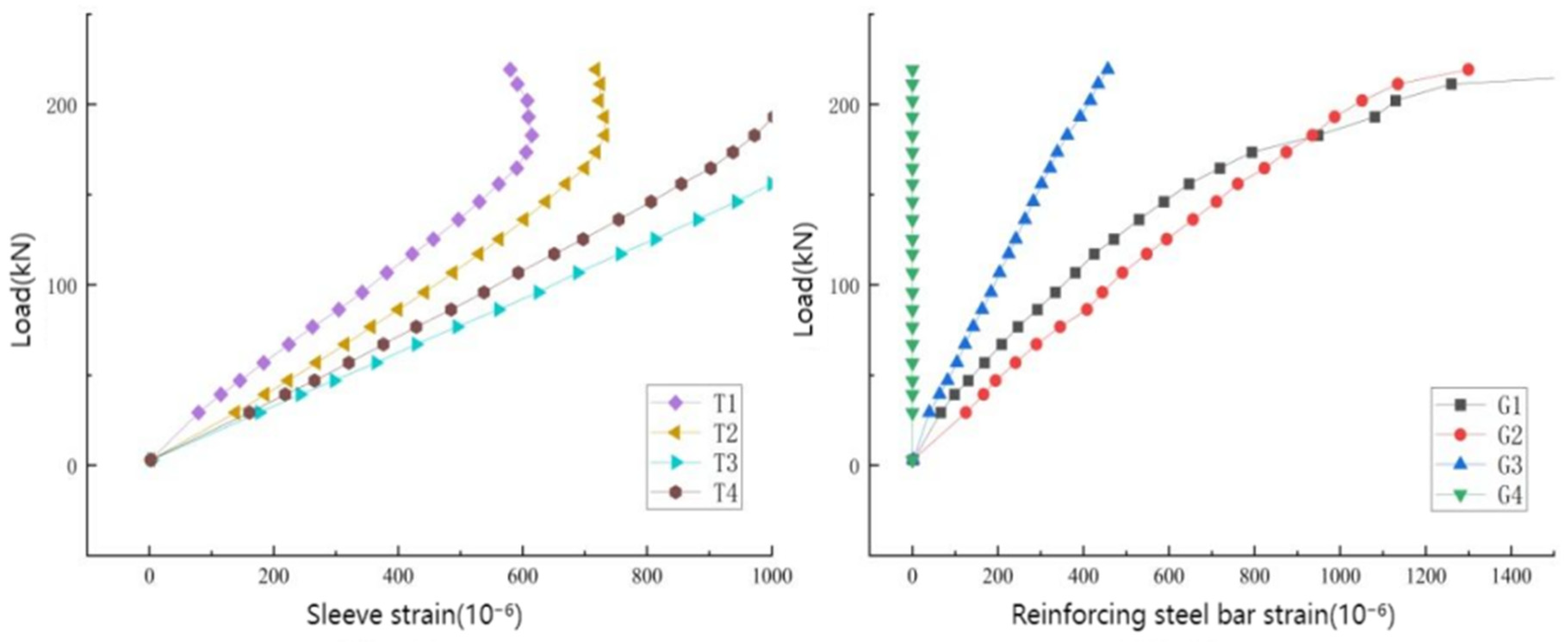
Figure 16.
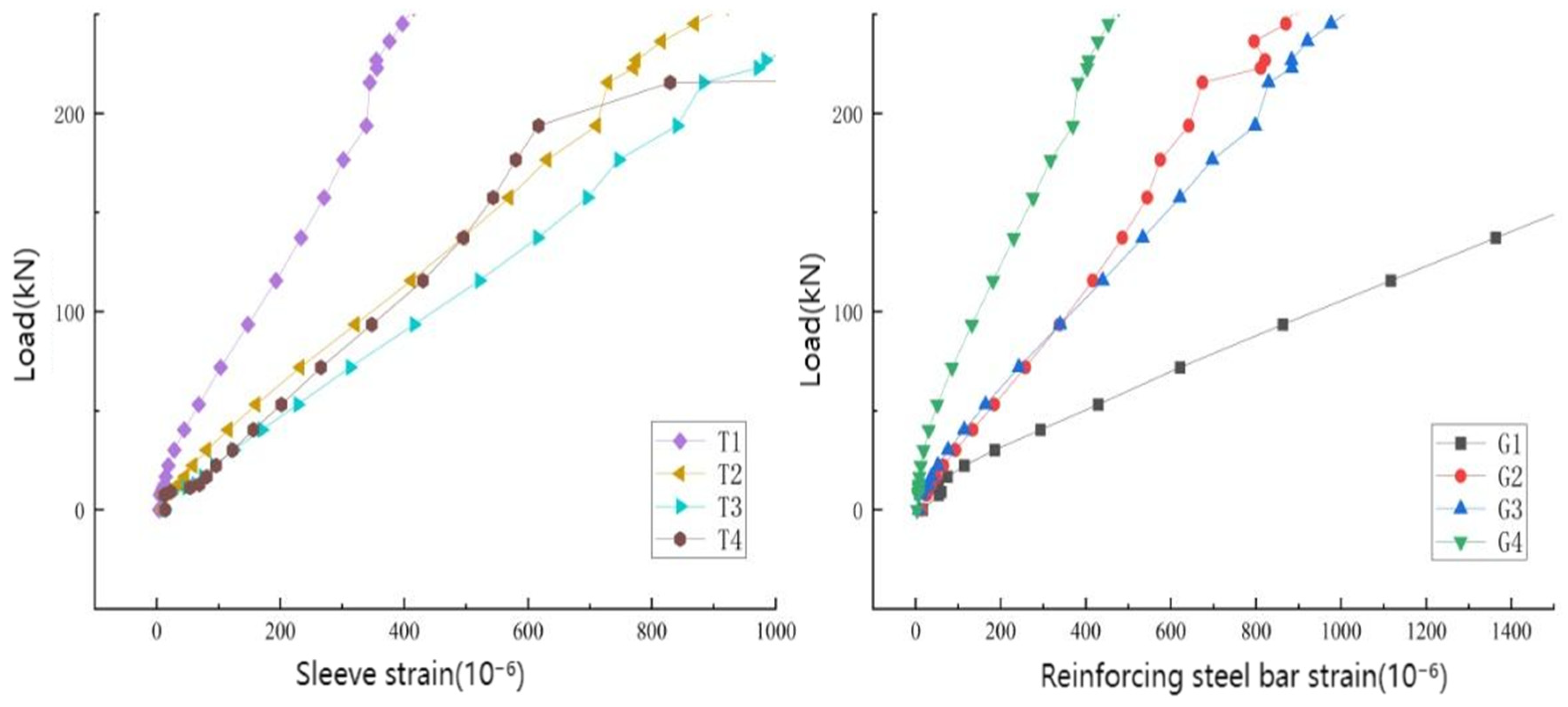
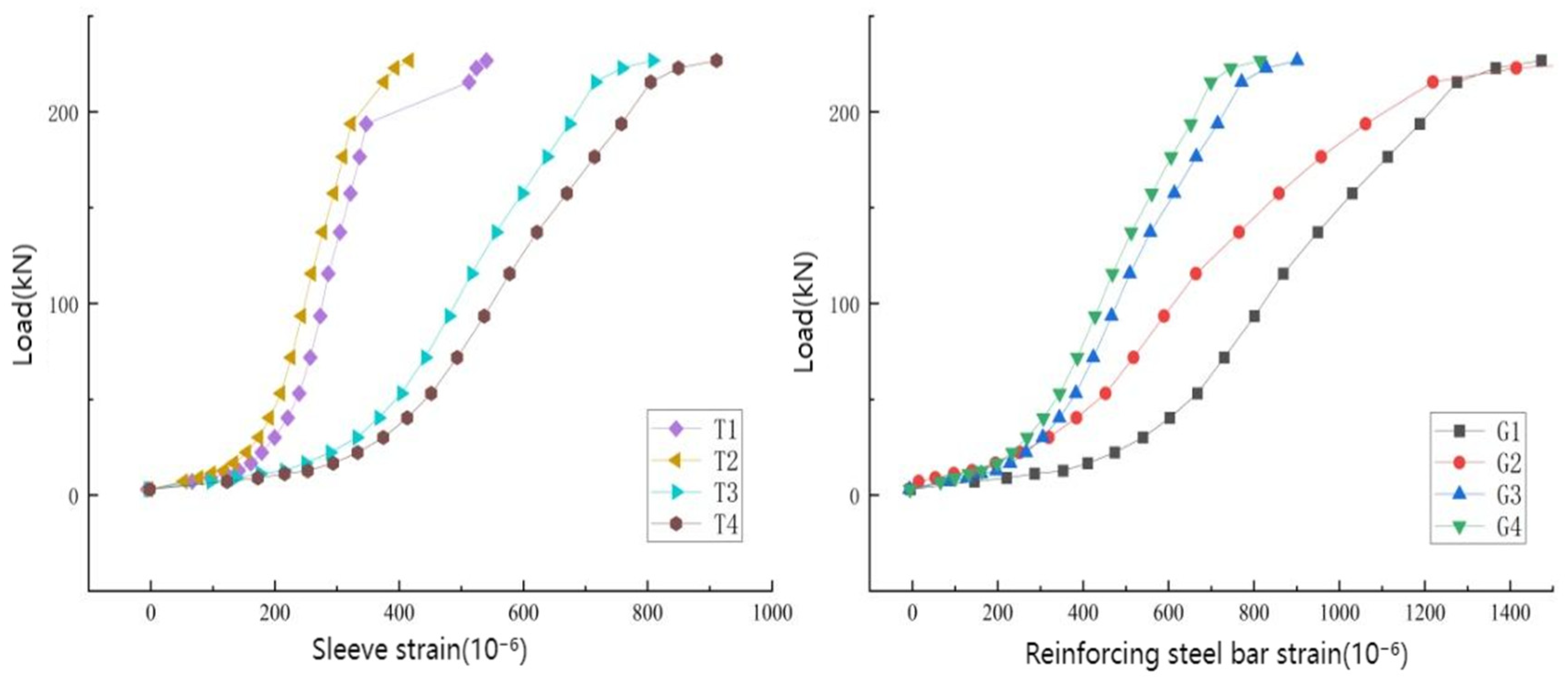
GT-8d-0d load–strain relationship curves.
Figure 16.
GT-8d-0d load–strain relationship curves.
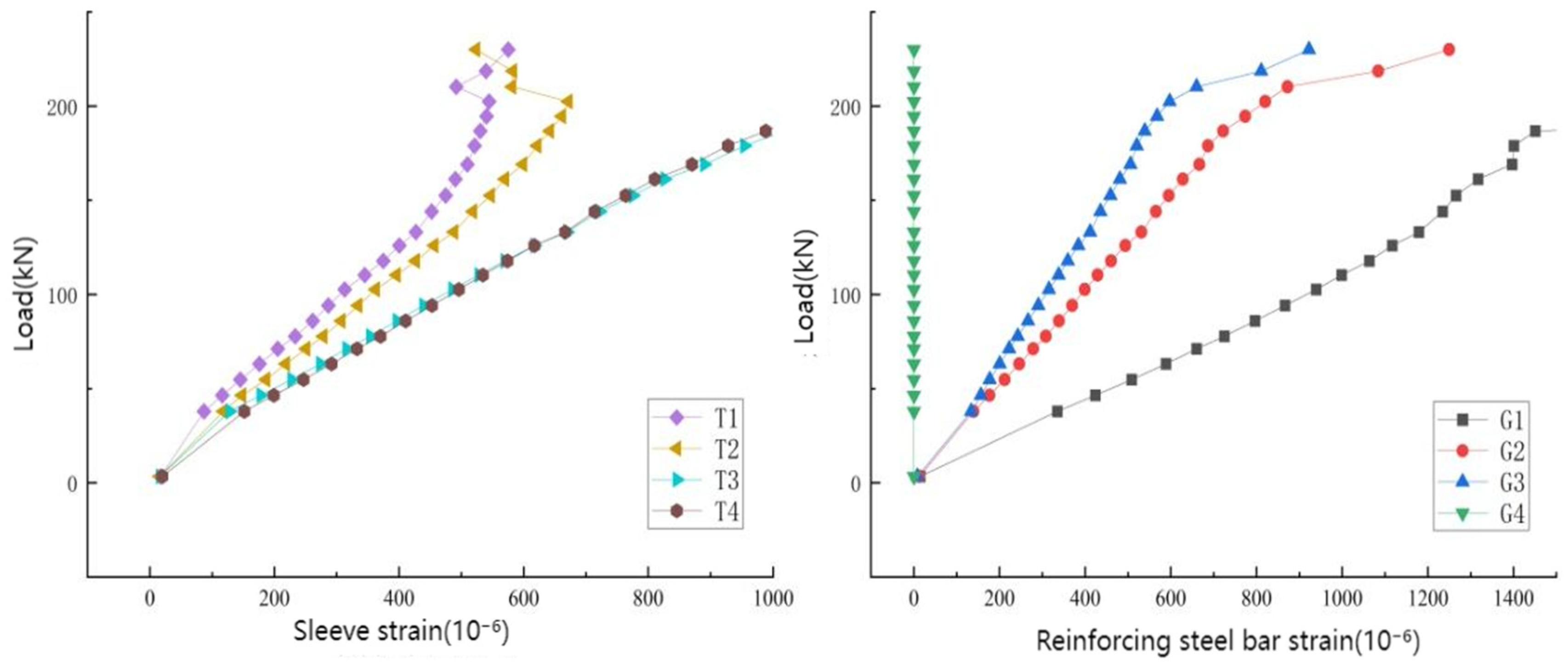
Figure 17.
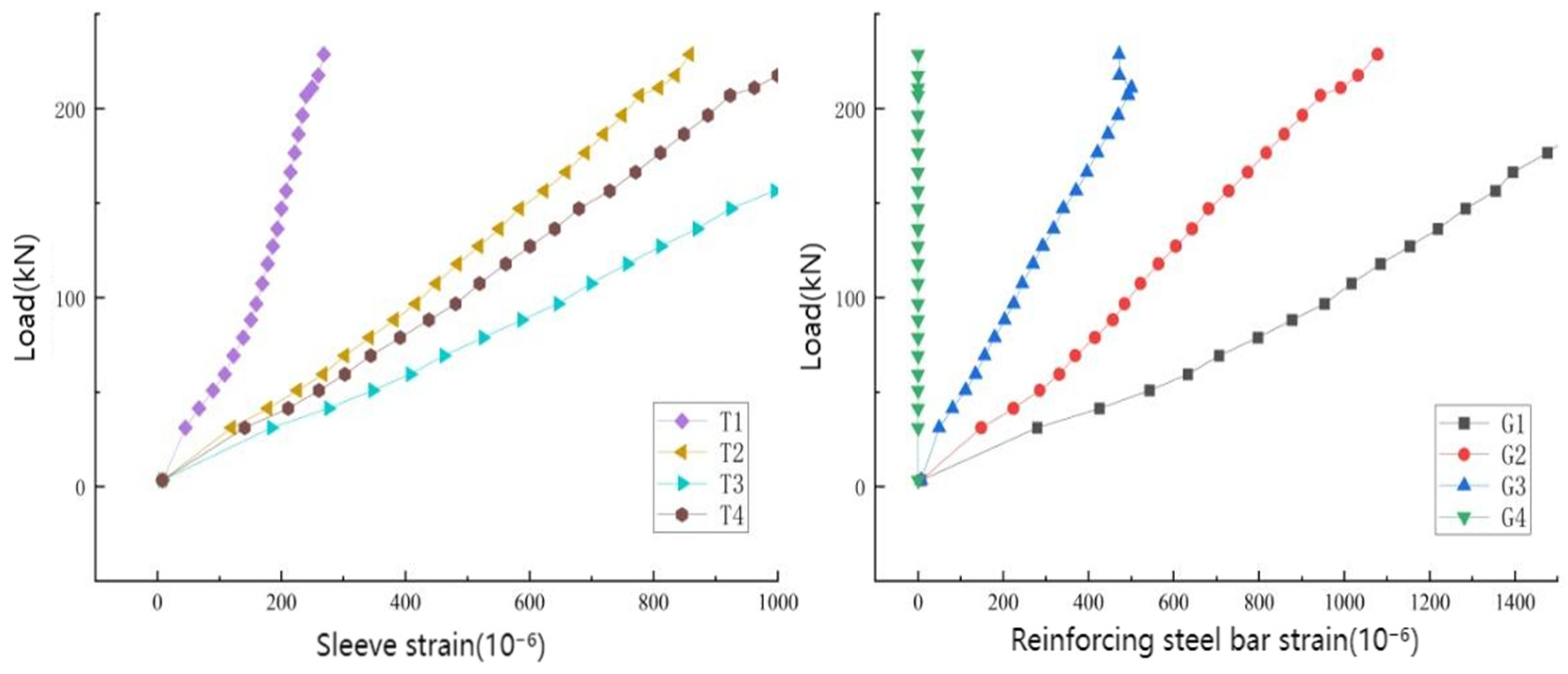
GT-6d-0d-2 load–strain relationship curves.
Figure 17.
GT-6d-0d-2 load–strain relationship curves.
Figure 18.
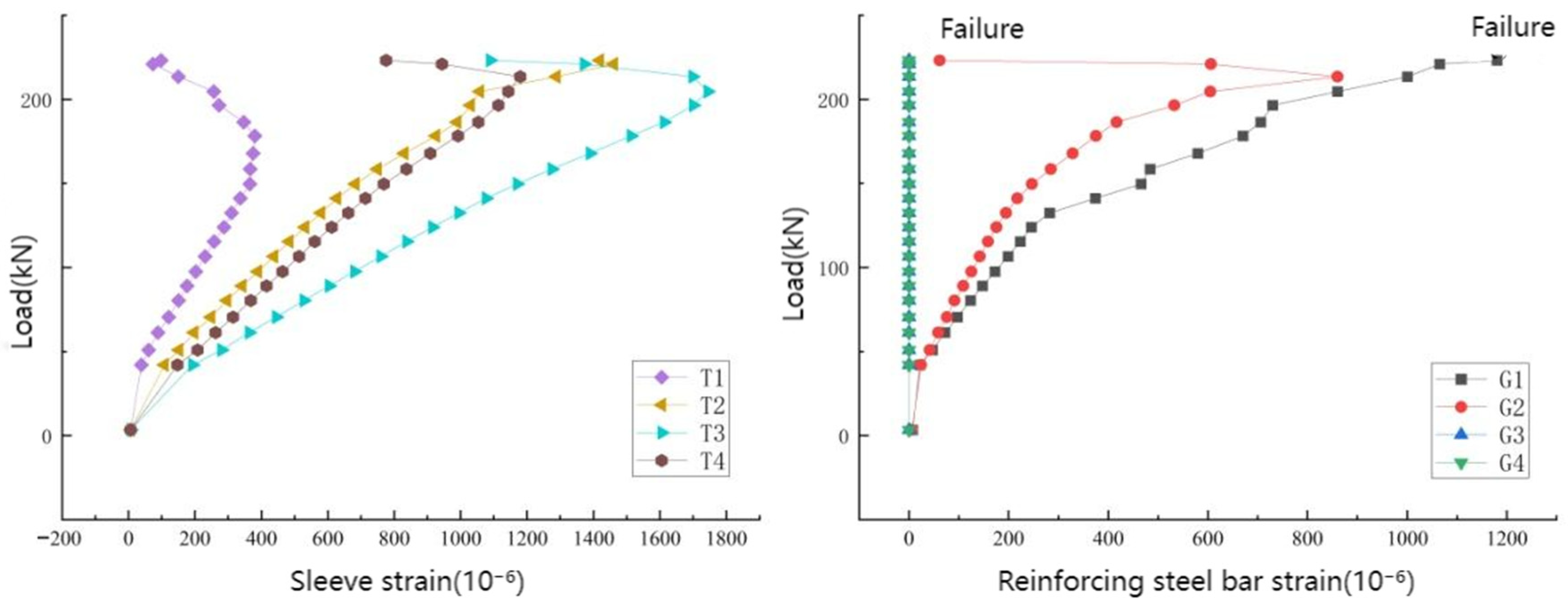
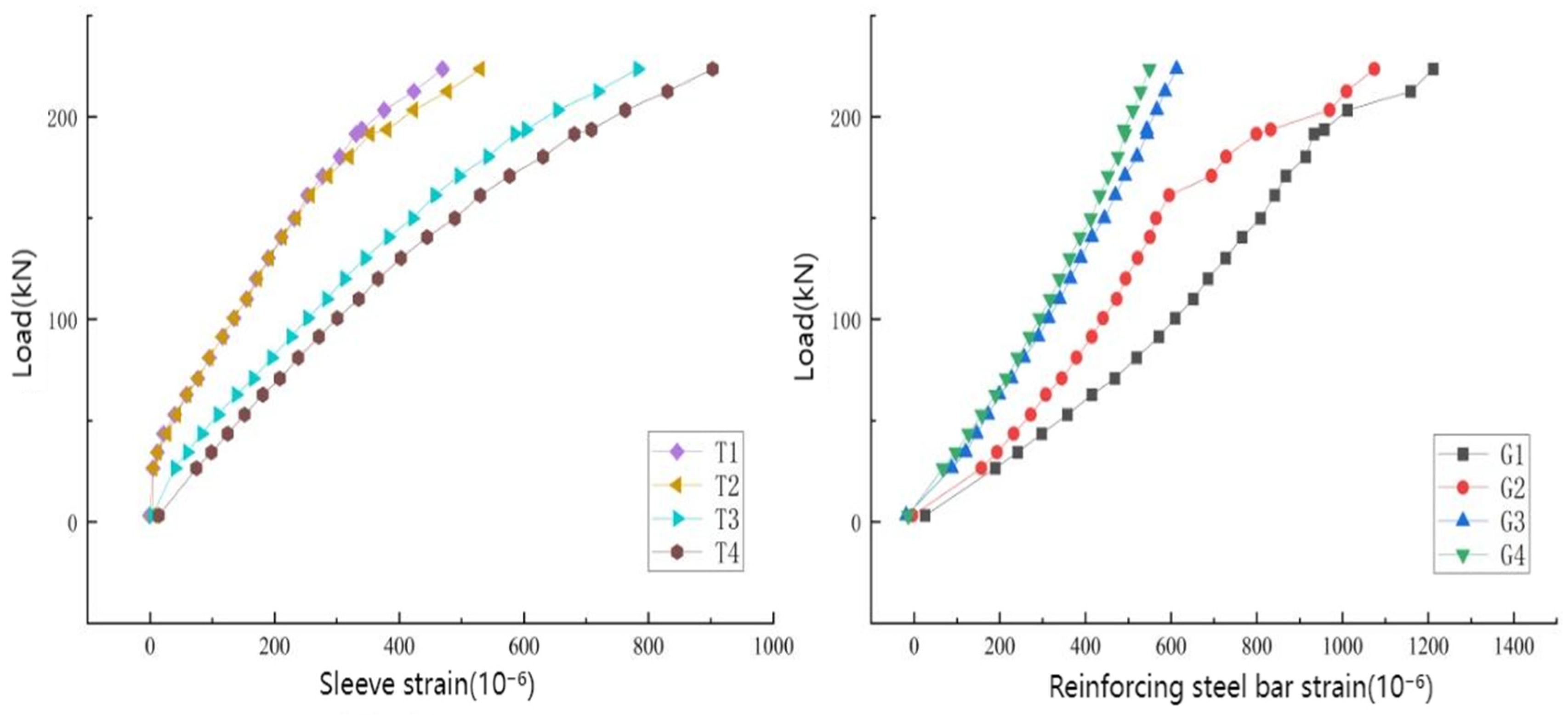
GT-4d-0d-1 load–strain relationship curves.
Figure 18.
GT-4d-0d-1 load–strain relationship curves.
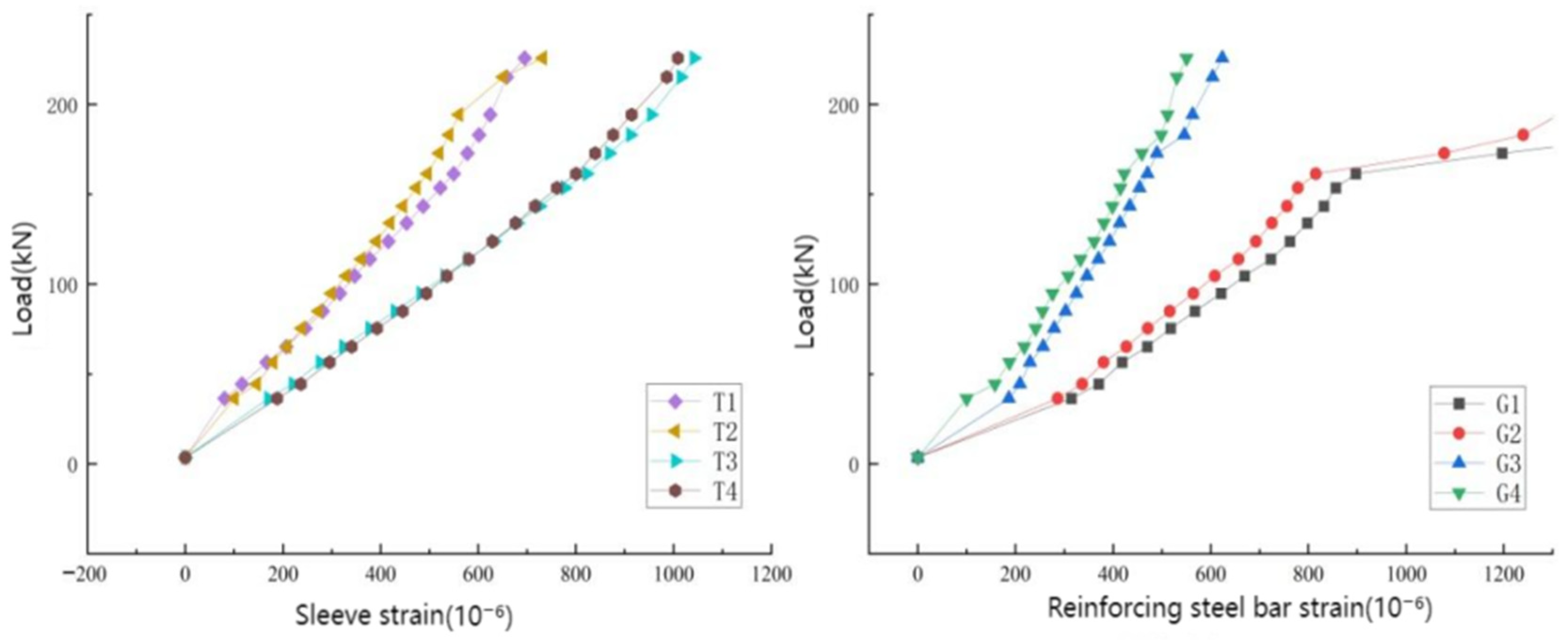
Figure 19.
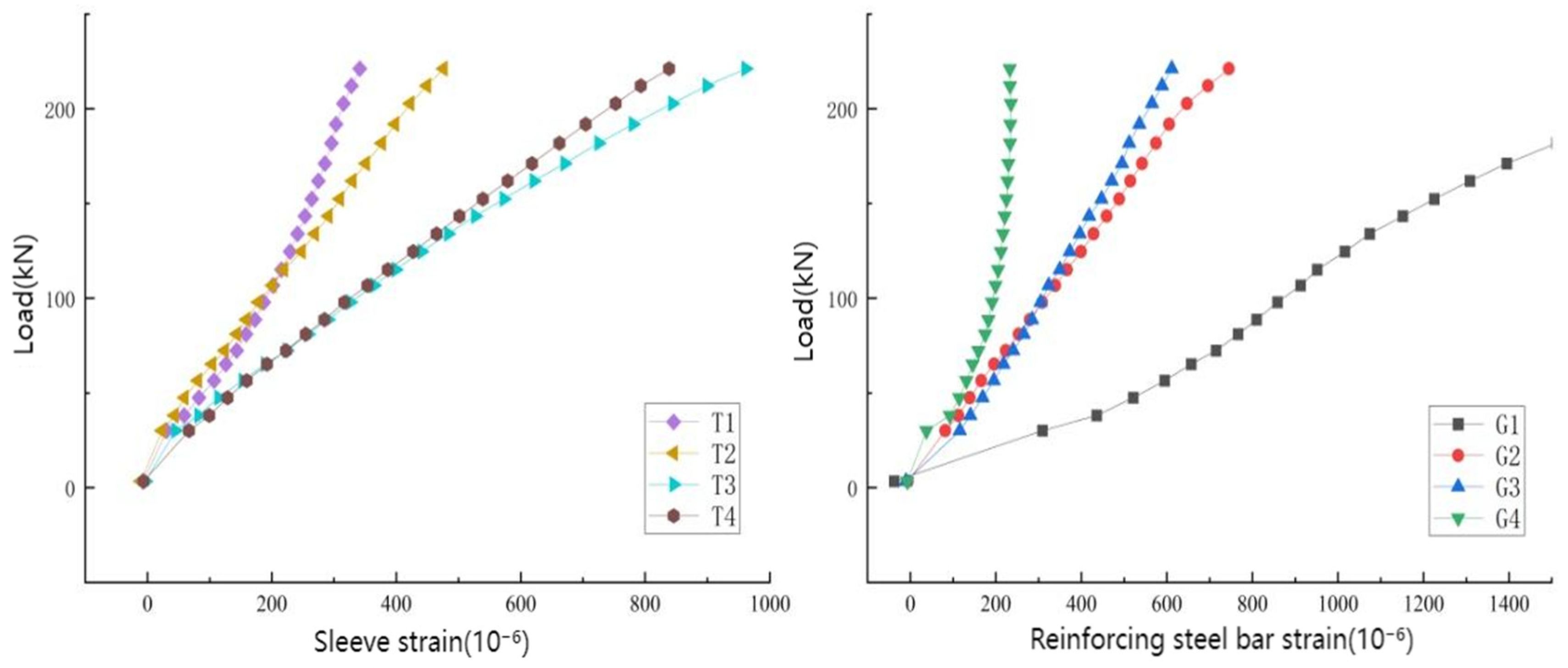
GT-6d-2d-I-2 load–strain relationship curves.
Figure 19.
GT-6d-2d-I-2 load–strain relationship curves.
Figure 20.
GT-6d-2d-II-1 Load–strain relationship curves.
Figure 20.
GT-6d-2d-II-1 Load–strain relationship curves.
Figure 21.
GT-4d-4d-II-1 load–strain relationship curves.
Figure 21.
GT-4d-4d-II-1 load–strain relationship curves.
Figure 22.
GT-4d-4d-I-1 load–strain relationship curves.
Figure 22.
GT-4d-4d-I-1 load–strain relationship curves.
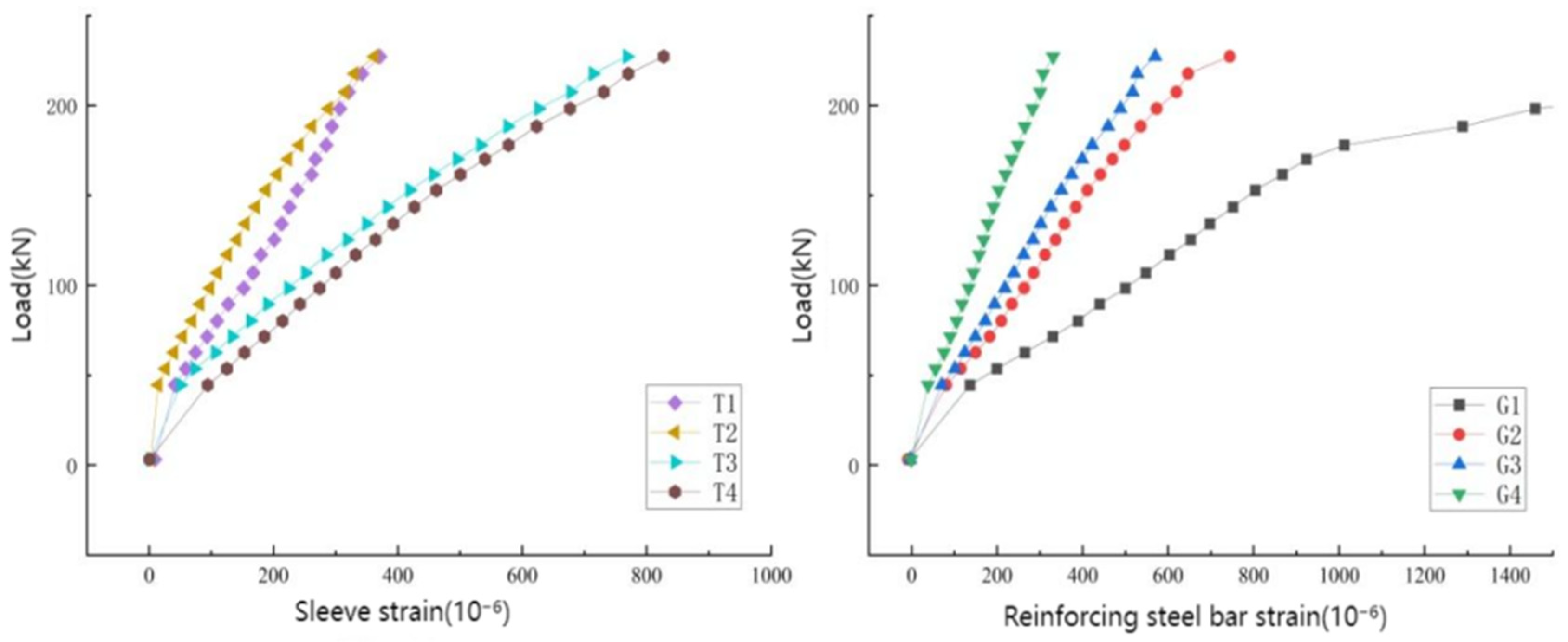
Figure 23.
GT-4d-2d-II-1 load–strain relationship curves.
Figure 23.
GT-4d-2d-II-1 load–strain relationship curves.
Figure 24.
GT-4d-2d-I-1 load–strain relationship curves.
Figure 24.
GT-4d-2d-I-1 load–strain relationship curves.
Figure 25.
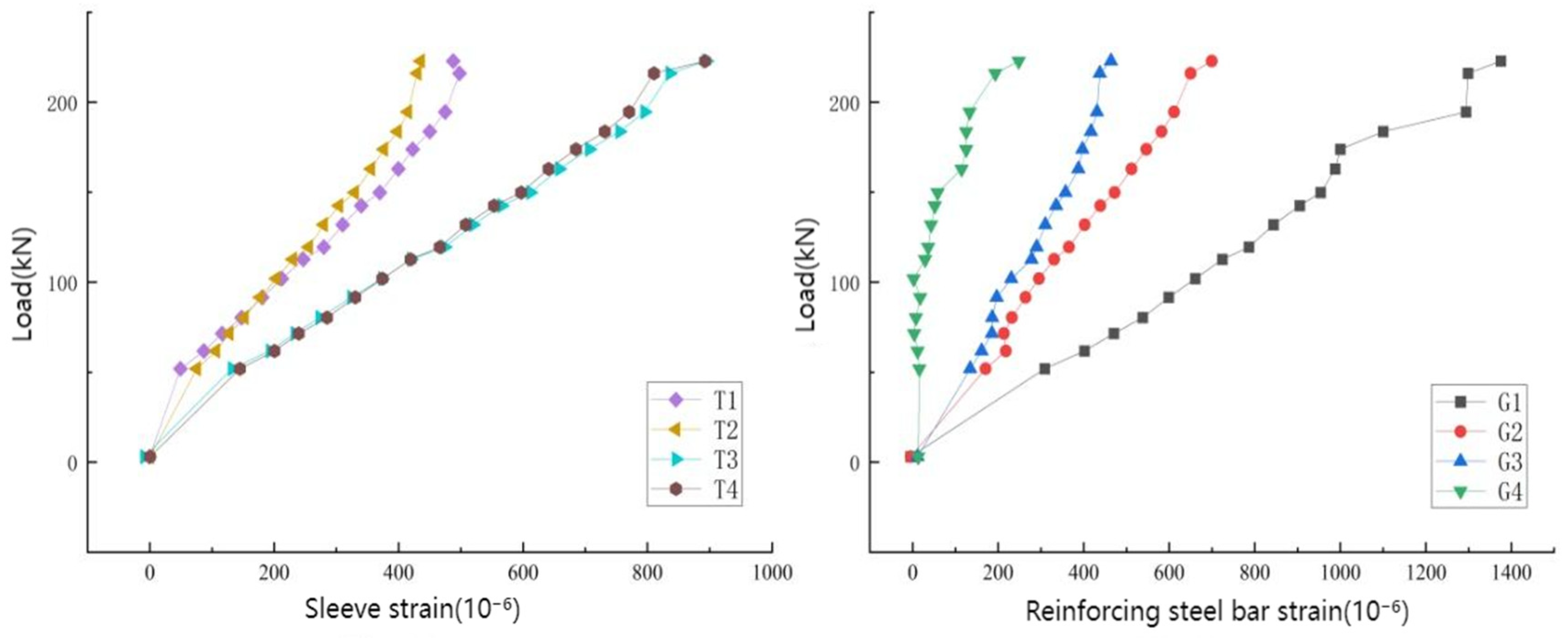
GT-2d-6d-II-1 load–strain relationship curves.
Figure 25.
GT-2d-6d-II-1 load–strain relationship curves.
Figure 26.
GT-2d-6d-I-1 load–strain relationship curves.
Figure 26.
GT-2d-6d-I-1 load–strain relationship curves.
Figure 27.
GT-2d-4d-II-1 load–strain relationship curves.
Figure 27.
GT-2d-4d-II-1 load–strain relationship curves.
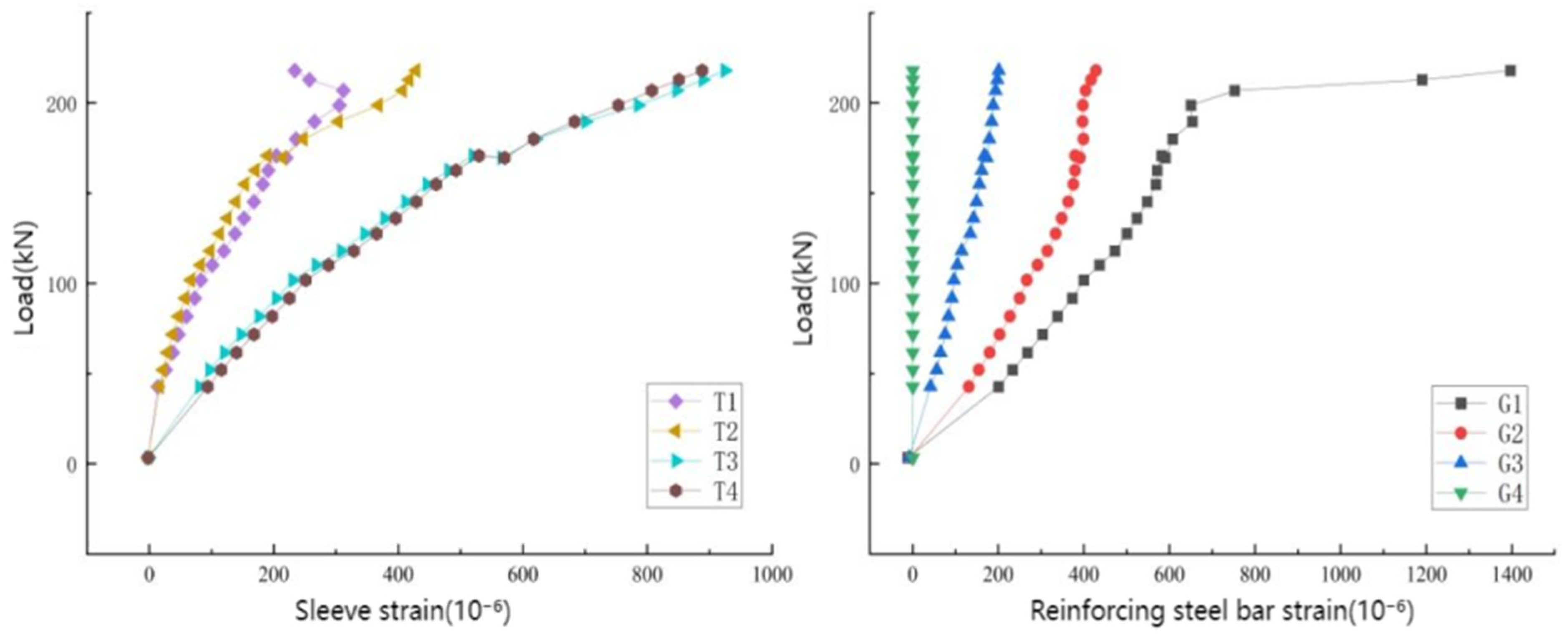
Figure 28.
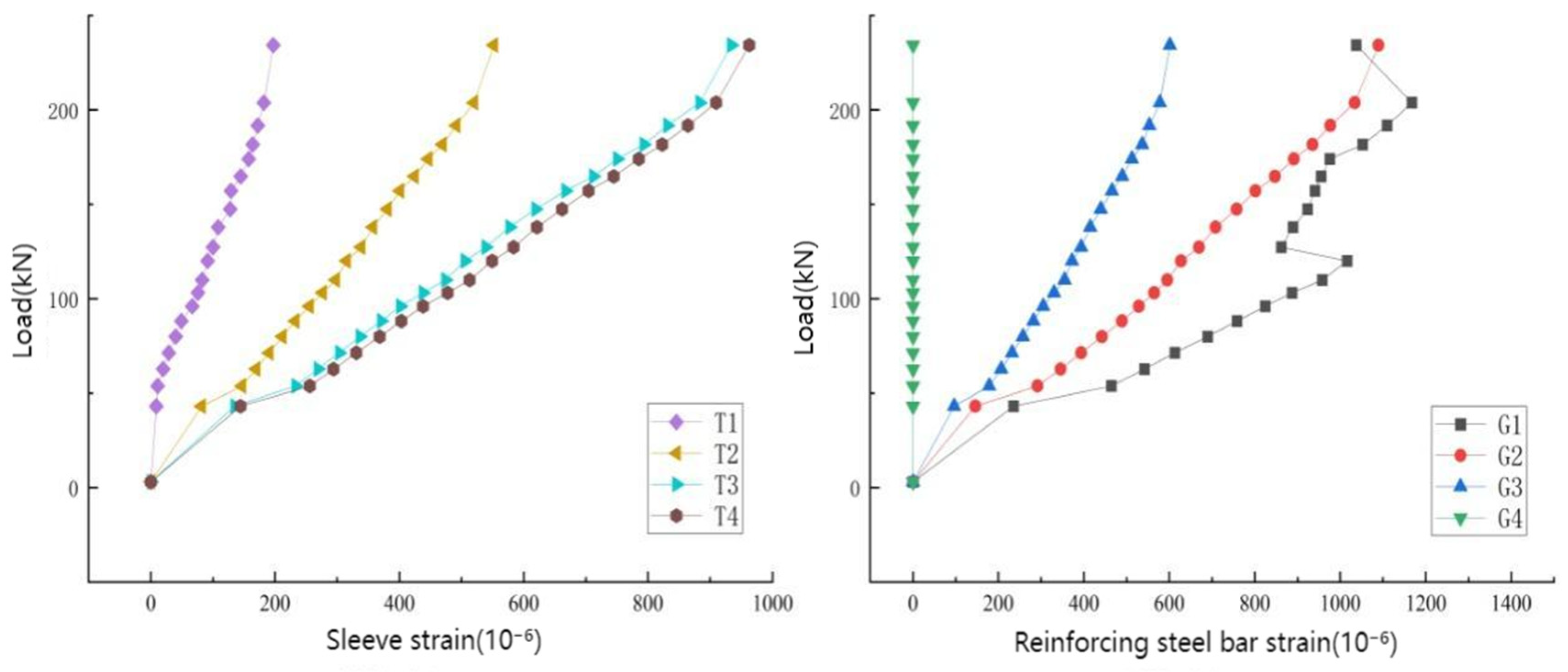
GT-2d-4d-I-1 load–strain relationship curves.
Figure 28.
GT-2d-4d-I-1 load–strain relationship curves.
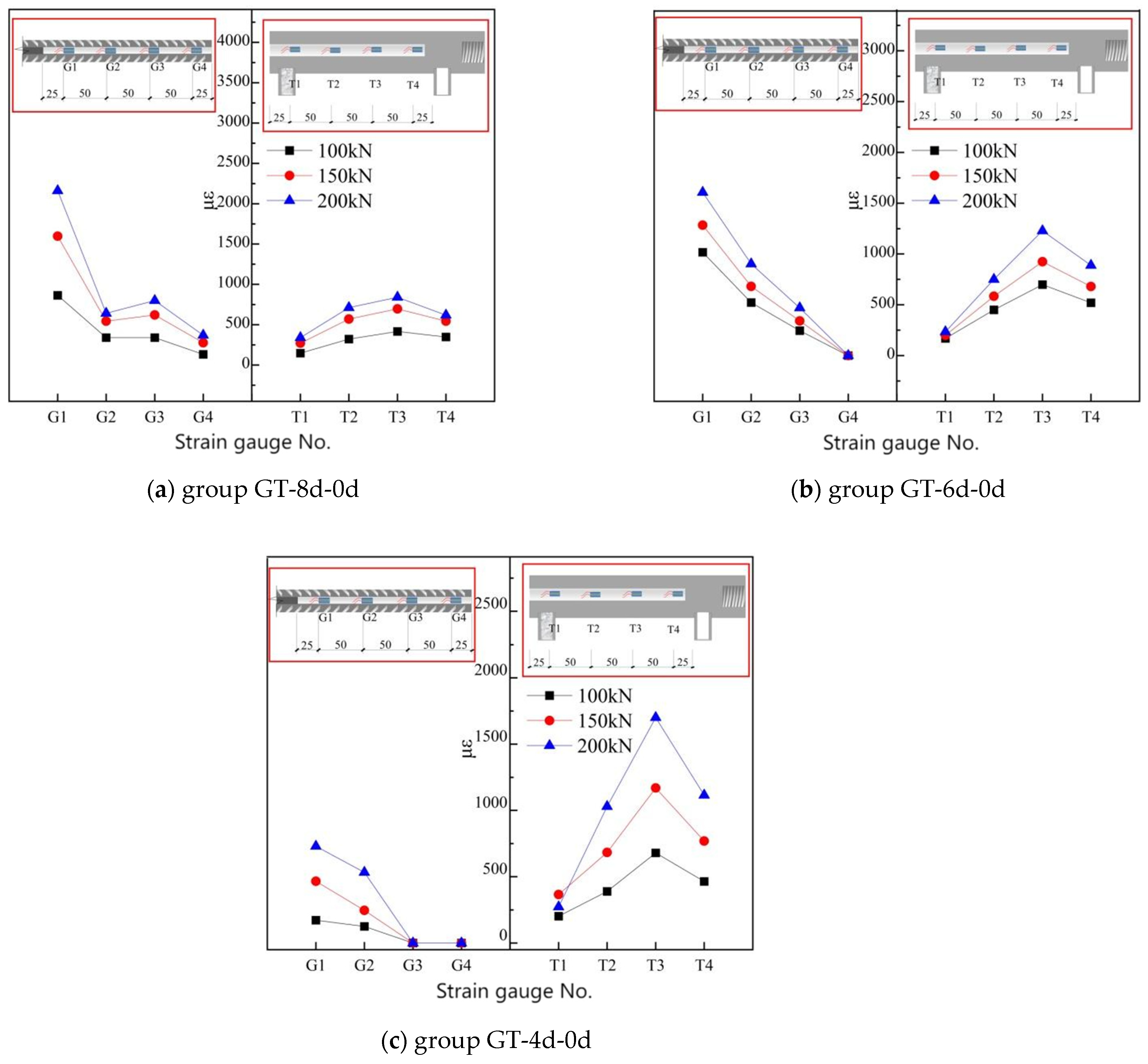
Figure 29.
Strain distribution of control group specimens.
Figure 29.
Strain distribution of control group specimens.
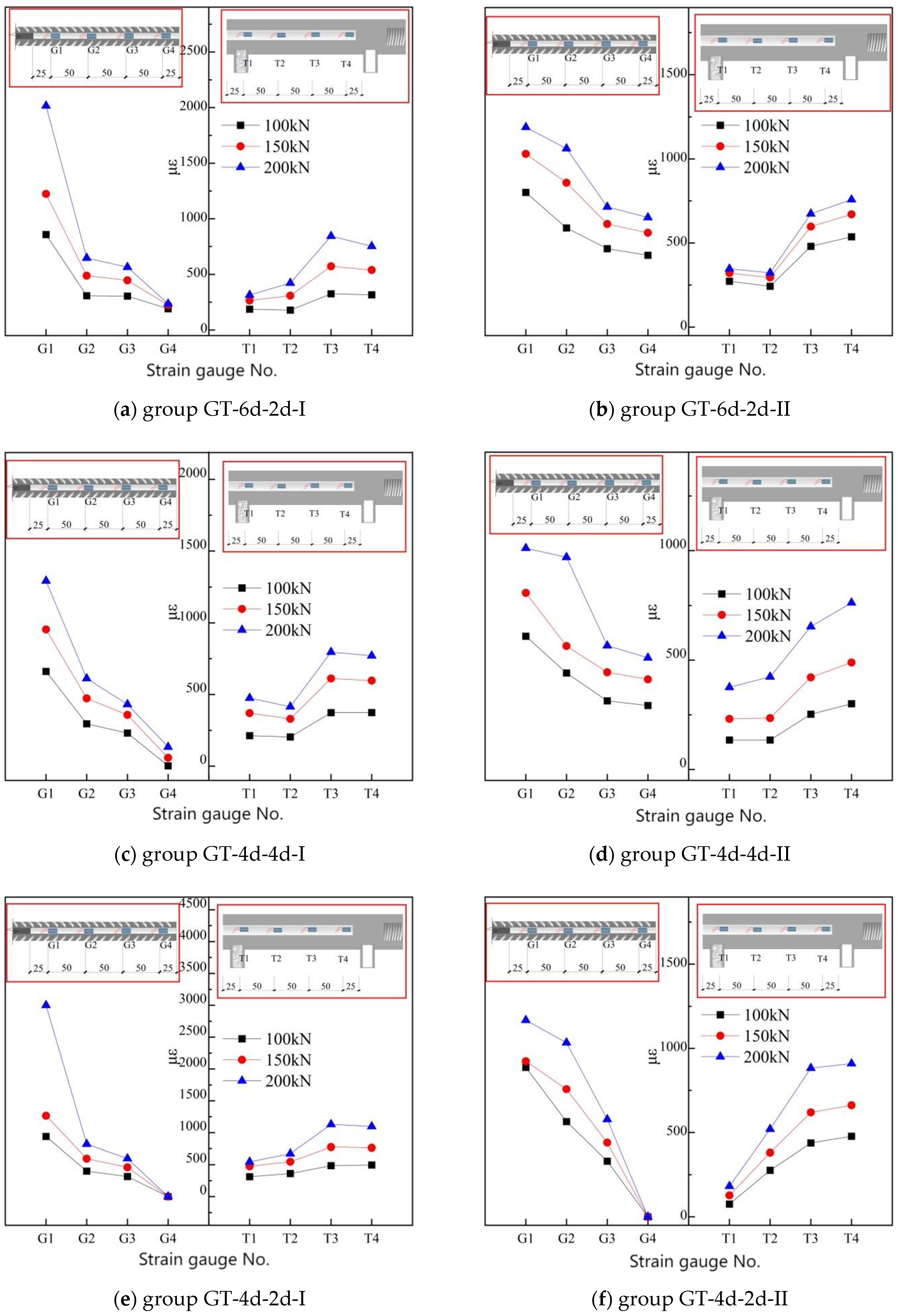
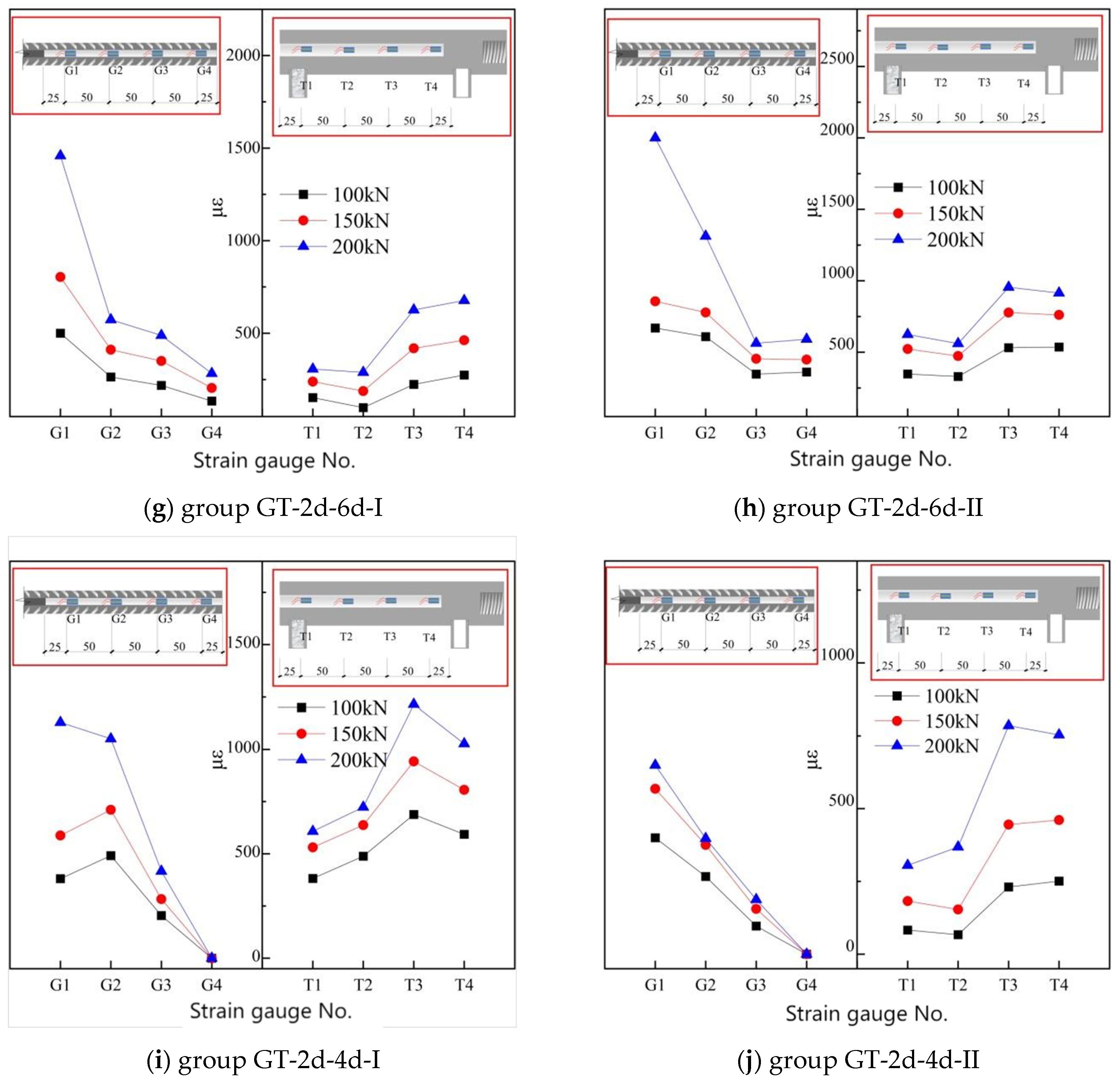
Figure 30.
Strain Distribution of Repaired Group Specimens.
Figure 30.
Strain Distribution of Repaired Group Specimens.
Table 1.
Threading Parameters for the Mechanical End of the Sleeve.
Table 1.
Threading Parameters for the Mechanical End of the Sleeve.
| Thread Pitch/mm | Thread Profile Angle/° | Threaded Connection Length/mm | Nominal Thread Diameter/mm | Installation Torque/N·m | Clear Hole Diameter/mm |
|---|
| 2.5 | 60 | 33 | 25.7 | ≥260 | ≤22 |
Table 2.
Parameters of the Grouted Sleeve Specimens.
Table 2.
Parameters of the Grouted Sleeve Specimens.
| Group No. | Specimen No. | Primary Anchorage Length L2/mm | Secondary Anchorage Length L3/mm | Total Anchorage Length L4/mm | Grouting Material Strength of Primary Anchorage/MPa | Grouting Material Strength of Secondary Anchorage/MPa |
|---|
| 1 | GT-8d-0d-1/GT-8d-0d-2/GT-8d-0d-3 | 200 | 0 | 200 | 85 | - |
| 2 | GT-6d-0d-1/GT-6d-0d-2/GT-6d-0d-3 | 150 | 0 | 150 | 85 | - |
| 3 | GT-4d-0d-1/GT-4d-0d-2/GT-4d-0d-3 | 100 | 0 | 200 | 85 | - |
| 4 | GT-6d-2d-I-1/GT-6d-2d-I-2/GT-6d-2d-I-3 | 150 | 50 | 200 | 85 | 85 |
| 5 | GT-4d-4d-I-1/GT-4d-4d-I-2/GT-4d-4d-I-3 | 100 | 100 | 200 | 85 | 85 |
| 6 | GT-4d-2d-I-1/GT-4d-2d-I-2/GT-4d-2d-I-3 | 100 | 50 | 150 | 85 | 85 |
| 7 | GT-2d-6d-I-1/GT-2d-6d-I-2/GT-2d-6d-I-3 | 50 | 150 | 200 | 85 | 85 |
| 8 | GT-2d-4d-I-1/GT-2d-4d-I-2/GT-2d-4d-I-3 | 50 | 100 | 150 | 85 | 85 |
| 9 | GT-6d-2d-II-1/GT-6d-2d-II-2/GT-6d-2d-II-3 | 150 | 50 | 200 | 85 | 100 |
| 10 | GT-4d-4d-II-1/GT-4d-4d-II-2/GT-4d-4d-II-3 | 100 | 100 | 200 | 85 | 100 |
| 11 | GT-4d-2d-II-1/GT-4d-2d-II-2/GT-4d-2d-II-3 | 100 | 50 | 150 | 85 | 100 |
| 12 | GT-2d-6d-II-1/GT-2d-6d-II-2/GT-2d-6d-II-3 | 50 | 150 | 200 | 85 | 100 |
| 13 | GT-2d-4d-II-1/GT-2d-4d-II-2/GT-2d-4d-II-3 | 50 | 100 | 150 | 85 | 100 |
Table 3.
Uniaxial Tensile Test Results of Reinforcing Bars.
Table 3.
Uniaxial Tensile Test Results of Reinforcing Bars.
| Diameter/mm | Reinforcing Steel Bar No. | Average Diameter/mm | Yield Strength/N/mm2 | Ultimate Strength/N/mm2 | Elongation After Fracture/% | Elastic Modulus/Mpa |
|---|
| 25 | 1 | 24.37 | 448 | 576 | 11.70 | 2.05 × 10⁵ |
| 2 | 24.74 | 450 | 584 | 11.40 | 2.12 × 10⁵ |
| 3 | 24.31 | 446 | 582 | 12.10 | 2.10 × 10⁵ |
Table 4.
Detailed Dimensions of the Sleeve.
Table 4.
Detailed Dimensions of the Sleeve.
| Items | Length (mm) |
|---|
| Total length L/mm | 256 |
| Reinforcing steel bar insertion depth L1/mm | 200 |
| Internal threaded hole depth L2/mm | 33 |
| Sleeve outer diameter d/mm | 50 |
| Threaded connection reinforcing steel bar diameter d1/mm | 25 |
| Grouted connection reinforcing steel bar diameter d2/mm | 25 |
| Sleeve inner diameter d3/mm | 38.5 |
| Grouting hole position a/mm | 40 |
| Bleeding hole position b/mm | 205 |
Table 5.
Material Properties of Grouted Sleeves.
Table 5.
Material Properties of Grouted Sleeves.
| Items | Performance Index |
|---|
| Yield strength σs/MPa | ≥355 |
| Tensile strength σb/MPa | ≥600 |
| Elongation after fracture δs/% | ≥16 |
Table 6.
Number of Shear Grooves in Reinforcing Bar Grouted Sleeves.
Table 6.
Number of Shear Grooves in Reinforcing Bar Grouted Sleeves.
| Connected reinforcing steel bar diameter/mm | 12–20 | 22–32 | 36–40 |
| Shear groove quantity/piece | ≥3 | ≥4 | ≥5 |
Table 7.
Test results of performance test for grouting.
Table 7.
Test results of performance test for grouting.
| Testing Items (Average Value of Three Times) | Ordinary Grouting Material | Grouting Reinforcement Material | Required Index |
|---|
| 1-day compressive strength/MPa | 36.5 | 38.2 | ≥35 |
| 3-day compressive strength/MPa | 62.2 | 64.5 | ≥60 |
| 28-day compressive strength/MPa | 93.1 | 103.3 | ≥85 |
| Initial fluidity/mm | 318.5 | 309.3 | ≥300 |
| 30 min fluidity/mm | 272.8 | 266.6 | ≥260 |
Table 8.
Test Results of Half-Grouted Sleeve Connection Specimens under Loading.
Table 8.
Test Results of Half-Grouted Sleeve Connection Specimens under Loading.
| Specimen No. | Yield Load (kN) | Ultimate Load (kN) (kN) | Failure Mode | Failure Location |
|---|
| GT-8d-0d-1 | 215.56 | 279.71 | Tensile fracture failure | Grouting end |
| GT-8d-0d-2 | 219.22 | 283.13 | Tensile fracture failure | Grouting end |
| GT-8d-0d-3 | 217.27 | 276.36 | Tensile fracture failure | Grouting end |
| GT-6d-0d-1 | 213.35 | 279.71 | Tensile fracture failure | Grouting end |
| GT-6d-0d-2 | 217.68 | 283.13 | Tensile fracture failure | Grouting end |
| GT-6d-0d-3 | 211.81 | 279.20 | Tensile fracture failure | Grouting end |
| GT-4d-0d-1 | 204.386 | 242.21 | Slip failure | Grouting end |
| GT-4d-0d-2 | 215.42 | 258.73 | Slip failure | Grouting end |
| GT-4d-0d-3 | 194.22 | 260.51 | Slip failure | Grouting end |
| GT-6d-2d-I-1 | 223.14 | 278.12 | Tensile fracture failure | Grouting end |
| GT-6d-2d-I-2 | 220.14 | 276.13 | Tensile fracture failure | Grouting end |
| GT-6d-2d-I-3 | 222.23 | 277.13 | Tensile fracture failure | Grouting end |
| GT-4d-4d-I-1 | 228.47 | 282.48 | Tensile fracture failure | Grouting end |
| GT-4d-4d-I-2 | 215.72 | 281.74 | Tensile fracture failure | Grouting end |
| GT-4d-4d-I-3 | 219.83 | 285.54 | Tensile fracture failure | Grouting end |
| GT-4d-2d-I-1 | 210.80 | 282.25 | Tensile fracture failure | Grouting end |
| GT-4d-2d-I-2 | 217.39 | 283.03 | Tensile fracture failure | Grouting end |
| GT-4d-2d-I-3 | 224.41 | 280.18 | Tensile fracture failure | Grouting end |
| GT-2d-6d-I-1 | 227.14 | 287.27 | Tensile fracture failure | Grouting end |
| GT-2d-6d-I-2 | 214.98 | 282.02 | Tensile fracture failure | Grouting end |
| GT-2d-6d-I-3 | 225.66 | 284.64 | Tensile fracture failure | Grouting end |
| GT-2d-4d-I-1 | 224.44 | 285.70 | Tensile fracture failure | Grouting end |
| GT-2d-4d-I-2 | 215.03 | 283.26 | Tensile fracture failure | Grouting end |
| GT-2d-4d-I-3 | 225.83 | 280.11 | Tensile fracture failure | Grouting end |
| GT-6d-2d-II-1 | 222.89 | 279.71 | Tensile fracture failure | Grouting end |
| GT-6d-2d-II-2 | 224.18 | 284.34 | Tensile fracture failure | Grouting end |
| GT-6d-2d-II-3 | 225.23 | 273.70 | Tensile fracture failure | Grouting end |
| GT-4d-4d-II-1 | 218.33 | 274.41 | Tensile fracture failure | Grouting end |
| GT-4d-4d-II-2 | 213.35 | 273.12 | Tensile fracture failure | Grouting end |
| GT-4d-4d-II-3 | 210.85 | 273.76 | Tensile fracture failure | Grouting end |
| GT-4d-2d-II-1 | 213.91 | 286.08 | Tensile fracture failure | Grouting end |
| GT-4d-2d-II-2 | 223.63 | 288.18 | Tensile fracture failure | Grouting end |
| GT-4d-2d-II-3 | 219.26 | 272.16 | Tensile fracture failure | Grouting end |
| GT-2d-6d-II-1 | 225.31 | 292.03 | Tensile fracture failure | Grouting end |
| GT-2d-6d-II-2 | 225.84 | 291.13 | Tensile fracture failure | Anchorage end |
| GT-2d-6d-II-3 | 225.43 | 291.46 | Tensile fracture failure | Grouting end |
| GT-2d-4d-II-1 | 212.90 | 282.80 | Tensile fracture failure | Grouting end |
| GT-2d-4d-II-2 | 226.30 | 279.62 | Tensile fracture failure | Grouting end |
| GT-2d-4d-II-3 | 222.07 | 281.21 | Tensile fracture failure | Grouting end |
Table 9.
Bond Strength of Specimens with an Initial Grouted Anchorage Length of 4 d.
Table 9.
Bond Strength of Specimens with an Initial Grouted Anchorage Length of 4 d.
| Specimen ID | Yield Load/kN | Ultimate Load/kN | /MPa | Failure Mode | Failure Location |
|---|
| GT-4d-0d-1 | 204.386 | 242.21 | 30.8 | Slip Failure | Grouting End |
| GT-4d-0d-2 | 215.42 | 258.73 | 32.9 | Slip Failure | Grouting End |
| GT-4d-0d-3 | 194.22 | 260.51 | 33.2 | Slip Failure | Grouting End |
Table 10.
Theoretical Calculated Values of Bond Strength and Comprehensive Bond Efficiency Coefficient k.
Table 10.
Theoretical Calculated Values of Bond Strength and Comprehensive Bond Efficiency Coefficient k.
| Concrete Strength | Anchorage Length /mm | Rebar Yield Strength/MPa | Bond Strength /MPa | |
|---|
| C30 | 8 d | 360 | 11.25 | 2.97 |
| C40 | 8 d | 360 | 11.25 | 2.57 |
| C50 | 8 d | 360 | 11.25 | 2.34 |
| C60 | 8 d | 360 | 11.25 | 2.14 |
| C70 | 8 d | 360 | 11.25 | 1.99 |
| C80 | 8 d | 360 | 22.5 | 3.75 |
| C80 | 8 d | 360 | 15 | 2.50 |
| C80 | 8 d | 360 | 11.25 | 1.88 |
Table 11.
Theoretical and Corrected Bond Strength Values of the Grouted Specimens.
Table 11.
Theoretical and Corrected Bond Strength Values of the Grouted Specimens.
| Specimen ID | Failure Mode | Test Load Value (kN) | Theoretical Rebar Fracture Load (kN) | Calculated Value by Theoretical Formula () | Calculated Value by Corrected Formula () |
|---|
| GT-4d-0d-1 | Rebar Slip | 242.21 | 264.71 | 136.07 | 253.32 |
| GT-4d-0d-2 | Rebar Slip | 258.73 | 264.71 | 136.07 | 253.32 |
| GT-4d-0d-3 | Rebar Slip | 260.51 | 264.71 | 136.07 | 253.32 |
| GT-6d-0d-1 | Rebar Fracture | 279.71 | 264.71 | 204.10 | 379.98 |
| GT-6d-0d-2 | Rebar Fracture | 283.13 | 264.71 | 204.10 | 379.98 |
| GT-6d-0d-3 | Rebar Fracture | 279.20 | 264.71 | 204.10 | 379.98 |
| GT-8d-0d-1 | Rebar Fracture | 279.71 | 264.71 | 272.14 | 506.64 |
| GT-8d-0d-2 | Rebar Fracture | 283.13 | 264.71 | 272.14 | 506.64 |
| GT-8d-0d-3 | Rebar Fracture | 276.36 | 264.71 | 272.14 | 506.64 |
| GT-6d-2d-I-1 | Rebar Fracture | 278.12 | 264.71 | 272.14 | 506.64 |
| GT-6d-2d-I-2 | Rebar Fracture | 276.13 | 264.71 | 272.14 | 506.64 |
| GT-6d-2d-I-3 | Rebar Fracture | 277.13 | 264.71 | 272.14 | 506.64 |
| GT-4d-4d-I-1 | Rebar Fracture | 282.48 | 264.71 | 272.14 | 506.64 |
| GT-4d-4d-I-2 | Rebar Fracture | 281.74 | 264.71 | 272.14 | 506.64 |
| GT-4d-4d-I-3 | Rebar Fracture | 285.54 | 264.71 | 272.14 | 506.64 |
| GT-4d-2d-I-1 | Rebar Fracture | 282.25 | 264.71 | 204.10 | 379.98 |
| GT-4d-2d-I-2 | Rebar Fracture | 283.03 | 264.71 | 204.10 | 379.98 |
| GT-4d-2d-I-3 | Rebar Fracture | 280.18 | 264.71 | 204.10 | 379.98 |
| GT-2d-6d-I-1 | Rebar Fracture | 287.27 | 264.71 | 272.14 | 506.64 |
| GT-2d-6d-I-2 | Rebar Fracture | 282.02 | 264.71 | 272.14 | 506.64 |
| GT-2d-6d-I-3 | Rebar Fracture | 284.64 | 264.71 | 272.14 | 506.64 |
| GT-2d-4d-I-1 | Rebar Fracture | 285.70 | 264.71 | 204.10 | 379.98 |
| GT-2d-4d-I-2 | Rebar Fracture | 283.26 | 264.71 | 204.10 | 379.98 |
| GT-2d-4d-I-3 | Rebar Fracture | 280.11 | 264.71 | 204.10 | 379.98 |
| GT-6d-2d-II-1 | Rebar Fracture | 279.71 | 264.71 | 277.89 | 517.35 |
| GT-6d-2d-II-2 | Rebar Fracture | 284.34 | 264.71 | 277.89 | 517.35 |
| GT-6d-2d-II-3 | Rebar Fracture | 273.70 | 264.71 | 277.89 | 517.35 |
| GT-4d-4d-II-1 | Rebar Fracture | 274.41 | 264.71 | 283.65 | 528.07 |
| GT-4d-4d-II-2 | Rebar Fracture | 273.12 | 264.71 | 283.65 | 528.07 |
| GT-4d-4d-II-3 | Rebar Fracture | 273.76 | 264.71 | 283.65 | 528.07 |
| GT-4d-2d-II-1 | Rebar Fracture | 286.08 | 264.71 | 209.86 | 390.69 |
| GT-4d-2d-II-2 | Rebar Fracture | 288.18 | 264.71 | 209.86 | 390.69 |
| GT-4d-2d-II-3 | Rebar Fracture | 272.16 | 264.71 | 209.86 | 390.69 |
| GT-2d-6d-II-1 | Rebar Fracture | 292.03 | 264.71 | 289.40 | 538.78 |
| GT-2d-6d-II-2 | Rebar Fracture | 291.13 | 264.71 | 289.40 | 538.78 |
| GT-2d-6d-II-3 | Rebar Fracture | 291.46 | 264.71 | 289.40 | 538.78 |
| GT-2d-4d-II-1 | Rebar Fracture | 282.80 | 264.71 | 215.61 | 401.41 |
| GT-2d-4d-II-2 | Rebar Fracture | 279.62 | 264.71 | 215.61 | 401.41 |
| GT-2d-4d-II-3 | Rebar Fracture | 281.21 | 264.71 | 215.61 | 401.41 |