


Abstract
The construction industry continues to grapple with persistently high accident rates and fragmented workforce management systems, where manual record-keeping and siloed data impede effective safety compliance. While digital interventions exist, they often rely on centralized databases that are vulnerable to manipulation and opaque. This systematic literature review critically examines the application of blockchain technology as a decentralized infrastructure for enhancing safety compliance in construction. Adhering to the PRISMA 2020 guidelines, this study synthesizes findings from 115 peer-reviewed articles (2020–2025) retrieved from Scopus, Web of Science, IEEE Xplore, and Google Scholar. The analysis focuses on three core mechanisms: (1) the creation of immutable, timestamped safety logs to prevent retroactive data tampering; (2) the integration of IoT sensors for real-time, trustless hazard monitoring; and (3) the deployment of smart contracts to automate compliance verification and incentive distribution. The review juxtaposes theoretical frameworks with empirical evidence from global case studies, including pilot projects in North America and the Asia-Pacific, to quantify benefits such as reduced reporting latency and improved data integrity. Despite promising results, the analysis reveals significant barriers to widespread adoption, notably the “oracle problem,” scalability limitations of consensus protocols, and the lack of legal recognition for blockchain records. This paper concludes that while blockchain is not a panacea, it offers a necessary layer of trust and accountability absent in traditional Common Data Environments (CDEs). Future research directions are proposed to address interoperability with BIM standards (ISO 19650) and to develop energy-efficient consensus mechanisms suitable for resource-constrained construction sites.
1. Introduction
Despite decades of regulatory reform and technological adoption, the construction industry remains one of the most hazardous sectors globally. Recent data from the International Labour Organization (ILO) indicates that the sector accounts for approximately 2.93 million deaths annually due to work-related factors, with 395 million non-fatal injuries occurring worldwide [1,2]. In the United States, the Occupational Safety and Health Administration (OSHA) reported that fall protection violations remained the most frequently cited standard in fiscal year 2024, highlighting a persistent gap between regulatory requirements and onsite adherence [3,4]. In 2023 alone, the US Bureau of Labor Statistics recorded 1075 fatal work injuries in construction, a concerning rise that underscores the limitations of current safety management paradigms [5,6].
Traditionally, safety compliance has relied on manual inspections and paper-based reporting, methods fraught with latency and human error. While the digitization of the industry has introduced Electronic Health and Safety (EHS) platforms and Common Data Environments (CDEs) to centralize information, these systems suffer from a critical architectural flaw: centralization. As noted in recent critiques of ISO 19650-compliant workflows, centralized CDEs rely on a single trusted authority, leaving safety records vulnerable to retroactive alteration, data silos, and “single point of failure” risks [7]. In the event of an accident, the integrity of digital logs in a standard SQL database can be compromised by any administrator with root access, creating a “trust deficit” among stakeholders (owners, contractors, and regulators) who often have adversarial relationships [8,9,10].
Blockchain technology, or Distributed Ledger Technology (DLT), offers a paradigm shift from “trust in authority” to “trust in code.” By distributing the ledger across multiple nodes, blockchain ensures that once a safety inspection or incident report is logged, it is cryptographically immutable and traceable [11,12,13]. Unlike standard EHS software, which primarily focuses on data storage, blockchain focuses on data provenance and accountability. This distinction is crucial for modern safety compliance, where the legal admissibility of digital records and the automated enforcement of safety protocols (via smart contracts) are becoming paramount.
Existing literature reviews have focused mainly on the broad applicability of blockchain in construction (e.g., supply chain, payments) or have been limited to conceptual frameworks. This review distinguishes itself by focusing specifically on safety compliance applications between 2020 and 2025, providing a critical analysis of how blockchain integrates with the Internet of Things (IoT) and Building Information Modeling (BIM) to create a proactive, rather than reactive, safety management ecosystem. It moves beyond theoretical benefits to examine quantitative evidence from recent pilot studies, offering a realistic assessment of the technology’s readiness level.
Against this backdrop, this review focuses specifically on safety compliance as a distinct application area for blockchain in construction. Prior reviews have examined blockchain in the built environment more broadly, often emphasizing contract administration, supply chains, or generic digital transformation, but have not systematically synthesized evidence related to safety, health, and regulatory compliance. In this paper we therefore ask: (i) how blockchain has been applied to safety related tasks in construction (such as inspection logging, incident and near miss reporting, worker credential management, and hazard monitoring); (ii) what technical approaches and data architectures have been used; and (iii) what benefits, limitations, and research gaps have been reported. Clarifying this focus helps distinguish blockchain-based safety tools from existing digital safety platforms such as common data environments (CDEs), environment, health, and safety (EHS) management systems, and mobile inspection applications, which typically rely on centralized databases and offer weaker guarantees of auditability and shared governance.
The paper is organized into five main sections. Following this introduction, Section 2 describes the review methodology adopted in this study. Section 3 provides an overview of blockchain technology fundamentals—explaining what a blockchain is, how consensus mechanisms and smart contracts work, and which features of blockchain are most pertinent to construction applications. Section 4 focuses on safety compliance, outlining the challenges in current safety management systems and exploring blockchain-enabled solutions that improve compliance. Section 5 identifies research gaps and future directions, raising open questions (e.g., scalability and legal considerations), technology integration, evaluation metrics, and recommendations for further research and pilot deployments. Finally, Section 6 concludes the paper by summarizing key insights and reflecting on the future implications for the construction industry.
2. Methodology
To ensure a comprehensive and reproducible assessment of the field, this study adopted a systematic literature review (SLR) approach in line with the PRISMA 2020 guidelines.
2.1. Search Strategy and Data Sources
A structured search was conducted on 10 September 2025, across four primary academic databases: Scopus, Web of Science Core Collection, IEEE Xplore, and Google Scholar. These databases were selected for their extensive coverage of engineering, computer science, and construction management literature. The search strategy employed a combination of keywords related to the technology, the industry, and the specific application domain. The primary search string used was: (“Blockchain” OR “Distributed Ledger Technology” OR “DLT” OR “Smart Contracts”) AND (“Construction” OR “AEC” OR “Built Environment”) AND (“Safety” OR “OHS” OR “H&S” OR “Compliance” OR “Risk Management”)
2.2. Inclusion and Exclusion Criteria
The search was limited to peer-reviewed journal articles and conference proceedings published between January 2020 and August 2025. This timeframe was selected to capture the most recent advancements following the initial “hype cycle” of blockchain technology, focusing on mature implementations and pilot studies.
Inclusion Criteria:
- Studies explicitly proposing or evaluating blockchain architectures for occupational health and safety (OHS) in construction.
- Papers presenting empirical data, prototypes, or validated frameworks.
- Articles written in English.
Exclusion Criteria:
- General reviews of blockchain in construction without a specific focus on safety.
- Non-peer-reviewed white papers, editorials, or abstract-only entries.
- Studies focusing solely on financial or supply chain aspects of blockchain, unless directly linked to safety compliance (e.g., safety-contingent payments).
2.3. Screening and Quality Assessment
The initial search yielded 477 records. After removing duplicates (n = 97) and screening titles/abstracts for relevance, 115 full-text articles were assessed for eligibility. Studies were appraised based on their technical depth, validation method (simulation vs. site pilot), and clarity of reported outcomes. This rigorous process ensured that the synthesized findings represent the highest quality evidence currently available in the domain.
3. Fundamentals of Blockchain Technology
To appreciate how blockchain can improve workforce management and safety compliance, it is essential to understand its fundamental concepts. This section provides a brief overview of blockchain’s origins and architecture, explains how consensus mechanisms and smart contracts work, and highlights the key features of blockchain that make it well-suited for applications in the construction industry.
3.1. Overview of Blockchain
Blockchain, a distributed ledger technology (DLT), provides a tamper-resistant, shared database maintained by multiple parties without a central authority. Each block contains transactions linked cryptographically, ensuring immutability and rapid tampering detection [14]. While first applied in cryptocurrencies, platforms such as Ethereum extended blockchain to programmable smart contracts, broadening its applications to sectors including construction [15]. In safety-critical environments where multiple stakeholders must coordinate yet may not fully trust one another, blockchain’s decentralized “single source of truth” offers secure, auditable safety records that reduce disputes and enhance compliance [16]. Permissioned or consortium blockchains are most applicable in construction, balancing transparency with the need to protect sensitive safety and workforce data [17].
3.2. Consensus Mechanisms
Consensus algorithms ensure that all nodes share the same safety compliance record without a central authority. Proof of Work (PoW) provides strong security but is resource-intensive [18,19], while Proof of Stake (PoS) and Practical Byzantine Fault Tolerance (PBFT) offer faster, energy-efficient alternatives [20]. In construction, frameworks such as Hyperledger Fabric employ PBFT-style protocols, enabling consortium participants (e.g., owners, contractors, regulators) to validate safety data rapidly [21]. The choice of mechanism influences trust models and practical deployment: public PoS systems could support industry-wide safety platforms, whereas private PBFT systems suit project-level compliance monitoring [22].
3.3. Smart Contracts
Smart contracts automate safety compliance by embedding rules directly into the blockchain. For example, site access can be automatically restricted if a worker’s expired digital safety certificate or an incident is instantly broadcast to all stakeholders [23]. This eliminates manual checks, reduces delays, and ensures consistent enforcement. Automated workflows, such as hazard reporting or real-time approvals, strengthen accountability and minimize disputes [24]. Challenges remain—bugs in code can undermine reliability, and legal recognition of blockchain-based enforcement is still evolving [25]. Despite this, smart contracts on platforms such as Hyperledger Fabric are increasingly being explored for credential validation and compliance automation [26,27].
3.4. Features Relevant to Construction
Blockchain technology possesses several distinctive features that directly address pain points in safety management, as summarized below:
- Immutable logs of inspections, training, and incident reports simplify regulatory audits and reduce cover-ups [28,29].
- Cryptographic immutability prevents falsified safety records; permissioned access safeguards sensitive worker data [30].
- Reduces reliance on a single authority, allowing regulators, contractors, and owners to share verified safety data on a shared ledger and access a consistent audit trail of safety-critical events [31].
- Integration with Internet of Things (IoT) devices (e.g., smart badges and sensors) provides real-time visibility into worker locations, equipment conditions, and hazard levels [32].
- Smart contracts enforce compliance rules automatically, ensuring that only certified workers perform high-risk tasks and that alerts are disseminated instantly [33].
Collectively, these capabilities position blockchain as a robust infrastructure for tamper-proof, transparent, and automated safety compliance, addressing persistent gaps in trust, monitoring, and accountability in construction. Figure 1 presents a diagram illustrating four main layers: (i) data acquisition devices (e.g., IoT sensors, wearables, mobile inspection applications); (ii) off-chain processing and storage components; (iii) a permissioned blockchain network that records safety events and executes smart contracts; and (iv) user interfaces for contractors, clients, and regulators. Arrows indicate the flow of safety data and compliance events between layers.
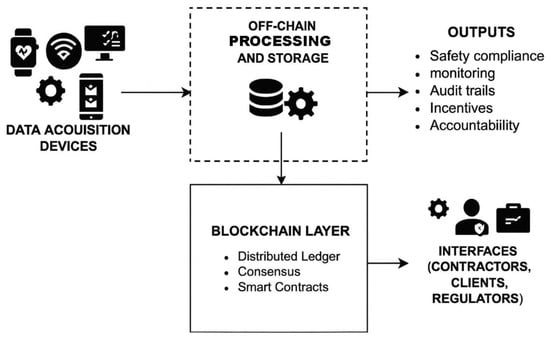
Figure 1.
Conceptual blockchain framework for safety compliance in construction.
4. Blockchain in Safety Compliance
Ensuring safety compliance is a critical aspect of construction project management. Construction sites are dynamic and often hazardous environments where non-compliance with safety protocols can lead to accidents, injuries, or even fatalities. This section explores how blockchain technology can enhance safety management in construction. First, it outlines current challenges in safety compliance and culture.
4.1. Safety Compliance Challenges
Fragmented Documentation and Poor Data Management: Construction safety management involves a vast amount of documentation—safety training records, equipment inspection logs, daily safety checklists, permits-to-work, incident reports, audit findings, etc. [5]. Traditionally, these are maintained on paper or in disparate digital systems (e.g., spreadsheets, standalone databases) [34]. When an incident occurs or during a safety audit, gathering all relevant documents can be cumbersome, and items may be missed [35]. Moreover, version control is an issue—it might be unclear whether the checklist used is the latest one or whether a procedure change was communicated to all [36]. As Ibrahim et al. [33] noted, encouraging the digitization of building data (including safety data) via blockchain could mitigate these data storage and consistency issues and enhance safety management. The lack of a unified system also means lessons learned on one project might not transfer easily to another.
Inaccuracies and Underreporting of Incidents: There is a well-known problem in safety compliance: not all incidents, especially near-misses or minor injuries, get reported accurately or at all. This can be due to fear of blame, cumbersome reporting processes, or oversight [5]. When records are kept manually, there is a risk of deliberate tampering [37]. A lack of trust in the reporting process leads to a dysfunctional safety culture. Workers might not report issues if they think records could be manipulated or doubt that any follow-up will occur. Additionally, with siloed systems, a company’s head office may only see summarized data long after the fact, limiting its ability to respond proactively. Therefore, data integrity and timeliness in safety reporting are crucial needs currently not fully met [38].
Lack of Real-Time Hazard Monitoring: Construction sites are constantly changing with new buildings, different workers, and weather conditions, making it challenging to maintain safety. Even though we have IoT sensors and CCTV, using them for safety has not taken off yet [39]. A lot of the time, safety is reactive, meaning we only deal with problems after something goes wrong or during inspections. If we do not have up-to-the-minute info, risks can go unnoticed until someone gets hurt. For example, a poor scaffold might not be detected unless a sensor triggers an alarm or an inspector notices it [40]. Communication can also be slow. Even when a problem is found, getting the word out to everyone, especially on big sites, can take a while. Old-school methods like radios or signs are often insufficient to ensure everyone knows what is happening. So, current systems struggle to provide everyone with a single, real-time view of site safety conditions [28].
Ensuring Compliance and Accountability: Achieving compliance is not just about having rules; it is about making sure they are followed and that there is accountability when they are not. Often on construction projects, multiple contractors overlap—if a safety violation is found (e.g., missing guardrails), accountability can be dodged [28]. Also, enforcing specific protocols (like daily equipment checks) can be hard to verify—you rely on honesty or a safety officer’s diligence. There might be insufficient incentive for workers to go the extra mile in safety compliance if they perceive it as mere bureaucracy [5]. There is a dearth of incentive programs for safety in construction and a lack of reliable monitoring mechanisms for hazard identification.
To summarize, safety compliance in construction currently suffers from disorganized record-keeping, delayed and sometimes unreliable reporting, and difficulties in real-time oversight and enforcement. These gaps provide an opportunity for a technology like blockchain, which excels at secure information sharing and automation, to make a positive impact, as described next.
4.2. Blockchain-Based Solutions for Safety Compliance
Traditional safety compliance relies on paper records, manual inspections, and delayed reporting, often leading to inefficiencies and underreporting. In contrast, blockchain-enabled workflows leverage immutable ledgers, IoT integration, and smart contracts to enable real-time, trustworthy, and automated compliance management, as shown in Figure 2. In Figure 2, the left side shows fragmented, paper-based processes for inspections and incident reporting. In contrast, the right side depicts a blockchain-enabled workflow in which inspections, incident reports, and certifications are captured digitally, written to a shared ledger, and can trigger smart contract-based notifications and access controls. Here are some key blockchain-based solutions targeted at construction safety.
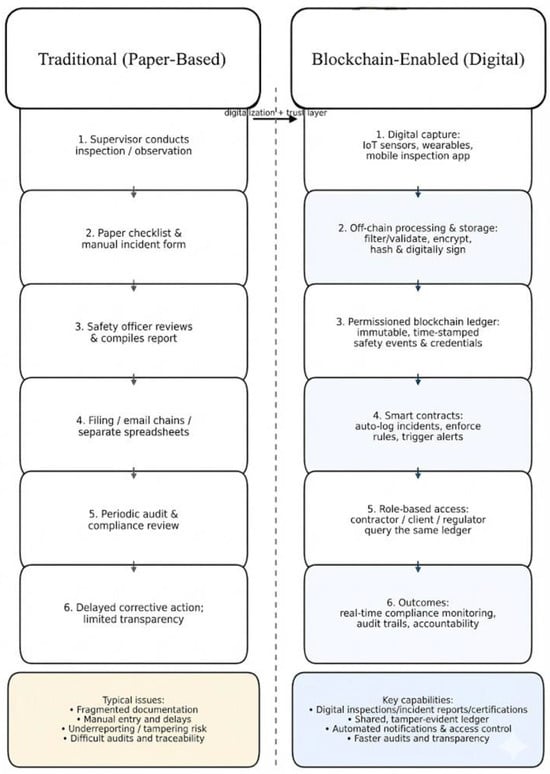
Figure 2.
Traditional versus blockchain-enabled safety management workflows.
Real-Time Safety Data Recording and Sharing: Integrating IoT sensors and wearable devices with blockchain enables real-time, tamper-proof safety monitoring. For instance, a smart helmet or wearable that monitors vital signs (heart rate) and environmental conditions (proximity to dangerous zones). These devices can continuously send data to a blockchain system. Each reading or event becomes a transaction on the blockchain, instantly viewable by safety managers and, if appropriate, by other workers, as a single source of truth [41]. The blockchain ensures the data is not altered or lost and provides a timestamped log of all safety-critical events. There are already prototypes of such systems: for example, J. Li et al. (2022) [42] proposed a blockchain based construction quality and safety management system that leverages IoT devices to monitor site conditions and records the resulting data on a blockchain; their prototype demonstrates the feasibility of tracking safety conditions more consistently in an experimental setting, although large scale field evidence is still limited. In practice, such a system might manifest as a dashboard that draws on blockchain data to display a heat map of site risks in real time. If a near-miss occurs (detected by a sudden movement sensor on a harness, for example), it gets logged immutably, ensuring it is investigated [43]. By providing a continuous, trustworthy stream of site safety data, blockchain helps move from reactive to proactive safety management [28].
Smart Contracts for Automated Incident Reporting and Response: Blockchain smart contracts can formalize safety procedures and automate compliance. For example, if a fall-detection sensor records a sudden stop, a contract can instantly log the event, alert first responders, and generate an incident report [44]. Similarly, inspection schedules can be codified: if a scaffold is not digitally signed off within seven days, the system flags non-compliance or locks IoT-controlled equipment [28]. These automated workflows eliminate oversight gaps, improve regulatory adherence, and reduce administrative burden on safety managers [45]. Comparable systems are already used in blockchain supply chains for compliance tracking, underscoring the transferability of this approach to construction safety [46].
Immutable Audit Trails for Certifications and Inspections: Blockchain’s immutability directly addresses the challenge of record tampering and audit difficulty [44]. An immutable audit trail is created by recording all safety-related certifications, training completion dates, and inspection records on a blockchain [36]. In any later review—whether an internal audit, a client review, or an investigation after an accident—there is a trustworthy ledger of what was done when, and by whom. This can speed up investigations and accountability [28]. For example, if a faulty piece of equipment caused an accident, the blockchain records might show when it was last inspected, by whom, and if any defects were noted. If an inspection was skipped or falsified, the presence or absence of on-chain data (or digital signatures) makes it evident [36]. Also, because blockchain entries can be linked to individuals’ digital identities, it promotes personal accountability: an inspector knows that once they certify something on the ledger, that record is permanent and tied to them, which can incentivize greater diligence [44]. Additionally, such a ledger can help in standards compliance—e.g., ISO 45001 (Occupational Health and Safety management standard) requires evidence of risk assessments, training, etc.; blockchain can store all this evidence in an organized way, simplifying certification processes for companies [28]. Kim et al. [28] proposed a system that could generate and synchronize blocks with project events, including document management such as safety reports, demonstrating the feasibility of embedding documentation processes into the blockchain. With all relevant safety documents hashed or stored on-chain, later audits can verify that documents were not modified after the fact [44]. This integrity is a strong advantage when legal and regulatory scrutiny occurs.
Blockchain-Enabled Safety Marketplaces and Incentive Programs: Blockchain can reinforce a positive safety culture by linking safe behavior to transparent reward systems. Workers who adhere to PPE protocols or achieve incident-free milestones may receive blockchain tokens redeemable for bonuses or recognition [47]. These rewards are distributed via smart contracts based on tamper-proof compliance data, ensuring fairness and preventing favoritism. Naderi et al. (2023) [48] piloted a system combining blockchain with computer vision to monitor PPE use and issue tokenized incentives, thereby improving safety, engagement, and compliance [49]. Beyond immediate rewards, accumulated safety tokens can form part of a worker’s digital profile, signaling a long-term commitment to safety to employers.
Cross-Organization Collaboration for Safety: A blockchain network can serve as a neutral platform for stakeholders to share information without any single party controlling it. For example, the general contractor, each subcontractor, and the labor union could all be nodes in a blockchain that tracks safety incidents. Because each has equal access and data integrity is assured, collaboration improves—a subcontractor cannot hide an incident from the GC, and the GC cannot unilaterally alter data to blame the subcontractor. This fosters a more cooperative approach, with the focus shifting to solving safety issues rather than assigning blame [50]. Additionally, regulatory bodies (like OSHA in the US or local labor departments) could be given access to or node participation to observe compliance in real time rather than just during occasional inspections. Some jurisdictions have begun exploring “RegTech” solutions using blockchain for continuous compliance in other sectors [45].
These blockchain-based solutions, from real-time data capture to automated enforcement, aim to create a safer construction environment by ensuring reliable information and accountable actions. Next, some actual implementations of these ideas are discussed.
4.3. Case Studies and Applications
Several pilot projects and research implementations illustrate how blockchain can be applied to safety compliance in construction:
- Blockchain Safety Data Management Framework (USA): Developed by Morteza et al. (2021) [46], a Blockchain Information Management conceptual model allows several parties to share inspection reports, risk assessments, and incident logs on a personal blockchain. Simulation revealed how accessible, trackable, and immovable safety data became, enhancing teamwork and trust even without IoT integration [46].
- Safety Rewards Prototype (USA): A recent project led by Naderi et al. (2023) [48] used blockchain and computer vision to monitor whether people were wearing their safety gear. People who follow safety rules get digital tokens stored on the blockchain. It is all open, and no one can cheat the system. They gave it a shot in a test setting, and it got people more involved and could reduce accidents by promoting a safety-first mindset [48].
- Hyperledger Fabric for Worker Safety Data (Korea): Saah et al. (2023) [51] implemented a blockchain model on Hyperledger Fabric to securely manage safety-related worker data. Validated on AWS, the system balanced data privacy and safety transparency, making risk metrics accessible to authorized stakeholders while protecting personal information—particularly relevant for high-risk projects [51].
- Construction Quality and Safety Management System (China): J. Li et al. (2022) [42] presented a blockchain-based platform experimentally tested for quality and safety assurance. While details remain limited, the system improved data reliability for safety checklists and inspections, highlighting the potential to integrate quality and safety records into a unified compliance framework [42].
- Equipment Safety Monitoring (China): Pan et al. (2024) [37] suggested combining deep learning and blockchain to monitor equipment safety. Their idea is that AI, powered by the Internet of Things, spots when equipment is used unsafely (like a crane carrying too much weight). When that happens, it records the incident on a blockchain. This way, everyone can see what is happening in real time, helping ensure equipment is used correctly [37].
- Worker-Level Safety Tracking (Hong Kong): Cheng et al. (2022) [47] developed a blockchain-based PPE compliance monitoring system using computer vision. Worker-level compliance data were stored immutably, providing real-time oversight and accountability that encouraged safer behavior and strengthened safety culture [47].
From the above, it is evident that blockchain is being tested in various safety-related capacities: whether it is focusing on process (ensuring checks and reports are done), people (incentivizing and tracking worker behavior), or equipment (monitoring safe operation). The case studies generally report positive outcomes, such as improved data integrity, better collaboration, and even quantitative safety improvements. However, they also reveal that many are still in the pilot or research phase and not yet business-as-usual on job sites. Blockchain enables safety data to be continuously captured, verified, stored, shared, audited, and incorporated into site practices, creating a transparent and proactive compliance loop, as shown in Figure 3. Safety-related information is captured on site, validated by authorized users or devices, registered on the blockchain, queried for audits and analytics, and fed back into site practices through dashboards and automated alerts. The figure emphasizes how each stage contributes to traceability and accountability.
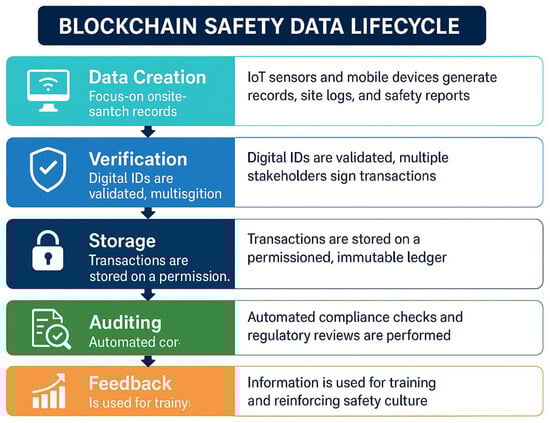
Figure 3.
Lifecycle of safety data in a blockchain ecosystem.
4.4. Benefits and Challenges of Blockchain in Safety Compliance
Benefits: Implementing blockchain in construction safety management can deliver several significant benefits, as shown in Table 1.

Table 1.
Blockchain Benefits for Safety Compliance.
Challenges: On the flip side, implementing blockchain for safety also faces challenges, as per Table 2:
Table 2.
Challenges of Using Blockchain for Safety Compliance.
Blockchain can significantly enhance construction safety compliance by improving data management, enabling faster communication, and introducing novel incentive structures, thereby leading to safer outcomes [5]. However, it is not a silver bullet—it must be implemented carefully, taking into account data quality, user acceptance, and integration challenges [60]. The following section compares our findings in labor vs. safety applications and discusses overarching insights [49].
In synthesizing the literature, we note that only a subset of the 115 reviewed studies reported quantitative safety outcomes such as changes in incident frequency, reporting times, or inspection efficiency. Many contributions remain at the conceptual or proof-of-concept stage, often validated only through simulations or limited pilot projects. Consequently, the benefits summarized in Table 1 combine effects observed in small-scale implementations with advantages inferred from the structural properties of blockchain systems, whereas the challenges listed in Table 2 are predominantly derived from implementation experiences and critical reflections. This distinction underlines the need for more empirical evaluations of blockchain-enabled safety management in real projects.
4.5. Evaluation Metrics
To assess the success and impact of blockchain implementations in construction, whether for labor or safety or combined, we need clear evaluation metrics:
- Effectiveness Metrics: These measure how well the blockchain solution achieves its intended outcomes. For safety, metrics include reduced safety incidents or accident rate, improved compliance rate, and faster response time to hazards. Another effectiveness measure is user participation—e.g., what portion of the workforce actively uses their blockchain-based digital IDs or checks the safety dashboard daily; high usage implies the system is effectively integrated into workflows [60].
- Efficiency Metrics: These consider productivity gains or resource savings. For example, reduced administrative labor—hours saved per week in safety reporting [61]. Transaction speed can also be a metric: how quickly an incident report can be disseminated (instantly vs. minutes with phones) [42].
- Scalability: Although more of a system property than an outcome, one can measure how the solution scales in a large project or across projects. Metrics could include the number of transactions per second the network can handle and how that correlates with user experience [62]. Also, the ease of onboarding new participants is a practical metric for scalability of adoption [63].
- Security and Data Integrity Metrics: One might assess if there have been any data breaches or tampering incidents. A successful metric could be “number of detected unauthorized changes = 0” (since blockchain should prevent such changes entirely) [64]. Alternatively, measure how many attempts were thwarted, if any (if such logs exist) [65]. Another metric is system reliability: e.g., no single-point-of-failure incidents, or if a node fails, the system continues (measuring blockchain’s fault tolerance in practice) [66].
- User Satisfaction and Adoption: Qualitative surveys can also be metrics—e.g., surveying workers and managers about their trust in data, ease of use, and perceived benefits. Increased satisfaction or trust levels post-implementation indicate a positive impact on the project environment [67]. Training time required is another metric; Ideally, metrics would show minimal training time due to intuitive interfaces, etc. [68].
- Interoperability and Integration Metrics: If integrated with other systems, measure data reconciliation errors and duplicate records. A good metric is reduction in duplicate data entry—e.g., before blockchain, the same data was entered in 3 systems, after blockchain, only one entry (so 66% reduction in duplicate work) [69,70].
Evaluating a blockchain solution requires looking at direct and indirect outcomes (like fewer accidents), improved trust, or better decision-making due to readily available data. Importantly, some benefits, such as “trust,” are hard to measure directly, but proxies exist (e.g., a reduction in dispute-resolution meetings or legal claims can imply greater trust). A comprehensive evaluation might combine quantitative data analysis with qualitative feedback (e.g., interviews with site personnel) to capture the whole picture. Since blockchain in construction is relatively new, more empirical studies are needed to report these metrics. The systematic review by Celik et al. (2023) [69] noted that future research should expand efforts and possibly include more empirical validation of proposed benefits.
5. Research Gaps and Future Directions
Blockchain in construction is still emerging. Though pilots and frameworks show promise, key research gaps and challenges remain, and upcoming innovations may further reshape their applications. This section identifies key research gaps and proposes directions for future research and development.
5.1. Key Research Questions
Despite the progress, several fundamental research questions remain, as noted in Table 3.
Table 3.
Research Questions.
These are some pressing research questions that, if answered, would pave the way for more robust and confident adoption of blockchain in construction.
5.2. Emerging Trends and Innovations
The landscape of digital technology is evolving, and several trends could influence or enhance the use of blockchain in construction:
- AI and Machine Learning: Combining blockchain with AI/ML unlocks powerful use cases in construction. AI can analyze safety and productivity data for predictive insights (e.g., accident or delay risks), while blockchain ensures the integrity of input data and enables secure sharing of results [71]. For instance, ML could predict when a worker is at risk of injury, triggering a blockchain-based smart contract to mandate breaks. Decentralized AI is another avenue, where blockchain supports federated learning—allowing companies to jointly train safety models without exposing raw data [72].
- IoT and Smart Construction Sites: In Construction 4.0, smarter, sensor-rich sites emerge with wearables, equipment sensors, and 5G connectivity, enabling real-time data flow. Blockchain can serve as a trusted ledger for this IoT data, logging inputs from drones, wearables, and machinery [32]. Digital twins, updated in real time, can also leverage blockchain for auditable change records [73]. IoT captures data, AI analyzes it, and blockchain secures and coordinates it, forming a synergistic loop for future construction management.
- Tokenization and New Financial Models: Tokenization converts real-world assets into digital tokens on a blockchain. In construction, this could include tokenizing labor hours, safety credits, or worker experience for use in qualification marketplaces [48]. Safety tokens might even translate into insurance discounts if integrated with insurers. On the financial side, cryptocurrency or stablecoin payments offer solutions for cross-border labor compensation, reducing delays in remote projects. This links construction blockchain applications to broader fintech innovations [74].
- NFTs for Assets and Credentials: Non-Fungible Tokens (NFTs), unique digital assets on blockchain, can be applied to construction. We already see something akin to this: an NFT could represent a unique credential or a piece of equipment’s identity. For the workforce, a training certificate NFT could be issued to a worker, which they truly own and can show to any employer (ensuring authenticity). For safety, an NFT might represent an incident report or investigation outcome—unchangeable and attributable [75]. In the facility management phase, NFTs might serve as records of equipment maintenance or as warranties. Abaci and Ulku (2022) [1] proposed an NFT-based asset management system that stores property and ownership records on blockchain to streamline verifications—an approach transferable to construction assets like tools or certifications [1]. While hype around NFTs has primarily focused on digital art, their use in enterprise contexts is an emerging trend that could spill into construction as a way to handle unique items and records.
- Standardization and Consortium Initiatives: We may see industry consortia forming specifically to create blockchain networks for construction. For example, major contractors might band together to create a Construction Blockchain Network that smaller players can join, much like some other industries have done (e.g., IBM’s TradeLens for shipping). These consortia might develop standards (with groups such as the Construction Industry Institute or ISO). A trend over the next few years could be the publication of standard protocols or taxonomies for blockchain in areas such as construction supply chains and the workforce. Additionally, more systematic reviews and meta-analyses will categorize the field and guide where innovation is needed [76].
Table 4 presents a breakdown of the quantitative outcomes resulting from the integration of blockchain technology into construction safety workflows. By consolidating data from recent literature, the table demonstrates how decentralized ledgers contribute to tangible gains in reporting efficiency, fraud mitigation, and material tracking.
Table 4.
Quantitative Impact of Blockchain Implementations in Construction Safety.
5.3. Recommendations for Future Research
Building on the gaps and trends identified, we offer several recommendations for future research directions:
- Pilot Studies and Longitudinal Assessments: Currently, most blockchain applications for construction safety are just in the testing phase. If we want to know if it works, we must try it out on real projects and watch what happens over time. Doing studies for a few years on different types of projects (like buildings vs. roads, or in different countries) could give us a better idea of how well it works. We could learn if people like using it and if it makes things safer. For example, imagine using blockchain to track safety on a road project for two years. We could see if people follow the rules better over time, and what the good and bad things about using blockchain are. Sharing what we learn—good or bad—would help everyone understand how blockchain can help with safety [69,77].
- Security and Privacy Frameworks: Before using blockchain for safety applications, we still need to address legal and security issues. There are still questions about whether blockchain records are acceptable for use in court in the event of an accident or workplace disagreement. We must also consider privacy and cybersecurity so workers can trust the system. Safety monitoring often involves sensitive personal and biometric data, raising fears of surveillance. There are ways to keep some info private, such as zero-knowledge proofs, so workers can prove they follow the rules without revealing too much. Plus, we must figure out how to keep blockchain systems safe from hackers who might try to mess with the data [12,78,79].
- Standard Development and Sandbox Environments: Research can contribute to or create sandbox environments where different solutions are tested under standardized conditions. For instance, an experimental setup could simulate a project with multiple subcontractors and test different blockchain configurations (Hyperledger vs. Ethereum-based, etc.) to see which works best for specific tasks. Results can inform the standards of bodies. As noted, exploring integration with BIM: developing a standardized way to reference a blockchain transaction in a BIM model property, for example, might be a research task [69,77].
- User Interface and Experience Research: How users interact with blockchain systems is often glossed over. Research in HCI (Human–Computer Interaction) tailored explicitly to construction contexts could improve interface design for these applications. For instance, designing intuitive mobile apps for workers that abstract the complexity of blockchain and provide functionality (like a simple “check-in” button that actually signs a transaction) is crucial. User testing such apps in the field and iterating on them is a worthwhile pursuit. Also, ensuring multilingual support, given that construction crews are often multinational, and an accessible design (for differing levels of tech literacy) are important to study [80].
- Economic and Business Model Research: Another angle is to study new business models enabled by blockchain in construction. For example, could contractors get lower insurance if they share their safety blockchain data with insurers? If so, research can validate that insurance risk lowers with certain blockchain-verified practices. If proven, that becomes an argument to adopt (because there is a monetary incentive via insurance). Alternatively, exploring how micro-investments or financing could be done via the tokenization of construction assets [81].
In summary, future research should aim to move blockchain in construction from a promising concept to a proven, standardized, and user-friendly practice. Collaboration between academia, industry practitioners, and government bodies will be key to addressing the multifaceted challenges and effectively leveraging emerging trends.
6. Conclusions
Blockchain technology is emerging as a potentially important enabler of safer construction projects, particularly in relation to safety compliance. This review has traced the evolution of blockchain applications from basic concepts to practical case studies, highlighting how decentralized ledgers can address persistent challenges in capturing, sharing, and auditing safety information. In principle, blockchain-based systems can provide a platform for real-time monitoring, accountability, and collaboration by recording inspections, incident reports, and training records in tamper-evident form. When safety actions or omissions are logged on a shared ledger, a culture of accountability can emerge: workers and supervisors alike know that adherence to protocols is visible and traceable. At the same time, most existing applications remain at the prototype or pilot stage, and rigorous empirical evidence on accident reduction or long-term organizational change is still limited.
Our synthesis of 115 studies shows that blockchain has been explored for a wide range of safety-related purposes—including incident information management, worker-level PPE monitoring, equipment safety, and safety incentive mechanisms—often in combination with Internet of Things (IoT) devices, artificial intelligence (AI), and building information modeling (BIM). Reported benefits include improved auditability of safety records, more reliable event traceability, opportunities for automated compliance checking via smart contracts, and new ways to reward safe behavior. At the same time, several technical and organizational challenges recur across the literature, such as data quality issues (“garbage in, garbage out”), interoperability with legacy systems, user acceptance and privacy concerns, implementation costs, and unresolved legal and regulatory questions.
Addressing these challenges will require coordinated efforts from researchers, industry practitioners, and regulators. Future work should prioritize longitudinal pilot studies on real projects; robust evaluation metrics for safety outcomes; privacy-preserving data architectures; and standardized interfaces between blockchain platforms, BIM models, and other construction information systems. Rather than viewing blockchain as a standalone solution, our findings suggest that it is most promising when embedded within broader digital transformation initiatives and sound safety management practices. If ongoing experimentation continues and key barriers are overcome, blockchain-backed platforms are likely to become one of several important components of the digital infrastructure supporting workforce administration and safety oversight in construction.
Author Contributions
Formal analysis, R.L., A.O.D., A.G.M. and M.N. Investigation, R.L., A.O.D., A.G.M. and M.N. Methodology, R.L., A.O.D., A.G.M. and M.N. Visualization, R.L., A.O.D., A.G.M. and M.N. Validation, R.L. and A.O.D. Writing—original draft, R.L., A.O.D., A.G.M. and M.N. Supervision, A.O.D. funding acquisition, project administration, A.O.D. Writing—review and editing, A.O.D. and A.G.M. All authors have read and agreed to the published version of the manuscript.
Funding
This research received no external funding.
Data Availability Statement
Data sharing does not apply to this article, as no new data were created or analyzed in this study.
Acknowledgments
The authors thank their respective institutions for their continuous support of this research. Thanks to the peer reviewers for their thoughtful comments, which significantly improved the manuscript. The authors also acknowledge the use of academic databases, including Scopus, Web of Science, IEEE Xplore, and Google Scholar, in preparing this literature review. The authors declare that no generative artificial intelligence (AI) tools were used to prepare this manuscript. All text, analyses, figures, and conclusions are entirely the original work of the authors.
Conflicts of Interest
Author Ratan Lal is employed by the HJ Russell & Company. The remaining authors declare that the research was conducted in the absence of any commercial or financial relationships that could be construed as a potential conflict of interest.
List of Acronyms
| AEC | Architecture, Engineering, and Construction |
| BIM | Building Information Modeling |
| CDE | Common Data Environment |
| DLT | Distributed Ledger Technology |
| EHS | Environment, Health, and Safety |
| IoT | Internet of Things |
| NFT | Non-Fungible Token |
| PRISMA | Preferred Reporting Items for Systematic Reviews and Meta-Analyses |
| SLR | Systematic Literature Review |
| SQL | Structured Query Language |
| PoW | Proof of Work |
| PoS | Proof of Stake |
| DLT | Distributed Ledger Technology |
| NFT | Non-Fungible Token |
| EPoW | Energy-Efficient Proof of Work |
| AI | Artificial Intelligence |
References
- Abaci, I.; Ulku, E.E. NFT-based Asset Management System. In Proceedings of the 2022 International Symposium on Multidisciplinary Studies and Innovative Technologies (ISMSIT), Ankara, Turkey, 20–22 October 2022; pp. 697–701. [Google Scholar] [CrossRef]
- Ganiyev, K.; Alizada, S.; Asgarov, A.; Gasimli, M.; Gasimzade, N. Safety Management in the Construction Industry: Bibliometric Analysis. Probl. Perspect. Manag. 2024, 22, 198–213. [Google Scholar] [CrossRef]
- Aldoubaee, A.; Hassan, N.H.; Rahim, F.A. A Systematic Review on Blockchain Scalability. Int. J. Adv. Comput. Sci. Appl. 2023, 14, 774–784. [Google Scholar] [CrossRef]
- Nain, M.; Sharma, S.; Chaurasia, S. Safety and Compliance Management System Using Computer Vision and Deep Learning. IOP Conf. Ser. Mater. Sci. Eng. 2021, 1099, 012013. [Google Scholar] [CrossRef]
- Ahmadisheykhsarmast, S.; Aminbakhsh, S.; Sonmez, R.; Uysal, F. A transformative solution for construction safety: Blockchain-based system for accident information management. J. Ind. Inf. Integr. 2023, 35, 100491. [Google Scholar] [CrossRef]
- Çeküç, S.; Gürcanlı, G.E.; Akın, F.D.; Kale, Ö.A. Determination of Subcontractor Selection Criteria from the View of Occupational Health and Safety in the Construction Industry. Int. J. Adv. Eng. Pure Sci. 2024, 36, 23–32. [Google Scholar] [CrossRef]
- Ahmad, L.; Khanji, S.; Iqbal, F.; Kamoun, F. Blockchain-based chain of custody: Towards real-time tamper-proof evidence management. In Proceedings of the 15th International Conference on Availability, Reliability and Security, Virtual, 25–28 August 2020. [Google Scholar] [CrossRef]
- Azzollini, J.P.; García, M.E.; Zubeldía, N.L. Blockchain-Based Data Integrity Management System for Decentralized Cloud Computing. Int. J. Inf. Eng. Sci. 2024, 1, 01–07. [Google Scholar] [CrossRef]
- Raliile, M.T.; Haupt, T.C. Machine learning applications for monitoring construction health and safety legislation and compliance. Proc. Int. Struct. Eng. Constr. 2020, 7, CON-23-1–CON-23-6. [Google Scholar] [CrossRef]
- Shishehgarkhaneh, M.B.; Moehler, R.C.; Moradinia, S.F. Blockchain in the Construction Industry between 2016 and 2022: A Review, Bibliometric, and Network Analysis. Smart Cities 2023, 6, 819–845. [Google Scholar] [CrossRef]
- AlHanaee, N.; Alhanaee, T. Smart Contract Using Blockchain in Construction and Infrastructure Sector in the COVID-19 Pandemic. In Proceedings of the International Symposium on Automation and Robotics in Construction (ISARC), Dubai, United Arab Emirates, 2–5 November 2021; pp. 1018–1024. [Google Scholar] [CrossRef]
- Ameyaw, E.E.; Agyekum-Mensah, G.; Kumar, B.; Edwards, D.J. Understanding barriers to the adoption of blockchain-enabled smart contracts in construction projects: Perspectives of construction practitioners. Smart Sustain. Built Environ. 2024. [Google Scholar] [CrossRef]
- Zhao, X.; Zhang, Z.; Hu, R.; Liu, J.; Yang, X.; Zhang, R.; Gao, H. Blockchain Technology Based Digital Document Management System Design. In Proceedings of the 2022 7th Asia Conference on Power and Electrical Engineering (ACPEE), Online, 15–17 April 2022; pp. 440–446. [Google Scholar] [CrossRef]
- Solaiman, E.; Wike, T.; Sfyrakis, I. Implementation and evaluation of smart contracts using a hybrid on- and off-blockchain architecture. Concurrency Comput. Pract. Exper. 2021, 33, e5811. [Google Scholar] [CrossRef]
- Saini, K.; Roy, A.; Chelliah, P.R.; Patel, T. Blockchain 2.O: A Smart Contract. In Proceedings of the 2021 International Conference on Computational Performance Evaluation (ComPE), Online, 1–3 December 2021; pp. 524–528. [Google Scholar] [CrossRef]
- Corneli, A.; Naticchia, B.; Spegni, F.; Spalazzi, L. Combining blockchain and BPMN coreographies for construction management. In Proceedings of the 2021 European Conference on Computing in Construction, Online, 19–28 July 2021; pp. 34–41. [Google Scholar] [CrossRef]
- Holovanenko, M. Optimization of Business Processes of Ukrainian Companies Based on Blockchain Technology. Theor. Appl. Issues Econ. 2024, 48, 56–61. [Google Scholar] [CrossRef]
- Wang, Y.; Peng, H.; Su, Z.; Luan, T.H.; Benslimane, A.; Wu, Y. A Platform-Free Proof of Federated Learning Consensus Mechanism for Sustainable Blockchains. IEEE J. Sel. Areas Commun. 2022, 40, 3305–3324. [Google Scholar] [CrossRef]
- Yu, S.; Qiao, Y.; Bo, J.; Yang, F.; Wang, S. EPoW: Energy-Efficient Proof-of-Work. IEEE Trans. Netw. Sci. Eng. 2024, 11, 6285–6297. [Google Scholar] [CrossRef]
- Katiyar, N.; Verma, S.; Kumar, M.; Kumar, P.; Sahu, D. Decentralized Consensus Mechanisms in Blockchain: A Comparative Analysis. Int. J. Recent Innov. Trends Comput. Commun. 2023, 11, 706–716. [Google Scholar] [CrossRef]
- Wahab, N.H.A.; Dayong, Z.; Fadila, J.N.; Wong, K.Y. Advances in Consortium Chain Scalability: A Review of the Practical Byzantine Fault Tolerance Consensus Algorithm. Int. J. Adv. Comput. Sci. Appl. 2024, 15, 977–991. [Google Scholar] [CrossRef]
- Noman, E.; Setyohadi, D.B. A Survey of Blockchain in Governance: Framework Selection and Future Implementation in Indonesian Government. Conf. Ser. 2023, 4, 34–48. [Google Scholar] [CrossRef]
- van Groesen, W.; Pauwels, P. Tracking prefabricated assets and compliance using quick response (QR) codes, blockchain and smart contract technology. Autom. Constr. 2022, 141, 104420. [Google Scholar] [CrossRef]
- Rathnayake, I.; Wedawatta, G.; Tezel, A. Smart Contracts in the Construction Industry: A Systematic Review. Buildings 2022, 12, 2082. [Google Scholar] [CrossRef]
- Rasti, A.; Amyot, D.; Parvizimosaed, A.; Roveri, M.; Logrippo, L.; Anda, A.; Mylopoulos, J. Symboleo2SC: From legal contract specifications to smart contracts. In Proceedings of the 25th International Conference on Model Driven Engineering Languages and Systems, Montreal, QC, Canada, 23–28 October 2022. [Google Scholar] [CrossRef]
- Kannengieser, N.; Lins, S.; Sander, C.; Winter, K.; Frey, H.; Sunyaev, A. Challenges and Common Solutions in Smart Contract Development. IEEE Trans. Softw. Eng. 2022, 48, 4291–4318. [Google Scholar] [CrossRef]
- Li, P.; Li, S.; Ding, M.; Yu, J.; Zhang, H.; Zhou, X.; Li, J. A Vulnerability Detection Framework for Hyperledger Fabric Smart Contracts Based on Dynamic and Static Analysis. In Proceedings of the EASE ’22: 26th International Conference on Evaluation and Assessment in Software Engineering, Gothenburg, Sweden, 13–15 June 2022; pp. 366–374. [Google Scholar] [CrossRef]
- Kim, D.; Yang, J.; Lee, D.; Lee, D.; Rahimian, F.; Park, C. Blockchain-enhanced computer vision approach for remote safety inspection in construction. Eng. Constr. Archit. Manag. 2024; ahead-of-print. [Google Scholar] [CrossRef]
- Wu, H.; Li, H.; Luo, X.; Jiang, S. Blockchain-Based Onsite Activity Management for Smart Construction Process Quality Traceability. IEEE Internet Things J. 2023, 10, 21554–21565. [Google Scholar] [CrossRef]
- Thilakavathy, P.; Jayachitra, S.; Aeron, A.; Kumar, N.; Ali, S.S.; Malathy, M. Investigating Blockchain Security Mechanisms for Tamper-Proof Data Storage. In Proceedings of the 2023 International Conference on Communication, Security and Artificial Intelligence (ICCSAI), Greater Noida, India, 23–25 November 2023; pp. 926–930. [Google Scholar] [CrossRef]
- Qian, X.; Papadonikolaki, E. Shifting trust in construction supply chains through blockchain technology. Eng. Constr. Archit. Manag. 2021, 28, 584–602. [Google Scholar] [CrossRef]
- Singh, P. Blockchain based Security Solutions with IoT Application in Construction Industry. IOP Conf. Ser. Earth Environ. Sci. 2020, 614, 012052. [Google Scholar] [CrossRef]
- Ibrahim, R.; Harby, A.A.; Nashwan, M.S.; Elhakeem, A. Financial Contract Administration in Construction via Cryptocurrency Blockchain and Smart Contract: A Proof of Concept. Buildings 2022, 12, 1072. [Google Scholar] [CrossRef]
- Lin, Y.H.; Ho, S.P.; Wang, H.K.; Hsu, W.C. Application of Blockchain in Construction Inspection Activities. In Proceedings of the CONF-CDS 2021: The 2nd International Conference on Computing and Data Science, Online, 28–30 January 2021; pp. 1–5. [Google Scholar] [CrossRef]
- Sati, A.; Al-Tabtabai, H. A paradigm shift toward the application of blockchain in enhancing quality information management. Constr. Innov. 2024, 24, 407–424. [Google Scholar] [CrossRef]
- Zhang, W.; Sun, G.; Xu, L.; Lu, Q.; Ning, H.; Zhang, P.; Yang, S. A Trustworthy Safety Inspection Framework Using Performance-Security Balanced Blockchain. IEEE Internet Things J. 2022, 9, 8178–8190. [Google Scholar] [CrossRef]
- Pan, X.; Shen, L.; Zhong, B.; Sheng, D.; Huang, F.; Yang, L. Novel blockchain deep learning framework to ensure video security and lightweight storage for construction safety management. Adv. Eng. Inform. 2024, 59, 102334. [Google Scholar] [CrossRef]
- Shi, Z.; Bergers, J.; Korsmit, K.; Zhao, Z. AUDITEM: Toward an Automated and Efficient Data Integrity Verification Model Using Blockchain. arXiv 2022, arXiv:2207.00370. [Google Scholar] [CrossRef]
- Jin, R.; Zhang, H.; Liu, D.; Yan, X. IoT-based detecting, locating and alarming of unauthorized intrusion on construction sites. Autom. Constr. 2020, 118, 103278. [Google Scholar] [CrossRef]
- Yang, Z.Q.; Yang, J.; Yuan, E. Safety Monitoring of Construction Equipment based on Multi-sensor Technology. In Proceedings of the 37th International Symposium on Automation and Robotics in Construction (ISARC), Online, 27–29 October 2020; pp. 677–684. [Google Scholar] [CrossRef]
- Okonkwo, C.; Awolusi, I.; Nnaji, C. Privacy and security in the use of wearable internet of things for construction safety and health monitoring. IOP Conf. Ser. Earth Environ. Sci. 2022, 1101, 092004. [Google Scholar] [CrossRef]
- Li, J.; Wang, J.; Ji, W.; Yu, Y.; Chen, C. Construction Project Quality and Safety Management System Based on Blockchain Technology. In Proceedings of the 2022 Global Reliability and Prognostics and Health Management Conference (PHM-Yantai), Yantai, China, 13–16 October 2022; pp. 2–3. [Google Scholar] [CrossRef]
- Anjum, K.N.; Luz, A. Investigating the Role of Internet of Things (IoT) Sensors in Enhancing Construction Site Safety and Efficiency. Int. J. Adv. Eng. Manag. 2024, 6, 463–470. [Google Scholar] [CrossRef]
- More, S.S.; Patel, N.; Parab, S.; Maurya, S. Blockchain based Tamper Proof Certificates. In Proceedings of the International Conference on Smart Data Intelligence (ICSMDI 2021), Tamil Nadu, India, 29–30 April 2021; pp. 1–7. [Google Scholar] [CrossRef]
- Jiang, J.C. Technology-Enabled Co-Regulation for Blockchain Implementation. SSRN Electron. J. 2021, 83, 829. [Google Scholar] [CrossRef]
- Morteza, A.; Ilbeigi, M.; Schwed, J. A Blockchain Information Management Framework for Construction Safety. In Proceedings of the ASCE International Conference on Computing in Civil Engineering 2021, Orlando, FL, USA, 12–14 September 2021; pp. 342–349. [Google Scholar] [CrossRef]
- Cheng, J.C.P.; Wong, P.K.Y.; Luo, H.; Wang, M.; Leung, P.H. Vision-based monitoring of site safety compliance based on worker re-identification and personal protective equipment classification. Autom. Constr. 2022, 139, 104312. [Google Scholar] [CrossRef]
- Naderi, H.; Shojaei, A.; Ly, R. Autonomous construction safety incentive mechanism using blockchain-enabled tokens and vision-based techniques. Autom. Constr. 2023, 153, 104959. [Google Scholar] [CrossRef]
- Xu, J.; Lu, W.; Wu, L.; Lou, J.; Li, X. Balancing privacy and occupational safety and health in construction: A blockchain-enabled P-OSH deployment framework. Saf. Sci. 2022, 154, 105860. [Google Scholar] [CrossRef]
- Heydari, M.; Shojaei, A. Blockchain applications in the construction supply chain. Autom. Constr. 2025, 171, 105998. [Google Scholar] [CrossRef]
- Saah, A.E.N.; Yee, J.J.; Choi, J.H. Securing Construction Workers’ Data Security and Privacy with Blockchain Technology. Appl. Sci. 2023, 13, 13339. [Google Scholar] [CrossRef]
- Ahmad, A.; Saad, M.; Al Ghamdi, M.; Nyang, D.H.; Mohaisen, D. BlockTrail: A Service for Secure and Transparent Blockchain-Driven Audit Trails. IEEE Syst. J. 2022, 16, 1367–1378. [Google Scholar] [CrossRef]
- Sreenivasaraja, N.; Velmurugan, G.; Ganesh, L.S.; Marudhakavi, V. Innovative Method for Accident Prevention in Construction Sites with Virtual Reality Analysis. In Proceedings of the 2023 3rd International Conference on Pervasive Computing and Social Networking (ICPCSN), Salem, India, 19–20 June 2023; pp. 817–822. [Google Scholar] [CrossRef]
- Zhang, P.; Wu, H.; Li, H.; Zhong, B.; Fung, I.W.H.; Lee, Y.Y.R. Exploring the adoption of blockchain in modular integrated construction projects: A game theory-based analysis. J. Clean. Prod. 2023, 408, 137115. [Google Scholar] [CrossRef]
- Chen, C.L.; Lim, Z.Y.; Liao, H.C. Blockchain-based community safety security system with iot secure devices. Sustainability 2021, 13, 13994. [Google Scholar] [CrossRef]
- Sohani, S.; Shahryari, M.; Allahbakhsh, M.; Amintoosi, H. Towards a Standard Framework for Integrating Blockchain with the Internet of Things. In Proceedings of the 2024 8th International Conference on Smart Cities, Internet of Things and Applications (SCIoT), Mashhad, Iran, 14–15 May 2024; pp. 142–148. [Google Scholar] [CrossRef]
- Liao, L.; Ye, Y.; Wei, N.; Li, H.; Fan, C. Exploring blockchain technology acceptance among non-managerial construction practitioners in Shenzhen, China. Eng. Constr. Archit. Manag. 2024, 31, 2053–2076. [Google Scholar] [CrossRef]
- Okonkwo, C.; Okpala, I.; Awolusi, I.; Nnaji, C. Overcoming barriers to smart safety management system implementation in the construction industry. Results Eng. 2023, 20, 101503. [Google Scholar] [CrossRef]
- Hafeznia, H.; Stojadinović, B. ResQ-IOS: An iterative optimization-based simulation framework for quantifying the resilience of interdependent critical infrastructure systems to natural hazards. Appl. Energy 2023, 349, 121558. [Google Scholar] [CrossRef]
- Mahmudnia, D.; Arashpour, M.; Yang, R. Blockchain in construction management: Applications, advantages and limitations. Autom. Constr. 2022, 140, 104379. [Google Scholar] [CrossRef]
- Yang, J.; Lee, D.; Baek, C.; Park, C.; Lan, B.Q.; Lee, D. Leveraging Blockchain for Scaffolding Work Management in Construction. IEEE Access 2022, 10, 39220–39238. [Google Scholar] [CrossRef]
- Sohrabi, N.; Tari, Z. On the Scalability of Blockchain Systems. In Proceedings of the 2020 IEEE International Conference on Cloud Engineering (IC2E), Sydney, Australia, 21–24 April 2020; pp. 124–133. [Google Scholar] [CrossRef]
- Rawlins, C.; Jagannathan, S. Improved Intelligent Ledger Construction for Realistic IoT Blockchain Networks. In Proceedings of the 2023 IEEE International Conference on Artificial Intelligence, Blockchain, and Internet of Things (AIBThings), Mount Pleasant, MI, USA, 16–17 September 2023. [Google Scholar] [CrossRef]
- Salagrama, S.; Bibhu, V.; Rana, A. Blockchain Based Data Integrity Security Management. Procedia Comput. Sci. 2022, 215, 331–339. [Google Scholar] [CrossRef]
- Han, Z.; Xie, X.; Du, X.; Du, Y.; He, X. Blockchain-Based Data Integrity Verification. In Proceedings of the 2024 4th International Conference on Blockchain Technology and Information Security (ICBCTIS), Wuhan, China, 28–30 April 2024; pp. 226–232. [Google Scholar] [CrossRef]
- Maariz, A.; Wiputra, M.A.; Armanto, M.R.D. Blockchain Technology: Revolutionizing Data Integrity and Security in Digital Environments. Int. Trans. Educ. Technol. 2024, 2, 92–98. [Google Scholar] [CrossRef]
- Cheng, M.; Chong, H.Y. Understanding the Determinants of Blockchain Adoption in the Engineering-Construction Industry: Multi-Stakeholders’ Analyses. IEEE Access 2022, 10, 108307–108319. [Google Scholar] [CrossRef]
- Xu, Y.; Chong, H.Y.; Chi, M. Modelling the blockchain adoption barriers in the AEC industry. Eng. Constr. Archit. Manag. 2023, 30, 125–153. [Google Scholar] [CrossRef]
- Celik, Y.; Petri, I.; Rezgui, Y. Integrating BIM and Blockchain across construction lifecycle and supply chains. Comput. Ind. 2023, 148, 103886. [Google Scholar] [CrossRef]
- Liu, Y.; Tao, X.; Das, M.; Gong, X.; Liu, H.; Xu, Y.; Xie, A.; Cheng, J.C. Blockchain-enabled platform-as-a-service for production management in off-site construction design using openBIM standards. Autom. Constr. 2024, 164, 105447. [Google Scholar] [CrossRef]
- Zheng, C.; Tao, X.; Dong, L.; Zukaib, U.; Tang, J.; Zhou, H.; Cheng, J.C.P.; Cui, X.; Shen, Z. Decentralized artificial intelligence in construction using blockchain. Autom. Constr. 2024, 166, 105669. [Google Scholar] [CrossRef]
- Adel, K.; Elhakeem, A.; Marzouk, M. Decentralizing construction AI applications using blockchain technology. Expert Syst. Appl. 2022, 194, 116548. [Google Scholar] [CrossRef]
- Brandín, R.; Abrishami, S. Information traceability platforms for asset data lifecycle: Blockchain-based technologies. Smart Sustain. Built Environ. 2021, 10, 364–386. [Google Scholar] [CrossRef]
- Sule, K.S.; Eyo-Udo, N.L.; Onukwulu, E.C.; Agho, M.O.; Azubuike, C. Implementing Blockchain for Secure and Efficient Cross-Border Payment Systems. Int. J. Res. Innov. Appl. Sci. 2023, 9, 508–535. [Google Scholar] [CrossRef]
- Musamih, A.; Salah, K.; Jayaraman, R.; Yaqoob, I.; Puthal, D.; Ellahham, S. NFTs in Healthcare: Vision, Opportunities, and Challenges. IEEE Consum. Electron. Mag. 2023, 12, 21–32. [Google Scholar] [CrossRef]
- Samsami, R. A Systematic Review of Automated Construction Inspection and Progress Monitoring (ACIPM): Applications, Challenges, and Future Directions. CivilEng 2024, 5, 265–287. [Google Scholar] [CrossRef]
- Guo, S.; Zhang, K.; Gong, B.; Chen, L.; Ren, Y.; Qi, F. Sandbox Computing: A Data Privacy Trusted Sharing Paradigm Via Blockchain and Federated Learning. IEEE Trans. Comput. 2023, 72, 800–810. [Google Scholar] [CrossRef]
- Almahasneh, Y. The Legal Nature of Smart Contracts Programmed using Blockchain Technology. Int. J. Law Res. Stud. 2024, 3, 8–31. [Google Scholar] [CrossRef]
- Szabo, J.; Bernard, C.; Philip, L. Legal implications and challenges of blockchain technology and smart contracts. Comput. Life 2024, 12, 2024. [Google Scholar] [CrossRef]
- Yu, J.; Zhong, H.; Bolpagni, M. Integrating blockchain with building information modelling (BIM): A systematic review based on a sociotechnical system perspective. Constr. Innov. 2024, 24, 280–316. [Google Scholar] [CrossRef]
- Saroop, S.; Tyagi, R.K.; Sinha, S.; Abidin, S. Blockchain-Based Zero-Knowledge Proofs for Data Privacy: Explore the Application of Blockchain Technology in facilitating Privacy-Preserving Transactions through Zero-Knowledge Proofs and Analyze their Effectiveness in Protecting Sensitive Data. In Proceedings of the 5th International Conference on Information Management & Machine Intelligence, Jaipur, India, 23–25 November 2023. [Google Scholar] [CrossRef]
Disclaimer/Publisher’s Note: The statements, opinions and data contained in all publications are solely those of the individual author(s) and contributor(s) and not of MDPI and/or the editor(s). MDPI and/or the editor(s) disclaim responsibility for any injury to people or property resulting from any ideas, methods, instructions or products referred to in the content. |
© 2025 by the authors. Licensee MDPI, Basel, Switzerland. This article is an open access article distributed under the terms and conditions of the Creative Commons Attribution (CC BY) license.