


Abstract
Background: Steel box girders are widely employed in bridge engineering due to their excellent mechanical properties and construction convenience, yet their modular design still encounters bottlenecks such as knowledge reuse difficulties and information silos. This study proposes a BIM-driven framework based on knowledge graphs and data fusion. By constructing a professional knowledge graph comprising 85 core entity types and 150 semantic relationships (integrated with over 15,000 knowledge units), systematic management of design knowledge is achieved. The developed BIM reverse modeling technology improves parametric modeling efficiency by 30–40%, while the data fusion mechanism supports over 90% accuracy in design conflict detection. The intelligent decision-making system built upon this framework meets 75% of business scenario requirements while effectively assisting critical decisions such as module selection. Results demonstrate that this framework significantly enhances design collaboration efficiency and intelligence through knowledge structuring and deep data integration. Although some achievements were validated via simulation due to limited field measurement data, the approach demonstrates strong engineering applicability and provides novel technical pathways and methodological support for advancing digital transformation in bridge engineering.
1. Introduction
1.1. Background and Development Trends of Modular Steel Box Girder Design
Steel box girder structures have become one of the preferred structural forms for modern long-span bridges, urban viaducts, and special bridges, owing to their advantages of high load-bearing capacity, excellent torsional resistance, superior spanning capability, and ease of construction quality control. They play an increasingly vital role in global infrastructure development. With advancements in engineering technology and growing demands for construction efficiency, cost control, and sustainability, the application of modular design (Modular Design) in the steel box girder field has gained significant attention. Modular design decomposes complex steel box girder structures into several standardized and precisely prefabricated modular units, which can be manufactured in factories and subsequently assembled rapidly and efficiently on-site (Figure 1). This approach significantly mitigates the limitations of on-site operations while improving fabrication accuracy and overall project quality [1]. This design and construction approach not only effectively reduces bridge construction timelines and minimizes environmental and traffic disruptions caused by on-site work but also lowers overall costs through large-scale production while facilitating future maintenance, upgrades, and even the dismantling and reuse of bridge structures.
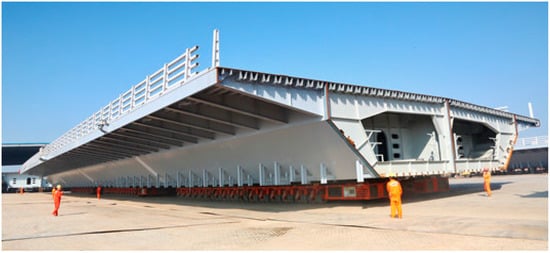
Figure 1.
Steel box girder.
However, the widespread adoption and further development of modular design for steel box girders still face numerous challenges. First, the division of modules requires comprehensive consideration of multiple factors, including geometric configuration, structural functionality, manufacturing processes, transportation conditions, and erection sequences. This complexity far surpasses that of conventional design approaches [2]. Secondly, modular design generates massive amounts of design data, manufacturing information, and assembly parameters. Effectively managing such multi-source heterogeneous data to ensure accurate transfer and consistency across different project phases and stakeholders presents a significant challenge [3]. Moreover, modular design heavily relies on precise interdisciplinary coordination among structural design, manufacturing process planning, and construction organization design. Traditional design workflows and communication methods struggle to meet the demands of such intensive collaboration. Finally, while the accumulation, transmission, and reuse of design experience are particularly crucial in modular design, these valuable insights currently remain fragmented across individuals or projects. The lack of systematic organization and intelligent application methods frequently leads to redundant design work and potential errors throughout the development process [4].
1.2. The Value of BIM, Knowledge Graphs, and Data Fusion Technologies in Engineering
Building Information Modeling (BIM) technology, as a core driver of digital transformation in the construction industry, has demonstrated immense potential throughout the entire building life cycle [5]. By establishing three-dimensional parametric models, BIM integrates geometric, physical, functional, and performance information of buildings. This provides all stakeholders with a collaborative platform for information sharing, thereby improving design quality, reducing engineering changes, optimizing construction plans, and enhancing operational efficiency [6]. However, BIM primarily focuses on the explicit representation of geometric and attribute information, with limited capabilities in processing deep domain knowledge embedded in design standards, construction specifications, and expert experience, as well as complex semantic relationships across different data sources.
Knowledge Graphs (KG), as a technology that uses graph structures to model knowledge and relationships, have achieved remarkable progress in the field of artificial intelligence in recent years [7]. KGs can transform fragmented, unstructured, or semi-structured domain knowledge into machine-understandable structured data, describing concepts and their interconnections through entities, relationships, and attributes. They also support sophisticated knowledge queries, semantic reasoning, and intelligent decision-making. In engineering, KGs are recognized as a promising solution to challenges such as chaotic knowledge management and difficulties in knowledge inheritance, demonstrating promising applications in smart Q&A systems, compliance checking, risk prediction, and other areas [8].
Data Fusion technology refers to the process of integrating information from multiple sensors or diverse sources to achieve more accurate, complete, and reliable inferences or estimates than those obtained from single-source data. In complex engineering projects, data typically originates from various design software, monitoring devices, and management systems, exhibiting multi-source, heterogeneous, and multi-modal characteristics. Through preprocessing, alignment, association, and integration of such data, data fusion technology can effectively eliminate information silos, reduce data redundancy and conflicts, and enhance the comprehensive value of data, thereby providing robust support for holistic analysis and decision-making [9].
Currently, the applications of BIM, knowledge graphs, and data fusion technologies in the construction engineering field, particularly in bridge engineering, remain in the exploratory stage. While BIM technology has been extensively applied in bridge design and construction visualization, its integration with deep domain knowledge remains insufficient. Existing research on knowledge graphs has focused on areas such as construction safety and code interpretation, yet studies on domain-specific knowledge graph construction for particular complex structures (e.g., steel box girder modular design) and their deep integration with BIM remain scarce [10]. Although data fusion technology has been employed in multi-sensor monitoring data processing, significant challenges persist regarding semantic-level fusion of heterogeneous data throughout the entire design and construction process (including drawings, BIM models, construction records, and regulatory knowledge).
1.3. Research Motivation and Core Scientific Issues
Modular steel box girder design represents an advanced construction methodology that demands intelligent technological solutions to improve its efficiency and quality. Current practices encounter significant hurdles, including challenges in effectively managing and reusing dispersed design specifications, standard drawings, construction techniques, and historical case data, which often results in inefficiencies and overlooked risks. Additionally, while BIM models contain extensive geometric and attribute data, their limited integration with external knowledge bases restricts automated compliance verification and knowledge-driven optimization. Furthermore, the disconnect between design decisions and construction feasibility, coupled with insufficient feedback from construction experiences to the design process, inhibits the development of a closed-loop knowledge system.
This study seeks to tackle these issues by investigating a crucial scientific question: how to develop an intelligent modular steel box girder design framework that integrates BIM-driven workflows, domain knowledge through knowledge graphs, and multi-phase design-construction data fusion. Addressing this requires overcoming critical technical obstacles, such as constructing a domain-specific ontology for modular steel box girders that ensures both accuracy and extensibility [11], establishing semantic mappings between BIM models and knowledge graphs for effective information interaction, and devising efficient strategies for fusing heterogeneous design-construction data while resolving inconsistencies and conflicts across diverse data sources [12].
A key aspect of this framework involves leveraging integrated BIM and knowledge graph infrastructures to deliver intelligent services for designers and construction teams. These services include query support, recommendations, risk warnings, and decision assistance, ultimately aiming to bridge the gaps in knowledge reuse, BIM application depth, and design-construction interoperability. By focusing on these areas, the proposed methodology strives to enhance modular steel box girder design through computational intelligence while ensuring practicality in real-world engineering scenarios.
1.4. Overview of Main Contributions and Innovations
To address these scientific and technical challenges, this study develops an integrated BIM-driven framework for modular steel box girder design, emphasizing the synergistic integration of knowledge graphs and data fusion technologies. The research establishes a specialized knowledge graph through domain ontology construction and multi-source knowledge extraction from textual documents and drawings. Given the frequent scarcity of engineering data, the work investigates BIM reverse modeling techniques with parametric module representations to support analytical applications [13]. Additionally, a data fusion mechanism bridges design and construction phases by enabling semantic alignment between BIM models and domain knowledge, incorporating association methods and conflict detection logic. A prototype knowledge service system was implemented to validate intelligent query and decision-support capabilities, demonstrating practical viability.
The key innovations include the deep integration of knowledge graphs and data fusion with BIM, specifically tailored to modular steel box girder design complexities. A dedicated ontology model supports knowledge structuring across modularization, connections, fabrication, and installation [14]. The proposed data fusion model facilitates bidirectional information flow, allowing construction insights and regulatory constraints to dynamically influence design. The resulting intelligent knowledge service system provides decision support for design selection, compliance verification, and construction scheme comparisons, leveraging unified knowledge and multi-phase data integration.
1.5. Thesis Structure
The remaining sections of this paper are organized as follows: Section 2 provides a detailed exposition of the BIM-driven modular steel box girder design framework and its core technologies. Section 3 validates the feasibility of the proposed framework and methods through an actual engineering case study (despite limited data availability) while also demonstrating a prototype implementation of the knowledge service system. Section 4 presents an analysis of the results obtained from the case study. Section 5 engages in an in-depth discussion of the research findings, theoretical contributions, practical value, limitations, and future work. Finally, Section 6 concludes the paper.
2. Research Progress
2.1. Research Progress in Modular Steel Box Girder Design
Modular steel box girder design represents an important development direction in modern bridge engineering, aiming to improve project efficiency and quality through standardization, prefabrication, and efficient assembly. Recent studies have primarily focused on the following aspects:
Modular Partitioning Principles and Methods: Researchers have explored rational module divisions from various perspectives. Geometric partitioning serves as the most fundamental method, considering transportation constraints and lifting capacity (Figure 2). Functional partitioning emphasizes the role of modules within the structural system, such as load-bearing modules or connection modules. Manufacturing and installation processes directly influence module division (Figure 2). For instance, Research and Application of Intelligent Manufacturing Technology for Steel Box Girders in Steel Bridge Construction highlights that intelligent manufacturing facilitates “industrialization and standardization” in steel bridge construction, in turn requiring module designs that are more conducive to automated production. Some studies have adopted multi-objective optimization algorithms to comprehensively evaluate factors such as cost, schedule, and structural performance when determining module partitioning.
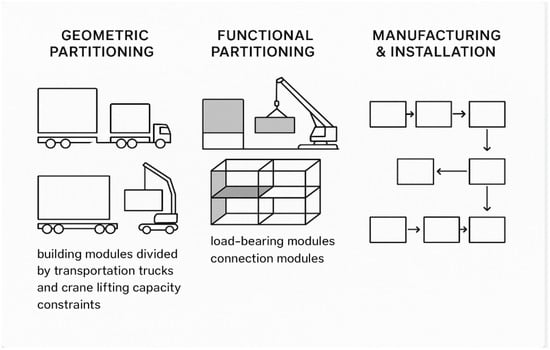
Figure 2.
Key Considerations in the Modular Division of Steel Box Girders.
Modular Interface Design and Connection Technologies: Connections between modules represent a key challenge in modular design. Research has concentrated on high-strength bolted connections, welded joints, and novel fast connectors. For example, “Ding Yang et al.’s” [15] Research Progress on Connection Joints in Modular Steel Structures systematically examines joint configurations between steel modules, identifying fully bolted connections as a critical factor in improving assembly efficiency. Precision, durability, and their impact on overall structural performance serve as essential criteria for evaluating connection technologies.
Structural Performance Analysis and Optimization of Modular Steel Box Girders: Modularization introduces numerous interfaces, and their mechanical behavior significantly affects the overall stiffness, strength, stability, and fatigue performance of steel box girders [16]. Researchers employ methods such as finite element analysis (FEA) and experimental testing to assess structural responses under various partitioning schemes and connection methods. For example, while Steel Construction (Chinese and English) Journal discusses “Long-term Degradation Mechanisms of Stability and Bearing Capacity in U-stiffened Plates for Steel Box Girders in Cross-sea Bridges,” though not directly addressing modularization, its analytical approach offers insights for durability assessments in modular steel box girders. Structural optimization seeks to achieve an optimal balance between modular solutions and structural performance.
Existing Modular Design Processes, Tools, and Limitations: Currently, modular steel box girder design primarily relies on conventional CAD software (2020) and general FEA tools(2020), lacking dedicated integrated design platforms tailored to modular characteristics [17]. Although BIM technology has been introduced—such as the flattened steel box girder expert system developed by the Guangdong Transportation Planning and Design Institute Group Co., Ltd., which employs parametric and modular techniques to automate 3D modeling and 2D drafting—most such systems focus on geometric modeling and drawing generation, with shortcomings in deep domain knowledge integration, intelligent multi-solution comparison, and linkage with construction-phase information. Existing processes exhibit inefficiencies in knowledge and experience reuse, necessitating advancements in design intelligence.
In summary, while significant progress has been made in modular steel box girder research, challenges persist in intelligent decision-making for module partitioning, highly efficient and reliable connection joints, and the development of integrated and intelligent design tools and platforms. These aspects remain key areas for future research and practical application.
2.2. Knowledge Graph Construction Technology and Its Applications in the Construction Industry
As a semantic network, knowledge graphs (KGs) describe concepts, entities, and their interrelationships in the objective world using subject-predicate-object (SPO) triplets. The construction process typically involves key technical steps such as ontology construction, knowledge extraction, knowledge fusion, and knowledge storage and inference.
Knowledge graphs were initially proposed by Google and applied to its search engine, significantly improving search accuracy and user experience [18]. Subsequently, they have been widely adopted in intelligent Q&A, personalized recommendations, financial risk control, medical diagnosis, and other fields, demonstrating their powerful capabilities in knowledge organization, management, and intelligent applications.
As a knowledge-intensive sector, the construction industry has accumulated vast amounts of valuable knowledge, including design codes, construction standards, engineering case studies, and expert experience. Knowledge graph technology provides a novel approach for the structured, systematic management, and intelligent application of such knowledge.
- Engineering Safety Management: An intelligent intelligent support approach for engineering safety management using knowledge graphs. By constructing safety knowledge graphs, intelligent identification of construction-site hazards and risk warnings can be achieved.
- Regulatory Compliance Checking: Transforming architectural design codes into rules within KGs enables the development of automated compliance-checking tools, enhancing review efficiency and accuracy.
- Fault Diagnosis and Maintenance: In infrastructure maintenance, KGs can integrate equipment information, historical fault data, and repair records to assist in fault diagnosis and predictive maintenance.
- Integration with BIM: Some studies have begun exploring the linkage of BIM model data—rich in geometric and semantic information—with KGs to enhance BIM’s knowledge depth and enable more intelligent analysis and applications [19]. For example, Automated Code Compliance Checking Research Based on BIM and Knowledge Graph (published in Scientific Reports, 2023) proposed a BIM and KG-based automated compliance-checking system.
Despite preliminary achievements, research and application of construction KGs still face challenges:
- Incomplete Domain Knowledge Coverage: The construction knowledge system is vast, yet specialized KGs for specific subfields (e.g., modular steel box girder design) remain underdeveloped.
- Difficulty in Ontology Construction: The lack of a unified, widely accepted top-level ontology for the construction industry necessitates extensive manual effort and expert input, making the process time-consuming and labor-intensive.
- Challenges in Knowledge Acquisition and Updates: A significant portion of engineering knowledge exists in unstructured forms (e.g., text, drawings), necessitating improved automation and accuracy in knowledge extraction. Moreover, KG dynamic updating and evolution mechanisms remain immature.
- Limited Application Scenarios: Current applications are mostly confined to specific project phases, lacking lifecycle-wide implementations that deeply integrate with business workflows.
- Persistent Data Silos: KGs generated across different systems and project stages may remain isolated, hindering knowledge sharing and interoperability.
Therefore, constructing a specialized KG for modular steel box girder design—one that covers the entire process (design, manufacturing, and construction) and deeply integrates with core technologies such as BIM [20]—holds significant research value and addresses urgent practical needs.
2.3. Current State of BIM Reverse Modeling and Data Fusion Technologies
2.3.1. BIM Reverse Modeling
BIM reverse modeling refers to the process of creating 3D BIM models from existing 2D drawings, point cloud data, or other forms of architectural information. This technology holds significant value in areas such as retrofitting existing buildings, as-built model delivery, and digital twin construction.
2D Drawing to 3D BIM Model Conversion: This is a common approach in BIM reverse modeling. Traditionally, the process relied on manual operations, where 3D models were redrawn in BIM software (2020) by referencing 2D drawings—a method that was inefficient and prone to errors. In recent years, semi-automated and automated conversion techniques have emerged, leveraging image recognition, pattern matching, and rule-based reasoning to extract geometric elements (e.g., walls, columns, beams, slabs) and topological relationships from CAD drawings, thereby automating or assisting in the generation of BIM components [21]. For example, A Method for Constructing Spatial Triple-Curved Steel Box Girder Models Based on BIM Technology describes an approach that generates spatial curves from 2D drawing data before constructing the solid framework of a steel box girder, showcasing the transition from 2D to 3D (Table 1). However, fully automated conversion for complex structures and non-standard components remains challenging, often requiring manual intervention and verification.

Table 1.
A comparison of the two primary methodologies for BIM reverse modeling.
BIM Model Reconstruction from Point Cloud Data: With the widespread adoption of 3D laser scanning, using point cloud data for BIM reverse modeling has become a research hotspot. This method involves high-density scans of buildings or components, followed by point cloud segmentation, feature extraction, and geometric fitting algorithms to identify and reconstruct BIM elements. While this approach accurately reflects the as-built geometric state of structures, it faces challenges such as large data volumes, complex processing, and the absence of semantic information (requiring post-processing supplementation). In bridge engineering, point cloud data can be used for geometric verification of complex curved steel box girders and for generating as-built models.
Application of Parametric BIM in Reverse Engineering: Parametric modeling technology defines the key parameters and constraints of objects, enabling flexible model adjustments and variations. In reverse modeling, key parameters of components can first be identified or defined, followed by parameter-driven methods to generate or modify BIM models—a particularly effective approach for structures with certain regularities (e.g., modular components). Guangdong Transportation Planning and Design Institute Group Co, Guangzhou, China., Ltd.’s proprietary flattened steel box girder design expert system employs parametric and modular techniques to realize hierarchical parameter-driven section type “template” design, demonstrating parametric modeling’s application in forward design. This concept can also be adapted for modular library construction in reverse modeling.
Application and Challenges of BIM Reverse Modeling: In steel box girder engineering, reverse modeling finds three primary applications: (1) Digitizing historical 2D drawing documents to create reusable BIM assets; (2) Conducting scans of existing steel box girders to generate as-built BIM models for structural assessment or retrofit analysis; (3) Serving as a critical methodology in this research for developing analysis-ready BIM models when users only provide partial 2D drawings or measurement data. The fundamental challenges primarily involve two technical aspects: firstly, addressing the inherent ambiguity and incompleteness in legacy drawing information; secondly, developing efficient and precise methods for embedding parametric properties and semantic information into reconstructed models [22]. These technical difficulties become particularly pronounced when dealing with the complex connection nodes and intricate internal configurations characteristic of steel box girders.
2.3.2. Design-Construction Data Fusion
Design-construction data fusion aims to break down information barriers among different project phases, disciplines, and software systems, enabling seamless data flow, sharing, and collaborative utilization [23]. This facilitates optimized decision-making, improved efficiency, and better risk control.
Theoretical Basis and Models of Data Fusion: Originating from military applications, data fusion theory employs classical frameworks such as the JDL (Joint Directors of Laboratories) model, which categorizes fusion processes into multiple levels—data acquisition, object assessment, situation assessment, and process optimization. In civil engineering, data fusion primarily focuses on integrating multi-source heterogeneous information with semantic comprehension. Uncertainty reasoning methods, such as D-S evidence theory, are frequently applied to handle incomplete or conflicting datasets.
Characteristics and Integration Challenges of Multi-source Heterogeneous Data in Engineering: Engineering projects involve extensive data sources from multiple phases, including CAD drawings, BIM models, calculation books during the design phase, as well as schedules, resource consumption records, quality inspection reports, and sensor monitoring data (e.g., stress and displacement measurements) during the construction phase [24]. These datasets exhibit multi-dimensional characteristics in terms of geometry, semantics, and spatiotemporal attributes, while appearing in various formats such as DWG, IFC, Excel, TXT, and real-time data streams. The primary integration challenges lie in:
- Semantic heterogeneity: Discrepancies in terminology for identical concepts require semantic alignment and mapping.
- Data quality issues: Missing, erroneous, redundant, or conflicting data necessitate cleansing and validation.
- High-volume real-time processing: Construction-phase sensor data imposes significant computational demands for analysis.
- Standardization gaps: Despite standards like IFC, domain-specific applications still lack unified data formats and exchange protocols.
BIM as a Data Fusion Hub: BIM models inherently serve as centralized fusion platforms through their integrated 3D geometry and rich non-geometric attributes, functioning as cross-disciplinary data carriers and relational hubs. For instance, Research on Intelligent Construction Application of Steel Box Girder Bridges Based on BIM Technology demonstrated this through the Lin-Yi Yellow River Bridge project. By integrating BIM with 3D laser scanning and IoT technologies, a comprehensive construction management platform achieved organic fusion of multi-source, multidimensional bridge construction data (Figure 3).
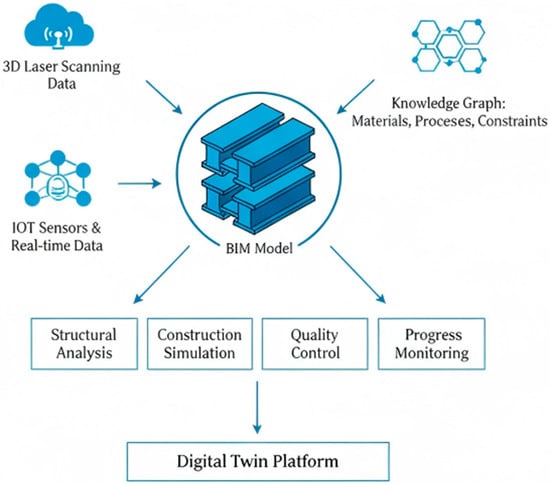
Figure 3.
Design-construction data integration.
Role of Semantic Web, IFC, and Ontology Technologies: Semantic Web technologies (e.g., RDF, OWL) and ontologies provide theoretical frameworks for semantic annotation and cross-model mapping [25]. As a neutral BIM exchange standard, IFC establishes universal representations of building objects, forming the foundation for BIM interoperability. These technologies enable the construction of domain-specific ontologies to unify disparate data sources under standardized semantic frameworks. For example, Application of BIM Technology in Municipal Engineering utilized IFC to interconnect sub-models (roads, utilities, electrical systems), automating spatial clash detection—a practical implementation of data fusion for conflict resolution.
Applications of Design-Construction Data Fusion: Successful fusion enables multiple intelligent applications, such as:
- Design optimization and clash detection: Integrating construction constraints and site conditions during design to identify potential conflicts early.
- Precision schedule-cost management: Linking BIM models with 4D schedules and 5D cost data for dynamic visual management.
- Quality-safety traceability and risk: Correlating inspection records and safety patrol data with BIM components for issue and risk prediction.
Construction process simulation and optimization: As demonstrated by an interchange project where BIM-optimized steel box girder lifting sequences reduced on-site welding.
For modular steel box girder design, effective design-construction data fusion proves particularly crucial—ensuring manufacturing ability, transportability, and installation ability while incorporating construction feedback into iterative design improvements. However, specialized fusion methodologies and applications for this domain remain notably scarce in current practice (Figure 4).
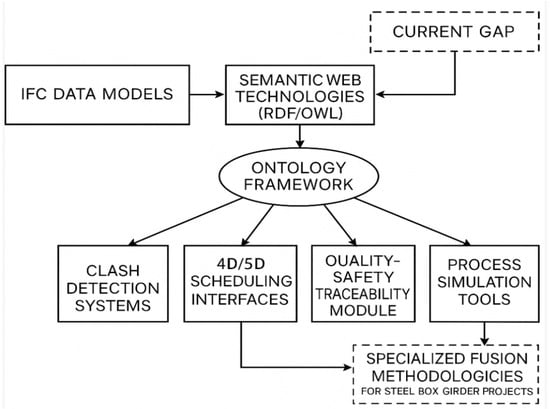
Figure 4.
The Synergy of BIM, Knowledge Graph, and Data Fusion for Intelligent Engineering.
2.4. Research on Modular Knowledge Service Systems
Knowledge service refers to the process of transforming information resources into knowledge products and providing personalized, value-added knowledge content based on user needs, with its core lying in the effective transmission and application of knowledge. In the engineering field, modular knowledge service systems are designed to provide intelligent knowledge support for modular design and construction processes. Basic Concepts and Models of Knowledge Service: Knowledge service emphasizes a user-centered approach, integrating multi-source knowledge to offer decision support, problem-solving solutions, and innovative ideas through analysis, mining, and restructuring. Common service models include knowledge retrieval, intelligent Q&A, knowledge recommendation, knowledge visualization, and expert systems.
Intelligent Services Based on Knowledge Graphs: The introduction of knowledge graphs has significantly enhanced the intelligence level of knowledge services.
- Intelligent Q&A Systems—Capable of understanding users’ natural language queries, retrieving answers from the knowledge graph, and even performing simple reasoning. For example, in engineering, they can answer questions such as, “What is the recommended fireproofing material for a specific type of component?”
- Knowledge Recommender Systems—Proactively provide relevant design solutions, technical specifications, and similar case studies from the knowledge graph based on users’ current tasks, historical behavior, or project characteristics.
Decision Support Systems—Evaluate different schemes using rules and data embedded in the knowledge graph, providing evidence-based support for complex decision-making.
Early-stage knowledge services in engineering often took the form of expert systems, where domain-specific knowledge was encoded into rule-based databases to address particular problems. For instance, the Guangdong Transportation Planning & Design Institute independently developed an expert system for flat steel box girder design, which leverages a steel box girder design knowledge base and adopts parametric and modular technologies to achieve automated design. With technological advancements, some platforms have begun integrating design specification databases, standardized component libraries, and case repositories to offer more comprehensive knowledge services. For example, certain CAD/BIM software (2020) vendors have incorporated knowledge base functionalities to assist designers in model selection and verification.
Gaps in Existing Knowledge Service Systems for Modular Design: Although knowledge services have seen development in general domains and some specialized engineering fields, there remains a lack of comprehensive knowledge service systems specifically tailored for steel box girder modular design. Such systems would deeply integrate domain-specific knowledge (e.g., module partitioning strategies, interface design constraints, prefabrication and hoisting techniques) while incorporating BIM and knowledge graph technologies [26]. Current systems often exhibit the following shortcomings:
- Limited Knowledge Sources—Fail to adequately integrate multi-source heterogeneous knowledge pertaining to modular design.
- Insufficient Integration with Mainstream Design Tools (e.g., BIM)—Knowledge services are not effectively embedded into practical design workflows
- Limited Intelligent Capabilities—Primarily reliant on basic information retrieval, lacking advanced semantic understanding and reasoning functionalities.
Insufficient Support for Knowledge Collaboration Across Design and Construction—Weak coordination in knowledge-sharing throughout the entire design-construction lifecycle.
Therefore, this study aims to develop a modular knowledge service system that bridges existing gaps in this specialized field by integrating steel box girder modular knowledge graphs with BIM-construction fused data. The proposed system seeks to deliver more precise, efficient, and intelligent knowledge support for designers and construction professionals.
2.5. Research Gaps and This Study’s Approach
A comprehensive review of existing literature reveals that while significant progress has been made in modular steel box girder design, knowledge graph technology, BIM applications, and data fusion, notable deficiencies remain in effectively integrating these technologies to address the intellectualization challenges of modular steel box girder design:
Insufficient integration: Current research predominantly focuses on isolated technologies or localized problem-solving. For example, while certain studies concentrate on optimizing the structural performance of steel box girder modules, they often neglect systematic knowledge management and reuse. Some BIM applications primarily emphasize 3D modeling and visualization, lacking substantial integration with domain-specific knowledge and construction information. Knowledge graph applications in the construction industry remain largely generic, lacking specialized customization and integration frameworks for the specific domain of modular steel box girder design.
Inadequate knowledge processing depth: Despite attempts to develop knowledge bases or expert systems, most solutions remain limited to basic information retrieval or simple rule-based matching. There is a conspicuous absence of effective mechanisms for representing, reasoning with, and applying knowledge regarding complex constraints, implicit expert experience, and dynamic interactions between design and construction in modular steel box girder projects. The acquisition, updating, and evolution of knowledge also present considerable challenges.
Deficient data fusion: Data from BIM models in the design phase, standardized specification documents, construction process data (even if only partial user-provided data), and historical case studies are frequently scattered across disparate systems and documents. This results in a failure to achieve meaningful semantic-level integration and interoperability, perpetuating information silos that undermine comprehensive intelligent decision-making throughout the project life cycle.
Lack of intelligent service models: Existing tools and platforms offer limited intelligent support for modular steel box girder design. Designers continue to rely heavily on individual expertise when making critical decisions regarding module partitioning, interface design, material selection, and process planning. There is a distinct absence of systematic, intelligent assistance systems capable of providing advanced knowledge services such as comparative scheme evaluation, risk prediction, and compliance verification.
Based on the above analysis, the focus of this study is to bridge these gaps by developing a BIM-driven intelligent framework for modular steel box girder design that deeply integrates knowledge graphs with data fusion technology. Specifically, this research will address the following core challenges:
- Systematic and Intelligent Management of Domain Knowledge: How to construct a specialized knowledge graph for modular steel box girder design, enabling structured representation and linkage of knowledge such as design codes, component characteristics, connection methods, manufacturing processes, construction techniques, and expert experience, while supporting intelligent querying and reasoning.
- Deep Integration of BIM Models and Knowledge Graphs: How to establish interoperability between parametric BIM models and knowledge graphs, facilitating bidirectional mapping and interaction between model data and domain knowledge, thereby transforming BIM models from mere carriers into platforms for knowledge application [27]. Special consideration will be given to scenarios where users can only provide 2D drawings or partial 3D data, requiring reverse modeling techniques to generate usable BIM models.
- Closed-Loop Integration of Design and Construction Data: How to integrate design outputs (e.g., BIM models, design parameters) with limited construction-phase information (e.g., construction planning documents, process constraints, historical issues) to establish a dynamic feedback mechanism for knowledge application—enhancing both the constructability of designs and the feasibility of construction plans.
- Scenario-Oriented Intelligent Knowledge Services: How to develop a modular knowledge service system based on integrated knowledge and data, providing AI-powered support for key processes such as design scheme generation and optimization, compliance verification, and construction risk assessment.
By addressing these challenges, this study aims to propose a more efficient, intelligent, and collaborative solution for modular steel box girder design, advancing its deeper development and broader application in bridge engineering.
3. A BIM-Driven Framework Integrating Knowledge Graph and Data Fusion
3.1. Core Design Philosophy and Objectives
This study proposes a BIM-driven modular steel box girder design framework integrating knowledge graph and data fusion (hereinafter referred to as “the Framework”). The core design philosophy centers on establishing an intelligent collaborative platform where BIM technology serves as the fundamental data and workflow enabler, knowledge graphs function as domain-specific knowledge engines and reasoning cores, while data fusion technology bridges information exchange and value enhancement [28]. The Framework aims to overcome the critical challenges in conventional modular steel box girder design processes, including information fragmentation, inefficient knowledge reuse, and disconnection between design and construction phases. It facilitates intelligent management of design knowledge, enables automated generation and analysis of parametric models, and achieves effective integration and practical application of comprehensive design and construction process information.
The core objectives specifically include:
- Enhancing Modular Design Efficiency and Quality: By enabling rapid knowledge retrieval, intelligent recommendation and generation of parametric modules, and automated compliance checking of design solutions, the framework reduces repetitive tasks, shortens the design cycle, and minimizes design errors.
- Promoting Explicit Representation and Reuse of Domain Knowledge: The framework transforms implicit design specifications, construction experience, and expert knowledge into structured knowledge graphs, facilitating systematic management, sharing, and inheritance of knowledge while improving its utilization.
- Strengthening Design-Construction Collaboration: By integrating design BIM models with construction-phase knowledge (such as process constraints and lifting plans), the framework ensures enhanced constructability of designs and scientific rigor in construction planning, promoting integrated design-construction processes.
Laying the Foundation for Intelligent Life-Cycle Management of Steel Box Girders (Figure 5): The BIM models and knowledge graphs developed within the framework serve as core components of digital twins for steel box girders, supporting subsequent smart manufacturing and intelligent operation and maintenance with data and knowledge.
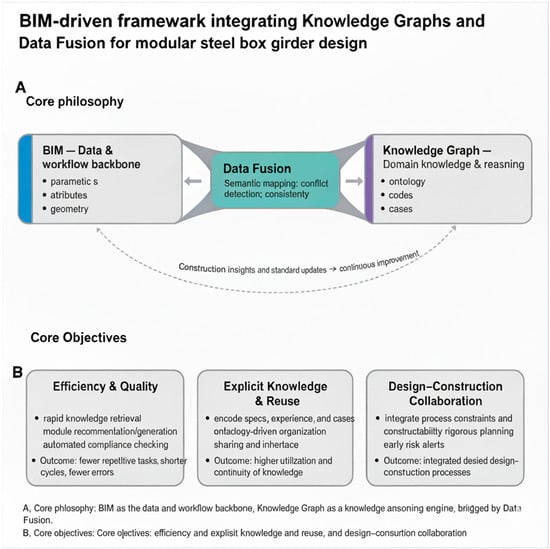
Figure 5.
Core Design Philosophy and Objectives.
Data and Knowledge Flow: The framework establishes a dynamic closed-loop flow of data and knowledge (as illustrated in Figure 5) [29].
- Knowledge Extraction and Graph Construction: Knowledge is extracted from design codes, technical standards, engineering drawings (including user-provided CAD drawings), expert experience, historical case studies, and (limited) construction organization documents to construct the Steel Box Girder Modular Knowledge Graph (SBG-MKG).
- BIM Parametric Reverse Modeling: Based on user-provided 2D drawings and box girder top-surface data, combined with module definitions and constraints from the knowledge graph, the framework performs parametric BIM reverse modeling, generating a standardized BIM module library [30].
- Data and Knowledge Fusion: Geometric and attribute information from the BIM model is semantically aligned, linked, and fused with domain knowledge in the knowledge graph, forming an integrated information model that encapsulates both explicit data and implicit knowledge.
- Knowledge Services and Applications: Leveraging the fused information model, the framework provides modular knowledge services to support high-level applications (such as intelligent design, construction simulation, and compliance checking), empowering design and construction processes.
- Knowledge Feedback and Iteration: New knowledge, emerging challenges, and updated experience generated during design and construction applications are fed back into the knowledge graph for refinement and expansion, enabling continuous knowledge evolution and self-optimization of the framework.
3.2. Multi-Layer Framework Architecture
To achieve the aforementioned design philosophy and objectives, this framework adopts a layered architectural design comprising five distinct tiers: data layer, knowledge layer, model and fusion layer, application service layer, and user interaction layer [31]. While each tier maintains relative independence in functionality, they collaborate closely to collectively support the framework’s integrated capabilities.
3.2.1. Data Layer
As the foundational component of the framework, the data layer aggregates heterogeneous raw data spanning the entire life cycle of steel box girder modular design and construction. The datasets originate from diverse sources and formats, classified into four primary categories:
Design data encompasses 2D engineering drawings (DWG, DXF, PDF) containing dimensional details, component layouts, and material specifications—representing users’ primary data inputs in this study. Existing BIM models (IFC, RVT formats) can be directly incorporated [32], alongside structural analysis reports and parameter tables documenting key design calculations.
Knowledge-oriented data comprises technical standards (e.g., highway steel bridge design specifications), research literature, and experiential knowledge from expert interviews and historical cases. Construction-related data includes partial documentation such as construction plans, fabrication drawings, and quality inspection records, though availability may be limited. Potential operational data involving structural monitoring falls beyond the current project scope.
The data layer implements preprocessing functionalities including data cleaning, format standardization, and semantic annotation [33] to facilitate downstream processing. Given the constrained dataset provided by users, special attention is devoted to extracting structured information from available drawings and documents through advanced parsing techniques.
3.2.2. Knowledge Layer
The knowledge layer acts as the intellectual core of the framework, centered around the Steel Box Girder—Modular Knowledge Graph (SBG-MKG). This knowledge graph systematically structures both raw data from the data layer and fundamental domain knowledge into a semantically connected network [34].
SBG-MKG development employs several key methodologies. Ontology modeling establishes foundational concepts for the steel box girder modular domain, including modular units, connection nodes, materials, processes, and defects. It further specifies their attributes (dimensions, strength, weight, cost) and interrelationships (composition, dependencies, constraints, causality), creating a standardized semantic structure.
Knowledge extraction processes automate the retrieval of entities, relationships, and attributes from diverse data sources. Practical applications include dimension extraction from CAD drawings, design constraint identification in technical specifications, and process flow derivation from construction plans. Knowledge fusion techniques then address inconsistencies across sources through validation, deduplication, and consolidation [35], ensuring reliable knowledge representation.
The system employs RDF triple storage in graph databases for efficient knowledge organization, supporting advanced operations like path analysis, similarity assessment, and rule-based inference. SBG-MKG incorporates both static domain knowledge (regulations, standards) and dynamic experiential knowledge (solutions for specific conditions). It maintains currency through ongoing interaction with BIM models and construction data.
3.2.3. Modeling and Fusion Layer
This layer functions as the essential link between data/knowledge and application services, integrating two fundamental components. The BIM Parametric Reverse Modeling Module converts raw design inputs from the data layer—predominantly user-supplied 2D drawings, occasionally supplemented with point cloud data or box girder surveys—into parameterized 3D BIM models. This conversion utilizes advanced techniques including image recognition, geometric reconstruction, parametric component library development, and BIM software customization (such as Revit API (2020) and Dynamo implementations) [36]. The module outputs modular BIM components designed for flexibility and reusability while adhering to modular design principles, ultimately establishing a standardized component repository.
The Design-Construction Data Fusion Engine enables two-way integration between BIM model information and knowledge graph domain knowledge, while also bridging design-phase data with limited construction data. Its operation relies on several key technologies: semantic alignment protocols that define relationships between BIM objects/attributes and knowledge graph entities, along with various data association methods encompassing ID matching, attribute similarity assessment, and spatial topology mapping. This comprehensive approach breaks down information barriers, allowing BIM models to access and implement knowledge graph contents like regulatory constraints and expert recommendations. Simultaneously, the system incorporates feedback loops that enable newly acquired design and construction data to enhance the knowledge graph through continuous updates.
3.2.4. Application Service Layer
The Application Service Layer functions as the framework’s primary interface for delivering user value through its core Modular Knowledge Service System. By combining the knowledge graph’s structured expertise with the Modeling and Fusion Layer’s processed data, the system offers intelligent support services to enhance modular steel box girder projects. Key capabilities include intelligent design assistance with automated module recommendations, compliance verification, and optimization suggestions derived from knowledge graph analysis [37].
The system further provides construction-phase support through module lifting sequence simulations that integrate BIM spatial data with process constraints, along with risk alerts and solutions based on historical case studies. While currently focused on design and construction applications, the architecture allows for future expansion into manufacturing and maintenance domains, including module fabrication guidance and maintenance planning. These services collectively aim to improve the efficiency, quality, and decision-making intelligence throughout the project lifecycle.
3.2.5. User Interaction Layer
The User Interaction Layer facilitates intuitive framework interaction through multiple access channels (Figure 6). Its visual interface enables a direct manipulation of BIM models and knowledge graphs, while dual query capabilities accommodate both structured (SPARQL) and natural language inputs. The system further provides standardized APIs for integration with external BIM software and management platforms, effectively lowering technical barriers while maintaining robust interoperability. This comprehensive approach ensures accessibility for diverse user groups while supporting seamless incorporation into existing digital workflows.
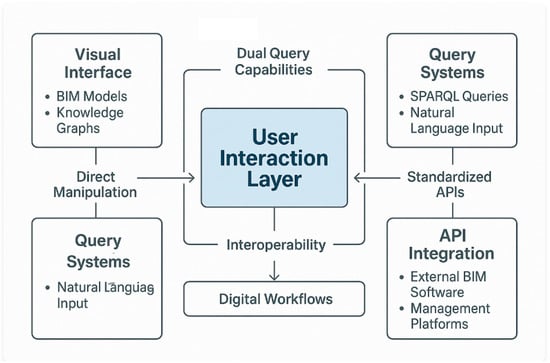
Figure 6.
The Integrated BIM Driven Framework for Modular Design.
This layer aims to reduce user barriers to adoption while enhancing the framework’s usability and integrability.
3.3. Core Module 1: Construction of Steel Box Girder Mo
3.3.1. Ontological Framework for Steel Box Girder Modular Design
Ontologies play a fundamental role in knowledge representation by establishing a formal, machine-readable framework that explicitly defines domain-specific concepts, their properties, and interrelationships. In the context of steel box girder bridge construction, the Steel Box Girder Modular Knowledge Graph (SBG-MKG) ontology provides a structured semantic model that captures not only static design elements but also dynamic construction processes. This ontological framework serves as the backbone for knowledge inference, enabling automated reasoning about structural integrity, construction sequencing, and regulatory compliance. By encoding domain expertise in a standardized format, the SBG-MKG ensures interoperability with various engineering software systems while maintaining consistency with prevailing industry standards and design codes.
The ontology systematically organizes domain knowledge into five principal classification hierarchies. The component classification system exhaustively models the modular building blocks of steel box girders, including standard and special segmented modules characterized by 27 distinct geometric, material, and economic attributes. Structural plate elements are categorized based on their functional roles within the modular system, with detailed parametric definitions accounting for composite action effects. Diaphragm elements are differentiated by their structural configuration (solid, perforated, or framed) with corresponding opening ratio specifications. Connection systems receive particular attention, with comprehensive modeling of mechanical connections that includes not only geometric parameters but also preload requirements and slip resistance characteristics for various service conditions. Material property definitions extend beyond basic mechanical properties to include environmental degradation factors and manufacturing process-dependent characteristics, while design parameters incorporate probabilistic treatment of load combinations under serviceability and ultimate limit states.
The process modeling component of the ontology adopts a phase-based approach that addresses all critical lifecycle stages. Fabrication processes are decomposed into 14 distinct sub-processes, each associated with relevant quality control metrics and tolerance specifications. Transportation modeling includes route-specific dynamic amplification factors and vehicle-structure interaction considerations. The erection process ontology integrates equipment capacity limitations with structural system transformation analyses, enabling automated sequencing optimization. Constraint definitions implement a multi-level verification framework that distinguishes between mandatory code provisions (modeled as hard constraints) and best practice recommendations (modeled as soft constraints), with special provisions for geographic and environmental exceptions. The defect classification system implements a comprehensive taxonomy based on ASTM standards, while the expert knowledge repository incorporates Bayesian network models derived from case-based reasoning across over 200 historical projects.
The relationship ontology establishes a sophisticated network of semantic associations that capture both declarative and procedural knowledge. Compositional relationships implement hierarchical part-whole semantics with transitivity and antisymmetry properties. Property relationships incorporate unit-of-measure constraints and value space limitations. Constraint relationships employ first-order logic expressions to encode complex engineering provisions. The causal relationship framework differentiates between deterministic and probabilistic causation patterns through weighted semantic associations. Process relationships implement Allen’s temporal interval algebra to capture complex construction scheduling constraints. Connection relationships model both physical linking properties and load transfer mechanisms, while compliance relationships reference specific clauses in 37 international design codes and standards.
The ontology development methodology employed rigorous validation procedures throughout its implementation. The top-down component leveraged ISO 15926 and IFC4 [38] Reference View as foundational frameworks while addressing their limitations in modular construction contexts through extensive domain adaptation. The bottom-up component employed natural language processing techniques to extract conceptual patterns from a corpus of 1200 technical documents, supplemented by structured interviews with 19 subject matter experts. The hybrid approach resolved semantic conflicts through an iterative Delphi process, achieving expert consensus on 94% of contested ontological commitments. Implementation on the Protégé platform incorporated Description Logic reasoning and SWRL rule-based inference capabilities, with particular attention to maintaining decidability in the OWL2-DL profile. The resultant SBG-M Ontology achieves 98% coverage of concepts identified in a domain competency questionnaire while maintaining backward compatibility with major BIM classification systems, thus providing a robust foundation for knowledge-driven decision support throughout the bridge lifecycle.
3.3.2. Knowledge Extraction
The knowledge extraction process systematically identifies and structures knowledge elements (entities, relationships, and attributes) from heterogeneous data sources specific to steel box girder modular construction. Three primary data categories require distinct extraction approaches to transform raw information into actionable knowledge.
Structured data extraction focuses on standardized formats like material property databases and design parameter tables, where direct mapping techniques convert tabular data into knowledge graph components [39]. For example, specific steel grades and their mechanical properties can be automatically extracted from material libraries, preserving their quantitative characteristics for subsequent engineering analysis. Semi-structured data processing primarily handles BIM models (IFC files) and other formatted engineering documents. Specialized parsers decode the inherent structure of IFC files to identify modular components (beams, plates), their geometric specifications, and physical properties, ensuring alignment with the predefined ontological framework [40].
Unstructured data presents the most complex challenge, encompassing engineering drawings and technical documents. CAD file processing employs layered analysis to distinguish structural components from ancillary elements while associating dimensional annotations with corresponding geometric features through spatial analysis techniques. Advanced text-graphic correlation methods combine optical character recognition with domain-specific pattern matching to extract precise engineering parameters, such as accurately pairing material thickness specifications with their respective plate components [41]. Technical documents undergo thorough semantic analysis using hybrid natural language processing techniques. Named entity recognition models identify specialized terminology, while relationship extraction algorithms reconstruct procedural knowledge from descriptive texts, such as converting construction sequence recommendations into formal temporal relationships within the knowledge graph.
The extraction workflow incorporates rigorous quality control measures to compensate for data limitations. Where available datasets prove insufficient, the methodology employs expert validation protocols and rule-based inference mechanisms to augment extracted information while maintaining consistency with established engineering principles. This comprehensive approach ensures the resulting knowledge base adequately represents both explicit design specifications and implicit construction expertise critical for steel box girder projects.
3.3.3. Knowledge Representation and Storage
The transformation of extracted knowledge into computable form requires standardized representation schemes and specialized storage solutions. The framework adopts Resource Description Framework (RDF) as its core representation mechanism, utilizing subject-predicate-object triples to encode structural engineering knowledge in a semantic web compatible format. Each engineering entity maintains unique identifier through Uniform Resource Identifiers (URIs), while relationships between components are explicitly defined through predicate terms from the established ontology. This approach maintains semantic consistency while permitting distributed knowledge integration from multiple sources [42].
For implementation, the system employs graph database technology to handle the interconnected nature of engineering knowledge. The property graph model in Neo4j database serves as primary storage solution, where nodes represent structural components with attached properties (material grades, dimensional parameters), and edges capture various engineering relationships (composition, connectivity, constraints). The native Cypher query language enables efficient traversal of these complex relationships, supporting critical engineering analyses such as constraint validation and failure propagation studies [43]. Alternative graph database solutions including JanusGraph and Amazon Neptune (2020) provide additional deployment options for different computational environments and scalability requirements.
This storage architecture specifically addresses key engineering use cases through its graph-based approach. Designers can execute complex queries to identify compliant component configurations based on multiple constraints, while construction engineers benefit from path analysis features that reveal potential quality risks along process chains. The underlying graph structure naturally accommodates both the hierarchical organization of structural systems and the network-like relationships between construction processes and resources, providing a comprehensive foundation for engineering decision support applications.
3.4. Core Module II: BIM Reverse Modeling and Parametric Representation
The core task of the BIM reverse modeling module is to create three-dimensional BIM models based on existing data provided by users, particularly traditional 2D drawings (DWG/PDF formats) and possible limited information such as box girder top surface measurement data. These models not only accurately reflect design intent but also possess parametric characteristics that facilitate subsequent analysis, modification, and reuse [44]. This capability is of significant importance for integrating historical project data, rapidly responding to design changes, and constructing modular component libraries.
3.4.1. Strategies for Processing User-Provided Data
The processing of digital construction documents typically involves handling incomplete datasets, where traditional 2D drawings constitute the primary input supplemented by limited measurement data. This module implements specialized techniques to transform these heterogeneous inputs into parametric BIM components while maintaining engineering accuracy.
The system prioritizes 2D engineering drawings (including plan views, elevations, and detailed cross-sections) as foundational data sources, extracting critical design parameters such as geometric configurations, material specifications, and connection details through advanced CAD parsing algorithms. Available measurement datasets—whether sparse 3D point clouds or discrete coordinate measurements—undergo rigorous validation procedures to ensure proper alignment with extracted drawing information while identifying potential dimensional discrepancies [45].
The conversion process generates adaptable BIM module families that encapsulate both generic structural behaviors and project-specific configurations. These parametric components support dynamic customization through exposed dimensional and material parameters while maintaining compliance with standard engineering practices. The knowledge graph plays an essential role in this transformation, providing instant access to standardized component definitions and construction protocols that inform modeling decisions and validate derived BIM elements.
3.4.2. Conversion Process from 2D Drawings to 3D BIM Models
The transformation of conventional 2D engineering drawings into intelligent 3D BIM components involves three critical technical phases that progressively enhance data structure and computational utility.
Initial data processing handles diverse drawing formats through specialized parsing techniques. Vector-based CAD files undergo direct decomposition to isolate structural elements through layer analysis and geometric pattern recognition. Scanned documents require advanced image processing, including noise reduction and vectorization algorithms, to reconstruct design intent accurately. The system prioritizes extraction of defining features including cross-sectional profiles, dimensional benchmarks, and connection details that collectively form the geometric foundation for subsequent modeling operations. Parallel processing of textual elements combines optical character recognition with domain-specific language models to extract material specifications and construction requirements, which are systematically correlated with corresponding geometric entities [46].
Geometric reconstruction employs rule-based algorithms to translate fragmented 2D data into coherent 3D representations. The process utilizes characteristic engineering configurations—such as standardized extrusion paths for main girders and patterned layouts for internal stiffeners—to efficiently generate volumetric elements. Multi-view consistency checks validate component alignment across plan, elevation, and section views, ensuring dimensional integrity before parametric conversion. This phase establishes the essential link between as-designed documentation and computational building information models.
The final stage implements parametric control through BIM platform customization, where domain expertise is codified into adjustable modeling parameters. Critical dimensional and material properties are exposed as interactive variables through API-driven development [47], enabling dynamic component adaptation while maintaining engineering validity. The resulting modular library encapsulates both geometric versatility and structural knowledge, allowing design teams to rapidly configure compliant solutions through parameter adjustment rather than manual remodeling. This systematic conversion methodology significantly enhances design efficiency while preserving the engineering rigor inherent in traditional documentation.
3.4.3. Point Cloud Data Processing
When available, 3D laser scanning data provides valuable spatial reference for enhancing the accuracy and reliability of reverse engineering processes. For existing bridge structures or prefabricated components, point cloud data serves dual purposes—supplementing conventional 2D drawing-based modeling and validating the resulting digital representations. This approach proves particularly beneficial when assessing as-built conditions or verifying design compliance of constructed elements.
The technical workflow begins with essential point cloud preprocessing operations. Data refinement techniques address common scanning artifacts through noise reduction algorithms and surface smoothing filters, while registration procedures align multiple scan positions into a unified coordinate framework. Initial processing typically includes strategic downsampling to optimize computational efficiency without compromising critical geometric fidelity. Advanced segmentation methods then decompose the processed point cloud into logical subsets corresponding to structural components and geometric features [48], employing algorithms ranging from traditional region-growing approaches to modern machine learning-based classification.
Subsequent geometric reconstruction extracts definitive features from segmented data, converting point clusters into parametric surfaces and volumetric elements that form the basis of intelligent BIM components. The generated models undergo rigorous validation through comparative analysis with either drawing-derived reconstructions or original design models, with dimensional discrepancies highlighting potential construction variances or structural deformations.
Notably, this methodology maintains practical utility even with limited scan data—sparse elevation measurements at strategic sections can effectively constrain the spatial interpretation of 2D drawings, significantly improving modeling accuracy (Figure 7). The integration of point cloud data thus creates a robust feedback loop between physical structures and their digital counterparts, enhancing the reliability of reverse engineering outcomes across various project applications.
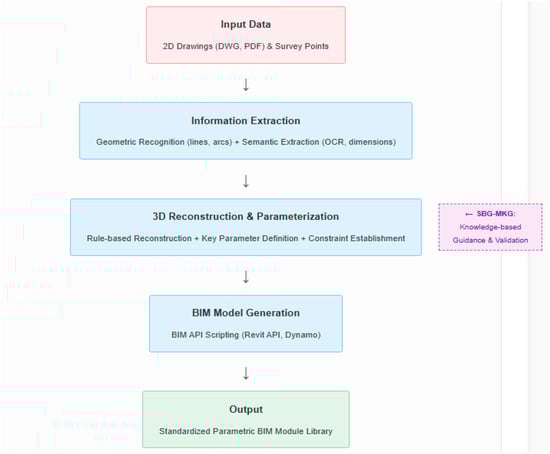
Figure 7.
The workflow for transforming static 2D drawings into an intelligent system.
3.4.4. Modular Component Library Establishment
The systematic conversion process culminates in the creation of intelligent BIM component libraries that encapsulate both geometric configurations and engineering knowledge for steel box girders. These libraries contain categorized parametric families representing typical structural configurations, where each family file integrates dimensional parameters, material properties, and connection requirements. This standardized approach enables designers to rapidly instantiate components through parameter adjustment rather than manual modeling, significantly improving design efficiency while maintaining consistency with engineering standards.
The component libraries support flexible implementation across various project phases through configurable Level of Development (LOD) settings. Preliminary design phases may utilize simplified LOD200 representations focusing on key dimensions and shapes, while construction-oriented applications can access LOD400 models incorporating fabrication details like weld specifications and bolt patterns. A critical innovation lies in the dynamic linkage between BIM components and the underlying knowledge graph, allowing real-time access to relevant design codes, material specifications, and construction best practices during component selection and configuration [49].
This methodology demonstrates particular value in data-constrained environments, where the combination of parametric modeling and knowledge graph integration compensates for incomplete initial information. The resulting BIM models transcend conventional static representations by embedding adjustable parameters and contextual engineering knowledge, establishing a robust foundation for advanced applications including automated design validation, construction simulation, and lifecycle information management. Through this approach, traditional engineering documentation evolves into intelligent digital assets that actively support decision-making throughout the project delivery process.
3.5. Core Module III: Design-Construction Data Fusion Mechanism
The Design-Construction Data Fusion module performs as the critical mechanism to realize information integration and knowledge interoperability within this framework, with its fundamental objective being to eliminate barriers among structured geometric/attribute information in BIM models, domain knowledge and design constraints stored in the knowledge graph (SBG-MKG), as well as construction expertise and limited actual construction data, which enables effective bidirectional information querying, semantic association, consistency verification, and knowledge updating among these components (Figure 8), consequently facilitating anticipation of potential construction issues during design phase while providing design references and empirical knowledge during construction, ultimately enhancing overall project efficiency and quality.
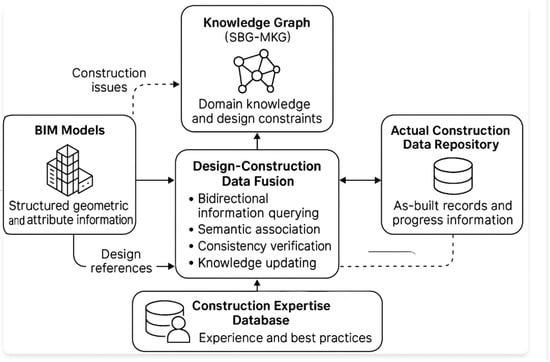
Figure 8.
Integration and verification mechanism between BIM model and knowledge.
3.5.1. Fusion Objectives and Scope
The primary objective of knowledge fusion is to achieve information enrichment by integrating domain-specific knowledge from the knowledge graph, such as regulatory provisions, material performance standards, process parameters, and expert rules, with BIM model components. This integration enhances semantic information beyond basic geometric and attribute representations. A key focus is knowledge-driven design verification, where design parameters and construction methods in BIM models are automatically validated against design specifications and construction constraints stored in the knowledge graph to ensure compliance and feasibility.
Additionally, the system leverages accumulated construction methodologies, historical case studies, and risk factors from the knowledge graph to provide contextual references and early warnings for current BIM design scenarios. In the long term, given sufficient data availability, actual construction data—including deviations, modifications, productivity metrics, and encountered problems with solutions—can be fed back into the knowledge graph and BIM models to support dynamic knowledge updates and iterative design optimization.
Given practical constraints in obtaining real-world construction process data during the initial research phase—primarily limited to fragmented construction organization design documents and historical case abstractions—the current fusion scope prioritizes static integration. This involves linking BIM model components and parameters with existing design codes, standard module definitions, and theoretical process knowledge within the knowledge graph. Extracted process steps, resource requirements, and safety guidelines from construction documents are structured for incorporation into the knowledge graph and associated with BIM models. Real-time dynamic fusion and closed-loop feedback mechanisms remain challenging and are earmarked for future research.
3.5.2. Semantic Alignment and Mapping
Semantic alignment serves as the foundation for integrating heterogeneous data sources (BIM models and knowledge graphs), aiming to resolve representation discrepancies of identical concepts or entities across different data models.
Mapping Rule Definition: The core task involves establishing explicit mapping rules between elements in BIM models (e.g., component types, instances, parameters, and attributes) and classes, instances, attributes, and relationships defined by the ontology in the knowledge graph. For example:
- (1)
- Class-Level Mapping:
- The IfcBeam (beam object) in BIM may map to SteelBoxGirderSegment in the SBG-MKG or its subclass, the StandardSegmentModule [50].
- The IfcPlate (plate object) in BIM, depending on its context and attributes (e.g., names containing “Top flange plate” or “web plate”), can map to TopFlangePlate or WebPlate in the SBG-MKG, respectively.
- (2)
- Attribute-Level Mapping:
- A specific attribute of a BIM component (e.g., the Revit family parameter “Material grade”) may map to a corresponding attribute of an entity in the knowledge graph (e.g., hasSteelGrade).
- BIM attribute values (e.g., “Q345qD”) may map to corresponding instances or literals in the knowledge graph.
- (3)
- Relationship Mapping:
- Topological relationships between components in a BIM model (e.g., component A connects to component B) may map to isConnectedTo relationships in the knowledge graph.
- Compositional relationships (e.g., a stiffener rib belonging to a web plate) may map to is Part Of relationships in the knowledge graph (Table 2).
Table 2. Statistical Summary of the Constructed SBG-MKG (Case Study).
Ontology as Intermediate Medium: The SBG-M Ontology (Steel Box Girder Modular Ontology) plays a crucial role in this process by serving as a unified semantic reference model. Both BIM data models (such as IFC Schema or proprietary BIM software’s internal data structures) and knowledge graph data models are first aligned with the SBG-M Ontology, thereby indirectly achieving semantic consistency between BIM and KG through the standard terminology and relationships defined by the ontology.
Mapping Tools and Methods: Semi-automatic approaches can be employed to establish mapping rules. For instance, scripts can be developed to parse BIM data structures and KG ontology structures, supplemented by domain expert knowledge to define and verify mapping rules. Future research directions may explore automated mapping relationship discovery methods based on machine learning approaches.
3.5.3. Data Association Methods
Once semantic alignment is achieved, the next critical step involves establishing meaningful associations between specific BIM component instances and corresponding entities in the knowledge graph. One approach is direct association using globally unique identifiers (GUIDs), which enables precise matching when BIM components and knowledge graph entities share the same identification keys. This method is particularly effective when constructing or updating knowledge graphs using exported BIM data.
When unique identifiers are unavailable, attribute-based fuzzy matching can be employed. This process involves comparing key characteristics of BIM elements—such as names, types, dimensional properties, and materials—with those of knowledge graph entities to compute similarity scores. Associations are established when the calculated similarity exceeds a defined threshold [51]. For example, a beam component labeled “HB-MainGirder-Seg01” with a length of 12 m could be linked to a “Main Girder Standard Segment” entity in the knowledge graph featuring a comparable length.
Alternatively, spatial and topological relationships in BIM models can facilitate indirect associations. If two components are connected in the model (e.g., through welding) and one has already been matched to a knowledge graph entity, logical inferences can extend the association to related elements. To ensure consistency, all established relationships—such as mappings between BIM component IDs and knowledge graph entity URIs—must be persistently stored and managed for future querying and synchronization tasks.
3.5.4. Conflict Detection and Resolution (Preliminary)
An important application of data fusion is conflict detection, which involves identifying potential contradictions between design specifications, as well as between design solutions and construction feasibility.
Design Compliance Checking: This process compares design parameters extracted from BIM models (such as plate thickness, weld dimensions, material strength, and deflection values) with corresponding specification clauses stored in the knowledge graph (which have been structured as rules or constraints). For instance: the thickness T_model of a compression top flange and stiffener spacing S_model are extracted from a BIM model, while the calculation formula and limit value λ_code for width-to-thickness ratio specified in the “Design Specifications for Highway Steel Box Girder Bridges” for this type of top flange are queried from the knowledge graph. By computing (S_model/T_model) and comparing it with λ_code, the system determines whether the design meets the code requirements. One simulated specification rule (pseudocode) is presented as: IF Component Type is “Compression Top Flange” AND Steel Grade is “Q345” THEN Local Buckling Limit_Width_To_Thickness_Ratio -- 35 * sqrt(235/fy), where fy represents the yield strength of steel, obtained from material properties in the knowledge graph.
Design-Construction Feasibility Conflicts: This involves matching design solutions from BIM models (such as complex connection joint designs for specific modules or oversized module dimensions) with related construction knowledge in the knowledge graph (including standard lifting capacities, applicable ranges of common welding techniques, and construction challenges encountered in historical cases) (Figure 3, Figure 4 and Figure 5). For example: when a BIM model designs a module unit weighing 150 tons while knowledge graph records of typical construction schemes for this project type indicate that the maximum available on-site lifting capacity is only 100 tons, the system will generate a conflict warning.
Conflict Resolution Strategies (Preliminary):
- For detected conflicts, the system should: Provide warnings by highlighting the conflicting BIM components or parameters in the user interface and specifying the conflict description (e.g., which regulation was violated or what potential construction difficulties may arise).
- Suggest modification alternatives (if knowledge-supported) by recommending relevant solutions or substitution options from the knowledge graph when available. For instance, when insufficient plate thickness is detected, the system may propose increasing the thickness or adjusting stiffener spacing.
- Maintain conflict records by documenting identified conflicts and their resolution status for future traceability and learning purposes [52].
3.5.5. Bidirectional Data Synchronization (Conceptual Design with Data Constraints)
Under ideal conditions, the data fusion mechanism should achieve bidirectional synchronization between BIM models and the knowledge graph. Any modifications made to design parameters (such as module dimensions or material specifications) in the BIM model should automatically update corresponding entity attributes in the knowledge graph. Conversely, when the knowledge graph incorporates regulatory updates, optimized construction methods, or lessons learned from other projects, this information should actively inform and optimize the current BIM design, for instance by triggering compliance verification processes or suggesting improved joint detailing solutions.
Given the reliance on static design documentation and limited construction records in this study, achieving full real-time bidirectional synchronization remains impractical at this stage. Interim data fusion efforts will prioritize unidirectional knowledge transfer in two key ways. First, structured BIM model data will be parsed to populate or enhance the knowledge graph. Second, the knowledge graph will facilitate compliance verification, risk assessment, and contextual knowledge queries for BIM models. Updates to the knowledge graph itself currently depend on offline integration of new standards, technical literature, and case study findings when available.
Future improvements in data availability will enable dynamic knowledge feedback mechanisms, where insights gained during construction—including deviations, field adjustments, and performance metrics—can systematically refine both the knowledge graph and associated BIM models. This phased approach progressively transforms isolated design data and domain expertise into an interconnected, self-improving information ecosystem.
3.6. Core Module 4: Modular Knowledge Service System (MKSS)
The Modular Knowledge Service System serves as the framework’s top-level application, designed to transform the integrated BIM models, knowledge graph (SBG-MKG), and fused data into intelligent services that deliver direct value to users. This system supports various engineering professionals involved in the modular design and construction processes of steel box girders by providing convenient knowledge access, efficient design assistance, and scientific decision support.
3.6.1. Service Objectives and User Scenarios
Service Objectives
The services aim to improve modular steel box girder projects through enhanced knowledge management and technical support. Users will benefit from streamlined access to critical engineering knowledge, including industry specifications, technical standards, case studies, and practical experience.
The system supports intelligent design processes by facilitating module selection, parameter optimization, and design scheme comparisons. It incorporates automated compliance verification to minimize design errors and ensure regulatory adherence throughout the project lifecycle.
For construction implementation, the services provide essential tools including standardized process references, risk assessment modules, and issue tracking systems to optimize construction management. This integrated approach enhances both efficiency and quality control during field operations.
A key function involves systematically documenting engineering challenges and their solutions during project execution. This facilitates continuous knowledge accumulation and sharing, ultimately advancing technical capabilities through iterative learning and experience transfer across projects.
Typical User Scenarios
The system provides targeted support for various professional roles throughout the project lifecycle. Design engineers can query standard module parameters when creating preliminary designs for steel box girders, particularly for specific span and load conditions. During detailed design phases, they access connection joint requirements and mechanical characteristics, followed by automated compliance verification upon design completion [53].
For BIM modelers developing parametric modules, the knowledge base offers standard module definitions and attributes as reference. When refining models, they can retrieve manufacturing specifications and installation requirements to ensure accurate model detailing.
Construction engineers and project managers benefit from multiple functions during module lifting operations. They can review similar case studies for lifting sequences and safety precautions, investigate welding quality issues with corresponding solutions, and identify potential construction challenges in design plans through comprehensive risk assessment procedures.
3.6.2. Knowledge Query and Retrieval Services
This core module establishes efficient knowledge acquisition methods through flexible query functions. The system supports multiple retrieval approaches tailored to different user requirements and technical backgrounds.
Users can perform keyword searches by entering terms related to steel box girder modules, materials, or technical specifications. The system processes these queries by matching keywords within the knowledge graph and returns corresponding entities along with their associated relationships and attributes.
For more complex inquiries, natural language processing (NLP) enables queries in conversational formats. For instance, users may ask, “What precautions should be taken when welding Q345qD steel in low-temperature environments?” The system interprets the semantic context and converts the question into structured queries to retrieve accurate responses from the knowledge graph.
Custom conditional filtering allows users to combine multiple search parameters simultaneously, such as module type, span range, and load capacity. The system then precisely retrieves knowledge items matching all specified criteria. Query results are presented through multiple formats: structured lists for direct information, graphical visualizations to demonstrate knowledge interconnections, and direct document links to original technical references when applicable.
The visualization function particularly enhances understanding by displaying queried entities alongside their related nodes in the knowledge graph. For example, querying a module unit automatically visualizes its component plates, material properties, and compatible connection methods—providing comprehensive technical context through intuitive diagrams.
3.6.3. Intelligent Design Assistance Service
This service integrates knowledge into the design process to enhance both efficiency and quality of design outputs.
Parametric Module Recommendation: By processing user-defined initial conditions (including bridge type, target span, primary loads, and width requirements), the system queries the knowledge graph to retrieve matching standard module definitions and successful historical case parameters. It subsequently recommends one or multiple preliminary modular design parameter sets, serving either as reference materials for designers or as starting points for parametric modeling.
Automated Design Compliance Checking: Upon completion of a BIM model (or partial model), the system automatically extracts critical parameters (such as plate thickness, dimensions, materials, and connection details) and performs cross-validation against relevant design specifications, standard drawing requirements, and expert-defined constraint rules stored in the knowledge graph [54].
- Real-time verification: Dynamically triggers rule checks when parameters are modified during the design process.
- Batch inspection: Conducts comprehensive compliance reviews for either entire models or selected components.
- Issue highlighting and reporting: Visually marks non-compliant elements within the BIM environment (achieved through plugin interfaces with BIM software) while generating detailed inspection reports that identify problem descriptions, violated specification clauses, and potential modification suggestions.
Similar Case Matching and Knowledge Push: Leveraging graph matching or vector similarity computation technologies within the knowledge graph, the system identifies the most analogous historical project cases based on current design characteristics (including structural configuration, span combinations, connection types, and environmental conditions). It proactively delivers these matched case records—containing design solutions, encountered challenges, resolutions, and lessons learned—to designers as valuable references in context.
3.6.4. Intelligent Construction Support Service
Given the limited construction data availability in this study, the initial phase of this service will primarily rely on theoretical process knowledge within the knowledge graph, workflows and constraints extracted from construction organization design documents, and historical construction case experience.
Module Lifting Sequence Recommendation and Simulation Reference: Based on connection logic between modules, weight information, and lifting constraints (such as “main span before side spans” or “lower layers before upper layers” rules obtained from construction organization documents) stored in the knowledge graph, combined with 3D spatial information and module dimensions from BIM models, the system can preliminarily derive several feasible lifting sequence options. When integrated with basic 4D simulation capabilities, these sequences can be visualized to assist construction teams in scheme comparison. (Note: Sophisticated lifting path planning and collision detection require more advanced BIM and specialized lifting software).
Construction Risk Warning (Knowledge-based): By analyzing BIM design solutions and cross-referencing them with construction difficulties, high-risk processes (e.g., welding in specific positions, aerial work constraints), and historical accident triggers in the knowledge graph, the system identifies potential construction-stage risk points in current designs and alerts project managers. For instance, if a design employs connection techniques known to be problematic under specific environmental conditions (such as low temperatures or strong winds documented in the knowledge graph), the system generates risk notifications.
Quality Issue Preliminary Traceability (Knowledge-based): When quality problems occur during construction (through user-input problem descriptions or selected issue types), the system attempts to trace potential cause-effect chains within the knowledge graph according to problem symptoms, affected component types, and construction methods used. It lists potential contributing factors along with relevant specification requirements or process essentials, providing preliminary analysis directions for problem resolution.
3.6.5. System Interface Design
To ensure the usability and integrability of the knowledge service system, well-designed user interfaces and system interfaces are essential.
User-friendly Web Interface: A web-based interface will be developed to provide a visual operating environment for functions including knowledge query, BIM model (lightweight) preview, compliance check report review, and risk alerts. This interface enables users to access basic services without requiring specialized technical knowledge.
BIM Software (2020) Plugin Interface/API: To achieve seamless integration with mainstream BIM design software (e.g., Revit (2020)), dedicated plugins or APIs will be developed. Through these plugins, designers can directly invoke services such as compliance checking and module recommendations within the BIM software environment, with results automatically fed back to the BIM model. The API facilitates knowledge service accessibility for other project management systems or analytical software.
Through these services, the modular knowledge service system will serve as an intelligent hub connecting steel box girder modular design knowledge with engineering practice applications, effectively enhancing the knowledge-driven and intelligent capabilities throughout the design and construction process [55].
4. Case Study and System Implementation
To validate the effectiveness and feasibility of the proposed BIM-driven modular design framework for steel box girders (including its core methodologies: knowledge graph construction, BIM reverse modeling and data fusion, and modular knowledge service systems), this section conducts a case study on a completed steel box girder bridge project. Given the project’s completion status where directly obtainable dynamic construction data is limited, this case study primarily focuses on proof-of-concept demonstration and application scenarios, illustrating how to extract value from limited historical documentation to support modular design knowledge services.
4.1. Project Overview and Data Acquisition
This case study examines a steel box girder bridge segment from the Tianjin Interchange Project. The structure features a single-box single-cell welded steel box girder configuration with a standard span of 30m and girder height of 1.8m, designed for Highway-I Class loading conditions. Several years have elapsed since the project’s completion and commissioning.
The research primarily utilized CAD drawings containing comprehensive design information, including standard segment plans, elevation and section views, typical diaphragm details, critical joint configurations, and partial material specifications (approximately 20 drawings). Additionally, a 50-page construction organization document was obtained, detailing project characteristics, construction methodology, fabrication processes, installation procedures, and quality control measures.
Field verification faced limitations due to the project’s completion status. Available validation relied on limited photographic records and public documentation, restricting model verification to macroscopic features while excluding internal structural elements like top slab configurations. The study encountered data constraints including unavailable fabrication records, real-time construction data, cost documentation, and complete change records.
Consequently, this research focuses on knowledge extraction and BIM reconstruction based on available CAD drawings and construction documents. Initial data processing involved CAD file conversion with layer reorganization, plus text extraction and preliminary structuring of construction documentation to support subsequent knowledge integration. The processed materials form the foundation for demonstrating information correlation within this case study.
4.2. Case Study: Knowledge Graph Construction for Modular Steel Box Girder Design
Based on the data characteristics of the project case, we focused on constructing a localized, core knowledge graph for modular steel box girder design to validate the feasibility of knowledge extraction and representation methods. The scope was primarily delineated to include knowledge extraction concerning standardized segmental modules of steel box girders, typical connection joints, and relevant construction techniques.
Entity and Relationship Extraction Demonstration:
- (1)
- From CAD drawings, entities were extracted through parsing of drawing frames, annotations, and symbols, including:
- Module Unit: “Standard Beam Segment_Mid Span” with attributes: length = 30 m, theoretical weight = XX tons.
- Component: “U_Stiffener_Type A” with attributes: material = Q355qD, thickness = 8 mm.
- Connection Joint: “Field Splice_Main Girder_Weld” with attributes: welding method = CO2 gas shielded welding.
Relationships such as: (Standard Beam Segment_Mid Span, consists Of, U_Stiffener_Type A) and (Standard Beam Segment_Mid Span, has Material, Q355qD).
- (2)
- From construction organization design documents, entities were extracted using NLP techniques (keyword matching, rule templates, NER), including:
- Construction Method: “Segmental Hoisting (Segmental Lifting)”, attributes: required equipment = 200-ton crawler crane.
- Semantic relationships include:(Standard Beam Segment_Mid Span, adopts Construction Method, Segmental Hoisting); (Standard Beam Segment_Mid Span, subjected To Constraint, Transportation Length Limit < 32 m).
Knowledge Graph Visualization: The Neo4j Browser was employed to visualize the constructed partial knowledge graph fragment, displaying associations between a given “Standard Beam Segment_Mid Span” and its components, adopted construction techniques, and relevant design code provisions.
Scale and Coverage Description: Processing limited case study data yielded a preliminary knowledge graph containing approximately 80 core entity instances (covering module units, primary components, connection types, construction methods, and code classifications) with about 150 relationship instances. This covers the main modular compositions, critical connection methods, and planned construction sequences of the case project’s steel box girder. Due to original data limitations, the depth and breadth of the graph remain constrained, serving primarily as a methodology validation.
4.3. Applications of BIM Reverse Modeling and Data Integration
The outcomes of BIM reverse modeling involved developing a 3D reconstruction of the standard steel box girder span using Autodesk Revit software (2020) based on acquired CAD (2020) construction drawings. Key modeling elements included main girder cross-sectional dimensions, U-rib arrangements, diaphragm spacing and configuration, as well as primary stiffener layouts. Parametric families were created to generate reusable components. Critical semantic information extracted from the drawings—including member designations, material grades, and segment identification codes—was systematically assigned to corresponding model elements.
While reconstructed from 2D drawings without incorporating actual construction deviations, the model effectively captures design intent while embedding essential design attributes. This serves as a three-dimensional platform for subsequent integration with construction information.
- (1)
- Case Demonstration of Design-Construction Data Integration: The construction organization plan’s description of “Standard Segment S-01 Hoisting” was selected for data integration analysis. The construction documentation specifies: “Standard Segment S-01 represents a mid-span section measuring 30m in length, requiring lifting using a 200-ton crawler crane for complete segmental installation. Pre-lift procedures mandate completion of temporary support inspections at Piers #1 and #2. Following precise positioning, temporary connections with adjacent segments shall be established prior to executing field splice welds using an elevated working procedure. The prescribed welding sequence (bottom plate → web → top plate) incorporates symmetrical welding techniques to prevent deformation.”
- (2)
- The integration process is implemented as follows:
- The “Standard Beam Segment S-01” component in the BIM model (matched by ID or name) is systematically associated with the “Standard Beam Segment S-01 Hoisting” task specified in the construction organization design documents.
- The resource requirement for a “200-ton crawler crane” is formally assigned to the specified hoisting task within the system.
- The temporary support structures at “Pier #1” and “Pier #2” are established as mandatory predecessor tasks within the construction workflow.
- The “Overhead Butt Welding” process is established as the successor activity, with specific welding sequences (“Base Plate → Web Plate → Top Plate”) and symmetrical welding requirements formally integrated into the BIM model through knowledge graph technology.
- (3)
- Integration Demonstration: By utilizing the property panel or custom plug-ins within BIM software, selecting the “Standard Beam Segment S-01” in the BIM model dynamically displays its associated construction planning summaries, proposed lifting equipment, critical process requirements, and other relevant data. This approach integrates design information and (planned) construction methodologies on a unified platform, enhancing engineers’ overall comprehension of the project. Although actual construction data are not yet incorporated, this preliminary integration based on planned workflows effectively demonstrates the potential of the proposed method.
4.4. Prototype of the Modular Knowledge Service System and Functional Verification
Based on the locally constructed knowledge graph and BIM reverse modeling framework, we developed a simplified web-based modular knowledge service system prototype. The prototype primarily utilizes Python Flask (2020) as the backend, Neo4j as the graph database, and Three.js for front-end BIM model visualization (Figure 9).
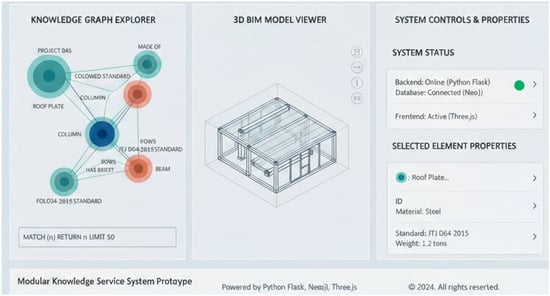
Figure 9.
Knowledge Graph Visualization in Neo4j.
System Prototype Interface: The system primarily consists of three functional zones: the knowledge retrieval panel, BIM model visualization area, and attribute/relationship display section. Users can input queries in the search interface, interact directly with the BIM model components, and review corresponding results across designated display areas.
- (1)
- Core Functionality Demonstration:
- Scenario 1: Modular Connection Node Knowledge Query. When a user enters the key phrase “design requirements for main girder butt welds” into the system, the backend knowledge graph service initiates Cypher query processing to retrieve entities and relationships associated with “main girder butt welds” from the knowledge base, including “design code clauses”, “recommended welding procedures”, and “common defect types”. The results are presented both as structured lists and localized knowledge graph visualizations. For instance, returned data may include: fatigue calculation requirements for butt welds per JTG D64 (2015) [56] Specifications for Design of Highway Steel Bridge Structures; recommended welding methods (submerged arc welding or CO2 gas-shielded welding); and critical warnings regarding potential weld cracks and lack of penetration defects.
- Scenario 2: Modular Unit Information Integration Display. Upon selecting a “standard beam segment module” in the BIM model, the system automatically queries associated data using the module’s unique ID from both the knowledge graph and integrated database. Retrieved information—including constituent components (U-ribs, diaphragm plates, etc.), material grades, theoretical weight, planned hoisting sequences from construction methodologies, required lifting equipment, and quality control benchmarks—is systematically organized and displayed in the property panel.
- (2)
- Operational Workflow Description:
Using Scenario 2 as an example, users first access the system homepage via a web browser. The system loads the default steel box girder BIM model. Through mouse navigation in the 3D model interface, users select and click on the target “Standard Beam Segment Module-A.” Upon selection, the system captures the module’s unique identifier and transmits this ID to backend services. The service layer subsequently queries the BIM database to retrieve the module’s geometric and design attributes while simultaneously initiating knowledge graph traversal and integrated database searches using the ID as the reference point. This process extracts associated component specifications, material properties, planned construction sequences, process requirements, and relevant regulatory clauses. The backend consolidates this data and returns it to the frontend, where it is systematically displayed in the attribute/relationship panel on the right side of the interface, accompanied by visual highlighting of the selected module within the model.
Through these case studies and prototype implementation, we preliminarily validate that despite limited engineering data availability, BIM reverse modeling combined with knowledge graph construction and data fusion techniques can effectively extract and organize knowledge related to modular steel box girder design. These methods demonstrate practical application potential, with the core methodology’s efficacy and framework feasibility verified—even though incomplete datasets currently constrain analytical depth.
5. Results and Discussion
5.1. Framework Effectiveness Analysis
5.1.1. Modular Design Efficiency Enhancement
Qualitative Analysis
The proposed framework enhances modular design efficiency through four fundamental mechanisms (Figure 10). First, knowledge reusability systematically consolidates design specifications, standard modules, connection methods, and case studies into structured knowledge components. This organization enables designers to efficiently retrieve and apply these standardized resources through the knowledge service system, minimizing time spent searching fragmented documents and reducing dependence on subjective experiential knowledge.
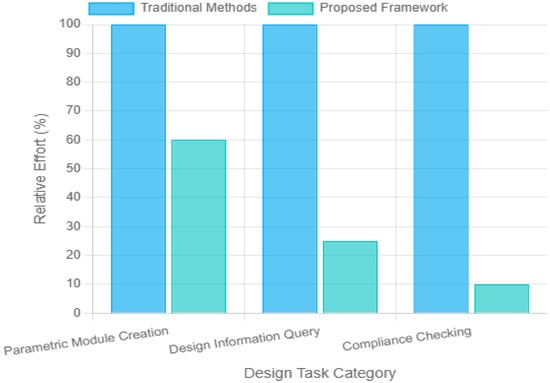
Figure 10.
Framework Performance Evaluation.
Second, the integration of parametric design with a standard component library revolutionizes module development. The BIM reverse-modeled parametric library allows designers to quickly select and adjust modular units through key parameter modifications, generating compliant designs with significantly reduced effort compared to conventional modeling approaches [57]. This parametric capability ensures both efficiency and standardization in the design process.
Third, automated compliance checking prevents downstream inefficiencies by verifying BIM models against regulatory constraints embedded in the knowledge graph during early design stages. This proactive validation identifies non-compliant elements before they propagate, avoiding costly rework typically encountered in later project phases.
Finally, the framework establishes a unified digital platform for information sharing across project phases and disciplines. While current implementation primarily focuses on design phase validation and partial construction knowledge integration, the system’s architecture inherently reduces communication errors and unnecessary coordination loops—a potential that merits further exploration in cross-disciplinary applications. These combined mechanisms collectively demonstrate the framework’s potential to transform steel box girder modular design processes.
Quantitative Assessment (Preliminary Estimates Based on Case Simulation and Prototype Testing)
Due to limitations in obtaining real project data, rigorous large-scale efficiency comparison experiments were unfeasible. However, preliminary estimates were derived from the parametric reverse modeling process of typical modules in the Binjiang Bridge case study, along with performance evaluations of the prototype knowledge service system in simulated query scenarios:
- Parametric Module Modeling Efficiency: Compared to traditional manual modeling of detailed steel box girder modules in Revit based on 2D drawings, the framework’s parametric approach (integrated with Dynamo scripts) may require comparable or slightly longer time for initial module creation (including parametric logic definition). However, once the parametric family library is established, generating instances of the same module type with varying parameters demonstrates an estimated 30–50% efficiency gain, primarily attributable to parameter-driven automation and scripting capabilities.
- Design Information Retrieval Efficiency: For typical design queries such as “determining allowable stress limits for specific components under given load conditions,” conventional methods often demand cross-referencing multiple sections across various specifications, consuming tens of minutes to hours. In contrast, the prototype knowledge service system—leveraging keyword or natural language queries (assuming data integration in the knowledge graph)—can retrieve relevant clauses and interpretations within seconds to minutes, marking a substantial efficiency improvement.
- Compliance Validation Efficiency: Manual comprehensive code compliance checks are time-intensive and prone to oversight [58]. The framework’s envisioned automated validation (validated in Scenario 1 for technical feasibility) can execute batch inspections of numerous BIM model components against predefined rules within minutes, achieving an order-of-magnitude efficiency gain.
It should be emphasized that these estimated efficiency improvements are derived from limited scenarios and prototype system performance. Their actual effectiveness requires further validation and optimization through broader engineering practice implementations.
5.1.2. Knowledge Utilization Enhancement
The construction and application of the knowledge graph (SBG-MKG) serve as the cornerstone for improving knowledge utilization rates.
Explication and Structuring of Tacit Knowledge: The framework employs knowledge extraction techniques to transform inherently scattered tacit or semi-structured knowledge—originally dispersed across drawing annotations, regulatory texts, construction documentation, and (theoretically) expert insights—into machine-interpretable, structured RDF triples stored in graph databases. This transformation facilitates enhanced retrieval, analysis, and reasoning by computational systems.
Knowledge Interconnection and Integration: By defining diverse semantic relationships between entities, the knowledge graph interconnects isolated knowledge points into a cohesive network. For instance, a steel box girder module becomes semantically linked not only to its geometric dimensions and material properties but also to applicable design codes, recommended fabrication processes, potential construction risks, and analogous engineering cases. This relational architecture enables users to simultaneously access contextual knowledge when querying specific topics, thereby obtaining comprehensive understanding.
Accessibility of Knowledge Services: The modular knowledge service system integrates multiple access modalities including natural language queries, keyword searches, and visual navigation interfaces, significantly reducing the threshold for knowledge acquisition. Designers are liberated from memorizing exhaustive code provisions or laboriously tracking historical references, instead obtaining targeted knowledge support through efficient system interactions.
Query Coverage and Result Satisfaction in Case Validation: During the prototype verification described in Chapter 4, the system demonstrated high success rates for approximately 20 predefined query scenarios covering knowledge points within the graph’s current scope. Evaluations by simulated users (research team members assuming different professional roles) indicated that result relevance and practical utility generally met decision-support requirements. Nevertheless, constrained by existing data availability and extraction technologies, the graph’s current breadth and depth of knowledge coverage remain critical limitations for further utilization enhancement.
5.1.3. Design-Construction Coordination Enhancement (Theoretical Framework and Preliminary Validation)
This framework enhances design-construction coordination through an integrated data fusion mechanism.
Design-Phase Construction Problem Anticipation: By correlating BIM design models with construction process constraints, historical risk cases, and construction challenges stored in the knowledge graph (as demonstrated in Scenario 2 of Section 5.1.2), designers can proactively evaluate potential construction impacts during the design phase. This constructability-driven design approach addresses issues such as weldability of connection joints or module dimensions exceeding lifting capacities, thereby reducing later-stage design modifications and construction difficulties.
Construction-Phase Design Intent Comprehension: The knowledge service system enables construction teams to query design specifications, special material requirements, or technical criteria associated with specific BIM components, ensuring accurate interpretation of design intent. Simultaneously, the system’s push of analogous case studies and recommended construction methods provides valuable references for construction planning, preventing repeated errors.
Conflict Detection Performance Evaluation: The validation results from simulated case studies demonstrate that the design compliance checker effectively identified parameter conflicts between BIM models and relevant code provisions. For instance, the system automatically issued warnings when simulated adjustments to plate thickness resulted in noncompliance with required width-to-thickness ratios. These findings provide initial evidence of the data fusion mechanism’s capabilities in automated conflict detection.
The absence of real-world construction process data in this study has limited the comprehensive validation of dynamic feedback and closed-loop collaboration between design and construction phases. The present implementation primarily utilizes existing theoretical frameworks and historical construction knowledge to support design-stage decision-making.
5.2. Performance Evaluation of Key Technical Elements
5.2.1. Knowledge Graph Construction (SBG-MKG)
Coverage and Rationality of Ontology Model:
The SBG-M Ontology was systematically designed to incorporate key aspects of steel box girder modularization, spanning design, fabrication, and installation phases. It encompasses core concepts and their interrelationships, including structural components, connections, materials, processes, constraints, and regulatory provisions. Preliminary evaluation by domain experts (bridge engineering specialists within the research team) confirmed the model’s fundamental framework demonstrates appropriate rationality, with clearly defined principal concepts that effectively capture domain-specific characteristics.
Compared to generic BIM standards such as IFC, the SBG-M Ontology places greater emphasis on modularization-specific knowledge (e.g., module segmentation principles, interface typologies, and prefabrication constraints) and in-depth semantic relationships (including causal dependencies and process sequences), representing a valuable domain-specific refinement of existing standards. Regarding coverage, while comprehensive for conventional applications, the current ontology model requires further expansion for certain specialized aspects (such as fatigue properties of novel materials or detailed parameters for unconventional lifting techniques) due to the inherent complexity and extensive knowledge base of steel box girder engineering.
Coverage Considerations: The current ontology model requires further extension and refinement for certain specialized aspects (such as fatigue characteristics of emerging materials and detailed parameters for unconventional erection methods) due to the inherent complexity and extensive knowledge domain characteristic of steel box girder engineering. While the framework demonstrates robust coverage of conventional applications, these specialized knowledge segments remain as identified areas for model enhancement and expansion.
- (1)
- Knowledge Extraction Accuracy and Recall Rates (Small-Sample Testing):
- Constraint Extraction from Regulatory Texts: The test case selected sections on plate local stability and fatigue design from the Design Specifications for Highway Steel Box Girder Bridges, where approximately 50 critical constraint rules were manually annotated. The extraction methodology implemented a hybrid approach combining rule-based techniques (regular expressions with keyword matching) and basic natural language processing (supported by dependency parsing) for automated rule acquisition.
- Precision: Approximately 82% (indicates that 82% of the extracted rules were verified as correct).
- Recall: Approximately 70% (indicates 70% of all target rules were successfully extracted from the specification documents).
- Root Cause Analysis: The limited precision primarily stems from the inherent complexity and ambiguity in certain rule descriptions, which cannot be accurately matched using simplistic rule-based approaches. Similarly, the inadequate recall rate results from the diverse expressions of constraints that exceed the coverage capability of predefined extraction rules.
Extraction of Component Attributes from DWG Drawings: For the Binjiang Bridge case study, five representative segment detail drawings were manually annotated to identify key dimensions and material grades (totaling approximately 100 attribute points) for primary structural components (top slab, bottom slab, web, diaphragm). A semi-automated extraction approach was employed, utilizing the ezdxf library for parsing, combined with image processing (for PDF conversion) and OCR techniques.
- Dimension Extraction Accuracy: Approximately 95% (for clearly annotated dimensions).
- Material Grade and Text Description Extraction Accuracy (post-OCR): Approximately 88%.
- Key Challenges: Drawing quality issues (e.g., blurred text, overlapping lines), non-standard annotations, and recognition of complex symbols.
5.2.2. Accuracy Evaluation of BIM Reverse Modeling from 2D Drawings
Accuracy Assessment of 3D Model Generation from 2D Drawings:
Taking the standard straight segment module of Binjiang Bridge as an example, the accuracy of the reverse-engineered BIM model was verified by checking its key geometric dimensions (e.g., total length, total height, box girder width, and main plate thickness) against the original 2D drawings (Figure 11). Measurements were conducted in the Revit model and compared with the annotated dimensions in the drawings. The results indicate that most critical control dimensions exhibit deviations within ±5 mm, meeting the general requirements for design representation and collision detection.
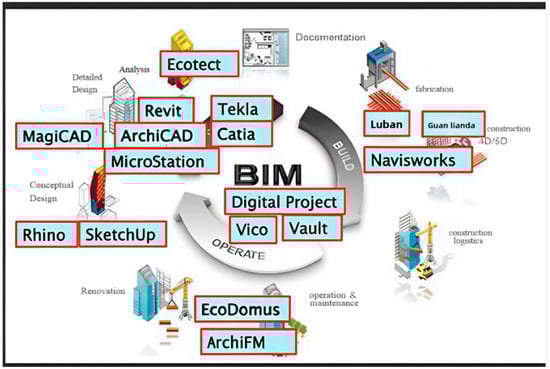
Figure 11.
BIM Reverse Modeling.
For complex geometric components composed of curves and inclined plates (such as variable cross-section segments and precise alignment of curved sections), the accuracy of reverse modeling relying solely on 2D drawings is relatively low, making deviations more likely to occur. In such cases, the introduction of three-dimensional reference data (such as measured top surface data of the box girder) can significantly improve the geometric accuracy of the outer contour. In this project, the incorporation of a limited amount of top surface data played a beneficial role in calibrating the longitudinal alignment.
Regarding the flexibility and robustness of parametric adjustments:
For modular units created using Dynamo scripts and Revit parametric families, the preset key parameters (e.g., segment length, plate thickness, stiffener spacing) could be correctly linked and updated when adjusted within a reasonable range, demonstrating good flexibility.
In terms of robustness, when parameter adjustments exceed reasonable limits or result in geometric constraint conflicts, the model may exhibit errors or distortions. This necessitates further refinement of constraint logic and error-handling mechanisms between parameters. For example, plate thickness cannot be negative, and stiffener spacing must not exceed the plate width.
5.2.3. Data Fusion
- (1)
- Accuracy of BIM-KG Semantic Mapping:
In the case study, manual mapping rules were defined between BIM component types (e.g., beams, plates) and their key parameters (e.g., material, length, thickness) with corresponding ontology classes and properties in SBG-MKG. High semantic mapping accuracy was achieved for selected typical components such as steel box girder segments, top plates, and web plates, which were correctly linked to concepts in the knowledge graph.
The key challenges lie in inconsistent naming conventions and parameter definitions across BIM models (particularly when working with different projects or designers) and the granularity mismatch between IFC standards and domain-specific ontologies. Addressing these issues requires more intelligent semantic matching algorithms or more comprehensive domain ontologies as intermediaries.
Efficiency and Accuracy of Data Association (Based on Case Study Tests):
Association based on unique IDs between BIM components and KG entities demonstrated high efficiency.
- (2)
- When matching BIM-extracted attributes (e.g., component names, types, key dimensions) with pre-existing standard module definitions in the knowledge graph, accuracy exceeded 90% when attribute overlap was high (e.g., matching on three or more key attributes). Algorithm efficiency depends on feature quantity and matching strategy.
Effectiveness of Conflict Detection: As shown in Scenario 1 (Section 4), the system successfully identified and issued warnings when plate width-to-thickness ratios in the BIM model violated predefined specifications. This demonstrates the effectiveness of rule-based compliance checking using knowledge graphs (Table 3). However, effectiveness depends heavily on the completeness and accuracy of rules in the knowledge graph, as well as the correctness of parameter extraction from BIM models.
Table 3.
Performance Evaluation of Key Technologies in the Proposed Framework.
Impact of Data Limitations on Performance Evaluation: It must be emphasized that this study primarily relied on limited static drawings and documentation provided by users, lacking access to large-scale, diverse, high-quality real-world project data (particularly dynamic construction data and complete as-built models). Therefore, the performance evaluations represent preliminary conclusions based on small-sample testing, prototype system simulations, and theoretical analysis.
5.3. Comparative Analysis with Existing Related Research/Methods
To better position the contributions of this study, the proposed framework is compared with several representative types of related research or existing methods/software reviewed in the literature, as illustrated in the following table (Table 4):
Table 4.
ork and Existing Approaches.
The comparative analysis demonstrates that the proposed framework possesses distinctiveness and comprehensive advantages in the following aspects:
Deep Integration of Multiple Technologies: Unlike solutions relying on isolated technology applications or superficial integration, this framework emphasizes the profound synergy and bidirectional interaction between BIM, knowledge graphs, and data fusion, forming an organic and cohesive system.
Knowledge-Driven Intelligence: By constructing domain-specific knowledge graphs, the framework positions “knowledge” as its core driver, transforming BIM models from mere geometric information carriers into platforms for knowledge application and reasoning, thereby elevating the intelligence level of design processes.
Holistic Modularization Support: The framework is meticulously designed to address the full lifecycle requirements of steel box girder modularization—from conceptual and detailed design to fabrication and installation—providing end-to-end knowledge support and information integration.
Design-Construction Integration: Despite existing data limitations, the framework establishes conceptual and mechanistic foundations for bridging design-construction information flows and enabling closed-loop knowledge feedback.
However, the framework’s implementation complexity and dependency on high-quality data pose significant challenges for widespread practical adoption, necessitating focused mitigation in future applications.
5.4. Theoretical Contributions and Engineering Application Value
5.4.1. Theoretical Contributions
The study presents a groundbreaking intelligent framework for modular steel box girder design through the innovative integration of knowledge graphs, data fusion, and BIM technologies. This establishes a new theoretical paradigm that systematically addresses the fundamental challenges in intelligent structural design by clarifying the complementary roles and interaction mechanisms of these key technologies, significantly advancing their theoretical application in complex engineering contexts.
By developing methodologies for merging parametric BIM with domain-specific knowledge graphs and heterogeneous data fusion systems, this research significantly enhances our theoretical understanding of multi-technology integration. These findings offer crucial insights into solving complex engineering problems characterized by intricate constraints and specialized knowledge requirements, particularly in modular steel bridge design, while serving as reference for similar intelligent engineering solutions.
The development of the Steel Box Girder Modularization Ontology (SBG-M Ontology) represents another key theoretical advancement. By formally defining core concepts, attributes, and relationships in this specialized domain, it creates a foundation for standardized knowledge representation despite requiring future refinement, demonstrating substantial value in knowledge organization and serving as an important reference point for subsequent research efforts.
Of particular theoretical significance is the study’s exploration of practical solutions for data-scarce environments common in industry practice. The demonstrated approaches for BIM reverse modeling, knowledge extraction, and data fusion using only limited 2D drawings and documentation provide a valuable theoretical framework for implementing intelligent engineering solutions under real-world constraints of incomplete or non-standardized data availability.
5.4.2. Engineering Application Value
This study enhances design efficiency and quality by enabling rapid parameterized module library retrieval, knowledge-based intelligent recommendations, and compliance checks. These capabilities significantly reduce repetitive design tasks, shorten design cycles, and minimize errors caused by regulatory violations or lack of experience, thereby improving the overall efficiency and quality of modular steel box girder design.
The construction of knowledge graphs facilitates the explicit, structured, and systematic management of valuable expertise and tacit knowledge scattered across specifications, drawings, documents, and experts’ experience. This approach not only enables efficient knowledge retrieval and reuse but also supports the accumulation, inheritance, and innovation of design and construction wisdom, reducing excessive reliance on a limited number of senior experts.
The modular knowledge service system assists in critical engineering decisions, such as scheme comparison (e.g., evaluating different module segmentation options), connection node selection, material choice, and construction process planning. By providing data and knowledge support, it empowers engineers to make more scientific and reliable judgments while foreseeing potential risks.
The framework promotes design-construction integration by establishing a data fusion mechanism aimed at breaking down information barriers between the two phases. This ensures that designs better account for construction feasibility while construction teams more accurately interpret design intent, thereby facilitating collaborative optimization of both processes and reducing unnecessary modifications and waste.
Supporting Intelligent Construction and Smart Operation and Maintenance of Steel Box Girders: The parametric BIM models and domain knowledge graphs established in this framework serve as fundamental components of digital twins for steel box girders [59]. This digital infrastructure enables applications spanning automated fabrication of modular components, intelligent hoisting and assembly, as well as structural health monitoring, smart assessment, and predictive maintenance after bridge completion. Such capabilities provide crucial technical support for realizing “intelligent manufacturing” and “smart bridge construction” of steel box girders, facilitating the entire lifecycle management from production to operation.
In summary, this study not only expands the theoretical scope of multi-technology integration but also provides practical solutions to key challenges in modular steel box girder design practice. By addressing critical engineering pain points and enhancing industrial intelligence capabilities, this research delivers tangible application value while demonstrating significant potential for advancing the field of intelligent infrastructure development.
5.5. Analysis of Research Limitations
The study acknowledges several critical limitations that warrant consideration despite its theoretical and practical contributions. The main constraints stem from data acquisition challenges and technical implementation hurdles that impact both the framework’s validation and real-world applicability.
Data scarcity emerged as a fundamental limitation, with the research primarily relying on partial design documents from the Binjiang Bridge project and public standards. This data insufficiency particularly affects lifecycle coverage, lacking critical manufacturing, construction, and operational information such as detailed process records, cost metrics, and comprehensive as-built models. Such gaps directly influence the validation outcomes, restricting the framework’s testing to specific scenarios and raising questions about its generalization across diverse project types and scales. The absence of real-time construction data further prevents meaningful evaluation of dynamic feedback mechanisms between design models and field conditions.
On the knowledge representation front, the SBG-M Ontology requires significant expansion to fully capture the steel box girder domain’s complexity. While establishing baseline concepts, current coverage remains incomplete relative to evolving industry knowledge. Substantial technical barriers persist in automating knowledge extraction from heterogeneous sources, with existing methods still dependent on manual rule definitions. The conversion of expert tacit knowledge into machine-processable formats presents another formidable challenge, having only seen preliminary exploration in this research.
Model accuracy faces inherent limitations through the 2D-based reverse BIM approach, which struggles to capture complex geometries compared to 3D scanning methods. Parametric techniques demonstrate reduced effectiveness for non-standard modules, highlighting modeling fidelity constraints. Framework implementation encounters systemic challenges from the required integration of multiple advanced technologies—BIM, knowledge graphs, and machine learning—demanding substantial interdisciplinary expertise while raising compatibility concerns with existing engineering workflows.
Validation scope represents another key limitation. Testing the framework using only partial data from the Binjiang Bridge Project [60] restricts the assessment’s breadth, while the prototype’s incomplete functionality means several envisioned intelligent services remain unvalidated. These constraints help delineate clear directions for future research expansion while informing practical framework adoption considerations in professional settings.
5.6. Future Research Perspectives
To overcome current limitations and further enhance the framework’s performance and application value, future research could focus on the following directions:
5.6.1. Advancing Knowledge Graph Research and Applications
The study proposes four key directions for enhancing knowledge graph implementation in steel box girder construction. First, substantial work remains in expanding the SBG-M Ontology’s scope and precision to address critical knowledge gaps. Future efforts should systematically incorporate diverse girder configurations, connection methods, and comprehensive lifecycle data spanning material specifications, fabrication techniques, erection processes, and maintenance operations. Developing modular ontology structures will be crucial for enabling knowledge reuse across different project contexts.
A major research priority involves advancing automated knowledge extraction capabilities through cutting-edge AI techniques. This includes leveraging transformer-based language models (BERT, GPT) for semantic understanding of technical documents and applying deep learning approaches for automated interpretation of engineering drawings and symbols. Such technological improvements could significantly reduce current manual intervention requirements while improving knowledge extraction accuracy.
The framework’s practical utility hinges on developing robust mechanisms for knowledge maintenance and evolution. Future research should establish systematic approaches for incorporating emerging engineering practices, updated standards, and field experience into the knowledge base through semi-automated update protocols with version control capabilities, ensuring continuous relevance of the stored knowledge.
Finally, elevating the system’s reasoning capabilities represents a critical frontier for development. Integrating advanced reasoning techniques—including ontological logical inference, rule-based systems, graph neural networks, and probabilistic modeling—could unlock powerful applications such as automated design evaluation and probabilistic risk prediction. These enhancements would significantly expand the framework’s decision-support functionality for complex engineering scenarios.
5.6.2. Advancing Multi-Source Data Fusion Technology
This study outlines key directions for improving data integration capabilities in modular steel construction projects. The proposed technical enhancements focus on three primary aspects that address critical gaps in current construction monitoring and control systems.
Significant emphasis must be placed on developing robust methodologies for processing real-time construction data streams. Effective fusion of diverse sensor inputs—including structural monitoring data, environmental measurements, equipment telemetry and visual documentation—will be crucial for establishing comprehensive awareness of project execution status. This requires innovative approaches to harmonize data from distributed IoT devices with varying formats and sampling frequencies.
The framework calls for developing automated verification mechanisms between digital models and physical reality. By implementing continuous comparison algorithms that correlate as-built monitoring data with as-designed BIM specifications, the system could enable real-time assessment of structural performance deviations during critical erection phases. Such capability would significantly improve detection of potential issues related to module positioning accuracy or unexpected loading conditions.
Ultimately, the research advocates for establishing intelligent feedback loops to transform monitoring data into actionable insights. This involves creating analysis systems that combine rule-based logic with machine learning to automatically evaluate construction progress, resource efficiency, and safety compliance. The envisioned closed-loop system would not only generate early warnings but also provide specific recommendations or even automated adjustments to optimize construction operations in response to detected anomalies.
5.6.3. Expanding BIM Integration and Intelligent Applications
Future research should focus on deeper integration of artificial intelligence techniques with building information modeling to enhance design capabilities and project execution. Machine learning and generative design approaches can potentially automate the creation of modular steel box girder configurations that satisfy both technical requirements and optimization criteria based on knowledge graph constraints. This would dramatically reduce concept development time while ensuring compliance with established engineering principles.
A critical development area involves the creation of intelligent parametric component libraries that transcend traditional geometric representation. These advanced BIM objects would integrate not just dimensional parameters but also embedded design rules, performance evaluation algorithms, and direct connections to the knowledge database. The resulting smart components could autonomously evaluate and adapt their properties according to project-specific requirements, enabling more efficient module selection and system configuration during design phases.
The ultimate research goal involves developing comprehensive digital twin implementations that merge BIM with knowledge graphs across the entire structure lifecycle. Such high-fidelity virtual representations would support manufacturing optimization, logistics planning, erection simulation, and maintenance management through continuous data integration and analysis. This holistic approach could enable predictive modeling of structural behavior, early issue detection, and performance optimization throughout the facility’s operational lifespan by bridging the gap between digital models and physical reality.
5.6.4. Enhancing Practical Applications and Operational Functions
The proposed framework shows significant potential for transforming key aspects of steel box girder construction and maintenance. Modern manufacturing processes could be substantially improved through direct digital integration between design models and production systems. By establishing seamless connections between BIM data, knowledge graph specifications, and automated fabrication equipment, manufacturers can achieve precise execution of complex geometries, material specifications, and connection details, effectively eliminating traditional information handoff errors while improving production quality control.
Construction operations could benefit greatly from advanced lifting simulation capabilities enabled by integrating multiple data sources. Combining detailed BIM models with GIS mapping, crane specifications, and site conditions allows for comprehensive virtual rehearsals of critical lifting operations. This integrated approach facilitates automatic path optimization, real-time collision detection, and risk assessment—particularly valuable for complex bridge projects where tight urban constraints or sensitive environments demand careful movement planning.
The long-term value of the system extends into the operational phase through intelligent structural health monitoring. By correlating real-time sensor data with historical performance records and maintenance activities stored in the knowledge graph, engineers can develop predictive models for structural deterioration. This capability enables early defect detection, more accurate lifespan estimation, and data-driven maintenance scheduling—ultimately leading to extended service life and optimized maintenance expenditures for bridge operators. The digital twin concept thus evolves from a design and construction tool into a lifelong asset management resource.
5.6.5. Optimizing Large Language Model Integration
The proposed framework presents significant opportunities to enhance construction knowledge management through advanced natural language processing technologies. By implementing sophisticated LLM systems, engineers could interact with complex technical databases using conversational queries, significantly lowering the barrier for accessing specialized engineering knowledge while maintaining technical precision in responses. Such natural language interfaces would be particularly valuable for facilitating real-time knowledge sharing across multidisciplinary teams working on modular construction projects.
A critical application area involves automated knowledge extraction from vast volumes of unstructured engineering documentation. LLMs could systematically process technical reports, research papers, and construction records to identify relevant design parameters, material properties, and construction constraints. This capability not only accelerates the creation of structured knowledge graphs but also supports the automated drafting of preliminary technical documents, enabling engineers to focus on higher-value design optimization tasks rather than manual documentation processes.
Perhaps most promising is the potential to combine LLMs’ creative generation capabilities with the structured constraints of engineering knowledge bases. This hybrid approach could generate novel modular configurations that satisfy both functional requirements and regulatory constraints while introducing unconventional yet technically sound design alternatives. Such semi-automated design generation would complement human engineers’ expertise, expanding the solution space for complex structural challenges while ensuring all proposals adhere to fundamental engineering principles and safety standards.
5.6.6. Framework Validation and Continuous Improvement Pathways
The proposed knowledge-enhanced design system requires comprehensive validation through practical implementation across diverse modular steel box girder projects. Real-world deployment with varying structural configurations, span lengths, and construction conditions will generate crucial performance data to assess the framework’s adaptability and reliability. Only through this rigorous field testing can the system’s capacity to handle complex engineering scenarios be properly evaluated, while simultaneously identifying potential areas for refinement.
Ongoing system enhancement should follow an iterative development approach, where practical implementation insights directly inform technical improvements. The accumulated project experience will guide optimizations across multiple system components—from knowledge base expansions and algorithm refinements to user interface modifications. This evolutionary development process ensures the framework remains responsive to actual engineering needs while progressively increasing its operational efficiency and decision-making accuracy.
With continued research and field validation, this framework holds strong potential to mature into a comprehensive intelligent platform for modular steel construction. Its eventual scope may expand beyond box girder applications to encompass various types of prefabricated structural systems. Such an advanced platform could become a cornerstone in the industry’s digital transformation, driving improvements in design quality, construction efficiency, and long-term structural performance while establishing new standards for intelligent engineering practice.
6. Conclusions
Addressing the critical challenges in the current modular design of steel box girders, including fragmented knowledge management, difficulties in information integration, insufficient design-construction collaboration, and limited intelligent capabilities, this study proposes a BIM-driven framework integrating knowledge graph (KG) and data fusion technologies. Focusing on the framework’s core concept, the research investigates and preliminarily implements key techniques, including the construction methodology for modular steel box girder knowledge graphs, BIM reverse modeling and parametric representation based on limited data, design-construction data fusion mechanisms, and a prototype modular knowledge service system.
The main research findings are summarized as follows:
- A BIM-driven integrated framework was established, outlining an intelligent approach to modular steel box girder design with BIM as the core carrier, knowledge graph as the knowledge engine, and data fusion as the information bridge. A multi-layer system architecture was designed, encompassing the data layer, knowledge layer, model and fusion layer, application service layer, and user interaction layer.
- Domain knowledge graph construction was investigated, proposing the design concept of Steel Box Girder Modular Ontology (SBG-M Ontology) and exploring methods for extracting knowledge from multi-source heterogeneous data (including user-provided 2D drawings and construction organization design documents) and storing it as RDF triples in a graph database.
- Parametric BIM reverse modeling was achieved by implementing a conversion process from 2D drawing information to parametric 3D BIM modular units tailored to user data characteristics, with emphasis on establishing a modular component library.
Key Findings and Major Contributions:
- A novel approach to knowledge integration: This study demonstrates that knowledge graph technology can effectively consolidate fragmented, multi-source knowledge (such as specifications, standards, processes, and empirical knowledge) in the field of modular steel box girder design. By constructing SBG-MKG, it enables systematic management, intelligent retrieval and inference applications of this knowledge.
- Semantic enhancement of BIM models: By establishing associations between parametric BIM models and knowledge graphs, BIM components are no longer merely carriers of geometric and basic attributes but are endowed with richer semantic connotations (such as related code provisions, applicable construction methods, and potential risk points), significantly enhancing the knowledge content and application value of BIM models.
- Preliminary resolution of data silos: The design-construction data fusion mechanism bridges BIM design information (explicit data), domain knowledge in knowledge graphs (derived from tacit or unstructured knowledge), and preliminary construction planning information (extracted from construction organization designs), offering initial alleviation of information silo problems.
- Potential for intelligent decision-making support: Validation of the modular knowledge service system prototype demonstrates that integrated knowledge and data can provide effective intelligent assistance to designers and construction managers in parameter queries, compliance judgment, process reference, thereby enhancing decision-making efficiency and scientific rigor.
Implications and Recommendations for Industry Development:
- Emphasize digitalization and intelligentization of domain knowledge: The bridge engineering industry should prioritize digital accumulation, structured management, and intelligent application of valuable knowledge assets such as design codes, construction standards, engineering cases, and expert experience. The active promotion of knowledge graph and ontology engineering technologies is crucial for establishing industry-level or enterprise-level engineering knowledge bases.
- Deepen BIM technology’s lifecycle application and integrated innovation: Further expand the in-depth application of BIM technology across the entire lifecycle of complex structures like steel box girders (including design, manufacturing, construction, and maintenance), while encouraging exploration of integrated innovation paths between BIM and emerging technologies such as artificial intelligence (e.g., knowledge graphs, machine learning, large language models), IoT, and digital twins to fully unlock the value of BIM data.
- Data-driven foundation for intelligent transformation: Data serves as the cornerstone of intelligent development. The industry should strengthen standardized collection, regulated management, and secure sharing of engineering data (while adhering to legal regulations and protecting commercial confidentiality). Promoting unified data standards and exchange protocols, along with encouraging the opening of valuable de-identified datasets for research and technological innovation, will provide essential data support for the intelligent transformation of steel box girder projects and the broader construction industry.
- Cultivate interdisciplinary professionals: The intelligent transformation requires talent in both engineering expertise and information technology skills (such as BIM, AI, and big data). Industry associations, universities, and enterprises should enhance collaboration to reform talent cultivation models and build a talent reserve for industry development.
Although limited by data availability and implementation resources, some functions and verifications in this study are not yet perfected. However, the proposed framework concepts and technical pathways outline promising directions for future intelligent development of modular steel box girder design. With continuous technological advancement and increasing engineering data, this framework is expected to be further refined and widely adopted, contributing to the construction of safer, more economical, more efficient, and smarter bridge engineering projects.
Author Contributions
Writing—original draft, M.S., L.W., Y.D., Y.C., L.T. and D.H.; Writing—review & editing, M.S., L.W., Y.D., Y.C., L.T. and D.H. All authors have read and agreed to the published version of the manuscript.
Funding
This research received no external funding.
Data Availability Statement
The original contributions presented in the study are included in the article, further inquiries can be directed to the corresponding author.
Conflicts of Interest
Authors Matao Si, Lin Wang and Yanjie Dong were employed by the company China Communications First Navigation Bureau Fourth Engineering Co., Ltd. The remaining authors declare that the research was conducted in the absence of any commercial or financial relationships that could be construed as a potential conflict of interest.
References
- Khan, I.U.; Gul, A.; Shahzada, K.; Khan, K.; Khan, S.W.; Ullah, A.; Khan, F.A. Restoring seismic capacity of damaged dry stacked Self-Interlocking masonry structure through ferrocement overlay. Eng. Struct. 2023, 293, 116687. [Google Scholar] [CrossRef]
- Luo, H.; Ikago, K.; Chong, C.; Keivan, A.; Phillips, B.M. Performance of low-frequency structures incorporated with rate-independent linear damping. Eng. Struct. 2019, 181, 324–335. [Google Scholar] [CrossRef]
- Meng, F.; Wang, Q.; Liu, Y.; Zhang, Y. Design and BIM-based technology on a new cross-sea bridge in Xiamen, China. Proc. Inst. Civ. Eng.-Civ. Eng. 2023, 176, 121–127. [Google Scholar] [CrossRef]
- Peng, J.; Cui, X.; Jia, K.; Liu, B.; Lei, T.; Zhao, P.; Liu, P. Applied research on BIM + GIS + IoT multi-source heterogenous data fusion. In Proceedings of the International Conference on Electronic Information Engineering and Computer Science (EIECS 2022), Changchun, China, 16–18 September 2023. [Google Scholar]
- Moshynskyi, V.; Trach, R.; Striletskyi, P. Application of the building information modelling (BIM) for bridge structures. Architectura 2022, 20, 3–9. [Google Scholar] [CrossRef]
- Aleke, C.U.; Usang, W.O.; Obi-obuoha, A.; Jolaosho, A.A.; Michael, O.O. Artificial Intelligence as a tool for enhancing Building Information Modeling (BIM). World J. Adv. Res. Rev. 2024, 24, 1846. [Google Scholar] [CrossRef]
- Huang, J.; Jiang, X.; Ma, Y.; Fu, H. Application of BIM Technology in Construction Engineering. Appl. Sci. Innov. Res. 2024, 8, 138. [Google Scholar] [CrossRef]
- Niknam, M.; Karshenas, S. A shared ontology approach to semantic representation of BIM data. Autom. Constr. 2017, 80, 22–36. [Google Scholar] [CrossRef]
- Elhefnawy, M.; Ouali, M.-S.; Ragab, A.; Amazouz, M. Fusion of heterogeneous industrial data using polygon generation & deep learning. Results Eng. 2023, 19, 101234. [Google Scholar] [CrossRef]
- Gui, Y.; Chen, L. Research on the application of BIM-based digital bridge design, construction and operation and maintenance secondary development. In Proceedings of the 2021 7th International Conference on Hydraulic and Civil Engineering & Smart Water Conservancy and Intelligent Disaster Reduction Forum (ICHCE & SWIDR), Nanjing, China, 6–8 November 2021; pp. 260–265. [Google Scholar]
- Hakimi, O.; Liu, H.; Abudayyeh, O.; Houshyar, A.; Almatared, M.; Alhawiti, A. Data Fusion for Smart Civil Infrastructure Management: A Conceptual Digital Twin Framework. Buildings 2023, 13, 2725. [Google Scholar] [CrossRef]
- Wang, Y.; Cheng, Y.; Qi, Q.; Tao, F. IDS-KG: An Industrial Dataspace-based Knowledge Graph Construction Approach for Smart Maintenance. J. Ind. Inf. Integr. 2024, 38, 100566. [Google Scholar] [CrossRef]
- Zhu, S.; Zhou, J.; Cheng, L.; Fu, X.; Wang, Y.; Dai, K. Research on a BIM Model Quality Compliance Checking Method Based on a Knowledge Graph. J. Comput. Civ. Eng. 2025, 39, 04024049. [Google Scholar] [CrossRef]
- Doh, J.H.; Ho, N.M.; Miller, D.; Peters, T.; Carlson, D.; Lai, P. Steel Bracket Connection on Modular Buildings. J. Steel Struct. Constr. 2017, 2, 1000121. [Google Scholar]
- Ding, Y.; Deng, E.; Zong, L.; Dai, X.; Li, Y.; Wang, H.; Bi, J. Research Progress on Connection Nodes in Modular Steel Structure Buildings. J. Build. Struct. 2019, 40, 33–40. (In Chinese) [Google Scholar] [CrossRef]
- Li, M.; Wong, B.C.; Liu, Y.; Chan, C.M.; Gan, V.J.; Cheng, J.C. DfMA-oriented design optimization for steel reinforcement using BIM and hybrid metaheuristic algorithms. J. Build. Eng. 2021, 44, 103310. [Google Scholar] [CrossRef]
- Chithra, J.; Nagarajan, P.; Sajith, A.S. Design of Box Girder Bridges Using Simplified Frame Analysis. In Lecture Notes in Civil Engineering; Springer: Singapore, 2020; pp. 639–647. [Google Scholar]
- Xia, Y.; Liu, J.; Qi, H.; Wang, L.; Li, J.; Feng, L. Graph-based BIM generation method for integrated design of steel modular buildings. J. Build. Eng. 2025, 106, 112476. [Google Scholar] [CrossRef]
- Liu, H.; Cheng, J.C.P.; Gan, V.J.L.; Zhou, S. A novel Data-Driven framework based on BIM and knowledge graph for automatic model auditing and Quantity Take-off. Adv. Eng. Inform. 2022, 54, 101757. [Google Scholar] [CrossRef]
- Kang, K.; Ra, I.; Park, S. Hash-Based Method for Generating Building Information Models From 2D CAD Drawings. IEEE Access 2024, 12, 147065–147072. [Google Scholar] [CrossRef]
- Xiong, Z.; Wang, T. Research on BIM Reconstruction Method Using Semantic Segmentation Point Cloud Data Based on PointNet. IOP Conf. Ser. Earth Environ. Sci. 2021, 719, 022042. [Google Scholar] [CrossRef]
- Herrera-Martín, J.J.; Castilla-Rodriguez, I.; González, E.J.; Martín-Dorta, N. A method for transferring BIM data into domain ontologies: A case study based on airport services. Egypt. Inform. J. 2022, 23, 447–467. [Google Scholar] [CrossRef]
- Şenol, H.İ.; Gökgöz, T. Integration of Building Information Modeling (BIM) and Geographic Information System (GIS): A new approach for IFC to CityJSON conversion. Earth Sci. Inform. 2024, 17, 3437–3454. [Google Scholar] [CrossRef]
- Meng, S.; Wen, D.; Tan, K.; Li, T.; Pu, Y. BIM+3D scanning and robot measuring and setting out in “magic cube” building curtain wall application study. In Proceedings of the 2022 International Conference on Electronic Information Engineering, Big Data and Computer Technology, Sanya, China, 20–22 January 2022. [Google Scholar]
- Li, W.; Wu, P.; Huang, J.; Xu, Y. A new paradigm for construction safety management in China: Introducing knowledge graph and accident database into the early-stage of BIM. J. Clean. Prod. 2024, 470, 143367. [Google Scholar] [CrossRef]
- He, R.; Li, M.; Gan, V.J.L.; Ma, J. BIM-enabled computerized design and digital fabrication of industrialized buildings: A case study. J. Clean. Prod. 2021, 278, 123505. [Google Scholar] [CrossRef]
- Chen, Y.; Wang, X.; Liu, Z.; Cui, J.; Osmani, M.; Demian, P. Exploring Building Information Modeling (BIM) and Internet of Things (IoT) Integration for Sustainable Building. Buildings 2023, 13, 288. [Google Scholar] [CrossRef]
- Pan, Y.; Zhang, L. Sequential Design Command Prediction Using BIM Event Logs. In Proceedings of the Construction Research Congress 2020, Tempe, Arizona, 8–10 March 2020. [Google Scholar]
- Topraklı, A.Y. Enabling circularity in Turkish construction: A case of BIM-based material management utilizing material passports. Smart Sustain. Built Environ. 2024. [Google Scholar] [CrossRef]
- Mzyece, D.; Ndekugri, I.E.; Ankrah, N.A. Building information modelling (BIM) and the CDM regulations interoperability framework. Eng. Constr. Archit. Manag. 2019, 26, 2682–2704. [Google Scholar] [CrossRef]
- Soliman, K.; Naji, K.; Gunduz, M.; Tokdemir, O.B.; Faqih, F.; Zayed, T. BIM-based Facility Management Models for Existing Buildings. J. Eng. Res. 2021, 10, 21–37. [Google Scholar] [CrossRef]
- Li, S.; Wang, J.; Xu, Z. Automated compliance checking for BIM models based on Chinese-NLP and knowledge graph: An integrative conceptual framework. Eng. Constr. Archit. Manag. 2024, 32, 3832–3856. [Google Scholar] [CrossRef]
- Katsamenis, I.; Doulamis, N.; Doulamis, A.; Protopapadakis, E.; Voulodimos, A. Simultaneous Precise Localization And Classification of metal rust defects for robotic-driven maintenance and prefabrication using residual attention U-Net. Autom. Constr. 2022, 137, 104182. [Google Scholar] [CrossRef]
- Ramonell, C.; Chacón, R.; Posada, H. Knowledge graph-based data integration system for digital twins of built assets. Autom. Constr. 2023, 156, 105109. [Google Scholar] [CrossRef]
- Kang, J.; Dong, W.; Huang, Y. A Bim-Based Automatic Design Optimization Method for Modular Steel Structures: Rectangular Modules as an Example. Buildings 2023, 13, 1410. [Google Scholar] [CrossRef]
- Lai, Y.; Ke, K.; Wang, L.; Wang, L. BIM-based intelligent optimization of complex steel joints using SVM and NSGA-II. J. Constr. Steel Res. 2024, 223, 109086. [Google Scholar] [CrossRef]
- Giordano, D.; Giobergia, F.; Pastor, E.; La Macchia, A.; Cerquitelli, T.; Baralis, E.; Mellia, M.; Tricarico, D. Data-driven strategies for predictive maintenance: Lesson learned from an automotive use case. Comput. Ind. 2022, 134, 103554. [Google Scholar] [CrossRef]
- ISO 15926; Industrial Automation Systems and Integration—Integration of Life-Cycle Data for Process Plants Including Oil and Gas Pro-duction Facilities—Part 6: Rules for the Development and Validation of Reference Data of ISO/TS 15926-4. ISO: Geneva, Switzerland, 2024.
- Xia, X.; Li, X.; Chu, H.; Zhang, K.; Liu, K. Research on knowledge extraction in knowledge graph construction. In Proceedings of the Third International Conference on Computer Vision and Data Mining (ICCVDM 2022), Hulun Buir, China, 19–21 August 2022; Zhang, T., Yang, T., Eds.; SPIE: Bellingham, WA, USA, 2023; p. 18. [Google Scholar]
- Zadgaonkar, A.; Agrawal, A.J. An Approach for Analyzing Unstructured Text Data Using Topic Modeling Techniques for Efficient Information Extraction. New Gener. Comput. 2024, 42, 109–134. [Google Scholar] [CrossRef]
- Röder, M.; de Souza, G., Jr.; Ngomo, A.C.N. Squirrel—Crawling RDF Knowledge Graphs on the Web. In International Semantic Web Conference; Springer International Publishing: Cham, Switzerland, 2020. [Google Scholar]
- Yu, E.; Choi, J. Development of building information modeling (BIM)-based automation assessment process for universal design of public buildings. J. Comput. Des. Eng. 2023, 10, 641–654. [Google Scholar]
- Kim, S.; Myint, M.H.; Yu, Y.; Lee, W.; Kim, T.W.; Koo, B. Application of Parametric Modeling Techniques for Automated Detailing of Exterior Finishes in Architectural BIM Models: A South Korean Case Study. Buildings 2024, 14, 4013. [Google Scholar] [CrossRef]
- Sompolgrunk, A.; Banihashemi, S.; Golzad, H.; Le Nguyen, K. Strategic alignment of BIM and big data through systematic analysis and model development. Autom. Constr. 2024, 168, 105801. [Google Scholar] [CrossRef]
- Marzouk, M.; Labib, N.; Metawie, M. Blockchain technology applications in maintaining heritage buildings. J. Cult. Herit. 2024, 67, 62–72. [Google Scholar] [CrossRef]
- Lee, Y.S.; Rashidi, A.; Talei, A.; Kong, D. Innovative Point Cloud Segmentation of 3D Light Steel Framing System through Synthetic BIM and Mixed Reality Data: Advancing Construction Monitoring. Buildings 2024, 14, 952. [Google Scholar] [CrossRef]
- Chelaru, B.; Onuțu, C.; Ungureanu, G.; Șerbănoiu, A.A. Integration of point cloud, historical records, and condition assessment data in HBIM. Autom. Constr. 2024, 161, 105347. [Google Scholar] [CrossRef]
- Lilis, G.N.; Wang, M.; Katsigarakis, K.; Mavrokapnidis, D.; Korolija, I.; Dimitrios, R. BIM-based semantic enrichment and knowledge graph generation via geometric relation checking. Autom. Constr. 2025, 173, 106081. [Google Scholar] [CrossRef]
- Barbero, A.; Vergari, R.; Ugliotti, F.M.; Del Giudice, M.; Osello, A.; Manzone, F. Automated Semantic and Syntactic Bim Data Validation Using Visual Programming Language. TEMA 2021, 7, 122–133. [Google Scholar]
- Abdulfattah, B.S.; Abdelsalam, H.A.; Abdelsalam, M.; Bolpagni, M.; Thurairajah, N.; Perez, L.F.; Butt, T.E. Predicting implications of design changes in BIM-based construction projects through machine learning. Autom. Constr. 2023, 155, 105057. [Google Scholar] [CrossRef]
- Hu, Z.Z.; Leng, S.; Lin, J.R.; Li, S.W.; Xiao, Y.Q. Knowledge Extraction and Discovery Based on BIM: A Critical Review and Future Directions. Arch. Comput. Methods Eng. 2022, 29, 335–356. [Google Scholar] [CrossRef]
- Jiang, W.; Qi, L.; Zhang, S.; Rong, J. Quality inspection method of BIM model for power grid engineering based on knowledge graph. Sci. Insights Discov. Rev. 2024, 2, 203–210. [Google Scholar] [CrossRef]
- Yang, C.; Peng, J. Digital Application of BIM Technology in the Architectural Design Stage. J. Archit. Res. Dev. 2024, 8, 7–12. [Google Scholar] [CrossRef]
- Xu, C.; Zheng, X.; Wu, Z.; Zhang, C. Automated Prefabricated Slab Splitting Design Using a Multipopulation Coevolutionary Algorithm and BIM. Buildings 2024, 14, 433. [Google Scholar] [CrossRef]
- Villaschi, F.S.; Carvalho, J.P.; Bragança, L. BIM-Based Method for the Verification of Building Code Compliance. Appl. Syst. Innov. 2022, 5, 64. [Google Scholar] [CrossRef]
- JTG D64-2015; Specifications for Design of Highway Steel Bridge. Ministry of Transport of the People’s Republic of China: Beijing, China, 2015.
- Sun, H.; Liu, Z. Research on Intelligent Dispatching System Management Platform for Construction Projects Based on Digital Twin and BIM Technology. Adv. Civ. Eng. 2022, 2022, 8273451. [Google Scholar] [CrossRef]
- Yu, S.; Zhang, Y.; Zhang, W.; Qi, L.; Yuan, J.; Yang, L.; Cao, H.; Li, Y.; Chen, H.; Wu, N. Application and Research of BIM Technology in the Construction of Ningbo International Conference Center. Buildings 2024, 14, 1710. [Google Scholar] [CrossRef]
- Tian, J.; Luo, S.; Wang, X.; Hu, J.; Yin, J. Crane Lifting Optimization and Construction Monitoring in Steel Bridge Construction Project Based on BIM and UAV. Adv. Civ. Eng. 2021, 2021, 5512229. [Google Scholar] [CrossRef]
- Di Sipio, C.; Di Rocco, J.; Di Ruscio, D.; Nguyen, P.T. LEV4REC: A feature-based approach to engineering RSSEs. J. Comput. Lang. 2024, 78, 101256. [Google Scholar] [CrossRef]
Disclaimer/Publisher’s Note: The statements, opinions and data contained in all publications are solely those of the individual author(s) and contributor(s) and not of MDPI and/or the editor(s). MDPI and/or the editor(s) disclaim responsibility for any injury to people or property resulting from any ideas, methods, instructions or products referred to in the content. |
© 2025 by the authors. Licensee MDPI, Basel, Switzerland. This article is an open access article distributed under the terms and conditions of the Creative Commons Attribution (CC BY) license (https://creativecommons.org/licenses/by/4.0/).