Energy Performance and Optimization of Window Insulation System for Single-Story Heated Industrial Building Retrofits in the Severe Cold Regions of Northeast China

Abstract
1. Introduction
2. Materials and Methods
2.1. Field Survey and Prototype Development
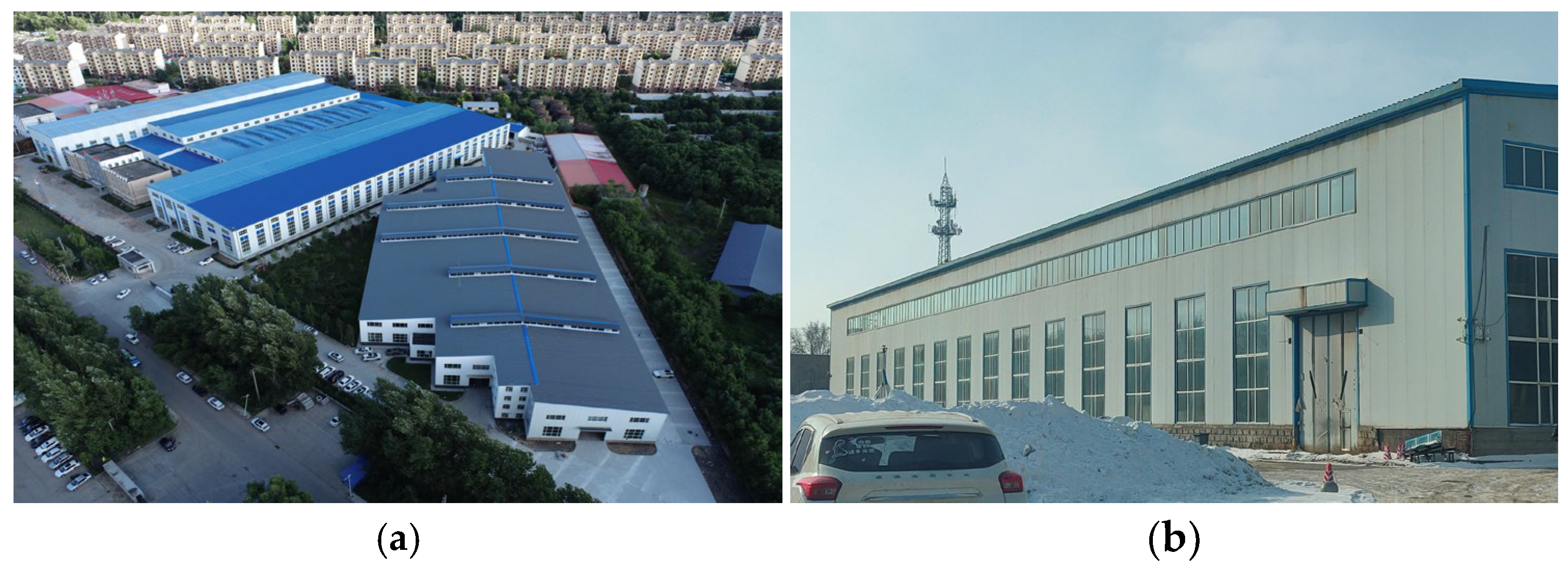
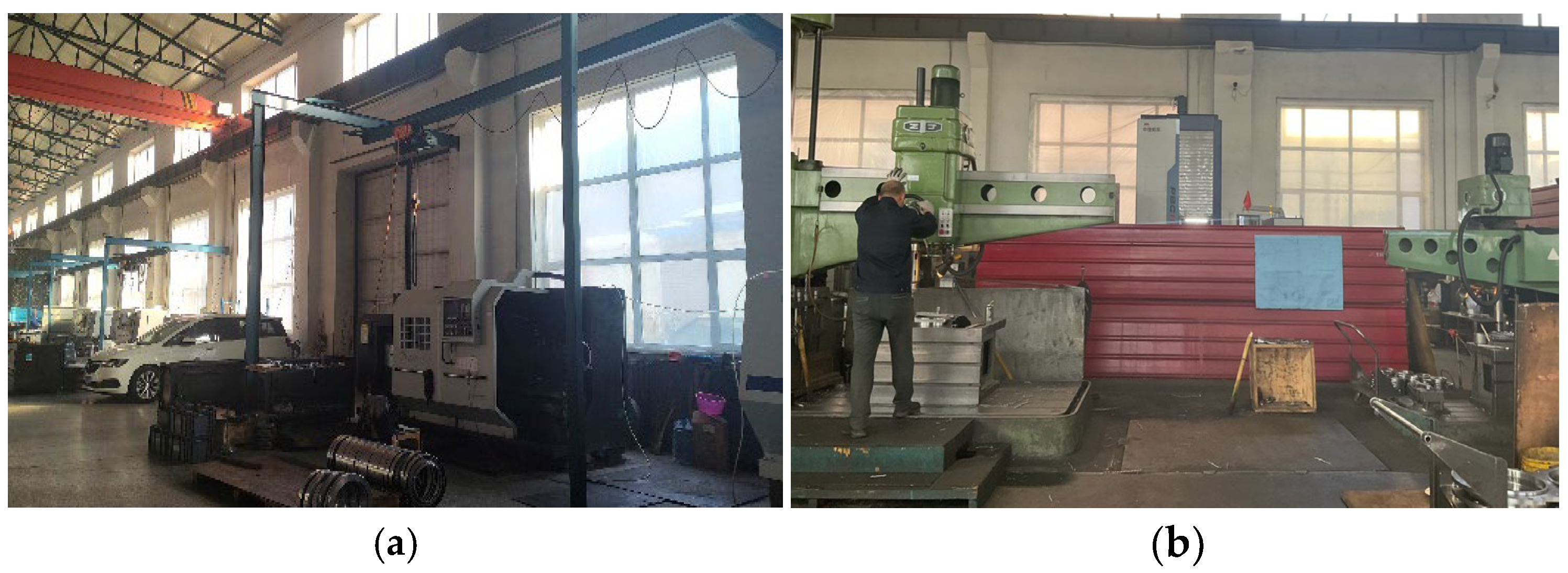
2.1.1. Sample Selection and Data Collection
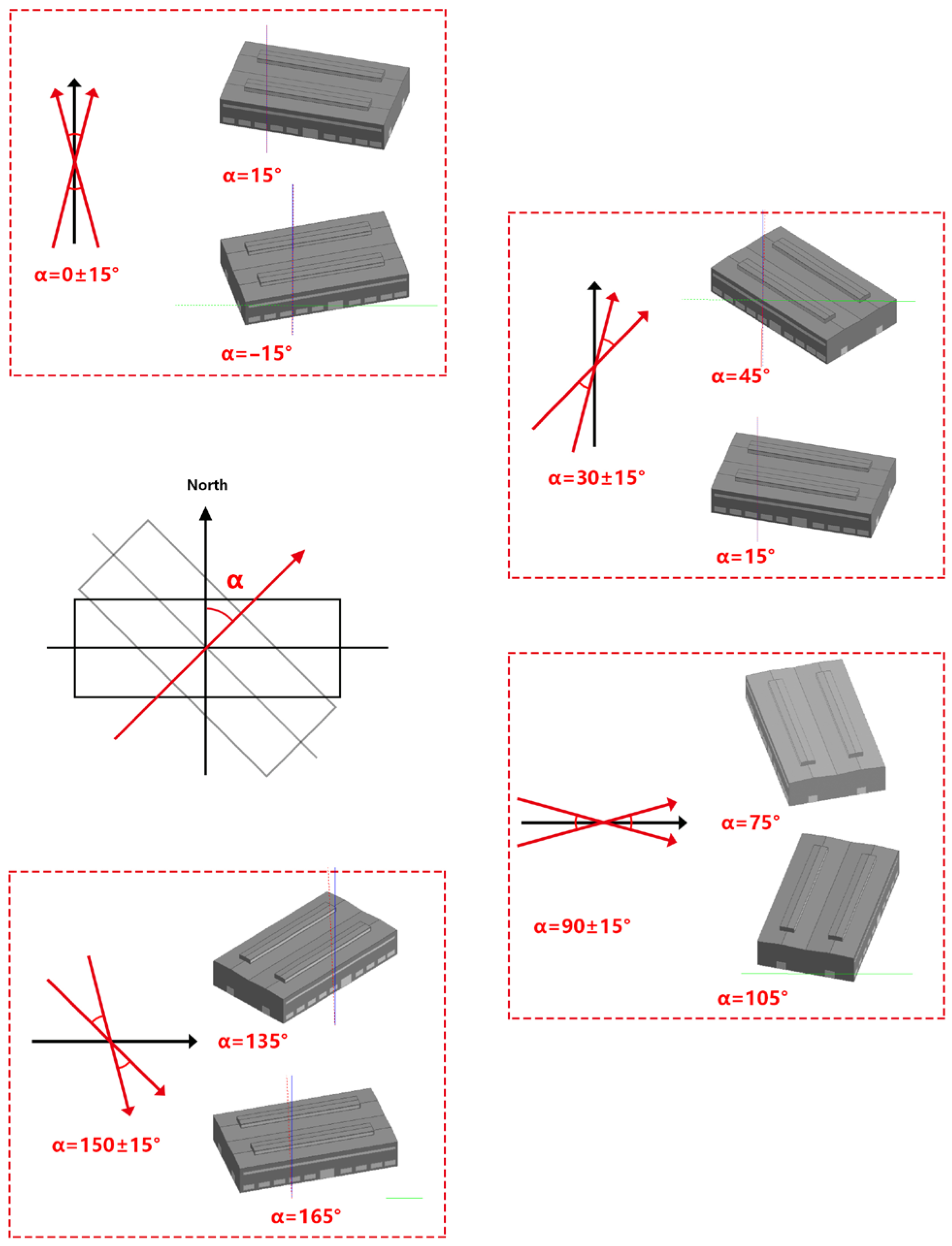
2.1.2. Analysis of Building Characteristics
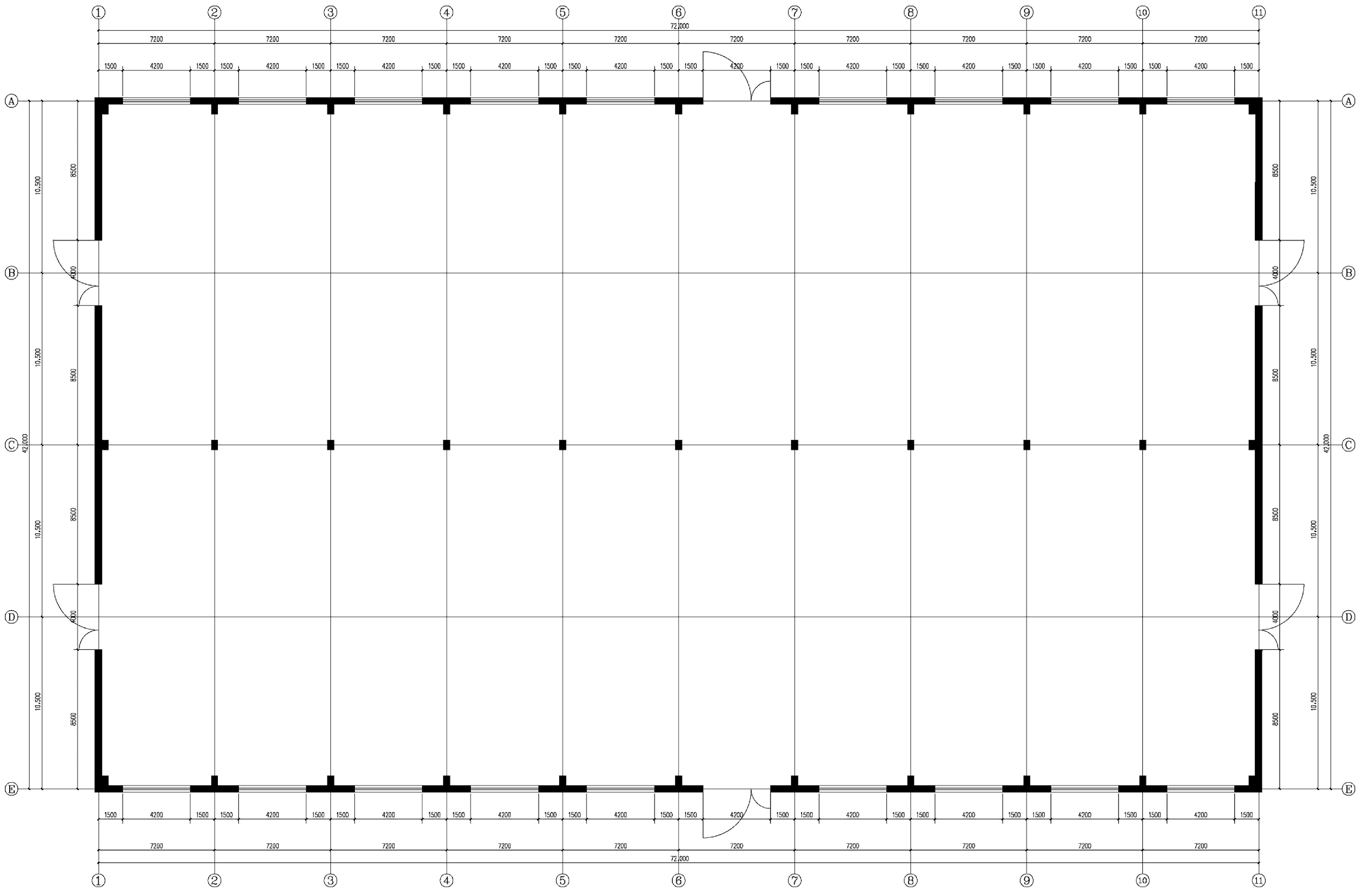
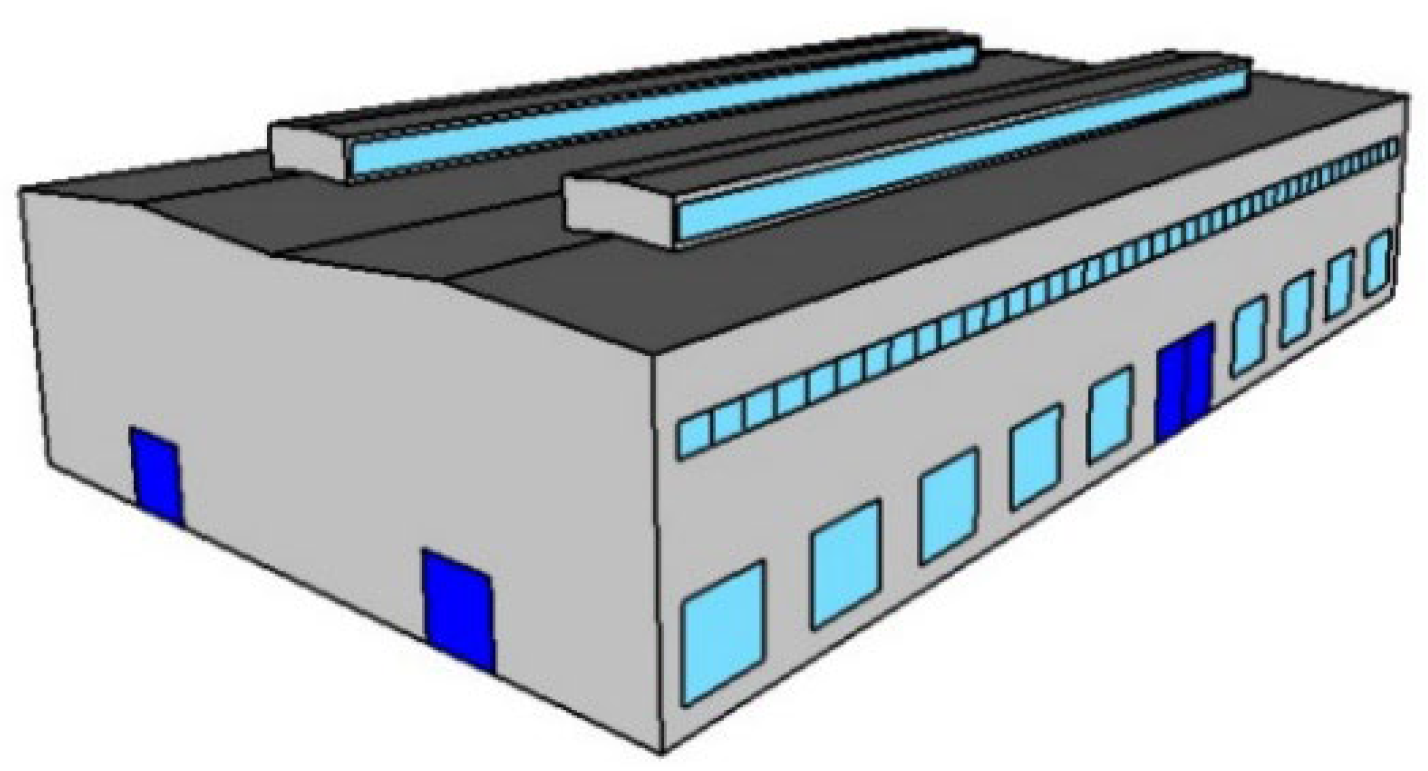
2.1.3. Establishment of Six Typical Prototypes
2.2. Baseline Simulation Model and Parameters
2.3. Simulation Scenario Design
2.3.1. Analysis of Influencing Factors
2.3.2. Scenarios Based on Insulation Layer Parameters
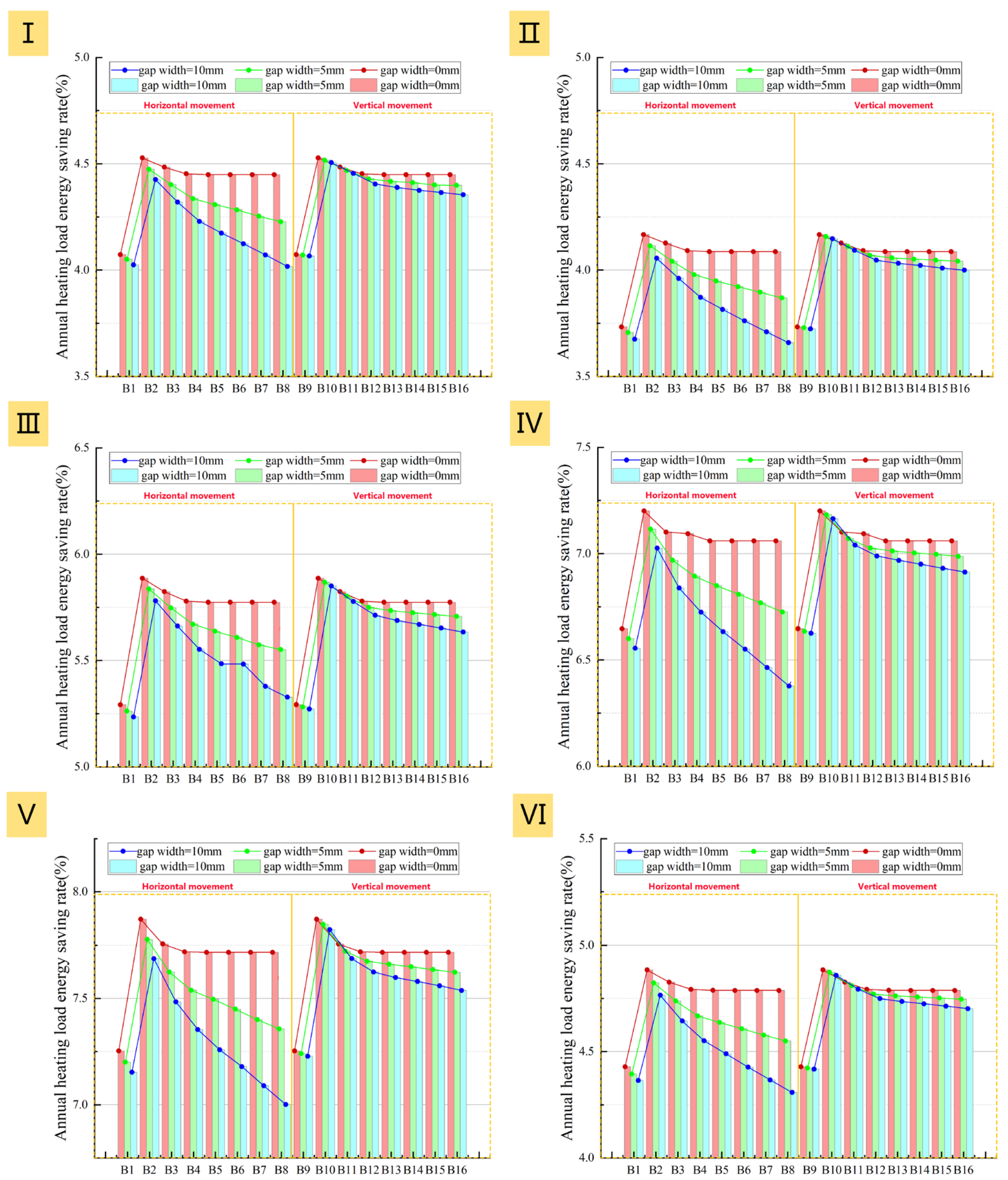
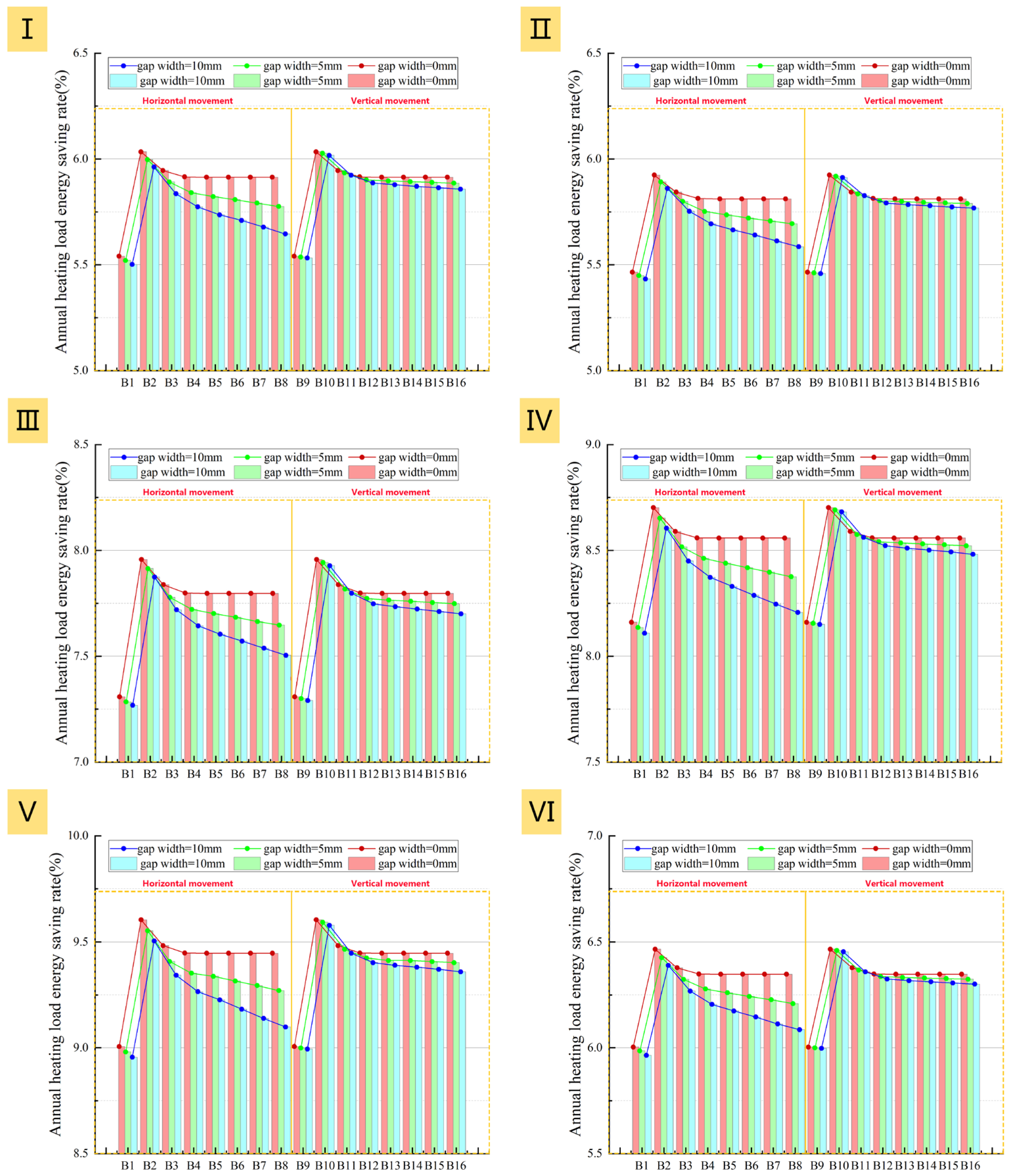
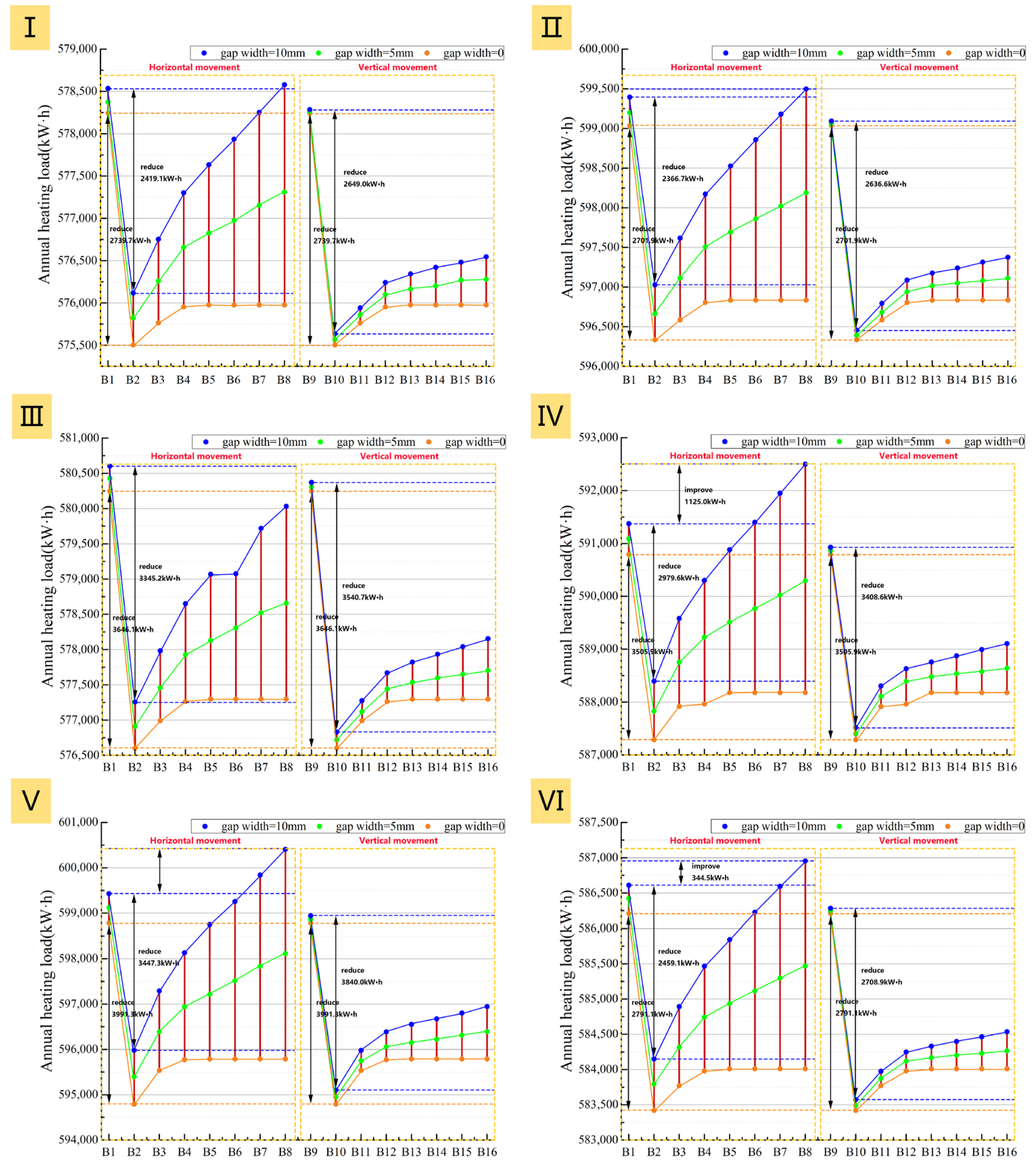
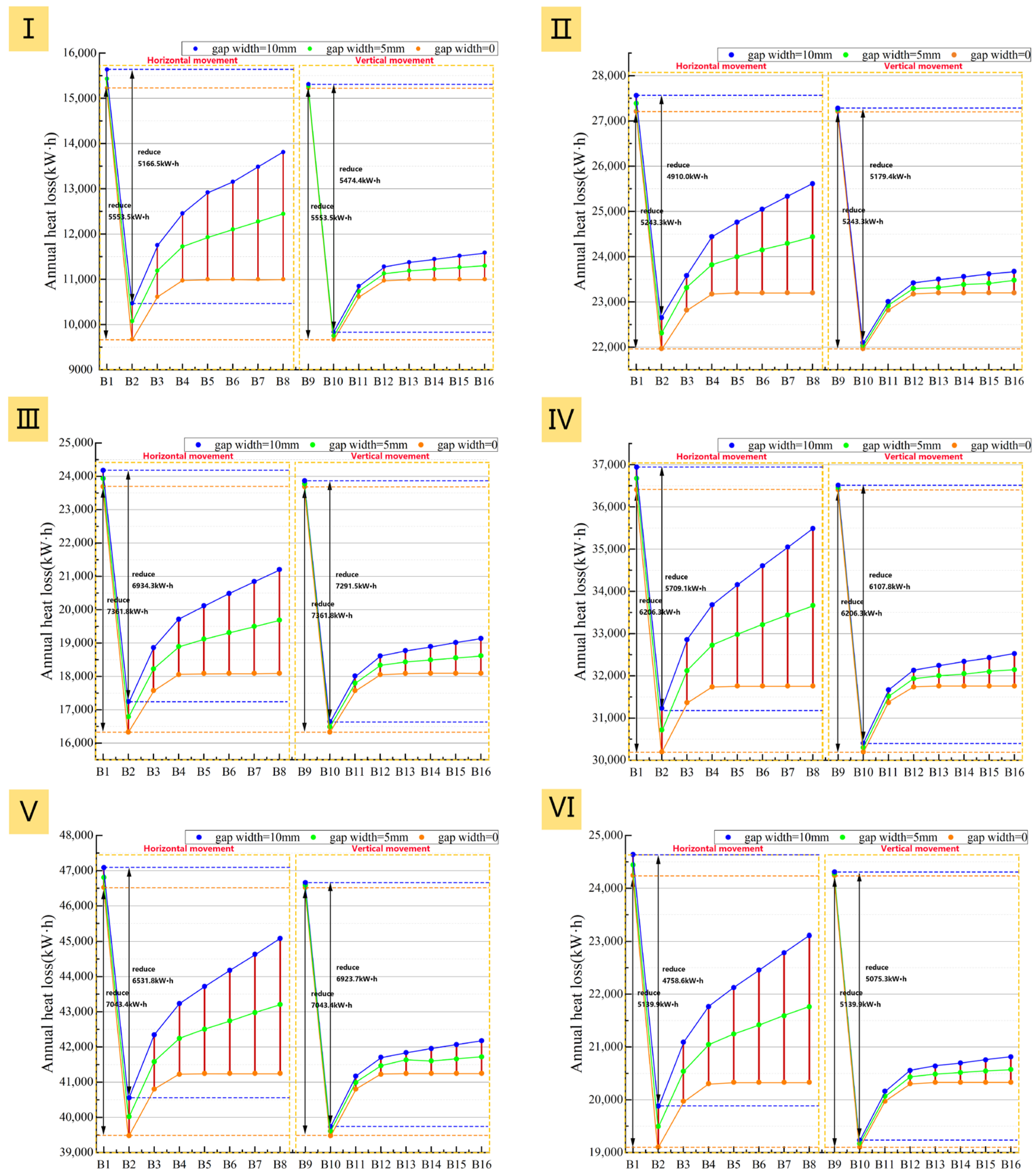
2.3.3. Scenarios Based on Air Cavity Parameters
2.4. Dynamic Simulation
2.4.1. Selection of Simulation Tool
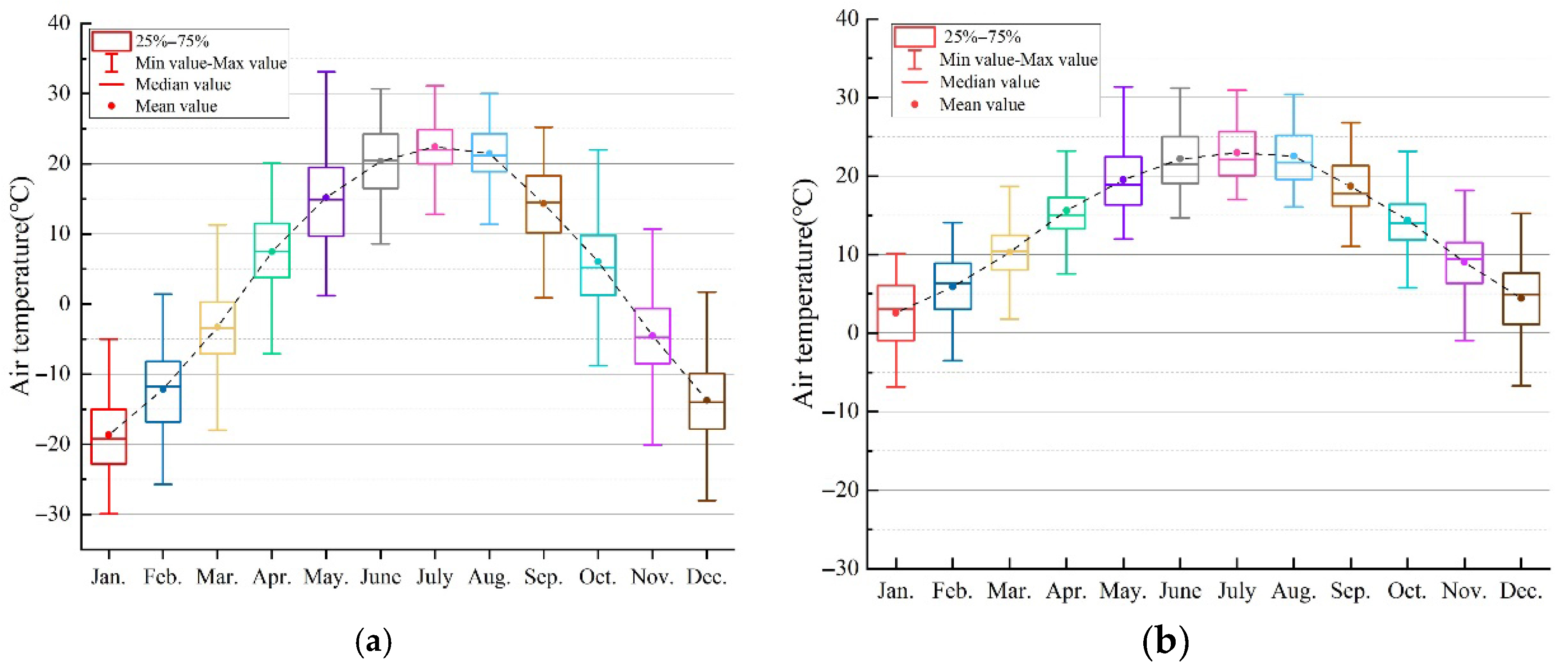
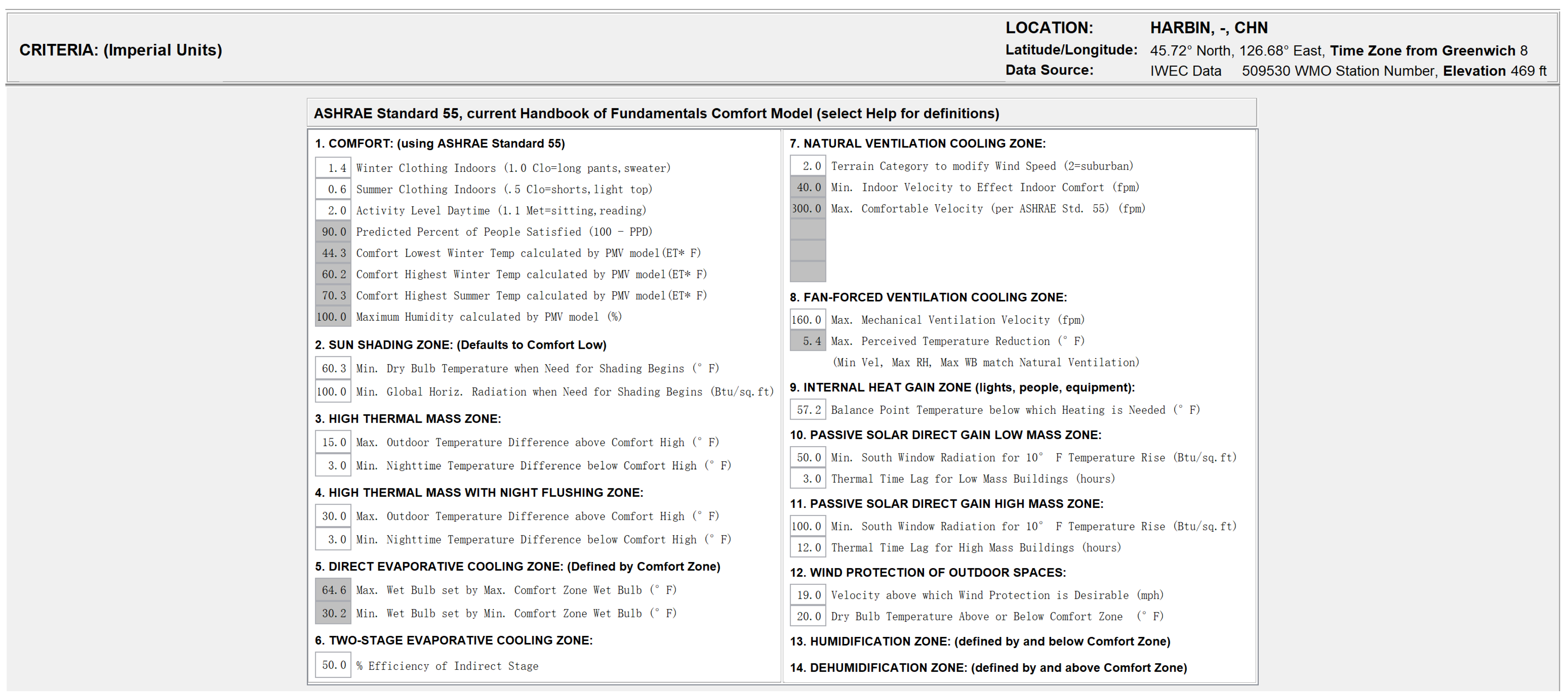
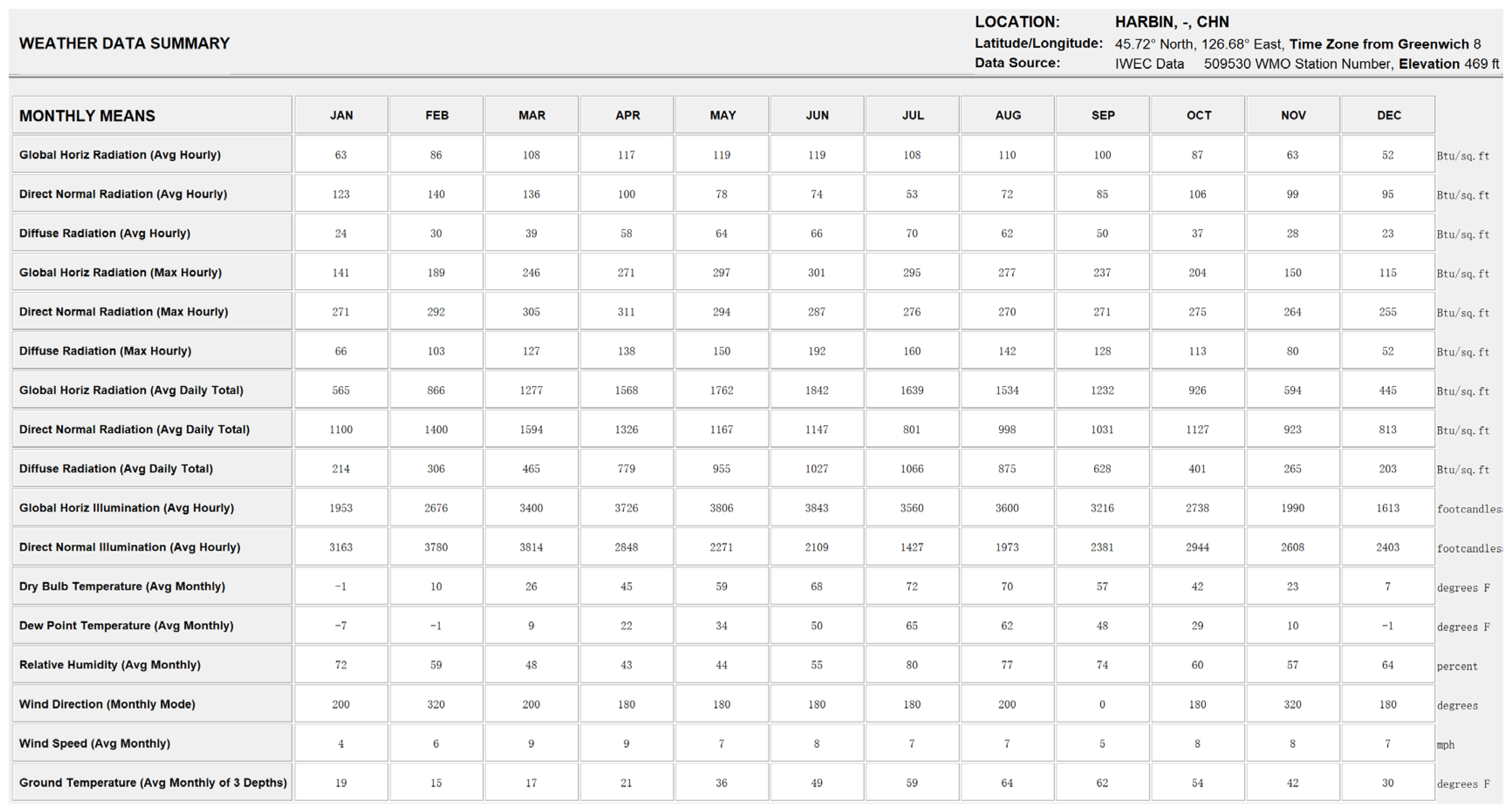
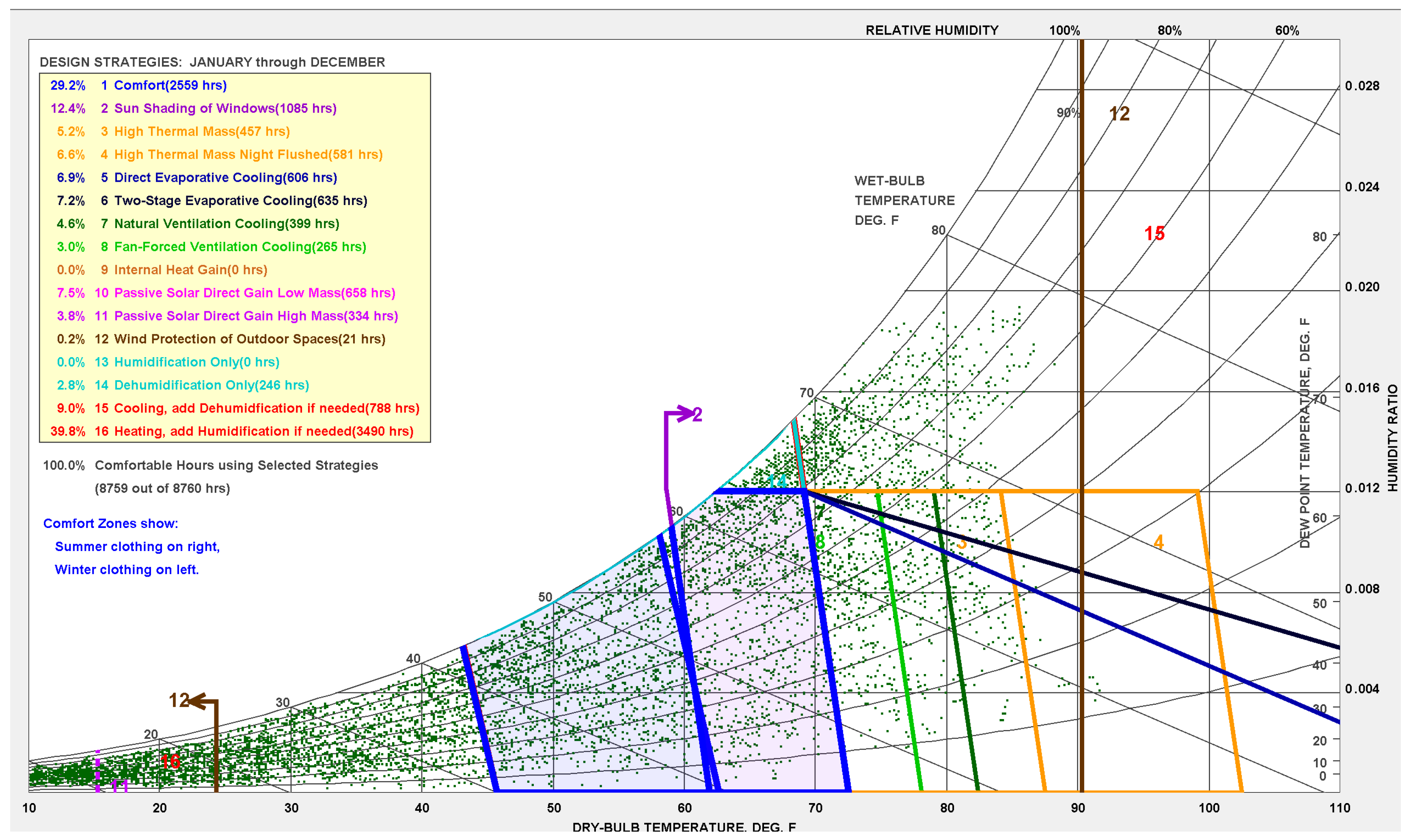
2.4.2. Climatic Data and Boundary Conditions
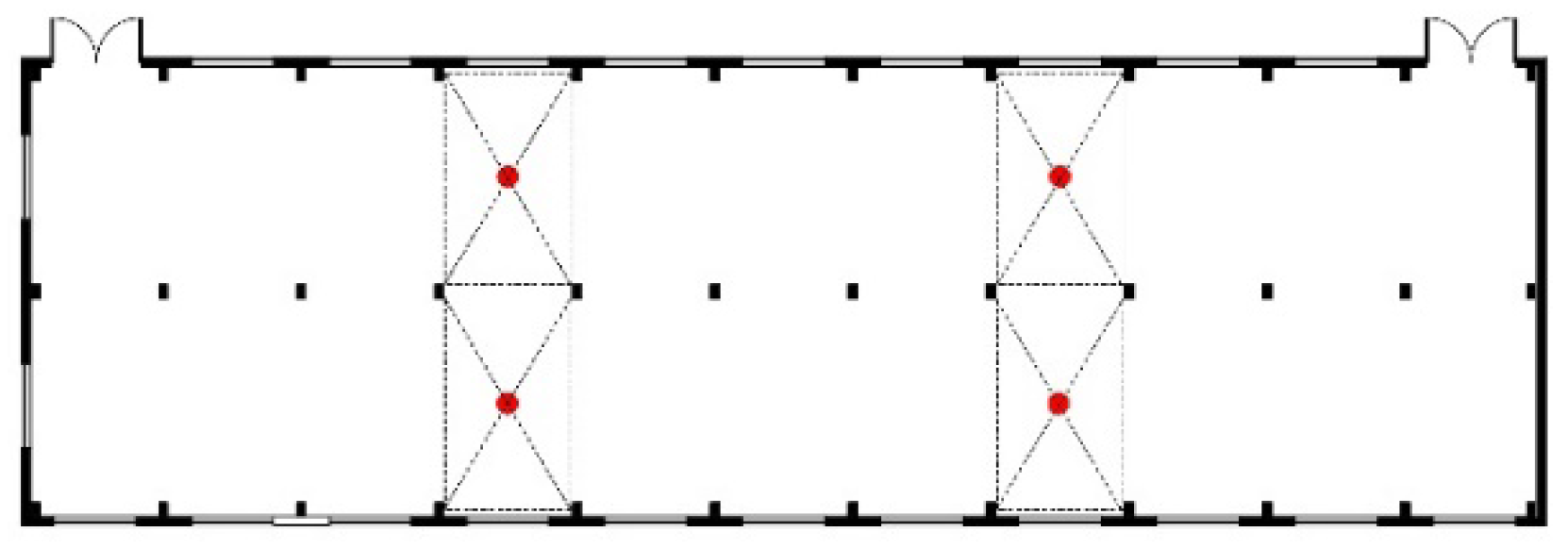
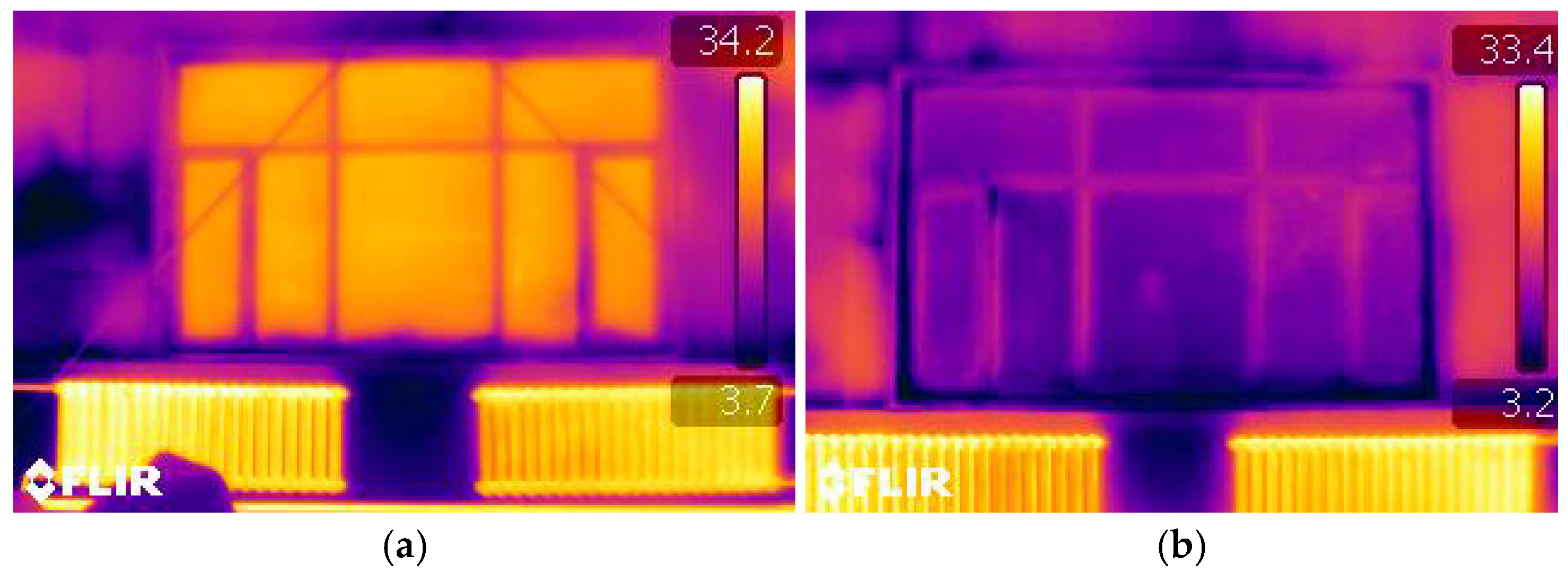
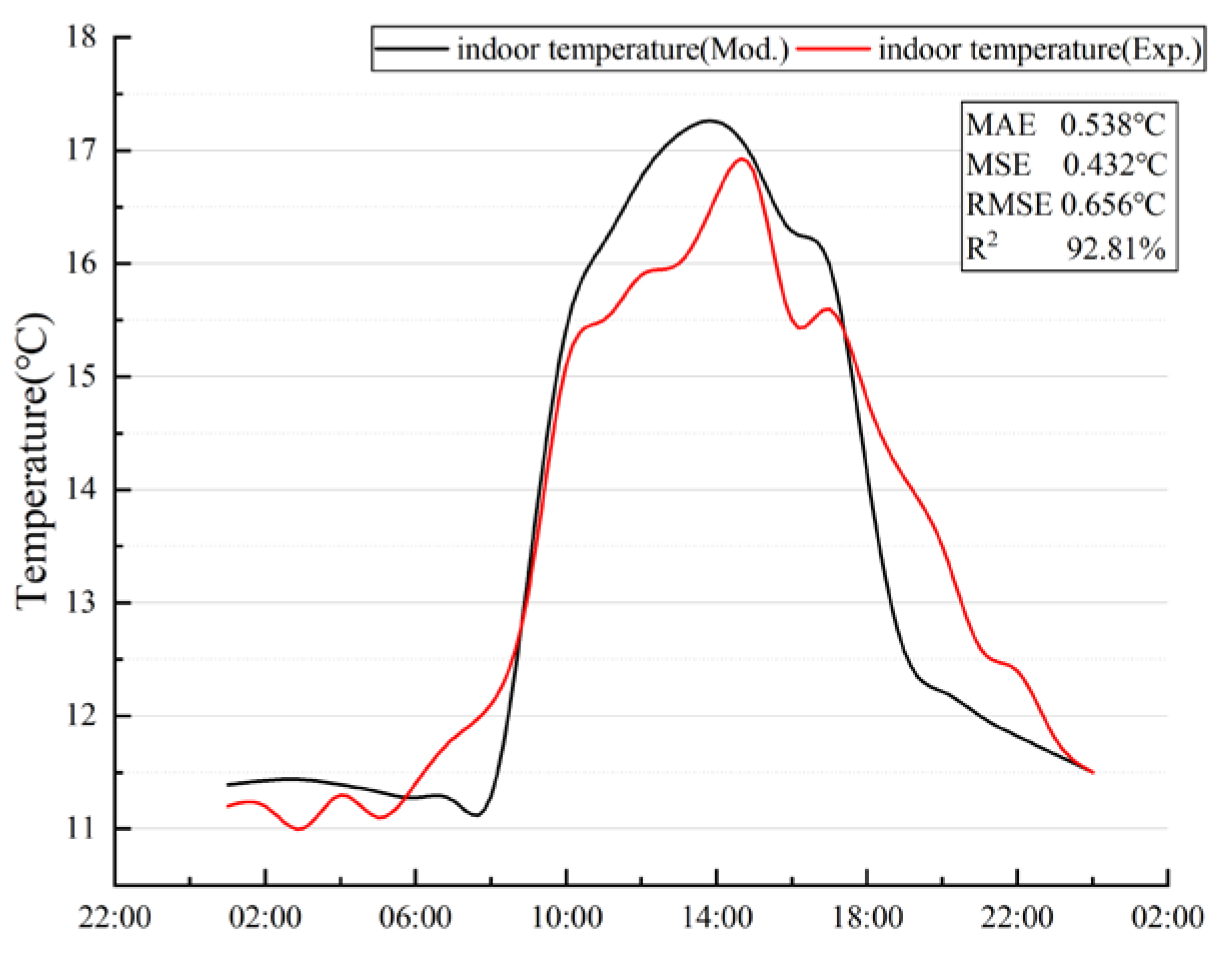
2.4.3. Baseline Model Validation
3. Results and Discussion
3.1. Parameters of the Insulation Layer
3.1.1. Transparent Insulation Materials
3.1.2. Opaque Insulation Materials
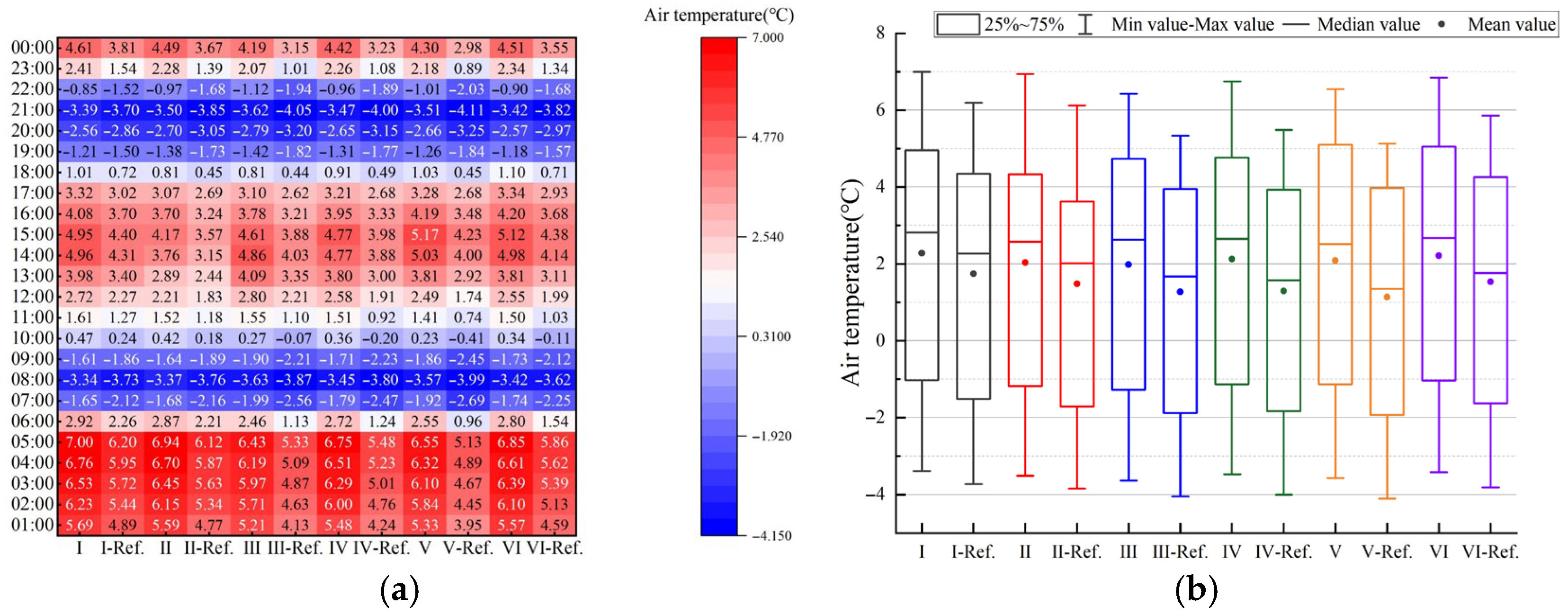
Thermal Performance Analysis
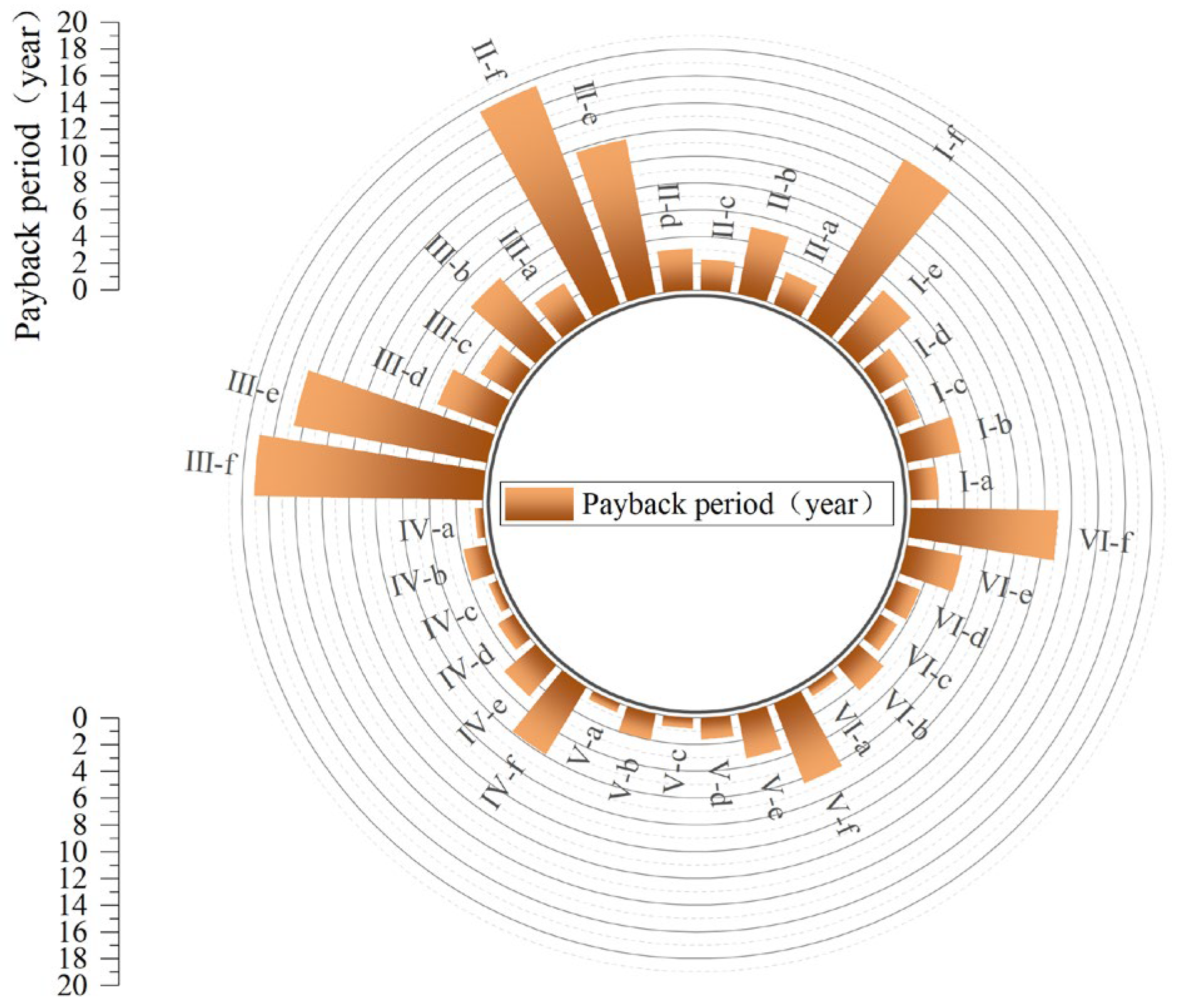
Techno-Economic Analysis and Optimization
3.1.3. Selection Strategy for Window Insulation Layers
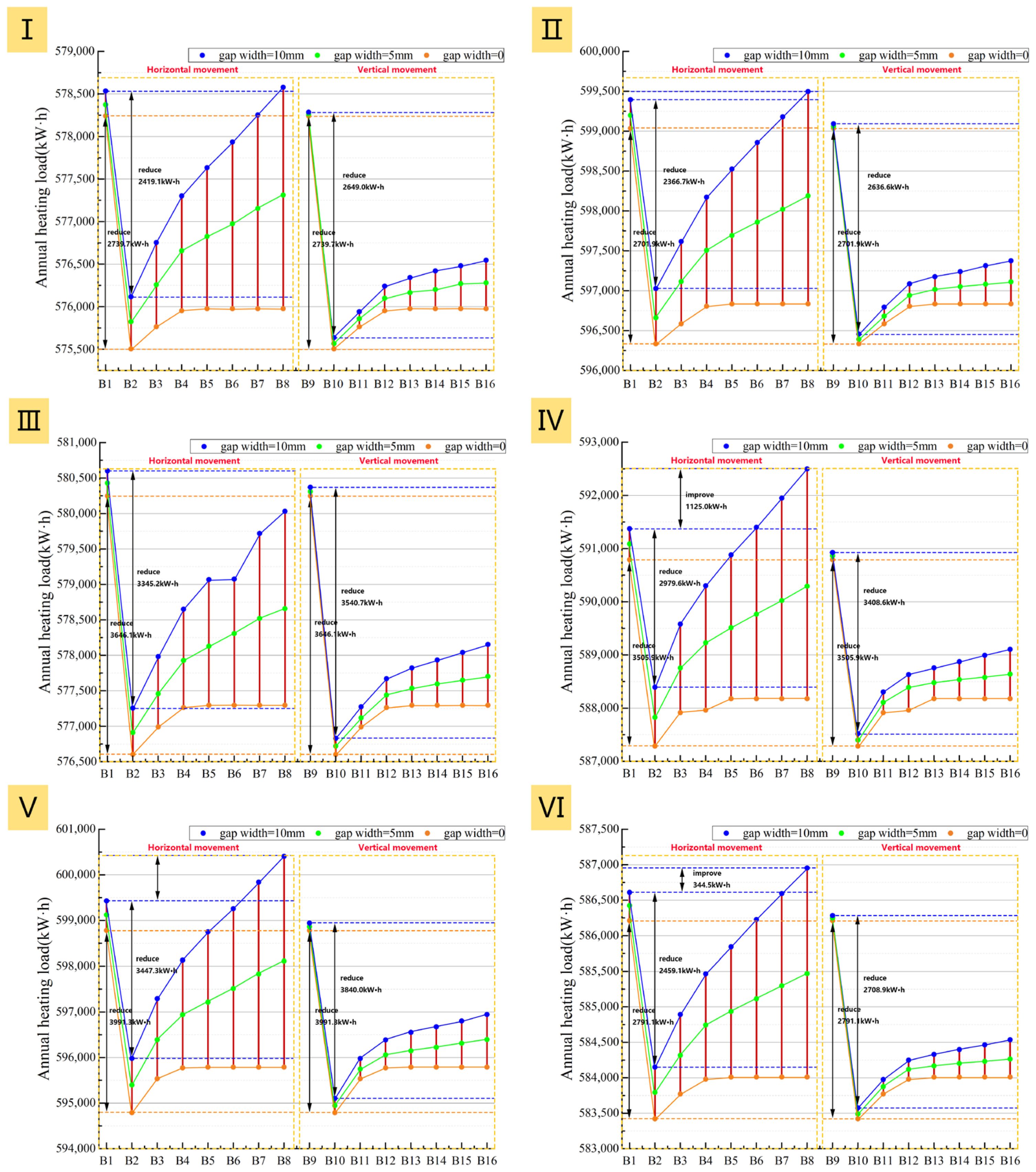
3.2. Parameters of the Installation Configuration
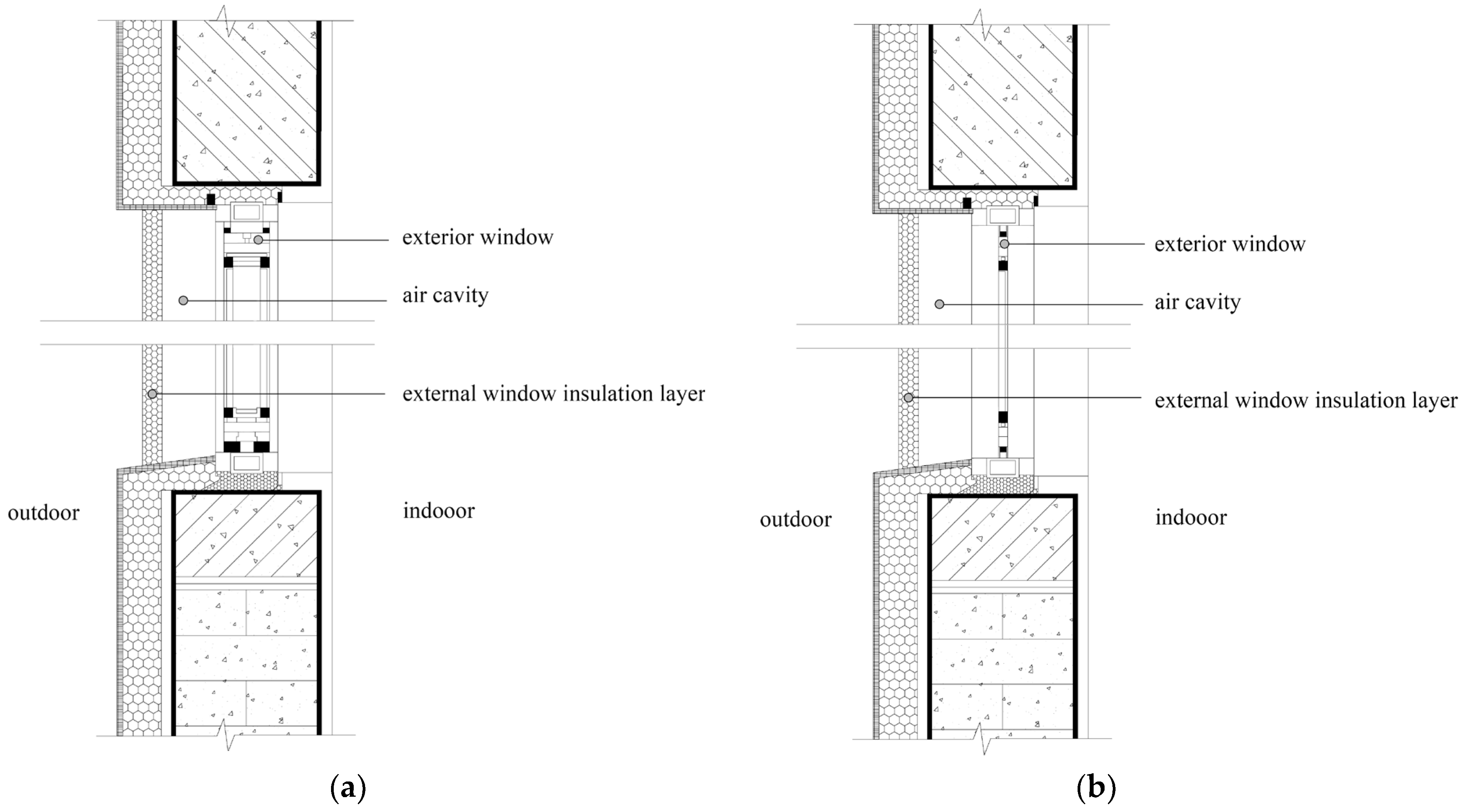
3.2.1. Internal Window Insulation Layer
3.2.2. External Window Insulation Layer
3.2.3. Comparison of Single- and Double-Sided Insulation
3.3. Integration of Insulation Systems with Prefabricated Facades
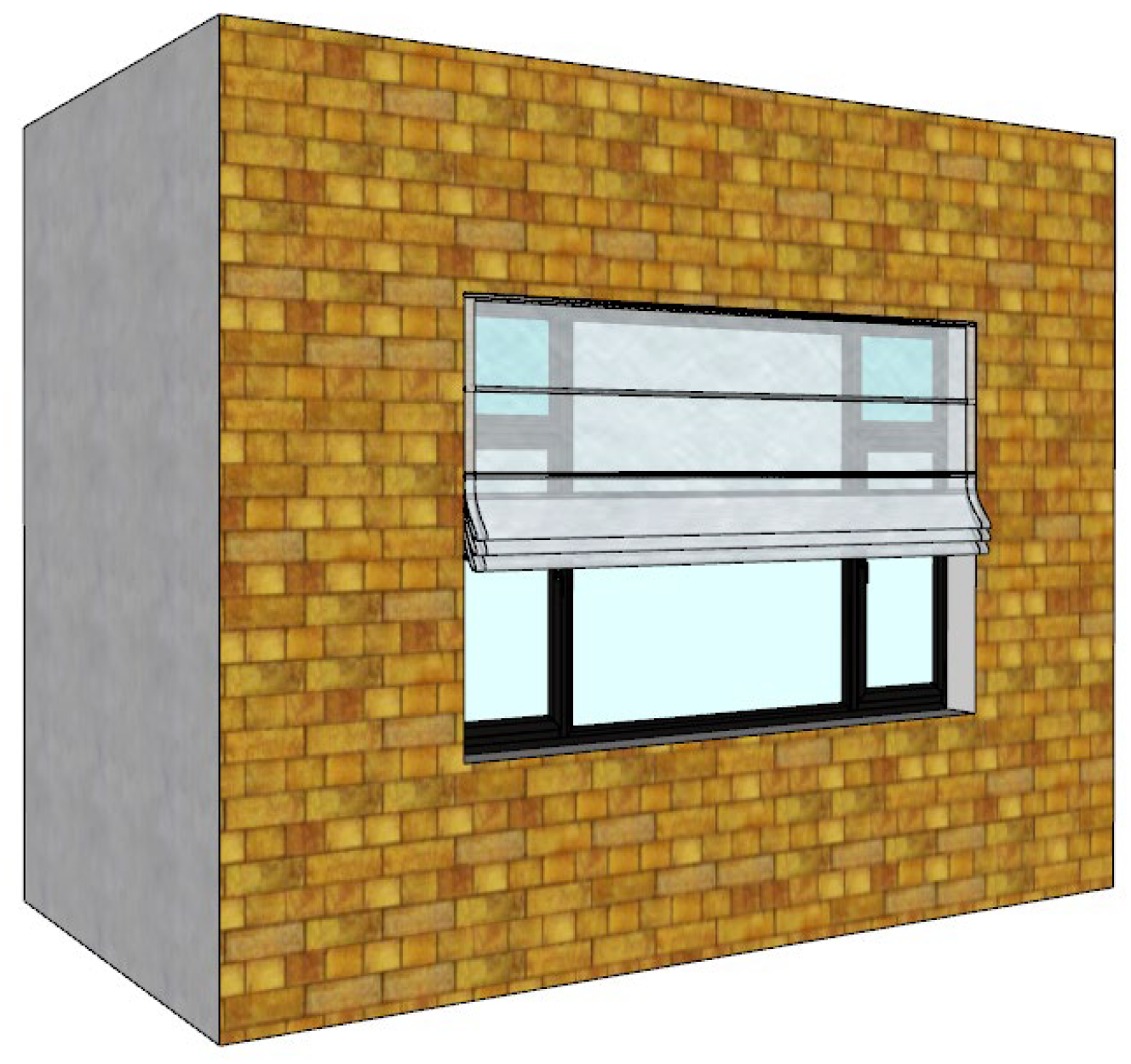
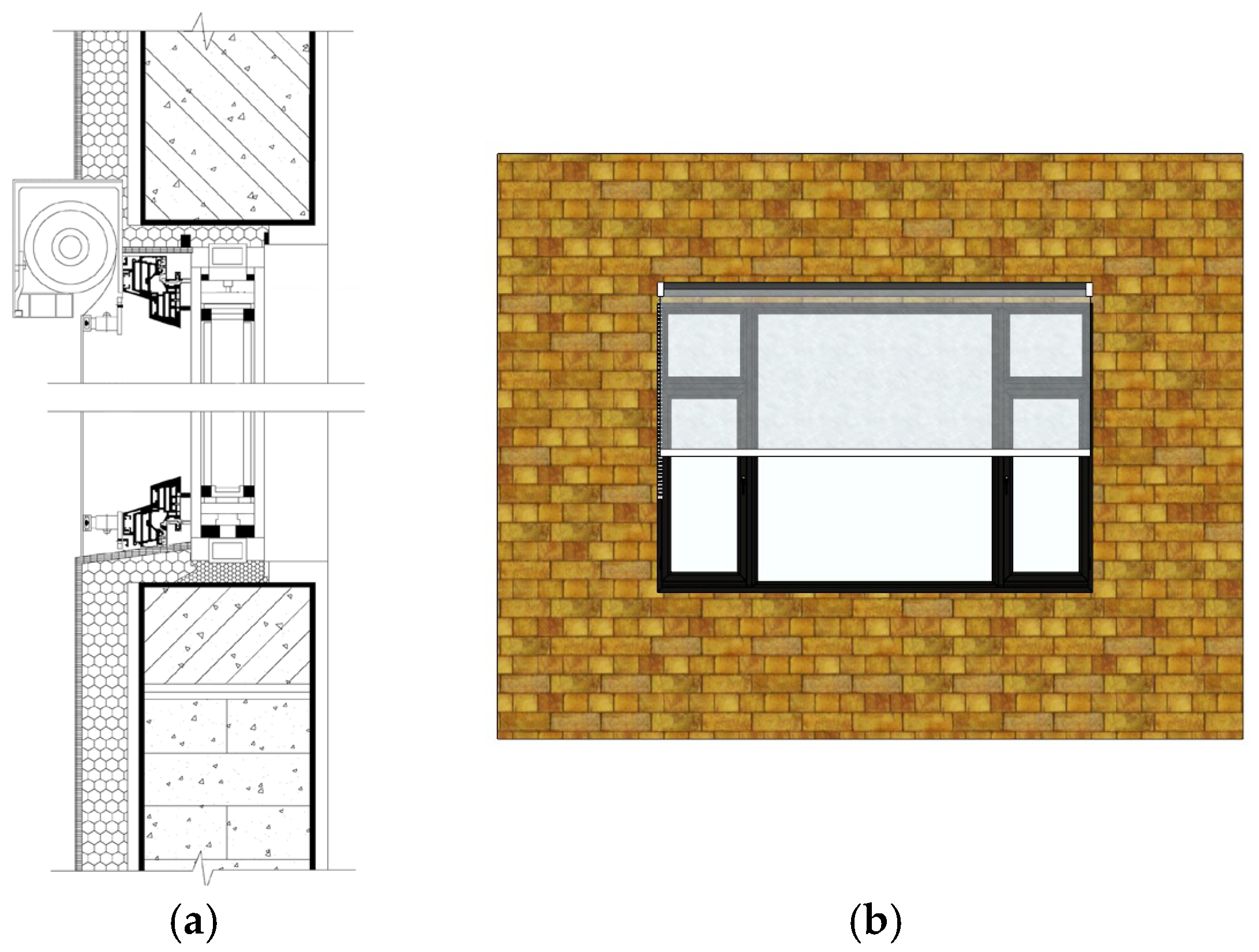
3.3.1. Integrated Roller Shutter System for Flexible Materials
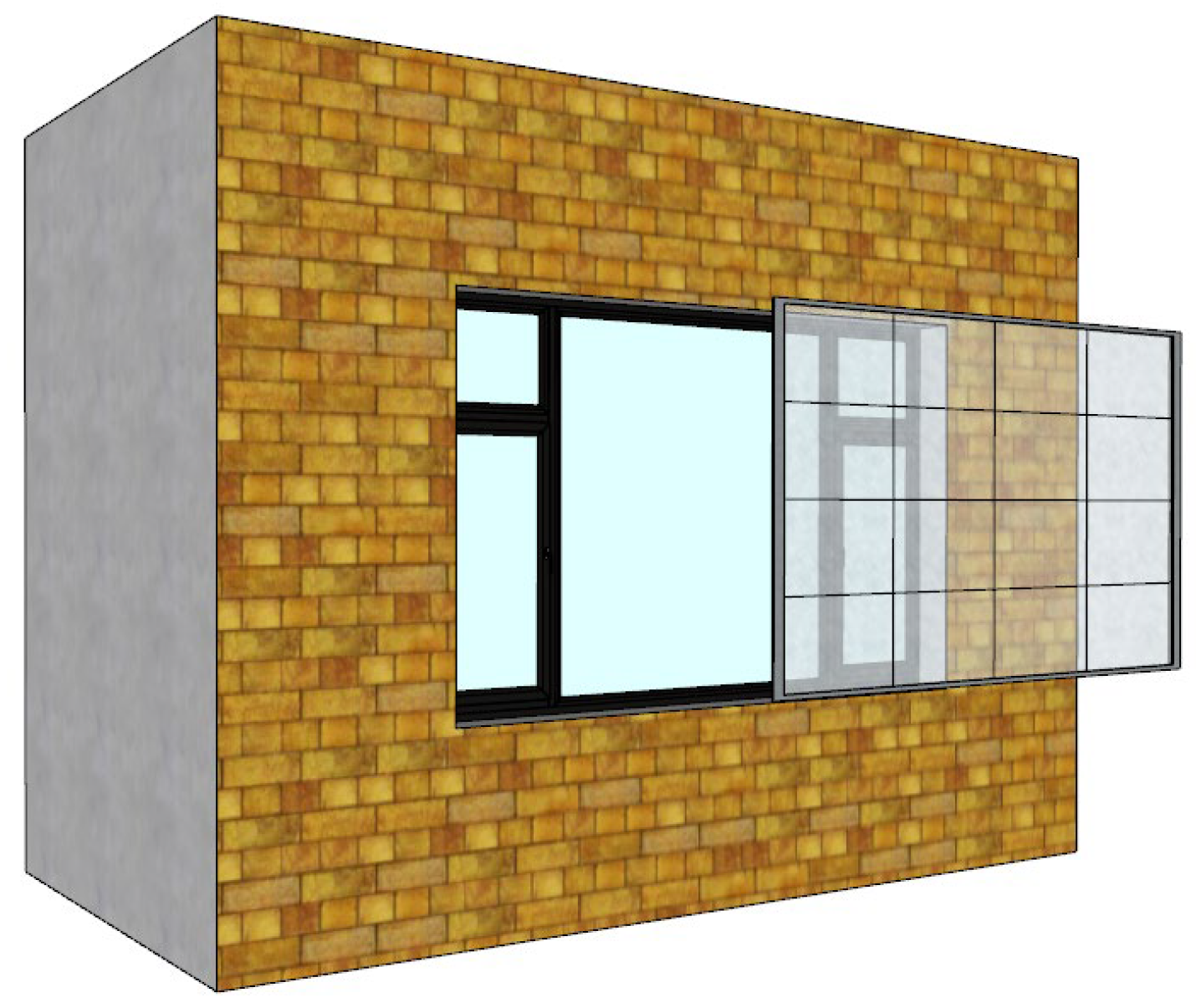
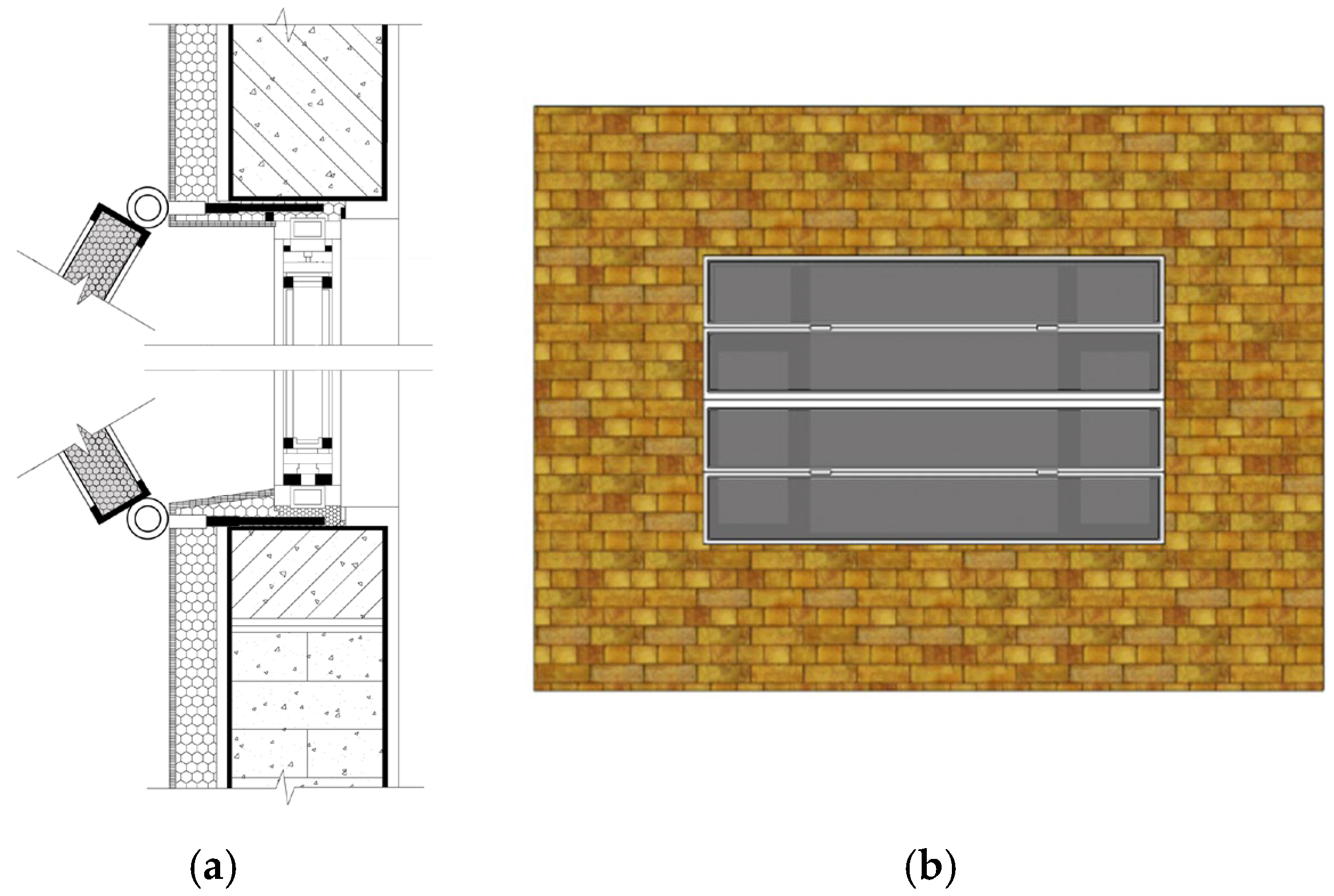
3.3.2. Modular Folding Panel System for Rigid Materials
4. Conclusions
Author Contributions
Funding
Data Availability Statement
Conflicts of Interest
Abbreviations
| TMY | Typical Meteorological Year |
| MAE | Mean Absolute Error |
| RMSE | Root Mean Squared Error |
| MSE | Mean Squared Error |
| PVC | Polyvinylchloride |
| EPS | Expanded Polystyrene Foam |
| XPS | Extruded Polystyrene Foam |
| PUR | Polyisocyanurate Foam |
| WWR | Window–wall Ratio |
| SHGC | Solar Heat Gain Coefficient |
References
- Guo, S.Y.; Yan, D.; Hu, S.; Zhang, Y. Modelling building energy consumption in China under different future scenarios. Energy 2021, 214, 119063. [Google Scholar] [CrossRef]
- Chang, C.Y.; Chen, P.K. Human response to window views and indoor plants in the workplace. Hortscience 2005, 40, 1354–1359. [Google Scholar] [CrossRef]
- Shin, W.S. The influence of forest view through a window on job satisfaction and job stress. Scand. J. Forest Res. 2007, 22, 248–253. [Google Scholar] [CrossRef]
- Hart, R.; Selkowitz, S.; Curcija, C. Thermal performance and potential annual energy impact of retrofit thin-glass triple-pane glazing in US residential buildings. Build. Simul. 2019, 12, 79–86. [Google Scholar] [CrossRef]
- Jelle, B.P.; Hynd, A.; Gustavsen, A.; Arasteh, D.; Goudey, H.; Hart, R. Fenestration of today and tomorrow: A state-of-the-art review and future research opportunities. Sol. Energy Mater. Sol. Cells 2012, 96, 1–28. [Google Scholar] [CrossRef]
- Ke, Y.J.; Zhou, C.Z.; Zhou, Y.; Wang, S.C.; Chan, S.H.; Long, Y. Emerging Thermal-Responsive Materials and Integrated Techniques Targeting the Energy-Efficient Smart Window Application. Adv. Funct. Mater. 2018, 28, 1800113. [Google Scholar] [CrossRef]
- Gao, J.X.; Zhong, X.Y.; Cai, W.G.; Ren, H.; Huo, T.F.; Wang, X.; Mi, Z.F. Dilution effect of the building area on energy intensity in urban residential buildings. Nat. Commun. 2019, 10, 4944. [Google Scholar] [CrossRef] [PubMed]
- Liu, Z.J.; Liu, Y.W.; He, B.J.; Xu, W.; Jin, G.Y.; Zhang, X.T. Application and suitability analysis of the key technologies in nearly zero energy buildings in China. Renew. Sustain. Energy Rev. 2019, 101, 329–345. [Google Scholar] [CrossRef]
- Dalapati, G.K.; Kushwaha, A.K.; Sharma, M.; Suresh, V.; Shannigrahi, S.; Zhuk, S.; Masudy-Panah, S. Transparent heat regulating (THR) materials and coatings for energy saving window applications: Impact of materials design, micro-structural, and interface quality on the THR performance. Prog. Mater. Sci. 2018, 95, 42–131. [Google Scholar] [CrossRef]
- Inoue, T. Solar shading and daylighting by means of autonomous responsive dimming glass: Practical application. Energy Build. 2003, 35, 463–471. [Google Scholar] [CrossRef]
- Jiang, W.; Liu, B.; Zhang, X.; Zhang, T.; Li, D.; Ma, L. Energy performance of window with PCM frame. Sustain. Energy Technol. 2021, 45, 101109. [Google Scholar] [CrossRef]
- Nsaif, M.A.; Jalil, J.M.; Baccar, M. Experimental Investigation of the Thermal Performance of Triple Glazed Windows Integrated with PCM and Low-e Glass. Int. J. Heat Technol. 2024, 42, 1735–1743. [Google Scholar] [CrossRef]
- Zhou, H.; Yang, H.X.; Peng, J.Q. Solar PV vacuum glazing (SVG) insulated building facades: Thermal and electrical performances. Appl. Energy 2024, 376, 124323. [Google Scholar] [CrossRef]
- Liang, J.; Qiu, Y.M.; James, T.; Ruddell, B.L.; Dalrymple, M.; Earl, S.; Castelazo, A. Do energy retrofits work? Evidence from commercial and residential buildings in Phoenix. J. Environ. Econ. Manag. 2018, 92, 726–743. [Google Scholar] [CrossRef]
- Banti, N. Existing industrial buildings—A review on multidisciplinary research trends and retrofit solutions. J. Build. Eng. 2024, 84, 108615. [Google Scholar] [CrossRef]
- Gruner, M.; Matusiak, B.S. A Novel Dynamic Insulation System for Windows. Sustain. 2018, 10, 2907. [Google Scholar] [CrossRef]
- Sun, Y.Y.; Liu, X.; Ming, Y.; Liu, X.; Mahon, D.; Wilson, R.; Liu, H.; Eames, P.; Wu, Y.P. Energy and daylight performance of a smart window: Window integrated with thermotropic parallel slat-transparent insulation material. Appl. Energy 2021, 293, 116826. [Google Scholar] [CrossRef]
- Tzempelikos, A.; Athienitis, A.K. The impact of shading design and control on building cooling and lighting demand. Sol Energy 2007, 81, 369–382. [Google Scholar] [CrossRef]
- Ariosto, T.; Memari, A.M.; Solnosky, R.L. Development of designer aids for energy efficient residential window retrofit solutions. Sustain. Energy Technol. 2019, 33, 1–13. [Google Scholar] [CrossRef]
- Cai, G.W.; Sun, L.N.; Liu, D.Y.; Xu, B.Y.; Mo, Z.J. Potential of indoor room 3D ratio in reducing carbon emissions by prefabricated decoration in chain hotel buildings via multidimensional algorithm models for robot in-situ 3D printing. J. Build. Eng. 2025, 101, 111757. [Google Scholar] [CrossRef]
- Cai, G.W.; Guo, X.T.; Sun, Y.G. Prefabricated building construction in materialization phase as catalysts for hotel low-carbon transitions via hybrid computational visualization algorithms. Sci. Rep. 2025, 15, 19420. [Google Scholar] [CrossRef] [PubMed]
- Cai, G.; Liu, D.; Wu, Z. Multidimensional algorithms-based carbon efficiency model of building geometric 3D ratios for prefabricated 3D printing design and construction. npj Clean Energy 2025, 1, 5. [Google Scholar] [CrossRef]
- Colaco, S.G.; Kurian, C.P.; George, V.I.; Colaco, A.M. Prospective Techniques of Effective Daylight Harvesting in Commercial Buildings by Employing Window Glazing, Dynamic Shading Devices and Dimming Control-A Literature Review. Build. Simul. 2008, 1, 279–289. [Google Scholar] [CrossRef]
- Kim, J.; Paik, T. Recent Advances in Fabrication of Flexible, Thermochromic Vanadium Dioxide Films for Smart Windows. Nanomaterials 2021, 11, 2674. [Google Scholar] [CrossRef] [PubMed]
- Kunwar, N.; Cetin, K.S.; Passe, U.; Zhou, X.H.; Li, Y.H. Full-scale experimental testing of integrated dynamically-operated roller shades and lighting in perimeter office spaces. Sol Energy 2019, 186, 17–28. [Google Scholar] [CrossRef]
- Qin, X.T.; Liu, H.B.; Zhang, X.; Jiang, N.; Yang, L.; Jin, X. Thermal analysis of the window-wall interface for renovation of historical buildings. Energy Build. 2024, 310, 114108. [Google Scholar] [CrossRef]
- Zhao, S.Y.; Diao, J.X.; Yao, S.; Yuan, J.Y.; Liu, X.; Li, M. Seasonal optimization of envelope and shading devices oriented towards low-carbon emission for premodern historic residential buildings of China. Case Stud. Therm. Eng. 2024, 64, 105452. [Google Scholar] [CrossRef]
- Ohene, E.; McGehee, M.D.; Krarti, M. Quantifying energy benefits from window improvement strategies for commercial buildings. Energy Build. 2025, 347, 116239. [Google Scholar] [CrossRef]
- Seo, R.S.; Rhee, K.N. Experimental study on the thermal performance of thermally activated internal louvers. Build. Environ. 2025, 284, 113440. [Google Scholar] [CrossRef]
- Basok, B.; Novikov, V.; Pavlenko, A.; Koshlak, H.; Goncharuk, S.; Shmatok, O.; Davydenko, D. Sustainable Increase in Thermal Resistance of Window Construction: Experimental Verification and CFD Modelling of the Air Cavity Created by a Shutter. Materials 2025, 18, 2702. [Google Scholar] [CrossRef]
- Dabbagh, M.; Krarti, M. Experimental evaluation of the performance for switchable insulated shading systems. Energy Build. 2022, 256, 111753. [Google Scholar] [CrossRef]
- Adamus, J.; Pomada, M. Analysis of the Influence of External Wall Material Type on the Thermal Bridge at the Window-to-Wall Interface. Materials 2023, 16, 6585. [Google Scholar] [CrossRef]
- Kim, H.; Clayton, M.J. Parametric behavior maps: A method for evaluating the energy performance of climate-adaptive building envelopes. Energy Build. 2020, 219, 110020. [Google Scholar] [CrossRef]
- Krarti, M. Performance of PV integrated dynamic overhangs applied to US homes. Energy 2021, 230, 120843. [Google Scholar] [CrossRef]
- Lee, J.; Ali, A.S.; Haratian, S.; Stephens, B.; Heidarinejad, M. A framework to evaluate the thermal and energy performance of smart building systems in existing buildings: A case study on automated interior insulating window shades. Methodsx 2025, 14, 103378. [Google Scholar] [CrossRef]
- GB 55016-2021; General Code for Building Environment. China Architecture & Building Press: Beijing, China, 2021.
- Djokovic, J.M.; Nikolic, R.R.; Bujnak, J.; Hadzima, B.; Pastorek, F.; Dwornicka, R.; Ulewicz, R. Selection of the Optimal Window Type and Orientation for the Two Cities in Serbia and One in Slovakia. Energies 2022, 15, 323. [Google Scholar] [CrossRef]
- Gong, X.Z.; Akashi, Y.; Sumiyoshi, D. Optimization of passive design measures for residential buildings in different Chinese areas. Build. Environ. 2012, 58, 46–57. [Google Scholar] [CrossRef]
- Hee, W.J.; Alghoul, M.A.; Bakhtyar, B.; Elayeb, O.; Shameri, M.A.; Alrubaih, M.S.; Sopian, K. The role of window glazing on daylighting and energy saving in buildings. Renew. Sustain. Energy Rev. 2015, 42, 323–343. [Google Scholar] [CrossRef]
- Shen, H.; Tzempelikos, A. Sensitivity analysis on daylighting and energy performance of perimeter offices with automated shading. Build. Environ. 2013, 59, 303–314. [Google Scholar] [CrossRef]
- Xue, P.; Li, Q.; Xie, J.C.; Zhao, M.J.; Liu, J.P. Optimization of window-to-wall ratio with sunshades in China low latitude region considering daylighting and energy saving requirements. Appl. Energy 2019, 233, 62–70. [Google Scholar] [CrossRef]
- Krarti, M. Optimal energy performance of dynamic sliding and insulated shades for residential buildings. Energy 2023, 263, 125699. [Google Scholar] [CrossRef]
- Altun, A.F. Determination of Optimum Building Envelope Parameters of a Room concerning Window-to-Wall Ratio, Orientation, Insulation Thickness and Window Type. Buildings 2022, 12, 383. [Google Scholar] [CrossRef]
- Singh, R.; Lazarus, I.J.; Kishore, V.V.N. Effect of internal woven roller shade and glazing on the energy and daylighting performances of an office building in the cold climate of Shillong. Appl. Energy 2015, 159, 317–333. [Google Scholar] [CrossRef]
- GB 51245-2017; Unified Standard for Energy Efficiency Design of Industrial Buildings. China Architecture & Building Press: Beijing, China, 2017.
- GBZ/T 189.10-2007; Measurement of Physical Factors in Workplace—Part 10: Classification of Physical Workload. People’s Medical Publishing House: Beijing, China, 2007.
- GB/T 50785-2012; Evaluation Standard for Indoor Thermal and Humid Environment in Civil Buildings. China Architecture & Building Press: Beijing, China, 2012.
- Atzeri, A.; Cappelletti, F.; Gasparella, A. Internal versus external shading devices performance in office buildings. Energy Procedia 2014, 45, 463–472. [Google Scholar] [CrossRef]
- Múcka, M.; Sedivka, P.; Bomba, J.; Blazek, J. Influence of Spacer Frames for Wooden Roof Windows on the Formation of Surface Condensation. Bioresources 2016, 11, 6174–6184. [Google Scholar] [CrossRef]
- Song, S.Y.; Jo, J.H.; Yeo, M.S.; Kim, Y.D.; Song, K.D. Evaluation of inside surface condensation in double glazing window system with insulation spacer: A case study of residential complex. Build. Environ. 2007, 42, 940–950. [Google Scholar] [CrossRef]
- Ye, Y.Y.; Xu, P.; Mao, J.C.; Ji, Y. Experimental study on the effectiveness of internal shading devices. Energy Build. 2016, 111, 154–163. [Google Scholar] [CrossRef]
- Urbikain, M.K.; Davies, M.G. A frequency domain estimation of wall conduction transfer function coefficients. Energy Build. 2012, 51, 191–202. [Google Scholar] [CrossRef]
- ANSI/ASHRAE Standard 55-2023; Thermal Environmental Conditions for Human Occupancy. ASHRAE: Atlanta, GA, USA, 2023.
- ISO 6946:2017; Building Components and Building Elements—Thermal Resistance and Thermal Transmittance—Calculation Methods. ISO: Geneva, Switzerland, 2017.













| Orientation | α | Sample Size | Mean Indoor Air Temperature (°C) |
|---|---|---|---|
| north–south | 0° (±15°) | 21 | 14.7 |
| east–west | 90° (±15°) | 9 | 11.8 |
| Northeast–Southwest | 30° (±15°) | 6 | 13.1 |
| Northwest–Southeast | 150° (±15°) | 4 | 12.9 |
| Parameter | Specification | Frequency | Percentage |
|---|---|---|---|
| Orientation | 0° (±15°) | 23 | 57.5% |
| 90° (±15°) | 6 | 15.0% | |
| 30° (±15°) | 6 | 15.0% | |
| 150° (±15°) | 5 | 12.5% | |
| other | 4 | 10.0% | |
| WWR | 0.1 (±0.05) | 3 | 7.5% |
| 0.2 (±0.05) | 16 | 40.0% | |
| 0.3 (±0.05) | 12 | 32.5% | |
| 0.4 (±0.05) | 7 | 20.0% | |
| other | 2 | 5.0% | |
| 240 mm Perforated Concrete Brick Wall | 6 | 15.0% | |
| 300 mm Autoclaved Aerated Concrete (AAC) Block Wall | 8 | 20.0% | |
| other | 4 | 10.0% |
| Parameter | Specification | Frequency | Percentage |
|---|---|---|---|
| Window material | Double-glazed uPVC window (6 + 12 + 6) | 19 | 47.5% |
| Double-glazed aluminum alloy window (6 + 12 + 6) | 6 | 15.0% | |
| Single-glazed uPVC window (6 mm) | 7 | 17.5% | |
| Single-glazed aluminum alloy window (6 mm) | 3 | 7.5% | |
| other | 5 | 12.5% | |
| Wall type | 370 mm Composite Masonry Wall (100 mm Color-Coated Steel Sandwich Panel Cladding) | 17 | 42.5% |
| 240 mm Sintered Common Brick Wall | 5 | 12.5% | |
| 240 mm Perforated Concrete Brick Wall | 6 | 15.0% | |
| 300 mm Autoclaved Aerated Concrete (AAC) Block Wall | 8 | 20.0% | |
| other | 4 | 10.0% | |
| Roof type | Profiled Steel Composite Roof | 24 | 60.0% |
| Reinforced Concrete Slab Roof | 7 | 17.5% | |
| other | 9 | 22.5% |
| Prototype | Window Information | Building Visualization |
|---|---|---|
| I | Construction: Double-glazed uPVC window (6 + 12 + 6) | 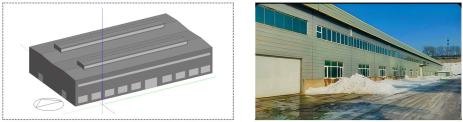 |
| U value: 2.67 W/(m2·K) | ||
| SHGC: 0.703 | ||
| WWR: 0.25 | ||
| Orientation: 0° | ||
| II | Construction: Double-glazed uPVC window (6 + 12 + 6) |  |
| U value: 2.67 W/(m2·K) | ||
| SHGC: 0.703 | ||
| WWR: 0.25 | ||
| Orientation: 90° | ||
| III | Construction: Double-glazed uPVC window (6 + 12 + 6) |  |
| U value: 2.67 W/(m2·K) | ||
| SHGC: 0.703 | ||
| WWR: 0.40 | ||
| Orientation: 150° | ||
| IV | Construction: Single-glazed uPVC window (6 mm) |  |
| U value: 5.77 W/(m2·K) | ||
| SHGC: 0.817 | ||
| WWR: 0.20 | ||
| Orientation: 0° | ||
| V | Construction: Single-glazed uPVC window (6 mm) |  |
| U value: 5.77 W/(m2·K) | ||
| SHGC: 0.817 | ||
| WWR: 0.25 | ||
| Orientation: 30° | ||
| VI | Construction: Double-glazed aluminum alloy window (6 + 12 + 6) |  |
| U value: 3.40 W/(m2·K) | ||
| SHGC: 0.783 | ||
| WWR: 0.20 | ||
| Orientation: 0° |
| Item | Construction | Sectional Detail | U Value (W/(m2·K)) |
|---|---|---|---|
| Roof | 0.5 mm Al-Zn Coated Steel Bottom Sheet + Aluminum Alloy Roof Clips + 0.3 mm Polyethylene (PE) Vapor Barrier + 100 mm Glass Wool Roll Felt Insulation + 0.3 mm Spunbonded Polyethylene Waterproof Breathable Membrane + 0.6 mm Al-Zn Coated Steel Top Sheet + 1.0 mm Polyester Cloth and Waterproof Coating | 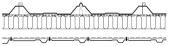 | 0.49 |
| Wall | 20 mm Cement Mortar + 370 mm Composite Masonry Wall (composed of 240 mm Standard Brick + 15 mm Mortar Joint + 115 mm Standard Brick) + 100 mm Color-Coated Steel Sandwich Panel | 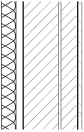 | 0.75 |
| Ground | 20 mm Cement Mortar Screed + 180 mm Reinforced Concrete Slab |  | 3.53 |
| Scenario | Material | Time | Thermal Conductivity (W/(m·K)) | Thickness (mm) | Surface Material | Surface Emissivity | |
|---|---|---|---|---|---|---|---|
| A1 | PVC | 0:00–24:00 | 0.15 | 0.3 | PVC | 0.2 | |
| A2 | A2-1 | EPS | 17:00–8:00 | 0.033 | 10 | Waterproof Canvas | 0.92 |
| A2-2 | EPS | 17:00–8:00 | 0.033 | 10 | Reinforced Aluminum Foil | 0.05 | |
| A3 | A3-1 | EPS | 17:00–8:00 | 0.033 | 20 | Waterproof Canvas | 0.92 |
| A3-2 | EPS | 17:00–8:00 | 0.033 | 20 | Reinforced Aluminum Foil | 0.05 | |
| A4 | A4-1 | EPS | 17:00–8:00 | 0.033 | 30 | Waterproof Canvas | 0.92 |
| A4-2 | EPS | 17:00–8:00 | 0.033 | 30 | Reinforced Aluminum Foil | 0.05 | |
| A5 | A5-1 | EPS | 17:00–8:00 | 0.033 | 40 | Waterproof Canvas | 0.92 |
| A5-2 | EPS | 17:00–8:00 | 0.033 | 40 | Reinforced Aluminum Foil | 0.05 | |
| A6 | A6-1 | EPS | 17:00–8:00 | 0.033 | 50 | Waterproof Canvas | 0.92 |
| A6-2 | EPS | 17:00–8:00 | 0.033 | 50 | Reinforced Aluminum Foil | 0.05 | |
| A7 | A7-1 | XPS | 17:00–8:00 | 0.028 | 10 | Waterproof Canvas | 0.92 |
| A7-2 | XPS | 17:00–8:00 | 0.028 | 10 | Reinforced Aluminum Foil | 0.05 | |
| A8 | A8-1 | XPS | 17:00–8:00 | 0.028 | 20 | Waterproof Canvas | 0.92 |
| A8-2 | XPS | 17:00–8:00 | 0.028 | 20 | Reinforced Aluminum Foil | 0.05 | |
| A9 | A9-1 | XPS | 17:00–8:00 | 0.028 | 30 | Waterproof Canvas | 0.92 |
| A9-2 | XPS | 17:00–8:00 | 0.028 | 30 | Reinforced Aluminum Foil | 0.05 | |
| A10 | A10-1 | XPS | 17:00–8:00 | 0.028 | 40 | Waterproof Canvas | 0.92 |
| A10-2 | XPS | 17:00–8:00 | 0.028 | 40 | Reinforced Aluminum Foil | 0.05 | |
| A11 | A11-1 | XPS | 17:00–8:00 | 0.028 | 50 | Waterproof Canvas | 0.92 |
| A11-2 | XPS | 17:00–8:00 | 0.028 | 50 | Reinforced Aluminum Foil | 0.05 | |
| A12 | A12-1 | PUR | 17:00–8:00 | 0.018 | 10 | Waterproof Canvas | 0.92 |
| A12-2 | PUR | 17:00–8:00 | 0.018 | 10 | Reinforced Aluminum Foil | 0.05 | |
| A13 | A13-1 | PUR | 17:00–8:00 | 0.018 | 20 | Waterproof Canvas | 0.92 |
| A13-2 | PUR | 17:00–8:00 | 0.018 | 20 | Reinforced Aluminum Foil | 0.05 | |
| A14 | A14-1 | PUR | 17:00–8:00 | 0.018 | 30 | Waterproof Canvas | 0.92 |
| A14-2 | PUR | 17:00–8:00 | 0.018 | 30 | Reinforced Aluminum Foil | 0.05 | |
| A15 | A15-1 | PUR | 17:00–8:00 | 0.018 | 40 | Waterproof Canvas | 0.92 |
| A15-2 | PUR | 17:00–8:00 | 0.018 | 40 | Reinforced Aluminum Foil | 0.05 | |
| A16 | A16-1 | PUR | 17:00–8:00 | 0.018 | 50 | Waterproof Canvas | 0.92 |
| A16-2 | PUR | 17:00–8:00 | 0.018 | 50 | Reinforced Aluminum Foil | 0.05 | |
| Scenario | Operation Mode of Insulation Layer | Air Cavity Thickness (mm) | Investigated Sub-Variables |
|---|---|---|---|
| B1 | Horizontal Sliding | 10 | Gap Width (mm): 0, 5, 10 Insulation Position: Exterior, Interior |
| B2 | Horizontal Sliding | 20 | Gap Width (mm): 0, 5, 10 Insulation Position: Exterior, Interior |
| B3 | Horizontal Sliding | 30 | Gap Width (mm): 0, 5, 10 Insulation Position: Exterior, Interior |
| B4 | Horizontal Sliding | 40 | Gap Width (mm): 0, 5, 10 Insulation Position: Exterior, Interior |
| B5 | Horizontal Sliding | 50 | Gap Width (mm): 0, 5, 10 Insulation Position: Exterior, Interior |
| B6 | Horizontal Sliding | 60 | Gap Width (mm): 0, 5, 10 Insulation Position: Exterior, Interior |
| B7 | Horizontal Sliding | 70 | Gap Width (mm): 0, 5, 10 Insulation Position: Exterior, Interior |
| B8 | Horizontal Sliding | 80 | Gap Width (mm): 0, 5, 10 Insulation Position: Exterior, Interior |
| B9 | Vertical Sliding | 10 | Gap Width (mm): 0, 5, 10 Insulation Position: Exterior, Interior |
| B10 | Vertical Sliding | 20 | Gap Width (mm): 0, 5, 10 Insulation Position: Exterior, Interior |
| B11 | Vertical Sliding | 30 | Gap Width (mm): 0, 5, 10 Insulation Position: Exterior, Interior |
| B12 | Vertical Sliding | 40 | Gap Width (mm): 0, 5, 10 Insulation Position: Exterior, Interior |
| B13 | Vertical Sliding | 50 | Gap Width (mm): 0, 5, 10 Insulation Position: Exterior, Interior |
| B14 | Vertical Sliding | 60 | Gap Width (mm): 0, 5, 10 Insulation Position: Exterior, Interior |
| B15 | Vertical Sliding | 70 | Gap Width (mm): 0, 5, 10 Insulation Position: Exterior, Interior |
| B16 | Vertical Sliding | 80 | Gap Width (mm): 0, 5, 10 Insulation Position: Exterior, Interior |
| Option | Prototype I | Prototype II | Prototype III | Prototype IV | Prototype V | Prototype VI |
|---|---|---|---|---|---|---|
| a | 20–30 mm EPS Board + Foil | 20–30 mm EPS Board + Foil | 20–30 mm EPS Board + Foil | 10–20 mm EPS Board + Foil | 10–20 mm EPS Board + Foil | 10–20 mm EPS Board + Foil |
| b | 40–50 mm EPS Board + Canvas | 40–50 mm EPS Board + Canvas | 40–50 mm EPS Board + Canvas | 30–40 mm EPS Board + Canvas | 30–40 mm EPS Board + Canvas | 30–40 mm EPS Board + Canvas |
| c | 20–30 mm XPS Board + Foil | 20–30 mm XPS Board + Foil | 20–30 mm XPS Board + Foil | 10–20 mm XPS Board + Foil | 10–20 mm XPS Board + Foil | 20–30 mm XPS Board + Foil |
| d | 30–40 mm XPS Board + Canvas | 30–40 mm XPS Board + Canvas | 40–50 mm XPS Board + Canvas | 30–40 mm XPS Board + Canvas | 30–40 mm XPS Board + Canvas | 30–40 mm XPS Board + Canvas |
| e | 10–20 mm PUR Board + Foil | 20–30 mm PUR Board + Foil | 20–30 mm PUR Board + Foil | 10–20 mm PUR Board + Foil | 10–20 mm PUR Board + Foil | 10–20 mm PUR Board + Foil |
| f | 30–40 mm PUR Board + Canvas | 30–40 mm PUR Board + Canvas | 30–40 mm PUR Board + Canvas | 20–30 mm PUR Board + Canvas | 20–30 mm PUR Board + Canvas | 30–40 mm PUR Board + Canvas |
| Window Type | Initial U-Value (W/(m2·K)) | Exterior-Only Application | Double-Sided Application | ||
|---|---|---|---|---|---|
| Final U-Value (W/(m2·K)) | Reduction (%) | Final U-Value (W/(m2·K)) | Reduction (%) | ||
| Double-glazed uPVC window | |||||
| Single-glazed uPVC window | |||||
Disclaimer/Publisher’s Note: The statements, opinions and data contained in all publications are solely those of the individual author(s) and contributor(s) and not of MDPI and/or the editor(s). MDPI and/or the editor(s) disclaim responsibility for any injury to people or property resulting from any ideas, methods, instructions or products referred to in the content. |
© 2025 by the authors. Licensee MDPI, Basel, Switzerland. This article is an open access article distributed under the terms and conditions of the Creative Commons Attribution (CC BY) license (https://creativecommons.org/licenses/by/4.0/).
Share and Cite
Chen, M.; Feng, L. Energy Performance and Optimization of Window Insulation System for Single-Story Heated Industrial Building Retrofits in the Severe Cold Regions of Northeast China. Buildings 2025, 15, 4572. https://doi.org/10.3390/buildings15244572
Chen M, Feng L. Energy Performance and Optimization of Window Insulation System for Single-Story Heated Industrial Building Retrofits in the Severe Cold Regions of Northeast China. Buildings. 2025; 15(24):4572. https://doi.org/10.3390/buildings15244572
Chicago/Turabian StyleChen, Meng, and Lin Feng. 2025. "Energy Performance and Optimization of Window Insulation System for Single-Story Heated Industrial Building Retrofits in the Severe Cold Regions of Northeast China" Buildings 15, no. 24: 4572. https://doi.org/10.3390/buildings15244572
APA StyleChen, M., & Feng, L. (2025). Energy Performance and Optimization of Window Insulation System for Single-Story Heated Industrial Building Retrofits in the Severe Cold Regions of Northeast China. Buildings, 15(24), 4572. https://doi.org/10.3390/buildings15244572