Spatiotemporal Dynamics and Driving Factors of Urban Expansion in the Chongqing Metropolitan Area Based on Nighttime Light Remote Sensing


Abstract
1. Introduction
2. Materials and Methods
2.1. Study Area
2.2. Methodology
2.2.1. Urban Expansion Intensity and Rate Indices
- (1)
- Urban Expansion Intensity Index (UEI)
- (2)
- Urban Expansion Rate Index (URI)
2.2.2. Nighttime Light Remote Sensing Metrics
- (1)
- Light Intensity Index (LII)
- (2)
- Lit Area Index (LAI)
2.2.3. POI-Based Spatial Functional Analysis
2.3. Data Sources and Processing
- (1)
- Land-Use Remote Sensing (2019–2023)
- (2)
- DMSP/OLS Nighttime Light Data
- (3)
- Landsat Satellite Imagery
- (4)
- POI Data
- (5)
- Administrative Boundary Data
- (6)
- Socioeconomic Statistics
3. Results
3.1. Spatiotemporal Characteristics of Urban Expansion in the Chongqing Metropolitan Area
3.1.1. Temporal Characteristics
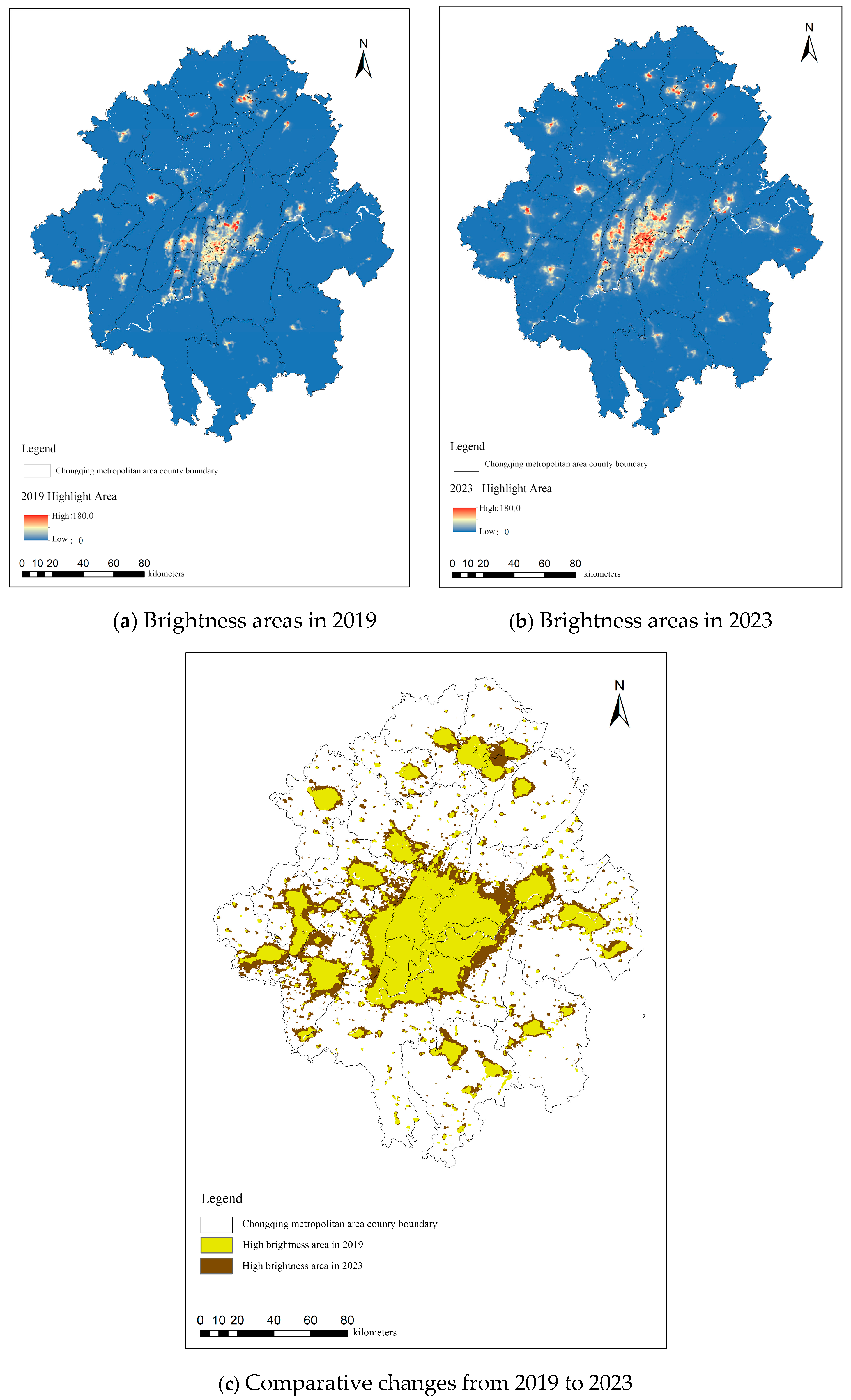
3.1.2. Spatial Characteristics
3.2. Drivers of Urban Expansion in the Chongqing Metropolitan Area
3.2.1. Identification of Influencing Factors
3.2.2. Analysis of Influencing Factors
- (1)
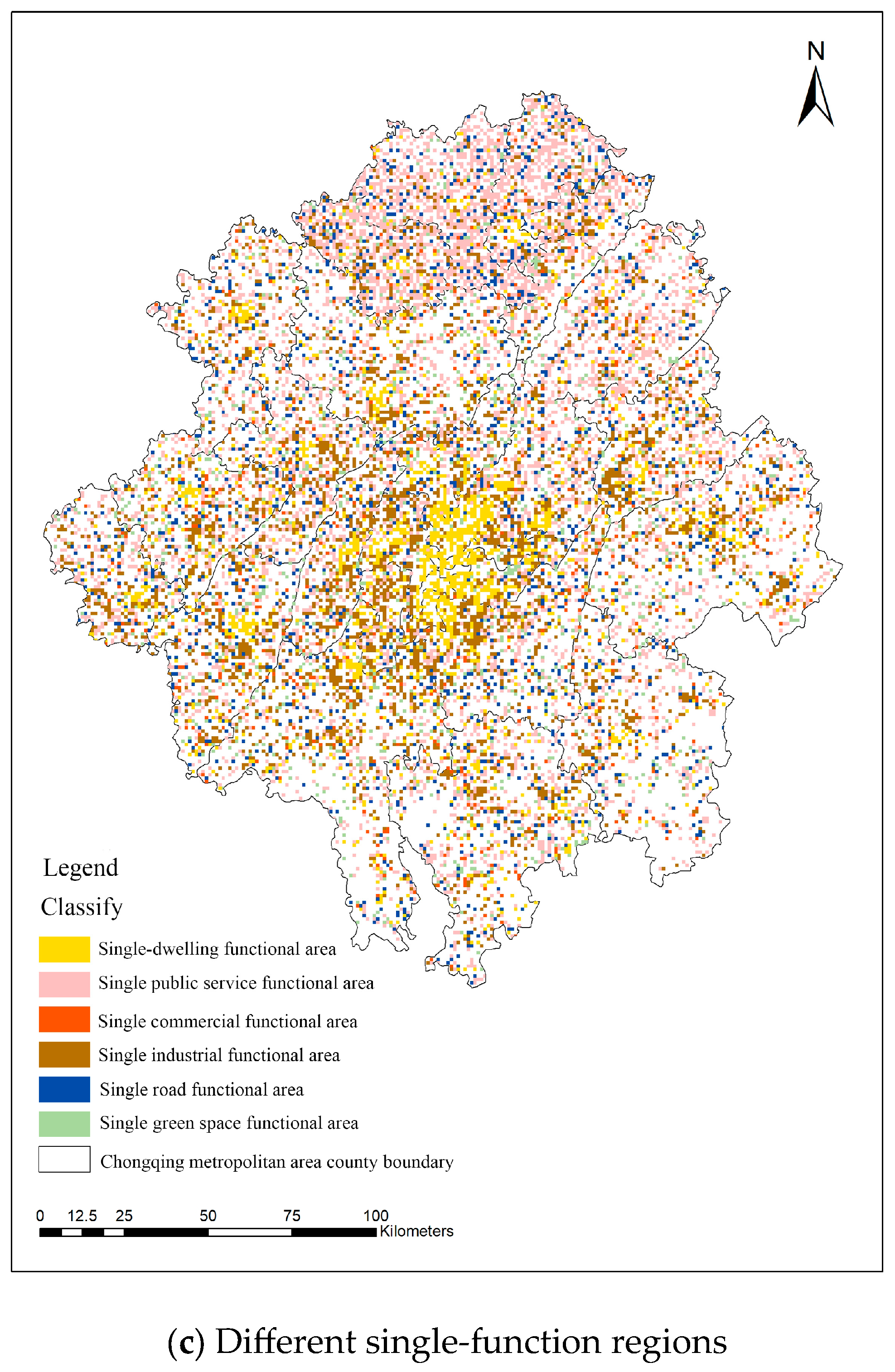
- Single-Function Regions
- (2)
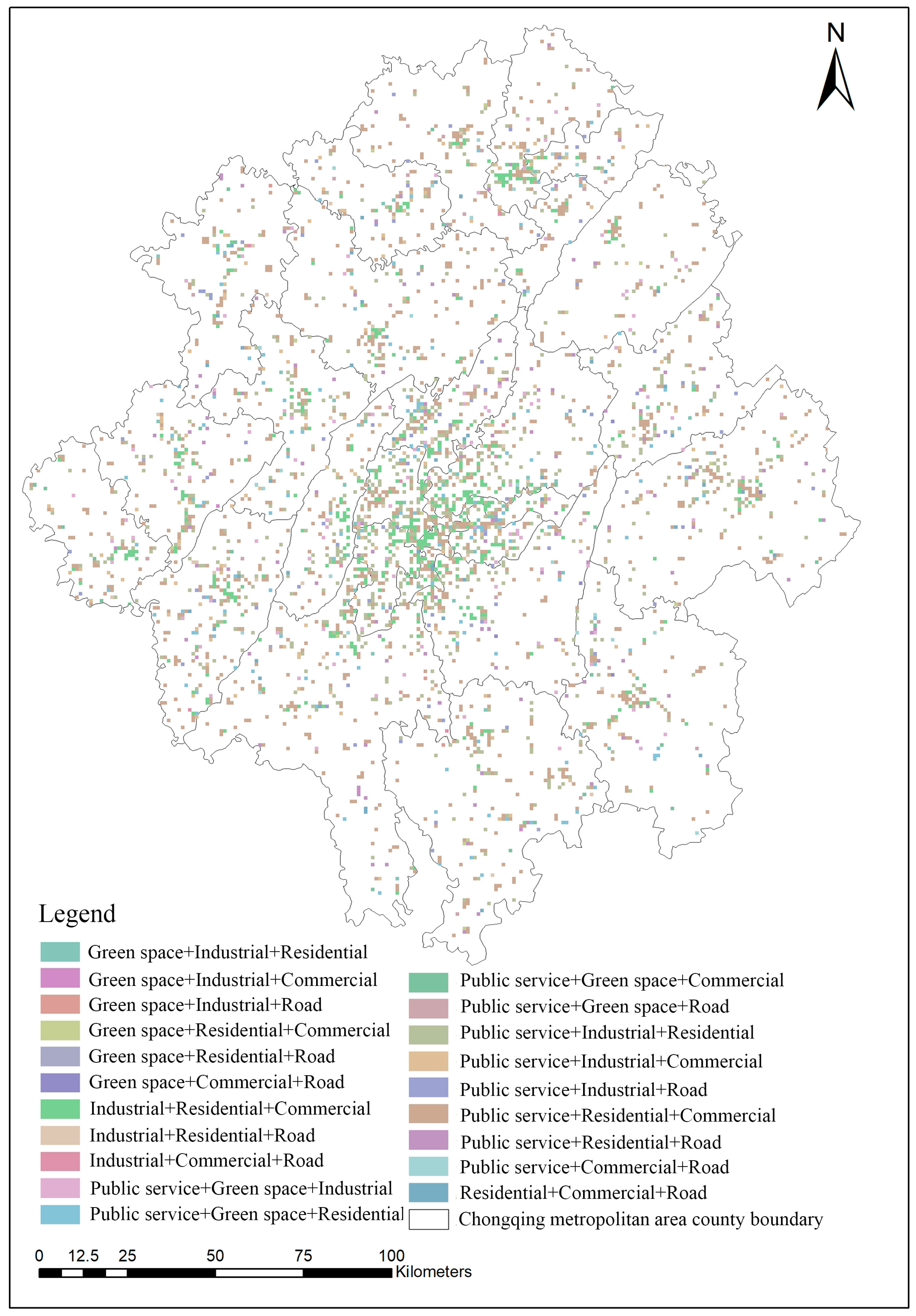
- Mixed-Function Regions
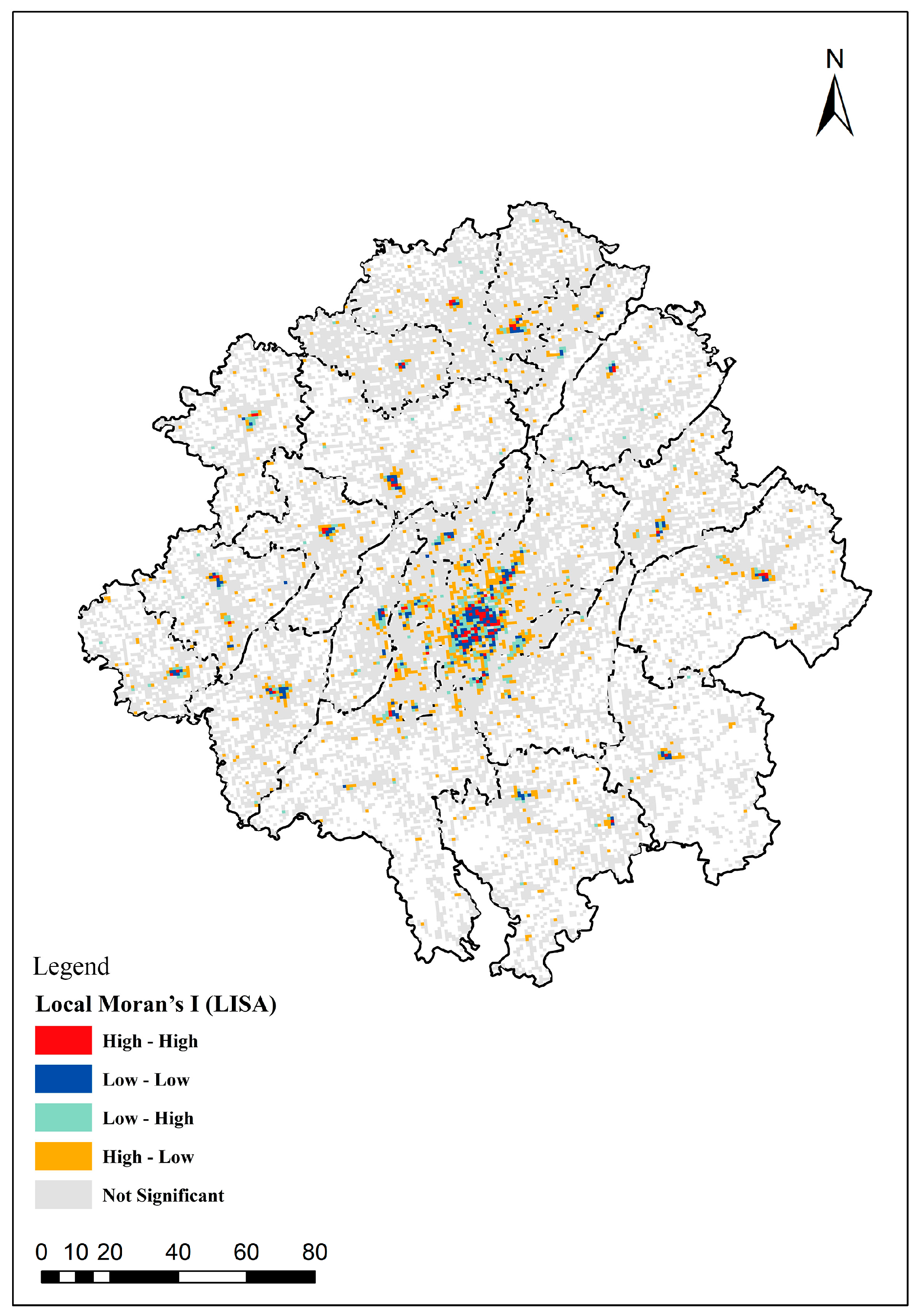
3.3. Urban Functional Pattern Evolution and Spatial Correlation Analysis
4. Discussion
4.1. Industrial Specialization and Spatially Directed Urban Expansion
4.2. Functional Diversification as a Marker of Metropolitan Maturity
4.3. Spatial Clustering and the Reinforcement of Polycentric Development
4.4. Implications for New Challenges in Digital City Planning
5. Conclusions
Author Contributions
Funding
Data Availability Statement
Conflicts of Interest
References
- Angel, S.; Parent, J.; Civco, D.L.; Blei, A.M. Making Room for a Planet of Cities; Lincoln Institute of Land Policy: Cambridge, MA, USA, 2011. [Google Scholar]
- Zhao, P.; Lü, B.; de Roo, G. Urban expansion and transportation: The impact of urban form on commuting patterns on the city fringe of Beijing. Environ. Plan. A 2010, 42, 2467–2486. [Google Scholar] [CrossRef]
- Yang, J.; Li, Z.; Zhang, D.; Zhong, J. An empirical analysis of the coupling and coordinated development of new urbanization and ecological welfare performance in China’s Chengdu–Chongqing economic circle. Sci. Rep. 2024, 14, 13197. [Google Scholar] [CrossRef]
- Wan, Y.; Chen, Y.; Zhang, H. A spatial econometric investigation into road traffic accessibility and economic growth: Insights from the Chengdu–Chongqing twin-city economic circle. Humanit. Soc. Sci. Commun. 2024, 11, 57. [Google Scholar] [CrossRef]
- Seto, K.C.; Güneralp, B.; Hutyra, L.R. Global forecasts of urban expansion to 2030 and direct impacts on biodiversity and carbon pools. Proc. Natl. Acad. Sci. USA 2012, 109, 16083–16088. [Google Scholar] [CrossRef] [PubMed]
- Lei, K.; Li, S.; Zhao, J. Coupling coordination between urbanization and economic development: A case study of the Chengdu–Chongqing urban agglomeration based on nighttime light data. Ecol. Indic. 2024, 160, 112927. [Google Scholar] [CrossRef]
- Wei, Y.; Li, Y.; Wang, S.; Wang, J.; Zhu, Y. Research on the Spatial Expansion Characteristics and Industrial and Policy Driving Forces … based on NPP-VIIRS Night Light Remote Sensing Data. Sustainability 2023, 15, 2188. [Google Scholar] [CrossRef]
- Batty, M. The New Science of Cities; MIT Press: Cambridge, MA, USA, 2013. [Google Scholar]
- Wang, L.; Fan, J. Spatial structure evolution of Guang’an City under the Chengdu–Chongqing twin-city economic circle. Front. Earth Sci. 2023, 11, 1252597. [Google Scholar] [CrossRef]
- Duan, Y. Coupling coordination between ecological carrying capacity and economic development in the Chengdu–Chongqing economic circle. Sustainability 2025, 17, 1998. [Google Scholar] [CrossRef]
- National Development and Reform Commission. Outline for the Construction of the Chengdu–Chongqing Twin-City Economic Circle; NDRC: Beijing, China, 2021. [Google Scholar]
- Chen, X.; Nordhaus, W.D. Using luminosity data as a proxy for economic statistics. Proc. Natl. Acad. Sci. USA 2011, 108, 8589–8594. [Google Scholar] [CrossRef]
- Gao, J.; Liu, Y.; Ma, L. Urban infrastructure investment and economic growth in China: Evidence from the Chengdu–Chongqing region. Cities 2022, 126, 103673. [Google Scholar] [CrossRef]
- Zhang, X.; Han, H. Characteristics and factors influencing the expansion of urban construction land in China. Sci. Rep. 2024, 14, 16040. [Google Scholar] [CrossRef] [PubMed]
- Dhanaraj, K.; Raman, S. Urban expansion quantification from remote sensing data: Extracting expansion modes using UEI, UED, and entropy measures. Remote Sens. Appl. Soc. Environ. 2021, 22, 100490. [Google Scholar]
- Alam, A.; Wang, J.; Abedin, M.A.; Sarker, M.N.I. Quantifying Spatiotemporal Patterns and Driving Factors of Urban Expansion in South Asia Using Remote Sensing and Socio-Economic Data. Heliyon 2023, 9, e13193. [Google Scholar] [CrossRef] [PubMed]
- Shi, K.; Yu, B.; Huang, Y.; Hu, Y.; Yin, B.; Chen, Z.; Wu, J. Extracting the Dynamics of Urban Expansion in China Using DMSP-OLS Nighttime Light Data from 1992 to 2008. Landsc. Urban Plan. 2012, 106, 62–72. [Google Scholar] [CrossRef]
- Xu, R.; Chen, Z.; Li, F.; Zhou, C. Identification of Urban Functional Zones Based on POI Density and Marginalized Graph Autoencoder. ISPRS Int. J. Geo-Inf. 2023, 12, 343. [Google Scholar] [CrossRef]
- Wang, Z.; Xu, X. Harnessing Google Earth Engine for multi-source land cover harmonization: Methodology and applications. Remote Sens. Lett. 2025, 16, 123–134. [Google Scholar]
- Chen, J.; Chen, J.; Liao, A.; Cao, X.; Chen, L.; Chen, X.; He, C.; Han, G.; Peng, S.; Lu, M.; et al. Global land cover mapping at 30 m resolution: A POK-based operational approach. Earth Syst. Sci. Data 2021, 13, 3907–3925. [Google Scholar]
- Singh, M.; Ghosh, S.; Magruder, L. NDUI+: A fused DMSP-OLS and VIIRS nighttime light dataset for seamless urban dynamics monitoring at 30 m resolution. arXiv 2023, arXiv:2306.02794. [Google Scholar]
- Li, X.; Zhou, Y.; Zhao, M.; Li, D. Urban expansion and its driving forces in China using nighttime light data from 1992 to 2018. Remote Sens. 2020, 12, 401. [Google Scholar] [CrossRef]
- Wu, C.; Ye, X.; Du, Q. Industrial restructuring and spatial pattern evolution in Chinese resource-based cities. Sustainability 2021, 13, 2165. [Google Scholar] [CrossRef]
- Zhang, H.; Chen, C.; Liu, W. Coordinated industrial development in the Chengdu–Chongqing Economic Circle: Patterns and strategies. J. Geogr. Sci. 2023, 33, 827–844. [Google Scholar]
- Ma, T.; Zhou, C.; Pei, T. Night-time light derived estimation of spatio-temporal characteristics of urbanization dynamics using DMSP/OLS and NPP/VIIRS satellite data. Remote Sens. Environ. 2019, 237, 111–473. [Google Scholar] [CrossRef]
- Liu, X.; Hu, G.; Chen, Y.; Li, X.; Xu, X.; Li, S.; Pei, F.; Wang, S. High-resolution multi-temporal mapping of global urban land using Landsat images based on the Google Earth Engine Platform. Remote Sens. Environ. 2018, 209, 227–239. [Google Scholar] [CrossRef]
- Fang, C.; Yu, D.; Wang, S. Spatial restructuring and regional integration in the Chengdu–Chongqing Economic Circle. Cities 2022, 121, 103477. [Google Scholar] [CrossRef]
- Shi, K.; Chen, Y.; Yu, B.; Xu, T.; Li, L. Detecting spatiotemporal dynamics of urban expansion in China using nighttime light data. Landsc. Urban Plan. 2019, 187, 70–80. [Google Scholar] [CrossRef]
- Wang, J.; Zhao, P.; Liu, Y. Transport infrastructure and regional economic growth in China: A spatial econometric analysis. Transp. Res. Part A Policy Pract. 2021, 148, 285–299. [Google Scholar] [CrossRef]
- Yang, Y.; Sun, Y.; Zhao, X. Transportation accessibility and industrial upgrading in metropolitan regions of China. Habitat Int. 2020, 104, 102–116. [Google Scholar] [CrossRef]
- Zhao, X.; Zhang, Y.; Wang, F. Coordinated development strategies for urban agglomerations under the Belt and Road Initiative: Evidence from the Yangtze River Economic Belt. Sustainability 2024, 16, 945. [Google Scholar]
- Long, Y.; Liu, X. Automated identification and characterization of parcels with OpenStreetMap and points of interest. Environ. Plan. B: Plan. Des. 2016, 43, 341–360. [Google Scholar] [CrossRef]
- Chen, Y.; Liu, X.; Li, X.; Gong, L. Delineating urban functional zones using a vector-based method from POI data. Computers Environ. Urban Syst. 2020, 81, 101472. [Google Scholar]
- Gao, S.; Janowicz, K.; Couclelis, H. Extracting urban functional regions from points of interest and human activities on location-based social networks. Trans. GIS 2017, 21, 446–467. [Google Scholar] [CrossRef]
- Yao, Y.; Li, X.; Liu, X.; Liu, P.; Liang, Z.; Zhang, J.; Mai, K. Sensing spatial distribution of urban land-use by integrating points-of-interest and Google Place data. Int. J. Geogr. Inf. Sci. 2017, 31, 825–848. [Google Scholar] [CrossRef]
- Wang, J.; Du, S. Identification of urban functional zones using high spatial resolution satellite imagery and POI data. ISPRS Int. J. Geo-Inf. 2018, 7, 177. [Google Scholar] [CrossRef]
- He, Q.; Song, Y. Industrial land change in Chinese cities: Patterns, drivers, and policy implications. Land-Use Policy 2021, 100, 104919. [Google Scholar] [CrossRef]
- Zhao, C.; Tang, Y. Transport accessibility and industrial land-use changes in China. J. Transp. Geogr. 2020, 88, 102846. [Google Scholar] [CrossRef]
- Li, X.; Gong, P.; Liang, L. A 30-year (1984–2013) record of annual urban dynamics of Beijing City derived from Landsat data. Remote Sens. Environ. 2015, 166, 78–90. [Google Scholar] [CrossRef]
- Fang, C.; Yu, D.; Wang, Z. Polycentric development and urban spatial restructuring in China. Urban Stud. 2020, 57, 853–871. [Google Scholar]
- Liu, X.; Kang, C.; Gong, L.; Liu, Y. Incorporating spatial interaction patterns in classifying and understanding urban land-use. Int. J. Geogr. Inf. Sci. 2016, 30, 334–350. [Google Scholar] [CrossRef]
- Zhang, W.; Li, X.; Chai, Y. Exploring urban spatial structure with multi-source data: A case study of Beijing. Cities 2019, 95, 102390. [Google Scholar] [CrossRef]
- Song, Y.; He, Q.; Wang, Z. Detecting spatial patterns of mixed land-use from POI data: An empirical study of Chinese cities. Habitat Int. 2021, 111, 102348. [Google Scholar] [CrossRef]
- Zeng, C.; Zhou, Y.; Wang, J.; Yan, J.; Zhao, Q. Measuring functional urban land-use diversity using multi-source geographic big data. Landsc. Urban Plan. 2020, 203, 103908. [Google Scholar] [CrossRef]
- Lai, X.; Zhou, M.; Chen, R. Spatiotemporal Patterns Evolution of Residential Areas Based on Moran’s I. ISPRS Int. J. Geo-Inf. 2023, 12, 233. [Google Scholar] [CrossRef]
- Jing, Y.; Liu, X.; Zhang, X.; Wang, H. A Method for Identifying Urban Functional Zones Based on POI and Land Use Data. Sustainability 2022, 14, 4130. [Google Scholar] [CrossRef]
- Xiao, Y.; Chen, L.; Wang, Z. Analysis and Optimization of the Spatial Patterns of Commercial Service Facilities at the Natural Neighborhood Scale. ISPRS Int. J. Geo-Inf. 2025, 14, 23. [Google Scholar] [CrossRef]
- Wang, M.; Zhou, Y.; Liu, Z. Assessing Urban Vitality in High-Density Cities via POI–Residential Interaction. Humanit. Soc. Sci. Commun. 2025, 12, 459. [Google Scholar] [CrossRef]
- Yang, Z.; Sliuzas, R.; Cai, J. Exploring Spatial Evolution of Economic Clusters Using Local Moran’s I: A Beijing Case Study (1983–2002). Int. J. Geogr. Inf. Sci. 2012, 26, 425–443. [Google Scholar]
- Xia, C.; Yeh, A.G.O.; Zhang, A. Analyzing Spatial Relationships between Urban Land Use Intensity and Vitality. Landsc. Urban Plan. 2020, 193, 103669. [Google Scholar] [CrossRef]
- Maghfira, Z.W.; Sutriadi, R.; Perdana, A.B. Assessing Urban Functional Area Delineation: POI Data and KDE Analysis in Pekanbaru. Comput. Urban Sci. 2025, 5, 33. [Google Scholar] [CrossRef]





| Region Type | City/District | 2019 | Increase (2019–2023) | 2023 |
|---|---|---|---|---|
| Core Circle (Chongqing Metro Area) | Chongqing | 3054.21 | 749.45 | 3803.66 |
| Yuzhong District | 23.1 | 0.0 | 23.1 | |
| Dadukou District | 97.13 | 0.0 | 97.13 | |
| Jiangbei District | 219.98 | −1.57 | 218.4 | |
| Shapingba District | 396.11 | 10.5 | 406.62 | |
| Jiulongpo District | 435.23 | 0.0 | 435.23 | |
| Nan’an District | 262.24 | 0.0 | 262.24 | |
| Beibei District | 399.0 | 133.61 | 532.62 | |
| Yubei District | 713.74 | 251.74 | 965.48 | |
| Banan District | 507.68 | 355.17 | 862.85 | |
| Tight Circle | Chongqing | 3028.48 | 2120.5 | 5148.98 |
| Fuling District | 348.6 | 217.88 | 566.48 | |
| Qijiang District | 274.58 | 156.71 | 431.29 | |
| Dazu District | 319.2 | 285.87 | 605.07 | |
| Changshou District | 318.41 | 142.54 | 460.95 | |
| Jiangjin District | 468.3 | 166.17 | 634.47 | |
| Hechuan District | 292.69 | 200.03 | 492.72 | |
| Yongchuan District | 306.86 | 411.08 | 717.94 | |
| Nanchuan District | 135.19 | 123.64 | 258.83 | |
| Bishan District | 320.25 | 252.79 | 573.04 | |
| Tongliang District | 244.39 | 163.8 | 408.19 | |
| Radiation Circle (Adjacent Cities) | Luzhou | 806.03 | 726.51 | 1751.29 |
| Jiangyang District | 210.88 | 120.82 | 331.7 | |
| Naxi District | 76.24 | 41.04 | 117.28 | |
| Longmatan District | 180.03 | 69.58 | 249.6 | |
| Luxian County | 118.32 | 268.2 | 386.51 | |
| Hejiang County | 81.6 | 86.16 | 167.76 |
| No. | Mixed-Function Type (Top 3 POIs) | Main Functional Composition (%) | Typical Distribution Area | Notable Characteristics |
|---|---|---|---|---|
| 1 | Green space + Industrial + Residential | 35–45/25–30/20–25 | Northern Yongchuan, Tongliang | Dense residential core with high accessibility to services and retail |
| 2 | Green space + Industrial + Commercial | 30–40/25–30/20–25 | Shapingba, Dadukou | Residential clusters adjacent to industrial plants and service nodes |
| 3 | Green space + Industrial + Road | 30–35/30–35/20–25 | Jiulongpo, Banan | Mixed manufacturing and retail near housing zones |
| 4 | Green space + Residential + Commercial | 30–40/30–35/20–25 | Nan’an, core industrial parks | Service facilities embedded within industrial-commercial complexes |
| 5 | Green space + Residential + Road | 35–40/30–35/20–25 | Wanzhou, Beibei | Green infrastructure integrated with housing and public services |
| 6 | Green space + Commercial + Road | 30–40/30–35/20–25 | Suburban residential clusters | Balanced ecological–Service–Living pattern |
| 7 | Industrial + Residential + Commercial | 30–35/30–35/25–30 | Traditional manufacturing | Mixed employment–Housing–Retail clusters supporting industrial workforce |
| 8 | Industrial + Residential + Road | 30–35/30–35/25–30 | River-based industrial corridors | Worker settlements aligned with industrial axes and road accessibility |
| 9 | Industrial + Commercial + Road | 35–40/30–35/20–25 | Logistics and wholesale corridors | Road-proximate industrial and trade complexes forming transport-oriented nodes |
| 10 | Public service + Green space + Industrial | 30–35/30–35/20–25 | Peripheral industrial districts | Service facilities integrated into industrial zones with ecological buffering |
| 11 | Public service + Green space + Residential | 35–40/30–35/20–25 | Suburban new towns | Public services embedded within ecological–Residential environments to enhance livability |
| 12 | Public service + Green space + Commercial | 35–40/30–35/20–25 | Recreational sub-centers | Green leisure areas supported by retail and service functions |
| 13 | Public service + Green space + Road | 30–40/30–35/20–25 | Roadside ecological corridors | Public facilities concentrated at intersections of green infrastructure and transport axes |
| 14 | Public service + Industrial + Residential | 35–40/30–35/20–25 | Transitional belts | Industrial–Residential coexistence structured by public service supply |
| 15 | Public service + Industrial + Commercial | 35–40/30–35/20–25 | Industrial parks | Service and administrative hubs facilitating industrial and trade activities |
| 16 | Public service + Industrial + Road | 35–40/30–35/20–25 | Highway-based industrial areas | Industrial service facilities clustered along major road networks |
| 17 | Public service + Residential + Commercial | 30–35/30–35/25–30 | Core metropolitan districts | Public services, housing, and retail jointly reinforcing compact urban cores |
| 18 | Public service + Residential + Road | 30–35/30–35/25–30 | Residential corridors | Service facilities supporting linear residential expansion along roads |
| 19 | Public service + Commercial + Road | 30–35/30–35/25–30 | Secondary urban centers | Retail and service functions concentrated along high-accessibility corridors |
| 20 | Residential + Commercial + Road | 35–40/30–35/20–25 | Central business corridors | Residential–Retail co-location forming dense linear mixed-use strips |
Disclaimer/Publisher’s Note: The statements, opinions and data contained in all publications are solely those of the individual author(s) and contributor(s) and not of MDPI and/or the editor(s). MDPI and/or the editor(s) disclaim responsibility for any injury to people or property resulting from any ideas, methods, instructions or products referred to in the content. |
© 2025 by the authors. Licensee MDPI, Basel, Switzerland. This article is an open access article distributed under the terms and conditions of the Creative Commons Attribution (CC BY) license (https://creativecommons.org/licenses/by/4.0/).
Share and Cite
Tu, S.; Zhan, Q.; Qiu, R.; Li, C. Spatiotemporal Dynamics and Driving Factors of Urban Expansion in the Chongqing Metropolitan Area Based on Nighttime Light Remote Sensing. Buildings 2025, 15, 3306. https://doi.org/10.3390/buildings15183306
Tu S, Zhan Q, Qiu R, Li C. Spatiotemporal Dynamics and Driving Factors of Urban Expansion in the Chongqing Metropolitan Area Based on Nighttime Light Remote Sensing. Buildings. 2025; 15(18):3306. https://doi.org/10.3390/buildings15183306
Chicago/Turabian StyleTu, Shiqi, Qingming Zhan, Ruihan Qiu, and Changling Li. 2025. "Spatiotemporal Dynamics and Driving Factors of Urban Expansion in the Chongqing Metropolitan Area Based on Nighttime Light Remote Sensing" Buildings 15, no. 18: 3306. https://doi.org/10.3390/buildings15183306
APA StyleTu, S., Zhan, Q., Qiu, R., & Li, C. (2025). Spatiotemporal Dynamics and Driving Factors of Urban Expansion in the Chongqing Metropolitan Area Based on Nighttime Light Remote Sensing. Buildings, 15(18), 3306. https://doi.org/10.3390/buildings15183306