


Abstract
Despite increased safety investments in the civil construction sector, high accident rates persist, often due to workers’ intentional unsafe behaviors influenced by poorly understood psychological factors. This study utilized validated interpretative structural modeling (VISM), an innovative technique, to investigate factors impacting the well-being and risk perception of construction workers in the Brazilian Amazon. The VISM model was developed through five steps: (1) identification of indicators; (2) definition of constructs; (3) identification of relationships between constructs; (4) validation of these relationships; and (5) creation of the model. The results underscore the effectiveness of VISM in crafting complex models with robust statistical validity, even in studies with sample limitations and intricate or circular relationships among constructs. The research identified various factors in this phenomenon, such as the importance given by management to workplace safety, job dissatisfaction, work-related stress, turnover intention, work–family balance, alcohol and cigarette use, physical health, perception of accident risks at work, and education and training in workplace safety. Another significant contribution lies in the model’s ability to discern both direct and indirect relationships among these well-being factors. This insight enables the formulation of strategies to enhance worker well-being and reduce workplace accidents, particularly those stemming from intentional unsafe behaviors.
1. Introduction
Investing in workplace safety is crucial in protecting the health, well-being, and physical integrity of workers. It also contributes to the efficiency and sustainability of industry operations. Data obtained by the main occupational health and safety health authorities estimate that there are approximately 2.78 million deaths per year attributed to work-related causes. Among these figures, about 380,500 fatal accidents occur annually, which equates to roughly 1000 deaths each day. This figure does not include non-fatal occupational accidents, which amount to a staggering 374 million per year [1]. The global cost of injuries, illnesses, and accidents at work is a considerable aspect, as it consumes up to 4% of the world’s gross domestic product (GDP) [2]. This issue is gaining increasing importance as part of the 2030 agenda, as it is fundamental for sustainable development; it emphasizes the promotion a safe and healthy work for all [3].
This scenario is evident in civil construction. The International Labour Organization (ILO) emphasizes the potential for accidents in this sector, as employees in developed countries are three to four times more prone to experiencing a fatal accident compared to other industries, while in developing countries, this figure increases to six times the likelihood of accidents [4,5]. Compounding the issue, the ILO also underscores that 60% of the workforce employed is not adequately safeguarded against workplace accidents [2].
In Brazil, the civil construction sector has been steadily increasing its investment in the safety of its workers. According to the Brazilian Association of Real Estate Developers—ABRAINC [6], in the period from December 2021 to May 2023, there were noteworthy developments: an increase in the average investment in collective protection equipment (CPE), rising from USD 923.45 to USD 2548.47 per employee; an increase in average monthly training hours, rising from 6.9 to 7.2; and an increase in the average monthly investment in personal protective equipment (PPE), increasing from USD 41.51 to USD 47.08 per worker. However, it is important to highlight that in 2021 alone, 34,219 accidents at work were recorded in the Brazilian construction sector, with it ranking as the fifth highest in terms of work-related accidents in the country [7].
These data clearly indicate that to decrease the number of accidents in the construction industry, it is insufficient to solely invest in planning, training, and protective equipment for workers. Other factors may be influencing the construction sector as a high-risk activity. This is possibly due to the fact that most accidents at work result from unsafe actions by workers [8]. While unintentional unsafe acts can be attributed to the workers’ safety skills (WS), intentional unsafe acts are explained by psychological factors [9].
In this context, various studies explore how psychological factors may influence the occurrence of workplace accidents. These factors include: social influence [8,10]; the work environment [8,10,11,12]; job satisfaction [11]; the perception of the inefficiency of security measures [10,13]; stress at work [14,15]; professional exhaustion or burnout [16]; physical and mental health [8,11,14,15,17]; and even optimism about job security [18]. This issue is so important that the US National Institute for Occupational Safety and Health (NIOSH) created the Total Worker Health (TWH) program, which deals with a set of safety practices and policies to prevent injuries and illnesses at work with the promotion of well-being, in which the worker’s life is assessed, including the psychological factors that may affect their behavior at work [19,20].
In construction, many of these psychological factors are encompassed by the concept of well-being at work. However, there are certain aspects related to this theme that are not adequately addressed. It is essential to recognize that a proportion of an individual’s life is spent in the workplace [21]. Therefore, employment and the work environment influence the formation of happiness for individuals and communities worldwide [22], including in civil construction. Therefore, researchers are working to develop methods and practices that consider not only health and safety but also promote well-being at work, as can be seen in the latest works [23,24,25,26], with a few exceptions [27].
Indeed, the construction industry is renowned for its challenging and often unhealthy working conditions [28]. It exhibits high rates of work-related illnesses and has detrimental impacts on the mental well-being of its own workers [29]. Characteristics such as long working hours, physical and job insecurity, and conflicts between work and family [30,31], in addition to workers’ lack of qualifications and less healthy lifestyles, such as the use of alcohol and smoking [32,33], due to the itinerant nature of the sector [34], contribute to making construction one of the most stressful occupations [35]. Other challenges include the predominance of male cultural stigmas [31,36], high rates of absenteeism and turnover [37,38], low productivity [39,40,41], and the organizational commitment of workers [42]. These peculiarities reinforce the complexity and risks associated with the construction industry.
It is clear that there are numerous aspects related to well-being at work that could be influencing the incidence of accidents, especially those resulting from intentional unsafe actions.
In this sense, from the perspective of construction workers in the Brazilian Amazon, what are the workplace well-being factors that affect their perception of accident risks? To address this question, this research aims to develop a conceptual model to investigate the influence of factors related to the well-being and perception of the risk of accidents among construction workers. With this, this research seeks to identify the interrelationships between these factors in order to guide welfare intervention strategies of well-being in construction with effective potential to effectively reduce work accidents stemming from intentional unsafe acts.
2. Literature Review
2.1. Well-Being at Work
Presently, well-being has gone from a popular perception to a measure of global interest, which is currently included in human development analyses [43]. Furthermore, it has emerged as a top priority in the agendas of governments, international organizations, healthcare companies, and research institutions [44].
With this growing interest, concepts related to the topic have been expanded and directed to different areas over time, with one of them being the work environment [45,46]. One of the notable advantages of understanding well-being in the context of work is that the relationships between well-being and antecedents inherent to work tend to be strong. This can provide a better understanding of how the characteristics of work impact the well-being of employee [47].
In organizations, the perceived benefits resulting from workplace health programs are diverse. They increase employees’ motivation [48], improve productivity (throughout the day and also throughout their career) [49], reduce absenteeism, and improve the work climate and contribute to the positive promotion of organizational image [50], increasing organizational citizenship behavior [51].
According to an interview involving 32,000 individuals conducted by the iOpener Institute, the researchers concluded that happy workers (a) take just one-tenth as much leave as less happy workers, (b) are six times more energized, (c) intend to stay twice as long in their job, and (d) are twice as productive [52]. Additionally, the study showed that employees who are happiest at work report being on task 80% of the work week, whereas employees who are truly unhappy at work only spend 40% of their time on task.
In fact, it is expected that workers who have high well-being will bring several benefits to organizations. From a more human perspective, the individual benefits resulting from this well-being are essential to a healthy life. Therefore, the search for prosperous work environments that promote the well-being of employees becomes a priority for both individuals and organizations.
2.2. Well-Being at Work for Construction Workers
In this context, organizations that are characterized by intensive use of labor have great potential in developing activities aimed at the well-being of their employees. This includes the construction industry, which, despite technological advancements, continues to rely on a substantial workforce. The construction industry, in general, is notably hazardous due to high numbers of on-site or commuting accidents [53]. Additionally, work-related illnesses in construction rank among the highest across all occupational groups [28]. This reality poses a challenge in effectively promoting occupational health in this industry [54].
In Brazil, the work environment for construction workers exhibits unique characteristics such as limited technological development, a high percentage of workers with low educational levels, low wages, and significant social deprivation [55,56]. Additionally, high job turnover prevents workers from having financial security, and negligence in enforcing safety standards, particularly among smaller, less regulated companies, is also prevalent, especially concerning fall protection [57]. Furthermore, workers often resist using personal protective equipment (PPE) [58].
To quantify accidents in the construction sector in the country, the Ministry of Social Security publishes the Statistical Yearbook of Workplace Accidents (AEAT), categorizing accidents into three main groups: (1) typical accidents, occurring during work, whether the worker is on the company premises or on duty elsewhere, (2) Commuting accidents, occurring during the journey between home and the workplace and vice versa, and (3) occupational diseases, caused as a consequence of work-related activities. Accidents between 2019 and 2021 are detailed in Table 1.

Table 1.
Number of workplace accidents in the Brazilian civil construction industry between 2016 and 2021.
Table 1 indicates accident rates between 2016 and 2021, demonstrating that accidents classified as typical remain high, with only minimal reductions in those related to occupational diseases. This highlights that occupational safety is a crucial factor to consider in the Brazilian construction industry, with workers being subjected to stressful situations.
Regarding work-related stress, professionals who work in this niche are exposed to several stressful factors [59,60], which have negative impacts on their mental well-being and reflects on individuals and organizations [29], including: long hours and high workload, role conflict, insecurity (both physical and job), dissatisfaction, high pressure, and conflict between work and family [30,31]. For Jebelli et al. [35], psychologically and physiologically demanding tasks carried out in dangerous work environments make construction one of the most stressful occupations, which affects productivity, safety, individual well-being, and the quality of work performed by the employees.
Other characteristics inherent to the construction sector further corroborate its uniqueness and risk: it has an itinerant in nature, it encourages workers to adopt less healthy lifestyles [34]; its workers lack proper qualifications [41,61] and are susceptible to drinking alcohol and smoking [32,33]; it is cyclical due to its dependence on economic factors [62]; it is male-dominated and characterized by predominantly male stigmas and cultures [31,36]; and it has a high rate of absenteeism and turnover [37,38]; on the other hand, it has a low productivity index [39,40,41] as well as organizational commitment [42].
Although there are initiatives to encourage increased well-being in workplaces in the construction industry, few interventions address the topic in a complete or global way [63]. Studies on psychosocial factors have primarily examined the negative effects on health, as well as focusing on the results of occupational accidents [64]. Therefore, it is important to carry out research to determine the extent of well-being problems, that is, studies that can assess well-being through the use of well-established diagnostic tools, since there is no empirical research with such an approach [30].
In a general context, there is a wave of interest in measuring and providing WBW, which is the main target of training and interventions in business organizations [65]. Despite this, Sender and Fleck [66] state that studies on happiness at work consist of a large number of studies that are dispersed, divergent and therefore not very conclusive, creating difficulties for the evolution of research on this topic (these authors sought concepts concerning happiness stemming from work within organizations).
In fact, the definitions of WBW are still not clear and differ significantly between authors, who choose both positive and negative concepts to represent it, as well as affective and cognitive dimensions. Therefore, there is a need for convergence in the literature, as current approaches do not allow for a full and integrated vision [66,67].
Many studies that claim to study this topic deal with issues such as stress, emotional exhaustion [68], interpersonal relationships, environment, nature of the task [69], engagement, and burnout [70], for example. On the other hand, terms such as satisfaction, involvement, commitment, engagement, state of flow, motivation, and well-being are the main ones found in academia that are linked to the construct [66]. In this work, well-being at work will be treated as the degree of satisfaction, interest, and excitement with the construction company, job and opportunities offered by the worker’s current job.
2.3. Aspects Related to the Safety Climate of Civil Construction Workers
Among the aspects related to WBW, the safety climate is frequently addressed in research [18,71,72]. According to these studies, the safety climate can be considered as people’s perception of safety in their work environment and is normally measured through abstract indicators related to the organization’s safety culture [71]. This fact is corroborated by Dedobbeleer and Béland [72], who demonstrate that the safety climate comprises factors such as management concerns, safety-related activities carried out by management, and employees’ perception of risk.
Furthermore, the safety climate has a close connection with initiatives aimed at the quality of work life in organizations [73]. The question to be answered revolves around the impact that the feeling of security that an individual has on their WBW.
In an effort to clarify this impact, Couto and Paschoal [74] conducted a correlation study between the safety climate and WBW, and they discovered that factors linked to quality of life at work are negatively related to the negative affect component of WBW. According to the actors, the stronger an individual’s perception of the positive impact of activities aimed at improving quality of life at work, the less negative effect they experience. In practice, it is believed that these activities do not necessarily increase well-being, but rather help prevent discomfort.
On the other hand, despite the constant need for progress and inspection, the strict current safety legislation and the collective awareness of workers and management make construction sites safer. Some recent case studies indicate significant adherence by construction employees to the companies’ safety policy (between 81% and 89%) and also safe behavior by the employees themselves—around 93% [75]. Others indicate a high level of compliance with regulatory safety standards for the construction sector, particularly NR-18. Out of 10 workers surveyed, 9 had a compliance rate of 80% with the standard [76].
In this situation, to some extent, safe practices may have become a standard requirement for employees, who do not see them as an aspect that provides well-being but rather as an obligation that any company has. Therefore, the feeling of security does not really seem to add to job satisfaction or positive affect.
In another analysis, in the construction industry, there are strong correlations between work stress and physical safety outcomes. It is also been found that the safety climate has the potential to reduce this stress, indicating that it can impact not only the physical health of employees but also their psychological health [77]. Thus, by mitigating negative aspects, the safety climate contributes to reducing negative effects on the work environment. These analyses highlight the importance of the safety climate as a crucial factor in promoting the well-being and safety of workers in the construction industry, highlighting the importance of continuous measures to improve the perception of safety and the organizational culture focused on safety in the sector.
In this context, conceptually, this research explores factors related to workplace well-being and the safety climate, wherein the perception of workplace accident risks is one of the components encompassed within the safety climate concept.
3. Methodology
To build the conceptual model of the factors that affect well-being at work and the perception of the risk of accidents among construction workers, this research used the validated interpretive structural modeling approach. This modeling technique, known as validated interpretative structural modeling (VISM), was presented by Santana et al. [78] and proves to be a powerful tool for modeling experimental research based on data obtained in survey research. VISM was chosen because it allows the construction of conceptual models with strong statistical support from a reduced number of interviews, even in situations where the sample exhibits non-normal data distribution [78], as is the case in this research.
Furthermore, the relationship between well-being and the perception of occupational accident risks is still not well understood due to the complexity of these interactions. In this context, VISM emerges as a technique capable of combining the explanatory power for complex phenomena of interpretative structural modeling (ISM) with the statistical validity of structural equation modeling–partial least squares (PLS-SEM), enabling the creation of complex models with strong statistical support, even in non-linear models containing circular and/or cross-relations among constructs [78].
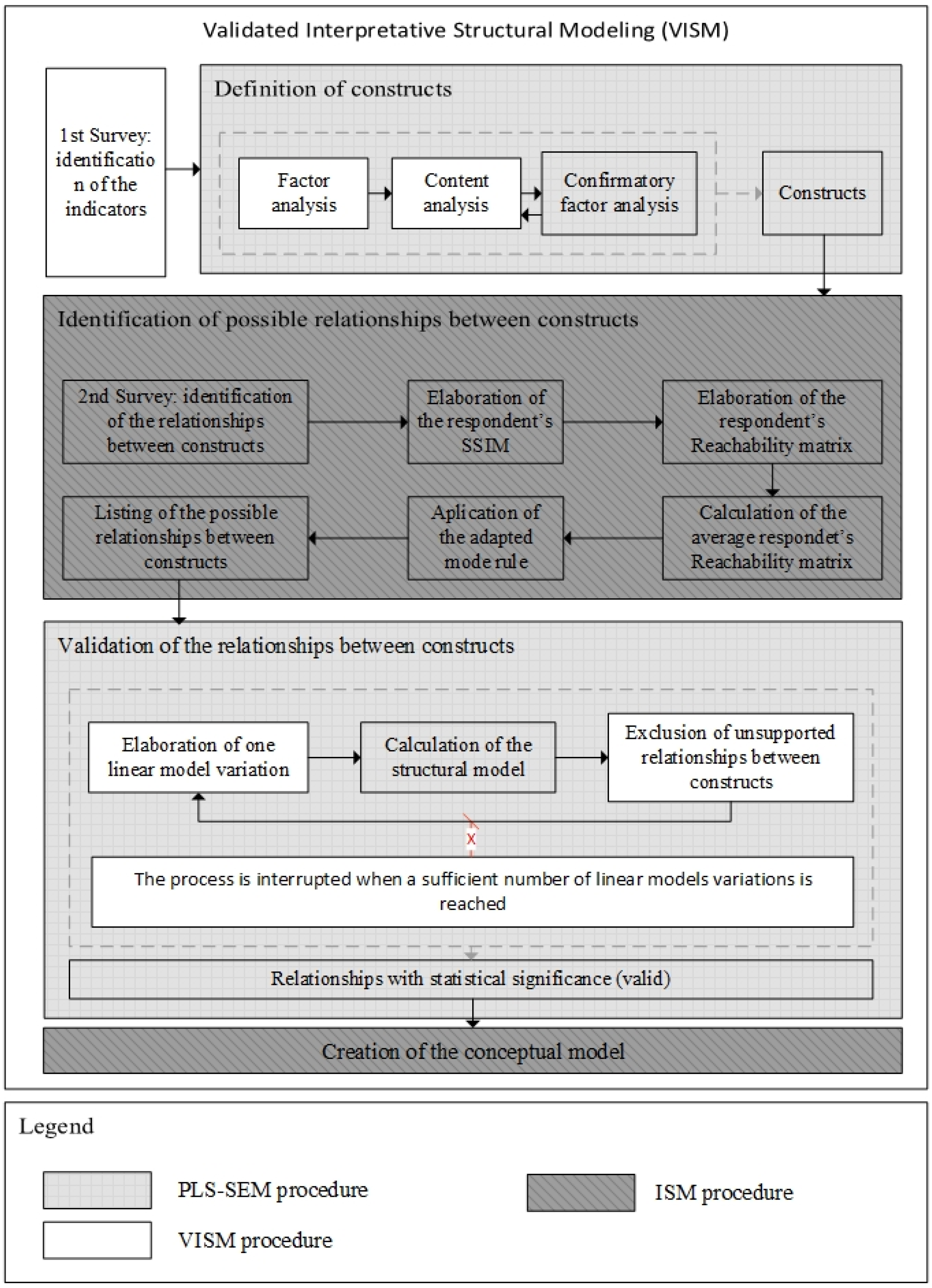
Following VISM procedures, the research methodology was developed in five stages: (1) identification of indicators of the safety climate and well-being at work for construction workers; (2) definition of constructs; (3) identification of the relationship between constructs; (4) validation of relationships between constructs; and (5) creation of the conceptual model.
Figure 1 summarizes the procedures used to build the model using the VISM modeling technique.
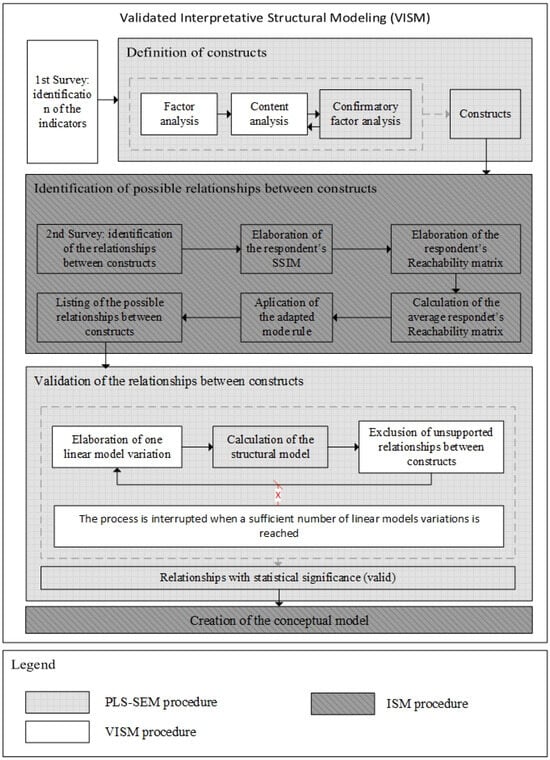
Figure 1.
Flowchart for constructing the VISM model of factors that affect well-being at work and the perception of the risk of accidents among construction workers.
The procedures used to execute each step of the developed model will be detailed below.
3.1. Identification and Measurement of the Safety Climate and Well-Being Indicators at Work for Civil Construction Workers
To identify indicators of well-being and workplace safety climate related to workers in the construction industry, a systematic review of the literature was carried out. A systematic literature review is a scientific search technique that aims to establish a clear and replicable method for data collection [79], which results in a broad set of results, ideally containing all studies relevant to the topic being researched [80].
In this research, ten search bases were chosen because they contain scientific publications related to the construction industry: EBSCO, ProQuest, PubMed, Scopus, Web of Science, Cochrane Library, SciELO, Emerald, PsycINFO and Engineering Village. The following search terms were used: (“safety climate” OR “safety culture” OR “safety perception”) AND (“well-being” OR “wellbeing” OR “well being”) AND (“civil construction” OR “construction industry” OR “construction sector” OR “construction sites” OR “civil construction workers”).
Initially, 988 articles were obtained in the searches. In the selection stage, 166 articles showed strong adherence to the topic, with them being accepted for the next stage. In the extraction stage, 74 studies were rejected and were 92 accepted, in which indicators related to the safety climate and well-being at work of construction workers were extracted.
As a result, 26 indicators were identified, as shown in Table 2. The next step involved measuring these indicators. This survey was conducted using a questionnaire developed based on models adopted by various renowned authors in the research field, as indicated in Table 2; the goal was to maintain them entirely in their original form to prevent distortions in their application and the responses obtained. To ensure response variability consistent with PLS-SEM, a 5-point Likert scale was adopted, where 1 = strongly disagree, 2 = disagree, 3 = partially agree, 4 = agree, and 5 = strongly agree. Regarding the questionnaire classification, it can be considered structured and closed, as it contains questions with pre-defined answers [81].
Table 2.
Constructs and indicators developed.
Construction workers from the cities of Belém, Ananindeua, Castanhal, and Abaetetuba were defined as a sample group, with the aim of achieving maximum diversity. These cities also had the highest number of ongoing construction projects in the state during the study period, between April and May 2019. Moreover, these cities shared the same labor relations, with them being governed by the same employers’ and workers’ unions and adhering to the same employment contract statutes. To ensure data quality, participants were randomly selected based on their availability and willingness to participate. The chosen data collection method was face-to-face, whereby the interviewer explained the questions and addressed any concerns [81]. Interviewee anonymity was preserved, and the interviews were conducted spontaneously and individually, with them lasting between twelve to fifteen minutes.
3.2. Definition of Constructs
The constructs are the basis of the model structure and are explained by the indicators measured from the data obtained with the first survey of the research. To create the constructs, a rigorous cycle procedure based on the study by Santana and Maués [87] was used, detailed below.
First, the indicators were grouped according to the literature review conducted in Section 3.1, forming the constructs. Subsequently, confirmatory factor analysis (CFA) was conducted to assess their coherence, obtained from the rules presented in Table 3. However, as in the study by Santana and Maués [87], the constructs at this first stage did not show statistical consistency and had to go through a rigorous procedure of two more stages. In this procedure, carried out in cycles, the adequacy of the indicators to the constructs was verified through content analysis, and the constructs were modified, or other constructs were created until their content and a confirmatory factor analysis indicated their adequacy to the objectives of the research and the statistical rigor necessary for the measurement model [87,88].
Table 3.
Confirmatory factor analysis rules.
3.3. Identification of Possible Relationships between Constructs
According to the VISM technique, the relationships identified in this stage are possible, but not guaranteed, and will only be true if they are validated in the subsequent stage. Aiming to identify the possible relationships between the constructs, a second survey was carried out to obtain the structural self-interaction matrix (SSIM).
Basically, in the SSIM, the respondents of this second survey were asked about the existence and direction of the relationship between each construct by assigning one of the following symbols: “V” for a direct relationship in the sense of the construct from left to right; “A” for a direct relationship in the sense of the construct from right to left; “X” for a cross-relationship; and “0” for a lack of a relationship between the evaluated constructs.
To develop the SSIM, a second questionnaire was created and emailed to accredited experts in the field of occupational safety and construction engineering in Brazil, including researchers and on-site engineers. The snowball sampling technique was employed for data collection, wherein the questionnaire was sent to one person, who then recommended other individuals to participate based on the sample criteria, until the research requirements were met [89]. The data for the second survey were collected from July to August 2019.
Based on the responses obtained from the second survey, the average accessibility matrix was created, allowing the identification of possible relationships between constructs. To do this, the mode rule was used. According to the mode rule, relationships that present values above 0.5 in the average accessibility matrix can be considered [78,90].
3.4. Validation of Relationships between Constructs
Once possible relationships between constructs have been identified, these relationships are checked for statistical significance. This is a key step in the VISM technique and aims to add the reliability of PLS-SEM models to ISM models. To achieve this, linear models will be constructed containing the potential relationships between constructs and then tested for statistical significance using bootstrapping procedures, following Santana et al.’s [78] guidelines. According to the author, we should adopt the following five conditions for the creation and testing of linear models used to validate relationships between constructs:
- The linear variations developed should show as many relations between constructs as possible;
- Possible unsupported relations should be deleted;
- A good test of a possible relation is one, in which, in the same linear variation, all existing relations between the constructs that precede it are tested;
- If possible, as many linear variations should be developed as the possible relations to be tested allow, otherwise, and there is no clear limit on the maximum number of linear variations to be tested, a sufficient number of linear variations should be tested (as in rule 5 shown below);
- A sufficient number of linear variations developed is one in which each relation is tested a number of times equal to the number of constructs. For example, if a model has ten constructs, each possible relation should be tested at least ten times.
For the significance test of the possible relations, the bootstrapping procedure will be used, a powerful tool of the PLS-SEM method for testing hypothetical relationships in complex models [88]. As a criterion to determine the validity of possible relationships, significance in the sample will be adopted at a 10% confidence level, that is, when the t value is above or equal to 1.65 [78,88].
3.5. Creation of the Conceptual Model
Once the valid relationships between the constructs have been identified, the conceptual model is drawn up. In this research, the standard conceptual model of the ISM technique will be used, containing the constructs and their relationships, represented by arrows. In this method, first, an SSIM is constructed containing the valid relationships between the constructs obtained in Section 3.4. Then, the influences between constructs are translated into relationships and represented by arrows. Finally, the constructs and their relationships are organized into a structure containing the model’s constructs and their interconnections. This model presentation format will be used as it highlights the interpellations between the model factors; therefore, it allows a more detailed analysis of the specific ways in which the safety climate and well-being at work of construction workers are related.
4. Results
4.1. Safety and Well-Being Climate Indicators at Work for Construction Workers
Table 2 presents the indicators adopted and the references that supported them, obtained from the systematic review of the literature developed. In Table 2 it can be seen that 26 indicators were used, which were later grouped into 10 constructs.
With the application of the first survey, 376 responses were obtained. The preponderant characteristics of the individuals who participated in this study are: (a) male (98.9%), (b) marital status married or friends (67.3%), (c) completed high school (31.6%), (d) aged between 29 and 38 years old, (e) with one to three children (72.6%), (f) time with the company up to 6 months (31.9%), and (h) have their own employment relationship with the construction company (83%). Despite the group being heterogeneous, no significant variations in the obtained responses were observed when statically utilizing the PLS-SEM procedure.
Once the research indicators were measured, it was possible to define the constructs that made up the developed model, according to the following topic.
4.2. Results of the of the Constructs Definition
To create the constructs, the rigorous three-step procedure developed by Santana and Maués [87] was adopted. As a result, several cycles were necessary, and Table 4 presents the constructs and results of the confirmatory factor analysis of the last creation cycle.
Table 4.
Results of the evaluation of the mensuration model.
Confirmatory factor analysis aims to test whether the arrangement of indicators in constructs is coherent with the factor model [91]. In Table 4, we can observe the cross-loadings between the constructs obtained through the measurement model of PLS-SEM. In Table 4, one can be see that the internal consistency of the factors is satisfactory, as the composite reliability presented values above 0.708 for all constructs [88]. Likewise, the convergent validity of the model was confirmed, given by the AVE greater than 0.5 and the square roots of the AVE (in bold on the diagonals) greater than the correlations of the constructs with the others.
Another method of checking discriminant validity is by examining cross-loadings between indicators. In this case, all indicators must have higher loadings with their associated construct [88]. Table 5 presents the cross-loadings between indicators and constructs; it can be seen that the discriminant validity rule was satisfied.
Table 5.
Cross-loadings between constructs and indicators.
In addition to the internal consistency and discriminant validity of the constructs, it is important to verify the consistency of the indicators in explaining their respective constructs [91]. Regarding the consistency of the indicators, the reliability of the indicators (loadings above 0.5 with their construct) and discriminant validity were confirmed, as all indicators showed higher loadings with their construct than with the others [88].
Once the constructs were defined, the next step was the identification of possible relationships between constructs.
4.3. Results of the Identification of Possible Relationships between Constructs
According to VISM, at this stage a second survey is carried out to identify possible relationships between constructs. As a result, five responses were obtained, a number equivalent to other surveys [78,92,93], and deemed sufficient, given that potential relationships would still be tested for statistical significance in the study. Among the respondents, all of them have more than twenty-five years of experience in the area of building construction, including three civil engineers, one occupational safety specialist, and one psychologist.
Table 6 presents the accessibility matrix containing the average of the responses obtained. According to Santana et al. [78], all relationships that present values greater than 0.5 are considered possible relationships between constructs, and they were statistically tested by the bootstrapping procedure of the PLS-SEM for their adherence in relation to the data from the first survey.
Table 6.
Accessibility matrix containing the average responses from the second survey.
4.4. Results of the Validation of Relationships between Constructs
At this stage, possible relationships between constructs will be tested for their statistical significance, as according to VISM, only validated relationships will be used to create the model. For this, the bootstrapping procedure was used in order to obtain the significance of possible relationships according to linear variations of the model, generated based on the five VISM conditions developed by Santana et al. [78].
The results of the linear variations developed are presented in Table 7 and Table 8. The possible relationships are presented in the columns, referring to the identifications of the constructs in Table 6; therefore, for example, the relationship 1-2 means a possible relationship of the construct SW in the sense of the UAC construct. In the lines of Table 7 and Table 8, the results of the t- and p-values (significance) for the linear variations (LV) developed by VISM are presented.
Table 7.
Results of the significance test of possible relationships between constructs (only valid relationships).
Table 8.
Results of the significance test of possible relationships between constructs (only non-significant relationships).
Twenty linear variations were created to investigate the relationships between the model’s constructs. In this process, twenty-three valid relationships were identified among the forty possible relationships tested. In Table 8, it is possible to observe that all seventeen rejected relationships were excluded up to the fourth linear variation as they were not significant in the sample at a 10% confidence level [78,88]. Furthermore, to meet VISM condition five, which requires that each possible relationship be tested a number of times equal to the number of constructs in the model, each relationship was tested at least ten times, as evidenced in the last row of Table 7 [78].
4.5. Conceptual Model
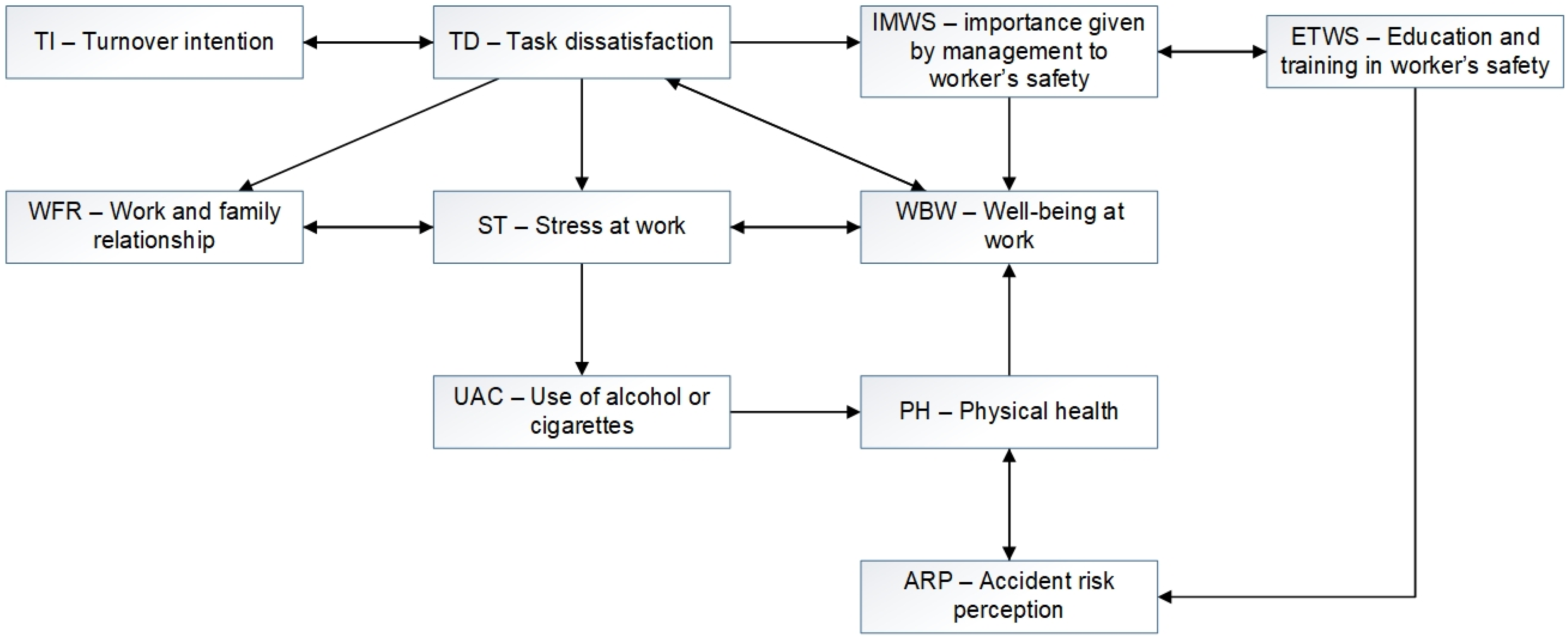
After identifying the relations between constructors, it was possible to create the conceptual model highlighting these relations. The resulting conceptual model is presented in Figure 2.
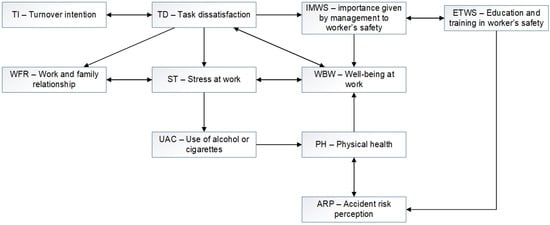
Figure 2.
Conceptual model of factors that affect the well-being and risk perception of construction workers.
After creating the model using the VISM methodology, its findings and contributions are elaborated upon in the following discussion section.
5. Discussion
As observed by the model developed, the connection between the importance given by construction company management to workplace safety and education and training in safety at work is evident. According to the research findings, a construction company in which the managers responsible for setting goals and guidelines for workers are concerned about their safety is highly likely to provide a more extensive range of courses and instructive measures on workplace safety (WS) for the workers.
To the same extent, the model highlights the influence of education and training in WS on the perception of accident risks. These findings align with other studies [12,18,94], and demonstrate the importance of training workers to deal with insecure situations as a fundamental risk management tool in construction projects.
Furthermore, these results indicate that the positive attitude of the construction company’s management towards WS education and training activities has a beneficial impact on the workers’ perception of accident risks at work. This highlights the importance of not only offering WS training to workers but also actively engaging those responsible for management and promoting safety-conscious behaviors as a strategy to decrease accidents, enhancing the safety climate and potentially reducing acts of workers’ insecurity. Previous studies support these findings, highlighting the influence of superiors’ WS attitude in mitigating unsafe behaviors among construction workers [12,18,71].
According to these studies, the imposition of penalties such as fines and infraction points to those who commit unsafe acts at work can serve as a deterrent [94]; however, a more humane approach may prove to be more advantageous. After all, studies demonstrate that the recognition of good behavior in WS [18], the strengthening of monitoring in WS at the construction site [95], the certification of training in WS [18], and even the presence and encouragement of management when providing courses and training in WS for employees have the potential to favor a reduction in unsafe acts at work [12,71]. Therefore, the model developed infers that promoting a culture of safety in the workplace, valuing the commitment of workers to adopt safe practices, and investing in their training represent an effective approach to enhancing the safety and well-being of workers in the construction industry.
Concerning the perception of accident risks, the model developed highlights its connection with the physical health of the worker, suggesting that workers who feel less susceptible to workplace accidents, due to education and training in WS, tend to possess a better perception of their health and, as a result, experience improved well-being at work. These findings align with those of Na et al. [9], which suggest that the unsafe behaviors of workers responsible for workplace accidents are linked to deliberate attitudes. Its relatively accepted that workers with good perception about risks at work positively influences construction workers’ risk-taking behavior [18]. In this context, the developed model suggests that workers with a diminished perception of their risk of accidents, physical health, and well-being have a propensity to commit unsafe acts due to dissatisfaction with well-being at work or a feeling that risk is part of the activities carried out and, therefore, cannot be avoided.
When it comes to factors associated with workplace stress, the model clarifies the ways in which dissatisfaction with tasks and turnover intention affect worker well-being. These findings are in line with the existing literature [27] and go further, helping to clarify how happens. According to the model, turnover intention is closely related to dissatisfaction with tasks, and dissatisfaction with tasks stands out as one of the main factors with a direct relationship with construction worker stress at work. Additionally, the model highlights one of the perverse ways in which stress at work can affect such a worker, as stress at work can harm the work–family relationship, as well as favor the use of alcohol and cigarettes, with damage to their physical health and negative consequences for their well-being.
6. Conclusions
In this study, an innovative modeling technique developed by Santana et al. [78] was employed, known as validated interpretative structural modeling (VISM). The results underscore the effectiveness of VISM in crafting complex models with robust statistical validity, even in exploratory research scenarios characterized by sample limitations and intricate or circular relationships among constructs. This represents a significant contribution, as many contemporary modeling techniques struggle to effectively address such complexities.
The developed model aimed to investigate the influence of factors affecting the well-being and accident risk perception of construction workers. The research identified various factors in this phenomenon, such as the importance given by management to workplace safety, job dissatisfaction, work-related stress, turnover intention, work–family balance, alcohol and cigarette use, physical health, perception of accident risks at work, and education and training in workplace safety.
Moreover, the primary contribution of the research lies in the formulation of the proposed model, which surpasses prior studies in the field. Previous research often identified only a few factors without exploring the intricate relationships between the elements influencing the well-being of construction workers. The developed model has the potential to assist researchers, construction enterprises, and practitioners by aiding in the formulation of strategies and the adoption of measures to enhance worker well-being and reduce workplace accident risks, especially those related to intentional unsafe acts.
As per the developed model, factors like the importance given by management to workplace safety, job dissatisfaction, work-related stress, and physical health directly impact the well-being of construction workers. Therefore, these factors should be prioritized. Simple strategies such as investing in training programs and adopting humane practices can significantly improve the safety climate and the overall well-being of the workforce.
Additionally, other factors indirectly affect the well-being of construction workers. For instance, job dissatisfaction and turnover intention are linked to work-related stress among laborers. Stress can negatively impact employees’ well-being, harming work–family relationships and increasing the use of alcohol and cigarettes. Furthermore, the significance given by management to safety influences education and training in safety, affecting accident risk perceptions, physical health, and ultimately the well-being of workers. These findings highlight how intentional unsafe acts can stem from dissatisfaction or a sense that risks are inherent in their work, prompting workers to engage in unsafe practices.
Despite the contributions, certain limitations should be acknowledged for future research. Firstly, workers from other countries with different cultures, climates, education levels, and behaviors might yield distinct models and, consequently, different relationships between constructs and strategies to enhance worker well-being. Secondly, the developed model represents the reality of building construction workers in the Brazilian Amazon context. Therefore, workers from infrastructure, port, or industrial construction sites might produce different results due to the application of advanced construction technologies and equipment, which could favor worker well-being. Thirdly, although PLS-SEM allows for the influence of demographic characteristics through multi-group analysis, no significant variations were identified in the results according to the 95% confidence interval, demonstrating the homogeneity of the findings. Future studies using alternative modeling methods or different samples could yield diverse analyses or compare different models to assess variations in relationships involving factors influencing construction workers’ well-being.
Author Contributions
Conceptualization, W.S. and L.M.M.; methodology, W.S.; software, W.S.; validation, W.S.; formal analysis, W.S.; investigation, W.S. and F.M.; resources, W.S. and F.M.; data curation, F.M.; writing—original draft preparation, W.S., F.M., L.M.N. and J.S.; writing—review and editing, W.S., L.M.M., L.M.N. and J.S.; visualization, W.S.; supervision, L.M.M.; project administration, W.S. and L.M.M.; funding acquisition, L.M.M. All authors have read and agreed to the published version of the manuscript.
Funding
The authors received no financial support for the research but did receive financial support for the publication of this article from PROPESP/PAPQ/UFPA. This study was financed in part by the Coordenação de Aperfeiçoamento de Pessoal de Nível (CAPES) (Coordination for the Improvement of Higher Education Personnel)-Brazil-Finance Code 001.
Data Availability Statement
The data presented in this study are available upon request from the corresponding author. The data are not publicly available due to the need to protect the privacy of the research respondents.
Conflicts of Interest
The authors declare no conflict of interest.
References
- Hamalainen, P.; Takala, J.; Kiat, T.B. Global Estimates of Occupational Accidents and Work-Related Illnesses 2017; ResearchGate: Berlin, Germany, 2017; ISBN 1424401364. [Google Scholar]
- ILO. Going beyond: For Safe & Healthy Supply Chains. In Vision Zero Fund; ILO: Geneva, Switzerland, 2017; Volume 4. [Google Scholar]
- United Nations. Goal 8: Promote Sustained, Inclusive and Sustainable Economic Growth, Full and Productive Employment and Decent Work for All; United Nations: New York, NY, USA, 2023. [Google Scholar]
- ILO. Safety and Health in the Construction Sector-Overcoming the Challenges. Available online: https://www.ilo.org/empent/Eventsandmeetings/WCMS_310993/lang--en (accessed on 8 June 2023).
- ILO. Construction: A Hazardous Work. Available online: https://www.ilo.org/safework/areasofwork/hazardous-work/WCMS_356576/lang--en (accessed on 17 September 2023).
- ABRAINC. Pesquisa Abrainc Sobre Acidentes De Trabalho Nas Obras; ABRAINC: São Paulo, Brazil, 2023. [Google Scholar]
- Ministério da Previdência Social. Anuário Estatístico de Acidentes de Trabalho; Ministério da Previdência Social: Brasília, Brazil, 2021. [Google Scholar]
- Choi, B.; Lee, S. An Empirically Based Agent-Based Model of the Sociocognitive Process of Construction Workers’ Safety Behavior. J. Constr. Eng. Manag. 2018, 144, 04017102. [Google Scholar] [CrossRef]
- An, Y.; Wang, H.; Yang, X.; Zhang, J.; Tong, R. Using the TPB and 24Model to Understand Workers’ Unintentional and Intentional Unsafe Behaviour: A Case Study. Saf. Sci. 2023, 163, 1060999. [Google Scholar] [CrossRef]
- Fung, I.W.H.; Tam, V.W.Y.; Sing, C.P.; Tang, K.K.W.; Ogunlana, S.O. Psychological Climate in Occupational Safety and Health: The Safety Awareness of Construction Workers in South China. Int. J. Constr. Manag. 2016, 16, 315–325. [Google Scholar] [CrossRef]
- Rivera, F.M.; Mora-serrano, J.; Oñate, E. Factors Influencing Safety on Construction Projects (FSCPs): Types and Categories. Int. J. Environ. Res. Public Health 2021, 18, 10884. [Google Scholar] [CrossRef]
- Namian, M.; Tafazzoli, M.; Al-bayati, A.J.; Kermanshachi, S. Are Construction Managers from Mars and Workers from Venus? Exploring Differences in Construction Safety Perception of Two Key Field Stakeholders. Int. J. Environ. Res. Public Health 2022, 19, 6172. [Google Scholar] [CrossRef]
- Man, S.S.; Alabdulkarim, S.; Chan, A.H.S.; Zhang, T. The Acceptance of Personal Protective Equipment among Hong Kong Construction Workers: An Integration of Technology Acceptance Model and Theory of Planned Behavior with Risk Perception and Safety Climate. J. Saf. Res. 2021, 79, 329–340. [Google Scholar] [CrossRef]
- Yang, J.; Ye, G.; Xiang, Q.; Kim, M.; Liu, Q.; Yue, H. Insights into the Mechanism of Construction Workers’ Unsafe Behaviors from an Individual Perspective. Saf. Sci. 2021, 133, 105004. [Google Scholar] [CrossRef]
- Yang, Y.; Wang, Y.; Easa, S.M.; Yan, X. Risk Factors Influencing Tunnel Construction Safety: Structural Equation Model Approach. Heliyon 2023, 9, e12924. [Google Scholar] [CrossRef]
- Ewen, C.; Jenkins, H.; Jackson, C.; Jutley-neilson, J.; Ewen, C.; Jenkins, H.; Jackson, C.; Jutley-neilson, J.; Ewen, C.; Jenkins, H.; et al. Well-Being, Job Satisfaction, Stress and Burnout in Speech-Language Pathologists: A Review. Int. J. Speech Lang. Pathol. 2020, 23, 180–190. [Google Scholar] [CrossRef]
- Zhang, Z.; Xiang, T.; Guo, H.; Ma, L.; Guan, Z.; Fang, Y. Impact of Physical and Mental Fatigue on Construction Workers’ Unsafe Behavior Based on Physiological Measurement. J. Saf. Res. 2023, 85, 457–468. [Google Scholar] [CrossRef]
- Man, S.S.; Yu, R.; Zhang, T.; Chan, A.H.S. How Optimism Bias and Safety Climate Influence the Risk-Taking Behavior of Construction Workers. Int. J. Environ. Res. Public Health 2022, 19, 1243. [Google Scholar] [CrossRef] [PubMed]
- Total Worker Health® Program. Available online: https://www.cdc.gov/niosh/twh/default.html (accessed on 10 August 2023).
- Worker Well-Being Questionnaire (WellBQ). Available online: https://www.cdc.gov/niosh/twh/wellbq/default.html (accessed on 10 August 2023).
- Dessen, M.C.; Paz, M.D.G.T.D. Bem-Estar Pessoal Nas Organizações: O Impacto de Configurações de Poder e Características de Personalidade. Psicol. Teor. Pesqui. 2010, 26, 549–556. [Google Scholar] [CrossRef]
- Moreira, F.D.S. Bem-Estar No Trabalho—Proposta de Uma Escala Para Operários Da Construção. Ph.D. Thesis, Universidade Federal do Pará (UFPA), Belém, Brazil, 2019. [Google Scholar]
- Liao, L.; Liao, K.; Wei, N.; Ye, Y.; Li, L.; Wu, Z. A Holistic Evaluation of Ergonomics Application in Health, Safety, and Environment Management Research for Construction Workers. Saf. Sci. 2023, 165, 106198. [Google Scholar] [CrossRef]
- Peters, S.E.; Trieu, H.D.; Manjourides, J.; Katz, J.N.; Dennerlein, J.T. Designing a Participatory Total Worker Health® Organizational Intervention for Commercial Construction Subcontractors to Improve Worker Safety, Health, and Well-Being: The “Arm for Subs” Trial. Int. J. Environ. Res. Public Health 2020, 17, 5093. [Google Scholar] [CrossRef]
- Sorensen, G.; Peters, S.; Nielsen, K.; Nagler, E.; Karapanos, M.; Wallace, L.; Burke, L.; Dennerlein, J.; Wagner, G. Improving Working Conditions to Promote Worker Safety, Health, and Wellbeing for Low-Wage Workers: The Workplace Organizational Health Study. Int. J. Environ. Res. Public Health 2019, 16, 1449. [Google Scholar] [CrossRef]
- Sorensen, G.; Sparer, E.; Williams, J.A.R.; Gundersen, D.; Boden, L.I.; Dennerlein, J.T.; Hashimoto, D.; Katz, J.N.; McLellan, D.L.; Okechukwu, C.A.; et al. Measuring Best Practices for Workplace Safety, Health, and Well-Being: The Workplace Integrated Safety and Health Assessment. J. Occup. Environ. Med. 2018, 60, 430. [Google Scholar] [CrossRef]
- Rani, H.A.; Radzi, A.R.; Alias, A.R.; Almutairi, S.; Rahman, R.A. Factors Affecting Workplace Well-Being: Building Construction Projects. Buildings 2022, 12, 910. [Google Scholar] [CrossRef]
- Deacon, C.; Smallwood, J.; Haupt, T. The Health and Well-Being of Older Construction Workers. Int. Congr. Ser. 2005, 1280, 172–177. [Google Scholar] [CrossRef]
- Sunindijo, R.Y.; Kamardeen, I. Work Stress Is a Threat to Gender Diversity in the Construction Industry. J. Constr. Eng. Manag. 2017, 143, 04017073. [Google Scholar] [CrossRef]
- Sang, K.; Dainty, A.; Ison, S. Warning: Working in Construction May Be Harmful to Your Psychological Well-Being! In People and Culture in Construction; Taylor & Francis: London, UK, 2007; pp. 127–143. ISBN 0-415-34870-6. [Google Scholar]
- Du Plessis, K.; Cronin, D.; Corney, T.; Green, E. Australian Blue-Collar Men’s Health and Well-Being: Contextual Issues for Workplace Health Promotion Interventions. Health Promot. Pract. 2013, 14, 715–720. [Google Scholar] [CrossRef]
- Zafar, J.; Chileshe, N. Analysis of Health and Well-Being Practices among Older Construction Site-Based Workers in South Australia. In Proceedings of the 34st Annual ARCOM Conference, Belfast, UK, 3–5 September 2018; Association of Researchers in Construction Management: Belfast, UK, 2018. [Google Scholar]
- Ferraz, R.R.N.; Aquino, S. Litíase Urinária Em Trabalhadores Da Construção Civil Como Indicador Para a Gestão Em Saúde e Melhoria Na Gestão de Pessoas. Cien. Saude Colet. 2014, 19, 4759–4766. [Google Scholar] [CrossRef] [PubMed]
- Martin-Halls, S. An Olympic Effort. Occup. Health 2009, 61, 32–34. Available online: http://link.galegroup.com/apps/doc/A268984712/AONE?u=capes&sid=AONE&xid=bbf1a6e8 (accessed on 17 September 2023).
- Jebelli, H.; Khalili, M.M.; Hwang, S.; Lee, S. A Supervised Learning-Based Construction Workers’ Stress Recognition Using a Wearable Electroencephalography (EEG) Device. In Proceedings of the Construction Research Congress 2018, New Orleans, LA, USA, 2–4 April 2018; pp. 148–157. [Google Scholar] [CrossRef]
- Powell, A.; Galea, N.; Salignac, S.; Loosemore, M.; Chappell, L. Masculinity and Workplace Wellbeing in the Australian Construction Industry. In Proceedings of the 34st Annual ARCOM Conference, Belfast, UK, 3–5 September 2018; pp. 321–330. [Google Scholar]
- Kines, P.; Andersen, L.P.S.; Spangenberg, S.; Mikkelsen, K.L.; Dyreborg, J.; Zohar, D. Improving Construction Site Safety through Leader-Based Verbal Safety Communication. J. Saf. Res. 2010, 41, 399–406. [Google Scholar] [CrossRef] [PubMed]
- Chih, Y.-Y.; Kiazad, K.; Zhou, L.; Capezio, A.; Li, M.; Restubog, S.L.D. Investigating Employee Turnover in the Construction Industry: A Psychological Contract Perspective. J. Constr. Eng. Manag. 2016, 142, 04016006. [Google Scholar] [CrossRef]
- Bierman, M.; Marnewick, A.; Pretorius, J.-H. Productivity Management in the South African Civil Construction Industry—Factors Affecting Construction Productivity. J. S. Afr. Inst. Civ. Eng. 2016, 58, 37–44. [Google Scholar] [CrossRef]
- Konstantinou, E. Vision-Based Construction Worker Task Productivity Monitoring. Ph.D. Thesis, Department of Engineering, University of Cambridge, Cambridge, UK, 2017. [Google Scholar]
- Priori Junior, L.; Silva, J.J.R.; Barkokébas Junior, B. O Perfil Do Trabalhador Da Construção Civil No Estado de Pernambuco Como Limitante Da Qualidade Do Setor. In Proceedings of the XII Encontro Nacional de Tecnologia do Ambiente Construído, Foz do Iguaçu, Brazil, 12–14 November 2008. [Google Scholar]
- Chih, Y.; Kiazad, K.; Cheng, D.; Capezio, A.; Restubog, S.L.D. Does Organizational Justice Matter? Implications for Construction Workers’ Organizational Commitment. J. Manag. Eng. 2017, 33, 04016043. [Google Scholar] [CrossRef]
- Sánchez-García, J.C.; Vargas-Morúa, G.; Hernández-Sánchez, B.R. Entrepreneurs’ Well-Being: A Bibliometric Review. Front. Psychol. 2018, 9, 1696. [Google Scholar] [CrossRef]
- Salvador-Carulla, L.; Lucas, R.; Ayuso-Mateos, J.L.; Miret, M. Use of the Terms “Wellbeing” and “Quality of Life” in Health Sciences: A Conceptual Framework. Eur. J. Psychiatry 2014, 28, 50–65. [Google Scholar] [CrossRef]
- Fisher, C.D. Happiness at Work. Int. J. Manag. Rev. 2010, 12, 384–412. [Google Scholar] [CrossRef]
- Santos, G.B.; Ceballos, A.G.D.C.D. Bem-Estar No Trabalho: Estudo de Revisão. Psicol. Estud. 2013, 18, 247–255. [Google Scholar] [CrossRef]
- Taris, T.W.; Schaufeli, W.B. Individual Well-Being and Performance at Work: A Conceptual and Theoretical Overview. In Well-Being and Performance at Work: The Role of Context; Psychology Press: London, UK, 2015; pp. 15–34. [Google Scholar]
- Tisu, L.; Lupșa, D.; Vîrgă, D.; Rusu, A. Personality Characteristics, Job Performance and Mental Health the Mediating Role of Work Engagement. Personal. Individ. Differ. 2020, 153, 109644. [Google Scholar] [CrossRef]
- Hewett, R.; Liefooghe, A.; Visockaite, G.; Roongrerngsuke, S. Bullying at Work: Cognitive Appraisal of Negative Acts, Coping, Wellbeing, and Performance. J. Occup. Health Psychol. 2018, 23, 71–84. [Google Scholar] [CrossRef] [PubMed]
- Loudoun, R.; Townsend, K. Implementing Health Promotion Programs in the Australian Construction Industry: Levers and Agents for Change. Eng. Constr. Archit. Manag. 2017, 24, 260–274. [Google Scholar] [CrossRef]
- Mousa, M.; Massoud, H.K.; Ayoubi, R.M. Gender, Diversity Management Perceptions, Workplace Happiness and Organisational Citizenship Behaviour. Empl. Relat. 2020, 42, 1249–1269. [Google Scholar] [CrossRef]
- Pryce-Jones, J.; Lindsay, J. What Happiness at Work Is and How to Use It. Ind. Commer. Train. 2014, 46, 130–134. [Google Scholar] [CrossRef]
- Ministério da Previdência Social. Dados Estatísticos—Saúde e Segurança Do Trabalhador; Ministério da Previdência Social: Brasília, Brazil, 2020. [Google Scholar]
- Gibb, A.; Cook, S.; Nyateka, N.; Bust, P.; Jones, W.; Finneran, A. Wearable Simulations for Ill-Health Conditions in Construction. Proc. Inst. Civ. Eng.-Civ. Eng. 2015, 168, 51–56. [Google Scholar] [CrossRef]
- López-Valcárcel, A.; Lima, J.M., Jr.; Dias, L.A. Segurança e Saúde No Trabalho Da Construção: Experiência Brasileira e Panorama Internacional; International Labour Organization: Brasília, Brazil, 2005; ISBN 9228178388. [Google Scholar]
- Gomes, H.P. Construção Civil e Saúde Do Trabalhador: Um Olhar Sobre as Pequenas Obras; Escola Nacional de saúde Pública “Sérgio Arouca” (Tese de Doutorado): Rio de Janeiro, Brazil, 2011; ISBN 0038-0717. [Google Scholar]
- Filgueiras, V.A. Saúde e Segurança Do Trabalho Na Construção Civil Brasileira. In Saúde e Segurança do Trabalho na Construção Civil Brasileira; Ministério do Trabalho e Emprego: Aracaju, Brazil, 2015; Volume 4, pp. 15–40. [Google Scholar]
- Felício, M.O.; de Oliveira Silva, A.M.; de Menezes Neto, E.L.; Oliveira, H.D.S.C.; Koseki, H.C.M.; Martins, M.M.; Pereira, M.G.D.F.; Ximenes, T.D.B.S. Segurança Do Trabalho: Os Problemas Nos Canteiros de Obras Por Falta Dos Equipamentos de Proteção Individual—EPI’S. Braz. J. Dev. 2022, 8, 47029–47047. [Google Scholar] [CrossRef]
- Dantas Filho, J.B.P.; Barros Neto, J.D.P.; Mourão, A.; Rocha, A.B.D.; Luccas, A.V.; Saggin, A. Respect for People’s Well-Being: Meditation for Construction Workers. In Proceedings of the 26th Annual Conference of the Nternational Group for Lean Construction, Chennai, India, 16–22 July 2018; Group for Lean Construction (IGLC): Chennai, India, 2018; pp. 1160–1169. [Google Scholar]
- Bowen, P.; Edwards, P.; Lingard, H.; Cattell, K. Predictive Modeling of Workplace Stress among Construction Professionals. J. Constr. Eng. Manag. 2014, 140, 04013055. [Google Scholar] [CrossRef]
- Neri, M. O Novo Velho Trabalhador da Construção Civil. 2011. Available online: https://bibliotecadigital.fgv.br/dspace/bitstream/handle/10438/24079/O-novo-velho-trabalhador-da-constru%C3%A7ao-civil-nc0197a.pdf?sequence=1&isAllowed=y (accessed on 17 September 2023).
- Townsend, K.; Lingard, H.; Bradley, L.; Brown, K. Complicated Working Time Arrangements: Construction Industry Case Study. J. Constr. Eng. Manag. 2012, 138, 443–448. [Google Scholar] [CrossRef]
- Anger, W.K.; Kyler-Yano, J.; Vaughn, K.; Wipfli, B.; Olson, R.; Blanco, M. Total Worker Health Intervention for Construction Workers Alters Safety, Health, Well-Being Measures. J. Occup. Environ. Med. 2018, 60, 700–709. [Google Scholar] [CrossRef]
- Lorente, L.; Salanova, M.; Martínez, I.M.; Vera, M. How Personal Resources Predict Work Engagement and Self-Rated Performance among Construction Workers: A Social Cognitive Perspective. Int. J. Psychol. 2014, 49, 200–207. [Google Scholar] [CrossRef]
- Goodman, F.R.; Disabato, D.J.; Kashdan, T.B.; Kauffman, S.B. Measuring Well-Being: A Comparison of Subjective Well-Being and PERMA. J. Posit. Psychol. 2017, 13, 321–332. [Google Scholar] [CrossRef]
- Sender, G.; Fleck, D. As Organizações e a Felicidade No Trabalho: Uma Perspectiva Integrada. Rev. Adm. Contemp. 2017, 21, 764–787. [Google Scholar] [CrossRef]
- Guillemin, M. Le Bonheur Au Travail: Qu’en Disent Les Scientifiques? Environ. Risque Sante 2018, 17, 487–497. [Google Scholar]
- Fogaça, N. Uma Perspectiva Multinível Da Relação Entre Desempenho, Bem-Estar, Justiça e Suporte Organizacional. Ph.D. Thesis, Universidade de Brasília (UNB), Brasília, Brazil, 2018. [Google Scholar]
- Da Silva, C.A.; Ferreira, M.C. Dimensões e Indicadores Da Qualidade de Vida e Do Bem-Estar No Trabalho. Psicol. Teor. Pesqui. 2013, 29, 331–339. [Google Scholar] [CrossRef]
- Mostert, K.; Peeters, M.; Rost, I. Work-Home Interference and the Relationship with Job Characteristics and Well-Being: A South African Study among Employees in the Construction Industry. Stress Health 2011, 27, e238–e251. [Google Scholar] [CrossRef]
- Chen, Y.; Mccabe, B.; Hyatt, D. A Resilience Safety Climate Model Predicting Construction Safety Performance. Saf. Sci. 2018, 109, 434–445. [Google Scholar] [CrossRef]
- Dedobbeleer, N.; Béland, F. A Safety Climate Measure for Construction Sites. J. Saf. Res. 1991, 22, 97–103. [Google Scholar] [CrossRef]
- Rueda, F.J.M.; Serenini, A.L.P.; Meireles, E. Relação Entre Qualidade de Vida No Trabalho e Confiança Do Empregado Na Organização. Rev. Psicol. Organ. E Trab. 2014, 14, 303–314. [Google Scholar]
- Couto, P.R.; Paschoal, T. Relação Entre Ações de Qualidade de Vida No Trabalho e Bem-Estar Laboral. Psicol. Argum. 2012, 30, 585–593. [Google Scholar]
- Silva, V.P.D. Percepção de Segurança Do Trabalho Na Construção Civil: Estudo de Caso Em Uma Construtora Com Foco Em Empreendimentos Imobiliários. Master’s Thesis, Universidade do Vale do Rio dos Sinos (UNISINOS), São Leopoldo, Brazil, 2018. [Google Scholar]
- Cuti, A.F.; Recchi, A.F.; Buligon, S.M. Áreas de Vivência Em Canteiros de Obras: Adequação à NR 18 X Percepção Dos Trabalhadores Em Obras de Diferentes Portes. Discip. Sci. Nat. Tecnol. 2017, 18, 207–225. [Google Scholar]
- Chen, Y.; McCabe, B.; Hyatt, D. Impact of Individual Resilience and Safety Climate on Safety Performance and Psychological Stress of Construction Workers: A Case Study of the Ontario Construction Industry. J. Saf. Res. 2017, 61, 167–176. [Google Scholar] [CrossRef] [PubMed]
- Santana, W.B.; Pereira, L.M.; Freires, F.G.M.; Maués, L.M.F. Analysis of the Barriers to the Adoption of Green Buildings Labels in Brazil by the Validated Interpretative Structural Modeling (VISM) Technique. J. Clean. Prod. 2023, 414, 137642. [Google Scholar] [CrossRef]
- Briner, R.B.; Denyer, D. Systematic Review and Evidence Synthesis as a Practice and Scholarship Tool. Capítulo 7. In The Oxford Handbook of Evidence-Based Management; Oxford University Press: Oxford, UK, 2012; ISBN 9780199968879. [Google Scholar]
- Dresch, A.; Lacerda, D.P.; Antunes, J.A.V., Jr. Design Science Research: Método de Pesquisa Para Avanço Da Ciência e Tecnologia, 1st ed.; Bookman: São Paulo, Brazil, 2015. [Google Scholar]
- Vieira, S. Como Elaborar Questionários; Atlas: São Paulo, Brazil, 2009; Volume 1. [Google Scholar]
- Paschoal, T.; Tamayo, Á. Validação Da Escala de Estresse No Trabalho. Estud. Psicol. 2004, 9, 45–52. [Google Scholar] [CrossRef]
- Siqueira, M.M.M.; Orengo, V.; Peiró, J.M. Bem-Estar No Trabalho. In Novas Medidas do Comportamento Organizacional: Ferramentas de Diagnóstico e de Gestão; Artmed: Porto Alegre, Brazil, 2014; pp. 39–51. ISBN 878-85-8271-022-7. [Google Scholar]
- Añez, C.R.R.; Reis, R.S.; Petroski, E.L. Versão Brasileira Do Questionário “Estilo de Vida Fantástico”: Tradução e Validação Para Adultos Jovens. Arq. Bras. Cardiol. 2008, 91, 102–109. [Google Scholar]
- Aguiar, C.V.N.; Bastos, A.V.B. Tradução, Adaptação e Evidências de Validade Para a Medida de Conflito Trabalho-Família. Aval. Psicol. 2013, 12, 203–212. [Google Scholar]
- Ciconelli, R.M. Tradução Para o Português e Validação Do Questionário Genérico de Qualidade de Vida. Ph.D. Thesis (Ciências da Saúde Aplicadas à Reumatologia), Universidade Federal de São Paulo, São Paulo, Brazil, 1997. [Google Scholar]
- Santana, W.B.; Maués, L.M.F. Environmental Protection Is Not Relevant in the Perceived Quality of Life of Low-Income Housing Residents: A PLS-SEM Approach in the Brazilian Amazon. Sustainability 2022, 14, 13171. [Google Scholar] [CrossRef]
- Hair, J.F.; Hult, G.T.M.; Ringle, C.M.; Sarstedt, M. A Primer on Partial Least Squares Structural Equation Modeling (PLS-SEM); Sage: Riverside County, CA, USA, 2014; ISBN 9781452217444. [Google Scholar]
- Fellows, R.; Liu, A. Research Methods for Construction, 4th ed.; Wiley Blackwell: West Sussex, UK, 2015; ISBN 9781118915745. [Google Scholar]
- Petrudi, S.H.H.; Tavana, M.; Abdi, M. A Comprehensive Framework for Analyzing Challenges in Humanitarian Supply Chain Management: A Case Study of the Iranian Red Crescent Society. Int. J. Disaster Risk Reduct. 2020, 42, 101340. [Google Scholar] [CrossRef]
- Henseler, J.; Hubona, G.; Ray, P.A. Using PLS Path Modeling in New Technology Research: Updated Guidelines. Ind. Manag. Data Syst. 2016, 116, 2–20. [Google Scholar] [CrossRef]
- Ilyas, R.M.; Banwet, D.K.; Shankar, R. Interventional Roadmap for Digital Enablement Leading to Effective Value-Chain Management in the Manufacturing Sector. Glob. Bus. Rev. 2005, 6, 207–229. [Google Scholar] [CrossRef]
- Song, L.; Li, Q.; List, G.F.; Deng, Y.; Lu, P. Using an AHP-ISM Based Method to Study the Vulnerability Factors of Urban Rail Transit System. Sustainability 2017, 9, 1065. [Google Scholar] [CrossRef]
- Wong, T.K.M.; Man, S.S.; Chan, A.H.S. Critical Factors for the Use or Non-Use of Personal Protective Equipment amongst Construction Workers. Saf. Sci. 2020, 126, 104663. [Google Scholar] [CrossRef]
- Fang, W.; Love, P.E.D.; Luo, H.; Ding, L. Computer Vision for Behaviour-Based Safety in Construction: A Review and Future Directions. Adv. Eng. Inform. 2020, 43, 100980. [Google Scholar] [CrossRef]
Disclaimer/Publisher’s Note: The statements, opinions and data contained in all publications are solely those of the individual author(s) and contributor(s) and not of MDPI and/or the editor(s). MDPI and/or the editor(s) disclaim responsibility for any injury to people or property resulting from any ideas, methods, instructions or products referred to in the content. |
© 2023 by the authors. Licensee MDPI, Basel, Switzerland. This article is an open access article distributed under the terms and conditions of the Creative Commons Attribution (CC BY) license (https://creativecommons.org/licenses/by/4.0/).