A Review of the EU’s Regulatory Framework for the Production of Nano-Enhanced Cosmetics

 ,
, 
Abstract
1. Introduction
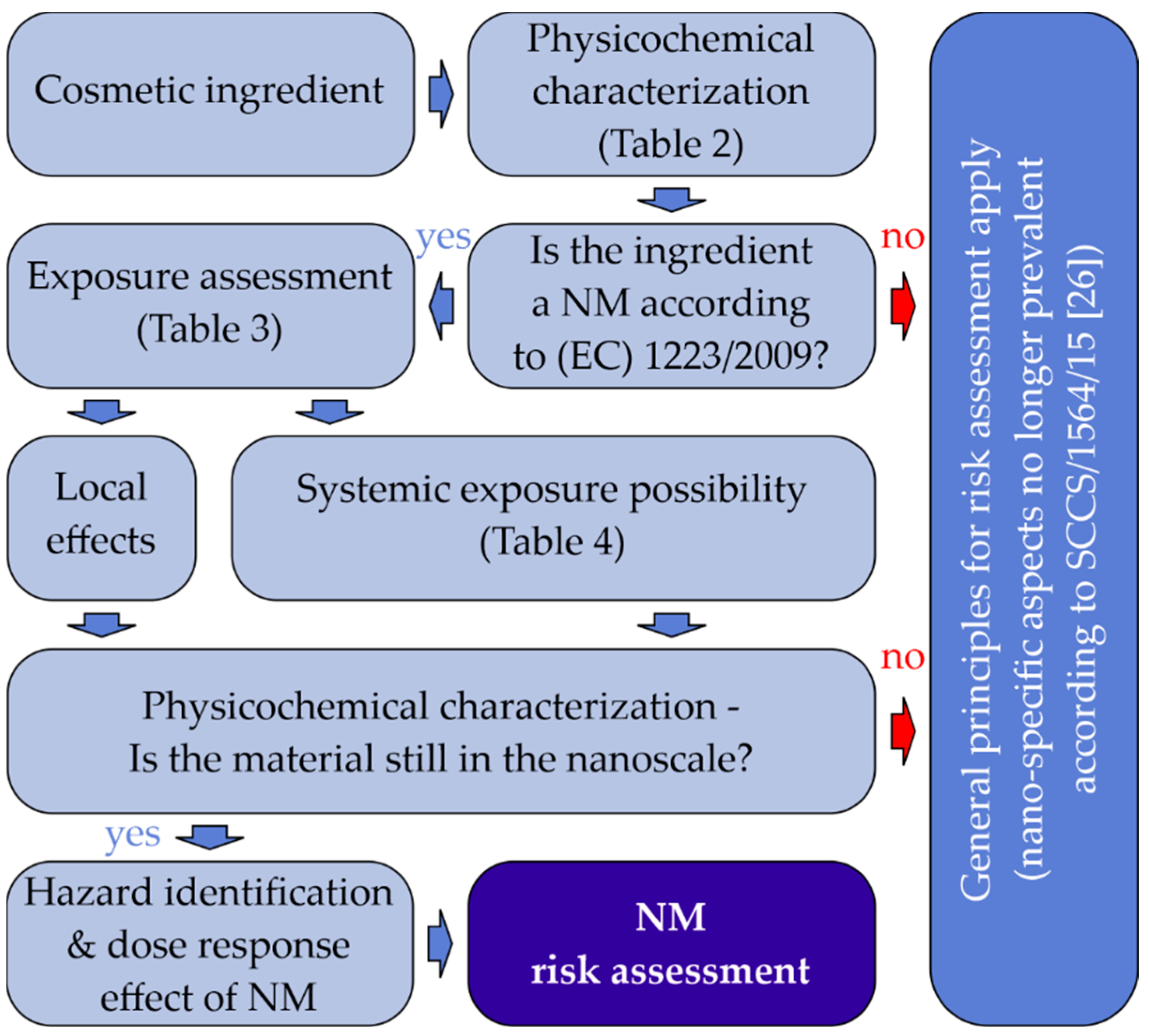
2. Identification of Nano-Enhanced Products and Specifications Thereof
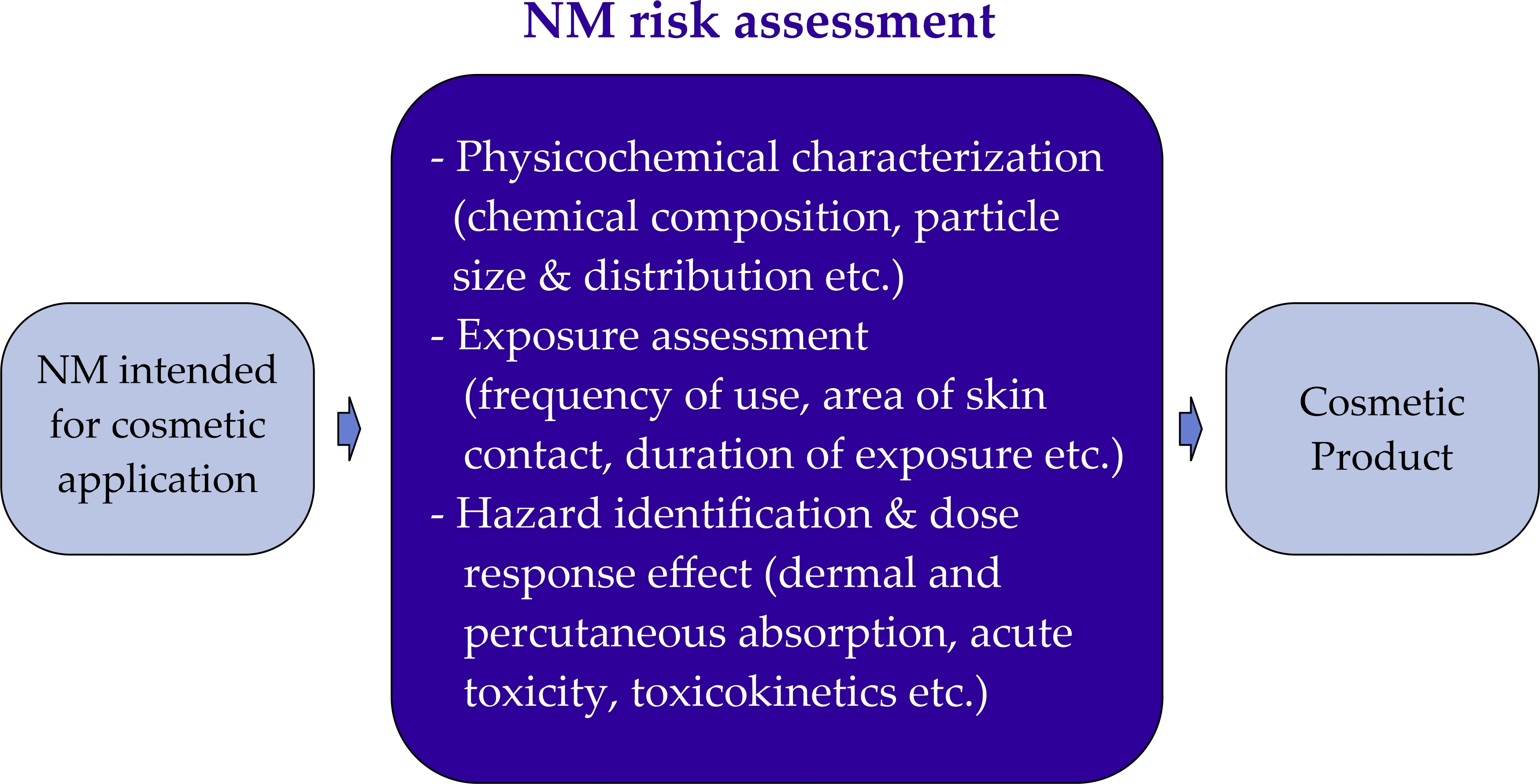
- The identification of the NM (chemical name according to the International Union of Pure and Applied Chemistry (IUPAC) etc.).
- The physicochemical characteristics of the NM (e.g., size, surface charge).
- An estimation of the annual quantity of NM, intended to be placed on the market through the cosmetic product.
- The toxicological profile of the NM.
- The reasonably foreseeable exposure conditions.
- The safety data of the NM and its respective risk assessment.
2.1. NM Identification
2.2. NM Specification
2.3. Toxicological Profile
2.4. Exposure Assessment
2.5. Overall Assessment
3. Nanocatalogue by European Commission
4. Opinions on Nanomaterials by SCCS
5. Cosmetics and Nanotechnology Products Database
6. Conclusions
Author Contributions
Funding
Institutional Review Board Statement
Informed Consent Statement
Data Availability Statement
Conflicts of Interest
Abbreviations
| AAS | Atomic Absorption Spectroscopy |
| AFM | Atomic Force Microscopy |
| AUC | Analytical Ultracentrifugation |
| BET | Brunauer–Emmett and Teller method |
| CAS | Chemical Abstracts Service |
| CI 77266 | Carbon black |
| CosIng | Cosmetic Ingredient Database |
| CPNP | Cosmetic Products Notification Portal |
| DLS | Dynamic Light Scattering |
| disc-CLS | disc-Centrifugal Liquid Sedimentation |
| DMA | Dynamic Mobility Analyzer |
| EFSA | European Food Safety Authority |
| FFF | Field Flow Fractionation |
| FTIR | Fourier Transform Infrared Spectroscopy |
| GC/LC-MS | Gas Chromatography/Liquid Chromatography coupled with Mass Spectrometry |
| GE | Gel Electrophoresis |
| HDC | Hydrodynamic Chromatography |
| HPLC | High Performance Liquid Chromatography |
| ICP-MS | Inductively Coupled Plasma Mass Spectrometry |
| INCI | International Nomenclature of Cosmetic Ingredients |
| LDE | Laser Doppler Electrophoresis |
| MBBT | 2,2′-methylene-bis-(6(2H-benzotriazol-2-yl)-4-(1,1,3,3-tetramethylbutyl)phenol) |
| MoS | Margins of Safety |
| MS | Mass Spectrometry |
| Nano SIMS | Nanoscale Secondary Ion Mass Spectrometry |
| NM | Nanomaterial |
| NMR | Nuclear Magnetic Resonance |
| NPD | Nanotechnology Products Database |
| OECD | Organization for Economic Co-operation and Development |
| PALS | Phase Analysis Scattering |
| REACH | Registration, Evaluation, Authorization and Restriction of Chemicals |
| RP | Responsible Person |
| RS | Raman Spectroscopy |
| SCENIHR | Scientific Committee on Emerging and Newly Identified Health Risks |
| SCCNFP | Scientific Committee on Cosmetic Products and Non-Food Products Intended for Consumers |
| SCCS | Scientific Committee on Consumer Safety |
| SEM | Scanning Electron Microscopy |
| SERS | Surface-enhanced Raman Spectroscopy |
| SPM | Scanning Probe Microscope |
| TEM | Transmission Electron Microscopy |
| TiO2 | Titanium dioxide |
| UV | Ultraviolet |
| UV-Vis | Ultraviolet-Visible Spectrophotometry |
| XPS | X-Ray Photoelectron Spectroscopy |
| XRD | X-ray Diffraction |
| ZnO | Zinc Oxide |
References
- Santos, A.C.; Panchal, A.; Rahman, N.; Pereira-Silva, M.; Pereira, I.; Veiga, F.; Lvov, Y. Evolution of hair treatment and care: Prospects of nanotube-based formulations. Nanomaterials 2019, 9, 903. [Google Scholar] [CrossRef] [Scilit] [PubMed]
- Raj, S.; Jose, S.; Sumod, U.S.; Sabitha, M. Nanotechnology in cosmetics: Opportunities and challenges. J. Pharm. Bioallied Sci. 2012, 4, 186–193. [Google Scholar] [CrossRef] [Scilit] [PubMed]
- Ajazzuddin, M.; Jeswani, G.; Jha, A.K. Nanocosmetics: Past, Present and Future Trends. Recent Pat. Nanomed. 2015, 5, 3–11. [Google Scholar] [CrossRef] [Scilit]
- Fytianos, G.; Rahdar, A.; Kyzas, G.Z. Nanomaterials in cosmetics: Recent updates. Nanomaterials 2020, 10, 979. [Google Scholar] [CrossRef] [Scilit] [PubMed]
- Nano Science Institute. Scientific Committee Rules on the Safety of Nanocosmetics. Available online: http://www.nanoscienceinstitute.com/NanoCosmetics.htm (accessed on 11 September 2020).
- Rigano, L.; Lionetti, N. Nanobiomaterials in Galenic Formulations and Cosmetics. Appl. Nanobiomater. 2016, 10, 121–145. [Google Scholar]
- Henkler, F.; Tralau, T.; Tentschert, J.; Kneuer, C.; Haase, A.; Platzek, T.; Luch, A.; Götz, M.E. Risk assessment of nanomaterials in cosmetics: A European union perspective. Arch. Toxicol. 2012, 86, 1641–1646. [Google Scholar] [CrossRef] [Scilit] [PubMed]
- Regulation (EC) 1907/2006 of 18 December 2006 Concerning the Registration, Evaluation, Authorisation and Restriction of Chemicals (REACH), Establishing a European Chemicals Agency, Amending Directive 1999/45/EC and Repealing Council Regulation (EEC) No 793/93 and Commission Regulation (EC) No 1488/94 as Well as Council Directive 76/769/EEC and Commission Directives 91/155/EEC, 93/67/EEC, 93/105/EC and 2000/21/EC [2006] OJ L 396/1; European Union: Brussels, Belgium, 2016.
- Regulation (EC) No 1223/2009 of 30 November 2009 on Cosmetic Products [2009] OJ L 342/59; European Union: Brussels, Belgium, 2009.
- Council Directive No 76/768/EEC of 27 July 1976 on the Approximation of the Laws of the Member States Relating to Cosmetic Products [1976] OJ L 262/169; European Union: Brussels, Belgium, 1976.
- Commission Recommendation No 2011/696/EU of 18 October 2011 on the Definition of Nanomaterial [2011] OJ L 275/38; European Union: Brussels, Belgium, 2011.
- Regulation (EU) No 528/2012 of 22 May 2012 Concerning the Making Available on the Market and Use of Biocidal Products [2012] OJ L 167/1, art 3 para 1(a); European Union: Brussels, Belgium, 2012.
- Opinion No SCCS/1484/12 of 26–27 June 2012 Guidance on the Safety of Nanomaterials in Cosmetics; European Union: Brussels, Belgium, 2012.
- Cosmetic Products Notification Portal Manual Referring to Article 13 of Regulation (EC) No. 1223/2009; European Union: Brussels, Belgium, 2017.
- Cosmetic Products Notification Portal Manual Referring to Article 16 of Regulation (EC) No. 1223/2009; European Union: Brussels, Belgium, 2017.
- Cosmetic Ingredient Database. Available online: https://ec.europa.eu/growth/sectors/cosmetics/cosing_en (accessed on 16 April 2020).
- SCCS. Opinion No SCCS/1588/17 of 07 March 2017 Checklists for Applicants Submitting Dossiers on Cosmetic Ingredients; Scientific Committee on Consumer Safety: Brussels, Belgium, 2017. [Google Scholar]
- SCCS. Opinion No SCCS/1611/19 of 30–31 October 2019 Guidance on the Safety Assessment of Nanomaterials in Cosmetics; Scientific Committee on Consumer Safety: Brussels, Belgium, 2019. [Google Scholar]
- EFSA. Guidance on the Risk Assessment of the Application of Nanoscience and Nanotechnologies in the Food and Feed Chain. EFSA J. 2011, 9, 2140. [Google Scholar] [CrossRef] [Scilit]
- OECD. Guideline for the Testing of Chemicals No OECD TG 439 of 22 July 2010, In Vitro Skin Irritation-Reconstructed Human Epidermis Test Method; OECD: Paris, France, 2010. [Google Scholar]
- OECD. Guideline for the Testing of Chemicals No OECD TG 442a of 22 July 2010, Skin Sensitization-Local Lymph Node Assay: DA; OECD: Paris, France, 2011. [Google Scholar]
- EFSA. Guidance on Risk Assessment of the Application of Nanoscience and Nanotechnologies in the Food and Feed Chain: Part 1, Human and Animal Health. Eur. Food Saf. Auth. 2018, 16, 5327. [Google Scholar]
- SCENIHR Opinion of 6 January 2015 on the Guidance on the Determination of Potential Health Effects of Nanomaterials Used in Medical Devices; European Union: Brussels, Belgium, 2015.
- EFSA. Scientific Opinion of the Scientific Committee on a Request from the European Commission on the Potential Risks Arising from Nanoscience and Nanotechnologies on Food and Feed Safety. Eur. Food Saf. Auth. 2009, 958, 1–39. [Google Scholar]
- FAO/WHO. Food and Agriculture Organization of the United Nations und World Health Organization: FAO/WHO Expert Meeting on the Application of Nanotechnologies in the Food and Agriculture Sectors; Meeting Report; Potential Food Safety Implications: Rome, Italy, 2009. [Google Scholar]
- SCCS Opinion No SCCS/1564/15 of 25 April 2016 The SCCS Notes of Guidance for the Testing of Cosmetic Ingredients and Their Safety Evaluation; Scientific Committee on Consumer Safety: Brussels, Belgium, 2016.
- SCCNFP Opinion No SCCNFP/0633/02 of 17 December 2002 on Updated Basic Requirements for Toxicological Dossiers; European Union: Brussels, Belgium, 2002.
- Catalogue of Nanomaterials in Cosmetic Products Placed on the Market, as Notified to the European Commission by Responsible Persons. 2018. Available online: https://ec.europa.eu/growth/content/commission-publishes-updated-catalogue-nanomaterials-used-cosmetics_en (accessed on 20 April 2020).
- Scientific Committee on Consumer Safety. Available online: https://ec.europa.eu/health/scientific_committees/consumer_safety_en (accessed on 1 March 2020).
- SCCS Opinion No SCCS/1429/11 of 20 September 2011 on 1,3,5-Triazine, 2,4,6-Tris [1,1′-Biphenyl]-4-yl-; Scientific Committee on Consumer Safety: Brussels, Belgium, 2011.
- SCCS Opinion No SCCS/1489/12 of 11 December 2012 on Zinc Oxide (Nano Form); Scientific Committee on Consumer Safety: Brussels, Belgium, 2012.
- SCCS Opinions: Carbon Black, Titanium Dioxide and Zinc Oxide. Available online: https://www.obelis.net/news/sccs-opinions-carbon-black-titanium-dioxide-and-zinc-oxide/ (accessed on 15 March 2020).
- SCCS Opinion No SCCS/1515/13 of 15 December 2015 on Carbon Black (Nano Form); Scientific Committee on Consumer Safety: Brussels, Belgium, 2015.
- SCCS Opinion No SCCS/1516/13 of 22 April 2014 on Titanium Dioxide (Nano Form); Scientific Committee on Consumer Safety: Brussels, Belgium, 2014.
- SCCS Opinion No SCCS/1580/16 of 22 June 2018 on Titanium Dioxide (Nano Form) Coated with Cetyl Phosphate, Manganese Dioxide or Triethoxycaprylylsilane as UV-Filter in Dermally Applied Cosmetic; Scientific Committee on Consumer Safety: Brussels, Belgium, 2018.
- SCCS Opinion No SCCS/1583/17 of 19 January 2018 on Titanium Dioxide (Nano Form) as UV-Filter in Sprays; Scientific Committee on Consumer Safety: Brussels, Belgium, 2018.
- SCCS Opinion No SCCS/1545/15 of 29 September 2015 on Silica, Hydrated Silica, and Silica Surface Modified with Alkyl Silylates (Nano Form); Scientific Committee on Consumer Safety: Brussels, Belgium, 2015.
- SCCS Opinion No SCCS/1546/15 of 25 June 2015 on 2,2′-Methylene-Bis-(6-(2H-Benzotriazol-2-yl)-4-(1,1,3,3-Tetramethylbutyl)phenol) (Nano Form); Scientific Committee on Consumer Safety: Brussels, Belgium, 2015.
- SCCS Opinion No SCCS/1595/18 of 21–22 June 2018 on Styrene/Acrylates Copolymer (Nano) and Sodium Styrene/Acrylates Copolymer (Nano); Scientific Committee on Consumer Safety: Brussels, Belgium, 2018.
- SCCS Opinion No SCCS/1596/18 of 24–25 October 2018 on Colloidal Silver (Nano); Scientific Committee on Consumer Safety: Brussels, Belgium, 2018.
- SCCS Opinion No SCCS/1624/20 of 27–28 October 2020 on Hydroxypatite (Nano); Scientific Committee on Consumer Safety: Brussels, Belgium, 2020.
- Nanometarials. Available online: https://ec.europa.eu/growth/sectors/cosmetics/products/nanomaterials_en (accessed on 20 March 2020).
- Nanotechnology Products Database, Cosmetics. Available online: https://product.statnano.com/industry/cosmetics (accessed on 20 March 2020).
- Request for Scientific Opinion of 30–31 October 2019 on on Gold (Nano)-Colloidal Gold (Nano), Gold Thioethylamino Hyaluronic Acid (Nano) and Acetyl Heptapeptide-9, Colloidal Gold (Nano); European Union: Brussels, Belgium, 2019.

| Regulation | Definition of Nanomaterial | Ref. |
|---|---|---|
| Commission Recommendation | A natural, incidental, or manufactured material containing particles, in an unbound state or as an aggregate or as an agglomerate and where, for 50% or more of the particles in the number size distribution, one or more external dimensions is in the size range 1–100 nm. | [11] |
| Regulation (EU) No 528/2012—Biocidal Products Regulation (BPR) | A natural or manufactured active substance or non-active substance containing particles, in an unbound state or as an aggregate or as an agglomerate and where, for 50% or more of the particles in the number size distribution, one or more external dimensions is in the size range 1–100 nm. | [12] |
| Regulation (EC) No 1223/2009—Cosmetic products | A material that is insoluble or bio-persistent and intentionally manufactured with one or more external dimensions, or an internal structure, on the scale from 1 to 100 nm. | [9] |
| Information | Description | Methods 1 |
|---|---|---|
| Chemical identity | Refers to information on the formula (e)/molecular structure(s) of the NM’s constituents, along with chemical/common names, and CAS/EINECS numbers (where available). | MS, AAS, ICP-MS, FTIR, NMR, etc. |
| Chemical composition | Contains information on the chemical composition of the NM, including purity, nature of impurities, coatings or surface moieties, doping material, encapsulating materials, processing chemicals, dispersing agents, and other additives or formulants, for example, stabilizers. | UV-Vis, HPLC, GC/LC-MS, AAS, ICP-MS, FTIR, NMR, XRD, etc. |
| Production process-derived particles | Description of the process used for production/modification of the NM, due to their significant effect on the properties of the NM, for example, pyrogenic or precipitated silica, sulfate, chloride, or argex process for TiO2. | - |
| Particle size 2 and distribution, including the presence of agglomerates or aggregates | Provides information/data on particle size (mean, median, and ±SD in nm), size distribution in terms of relative number versus size, as well as number weighted sum function (cumulative numbers). Graphical distribution diagrams must be provided for primary and secondary populations (e.g., agglomerates, aggregates), along with particle number and mass distribution. Particle size specifications should include any batch-to-batch variation, while information on the employed characterization techniques must be listed. The use of more than one characterization method has been recommended [19,20,21,22,23], with the default one, being electron microscopy-based imaging. | FFF, HDC, HPLC, AUC, disc-CLS, TEM, SEM, AFM, DLS, DMA |
| Morphology/Shape | Contains information on the NM’s preparation state/physical form (powder, solution, suspension, or dispersion), shape (spherical, tube, rod, etc.), and potential aggregation (primary particulates or agglomerates). Aspect ratio (for fiber/tube-like materials), especially for bio-persistent materials with aspect ratio >3. All data should be supported, for example, by appropriate TEM images. | AFM, TEM, SEM, NMR, XRD |
| Structure | Requires information on the NM structure, including 1D, 2D, and or 3D spatial distribution of the components (e.g., homogeneous mixture, core-shell, surface coating) [22]. Information should be supported by high-quality electron microscopy images of non-homogeneous particles. | AFM, TEM, SEM |
| Crystallographic structure | Contains information on the NM’s crystalline form (amorphous, polycrystalline, crystalline including specification of phase and volume fraction, as well as spatial distribution). | XRD, TEM |
| Surface characteristics | Requires detailed information on the NM’s surface. This should include surface charge (zeta potential), morphology/topography, interfacial tension, reactive sites, as well as any chemical/biochemical modifications or coatings that could change the surface reactivity or add a new functionality, as well as any surface contaminants. | LDE, SPM, XPS, MS, RS, FTIR, NMR, AUC, GE, SPM, LDE, PALS, Nano SIMS, SERS |
| Solubility | Contains information on solubility of the nanomaterial in relevant solvents and partitioning between the aqueous and organic phase (e.g., log Kow for organic NMs, and surface-modified inorganic nanomaterials). This includes dissolution rates for soluble and partially soluble NMs, along with information on the hygroscopicity of powders should also be provided. | Solubility/dissolution rate in water and other solvents |
| Surface area 3 | Requires BET-specific surface area information of the NM along with volume-specific surface area (VSSA). VSSA should, ideally, be calculated based on the density of the NM, rather than its bulk counterpart. | BET |
| Dispersibility | The dispersibility (insoluble NMs) in terms of a relative amount of the particles that can be dispersed in a suspending medium, must be provided. This should include information on the stability of the dispersion in the given media and the conditions applied [22]. | - |
| Catalytic activity 4 | Contains information on the chemical reactivity of the NM’s core material and/or surface coating, including photocatalytic activity and radical formation potential of relevant materials. | Kinetic data on the chemical, biochemical & catalyzed reactions |
| Concentration | Requires information on concentration in terms of particle mass and particle number per volume must be provided, both for dispersions and per mass for dry powders. | UV-Vis, HPLC, GC/LC-MS, AAS, ICP-MS, etc. |
| Dustiness 3 | Contains information on the dustiness of dry powder products. | EN 15051:2006, DIN 33897-2 |
| Density and pour density 5 | Includes information on density/porosity of granular materials and pour density. | DIN ISO 697, EN/ISO 60 |
| Redox potential | Contains information on the oxidation state and redox potential (for inorganic materials), including the conditions under which redox potential was measured. | Potentiometric methods, X-ray absorption spectroscopy |
| pH 6 | pH of aqueous suspension must be provided. | pH in aqueous media |
| Viscosity 7 | Provides information on the viscosity of liquid dispersions. | OECD TG 114 |
| Stability | Contains stability/dissociation constant data for the NM in the relevant formulation/media. | MS, HPLC, DLS, FTIR, NMR |
| Other aspects | Among others, UV absorption (extinction coefficient), light reflection. | UV-Vis |
| Type of Test | Intent/Purpose |
|---|---|
| 1. Dermal/percutaneous absorption 2. Toxicokinetics | Next to the uptake of nanomaterials (e.g., oral, inhalation, or dermal/percutaneous absorption), the toxicological assessment should focus on the distribution, metabolism, and elimination parameters relevant to the nanoparticles, especially in cases, where evidence of systematic absorption exists. These aspects combined, may provide insight into the fate and behavior of the NM and identify likely target organs. To eliminate possible biophysical interactions, the integrity of the NMs’ structure (e.g., agglomerates or aggregation behavior) and physicochemical characteristics should be examined, in terms of surface binding of proteins or other moieties. |
| 3. Acute toxicity (if available) 4. Irritation and corrosivity 5. Skin sensitization 6. Mutagenicity/genotoxicity 7. Repeated dose toxicity 1 | Evaluated together with type 1 testing, points 3 to 7, are considered as the base data for the toxicological assessment of any cosmetic ingredient, whether in micro- or nano-form.Based on the latest legislation, testing protocols associated with mutagenicity and genotoxicity are restricted to in vitro assays. The evaluation may progress to in vivo experiments only to demonstrate non-mutagenicity when positive results are noted in vitro. |
| 8. Carcinogenicity 9. Reproductive toxicity | In cases where type 1 testing indicates significant oral intake or considerable skin penetration during dermal/percutaneous absorption, these additional toxicological investigations may become necessary based on the toxicological profile of the NM and its chemical structure. Additional data on genotoxicity and/or mutagenicity may also be required. |
| 10. Photo-induced toxicity | If the cosmetic product is intended for dermal use and exposure to sunlight, with the NM absorbing certain wavelengths, then photo-induced toxicity should be evaluated. As the energy potential of these wavelengths, may elicit transformations in the NM’s configuration, its chemical reactivity may be affected. Among the phototoxic effects that require further investigation are: photoirritancy, photosensitization, and photomutagenicity. All additional data on the NM’s phototoxic potential must be provided for the relevant UV light wavelengths derived from the absorption spectrum of the NM [27], along with photostability data under the intended conditions of use of the final cosmetic product. |
| 11. Human data (where available) | In general, the SCCS considers human data as extremely useful and should be included whenever available. Nevertheless, volunteer studies involving nanomaterials should be approached with caution as there is still a lack of information on the severity of potential adverse effects. As a result, human data concerning the evaluation of nanomaterials are widely considered to be subject to ethical restrictions [27]. |
| A/A | Exposure Related Information |
|---|---|
| 1 | Category of cosmetic products in which the ingredient is intended for use |
| 2 | Concentration of the ingredient in the finished cosmetic product |
| 3 | Quantity of the product used at each application |
| 4 | Frequency of use 1 |
| 5 | Total area of skin contact 1 |
| 6 | Duration of exposure |
| 7 | Foreseeable uses which may increase exposure |
| 8 | Consumer target groups (e.g., children, people with sensitive, damaged, or compromised skin) |
| 9 | Quantity likely to enter the body (fraction absorbed), for each target group |
| 10 | Application on skin areas exposed to sunlight |
| 11 | Estimated dermal exposure, based on the intended use of the product |
| 12 | Estimated oral exposure, based on the intended use of the product |
| 13 | Estimated inhalation exposure, based on the intended use of the product |
| 14 | Exposure calculation for each target group |
| 15 | Other relevant information |
| INCI 1 or Other Name | Exposure Route | Product Category 2 | Function |
|---|---|---|---|
| Carbon black 3 | Dermal, oral | leave on/rinse off | colorant |
| Titanium dioxide 4 | Dermal, oral, Inhalation | leave on/rinse off | colorant, UV-filter |
| Zinc oxide 5 | Dermal, oral, Inhalation | leave on/rinse off | colorant, UV-filter |
| Methylene bisbenzotriazolyl tetramethylbutylphenol | Dermal, oral | leave on/rinse off | UV-filter |
| Tris-biphenyl triazine | Dermal, inhalation | leave on | UV-filter |
| Alumina | Dermal | leave on/rinse off | other functions |
| Copper/Colloidal copper | Dermal, oral | leave on/rinse off | other functions |
| Gold/Colloidal gold | Dermal, oral, inhalation | leave on/rinse off | other functions |
| Platinum/Colloidal platinum | Dermal | leave on/rinse off | other functions |
| Silver/Colloidal silver | Dermal, oral | leave on/rinse off | other functions |
| Fullerenes | Dermal | rinse off | other functions |
| Gold thioethylamino Hyaluronic acid | Dermal | leave on/rinse off | other functions |
| Hydrated silica | Dermal, oral | leave on/rinse off | other functions |
| Hydroxyapatite | Dermal, oral | leave on/rinse off | other functions |
| Lithium magnesium Sodium silicate | Dermal | leave on/rinse off | other functions |
| Silica | Dermal, oral Inhalation | leave on/rinse off | other functions |
| Silica dimethicone silylate | Dermal | leave on | other functions |
| Silica dimethyl silylate | Dermal, oral | leave on/rinse off | other functions |
| Silica silylate | Dermal | leave on/rinse off | other functions |
| Sodium magnesium fluorosilicate | Dermal, oral | leave on/rinse off | other functions |
| Sodium magnesium silicate | Dermal | leave on | other functions |
| Sodium propoxyhydroxypropyl thiosulfate silica | Dermal | leave on | other functions |
| Styrene/acrylates copolymer | Dermal | leave on | other functions |
| Ingredient | Opinion | Conclusions of SCCS | Adoption On | Reference |
|---|---|---|---|---|
| Tris-biphenyl triazine | SCCS/1429/11 | 10% of tris-biphenyl triazine can be considered safe for dermal application. | 20/09/2011 | [30] |
| Zinc Oxide 1 | SCCS/1489/12 | Up to 25% of ZnO can be used without posing a risk of adverse effects in humans, after dermal application. | 18/09/2012 | [31] |
| Carbon Black 2 | SCCS/1515/13 | Maximum allowed concentration as a colorant is 10%. | 12/12/2013 | [33] |
| TitaniumDioxide 3 | SCCS/1516/13 SCCS/1580/16 SCCS/1583/17 | Maximum allowed concentration as a UV-filter in sunscreen cosmetics is 25%. TiO2 with different coatings can be considered safe for application on healthy, intact, or sunburnt skin. No conclusions for spray applications. | 22/06/2013 07/03/2017 19/01/2018 | [34,35,36] |
| Silica 4 & its derivatives | SCCS/1545/15 | No firm conclusion either for or against the safety of SAS due to inadequate submitted data. | 20/03/2015 | [37] |
| MBBT 5 | SCCS/1546/15 | The use of MBBT, in nano-structured form as a UV-filter at a concentration up to 10% in dermally applied cosmetic products, is considered safe. | 25/03/2015 | [38] |
| Styrene/acrylates copolymer & sodium styrene/acrylates copolymer | SCCS/1595/18 | Due to lack of information available at that time, the SCCS could not draw any conclusions on the safety of these nano-entities. | 21/06/2018 | [39] |
| Colloidal Silver | SCCS/1596/18 | The SCCS was not in the position to draw a conclusion on the safety of colloidal silver in nano form when used in oral and dermal cosmetic products. | 24/10/2018 | [40] |
| Hydroxyapatite | SCCS/1624/20 | SCCS draw no conclusion on the safety of rod-shaped hydroxyapatite NMs, while reported potential toxicity of needle-shaped hydroxyapatite NMs. | 27–28/10/2020 | [41] |
| Country | Number of Nano-Cosmetics |
|---|---|
| Austria | 10 |
| Belgium | 5 |
| France | 69 |
| Germany | 82 |
| Italy | 1 |
| New Zealand | 2 |
| Poland | 18 |
| Spain | 4 |
| Sweden | 3 |
| Switzerland | 19 |
| UK | 117 |
| Ingredient | Number of Nano-Cosmetics |
|---|---|
| Titanium dioxide (nanoparticle/nanopowder) | 73 |
| Silver (nanoparticle/nanopowder) | 42 |
| Q10 (Vitamin C and E) (nanoliposomes) | 36 |
| Carbon (nanoparticle/nanopowder) | 28 |
| Gold (nanoparticle/nanopowder) | 15 |
| Silicon dioxide (nanoparticle/nanopowder) | 11 |
| Argan (nanoliposome) | 9 |
| Silver (nanoporous) | 6 |
| Snail (nanoliposome) | 5 |
| Zinc oxide (nanoparticle/nanopowder) | 3 |
| Hyaluronic acid (nanoliposomes) | 3 |
| Retinol (nanoliposome) | 2 |
| Organoclay (nanoparticle/nanopowder) | 2 |
| Methylene bis-benzotriazolyl tetramethylbutylphenol (nanoliposome) | 2 |
| Peptide (nanoliposome) | 1 |
| Triethoxycaptylylsilane (nanoliposome) | 1 |
| Hydroxystearic acid (nanoliposome) | 1 |
Publisher’s Note: MDPI stays neutral with regard to jurisdictional claims in published maps and institutional affiliations. |
© 2021 by the authors. Licensee MDPI, Basel, Switzerland. This article is an open access article distributed under the terms and conditions of the Creative Commons Attribution (CC BY) license (http://creativecommons.org/licenses/by/4.0/).
Share and Cite
Karamanidou, T.; Bourganis, V.; Gatzogianni, G.; Tsouknidas, A. A Review of the EU’s Regulatory Framework for the Production of Nano-Enhanced Cosmetics. Metals 2021, 11, 455. https://doi.org/10.3390/met11030455
Karamanidou T, Bourganis V, Gatzogianni G, Tsouknidas A. A Review of the EU’s Regulatory Framework for the Production of Nano-Enhanced Cosmetics. Metals. 2021; 11(3):455. https://doi.org/10.3390/met11030455
Chicago/Turabian StyleKaramanidou, Theodora, Vasileios Bourganis, Glykeria Gatzogianni, and Alexander Tsouknidas. 2021. "A Review of the EU’s Regulatory Framework for the Production of Nano-Enhanced Cosmetics" Metals 11, no. 3: 455. https://doi.org/10.3390/met11030455
APA StyleKaramanidou, T., Bourganis, V., Gatzogianni, G., & Tsouknidas, A. (2021). A Review of the EU’s Regulatory Framework for the Production of Nano-Enhanced Cosmetics. Metals, 11(3), 455. https://doi.org/10.3390/met11030455