


Abstract
Despite recent advances in women’s sport in Portugal, coaching remains a highly gendered domain in which women continue to be underrepresented in leadership positions. Understanding the barriers that constrain women’s coaching careers is therefore essential for advancing gender equality in sport. This study aimed to validate the Barriers to Sports Coaching Questionnaire for Women (BSCQW) for the Portuguese sport context. Following a translation and cultural adaptation process, data were collected from a sample of 660 Portuguese women coaches representing a wide range of sports and competitive levels. A formative measurement approach was adopted and assessed using Partial Least Squares Structural Equation Modeling. The results demonstrated acceptable collinearity among indicators and meaningful contributions of organizational, sociocultural, intrapersonal, and interpersonal barriers to their respective constructs. The sociocultural barriers construct was refined by removing one item due to limited relevance in the Portuguese context, resulting in a more parsimonious model while preserving theoretical coverage. Overall, the findings supported the validity and contextual adequacy of the BSCQW Portuguese version. This instrument provides a robust and practical tool for researchers, sport organizations, coach education programs, and policymakers to identify the barriers faced by women coaches, thereby informing initiatives to support women’s coaching careers in Portugal.
1. Introduction
Sport, a pillar of society and culture, has traditionally been viewed as a male-dominated space and a stage for the construction of masculinity and femininity representations regardless of the context, whether in high-performance, school or leisure contexts [1,2]. Gender distribution in sports psychology empirical research is highly uneven, with males overwhelmingly outnumbering female participants, with only 7% of studies focusing solely on women [3]. The report conducted by the European Institute for Gender Equality indicates that this trend extends to the Portuguese context, that although improving from previous years, continues to perform bellow the European Union’s level [4].
In Portugal, notoriously dominant sports, like football, have been implementing socio-political measures to minimize the recognized male hegemony (i.e., passive form of male dominance [5]); namely by (i) increasing athletes’ budgets to support their professionalization, (ii) broadcasting the main national and international competitions on open media channels, (iii) allocating reserved quotas for female coaches in training courses, and (iv) developing marketing actions around women sports, among others. Associated with these policies, recent achievements by women in sport in Portugal (i.e., historic participation of the women’s football team in the 2023 World Cup, the 5th place of the under-19 women’s handball team in the 2024 World Cup, the world title of Jéssica Rodrigues and Madalena Costa in ice speed skating and figure skating, respectively) have contributed to reducing stigma and gender inequality in sport, through increasing awareness and social and cultural legitimacy.
However, the abovementioned socio-political transformations have predominantly focused on female athletes, often not including coaches. Several national and international reports and studies continue to highlight that the likelihood of a woman occupying a leadership position in sport (e.g., technical coordinator, head coach) remains very limited [6,7]. As a minority group, female coaches are often subjected to lower salaries, fewer opportunities for career advancement, and lower expectations and aspirations compared to men [8,9,10,11,12]. To exemplify, using the ecological model of LaVoi and Dutove [13], Poos and Carson [14] found that women coaches from Luxembourg highlighted personal sacrifice, lack of federation support and opportunities and hegemonic masculinity as some of the barriers faced at individual, interpersonal, societal and organizational levels. Also, Petersen, et al. [15], found that, within the tennis context, women coaches perceived experiencing significantly more socio-cultural barriers (e.g., discrimination, marginalization) than their male peers. Attempting to contribute to addressing this issue, Banwell, et al. [16] investigated the benefits of a Female Coach Mentorship Program across the different levels of the Ecological-Intersectional Model. Their findings indicated that the mentorship program had a significant positive impact on women coaches at the individual and interpersonal levels, but no influence at the organizational and sociocultural levels. The finding from these studies supports the assumption that advancing women in coaching requires a multilayered and multifaceted approach, involving strategies and commitments from the micro to the macro levels. Nevertheless, before implementing interventions, it is essential to gain an in-depth understanding of the specific characteristics and contextual nuances of each sport setting.
Particularly in the Portuguese context, the EIGE [4] report stated that only 19% of women make up the highest decision-making bodies in the country’s most popular national Olympic sport organizations. In another example, the infographic published by the Portuguese Institute of Sport and Youth (IPDJ) in 2021 [17], revealed that women represent only 15% of the coaching population in Portugal. In Portugal, coach education can be pursued through academic or federative pathways, with certification levels ranging from Level I to Level III [18]. Currently, there are approximately 60 sports federations in the country, and a recent analysis indicates that women occupy only 16% of leadership positions within federations with Olympic representation [19]. Given the current portrait of the Portuguese sports context, understanding the barriers that constrain women coaches, and thereby hinder progress toward gender equality, is imperative.
The Barriers to Sports Coaching Questionnaire for Women (BSCQW) [20] was developed and preliminarily validated for the South African context. With 32 items, the instrument conceptualized the barriers experienced by women coaches across four dimensions: organizational, sociocultural, intrapersonal, and interpersonal. This questionnaire is grounded in the ecological approach to female coaches’ barriers initially proposed and developed by LaVoi and Dutove [13] and, to the best of our knowledge, it is the only instrument that specifically addresses this topic. Indeed, validating the BSCQW for the Portuguese population represents a critical first step towards systematically identifying not only the barriers faced by Portuguese women coaches, but also the points of intervention needed to promote change. This is particularly relevant given the absence of validated instruments addressing barriers to women’s coaching careers in Portugal. Aiming to provide a contextually appropriate and empirically grounded tool, the present study addresses a significant gap in the literature and offers practical insights to support the advancement of gender equality in Portuguese sport.
Accordingly, through a formative measurement approach, this study aimed to validate the BSCQW for its use with Portuguese women coaches.
2. Methods
2.1. Participants
The sample comprised 660 Portuguese women coaches aged between 20 and 74 years (M = 41 years, SD = 12 years), with formal certification ranging from level I to level III according to the Portuguese accreditation rules, and different years of coaching experience (M = 13 years, SD = 10 years) in individual or team sports. In detail, 66% of the coaches played the head coach role of youth athletes in clubs with moderate sportive prominence (i.e., clubs with most of the teams playing at national levels). Of the selected coaches, 80% held a university degree, 54% were married or in a committed relationship, and 51% did not have any children. Further details on participants’ characteristics are available as supplement (Appendix A Table A1).
Given the formative nature of the measurement model, traditional item-to-participant ratios used in reflective models were not applied [21,22]. Instead, sample size adequacy was determined based on previous validation studies of formative instruments and recommendations for multivariate analyses [23]. As abovementioned, participants represented a wide range of age, coaching experience, sports, academic background, and marital status, enhancing the heterogeneity of the sample and supporting the stability of formative indicators [24,25]. In fact, the sample size is well above the commonly reported thresholds in questionnaire validation studies (i.e., N ≥ 200–300) and is particularly adequate for the evaluation of a formative measurement model through the partial least squares structural equation model (PLS-SEM), where indicator stability and content coverage are prioritized over traditional factor-analytic assumptions [21,22,23,25].
2.2. Procedures
2.2.1. Translation and Cultural Adaptation
The translation and cultural adaptation process followed the guidelines for the cross-cultural adaptation of self-report instruments [26], aiming to ensure linguistic, conceptual, and cultural equivalence between the original questionnaire and Portuguese version. This procedure involved three members of the research team all Portuguese native and proficient in English, one of them bilingual. Initially, two native Portuguese-speaking researchers with expertise in coach education, sports pedagogy and sports coaching, independently translated the original questionnaire into Portuguese. These versions were subsequently compared and discussed by the research team, with discrepancies resolved through consensus (i.e., through conceptual equivalences, and back-translations) resulting in a single harmonized preliminary Portuguese version [27]. To further ensure conceptual and cultural adequacy, an external Portuguese-speaking expert with experience in sports pedagogy and education reviewed this version to evaluate its clarity, relevance, and conceptual equivalence. This process resulted in minor refinements that improved semantic precision and cultural appropriateness while maintaining the original meaning of the items. Of note, no item was significantly changed during this process.
The back-translation was conducted by a professional bilingual translator who was fluent in Portuguese and English, who had not been involved in the initial translation phase. The back-translated version was systematically compared with the original questionnaire by researchers proficient in both languages to identify and resolve any discrepancies, ensuring semantic, idiomatic and conceptual equivalence across versions.
Following the translation stages, content validity was formally assessed by a panel of experts with sports coaching, gender inequality studies, and questionnaire development recognized expertise [28]. Experts evaluated each item in terms of relevance, clarity, and representativeness of the construct within the Portuguese sociocultural and sporting context. This step was considered particularly critical given the formative nature of the measurement model, in which indicators collectively define the construct and are not assumed to be interchangeable.
Subsequently, face validity was evaluated through a pilot study involving 50 Portuguese women coaches from diverse sports and competitive levels. Participants were asked to complete the questionnaire and provide feedback regarding item comprehension, wording clarity, and overall structure. Feedback from the pilot study resulted in minor wording adjustments to enhance clarity and comprehensibility, while the underlying structure and content of the questionnaire remained unchanged. On average, participants completed the questionnaire in approximately 20 min. Overall, this multi-step process ensured that the Portuguese version of the BSCQW achieved not only linguistic equivalence but also conceptual and cultural appropriateness for use with Portuguese women coaches.
2.2.2. Data Collection
Prior to data collection, the study protocol was reviewed and approved by the University Ethics Board (Reference: CEFADE 12_2025), ensuring compliance with the principles of the European Code of Conduct for Research Integrity [29]. The consent form was distributed at the beginning of the questionnaire via Google Forms immediately following the presentation of the study’s aims and procedures. Thereby, prior to participating, all coaches provided free and informed consent, which included an explanation of the study’s purpose, the voluntary nature of participation, the right to withdraw at any time without penalty, and assurances of anonymity and confidentiality. No incentives or rewards were provided for coaches’ participation. The psychometric study was conducted between June and December of 2025 and comprised the translation, cultural adaptation, and psychometric validation of the BSCQW into Portuguese.
2.3. Measure
The BSCQW [20] was developed to examine the barriers to coaching experienced by women coaches. This instrument is structured around a four-factor model encompassing organizational, sociocultural, intrapersonal, and interpersonal barriers, and comprises a total of 32 items.
The first factor, organizational barriers, consists of 11 items addressing organizational policies, job descriptions, and professional practices (e.g., “I work longer hours than I would like to” and “Other people interfere with my coaching decisions”). The second factor, sociocultural barriers, includes 8 items and refers to cultural systems, gender ideologies, and societal norms that influence women coaches (e.g., “I am discriminated against for being a woman coach” and “I am considered to be unattractive”). The third factor, intrapersonal barriers, comprises 5 items related to personal and psychological factors (e.g., “I do not feel competent in my coaching role” and “I find it difficult to motivate my athletes”). The fourth factor, interpersonal barriers, includes 8 items that reflect a perceived lack of support from social agents or negative interactions with significant others (e.g., “Coaching interferes with my social life” and “My athletes prefer working with male coaches”).
All 32 items were rated on a five-point Likert-type scale ranging from 1 (strongly disagree) to 5 (strongly agree). The BSCQW was originally developed and preliminarily validated in South Africa using principal component analysis to examine its factorial structure, resulting in four components and demonstrating satisfactory internal consistency (Cronbach’s α = 0.81) [20]. In this study, this information is reported for contextual purposes only since internal consistency was not used to evaluate the measurement model, which is specified as formative.
2.4. Data Analysis
2.4.1. Preliminary Data Screening
Prior to model evaluation, the dataset was examined for response consistency and overall distribution. Descriptive statistics, including means, standard deviations, and ranges, were calculated for all items to examine response patterns and identify any potential anomalies. For preliminary descriptive analyses, item statistics were computed using the original (non-reversed) response scales, as administered to participants. Reverse-coded items were applied only during the PLS-SEM estimation to ensure conceptual alignment of the formative indicators.
2.4.2. Formative Model Evaluation
Although the original BSCQW was developed and preliminarily validated using PCA, which is typically applied in reflective contexts, the conceptual nature of the questionnaire supports a formative specification. Each item captures a specific barrier that contributes to defining its respective construct (organizational, sociocultural, intrapersonal, or interpersonal), and barriers are not expected to be interchangeable or to systematically covary. This is a key limitation of reflective interpretations, where indicators are typically assumed to represent the same underlying latent variable. Therefore, specifying the BSCQW as formative not only provides a more theoretically consistent approach, but also aligns the measurement model with the ecological framing that underpins the instrument.
Thereby, this study assessed the measurement model using PLS-SEM, implemented in SmartPLS version 4.1.1.5. The evaluation focused on collinearity, indicator relevance (outer weights), and practical significance (outer loadings), in line with established guidelines for formative constructs. Collinearity among formative indicators was assessed using the variance inflation factor (VIF). Values below 3.3 indicated that multicollinearity was not problematic and did not threaten the estimation of indicator weights [25,30]. Indicator relevance was evaluated through the magnitude and statistical significance of outer weights. A bootstrapping procedure with 5000 resamples was applied to assess significance, with p < 0.05 indicating a meaningful contribution to the construct [30]. In cases where outer weights were non-significant, outer loadings were examined. Loadings ≥ 0.50 were interpreted as demonstrating practical relevance, supporting the retention of theoretically important indicators [22,23].
Given the formative specification of the model, content validity (already established through prior translation, expert review, and pilot testing) was considered a prerequisite for the statistical evaluation of the model rather than a criterion for indicator assessment.
3. Results
3.1. Preliminary Analysis
Prior to the evaluation of the formative measurement model, the dataset was examined using IBM SPSS Statistics (version 30). Descriptive statistics were calculated for all 32-items, including means, standard deviations, minimum and maximum values. The results indicated adequate variability across all items, with mean scores ranging from 1.69 to 4.60 and standard deviations from 0.61 to 1.43, suggesting adequate dispersion of responses and no evidence of restricted variance. No patterns of inconsistent or extreme responses were observed, and no missing data were detected, confirming the suitability of the dataset for subsequent PLS-SEM analysis.
3.2. Formative Measurement Model Evaluation
The measurement model evaluation focused on assessing collinearity among indicators and determining their relative (outer weights) and absolute (outer loadings) contributions [30]. The collinearity values ranged from 1.011 to 2.124, remaining well below the conservative threshold of 3.3, indicating that multicollinearity did not compromise the estimation of indicator weights. The indicator contributions were further evaluated through their outer weights and loadings. Table 1 details the weights, loads and VIF values of the formative constructs.
Table 1.
Weights, loads and VIF values of the formative constructs.
For the organizational barriers construct, outer loadings ranged from 0.424 to 0.660, with all items exhibiting significant weights (p < 0.01). Item M10 showed the highest weight (0.310), indicating a particularly strong contribution, while items with moderate loadings, such as M3 and M5, were retained due to their significant weights and theoretical relevance.
Regarding sociocultural barriers construct, the model was re-evaluated after the removal of item M14 due to its non-significant weight and limited contribution. Loadings for the remaining indicators ranged from 0.103 to 0.772. Most indicators demonstrated acceptable to high loadings, with significant weights for all items (p < 0.05), except for item M13 (p = 0.115) which showed limited contribution. However, despite its non-significant weight, item-M13 showed high loadings (i.e., above 0.05 [23]) and for that reason was retained. Notably, despite its low loading (0.103), item M17 exhibited a significant weight (0.097, p = 0.022) and was retained based on theoretical justification.
Concerning intrapersonal barriers construct, the loadings ranged from 0.446 to 0.795, with all weights statistically significant (p < 0.05). Item M24 emerged as the strongest indicator (weight = 0.611), while items with lower loadings, such as M20 and M21, were retained based on their significant weights and theoretical relevance.
Finally, for the interpersonal barriers construct, loadings ranged from 0.416 to 0.605, with all items showing significant weights (p < 0.001). Item M31 was the strongest indicator (weight = 0.353), while items like M27 and M29, despite lower loadings, were retained due to significant weights (0.144).
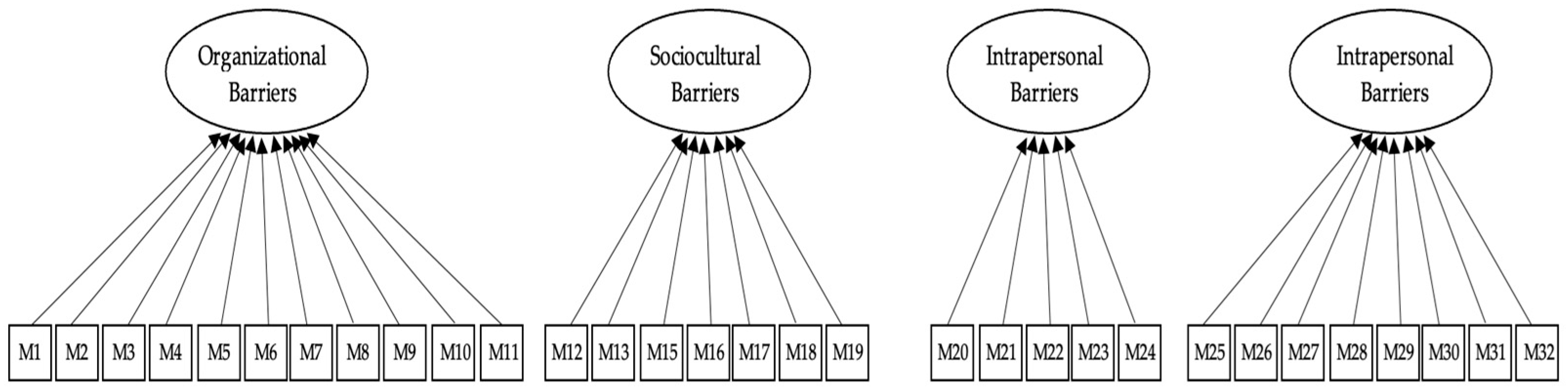
The final version of the Portuguese BSCQW (Figure 1) is available as supplement (Appendix A Table A2). Overall, the analysis demonstrated that most of the formative indicators presented significant weights and acceptable loadings, supporting the construct validity of the measurement model. Items with non-significant weights, particularly M13 in the sociocultural barriers construct, were retained based on theoretical considerations. Concomitantly, the removal of M14 improved model parsimony without compromising construct representation.
Figure 1.
Graphical representation of the Portuguese version of BSCQW.
4. Discussion
The present study aimed to validate the BSCQW for use with Portuguese women coaches using a formative measurement approach. Overall, the results provided strong support for the adequacy of the Portuguese version of the instrument since it demonstrated acceptable levels of collinearity, meaningful indicator contributions, and robust theoretical coverage across the four constructs (i.e., organizational, sociocultural, intrapersonal, and interpersonal barriers). Importantly, the findings confirmed that the original instrument proposed by Kubayi, Didymus, Morris-Eyton and Jooste [20] remains theoretically robust while capturing context-specific nuances relevant to the Portuguese sports environment. Consistent with the formative nature of the BSCQW, the discussion prioritizes the substantive contribution of indicators to construct definition rather than internal consistency or inter-item associations. Most of the items demonstrated significant outer weights and acceptable loadings which supported their retention. In cases where statistical contributions were weaker, theoretical relevance and content coverage guided our interpretation, in line with recommendations for formative measurement models [22,23,25].
The organizational barriers construct showed a strong and coherent indicator contributions, suggesting that organizational constraints constitute a central dimension of perceived barriers among Portuguese women coaches. Item M10 (“I have a lack of opportunity for promotion”) emerged as the most influential, highlighting restricted career progression as a particularly relevant issue. This finding is conceptually consistent with the original BSCQW study, which identified remuneration, workload, and administrative demands as central organizational barriers [20]. Aligned with these findings, broader international evidence has also been highlighting persistent vertical segregation and restricted access to leadership positions in women’s sport coaching (e.g., [10,13,15]). Other items related to workload, compensation, and working conditions, such as M3 (“I dislike having to coach during evenings and weekends”), M5 (“I am not well paid for my coaching”), and M11 (“My working schedules are inflexible”) presented moderate loadings but statistically significant weights, supporting their retention within the formative construct. Indeed, from a formative perspective, these items captured distinct organizational realities, such as unsociable working hours, financial insecurity, and inflexible schedules, that together contributed to the organizational barrier experience. Consistent with the findings from the original BSCQW study [20], as well as recently evidenced by Hoye, et al. [31] and LaVoi and Dutove [13], poor remuneration, excessive working hours, and administrative overload as salient constraints for women coaches.
The sociocultural barriers construct required a more nuanced interpretation due to variability in the contributions of the indicators. In detail, item M13 (“I am discriminated against for being a women coach”) presented a non-significant weight but a relatively high loading and, from a methodological viewpoint, was retained for that reason [22,23]. Indeed, in formative models, items like M13 remain essential for ensuring conceptual comprehensiveness, even when their statistical contribution is attenuated in a specific sample. Moreover, from a theoretical viewpoint, its retention was justified because gender-based discrimination is a core element in sociocultural barriers consistently reported in international literature (e.g., [8,12,16]). Notably, when LaVoi and Dutove [13] first conceptualized the barriers faced by female coaches, they emphasized that sociocultural barriers are primarily rooted in dominant gender ideologies and stereotypes, which closely aligns with the content of item M-13, thereby reinforcing the importance of its inclusion. In the original validation study (i.e., [20]), the sociocultural barriers were perceived as less salient in coaches’ day-to-day experience when compared to organizational or interpersonal barriers. Conversely, item M14 (“People perceive me as a lesbian because of my coaching position”) was excluded due to its non-significant weight and limited contribution to the construct. This result may reflect cultural specificities of the Portuguese context, where this stereotype and stigma may be less relevant, less openly expressed and/or more sensitive, leading to restricted variability in responses. The exclusion of item M14 improved the model’s parsimony without compromising the overall conceptual representation of sociocultural barriers. Regarding item M17 (“I do not have women role models to look up to”), despite its low loading, it exhibited a significant outer weight and was, therefore, retained. This result highlighted the substantive importance of having access to role models in shaping women’s coaching experiences and influencing their career aspirations. In fact, the absence of visible female role models has been widely identified as a barrier to recruitment, retention, and career progression in sport coaching [e.g., 10]. Similarly, it was the original BSCQW investigation [20] as a structural and symbolic constraint affecting women coaches’ professional trajectories. Thus, findings within this formative framework illustrated that sociocultural items differed in their statistical contributions but remained essential for capturing the nuanced and contextually gender-related barriers faced by women coaches.
The intrapersonal barriers construct demonstrated robust indicators’ contributions, suggesting that personal and psychological factors play a prominent role in shaping perceived barriers among Portuguese women coaches. Item M24 (“I find it difficult to motivate my athletes”), emerged as the strongest indicator, pointing to challenges related to self-efficacy and playing-role. Other indicators addressing perceived competence, skills, and emotional regulation, such as M20 (“I do not feel competent in my coaching role”) and M21 (“I lack coaching skills to be a successful coach”), also contributed meaningfully to this construct, since they ensured a comprehensive coverage of personal competence and skill-related barriers. Prior research has consistently shown that self-perceptions of competence and efficacy act as constraints on women’s progression in coaching, reinforcing the substantive validity of this construct across different cultural contexts [12,13,14,16].
The interpersonal barriers construct was well supported by the data, with all indicators showing significant contributions. Item M31 (“My athletes prefer working with male coaches”) emerged as the most influential indicator, highlighting the role of gendered athlete perceptions in shaping the professional legitimacy of women coaches. This finding is consistent with the original BSCQW study (i.e., [20]), as well as more recent investigations dedicated to documenting gender bias in sports coaching contexts [9,11,15]. Indicators related to work–life conflict, lack of social support, and relational difficulties with athletes and other stakeholders, such as M25 (“Coaching conflicts with my family commitments”), M26 (“Coaching interferes with my social life”), and M30 (“I have a lack of support from my close family members”), further contributed to the breadth of this construct. Other indicators, such as M29, were originally phrased as interpersonal competencies (e.g., the perceived ability to help athletes manage competitive stress). Because the interpersonal dimension is specified as a formative barriers construct, all indicators need to be oriented in the same direction, so that higher scores consistently reflect greater perceived constraints. For this reason, these positively worded items were reverse-coded prior to model estimation. In practical terms, lower perceived ability to support athletes’ stress regulation can be interpreted as an interpersonal barrier, since it may hinder the quality of coach–athlete interactions and increase relational strain in competitive contexts. These findings underscored the multifaceted nature of interpersonal barriers in women’s coaching experiences, as previously highlighted in the investigations of Hoye, Kappelides and Baxter [31] and Porter, et al. [32]. Whereas Kubayi, Didymus, Morris-Eyton and Jooste [20] highlighted the influence of culturally gendered domestic responsibilities in the South African context, the present study indicated that tensions between coaching demands, social life, and family responsibilities persist in Portugal, although they are shaped by different sociocultural dynamics.
4.1. Practical Implications
The validated Portuguese version of the BSCQW provided a conceptually robust and contextually appropriate instrument for assessing contemporary barriers experienced by women coaches. Its comprehensive coverage of organizational, sociocultural, intrapersonal, and interpersonal barriers enables both researchers and practitioners to identify key areas for intervention. For instance, findings regarding leadership opportunities, lack of role models, and athlete preferences suggest targeted strategies like mentorship programs, adaptation of learning contents in coach education programs, and policy development in regional associations and national federations. This instrument can also be used in future empirical studies to examine the relationship between these barriers and outcomes such as coaches’ training, retention, satisfaction over time, considering different sports, coach certification levels, and coaching experience, among others.
4.2. Strengths, Limitations and Future Avenues
The present study has several notable strengths. The large sample size (N = 660), combined with the inclusion of women coaches from a wide range of sports and competitive levels, enhances the robustness of the validation process and supports the stability of the formative measurement model. In addition, the rigorous translation and cultural adaptation procedures, together with the application of contemporary PLS-SEM guidelines, further strengthen the methodological quality and credibility of the study. Nevertheless, certain limitations should be acknowledged. This study acknowledges the limitations that should be noted.
First, although the instrument was validated for use in the Portuguese sport context, the cultural specificity of the findings limits the direct generalization of the results to other countries without further cross-cultural validation. Second, some sociocultural indicators, like M13, exhibited weaker statistical contributions, suggesting the need for continued refinement and potential cultural adaptation in future studies. In this sense, future research may explore alternative formulations or culturally adapted items to further refine the sociocultural barriers construct. Longitudinal studies are also warranted to examine the stability of perceived barriers over time and their relationships with other variables like coach retention and/or career progression. Therefore, future studies should continue to adapt the BSCQW culturally and linguistically for other national or cultural contexts and examine its psychometric properties in these settings. Such efforts would broaden the applicability of the instrument and enhance the systematic assessment of barriers faced by women coaches across different sports environments.
5. Conclusions
In conclusion, this study validated the BSCQW for use with Portuguese female coaches, providing a comprehensive assessment of organizational, sociocultural, intrapersonal, and interpersonal barriers in coaching. The instrument can inform targeted interventions, such as mentorship programs, policies to support career progression and reduce gender inequality, and strategies to strengthen social and institutional support. Overall, the Portuguese version of the BSCQW represents a valid and practical tool that contributes to both empirical research and the development of initiatives to support women coaches’ careers in the Portuguese sports context.
Author Contributions
Conceptualization, C.B., I.M. and A.R.; methodology and formal analysis, C.B. and P.C.; writing—original draft preparation, C.B., C.V. and A.R.; writing—review and editing C.B., I.M., P.C., C.V. and A.R. All authors have read and agreed to the published version of the manuscript.
Funding
CIFI2D is financed by the Portuguese Foundation for Science and Technology (FCT), under the DOI https://doi.org/10.54499/UIDB/05913/2020.
Institutional Review Board Statement
The study was conducted in accordance with the European Code of Conduct for Research Integrity (2023) and approved by the Institutional Ethics Committee of Faculty of Sport, University of Porto (protocol code: CEFADE 12_2025, date of approval: 28 May 2025).
Informed Consent Statement
Informed consent was obtained from all subjects involved in the study.
Data Availability Statement
The original contributions presented in this study are included in the article. Further inquiries can be directed to the corresponding author.
Acknowledgments
The authors thank to the Portuguese Institute of Sport and Youth (IPDJ), particularly Mário Moreira, for disseminating the questionnaire within the Portuguese community of women coaches.
Conflicts of Interest
The authors declare no conflicts of interest.
Abbreviations
The following abbreviations are used in this manuscript:
| BSCQW | Barriers to Sports Coaching Questionnaire for Women |
| PLS-SEM | Partial Least Squares Structural Equation Model |
Appendix A
Table A1.
Participant characteristics (N = 660).
Table A2.
Portuguese version of BSCQW.
References
- Kidd, B. Sports and masculinity. Sport Soc. 2013, 16, 553–564. [Google Scholar] [CrossRef] [Scilit]
- English, C. Toward sport reform: Hegemonic masculinity and reconceptualizing competition. J. Philos. Sport 2017, 44, 183–198. [Google Scholar] [CrossRef] [Scilit]
- Walton, C.C.; Gwyther, K.; Gao, C.X.; Purcell, R.; Rice, S.M. Evidence of gender imbalance across samples in sport and exercise psychology. Int. Rev. Sport Exerc. Psychol. 2024, 17, 1337–1355. [Google Scholar] [CrossRef] [Scilit]
- EIGE. Portugal: Gender Equlity Index 2025. Available online: https://eige.europa.eu/modules/custom/eige_gei/app/content/downloads/factsheets/PT_2025_factsheet.pdf (accessed on 20 February 2026).
- Connell, R.W.; Messerschmidt, J.W. Hegemonic Masculinity: Rethinking the Concept. Gend. Soc. 2005, 19, 829–859. [Google Scholar] [CrossRef] [Scilit]
- Bouche, C.; LaVoi, N.M. A Longitudinal Examination of Homologous Reproduction in Athletic Directors’ Hiring of Intercollegiate Head Coaches for Women Sports. Int. Sport Coach. J. 2023, 10, 172–180. [Google Scholar] [CrossRef] [Scilit]
- UNESCO. Sport and Gender Equality Game Plan: Guidelines for Gender-Transformative Sport Policies and Programmes 2024; United Nations Educational, Scientific and Cultural Organization: Paris, France, 2024; Available online: https://unesdoc.unesco.org/ark:/48223/pf0000390527 (accessed on 20 February 2026).
- Darvin, L.; Lubke, L. Assistant coach hiring trends: An updated investigation of homologous reproduction in intercollegiate women’s sport. Sports Coach. Rev. 2021, 10, 38–60. [Google Scholar] [CrossRef] [Scilit]
- Graham, L.C.; Blackett, A.D. ‘Coach, or female coach? And does it matter?’: An autoethnography of playing the gendered game over a twenty-year elite swim coaching career. Qual. Res. Sport Exerc. Health 2022, 14, 811–826. [Google Scholar] [CrossRef] [Scilit]
- Jowett, S.; Gosai, J.; Slade, K. Women in coaching: What are the problems and probable solutions? Sport Exerc. Psychol. Rev. 2022, 17, 16–29. [Google Scholar] [CrossRef] [Scilit]
- Burillo, A.; León-Quismondo, J.; Fernández-Luna, Á.; Burillo, P. Why are there no female coaches in elite women’s soccer? A qualitative study of Spanish female coaches. Sport Soc. 2024, 27, 1–13. [Google Scholar] [CrossRef] [Scilit]
- Karlik, S.; Wolden, M. Women’s collegiate soccer coaching in the United States: Exploring barriers and challenges. Soccer Soc. 2023, 24, 245–257. [Google Scholar] [CrossRef] [Scilit]
- LaVoi, N.M.; Dutove, J.K. Barriers and supports for female coaches: An ecological model. Sports Coach. Rev. 2012, 1, 17–37. [Google Scholar] [CrossRef] [Scilit]
- Poos, L.; Carson, F. The Experiences of High-Performance Female Coaches in Luxembourg. Women Sport Phys. Act. J. 2022, 30, 35–43. [Google Scholar] [CrossRef] [Scilit]
- Petersen, J.M.; Pill, S.; Ridley, K.; Agnew, D.; Prichard, I. Exploring the gendered experiences of Australian tennis coaches: A cross-sectional survey of women and men tennis coaches. J. Sports Sci. 2024, 42, 2163–2171. [Google Scholar] [CrossRef] [Scilit]
- Banwell, J.; Kerr, G.; Stirling, A. Benefits of a female coach mentorship programme on women coaches’ development: An ecological perspective. Sports Coach. Rev. 2021, 10, 61–83. [Google Scholar] [CrossRef] [Scilit]
- IPDJ. Técnicos de Desporto em Portugal: Um Retrato a Partir de Indicadores Estatísticos Recolhidos no Processo de Emissão de Títulos Profissionais [Sports Coaches in Portugal: A Portrait Based on Statistical Indicators Collected During the Process of Issuing Professional Certification]; Instituto Português do Desporto e Juventude, I.P.: Lisboa, Portugal, 2022. Available online: https://ipdj.gov.pt/-/ipdj-lanca-infografia-sobre-tecnicos-de-desporto-em-portugal (accessed on 20 February 2026).
- IPDJ. Referenciais de Formação Geral: Cursos de Treinadores de Desporto [General Education Guidelines: Sports Coach Education Courses]. 2020. Available online: https://ipdj.gov.pt/catalogo-referenciais-de-formacao (accessed on 20 February 2026).
- IPDJ. Relatório Final—Grupo de Trabalho para as Politicas Públicas em Matéria de Igualdade no Desporto; Instituto Português do Desporto e Juventude, I.P.: Lisboa, Portugal, 2023. Available online: https://ipdj.gov.pt/c/document_library/get_file?uuid=76e75080-237d-fc06-c7d8-88959e153caa&groupId=20123 (accessed on 25 January 2026).
- Kubayi, A.; Didymus, F.F.; Morris-Eyton, H.; Jooste, J. Design and preliminary validation of the barriers to sports coaching questionnaire for women in South Africa: An application of the ecological model. J. Sports Sci. 2020, 38, 2500–2507. [Google Scholar] [CrossRef] [Scilit] [PubMed]
- Bollen, K.A.; Lennox, R. Conventional wisdom on measurement: A structural equation perspective. Psychol. Bull. 1991, 110, 305–314. [Google Scholar] [CrossRef]
- Hair, J.F.; Hult, G.T.M.; Ringle, C.; Sarstedt, M. A Primer on Partial Least Squares Structural Equation Modeling (PLS-SEM), 3rd ed.; SAGE Publications: New York, NY, USA, 2021. [Google Scholar]
- Hair, J.F.; Sarstedt, M.; Ringle, M.; Gudergan, P. Advanced Issues in Partial Least Squares Structural Equation Modeling, 2nd ed.; Sage Publications: New York, NY, USA, 2023. [Google Scholar]
- Jarvis, C.B.; MacKenzie, S.B.; Podsakoff, P.M. A critical review of construct indicators and measurement model misspecification. J. Consum. Res. 2003, 30, 199–218. [Google Scholar] [CrossRef] [Scilit]
- Diamantopoulos, A.; Winklhofer, H.M. Index Construction with Formative Indicators: An Alternative to Scale Development. J. Mark. Res. 2001, 38, 269–277. [Google Scholar] [CrossRef] [Scilit]
- Brislin, R.W. Back-translation for cross-cultural research. J. Cross-Cult. Psychol. 1970, 1, 185–216. [Google Scholar] [CrossRef] [Scilit]
- Cruchinho, P.; López-Franco, M.D.; Capelas, M.L.; Almeida, S.; Bennett, P.M.; Silva, M.M.d.; Teixeira, G.; Nunes, E.; Lucas, P.; Gaspar, F. Translation, Cross-Cultural Adaptation, and Validation of Measurement Instruments: A Practical Guideline for Novice Researchers. J. Multidiscip. Healthc. 2024, 17, 2701–2728. [Google Scholar] [CrossRef] [Scilit] [PubMed]
- Rutherford-Hemming, T. Determining Content Validity and Reporting a Content Validity Index for Simulation Scenarios. Nurs. Educ. Perspect. 2015, 36, 389–393. [Google Scholar] [CrossRef] [Scilit]
- ALLEA. The European Code of Conduct for Research Integrity—Revised Edition 2023. 2023. Available online: https://allea.org/wp-content/uploads/2023/06/European-Code-of-Conduct-Revised-Edition-2023.pdf (accessed on 25 January 2026).
- Hair, J.F.; Risher, J.J.; Sarstedt, M.; Ringle, C.M. When to use and how to report the results of PLS-SEM. Eur. Bus. Rev. 2019, 31, 2–24. [Google Scholar] [CrossRef] [Scilit]
- Hoye, R.; Kappelides, P.; Baxter, H. The experiences of women coaches in community sport. Sports Coach. Rev. 2025, 1–21. [Google Scholar] [CrossRef] [Scilit]
- Porter, J.; Sveinson, K.; Spence, K. Invisible and Undervalued: A Feminist Critical Discourse Analysis of Women Coaches’ Emotional Labor. J. Sport Manag. 2025, 36, 407–418. [Google Scholar] [CrossRef] [Scilit]

Disclaimer/Publisher’s Note: The statements, opinions and data contained in all publications are solely those of the individual author(s) and contributor(s) and not of MDPI and/or the editor(s). MDPI and/or the editor(s) disclaim responsibility for any injury to people or property resulting from any ideas, methods, instructions or products referred to in the content. |
© 2026 by the authors. Licensee MDPI, Basel, Switzerland. This article is an open access article distributed under the terms and conditions of the Creative Commons Attribution (CC BY) license.