1. Introduction
The transition from childhood to early adolescence constitutes a defining, and frequently terminal, milestone in the trajectory of youth sport participation. Although organized sport is widely recognized as a fundamental platform for physical and psychosocial development, the age range of 13–15 consistently emerges in empirical research as the peak period of attrition [
1,
2]. This sharp decline is often simplistically attributed to a lack of motivation or inevitable burnout, yet such explanations fail to capture the structural and interpersonal complexity of the phenomenon. Dropout at this stage is rarely an isolated choice but rather the culmination of a systemic friction: a clash between the developmental imperative for autonomy and identity formation, the increasingly professionalized demands of the competitive sports infrastructure, and the often-overlooked reconfiguration of parental support and family resources.
The present article focuses on organized competitive youth sport during early adolescence (ages 13–15), encompassing non-elite and pre-elite participation pathways, while explicitly excluding highly selective professional academies. For many adolescents in this developmental window, continued participation depends not on institutional sponsorship but on ongoing parental logistical, financial, and temporal support, rendering parental decision-making a central structural condition of persistence or withdrawal. The existing literature has largely centered on internal psychological states of the adolescent, such as burnout, loss of motivation, or identity conflict, when explaining dropout [
3,
4]. While these factors are undoubtedly relevant, this focus often overlooks the material and logistical scaffolding that enables participation in the first place. Consequently, explanations that locate dropout primarily within the individual risk obscuring the relational and structural dynamics that make continued engagement possible or impossible.
To address this gap, the present analysis proposes a multidimensional framework that integrates psychological and sociological perspectives with a utilitarian lens centered on parental investment. Specifically, it introduces the concept of the Utilitarian Shift, defined as a developmental recalibration in parental investment in youth sport whereby continued logistical and financial support becomes conditional upon perceived returns (developmental, custodial, or future-oriented), rather than assumed as a stable background condition. This shift is characterized by (a) conditionality of support, (b) rational reallocation of family resources, and (c) a developmental timing that coincides with early adolescence.
Importantly, the Utilitarian Shift does not imply parental neglect, emotional disengagement, or deficient parenting practices. Rather, it reflects rational parental decision-making in response to changing developmental needs, rising participation costs, and diminishing functional utility of organized sport. As adolescents gain functional independence and the custodial and foundational developmental functions of sport diminish, parental investment increasingly requires justification beyond general growth or supervision. When such justification is no longer evident, parental support may be recalibrated or partially withdrawn. Within this framework, early adolescent sport dropout is not conceptualized as the direct outcome of a child’s loss of motivation, nor as the mechanical result of parental withdrawal. Instead, dropout is understood as emerging from the interaction between parental recalibration of support and adolescents’ motivational needs, identity processes, and perceived agency, under conditions where the material infrastructure required for participation becomes unstable. Finally, this framework situates structural mechanisms, such as the Relative Age Effect (RAE), within parental decision-making processes rather than treating them as isolated selection biases. RAE is conceptualized here as a structural signal that may accelerate parental re-evaluation of investment utility, particularly for late-maturing adolescents whose progression appears increasingly constrained within competitive systems [
5]. In this way, RAE supports the central argument by highlighting how systemic features interact with parental rationality to shape dropout trajectories.
These social, embodied, and cultural factors interact with parental rationality to shape dropout trajectories, influencing when continued sport participation is perceived as justified or no longer worthwhile. Beyond its relevance to sport systems, early adolescent sport dropout carries substantial public health and epidemiological implications. Early adolescence represents a critical inflection point in physical activity trajectories, as withdrawal from organized sport during this period is strongly associated with long-term reductions in physical activity and an increased risk of sustained sedentarism into adulthood [
6]. At the population level, declining participation in organized sport contributes to rising rates of adolescent physical inactivity, obesity, and non-communicable diseases associated with sedentary lifestyles, including cardiovascular and metabolic conditions [
7]. These trends are further amplified by broader societal shifts that increasingly prioritize academic performance and screen-based engagement over embodied physical activity, particularly during the transition to secondary education, a period consistently marked by sharp declines in daily movement and sport involvement [
8]. From this perspective, sport dropout is not solely a concern of youth sport systems, but a structural contributor to widening physical activity inequalities and long-term health risk.
Accordingly, the purpose of this article is threefold. It challenges the assumption of stable parental support, introduces the Utilitarian Shift as a novel family-level framework for early adolescent sport dropout, and outlines its theoretical and practical implications.
2. Multidimensional Perspectives on Adolescent Sport Dropout: Motivation, Identity, and Structural Constraints
Since sport participation frequently peaks and then declines sharply between the ages of 13 and 15 [
2,
9], an integrated framework is essential to account for the phenomenon’s psychological and sociological dimensions. Such a multidimensional lens captures the systemic friction and structural constraints that define this developmental transition.
Psychological models have traditionally explained youth sport dropout primarily through adolescents’ internal experiences, including diminished intrinsic motivation, burnout, identity conflict, and shifts in achievement goals. Within this literature, Self-Determination Theory (SDT) serves as a central framework for understanding the psychological processes underlying dropout, emphasizing the satisfaction of three basic psychological needs: autonomy, competence, and relatedness [
9,
10,
11,
12]. According to SDT, motivation is evaluated not merely by its intensity but by its quality, distinguishing between intrinsic motivation, which stems from inherent enjoyment, and extrinsic motivation, which is driven by external pressures [
13]. Early adolescence is marked by a developmental drive toward independence and identity formation, yet the transition to competitive youth sport often coincides with increasingly rigid and hierarchical structures that constrain autonomy [
14]. When the training environment is perceived as controlling and lacking opportunities for choice, intrinsic motivation may erode, gradually leading to amotivation and withdrawal [
15].
Similarly, the need for competence is challenged by the sharp rise in competitive standards characteristic of this developmental period. When adolescents experience a persistent gap between their abilities and escalating systemic requirements, their sense of efficacy is eroded [
3]. Relatedness also becomes increasingly salient, as peers replace parents as the primary agents of social validation. Team climates characterized by exclusion, rivalry, or performance-based valuation can compromise relatedness needs, accelerating disengagement, particularly among adolescents navigating identity consolidation [
16]. Complementing SDT, Achievement Goal Theory (AGT) explains how adolescents interpret success and failure within achievement contexts [
17]. AGT distinguishes between task orientation, where success is defined by personal improvement, and ego orientation, where success is evaluated through normative comparison [
18]. Early adolescence marks a critical cognitive shift in which young athletes become capable of differentiating effort from ability and engaging in complex social comparisons [
19,
20,
21]. In performance climates that emphasize rankings and outcomes, adolescents who are not among the top performers often experience declining self-worth regardless of effort [
22]. In such contexts, dropout may function as an agentic strategy to protect self-concept and avoid repeated public experiences of perceived failure, rather than as a passive response to declining motivation [
23].
From a sociological perspective, dropout must also be understood within broader processes of identity formation and structural constraint [
24]. Intensive involvement in organized sport can foster unidimensional athletic identities, leading to identity foreclosure during a developmental stage that otherwise demands exploration of multiple social roles [
25,
26]. When validation is tied primarily to athletic performance, identity becomes contingent and fragile [
27]. As adolescents seek autonomy and social diversification, the rigid demands of competitive sport may conflict with normative adolescent roles, rendering disengagement an act of self-redefinition rather than deviance or weakness [
28]. In this sense, dropout may represent an expression of agency, not its absence.
Parallel to identity-focused accounts, Social Exchange Theory offers a utilitarian framework in which participation is sustained only while perceived benefits outweigh accumulated costs [
29,
30]. During early adolescence, participation costs increase sharply, including time demands, physical strain, financial burden, and opportunity costs related to academics and peer relationships [
31,
32]. Crucially, this cost–benefit evaluation increasingly occurs at the level of the family unit rather than the adolescent alone, particularly when continued participation depends on parental transport, fees, and scheduling coordination. As perceived returns diminish, withdrawal becomes a rational response to changing conditions rather than a simple loss of interest [
33]. The structural organization of contemporary youth sport further intensifies these dynamics through early specialization and professionalization pressures [
4,
34,
35]. The ages of 13–15 often mark an abrupt transition into single-sport commitment and deliberate practice, reducing opportunities for play, diversification, and recovery [
36,
37,
38]. Such intensification frequently exceeds adolescents’ developmental coping resources, creating fertile conditions for burnout and entrapment, particularly when exit pathways are limited [
4].
Intersecting with these pressures is the RAE, which systematically advantages early maturing athletes while disadvantaging their later-maturing peers [
5,
39,
40,
41]. Within the present framework, RAE is not treated merely as a selection bias but as a structural signal that shapes parental perceptions of return on investment. When late-maturing adolescents are repeatedly overlooked or deselected, parents may interpret these signals as indicators of limited future convertibility, accelerating utilitarian recalibration of support. Thus, RAE operates as a catalyst within the Utilitarian Shift, linking system-level bias to parental decision-making and, ultimately, dropout. Taken together, these perspectives demonstrate that early adolescent sport dropout cannot be reduced to a single psychological deficit or motivational failure. Rather, it emerges from the interaction between adolescents’ developing agency and identity, escalating structural demands, and parental recalibration of investment under conditions of rising cost and declining perceived utility. Within this framework, Social Exchange Theory and sociological models of family investment constitute the primary analytic lens for understanding dropout as a family-level process, while Self-Determination Theory and Achievement Goal Theory are used to explain adolescents’ downstream psychological responses to these changing structural conditions.
3. The Human Factor: Parental Influence and the Paradox of Support
Parents constitute the primary socialization agents in the early stages of athletic development, yet during early adolescence their role undergoes a complex transformation that can inadvertently precipitate dropout [
42]. The literature distinguishes between parental support, defined by behaviors that facilitate participation and foster autonomy, and parental pressure, characterized by directive involvement and unrealistic expectations [
42]. While parental involvement is essential for logistical and emotional sustenance in childhood, early adolescence represents a critical inflection point at which parental roles, expectations, and perceived responsibilities begin to shift [
43]. Research suggests that around ages 12–14, parental involvement may increasingly transition from facilitative support to performance-contingent engagement [
44]. Frameworks of parental conditional regard demonstrate that when adolescents perceive parental approval as dependent on achievement, they experience heightened anxiety and fragile self-worth [
45]. This dynamic can transform sport from a developmental arena into a site of emotional risk, where continued participation is tied to maintaining parental validation rather than intrinsic enjoyment [
18]. As a result, adolescents may disengage from sport not to escape the activity itself, but to protect the parent–child relationship from strain, reframing withdrawal as an emotionally regulatory strategy rather than a motivational deficit [
42].
Beyond emotional processes, the material dimension of parental investment plays a decisive role in shaping adolescents’ experiences of sport participation. As competitive demands escalate, families are required to commit increasing financial, temporal, and logistical resources [
46]. Adolescents are often acutely aware of these sacrifices, including transportation burdens, financial strain, and disruptions to family routines [
31,
47]. This awareness may generate feelings of indebtedness and obligation, particularly during a developmental period characterized by emerging autonomy and moral sensitivity [
28,
31]. Raedeke’s [
48] conceptualization of entrapment is particularly relevant in this context. Entrapment describes a psychological state in which athletes persist in sport not because they desire to, but because they feel unable to withdraw due to sunk costs and perceived obligations. Importantly, entrapment does not negate adolescent agency; rather, it constrains it. Adolescents may experience a tension between their desire for autonomy and their perceived responsibility to justify parental investment, producing ambivalence rather than simple compliance or rebellion.
Crucially, adolescents are not passive recipients of parental investment decisions. Instead, they actively interpret, negotiate, and respond to parental expectations and resource allocation. Some adolescents persist despite mounting pressure, reframing participation as a moral obligation; others disengage as an assertion of agency, particularly when sport participation becomes emotionally or identity-threatening. Dropout in this context should therefore be understood as emerging from the interaction between parental investment dynamics and adolescents’ developmental need for autonomy, rather than as a unilateral parental or individual failure. In many cases, withdrawal is delayed until psychological strain becomes intolerable, resulting in abrupt or conflict-laden exits from sport [
28]. Such delayed dropout underscores how sustained parental investment, when coupled with escalating demands, can paradoxically inhibit adaptive disengagement, increasing emotional costs for both adolescents and families. These dynamics highlight the paradox of support: parental involvement is indispensable for participation, yet under certain conditions, it may unintentionally intensify the very pressures that render continued engagement unsustainable.
This section thus establishes parental influence as neither uniformly protective nor inherently detrimental, but as a dynamic relational force whose impact depends on developmental timing, structural context, and adolescents’ agency. These insights provide a critical foundation for understanding the Utilitarian Shift introduced in the following section, where parental withdrawal is examined not as an emotional failure but as a rational recalibration of family resources under changing conditions.
4. The Utilitarian Shift: A Rational Choice Perspective on Parental Withdrawal
The Utilitarian Shift refers to a developmental transition from unconditional to conditional parental investment in youth sport, driven by declining custodial and developmental utility rather than by deteriorating parent–child relationships or reduced parental care. While prevailing academic discourse on youth sport dropout has largely centered on adolescents’ internal psychological states, such as burnout, loss of motivation, or identity conflict, this perspective often overlooks the material and logistical infrastructure that enables continued participation. The present article advances a complementary, relationally oriented lens by examining dropout as a process shaped not only by adolescents’ desires or capacities, but also by parental recalibration of investment under changing developmental and structural conditions.
During early childhood, parental engagement in organized sport is typically sustained by two dominant incentives. The first is developmental, aligned with the logic of concerted cultivation, whereby parents view sport as a means of fostering discipline, social skills, physical capital, and structured identity formation [
49,
50]. The second is custodial: organized sport functions as a supervised, socially sanctioned childcare arrangement that supports employment and household management [
51]. As children enter early adolescence, the functional utility of both incentives begins to decline. Many parents perceive that foundational developmental gains, including basic skill acquisition, socialization, and habit formation, have already been achieved. Simultaneously, the custodial function of sport erodes as adolescents gain increasing autonomy, including the ability to return home independently, manage simple tasks, and navigate unsupervised time safely [
52].
The ages of 13–15 therefore represent a critical inflection point. This period is marked by the convergence of declining custodial utility, increasing adolescent autonomy, and intensifying sport-system demands, including specialization, performance differentiation, and selection pressures [
53]. It is this developmental misalignment, rather than age alone, that renders early adolescence a distinct vulnerability window for sport dropout. Parental investment is reassessed precisely now when participation becomes more costly, demanding, and uncertain. Under these conditions, parents may reevaluate the costs and expected returns of continued sport participation. Financial expenditures, time commitments, travel demands, and emotional strain are no longer offset by custodial necessity or broadly assumed developmental value. Investment thus shifts from a relatively fixed commitment to a conditional strategy, contingent on perceived future convertibility, psychosocial benefit, or exceptional promise [
54,
55]. This recalibration reflects not indifference, but a rational reallocation of finite family resources in response to evolving constraints.
Importantly, parental withdrawal does not directly cause dropout. Rather, it reshapes the structural conditions under which participation remains feasible. For most adolescents in organized competitive sport, sustained engagement depends on parental provision of transportation, fees, equipment, and schedule coordination. When this logistical scaffolding is partially or fully withdrawn, adolescents’ capacity to persist becomes constrained, regardless of intrinsic motivation or commitment. Dropout thus emerges not from a sudden loss of desire, but from a gradual erosion of the enabling infrastructure required for continued participation. This dynamic has significant implications for how resilience is conceptualized in youth sport. Resilience is often framed as an intrinsic trait reflecting perseverance in the face of adversity. Yet resilience is structurally contingent: adolescents can only demonstrate persistence if they are afforded repeated opportunities to remain engaged despite setbacks [
56]. When parental support is reduced at early signs of stagnation or non-exceptional performance, precisely when sport is no longer perceived as developmentally or custodially essential, the opportunity to enact resilience may be prematurely curtailed. In this sense, dropout reflects not a deficit in grit or coping, but the contraction of external support structures.
Crucially, the Utilitarian Shift interacts with adolescent agency rather than overriding it. Some adolescents respond to reduced parental support by intensifying self-directed commitment or seeking alternative resources; others interpret withdrawal as a signal that continued participation is no longer valued or viable. Dropout or persistence therefore emerges from the interaction between parental recalibration and adolescent response. Reduced support constrains participation, but outcomes depend on how adolescents interpret and act within these constraints. Taken together, the Utilitarian Shift reframes early adolescent sport dropout as a relational and structurally mediated outcome. It positions parental withdrawal as an upstream structural process that reshapes participation conditions, rather than as a reaction to adolescents’ declining interest. This perspective shifts analytical focus away from individual deficit models toward a broader understanding of how family-level rationality intersects with developmental timing and system-level demands to produce disengagement.
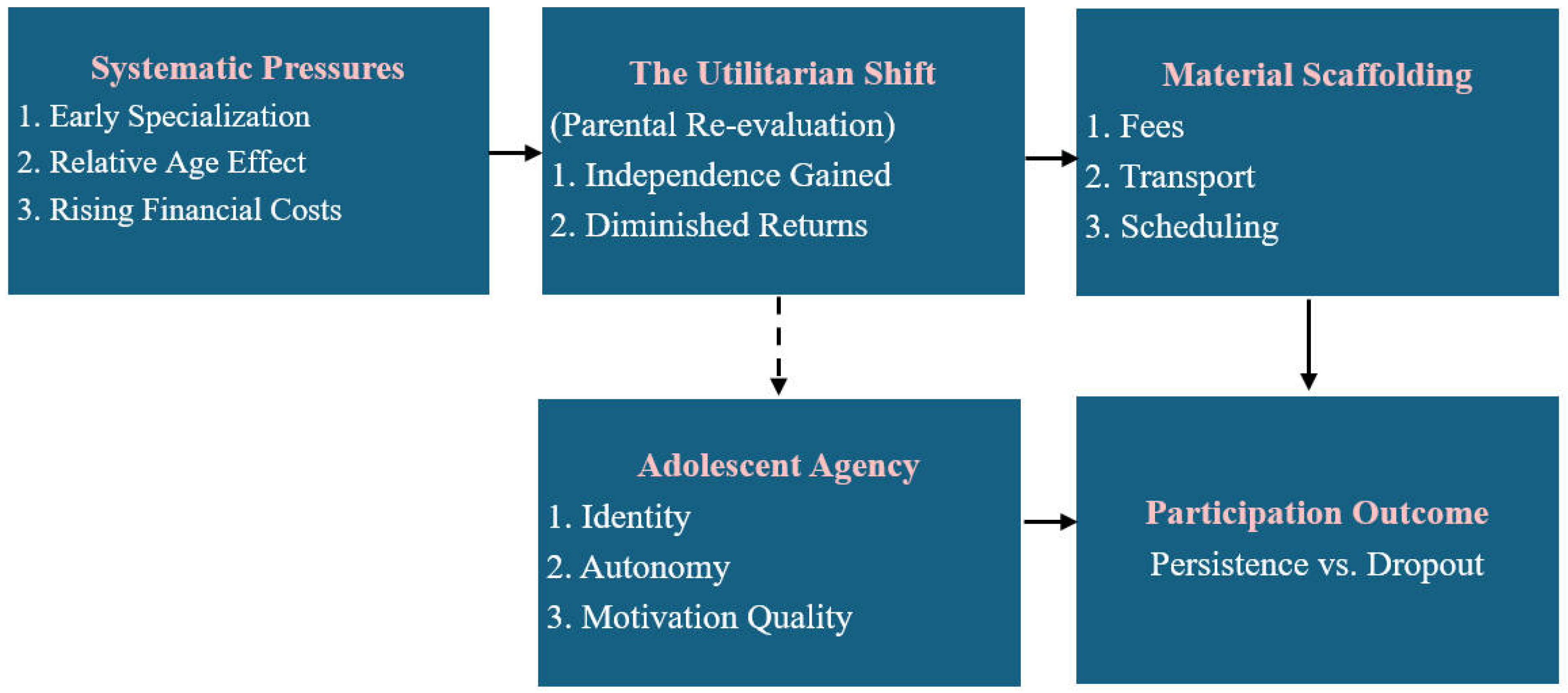
Figure 1 illustrates this interaction between developmental change, parental investment recalibration, and sport-system demands. During childhood, parental involvement is sustained by custodial necessity and broad developmental value. As adolescence unfolds, these justifications weaken, while structural costs and performance pressures intensify. Together, declining perceived returns and rising demands prompt a shift from assumed support to conditional investment. This recalibration reduces the logistical and material scaffolding that enables participation, limiting adolescents’ capacity to persist even when motivation remains intact. Early adolescent sport dropout thus reflects the convergence of developmental timing, parental rationality, and system-level pressures rather than a single causal factor.
5. Social, Embodied, and Cultural Moderators of the Utilitarian Shift
The Utilitarian Shift does not operate uniformly across adolescents or families, but is shaped by social, embodied, and cultural conditions that moderate how parental investment in youth sport is evaluated during early adolescence. Empirical research indicates that gender, biological maturation, household socioeconomic status (SES), and culturally patterned expectations regarding education and social mobility are associated with differential sport participation and discontinuation trajectories during this period [
57]. Gender and physical maturation are particularly salient moderators of perceived return on parental investment. Early adolescence is characterized by substantial variability in pubertal timing, producing visible performance differentials that are not reducible to effort or skill. Longitudinal evidence links pubertal timing and relative age to increased likelihood of sport discontinuation, underscoring the role of embodied developmental processes in shaping continuation trajectories [
58]. In organized sport systems that privilege early physical precocity, early maturation, especially in strength-, speed-, or size-dependent sports, may sustain parental investment, whereas later-maturing adolescents may encounter earlier recalibration of support. These dynamics are further shaped by gendered sport norms, as girls consistently show steeper declines in sport participation during adolescence than boys [
59].
Household SES further moderates the Utilitarian Shift by shaping families’ capacity to sustain investment under conditions of uncertain return. Population-based studies indicate that adolescents from higher-SES households are more likely to remain engaged in organized sport, while lower-SES youth are disproportionately represented among those who discontinue participation during adolescence [
25]. This pattern reflects differential tolerance for prolonged investment amid ambiguous payoff rather than differences in the perceived value of sport itself. SES thus conditions not only access to sport, but the temporal threshold at which continued participation remains feasible. Cultural logics surrounding education, sport, and social mobility further structure parental investment decisions. In contexts where academic achievement is viewed as the primary route to social advancement, sport participation may be framed as instrumental and provisional, becoming increasingly difficult to justify as educational demands intensify. Conversely, where sport is perceived as a viable pathway to social or familial mobility, parental investment may be sustained longer despite uncertain performance outcomes. These culturally embedded rationalities shape whether utilitarian recalibration is accelerated, delayed, or attenuated.
6. Conceptual and Methodological Pathways for Operationalization
Although the present article is conceptual in nature, the framework lends itself to clear empirical operationalization across multiple methodological approaches. The Utilitarian Shift is not proposed as a metaphor, but as a theoretically grounded process that can be examined, measured, and tested across developmental and cultural contexts [
60]. Qualitative approaches provide a primary pathway for examining parental recalibration of sport investment. In-depth interviews with parents and early adolescents can explore how perceived developmental returns, custodial utility, and future-oriented expectations evolve during the transition into adolescence [
60,
61]. Longitudinal qualitative designs, such as repeated interviews or reflective diaries, are particularly well suited to capturing the temporal unfolding of utilitarian recalibration and its interaction with adolescents’ motivational and identity processes [
60]. Focus groups may further illuminate shared parental norms and cultural logic surrounding continued or withdrawn investment in youth sport [
61].
Observational and longitudinal designs offer complementary opportunities to examine the structural conditions associated with the Utilitarian Shift. Prospective cohort studies tracking families across early adolescence could assess changes in parental logistical and financial support alongside adolescents’ participation trajectories and system-level transitions. Such designs would allow testing of the framework’s central temporal claims by examining whether parental withdrawal precedes, coincides with, or follows changes in adolescent motivation [
62]. Psychometric and survey-based approaches represent an additional avenue for large-scale testing. The development of validated measures assessing conditional parental investment, perceived return on investment, and adolescents’ awareness of family-level costs would enable examination of these constructs as moderators or mediators of established predictors of dropout, such as burnout, motivation quality, or perceived competence [
63,
64]. This approach allows the Utilitarian Shift to be empirically distinguished from barrier-facilitator models by positioning parental recalibration as an upstream structural process rather than a downstream correlate [
24]. Finally, cross-cultural and comparative studies are essential for identifying boundary conditions. Analyses across contexts that vary in parenting norms, sport system organization, and the symbolic value of sport can clarify when utilitarian recalibration is accelerated, delayed, or attenuated [
62]. Together, these methodological pathways position the Utilitarian Shift as a testable and scalable framework with clear implications for future empirical research.
7. Theoretical Implications: Beyond the Individual Athlete
Much of the existing literature on youth sport dropout has been organized around barrier-facilitator frameworks, which identify psychological, social, and structural factors that either promote or impede continued participation [
53]. While these models have been instrumental in mapping correlates of dropout, they are largely descriptive and additive in nature, implicitly treating parental logistical and financial support as a stable background condition rather than a dynamic component of the participation process. The present framework departs from this tradition by shifting the analytic focus away from the accumulation of barriers toward a relational, process-oriented mechanism through which the material conditions of participation are reconfigured during early adolescence. Rather than asking which factors obstruct persistence, the Utilitarian Shift examines how and why parental investment itself becomes conditional, thereby reshaping adolescents’ capacity to remain engaged irrespective of motivation or effort.
The present framework contributes to the literature on youth sport dropout by challenging the implicit assumption of parental constancy that underlies much athlete-centered research. While prior scholarship has provided detailed accounts of adolescents’ motivational trajectories, identity development, and vulnerability to burnout, it has largely treated parental logistical and financial support as a stable background condition rather than a dynamic variable. By introducing the Utilitarian Shift, this article reconceptualizes parental support as contingent, developmentally timed, and responsive to changing family-level cost–benefit calculations. This reconceptualization enables a micro–macro integration that bridges psychological processes within the adolescent and structural conditions external to them. Psychological outcomes such as amotivation, burnout, or disengagement are reframed as downstream consequences of upstream reallocations of family resources, rather than as isolated intrapsychic failures. In this sense, the framework relocates the origin of dropout from the individual athlete alone to the relational interface between adolescent agency and family-level rationality, embedded within broader sport system demands.
Importantly, this model does not negate adolescent agencies. On the contrary, it situates agency as conditional and context dependent. Adolescents’ capacity to persist, adapt, or recover from setbacks depends not only on motivational quality or identity coherence, but also on the availability of material and logistical scaffolding that makes persistence possible. Agency without infrastructure becomes symbolic rather than actionable. Dropout, therefore, reflects not a lack of will, but a constrained field of possible action. The Utilitarian Shift also extends social exchange perspectives by relocating the locus of rational calculation from the individual adolescent to the family economy. Whereas traditional applications of social exchange theory conceptualize adolescents as primary decision-makers weighing personal costs and rewards, the present framework highlights how parents act as co-decision-makers whose rationality operates at a different temporal and functional scale. Parental decisions are informed not only by immediate enjoyment or effort, but by long-term developmental priorities, household constraints, and perceived future convertibility of investment.
This shift has implications for how resilience is theorized in youth sport. Rather than treating resilience as an intrinsic character trait, the present framework conceptualizes it as structurally contingent, emerging only when adolescents are afforded sustained opportunities to remain engaged despite non-linear progress or temporary failure. When parental support is withdrawn precisely at moments of stagnation or deselection, for example, when sport participation loses custodial or developmental necessity, the developmental arc required for resilience is prematurely truncated. Dropout thus becomes a rational adaptation to altered structural conditions, rather than a moral or motivational shortcoming. Boundary conditions of the framework must also be acknowledged. The Utilitarian Shift is most readily observable in cultural contexts characterized by individualistic parenting norms, nuclear family structures, and marketized youth sport systems, where parental investment decisions are framed in terms of efficiency, opportunity cost, and future payoff. In more collectivist or family-centric cultural contexts, parental investment may operate according to different logics, such as shared family identity, communal honor, or intergenerational obligation. In such settings, children’s sporting success may be construed as family success, potentially moderating or delaying utilitarian recalibration. Accordingly, the present framework should be interpreted as culturally contingent rather than universally uniform, inviting comparative and cross-cultural research.
Taken together, these theoretical implications reposition early adolescent sport dropout as neither an individual pathology nor a simple failure of motivation. Instead, dropout emerges as a developmentally timed, structurally mediated outcome produced by the interaction of adolescent agency, parental rationality, and sport system demands. By foregrounding parental withdrawal as an upstream structural process, the Utilitarian Shift advances a more relational, realistic, and context-sensitive understanding of disengagement in youth sport.
8. Practical Implications: Restructuring the Value Proposition
Beyond its theoretical contribution, the framework advanced here carries critical practical implications for sport organizations, clubs, and governing bodies. Retention strategies that focus primarily on athlete enjoyment, coach behavior, or motivational climate, while valuable, are unlikely to be sufficient if they fail to address the structural and relational drivers of parental withdrawal during early adolescence. If dropout is partially precipitated by a rational recalibration of parental investment, then effective intervention must target the conditions under which continued parental support remains justifiable.
A central implication of the Utilitarian Shift framework is the need to restructure the value proposition of youth sport for parents during early adolescence. In childhood, parental investment is often justified by custodial necessity and broad developmental benefits. By early adolescence, however, these justifications weaken, and continued investment increasingly requires clear, credible, and communicated value. Sport organizations must therefore move beyond implicit assumptions of parental constancy and explicitly articulate how participation contributes to adolescents’ psychosocial development, identity formation, emotional regulation, and resilience, even in the absence of elite performance trajectories.
This reframing requires acknowledging that parental withdrawal is often a rational choice rather than a failure of commitment. Accordingly, interventions should not moralize disengagement, but instead reduce the costs and risks associated with continued participation. One promising avenue involves the creation of intermediate participation pathways that avoid the binary choice between high-performance commitment and complete withdrawal. Such pathways may include reduced training loads, flexible scheduling, mixed-ability competitive tiers, or hybrid recreational–competitive models that preserve athletic identity without imposing total institutional demands. Financial and logistical considerations are equally central. Lower-cost participation models, shared transportation systems, community-based programs, and school-linked sport initiatives can mitigate the burden that often triggers utilitarian recalibration. By reducing the material and temporal costs of engagement, organizations can sustain parental support long enough for adolescents to navigate periods of stagnation, deselection, or identity exploration without being forced into premature dropout.
Equally important is transparent communication with parents. Organizations should engage parents as partners rather than passive resource providers, clarifying developmental goals, expected trajectories, and realistic outcomes. Explicit acknowledgment that most adolescents will not progress to elite levels, paired with evidence-based claims about the non-performance-related benefits of sustained participation, may help recalibrate parental expectations without prompting withdrawal. Finally, this framework suggests that retention policies should be developmentally timed. Early adolescence represents a particularly vulnerable window during which parental investment is reassessed while system demands intensify. Targeted structural support during this period, rather than uniform interventions across all ages, may yield disproportionate benefits in preventing dropout. Such support might include transition programs, parental guidance resources, or organizational policies that deliberately slow specialization and maintain accessibility.
Taken together, these implications underscore a fundamental shift in how youth sport retention should be conceptualized. Sustaining participation in early adolescence requires retaining parents as much as retaining athletes. By redesigning participation pathways, reducing burdens, and explicitly addressing parental rationality, sport systems can better align developmental goals with family realities, thereby transforming dropout from an inevitable outcome into a preventable one.
9. Limitations and Conceptual Boundaries
This framework has several limitations. First, the Utilitarian Shift is presented as a conceptual model rather than an empirically validated causal explanation. Although informed by existing developmental, sociological, and sport participation research, its propositions require empirical testing, particularly through longitudinal and qualitative designs. Second, the framework is most relevant to marketized youth sport systems marked by high costs, early specialization, and strong parental involvement. Its applicability may be reduced in school-based, publicly funded, or welfare-integrated sport contexts, and may vary across cultures with different parenting norms and meanings attributed to sport. Third, the analysis focuses on organized and competitive sport, without addressing informal or self-organized physical activity. Withdrawal from organized sport does not necessarily imply disengagement from movement, and future research should examine how parental investment dynamics operate across different activity contexts. Finally, while the framework highlights parental rationality and resource allocation, it does not assume fully conscious or economically deterministic decision-making. Emotional, moral, and cultural factors may shape or counter utilitarian considerations, underscoring the need for empirical work that integrates these processes.
10. Conclusions
This conceptual article set out to reframe early adolescent sport dropout by shifting analytical attention away from the individual athlete alone and toward the relational and structural conditions that sustain or undermine continued participation. While prior scholarship has generated rich psychological and sociological explanations for why adolescents disengage from organized sport, these accounts have largely assumed the continued availability of parental logistical and financial support as a stable background condition. The present analysis challenges that assumption by introducing the concept of the Utilitarian Shift in parental investment. The Utilitarian Shift highlights how parental support during early adolescence becomes conditional rather than automatic, shaped by declining custodial utility, diminishing perceived developmental returns, escalating costs, and increasing system demands. Dropout is therefore reframed not as a sudden individual decision or a simple loss of motivation, but as the predictable outcome of a developmental and relational recalibration within the family unit. Importantly, parental withdrawal is not positioned as emotional disengagement or parenting failure, but as a rational reallocation of finite family resources under changing conditions.
Crucially, this framework avoids deterministic interpretations. Parental withdrawal does not mechanically cause dropout. Instead, it reshapes the structural conditions under which adolescents can enact motivation, agency, and resilience. When the material infrastructure required for participation, transportation, fees, scheduling coordination, is weakened or removed, adolescents may be unable to persist even when desire or commitment remains. Dropout thus emerges from the interaction between parental recalibration of support and adolescents’ motivational, identity-based, and practical responses, rather than from either process in isolation. By foregrounding parental decision-making, the Utilitarian Shift also reframes dominant narratives around resilience in youth sport. Rather than treating resilience as an intrinsic personal trait, the present analysis conceptualizes it as structurally contingent, requiring sustained opportunities to remain engaged through periods of stagnation, non-selection, or developmental mismatch. When parental support is withdrawn precisely at these moments, when sport participation no longer appears essential for safety or development, the conditions necessary for resilience are prematurely foreclosed. In this sense, dropout reflects not a lack of grit, but the collapse of an external enabling infrastructure.
The framework further underscores the importance of developmental timing. Early adolescence represents a critical convergence point at which parental investment is reassessed while sport systems intensify expectations through specialization, performance differentiation, and selection mechanisms such as the Relative Age Effect. This temporal misalignment creates a structural vulnerability window in which dropout becomes disproportionately likely, particularly for adolescents without clear elite trajectories. Finally, the cultural specificity of the Utilitarian Shift must be acknowledged. The model is most directly applicable within individualistic, market-oriented youth sport systems, where parental investment is framed in terms of efficiency, opportunity cost, and future payoff. In more collectivist or family-centric contexts, different logics of investment may prevail. Recognizing these boundary conditions not only strengthens the theoretical defensibility of the framework but also points toward important directions for cross-cultural and comparative research.
In conclusion, this article advances a relational and structurally grounded understanding of early adolescent sport dropout. By positioning parental withdrawal as an upstream mechanism rather than a downstream reaction, the Utilitarian Shift invites scholars, practitioners, and policymakers to rethink where responsibility for dropout resides and how prevention efforts should be targeted. Future efforts to sustain participation during early adolescence must therefore prioritize the retention of parents as structural enablers alongside the retention of athletes themselves, aligning youth sport systems more closely with developmental realities and family life.