


Abstract
This article examines the implementation of a cooperative training workshop for Spanish undergraduate social educators. The workshop aimed to explore the integration of escape rooms and breakouts in teaching, specifically addressing cyberbullying as a curricular topic. A total of 40 students participated in designing and qualitatively evaluating the training workshop. The findings highlight the workshop’s effectiveness in enhancing social education students’ training, preparing them for future professional careers, and enhancing their learning, teamwork, and proficiency in utilising ICT programs and resources. The study underscores the significance of incorporating these innovative approaches to improve student motivation, interest, and overall skill development.
1. Introduction
The incorporation of the Internet into people’s daily lives has been a fundamental element in its evolution [1]. Internet use can also improve certain abilities and skills, such as memory, fluid intelligence, and other cognitive functions [2]. The ability to search and access information online has improved users’ research and analytical skills, and the constant flow of information has stimulated their long-term learning and memory capacity [3,4]. The Internet and social media have created new forms of communication and socialisation that were not possible before, allowing children to develop more advanced social and communication skills [5].
However, the emergence of new technologies has led to an increase in the incidence of cyberbullying [6]. The prevalence of bullying and cyberbullying is high in the school population, and there is a trend towards an early onset of these phenomena [7]. Moreover, school institutions often lack resources and effective strategies to address these problems [8].
In this sense, although cyberbullying is perpetrated through electronic technologies and devices, it has been found that these same devices can also become, through appropriate video games, prevention tools that address both the problem of cyberbullying and bullying [9]. Previous studies have shown that serious games are effective as educational tools, as they are highly motivating and capable of raising awareness, teaching knowledge, modifying behaviour, and even improving skills [10]. Some research points to the effectiveness of serious games in improving bystanders’ helping behaviours in bullying situations by using a multi-method approach [11], such as the School of Empathy Game, a video game in which players start in the role of a victim.
Although there are numerous studies related to game-based learning [12,13], how to use these findings in teaching practices requires more research and scrutiny. For this reason, gamified interventions are beginning to be implemented in social education to complement actions outside and inside the classroom [14]. These interventions are based on the idea that the inclusion of playful elements in the teaching process can improve the motivation and interest of participants, which in turn can lead to better learning [15]. For these reasons, it is important for social educators to have a solid background in playful strategies to be able to integrate this technique effectively into their teaching and maximise its benefits for their students [16]. Training will also enable them to better understand how to apply games in a social and educational context and how to adapt them to meet the individual needs of students [17].
The use of gamification and games in education has become a topic of increasing interest in recent years [18]. Several studies have shown that incorporating playful elements in the teaching process can improve students’ motivation and interest, which in turn can lead to better learning [19]; other studies use gamification or “serious games” for the prevention and detection of bullying or cyberbullying [20]. One of the primary criticisms of gamification could be the possibility of pointsification, which involves creating a points system to encourage participants to complete actions, potentially resulting in participants exclusively focusing on activities to earn those points (appealing to external motivation) [21]. This concern stems from the notion that this kind of motivation might diminish the authenticity of participation, shifting the emphasis towards obtaining rewards rather than the content or experience itself. Moreover, critics also contend that gamification can oversimplify tasks and processes, reducing them to basic game elements. This oversimplification could potentially underestimate the abilities and discernment of participants while downplaying the inherent complexity of many activities [22].
However, it is essential to note that gamification encompasses a broader scope than the PBL (Points–Badges–Leaderboards) framework, aiming to create an engaging and game-like experience for participants [23]. This implies that gamification extends beyond mere surface-level incentives such as points or badges, striving to transform the overall experience into an immersive and enjoyable endeavour where participants actively participate in the design and development of the activity.
For this reason, to close the gap between academic research and teaching practices, a qualitative quasi-experimental study has been carried out on the implementation of a cooperative training workshop on educational breakouts in the university degree in social education. The main research objective was to design and qualitatively evaluate a training project based on breakouts and cooperative learning to work on social education curricular content. The research questions posed were as follows: (1) What are the students’ previous opinions about the use of games and/or gamification in the classroom or in their profession? (2) What do the students consider beneficial when applying an educational breakout workshop? (3) Do the students perceive disadvantages or possible improvements when applying an educational breakout workshop?
2. Materials and Methods
2.1. Participants
A convenience sample was chosen to select the participants. The inclusion criterion for the experimental group was the willingness to participate in the training workshop organised by one of the main researchers. A total of 40 social education students (33 females and 7 males, aged between 19 and 27 years, with an average age of 20.4 years) participated in the workshop and voluntarily answered the online survey of open-ended questions.
All participants received information about the project and gave written informed consent in accordance with the Declaration of Helsinki. Prior to data collection, students were informed of the nature of the study and guaranteed anonymity. This study is part of the Teaching Innovation Group “EDU-INNO”, approved by the University of Vigo.
2.2. Procedure
In this study, an innovative educational workshop was implemented through the creation of educational breakouts in the subject “Social Skills in Social Education” of the degree in Social Education at the University of Vigo during the academic year 2022/2023. The main objective of this subject is the acquisition of social skills to develop professional practice, and within the curricular content are the subjects of bullying and cyberbullying. Before starting the workshop, participants were informed about the activity to be carried out. While the activity was mandatory due to being a planned part of the subject, participation in the research aspect was voluntary (without adding to or subtracting from the final grade for the subject).
The workshop lasted for two and a half hours in a single session. In a session prior to the workshop, the course instructor introduced theoretical aspects of harassment and cyberbullying. This was intended to provide students with a basic understanding of the topics to be addressed in the workshop and to avoid using workshop time for theoretical content that could be covered outside of this workshop. However, theoretical and practical content on escape rooms and breakouts was covered in the workshop, allowing students to experience these methodologies in situ (See Figure 1).
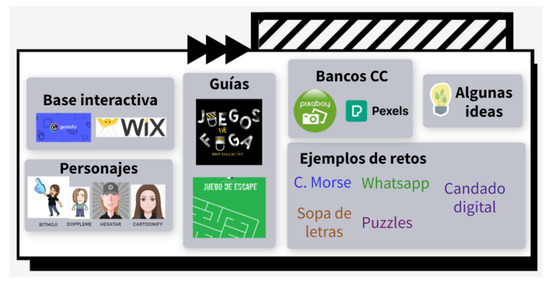
Figure 1.
Screenshot with some of the tools taught in the course.
After answering questions about the general operation, the 40 students were divided into teams of 4–6 students and presented with two case studies based on real issues facing adolescents today [24]. These cases were inspired by real-life situations and were modified to make them easy to comprehend, highlighting key elements of harassment or cyberbullying based on each case.
After offering a comprehensive overview of the workshop’s overarching mechanics, the group of 40 students was thoughtfully divided into teams comprising 4–6 members each. Subsequently, these teams were presented with two meticulously designed case studies, rooted in genuine challenges faced by contemporary adolescents [24]. Crafted to resonate with real-life scenarios while adapted for enhanced clarity, these case studies artfully illuminated the pivotal aspects of harassment and cyberbullying inherent to each situation.
Upon selecting a specific case, each team of students was allocated a designated timeframe to design an educational breakout. In this endeavour, the instructor played the role of a guide and collaborator, prepared to offer direction and address inquiries that emerged during the design process. The activities devised were aimed at creating ludic challenges that would culminate in the successful completion of a breakout (for instance, a quiz on cyberbullying using platforms like Quizziz or character creation to foster sensitivity). These activities adeptly integrated elements of sensitisation and intricate challenges that mirrored the very struggles individuals might encounter in their daily lives while grappling with harassment or cyberbullying.
The workshop’s methodological approach was grounded in cooperation, fostering an environment of synergy and collaboration among the participants. This was exemplified by a range of interactive group dynamics and cohesion exercises, fostering engagement and teamwork. This cooperative spirit was further bolstered by the strategic assignment of roles within the groups, ensuring that each member’s involvement was not only valued but also vital to the group’s collective progress. To enhance group cohesion, students considered incorporating various dynamic activities. The Interest Map exercise involves providing participants with blank paper and coloured markers to create visual representations of their interests, hobbies, goals, and more, allowing mutual understanding to flourish through shared insights. Alternatively, the Two Truths and a Lie game invites individuals to share two genuine facts and one false statement about themselves, fostering interaction as the group works together to decipher the fabrication. These activities not only inject fun but also cultivate a deeper sense of connection among participants. Furthermore, as part of the teacher’s role, it is essential to ensure that all team members feel confident to express their opinions among their peers.
Regarding the utilisation of Information and Communication Technology (ICT), the workshop sought to embrace modern tools to enrich the learning process. ICT are ubiquitous tools in today’s society and the working environment, so equipping students with skills in this field provides them with a competitive advantage in the job market. Moreover, designing escape rooms with ICT involves aspects such as creating digital content, solving technological problems, and fostering creativity in interactive experience design, thereby developing valuable transferable skills. In this workshop, emphasis was placed on the use of tools like Genially, Wix, avatar platforms, and other relevant websites.
Upon the successful culmination of the designed activity, participants were invited to partake in a reflective exercise via a questionnaire. The survey, lasting approximately ten minutes, invited them to contemplate the implications of the conducted activity on their prospective professional trajectories. This process provided an avenue for valuable introspection and forward-looking consideration.
2.3. Instruments and Data Analysis
After the training workshop, students were asked to voluntarily respond to an online qualitative questionnaire with open-ended questions [25]. An ad hoc questionnaire with open-ended questions was designed, using the MyForms platform, to elicit students’ opinions about their experience in the workshop. This format respected anonymity so that students could freely express their opinions.
An online survey of open-ended questions was proposed for students to answer voluntarily after the breakout training workshop. Data analysis was carried out using categorical content analysis [26]. As the survey was online, the transcription was automatic and used the ATLAS.ti software for Mac (version 9, ATLAS.ti Scientific Software Development GmbH, Berlin, Germany). A detailed analysis of the categories was carried out with labels. Related codes were grouped into sub-themes, and overlapping sub-themes were grouped together. After the individual analysis, they pooled the codes, and in case of disagreement, a third researcher was involved.
3. Results
The analysis of student opinions reflected in the survey showed the following categories and subcategories (see Table 1, Table 2, Table 3, Table 4 and Table 5).

Table 1.
Category 1: Negative preconception of video games.
Table 2.
Category 2: Cooperative learning.
Table 3.
Category 3: Dynamic learning.
Table 4.
Category 4: Tasks of the teacher.
Table 5.
Category 5: Possible improvements.
In relation to the first research question, although there is scientific evidence of the engagement and motivation capacity that games and gamification provide for university students (e.g., [27,28]), it has been observed that at least 25% of the students interviewed had prejudices about the usefulness or fun that games in general, and breakouts and escape rooms in particular, could produce. These negative prejudices can be related to misinformation and infoxication about gamification and games, relating them to wasting time or even that they are harmful [29,30]. Ref. [31] found these types of prejudices in more adult people, observing that they were reduced in younger people; however, our results show that it is still necessary to train young people who will work in socio-community intervention in this didactic tool to banish these prejudices.
A social educator must be able to face the challenges of their work in a cooperative and interdisciplinary manner [32]; therefore, their professional competencies must include abilities related to the expression of opinions and feelings and social skills related to interpersonal skills [33]. These results coincide with previous studies that evaluated teamwork and social skills after the application of play resources [34].
Another aspect that stands out in the students’ accounts is that this activity has allowed them to get to know their classmates better, indicating that this type of methodology leaves room for students to relate to each other, and, therefore, its continued use could favour a more positive classroom climate in higher education, as observed in recent research on secondary education [35].
In addition to providing a solid theoretical knowledge base, university degrees should reflect practical skills. Playful strategies such as gamification and educational escape rooms aim to foster an attitude of commitment to learning in students [36,37], which consequently leads to greater learning [38]. The results of our study are in line with this argument, since, as can be seen in the categories obtained, the students perceive that this workshop has been useful in their professional training, offering them both another perspective to work on class content, in this case, bullying and cyberbullying, and to learn about ICT resources in a practical way.
The role of the teacher has not been extensively studied in previous studies on gamification, which have focused on the impact on the students. In this study, it has not been considered a key variable in the workshop performance; however, in the student discourse, it has been a constant, so it was added as a main category. Most of the students interviewed mentioned that the teaching role has been key to the success of their gamified projects. [39] reflects on the teaching role in gamified practices, mentioning the need to move university teaching practice from the expository model to a more dynamic activity and student reflection. In this model, the teacher should facilitate reflection on what they are learning, using gamification as a didactic resource with possibilities in the metacognitive, cooperative, and reflective areas. In the present study, the students highlighted that for them to feel capable of designing an educational breakout, the teacher must show a series of qualities. Firstly, the frequent and constructive use of feedback encourages students to continue the task [40]. In the case of games, feedback is widely used, as there are different dynamics and mechanics of feedback and progression that can be employed in gamified systems [41]. The second most frequently mentioned quality was flexibility. The aim of this training workshop was for the students to know how to carry out an educational breakout for socio-community intervention and work against bullying, for which the didactic decision was taken to create two closed cases, but with open resolution solutions, so that each team could feel greater autonomy and creativity for their resolution. And finally, the students have valued that the teaching team is the one that offers different ICT resources so that they can explore and deepen them, also mentioned as part of their learning.
Finally, in relation to the third research question, as with any educational project, there is some room for improvement perceived by the pupils. Students agree that it would have been beneficial to have more sessions to design the educational breakout. In future implementations, we will leave at least three practical sessions for this work. They also mention that they would have enjoyed experimenting with an escape room beforehand before they were faced with designing one. This fact is also reported in the workshop, and in the following editions, students will experience at least one escape room in teams, either face-to-face [42] or digital [43], so that they can be familiar when they are challenged to design their own.
4. Discussion
The aim of this research was to elaborate and qualitatively evaluate a training plan based on the breakout strategy and cooperative learning, addressing the curricular contents of social education. This objective is based on the need to promote motivational methodologies for university students, so that they can perceive cooperative learning as an enhancer of creativity [44,45,46].
The results show that there are five main categories following the implementation of the educational breakout workshop. Each category focuses on key aspects of the process of implementation and evaluation of the training plan based on the breakout strategy and cooperative learning to address the curricular contents of the social education subject.
In this sense, in the field of higher education, the need has been identified to provide practical content that allows students to acquire specific skills and competencies for their future professional work [47]. It is also essential to evaluate the effectiveness of didactic tools such as simulations to ensure that students feel prepared and motivated to face the challenges of their professional performance [48].
It has been observed that with gamification as an educational and methodological strategy, greater cooperative learning, greater engagement, and greater motivation have been achieved, coinciding with the studies by [36,49]. It is highlighted that the application of a methodological design that presents achievable challenges for students and in which the teacher assumes a guiding role in the learning process, providing feedback in each session, can constitute crucial elements to foster flow in the context of university students [27].
Although the results suggest promising advancements in the use of gamification techniques in the training of social education professionals, certain limitations are identified. Firstly, the present study is affected by a relatively small sample size, which hinders the generalisation of the findings. Therefore, future research could involve a larger participant sample and, additionally, examine potential differences depending on whether students are pursuing a bachelor’s or master’s degree. Another limitation is linked to the method of sample selection, as due to data collection in a natural classroom setting, it was not feasible to analyse the sample based on the participants’ gender or age. Lastly, this research did not quantitatively measure cooperation ability before and after; thus, statistical improvement in this capacity cannot be confirmed, even though the students’ perception of cooperative learning and the engaging and motivating capacity of the breakout workshop was highly positive. Future research could focus on longitudinal studies on gamification, including a combined analysis with other variables such as academic performance or classroom environment.
5. Conclusions
The training of future social education professionals is essential to prevent and address situations of cyberbullying [50]. In this sense, educational breakouts have become a useful tool for training in digital competencies, specifically in issues related to cyberbullying, which is why their teaching in initial training may be of interest to students pursuing a bachelor’s degree in social education. In addition, gamification enables the learning of relevant content in a motivating way for students through the design of various games that they can use in their future professional performance.
Author Contributions
Conceptualisation, methodology, analysis, writing, A.M.-L. and P.R.-R.; Review and editing, J.M.R.-F.; visualisation, M.D.D.C. All authors have read and agreed to the published version of the manuscript.
Funding
This research received no external funding.
Institutional Review Board Statement
This study is part of the Teaching Innovation Group “EDU-INNO”, approved by the University of Vigo.
Informed Consent Statement
All participants received information about the project and gave written informed consent in accordance with the Declaration of Helsinki. Prior to data collection, students were informed of the nature of the study and guaranteed anonymity.
Data Availability Statement
Data are available at the request of the corresponding author.
Conflicts of Interest
The authors declare no conflict of interest.
References
- Rodríguez Rivera, P. What do women do on the internet: An analysis of internet use among adolescents in Galicia. J. Fem. Gend. Women Stud. 2022, 1, 36–51. [Google Scholar] [CrossRef]
- Hedman, A.; Lindqvist, E.; Nygård, L. How older adults with mild cognitive impairment relate to technology as part of present and future everyday life: A qualitative study. BMC Geriatr. 2016, 16, 73. [Google Scholar] [CrossRef] [PubMed]
- Hayes, B.; James, A.; Barn, R.; Watling, D. Children’s risk and benefit behaviours on social networking sites. Comput. Hum. Behav. 2022, 130, 107147. [Google Scholar] [CrossRef]
- Small, G.W.; Lee, J.; Kaufman, A.; Jalil, J.; Siddarth, P.; Gaddipati, H.; Moody, T.D.; Bookheimer, S.Y. Brain health consequences of digital technology use. Dialog-Clin. Neurosci. 2020, 22, 179–187. [Google Scholar] [CrossRef] [PubMed]
- Özer, D.; Altun, Ö.Ş.; Avşar, G. Investigation of the relationship between internet addiction, communication skills and difficulties in emotion regulation in nursing students. Arch. Psychiatr. Nurs. 2022, 42, 18–24. [Google Scholar] [CrossRef]
- Krešić Ćorić, M.; Kaštelan, A. Bullying through the Internet-Cyberbullying. Psychiatr. Danub. 2020, 32 (Suppl. S2), 269–272. [Google Scholar]
- Mertens, E.; Deković, M.; Leijten, P.; Van Londen, M.; Reitz, E. Components of School-Based Interventions Stimulating Students’ Intrapersonal and Interpersonal Domains: A Meta-analysis. Clin. Child Fam. Psychol. Rev. 2020, 23, 605–631. [Google Scholar] [CrossRef]
- Monelos, E.; Mendiri, P.; García-Fuentes, C.D. Bullying: Theoretical review, instruments and intervention programs. J. Stud. Res. Psychol. Educ. 2015, 2, 74–78. [Google Scholar] [CrossRef][Green Version]
- Calvo-Morata, A.; Alonso-Fernández, C.; Freire, M.; Martínez-Ortiz, I.; Fernández-Manjón, B. Serious games to prevent and detect bullying and cyberbullying: A systematic serious games and literature review. Comput. Educ. 2020, 157, 103958. [Google Scholar] [CrossRef]
- Calderón, A.; Ruiz, M. A systematic literature review on serious games evaluation: An application to software project management. Comput. Educ. 2015, 87, 396–422. [Google Scholar] [CrossRef]
- Kolić-Vehovec, S.; Smojver-Ažić, S.; Martinac Dorčić, T.; Rončević Zubković, B. Evaluation of serious game for changing students’ behaviour in bullying situation. J. Comput. Assist. Learn. 2019, 35, 39–48. [Google Scholar] [CrossRef]
- Byusa, E.; Kampire, E.; Mwesigye, A.R. Game-based learning approach on students’ motivation and understanding of chemistry concepts: A systematic review of literature. Heliyon 2022, 8, e09541. [Google Scholar] [CrossRef] [PubMed]
- Chen, U.-C.; Hou, H.-T. Design and Development of a Scaffolding-Based Mindtool for Gamified Learning Classrooms. J. Educ. Comput. Res. 2022, 61, 1–24. [Google Scholar] [CrossRef]
- Manzano-León, A.; Rodríguez-Ferrer, J.M.; Aguilar-Parra, J.M.; Salavera, C. The Legends of Elendor: Educational Gamification as an Influential Factor in Academic Flow and Academic Performance in Socially Depressed Communities. Educ. Sci. 2022, 13, 8. [Google Scholar] [CrossRef]
- Ouariachi, T.; Li, C.-Y.; Elving, W.J.L. Gamification Approaches for Education and Engagement on Pro-Environmental Behaviors: Searching for Best Practices. Sustainability 2020, 12, 4565. [Google Scholar] [CrossRef]
- Boyle, E.A.; Hainey, T.; Connolly, T.M.; Gray, G.; Earp, J.; Ott, M.; Lim, T.; Ninaus, M.; Ribeiro, C.; Pereira, J. An update to the systematic literature review of empirical evidence of the impacts and outcomes of computer games and serious games. Comput. Educ. 2016, 94, 178–192. [Google Scholar] [CrossRef]
- Castañeda-Vázquez, C.; Espejo-Garcés, T.; Zurita-Ortega, F.; Fernández-Revelles, A. The training of future teachers through gamification, tic and continuous assessment. Sport TK-Revista Euroam. Cienc. Deport. 2019, 8, 55–63. [Google Scholar] [CrossRef]
- Parra-González, M.E.; Segura-Robles, A. Scientific production on gamification in education: A scientometric analysis. Rev. Educ. 2019, 386, 113–135. [Google Scholar]
- Montero Mahecha, L. Los juegos libres, estrategia para mejorar el aprendizaje de lenguaje en básica secundaria. Zona Prox. 2022, 36, 114–137. [Google Scholar] [CrossRef]
- Ferreira, P.C.; Simão, A.M.V.; Paiva, A.; Martinho, C.; Prada, R.; Rocha, J. Serious Game-based Psychosocial Intervention to Foster Prosociality in Cyberbullying Bystanders. Psychosoc. Interv. 2022, 31, 83–96. [Google Scholar] [CrossRef]
- Disalvo, B. Pink Boxes and Chocolate-dipped Broccoli: Bad Game Design Providing Justifications for Reluctant Learners. In Proceedings of the 11th Conference of Games+Learning+Society Conference, Madison, WI, USA, 8–10 July 2015. [Google Scholar]
- Hung, A.C.Y. A critique and defense of gamification. J. Interact. Online Learn. 2017, 15, 57–72. [Google Scholar]
- Marczewski, A. Even Ninja Monkeys Like to Play: Unicorn Edition; Gamified UK: Addlestone, UK, 2018. [Google Scholar]
- Luo, X.; Zheng, R.; Xiao, P.; Xie, X.; Liu, Q.; Zhu, K.; Wu, X.; Xiang, Z.; Song, R. Relationship between school bullying and mental health status of adolescent students in China: A nationwide cross-sectional study. Asian J. Psychiatry 2022, 70, 103043. [Google Scholar] [CrossRef] [PubMed]
- Bickman, L.; Rog, D.J. (Eds.) Handbook of Applied Social Research Methods; SAGE Publications: Thousand Oaks, CA, USA, 2009. [Google Scholar]
- Gaber, J. Qualitative Analysis for Planning & Policy: Beyond the Numbers; Routledge: London, UK, 2020. [Google Scholar]
- Alsawaier, R.S. The effect of gamification on motivation and engagement. Int. J. Inf. Learn. Technol. 2018, 35, 56–79. [Google Scholar] [CrossRef]
- Rodriguez-Ferrer, J.M.; Manzano-León, A.; Cangas, A.J.; Aguilar-Parra, J.M. A Web-Based Escape Room to Raise Awareness About Severe Mental Illness Among University Students: Randomized Controlled Trial. JMIR Serious Games 2022, 10, e34222. [Google Scholar] [CrossRef] [PubMed]
- Núñez-Pacheco, R.; Barreda-Parra, A.; Guillén-Chávez, E.P.; Aguaded, I. Use of Videogames and Knowledge of Gamification in University Students. In Proceedings of the Ninth International Conference on Technological Ecosystems for Enhancing Multiculturality (TEEM’21), Barcelona, Spain, 26–29 October 2021; pp. 145–149. [Google Scholar]
- Thibault, M.; Hamari, J. Seven Points to Reappropriate Gamification. In Transforming Society and Organizations through Gamification; Spanellis, A., Harviainen, J.T., Eds.; Palgrave Macmillan: Cham, Switzerland, 2021. [Google Scholar] [CrossRef]
- Haasio, A.; Madge, O.L. Gamification and games in the libraries. In Proceedings of the 16th International Scientific Conference eLearning and Software for Education, Bucharest, Romania, 23–24 April 2020; pp. 98–103. [Google Scholar] [CrossRef]
- Martínez-Ortero, V. Social pedagogy and social education. Rev. Educ. Em Questão 2021, 59, 1–22. [Google Scholar] [CrossRef]
- López-Arias, J.M.; Rodríguez-Esteban, A. Competencias socioemocionales de los educadores sociales. Rev. Educ. 2022, 58, 535–550. [Google Scholar] [CrossRef]
- Nurtanto, M.; Kholifah, N.; Ahdhianto, E.; Samsudin, A.; Isnantyo, F.D. A Review of Gamification Impact on Student Behavioural and Learning Outcomes. Int. J. Interact. Mob. Technol. (iJIM) 2021, 15, 22–36. [Google Scholar] [CrossRef]
- Manzano-León, A.; Rodríguez-Ferrer, J.M.; Aguilar-Parra, J.M. Gamification in Science Education: Challenging Disengagement in Socially Deprived Communities. J. Chem. Educ. 2022, 100, 170–177. [Google Scholar] [CrossRef]
- Chans, G.M.; Castro, M.P. Gamification as a Strategy to Increase Motivation and Engagement in Higher Education Chemistry Students. Computers 2021, 10, 132. [Google Scholar] [CrossRef]
- Jayawardena, N.S.; Ross, M.; Quach, S.; Behl, A.; Gupta, M.; Lang, L.D. Effective Online Engagement Strategies through Gamification: A Systematic Literature Review and a Future Research Agenda. J. Glob. Inf. Manag. (JGIM) 2022, 30, 1–25. [Google Scholar] [CrossRef]
- Zainuddin, Z.; Chu, S.K.W.; Shujahat, M.; Perera, C.J. The impact of gamification on learning and instruction: A systematic review of empirical evidence. Educ. Res. Rev. 2020, 30, 100326. [Google Scholar] [CrossRef]
- Oliva, H.A. Gamification as a methodological strategy in the university educational context. Rev. Reflexión Y Real. 2016, 44, 29–47. [Google Scholar]
- Winstone, N.; Carless, D. Designing Effective Feedback Processes in Higher Education: A Learning-Focused Approach; Routledge: London, UK, 2019. [Google Scholar]
- Kapp, K. The Gamification of Learning and Instruction: Game-Based Methods and Strategies for Training and Education; Pfeiffer: Singapore, 2012. [Google Scholar]
- Manzano-León, A.; Rodríguez-Ferrer, J.M.; Aguilar-Parra, J.M.; Martínez, A.M.M.; de la Rosa, A.L.; García, D.S.; Campoy, J.M.F. Escape Rooms as a Learning Strategy for Special Education Master’s Degree Students. Int. J. Environ. Res. Public Health 2021, 18, 7304. [Google Scholar] [CrossRef]
- Neumann, K.L.; Alvarado-Albertorio, F.; Ramírez-Salgado, A. Online Approaches for Implementing a Digital Escape Room with Preservice Teachers. J. Technol. Teach. Educ. 2020, 28, 415–424. [Google Scholar]
- Boytchev, P.; Boytcheva, S. Gamified Evaluation in STEAM for Higher Education: A Case Study. Information 2020, 11, 316. [Google Scholar] [CrossRef]
- Kaufman, D.; Ireland, A. Enhancing Teacher Education with Simulations. TechTrends 2016, 60, 260–267. [Google Scholar] [CrossRef]
- Rooney, D.; Hopwood, N.; Boud, D.; Kelly, M. The Role of Simulation in Pedagogies of Higher Education for the Health Professions: Through a Practice-Based Lens. Vocat. Learn. 2015, 8, 269–285. [Google Scholar] [CrossRef]
- Rodríguez-Ferrer, J.M.; Manzano-León, A.; Aguilar-Parra, J.M. Game-Based Learning and Service-Learning to Teach Inclusive Education in Higher Education. Int. J. Environ. Res. Public Health 2023, 20, 3285. [Google Scholar] [CrossRef]
- Gutiérrez-Puertas, L.; Márquez-Hernández, V.V.; Román-López, P.; Rodríguez-Arrastia, M.J.; Ropero-Padilla, C.; Molina-Torres, G. Escape Rooms as a Clinical Evaluation Method for Nursing Students. Clin. Simul. Nurs. 2020, 49, 73–80. [Google Scholar] [CrossRef]
- Chernikova, O.; Heitzmann, N.; Stadler, M.; Holzberger, D.; Seidel, T.; Fischer, F. Simulation-Based Learning in Higher Education: A Meta-Analysis. Rev. Educ. Res. 2020, 90, 499–541. [Google Scholar] [CrossRef]
- Yosep, I.; Hikmat, R.; Mardhiyah, A. Preventing Cyberbullying and Reducing Its Negative Impact on Students Using E-Parenting: A Scoping Review. Sustainability 2023, 15, 1752. [Google Scholar] [CrossRef]
Disclaimer/Publisher’s Note: The statements, opinions and data contained in all publications are solely those of the individual author(s) and contributor(s) and not of MDPI and/or the editor(s). MDPI and/or the editor(s) disclaim responsibility for any injury to people or property resulting from any ideas, methods, instructions or products referred to in the content. |
© 2023 by the authors. Licensee MDPI, Basel, Switzerland. This article is an open access article distributed under the terms and conditions of the Creative Commons Attribution (CC BY) license (https://creativecommons.org/licenses/by/4.0/).